Corbyn Plots A Marxist Revolution – Could He Win The Election By Accident?

Corbyn Plots A Marxist Revolution – Could He Win The Election By Accident?

Via Strategic Macro blog,

I don’t think Corbyn can win outright. However, with the constituency system of 650 MPs and votes split often three or four ways in each constituency, he could get in via a coalition with the SNP or LibDems. He is currently only 41 MPs behind the Tories. With a Lab/ LibDem/ SNP coalition he only really needs 270-280 seats vs 247 now:

You Guv 9th September voting intentions:
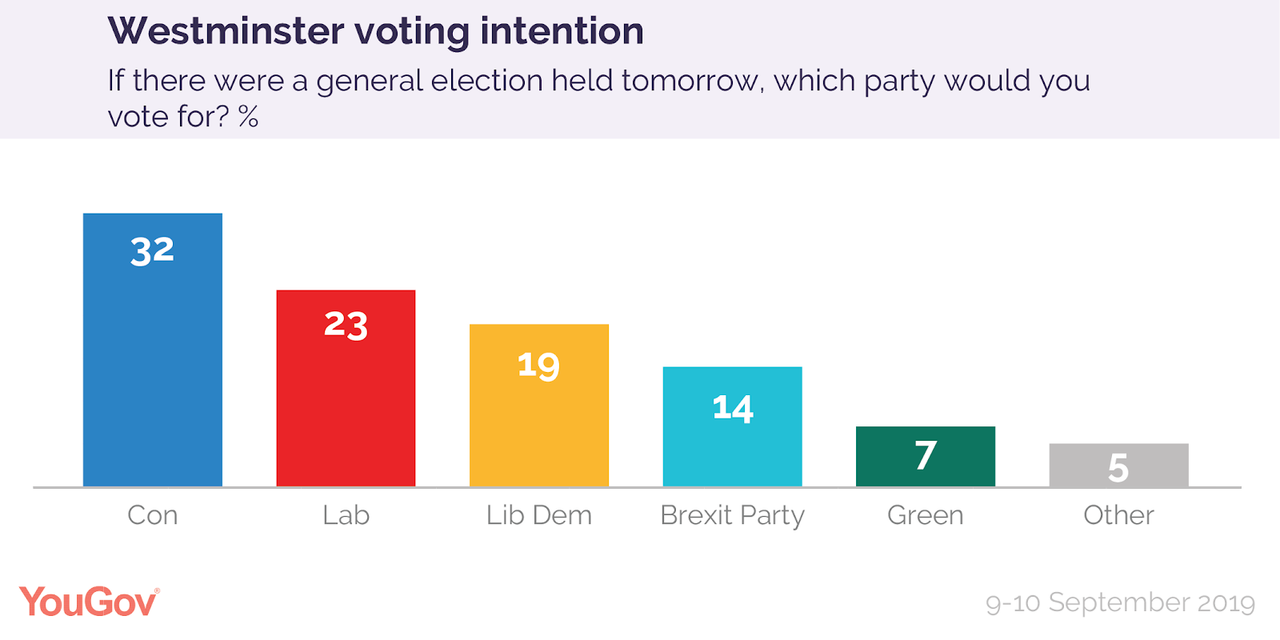
I think a lot of it will resolve to what the Brexit Party does to the Tory vote in Tory marginals vs how many votes Labour lose to the Brexit Party in the northern heartlands. Its unlikely the Brexit Party will win any seats outright.

Farage does not believe the Tory Party will exit the EU by itself, or at least will only exit via the Withdrawal Agreement which leaves the UK closely tied to EU rules, taxes and regulations. If Farage does campaign against them, he risks splitting the leave vote in Tory marginals. This would boost both the Lib Dems and Labour numbers in Parliament. Its unlikely the Brexit Party could cause many Labour marginals to become Tory seats.

Corbyn’s conference speech

The speech can be taken as a trial balloon for the manifesto in the coming election.

I would summarise it as planning to take capital away from successful people, who would invest it and giving it to unsuccessful people, who will spend it.

In the short term ‘free money for all’ policies boost the economy via upfront spending, but medium term it will be a disaster, as centralised state socialism always is.

My understanding of Marxism is as follows; the proletariat rise up and overthrow the ‘bourgeois’ capital owners and bring about a revolutionary socialist system. Marx predicted this is most likely to happen when the capitalist economy is in crisis. In other words; socialism is born out of capitalist failure and crisis.

I think its fair to say capitalism has been in the Third Turning since 2008 (in fact I think the Third Turning was 1997-2016), The Unravelling, whereby policy has aimed to continue the prior framework (credit super cycle supporting final demand in the face of large imbalances, global platform company labour arbitrage, concentration of assets and profits and falling wage shares to GDP).

Strauss-Howe predict that in the Fourth Turning reformist leaders emerge (which I see as happening since 2016), who break down the prior institutional framework and implement a new one, during which time there is a chaotic environment. Clearly our reformists are Boris Johnson and Jeremy Corbyn.

Viewed from this perspective, of Marxist theory in a time of struggle and reform, Corbyn’s speech tells you he sees himself as that revolutionary socialist leader and he intends to lead that revolution now.

Below are a summary of his key speech policies:

Economic control:

He described the economy as ‘a tool in the hands of policy makers’

  • So command and control and a return to centrally agreed ‘five year industrial plans’

  • He is unable to understand that the ‘capital and labour’ economic framework from 150 years ago has been displaced by a complex, high skilled service and innovation driven economy. 75% of our economic output is now non-industrial. 

  • His understanding of economics and business is defined by the prism of worker vs capital zero sum conflict  

He will scrap the Trade Union laws and nationalise rail, national electricity grid, water and mail.

  • The Trade Unions will just push for extortionate wage increases, which is a tax on consumers, is inflationary and pushes up the IRR hurdle on new private investments

  • In terms of nationalising certain complex, large, low RoE utility sectors; Im not so against it, if they are well run (which they wont be by the party bosses). We have had coordination and investment problems with rail and the national grid needs investment for electrical transportation in the coming years  

Pharmaceutical IP theft:

‘Using compulsory licensing to secure generic versions of patented medicines. We’ll tell the drugs companies that if they want public research funding then they’ll have to make their drugs affordable for all. And we will create a new publicly owned generic drugs manufacturer to supply cheaper medicines to our NHS’

  • He seems to have missed the part where the drug company gambled billions in developing the new drug and going forwards will make sure they don’t do any valuable R&D within the UK in order to protect their product IP and patents but will probably still use government money for early stage, primary scientific research

  • Hs also doesnt understand the difference between biotechnology drugs which involve an organic chemistry process (that is usually secret) and pharmaceutical drugs that are made in a traditional factory and can be more easily generically made

Government sponsored education programmes:

‘Free education for everyone throughout life as a right not a privilege. No more university tuition fees. Free childcare and a new Sure Start programme. Free vocational and technical education. And free training for adults.’

  • It has to be paid for by taxes, so why does he think he can spend this money better via centralisation than the tax payers organising their own education and training? 

  • Child care has already been regulated to the point of unaffordability. Pre-school nursery costs on average £12k a year, the highest cost in the world, vs around £5k per child school place.

  • Scrapping tuition fees would cost about £20bn a year, or 1% of GDP. 

Wealth redistribution:

He will give the workforce a 10% stake in large companies, paying a dividend of up to £500 a year to every employee. He will increase the minimum wage by almost 20%.

  • Large companies by definition have been the most successful ones and are essential for productivity/ volume of GDP, but here he wants to increase their cost of capital through basically a form of a shared ownership tax and rising the wages of the least productive workers

He wants to tax the top 5% and big companies.

  • While big companies drive GDP volume, its often small, entrepreneurial ones that come up with the breakthroughs that drive productivity growth

  • All higher taxes will do is increase the before tax IRR hurdle on a project and reduce investment

  • The Tories would cut taxes in an effort to bring in investment and jobs, which in turn see taxes through payrolls and sales taxes

5 year central plans:

UK industrial output is about £500bn a year, or 25% of GDP. He announced he would spend an unbelievable 25% of GDP, or 5% of annual GDP if spread over 5 years, on two large scale sets of new spending programmes. Corbyn is a Unions & QUANGO workers wet dream.

He will spend £250bn (£50bn a year/ 10% of UK annual industrial output if spread over 5 years) on energy, transport and broadband infrastructure.

  • In comparison parliament found a need for just £3-5bn of telecoms subsidy in rural areas. The private sector can deliver fast charging stations. The Tories are spending single digit billions on other areas of transportation plus the white elephant of HS2. 

  • Its not clear at all what the £250bn would be spent on, why the private sector cant and whether it would pay for itself. 

He will spend £250bn on ‘capital for businesses and co-ops’

  • No details, but could be the nationalisation programme or some other government/ union/ company forced union.

With £500bn without doubt you can solve some problems, but if that is low RoE or negative RoE and crowds out private sector investment it will just lead to less economic growth in the long run. Its also likely to be a massive union boondoggle and very beneficial to party and union connected businesses.

It might also be a bigger fiscal boost for German goods producers than anything the German government will agree to.

Who will pay for this?

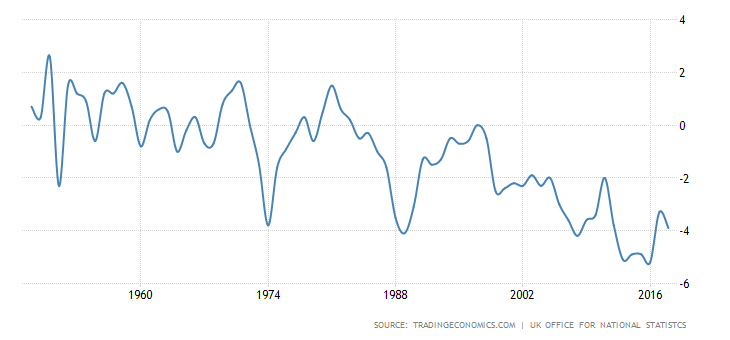
We already have a near record trade deficit and need to rebalance that via a careful strategy of higher wages, higher savings, higher investment, more domestic production and more exports and less imports. I have argued the case before for a private sector, investment led, economic boom after Brexit.

UK Current Account as a percent of GDP:
UK Capital flows, Qtly in £bns:
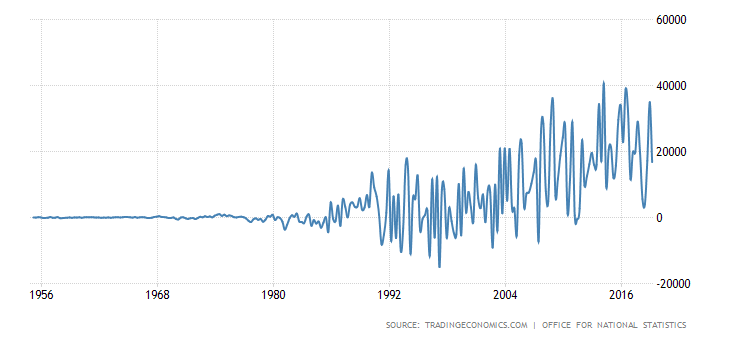
Corbyn simply sees the problems and plans to spend enormous amounts of money, but he cant know where the money will come from to pay for it. The external sector has been willing to finance UK deficits for some time as the economy rebounded and grew and while the UK represented a liberal safehaven. For a while it will also probably finance Corbyn given his policies are pro-cyclical and will offer higher returns/ yields for a period. However, longer term, given the high tax, stagflationary policies, it seems very unlikely the external sector will pay; so crowding out the domestic private sector is the only possible alternative. This is the stuff FX crisis are made of, but only a few years down the line.

The first five years could see a significant boost to GDP, maybe longer, but later on the negative effects will show more prominence, probably when there is a recession.

Two details were outlined however, those were that he will build large scale solar plants, battery hubs and wind farms and he will also ramp public house building. All of this is great for well connected, high-wage, unionised companies and QUANGOs.

Internationalism:

He will withdraw from US/ NATO military interventions in favour of diplomacy.

  • In effect he will weaken the ability of organisations like the UN and the ICC to enforce basic human rights onto rogue states and allow China’s sphere of influence to grow. That is the opposite of his stated foreign policy intention.

Brexit:

His fence sitting policy on Brexit it to; negotiate a better deal, put it to referendum and carry out the referendum result. Its a Remain party, but as an ardent Brexiteer he is calculating the referendum result will be to leave with whatever deal he has negotiated.

He would then be relatively free to implement his policies; he has no intention of reducing taxes or regulation (and therefore maintain the level playing field requirements) and having left the EU would not be as bound by EU state subsidy rules in his nationalisation and ‘investment’ programme.

Corbyn was never meant to be leader, after a career as a campaigner, he lucked into the role due to failure by mainstream career politicians. In the last several years he has been forced to become an expedient politician. His reformist agenda is also popular with the party grassroots.

Question is can he now luck into No. 10?


Tyler Durden

Thu, 10/31/2019 – 02:00

via ZeroHedge News https://ift.tt/2piVxzn Tyler Durden

Global Carmageddon Continues: Pirelli And VW Warn About “Worsening Market Scenario”

Global Carmageddon Continues: Pirelli And VW Warn About “Worsening Market Scenario”

The automotive industry has been mired in recession for the better part of the last 18 months and still shows no signs of stopping. On Tuesday, comments from both VW’s CEO and from tire maker Pirelli, who cut its guidance for 2020, continue to exemplify an industry where the very worst of a recession may still be yet to come.

VW’s CEO said in an interview with Bloomberg early this week that he was cautious about “all regions except South America”, including major car markets like North America, Europe and China. 

“We know what needs to be done – get our act together on vehicle launches and be very cautious on costs and expenses,” he commented. He also stated that he wasn’t surprised that PSA and Fiat Chrysler are in merger talks, given speculation about industry consolidation.

Volkswagen is expected to present a new five-year plan to its board in mid-November.

The shift to electric vehicles, more stringent emissions standards and a slowing global economy all continue to weigh on many auto manufacturers. 

Tire maker Pirelli also warned about its operating profit margin and cash flow on Tuesday, saying it would delay the presentation of a new business plan while it works out scenarios for what it sees as a “worsening market scenario”, according to Reuters

The company forecasted full year margin on adjusted EBIT of between 17% and 17.5%, much lower than already-lowered expectations of 18% to 19%. The company’s adjusted EBIT fell to 685 million euros for the nine months ended September 30, 2019. Pirelli also lowered its full year cash flow expectations to between 330 and 350 million euros, down from expectations of between 350 million and 380 million euros. 

The company said that greater fixed costs and lowered production to reduce inventories both stung its guidance.  

The company is set to present its industrial plans to 2022 in the first quarter of next year. This presentation was previously supposed to occur on December 11 of this year. Pirelli said the setback was due to the market being “more challenging compared with the forecasts of recent months”.

Chief Executive Marco Tronchetti Porvera said: “In this context, to protect our profitability we have to act deeper to reduce the cost of our products.”


Tyler Durden

Thu, 10/31/2019 – 01:00

via ZeroHedge News https://ift.tt/2NuG8DM Tyler Durden

Can lower courts decide novel abortion cases?

In late August, a panel of the Seventh Circuit affirmed an injunction against an Indiana abortion statute, over one judge’s dissent. (The statute requires parents to be notified in some circumstances that their child is getting an abortion without their consent.)

Today, the full Seventh Circuit decided not to rehear the case en banc, by a 6-5 vote. One of those judges, Judge Frank Easterbrook, joined by another, Judge Diane Sykes, wrote an opinion explaining his decision not to rehear the case. These judges are not fans of the Supreme Court’s abortion jurisprudence, so their reasoning was interesting. For one thing, Judge Easterbrook explained, the Supreme Court has agreed to hear an abortion case in a similar procedural posture out of Louisiana (though dealing with a different kind of law), and that might shed some light.

But in any event, Judge Easterbrook goes on, court of appeals review in abortion cases is pointless:

For a court of appeals cannot decide whether requiring a mature minor to notify her parents of an impending abortion, when she cannot persuade a court that avoiding notification is in her best interests, is an “undue burden” on abortion. The “undue burden” approach announced in Planned Parenthood of Southeastern Pennsylvania v. Casey, 505 U.S. 833 (1992), does not call on a court of appeals to interpret a text. Nor does it produce a result through interpretation of the Supreme Court’s opinions. How much burden is “undue” is a matter of judgment, which depends on what the burden would be (something the injunction prevents us from knowing) and whether that burden is excessive (a matter of weighing costs against benefits, which one judge is apt to do differently from another, and which judges as a group are apt to do differently from state legislators). Only the Justices, the proprietors of the undue-burden standard, can apply it to a new category of statute, such as the one Indiana has enacted. Three circuit judges already have guessed how that inquiry would come out; they did not agree. The quality of our work cannot be improved by having eight more circuit judges try the same exercise. It is better to send this dispute on its way to the only institution that can give an authoritative answer.

I’m familiar with various arguments about whether and how lower courts must apply Supreme Court precedent, but I can’t recall seeing the suggestion that there is a genre of Supreme Court precedent that a lower court simply “cannot” apply either way, so I thought it was worth noting.

from Latest – Reason.com https://ift.tt/2PESqw2
via IFTTT

Can lower courts decide novel abortion cases?

In late August, a panel of the Seventh Circuit affirmed an injunction against an Indiana abortion statute, over one judge’s dissent. (The statute requires parents to be notified in some circumstances that their child is getting an abortion without their consent.)

Today, the full Seventh Circuit decided not to rehear the case en banc, by a 6-5 vote. One of those judges, Judge Frank Easterbrook, joined by another, Judge Diane Sykes, wrote an opinion explaining his decision not to rehear the case. These judges are not fans of the Supreme Court’s abortion jurisprudence, so their reasoning was interesting. For one thing, Judge Easterbrook explained, the Supreme Court has agreed to hear an abortion case in a similar procedural posture out of Louisiana (though dealing with a different kind of law), and that might shed some light.

But in any event, Judge Easterbrook goes on, court of appeals review in abortion cases is pointless:

For a court of appeals cannot decide whether requiring a mature minor to notify her parents of an impending abortion, when she cannot persuade a court that avoiding notification is in her best interests, is an “undue burden” on abortion. The “undue burden” approach announced in Planned Parenthood of Southeastern Pennsylvania v. Casey, 505 U.S. 833 (1992), does not call on a court of appeals to interpret a text. Nor does it produce a result through interpretation of the Supreme Court’s opinions. How much burden is “undue” is a matter of judgment, which depends on what the burden would be (something the injunction prevents us from knowing) and whether that burden is excessive (a matter of weighing costs against benefits, which one judge is apt to do differently from another, and which judges as a group are apt to do differently from state legislators). Only the Justices, the proprietors of the undue-burden standard, can apply it to a new category of statute, such as the one Indiana has enacted. Three circuit judges already have guessed how that inquiry would come out; they did not agree. The quality of our work cannot be improved by having eight more circuit judges try the same exercise. It is better to send this dispute on its way to the only institution that can give an authoritative answer.

I’m familiar with various arguments about whether and how lower courts must apply Supreme Court precedent, but I can’t recall seeing the suggestion that there is a genre of Supreme Court precedent that a lower court simply “cannot” apply either way, so I thought it was worth noting.

from Latest – Reason.com https://ift.tt/2PESqw2
via IFTTT

End the Failed Renewable Fuel Standard Experiment

It’s time for the annual congressional fight over the Renewable Fuel Standard, or RFS. In one corner sit corn farmers and their representatives, who fight tenaciously not just to preserve the RFS but to expand it. In the other sits, well, just about everyone else. Whether you are a refiner, a consumer, an environmentalist, a free market economist, or just someone who cares about good government, there is ample reason to oppose the ethanol mandate.

Since 2005, the federal government has required that refineries blend increasing amounts of ethanol (grain alcohol) with gasoline. There are requirements for cellulosic, biodiesel, and advanced biofuels, with the rest of the mandate typically being met by corn ethanol since it is the cheapest.

The stated goals of the RFS were to reduce reliance on foreign energy and to move toward cleaner fuel sources. It falls short on both fronts.

Worries about dependence on foreign oil were mitigated by the U.S. shale oil and fracking boom, exemplifying the sort of innovation and market changes that central planners inevitably fail to account for. The RFS is worse than unnecessary when it comes to reducing foreign energy consumption, which is itself a goal of dubious benefit. The RFS works against this objective because meeting the excessive biodiesel mandate has actually required significant imports.

Compounding bad policy with worse, the Commerce Department keeps imposing tariffs on countries selling the cheapest biofuels available to meet the mandate.

The RFS also fails to deliver on the environmental front. A recent Cato Institute report by Arthur Wardle highlights the impact of expanded land use for corn—with the increased application of nitrogen fertilizer leading to runoff that contributes to the hypoxic dead zone in the Gulf of Mexico and kills sea life—as evidence that “the research on the Renewable Fuels Standard is clear that it degrades the environment.” The Cato report also cites a meta-analysis, published in the American Journal of Agricultural Economics, of studies that modeled the life cycle greenhouse gas emission of ethanol versus gasoline and found a meager reduction of only 0.23 percent.

Sadly, Congress is not currently preparing to revisit the big picture. The current battle is primarily over the use of waivers authorized by the law to mitigate the negative impact of the mandate on small refiners that are unable to blend their own ethanol or afford offsets. The House just convened a hearing on the topic, titled “Protecting the RFS: The Trump Administration’s Abuse of Secret Waivers.”

The Obama administration underutilized the hardship waivers, and some refiners consequently went out of business. The corn ethanol lobby is now unhappy with the number of waivers the Environmental Protection Agency has granted in recent years, even though they are a big reason why the mandate has not done much more harm. They also want higher volumes to be required on remaining refiners to make up for the hardship exemptions.

The statute provides no authority to reallocate obligations to other companies, and doing so would move policy in the wrong direction. As volume obligations increase, it’s vitally important that the waivers be preserved or else the industry would be hollowed out, leaving only the largest refineries. The waivers may not prove to be enough, so lawmakers could also consider capping the costs of Renewable Identification Numbers, which small refineries purchase from their larger counterparts in order to meet obligations that they cannot produce themselves.

Eliminating the mandate and its market distortions altogether would be even better.

President Donald Trump is trying to have it both ways, promising to please small refineries and farmers at the same time, which may be impossible. The administration wants to placate farmers for political reasons, but economic reality is proving to be too much of a challenge. Instead of extending and expanding crony handouts to farmers, perhaps the administration should consider ending the trade war that has hit farmers especially hard in the first place.

COPYRIGHT 2019 CREATORS.COM

from Latest – Reason.com https://ift.tt/2PxxSpj
via IFTTT

End the Failed Renewable Fuel Standard Experiment

It’s time for the annual congressional fight over the Renewable Fuel Standard, or RFS. In one corner sit corn farmers and their representatives, who fight tenaciously not just to preserve the RFS but to expand it. In the other sits, well, just about everyone else. Whether you are a refiner, a consumer, an environmentalist, a free market economist, or just someone who cares about good government, there is ample reason to oppose the ethanol mandate.

Since 2005, the federal government has required that refineries blend increasing amounts of ethanol (grain alcohol) with gasoline. There are requirements for cellulosic, biodiesel, and advanced biofuels, with the rest of the mandate typically being met by corn ethanol since it is the cheapest.

The stated goals of the RFS were to reduce reliance on foreign energy and to move toward cleaner fuel sources. It falls short on both fronts.

Worries about dependence on foreign oil were mitigated by the U.S. shale oil and fracking boom, exemplifying the sort of innovation and market changes that central planners inevitably fail to account for. The RFS is worse than unnecessary when it comes to reducing foreign energy consumption, which is itself a goal of dubious benefit. The RFS works against this objective because meeting the excessive biodiesel mandate has actually required significant imports.

Compounding bad policy with worse, the Commerce Department keeps imposing tariffs on countries selling the cheapest biofuels available to meet the mandate.

The RFS also fails to deliver on the environmental front. A recent Cato Institute report by Arthur Wardle highlights the impact of expanded land use for corn—with the increased application of nitrogen fertilizer leading to runoff that contributes to the hypoxic dead zone in the Gulf of Mexico and kills sea life—as evidence that “the research on the Renewable Fuels Standard is clear that it degrades the environment.” The Cato report also cites a meta-analysis, published in the American Journal of Agricultural Economics, of studies that modeled the life cycle greenhouse gas emission of ethanol versus gasoline and found a meager reduction of only 0.23 percent.

Sadly, Congress is not currently preparing to revisit the big picture. The current battle is primarily over the use of waivers authorized by the law to mitigate the negative impact of the mandate on small refiners that are unable to blend their own ethanol or afford offsets. The House just convened a hearing on the topic, titled “Protecting the RFS: The Trump Administration’s Abuse of Secret Waivers.”

The Obama administration underutilized the hardship waivers, and some refiners consequently went out of business. The corn ethanol lobby is now unhappy with the number of waivers the Environmental Protection Agency has granted in recent years, even though they are a big reason why the mandate has not done much more harm. They also want higher volumes to be required on remaining refiners to make up for the hardship exemptions.

The statute provides no authority to reallocate obligations to other companies, and doing so would move policy in the wrong direction. As volume obligations increase, it’s vitally important that the waivers be preserved or else the industry would be hollowed out, leaving only the largest refineries. The waivers may not prove to be enough, so lawmakers could also consider capping the costs of Renewable Identification Numbers, which small refineries purchase from their larger counterparts in order to meet obligations that they cannot produce themselves.

Eliminating the mandate and its market distortions altogether would be even better.

President Donald Trump is trying to have it both ways, promising to please small refineries and farmers at the same time, which may be impossible. The administration wants to placate farmers for political reasons, but economic reality is proving to be too much of a challenge. Instead of extending and expanding crony handouts to farmers, perhaps the administration should consider ending the trade war that has hit farmers especially hard in the first place.

COPYRIGHT 2019 CREATORS.COM

from Latest – Reason.com https://ift.tt/2PxxSpj
via IFTTT

America’s History Of Controlling The OPCW To Promote Regime Change

America’s History Of Controlling The OPCW To Promote Regime Change

Authored by Caitlin Johnstone via Medium.com,

You wouldn’t know it from today’s news headlines, but there’s a major scandal unfolding with potentially far-reaching consequences for the entire international community.

The political/media class has been dead silent about the fact that there are now two whistleblowers whose revelations have cast serious doubts on a chemical weapons watchdog group that is widely regarded as authoritative, despite the fact that this same political/media class has been crowing all month about how important whistleblowers are and how they need to be protected ever since a CIA spook exposed some dirt on the Trump administration.

When the Courage Foundation and WikiLeaks published the findings of an interdisciplinary panel which received an extensive presentation from a whistleblower from the Organization for the Prohibition of Chemical Weapons (OPCW) investigation of an alleged 2018 chlorine gas attack in Douma, Syria, it was left unclear (perhaps intentionally) whether this was the same whistleblower who leaked a dissenting Engineering Assessment to the Working Group on Syria, Propaganda and Media this past May or a different one. Subsequent comments from British journalist Jonathan Steele assert that there are indeed two separate whistleblowers from within the OPCW’s Douma investigation, both of whom claim that their investigative findings differed widely from the final OPCW Douma report and were suppressed from the public by the organization.

The official final report aligned with the mainstream narrative promulgated by America’s political/media class that the Syrian government killed dozens of civilians in Douma using cylinders of chlorine gas dropped from the air, while the two whistleblowers found that this is unlikely to have been the case. The official report did not explicitly assign blame to Assad, but it said its findings were in alignment with a chlorine gas attack and included a ballistics report which strongly implied an air strike (opposition fighters in Syria have no air force). The whistleblowers dispute both of these conclusions.

At the very least we can conclude from these revelations that the OPCW hid information from the public that an international watchdog organization has no business hiding about an event which led to an act of war in the form of an airstrike by the US, UK and France. We may also conclude that skepticism of their entire body of work around the world is perfectly legitimate until some very serious questions are answered. Right now no attempt is being made by the organization to bring about the kind of transparency which would help restore trust, with multiple journalists now reporting that the OPCW is refusing to answer their questions.

It is also not at all unreasonable to question whether the OPCW could have been influenced in some way by the United States behind the scenes, given how its now-dubious final report aligns so nicely with the narratives promoted by the CIA and US State Department, and given how we know for a fact that the US has aggressively manipulated the OPCW before in order to advance its regime change agendas.

In June of 2002, as the United States was preparing to invade Iraq, Mother Jones published an article titled “A Coup in The Hague” about the US government’s campaign to oust the OPCW’s very first Director General, José Bustani. If you’ve been following the recent OPCW revelations you will recall that Bustani was one of the panelists at the Courage Foundation whistleblower presentation in Brussels on October 15, after which he wrote the following:

The convincing evidence of irregular behavior in the OPCW investigation of the alleged Douma chemical attack confirms doubts and suspicions I already had. I could make no sense of what I was reading in the international press. Even official reports of investigations seemed incoherent at best. The picture is certainly clearer now, although very disturbing.”

Mother Jones (which used to be a decent outlet for the record) breaks down how the US government was able to successfully bully the OPCW into ousting the very popular Bustani from his position as Director General in April 2002 by threatening to withdraw funding from the organization. This was done because Bustani was having an uncomfortable amount of success bringing the Saddam Hussein government to the negotiating table, and his efforts were perceived as a threat to the war agenda.

“Indeed, US officials have offered little reason for its opposition to Bustani, saying only that they questioned his ‘management style’ and differed with several of Bustani’s decisions,” Mother Jones reports.

“Despite this, Washington waged an unusually public and vocal campaign to unseat Bustani, who had been unanimously reelected to lead the 145-nation body in May, 2000. Finally, at a ‘special session’ called after the US had threatened to cut off all funding for the organization, Bustani was sent packing.”

This happened despite broad international support for Bustani, including from then-Secretary of State Colin Powell who’d written to the renowned Brazilian diplomat praising his work in February 2001. According to the report’s author Hannah Wallace, the US was able to oust a unanimously re-elected Director General due to the disproportionate amount of financial influence America had over the OPCW.

“[I]n March of 2002, Bustani survived a US-led motion calling for a vote of no confidence in his leadership,” Wallace writes. “Having failed in that effort, Washington increased the pressure, threatening to cut off funding for the organization — a significant threat given that the US underwrites 22 percent of the total budget. A little more than a month later, Bustani was out.”

“Bustani suggests US officials were particularly displeased with his attempts to persuade Iraq to sign the chemical weapons treaty, which would have provided for routine and unannounced inspections of Iraqi weapons plants,” Wallace reported. “Of course, the Bush White House has recently cited Iraq’s refusal to allow such inspections as one justification for a new attack on Saddam Hussein’s regime.”

“Of course, had Iraq [joined the OPCW], a door would be opened towards the return of inspectors to Bagdad and consequently a viable, peaceful solution to the impasse,” Bustani told Mother Jones. “Is that what Washington wants these days?”

Bustani told Mother Jones that he was already seeing a shift in the OPCW into alignment with US interests. Again, this was back in 2002.

“The new OPCW, after my ousting, is already undergoing radical structural changes, along the lines of the US recipe, which will strike a definitive blow to the post of the Director General, making it once and for all a mere figurehead of a sham international regime,” he said.

“Bustani traces the shift to the influence of several hawkish officials in the Bush State Department, particularly Undersecretary of State for Arms Control and International Security, John Bolton,” Wallace wrote.

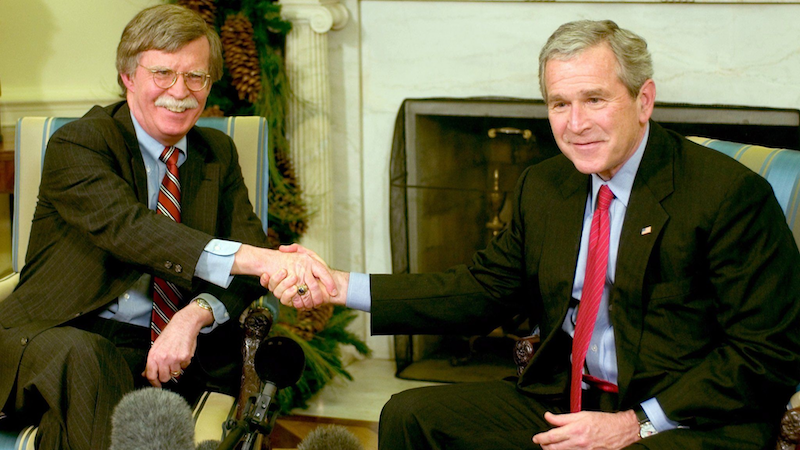
Indeed, we’ve learned since that Bolton took it much further than that. Bustani reported to The Intercept last year that Bolton literally threatened to harm his children if he didn’t resign from his position as Director General.

“You have 24 hours to leave the organization, and if you don’t comply with this decision by Washington, we have ways to retaliate against you,” Bolton reportedly told him, adding after a pause, “We know where your kids live. You have two sons in New York.”

The Intercept reports that Bolton’s office did not deny Bustani’s claim when asked for comment.

It is worth noting here that John Bolton was serving in the Trump administration as National Security Advisor throughout the entire time of the OPCW’s Douma investigation. Bolton held that position from April 9, 2018 to September 10, 2019. The OPCW’s Fact-Finding mission didn’t arrive in Syria until April 14 2018 and didn’t begin its investigation in Douma until several days after that, with its final report being released in March of 2019.

It is perfectly reasonable, given all this, to suspect that the US government may have exerted some influence over the OPCW’s Douma investigation. If they were depraved enough to not only threaten to withdraw funding from a chemical weapons watchdog in order to attain their warmongering agendas but actually threaten a diplomat’s family, they’re certainly depraved enough to manipulate an investigation into an alleged chemical weapons attack. This would explain the highly suspicious omissions and discrepancies in its report.

It is a well-established fact that the US government has long sought regime change in Syria, not just in 2012 with Timber Sycamore and the official position of “Assad must go”, but even before the violence began in 2011. I’ve compiled multiple primary source pieces of evidence in an article you can read by clicking here that the US government and its allies have been planning to orchestrate an uprising in Syria exactly as it occurred with the goal of toppling Assad, and a former Qatari Prime Minister revealed on television in 2017 that the US and its allies were involved in that conflict from the very moment it first started.

So to recap, we know that the US government has manipulated the OPCW in order to advance regime change agendas in the past, and we know that the US government has long had a regime change agenda against Syria. Many questions will need to be answered before we can rule out the possibility that these two facts converged in an ugly way upon the OPCW’s Douma investigation.

*  *  *

Thanks for reading! The best way to get around the internet censors and make sure you see the stuff I publish is to subscribe to the mailing list for my website, which will get you an email notification for everything I publish. My work is entirely reader-supported, so if you enjoyed this piece please consider sharing it around, liking me on Facebook, following my antics on Twitter, checking out my podcast on either YoutubesoundcloudApple podcasts or Spotify, following me on Steemit, throwing some money into my hat on Patreon or Paypalpurchasing some of my sweet merchandise, buying my new book Rogue Nation: Psychonautical Adventures With Caitlin Johnstone, or my previous book Woke: A Field Guide for Utopia Preppers. For more info on who I am, where I stand, and what I’m trying to do with this platform, click here. Everyone, racist platforms excluded, has my permission to republish or use any part of this work (or anything else I’ve written) in any way they like free of charge.

Bitcoin donations:1Ac7PCQXoQoLA9Sh8fhAgiU3PHA2EX5Zm2


Tyler Durden

Wed, 10/30/2019 – 23:50

Tags

via ZeroHedge News https://ift.tt/2Pu3350 Tyler Durden

A Conflicted Kimbal Musk Was Facing SolarCity Margin Calls Before Tesla’s Bailout, Deposition Shows

A Conflicted Kimbal Musk Was Facing SolarCity Margin Calls Before Tesla’s Bailout, Deposition Shows

More and more details to Tesla’s bailout of SolarCity are becoming clear. And the more details we get, the uglier things look. 

The latest addition to the story was yesterday, when one well known Tesla skeptic took the time to lay out, in wonderful detail, the financial pressure that SolarCity’s tanking stock price was putting on the company’s directors – specifically, Elon’s brother Kimbal Musk – who faced multiple margin calls prior to the merger. 

Using Kimbal Musk’s recently released deposition from the SolarCity lawsuit, the short seller known only as @TeslaCharts on Twitter, reconstructed the days leading up to Elon Musk pitching the SolarCity acquisition to the Tesla board. They detail a panicked Kimbal Musk, cursing about Tesla and blowing out his SpaceX shares to cover his SolarCity margin call – all while maintaining that he had zero conflict of interest in Tesla’s eventual bailout of SolarCity.

@TeslaCharts starts by layout out the context, reminding readers that Kimbal Musk was a large shareholder in SolarCity, as well as a board member of both Tesla and SpaceX at the time. 

He then makes note of Kimbal’s reasoning for not recusing himself regarding matters involving SolarCity. The only person who didn’t seem to think Kimbal had a conflict of interest was Kimbal himself. 

He continues down this line of logic, noting that despite owning 141,541 shares of SolarCity, Kimbal still did not think he had a conflict of interest because he was representing “the best interests of the shareholders of Tesla”.

From there, @TeslaCharts starts to lay out a timeline. First, October 20, 2015, when Kimbal is facing a margin call due to SolarCity for the first time. 

He then also lays out that many members of the Tesla and SolarCity boards are also on the Board of Directors of Kimbal’s company, the Kitchen. 

In fact, when Kimbal is seeking financing for his own company, SolarCity’s CEO tells him that he can’t participate because he is also facing his own margin calls. SolarCity is “seeing its ass”, CEO Lyndon Rive tells Kimbal. Of course, “seeing its ass” doesn’t appear in any SolarCity public filings around that time – this was information just for Kimbal. 

Then Kimbal winds up in a back and forth with the questioning attorney about the definition of a margin call, which he clearly doesn’t understand. The deposition shows that Kimbal used his Tesla line of credit to cover his SolarCity line – symbolic, of sorts, isn’t it?

Kimbal then faces a margin call on October 29, 2015 and uses his Tesla stock to again cover it. 

Kimbal is then rebuffed by Elon after he hits Elon up for a loan to try and bail himself out of his margin call. “You know that I don’t actually have cash, right?” Elon says to his brother. 

So Kimbal shifts his attention to potentially selling some of his SpaceX stock to cover the call. It is also noted that Elon Musk had a LTV of just 5% for his SpaceX shares at Goldman.

By February 8, 2016, all hell is breaking loose. SolarCity’s stock is still falling and Kimbal is forced to offer some SpaceX stock at $110. 

On February 9, 2016, there’s a clear sense of urgency when SolarCity dips to $18 per share. Kimbal yanks the offer on his SpaceX stock from $110 to $95 over the course of just one day. 

Kimbal then, frustrated, e-mails the CFO of his company, the Kitchen. “Motherfucker,” he says after describing Tesla’s 50% fall. 

So the next day, his brother Elon goes online and pulls forward the date for Model 3 reservations, announcing that more information on the unveil would be coming soon. Tesla stock moves higher and “margin loan pressure undoubtedly eases,” @TeslaCharts says.

And just two weeks later, Elon calls a meeting to pitch the idea of acquiring SolarCity. To nobody’s surprise, the Board doesn’t even discuss Kimbal Musk’s potential conflict of interest. 

The thread ends with @TeslaCharts saying what everyone else is thinking:

“The only thing surprising about this giant self-dealing Ponzi scheme is just how egregious it all is.”

The thread, in its entirety, can be read here. @TeslaCharts also appeared on a podcast on Sunday to lay out his thoughts both on Tesla’s recent quarterly results, and on the company’s claims about its “Version 3.0” of its solar roof tiles. 

Recall, we noted yesterday that despite the company’s “headline” Q3 numbers, its U.S. sales actually plunged 39% in the quarter. 


Tyler Durden

Wed, 10/30/2019 – 23:30

via ZeroHedge News https://ift.tt/3389mPO Tyler Durden

Chinese PMIs Unexpectedly Slide Further Into Contraction, Just Shy Of Post-Crisis Lows

Chinese PMIs Unexpectedly Slide Further Into Contraction, Just Shy Of Post-Crisis Lows

If there was some hope that that today’s Fed rate cut would mark the bottom of the global economic slowdown and serve as the basis for even a modest recovery – after all, even Powell admitted that after this, nothing less than a full blown economic shitstorm would force the Fed to cut more – then Beijing promptly crapped all over any such optimism, when it reported that its latest official PMIs for the month of October not only missed by a mile, but were two of the worst prints since the financial crisis.

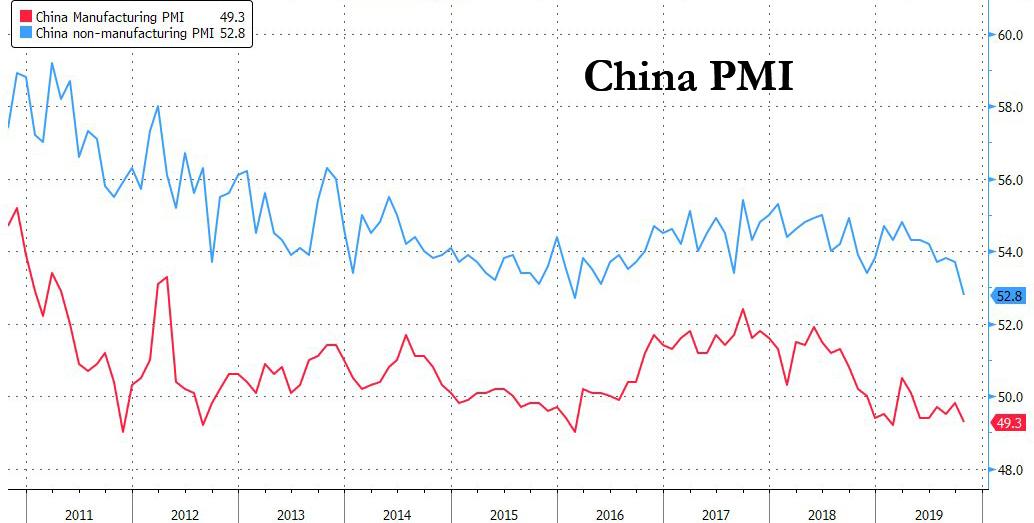
Early on Thursday, China’s National Bureau of Statistics reported that in October, China’s manufacturing PMI slumped deeper into contraction, dropping from 49.8 to 49.3, not only below the 49.8 consensus estimate, but also below the lowest sellside estimate (the range was 49.5-50.5). Worse, the Non-manufacturing PMI, which many had ignored for months because it was so deeply into expansionary territory, tumbled sharply, and after its biggest drop in almost a year, dipped to 52.8 from 53.6, and is now just shy of the lowest print since the financial crisis.

It gets even worse: whereas the contraction for large cap companies was modest, at just 49.9, down from 50.8, mid cap companies were worse, at 49.0, while small caps were dismal, at a paltry 47.9, down from 48.8.

Broken down by components, almost every index posted a decline, with the exception of the worst one, employment, which posted a modest increase:

  • Production  50.8, down from 52.3
  • New Orders 49.6, down from 50.5
  • Employment 47.3, up from 47.0

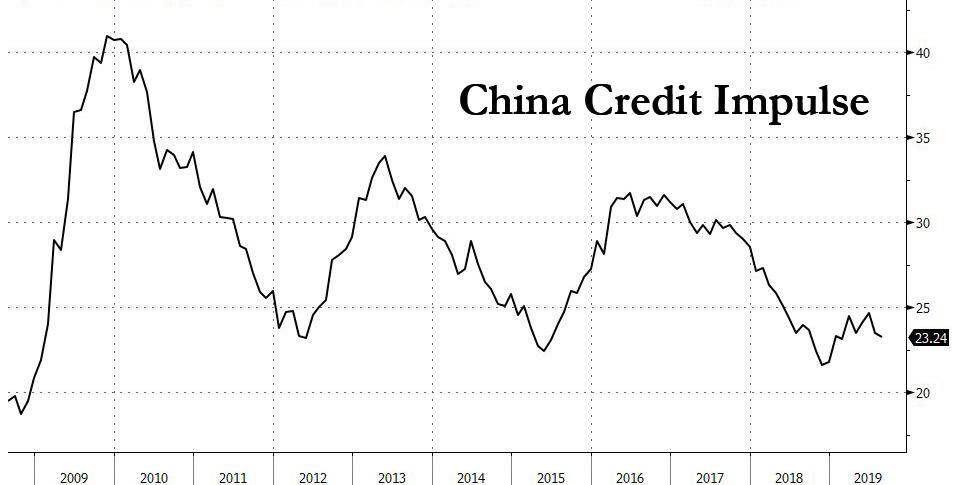
The above means that not only is the trade war with the US continuing to take its toll on China, but as long as Beijing refuses to spark a massive credit injection spree, which rebooted the global economy after the financial crisis, after the European sovereign debt crisis, and again after the Shanghai Accord…

… then the Fed’s hopes that its “insurance cuts” will amount to anything, will soon be drowned in the chaos of another global recession, but not before the Fed first cuts rates back to zero first, and then negative.


Tyler Durden

Wed, 10/30/2019 – 23:13

via ZeroHedge News https://ift.tt/333xkvc Tyler Durden

The Militarization Of Everything

The Militarization Of Everything

Authored by William Astore via TomDispatch.com,

Killing Me Softly with Militarism – The Decay of Democracy in America

When Americans think of militarism, they may imagine jackbooted soldiers goose-stepping through the streets as flag-waving crowds exult; or, like our president, they may think of enormous parades featuring troops and missiles and tanks, with warplanes soaring overhead. Or nationalist dictators wearing military uniforms encrusted with medals, ribbons, and badges like so many barnacles on a sinking ship of state. (Was Donald Trump only joking recently when he said he’d like to award himself a Medal of Honor?) And what they may also think is: that’s not us. That’s not America. After all, Lady Liberty used to welcome newcomers with a torch, not an AR-15. We don’t wall ourselves in while bombing others in distant parts of the world, right?

But militarism is more than thuggish dictators, predatory weaponry, and steely-eyed troops. There are softer forms of it that are no less significant than the “hard” ones. In fact, in a self-avowed democracy like the United States, such softer forms are often more effective because they seem so much less insidious, so much less dangerous. Even in the heartland of Trump’s famed base, most Americans continue to reject nakedly bellicose displays like phalanxes of tanks rolling down Pennsylvania Avenue. 

But who can object to celebrating “hometown heroes” in uniform, as happens regularly at sports events of every sort in twenty-first-century America? Or polite and smiling military recruiters in schools? Or gung-ho war movies like the latest version of Midway, timed for Veterans Day weekend 2019 and marking America’s 1942 naval victory over Japan, when we were not only the good guys but the underdogs?

What do I mean by softer forms of militarism? I’m a football fan, so one recent Sunday afternoon found me watching an NFL game on CBS. People deplore violence in such games, and rightly so, given the number of injuries among the players, notably concussions that debilitate lives. But what about violent commercials during the game? In that one afternoon, I noted repetitive commercials for SEAL TeamSWAT, and FBI, all CBS shows from this quietly militarized American moment of ours. In other words, I was exposed to lots of guns, explosions, fisticuffs, and the like, but more than anything I was given glimpses of hard men (and a woman or two) in uniform who have the very answers we need and, like the Pentagon-supplied police in Ferguson, Missouri, in 2014, are armed to the teeth. (“Models with guns,” my wife calls them.) 

Got a situation in Nowhere-stan? Send in the Navy SEALs. Got a murderer on the loose? Send in the SWAT team. With their superior weaponry and can-do spirit, Special Forces of every sort are sure to win the day (except, of course, when they don’t, as in America’s current series of never-ending wars in distant lands).

And it hardly ends with those three shows. Consider, for example, this century’s update of Magnum P.I., a CBS show featuring a kickass private investigator. In the original Magnum P.I. that I watched as a teenager, Tom Selleck played the character with an easy charm. Magnum’s military background in Vietnam was acknowledged but not hyped. Unsurprisingly, today’s Magnum is proudly billed as an ex-Navy SEAL.

Cop and military shows are nothing new on American TV, but never have I seen so many of them, new and old, and so well-armed. On CBS alone you can add to the mix Hawaii Five-O (yet more models with guns updated and up-armed from my youthful years), the three NCIS (Naval Criminal Investigative Service) shows, and Blue Bloods (ironically starring a more grizzled and less charming Tom Selleck) — and who knows what I haven’t noticed? While today’s cop/military shows feature far more diversity with respect to gender, ethnicity, and race compared to hoary classics like Dragnet, they also feature far more gunplay and other forms of bloody violence.

Look, as a veteran, I have nothing against realistic shows on the military. Coming from a family of first responders — I count four firefighters and two police officers in my immediate family — I loved shows like Adam-12 and Emergency! in my youth. What I’m against is the strange militarization of everything, including, for instance, the idea, distinctly of our moment, that first responders need their very own version of the American flag to mark their service. Perhaps you’ve seen those thin blue line flags, sometimes augmented with a red line for firefighters. As a military veteran, my gut tells me that there should only be one American flag and it should be good enough for all Americans. Think of the proliferation of flags as another soft type of up-armoring (this time of patriotism). 

Speaking of which, whatever happened to Dragnet’s Sergeant Joe Friday, on the beat, serving his fellow citizens, and pursuing law enforcement as a calling? He didn’t need a thin blue line battle flag. And in the rare times when he wielded a gun, it was .38 Special. Today’s version of Joe looks a lot more like G.I. Joe, decked out in body armor and carrying an assault rifle as he exits a tank-like vehicle, maybe even a surplus MRAP from America’s failed imperial wars.

Militarism in the USA

Besides TV shows, movies, and commercials, there are many signs of the increasing embrace of militarized values and attitudes in this country. The result: the acceptance of a military in places where it shouldn’t be, one that’s over-celebrated, over-hyped, and given far too much money and cultural authority, while becoming virtually immune to serious criticism.

Let me offer just nine signs of this that would have been so much less conceivable when I was a young boy watching reruns of Dragnet:

1. Roughly two-thirds of the federal government’s discretionary budget for 2020 will, unbelievably enough, be devoted to the Pentagon and related military functions, with each year’s “defense” budget coming ever closer to a trillion dollars. Such colossal sums are rarely debated in Congress; indeed, they enjoy wide bipartisan support.

2. The U.S. military remains the most trusted institution in our society, so say 74% of Americans surveyed in a Gallup poll. No other institution even comes close, certainly not the presidency (37%) or Congress (which recently rose to a monumental 25% on an impeachment high). Yet that same military has produced disasters or quagmires in Afghanistan, Iraq, Libya, Syria, Somalia, and elsewhere. Various “surges” have repeatedly failed. The Pentagon itself can’t even pass an audit. Why so much trust?

3. A state of permanent war is considered America’s new normal. Wars are now automatically treated as multi-generational with little concern for how permawar might degrade our democracy. Anti-war protesters are rare enough to be lone voices crying in the wilderness. 

4. America’s generals continue to be treated, without the slightest irony, as “the adults in the room.” Sages like former Secretary of Defense James Mattis (cited glowingly in the recent debate among 12 Democratic presidential hopefuls) will save America from unskilled and tempestuous politicians like one Donald J. Trump. In the 2016 presidential race, it seemed that neither candidate could run without being endorsed by a screaming general (Michael Flynn for Trump; John Allen for Clinton).

5. The media routinely embraces retired U.S. military officers and uses them as talking heads to explain and promote military action to the American people. Simultaneously, when the military goes to war, civilian journalists are “embedded” within those forces and so are dependent on them in every way. The result tends to be a cheerleading media that supports the military in the name of patriotism — as well as higher ratings and corporate profits.

6. America’s foreign aid is increasingly military aid. Consider, for instance, the current controversy over the aid to Ukraine that President Trump blocked before his infamous phone call, which was, of course, partially about weaponry. This should serve to remind us that the United States has become the world’s foremost merchant of death, selling far more weapons globally than any other country. Again, there is no real debate here about the morality of profiting from such massive sales, whether abroad ($55.4 billion in arms sales for this fiscal year alone, says the Defense Security Cooperation Agency) or at home (a staggering 150 million new guns produced in the USA since 1986, the vast majority remaining in American hands).

7. In that context, consider the militarization of the weaponry in those very hands, from .50 caliber sniper rifles to various military-style assault rifles. Roughly 15 million AR-15s are currently owned by ordinary Americans. We’re talking about a gun designed for battlefield-style rapid shooting and maximum damage against humans. In the 1970s, when I was a teenager, the hunters in my family had bolt-action rifles for deer hunting, shotguns for birds, and pistols for home defense and plinking. No one had a military-style assault rifle because no one needed one or even wanted one. Now, worried suburbanites buy them, thinking they’re getting their “man card” back by toting such a weapon of mass destruction.

8. Paradoxically, even as Americans slaughter each other and themselves in large numbers via mass shootings and suicides (nearly 40,000 gun deaths in 2017 alone), they largely ignore Washington’s overseas wars and the continued bombing of numerous countries. But ignorance is not bliss. By tacitly giving the military a blank check, issued in the name of securing the homeland, Americans embrace that military, however loosely, and its misuse of violence across significant parts of the planet. Should it be any surprise that a country that kills so wantonly overseas over such a prolonged period would also experience mass shootings and other forms of violence at home?

9. Even as Americans “support our troops” and celebrate them as “heroes,” the military itself has taken on a new “warrior ethos” that would once — in the age of a draft army — have been contrary to this country’s citizen-soldier tradition, especially as articulated and exhibited by the “greatest generation” during World War II.

What these nine items add up to is a paradigm shift as well as a change in the zeitgeist. The U.S. military is no longer a tool that a democracy funds and uses reluctantly.  It’s become an alleged force for good, a virtuous entity, a band of brothers (and sisters), America’s foremost missionaries overseas and most lovable and admired heroes at home. This embrace of the military is precisely what I would call soft militarism. Jackbooted troops may not be marching in our streets, but they increasingly seem to be marching unopposed through — and occupying — our minds.

The Decay of Democracy

As Americans embrace the military, less violent policy options are downplayed or disregarded. Consider the State Department, America’s diplomatic corps, now a tiny, increasingly defunded branch of the Pentagon led by Mike Pompeo (celebrated by Donald Trump as a tremendous leader because he did well at West Point). Consider President Trump as well, who’s been labeled an isolationist, and his stunning inability to truly withdraw troops or end wars. In Syria, U.S. troops were recently redeployed, not withdrawn, not from the region anyway, even as more troops are being sent to Saudi Arabia. In Afghanistan, Trump sent a few thousand more troops in 2017, his own modest version of a mini-surge and they’re still there, even as peace negotiations with the Taliban have been abandoned. That decision, in turn, led to a new surge (a “near record high”) in U.S. bombing in that country in September, naturally in the name of advancing peace. The result: yet higher levels of civilian deaths.

How did the U.S. increasingly come to reject diplomacy and democracy for militarism and proto-autocracy? Partly, I think, because of the absence of a military draft. Precisely because military service is voluntary, it can be valorized. It can be elevated as a calling that’s uniquely heroic and sacrificial. Even though most troops are drawn from the working class and volunteer for diverse reasons, their motivations and their imperfections can be ignored as politicians praise them to the rooftops. Related to this is the Rambo-like cult of the warrior and warrior ethos, now celebrated as something desirable in America. Such an ethos fits seamlessly with America’s generational wars. Unlike conflicted draftees, warriors exist solely to wage war. They are less likely to have the questioning attitude of the citizen-soldier. 

Don’t get me wrong: reviving the draft isn’t the solution; reviving democracy is. We need the active involvement of informed citizens, especially resistance to endless wars and budget-busting spending on American weapons of mass destruction. The true cost of our previously soft (now possibly hardening) militarism isn’t seen only in this country’s quickening march toward a militarized authoritarianism. It can also be measured in the dead and wounded from our wars, including the dead, wounded, and displaced in distant lands. It can be seen as well in the rise of increasingly well-armed, self-avowed nationalists domestically who promise solutions via walls and weapons and “good guys” with guns. (“Shoot them in the legs,” Trump is alleged to have said about immigrants crossing America’s southern border illegally.)

Democracy shouldn’t be about celebrating overlords in uniform. A now-widely accepted belief is that America is more divided, more partisan than ever, approaching perhaps a new civil war, as echoed in the rhetoric of our current president. Small wonder that inflammatory rhetoric is thriving and the list of this country’s enemies lengthening when Americans themselves have so softly yet fervently embraced militarism.

With apologies to the great Roberta Flack, America is killing itself softly with war songs.


Tyler Durden

Wed, 10/30/2019 – 23:10

via ZeroHedge News https://ift.tt/2owbscX Tyler Durden