How I lost 100% of my investment on the Corona Virus

At precisely 11am on November 11, 1918, in a nondescript railroad car in northeastern France, a group of senior military officers and government officials signed an armistice agreement that effectively ended World War 1.

The Great War had killed a staggering 9 million soldiers in four years. That’s more than nearly every major global conflict in the previous two centuries combined.

Yet right at the same time as the war ended, a mysterious new virus started spreading around the world that eventually became known as the Spanish Flu.

And in less than three years the Spanish Flu infected 500 million people and killed as many as 100 million people, roughly 5% of the entire world population at the time.

This made the Spanish Flu five times deadlier than World War 1. And that’s really scary to think about.

But let me be clear: the Coronavirus is not the Spanish Flu. Not even close.

It’s understandable and completely normal to be nervous about the Coronavirus. It’s starting to spread rapidly, infection rates are climbing, and financial markets are swooning.

But we are going to be just fine. Humanity as suffered through much worse.

Now, to shrug this off as ‘no big deal’ is frankly a bit silly. This is obviously a pretty big deal, and it’s having a major impact worldwide in some of the strangest ways.

For example, lately I have been negotiating the refinance of an approximately $8 million loan with a large European bank. But that deal has slowed to a crawl thanks to Coronavirus. (Fortunately, the loan continues to earn substantial interest, so the delay is quite profitable for us.)

In Hong Kong, I’m leading a civil lawsuit against a fraudulent investment scheme, but the courts have been closed for weeks and don’t look to be opening anytime soon.

And I expect the impact will only grow… so being a little bit nervous about this does not make you paranoid.

But just remember that, as human beings, we generally make HORRIBLE decisions when we’re emotional… especially when that emotion is FEAR.

It’s also very easy to succumb to a herd mentality at a time like this. When everyone else is freaking out and panicking, it’s even easier to freak out and panic.

So let’s step back for a moment and think rationally together about a few things:

First, don’t do anything drastic. Avoid reactionary decisions, especially related to your finances.

For example, if you’re thinking about dumping all of your stocks because of the Coronavirus, then why did you buy them in the first place?

Business is hard, and there are always going to be complications and challenges. You can’t expect everything to be smooth sailing 100% of the time.

Great businesses adapt and overcome. They thrive when others buckle, and they come out of turmoil stronger than ever.

So think twice before you follow the crowd and sell shares of a great business that’s managed by talented people of integrity.

Second– three weeks ago I wrote about the virus, saying that “It doesn’t hurt to have a Plan B. . . if the virus appears to be spreading, you can bet that there will be a run on surgical masks and potentially even food at the grocery store.”

That appears to be happening in a number of places that have heavy infection rates. And it’s very difficult to find N95 respirator masks now.

I’ll reiterate—there is no downside to stocking up on some extra food, especially non-perishables, and some medicine.

Last, I’ll tell you a quick story that you’ll hopefully find hilarious.

A few weeks ago when the virus started becoming more of a concern, I thought to myself, “if the virus really starts to spread, stock markets will take a big hit.”

So I bought some ‘out of the money’ put options on the S&P 500. If you’re not sure what that means, I was essentially betting a small amount of money that the stock market would fall. And if my prediction came true, the bet would have paid off probably 10x within 2-3 weeks.

The thing about options, though, is that they’re not open-ended. I had to bet that the market would fall by a specific date. And the date I chose was Friday, February 21st—last week.

Well, Friday February 21st came and went without any fuss whatsoever. So I lost all the money I bet.

The very next trading day, Monday morning, the market tanked. And the day after that. And the day after that. And the day after that.

So I was right that the market would plummet. But I was just barely wrong about the timing. I was wrong by literally one trading day… and as a result I lost 100% of my investment.

The good news is that the amount of money I put down was trivial, so no big deal.

But it is a nice reminder that, even when you get the trend right, it’s damn near impossible to predict the timing.

Frankly I should have just bought more gold.

Gold has surged as a result of the virus spreading around the world because it’s a safe haven asset. On top of that, gold has several supply and demand fundamentals that support higher prices.

But we’ll talk more about gold soon, and why I think it has even more room to run.

Source

from Sovereign Man https://ift.tt/2uzeQa0
via IFTTT

ECB’s Lagarde Pours Cold Water On Trader Hopes For Imminent Central Bank Bailout

ECB’s Lagarde Pours Cold Water On Trader Hopes For Imminent Central Bank Bailout

With the Dow Jones entering a correction just 6 trading days after it hit an all time high, the market which has no idea how to trade in a down tape, is freaking out and predictably has spawned a rumor that an emergency rate cut is imminent, a rumor which may have been sparked by Kocherlakota’s recent Bloomberg oped as well as Janet Yellen’s hints last night at Brookings for coordinated global central bank action, and which has helped stocks recoup half their intraday losses.

Unfortunately for the bailout-starved investors, ECB head Christine Lagarde poured cold water on expectations of an imminent coordinated central bank market rescue, when she downplayed the chances of the ECB providing an imminent response to the spread of the coronavirus, which has prompted economists to slash their eurozone growth forecasts.

The ECB president told the Financial Times the ECB was monitoring the outbreak “very carefully” but said it was not yet at the stage where it would have a lasting impact on inflation and, therefore, require a monetary policy response.

“It is a fast-developing phenomenon, which requires that we monitor very carefully,” said Ms Lagarde. “It is clearly not an area where a central bank has actually an opinion. It is really for the health service and health experts to give us their take . . . on the evolution and particularly importantly on containment.”

Lagarde said all of the bank’s base-case scenarios are “based at the moment on containment in reasonably short order”.

“I was very pleased to see that the numbers in China on deaths relative to contagion seem to have declined for the third or fourth day, which seems to indicate that there is a degree of improvement,” she added.

Lagarde’s amusing faith in Chinese numbers aside (as the former IMF head she knows better than anyone just how fake Beijing’s “data” is) her comments indicate that not only is an emergency intervention by the ECB (and likely Fed) unlikely, but that the central bank is hoping to keep interest rates on hold when it meets to discuss monetary policy in two weeks according to the FT, despite calls from economists for it to cut rates and step up its bond purchases.

At the same time, she said the bank would have to determine whether coronavirus was set to cause a “long-lasting shock” that would impact supply and demand as well as inflation. “But we are certainly not at that point yet,” she added.

Needless to say, this stance by the head of the ECB, which has kept its deposit rate unchanged at minus 0.5% since a cut last September, could disappoint investors who are pricing in more rate cuts by the central bank in coming months. Earlier in the day, Europe’s Stoxx Europe 600 tumbled 4%, as it entered a 10% correction it hit just over a week ago.

After ignoring the dire consequences of the coronavirus for weeks, economists finally started paying attention after the pandemic spread to other nations, rising fear that the impact of the virus will continue to disrupt global supply chains and compound the woes of European manufacturers, which have suffered two years of falling orders and production. They also worry the health crisis could weigh on weak growth in the eurozone, which last year fell to its lowest level in seven years.

Earlier in the day, Bank of America cut its 2020 global growth forecast to 2.8%.

This would be the lowest reading since 2009 as the world careens into its first recession since the financial crisis.


Tyler Durden

Thu, 02/27/2020 – 11:50

via ZeroHedge News https://ift.tt/38b0quI Tyler Durden

Retail Investors Just Got Nuked: Here Are The Stocks They Are Puking

Retail Investors Just Got Nuked: Here Are The Stocks They Are Puking

Stocks typically take the escalator up and elevator down. However, over the past three months, it seemed the most popular retail stocks were taking the express elevator to the top floor (in part thanks to a record surge in call buying among a certain group of reddit “investors”).

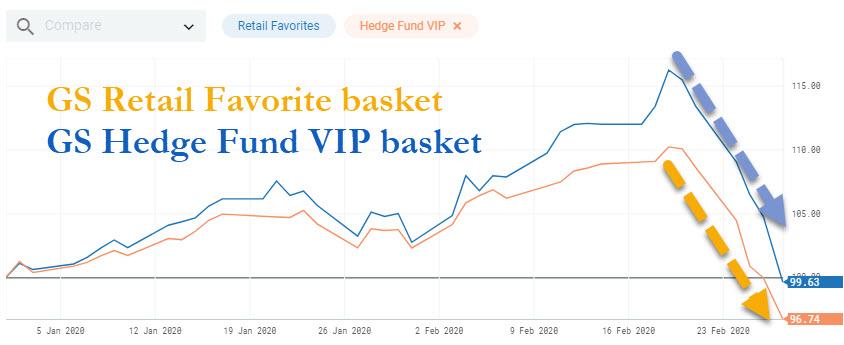
As a result, just this weekend we observed that in this “bizarro market”, retail investors had managed to outperform hedge funds YTD, a divergence which we said we “doubt divergence will last long”.

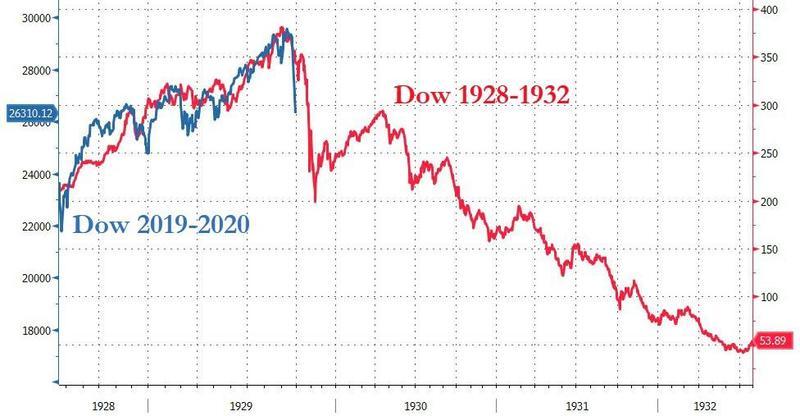
We didn’t have long to wait, and with stocks now skipping the elevator altogether and going the gravitational freefall route and crashing back to earth with the Dow entering the fastest correction from an all time high since just months before the Great Depression…

… the Goldman Sachs Retail Favorite basket, after returning more than 16% YTD just last week, is now down for the year (curiously, it is still outperforming the GS Hedge Fund VIP basket which as of this morning is down more than 3% in 2020.)

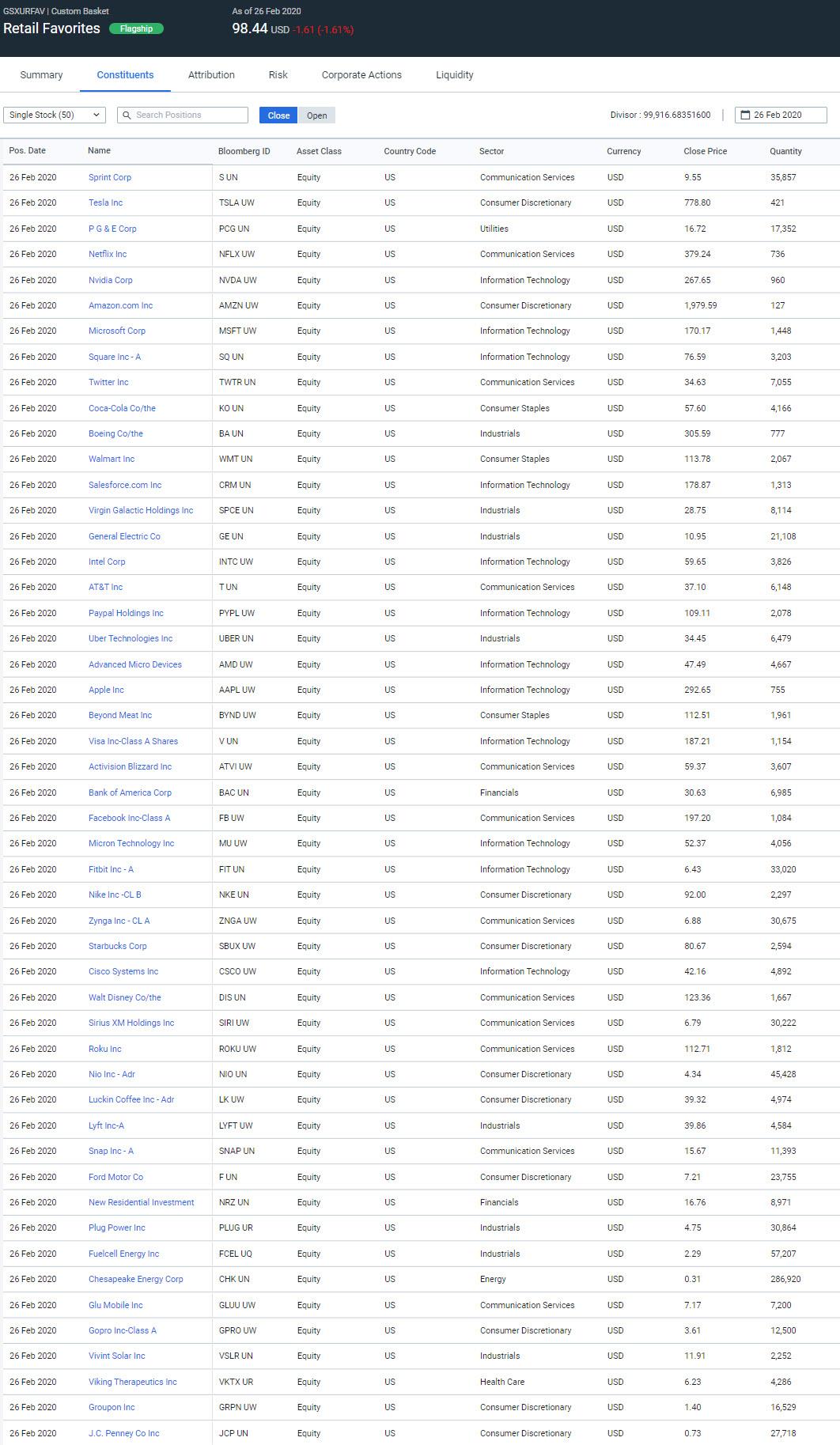
And while we pointed out that retail momo darling Tesla has gotten crushed, it’s just one of the 50 or so retail favorite stocks that make up the Goldman basket. So for those wondering which stocks they should short if this is indeed the long-awaited retail capitulation, the answer is below: these are all the 50 stocks that make up the Goldman Retail Favorites list.

Meanwhile, a quick look at the r/wallstreetbets forum on reddit, where the world’s biggest momentum chasers have now gathered (even making it to Bloomberg in the process), and where a lot of millennials got very rich, very fast, well… they are probably not quite as rich any more.


Tyler Durden

Thu, 02/27/2020 – 11:33

via ZeroHedge News https://ift.tt/2I4J0oA Tyler Durden

Why Libertarian-Leaning Reps. Massie and Amash Voted Against the House’s Anti-Lynching Bill

Why would two libertarian-leaning legislators vote against an anti-lynching law? Because lynchings are already illegal, and the law would further federalize crime and give prosecutors more power—including what amounts to an expansion of the federal death penalty.

On Wednesday, the House passed H.R. 35, the Emmet Till Antilynching Act, by a vote of 410 to 4. Those opposed included libertarian-leaning Reps. Justin Amash (I–Mich.) and Thomas Massie (R–Ky.); the other two voting “no” were Rep. Louie Gohmert (R–Texas) and Rep. Ted Yoho (R–Fla.).

The Senate version of the bill passed unanimously last year. There are slight differences between the new bills, but The Washington Post reports that House Democrats are optimistic their version the legislation will be quickly passed by the Senate. Supporters of the measure expressed incredulity that it took so long to pass federal anti-lynching legislation:

Some of the bill’s backers turned their fire on the four House members who dared to vote against it:

But they weren’t voting “FOR lynching.” As Amash notes, killing people because of their race is already a federal hate crime:

What H.R. 35 does is criminalize a conspiracy to violate existing federal hate crime laws or certain sections of the Civil Rights Act of 1968. It would also attach to these conspiracies the same punishment as the underlying crimes themselves, except in the case where the current crimes come with a maximum sentence of fewer than 10 years. In that case, the conspiracy to commit those crimes would be punishable by up to 10 years.

This, as Amash notes in a Twitter thread explaining his vote against the bill, would effectively expand the federal death penalty, which he would like to see abolished:

Amash also argues that the bill criminalizes conspiracies to commit crimes that the Constitution leaves to the states, thus doubling down on the federalization of criminal law. That, he points out, has not usually been a great development for the people anti-lynching legislation is supposed to protect.

Massie likewise raised constitutional concerns about the bill, while making the broader case against hate crimes as their special kind of criminal law.

“I voted against H.R. 35 because the Constitution specifies only a handful of federal crimes, and leaves the rest to individual states to prosecute,” he tells Reason. “In addition, this bill expands current federal ‘hate crime’ laws.  A crime is a crime, and all victims deserve equal justice.  Adding enhanced penalties for ‘hate’ tends to endanger other liberties such as freedom of speech.”

Gohmert took a different tack, arguing—contra Massie and Amash—that the bill doesn’t do enough to punish lynching at the federal level.

“A version of the bill released on January 3 of this year stated that anyone who assembles with the intention of lynching or who causes death by lynching ‘shall be imprisoned for any term of years or for life.’ The bill we voted on today does not include this clause,” Gohmert argued in a statement. “Such a hateful crime deserves a severe sentence, and I could not in good conscience vote on a bill that addresses lynching on such a low level.”

For his part, Yoho told Newsweek that H.R. 35 was federal overreach and that hate crimes should be handled at the state level.

There’s good reason to be concerned about expanding the number of things the federal government can prosecute as hate crimes, given how zealously the feds use such laws to stick people with harsh sentences they would never have gotten at the state level.

A good example is the case of Tiffany Harris, a black New York woman who was arrested in December 2019 after slapping three Jewish women while saying “fuck you, Jews.”

Harris was initially charged with a number of crimes by New York officials, the most serious of which was assault in the third degree, a misdemeanor punishable by up to a year in jail. If she were convicted under New York’s hate crime law, she could get up to four years in prison.

In January, the U.S. Department of Justice intervened in Harris’ case, charging her with three hate crimes that could add an additional 10 years to any sentence she gets at the state level. Federal officials argued that additional punishment was necessary to deter a rise in anti-Semitic attacks.

“Federal hate crime laws invite this sort of capricious, politically motivated intervention, which is especially troubling given their weak constitutional basis,” wrote Reason‘s Jacob Sullum at the time.

The anti-lynching bill that passed the House yesterday, whatever the good intentions behind it, will invite more federal prosecutions of this kind.

from Latest – Reason.com https://ift.tt/2TfMXMA
via IFTTT

Why Libertarian-Leaning Reps. Massie and Amash Voted Against the House’s Anti-Lynching Bill

Why would two libertarian-leaning legislators vote against an anti-lynching law? Because lynchings are already illegal, and the law would further federalize crime and give prosecutors more power—including what amounts to an expansion of the federal death penalty.

On Wednesday, the House passed H.R. 35, the Emmet Till Antilynching Act, by a vote of 410 to 4. Those opposed included libertarian-leaning Reps. Justin Amash (I–Mich.) and Thomas Massie (R–Ky.); the other two voting “no” were Rep. Louie Gohmert (R–Texas) and Rep. Ted Yoho (R–Fla.).

The Senate version of the bill passed unanimously last year. There are slight differences between the new bills, but The Washington Post reports that House Democrats are optimistic their version the legislation will be quickly passed by the Senate. Supporters of the measure expressed incredulity that it took so long to pass federal anti-lynching legislation:

Some of the bill’s backers turned their fire on the four House members who dared to vote against it:

But they weren’t voting “FOR lynching.” As Amash notes, killing people because of their race is already a federal hate crime:

What H.R. 35 does is criminalize a conspiracy to violate existing federal hate crime laws or certain sections of the Civil Rights Act of 1968. It would also attach to these conspiracies the same punishment as the underlying crimes themselves, except in the case where the current crimes come with a maximum sentence of fewer than 10 years. In that case, the conspiracy to commit those crimes would be punishable by up to 10 years.

This, as Amash notes in a Twitter thread explaining his vote against the bill, would effectively expand the federal death penalty, which he would like to see abolished:

Amash also argues that the bill criminalizes conspiracies to commit crimes that the Constitution leaves to the states, thus doubling down on the federalization of criminal law. That, he points out, has not usually been a great development for the people anti-lynching legislation is supposed to protect.

Massie likewise raised constitutional concerns about the bill, while making the broader case against hate crimes as their special kind of criminal law.

“I voted against H.R. 35 because the Constitution specifies only a handful of federal crimes, and leaves the rest to individual states to prosecute,” he tells Reason. “In addition, this bill expands current federal ‘hate crime’ laws.  A crime is a crime, and all victims deserve equal justice.  Adding enhanced penalties for ‘hate’ tends to endanger other liberties such as freedom of speech.”

Gohmert took a different tack, arguing—contra Massie and Amash—that the bill doesn’t do enough to punish lynching at the federal level.

“A version of the bill released on January 3 of this year stated that anyone who assembles with the intention of lynching or who causes death by lynching ‘shall be imprisoned for any term of years or for life.’ The bill we voted on today does not include this clause,” Gohmert argued in a statement. “Such a hateful crime deserves a severe sentence, and I could not in good conscience vote on a bill that addresses lynching on such a low level.”

For his part, Yoho told Newsweek that H.R. 35 was federal overreach and that hate crimes should be handled at the state level.

There’s good reason to be concerned about expanding the number of things the federal government can prosecute as hate crimes, given how zealously the feds use such laws to stick people with harsh sentences they would never have gotten at the state level.

A good example is the case of Tiffany Harris, a black New York woman who was arrested in December 2019 after slapping three Jewish women while saying “fuck you, Jews.”

Harris was initially charged with a number of crimes by New York officials, the most serious of which was assault in the third degree, a misdemeanor punishable by up to a year in jail. If she were convicted under New York’s hate crime law, she could get up to four years in prison.

In January, the U.S. Department of Justice intervened in Harris’ case, charging her with three hate crimes that could add an additional 10 years to any sentence she gets at the state level. Federal officials argued that additional punishment was necessary to deter a rise in anti-Semitic attacks.

“Federal hate crime laws invite this sort of capricious, politically motivated intervention, which is especially troubling given their weak constitutional basis,” wrote Reason‘s Jacob Sullum at the time.

The anti-lynching bill that passed the House yesterday, whatever the good intentions behind it, will invite more federal prosecutions of this kind.

from Latest – Reason.com https://ift.tt/2TfMXMA
via IFTTT

Tesla Burning: Down 30% In Days As Markets Blindsided By Worst Weekly Selloff Since The Financial Crisis

Tesla Burning: Down 30% In Days As Markets Blindsided By Worst Weekly Selloff Since The Financial Crisis

Stocks take the stairs up, and the elevator down… usually. In Tesla’s case, they took the elevator both up and then back down again.

While Tesla longs may have won the last month or two as the stock ripped from $300 to almost $1000 on a massive short squeeze – they are now starting to learn the very important (and very overdue) adage that when the tide goes out, you see who is swimming naked.

Yes, every millennial and annoying family member crowing over the last 2 months at family gatherings and social events about what investing geniuses they are for buying Tesla is now rushing to slam the sell button and get ahead of what is likely to be continued, non-stop selling, as the coronavirus pandemic continues to grind the global economy to a halt and strike the investing public with fear of the many unknowns that still remain.

Tesla is down about 12% today so far and about 30% off its 52 week highs. 

And Elon Musk, who had the chance to shore up his company’s balance sheet and pay off all his debt at a ridiculous valuation just weeks ago, may now be facing the reality that the train has left the station. 

Meanwhile, according to Robintrack which keeps track of bagholders retail investors – people haven’t even started to lighten up on the name yet…

…which means we may only be seeing the very beginning. 

We always knew that people who had entered the financial world over the last 10 years would eventually have to learn that markets simply don’t always go up, with no questions asked.

Now, it’s becoming clear that Tesla may wind up teaching that brutal lesson to many who desperately need it. 


Tyler Durden

Thu, 02/27/2020 – 10:59

via ZeroHedge News https://ift.tt/2HZFEn9 Tyler Durden

Rabobank: Markets Need To Start Pricing For One Of Two Things – One Bad, The Other Terrible

Rabobank: Markets Need To Start Pricing For One Of Two Things – One Bad, The Other Terrible

Submitted by Michael Every of Rabobank

It is that rarest of occasions. Not a global pandemic, because: 1) we still aren’t in one yet, officially; and 2) we have had that pandemic declaration made in the relatively recent past (2009-10). Rather, we are being told by well-known voices on Wall Street NOT to buy this particular dip in stocks, which closed down once again in the US (S&P -0.4%) to make it three losing sessions in three. The Nikkei is also down another 2.1% this morning in Asia. Furthermore, those “Kud-LOW” bond yields are also now Kud-LOWER, with the 10-year US Treasury at 1.30%, a new record that I suspect will not hold for long. Aussie 10s also hit a new record low of 0.84%, as once the virus hits housing prices in Sydney and Melbourne, the RBA will of course be forced to act.

Is that equity slump and yield-move justified though? Certainly, when the WHO notes that the spread of COVID-19 is now faster and wider outside China than within it. (Albeit with a further press report alleging that China’s numbers are far higher than being officially recognised). At time of writing we now have the first cases in new locations like Georgia, Greece, Finland, Macedonia, Norway, and Romania, to say nothing of suspicions of what may be happening unrecorded in Africa, as well as what looks like the first case in the US unrelated directly to China, and with 91 reported as under precautionary quarantine in the States too. This virus is indeed now threatening to spread at the pace previously seen in China in many other locations.

Yesterday also saw US President Trump make a public statement on COVID-19, and rather than be as dismissive as his recent tweets, he appointed Vice-President Pence as the “Virus Czar”, who will have direct responsibility for fighting what is now recognised as a real potential crisis – even if Trump again tried to accentuate the positive via talking up the possibility of a vaccine (which experts say is 12-18 months away). He also said he would be willing to take whatever financial virus-fighting package Congress offers, having asked for USD2.5bn and then seeing Democrats up this to USD8.5bn to try to out-bid him.

Australia has also just initiated its official virus emergency plan. Presumably this will not allow some Australian universities to continue doing what they have been doing until now: allegedly paying Chinese students to fly back into Australia via third countries to evade quarantine restrictions. Ah, the wonders of capitalism!

Meanwhile, other travel shutdowns and lockdowns are proceeding apace. Notably, Israel has become the first country to officially recommend, not yet order, that ALL international travel be postponed unless absolutely essential. Is that an over-reaction? The WHO and EU would of course scream “Yes” and “Because markets”. But what is an individual holiday, shopping trip, or business meeting weighed up against the fat tail-risk of catching and spreading a virus that might decimate an economy and kill an untold number? It is also an uncanny parallel with the 2013 movie “World War Z”, which for those who don’t recall saw Israel as the only global hold-out against a zombie plague. Of course, in the same movie religious fervour (loud singing) allows the plague in anyway; and here there is another ironic parallel, as Israel waits to see if South Korean Christian pilgrims who recently tested positive after returning from the Holy Land brought it in with them or picked it up on the flight home.

Regardless, markets now need to start pricing for one of two things. Either COVID-19 is going to spread, making an untold number sick and killing many others, and economies will go into lockdown as supply-chains are badly hit; or governments are going to lockdown anyway, the public are going to rapidly scale back most activities, and supply chains will again be badly hit. In either case, don’t buy the dips.

Tellingly, one Six Nations Rugby game has already been postponed, and there are real questions being asked over the safety of events such as Euro 2020, the Giro D’Italia, the Olympics, and even the annual Muslim Hajj to Saudi Arabia. (Please also see the special report we published yesterday on COVID-19 vs. the Spanish flu and previously-unrecognised “Sick-stematic risk” in the global economy.)

The other key market question is how FX will trade any global pandemic. For now some of the safe-haven shine seems to be coming off of the US Dollar following the dip in stocks and the Virus Czar appointment. However, as we have seen so far in recent years, and during the trade war, this is all a question of who has the least dirty (or virus-y) dirty shirt: the level of USD debt outstanding, and the fact that US imports paid for in USD are likely to crash in a World War Z scenario are both likely to mean that the Dollar gets a very strong bid again at some point – just as US Treasuries are, for example. (Not to say that gold won’t get a bid in a time of panic: it will.)


Tyler Durden

Thu, 02/27/2020 – 10:45

via ZeroHedge News https://ift.tt/2I35aYq Tyler Durden

The Last Time This Happened Was Days Before The Great Depression

The Last Time This Happened Was Days Before The Great Depression

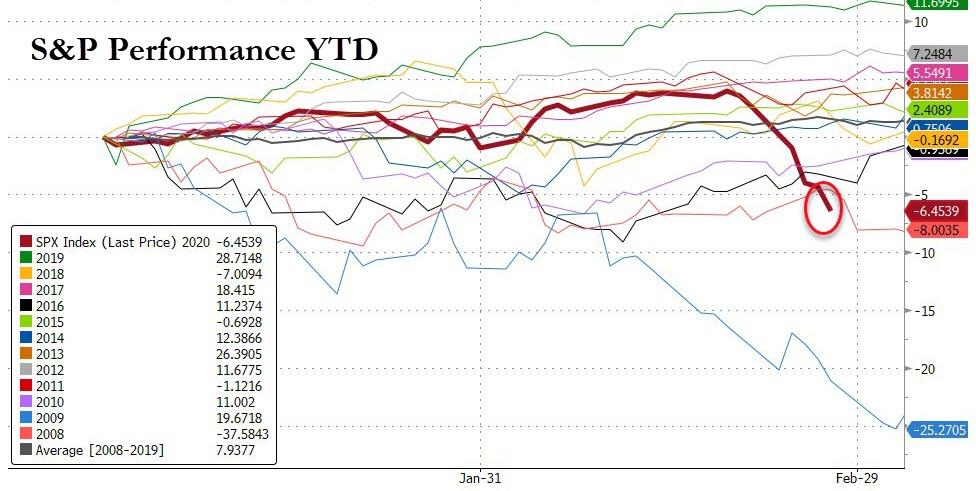
The US equity market is suffering its worst start to a year since 2009…

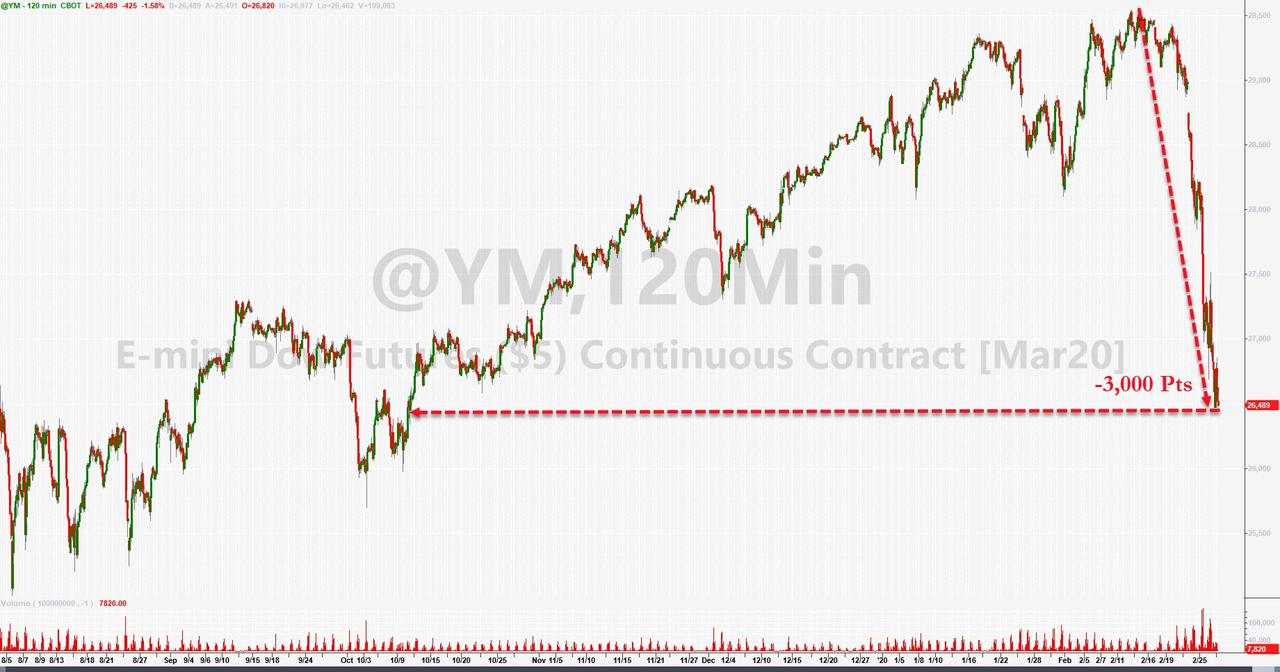
In the space of just six days, we went from record high to a ‘correction’ (over 3,000 Dow points and down over 10.5%)…

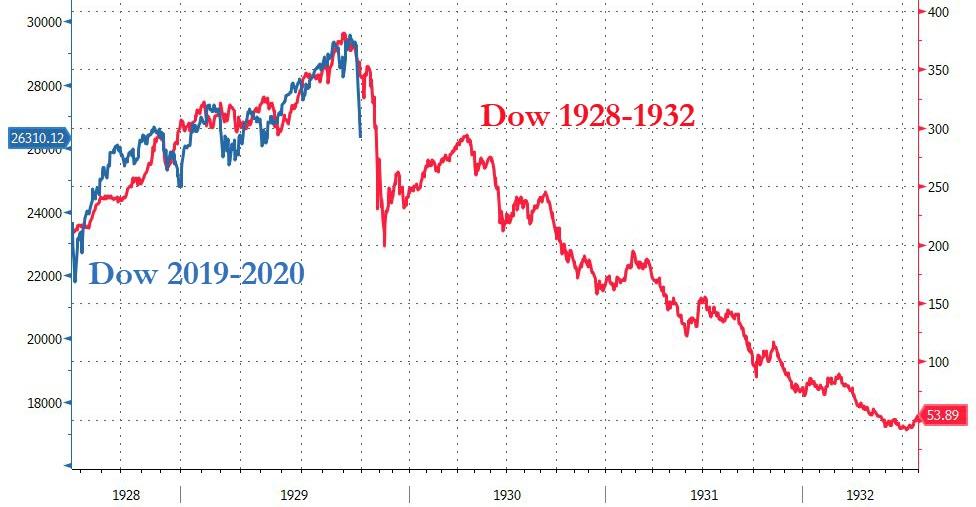
What is most ominous is the fact that, as NatAlliance Securities reports“This would be only the second time in history that this has happened. The other? 1928.”

In other words, the only other time the Dow Jones entered a correction this fast from an all time high was months before the start of the Great Depression.


Tyler Durden

Thu, 02/27/2020 – 10:30

via ZeroHedge News https://ift.tt/2Vrf8Lb Tyler Durden

Will A Face Mask Really Protect You From The Coronavirus?

Will A Face Mask Really Protect You From The Coronavirus?

Authored by Mac Slavo via SHTFplan.com,

Health officials have been suggesting the use of face masks to prevent the spread and transmission of the coronavirus, which is quickly spreading around the globe.  But the real question is do they really protect you from the virus?

The simple answer is yes, but efficacy is still not 100%. As masks sell out everywhere, it’s time to understand what they do to help.

If you decide to use a face mask, choose a NIOSH-approved N100 mask because it protects the wearer by fully covering the mouth. An N100 mask will help prevent inhalation of 99.7% of airborne germs, which means they aren’t a totally fail-proof method. N95 and N99 masks can also be effective. They are still your best bet IF you have a proper fit and it is not loose on the sides.  Protection from debris and materials that are larger than 0.3 microns or greater can be achieved with both N100 and P100 respirators, as well as N95 and N99 respirators.

Since the general consensus has been that the coronavirus is expelled from an infected person and remains on dust particles and water droplets in the air, these can be effective at preventing the inhalation of infected debris as long as the fit is correct. 

Also, it’s important to note that the “N” designation means that these respirators are not resistant to oil. The “P” indicates that a P100 respirator is oil proof, meaning it should also work, but may cost you a bit more. If that’s all you can find, however,  it could boost your chances of not getting sick. But again, the mask needs to fit correctly and that cannot be stressed enough. 

Don’t just use a mask and expect that to be enough either. Even if it’s properly worn, it’s only about 80% effective, according to doctors.  Take the same precautions you would with the flu. Avoid public places and crowds, stay at least six feet away from others, and cover your cough or sneeze.  Wash your hands well and sanitize the surfaces of your home frequently (bleach works well and it’s inexpensive), especially those often touched. Teach your children proper handwashing techniques and send them to school with hand sanitizer. Practice good hygiene and make sure you do the best you can to keep your immune system running on all cylinders.

If this becomes a pandemic, you’ll want to make sure you have stored extra food and water to keep from having to go to the grocery store often.

Prep For Cold & Flu Season: How To Boost Your Immune System Naturally

5 Easy Ways To Boost Your Immune System Naturally During Cold And Flu Season

Eat right, avoid too much stress, avoid overconsumption of alcohol and nicotine, and get an adequate amount of sleep to help your immune system stay on track. The coronavirus seems to be more deadly to those with a less effective immune system, such as the elderly.

Best Immune System-Boosting Foods To Get You Through Flu Season

The best way to beat the coronavirus is to not get it and not spread it.


Tyler Durden

Thu, 02/27/2020 – 10:15

via ZeroHedge News https://ift.tt/2TiIRDy Tyler Durden

Pending Home Sales Spike In January, Will Stock Slump Hurt Housing Market?

Pending Home Sales Spike In January, Will Stock Slump Hurt Housing Market?

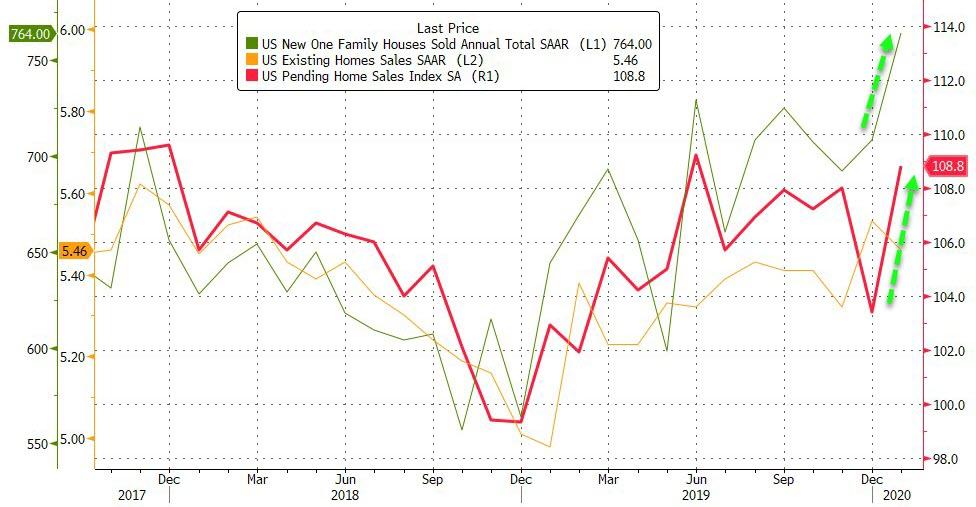
Once again, pending home sales is the tie-breaker in US housing as new home sales soared and existing home sales dipped in January.

Pending home sales fell 4.9% MoM in December and were expected to rebound 3.0% MoM in January but accelerated more, rising 5.2% MoM (and December was revised up to -4.3% MoM)

That MoM rise is the biggest jump since October 2010.

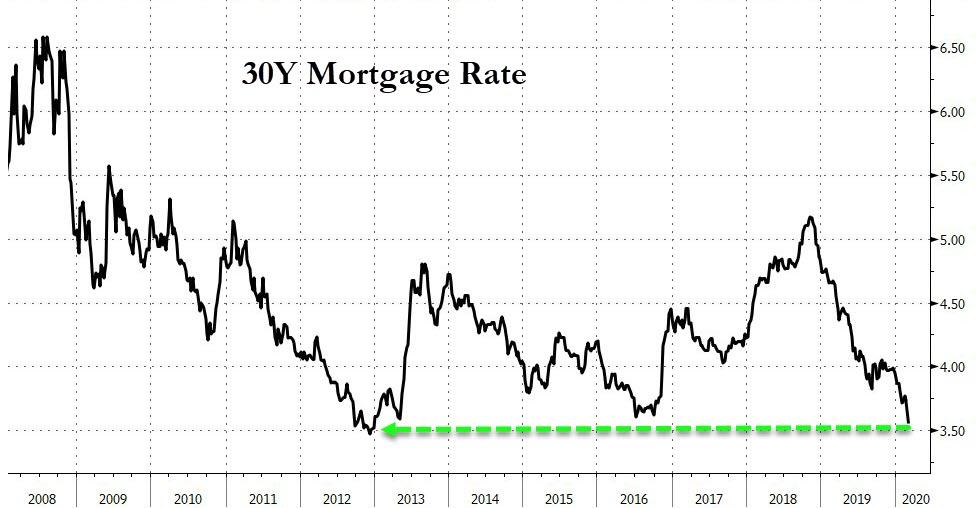
“This month’s solid activity — the second-highest monthly figure in over two years — is due to the good economic backdrop and exceptionally low mortgage rates,” Lawrence Yun, NAR’s chief economist, said in a statement.

“We are still lacking in inventory.”

Signings last month increased in all regions but the West. The index of pending sales jumped 8.7% in the South, the biggest region, to the highest level since March 2006.

Of course, mortgage rates have collapsed in recent days suggesting more demand…

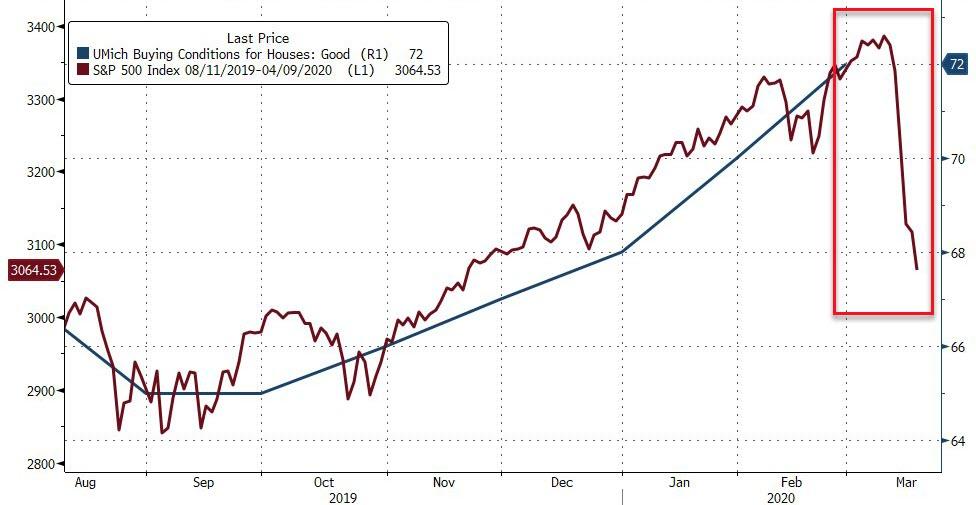
But, will the equity market plunge cause home-buying sentiment to slump?


Tyler Durden

Thu, 02/27/2020 – 10:04

via ZeroHedge News https://ift.tt/2T1RCTs Tyler Durden