Rickards: How Gold Is Manipulated

Rickards: How Gold Is Manipulated

Authored by James Rickards via The Daily Reckoning,

Is there gold price manipulation going on? Absolutely. There’s no question about it. That’s not just an opinion.

There is hard statistical evidence to make the case, in addition to anecdotal evidence and forensic evidence. The evidence is very clear, in fact.

I’ve spoken to members of Congress. I’ve spoken to people in the intelligence community, in the defense community, very senior people at the IMF. I don’t believe in making strong claims without strong evidence, and the evidence is all there.

I spoke to a PhD statistician who works for one of the biggest hedge funds in the world. I can’t mention the fund’s name but it’s a household name. You’ve probably heard of it. He looked at COMEX (the primary market for gold) opening prices and COMEX closing prices for a 10-year period.

He was dumbfounded.

He said it was is the most blatant case of manipulation he’d ever seen. He said if you went into the aftermarket, bought after the close and sold before the opening every day, you would make risk-free profits.

He said statistically that’s impossible unless there’s manipulation occurring.

I also spoke to Professor Rosa Abrantes-Metz at the New York University Stern School of Business. She is the leading expert on globe price manipulation. She has actually testified in gold manipulation cases.

She wrote a report reaching the same conclusions. It’s not just an opinion, it’s not just a deep, dark conspiracy theory. Here’s a PhD statistician and a prominent market expert lawyer, expert witness in litigation qualified by the courts, who independently reached the same conclusion.

How do these manipulations occur?

Currently the price of gold is set in two places. One is the London spot market, controlled by six big banks including Goldman Sachs and JPMorgan. The other is the New York gold futures market controlled by COMEX, which is governed by its big clearing members, also including major western banks.

In effect, the big western banks have a monopoly on gold prices even if they do not have a monopoly on physical gold.

The easiest way to perform paper manipulation is through COMEX futures. Rigging futures markets is child’s play. You just wait until a little bit before the close and put in a massive sell order. By doing this you scare the other side of the market into lowering their bid price; they back away.

That lower price then gets trumpeted around the world as the “price” of gold, discouraging investors and hurting sentiment. The price decline spooks hedge funds into dumping more gold as they hit “stop-loss” limits on their positions.

A self-fulfilling momentum is established where selling begets more selling and the price spirals down for no particular reason except that someone wanted it that way. Eventually a bottom is established and buyers step in, but by then the damage is done.

Futures have a huge amount of leverage that can easily reach 20 to 1. For $10 million of cash margin, I can sell $200 million of paper gold.

Hedge funds are now large players in the gold market. To a hedge fund, gold may be an interesting market in which to deploy its trading style. To them, gold is just another tradable commodity. It could just as well be coffee beans, soybeans, Treasury bonds, or any other traded good.

Hedge funds use what are called “stop-loss” limits. When they establish a trading position, they set a maximum amount they are willing to lose before they get out. Once that limit is reached, they automatically sell the position regardless of their long-term view of the metal.

Perhaps they don’t even have a long-term view, just a short-term trading perspective. If a particular hedge fund wants to manipulate the gold market from the short side, all it has to do is throw in a large sell order, push gold down a certain amount, and once it hits that amount, these stops are triggered at the funds that are long gold.

Once one hedge fund hits a stop-loss price, that hedge fund automatically sells. That drives the price down more. The next hedge fund hits its stop-loss. Then it sells too, driving the price down again. Selling gathers momentum, and soon everyone is selling.

Another way to manipulate the price is through gold leasing and “unallocated forwards.”

“Unallocated” is one of those buzzwords in the gold market. When most large gold buyers want to buy physical gold, they’ll call JPMorgan Chase, HSBC, Citibank, or one of the large gold dealers.

They’ll put in an order for, say, $5 million worth of gold. The bank will say fine, send us your money for the gold and we’ll offer you a written contract in a standard form. Yet if you read the contract, it says you own gold on an “unallocated” basis. That means you don’t have designated bars.

There’s no group of gold bars that have your name on them or specific gold bar serial numbers that are registered to you.

In practice, unallocated gold allows the bank to sell the same physical gold ten times over to ten different buyers.

It’s no different from any other kind of fractional reserve banking. Banks never have as much cash on hand as they do deposits. Every depositor in a bank thinks he can walk in and get cash whenever he wants, but every banker knows the bank doesn’t have that much cash. The bank puts the money out on loan or buys securities; banks are highly leveraged institutions.

If everyone showed up for the cash at once, there’s no way the bank could pay it. That’s why the lender of last resort, the Federal Reserve, can just print the money if  need be. It’s no different in the physical gold market, except there is no gold lender of last resort.

Banks sell more gold than they have. If every holder of unallocated gold showed up all at once and said, “Please give me my gold,” there wouldn’t be nearly enough to go around. Yet people don’t want the physical gold for the most part.

There are risks involved, storage costs, transportation costs, and insurance costs. They’re happy to leave it in the bank. What they may not realize is that the bank doesn’t actually have it either.

Gold holders should expect these games to continue until a fundamental development drives the price to a permanently higher plateau.

How does the individual investor stand up against such forces?

In the short run, you can’t beat them, but in the long run, you always will, because these manipulations have a finite life.

Eventually the manipulators run out of physical gold, or a change in inflation expectations leads to price surges even governments cannot control. There is an endgame.

History shows manipulations can last for a long time yet always fail in the end. They failed in the 1960s London Gold Pool, with the United States dumping in the late 1970s, and the central bank dumping in the 1990s and early 2000s. The gold price went relentlessly higher from $35 per ounce in 1968 when the London Gold Pool failed to $1,900 per ounce in 2011, the all-time high.

Price manipulation always fails. And the dollar price of gold will resume its march higher. The other weakness in the manipulation schemes appears in the use of paper gold through leasing, hedge funds, and unallocated gold forwards.

These techniques are powerful. Still, any manipulation requires some physical gold. It may not be a lot, perhaps less than 1% of all the paper transactions, yet some physical gold is needed. The physical gold is also rapidly disappearing as more countries are buying it up. That puts a limit on the amount of paper gold transactions that can be implemented.

My advice to investors is that it’s important to understand the dynamics behind gold pricing. Understanding these dynamics lets you see the endgame more clearly and supports the rationale for owning gold even when short-term price movements are adverse.

Gold will win in the end.


Tyler Durden

Thu, 02/27/2020 – 13:05

via ZeroHedge News https://ift.tt/3875EHH Tyler Durden
The Feds’ Bulk Collection of Our Data Records Has Been Expensive and Useless. But That Doesn’t Mean It’s Going to Stop.

The U.S. government spent $100 million collecting all our phone and text records for four years and got next to nothing out of it.

Try to contain your surprise. (I’m actually shocked it’s only $100 million.) This info comes from a newly declassified report from the federal Privacy and Civil Liberties Board. The report analyzes the call records program implemented by the USA Freedom Act in 2015, which formalized but also restrained the National Security Agency’s secret collection of Americans’ communications metadata.

Prior to the USA Freedom Act, the NSA had used the PATRIOT Act to justify collecting this data with neither the knowledge nor the consent of Americans, or even of Congress. Once Edward Snowden blew the whistle on this secret surveillance, the USA Freedom Act was hammered out as a compromise that gave the NSA much more limited access to collected metadata in order to pursue investigations using specific terms.

The USA Freedom Act sunsets in mid-March. We already know these searches haven’t been all that helpful, because the NSA has abandoned them. Part of the problem was repeated situations where attempts to collect records went awry and brought in far more private information than they were allowed to look at under the law.

This new report shows that the mass collection of Americans’ phone records turned out not to be a particularly good tool for tracking down terrorism. Its authors determined that the NSA wrote only 15 intelligence reports based on information from call records accessed through the law. Of those, 11 duplicated information that was already in FBI records. Two contained information that the FBI had received through other means. One led the FBI to vet an individual, but it ultimately decided not to open an investigation. So that just leaves just one case where the bureau received unique info that it decided to use to open a foreign intelligence investigation.

All that for $100 million!

A logical person would assume that letting these powers sunset would be the smartest choice. Why violate Americans’ privacy rights if even the government itself acknowledges the intrusions aren’t actually accomplishing anything? But logic means nothing next to institutional inertia. The government doesn’t like to give up any power or program, even when it’s not useful.

So now there’s a big congressional fight about renewing the USA Freedom Act. In January, a bipartisan pack of privacy-minded lawmakers introduced a bill that would formally end the bulk collection of Americans’ records and introduce other reforms to the secretive Foreign Intelligence Surveillance Amendment (FISA) Court to provide some more transparency and better protect Americans from unwarranted surveillance. Their bill has support of both the left-leaning tech activist group Demand Progress and the more conservative FreedomWorks.

But congressional leaders just want to push through a quick temporary renewal with some less modest fixes. Reps. Jerrold Nadler (D–N.Y.) and Adam Schiff (D–Calif.), chairs of the House Intelligence and Judiciary Committees, put together a reform bill of their own that would extend the USA Freedom Act until 2023. Nadler and Schiff’s bill would end the bulk data collection program but would extend the part of Section 215 of the Patriot Act that lets the FBI secretly collect business records it deems relevant to terrorism investigations. So the feds will be able to easily collect your data when it’s in the hands of a third party—and these days, that means most of your data.

Rep. Zoe Logren (D–Calif.), a strong privacy supporter who has previously teamed up with the likes of Reps. Justin Amash (I–Mich.) and Thomas Massie (R–Ky.) to try to limit the NSA and FBI’s warrantless snooping powers, was not happy about this weaker bill. She has announced plans to introduce amendments. Yesterday, rather than debating the merits of the proposal, Democratic leaders cancelled the hearing, apparently worried that stronger privacy protections could kill the Schiff-Nadler bill’s chances. Both FreedomWorks and Demand Progress have put out statements criticizing Schiff and Nadler for dodging the debate.

As Charlie Savage and Nicholas Fandos note at The New York Times, President Donald Trump is a wild card in this fight. Trump has railed against the FISA court and the surveillance state, due to the investigation of his presidential campaign. And some of his complaints were justified: Independent analysis have showed serious problems with how the FBI pursued its warrants to wiretap former Trump aide Carter Page, as well as a lack of openness and thoroughness with the FISA Court.

But the language the FBI used to justify snooping on Page is a completely different section of the law. And when Trump has been given opportunities to rein in federal surveillance of Americans not linked to Donald Trump, he did the exact opposite. Meanwhile, Attorney General William Barr has said he wants a “clean” reauthorization of the USA Freedom Act without any reforms at all, telling House Republicans that he can make administrative reforms to procedures. That’s the worst possible outcome, because it would give Barr the power to decide—in secret—whose privacy rights are protected and whose are not. It’s Congress’ job, not Barr’s, to put limits on the Justice Department’s surveillance authorities.

Trump, this morning, showed some support for FISA reforms, but again apparently connected to the belief that changes to the USA Freedom Act have any relevance to the investigation of his campaign. They don’t, but hey, if that’s what helps push through changes that better protect all our privacy, I’m not going to complain.

from Latest – Reason.com https://ift.tt/2T8cUPr
via IFTTT

Students Demand Censorship of ‘Coronavirus’ Theme Party

Some students at the State University of New York at Albany (SUNY-Albany) posted a video on Instagram that advertised a “coronavirus” themed party, complete with corona-beer-filled ice buckets and attendees in surgical masks. The video was subsequently deleted.

Tacky and insensitive? Sure. A reason for the administration to intervene? No.

Nevertheless, some other students have demanded that the university punish this “hate crime against Asian students and scholars.” Since the coronavirus originated in Asia and has so far mostly affected Asian people, the party is presumed to spread negative stereotypes about Asian people.

The Asian American Alliance at SUNY-Albany also called on the administration to investigate the students who posted the video and make them apologize.

In a statement, the administration described the party as “distasteful and hurtful.” The university also announced an investigation, and noted that any students who violated the university’s code of conduct will be punished.

But there’s nothing to investigate, sanction, or punish. SUNY-Albany is a public university, and as such, its students have the right throw dumb theme parties. Their expression is protected by the First Amendment, and the administration cannot take action against them, even if other students are offended by it.

“The act of hosting a party with a theme is itself expressive, and the First Amendment generally does not permit state actors—such as public universities—to make distinctions between whether expression is offensive or inoffensive,” wrote Adam Steinbaugh of the Foundation for Individual Rights in Education. “That’s why public officials, including those at public universities, cannot ban flag burningdrag shows, culturally appropriative Halloween costumes, and other expressive events that offend many other students, like an ‘ugly women’ contest.”

Topical theme parties on campuses often offend one group or another. The offended are entitled to feel that way, and to speak up about it. But they aren’t supposed to weaponize those feelings through the university’s disciplinary process.

from Latest – Reason.com https://ift.tt/2T5zPuH
via IFTTT

Students Demand Censorship of ‘Coronavirus’ Theme Party

Some students at the State University of New York at Albany (SUNY-Albany) posted a video on Instagram that advertised a “coronavirus” themed party, complete with corona-beer-filled ice buckets and attendees in surgical masks. The video was subsequently deleted.

Tacky and insensitive? Sure. A reason for the administration to intervene? No.

Nevertheless, some other students have demanded that the university punish this “hate crime against Asian students and scholars.” Since the coronavirus originated in Asia and has so far mostly affected Asian people, the party is presumed to spread negative stereotypes about Asian people.

The Asian American Alliance at SUNY-Albany also called on the administration to investigate the students who posted the video and make them apologize.

In a statement, the administration described the party as “distasteful and hurtful.” The university also announced an investigation, and noted that any students who violated the university’s code of conduct will be punished.

But there’s nothing to investigate, sanction, or punish. SUNY-Albany is a public university, and as such, its students have the right throw dumb theme parties. Their expression is protected by the First Amendment, and the administration cannot take action against them, even if other students are offended by it.

“The act of hosting a party with a theme is itself expressive, and the First Amendment generally does not permit state actors—such as public universities—to make distinctions between whether expression is offensive or inoffensive,” wrote Adam Steinbaugh of the Foundation for Individual Rights in Education. “That’s why public officials, including those at public universities, cannot ban flag burningdrag shows, culturally appropriative Halloween costumes, and other expressive events that offend many other students, like an ‘ugly women’ contest.”

Topical theme parties on campuses often offend one group or another. The offended are entitled to feel that way, and to speak up about it. But they aren’t supposed to weaponize those feelings through the university’s disciplinary process.

from Latest – Reason.com https://ift.tt/2T5zPuH
via IFTTT

Pope Cancels Event Over “Slight Illness” After Shaking Hands With ‘Mask-Wearing’ Public In St. Peter’s Square

Pope Cancels Event Over “Slight Illness” After Shaking Hands With ‘Mask-Wearing’ Public In St. Peter’s Square

The pope catching the coronavirus would certainly make an interesting sequel to Netflix’s “Two Popes.”

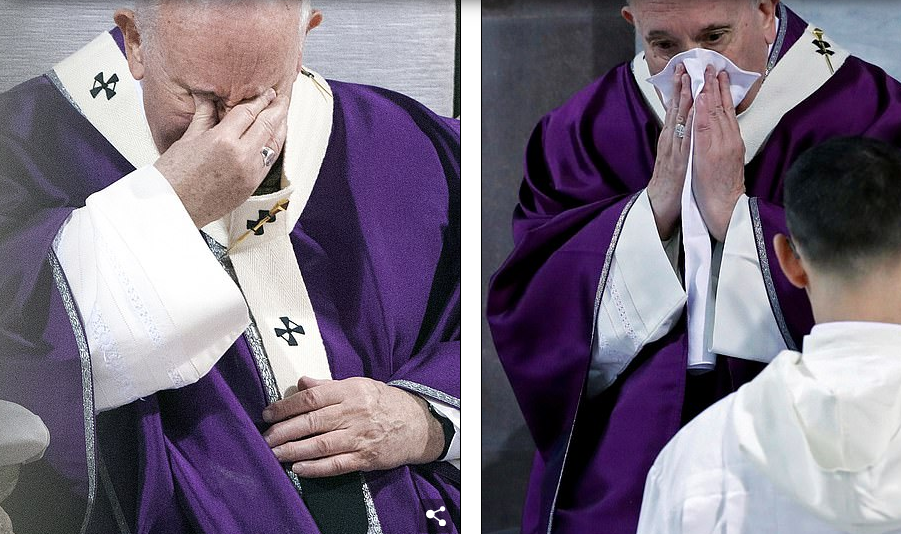
After breaking with his typical practice of waving and instead making a point to shake hands with revelers during his Ash Wednesday audience in St. Peter’s Square, media reports claim Pope Francis has fallen ill with a “slight illness”.

However, observers noted that he sounded hoarse and already appeared to have a slight cold during the Ash Wednesday service, quieting fears that he might have picked up the virus during the public audience, that was attended by thousands despite the outbreak in Italy sparking fears of public gatherings. The pope reportedly coughed during the service repeatedly.

As the Catholic season of Lent begins, the pope tweeted a blessing a few hours ago.

In a sign of strength from the Vatican, His Holiness will complete his regular schedule on Thursday after cancelling an event at a Rome basilica.

“Because of a slight indisposition, he preferred to stay inside Santa Marta,” the Vatican said, referring to the Vatican guest house where the 83-year-old pontiff lives.

“All other commitments will go ahead regularly,” spokesman Matteo Bruni said.

Bloomberg reports that the Vatican released a picture of the pope and Cardinal Antonio Tagle, a Filipino who has recently taken a new post in the Vatican, meeting on Thursday morning with members of the Global Catholic Climate Movement, an international environmental group in a meeting near the pope’s guest house. Many of the members of crowd on Wednesday wore protective gear including facemasks, even as the pope didn’t.

The pope looked markedly better than the Iranian ministry who appeared feverish during a public press conference.

For those who aren’t closely familiar with the pope’s background, his biographer reminded the press that Francis is missing a part of one lung from a brush with tuberculosis in his native Buenos Aires. He was in his early 20s when it was removed. He also reportedly suffers from sciatica, for which he regularly undergoes physical therapy, which is why he often has trouble climbing stairs.


Tyler Durden

Thu, 02/27/2020 – 12:50

via ZeroHedge News https://ift.tt/2I2uo9u Tyler Durden

Traders Now Betting On Two March Rate Cuts As OIS Craters

Traders Now Betting On Two March Rate Cuts As OIS Craters

With Chritsine Lagarde blowing up the market’s hopes for an emergency coordinated central bank rate cut, traders have decided to switch to the “stick” approach, and instead of asking nicely for another bailout from the Fed, they have decided to force one through.

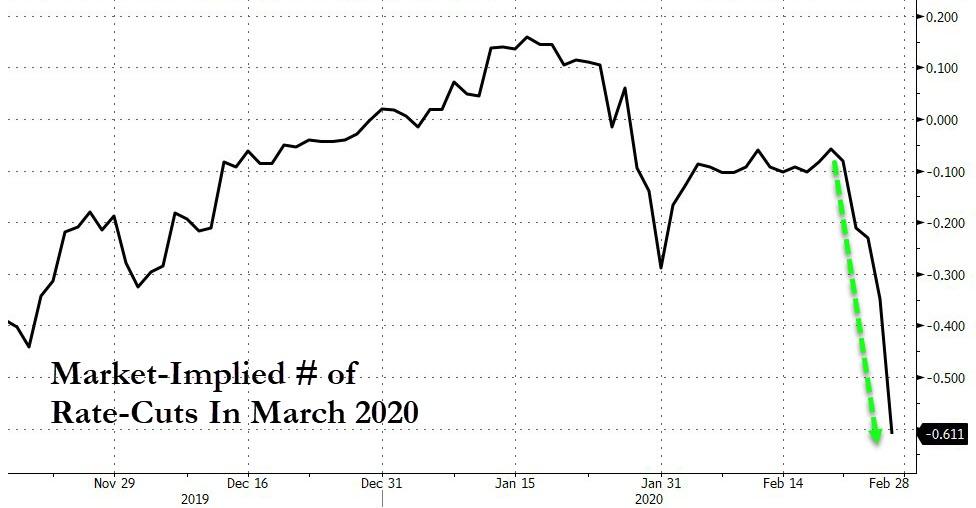
As a result, even as the latest overnight index swaps are cratering on Thursday as money markets start to price in a rate cut at the March FOMC meeting with the first Fed-dated OIS for March meeting dropping as low as 1.415% Thursday, implying 16.5bp of rate cuts, before settling around 1.44% after the Lagarde statement (around a 60% chance of a 25bps March rate-cut).

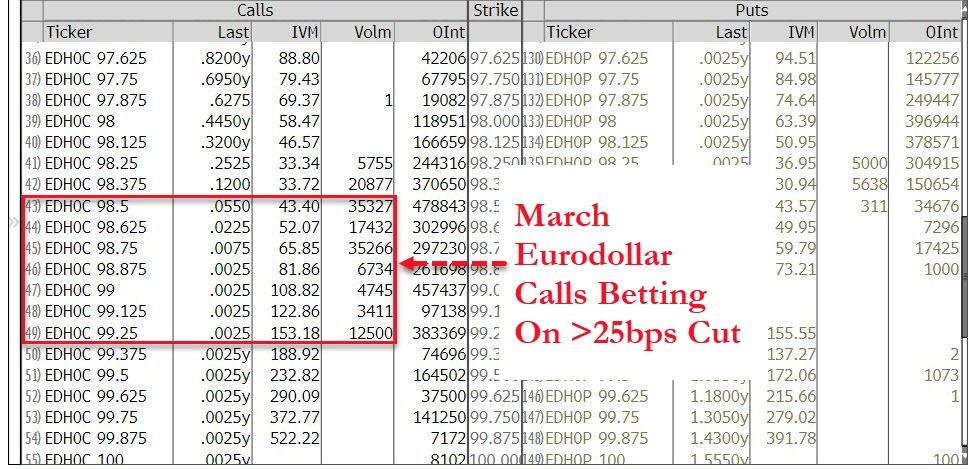
…but, aggressive eurodollar option traders have started to hedge for more than 25bp of easing at the March 17-18 meeting, i.e., the volume of calls betting on more than one 25bps cut are soaring.

Going further down the curve, some are going for broke, and betting on as many as 5 rate cuts by mid-year, which would send the Fed Funds just above 0%. As Bloomberg’s Edward Bolingbroke notes, “one of the largest eurodollar options flows Thursday morning targets a total of 125bp of rate cuts into the June 2020 futures, which are currently pricing in 55bp of cuts.” He adds that “the buying in the 99.50 strike was aggressive, including 125k bought at 1.25 ticks.”

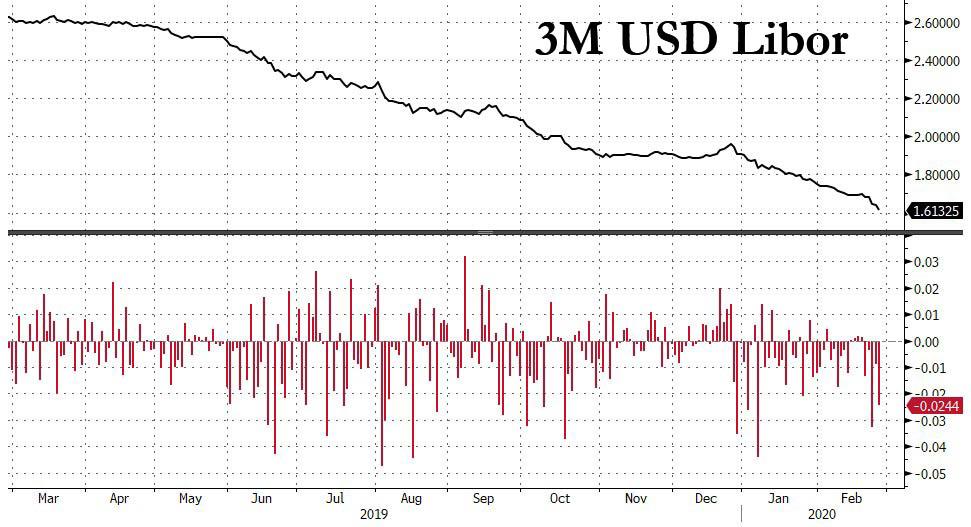
Meanwhile, following the manic moves in the Eurodollar strip, 3-Month USD Libor fixes are catching up, or rather down, with the front-end rally and has now dropped 11.6bp since last Wednesday to 1.58038, and from 1.61325% on Wednesday…

…  just marginally above current 1.58% effective Fed funds rate.

In short, if the Fed won’t agree to cut rates on its own, the market will force its hand.


Tyler Durden

Thu, 02/27/2020 – 12:35

via ZeroHedge News https://ift.tt/2vaIbbj Tyler Durden

Virginia Bill Targets Massage Parlor Workers

Legislation moving through the Virginia state legislature aims to make it easier to arrest and prosecute massage parlor workers for sexual touching. The bill—which passed the state House on February 11 and is currently in committee in the Senate—would amend Virginia’s prostitution law to include any touching of “the intimate parts of another with the intent to sexually arouse or gratify for money.”

As it stands, one must engage in or offer to engage in anal sex, “fornication…cunnilingus, fellatio, or anilingus” for pay to be guilty of prostitution. The new law would give police more room to prosecute massage-business-based sex work, which often involves erotic touching but not sexual penetration.

The authorities are (of course) pushing this as a way to combat “sex trafficking.” But in reality, it would simply make it easier for police to arrest people engaging in prostitution, whether or not they are being coerced or exploited.

Should the law pass, it will give Virginia law enforcement more ammunition to harass other massage business workers too, and to accuse them of prostitution on highly subjective grounds.

Proving an intent “to sexually arouse or gratify” may be a tough slog. But even if many convictions under this law prove elusive, it could still mean jail time for those arrested—significant amounts of jail time if they can’t pay bail. If the workers are immigrants, it could also mean trouble with Immigration and Customs Enforcement (ICE), even if they have legal status and even if no prostitution charge actually sticks. Simply being accused can be enough to run afoul of “good moral character” clauses in immigration law. And language barriers and lack of resources to pay a good lawyer also make it difficult for many immigrant masseuses and sex workers to get a fair shake.

In addition to making sexual touching sufficient to trigger a prostitution charge, the proposed legislation would make it a felony to employ anyone “for the purpose of causing such person to engage in the touching of the intimate parts of another person with the intent to sexually arouse or gratify.”

Henrico Deputy Commonwealth’s Attorney Mike Feinmel told the Richmond Times-Dispatch that going after the operators of massage businesses where prostitution takes place had previously proved too hard. He complained that prosecutors can often only charge them for “maintaining a bawdy place” (a misdemeanor).

This isn’t for lack of laws to punish more severe behavior, mind you. It’s that—despite time and again pursuing prostitution stings as “human trafficking busts”—Virginia police have failed to find evidence of human trafficking or other things that would warrant more severe charges.

A less punitive and panicked system than ours might conclude that police have been doing due diligence and that their worst fears are, thankfully, unfounded for now. Instead, the authorities have decided that if there are no felonies to be found in these businesses now—just some unauthorized handjobs—they’ll change the law to make it a felony to own a place where unauthorized handjobs take place.

from Latest – Reason.com https://ift.tt/2Tno1Tk
via IFTTT

Virginia Bill Targets Massage Parlor Workers

Legislation moving through the Virginia state legislature aims to make it easier to arrest and prosecute massage parlor workers for sexual touching. The bill—which passed the state House on February 11 and is currently in committee in the Senate—would amend Virginia’s prostitution law to include any touching of “the intimate parts of another with the intent to sexually arouse or gratify for money.”

As it stands, one must engage in or offer to engage in anal sex, “fornication…cunnilingus, fellatio, or anilingus” for pay to be guilty of prostitution. The new law would give police more room to prosecute massage-business-based sex work, which often involves erotic touching but not sexual penetration.

The authorities are (of course) pushing this as a way to combat “sex trafficking.” But in reality, it would simply make it easier for police to arrest people engaging in prostitution, whether or not they are being coerced or exploited.

Should the law pass, it will give Virginia law enforcement more ammunition to harass other massage business workers too, and to accuse them of prostitution on highly subjective grounds.

Proving an intent “to sexually arouse or gratify” may be a tough slog. But even if many convictions under this law prove elusive, it could still mean jail time for those arrested—significant amounts of jail time if they can’t pay bail. If the workers are immigrants, it could also mean trouble with Immigration and Customs Enforcement (ICE), even if they have legal status and even if no prostitution charge actually sticks. Simply being accused can be enough to run afoul of “good moral character” clauses in immigration law. And language barriers and lack of resources to pay a good lawyer also make it difficult for many immigrant masseuses and sex workers to get a fair shake.

In addition to making sexual touching sufficient to trigger a prostitution charge, the proposed legislation would make it a felony to employ anyone “for the purpose of causing such person to engage in the touching of the intimate parts of another person with the intent to sexually arouse or gratify.”

Henrico Deputy Commonwealth’s Attorney Mike Feinmel told the Richmond Times-Dispatch that going after the operators of massage businesses where prostitution takes place had previously proved too hard. He complained that prosecutors can often only charge them for “maintaining a bawdy place” (a misdemeanor).

This isn’t for lack of laws to punish more severe behavior, mind you. It’s that—despite time and again pursuing prostitution stings as “human trafficking busts”—Virginia police have failed to find evidence of human trafficking or other things that would warrant more severe charges.

A less punitive and panicked system than ours might conclude that police have been doing due diligence and that their worst fears are, thankfully, unfounded for now. Instead, the authorities have decided that if there are no felonies to be found in these businesses now—just some unauthorized handjobs—they’ll change the law to make it a felony to own a place where unauthorized handjobs take place.

from Latest – Reason.com https://ift.tt/2Tno1Tk
via IFTTT

Saudis Ban Mecca Pilgrimages Over Covid-19 Fears; Last Major Hajj Outbreak Killed 35,000

Saudis Ban Mecca Pilgrimages Over Covid-19 Fears; Last Major Hajj Outbreak Killed 35,000

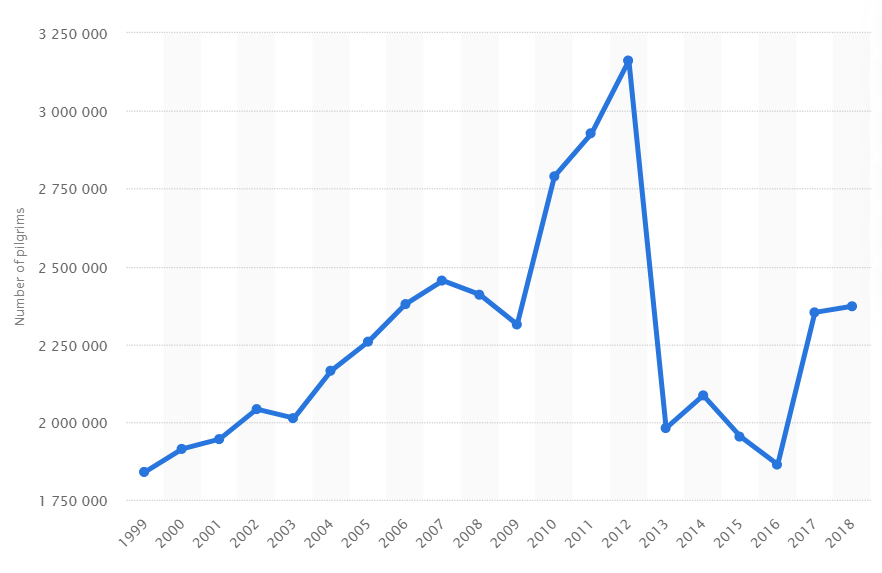
By far the largest annual gathering of humans in the world is the pilgrimage to Mecca, which in 2018 alone saw about 2.4 million Muslims make the religious trip. 

Given approximately a whopping quarter of world’s population identifies as Muslim, and each adherent is supposed to make the trip as a “religious duty” at least once in their lives, the latest coronavirus news out of the Middle East is almost unprecedented and hugely disruptive to travel patterns into the gulf region.

Saudi Arabia has now suspended entry visas for pilgrim’s wishing to visit the kingdom’s holy sites, the foreign ministry has announced. 

Hajj file photo, Mecca.

The AFP reports:

The government is “suspending entry to the Kingdom for the purpose of Umrah and visiting the Prophet’s Mosque temporarily”, the foreign ministry said in a statement, referring to the Islamic pilgrimage to Mecca that can be undertaken at any time of year.

Umrah attracts tens of thousands of devout Muslims from all over the globe each month.

“Saudi Arabia renews its support for all international measures to limit the spread of this virus and urges its citizens to exercise caution before travelling to countries experiencing coronavirus outbreaks,” the Saudi foreign ministry statement said. “We ask God Almighty to spare all humanity from all harm.”

Simultaneously, the Saudi foreign ministry said it’s suspending visas for any tourists coming from countries considered a “danger” for the spread of coronavirus. 

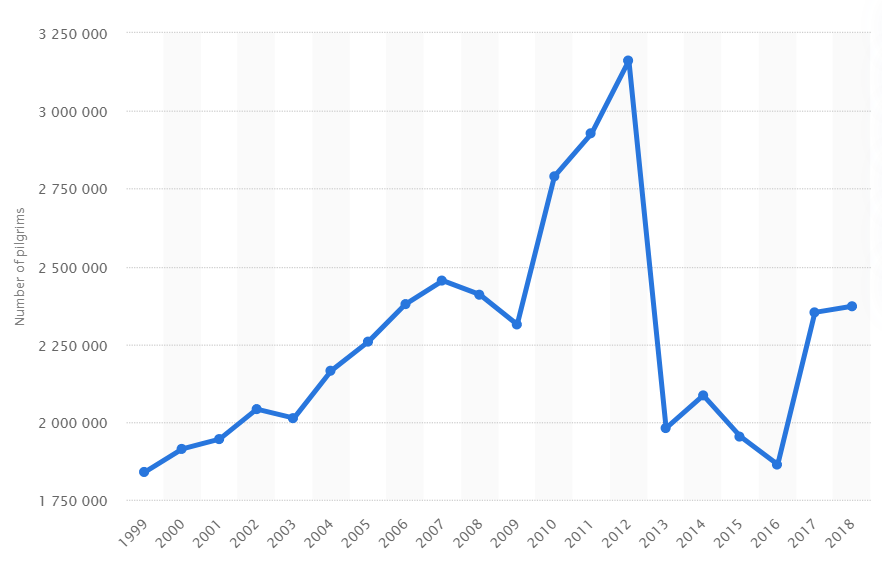
Annual number of Hajj pilgrims to Saudi Arabia from 1999 to 2018:

You will find more infographics at Statista

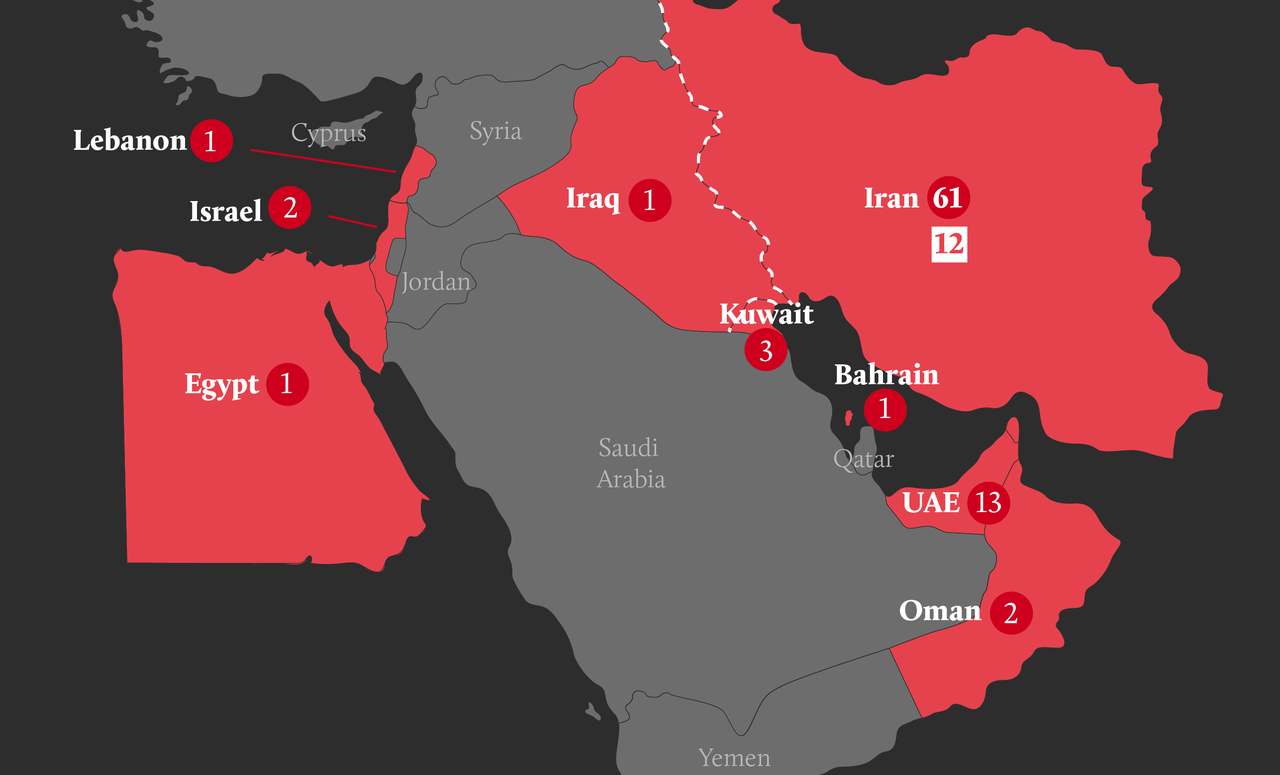
Countries surrounding Saudi Arabia have lately begun to report their first cases, especially the United Arab Emirates, which now has at least 13 confirmed cases, in a worrisome sign in could hit the gulf region hard, given also it’s a major international transport hub straddling east Asia and the West.

Kuwait, Bahrain, and Oman have also each reported a handful of cases, while numbers look to be soaring in panic-stricken Iran across the Persian Gulf.  

Though millions visit Mecca and Medina throughout the year, the surge of pilgrims reaches a peak during the 10-day Hajj, which is this year set for late July into early August. Spread of disease has always been a major concern, given the extremely “close quarters” during the major religious event.

Coronavirus around the region, according to the below Middle East Eye map. Iran’s numbers are now believed much higher than official figures.

According to Al Jazeera:

The earliest recorded outbreak came in 632 as pilgrims fought off malaria. A cholera outbreak in 1821 killed an estimated 20,000 pilgrims. Another cholera outbreak in 1865 killed 15,000 pilgrims and then spread worldwide.

More recently, Saudi Arabia faced danger from a related coronavirus that caused Middle East respiratory syndrome, or MERS.

Analysts are calling this latest banning of pilgrims to the kingdom “unprecedented” but necessary given the extreme danger for rapid spread of the virus. 

But given that the last major outbreaks recorded in the 19th century collectively killed a total estimated 35,000 people – authorities are taking no chances. 

Covid-19 has infected 80,000 people globally, mainly in China, and the CDC has this week admitted the outbreak could go in “any direction”.


Tyler Durden

Thu, 02/27/2020 – 12:20

via ZeroHedge News https://ift.tt/395ET7T Tyler Durden

SEC Slammed For “Shifting Standards” Following Latest Bitcoin ETF Rejection

SEC Slammed For “Shifting Standards” Following Latest Bitcoin ETF Rejection

Authored by Andrew Fenton via Coin Telegraph.com,

The US Securities and Exchange Commision has rejected New York based firm Wilshire Phoenix’s Bitcoin Exchange Traded Fund (ETF) application, citing ongoing concerns over market manipulation and a lack of surveillance-sharing agreements.

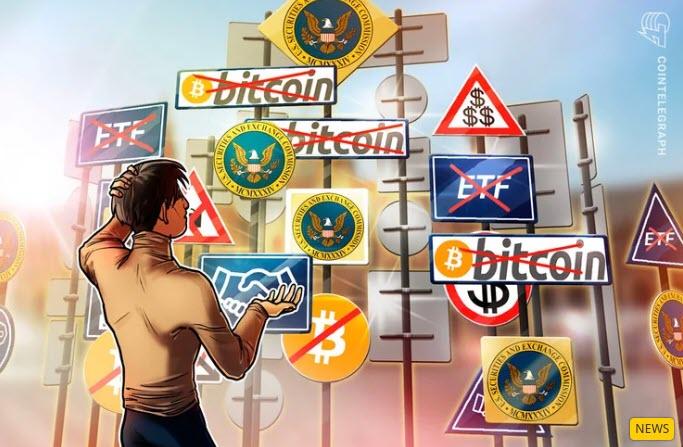
image courtesy of CoinTelegraph

Commissioner Hester ‘Crypto Mom’ Peirce has publicly disagreed with the rejection.

NYSE Arca had submitted a proposed rule change to allow the listing and trade of Wilshire Phoenix’s United States Bitcoin and Treasury Investment Trust. The proposal included both US Treasury Bonds and Bitcoin and hoped to address the SEC’s concerns over market manipulation by automatically rebalancing into bonds during periods of BTC price volatility.

Explaining the reasons behind its Wednesday ruling the SEC said the company had been unable to provide enough proof that it can protect itself from “fraudulent and manipulative acts and practices” in the Bitcoin market in order “to protect investors and the public interest.”

The SEC noted:

“The Commission must disapprove a proposed rule change filed by a national securities exchange if it does not find that the proposed rule change is consistent with the applicable requirements of the Exchange Act — including the requirement under Section 6(b)(5) that the rules of a national securities exchange be designed to prevent fraudulent and manipulative acts and practices.”

In her dissent to the rejection, Commissioner Peirce stated that the commission had “once again disapproved of a proposed rule change that would give American investors access to Bitcoin through a product listed and traded on a national securities exchange subject to the commission’s regulatory framework.”

“This line of disapprovals leads me to conclude that this Commission is unwilling to approve the listing of any product that would provide access to the market for Bitcoin and that no filing will meet the ever-shifting standards that this Commission insists on applying to Bitcoin-related products — and only to Bitcoin-related products.”

The SEC has rejected at least nine previous Bitcoin ETF applications to date including applications from Bitwise Asset Management, VanEck/SolidX and Direxion. Kryptoin and Crescent Crypto still have crypto ETF proposals awaiting decisions from the SEC.


Tyler Durden

Thu, 02/27/2020 – 12:06

via ZeroHedge News https://ift.tt/3ccZR6L Tyler Durden