“The Only Rule that Governs the Confirmation Process Is the Law of the Jungle”

In February 2016, after the tragic death of Justice Antonin Scalia, Benjamin Wittes and Miguel Estrada wrote on the demise of judicial confirmation norms in the Washington Post.  The advice they offered then, remains relevant today: “Assume that anyone who claims to be acting out of a pristine sense of civic principle is being dishonest.” This may have been a cynical take, but it’s hard to argue against.

As they wrote at the time:

We have both argued for a world in which judicial nominees receive prompt hearings and up-and-down votes based solely on their objective qualifications — education, experience and temperament. But that has not been our world for at least two decades. The savvy citizen should recognize as much and heavily discount anyone who speaks in the language of principle about the rules or norms that do or should govern the treatment of either a judicial nominee or the president who sends that nominee to the Senate. As recent history demonstrates, the only rule that governs the confirmation process is the law of the jungle: There are no rules. There is no point in pretending otherwise, as much as many of us wish it were not so.

We have come by this view with extreme reluctance. One of us was a judicial nominee who never got a vote from the Senate but who nonetheless publicly encouraged the Senate to support President Obama’s appointees, including an overwhelmingly qualified Supreme Court nominee of the opposite party. The other wrote editorials for The Post for many years decrying unreasonable Senate treatment of nominees of the Bill Clinton and George W. Bush administration alike and also wrote a book arguing for a restoration of norms of expeditious and fair consideration of nominees. Both of us believe that when presidents nominate qualified nominees, the Senate should confirm them, and that courts should be fully staffed at all times to dispense justice to the litigants who come before them.

Rarely has either of us lost an argument more completely at the hands of the entire political culture than we have lost this one.

Like Wittes and Estrada, I would prefer the Senate to focus on the objective qualifications of nominees, and not on whether Senators believe a judge embraces the proper judicial philosophy. Although this is not constitutionally required, I have long believed such a standard is implied because the Constitution does not distinguish between judicial nominations and other presidential nominations. [“The president . . . shall nominate, and by and with the Advice and Consent of the Senate, shall appoint Ambassadors, other public Ministers and Consuls, Judges of the supreme Court, and all other Officers of the United States.”]

Such a norm is what allowed for the unanimous confirmation of Justice Antonin Scalia, and near-unanimous confirmation of Ruth Bader Ginsburg, despite the fact that many Senators disagreed with them on many issues. (Consider: If pro-choice Senators should vote against a nominee who is skeptical of Roe, pro-life Senators should have voted against Ginsburg, who was replacing the reliably anti-Roe justice, Byron White.).

As Wittes and Estrada noted in 2016, however, this norm of largely deferring to the President’s nominees did not last very long. Indeed, some Senators actively sought to destroy it, finding other ways to obstruct nominees (as the Washington Post reported on Nov. 12, 1985) and eventually arguing that ideology alone was sufficient reason to oppose a judge’s confirmation (which was the point of a set of hearings held in 2001). Senators hold grudges, and unilateral disarmament is not a viable strategy, so the result was an escalating game of tit-for-tat. It may have begun in the 1980s, when the confirmation of judicial nominees was held up in election years, but rapidly metastasized, producing serious consequences.

As Wittes and Estrada noted, the back-and-forth has gone on long enough, that neither side can escape blame:

Republicans and Democrats put the blame on the other for the complete abandonment of rules and norms in the judicial confirmation process. Both are being insincere — whitewashing their conduct over a long period of time while complaining bitterly about the very same conduct on the part of the other side. Both have chosen, in increments of one-upmanship, to replace a common law of judicial nominations that was based on certain norms with one based on power politics alone.

Today, there is no principle and no norm in the judicial nominations process that either side would not violate itself and simultaneously demand the other side observe as a matter of decency and inter-branch comity.

Like Wittes, I spent years arguing for various de-escalatory reforms, but neither side was interested. True de-escalation requires sacrifice—a willingness not to take advantage of the upper hand—and that’s not a language today’s politicians understand. President George W. Bush re-nominated one of Clinton’s failed appellate nominees (Roger Gregory), over the objections of Republican Senators. This minor gesture was never reciprocated, nor repeated. The lesson learned was seems to have been that de-escalation is for suckers.

Wittes and Estrada concluded:

Our new judicial nominations system . . . came as a wolf. There were many good reasons, knowable at the time, not to let the wolf through the door. Both parties had other priorities — most important the perceived urgent need to prevent the other party from confirming its nominees. Appeals to principle and precedent ring hollow now — particularly because the parties are still appealing only to principles that any sentient observer knows they would not follow themselves.

I would like to think there is still a way back, but I am not sure what it is.  Term limits for justices might help lower the stakes, as could jurisdiction stripping, but I doubt such reforms would be enough. There is a need for more lower court judgeships, so there will be opportunities for Senators to work together for the health of our judiciary if they so choose, but I am not optimistic. Expanding the size of the Supreme Court would only make things worse, however, as it would represent yet another round of retaliatory escalation, and risk permanently compromising the Court’s ability to serve as a check on majoritarian excess. To me that’s a frightening prospect, but I am sure to some it would be a feature, not a bug.

from Latest – Reason.com https://ift.tt/2Shm4Yl
via IFTTT
“The Only Rule that Governs the Confirmation Process Is the Law of the Jungle”

In February 2016, after the tragic death of Justice Antonin Scalia, Benjamin Wittes and Miguel Estrada wrote on the demise of judicial confirmation norms in the Washington Post.  The advice they offered then, remains relevant today: “Assume that anyone who claims to be acting out of a pristine sense of civic principle is being dishonest.” This may have been a cynical take, but it’s hard to argue against.

As they wrote at the time:

We have both argued for a world in which judicial nominees receive prompt hearings and up-and-down votes based solely on their objective qualifications — education, experience and temperament. But that has not been our world for at least two decades. The savvy citizen should recognize as much and heavily discount anyone who speaks in the language of principle about the rules or norms that do or should govern the treatment of either a judicial nominee or the president who sends that nominee to the Senate. As recent history demonstrates, the only rule that governs the confirmation process is the law of the jungle: There are no rules. There is no point in pretending otherwise, as much as many of us wish it were not so.

We have come by this view with extreme reluctance. One of us was a judicial nominee who never got a vote from the Senate but who nonetheless publicly encouraged the Senate to support President Obama’s appointees, including an overwhelmingly qualified Supreme Court nominee of the opposite party. The other wrote editorials for The Post for many years decrying unreasonable Senate treatment of nominees of the Bill Clinton and George W. Bush administration alike and also wrote a book arguing for a restoration of norms of expeditious and fair consideration of nominees. Both of us believe that when presidents nominate qualified nominees, the Senate should confirm them, and that courts should be fully staffed at all times to dispense justice to the litigants who come before them.

Rarely has either of us lost an argument more completely at the hands of the entire political culture than we have lost this one.

Like Wittes and Estrada, I would prefer the Senate to focus on the objective qualifications of nominees, and not on whether Senators believe a judge embraces the proper judicial philosophy. Although this is not constitutionally required, I have long believed such a standard is implied because the Constitution does not distinguish between judicial nominations and other presidential nominations. [“The president . . . shall nominate, and by and with the Advice and Consent of the Senate, shall appoint Ambassadors, other public Ministers and Consuls, Judges of the supreme Court, and all other Officers of the United States.”]

Such a norm is what allowed for the unanimous confirmation of Justice Antonin Scalia, and near-unanimous confirmation of Ruth Bader Ginsburg, despite the fact that many Senators disagreed with them on many issues. (Consider: If pro-choice Senators should vote against a nominee who is skeptical of Roe, pro-life Senators should have voted against Ginsburg, who was replacing the reliably anti-Roe justice, Byron White.).

As Wittes and Estrada noted in 2016, however, this norm of largely deferring to the President’s nominees did not last very long. Indeed, some Senators actively sought to destroy it, finding other ways to obstruct nominees (as the Washington Post reported on Nov. 12, 1985) and eventually arguing that ideology alone was sufficient reason to oppose a judge’s confirmation (which was the point of a set of hearings held in 2001). Senators hold grudges, and unilateral disarmament is not a viable strategy, so the result was an escalating game of tit-for-tat. It may have begun in the 1980s, when the confirmation of judicial nominees was held up in election years, but rapidly metastasized, producing serious consequences.

As Wittes and Estrada noted, the back-and-forth has gone on long enough, that neither side can escape blame:

Republicans and Democrats put the blame on the other for the complete abandonment of rules and norms in the judicial confirmation process. Both are being insincere — whitewashing their conduct over a long period of time while complaining bitterly about the very same conduct on the part of the other side. Both have chosen, in increments of one-upmanship, to replace a common law of judicial nominations that was based on certain norms with one based on power politics alone.

Today, there is no principle and no norm in the judicial nominations process that either side would not violate itself and simultaneously demand the other side observe as a matter of decency and inter-branch comity.

Like Wittes, I spent years arguing for various de-escalatory reforms, but neither side was interested. True de-escalation requires sacrifice—a willingness not to take advantage of the upper hand—and that’s not a language today’s politicians understand. President George W. Bush re-nominated one of Clinton’s failed appellate nominees (Roger Gregory), over the objections of Republican Senators. This minor gesture was never reciprocated, nor repeated. The lesson learned was seems to have been that de-escalation is for suckers.

Wittes and Estrada concluded:

Our new judicial nominations system . . . came as a wolf. There were many good reasons, knowable at the time, not to let the wolf through the door. Both parties had other priorities — most important the perceived urgent need to prevent the other party from confirming its nominees. Appeals to principle and precedent ring hollow now — particularly because the parties are still appealing only to principles that any sentient observer knows they would not follow themselves.

I would like to think there is still a way back, but I am not sure what it is.  Term limits for justices might help lower the stakes, as could jurisdiction stripping, but I doubt such reforms would be enough. There is a need for more lower court judgeships, so there will be opportunities for Senators to work together for the health of our judiciary if they so choose, but I am not optimistic. Expanding the size of the Supreme Court would only make things worse, however, as it would represent yet another round of retaliatory escalation, and risk permanently compromising the Court’s ability to serve as a check on majoritarian excess. To me that’s a frightening prospect, but I am sure to some it would be a feature, not a bug.

from Latest – Reason.com https://ift.tt/2Shm4Yl
via IFTTT
Reputation Repair Service Costs as Measure for Damages in a Libel Case

From Dinkins v. Schinzel, decided Friday by Judge Jennifer A. Dorsey (D. Nev.):

Pro se plaintiff Kenneth Dinkins seeks default judgment against pro se defendant Geraldine Schinzel for libel per se. When Schinzel failed to comply with a court order after the parties’ settlement conference, I ordered default be entered against her and granted Dinkins the opportunity to move for default judgment under Federal Rule of Civil Procedure 55. Because Dinkins’s claim satisfies the factors outlined in Eitel v. McCool (9th Cir. 1986), I grant his motion, award him $43,000 in general damages, and close this case….

After a real-estate deal between Schinzel and Dinkins went sour, Schinzel published libelous statements about Dinkins and his business on the internet. In January 2019, I resolved the parties’ cross-motions for summary judgment, ordered them to attend a settlement conference, and—within ten days of the conference—to file a joint pretrial order. The parties failed to settle their dispute, and Schinzel stopped appearing in this litigation, ignoring Dinkins’s attempts to prepare the joint pretrial order and failing to file her own. Based on Schinzel’s apparent refusal to comply with my order and upon Dinkins’s motion, I entered default against her, dismissing her counterclaims, striking her answer to Dinkins’s complaint, and authorizing Dinkins to file a motion for entry of default judgment. Like his motion for default, Dinkins’s motion for default judgment is unopposed….

As default has already been entered in this case, I must take the complaint’s factual allegations as true, except those relating to damages…. The court reserves the power to require a plaintiff to provide additional proof of facts or damages in order to ensure that the requested relief is appropriate….

The second and third Eitel factors focus on whether Dinkins has stated a claim under which he can recover…. Dinkins’s complaint allegations, taken as true, state a claim for libel per se. Dinkins alleges that Schinzel published multiple false and defamatory statements about him on ripoffreport.com, calling him a “scam artist,” a “theif [sic],” “a pathological lier [sic][,] and a vulger [sic] low life that prays [sic] on trusting individuals.” She also accused Dinkins of “running a criminal enterprise,” claimed that he “stalks” others, had “no license of any kind,” ran a real-estate website teaching others to “scam,” and she asserted that he is “being investigated for selling vacant land illegally across state lines.”

Dinkins alleges that Schinzel knew these claims were untrue when she made them. Finally, Dinkins claims that these defamatory remarks damaged his business as both a real-estate investor and a real-estate investing coach. So this factor weighs in favor of entering a default judgment against Schinzel….

[T]he court [also] considers the amount of money at stake in relation to the seriousness of the defendant’s conduct. For a libel per se claim, Dinkins is entitled to presumed, general damages, largely because of the “impossibility of affixing an exact monetary amount for present and future injury to the plaintiff’s reputation, wounded feelings and humiliation, loss of business, and any consequential physical illness or pain.” However, such damage claims must “still be supported by competent evidence.”

Dinkins maintains that he is entitled to $300,000, which is the sum of his allegedly lost business revenue and the cost of hiring a professional company to repair his online reputation. Dinkins’s estimates about his lost revenue are speculative at best. He does not provide evidence of prior or lost sales, but instead attaches alleged text and email conversations in which individuals decline to do business with him, citing their concerns about his reputation. {Dinkins admits that it is “impossible” to know the extent of Schinzel’s damage to his reputation or determine who would have bought properties from him, absent her libelous statements.}

Dinkins also attaches estimates from ReputationX and DMA, both of which perform search-engine optimization to suppress negative online content and promote positive articles. DMA charges $18,000 per month for an indeterminate number of months, and caters to “celebrities” and “professional athletes.” ReputationX requires an initial $3,000 investment, with an additional $5,000 per month, every month, for up to twelve months. Absent concrete evidence regarding Dinkins’s lost revenues, anticipated or otherwise, or the need for DMA’s “aggressive” services, I cannot authorize an award of $300,000—such an amount would be exceedingly harsh. But Dinkins has provided sufficient evidence warranting damages in the amount needed to hire ReputationX for eight months, for a total of $43,000. So this factor weights in favor of awarding default judgment….

Under these circumstances, default judgment is warranted here. Dinkins is entitled to a default judgment of $43,000 against Schinzel for his libel per se claim….

from Latest – Reason.com https://ift.tt/3jaGvlI
via IFTTT

China’s Too-Big-To-Fail Real Estate Giant Averts Liquidity Crisis

China’s Too-Big-To-Fail Real Estate Giant Averts Liquidity Crisis

Tyler Durden

Tue, 09/29/2020 – 21:25

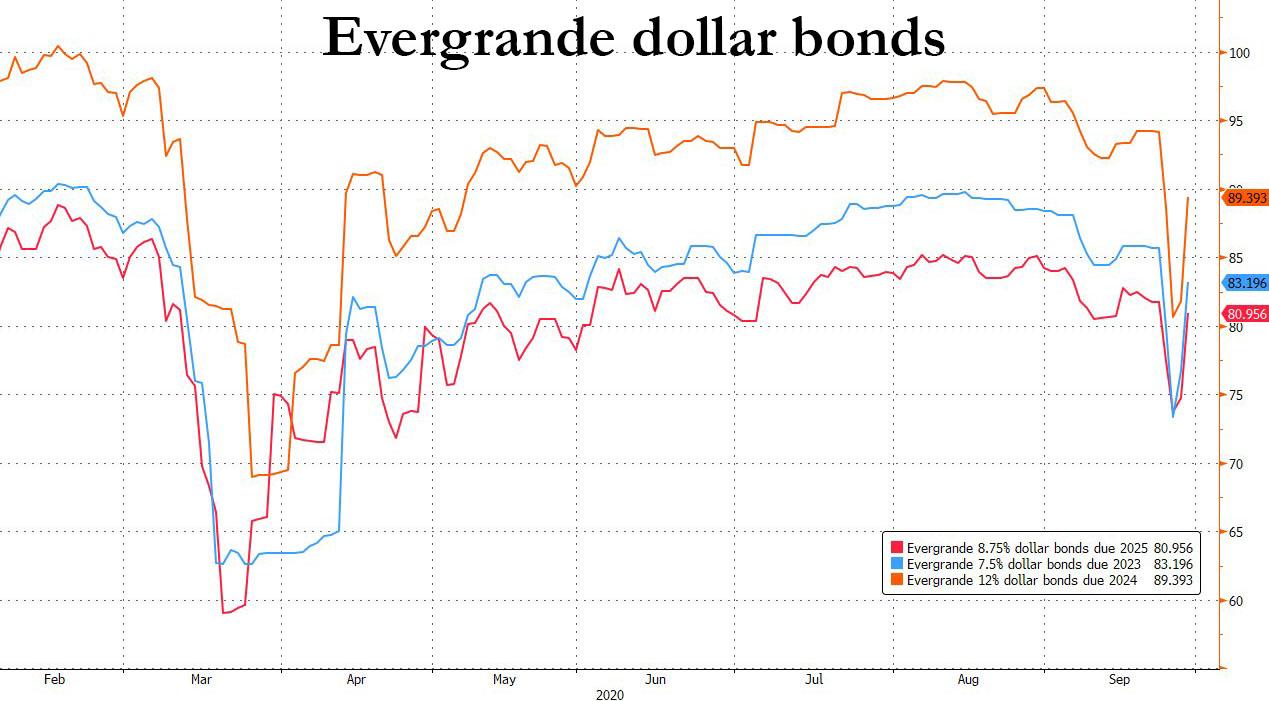
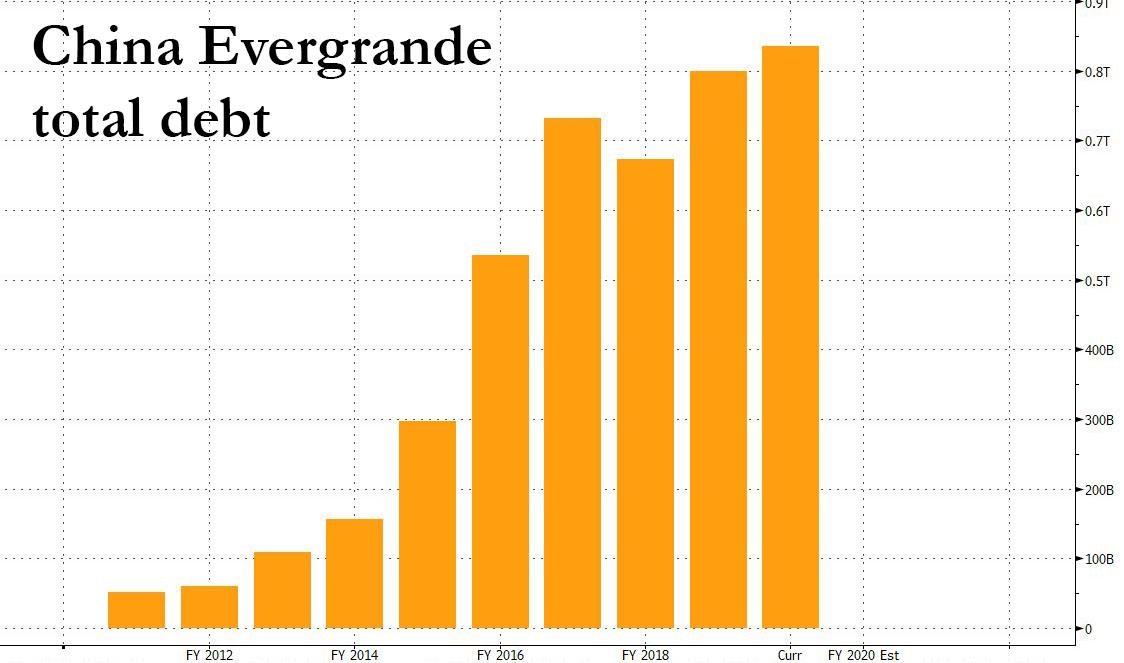
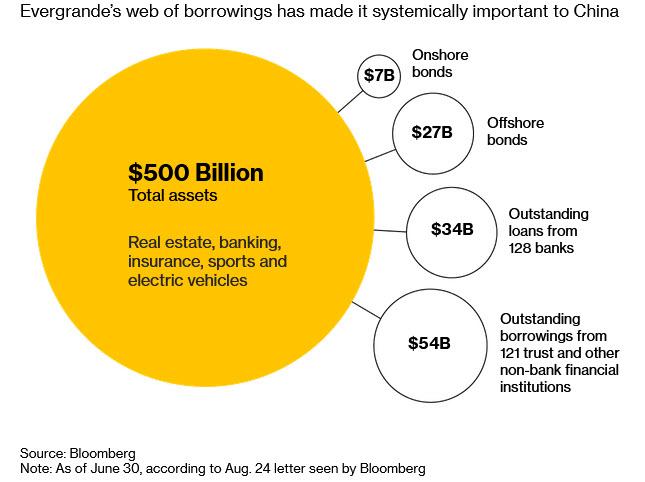
Last week, we reported that Beijing was suddenly on edge after a core pillar of China’s housing market – China Evergrande, the mainland’s second largest and the world’s most indebted property developer, saw its stock plunge and its bonds briefly halted following reports it was seeking government help to stave off a cash crunch caused the price of its shares and debt to tumble, and sparking a crisis of confidence among creditors who’ve lent the world’s most indebted developer more than $120 billion.

At the heart of Evergrande’s problems was its massive debt which had hit the brick wall of China’s suddenly careening housing market, leaving the company in a liquidity crunch and locked out from capital markets, preventing it from continuing its unprecedented debt expansion at a time it was facing a brutal debt maturity schedule which sees billions in existing yuan and dollar bonds set for repayment.

As we concluded, “If the company remains locked out of capital markets, if it can’t restore access to its line of credit, and unless it can complete its reverse merger, it just may be over for Evergrande, and also for China’s gargantuan housing bubble.”

Fast forward to Tuesday, when the Chinese conglomerate – on the edge of a liquidity and solvency abyss – took a critical step toward avoiding a cash crunch that had threatened to roil the nation’s $50 trillion financial system and reverberate across global markets.

As Bloomberg reports, following a turbulent few days which saw Evergrande bonds plunge and in which banks, bondholders and senior government officials grew alarmed about Evergrande’s financial health, the world’s most indebted developer said it reached an agreement with a group of strategic investors to avoid repayments that would have soaked up most of the company’s available liquidity and potentially crippled the junk-rated company’s balance sheet.

On Tuesday, Evergrande said that investors holding equity stakes worth about 86.3 billion yuan ($12.7 billion) agreed to keep their shares and not require the company to buy them out. That group represents the majority of the 130 billion yuan in shares held by strategic investors in its Hengda Real Estate unit, who could demand repayment in January under certain conditions. Evergrande is also in talks with the remaining investors on similar deals. The developer has finished negotiations with investors holding 15.5 billion yuan of equity interests, who are seeking further approvals. Talks with investors holding the remaining 28.2 billion yuan are ongoing.

The deal buys crucial time for Evergrande to rein in a complex web of liabilities that some analysts have said makes the property behemoth too big to fail.

“The agreement solves the core issue of Evergrande, which is liquidity concern,” said Raymond Cheng, a property analyst at CGS-CIMB Securities. It’s also known as “kicking the can.”

As reported last week, as part of an agreement Evergrande struck with some of its largest investors, the company raised about 130 billion yuan ($19bn) by selling shares in its subsidiary Hengda Real Estate which it hoped to float on the Shenzhen’s stock exchange through a merger with an already listed company; Evergrande would need to repay investors if failed to win approval for a backdoor listing on the Shenzhen stock exchange by Jan. 31. 

Evergrande owes $88 billion to banks, shadow lenders and individual investors across China and has borrowed $35 billion from bondholders around the world. More than 2 million homebuyers have given the company down payments on yet-to-be-completed properties.

Relief after Evergrande’s announcement late Tuesday in Hong Kong helped send the company’s dollar bonds surging, although at 80 cents on the dollar it was still trading slightly lower than before investor angst exploded to the fore on Thursday.

Last week’s losses came after reports that Evergrande had warned provincial officials of a liquidity squeeze, citing its obligation to return money to some strategic investors if it failed to win approval for a backdoor listing of its main real estate assets in China by Jan. 31. While Evergrande dismissed the reports as based on rumors and “fabricated” documents, the news contributed to a selloff in high-yield bonds across Asia and prompted several Chinese banks to hold emergency meetings to assess their exposure.

While it was unclear if China’s authorities played any role in the agreement, China’s cabinet and its financial stability committee, chaired by Vice Premier Liu He, have discussed risks posed by Evergrande without making any decisions on whether to intervene, Bloomberg reported citing people familiar with the matter said before Evergrande’s announcement.

Had the company failed to reach an agreement with investors, Chinese regulators were considering options to support the developer, such as directing state-owned companies to take stakes in Evergrande or giving the company a green light for its proposed listing of an electric-vehicle unit in China, Bloomberg added, confirming just how “systemic” the company is to Beijing and the local economy. 

In the end, those pragmatists who were confident that China would not allow the company to fail were proven right. Indeed, speculation that authorities would bail out the company solve any liquidity problems is one reason why its shares and bonds rallied even before Tuesday’s announcement.

The amusing irony is that even though China’s government has long threatened it would allow critical companies to fail, it boldly continues its long history of bailing out systemically important companies to maintain financial stability. While policy makers have in recent years sought to instill more market discipline and reduce moral hazard, the economic shock caused by the Covid-19 pandemic has refocused their attention on stability.

via ZeroHedge News https://ift.tt/2HB9HV2 Tyler Durden

The Fed Has Given Big Business A Huge Advantage

The Fed Has Given Big Business A Huge Advantage

Tyler Durden

Tue, 09/29/2020 – 21:05

Authored by Bruce Wilds via Advancing Time blog,

The last few months have been painful for small businesses across America. These businesses often have a difficult time getting a bank loan. Bubbling up to the surface is the recognition the Fed has played a major role in pushing inequality higher. This was highlighted when Federal Reserve chairman Jerome Powell admitted it’s tough for the Fed to boost lending to smaller businesses. “Trying to underwrite the credit of hundreds of thousands of very small businesses would be very difficult,” Powell said. He acknowledged that many of these small loans are really nothing more than the personal promises of people struggling to keep the doors of their business open.

And it’s gone!

As the financial pain from the pandemic and government restrictions placed on businesses continue, much of the money thrown out to ease our pain has rapidly flowed into the hands of Wall Street and big business. The reality that most small businesses close in failure underlines the risk involved in loaning money to such concerns. Still, it is difficult to deny the importance of small business in the overall economy. It plays a major role in communities by both creating jobs and allowing individuals to better their lot in life.

During a recent exchange between House Financial Services Committee Chairwoman Rep. Maxine Waters of California and Powell, it became evident that Powell was not rushing to implement changes in the way things are done in an effort to aid small businesses and level the playing field. Waters suggested the Fed and Treasury Department lower the minimum size of the loans under the Main Street Lending Program to $100,000 from the current $250,000 to help a larger number of small companies that have been hurt by the pandemic. Powell even went so far as to claim there was little demand for loans below $1 million.

A business owner struggling to pay his three workers would dispute Powell’s statement about little demand for smaller loans. Both Powell and Treasury Secretary Steven Mnuchin have also voiced concern about the commercial real estate sector and how they both indicated it is not easy for the federal government to craft an aid program to blunt the damage growing in this part of the economy. Mnuchin said the PPP program has played a role in enabling firms to continue paying their rent so landlords can pay their mortgages. There is fear building in the area of commercial real estate that defaults will send property values into a downward spiral.  

Sadly, the same policies that dump huge money into larger businesses because it is an easier and faster way to bolster the economy give these concerns a huge advantage over their smaller competitors. A big problem is that this often is enough to put smaller companies out of business. The damage this is doing to society is something that will be difficult to remedy. Once businesses close a series of negative events generally unfold such as buildings going empty and debts not being paid. This tends to impact the economy and communities for years.

On Thursday Powell and Mnuchin appeared before the Senate Banking Committee and answered even more questions about the hardship the coronavirus has brought upon the economy. While they see significant support for legislation that supports jobs and extending the PPP the recognized the gap between the House and Senate negotiations. Still, they gave little doubt more money and fiscal support will be needed and they are ready to act. This includes looking at ways to expand the Main Street lending facility and make the programs more flexible. This means we will probably see more money flowing into a forgivable loan or grant programs. Both indicated the need to get more PPP money to businesses with decreased revenue saying it would be very important in the effort to save jobs.

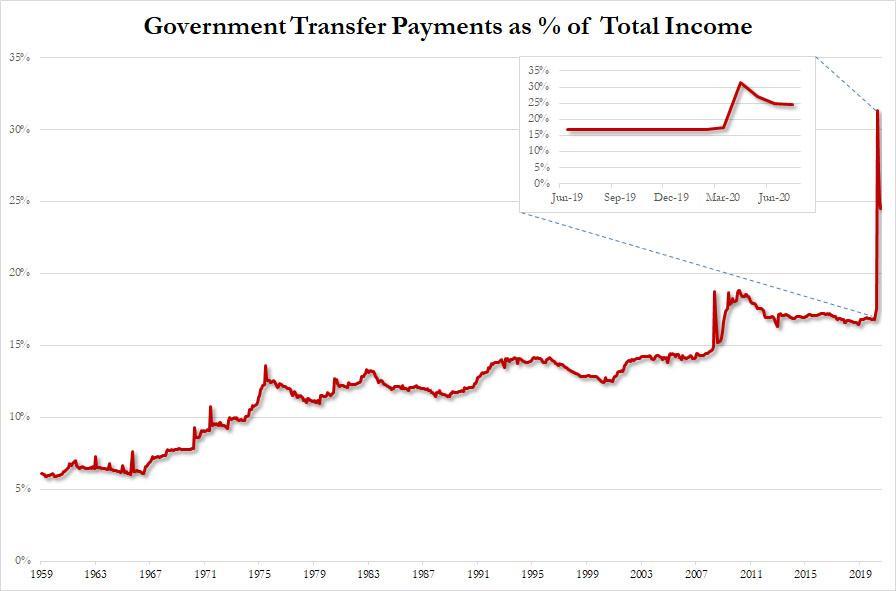
The recession this year due to covid-related shutdowns is bizarre in nature due to the extreme intervention of central banks and governments. We have seen many small businesses devastated at the same time personal incomes have soared. Usually, a recession is marked by a fall in incomes or consumers being tapped out and unable to spend. The massive fiscal stimulus that has been unleashed by the U.S. government has led to the biggest surge in personal income in history. In fact, government transfer payments have soared to where they constitute an unheard of 30% of all personal income.

Government Transfer Of Payments Has Soared

To put this into context, the  transfer of payments has been rising for decades but the covid-19 crisis has allowed it to explode. During the 50s and 60s, it was around 7%. for a short period in the mid70s and following the 2008 financial crisis it hit the high teens. as the chart on the left indicates this is far above any intervention we have experienced in the past. This is why in this bizarre economy nobody should consider the GDP as an indicator of our economic health.  

In short, the Fed has been subsidizing the 1% at a heightened pace for the past decade and this has both spurred inequality and given big business a huge advantage in the ability to fund its needs. It also means the government has been funding the lives of every American to a greater extent. From the talk now being bantered around, it sounds like all these people are talking about again releasing trillions of dollars into the economy. We should all be aware that the longer this goes on the more power is shifted away from the people and the small businesses that line Main Street.

A final thought, it is all very difficult to square this with what Richmond Fed President Tom Barkin said on Thursday, “The U.S. recession was severe but also short and is now over.”

Ironically, this is also the same day that St. Louis Fed President James Bullard claimed the economy could fully recovery on some metrics by the end of this year. In my opinion, more important than squaring such talk is the fact small business has taken the brunt of pain dished out while Wall Street and big business have eaten their lunch.

via ZeroHedge News https://ift.tt/3kYrJyV Tyler Durden

Watch Live: Trump Versus Biden, Round 1 – The Quickening

Watch Live: Trump Versus Biden, Round 1 – The Quickening

Tyler Durden

Tue, 09/29/2020 – 20:45

Watch live (due to begin at 2100ET):

With only around 6% of voters reportedly undecided, one wonders just how much this matters… but hey the TV ratings will be through the roof.

The bar for Biden to beat expectations is low (anything other than falling asleep may be perceived as a win).

*  *  *

‘Who wants to live forever’ in the annals of US history?

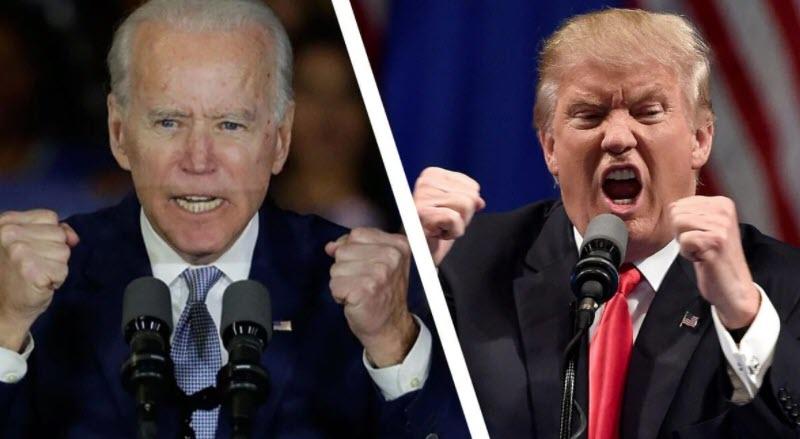
That is the question we hope to get closer to answering as tonight’s Presidential debate brings Joe Biden and Donald Trump the closest together since the COVID lockdowns began.

Biden and Trump are scheduled to face off at 9pmET at Case Western Reserve University in Cleveland, Ohio.

Matt Taibbi warns that the potential for this event to spiral out of control and descend into an Ali-Frazier-Studio-Brawl situation is significantly higher than in any major party debate before, light years beyond even the Trump-Clinton situation.

Trump and Biden are each almost guaranteed to go after one another’s children. Even if Trump somehow doesn’t call Biden a drug-addled dummy, or challenge him to remember what state he’s in, Wallace could easily bring it up and goad Trump into doubling down.

Would we be surprised by something like, “Joe hasn’t had a hard-on in thirty years?” We would not.

Similarly, would we be shocked if Biden’s brain malfunctioned mid-insult and said something like, “Answer that, you stupid fat un-American bastard!” No, we wouldn’t.

Trump has a history of breathing down his opponent’s collar, while Biden has a long record of jamming his bony Creepshow-finger in the sternums of people who challenge him — hell, he does it to people who like him. He nibbled his wife’s finger onstage and is on record talking about fighting people with bicycle chains. Trump has been known to spray water bottles around at the podium and go after wives and mothers of political opponents.

These are weird, unstable dudes, in a super-charged environment, on live TV.

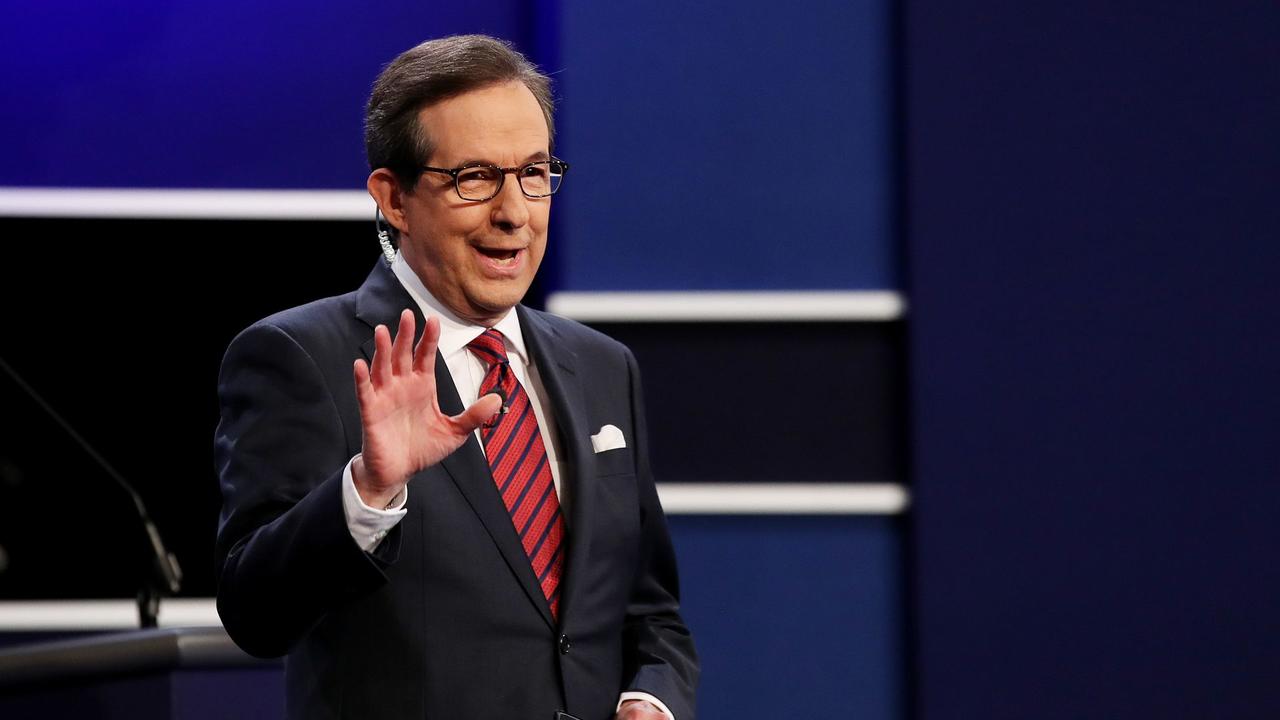
The moderator, Fox News’ Chris Wallace, chose the following six topics for the candidates to answer questions on.

  1. COVID-19:

  2. Race and Violence In Our Cities

  3. The Candidates’ Track Records

  4. The Integrity of the Election

  5. The Economy

  6. The Supreme Court

Each topic will be tackled for 15 minutes.

The debate is slated to go on for 90 minutes.

As with every debate, there will be plenty of spinning and pivoting from the candidates. And what if they say something that simply isn’t true? What will Wallace do?

Poynter’s Tom Davis notes that Wallace has turned down all interview requests leading up to tonight’s debate, but as The New York Times’ Michael M. Grynbaum notes in his debate preview, Wallace sees himself as a facilitator, not a fact-checker.

Before moderating a debate in 2016 between Trump and Hillary Clinton — a job he was widely praised for — Wallace said, “I do not believe it is my job to be a truth squad.”

That’s also what debate commission co-chairman Frank Fahrenkopf said on CNN’s “Reliable Sources” on Sunday — that the moderator is not there to fact-check the candidates.

It is the job of the networks and other news organizations to fact check. However, don’t expect to see the networks fact-checking in real time on your TV screen as the debate is ongoing. The networks will save that for their post-debate coverage.

Remember, at the end of the day, “there can be only one!”

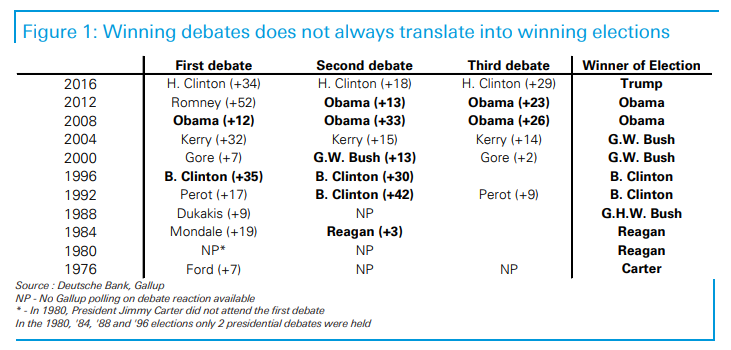
And maybe – as Deutsche notes – being “the one” tonight may not be the best plan…

In fact, in the last 10 elections with debate reaction data stretching back to 1976, only 2 candidates who were perceived to have won the first debate went on to win the election.

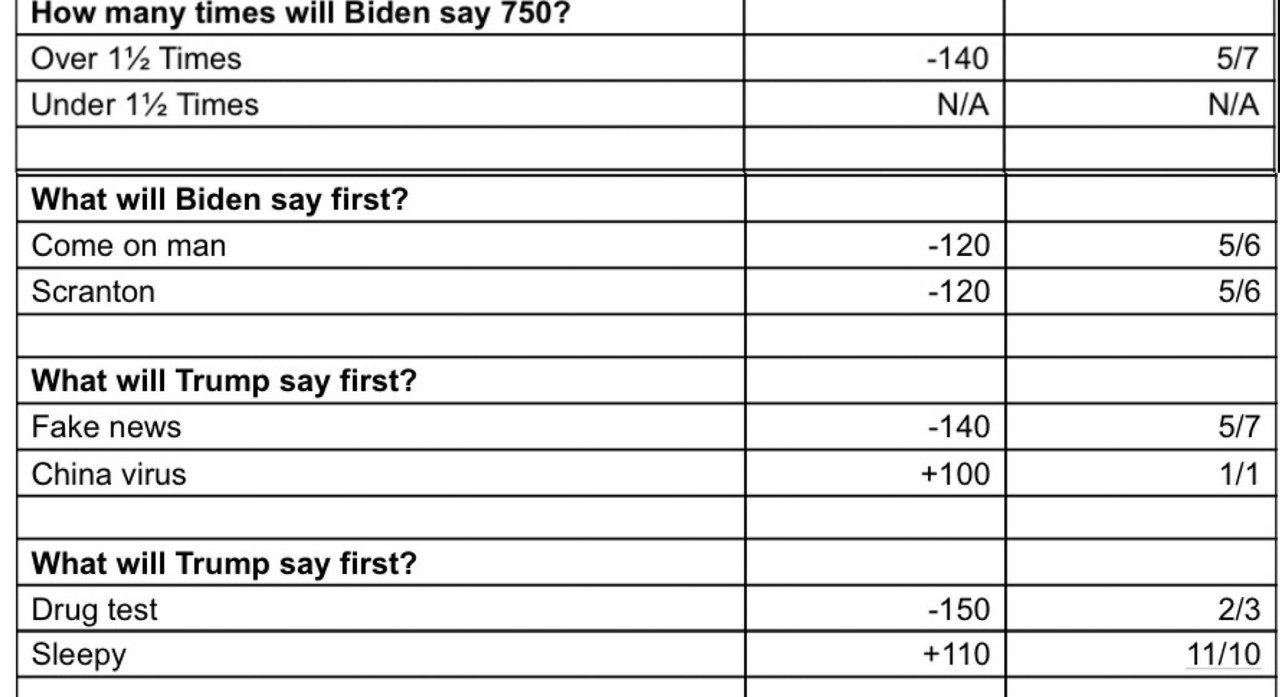
If you’re a gambling man (woman or other)…

And because we all deserve a laugh, here’s Babylon Bee:

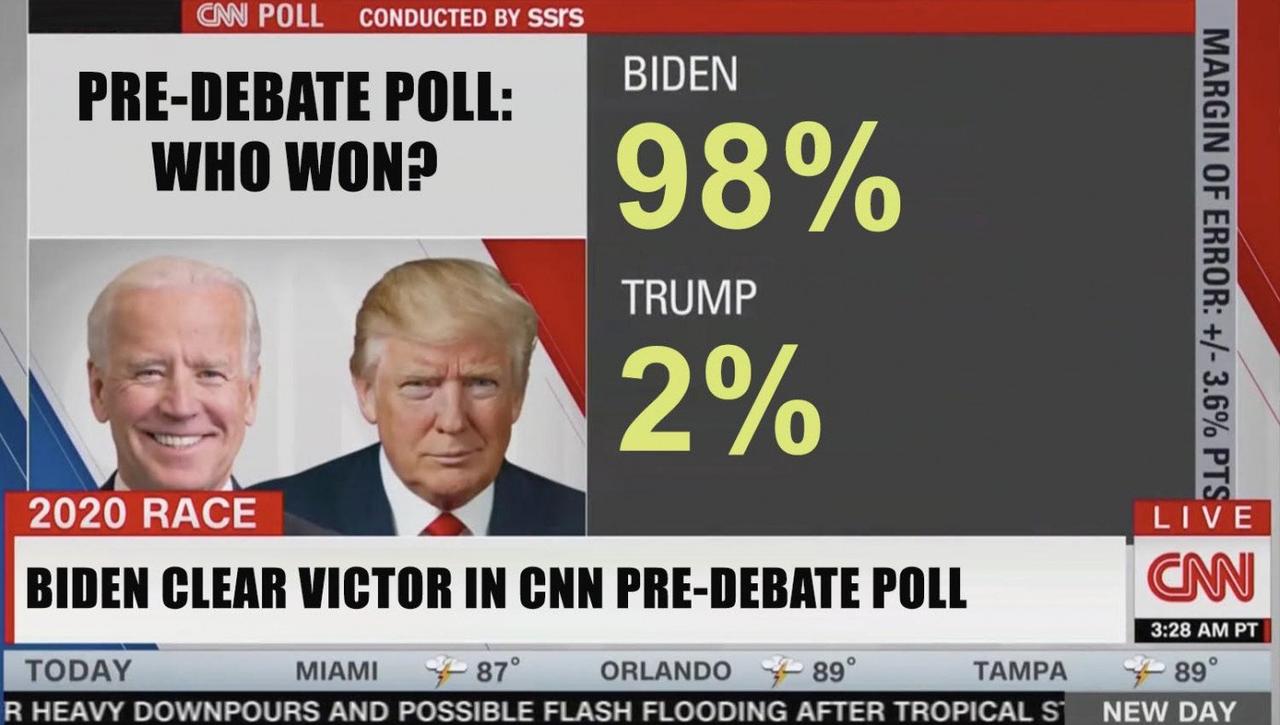
CNN Pre-Debate Poll Shows Biden Clearly Won Debate

In a highly accurate and scientific CNN poll taken pre-debate, presidential candidate Joe Biden has had a clear win over incumbent President Donald Trump, with 98% saying Biden won the debate tonight and only 2% saying Trump won.

“Biden just dominated Trump with his very non-senile performance,” said pundit Jacob Ingram. “Or at least that’s what everyone knows is going to happen.”

The poll sampled smart people who are also attractive and cool, and it’s very clear that those people all think Biden is great and have already awarded him the win in tonight’s debate against the dumb and abrasive Trump.

“With such a clear and decisive win, there’s really no reason to even have the debate,” said Biden campaign staffer Lucas Mathis. “That would only distract from how great Biden is doing. And ruin his naps.”

The Trump campaign has denounced the poll as “fake news,” even though the poll was made using numbers and a computer which are common instruments of science.

It is unclear if the actual debate tonight could affect the poll results, but most experts expect that it will not. 

Watch live (due to begin at 2100ET):

But, as Poynter.org’s Tom Davis asks, “Does it even matter?”

Two things about tonight’s debate. Expect huge television numbers. And yet don’t expect it to sway many voters.

The first Trump-Clinton debate in 2016 drew a whopping TV audience of 84 million, making it the most-watched presidential debate ever. That many people could watch tonight’s debate, although not all on TV. Streaming services and views on websites could make up a sizable portion of the audience.

But will it make a difference among voters? The New York Times’ Michael M. Grynbaum points to a recent Wall Street Journal/NBC News poll that shows that 70% of voters say the debates likely would not influence their vote. In that case, you wonder if some will not watch simply because they are stressed out or just plain tired of divisive politics.

Meanwhile, a new NBCLX/YouGov poll shows that while Republicans are twice as likely as Democrats for their preferred candidate to say whatever is necessary to “win” a debate, 83% of those polled (3,190 Americans) prefer that candidates always tell the truth in a debate.

I do expect a big audience tonight, even if it won’t change many minds. Why? Partly for viewers to feel validated by their candidate and partly because, hey, it’s Trump vs. Biden for the first time on TV.

Watch Useful Idiots host Katie Halper and Matt Taibbi moderating a livestreamed debate-drinking game:

The rules are simple:

Drink THE FIRST TIME:

  1. Biden begins a sentence with, “Look.”

  2. Biden brings up Trump’s taxes, or “$750.”

  3. Trump mentions “Hunter.” Double-shot if he gives him a nickname, like “Crack-boy.”

Drink EVERY TIME:

  1. Biden mentions “Obama” or the “Obama-Biden administration.”

  2. Biden says, “United States of America.”

  3. Trump calls Biden a radical leftist. Double if he references the “Bernie-Biden left” or some iteration thereof.

  4. Trump mocks Biden for being mentally impaired or lost without a teleprompter.

  5. Biden gives up his time before it’s up, a.k.a. the “Check, please!” rule.

  6. Biden invokes, “C’mon, Man,” “Malarkey,” “Scranton,” “Existential threat,” “Soul of the Nation,” or “I’m the guy that…”

  7. Trump brings up “ballots,” “fake news,” “Ilhan Omar,” “career politician,” “Get Trump,” “hoax,” “Sleepy,” or the awesomeness of police.

  8. Biden brings up the loss of any of his family members. Double if Trump steers this moment in an inappropriate direction.

  9. Trump tells a lie; Biden says something that doesn’t make sense.

  10. The men accuse each other of being racist. Drink twice if you believe the charge.

  11. Martyr shots: Biden invokes the name of a nonwhite police victim like Breonna Taylor or George Floyd, or Trump invokes the name of an embattled statue subject like Jefferson, Lincoln, or Teddy Roosevelt.

  12. “Amy Coney Barrett.” Bonus if Biden botches the name, e.g. “Amy Hairy Conehead.”

You may finish your remaining alcohol if there is a fight. The men grabbing each other by the neck, pulling ties or underwear bands, spitting, ball-kicking, or any other physical provocation counts.

via ZeroHedge News https://ift.tt/348pzGh Tyler Durden

Reputation Repair Service Costs as Measure for Damages in a Libel Case

From Dinkins v. Schinzel, decided Friday by Judge Jennifer A. Dorsey (D. Nev.):

Pro se plaintiff Kenneth Dinkins seeks default judgment against pro se defendant Geraldine Schinzel for libel per se. When Schinzel failed to comply with a court order after the parties’ settlement conference, I ordered default be entered against her and granted Dinkins the opportunity to move for default judgment under Federal Rule of Civil Procedure 55. Because Dinkins’s claim satisfies the factors outlined in Eitel v. McCool (9th Cir. 1986), I grant his motion, award him $43,000 in general damages, and close this case….

After a real-estate deal between Schinzel and Dinkins went sour, Schinzel published libelous statements about Dinkins and his business on the internet. In January 2019, I resolved the parties’ cross-motions for summary judgment, ordered them to attend a settlement conference, and—within ten days of the conference—to file a joint pretrial order. The parties failed to settle their dispute, and Schinzel stopped appearing in this litigation, ignoring Dinkins’s attempts to prepare the joint pretrial order and failing to file her own. Based on Schinzel’s apparent refusal to comply with my order and upon Dinkins’s motion, I entered default against her, dismissing her counterclaims, striking her answer to Dinkins’s complaint, and authorizing Dinkins to file a motion for entry of default judgment. Like his motion for default, Dinkins’s motion for default judgment is unopposed….

As default has already been entered in this case, I must take the complaint’s factual allegations as true, except those relating to damages…. The court reserves the power to require a plaintiff to provide additional proof of facts or damages in order to ensure that the requested relief is appropriate….

The second and third Eitel factors focus on whether Dinkins has stated a claim under which he can recover…. Dinkins’s complaint allegations, taken as true, state a claim for libel per se. Dinkins alleges that Schinzel published multiple false and defamatory statements about him on ripoffreport.com, calling him a “scam artist,” a “theif [sic],” “a pathological lier [sic][,] and a vulger [sic] low life that prays [sic] on trusting individuals.” She also accused Dinkins of “running a criminal enterprise,” claimed that he “stalks” others, had “no license of any kind,” ran a real-estate website teaching others to “scam,” and she asserted that he is “being investigated for selling vacant land illegally across state lines.”

Dinkins alleges that Schinzel knew these claims were untrue when she made them. Finally, Dinkins claims that these defamatory remarks damaged his business as both a real-estate investor and a real-estate investing coach. So this factor weighs in favor of entering a default judgment against Schinzel….

[T]he court [also] considers the amount of money at stake in relation to the seriousness of the defendant’s conduct. For a libel per se claim, Dinkins is entitled to presumed, general damages, largely because of the “impossibility of affixing an exact monetary amount for present and future injury to the plaintiff’s reputation, wounded feelings and humiliation, loss of business, and any consequential physical illness or pain.” However, such damage claims must “still be supported by competent evidence.”

Dinkins maintains that he is entitled to $300,000, which is the sum of his allegedly lost business revenue and the cost of hiring a professional company to repair his online reputation. Dinkins’s estimates about his lost revenue are speculative at best. He does not provide evidence of prior or lost sales, but instead attaches alleged text and email conversations in which individuals decline to do business with him, citing their concerns about his reputation. {Dinkins admits that it is “impossible” to know the extent of Schinzel’s damage to his reputation or determine who would have bought properties from him, absent her libelous statements.}

Dinkins also attaches estimates from ReputationX and DMA, both of which perform search-engine optimization to suppress negative online content and promote positive articles. DMA charges $18,000 per month for an indeterminate number of months, and caters to “celebrities” and “professional athletes.” ReputationX requires an initial $3,000 investment, with an additional $5,000 per month, every month, for up to twelve months. Absent concrete evidence regarding Dinkins’s lost revenues, anticipated or otherwise, or the need for DMA’s “aggressive” services, I cannot authorize an award of $300,000—such an amount would be exceedingly harsh. But Dinkins has provided sufficient evidence warranting damages in the amount needed to hire ReputationX for eight months, for a total of $43,000. So this factor weights in favor of awarding default judgment….

Under these circumstances, default judgment is warranted here. Dinkins is entitled to a default judgment of $43,000 against Schinzel for his libel per se claim….

from Latest – Reason.com https://ift.tt/3jaGvlI
via IFTTT

NYC Hammered By 40% Bankruptcy Surge, Braces For Next Wave 

NYC Hammered By 40% Bankruptcy Surge, Braces For Next Wave 

Tyler Durden

Tue, 09/29/2020 – 20:25

While Wall Street panic buys stocks again, on hopes Washington can pass the next round of much-needed economic stimulus, the broader commercial real estate market continues to implode and nowhere more so than the epicenter in New York City, where nearly 6,000 business closures, has resulted in a 40% eruption in bankruptcy filings across business districts of all five boroughs this year, reported Bloomberg

Al Togut, a bankruptcy lawyer who has handled insolvencies for small firms to mega-corporations, said, “by late fall, there will be an avalanche of bankruptcies … When the cold weather comes, that’s when we’ll start to see a surge in bankruptcies in New York City.”

The coming wave of business closings, as explained in Old Man Winter To Plunge Restaurants Into Further Chaos,” is set to crush eateries and other small businesses in NYC ahead of the holiday season. 

“It’s a crisis, and we need to act—our economy can’t recover without saving small businesses,” said NYC Comptroller Scott Stringer, a candidate in next year’s mayoral election.

“When they close, we don’t just lose our beloved Main Street businesses. We lose jobs, tax revenue and the economic backbone of our city,” Stringer said. 

The Partnership for New York City, a nonprofit membership organization of NYC’s top businesses, warned the virus pandemic could permanently close a third of the 230,000 businesses across all five boroughs. 

Bankruptcy filings in the region have skyrocketed since the middle of March, when the state of New York reported its first deaths from Covid-19 and Governor Andrew Cuomo closed all nonessential businesses. There were 610 filings in the Southern and Eastern Districts of New York from March 16 to Sept. 27, according to court records. That’s a 40 percent jump from the same period in 2019 and the most by far for any year since the financial crisis. The districts include some nearby counties.

Almost 6,000 New York City businesses closed from March 1 to Sept. 11, according to Yelp, the website of user reviews. Over 4,000 of those closed permanently.

The carnage has been demoralizing after decades in which the city fought back from the brink of bankruptcy, the scourges of crack cocaine and violent crime, terrorist attacks and recession. The pandemic hit as the city had achieved record high employment and low crime. – Bloomberg

The effects of the pandemic are still being felt in late September, as only 15% of NYC’s 1.2 million office workers had returned, according to the Partnership for New York City. None of this suggests NYC’s recovery will be “V” shaped. 

“Retail and real estate will continue to decline in New York until you can reignite the office traffic,” warned Joseph Malfitano, who advised Brooks Brothers and the parent company of Ann Taylor in their bankruptcies earlier this year. 

Vin McCann, a restaurant consultant, said once temperatures dip in the city, the next wave of restaurant closures will be seen. 

“Once you hit below 60 degrees… I would bet you that between 25 and 50 percent of restaurants in New York City will not come back,” said McCann. 

The city’s Department of Small Business Services received about 35,000 requests from businesses since June and has allocated nearly 4,000 grants, totaling about $80 million, to business owners struggling to survive the virus-induced economic downturn. 

“A third of our small businesses could be closed if we don’t have a strong recovery,” said Jonnel Doris, the department’s commissioner. “The fate of small businesses will determine the fate of the city.”

In early September, NYC restaurants banded together and sued the state for $2 billion in damages and allege that the government is violating the constitutional rights of the owners of more than 150,000 NYC restaurants. 

This is particularly troubling, considering the spillover of closures is beginning to pressure the commercial real estate market in the city. 

via ZeroHedge News https://ift.tt/30lBv6i Tyler Durden

911 System Goes Down Across The Country: Was This A Test?

911 System Goes Down Across The Country: Was This A Test?

Tyler Durden

Tue, 09/29/2020 – 20:05

Authored by Robert Wheeler via The Organic Prepper blog,

As we inch closer and closer to election day and the potential chaos that will ensue, more and more signs of a destabilization of American society that will have reverberations across the world are coming into view. Pieces of the puzzle that have been put together by writers such as myself, Brandon Turbeville, Whitney Webb, Alan Watt and many others are now seen coming together in real life. We are just a month away from one of the most simulated events in years, the 2020 election.

Both I and Whitney Webb (her articles are a MUST READ) have been writing about the coming chaos that is clearly slated to take place in November if Deep State elements have their way.

But there are more than simple “war games” and simulations taking place right now. What possibly amounts to real-world simulations, attributed to systems outages, have recently developed across the country.

911 down across the country

One such “real world simulation,” (aka test run) was reported in the U.S. Sun on September 28, 2020 in an article entitled, “911 Emergency: 911 Lines Go Down Across The US Sparking Panic As Callers Can’t Get Through To Emergency Services,” where Catherina Gioina reported,

POLICE departments across the country Monday night reported their 911 systems nonoperational – and it’s reportedly due to a Microsoft Office 360 outage.

“As of 5 p.m., City phones and emails are experiencing intermittent outages related to a larger Microsoft 365 outage,” the City of Redmond, Washington tweeted. “We are hoping the issue is resolved shortly. Sorry for any inconvenience.”

Panic spread across the nation’s police departments as the 911 systems were rendered useless – and left police departments turning to social media to tell residents there were other ways to contact emergency services.

“ATTENTION: The 911 lines are not operational nationwide. This is for phone calls and text messaging,” tweeted the Minneapolis Police Department. “If you need police, fire or emergency medical assistance in Minneapolis, please call” a local number.

“We will advise when this issue is fixed,” it ended.

Similar problems continued for other police departments in the state of Minnesota.

The Minnetonka Police Department tweeted “911 lines are out nationwide. In Minnetonka and Hennepin county, you will need to call” another local number.

Minnesota’s Crystal Police Department instead urged residents to call their local fire station for help instead.

“911 is currently out in Crystal. If you have an emergency please go a fire department,” it tweeted. “They will be staffed with crews. More to follow when info becomes available.”

The issue was likewise felt in Delaware, where the Delaware State Police asked people to call a local number.

“Delaware State Police Dispatch Centers are currently experiencing a state wide interruption in service,” the dispatch center said in a statement. “Anyone attempting to call 911 either by cellphone or landline will experience a busy signal.”

“At this time the issue is being addressed and it is unknown how long the 911 phone service will be unavailable,” the statement continued. “If you need to report an emergency, you are encouraged to text 911 and type your emergency in the message field.”

A number of police departments in Arizona were running into issues with 911 as well.

“POLICE ALERT: 911 lines are down statewide. For emergencies, please call Prescott Valley Police Dispatch at,” the Prescott Valley Police Department tweeted “until further notice.”

Also in Arizona, the Tucson Police Department asked residents to contact a local number as well.

“911 services are down in the City of Tucson. If you need to make an emergency call, dial,” the department tweeted. “We will let you know when 911 is back online.”

Luckily, the Oro Valley Police Department, also in Arizona, said they had solved the issue.

“It’s fixed! 911 is back up for all agencies! We did take this opportunity to test the “Text to 911″ and that did continue to work through this outage,” the department tweeted. “So keep that in mind, it is another way to contact police services.”

Microsoft Office 360’s outage crashed across the nation Monday evening, forcing the more than 500,000 businesses that use the service to make do while the tech giant addresses the issue.

A Microsoft spokesperson told The Sun: “We’re working to resolve a service interruption impacting a subset of customers performing authentication operations. Visit the Azure Status page for updates.”

CNNThe Hill, and NBC New York among many other outlets reported on the outages also.

Was this an accident or a test?

This outage has many now wondering whether or not someone is preparing for a nationwide emergency services outage in the wake of election chaos. Others are wondering if the United States will experience a massive cyberattack – predictably to be blamed on Russia, China, or Iran – either in the lead up to, during, or shortly after the 2020 elections.

The fact that the disruption in communications is being attributed to a Microsoft outage is telling also. For those who may not have had the chance to read Whitney Webb’s article, “How Government and Media Are Prepping America for a Failed 2020 Election,” Webb has a section titled “Conflict of interest-ridden Microsoft “defends democracy” where she writes of Microsoft’s actual danger to democracy. She writes,

Last year saw the tech behemoth Microsoft join the effort to blame foreign state actors, specifically Iran, for cyberattacks against the U.S. This helped to bolster assertions that had largely originated with a handful of U.S. intelligence officials and hawkish, neoconservative-aligned think tanks as media reports on Microsoft’s related claims treated the company as an independent private sector observer.

Yet, as MintPress investigations have revealed, Microsoft has clear conflicts of interest with respect to election interference. Its “Defending Democracy” program has spawned tools like “NewsGuard” and “ElectionGuard” that it claims will help protect U.S. democracy, but — upon closer examination — instead have the opposite effect.

Last January, MintPress exposed NewsGuard’s neoconservative backers and how special interest groups were backing the program in an effort to censor independent journalism under the guise of the fight against “fake news.” Subsequent investigations revealed the risk that Microsoft’s ElectionGuard poses to U.S. voting machines, which it claims to make more secure and how the platform was developed by companies closely tied to the Pentagon’s infamous research branch DARPA and Israeli military intelligence Unit 8200.

ElecionGuard software has since been adopted by numerous voting machine manufacturers and is slated to be used in some Democratic Primary votes. Notably, the push for the adoption of ElectionGuard software has been spearheaded by the recently created Cybersecurity and Infrastructure Security Agency (CISA), which is the federal agency tasked with overseeing election security and is headed by Christopher Krebs, a former high level Microsoft executive.

In recent months, Microsoft has also been at the center of claims that Iran attempted to hack U.S. presidential campaigns ahead of 2020 as well as claims that Iran plans to target the U.S. power grid and other critical infrastructure with cyberattacks.

Last October, Microsoft penned a blog post discussing a “threat group” it named Phosphorus that they “believe originates from Iran and is linked to the Iranian government.” The post went on to claim that Phosphorus attempted to target a U.S. presidential campaign, which later media reports claimed was President Trump’s re-election campaign. Microsoft concluded that the attempt was “not technically sophisticated” and ultimately unsuccessful, but felt compelled to disclose it and link it to Iran’s government.

Though it provided no evidence for the hack or its reasons for “believing” that the attack originated from Iran, media reports treated Microsoft’s declaration as proof that Iran had begun actively meddling in the 2020 election. Headlines such as “Iranian Hackers Target Trump Campaign as 2020 Threats Mount,” “Iran-linked Hackers Target Trump 2020 Campaign, Microsoft says”, “Microsoft: Iran government-linked hacker targeted 2020 presidential campaign” and “Microsoft Says Iranians Tried To Hack U.S. Presidential Campaign,” were blasted across the front pages of American media. None of the reports scrutinized Microsoft’s claims or noted the clear conflict of interest Microsoft had in making such claims due to its efforts to see its own ElectionGuard Software adopted nationwide.

Media reports also left out the fact that Microsoft is a major government contractor for the U.S. intelligence community and the Pentagon. Notably, the Trump campaign, which Microsoft said was the target of this attack, was later identified as the only major presidential campaign using Microsoft’s “AccountGuard” software, part of its dubious “Defending Democracy” program that also spawned NewsGuard and ElectionGuard. AccountGuard claims to protect campaign-linked emails and data from hackers.

Microsoft surfaced not long after, again claiming that Iran was maliciously targeting the United States’ civilian infrastructure. This subsequent claim was first published by Wired and later covered by other outlets. Those reports cite a single person, Microsoft security researcher Ned Moran, who claimed that an Iran-backed hacking group called APT33 was targeting the U.S. “physical control systems used in electric utilities, manufacturing, and oil refineries.”

“They’re trying to deliver messages to their adversaries and trying to compel and change their adversaries’ behavior,” Moran told Wired. Moran also stated that “Microsoft hasn’t seen direct evidence of APT33 carrying out a disruptive cyberattack rather than mere espionage or reconnaissance, it’s seen incidents where the group has at least laid the groundwork for those attacks.”

The truth is that the nationwide outage could indeed be a result of a failure of Microsoft system and the timing could indeed have been a coincidence. Given the fact that there have been so many simulations of the events of 2020 and, particularly the 2020 elections, however, it is well worth paying attention to. It is also dangerous to assume anything so critically important as nationwide emergency services momentarily disappearing is a coincidence, especially this year.

You may be completely on your own in the event of an emergency.

Writers on this website have assured you frequently that in the event of a crisis, you may find yourself completely on your own. Selco and Jose have both shared stories confirming this in their own writings.  Just recently, a woman in Kenosha, Wisconsin came to the same conclusion during the riots there – nobody was coming to help.

If things go sideways, you’d better be prepared to handle the situation on your own because help may not be on the way.

via ZeroHedge News https://ift.tt/33eqo19 Tyler Durden

You Can Now Have A Tiny Home Office 3D-Printed In 24 Hours 

You Can Now Have A Tiny Home Office 3D-Printed In 24 Hours 

Tyler Durden

Tue, 09/29/2020 – 19:45

As the new workplace normal moves rapidly towards remote work, demand for smaller, smart satellite workplaces has increased. Not too long ago, we noted how some Americans were shelling out as much as $30,000 for tiny home offices in their backyards. 

Now, a California-based startup, called Might Buildings, is 3D printing tiny offices (about a 350 square foot structure) in just 24-hours, reported Spectrum News 1 Los Angeles.

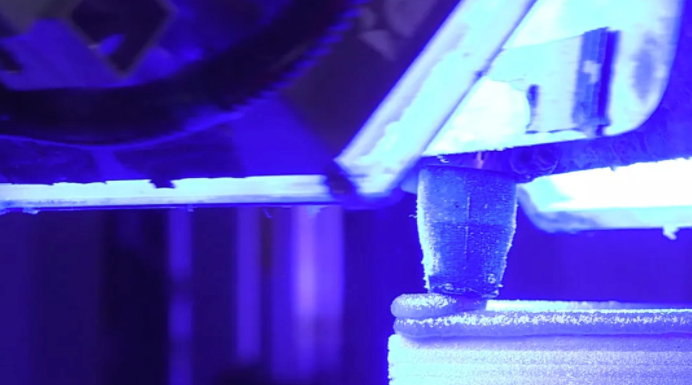
While we showed other companies, such as Colorado-based Studio Shed, using traditional labor and materials, Might Buildings uses synthetic stone 3D printed under UV light to make complex shapes and structures. 

“We developed a 3D printing technology that allows us to build and manufacture buildings faster and more efficiently than traditional construction,” said Natalia Dobrynina, head of sales for Mighty Buildings. 

Might Buildings says the building plans are pre-approved for any county in California. 

“Depending on your access to your site, we could use a crane to pick it up and drop it into your backyard,” Dobrynina said.

Watch Might Buildings 3D-Print Tiny Office 

And if it is not a tiny home office people are seeking, then there’s the ability to transform it into a tiny home and generate rental income. 

via ZeroHedge News https://ift.tt/3cHi112 Tyler Durden