Maryland Man Jailed For One Year Following Multiple Parties During Virus Lockdown Tyler Durden
Mon, 09/28/2020 – 15:00
A Maryland man who held multiple large gatherings during lockdowns in violation of Gov. Larry Hogan’s public health order, banning groups over ten or more people, was sentenced to one year in jail, reported WJZ Baltimore.
Judge W. Louis Hennessy sentenced Shawn Marshall Myers, 42, of Hughesville, to one year in jail on Friday (Sept. 25) for failure to comply with an emergency order.
Myers threw multiple parties on his property; in some cases, more than 50 attendees were counted by the local law enforcement agency in late March, which was around the time the virus pandemic erupted.
According to the Charles County Sheriff, the first party was held on Mar. 22, had between 50 to 60 people.
“Myers was argumentative with officers but eventually agreed to disband his party,” according to the State’s Attorney.
About one week later, on Mar. 27, officers responded to Myers’ home for a second time, finding more than 50 people partying. At that point, he was arrested.
“Officers told Myers to disband the party, but again he was argumentative claiming he and his guests had the right to congregate,” the State’s Attorney said. “Beyond being argumentative, Myers directed his guests to stay in defiance of Governor Hogan’s Orders and the officers’ lawful orders to disband the party.”
In addition to a jail sentence, Myers was slapped with a $5,000 fine and ordered to serve up to three years of unsupervised probation upon his release.
Readers may recall Myers wasn’t the only one hosting parties during lockdowns. “Covidiot” millennials threw wild parties as a game to infect each other so they can “get it over with” and get the antibodies.
via ZeroHedge News https://ift.tt/3icBwjg Tyler Durden
In the Soviet Union it was forbidden to dispute the wisdom of the “party line.” That’s because Marxian communism was viewed as the scientifically inevitable progression of mankind. For Marx and Lenin, the “science was settled.” Therefore anyone speaking out against “the science” of the Soviet system must be acting with malice; must actually want destruction; must want people to die.
Anyone voicing opposition to the “settled science” of Marxism-Leninism soon found their voice silenced. Oftentimes permanently.
Ironically, just 30 years after the “science” of Marxism-Leninism imploded for all the world to see, we are witnessing a resurgence here in the US of the idea that to question “the science” is not to seek truth or refine understanding of what appears to be conflicting evidence. No, it is to actually wish harm on one’s fellow Americans.
And while we who question “the science” are not being physically carried off to the gulags for disputing the wisdom of our “betters” in the CDC or the World Health Organization, for example, we are finding that the outcome is the same. We are being silenced and accused of malicious intent. The Soviet Communists called dissidents like us “wreckers.”
Last week on my daily news broadcast, the Ron Paul Liberty Report, we reported on two whistleblowers from inside the CDC and Big Pharma who raised serious and legitimate questions about the prevailing coronavirus narrative. The former Chief Science Officer for the pharmaceutical giant Pfizer, Dr. Mike Yeadon, has stated that from his experience he believes that nearly 90 percent of the current tests for Covid produce false positives. That means that this massive expansion in “cases,” used to justify continued attacks on our civil liberties, is simply phony.
As Dr. Yeadon said in a recent interview about the Orwellian UK coronavirus lockdown, “we are basing a government policy, an economic policy, a civil liberties policy, in terms of limiting people to six people in a meeting…all based on, what may well be, completely fake data on this coronavirus?”
Is Dr. Yeadon correct in claiming that based on his scientific observation there is no “second wave”? We don’t know. But we do know that his claims that the massive increase in “cases” in Europe used to justify new lockdowns are not in any way being matched with a similar increase in deaths. The EU’s own charts prove this. Deaths remain a flat line near zero while “cases” skyrocket to match the massive increase in testing.
Yet when we reported on Dr. Yeadon’s findings on the Liberty Report last week we found that for the first time ever, our program was removed by YouTube.
YouTube, owned by Google, which is firmly embedded into the deep state, was vague in explaining just where we violated their “community standards” by simply reporting on qualified scientists who happen to disagree with the mainstream coronavirus narrative.
But they did offer this shocking explanation in an email sent to us at the Ron Paul Liberty Report:
“YouTube does not allow content that explicitly disputes the efficacy of the World Health Organization.”
Incredible!
It’s not the science that is settled. What appears to be “settled is the impulse to silence anyone who asks “why”?
via ZeroHedge News https://ift.tt/2HF5yj2 Tyler Durden
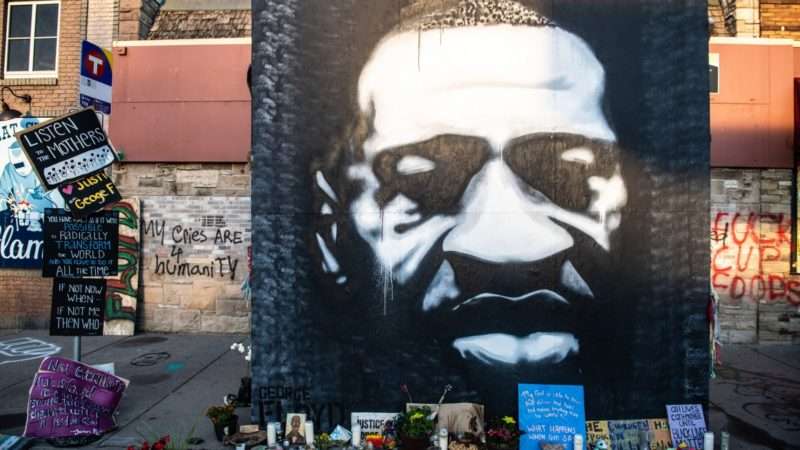
George Floyd’s death under the knee of then–Minneapolis Police Officer Derek Chauvin unleashed the activism that prompted the Minneapolis City Council to vote in June to completely eliminate the police department and attempt to craft a more “holistic” approach to handling public safety.
That’s not happening. It turns out that actually shifting policies takes more than embracing an expansive but vague concept of change.
The Minneapolis City Council knew this in June: The council’s vote didn’t actually order the disbanding or defunding of police. Instead it launched a lengthy process to change the city’s charter with the aim of ultimately replacing the police department with a “Community Safety & Violence Prevention Department.”
What does that actually mean? Well, that’s part of the problem. The proposed changes to the city’s charter cross out the section on the police and add sections for this new department. Here how the proposal describes the department and the person tapped to lead it:
Department of Community Safety and Violence Prevention. The City Council must establish, maintain, adequately fund, and consistently engage the public about a department of community safety and violence prevention, which will have responsibility for public safety services prioritizing a holistic, public health-oriented approach.
Director of Community Safety and Violence Prevention Department. The Mayor nominates and the City Council appoints a director of the department of community safety and violence prevention under section 8.4(b). Individuals eligible to be appointed as director will have non-law enforcement experience in community safety services, including but not limited to public health and/or restorative justice approaches.
But what does that mean? The next two parts of the proposal essentially restore the idea of having a police department, but just call it the “Division of Law Enforcement Services.”
This vagueness, The New York Timesreports, ended up being a significant problem. As has become increasingly clear since that vote, there is no real agreement on what this new vision of policing should look like; much of the public—including, in one poll, 50 percent of black residents—”opposed reducing the size of the police department.” Meanwhile, councilors “repeatedly heard criticism from business owners and residents in more affluent areas of their wards who feared for their safety, as misinformation spread that the end of the police department was imminent.”
It turned out the City Council did not even have the authority to disband the police. Minneapolis is a charter city, and changes to its charter need to be reviewed by a state-appointed charter commission full of volunteers. The commission members are supposed to consider any legal or technical problems with a proposed charter change before putting it before voters. They decided that the proposal had not been written with proper legal provisions or with enough public input, and they declined to forward the City Council’s amendment by a vote of 5–10, instead calling for further study. The public will not be voting on it this November.
What has happened instead are some simple, but valuable, incremental reforms. Notably, while there’s been barely any “defunding” of the Minneapolis Police Department at all, $1.1 million was shifted from the police to the health department for more resources to try to help mediate conflicts.
The other major “accomplishment” of this vote has been to launch a new front of culture wars across the country where those with substantive policy proposals to reduce overpolicing have been drowned out by rioters on one side and aggressive police supporters on the other. President Donald Trump now campaigns by misrepresenting urban environments as lawless zones of anarchy, and the Department of Justice is attempting to cut grants to cities that cut spending to the police departments.
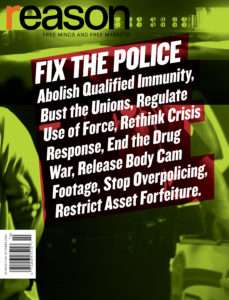
The best way to reduce police spending is to take the time to reform the ordinances, policies, and practices that cause police departments to expand and that protect officers from accountability for misconduct. Reason‘s October issue about fixing the police offers a host of substantive, specific changes that will lead to less policing (by ending the drug war, for example) and more accountability for police conduct (by abolishing qualified immunity and busting the police unions). Check out how to reform policing without relying on vague utopian sloganeering here.
from Latest – Reason.com https://ift.tt/3kXMDhU
via IFTTT
George Floyd’s death under the knee of then–Minneapolis Police Officer Derek Chauvin unleashed the activism that prompted the Minneapolis City Council to vote in June to completely eliminate the police department and attempt to craft a more “holistic” approach to handling public safety.
That’s not happening. It turns out that actually shifting policies takes more than embracing an expansive but vague concept of change.
The Minneapolis City Council knew this in June: The council’s vote didn’t actually order the disbanding or defunding of police. Instead it launched a lengthy process to change the city’s charter with the aim of ultimately replacing the police department with a “Community Safety & Violence Prevention Department.”
What does that actually mean? Well, that’s part of the problem. The proposed changes to the city’s charter cross out the section on the police and add sections for this new department. Here how the proposal describes the department and the person tapped to lead it:
Department of Community Safety and Violence Prevention. The City Council must establish, maintain, adequately fund, and consistently engage the public about a department of community safety and violence prevention, which will have responsibility for public safety services prioritizing a holistic, public health-oriented approach.
Director of Community Safety and Violence Prevention Department. The Mayor nominates and the City Council appoints a director of the department of community safety and violence prevention under section 8.4(b). Individuals eligible to be appointed as director will have non-law enforcement experience in community safety services, including but not limited to public health and/or restorative justice approaches.
But what does that mean? The next two parts of the proposal essentially restore the idea of having a police department, but just call it the “Division of Law Enforcement Services.”
This vagueness, The New York Timesreports, ended up being a significant problem. As has become increasingly clear since that vote, there is no real agreement on what this new vision of policing should look like; much of the public—including, in one poll, 50 percent of black residents—”opposed reducing the size of the police department.” Meanwhile, councilors “repeatedly heard criticism from business owners and residents in more affluent areas of their wards who feared for their safety, as misinformation spread that the end of the police department was imminent.”
It turned out the City Council did not even have the authority to disband the police. Minneapolis is a charter city, and changes to its charter need to be reviewed by a state-appointed charter commission full of volunteers. The commission members are supposed to consider any legal or technical problems with a proposed charter change before putting it before voters. They decided that the proposal had not been written with proper legal provisions or with enough public input, and they declined to forward the City Council’s amendment by a vote of 5–10, instead calling for further study. The public will not be voting on it this November.
What has happened instead are some simple, but valuable, incremental reforms. Notably, while there’s been barely any “defunding” of the Minneapolis Police Department at all, $1.1 million was shifted from the police to the health department for more resources to try to help mediate conflicts.
The other major “accomplishment” of this vote has been to launch a new front of culture wars across the country where those with substantive policy proposals to reduce overpolicing have been drowned out by rioters on one side and aggressive police supporters on the other. President Donald Trump now campaigns by misrepresenting urban environments as lawless zones of anarchy, and the Department of Justice is attempting to cut grants to cities that cut spending to the police departments.
The best way to reduce police spending is to take the time to reform the ordinances, policies, and practices that cause police departments to expand and that protect officers from accountability for misconduct. Reason‘s October issue about fixing the police offers a host of substantive, specific changes that will lead to less policing (by ending the drug war, for example) and more accountability for police conduct (by abolishing qualified immunity and busting the police unions). Check out how to reform policing without relying on vague utopian sloganeering here.
from Latest – Reason.com https://ift.tt/3kXMDhU
via IFTTT
“Inflation Is Already Here”: The Fed May Have A Major Problem On Its Hands Tyler Durden
Mon, 09/28/2020 – 14:20
In late August, the Fed unveiled its new flexible Average Inflation Targeting (fAIT) paradigm which while still lacking strict forward guidance and operational parameters (what is the target inflation? what is the lookback period? how long will the overshoot last) means that – according to the latest FOMC projections – the Fed expects rates to be at zero at least until 2023.
There is just one problem (well technically two): for the Fed’s AIT scheme to work, inflation will have to be low enough to where even if it rises above the 2% long-term target, the overshoot will be manageable and won’t take place for a while. However, it now appears that even official readings of both goods and wage inflation, are starting to creep up substantially and could jeopardize the Fed’s inflation overshoot target as soon as 2021.
First, a brief refresher on what the Fed has said regarding AIT – here, as Nordea’s Andreas Steno Larsen writes, there has been a purposeful lack of clarity from Jay Powell although less profiled members of the FOMC committee have been much clearer in their communication: for example Robert Kaplan has saide he could support a hike “if inflation hits 2.275-2.350%”, while uber-dorve Kashkari has suggested that interest rates are kept at current levels until inflation “breaks above 2% in 12 consecutive months.” Most notably, perhaps, Chicago Fed’s Evans – also a dove – hinted last week that a rate hike could potentially come into play before 2% is breached, if the Fed was comfortable enough with the inflation outlook.
The problem emerges that depending on where one looks, one can make the argument that much of what US consumers are spending money on is seeing price increases that are already at – if not above – the Fed’s inflation overshoot targets.
As the WSJ’s James Mackintosh writes, “if it feels like the price of everything you buy has been soaring, that’s because it has—even as central bankers everywhere worry about the danger of deflation.” He then points out to the “massive gap” between everyday experience and the annual inflation rate of 1.3%, and notes that “the price of the stuff we’re buying is rising much faster, while the stuff we’re no longer buying has been falling, but still counts for the figures.”
Which makes sense, of course: after all with more demand for a given good or service, the price will jump and vice versa. And as the data reveals, in this post-covid, “work-from-home” age, annual inflation for certain products is now solidly overshooting the Fed’s targets:
Start with the cost of food at home, where so many Americans have been spending their time, and which was up 4.6% in August compared with a year earlier, the biggest rise in almost a decade. In deserted workplace and school cafeterias, food is 3% cheaper.
While food prices are traditionally volatile, the same pattern emerges for many things sensitive to us sitting at home on Zoom. Few home workers need a new suit or dress (down 17%), makeup (down 3%), hotel room (down 13%) or air ticket (down 23%). At the same, the following activities have led to sharp price increases: sitting at home in your pajamas (men’s nightwear is up 4%), cycling (bikes up 6%), reading for pleasure (books up 4%, newspapers up 5%) and making things (sewing machines and fabric up 9%, cameras up 4%). Medical care is in demand (up 5%), while higher education is much less attractive (tuition fees up 1.3%, the lowest since data started in the late 1970s).
The swings in buying habits have also accentuated a core aspect of the current inflation/deflation debate: namely, how inflation is officiallymeasured, with an emphasis on the difference between the consumer-price index (CPI) and the personal-consumption-expenditures price index (PCE). As the WSJ reminds us, CPI captures the headlines and determines the return on inflation-linked Treasurys, or TIPS. The Federal Reserve uses PCE—and the two diverged over the summer.
CPI is assessed based on spending patterns from a couple of years ago, while PCE recalculates spending every month. The latest PCE data is only through July, but showed prices rebounded, rising 0.4% over three months compared with the prior three months, on an annualized basis. CPI was still showing prices falling on that basis, although in August the reopening of the economy pushed three-month annualized CPI inflation above 3%.
The PCE will be even higher for August Mackintosh writes, given its calculation method.
Another reason why prices have spiked in recent months is that the pandemic provided inflationary pressure by restricting supply, so when demand rose — for example for eating out as the lockdown eased — prices rose sharply. And because Covid-19 has intensified the U.S.-China trade war and the trend toward deglobalization, supply could be constrained for a long time as existing global supply chains are uprooted.
Still, most economists are confident that the prevailing price forces over the next 1-2 years are mostly deflationary, largely due to the massive layoffs which have crushed wages and continued social distancing.
“In the short term the demand shock prevails, so we will have subdued prices for the next 12 to 18 months,” says Luigi Speranza, chief global economist at BNP Paribas. Lingering effects from the pandemic could mean less need for travel and tourism workers for years, while those who have been unemployed lose skills.
Others are more worried about the deflationary side-effects of upcoming macro transformations, especially how a wave of delinquencies and defaults across commercial property will lead to widespread – and deflationary – debt-destruction as many workers leave to find new roles.
Many of these concerns will be laid to rest if and when Congress agrees on a fifth fiscal stimulus – once Pelosi and McConnell agree on another $1.5-$2 trillion in stimulus and is handed out to US consumers, this summer’s price rises could continue and become a serious worry for investors. Alternatively, if the second wave of Covid-19 is followed by a third, heavy job losses and renewed recession would threaten demand and thus prices again. In Europe, the three-month inflation rate fell back to exactly zero in August as a second wave hit Spain and France.
The bottom line is that while many debate what happens next, the current reality is stark: surging prices for things Americans needs, offset by declining prices for things they don’t. This, according to the Fed, washes out and does not merit tighter financial conditions, even though for the average American on Main Street, the ongoing price spike has proven to be especially painful.
* * *
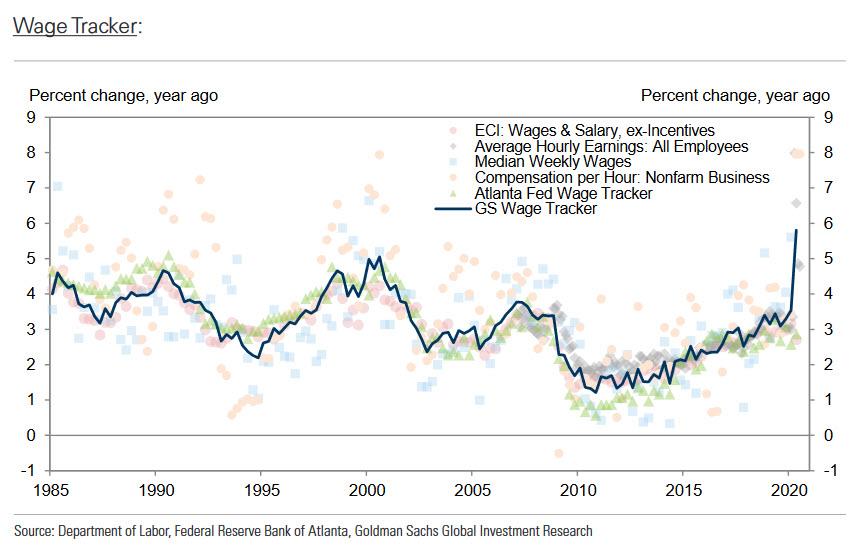
And then there is another problem: whereas the Fed – and most economists – are convinced that due to massive recent layoffs and the growing slack in the labor force, wages will not rise for a long, long time, a real-time measurement of wage growth as reflected in the Goldman Sachs weekly Wage Tracker, which tracks a universe of wage metrics including the ECI wages and salary data, the BLS’s average hourly earnings, hourly compensation and the Atlanta Fed Wage Tracker – reveals the highest print on record!
To be sure, much of this is due to the government transfer payments exploding and a creeping experiment in Universal Basic Income, but it is safe to say that one way or another, generous government handouts to America’s poorest will continue into the next administration unless either Trump or Biden want daily riots. But the bottom line is that between the massive government stimulus and organic demand for skilled, highly-employed workers, which has already normalized to pre-covid levels…
… the Fed may soon be shocked at how quickly wages inflation returns, in addition to the runaway inflation for “things Americans need” discussed above.
In short, absent a double-dip recession or a sharp economic contraction, inflation – especially its most benign and welcome form – employee wages, may already be more than double the Fed’s AIT target. If sustained this leaves three options: i) the Fed will hike rates far sooner than 2023, ii) the definition of hourly wages and prices will be revised in a way to make them appear smaller (just ask Japan with its 10 different CPI trackers, how effective that is), or iii) the Fed will merely move the goalposts and change its AIT framework, saying it won’t hike until inflation hits 3%, 4%, 5% or more…
For now, however, both prices (for things US consumers actually need) and wages (for those Americans who have a job) are rising fast and that will create a lot of headaches for the Fed in the coming months.
via ZeroHedge News https://ift.tt/2SarMLy Tyler Durden
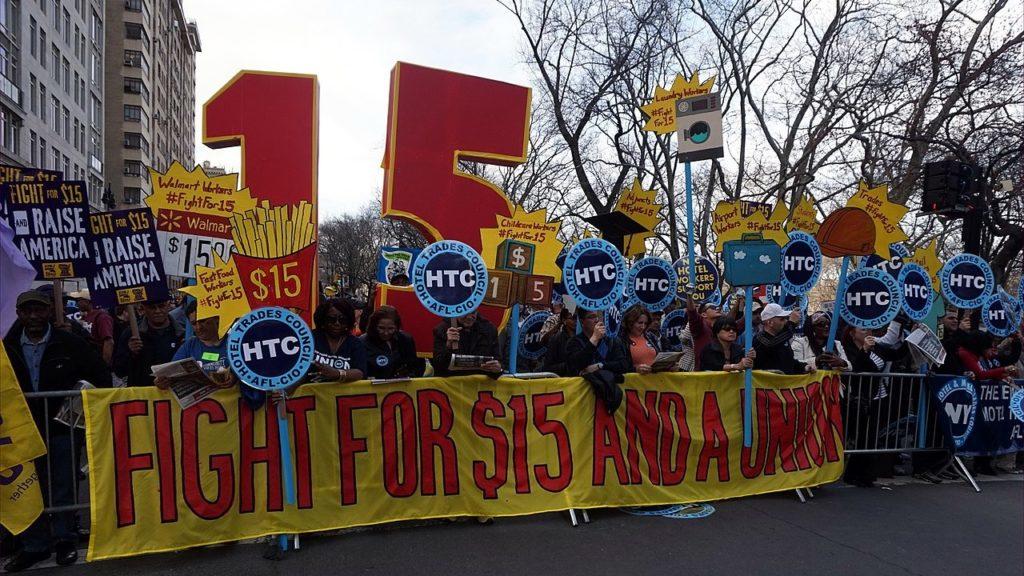
You’ve almost certainly heard about the “fight for $15” movement to increase the minimum wage. Well, some activists have upped the ante. How does “Fight for $20” strike you?
Here’s the problem, these people are trying to solve a legitimate problem with a really bad solution.
Last year, Rep. Rashida Tlaib (D-Mich.) called for a $20 national minimum wage. And why not? If $15 is good, wouldn’t $20 be better? In fact, why not go for $30 an hour. Or $100? If you can just arbitrarily assign a number to wages without consequences, why not go really big?
This reveals the problem with progressive thinking on wages. They know at some level you can’t force wages to infinity. But they have no actual economic principle upon which to peg their policy. They just throw out arbitrary numbers based on political considerations and feelings. If Bernie is going to run on $15 an hour, Tlaib can one-up him by pushing for $20. Somebody else can come off as even more compassionate by demanding $25.
The problem with all of this political posturing is it eventually drives actual policy. We’re already seeing moves for a $20 an hour minimum wage. The Aurora County, Colorado, City Council recently shot down a plan to raise the city’s minimum wage to $20 by 2027. But it’s only a matter of time before someplace approves this nonsense.
And no matter how compassionate it may seem, these policies have horrible economic consequences. In the end, basic economics always wins.
There’s an even bigger problem underlying all this. We don’t have a wage problem. We have a money problem.
Minimum wage advocates seek to solve a legitimate problem facing American workers: their dollars buy less and less every year. But simply mandating employers fork over more dollars is a little like putting a band-aid on an amputation. It doesn’t do anything to address the underlying problem.
Our money is broken, and we need to fix it.
The US government’s monetary policy devalues our currency, and that means less purchasing power for you and me. Simply put, when the government debases the currency; a dollar no longer buys the same amount of stuff it once did. Quantitative easing devalues the currency and the Federal Reserve has engaged in the practice for years. And they have put it on hyperdrive in response to the coronavirus pandemic.
This is one of the many reasons to invest in gold. Download SchiffGold’s Free White Paper: Why Buy Gold Now?
So, what does this have to do with wages? Well, consider this: in 1964, the minimum wage stood at $1.25. To put it another way, a minimum wage worker earned five silver quarters for every hour worked. Today, you can’t even buy a cup of coffee with those five quarters.
But the silver melt-value of those five quarters today stands at over $20.
There’s your $20 per hour minimum wage.
This vividly illustrates currency debasement.
In terms of purchasing power, the value of the silver remains relatively stable, but the value of a dollar shrinks. The long-term rise in the price of silver reflects this reality. It’s the very reason people buy silver and buy gold.
Now flip things around. Today, it takes 60 quarters to pay a $15 minimum wage. If you paid that in 1964 silver quarters, the value of the metal would be something in the neighborhood of $250!
This demonstrates why precious metals are good investments. Silver and gold retain their value as paper currencies continue to debase – thus raising prices over the long-term.
In an economy with stable money, prices tend to fall, not rise. That means more purchasing power to the poor, minimum wage workers, those on fixed incomes, and savers. But the government currently debases our currency. The politicians and central bankers claim their policies stabilize economies and protect the people from currency debasement. But in truth, these policies only enrich the politically well-connected at the expense of you and me.
Minimum wage hikes only mask the problem. We need to fix the money.
via ZeroHedge News https://ift.tt/30daJNG Tyler Durden
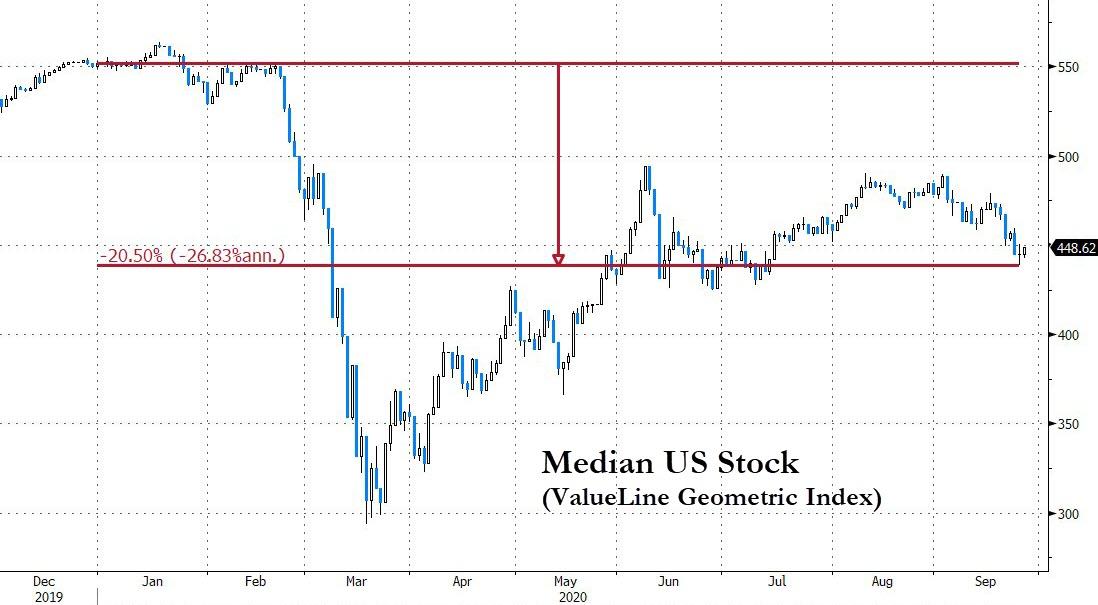
“Bonds ain’t buying it” but US equity markets are – for now – staging yet another bounce after what CNBC has variously described as “a pause that refreshes” or a “healthy pullback.” The median stock is down over 20% from record highs…
Source: Bloomberg
…leaving BofA’s Stephen Suttmeier and Jordan Young to ask (and attempt an answer): “Is the S&P 500 correction over yet?”
The long and the short of it – pun intended – is, we don’t know, but these levels and drivers should help clarify the next move as volatility continues to rise.
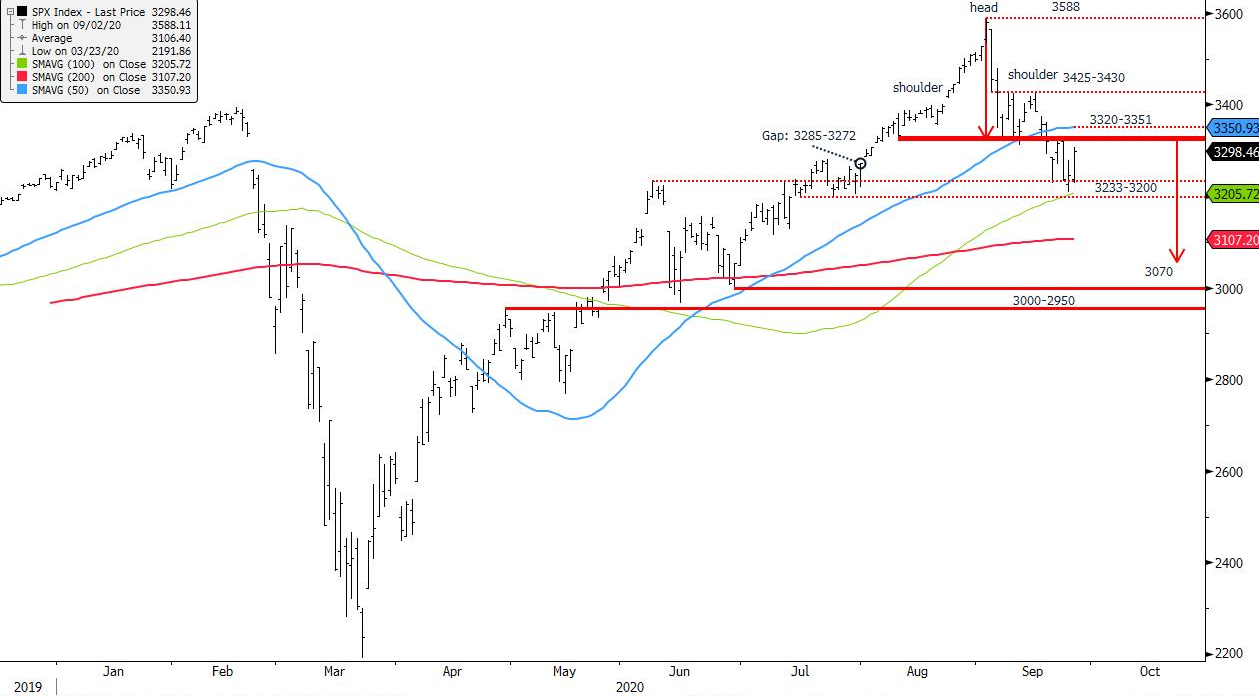
The S&P 500 broke down from the head and shoulders top
Tactical resistance moves to 3320-3351 (last week’s high, head and shoulder top neckline, and the 50-day MA). If the SPX stays below this resistance, the head and shoulders top is firmly intact with supports at 3233-3200 (late July breakout area and rising 100-day MA), which held last week, and then 3107-3070 (rising 200-day MA and pattern count).
If the SPX regains 3320-3351, it would call the head and shoulders top into question, but a decisive move above the right shoulder peak at 3425-3430 is the signal needed to completely invalidate this tactical top pattern on the SPX.
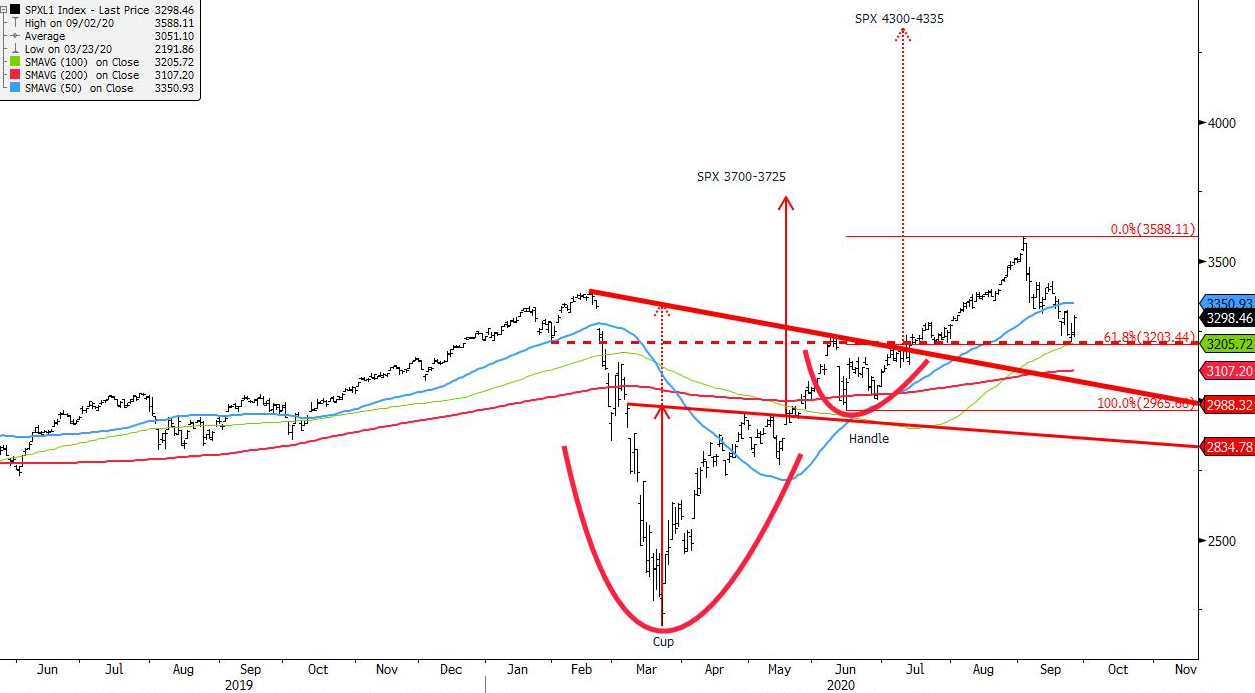
As BofA notes, the SPX completed a 2020 cup-and-handle pattern – a longer-term bullish continuation pattern with upside counts to 3700 and 4300.
SPX 4300 is an aspirational upside count, but one that is achievable based on the bullish breakout, positive backdrop signals (Table 1 below) and our secular bull market roadmap.
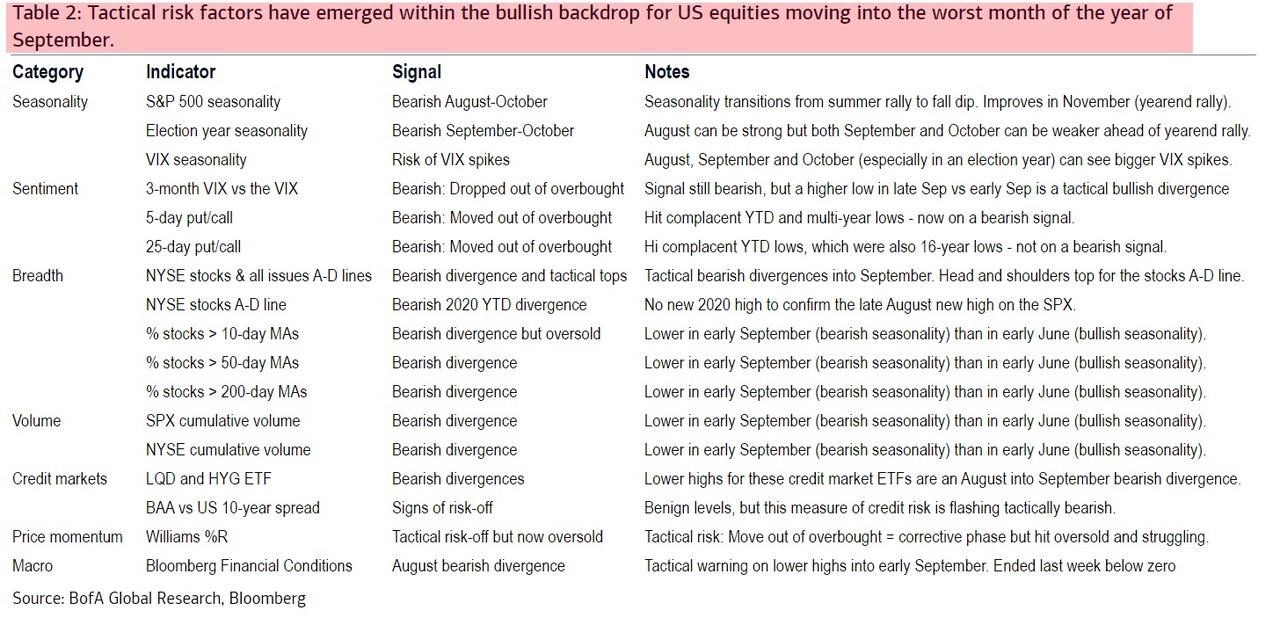
Weaker seasonality and tactical risks (Table 2 below) have triggered a correction ahead of the November election, but this bullish setup stays intact if the SPX holds big support in the 3200 to 3000 range (breakout points, 100/200-day MAs and broken downtrend line).
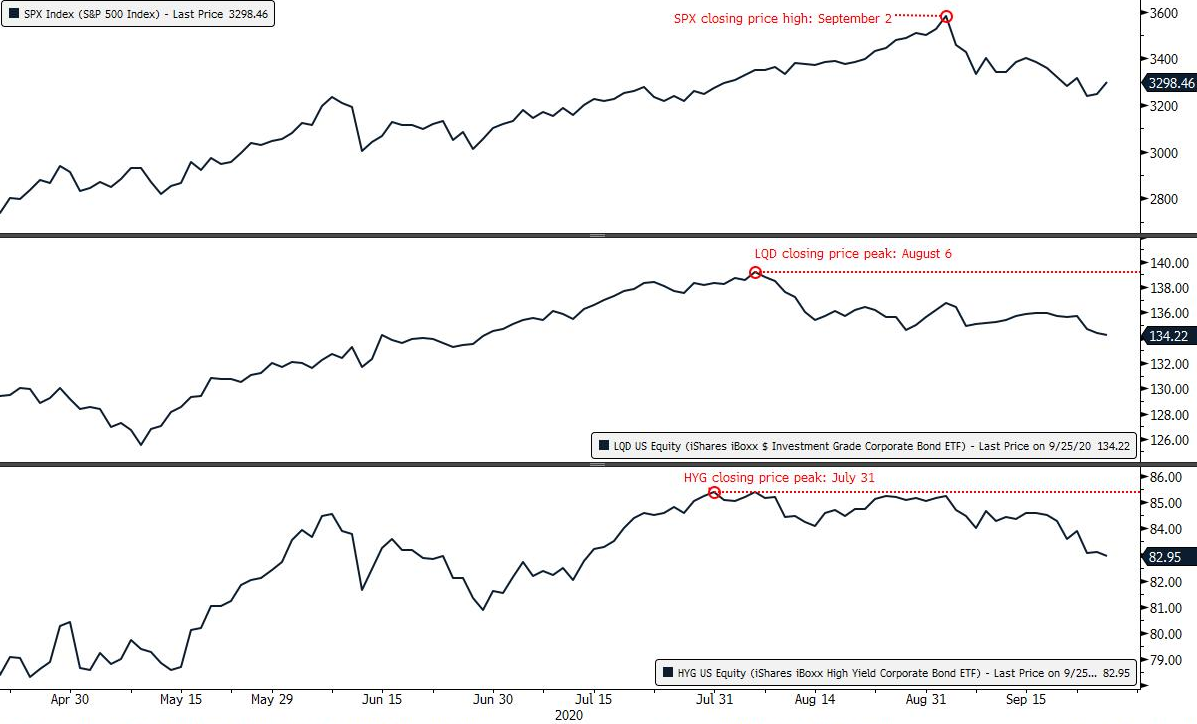
Most notably, downside risks are highlighted by a lack of confirmation of any upside bounce from the credit markets.
The iShares iBoxx $ Investment Grade Corporate Bond ETF (LQD) and the iShares iBoxx High Yield Corporate Bond ETF (HYG) dropped as the SPX grinded higher in August. We highlighted this as a tactical bearish divergence for US equities in Market Comment: 18 Aug 20.
Although the SPX rallied on Thursday and Friday (9/24-9/25), both of these credit market ETFs trended lower into the end of last week and did not confirm the rally on the SPX. We view this as a tactical risk for US equities.
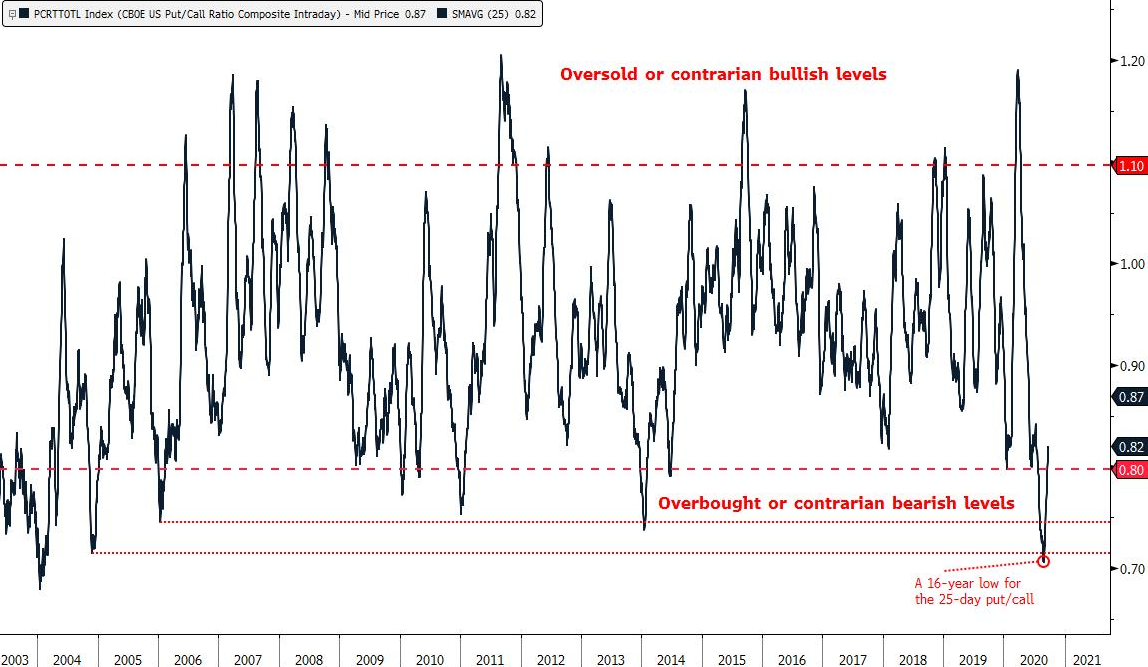
Additionally, options markets remain unimpressed at any bounce.
The 25-day CBOE total put/call ratio probed to 16-year lows on the 2020 summer rally (Market Comment: 18 Aug 20), which we viewed as contrarian bearish entering a period of bearish US equity market seasonality.
The September correction has taken this put/call out of this deep overbought or complacent level, but it is nowhere near a contrarian bullish oversold or fearful reading with five weeks to go until the US Presidential election in early November.
Simply put, the BofA analysts warn that tactical fear may need to increase prior to a good equity market low.
via ZeroHedge News https://ift.tt/339YyTy Tyler Durden
I thought I’d repeat a post I wrote up about this case last year, when it was handed down; see also Jacob Sullum’s post from yesterday on this subject.
[* * *]
From Friday’s [June 28, 2019] Seventh Circuit decision in Doe v. Purdue Univ., written by Judge Amy Coney Barrett and joined by Judges Diane Sykes and Amy St. Eve:
After finding John Doe guilty of sexual violence against Jane Doe, Purdue University suspended him for an academic year and imposed conditions on his readmission. As a result of that decision, John was expelled from the Navy ROTC program, which terminated both his ROTC scholarship and plan to pursue a career in the Navy…. [We conclude that] John has adequately alleged violations of both the Fourteenth Amendment and Title IX.
The court concluded that, under Indiana law, university students have no property right in their continuing attendance at the university, and thus they can’t sue for deprivation of property without due process. (Federal courts disagree on this question: “The First, Sixth, and Tenth Circuits have recognized a generalized property interest in higher education. The Fifth and Eighth Circuits have assumed without deciding that such a property interest exists. The Second, Third, Fourth, Ninth, and Eleventh Circuits join [the Seventh Circuit] in making a state-specific inquiry to determine whether a property interest exists.”)
But the court held that Doe adequately alleged that he was being deprived of his liberty, on a so-called “stigma plus” theory: Purdue had been accusing him of a crime, and combining the stigma of this accusation with a one-year suspension, which led to his expulsion from the Navy ROTC program. (Mere alleged defamatory falsehoods aren’t seen as deprivations of liberty for Due Process Clause purposes, but alleged defamatory falsehoods coupled with tangible government action often are.) And, the court concluded, this deprivation of liberty was done without due process:
John’s circumstances entitled him to relatively formal procedures: he was suspended by a university rather than a high school, for sexual violence rather than academic failure, and for an academic year rather than a few days. Yet Purdue’s process fell short of what even a high school must provide to a student facing a days-long suspension.
“[D]ue process requires, in connection with a suspension of 10 days or less, that the student be given oral or written notice of the charges against him and, if he denies them, an explanation of the evidence the authorities have and an opportunity to present his side of the story.” John received notice of Jane’s allegations and denied them, but Purdue did not disclose its evidence to John. And withholding the evidence on which it relied in adjudicating his guilt was itself sufficient to render the process fundamentally unfair. “[F]airness can rarely be obtained by secret, one-sided determination of facts decisive of rights….”
John has adequately alleged that the process was deficient in other respects as well. To satisfy the Due Process Clause, “a hearing must be a real one, not a sham or pretense.” At John’s meeting with the Advisory Committee, two of the three panel members candidly admitted that they had not read the investigative report, which suggests that they decided that John was guilty based on the accusation rather than the evidence.
And in a case that boiled down to a “he said/she said,” it is particularly concerning that [Dean of Students Katherine] Sermersheim and the committee concluded that Jane was the more credible witness—in fact, that she was credible at all—without ever speaking to her in person. Indeed, they did not even receive a statement written by Jane herself, much less a sworn statement. It is unclear, to say the least, how Sermersheim and the committee could have evaluated Jane’s credibility.
Sermersheim and the Advisory Committee’s failure to make any attempt to examine Jane’s credibility is all the more troubling because John identified specific impeachment evidence. He said that Jane was depressed, had attempted suicide, and was angry at him for reporting the attempt. His roommate—with whom Sermersheim and the Advisory Committee refused to speak—maintained that he was present at the time of the alleged assault and that Jane’s rendition of events was false. And John insisted that Jane’s behavior after the alleged assault—including her texts, gifts, and continued romantic relationship with him—was inconsistent with her claim that he had committed sexual violence against her. Sermersheim and the Advisory Committee may have concluded in the end that John’s impeachment evidence did not undercut Jane’s credibility. But their failure to even question Jane or John’s roommate to probe whether this evidence was reason to disbelieve Jane was fundamentally unfair to John.
Researcher and attorney Michael P. Senger suggests that the Chinese government launched an aggressive propaganda campaign to exaggerate the severity of coronavirus in order to force the rest of the world into a draconian lockdown that would serve to benefit Beijing.
In an article for Tablet Magazine, Senger details how in late January, “international COVID-19 hysteria began” with a series of suspicious videos posted to social media sites showing people in China suddenly collapsing on the streets, including one instance where a man held out his arm to break his fall, suggesting the collapse was staged.
After tens of millions of people were confined to their homes during one of the most brutally enforced lockdowns in history, Senger notes how in February the CCP “reported an exponential decline in coronavirus cases, until March 19 when they announced their lockdown had eliminated domestic cases entirely.”
China has officially recorded just 4,634 deaths from coronavirus, despite having a population almost five times larger than the United States, where the current death toll stands at over 205,000.
The World Health Organization and other scientific experts then waxed lyrical about China’s response to COVID-19, which is what led to virtually every other country on the planet mirroring its approach.
However, Senger argues that the initial hysteria over COVID and lockdown that followed could have been a carefully orchestrated Chinese propaganda campaign to hoodwink its hegemonic competitors into destroying their own economies in response to a virus with a relatively low fatality rate.
The researcher documents how armies of Chinese bot accounts on Twitter were instrumental in promoting early lockdowns in countries like Italy while bombarding political figures who refused to order strict lockdowns, such as South Dakota Gov. Kristi Noem, with criticism and abuse.
By promoting fraudulent data, aggressively deploying disinformation, and flexing its institutional clout, Beijing transformed the snake oil of lockdowns into “science,” crippling rival economies, expanding its influence, and sowing authoritarian values.https://t.co/VdC2DkDckG
He also highlights how Chinese state media organs savaged the “herd immunity” approach, which was initially considered but then rejected by several western leaders, as a violation of “human rights.”
Sweden, which went for the herd immunity approach by refusing to enforce a lockdown and came out economically better than any other European country, was also targeted by the bots, as was British Prime Minister Boris Johnson, who was accused of engaging in “genocide” by initially considering the herd immunity approach.
Senger’s conclusion explores why China aggressively emphasized the need for global lockdowns.
“The most benign possible explanation for the CCP’s campaign for global lockdowns is that the party aggressively promoted the same lie internationally as domestically—that lockdowns worked.
For party members, when Wuhan locked down it likely went without saying that the lockdown would “eliminate” coronavirus; if Xi willed it to be true, then it must be so. This is the totalitarian pathology that George Orwell called “double-think.” But the fact that authoritarian regimes always lie does not give them a right to spread deadly lies to the rest of the world, especially by clandestine means.”
“And then there’s the possibility that by shutting down the world, Xi Jinping, who vaulted through the ranks of the party, quotes ancient Chinese scholars, has mastered debts and derivatives, studies complexity science, and envisions a socialist future with China at its center, knew exactly what he was doing.”
Senger’s theory holds weight when one considers how China has now been back to “normal” for months, while western countries, still panicked by COVID hysteria, continue to lockdown their citizens and cripple their own economies despite hospitalizations and deaths due to coronavirus having flatlined in countries like the United Kingdom.
* * *
In the age of mass Silicon Valley censorship It is crucial that we stay in touch. I need you to sign up for my free newsletter here. Also, I urgently need your financial support here.
via ZeroHedge News https://ift.tt/3n30FRc Tyler Durden
Cathie Wood Ignores Massive NASDAQ Gamma Squeeze, Instead Says ARK Invest’s Success Is Due To “Diversity” Tyler Durden
Mon, 09/28/2020 – 13:00
Apparently unaware of the effect a multi-billion dollar gamma squeeze had on the NASDAQ over the last 6 months, ARK Invest’s Cathie Wood would rather attribute her success to something way more “woke”: diversity.
The fund manager told Bloomberg this week that her firm’s success comes from the fact that almost none of her analysts have a finance background (hence the constantly overweight position in Tesla). In fact, the previous work careers of her analysts include things like sailboat captain, gaming engineer and AI expert.
ARK is up 81% in its main fund this year. Wood told Bloomberg: “You’re probably not going to find a more diversified group of people. They already have one foot in the new world, and they are extremely creative in terms of figuring out how the world is going to work.”
Yes, but do they know how to read a cash flow statement yet?
Sam Korus is a former sailboat captain who works for ARK as an analyst for autonomous technology and robotics. Because apparently sailboating and the forefront of autonomous technology go perfect together: one is based solely on the efficiency of manual labor out at sea, the other is based on digital artificial intelligence in a server room somewhere.
In fact, Wood even admitted she would have never known what CRISPR gene editing technology was if she hadn’t hired analysts who had “experimented” with it.
Analyst James Wang said: “If we all came from a financial background, we would inevitability have views that are much more similar and more aligned with the current price expectations set by the market.” In other words, we are happily disconnected from the reality of financial statements.
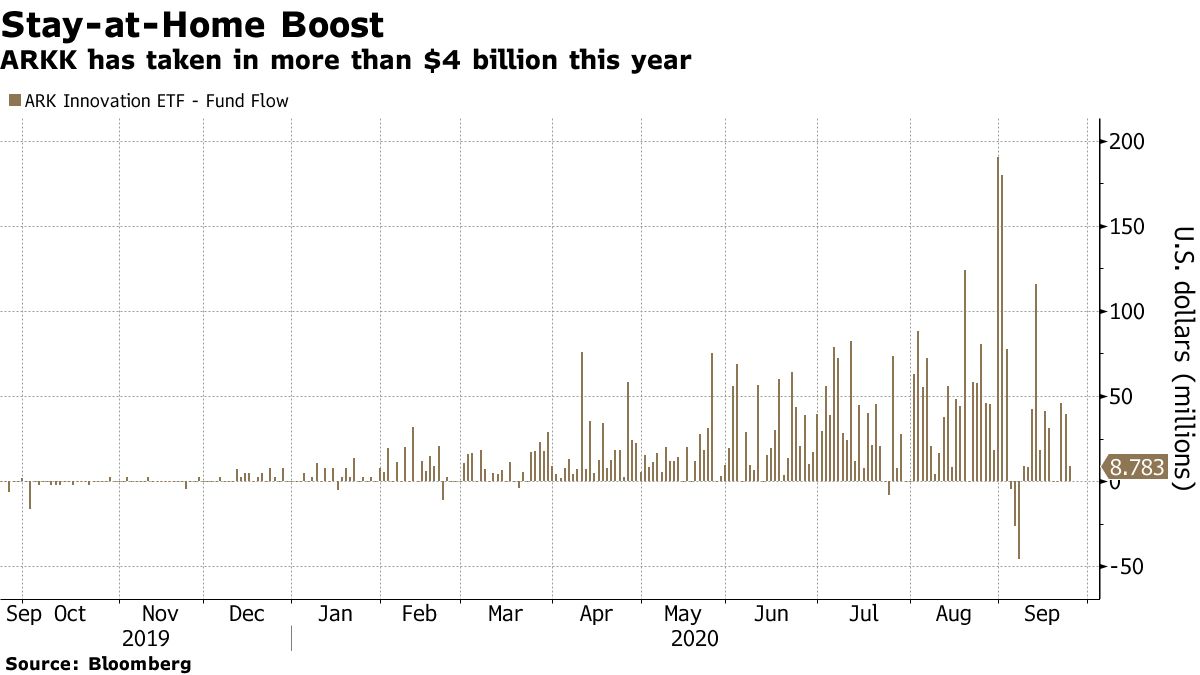
And in today’s market, that disconnect pays big. Wood’s funds have been top performers this year; ARKK and ARKW have returned more than 78% so far in 2020. But if we may interject for a moment, if almost no one comes from a financial background, how is that “diverse”?
The company’s Chief Compliance Officer, Kellen Carter, said: “It’s an example of how diversity can make companies more efficient and productive because of the diversity of experience that we all bring to the table.”
Recall, about a week ago, we noted that the “diverse” group decided to do what they do best: add more Tesla on any and all dips regardless of the company’s valuation. Wood said last week she was “happy” to see Tesla shares “get slapped” and was, of course, buying more.
“We wait for those sorts of days where there is outright fear,” she said of a company participating in an index that has doubled off its lows in less than 6 months thanks to a Fed and Softbank induced manipulation frenzy. “If we think the stock has dropped enough, we’ll move in, and we did.”
“I was happy to see it get slapped,” she commented.
Tesla was, in fact, slapped this month, falling 21% after it was announced that the company was snubbed for entry into the S&P 500. Wood says she used that as an “opportunity” to boost ARKK’s $8.4 billion ETF’s position in the name to 10.7% from 9.9%.
Shares are up almost 35% since then, once again validating Wood’s investment strategy, which appears to be betting that economic reality as it relates to public companies no longer exists.
via ZeroHedge News https://ift.tt/3jbdzKr Tyler Durden