It’s been four years since Donald Trump promised to release his personal income tax returns. Now that The New York Times has gone and done it for him, it’s easy to see why the president never followed through on that promise.
Trump ultimately paid just $750 per year in federal income taxes in 2016 and 2017, according to the Times report, and that was $750 more than he paid in other recent years. In fact, in 11 out of 18 years that the Times looked at, Trump effectively paid $0 in federal income tax.
Trump’s tax burden was “less than those earning under $5K, and less then every income group earning more than $20K,” New York University law professor Lily Batchelder points out.
It’s also much less than he paid in taxes to other nations. “In 2017, the president’s $750 contribution to the operations of the U.S. government was dwarfed by the $15,598 he or his companies paid in Panama, the $145,400 in India and the $156,824 in the Philippines,” says the Times.
Just finished reading the big Trump Taxes NYT piece but I came away from it feeling like the federal tax code is the real villain here
How did he pay so little here? “Trump initially paid almost $95 million in federal income taxes over the 18 years,” the Times reports. But he
later managed to recoup most of that money, with interest, by applying for and receiving a $72.9 million tax refund, starting in 2010.
The refund reduced his total federal income tax bill between 2000 and 2017 to an annual average of $1.4 million. By comparison, the average American in the top .001 percent of earners paid about $25 million in federal income taxes each year over the same span.
The refund also earned him an IRS audit, starting in 2011, that has not been resolved.
“A lot of tax scams out there but it’s genuinely rare—and suspicious—for a rich person to have such a low tax bill,” claimed Matthew Yglesias of Vox.
“It’s not immediately obvious that this is odd for an active real estate investor,” the Tax Foundation’s Karl Smith responded. “Especially doing renovations. This activity can be an enormous cash suck with very long payout horizons. [It’s] totally conceivable that a successful active investor could be cash neg their whole life.”
Trump’s ability to so successfully minimize his tax burden is impressive. Much less impressive is what these tax returns suggest about Trump’s business prowess.
“Many of Trump’s top businesses are losing money, even as those losses have helped him shrink his federal tax bill to essentially nothing,” notes AP. “The president has frequently pointed to his far-flung hotels, golf courses and resorts as evidence of his success as a developer and businessman. Yet these properties have been been draining money.”
Trump told Americans in 2018 that he his annual earnings were $434 million. But he told the IRS that he had lost $47.4 million that year.
His golf courses have allegedly lost $315 million since 2000. The Trump International Hotel in D.C. has lost $55 million.
“It is important to remember that the returns are not an unvarnished look at Mr. Trump’s business activity,” writes the Times‘ David Leonhardt. “They are instead his own portrayal of his companies, compiled for the I.R.S. But they do offer the most detailed picture yet available.”
It’s a good morning to remind you that you are more likely to be audited if you are poor than if you are rich:@paulkiel‘s story:https://t.co/kaLSGTzDUA
• Good news for folks in England: London will finally let Uber operate within its city limits again.
• California will start requiring prisons to house transgender inmates in the prison that matches their gender identity.
• Police officers in riot gear arrested peaceful protesters in New York City last night for having “gathered on the sidewalk and a pedestrian island on Hudson Street” after police told them not to. Meanwhile, in Maryland, more than 100 people were arrested for attending an unauthorized car rally.
from Latest – Reason.com https://ift.tt/3l70hPR
via IFTTT
It’s been four years since Donald Trump promised to release his personal income tax returns. Now that The New York Times has gone and done it for him, it’s easy to see why the president never followed through on that promise.
Trump ultimately paid just $750 per year in federal income taxes in 2016 and 2017, according to the Times report, and that was $750 more than he paid in other recent years. In fact, in 11 out of 18 years that the Times looked at, Trump effectively paid $0 in federal income tax.
Trump’s tax burden was “less than those earning under $5K, and less then every income group earning more than $20K,” New York University law professor Lily Batchelder points out.
It’s also much less than he paid in taxes to other nations. “In 2017, the president’s $750 contribution to the operations of the U.S. government was dwarfed by the $15,598 he or his companies paid in Panama, the $145,400 in India and the $156,824 in the Philippines,” says the Times.
Just finished reading the big Trump Taxes NYT piece but I came away from it feeling like the federal tax code is the real villain here
How did he pay so little here? “Trump initially paid almost $95 million in federal income taxes over the 18 years,” the Times reports. But he
later managed to recoup most of that money, with interest, by applying for and receiving a $72.9 million tax refund, starting in 2010.
The refund reduced his total federal income tax bill between 2000 and 2017 to an annual average of $1.4 million. By comparison, the average American in the top .001 percent of earners paid about $25 million in federal income taxes each year over the same span.
The refund also earned him an IRS audit, starting in 2011, that has not been resolved.
“A lot of tax scams out there but it’s genuinely rare—and suspicious—for a rich person to have such a low tax bill,” claimed Matthew Yglesias of Vox.
“It’s not immediately obvious that this is odd for an active real estate investor,” the Tax Foundation’s Karl Smith responded. “Especially doing renovations. This activity can be an enormous cash suck with very long payout horizons. [It’s] totally conceivable that a successful active investor could be cash neg their whole life.”
Trump’s ability to so successfully minimize his tax burden is impressive. Much less impressive is what these tax returns suggest about Trump’s business prowess.
“Many of Trump’s top businesses are losing money, even as those losses have helped him shrink his federal tax bill to essentially nothing,” notes AP. “The president has frequently pointed to his far-flung hotels, golf courses and resorts as evidence of his success as a developer and businessman. Yet these properties have been been draining money.”
Trump told Americans in 2018 that he his annual earnings were $434 million. But he told the IRS that he had lost $47.4 million that year.
His golf courses have allegedly lost $315 million since 2000. The Trump International Hotel in D.C. has lost $55 million.
“It is important to remember that the returns are not an unvarnished look at Mr. Trump’s business activity,” writes the Times‘ David Leonhardt. “They are instead his own portrayal of his companies, compiled for the I.R.S. But they do offer the most detailed picture yet available.
It’s a good morning to remind you that you are more likely to be audited if you are poor than if you are rich:@paulkiel‘s story:https://t.co/kaLSGTzDUA
• Good news for folks in England: London will finally let Uber operate within its city limits again.
• California will start requiring prisons to house transgender inmates in the prison that matches their gender identity.
• Police officers in riot gear arrested peaceful protesters in New York City last night for having “gathered on the sidewalk and a pedestrian island on Hudson Street” after police told them not to. Meanwhile, in Maryland, more than 100 people were arrested for attending an unauthorized car rally.
from Latest – Reason.com https://ift.tt/3l70hPR
via IFTTT
Key Events This Week: Payrolls, PMIs And Presidential Debate Tyler Durden
Mon, 09/28/2020 – 09:20
As we wave goodbye to the third quarter and welcome Q4, which for once everyone can agree will begin on Thursday, politics will move increasingly into the spotlight for investors according to DB’s Jim Reid who reminds us that tomorrow features the first presidential debate in the US. This comes in what is likely to be a febrile atmosphere after the expected weekend announcement of President Trump’s pick for the Supreme Court. Staying with politics we’ll see the resumption of Brexit negotiations between the UK and the EU. In data terms the US jobs report on Friday, the ADP report on Wednesday and global manufacturing PMIs on Thursday will be the keys.
Going into more detail now and tomorrow we see the much-anticipated first debate between Trump and Biden. This will be the first time that the candidates have directly debated each other, and will last for 90 minutes, with the debate divided into six segments. We’ve already been informed that subject to new developments, the topics will be:
the Trump and Biden records;
the Supreme Court;
Covid-19;
the economy;
race and violence in our cities;
and the integrity of the election.
The New York Times report over the weekend on the President’s tax returns, which he had avoided disclosing in the 2016 race, as well throughout his first term in office, is quite likely to make an appearance as well. This is the first of three debates between the two, with the others taking place on October 15 and 22, and a debate between the Vice Presidential candidates taking place as well on October 7.
Heading into this debate, Trump picked Amy Coney Barrett to be his choice for the vacant US Supreme Court seat. Confirmation hearings are expected to start on October 12th with a full Senate vote possible by October 26th and just before the election. As has been well flagged this could turn the Supreme Court 6-3 in favour of the Republicans and could have legal ramifications for the US for a generation. And as has also been well flagged, this nomination is highly contentious this close to an election with the Democrats looking at all options to address the balance if they win the White House and Senate in November – assuming the nomination goes through before a new Senate is seated in January.
Elsewhere in the US we get the September jobs report on Friday, which will be the last report we get before Election Day. In August, the unemployment rate fell to a lower-than-expected 8.4%, and the consensus is looking for a further decline to 8.2 % in September. In terms of non-farm payrolls, the consensus is looking for job growth of +865k, but it’s worth bearing in mind that having lost over -22MM jobs in March and April, even this figure would mean that just over half of them have been recovered, still leaving nonfarm payrolls over 10MM below their peak back in February.
The other important data release to watch out for next week will be the release of the manufacturing PMIs and the ISM manufacturing index on Thursday. The flash readings we’ve already had generally showed manufacturing holding up relative to expectations, whereas the services readings disappointed, possibly as hospitality/entertainment related industries start to see heightened restrictions again. For example in the Euro Area, the flash manufacturing PMI rose to 53.7, which was its highest reading since August 2018 but the services reading was down to 47.6 from 50.5 last month.
A visual summary of the events this week is shown in the table below:
Elsewhere, a special European Council meeting of EU leaders will take place on Thursday and Friday. This was originally meant to have taken place the previous week, but was postponed after European Council President Michel had to self-isolate after coming into contact with a security officer who tested positive. In terms of the agenda, there are a number of items, including relations with Turkey and the situation in the Eastern Mediterranean, as well as relations with China.
Here is a summary breakdown of key events by day courtesy of Deustche Bank:
Monday September 28
Data: Japan final July leading index, US September Dallas Fed manufacturing index
Central Banks: ECB President Lagarde, ECB’s Schnabel and Fed’s Mester speak
Politics: Brexit talks between the UK and the EU resume
Tuesday September 29
Data: France September consumer confidence, UK August mortgage approvals, Euro Area final September consumer confidence, Germany preliminary September CPI, US preliminary August wholesale inventories, September Conference Board consumer confidence
Central Banks: Bank of Japan release Summary of Opinions from September meeting, Fed Vice Chair Quarles, Vice Chair Clarida, Williams and Harker speak
Politics: US Presidential Debate
Wednesday September 30
Data: Japan August retail sales, housing starts, preliminary August industrial production, final August machine tool orders, July vehicle production, China September composite PMI, manufacturing PMI, non-manufacturing PMI, UK final Q2 GDP, France preliminary September CPI, Germany September unemployment change, Italy preliminary September CPI, US September ADP employment change, MNI Chicago PMI, third Q2 GDP reading, August pending home sales, Canada July GDP
Central Banks: ECB President Lagarde, ECB’s Lane and Rehn, Fed’s Kashkari and Bowman speak
Thursday October 1
Data: September manufacturing PMIs from Australia, Indonesia, Japan, India, Russia, Turkey, Italy, France, Germany, Euro Area, UK, South Africa, Brazil, Canada, US and Mexico, Japan September vehicle sales, Italy preliminary August unemployment rate, Euro Area August PPI, unemployment rate, US weekly initial jobless claims, August personal income, personal spending, construction spending, September ISM manufacturing
Central Banks: Reserve Bank of India monetary policy decision, ECB’s Lane, Fed’s Williams and Bowman speak
Politics: Special European Council summit begins
Friday October 2
Data: Japan August jobless rate, September monetary base, Euro Area September flash CPI, US September change in nonfarm payrolls, unemployment rate, average hourly earnings, final September University of Michigan consumer sentiment index, August factory orders, final August durable goods orders, nondefence capital goods orders ex air
Central Banks: ECB’s Holzmann and Fed’s Harker speak
Politics: Special European Council summit concludes
* * *
Finally, looking at just the US, economic data releases this week are the ISM manufacturing index on Thursday and the employment report on Friday. There are numerous scheduled speaking engagements by Fed officials this week.
Monday, September 28
10:30 AM Dallas Fed manufacturing index, September (consensus 9.5, last 8.0)
02:00 PM Cleveland Fed President Mester (FOMC voter) speaks: Cleveland Fed President Loretta Mester will participate in a webinar hosted by the African American Chamber of Commerce of Western Pennsylvania. Prepared text and audience Q&A are expected.
Tuesday, September 29
08:25 AM New York Fed President Williams (FOMC voter) speaks: New York Fed President John Williams will speak at a webinar for the 2020 US Treasury Market Conference. Prepared text is expected.
08:30 AM Advance goods trade balance, August (GS -$81.0bn, consensus -$81.8bn, last -$80.1bn): We estimate that the goods trade deficit decreased by $0.9bn to $81.0bn in August compared to the final July report, as both exports and imports likely rose further.
08:30 AM Wholesale inventories, August preliminary (consensus -0.1%, last -0.3%)
09:00 AM S&P/Case-Shiller 20-city home price index, July (GS +0.2%, consensus +0.10%, last flat): We estimate the S&P/Case-Shiller 20-city home price index increased by 0.2% in July, following an unchanged level in June.
09:30 AM Philadelphia Fed President Harker (FOMC voter) speaks: Philadelphia Fed President Patrick Harker will take part in a virtual discussion on machine learning hosted by the Official Monetary and Financial Institutions Forum. Prepared text and audience Q&A are expected.
10:00 AM Conference Board consumer confidence, September (GS 91.0, consensus 90.0, last 84.8): We estimate that the Conference Board consumer confidence index increased by 6.2pt to 91.0 in September based on improvements in other consumer confidence measures, including our GS Twitter Economic Sentiment Index.
11:40 AM Fed Vice Chair Clarida (FOMC voter) speaks: Fed Vice Chair Richard Clarida will moderate a discussion on “Future Considerations for Treasury Market Resilience” hosted by the New York Fed.
01:00 PM New York Fed President Williams (FOMC voter) speaks: New York Fed President John Williams will speak at a virtual event hosted by the Policy Advisory Board at the Fisher Center for Real Estate and Economics.
01:00 PM Fed Governor Quarles (FOMC voter) speaks: Fed Vice Chair for Supervision Randal Quarles will participate in a panel on financial regulation hosted by Harvard Law School and the Program on International Financial Systems.
03:00 PM Fed Governor Quarles (FOMC voter) speaks: Fed Vice Chair for Supervision Randal Quarles will speak about financial stability at a webinar hosted by the University of Maryland. Audience Q&A is expected.
Wednesday, September 30
08:15 AM ADP employment report, September (GS +650k, consensus +630k, last +428k): We expect a 650k gain in ADP payroll employment – below our forecast of +1,200k for private payrolls in the Bureau of Labor Statistics report – reflecting drags from the other inputs of the ADP model.
08:30 AM GDP, Q2 third (GS -31.7%, consensus -31.7%, last -31.7%): Personal consumption, Q2 third (GS -34.1%, consensus -34.1%, last -34.1%); We expect no revision on net to Q2 GDP in the third vintage (previously reported at -31.7% qoq ar).
09:45 AM Chicago PMI, September (GS 53.0, consensus 52.0, last 51.2): We estimate that the Chicago PMI increased by 1.7pt to 53.0 in September — following a 0.7pt decline in August — reflecting firmer manufacturing surveys on net so far in the month.
10:00 AM Pending home sales, August (GS +6.0%, consensus +3.0%, last +5.9%): We estimate that pending home sales rose by 6.0% in August based on regional home sales data, following a 5.9% increase in July. We have found pending home sales to be a useful leading indicator of existing home sales with a one-to-two-month lag.
11:00 AM Minneapolis Fed President Kashkari (FOMC voter) speaks: Minneapolis Fed President Neel Kashkari will discuss COVID-19 and the economy at a virtual forum hosted by the Wisconsin Manufacturers and Commerce.
01:40 PM Fed Governor Bowman (FOMC voter) speaks: Fed Governor Michelle Bowman will speak on community banking at a conference hosted by the St. Louis Fed. Prepared text and audience Q&A are expected.
Thursday, October 1
08:30 AM Initial jobless claims, week ended September 26 (GS 875k, consensus 850k, last 870k); Continuing jobless claims, week ended September 19 (consensus 12,250k, last 12,580k); We estimate initial jobless claims increased to 875k in the week ended September 26. We see large, two-sided risks around this week’s initial claims forecast due to California’s two week pause in new claim applications.
08:30 AM Personal income, August (GS -2.0%, consensus -2.5%, last +0.4%); Personal spending, August (GS +1.0% consensus +0.8%, last +1.9%); PCE price index, August (GS +0.31%, consensus +0.3%, last +0.32%); Core PCE price index, August (GS +0.33%, consensus +0.3%, last +0.35%); PCE price index (yoy), August (GS +1.25%, consensus +1.2%, last +1.00%); Core PCE price index (yoy), August (GS +1.44%, consensus +1.4%, last +1.25%): Based on details in the PPI, CPI, and import price reports, we forecast that the core PCE price index rose by 0.33% month-over-month in August, corresponding to a 1.44% increase from a year earlier. Additionally, we expect that the headline PCE price index increased by 0.31% in August, corresponding to a 1.25% increase from a year earlier. We expect a 2.0% decrease in personal income in August and a 1.0% increase in personal spending.
09:45 AM Markit US manufacturing PMI, September final (consensus 53.5, last 53.5)
10:00 AM ISM manufacturing index, September (GS 56.5, consensus 56.3, last 56.0): We expect the ISM manufacturing index to edge up by 0.5pt to 56.5 in the September report. Our manufacturing survey tracker for September increased by 1.0pt to 56.4.
10:00 AM Construction spending, August (GS +0.7%, consensus +0.7%, last +0.1%): We estimate a 0.7% increase in construction spending in August, with scope for increases in private residential and public construction.
11:00 AM New York Fed President Williams (FOMC voter) speaks: New York Fed President John Williams will moderate a virtual discussion with Merck CEO Kenneth Frazier hosted by the Economic Club of New York.
11:00 AM New York Fed President Williams (FOMC voter) speaks: New York Fed President John Williams will deliver pre-recorded remarks at the New York Fed Research Conference on FinTech.
03:00 PM Fed Governor Bowman (FOMC voter) speaks: Fed Governor Michelle Bowman will speak on community banking at an event hosted by the Montana State University Jake Jabs College of Business and Entrepreneurship. Prepared text and audience Q&A are expected.
05:00 PM Lightweight motor vehicle sales, September (GS 15.0m, consensus 15.6m, last 15.2m)
Friday, October 2
08:30 AM Nonfarm payroll employment, September (GS +1,100k, consensus +850k, last +1,371k); Private payroll employment, September (GS +1,200k, consensus +850k, last +1,027k); Average hourly earnings (mom), September (GS +0.1%, consensus +0.2%, last +0.4%); Average hourly earnings (yoy), September (GS +4.8%, consensus +4.5%, last +4.7%); Unemployment rate, September (GS 8.1%, consensus 8.2%, last 8.4%): We estimate nonfarm payroll growth rose +1.1mn in September after +1.4mn in August. The resurgence of the coronavirus did not halt the sharp rebound in payrolls over the summer, and the second-derivative improvement of the public-health situation coupled with favorable readings of jobless claims and alternative labor market indicators is consistent with another sizable gain in the nonfarm measure. On the negative side, we expect the start of the school year to lower seasonally adjusted education payrolls by 200-300k (public + private), as many janitors and support staff did not return to work as usual. The inability to obtain childcare is also likely to weigh on job creation at the margin, though its effect may already be mostly reflected in the August payroll levels (given the cancellation of some in-person summer camps and an earlier reduction in childcare provider availability). We also expect a roughly 50k drag to government payrolls from the start of the wind-down of Census canvassing activities (we estimate private payrolls rose 1.2mn).
We estimate the unemployment rate declined by three tenths to 8.1%, reflecting another increase in household employment partially offset by higher labor force participation. We estimate average hourly earnings rose 0.1% month-over-month, boosting the year-on-year rate by a tenth to 4.8%. This forecast reflects a continuing unwind of the composition shift from lower to higher paid workers as well as negative calendar effects.
09:00 AM Philadelphia Fed President Harker (FOMC voter) speaks: Philadelphia Fed President Patrick Harker will take part in a virtual discussion on an inclusive workforce recovery. Prepared text and audience Q&A are expected.
10:00 AM University of Michigan consumer sentiment, September final (GS 79.0, consensus 78.9, last 78.9): We expect the University of Michigan consumer sentiment index to edge 0.1pt higher from the preliminary estimate for September, in which the index rose by 4.8pt. The report’s measure of 5- to 10-year inflation expectations declined by one tenth to 2.6% in the preliminary report.
10:00 AM Factory orders, August (GS +1.2%, consensus +1.0%, last +6.4%); Durable goods orders, August final (last +0.4%); Durable goods orders ex-transportation, August final (last +0.4%); Core capital goods orders, August final (last +1.8%); Core capital goods shipments, August final (last +1.5%): We estimate factory orders increased by 1.2% in August following a 6.4% increase in July. Durable goods orders rose by 0.4% in the August advance report, and core capital goods orders rose by 1.8%.
Source: Goldman, Deutsche Bank, BofA
via ZeroHedge News https://ift.tt/339jDxp Tyler Durden
“Take A Deep Breath: Markets Are About To Be Dragged Into A Real-Life Version Of Fear And Loathing” Tyler Durden
Mon, 09/28/2020 – 09:10
By Michael Every of Rabobank
Take a deep breath. Markets are about to be dragged into a real-life version of ‘Fear and Loathing in Las Vegas’, a cinematic achievement one does not so much feel one has watched as been forced to snort off the screen at gunpoint. In other words, the climax of the US presidential election is upon us. Of course, there is a better Hunter S. Thompson novel to capture the bad trip that is 2020: ‘Fear and Loathing on the Campaign Trail ‘72’, which McGovern’s campaign manager himself said represented “the least factual, most accurate account” of the election. Indeed, once again we live in times where we are both lacking facts and yet see total accuracy; or we have the facts and lack the accuracy.
So where do we stand this morning after just one weekend of US news? President Trump nominated Amy Coney Barret (ACB) to replace the sadly-departed Ruth Bader Ginsburg (RBG) on the Supreme Court. This appears to be achievable before the election day provided Trump does not lose more than three Republican senators along the way. Everyone hum along: “ACB; Easy as 1,2,3; Unless you lose Mitt Rom-ney; Mur-kow-ski; and then in November, McSally.” Naturally, this drama –not another fiscal stimulus package– now preoccupies Washington DC, despite the desperate need for one according to every Fed speaker.
Trump used Twitter to challenge Joe Biden to a drug test either before or after the looming presidential debate tomorrow night, which he would also take too, in order to remove any suspicions that either candidate is taking performance-enhancers. Which underlines just how far 2020 is into Hunter S Thompson territory. Indeed, the journalist who best captures his tone to me today (albeit in a sober sense), Matt Taibbi, replied on Twitter: “Drugs should be administered to both candidates in equal doses, live and before opening statements, by someone with expertise – like the road manager of a metal band.” Who wouldn’t pay to see that show? And would the answers we get make any less sense for the scale of problems we all face?
The New York Times released what it claims are Donald Trump’s tax returns The headline is that Trump allegedly paid just *USD750* in income taxes in 2016 and 2017 and no income tax at all for 11 years. Of course, we don’t know if this is true or not as we don’t have the actual returns, which would probably mean 5 years in prison for someone. Trump has naturally dismissed it all as ‘Fake News’. However, there is much gnashing at teeth that this is entirely inappropriate for a billionaire. Actually, it would be entirely typical for a billionaire to pay so little – because that is the way the US tax system works, and all the journalists writing today’s outrage pieces know that, especially the ones working for billionaire media owners.
Is it healthy? That’s a whole different question – which will not be asked on the campaign trail by anyone. In this someone-spiked-my-drink atmosphere, Joe (and Jill) Biden’s joint tax returns –released with full transparency– show in 2016 he earned USD400,000 as Vice-President, and in 2017 that rose to USD11m, falling back to USD4.6m in 2018. That is a lot of well-paid after-dinner speeches and book royalties that don’t await anyone reading this once they retire – but again is not in question in DC, because that’s just how the system works. The Wall Street Journal also claims they avoided paying USD500,000 in tax on it by classifying it “as S-corporation profits rather than taxable wages.” (A technique UK politicians have also used for years too, and it’s all perfectly legal and normal on both sides of the Atlantic.) Expect many more such stories, and worse, in coming weeks: that’s a campaign trail, folks.
Somehow this seems unlikely to move the polls very much; then again, which polls? Most still show a very healthy Biden lead. However, a subset of pollsters vociferously claim this is failing to pick up a massive realignment of new likely voters which is increasingly making this into not a traditional Republican vs Democrat battle, but into an ‘insider’ vs. ‘outsider’ one. Of course, that’s just a view, and people will always talk their own book: but more volatility could well lie ahead.
Finally, this morning Project Veritas has also reported allegations of organised ballot harvesting of mail-in votes having been captured in Michigan, which none of the larger newspapers are going anywhere near, just the more tabloid New York Post.
Naturally, China’s Global Times is running an editorial today that talks about the end of the Roman Empire and the failing appeal of the US despite “so called freedom and democracy.” As Thompson already noted back in ’72: “It was like a scene from the final hours of the Roman Empire: Everywhere you looked, some prominent politician was degrading himself in public.” The good news? As far back as ’72 he was also already writing: “The only thing I ever saw that came close to Objective Journalism was a closed-circuit TV setup that watched shoplifters in the General Store at Woody Creek, Colorado.”; and was asking “Where will it end? How low do you have to stoop in this country to be President?”
In short, this too shall pass.
But first we have weeks and weeks of daily crazy stories…and of no US fiscal stimulus (most likely)… and consequently of further moves back towards the USD. Which might make as much sense to some as the same way Hunter S. Thompson would reach for a case of ether when already so full of drugs that he looked like a petro-chemical plant; but in both cases one still ends up with a fist full of dollars somehow, tangled up in red, white, and blue. God bless America!
Indicatively, consider that a US judge has just stayed the shutdown of TikTok, following a similar delay on WeChat: we have the US president calling both a national security concern, and yet a judge is capable of halting the process to ensure that it is entirely legal.
The US Department of Commerce has meanwhile decided to impose restrictions on US tech exports to China’s biggest chipmaker SMIC after concluding there is an “unacceptable risk” that equipment supplied to it could be used for military purposes. Again, this shows US muscle. China is talking about the need for a “long march” to break its tech dependence on the West. That, as Bloomberg reports that “China’s Rebound Lost Momentum in September, Early Data Show”.
Abroad –and getting almost no coverage because there are no nice 5-star hotels or big media bar tabs available in the vicinity– we also have war between Armenia and Azerbaijan, which potentially risks dragging in Russia and Turkey on opposite sides. In the very worst-case scenario, it is also alleged that Armenia could even blow up the gas pipelines that cross it and which feed Turkey (which now has some involvement in Libya, Syria, Iraq, and Armenia, as well as geopolitical tensions with Greece and Cyprus).
Let’s finish with a duo of red, white, and blue of Hunter-isms:
“When the going gets weird, the weird turn professional.”
“With the truth so dull and depressing, the only working alternative is wild bursts of madness and filigree.”
via ZeroHedge News https://ift.tt/2EIwP2Y Tyler Durden
Global COVID-19 cases have breached the 33 million mark as infections continue to soar worldwide. The official death count is around one million, as China is at it again, urging domestic companies to halt frozen imports of food from countries that have been severely impacted by the pandemic due to the risk of transmission through packaging, reported Bloomberg.
In July, we also noted imports of shrimp from Ecuador were found to be carrying the virus, well, not the shrimp itself, but, according to China, the packaging had traces of the virus.
Now the Beijing city government on Monday warned companies to avoid importing frozen food from countries where the virus is rampant. This comes after China found its first local asymptomatic infection in more than a month as two workers at a port in Qingdao city tested positive after unloading frozen seafood.
In recent weeks, China halted seafood imports from two Russian vessels and a Brazilian company after the virus was found on packaging. Individual food plants in Ecuador, Brazil, and Indonesia have seen their exports to China ground to a halt as well.
Bloomberg notes that “cold-storage facilities and meat-processing plants are ideal environments for the virus to thrive, there has been no concrete evidence the virus can be transmitted through food and packaging, and experts remain doubtful that it’s a major threat.”
In August, China’s top virus expert advised the government to limit imports of frozen food to mitigate the spreading of the virus. The FDA has said it’s “not aware of any evidence” that links the transmission of the respiratory virus to food.
Virus scares tied to imports is just another tool for Beijing to keep the narrative alive that the virus originated outside China – Beijing has been caught implicitly supporting these conspiracy theories. Maybe they’ve learned this time to be more subtle.
via ZeroHedge News https://ift.tt/3mYUKws Tyler Durden
“You can’t buy happiness but you can buy tea, and that’s kind of the same thing..”
There are some weekends when its best to just not open a newspaper, listen to the wireless, or watch the BBC. If you did you are probably near-suicidal by now at the bleakness predicted ahead. The government is completely and utterly hamstrung by the Pandemic Fear it’s created versus the need to reopen the economy. They are tripping up over everything in a storm of confusion. After imploring us to save the NHS the reality is national economic suicide will close it down even faster. Our mop-top premier is nervous and conflicted. A poll at the weekend put Labour ahead in the polls. Well done Sir Kier. Keep hoping Boris trips over his laces for the next 4 years and you will do just fine… As national treasures like Rolls Royce desperately seek funding from overseas, it feels like panic is mounting…
Relax.
This is the just the way we do things in the UK. We like to fret, panic, tear our hair out.. and then have a nice cup of teaand not worry about it anymore. There, there… it will all be better tomorrow. And sure enough… the sun will eventually rise… On a broken dystopian ruined landscape of economic destruction or a bright new technology-led Britain?
Personally.. I favour the latter… but fear the former.
Top of the madness list is Students being charged £9,000 per annum for not being taught and charged £200 a week to be locked up in solitary confinement because nobody thought they might socialise? Next week it will be something else equally ill-considered and barmy.
There are always pragmatic solutions. The right thing to do with students would be to tell them:
Sorry, you can’t go to pubs, discos, or bars, or use public transport, but the student unions will be open all night and the drinks are on us. You are all going to catch it whatever we do so catch it together, stay on campus don’t spread it, and when you recover (as you surely shall), we can get on with business of teaching you… Party On! Nope. The government’s policy is to create a new generation of non-students whose happiest days will be their most suicidal. Not good.
Students matter.
The UK has excellent prospects. We’ve always been inventive, bright and innovative which a national penchant for being inquisitive – which is what matters. Exactly the right characteristics for a tech-savy future economy – if we can find the trained engineers, computer geeks, doctors and all the rest to make it happen. But if you crash education – our economic future will stall.
I think I came to understand the problem on Friday evening watching the news. Some gormless acne’d creature was lecturing the BBC’s reporter about how anyone without a mask or wasn’t social distancing clearly didn’t care about anyone else, was willing to murder their own family and others, and should be locked up. It is all government’s fault for not completely locking down the economy again – he loudly told viewers. These words of wisdom were delivered from a packed table of equally spotty youths sitting in a pub.
Stupidity rules.
The UK has become a nation of scared idiots with the bleak reality of the Chancellor being “unable to save every job” means about a million unemployed by Christmas and penury for large parts of the UK’s small business and gig-economy sectors because they haven’t been getting equal access to support.
The sheer misery of it all… it’s enough to turn one to drink. (It works. I have the answer: Apples. Especially apples in their fermented state. My chum Jonnie and I found a good bottle of Calvados on Friday evening in the “special cupboard”. It was so good it literally kept my spirts up right through till Sunday afternoon when we celebrated the end of summer with a delicious pig and some excellent Cider.) Thank goodness for alcohol. Without it.. one might get a tad depressed at the UK Narrative.
Winter is coming… (but Spring will surely follow….)
I really would like the name of Monetary Policy Committee (MPC) member Silvana Tenreyro’s drug dealer. In a wide-ranging Sunday Torygraph interviewshe said the evidence from other countries on the effectiveness of negative rates is “encouraging”. “We have been discussing our toolkit in recent months, including how effective negative rates might be in the current context,” she says. “The evidence has been encouraging.”
Even Andrew Bailey, the Man at the helm of the Bank, thinks that evidence is a “mixed bag”. Andy Haldane, chief economist must have found an even better pharmaceuticals supplier as he apparently still believes in the V-Shaped recovery…
Tenreyho added;“Banks adapted well – their profitability increased with negative rates largely because impairments and loss provisions have decreased with the boost to activity and the increase in asset prices.” Really? (US readers – that’s a loaded comment oozing with sarcasm implying scepticism.) European banks are being paid billions by the ECB to borrow cash, but still aren’t lending because they fear losses, while low rates are killing their margins. And economies aren’t working.
As a Harvard professor I’m not sure if Tenreyho is a member of the Bank’s pension scheme – which will no doubt be based on final salary. For those of us living in the real world and seeing the returns on our self-funded pension pots unlikely to fund any kind of retirement, zero rates means we’ll be working till we drop.
As for the effectiveness of ultra-low rates… I am looking at Japan (a bit of a special case) and Europe (a basket case) and wondering just how successful NIRP (Negative Interest Rate Policy) will prove for economic regeneration when its only success thus far has been to prop up legions of zombie companies and not create many new jobs. If negative interest rates are so effective…. why has the occidental economy been bouncing along so weakly and skirting recessions these last 12 years? For all the talk of low rate and synchronous recovery – growth has been lethargic for years..
Here’s a challenge for Porridge readers. Find me a single market economist who thinks negative interest rates will trigger economic growth and explain to me how?
Negative interest rates do not obey the conventional physics of money. As rates approach zero – behaviours change. The controls reverse.
NIRP acts as a disincentive to considered growth investment. Investors are forced to take increased risk to make any kind of returns, while the normal invisible hand effects on markets to efficiently allocate capital within an economy flatline. Zero rates cause the normal flow of money in an economy to hit stall speed.
Why?
When money costs nothing it is worth nothing. Which partially explains why companies don’t invest in plant, output, new jobs or capacity through low rate periods, but see the greatest returns from leveraging themselves up with ultra-cheap debt to convert equity into debt via stock buybacks. To management it’s the most “efficient” use of capital and meets the Miltonian diktats of all value being created for the benefit of the owner in a Shareholder Economy. (Plus, it ensures the largest bonuses for clever management who’ve been able to raise the stock price..)
Investors know companies buying back their own stock are creating zero-value-added, but favour these companies only because they expect the stock price to rise. Rational investment objectives in terms of wealth creation via growth strategies (ie new products or factories) are corrupted by zero rates – away from growth maximisation towards financial asset growth.
The second part of the equation is that any economy using negative interest rates is clearly in trouble, is low growth, and therefore not worth investing in.
The end result is negative interest rates directly fuel financial asset inflation while adding zero to economic value or growth. That creates 2 effects:
1) ever increasing government intervention which is inherently distorting, and
2) distorted entrepreneurial spirits and investment objectives aimed which ultimately destabilise society as the rich owners of financial assets get richer, while the toiling classes see less and less.
Of course.. I might be wrong. When a distinguished Harvard Economics professor and member of MPC says NIRP is a good thing… whom am I to argue…
via ZeroHedge News https://ift.tt/3j9gMdm Tyler Durden
Global COVID-19 Deaths On Track To Top 1 Million, UK Prepares New ‘Localized Lockdown’ Measures: Live Updates Tyler Durden
Mon, 09/28/2020 – 08:20
Summary:
Global deaths just below 1 million
UK prepares new lockdown measures
Case total tops 33 million
Indian cases top 6 million
Inovio pauses vaccine trial
Russian outbreak worsens
New UK fines take effect
Australia’s Victoria region posts just 5 new cases
* * *
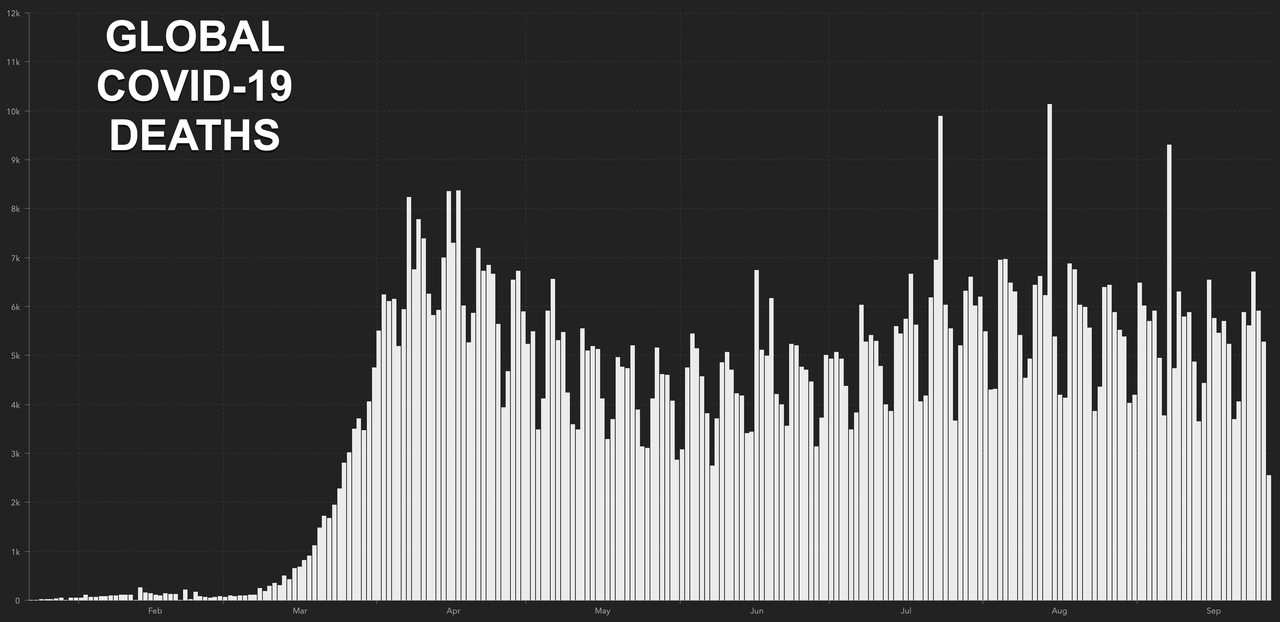
With COVID-19-linked deaths in the US accelerating to roughly 1,000 per day for the first time since before the Sun Belt outbreaks peaked over the summer, the US surpassed 200,000 deaths last week, and now the world is on track to surpass 1 million deaths within the next 24 hours, according to the Associated Press.
Globally, the number of deaths reported on Sunday fell by roughly 50% from the more than 5,000 reported on Saturday. Just 2,552 deaths were reported on Sunday, bringing the global total to 998,145 as of Monday morning, within 2,000 deaths of 1 million. Unless the pace of fatalities slows remarkably on Monday, we will top 1 million before midnight – and possibly before the close of the US market day.
Some experts, however, believe the true death tally might actually be twice the official number, as underreporting has largely gone unchallenged in China and elsewhere.
On the vaccine front, Inovio, a US biotech company, said its Phase 2/3 trials for a COVID-19 vaccine candidate had been put on hold as the company answers more questions from the FDA. Its shares slid 35% on the news, but news of the delay didn’t have any broader impact on markets.
The pace of new COVID-19 cases slowed again on Sunday to 155,542 new cases, but the 7-day average remained firmly in expansionary territory as outbreaks in the US and Europe, along with a handful of other regions, intensify. Many experts fear a quickening in the pace of deaths weeks after cases rise, though others argue that advances in the treatment procedures have helped to lower the mortality rate significantly. Sunday’s numbers pushed the global total past 33 million, to 33,130,914.
As Russia strikes deals around the world to hold Phase 3 trials for “Sputnik 5”, the COVID-19 vaccine developed by the Gameleya Institute and funded by a Russian sovereign wealth fund, an outbreak in Moscow has continued to drive the largest surge in infections since June. New cases in Russia have risen to the highest level since June 16, as authorities confirmed 8,135 new infections in the past 24 hours, pushing the total to 1,159,573. Another 61 people have died, taking the official death toll to 20,385.
But aside from the global figures, the biggest story overnight is India’s total coronavirus infections, which exceeded 6 million as the country reported 82,170 new cases in the last 24 hours, while its death toll jumped by 1,039 to 95,542. The new cases pushed India’s total to north of 6 million cases, leaving it within striking distance of the US total. Though the pace of new infections has slowed since India’s peak a couple of weeks ago, many still expect India to become the world’s biggest outbreak – surpassing the US – within the next 2-3 weeks. India is currently reporting new cases faster than any other country.
Of the total 6.07 million cases, 15.85% of patients are currently active while 82.58% have recovered, according to official data. The coronavirus mortality rate in the country stands at 1.57%, according to the latest update from the health ministry.
Additioanly, the UK is reportedly preparing to enforce new social lockdown across much of northern Britain and potentially London as the country deals with a second wave of coronavirus, according to a Times of London report, which cited unidentified government officials. All pubs, restaurants and bars would be ordered shut for two weeks, per the sources.
Finally, in the UK, the new fines promised by PM Boris Johnson take effect on Monday, with Britons now facing fines of up to £10,000 for people who refuse to self-isolate and follow other social-distancing measures. Britons are asked to snitch on any neighbors seen knowingly violating quarantine orders.
Here’s some other news from overnight:
Australia’s Victoria says its daily rise in new infections fell to five, dropping into the single digits for the first time in more than three months. The state placed nearly 5 million residents of its capital, Melbourne, into a hard lockdown in early August but lifted a night curfew on Sunday thanks to a steady fall in new daily cases (Source: Nikkei).
Saudi Arabia, which is presiding over the Group of 20 countries this year, says the upcoming November gathering of world leaders will be held virtually amid the pandemic (Source: Associated Press).
China reported 21 new cases on Sunday, up from 14 a day earlier, though it claimed all the new cases were “imported”. The number of new asymptomatic cases, which are classified differently from confirmed COVID-19 patients, fell to 14 from 26 a day earlier (Sources: Nikkei).
South Korea reported 50 new infections, down from 95 from the prior day, and the fewest since a new wave of outbreaks that first emerged after a couple of ‘super-spreader’ events last month (Source: Nikkei).
Japan plans to slowly lift overseas travel alerts in October, allowing travel from 10 countries and regions that have a low number of new coronavirus infections, including Australia, New Zealand, and Vietnam (Source: Nikkei).
via ZeroHedge News https://ift.tt/344RWFp Tyler Durden
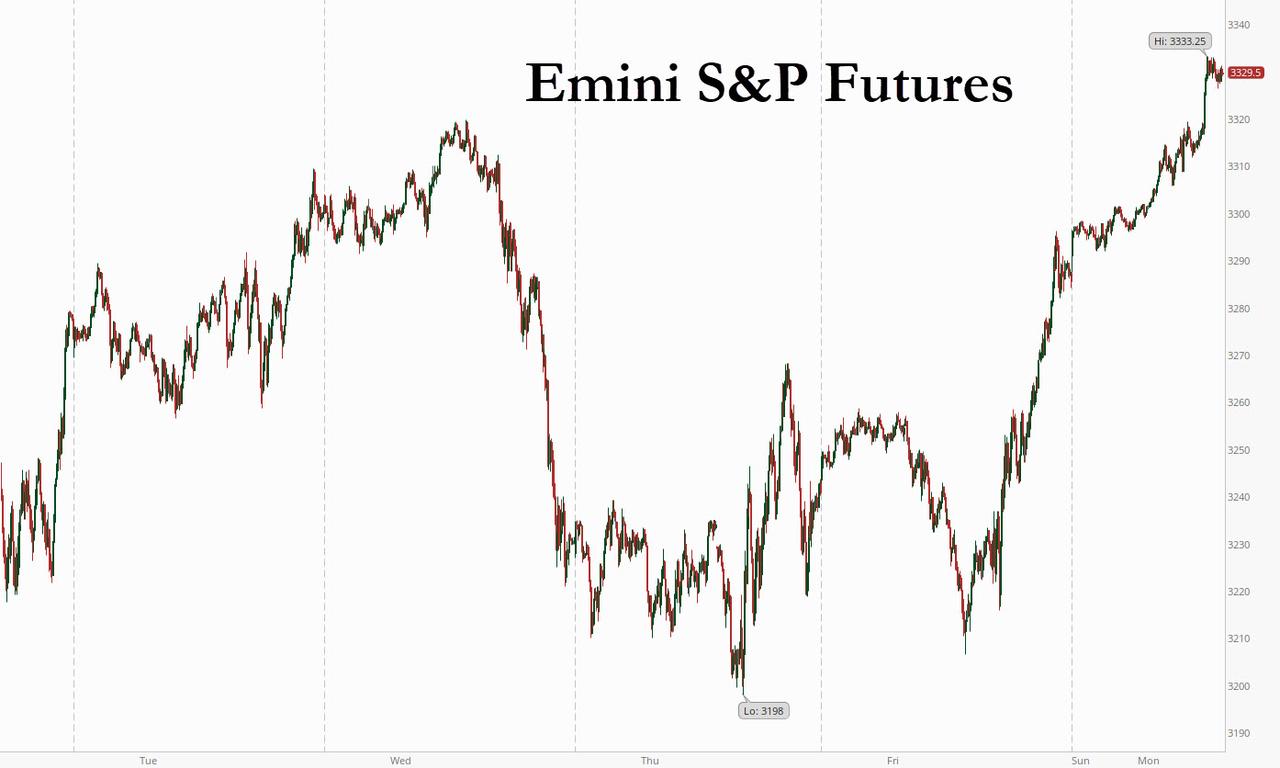
“It’s Hard To Become Too Bearish”: Futures Surge Amid Optimism Selloff Has Gone Too Far Tyler Durden
Mon, 09/28/2020 – 08:07
US stocks future indexes rose on Monday following Friday’s gains and tracking major gains in European and Asian markets amid optimism that the recent selloff in equity markets is overdone. The dollar weakened and Treasury yields rose. The pound strengthened on hopes that U.K. and European Union officials will be able to make progress as a key week of Brexit talks begins, while the Turkish lira crashed to a new all time low on fears the country would be dragged into the sudden breakout of war between Armenia and Azerbaijan.
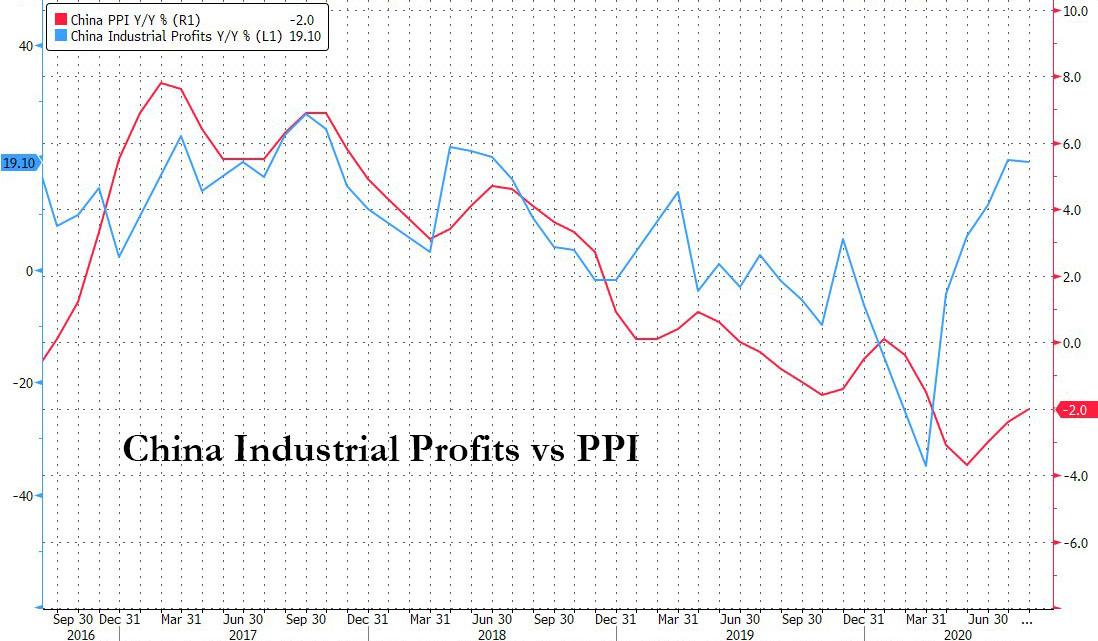
Hopes of a global economic recovery were supported by data showing continued growth in China’s industrial profits, despite fresh concerns that China’s data is once again being manipulated for political purposes with profits diverging massively from PPPI.
Shares of American Airlines, United Airlines, cruise operators Royal Caribbean Cruises Ltd and Carnival Corp rose between 2.5% and 5.6% in premarket trading as sentiment on covid-linked names reversed despite a continued rise in officially reported cases. The global death toll from Covid-19 will likely pass 1 million today, with cases already above 33 million. The milestone will be passed as governments continue to struggle to contain the disease, with authorities in many countries imposing or extending measures. The Times in London is reporting that the city may be forced into another lockdown. New York officials are concerned about localized spikes in infections, even as the city-wide rate remains low.
Late on Friday, American Airlines said it has secured a $5.5 billion Treasury loan and could tap up to $2 billion more in October depending on the allocation of extra funds under a $25 billion loan package for airlines. Uber surged in U.S. pre-market trading after a judge ruled that the ride-hailing app is “fit and proper” to operate in London. The FAAMG stocks rose between 1.1% and 2.2% as Nasdaq futures surged.
Global markets started the week solidly in the green, following Wall Street’s main indexes higher on Friday, helped by technology stocks, but the Dow Jones and the S&P 500 indexes posted their longest weekly losing streaks in a year on fears of a slowing pace of economic growth. Worries over rising coronavirus cases and waning hopes of more fiscal stimulus have led to a spike in market volatility in the past few weeks, and analysts expect trading to remain choppy in the run up to the Nov. 3 presidential election. The VIX spiked to its highest in nearly two weeks last Monday, with analysts warning of further upside to the index heading toward the end of the quarter, and Morgan Stanley warning of a “difficult trading environment” in the next 4-5 weeks.
Stocks also rose on lingering hopes a fiscal deal may still happen before the election. The rapidly diminishing chances of a new fiscal stimulus package ahead of the election got a modest kick after Speaker Nancy Pelosi said Democrats would unveil a new “proffer” shortly, adding that she would prefer the House majority to pass an actual deal than simply vote on a package that would be dead on arrival in the Senate. While there were some talks between Pelosi and Treasury Secretary Steven Mnuchin on Friday, the continuing deep divides on the size of any package and the very short timeline to the election means lawmakers remain skeptical a breakthrough is possible
The Europe Stoxx 600 Index rose more than 2% rebounding from the biggest weekly drop in more than three months as banks rallied the most in three weeks leading the advance among sectors. HSBC Holdings surged 9%, its biggest one-day gain since 2009 after Ping An Insurance Group, its biggest shareholder, raised its stake in the lender to 8%, in a bet the embattled lender will return to paying dividends and said it “remains confident” in HSBC’s long-term prospects.
European carmarkers rallied following comments from Nissan Motor that the company expects to return to profitability in 2021. Diageo rose after saying it expects business to improve as bars and restaurants reopen.
“It is hard to become too bearish,” said Mark Dowding, the chief investment officer at BlueBay Asset Management. “As we look into 2021, growth should be stronger, policy will stay supportive with further fiscal spending. A vaccine is also expected to be deployed and life to return closer to normal by the middle of next year.”
“Investors grapple with many variables that could bring increasing amounts of volatility in the week ahead,” said Hussein Sayed, chief markets strategist at FXTM.
Optimism spilled over from Asian trading hours after data over the weekend showed profits at China’s industrial firms grew for the fourth straight month in August.
Earlier in the session, Asian stocks gained, led by IT and industrials, after rising in the last session. Most markets in the region were up, with Taiwan’s Taiex Index gaining 1.9% and Japan’s Topix Index rising 1.7%, while Jakarta Composite dropped 0.8%. The Topix gained 1.7%, with Careerlink and Scala rising the most. The Shanghai Composite Index was little changed, with Shanghai Zijiang Enterprise Group advancing and Ribo Fashion declining the most.
At the same time, Bloomberg notes that tension between Beijing and Washington continues to simmer. President Donald Trump’s ban on TikTok was temporarily blocked by a federal judge, dealing a blow to the government in its showdown with the popular Chinese-owned app over national security concerns. China’s largest chipmaker, Semiconductor Manufacturing International Corp., sank to a four-month low in Hong Kong after the U.S. imposed export restrictions.
In rates, treasuries bear steepened, with long-end yields cheaper by ~2bp vs. Friday close as the the risk-on backdrop weighed on long-end. Treasury 10-year yields cheaper by 1.5bp at ~0.67%, trading broadly in line with bunds; gilts lag by ~1.2bp. Month-end flows may also support long-end with with Bloomberg Barclays U.S. Treasury index to extend by 0.09y, more than usual October extension. IG credit issuance slate includes AngloGold Ashanti Holdings 10Y; $25bn expected to price this week
In FX, the Bloomberg Dollar Spot Index retreated from a two-month high reached on Friday, and the greenback fell versus most of its Group-of-10 peers. The pound was on track for its biggest gain this month, even with the EU stiffening its demands over how any trade deal will be enforced after losing trust in Boris Johnson because of his attempt to rewrite last year’s divorce agreement. The Canadian dollar was the weakest performer as oil prices struggled to build on recent gains. Australian dollar edged up as investors unwound short positions after Westpac pushed out its forecast for RBA easing to Nov. 3 from Oct. 6. Aussie bond futures drop briefly before recovering. Japan’s currency caught a bid after The Times of London reported the U.S. may relocate American assets away from an airbase in Turkey to Crete to boost its military presence in the eastern Mediterranean
In commodities, oil and the dollar traded lower, while gold rebounded after hitting extremely oversold territory, aided by the drop in the dollar.
On today’s data calendar, we have the Dallas Fed Manufacturing Outlook, while Thor Industries and Cal-Maine Foods are set to report earnings.
Market Snapshot
S&P 500 futures up 0.9% to 3,316.75
STOXX Europe 600 up 1.7% to 361.53
Brent Futures down 0.6% to $41.65/bbl
Gold spot down 0.4% to $1,854.14
U.S. Dollar Index down 0.2% to 94.45
German 10Y yield rose 1.4 bps to -0.515%
Euro up 0.04% to $1.1636
Brent Futures down 0.6% to $41.65/bbl
Italian 10Y yield fell 0.8 bps to 0.682%
Spanish 10Y yield fell 0.3 bps to 0.245%
MXAP up 1.1% to 170.21
MXAPJ up 0.7% to 551.50
Nikkei up 1.3% to 23,511.62
Topix up 1.7% to 1,661.93
Hang Seng Index up 1% to 23,476.05
Shanghai Composite down 0.06% to 3,217.54
Sensex up 1.6% to 37,968.28
Australia S&P/ASX 200 down 0.2% to 5,952.32
Kospi up 1.3% to 2,308.08
Top Overnight News from Bloomberg
The Bank of England’s discussions on negative interest rates have been “encouraging,” according to policy maker Silvana Tenreyro, in a sign that the U.K. could yet follow peers such as the European Central Bank below zero
London’s major clearinghouses for derivatives, energy and metal trades will be able to do business with banks in the European Union next year in a move that averts Brexit market disruption
Bank of America Corp. and Lloyds Banking Group Plc have completed one of the first cross-currency swaps using Libor’s replacements, marking the latest step in the long exodus out of the scandal-tainted rate
Safe-haven assets seen as traditional hedges aren’t panning out as they once did, according to JPMorgan Chase & Co. Easy- money policies may actually be keeping investors in cash and away from other traditional buffers, strategists led by John Normand wrote in a note Friday. That’s because such policies create a zero-yield environment where cyclical assets might be too difficult to hedge, they said
A Conservative Party rebellion against Boris Johnson’s emergency coronavirus powers is gaining momentum after opposition parties signaled their support
Battle lines are being drawn at the heart of the European Central Bank over whether to add monetary support soon to head off any economic slowdown, or wait for stronger evidence that it’s needed
A quick look at global markets courtesy of NewsSquawk:
Asian stocks began the week mostly higher, but ultimately finished mixed, as the region initially picked up the baton from last Friday’s tech-driven momentum on Wall Street. ASX 200 (-0.2%) and Nikkei 225 (+1.3%) were initially positive with Australia led by tech as the sector followed suit from US peers and with sentiment mildly underpinned by news Victoria state is to speed up its easing of COVID-19 restrictions. However, gains were capped and price action weighed on due to weakness in consumer staples and financials, while Tokyo stocks largely shrugged off a choppy currency. Hang Seng (+1.0%) and Shanghai Comp. (U/C) finished mixed mixed with underperformance in the mainland following a net liquidity drain by the PBoC and as participants digested the latest developments between the world’s 2 largest economies. This includes the US federal judge decision to grant a preliminary injunction against President Trump’s ban on TikTok downloads from US app stores which had been set to take effect from midnight, while SMIC shares slumped after the US Commerce Department announced tighter restrictions on China’s largest chipmaker on allegations that exports to the Co. posed an unacceptable risk of being diverted to military end-use. Nonetheless, the mood in Hong Kong was more constructive with HSBC registering its biggest intraday gain in over a decade after Ping An Insurance acquired 10.8mln H-shares to boost its stake to 8%. Finally, 10yr JGBs were rangebound with price action sideways as demand is sapped by the mildly positive risk tone but with downside stemmed amid the BoJ’s presence in the market for a total of JPY 900bln of JGBs.
Top Asian News
Singapore Regulator, Banks in Talks to Extend Debt Relief Scheme
Credit Suisse’s Pozsar Warns of Funding Flood: Liquidity Watch
Betting on Yen Strength Is More Popular Than Ever Among Funds
Stocks in Europe kicked the week off higher across the board (Euro Stoxx 50 +2.1%) following a relatively mixed APAC session, with gains in Europe more pronounced than performance in State-side equity futures at present. Broad-based gains were seen across European bourses at the cash open, but since then Germany’s DAX (+2.6%) emerged as the front runner, whilst the UK’s FTSE 100 (+1.4%) waned on a currency dynamics and Switzerland’s SMI (-0.6%) remains the laggard due to a losses in large-cap stocks including Roche (-0.7%) and Nestle (-0.3%). Sectors are higher across the board with a cyclical/value tilt – with Banks outpacing on the back of HSBC (+8.8%) and Commerzbank (+5.1%) with the former bolstered by Ping An Insurance upping its stake in the Co. to 8% via a purchase of 10.8M, whilst the latter cheers the appointing of a new CEO effective Jan 2021. On the other side of the sector spectrum resides the defensive sectors such as healthcare, telecoms and consumer staples. In terms of individual movers, ArcelorMittal (+10%) extends on gains after M&A, with Cleveland-Cliffs (CLF) to acquire ArcelorMittal’s US operations for ~USD 1.4bln, meanwhile the Co. has also announced a share buyback programme. Diageo (+6.6%) is higher after highlighting that business is performing strongly and ahead of expectations. William Hill (-11.1%) unwinds some of Friday’s speculation-fuelled gains after Caesars offered to take over the group at GBP 2.72/shr (vs. Friday’s GBP 3.12/shr close). Rolls-Royce (-4.5%) also sees losses and resides towards the foot of the Stoxx 600 as the engine maker said there has been no final decision in regards any sovereign wealth fund taking a stake in the group. Despite the broader gains across the Travel & Leisure sector, Air France-KLM (-0.7%) bucks the trend as the Co. expects their November-December program to be at 50% of initial plan.
Top European News
Siemens Energy Slumps on Debut Pushing Value Below Expectations
Key London Clearinghouses Win Right to Operate in EU Post-Brexit
Brexit Talks Enter Key Week With Time and Trust Running Out
French Minister Says LVMH Letter Controversy Excessive
In FX, the Dollar has drifted down from Friday’s highs following a Wall Street recovery rally that has filtered through to APAC and EU equities to varying degrees. However, the DXY remains anchored around the 94.500 level and for once may derive some underlying support into month/quarter end given at least one bank model signalling a buy vs the Eur based on a relatively strong rotation into stocks from bonds to balance asset positions. Meanwhile, on an especially quiet Monday in terms of data, option expiries may have more influence on direction alongside another heavy slate of Central Bank speakers. The index is currently holding within a 94.344-640 range after reaching 97.745 at the tail end of last week, but the Buck is still maintaining strength vs EM currencies and extending gains against some.
GBP – Sterling is firmer across the board, with Cable back on the 1.2800 handle again and Eur/Gbp down below 0.9100 amidst hope if not conviction of progress on a Brexit trade deal going into the latest formal negotiations between the UK and EU in Brussels this week. Moreover, the cross looks technically bearish (bullish from the Pound’s perspective) after breaching the 10 DMA and a key pivot point at 0.9153 and 0.9118 respectively, while Cable is nudging beyond 1.2850 having cleared its 10 DMA circa 1.2828 amidst latest NIRP nuances from the BoE (Tenreyro noting encouraging evidence from tests of sub-zero rates, but Ramsden more circumspect as he still sees the effective lower bound at 0.1%).
AUD – Decent option expiry interest at the 0.7000 strike in Aud/Usd (1.3 bn) appears safe as the Aussie hovers near 0.7050 on a sudden change in RBA rate outlook from Westpac to -15 bp in November instead of the looming policy meeting next week, while COVID-19 restrictions are to be relaxed further in Victoria after the daily rate of infections in the state slowed to sub-20.
JPY/CHF/EUR/NZD – All clawing back some losses vs the Buck, with the Yen rebounding above 105.50 where 1.8 bn expiries reside, but perhaps capped by another 1 bn sitting from 105.00 to 104.90, while the Franc has bounced just ahead of 0.9300 and is pivoting 1.0800 against the Euro following mixed weekly Swiss bank sight deposit balances. Elsewhere, Eur/Usd is just under 1.1650 and also eyeing option expiries as 1.1 bn roll off between the half round number and 1.1640, but ECB commentary could be more influential after a ramp up in verbal intervention from de Cos and Visco before 2 scheduled speeches by Schnabel and one from President Lagarde. Back down under, the Kiwi is straddling 0.6650 and 1.0750 against the Aussie awaiting official NZ election results that PM Adern’s Labour Party seems on course to win without requiring any assistance in the form of a coalition.
SCANDI/EM – Contrasting starts to the new week as the Swedish and Norwegian Crowns recoup declines vs the Euro and unwind recent underperformance regardless of data that is weak on paper via retail sales and trade in the case of the former. Conversely, the Turkish Lira has lost all and more of its post-CBRT rate hike recovery momentum to trade at fresh record lows close to 7.7900 even though the country’s banking watchdog will lower the asset ratio for deposit banks to 90% from 95% effective this Thursday and President Erdogan reckons the resumption of talks with Greece will be constructive and views this week’s EU Summit as a chance to ‘reset’ relations.
In commodities, WTI and Brent front month futures are modestly firmer and are beginning to derive benefit from the improving risk-sentiment more broadly. For the majority of the morning, the benchmarks have been drifting lower in-spite of the aforementioned gains seen across the equity complex, with attention remaining on the demand outlook for crude given the resurgence of COVID-19 triggering talks of tighter lockdowns in certain economies. Russian Energy Minister Novak emerged on the wires today and noted that global oil markets have been stable with restored balance; albeit, cited a second wave of COVID-19 as a downside risk. Subsequently, reports highlight that Russia’s Rosneft is intending to cut output by 10% in October from September levels potentially due to weaker refining margins and an expected drop in demand for oil products in Russia and Europe, the sources stated. Elsewhere, conflict has erupted between Armenia and OPEC member Azerbaijan, although reports thus far point to the military actions being contained within border regions and not close to any Azeri fields, refineries or ports. Something to keep on the radar – Norwegian offshore workers are planning strike action if annual pay negotiations fail, which could lead to the shuttering of around 22% of Norway’s oil and gas output, according to The Norwegian Oil and Gas Association. WTI Nov currently resides around the USD 40.40/bbl level and towards highs of 40.46/bbl, whilst Brent Nov sees itself just north of USD 42.00/bbl (vs. high 42.12/bbl). Elsewhere, precious metals are marginally softer with spot gold just above USD 1850/oz (vs. high 1865.96/oz) and spot silver above USD 22.50/oz (vs. high 23.08/oz) having tested the level in late APAC trade. In terms of base metals, LME copper remains firmer given the strength in stock markets, contained Dollar and expectations for firmer demand from China. Similarly, Dalian iron ore futures were buoyed overnight with participants also keeping an eye on lower volumes ahead of the Chinese October 1st – 8th National Day Holiday.
US Event Calendar
10:30am: Dallas Fed Manf. Activity, est. 9.5, prior 8
DB’s Jim Reid concludes the overnight wrap
Asian markets have started the week on front foot this morning with the Nikkei (+0.72%), Hang Seng (+0.74%), Kospi (+1.49%) and Asx (+0.11%) all up. Futures on the S&P 500 are also up +0.43%. Chinese bourses are trading flat to down however with the CSI (+0.07%) and the Shanghai Comp (-0.22%) lower. In Fx, the US dollar index is down -0.16%.
Looking forwards now, this week we move into Q4, on which we have an in-line with consensus view that it will start on Thursday. Politics will move increasingly into the spotlight for investors, with the coming week featuring the first presidential debate in the US tomorrow. This comes in what is likely to be a febrile atmosphere after the expected weekend announcement of President Trump’s pick for the Supreme Court. Staying with politics we’ll see the resumption of Brexit negotiations between the UK and the EU. In data terms the US jobs report on Friday and global manufacturing PMIs on Thursday will be the keys.
Going into more detail now and tomorrow we see the much-anticipated first debate between Mr Trump and Mr Biden. This will be the first time that the candidates have directly debated each other, and will last for 90 minutes, with the debate divided into six segments. We’ve already been informed that subject to new developments, the topics will be: the Trump and Biden records; the Supreme Court; Covid-19; the economy; race and violence in our cities; and the integrity of the election. The New York Times report over the weekend on the President’s tax returns, which he had avoided disclosing in the 2016 race, as well throughout his first term in office, is quite likely to make an appearance as well. This is the first of three debates between the two, with the others taking place on October 15 and 22, and a debate between the Vice Presidential candidates taking place as well on October 7.
Heading into this debate, Mr Trump picked Amy Coney Barrett to be his choice for the vacant US Supreme Court seat. Confirmation hearings are expected to start on October 12th with a full Senate vote possible by October 26th and just before the election. As has been well flagged this could turn the Supreme Court 6-3 in favour of the Republicans and could have legal ramifications for the US for a generation. And as has also been well flagged, this nomination is highly contentious this close to an election with the Democrats looking at all options to address the balance if they win the White House and Senate in November – assuming the nomination goes through before a new Senate is seated in January.
Elsewhere in the US we see the September jobs report on Friday, which will be the last report we get before Election Day. In August, the unemployment rate fell to a lower-than-expected 8.4%, and the consensus is looking for a further decline to 8.2 % in September. In terms of nonfarm payrolls, the consensus is looking for job growth of +865k, but it’s worth bearing in mind that having lost over -22m jobs in March and April, even this figure would mean that just over half of them have been recovered, still leaving nonfarm payrolls over 10m below their peak back in February.
The other important data release to watch out for next week will be the release of the manufacturing PMIs and the ISM manufacturing index on Thursday. The flash readings we’ve already had generally showed manufacturing holding up relative to expectations, whereas the services readings disappointed, possibly as hospitality/entertainment related industries start to see heightened restrictions again. For example in the Euro Area, the flash manufacturing PMI rose to 53.7, which was its highest reading since August 2018 but the services reading was down to 47.6 from 50.5 last month.
Elsewhere, a special European Council meeting of EU leaders will be taking place on Thursday and Friday. This was originally meant to have taken place the previous week, but was postponed after European Council President Michel had to self-isolate after coming into contact with a security officer who tested positive. In terms of the agenda, there are a number of items, including relations with Turkey and the situation in the Eastern Mediterranean, as well as relations with China. The full day by day calendar is at the end including key central bank speakers.
Back to last week and global equity markets continued to fall as a mix of rising coronavirus cases and further deteriorating data weighed on risk sentiment. The S&P 500 dropped -0.76% despite a strong Friday (+1.47%), declining for a fourth straight week. Banks (-6.18%) and Airlines (-8.01%) were among the largest laggards as the selling expanded from large cap tech. Tech stocks actually broke its recent slide, with Friday’s +2.26% gain helping the NASDAQ to finish up +1.11% on the week. It was the first weekly gain in the index since August. European equities continued their slide with the Stoxx 600 ending the week -3.60% lower (-0.10% Friday). The DAX (-4.93%), FTSE 100 (-2.74%), FTSE MIB (-4.23%), IBEX (-4.35%) and CAC (-4.99%) all posted deep weekly losses as the increasing Covid-19 cases have caused some restrictions to be reinstated in countries, most notably the UK, France and Spain.
The dollar rose (+1.78%) for the third week out of the last four as investors sought protection in the downturn, it was the largest weekly dollar rally since early-April and the greenback finished at 2 month highs. Core sovereign debt rose as risk sentiment waned, with US 10yr Treasury yields falling -3.4bps (-0.7bps Friday) and 10yr bunds dropping -3.9bps (-1.1bps Friday). With the dollar’s rise and the weaker risk appetite WTI (-2.12%) and Brent crude (-2.76%) fell sharply for a second week. Elsewhere in commodities, gold fell (-4.36%) to two month lows as inflation expectations dropped in the US.
In terms of data last Friday, Italian Consumer Confidence came in at 103.4, which was above expectations (100.8) and 2.4pts higher than last month’s revised figure. This was driven by a jump in manufacturing confidence from 87.1 last month to 92.1 in September (vs. 87.4 expected). The overall confidence level remains below the pre-pandemic levels but continues to trend higher and may reflect the relatively smaller second wave of coronavirus cases in the country. In the US durable goods orders increased by +0.4%, a slower pace than expected (+1.5%), though August’s number was revised up three tenths of a per cent to +11.7%. Meanwhile core capital goods rose +1.8% (vs. 1.0% expected) while last month was revised up to +2.5%, indicating that business and manufacturing investment continues to rebound.
via ZeroHedge News https://ift.tt/337LwWv Tyler Durden