Turkish Lira Crashes To Record Low, Hammered By Armenian-Azeri War

Turkish Lira Crashes To Record Low, Hammered By Armenian-Azeri War

Tyler Durden

Mon, 09/28/2020 – 07:26

So much for last Thursday’s surprise rate hike by the Central Bank of Turkey. 

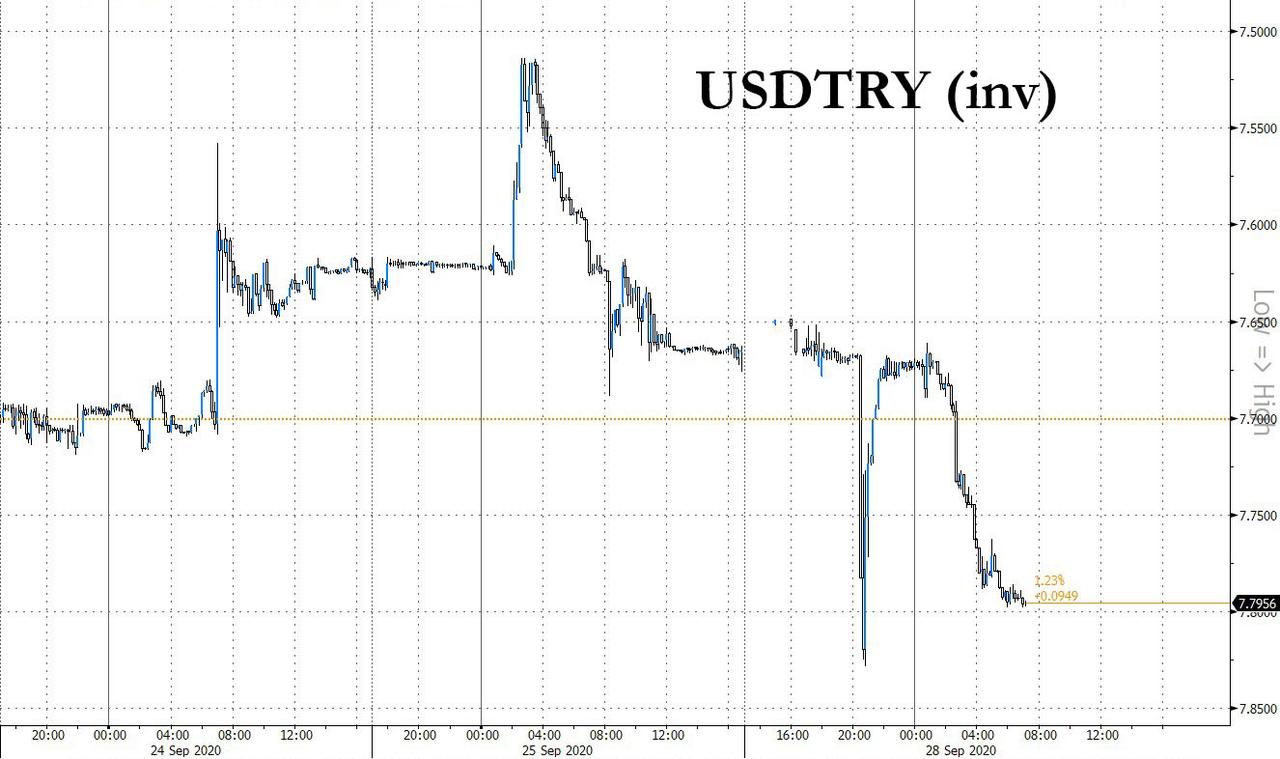
Two trading days after the CBRT unexpectedly hiked rates by 200bps to stem the ongoing plunge in the country’s currency, overnight the Turkey’s lira dropped to a record as geopolitical risks rose in the region due to clashes between Azerbaijan and Armenia.

Shortly after Japanese traders arrived, the lira flash crashed as much as 2.1% to 7.8279 against the U.S. dollar. Then after recovering most losses, it resumed the drift lower and was down 1.7% at 7.914 by 7:00 a.m. ET. 
“The fear is that Turkey, whose economy is on its knees and is actively engaged in escalating conflicts in northern Syria, and with Greece in the Mediterranean, could get dragged into yet another regional conflict it can ill afford, either politically or economically,” says Jeffrey Halley, senior market analyst in Singapore at Oanda

“That has torpedoed the Turkish lira this morning, whipping out any gains from the surprise rate hike by the central bank last week and an easing of currency trading restrictions,” he added.

The lira fall reversed all the brief benefits from the Turkish central bank’s surprise policy-rate hike and the banking regulator’s decision to ease trading restrictions for foreign investors last week. The regulator also eased the asset-ratio rule for banks on Monday in a move that paves the way for lenders to increase lira-loan rates.

It wasn’t just the lira: Russia’s ruble also stumbled the most among emerging-market currencies after the Turkish lira, amid concern the regional powers may be dragged into an escalation in fighting between Azerbaijan and Armenia. The Rusian currency was down -0.7% to 78.76/USD, fourth straight day of declines, to weakest since April 2.

“The proximity of the armed conflict to Russia’s borders, as well as Turkey’s alleged role in supporting the Azeri side, could make foreign investors more wary of Russian assets,” Rosbank analysts write in a note; ruble could weaken to 80/USD before it recovers, they write.

“Geopolitical headwinds remain a threat to the Russian investment case, particularly the ruble, with campaigning for the US election gathering pace” Alfa-Bank analysts write in a note.


via ZeroHedge News https://ift.tt/339tOlJ Tyler Durden

‘Cash-For-Ballots’ Fraud Uncovered In Ilhan Omar’s Minnesota District: Veritas

‘Cash-For-Ballots’ Fraud Uncovered In Ilhan Omar’s Minnesota District: Veritas

Tyler Durden

Mon, 09/28/2020 – 07:18

A scheme run by a so-called ‘ballot harvesters’ in Rep. Ilhan Omar’s Minneapolis district was uncovered in a shocking exposé by Project Veritas. In one segment, alleged ballot harvester Liban Mohamed – the brother of Minneapolis city council member Jamal Osman, can be seen sifting through piles of ballots in his car in videos posted to his own snapchat channel under the name “KingLiban1.”

“Just today we got 300 for Jamal Osman,” said Mohamed. “As you can see my car is full. All these are absentees’ ballots. Can’t you see?

Attorney Jeff Wojciechowski of Hennepin County told Project Veritas that the ballot harvesting described in the video appears “illegal, and we will be investigating.”

According to Veritas, “Mohamed said he was collecting the ballots to help his brother win the city’s Aug. 11 special election for a vacant Ward 6 city council race—which was held the same day as the primary for Omar’s MN-05 congressional seat. Ward 6 is the heart of the city’s Somali community and the Omar’s political base.”

Our investigation found that among three locations inside Ward 6, a ballot harvesting triangle,  where the scheme operates: the Riverside Plaza apartments,  the senior citizen community at Horn Towers and the Minneapolis Elections and Voter Services office at 980 E. Hennepin Ave., which also functions as a voting location and ballot drop-off site.

Mohamed continued: “Money is everything. Money is the king in this world. If you got no money, you should not be here period. You know what I am saying.” –Project Veritas

Mohamed also opined on what it takes to run a campaign, saying “Money is everything and a campaign is managed by money. You cannot campaign with $200 or $100 you got from your grandmother or grandfather. You cannot campaign with that. You gotta have an investment to campaign. You gotta have fundraisers.”

The scheme was uncovered by Omar Jamal, chairman of the Somali Watchdog Group. Jamal works with the Ramsey County Sheriff’s Department and is a political insider who is active within the city’s Somali community.

“I have been involved in the community for the last 20 years,” he said.

Jamal said he was motivated to reach out to Project Veritas, because he wants to eliminate the corruption that weakens his community, such as the ballot harvesting practiced by Minnesota’s Democratic-Farmer-Labor Party, in which Ilhan Omar has emerged as a rising power broker

It’s an open secret,” he said. “she [Omar] will do anything that she can do to get elected and she has hundreds of people on the streets doing that.

The political insider said he hopes there is still time to clean up elections in the country.

“If American people don’t pay attention to what’s happening, the country will collapse,” he said. –Project Veritas


“The regulations, if you ignore that and you let corruption and fraud become a daily business and then tough luck, the country will not exist as they [Americans] know it,” said Jamal, adding “I’m afraid it’s already too big to stop, you know, maybe it’s too late. Maybe it’s already too big to stop.”

“There’s a lot of people invested in this, you know, and they don’t care how they did it: ‘We win,’ and that’s it.”

Jamal interviewed a Somali-American ballot harvester as part of his participation in the Veritas investigation. The harvester told him how he was paid to vote in the August 11 special election and primary – and that Somali-American vote-buying operatives from the Omar machine came to his apartment building to make sure ballots were ‘correctly’ filled out – often doing it themselves.

“They come to us. They came to our homes. They said: ‘This year, you will vote for Ilhan,’” he said. “They said: ‘We will make the absentee ballots. We will fill out the forms for you and when you get them back, we will again fill it out and send it.”

Somali-Americans were told they don’t need to go to voting sites, because Omar operatives told him “You stay home and you will not go to the place.”

After the ballots are signed and documented the harvester said he got paid.

“When we sign the voting document and they fill it out is when they give us the money,” he said. “The minute we signed the thing [ballot] for the election. That’s when we get paid.”

Targeting the elderly:

Omar Jamal: So they [ballot harvesters] will request it [the ballot] for the elderly?
Ballot harvester: Yes. They [ballot harvesters] request [the ballot] for them [the elderly].
Omar Jamal: And it [the ballot] is taken away from them [elderly]?
Ballot Harvester: Yes. It [the ballot] is taken away from them [elderly].

Read the rest of the report here and watch the entire video below:

via ZeroHedge News https://ift.tt/2EITSuy Tyler Durden

Judge Restores Uber’s License To Operate In London, Its Biggest European Market

Judge Restores Uber’s License To Operate In London, Its Biggest European Market

Tyler Durden

Mon, 09/28/2020 – 06:19

In a decision that ends a yearslong battle with the taxi regulator in Uber’s biggest European market, the American ride-hailing company has just had its license approved by a British judge who ruled that the company is “fit and proper” to hold a license after winning an appeals process.

Deputy chief magistrate Tan Ikram said Uber had met the “fit and proper” standard to receive a license almost a year after the London transport regulator, Transport for London (otherwise known as TfL), refused to extend the company’s prior license. That decision set in motion the second battle over Uber’s London operating license, after an investigation by the regulator turned up evidence that Uber drivers were still driving under others’ names, a security hole that the regulator immediately took issue with.

A ban, of course, would have been a major blow for the ride-hailing service, which has 45,000 drivers on the road in the British capital, and provides millions of rides each month.

The magistrate ruled that while “Uber does not have a perfect record…it has been an improving picture.” “I am satisfied that they are doing what a reasonable business in their sector could be expected to do, perhaps even more,” the judge added.

The issue stretches back to September 2017, when TfL first announced that Uber’s license wouldn’t be renewed, citing issues with the company’s process for reporting serious crimes committed by drivers, among other transgressions (including Uber’s “greyball” software). At the time, the regulator deemed the company was “not fit and proper” to hold the license.

Read the decision below:

Uber-v-TFL by Zerohedge on Scribd

via ZeroHedge News https://ift.tt/36b4Q7m Tyler Durden

Nat Gas Prices Set To Soar As First Cold Blast To Strike Eastern US Next Week

Nat Gas Prices Set To Soar As First Cold Blast To Strike Eastern US Next Week

Tyler Durden

Mon, 09/28/2020 – 05:45

A significant cooldown has arrived, with the jet stream from Canada plunging this weekend, which will allow the eastern United States to experience its first taste of fall for much of next week. 

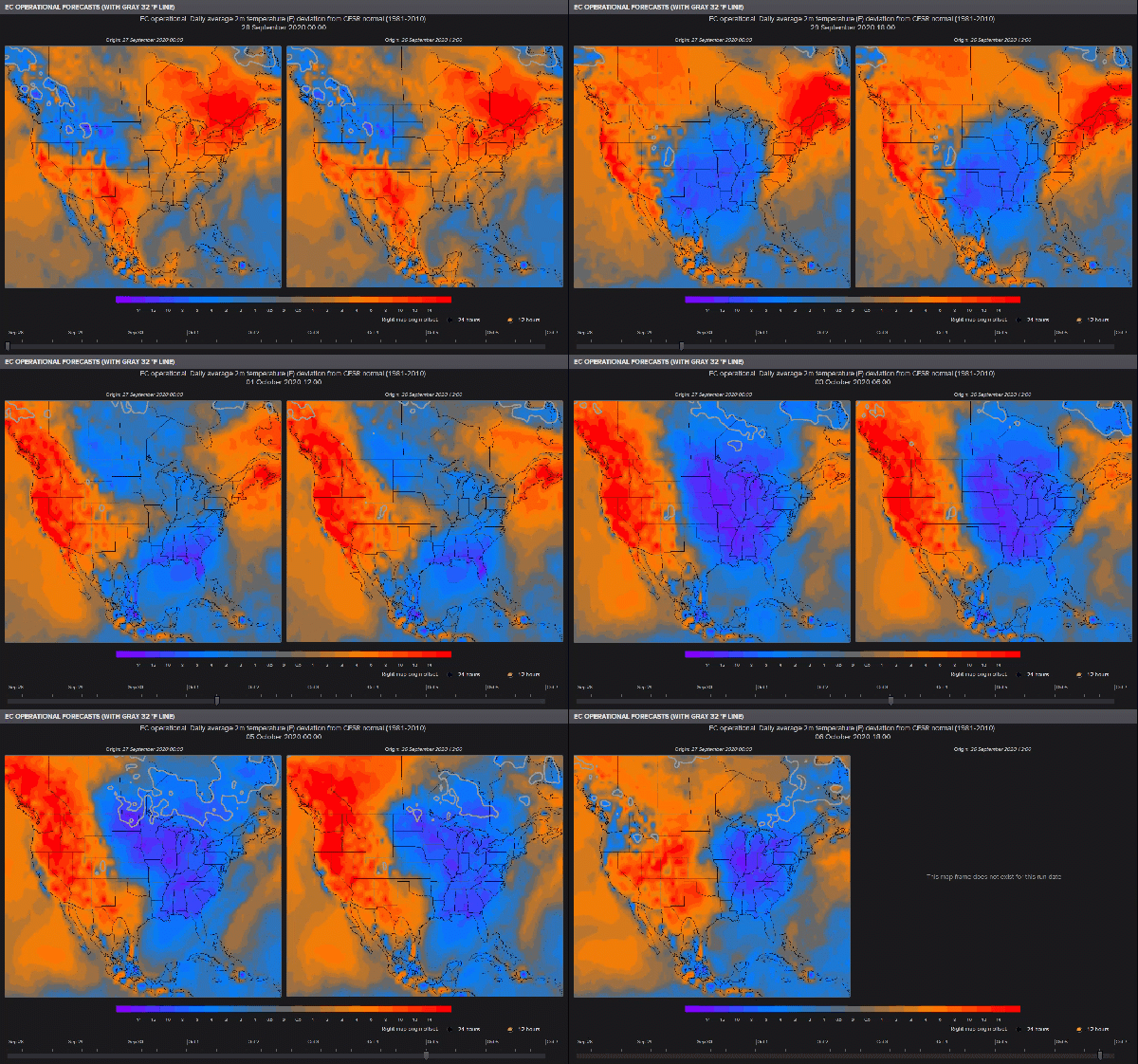
The ten-day outlook in terms of the thermal aspect shows a cold airmass will encompass all U.S. Plains, Midwest, Southeast, and Northeast, where temperatures could hover 8 to 15 degrees below normal through the first week of October. 

E.C. Operational Forecast (with gray 32 degrees Fahrenheit line) shows the blast of cold air pouring in from Canada this weekend and will cover much of the eastern U.S. through Oct. 6. 

As for frost risks over the next ten days, Reuters’ commodity desk said:

“Although the greatest cool anomalies should be observed in Missouri and surrounding states, the risk for occasional and short-lasting overnight frost risks are on the rise across the upper Midwest. As for now, confidence in frost appearance is rather low, but the situation should be monitored and updated over the next week.”

The National Weather Service announced a moderate to high risk for cooler temperatures from the Midwest to the Mid-Atlantic between Oct. 1 and 7.

According to The Washington Post, “the surge of cold set to enter the eastern U.S. just one week after scores of locations in interior New England and western New York set record lows in the 20s and 30s. The chill even reached the Mid-Atlantic, where Washington observed lows in the 40s on four straight days in September for the first time since 1950.”

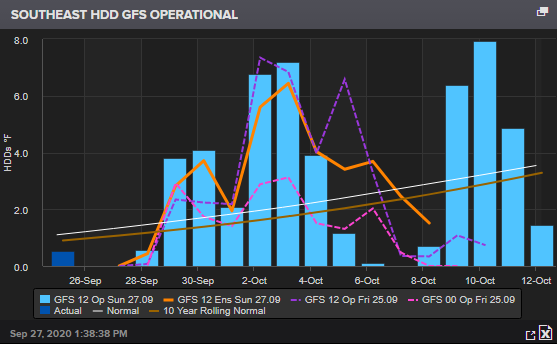
A chilly start to October will result in energy usage demand to increase. Heating degree day (HDD), the measure designed to quantify the demand for energy needed to heat a building, is set to rise in the Midwest, Southeast, and Northeast in the coming days. 

HDD Midwest

HDD Southeast

HDD Northeast 

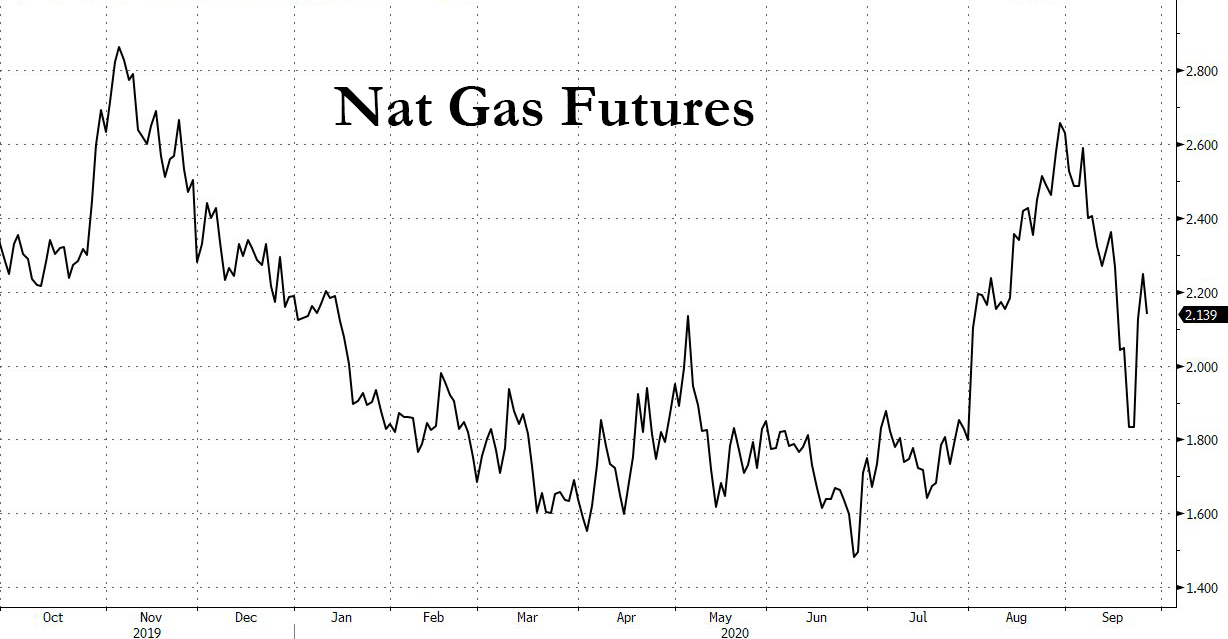
Oilprice.com says the “coming winter season and the end of the hurricane season that has disrupted LNG operations and exports along the U.S. Gulf Coast, coupled with recovering gas demand for industrial activities in Asia and Europe, are likely to send natural gas prices to above $3 per million British thermal units.” 

The latest “rollercoaster” in nat gas prices was “indicative of a demand/supply picture in a so-called ‘shoulder season’ when power demand for air conditioning begins to wane, but demand for heating is not there yet. So prices reacted to the immediate drivers—storage, feed supply for LNG, and storm-induced shut-ins,” said the energy blog. 

In seasonal terms, nat gas futures are set to rise as the rapid onset of fall-like conditions begins. 

Readers may recall, we noted, at the start of September, how the 45-day HDD for the U.S. signaled energy demand to heat structures was set to increase. Now it’s a waiting game for nat gas futures to surge on the bullish fundamental shift.

via ZeroHedge News https://ift.tt/2GhdXZ4 Tyler Durden

Trump’s Visa Ban Will Slow America’s Recovery

topicsimmigration

In April, as COVID-19 spread through the United States, President Donald Trump imposed a two-month pause on nearly all legal immigration to protect America’s physical and economic health. He has now extended the ban until December and expanded it, while acknowledging that the changes are primarily about protectionism for American labor.

The original ban halted new green cards for anyone other than the children and spouses of American citizens, because, the order claimed, lawful permanent residents get instant “‘open-market’ employment authorization documents” that allow them to immediately compete with American citizens “for almost any job in any sector of the economy.” The latest ban also imposes a moratorium on temporary work visas for foreign techies, low-skilled nonagricultural workers, people with summer jobs, and intra-company transfers. America’s unemployment rate quadrupled between February and May, Trump proclaimed, so more foreign workers would “present a significant threat to employment opportunities for Americans.”

Foreign workers typically fill niches at both the top and bottom ends of the labor spectrum, where qualified Americans aren’t available or willing to take jobs. If there were a surfeit of such workers, the labor market would itself reduce foreign worker inflows, since existing labor and immigration laws already make it costly to hire a foreigner. But restrictionists argue that starving businesses of foreign workers will force them to invest in training domestic workers or to start paying them more.

Yet the market cannot bear endless price increases. To control labor costs, businesses will automate what they can and outsource what they can’t, resulting in a bigger loss of American jobs.

The former happened after the end of the “bracero” program in 1964 that had allowed American farmers to hire around half a million Mexican guest workers on a seasonal basis. The small increase in wages that farms had to pay domestic workers evaporated quickly as machines replaced the lost Mexicans.

The latter will happen in the tech sector. Even when the United States’ overall unemployment rate in June touched 13.3 percent, that number was only 2.5 percent for computing jobs, according to the pro-immigration National Foundation for American Policy.

In 2004, when Congress slashed the high-skilled H-1B visa cap from 195,000 a year to less than half that, multinational companies started hiring more workers in their affiliates abroad, according to Wharton School professor of management Britta Glennon. Given that each H-1B supports 1.83 jobs for Americans, University of North Florida economist Madeline Zavodny has found that the net result of turning away foreign labor is greater unemployment—and lower wages—for native-born workers.


from Latest – Reason.com https://ift.tt/2GjQWVK
via IFTTT

Trump’s Visa Ban Will Slow America’s Recovery

topicsimmigration

In April, as COVID-19 spread through the United States, President Donald Trump imposed a two-month pause on nearly all legal immigration to protect America’s physical and economic health. He has now extended the ban until December and expanded it, while acknowledging that the changes are primarily about protectionism for American labor.

The original ban halted new green cards for anyone other than the children and spouses of American citizens, because, the order claimed, lawful permanent residents get instant “‘open-market’ employment authorization documents” that allow them to immediately compete with American citizens “for almost any job in any sector of the economy.” The latest ban also imposes a moratorium on temporary work visas for foreign techies, low-skilled nonagricultural workers, people with summer jobs, and intra-company transfers. America’s unemployment rate quadrupled between February and May, Trump proclaimed, so more foreign workers would “present a significant threat to employment opportunities for Americans.”

Foreign workers typically fill niches at both the top and bottom ends of the labor spectrum, where qualified Americans aren’t available or willing to take jobs. If there were a surfeit of such workers, the labor market would itself reduce foreign worker inflows, since existing labor and immigration laws already make it costly to hire a foreigner. But restrictionists argue that starving businesses of foreign workers will force them to invest in training domestic workers or to start paying them more.

Yet the market cannot bear endless price increases. To control labor costs, businesses will automate what they can and outsource what they can’t, resulting in a bigger loss of American jobs.

The former happened after the end of the “bracero” program in 1964 that had allowed American farmers to hire around half a million Mexican guest workers on a seasonal basis. The small increase in wages that farms had to pay domestic workers evaporated quickly as machines replaced the lost Mexicans.

The latter will happen in the tech sector. Even when the United States’ overall unemployment rate in June touched 13.3 percent, that number was only 2.5 percent for computing jobs, according to the pro-immigration National Foundation for American Policy.

In 2004, when Congress slashed the high-skilled H-1B visa cap from 195,000 a year to less than half that, multinational companies started hiring more workers in their affiliates abroad, according to Wharton School professor of management Britta Glennon. Given that each H-1B supports 1.83 jobs for Americans, University of North Florida economist Madeline Zavodny has found that the net result of turning away foreign labor is greater unemployment—and lower wages—for native-born workers.


from Latest – Reason.com https://ift.tt/2GjQWVK
via IFTTT

British Students Say They’re Being Treated Like “Prisoners” Due To Draconian COVID Measures

British Students Say They’re Being Treated Like “Prisoners” Due To Draconian COVID Measures

Tyler Durden

Mon, 09/28/2020 – 05:00

Authored by Paul Joseph Watson via Summit News,

Students at universities throughout the United Kingdom are being treated like ‘prisoners’ as draconian coronavirus rules mandate they eat alone, aren’t allowed to go out and are forced to cut themselves off from others or face suspension.

Interviews with students at Edinburgh University illustrate how overbearing the new rules are, with students being made to bring their own cutlery and eat alone at spaced out exam-style desks as the room is constantly patrolled by monitors ensuring they don’t violate the protocols.

“Now they have taken the takeaway option away and I’ve been told that everyone is forced to eat alone and not allowed to get up from their allocated table for more food or water,” said Liberty Phelan, who edits the student newspaper.

“There are huge queues to get into the dining hall and staff lead students to tables so you don’t even choose who you sit next to,” she added.

“In the accommodation you’re only allowed one other person in your room, but some people have had parties and the police have been called,” said Phelan.

Another student who wished to remain anonymous says students have now begun skipping meals to avoid the experience altogether.

First year student Florence Carr-Jones said inspectors patrolled halls of residence, ensuring no fun could be had.

“Security guards roam the halls in the evenings knocking on noisy doors, threatening fines and suspensions,” she said.

The university has also called police on students for holding illegal parties, warning them they face being kicked out.

Students are also being told that they’re not allowed out this weekend and will be legally barred from going home for Christmas.

“Not even terrorists are treated this badly,” remarked former Brexit Party MEP Alexandra Philips.

Imagine being excited to start your first year at university and getting to meet a bunch of new friends, only to find that you’re treated like a prisoner and aren’t even allowed to go out or have social contact with more than one person.

As we highlighted earlier, the streets of the UK are also now being patrolled by ‘COVID street enforcers’ who are peering into windows and letterboxes to make sure pubs and private member clubs are not staying open past the new 10pm curfew.

The British government also encouraged citizens to spy on each other and report their neighbors to authorities despite the fact that coronavirus cases and hospitalizations have virtually flatlined, with a relatively minor increase in cases being due to more testing and huge numbers of false positives.

*  *  *

In the age of mass Silicon Valley censorship It is crucial that we stay in touch. I need you to sign up for my free newsletter here. Also, I urgently need your financial support here.

via ZeroHedge News https://ift.tt/30aMgIv Tyler Durden

Brickbat: Here’s Your Warrant

policeraid_1160x653_1161x653

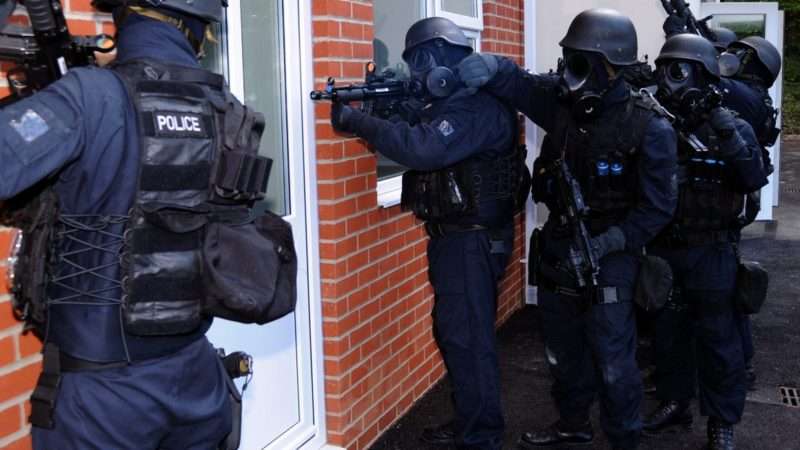
When Harris County, Texas, deputies arrived at his home seeking a Curtis Rogers, Louis Rodriguez told them they had the wrong house. Rodriguez, a retired police officer, then asked for their warrant. Instead, they knocked in his door and forced him and his family outside. The cops soon realized they were, as Rodriguez told them, at the wrong house. In a statement, the sheriff’s office says it had the door replaced and “the incident is under review.”

from Latest – Reason.com https://ift.tt/3mS2sIF
via IFTTT

Brickbat: Here’s Your Warrant

policeraid_1160x653_1161x653

When Harris County, Texas, deputies arrived at his home seeking a Curtis Rogers, Louis Rodriguez told them they had the wrong house. Rodriguez, a retired police officer, then asked for their warrant. Instead, they knocked in his door and forced him and his family outside. The cops soon realized they were, as Rodriguez told them, at the wrong house. In a statement, the sheriff’s office says it had the door replaced and “the incident is under review.”

from Latest – Reason.com https://ift.tt/3mS2sIF
via IFTTT

Deutsche Bank Bucks Wall Street Trend, Makes ‘Working From Home’ Permanent

Deutsche Bank Bucks Wall Street Trend, Makes ‘Working From Home’ Permanent

Tyler Durden

Mon, 09/28/2020 – 04:15

As the German megabank culls tens of thousands of jobs as part of a “restructuring” that’s also the biggest Wall Street bloodletting since Lehman’s collapse, it appears Deutsche Bank has hit on a strategy to attract more top talent, or at the very least compensate remaining employees for the inherent risks that come with working at DB.

CEO Christian Sewing is taking a different tack from JP Morgan and Goldman Sachs, who have already moved most of their traders and other investment banking personnel back to offices in the US and Europe (though in London, workers are back to working from home on orders of the prime minister). So far, JPM’s embrace of working at the office has given employees plenty to grumble about.

According to Bloomberg, the bank’s leadership is working on a new “hybrid model” that would allow staff to split time between home and the office. In addition to making life easier for employees (especially women), the measures would help save costs for DB, which can then lease less office space.

Eventually, employees will have “binding agreements” written into their contracts governing how they can work from home, according to Bloomberg.

The new policies will eventually allow employees to have binding agreements on how many days per week they want to work away from the office, a person familiar with the matter said. The lender has developed estimates of how big a share will work from home, according to the person, who asked not to be identified discussing internal planning.

Deutsche Bank is joining lenders such as Mizuho Financial Group Inc. and Fifth Third Bancorp in cutting office costs after the coronavirus pandemic forced a large number of employees to work from home. Its top executives have repeatedly said they’ve been positively surprised by how little the shift has affected productivity, an assessment not all Wall Street companies are sharing.

The decision makes sense from a health standpoint as both Goldman Sachs and JPM have already seen trading floor outbreaks since recalling their employees.

DB’s long-suffering shareholders can probably appreciate Sewing going against the grain in a way that, although it might anger some potential clients, will almost certainly yield hundreds of millions of dollars in annual cost-savings for the bank in the long term. DB spent $2 billion last year on rent and furniture.

Deutsche Bank is becoming “more aggressive about how we want to use the space, given what we are learning now about the way the workforce will choose to engage and choose to work every day,” Chief Financial Officer James von Moltke said on Tuesday.

The lender spent 1.7 billion euros ($2 billion) on rent and furniture last year, an amount it had expected to remain stable before the pandemic hit. After the experience of the first half, von Moltke said the bank now sees room to lower those costs.

Deutsche Bank earlier this week took a step in that direction when it gave up two of the five floors it rents in one of Zurich’s most expensive office buildings. A spokesman cited expectations that more people will work from home as one reason for the decision.

Deutsche Bank will also switch New York offices next year to cut office space there by almost a third. The lender has reduced its U.S. workforce by about a fifth over the past couple of years. The bank’s asset management unit DWS Group has recently moved to a cheaper London office.

At long last, DB has stumbled onto a belt-tightening strategy that isn’t culling the bank’s workforce, or walling off toxic assets. Real estate developers like the one currently occupying the White House (once a major Deutsche Bank client) might not like the bank’s stance. But in the end, the potential cost savings, and increased attractiveness to top talent, are pretty compelling.

via ZeroHedge News https://ift.tt/3jb0CAa Tyler Durden