2 Charged In Veterans’ Home COVID-19 Outbreak That Left 76 Dead

2 Charged In Veterans’ Home COVID-19 Outbreak That Left 76 Dead

Tyler Durden

Fri, 09/25/2020 – 16:40

One of the biggest contributing factors to the virus’s lethality during the early days of the US coronavirus outbreak was the fact that several states, particularly New York, New Jersey and Massachusetts, failed to secure nursing homes and other facilities where large numbers of vulnerable patients were treated.

And as federal prosecutors look into policies like the disastrous decision to require hospitals to return COVID-19 positive patients to the long-term care facilities where they lived, a policy adopted in NY and several other states, Massachusetts prosecutors are getting a jump on the scape-goating by prosecuting the top administrator and chief doctor of a state-run veterans home that was simply overwhelmed by the virus during the early days of the outbreak.

According to the New York Times, Bennett Walsh, 50, and Dr. David Clinton, 71, were indicted Thursday by a state grand jury on charges related to their work at the facility, the Holyoke Soldiers’ Home in the city of Holyoke. All told, 76 staff and patients died at the home (mostly patients) which housed poor veterans from wars dating back to WWII.

Each man was indicted on five counts for two charges; the specific charges were for caretakers who “wantonly or recklessly” permit or cause bodily injury and abuse, neglect or mistreatment of an older or disabled person.

Lawyers for Mr. Walsh and Dr. Clinton, of Springfield and South Hadley, Mass., could not immediately be reached.

As staff members called out en masse and the coronavirus spread like wildfire through the home, the administrators made some desperate decisions that led to patients being crowded into new wards, with COVID-positive, and non-positive, patients mingling without any protection.

The state a few weeks ago released a lengthy report detailing everything that went wrong at the home. But for those that didn’t read it, the NYT has a quick recap.

Investigators focused on the events of late March, when staff members combined two dementia wards with infected veterans and healthy residents, “increasing the exposure of asymptomatic veterans to the virus,” the attorney general’s office said.

Because of staffing shortages, the facility consolidated the units, which had a total of 42 residents who had different Covid-19 statuses, the office said. Residents who were positive or symptomatic were placed six in a room that typically held four veterans, it said.

Residents believed to be asymptomatic were placed in nine beds in the dining room, where they were “a few feet apart from each other” and next to the room where the infected patients were, it said.

One employee of the facility  told investigators that the decision to merge wards was “the most insane thing I ever saw in my entire life,” according to a report released months later.

“The residents in the consolidated unit were allegedly mingling together, regardless of Covid-19 status,” the office said, adding that this decision was reckless from an infection-control perspective, and placed the asymptomatic veterans at “an increased risk of contracting Covid-19.”

Employee described the decision to combine the wards in horrifying terms. Even patients believed to be asymptomatic were crowded in rooms with only a few feet of space between them, and not far from the infected patients.

One employee of the facility told investigators that the decision to merge wards was “the most insane thing I ever saw in my entire life,” according to a report released months later.

“The residents in the consolidated unit were allegedly mingling together, regardless of Covid-19 status,” the office said, adding that this decision was reckless from an infection-control perspective, and placed the asymptomatic veterans at “an increased risk of contracting Covid-19.”

[…]

In June, investigators released a 174-page report that depicted a facility in chaos, excoriated the decision to combine crowded wards and described conditions in nightmarish terms. In addition to cataloging a series of errors in protecting residents, the report quoted people who worked at the facility, including one who said it “felt like it was moving the concentration camp, we were moving these unknowing veterans off to die.”

Though deaths in the US have turned higher over the past week or so, the virus’s mortality rate has fallen significantly since the spring, as younger people bear the brunt of it. But we’d certainly like to know what the state was doing – if anything – to ensure homes like the veterans home in Holyoke had enough resources to protect their residents.

via ZeroHedge News https://ift.tt/2HyG7zB Tyler Durden

USC Marshall Business School Dean E-Mail on the Greg Patton / “Neige” Controversy

Here’s the e-mail, just circulated this morning (I’ve confirmed this):

Dear Colleagues,

I have now attended department meetings at all seven of our academic units. Every meeting involved hard but important discussions, and I thank you for your willingness to freely and openly express your opinions and concerns.

A number of themes emerged that we will work on together in the months ahead. But one issue that stands in the way is the email I sent to our first-year full-time MBA students announcing that Professor Greg Patton was stepping aside from his GSBA 542 three-week course. I felt compelled to immediately address the genuine and serious concerns expressed by a number of student groups and individual students, including some enrolled in GSBA 542 who said they would stop attending the remaining two weeks of class. I will always respect and support students who come forward with concerns and will take them seriously, as I did in this case.

However, many of you have read that note as suggesting that I had prejudged the case. As I said when asked about this in the department meetings, this was not my intention. Nor was it my intent to cast aspersions on specific Mandarin words or on Mandarin generally. But I can see how reasonable people could draw a different conclusion in both cases from my email [see the original email below -EV]. I can only offer my sincere apologies that I left that impression, as I believed Professor Patton when he said he did not intend to do his students any harm and I have apologized to him as well.

The university’s Office for Equity, Equal Opportunity and Title IX (EEO-TIX) looked into this matter and concluded that the concerns expressed by students were sincere, but that Professor Patton’s actions did not violate the university’s policy. They have also communicated this to the professor and he allowed me to share their conclusion with you.

To be clear, Professor Patton was never suspended nor did his status at Marshall change. He is currently teaching in Marshall’s EMBA program and he will continue his regular teaching schedule next semester.

More generally, this incident has led many faculty to question whether they will be supported if they “make an honest mistake” in the classroom. Faculty are at the heart of all great business schools and every member of my leadership team will always do everything we can to support you and to ensure you thrive in both your research and teaching missions. We fully support our students and staff as well.

In order for our faculty and students to flourish in the classroom, it is essential that everyone feels free to express their views openly and to learn from each other from a perspective of mutual trust and respect. This can be challenging in today’s charged environment, but we must all strive to find the right balance.

During my very brief tenure as dean, I have seen you all rise admirably to the challenge of giving our students the best possible education in a remote environment. But working from home has made it impossible for me to get to know you, and for you to get to know me. It has created stresses that we have never before experienced. This has been a very tough episode for all of us. But I very much look forward to moving beyond it to work with you to elevate Marshall to new heights. I believe the future is very bright.

Sincerely,

Geoff Garrett

Dean

Here, for perspective, is the original email from the Dean:

Last Thursday in your GSBA-542 classes, Professor Greg Patton repeated several times a Chinese word that sounds very similar to a vile racial slur in English. Understandably, this caused great pain and upset among students, and for that I am deeply sorry. It is simply unacceptable for faculty to use words in class that can marginalize, hurt and harm the psychological safety of our students. We must and we will do better.

Professor Marion Philadelphia, Chair of the Department of Business Communications, will take over teaching the remainder of GSBA-542, beginning tomorrow, Tuesday August 25.

Over the coming weeks and months, I have no higher priority than to work with Vice Dean Sharoni Little, Vice Dean Suh-Pyng Ku and the other members of the Marshall leadership team to identify and redress bias, microaggressions, inequities and all forms of systemic racism associated with anyone’s identity throughout our school. We each must grow and learn always to engage respectfully with one another while fostering and exemplifying the knowledge and skills needed to lead and shape our diverse and global world—such as courage, empathy, compassion, advocacy, collaboration, and integrity.

I am deeply saddened by this disturbing episode that has caused such anguish and trauma. What happened cannot be undone. But please know that Sharoni, Suh-Pyng and I along with the entire Full-Time MBA Program team are here to support each of you. We welcome the opportunity to have conversations with any of you individually.

Sincerely,

Geoff Garrett

Dean

from Latest – Reason.com https://ift.tt/2G6SCll
via IFTTT

Federal Prosecutors Argue COVID-19 Is Just ‘One More Way to Perish in Prison’

elderly-inmate

Federal prosecutors unsuccessfully tried to argue this week that an 80-year-old inmate serving a life sentence for marijuana offenses shouldn’t be released because COVID-19 is just “one more way to perish in prison.”

U.S. District Judge Donald Graham disagreed and ordered Atilano Dominguez, who was 27 years into his life sentence, to be released from federal prison on Tuesday, over the objections of the Miami U.S. Attorney’s Office and the Bureau of Prisons (BOP). The U.S. government opposed his petition for compassionate release on the grounds that Dominguez, who’s mostly confined to a wheelchair due to advanced arthritis in both knees, was a recidivism risk and that his life sentence was imposed with the knowledge that he could die of any number of illnesses in prison.

Dominguez was one of thousands of federal inmates who applied for compassionate release—a policy allows elderly and terminally ill inmates to go home ahead of schedule—in response to the COVID-19 pandemic. In late March, Attorney General William Barr directed the BOP to use compassionate release, home confinement, and other measures to get elderly and at-risk inmates out of federal prison. Despite the release of more than 7,000 thousand inmates, though, the rollout of Barr’s directive has been maddeningly inconsistent for inmates and families.

Dominguez was sentenced in 1994 to life in prison on two charges of conspiracy to possess with intent to distribute marijuana and possession with intent to distribute marijuana. His sentence was upgraded to a mandatory life sentence after prosecutors filed a draconian “three strikes” enhancement against him based on previous cocaine offenses. Graham wrote in his order releasing Dominguez that the judge at Dominguez’s original sentencing noted it was probably “too severe,” but there was nothing the judge could do because of the mandatory sentence.

Dominguez’ advanced age and long list of serious medical conditions—including diabetes, hypertension, and congestive heart failure—certainly fit the qualifying conditions for inmates at risk for COVID-19. But federal prosecutors said those were not “extraordinary and compelling reasons” to grant him relief, because he was expected to die in prison anyway.

“The government does not contest that the Defendant’s age and medical condition render him vulnerable to serious consequences if he were to contract the illness,” the Miami U.S. Attorney’s Office argued in a motion opposing Dominguez’s petition. “However, the Defendant’s sentence of life imprisonment always contemplated that the Defendant could perish in prison. The existence of one more way to perish in prison, specifically COVID-19 in addition to heart disease, cancer, stroke, aneurysms and myriad other ailments that afflict the aged, does not alter the appropriateness of the Defendant’s incarceration.”

Before 2018, that would have been the end of the line for Dominguez. There used to be no judicial review available for inmates applying for compassionate release, leaving inmates at the mercy of an arbitrary, inscrutable, and cruel prison bureaucracy. Justice Department records obtained by the criminal justice advocacy group FAMM in 2018 showed that at least 81 federal inmates had died since 2014 while waiting for the government to review their applications. 

However, after the passage of the FIRST STEP Act in 2018, federal inmates can now take their pleas to a judge if the BOP rejects their applications.

Graham ruled in Dominguez’s favor, finding that “there is no authority that persons sentenced to life imprisonment are somehow precluded from being granted compassionate release or are subject to a higher standard of proof.” He was also not convinced by the argument that an 80-year-old quadruple bypass survivor with arthritic knees was a significant safety risk to the community.

For criminal justice groups, cases like this boil down to basic human decency. “Title 9 of the U.S. Attorney’s Manual governs criminal proceedings, and there is no provision there that requires you to be an asshole,” FAMM president Kevin Ring says.

Ring is not the only one. Earlier this year, a federal judge harshly rebuked the U.S. Attorney’s Office in San Francisco for pressuring defendants into plea deals that would waive their rights to compassionate release under the FIRST STEP Act, calling the practice “appalling cruel.”

Reason reported last year on the case of Steve Brittner, a former federal inmate who was diagnosed with metastatic brain cancer. Federal prosecutors opposed his compassionate release petition because they said his life expectancy exceeded his release date. In essence, Brittner wasn’t dying fast enough to qualify.

Then there’s Angela Beck, who suffered a year of potentially fatal medical neglect waiting for a breast cancer diagnosis and treatment. A federal judge granted Beck’s petition for compassionate release, finding that the neglect Beck suffered “likely reached the level of a constitutional violation,” and that if she remained in BOP custody she would face “a substantial likelihood of substandard medical care for her life-threatening disease.”

So far, there have been 124 federal inmate deaths and two BOP staff deaths due to COVID-19. The first inmate to die was a drug offender.

from Latest – Reason.com https://ift.tt/2EzptyL
via IFTTT

USC Marshall Business School Dean E-Mail on the Greg Patton / “Neige” Controversy

Here’s the e-mail, just circulated this morning (I’ve confirmed this):

Dear Colleagues,

I have now attended department meetings at all seven of our academic units. Every meeting involved hard but important discussions, and I thank you for your willingness to freely and openly express your opinions and concerns.

A number of themes emerged that we will work on together in the months ahead. But one issue that stands in the way is the email I sent to our first-year full-time MBA students announcing that Professor Greg Patton was stepping aside from his GSBA 542 three-week course. I felt compelled to immediately address the genuine and serious concerns expressed by a number of student groups and individual students, including some enrolled in GSBA 542 who said they would stop attending the remaining two weeks of class. I will always respect and support students who come forward with concerns and will take them seriously, as I did in this case.

However, many of you have read that note as suggesting that I had prejudged the case. As I said when asked about this in the department meetings, this was not my intention. Nor was it my intent to cast aspersions on specific Mandarin words or on Mandarin generally. But I can see how reasonable people could draw a different conclusion in both cases from my email [see the original email below -EV]. I can only offer my sincere apologies that I left that impression, as I believed Professor Patton when he said he did not intend to do his students any harm and I have apologized to him as well.

The university’s Office for Equity, Equal Opportunity and Title IX (EEO-TIX) looked into this matter and concluded that the concerns expressed by students were sincere, but that Professor Patton’s actions did not violate the university’s policy. They have also communicated this to the professor and he allowed me to share their conclusion with you.

To be clear, Professor Patton was never suspended nor did his status at Marshall change. He is currently teaching in Marshall’s EMBA program and he will continue his regular teaching schedule next semester.

More generally, this incident has led many faculty to question whether they will be supported if they “make an honest mistake” in the classroom. Faculty are at the heart of all great business schools and every member of my leadership team will always do everything we can to support you and to ensure you thrive in both your research and teaching missions. We fully support our students and staff as well.

In order for our faculty and students to flourish in the classroom, it is essential that everyone feels free to express their views openly and to learn from each other from a perspective of mutual trust and respect. This can be challenging in today’s charged environment, but we must all strive to find the right balance.

During my very brief tenure as dean, I have seen you all rise admirably to the challenge of giving our students the best possible education in a remote environment. But working from home has made it impossible for me to get to know you, and for you to get to know me. It has created stresses that we have never before experienced. This has been a very tough episode for all of us. But I very much look forward to moving beyond it to work with you to elevate Marshall to new heights. I believe the future is very bright.

Sincerely,

Geoff Garrett

Dean

Here, for perspective, is the original email from the Dean:

Last Thursday in your GSBA-542 classes, Professor Greg Patton repeated several times a Chinese word that sounds very similar to a vile racial slur in English. Understandably, this caused great pain and upset among students, and for that I am deeply sorry. It is simply unacceptable for faculty to use words in class that can marginalize, hurt and harm the psychological safety of our students. We must and we will do better.

Professor Marion Philadelphia, Chair of the Department of Business Communications, will take over teaching the remainder of GSBA-542, beginning tomorrow, Tuesday August 25.

Over the coming weeks and months, I have no higher priority than to work with Vice Dean Sharoni Little, Vice Dean Suh-Pyng Ku and the other members of the Marshall leadership team to identify and redress bias, microaggressions, inequities and all forms of systemic racism associated with anyone’s identity throughout our school. We each must grow and learn always to engage respectfully with one another while fostering and exemplifying the knowledge and skills needed to lead and shape our diverse and global world—such as courage, empathy, compassion, advocacy, collaboration, and integrity.

I am deeply saddened by this disturbing episode that has caused such anguish and trauma. What happened cannot be undone. But please know that Sharoni, Suh-Pyng and I along with the entire Full-Time MBA Program team are here to support each of you. We welcome the opportunity to have conversations with any of you individually.

Sincerely,

Geoff Garrett

Dean

from Latest – Reason.com https://ift.tt/2G6SCll
via IFTTT

Federal Prosecutors Argue COVID-19 Is Just ‘One More Way to Perish in Prison’

elderly-inmate

Federal prosecutors unsuccessfully tried to argue this week that an 80-year-old inmate serving a life sentence for marijuana offenses shouldn’t be released because COVID-19 is just “one more way to perish in prison.”

U.S. District Judge Donald Graham disagreed and ordered Atilano Dominguez, who was 27 years into his life sentence, to be released from federal prison on Tuesday, over the objections of the Miami U.S. Attorney’s Office and the Bureau of Prisons (BOP). The U.S. government opposed his petition for compassionate release on the grounds that Dominguez, who’s mostly confined to a wheelchair due to advanced arthritis in both knees, was a recidivism risk and that his life sentence was imposed with the knowledge that he could die of any number of illnesses in prison.

Dominguez was one of thousands of federal inmates who applied for compassionate release—a policy allows elderly and terminally ill inmates to go home ahead of schedule—in response to the COVID-19 pandemic. In late March, Attorney General William Barr directed the BOP to use compassionate release, home confinement, and other measures to get elderly and at-risk inmates out of federal prison. Despite the release of more than 7,000 thousand inmates, though, the rollout of Barr’s directive has been maddeningly inconsistent for inmates and families.

Dominguez was sentenced in 1994 to life in prison on two charges of conspiracy to possess with intent to distribute marijuana and possession with intent to distribute marijuana. His sentence was upgraded to a mandatory life sentence after prosecutors filed a draconian “three strikes” enhancement against him based on previous cocaine offenses. Graham wrote in his order releasing Dominguez that the judge at Dominguez’s original sentencing noted it was probably “too severe,” but there was nothing the judge could do because of the mandatory sentence.

Dominguez’ advanced age and long list of serious medical conditions—including diabetes, hypertension, and congestive heart failure—certainly fit the qualifying conditions for inmates at risk for COVID-19. But federal prosecutors said those were not “extraordinary and compelling reasons” to grant him relief, because he was expected to die in prison anyway.

“The government does not contest that the Defendant’s age and medical condition render him vulnerable to serious consequences if he were to contract the illness,” the Miami U.S. Attorney’s Office argued in a motion opposing Dominguez’s petition. “However, the Defendant’s sentence of life imprisonment always contemplated that the Defendant could perish in prison. The existence of one more way to perish in prison, specifically COVID-19 in addition to heart disease, cancer, stroke, aneurysms and myriad other ailments that afflict the aged, does not alter the appropriateness of the Defendant’s incarceration.”

Before 2018, that would have been the end of the line for Dominguez. There used to be no judicial review available for inmates applying for compassionate release, leaving inmates at the mercy of an arbitrary, inscrutable, and cruel prison bureaucracy. Justice Department records obtained by the criminal justice advocacy group FAMM in 2018 showed that at least 81 federal inmates had died since 2014 while waiting for the government to review their applications. 

However, after the passage of the FIRST STEP Act in 2018, federal inmates can now take their pleas to a judge if the BOP rejects their applications.

Graham ruled in Dominguez’s favor, finding that “there is no authority that persons sentenced to life imprisonment are somehow precluded from being granted compassionate release or are subject to a higher standard of proof.” He was also not convinced by the argument that an 80-year-old quadruple bypass survivor with arthritic knees was a significant safety risk to the community.

For criminal justice groups, cases like this boil down to basic human decency. “Title 9 of the U.S. Attorney’s Manual governs criminal proceedings, and there is no provision there that requires you to be an asshole,” FAMM president Kevin Ring says.

Ring is not the only one. Earlier this year, a federal judge harshly rebuked the U.S. Attorney’s Office in San Francisco for pressuring defendants into plea deals that would waive their rights to compassionate release under the FIRST STEP Act, calling the practice “appalling cruel.”

Reason reported last year on the case of Steve Brittner, a former federal inmate who was diagnosed with metastatic brain cancer. Federal prosecutors opposed his compassionate release petition because they said his life expectancy exceeded his release date. In essence, Brittner wasn’t dying fast enough to qualify.

Then there’s Angela Beck, who suffered a year of potentially fatal medical neglect waiting for a breast cancer diagnosis and treatment. A federal judge granted Beck’s petition for compassionate release, finding that the neglect Beck suffered “likely reached the level of a constitutional violation,” and that if she remained in BOP custody she would face “a substantial likelihood of substandard medical care for her life-threatening disease.”

So far, there have been 124 federal inmate deaths and two BOP staff deaths due to COVID-19. The first inmate to die was a drug offender.

from Latest – Reason.com https://ift.tt/2EzptyL
via IFTTT

BLM Stealth-Edits Website Amid Marxist Blowback, Plunge In Americans’ Support

BLM Stealth-Edits Website Amid Marxist Blowback, Plunge In Americans’ Support

Tyler Durden

Fri, 09/25/2020 – 16:20

A new Associated Press poll finds that there has been a massive 15 point swing and that most Americans are now hostile to Black Lives Matter protests.

“The poll from The Associated Press-NORC Center for Public Affairs Research finds that 44% of Americans disapprove of protests in response to police violence against Black Americans, while 39% approve. In June, 54% approved. The new survey was conducted Sept. 11-14, before Wednesday’s announcement that a lone Louisville police officer would be charged in the Taylor case, but not for her actual death.”

As Summit News’ Paul Joseph Watson notes, the figures are also interesting when broken down along racial lines.

Just 35% of white Americans approve of the protests, down from 53% back in June. Just Latinos, 31% approve, compared with 44% in June.

Support for BLM amongst African-Americans has also dropped from 81% to 63%.

As Chris Menahan notes, “AP-NORC chose to exclude Latinos from their chart to make it seem like this is just a Black vs White thing.”

Support for BLM amongst Republicans has also dropped from 29% to 9%. Meanwhile, 70% of Democrats still approve of the protests, while significantly more people on both sides of the political spectrum believe the demonstrations to be “mostly or all violent.”

The survey also finds that belief in the central underpinning narrative pushed by BLM, that blacks are being indiscriminately targeted by police, is being eroded.

“Overall, Americans are less likely than they were in June to say deadly force is more commonly used against a Black person than a white person, 50% vs. 61%. And fewer now say that officers who cause injury or death on the job are treated too leniently by the justice system, 52% vs. 65%.”

The numbers are clear – supporting Black Lives Matter is a losing election issue.

Only when Democrats began to realize that a few weeks ago did they finally denounce the bedlam that has plagued American streets since the end of May.

All of which may explain why BLM scrubbed its “what we believe” page from the organization’s website.

Frankly, as American Thinker’s Silvio Canto, Jr writes, we’re surprised that it took this long.

In other words, it’s amazing that all of those Marxist and anti-family ideas sat on the Black Lives Matter website for so long.

Well, BLM is changing its image, as Jason Whitlock wrote:   

BLM’s “what we believe” page originally exposed the movement’s heavy Marxist influence. The page called for the disruption of the nuclear family. Let me quote it directly.

“We disrupt the Western-prescribed nuclear family structure requirement by supporting each other as extended families and ‘villages’ that collectively care for one another, especially our children, to the degree that mothers, parents and children are comfortable.”

That’s a Marxist concept.

Libby Emmons at The Post Millennial succinctly summarized the BLM agenda, writing that BLM “espouses Marxist principles of communal children and the demise of the family structure over American ideals of individualism and family unity.”

People are finally looking beyond BLM’s catchy slogan and evaluating the actual agenda. The agenda is Karl Marx’s anti-God, pro-communism political theory. BLM scrubbed its “what we believe” page because smart people are distancing themselves from BLM. 

Thank you Jason, for pointing this out.

What continues to amaze is that this information sat on their website during all the riots and violence.  Yet, no one in the media ever asked anything about the people behind BLM or what all of those statements were about.

Things are starting to change, as Jason Whitlock notes, this summer while American sports leagues were swallowing Black Lives Matter’s entire agenda and embedding their slogans onto fields and courts, the Premier Soccer League distanced itself from BLM. 

Read this story from early July about EPL stars and their new position on BLM.  Two weeks ago, ESPN reported that Premier League clubs scrapped their BLM badges. 

via ZeroHedge News https://ift.tt/2S31xXm Tyler Durden

Dow Suffers Worst Week Since June As Dollar Surges Most In Six Months

Dow Suffers Worst Week Since June As Dollar Surges Most In Six Months

Tyler Durden

Fri, 09/25/2020 – 16:00

A mixed picture in the major US equity indices this week with mega-tech-heavy Nasdaq managing gains (busting a three-week losing streak) as The Dow suffered its worst week since June, S&P and Dow down for the 4th week in a row (longest losing streak since Aug 2019)

But, away from index-land, the media US stock is in bear market, down over 20% year-to-date…

Source: Bloomberg

A much uglier week for European stocks…

Source: Bloomberg

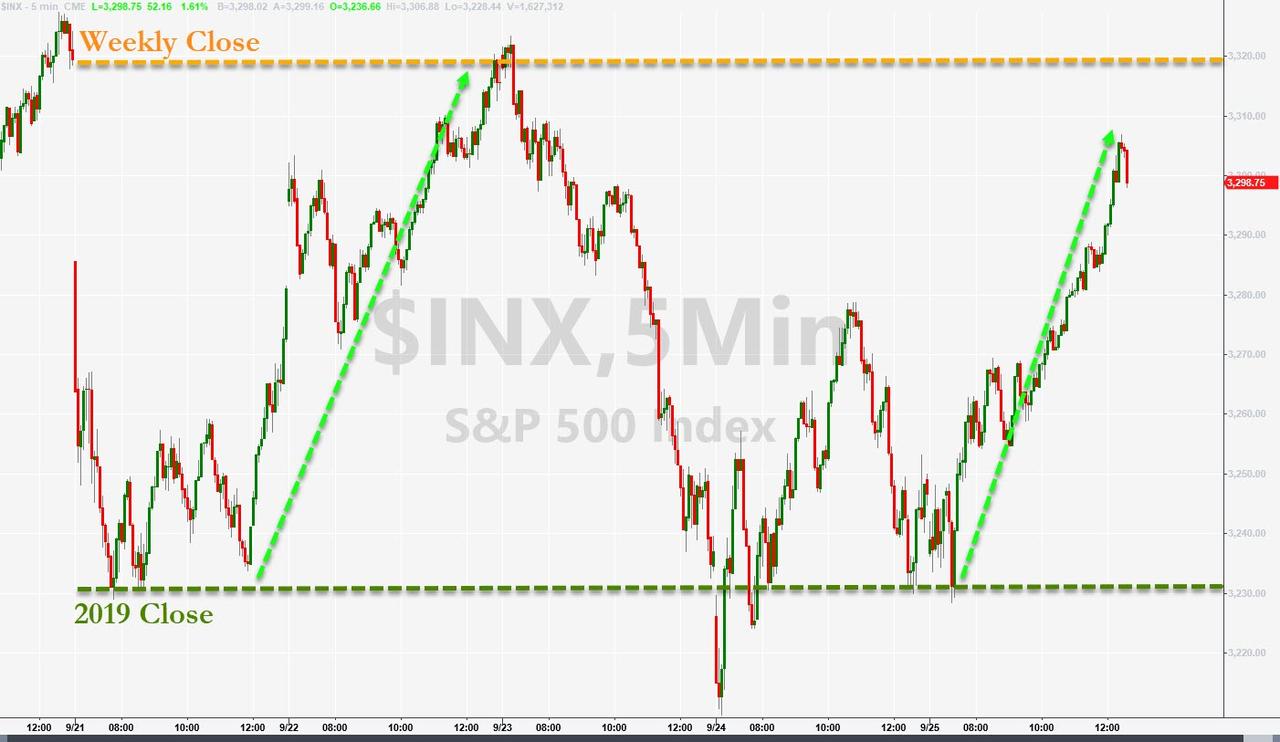
The S&P 500 bounced off “unch” for 2020 today…


Cyclicals underperformed this week (down the 4th week in a row – longest losing streak since March collapse)

Source: Bloomberg

Uncertainty around the election continued to rise this week…

Source: Bloomberg

Treasury yields were all lower on the week with the long-end outperforming (30Y -5bps, 2Y -1bps)…

Source: Bloomberg

Real yields surged higher on the week, dragging gold lower…

Source: Bloomberg

The dollar ripped higher this week (5th day higher in the last 6 higher) to its best week since March

Source: Bloomberg

Notably the dollar rallied to the March low pivot…

Source: Bloomberg

We note that the net spec positioning across FX futures was extremely short the USD which may explain the week’s squeeze…

Source: Bloomberg

Cryptos were all lower on the week (even with the rally of the last two days) with Bitcoin the least hit and Ethereum worst…

Source: Bloomberg

Silver was on target for its worst week since Sept 2011 before today’s bounce but all the major commodities were weaker on the week amid a soaring USD…

Source: Bloomberg

The last time silver saw such a drop, it screamed higher…

Source: Bloomberg

WTI ended lower but managed to hold back above $40…

Gold has outperformed silver for 5 of the last 6 days – the biggest weekly outperformance since March…

Source: Bloomberg

Finally, there’s this…

Source: Bloomberg

And, this seemed to sum things up nicely…

via ZeroHedge News https://ift.tt/3hYgEMs Tyler Durden

Amazon’s In-Home Security Drone Is Company’s “Most Chilling Surveillance Product” Yet

Amazon’s In-Home Security Drone Is Company’s “Most Chilling Surveillance Product” Yet

Tyler Durden

Fri, 09/25/2020 – 15:50

One of the biggest takeaways from Amazon’s annual product event is the need for constant recording if that is at home or in the car.

If readers see nothing wrong with the proliferation of mass surveillance, nevertheless, a host of always-on surveillance products operated by a mega-corporation, then now could be the time to purchase a camera-mounted drone that can buzz inside your home, searching for intruders or making sure the stove is not on. 

Ring announced the Always Home Cam during the Amazon event on Thursday, a “compact, lightweight, autonomously flying indoor camera” that can fly around the home, searching for disturbances. 

The tiny drone will retail for $250 and launches if another Ring product is triggered; It can respond to a whole host of emergencies such as break-ins and fires. After launch, the drone flies to the source of the disturbance, producing a live streaming feed for the end-user. 

The technology sounds wonderful, who wouldn’t want a personal security drone monitoring their home, but again, it’s owned by Amazon, which will undoubtedly raise some red flags about privacy. 

Big Brother Watch, a non-profit British advocacy group, described the drone as the “most chilling home surveillance product” yet.

“It’s difficult to imagine why Amazon thinks anyone wants flying internet cameras linked up to a data-gathering company in the privacy of their own home,” Silkie Carlo from Big Brother Watch told BBC

“It’s important to acknowledge the influence that Amazon’s product development is having on communities and the growing surveillance market,” Carlo said. 

If readers are aware, Ring recently partnered with more than 400 law enforcement agencies around the country, allowing police access to homeowners’ camera footage if necessary. The partnerships allow police to tap into millions of internet-connected cameras for solving crimes.

Ring’s deals with police fuel broader questions about privacy, surveillance, and the expanding reach of tech giants and local police into private homes. 

via ZeroHedge News https://ift.tt/3kR6ZZM Tyler Durden

Is Powell Sending An Even Louder Message: Fed Refuses To Resume Bond ETF Purchases Despite Slump

Is Powell Sending An Even Louder Message: Fed Refuses To Resume Bond ETF Purchases Despite Slump

Tyler Durden

Fri, 09/25/2020 – 15:30

Two weeks ago, when the Fed published its latest monthly breakdown of purchases Secondary Market Corporate Credit Facility which shockingly showed that in the entire month of August, the Fed had not purchased a single corporate bond ETF and had barely purchased any corporate bonds in the open market, we asked if Powell was “sending the market as message.”

In the subsequent two weeks, which saw a sharp drop in risk assets and the Nasdaq sliding into a 10% correction, coupled with a modest rout across the corporate bond sector, many had expected the Fed to revert to its role as custodian of market stability and ramp up its purchases of corporate bonds, if for no other reason then to assure investors that Uncle Jerome was still watching over everyone.

So in what may come as a big surprise to all those praying for the Fed to bail them out, or to at least telegraph that he is keeping an eye on the current tech-led market mess, Powell did no such thing and in fact the Fed’s latest weekly H.4.1 report showed that the corporate credit facilities held $12.911bn of corporate bonds and ETFs as of Tuesday, up a tiny $44 million from $12.867BN the prior week.

And since that implies the Fed bought a paltry $9 million/day of corporate bonds and ETFs on average this past week, down from $19 million/day the prior week, and far, far below the $300 million in daily corporate bond/ETF purchases for much of the early summer, one wonders if Powell is urgently trying to let the market know that it is on its own?


via ZeroHedge News https://ift.tt/36b6Yfg Tyler Durden

Short Circuit: A Roundup of Recent Federal Court Decisions

Please enjoy the latest edition of Short Circuit, a weekly feature from the Institute for Justice.

Recently the Eleventh Circuit upheld Florida’s system of allowing former felons to get back their right to vote, even though it makes it very hard for former felons to actually do that. Critics have rightfully decried the ruling, but, unfortunately, it’s based on decades of Supreme Court precedent that many of those same critics have likely endorsed. Director of IJ’s Center for Judicial Engagement Anthony Sanders tells us how supporting the extreme version of the rational basis test in some cases but not others is a bargain with Leviathan that you just can’t win. Click here to read.

  • After Congress declined to appropriate funding to Build The Wall, the president moved some money around to build some of it anyway. House of Representatives: Can’t do that. D.C. Circuit: “It is a core structural protection of the Constitution—a wall, so to speak, between the branches of government that prevents encroachment of the House’s and Senate’s power of the purse.” Therefore, the House has standing to sue. The case should not have been dismissed.
  • Police planning a no-knock raid on a suspected drug dealer observe him leaving home around 9:00 p.m. Without checking whether the suspect had returned, police conduct the raid the next morning. Within seconds of breaching the front door, police shoot an unarmed houseguest in the stomach. Jury: The officer wasn’t negligent, but the city was. Trial court: The municipality didn’t have a “special relationship” with the plaintiff and therefore had no duty to avoid negligently getting him shot in the stomach. Second Circuit: Not so clear; we’ll let the New York Court of Appeals straighten this out.
  • Technology company rescinds job offers after background checks turn up past felony convictions. Two would-have-been employees sue, claiming the company’s policy has a disparate impact on African Americans.  Second Circuit:  Plaintiffs would have us assume that, because African Americans in general are more likely to have felony convictions, the same holds true for African American web developers.  That assumption is not plausible or even logical, so the complaint must be dismissed.
  • Grim reading: At the turn of the 20th century, German colonial and military authorities annihilated about 100,000 people in what is now Namibia, killing 80% of the Ovaherero and 50% of the Nama tribes and subjecting many more to slavery, concentration camps, and live medical experimentation. Second Circuit: These terrible wrongs can’t be addressed in U.S. courts.
  • After praising the Christchurch massacre online, white supremacist is interviewed by the FBI. He lies to agents about owning a gun, and he’s convicted of making a false statement. Among his conditions of supervised release: monitored internet use and no promoting violence online (or posting at all on violence-promoting websites). Second Circuit: Yes, he was convicted of lying to the feds about a gun, but, in the broader context, these conditions are appropriately related to the crime. The “violence” condition, however, is too vague.
  • Stay in your apartment, says Philadelphia 911 operator, and wait for the fire department to come rescue you. But then the 911 operator gives the fire department a wrong address and neglects to mention there’s a family still in the building. Rescue never comes. Third Circuit: Gov’t owes a duty of care when it itself creates a danger; but that rule does not apply here, where the operator merely failed to act. (Two judges separately confer, find this conclusion “troubling” not because it denies liability but because liability might conceivably be imposed in some other case.)
  • Allegation: Acting on the advice of his lawyer, Pennsylvania man stands up at a sheriff’s auction to inform bidders that he has an unrecorded interest in a property up for auction. An attorney for the sheriff’s office and an officer promptly place him in a chokehold, stun him, and drag him from the room for violating their unwritten “no comment” rule. A First Amendment violation? Third Circuit: The auction is a nonpublic forum, and the “no comment” rule is a reasonable way to move things along. Probably didn’t need to rough the guy up, though.
  • In which Judge Willett, concurring, again expresses himself of the view that “courts should attempt to provide greater judicial guidance” in qualified immunity cases by “explaining whether a right was in fact violated, not merely whether a rights violation was clearly established.” (Nota bene: A pending cert petition authored by, inter alios, the MacArthur Justice Center invites the U.S. Supreme Court to align itself with this view.)
  • Courtesy of the Fifth Circuit, here’s a reminder that it doesn’t matter if subject-matter jurisdiction wasn’t raised below. Thus, this challenge to state billboard regulations—removed to federal court by the gov’t, which raised subject-matter jurisdiction just 11 days before appellate argument—is headed back to state court.
  • After more than 1,300 cities and counties file lawsuits against opioid manufacturers, the cases are consolidated in the Northern District of Ohio. Attorneys representing 51 of these plaintiffs attempt to certify a “negotiation class” consisting of every city and county in the United States. The trial court certifies the class; objecting municipalities appeal. Sixth Circuit: However “innovative and effective” such a class might be in resolving mass tort claims, it’s not allowed under the Federal Rules. Dissent: The Federal Rules are about making it easier to resolve cases, and that’s how we should interpret the class certification rules.
  • After sustaining a blow from a baseball bat, would-be robber is arrested and held in Franklin County, Ky. jail. In the days that follow, he consistently vomits and suffers two seizures before being taken to hospital (where he suffers a third seizure). Sixth Circuit: The jail’s medical personnel were not deliberately indifferent to the man’s medical needs, so his constitutional claims were rightly dismissed. Partial dissent: For three of the nurses, a jury should decide whether they acted recklessly.
  • In 1971, a hippie is murdered in Nederland, Colo. The main suspect is the town’s marshal, but he’s not charged until confessing at a nursing home in 1997. Twenty years later, one of the hippie’s friends decides “to take care of some old business” by leaving a homemade bomb at the Nederland police station. (The bomb squad neutralizes it.) He’s sentenced to 27 years. Tenth Circuit: Resentence him. Among other things, shouldn’t have applied that terrorism enhancement.
  • Eleventh Circuit: It violates due process for judicial actors to profit from convictions and sentencing decisions and that also goes for quasi-judicial actors, like private probation companies. So a lawsuit against a probation company used by Gardendale, Ala. to impose conditions on probationers and extend their terms of probation, thus increasing the fees the company could extract from them, should not have been dismissed. (IJ filed an amicus brief urging this course of action.)
  • And in en banc news, the Fourth Circuit will not reconsider its decision that a school district violated Title IX and the Constitution when it prohibited a transgender male student from using male restrooms. Judge Niemeyer concurs in the denial on the grounds that the panel opinion is so wrong the Supreme Court should take the case directly. Judge Wynn concurs on the alternative ground that the panel opinion is so right that there’s nothing to rehear.

Priscilla Villarreal is a one-person news phenom in Laredo, Texas. Going by “Lagordiloca” (an endearing Spanish nickname meaning “the big crazy lady”), she’s drawn national attention for her bold newsgathering and unfiltered reporting. As a critic of local government and police, she’s also drawn their ire. So they began a campaign of retaliatory actions against her, culminating in her arrest and prosecution under an obscure and seldom used statute against “misuse of public information.” But Villarreal didn’t misuse anything. All she did was ask a confidential police source to corroborate facts about breaking news stories. That’s what Pulitzer Prize winners do every day. So Villarreal sued for retaliatory arrest. But a federal district court granted the officials qualified immunity, holding that they could plead ignorance of the First Amendment by pointing to their reliance on a statute—no matter how obviously unconstitutional or inapplicable. Now, IJ has filed an amicus brief in support of Villarreal, urging the Fifth Circuit to recognize that the district court’s holding is dangerous to a free society and that qualified immunity cannot shield officers who enforce blatantly unconstitutional laws or criminalize core First Amendment activity.

from Latest – Reason.com https://ift.tt/3j4Qb1a
via IFTTT