Short Circuit: A Roundup of Recent Federal Court Decisions

Please enjoy the latest edition of Short Circuit, a weekly feature from the Institute for Justice.

Recently the Eleventh Circuit upheld Florida’s system of allowing former felons to get back their right to vote, even though it makes it very hard for former felons to actually do that. Critics have rightfully decried the ruling, but, unfortunately, it’s based on decades of Supreme Court precedent that many of those same critics have likely endorsed. Director of IJ’s Center for Judicial Engagement Anthony Sanders tells us how supporting the extreme version of the rational basis test in some cases but not others is a bargain with Leviathan that you just can’t win. Click here to read.

  • After Congress declined to appropriate funding to Build The Wall, the president moved some money around to build some of it anyway. House of Representatives: Can’t do that. D.C. Circuit: “It is a core structural protection of the Constitution—a wall, so to speak, between the branches of government that prevents encroachment of the House’s and Senate’s power of the purse.” Therefore, the House has standing to sue. The case should not have been dismissed.
  • Police planning a no-knock raid on a suspected drug dealer observe him leaving home around 9:00 p.m. Without checking whether the suspect had returned, police conduct the raid the next morning. Within seconds of breaching the front door, police shoot an unarmed houseguest in the stomach. Jury: The officer wasn’t negligent, but the city was. Trial court: The municipality didn’t have a “special relationship” with the plaintiff and therefore had no duty to avoid negligently getting him shot in the stomach. Second Circuit: Not so clear; we’ll let the New York Court of Appeals straighten this out.
  • Technology company rescinds job offers after background checks turn up past felony convictions. Two would-have-been employees sue, claiming the company’s policy has a disparate impact on African Americans.  Second Circuit:  Plaintiffs would have us assume that, because African Americans in general are more likely to have felony convictions, the same holds true for African American web developers.  That assumption is not plausible or even logical, so the complaint must be dismissed.
  • Grim reading: At the turn of the 20th century, German colonial and military authorities annihilated about 100,000 people in what is now Namibia, killing 80% of the Ovaherero and 50% of the Nama tribes and subjecting many more to slavery, concentration camps, and live medical experimentation. Second Circuit: These terrible wrongs can’t be addressed in U.S. courts.
  • After praising the Christchurch massacre online, white supremacist is interviewed by the FBI. He lies to agents about owning a gun, and he’s convicted of making a false statement. Among his conditions of supervised release: monitored internet use and no promoting violence online (or posting at all on violence-promoting websites). Second Circuit: Yes, he was convicted of lying to the feds about a gun, but, in the broader context, these conditions are appropriately related to the crime. The “violence” condition, however, is too vague.
  • Stay in your apartment, says Philadelphia 911 operator, and wait for the fire department to come rescue you. But then the 911 operator gives the fire department a wrong address and neglects to mention there’s a family still in the building. Rescue never comes. Third Circuit: Gov’t owes a duty of care when it itself creates a danger; but that rule does not apply here, where the operator merely failed to act. (Two judges separately confer, find this conclusion “troubling” not because it denies liability but because liability might conceivably be imposed in some other case.)
  • Allegation: Acting on the advice of his lawyer, Pennsylvania man stands up at a sheriff’s auction to inform bidders that he has an unrecorded interest in a property up for auction. An attorney for the sheriff’s office and an officer promptly place him in a chokehold, stun him, and drag him from the room for violating their unwritten “no comment” rule. A First Amendment violation? Third Circuit: The auction is a nonpublic forum, and the “no comment” rule is a reasonable way to move things along. Probably didn’t need to rough the guy up, though.
  • In which Judge Willett, concurring, again expresses himself of the view that “courts should attempt to provide greater judicial guidance” in qualified immunity cases by “explaining whether a right was in fact violated, not merely whether a rights violation was clearly established.” (Nota bene: A pending cert petition authored by, inter alios, the MacArthur Justice Center invites the U.S. Supreme Court to align itself with this view.)
  • Courtesy of the Fifth Circuit, here’s a reminder that it doesn’t matter if subject-matter jurisdiction wasn’t raised below. Thus, this challenge to state billboard regulations—removed to federal court by the gov’t, which raised subject-matter jurisdiction just 11 days before appellate argument—is headed back to state court.
  • After more than 1,300 cities and counties file lawsuits against opioid manufacturers, the cases are consolidated in the Northern District of Ohio. Attorneys representing 51 of these plaintiffs attempt to certify a “negotiation class” consisting of every city and county in the United States. The trial court certifies the class; objecting municipalities appeal. Sixth Circuit: However “innovative and effective” such a class might be in resolving mass tort claims, it’s not allowed under the Federal Rules. Dissent: The Federal Rules are about making it easier to resolve cases, and that’s how we should interpret the class certification rules.
  • After sustaining a blow from a baseball bat, would-be robber is arrested and held in Franklin County, Ky. jail. In the days that follow, he consistently vomits and suffers two seizures before being taken to hospital (where he suffers a third seizure). Sixth Circuit: The jail’s medical personnel were not deliberately indifferent to the man’s medical needs, so his constitutional claims were rightly dismissed. Partial dissent: For three of the nurses, a jury should decide whether they acted recklessly.
  • In 1971, a hippie is murdered in Nederland, Colo. The main suspect is the town’s marshal, but he’s not charged until confessing at a nursing home in 1997. Twenty years later, one of the hippie’s friends decides “to take care of some old business” by leaving a homemade bomb at the Nederland police station. (The bomb squad neutralizes it.) He’s sentenced to 27 years. Tenth Circuit: Resentence him. Among other things, shouldn’t have applied that terrorism enhancement.
  • Eleventh Circuit: It violates due process for judicial actors to profit from convictions and sentencing decisions and that also goes for quasi-judicial actors, like private probation companies. So a lawsuit against a probation company used by Gardendale, Ala. to impose conditions on probationers and extend their terms of probation, thus increasing the fees the company could extract from them, should not have been dismissed. (IJ filed an amicus brief urging this course of action.)
  • And in en banc news, the Fourth Circuit will not reconsider its decision that a school district violated Title IX and the Constitution when it prohibited a transgender male student from using male restrooms. Judge Niemeyer concurs in the denial on the grounds that the panel opinion is so wrong the Supreme Court should take the case directly. Judge Wynn concurs on the alternative ground that the panel opinion is so right that there’s nothing to rehear.

Priscilla Villarreal is a one-person news phenom in Laredo, Texas. Going by “Lagordiloca” (an endearing Spanish nickname meaning “the big crazy lady”), she’s drawn national attention for her bold newsgathering and unfiltered reporting. As a critic of local government and police, she’s also drawn their ire. So they began a campaign of retaliatory actions against her, culminating in her arrest and prosecution under an obscure and seldom used statute against “misuse of public information.” But Villarreal didn’t misuse anything. All she did was ask a confidential police source to corroborate facts about breaking news stories. That’s what Pulitzer Prize winners do every day. So Villarreal sued for retaliatory arrest. But a federal district court granted the officials qualified immunity, holding that they could plead ignorance of the First Amendment by pointing to their reliance on a statute—no matter how obviously unconstitutional or inapplicable. Now, IJ has filed an amicus brief in support of Villarreal, urging the Fifth Circuit to recognize that the district court’s holding is dangerous to a free society and that qualified immunity cannot shield officers who enforce blatantly unconstitutional laws or criminalize core First Amendment activity.

from Latest – Reason.com https://ift.tt/3j4Qb1a
via IFTTT

Antebellum Is Empty Social Commentary Disguised as a Horror Movie

antebellum-janelle-monae-LARGE

For decades, horror movies have been vehicles for social commentary. In 1968, director George Romero’s genre-defining zombie film, Night of the Living Dead, served (perhaps inadvertently) as a parable about American racism; its ’70s sequel, Dawn of the Dead, tackled soulless consumerism and suburban ennui. By the time the series reached the George W. Bush era, with 2005’s Land of the Dead, Romero transformed the unending war between humans and zombies into a darkly comic riff on class division and wartime propaganda. His movies were tense, gory affairs about a fantastical otherworld in which the shuffling, flesh-eating undead regularly chased terrified civilians through homes and roads and shopping malls. They were also about the very particular, very normal real world that he, and his viewers, lived in. 

Romero was far from the only director to inject political consciousness into genre filmmaking. In the 1980s, John Carpenter directed a string of beloved genre films—The Thing, Escape From New York, They Live—that reflected his left-leaning sensibilities. More recently, horror has tackled issues like familial trauma and mental health (Ari Aster’s Hereditary) and domestic violence (Leigh Whannell’s The Invisible Man), shading and sharpening prosaic horrors with genre thrills and chills. And thanks in large part to Jordan Peele, whose Get Out and Us directly overlaid the experience of present-day American racism onto horror tropes, the genre has continued to engage with issues of race and discrimination. Part of what made these movies effective was the balance between genre thrills and social commentary, the way that each enabled and expanded the possibilities of the other. 

As big-budget Hollywood studio filmmaking has drifted away from socially and culturally engaged stories and concepts, except in the most superficial way, modestly budgeted horror movies have become one of the few places where these sorts of ideas are consistently explored in popular feature films. Indeed, it is now almost more surprising to see a horror picture that does not attempt some sort of social commentary; it is only a little bit of an overstatement to say that horror has become Hollywood’s op-ed page.

Which brings us to Antebellum. The debut feature from filmmakers Gerard Bush and Christopher Renz, which recently debuted on video-on-demand, Antebellum is social horror movie that offers neither scares nor ideas. Instead, it’s a one-note, one-twist concept in search of a story. 

The film begins with a William Faulkner quote—”The past is never dead. It’s not even past.”—then opens onto a plantation run by Confederate soldiers where slaves are beaten, raped, and forced to perform punishing work in total silence. The central character is a slave, played by Janelle Monáe, who is plotting some sort of escape. But there’s little in the way of narrative momentum or character development until the story eventually appears to shift gears. 

Once again, we meet Monáe, but this time she’s a successful contemporary author who goes on television to debate racial justice, gives TED Talk–style lectures to packed rooms, and casually works references to intersectionality into conversations. Obviously, there’s a connection between the slave played by Monáe on the plantation and the author played by Monáe in the present day, a spiritual or metaphorical link between plantation-era slavery and the black lives of today. 

To explain that link, however, would be to spoil the film’s big twist, which—spoiler alert—is exactly what I’m going to do. 

It turns out that the two Monáes are not connected by spirit or ancestry or anything so metaphorically indirect. Instead, they are literally the same person. The scenes of Monáe as a successful author are actually flashback, at the end of which she is kidnapped by a shadowy cabal led by a stalker played by Jena Malone, then brought to a present slave plantation that is operated for the pleasure of present-day racists, including, it turns out, a sitting U.S. senator. 

That’s it. That’s the movie. There’s barely a story. The characters are paper-thin. The plantation scenes are difficult to watch, and if anything seem designed to capitalize on the very abuses they nominally seek to critique. But they’re not tense or frightening, nor even particularly illustrative, as in something like 12 Years a Slave; the scenes of grotesque violence do little to advance either a narrative or the viewer’s understanding the world. Monáe’s author character, meanwhile, has little to do except deliver pat mini-monologues about racial justice.

At every turn, Antebellum is flat, unpleasant, and empty. The entire film is just a delivery system for a twist whose entire unsubtle point could have been made in the space of a tweet. It’s Faulkner’s quote with handclap emojis. 

Fair enough, you might say: Racism’s legacy is neither subtle nor thrilling, but an omnipresent and awful reality. It’s not made for entertainment. But a movie, especially a horror movie, isn’t reality, and it has to give viewers a reason to want to watch. The most successful genre filmmakers take reality and recast it, shaping it into something else—a story, an idea, a parable, a portrait of a particular person. Romero’s zombie films were visceral, white-knuckle affairs with sympathetic characters; Get Out escalates into a terrifying escape scenario; The Invisible Man draws viewers into a tense, high-stakes cycle of abuse and revenge. All of these films had thrills and ideas in balance, each working to prop up the other. Antebellum has neither enough ideas for an op-ed nor enough scares for a horror movie. It’s an empty twist in search of grander meaning. 

Directors Bush and Renz have described themselves as activist filmmakers dedicated to advancing social causes. But no amount of activism can save such shoddy, underdeveloped material—and from the looks of Antebellum, their activism has clouded their filmmaking judgment. There are no zombies to be found in their film, but politics seems to have eaten their brains. 

from Latest – Reason.com https://ift.tt/3j7gnYX
via IFTTT

Virtually Insane: 12-Year-Old Louisiana Boy Suspended After BB Gun Spotted In His Room By Teacher

Virtually Insane: 12-Year-Old Louisiana Boy Suspended After BB Gun Spotted In His Room By Teacher

Tyler Durden

Fri, 09/25/2020 – 15:10

Authored by Jonathan Turley,

We recently discussed the absurd case of a school sending police to the home of a 12-year-old boy in Colorado because he showed a toy gun inside his own home.  Despite teaching such children virtually, the school treated the toy gun as a violation of “in school” policies.

Now  Ka Mauri Harrison, 9, who attends Woodmere Elementary in Harvey, has been suspended because a teacher spotted a BB gun in his room.  As with the Colorado case, Louisiana school officials defended this new case of virtual insanity.

NOLA.com reported that Ka Mauri was suspended for six days after his teacher spotted a BB gun in his bedroom. He was taking a virtual class on Sept. 11 when his younger brother came bursting into the room and tripped over the BB gun. Ka Mauri was taking an English test, so he quickly grabbed the BB gun and placed it “by his side” and continued the test. When the teacher called him out, Ka Mauri did not answer because his sound was muted during the test. As a result, he was suspended for having a gun “in school.”

The Louisiana Department of Education School Behavior Report listed the incident as “possesses weapons prohibited under federal law.”  Obviously, there is nothing prohibited in the possession of a bb gun, which is not even defined as a “firearm” since it is air-powered.  (The term “firearm” is defined in the Gun Control Act of 1968, 18 U.S.C. Section 921(a)(3), to include “(A) any weapon (including a starter gun), which will, or is designed to or may readily be converted to expel a projectile by the action of an explosive.) It does meet the definition of a weapon or simulated weapon under most school policies. However, those policies were written for the appearance of such toys or weapons in school, not in the home where they are perfectly lawful.

Like many thousands of parents, Nyron Harrison told NOLA.com that he bought a BB gun and taught his son to use it safely.  It was not loaded and Ka Mauri appears to have taken possession to keep it away from his younger brother and then continued with his test.  Even if the teacher had thought it might be a firearm and appropriately called the police for the child’s safety, it was shown not to be a firearm and there was no need for this suspension.

We have been dealing with the insanity of zero tolerance rules for years. Here is a prior column on the subject (and here). Children have been suspended or expelled for drawing stick figures or wearing military hats or bringing Legos shaped like guns or even having Danish in the shape of a gun. Various criminal and disciplinary cases were opened for finger guns. Despite the public outcry over the completely irrational and abusive application of zero tolerance rules, administrators and teachers continue to apply them blindly. If you do not have to exercise judgment, you can never been blamed for any failure. Conversely, even when the public outcry results in a reversal, teachers and administrators never seem punished with the same vigor for showing no judgment or logic in punishing a child.

How is suspension in the best interest of him or the school?  It is not. It is the same blind and callous application of zero tolerance rules that has been denounced for years without no apparent impact on school officials. A simple call to the parents would have sufficed to ask them to be sure that the bb gun is not displayed. Ka Mauri’s parents seem entirely responsible and responsive in these media accounts. Instead of addressing this issue with a modicum of restraint and proportionality, the interest of the child were discarded in a thoughtless and harmful bureaucratic response. There is a need for discipline in this case but it is not Ka Mauri who warrants such action.

via ZeroHedge News https://ift.tt/3ctrZDa Tyler Durden

After 30 Years In LA, Canyon Partners Plans Move To Texas Due To “High Taxes, Congestion”

After 30 Years In LA, Canyon Partners Plans Move To Texas Due To “High Taxes, Congestion”

Tyler Durden

Fri, 09/25/2020 – 14:50

Two months ago, Joe Rogan famously questioned why people pay for the “privilege” to live in places like California; where taxes are sky high, likely heading higher, the government is bloated and intrusive and Democratic leadership seems to have no real interest in either being fiscally responsible or (lately) maintaining law and order.

“I’m outta here. I’m gonna go to Texas. I just want to go somewhere in the center of the country, somewhere it’s easier to travel to both places, and somewhere where you have a little bit more freedom.”

“Also I think that um, where we live right here in Los Angeles is overcrowded. And I think, most of the time that’s not a problem. But I think it’s exposing the fact that it’s a real issue, when you look at the number of people that uh, are catching COVID because of this overpopulation issue.”

“When you look at the traffic, when you look at the economic despair, when you look at the homelessness problem that’s accelerated radically over the last six, seven, ten years, I think there’s too many people here,” he continued.

“I think it’s not tenable, I don’t think that it’s manageable. And every mayor does a shit job of doing it because I don’t think anybody could do a great job of it. I think there’s certain things you’re gonna have to deal with when you have a population of whatever the f**k L.A. is, it’s like twenty million plus people,” Rogan said.

Quite a rant… But Rogan is far from alone as the exodus of rich, poor, liberal, conservative California Dreamers has escalated. As we noted at the start of the year, even before the lockdowns forced millions to ‘work from home’ or worse ‘not work’, about 203,000 people left California, a result of the state’s shifting migration patterns and economic strains that are making it harder to afford living here.

The latest high-profile “California leaver” turns out to be $24 billion AUM hedge fund Canyon Partners, which has been a well known fixture in Los Angeles financial circles since its founding in 1990.

As Bloomberg reports, high taxes, congestion, and the fire risks of Southern California, have driven Canyon’s founders, Josh Friedman and Mitch Julis to explore a geographical shift.

According to people familiar with the discussions, Dallas and Austin are the front-runners and the firm expects to make the final decision next month as employees have been pitched the lure of Texas to lead a better life.

Canyon had 177 employees as of the end of 2019, according to its latest regulatory filing.

This exodus from liberal, high-taxation states has been a notable theme on the East Coast, as we recently detailed here, and now seems to be spreading the wealthiest on the West Coast.

via ZeroHedge News https://ift.tt/332BaHD Tyler Durden

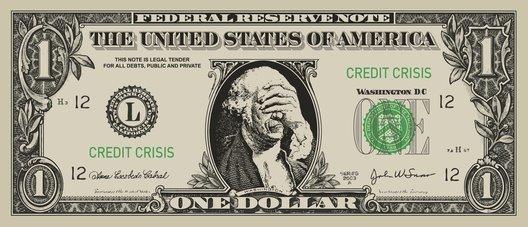
What Happens When The Dollar Really Starts To Rise?

What Happens When The Dollar Really Starts To Rise?

Tyler Durden

Fri, 09/25/2020 – 14:32

Authored by Tom Luongo via Gold, Goats, ‘n Guns blog,

Since the equity market topped a few weeks ago, bears have been going around the room taking turns punching various assets in the face.

It started with equities and moved into Bitcoin which was rejected at $12,000 and promptly collapsed into support around $10,500.

Then it was oil’s turn, which three weeks ago broke down below $40 Brent Crude for the first time since May.

The music finally stopped for copper, gold, silver and the euro. All of them got bushwhacked like they were old people wearing a MAGA hat in Portland this week.

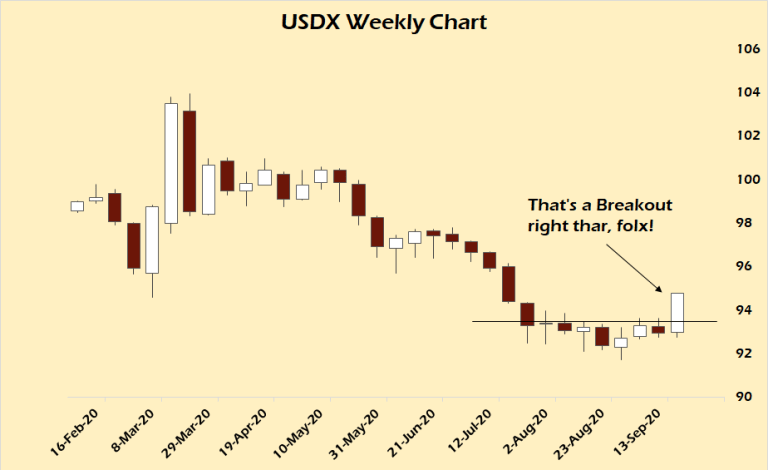
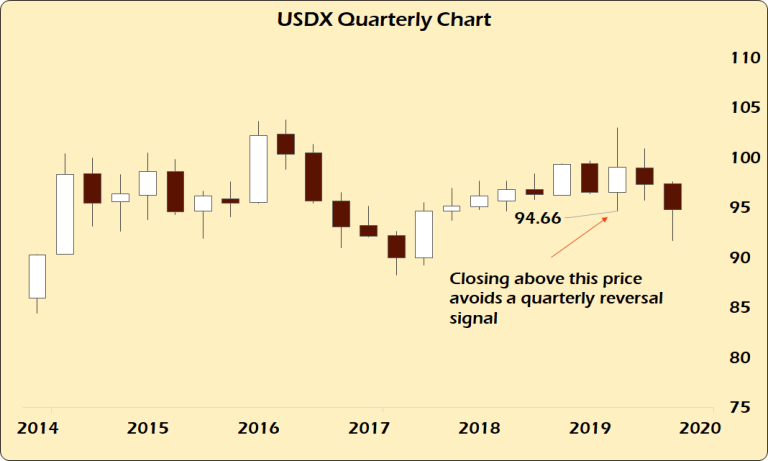
All of this occurred because the U.S. dollar first stopped falling and then had the temerity to put in a weak rally. The USDX, as flawed a measure as anything coming out of pollsters or the BLS, popped off its recent lows to break out definitively above 94.

And as we finish this final full trading week of Q3 we have to ask ourselves are we setting up for another dollar whirlwind in Q4 or will the winds of political unrest keep the dollar weak as the Fed re-enters the market and make the magic money machine go Brrr…?

But given that even the Fed is finally admitting that all this QE is actually deflationary do we really think there’s a real choice in this?

Because if the weekly chart didn’t convince you the next dollar bull wave is in process, then let’s go out in time and see what’s what?

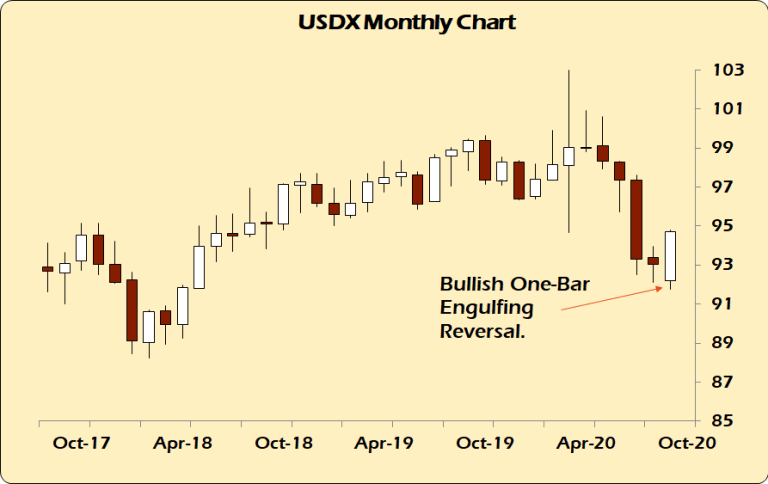
Let’s take this one-step further in time to to complete the picture, because none of this means anything if the long-term chart is bearish. That would just imply a mild reaction rally which will likely fade in Q4 or Q1 2021.

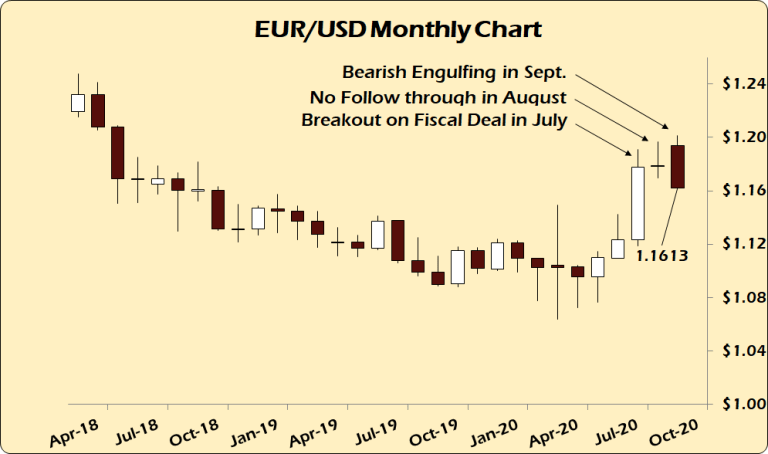
None of this is a done deal since Q3 and September do not close until Wednesday, but the markets are primed for this to occur. That monthly bearish engulfing reversal bar that the USDX is tracing can be seen all across important markets at this point — AAPL, Silver, and the NASDAQ are all flirting with this most bearish of signals.

But the most important one, in my opinion, is the euro as news this week of increasing odds of a no-deal Brexit coupled with breakdowns of the European banking sector and FinCEN releases of turning a blind-eye to money laundering put big pressure on the currency that just won’t die.

This is looking for all the world like a classic false-move in the euro to $1.20 on news of the European fiscal package which gave tax and spend authority to the European Commission for the first time. And while that is a major ‘accomplishment’ for the EU it is also not, at this time practical or germane to the very real problems existent within the European economy.

As COVID-19 news goes against Europe, which feeds The Davos Crowd’s plans for a Great Reset, the euro will come under even stronger pressure in Q4 as economic data worsens.

This is especially true as Donald Trump’s odds of re-election rise, which they are daily. A Trump victory should send the euro into a real tailspin which could breach the March low if things get disorderly.

From shifting polls to collapsing narratives about racially-motivated police killings, the malfeasance surrounding Obamagate and garnering enough votes to replace Ruth Bader Ginsburg on the Supreme Court, Trump looks to be in control of things with forty days to go until election day.

I fully expect at this point for U.S. Attorney John Durham to deal Obama et.al. a massive October Surprise which will offset any weakness in equity markets thanks to a rising dollar.

The markets have traded all summer betting on a Biden victory and political unrest keeping in question the future of investor capital in the U.S. That has kept the dollar weak and the euro falsely strong. It has guided the Yen higher on renewed Chinese economic strength but it hasn’t done anything to whet real appetites for the dollar or dollar-denominated assets.

The 10 year US Treasury has pushed backed towards 65 basis points, the yield curve is flattening because there’s no where to go on the short end of the maturity curve. Mnuchin and the Treasury can still sell record levels of long-dated U.S. debt at record high prices and the auctions not tail badly.

But the most telling thing about all of this is that we haven’t seen any inkling yet of real turmoil in the financial plumbing and yet these bearish technical signals are already happening.

Foreign central banks are still holding their purchases in trust with the Fed in New York, reloading for the next round of currency defense.

From the latest Fed Balance Sheet report, there’s no stress on their balance sheet. Repos are still at zero. Central Bank Liquidity Swaps are still falling, now down over 90% from their peak of $455+ billion in April.

This isn’t to say all is well or anything it is to say that nothing seems imminent and yet, we’re seeing headline-grabbing volatility, a $150 drop in gold prices, a $7 drop in Silver and a 4% move in the euro in a two-week period.

And these are supposed to still be the good times where the economic data is holding up, Pelosi and the Democrats are in full-on “holding our breath until we turn blue and pass out” mode and every day seems one day closer to a permanent fracturing.

If this is what good times look like, the real question we should be asking ourselves now is, “What happens when things get real?”

*  *  *

Join My Patreon if you want a heads up on where things are heading.  Install the Brave Browser if you don’t want Google to Age-Restrict your life out of existence.

via ZeroHedge News https://ift.tt/2RXPKtJ Tyler Durden

Antebellum Is Empty Social Commentary Disguised as a Horror Movie

antebellum-janelle-monae-LARGE

For decades, horror movies have been vehicles for social commentary. In 1968, director George Romero’s genre-defining zombie film, Night of the Living Dead, served (perhaps inadvertently) as a parable about American racism; its ’70s sequel, Dawn of the Dead, tackled soulless consumerism and suburban ennui. By the time the series reached the George W. Bush era, with 2005’s Land of the Dead, Romero transformed the unending war between humans and zombies into a darkly comic riff on class division and wartime propaganda. His movies were tense, gory affairs about a fantastical otherworld in which the shuffling, flesh-eating undead regularly chased terrified civilians through homes and roads and shopping malls. They were also about the very particular, very normal real world that he, and his viewers, lived in. 

Romero was far from the only director to inject political consciousness into genre filmmaking. In the 1980s, John Carpenter directed a string of beloved genre films—The Thing, Escape From New York, They Live—that reflected his left-leaning sensibilities. More recently, horror has tackled issues like familial trauma and mental health (Ari Aster’s Hereditary) and domestic violence (Leigh Whannell’s The Invisible Man), shading and sharpening prosaic horrors with genre thrills and chills. And thanks in large part to Jordan Peele, whose Get Out and Us directly overlaid the experience of present-day American racism onto horror tropes, the genre has continued to engage with issues of race and discrimination. Part of what made these movies effective was the balance between genre thrills and social commentary, the way that each enabled and expanded the possibilities of the other. 

As big-budget Hollywood studio filmmaking has drifted away from socially and culturally engaged stories and concepts, except in the most superficial way, modestly budgeted horror movies have become one of the few places where these sorts of ideas are consistently explored in popular feature films. Indeed, it is now almost more surprising to see a horror picture that does not attempt some sort of social commentary; it is only a little bit of an overstatement to say that horror has become Hollywood’s op-ed page.

Which brings us to Antebellum. The debut feature from filmmakers Gerard Bush and Christopher Renz, which recently debuted on video-on-demand, Antebellum is social horror movie that offers neither scares nor ideas. Instead, it’s a one-note, one-twist concept in search of a story. 

The film begins with a William Faulkner quote—”The past is never dead. It’s not even past.”—then opens onto a plantation run by Confederate soldiers where slaves are beaten, raped, and forced to perform punishing work in total silence. The central character is a slave, played by Janelle Monáe, who is plotting some sort of escape. But there’s little in the way of narrative momentum or character development until the story eventually appears to shift gears. 

Once again, we meet Monáe, but this time she’s a successful contemporary author who goes on television to debate racial justice, gives TED Talk–style lectures to packed rooms, and casually works references to intersectionality into conversations. Obviously, there’s a connection between the slave played by Monáe on the plantation and the author played by Monáe in the present day, a spiritual or metaphorical link between plantation-era slavery and the black lives of today. 

To explain that link, however, would be to spoil the film’s big twist, which—spoiler alert—is exactly what I’m going to do. 

It turns out that the two Monáes are not connected by spirit or ancestry or anything so metaphorically indirect. Instead, they are literally the same person. The scenes of Monáe as a successful author are actually flashback, at the end of which she is kidnapped by a shadowy cabal led by a stalker played by Jena Malone, then brought to a present slave plantation that is operated for the pleasure of present-day racists, including, it turns out, a sitting U.S. senator. 

That’s it. That’s the movie. There’s barely a story. The characters are paper-thin. The plantation scenes are difficult to watch, and if anything seem designed to capitalize on the very abuses they nominally seek to critique. But they’re not tense or frightening, nor even particularly illustrative, as in something like 12 Years a Slave; the scenes of grotesque violence do little to advance either a narrative or the viewer’s understanding the world. Monáe’s author character, meanwhile, has little to do except deliver pat mini-monologues about racial justice.

At every turn, Antebellum is flat, unpleasant, and empty. The entire film is just a delivery system for a twist whose entire unsubtle point could have been made in the space of a tweet. It’s Faulkner’s quote with handclap emojis. 

Fair enough, you might say: Racism’s legacy is neither subtle nor thrilling, but an omnipresent and awful reality. It’s not made for entertainment. But a movie, especially a horror movie, isn’t reality, and it has to give viewers a reason to want to watch. The most successful genre filmmakers take reality and recast it, shaping it into something else—a story, an idea, a parable, a portrait of a particular person. Romero’s zombie films were visceral, white-knuckle affairs with sympathetic characters; Get Out escalates into a terrifying escape scenario; The Invisible Man draws viewers into a tense, high-stakes cycle of abuse and revenge. All of these films had thrills and ideas in balance, each working to prop up the other. Antebellum has neither enough ideas for an op-ed nor enough scares for a horror movie. It’s an empty twist in search of grander meaning. 

Directors Bush and Renz have described themselves as activist filmmakers dedicated to advancing social causes. But no amount of activism can save such shoddy, underdeveloped material—and from the looks of Antebellum, their activism has clouded their filmmaking judgment. There are no zombies to be found in their film, but politics seems to have eaten their brains. 

from Latest – Reason.com https://ift.tt/3j7gnYX
via IFTTT

Deregulate Pharmacists Now To Increase COVID-19 Vaccine Uptake

pharmacycovidshot

Enabling tens of millions of Americans to get themselves speedily vaccinated against COVID-19 will be a huge logistics challenge. A new policy brief from the Mercatus Center, a think tank at George Mason University, argues that we could greatly accelerate the process by removing the complex state regulations that prevent pharmacists from administering vaccines.

There’s a good chance we’ll need those vaccines to end the pandemic. Herd immunity is the resistance you get to the spread of a contagious disease when a sufficiently high proportion of a population is immune to the illness; you can reach it through either mass infection or mass vaccination.

Epidemiologists generally estimate that the COVID-19 threshold for herd immunity is around 60 to 70 percent. Some researchers believe the number may be much lower than that, but even then we aren’t necessarily near the threshold: Recent testing of nearly 1 million American blood donors from June 15 to August 23 for COVID-19 antibodies finds that only 1.82 percent had them.

Blood donations aren’t a random sample of the population, of course. But in congressional testimony earlier this week, Centers for Disease Control and Prevention (CDC) chief Robert Redfield noted that his agency “is in the process of a very large, sequential study across the entire United States” to measure the presence of antibodies to the novel coronavirus; the stufy will be finalized and likely “published in the next week or so.” According to Redfield, “The preliminary results on the first round show that a majority of our nation—more than 90 percent of the population—remains susceptible” to the novel coronavirus.

So if mass infection isn’t about the get us there, tens of millions of American will need to get vaccinated to achieve herd immunity against the virus. In congressional testimony earlier this week, National Institute for Allergy and Infectious Disease Director Anthony Fauci said that he believes that the U.S. will have produced enough doses of a coronavirus vaccine to distribute to every American by April.

But who will give us those shots? While most states already allow pharmacists to administer many vaccines, regulators have unnecessarily imposed a variety of age restrictions on which patients pharmacists may vaccinate and individual patient prescription requirements.

The Mercatus Center report recommends that state regulators relax age restrictions on pharmacist-administered vaccinations; issue statewide standing orders authorizing pharmacists to administer vaccines without requiring a physician-written prescription for each patient; and revise regulations, as Oregon has, to permit pharmacists to administer all of the vaccines recommended by the CDC’s Advisory Committee on Immunization Practices. The latter recommendation “prevents lag in vaccine administration due to boards or legislatures having to approve individually named vaccines for pharmacist administration.”

Herd immunity is a big goal. Now is the time to unleash America’s 88,000 pharmacies and 314,000 pharmacists to reach it.

from Latest – Reason.com https://ift.tt/3mRvHLB
via IFTTT

Sixth Circuit Rejects Claim Covid-19 Requires Easing of Ballot Initiative Rules

Today the U.S. Court of Appeals for the Sixth Circuit rejected a challenge to Ohio’s laws governing the placement of initiatives on the ballot. The plaintiffs argued that the relevant ballot access provisions imposed an unconstitutional burden in light of the Covid-19 pandemic. The panel, consisting of Judges Sutton, McKeague and Nalbandian, disagreed.

The court’s per curiam opinion in Thompson v. Dewine summarizes the case:

The COVID-19 pandemic has upended life in many ways. In response to the unfolding public health crisis, states across the country imposed various orders in hopes of containing the virus. Ohio, for its part, asked its citizens to stay at home and restricted the size of gatherings.

This case, which we’ve seen before, involves the intersection of COVID-19, the state’s responses to that pandemic, and some of Ohio’s conditions that must be met before a ballot initiative can get on the ballot for Election Day. See Thompson v. DeWine, 959 F.3d 804, 806 (6th Cir.) (per curiam), mot. to vacate stay denied,—S. Ct. —-, No. 19A1054, 2020 WL 3456705 (2020).

Plaintiffs say that Ohio’s ballot initiative conditions are unconstitutional as applied during this pandemic and request that the federal courts relax them, at least for the time being. Plaintiffs’ challenge is a curious one. There is no question that Ohio’s ballot initiative conditions are, standing alone, constitutional, there is no question that Ohio is not responsible for COVID-19, and Plaintiffs are not challenging Ohio’s restrictions on public gatherings and the like, which Ohio imposed to address the pandemic—so we assume those are constitutional as well. And yet, Plaintiffs contend that when you put all of this together, in effect, two constitutional rights plus one outside catalyst make one constitutional wrong. The district court agreed and granted a preliminary injunction. We stayed that order because we disagreed. And now, because we still disagree, we reverse the district court’s grant of a preliminary injunction

From later in the opinion:

we note that the Federal Constitution gives states, not federal courts, “the ability to choose among many permissible options when designing elections.” Id. We don’t “lightly tamper” with that authority. Id. Instead, the power to adapt or modify state law to changing conditions—especially during a pandemic—rests with state officials and the citizens of the state.

So while federal courts can sometimes enjoin unconstitutional state laws, we can’t engage in “a plenary re-writing of the State’s ballot-access provisions.” Esshaki, 813 F. App’x at 172. Instead, “[t]he Constitution grants States broad power to prescribe the ‘Times, Places and Manner of holding Elections for Senators and Representatives,’ which power is matched by state control over the election process for state offices.” Clingman v. Beaver, 544 U.S. 581, 586 (2005) (citations omitted).

We don’t have the power to tell states how they should run their elections. If we find a state ballot-access requirement unconstitutional, we can enjoin its enforcement. See, e.g., Esshaki, 813 F. App’x at 172. But otherwise, “state and local authorities have primary responsibility for curing constitutional violations.” Hutto v. Finney, 437 U.S. 678, 687 n.9 (1978); Esshaki, 813 F. App’x at 172 (holding that it “was not justified” for a district court to extend the deadline to file signed petitions and order the state to accept electronic signatures).

So when the district court here ordered Ohio to accept electronically signed and witnessed petitions and extended the deadline for submitting petitions, it overstepped its bounds. It effectively rewrote Ohio’s constitution and statutes and “intrude[d] into the proper sphere of the States.” Missouri v. Jenkins, 515 U.S. 70, 131 (1995) (Thomas, J., concurring); see Thompson, 959 F.3d at 812 (“[T]he district court exceeded its authority by rewriting Ohio law with its injunction.”). Federal courts don’t have this authority.

from Latest – Reason.com https://ift.tt/2RXKC8X
via IFTTT

Deregulate Pharmacists Now To Increase COVID-19 Vaccine Uptake

pharmacycovidshot

Enabling tens of millions of Americans to get themselves speedily vaccinated against COVID-19 will be a huge logistics challenge. A new policy brief from the Mercatus Center, a think tank at George Mason University, argues that we could greatly accelerate the process by removing the complex state regulations that prevent pharmacists from administering vaccines.

There’s a good chance we’ll need those vaccines to end the pandemic. Herd immunity is the resistance you get to the spread of a contagious disease when a sufficiently high proportion of a population is immune to the illness; you can reach it through either mass infection or mass vaccination.

Epidemiologists generally estimate that the COVID-19 threshold for herd immunity is around 60 to 70 percent. Some researchers believe the number may be much lower than that, but even then we aren’t necessarily near the threshold: Recent testing of nearly 1 million American blood donors from June 15 to August 23 for COVID-19 antibodies finds that only 1.82 percent had them.

Blood donations aren’t a random sample of the population, of course. But in congressional testimony earlier this week, Centers for Disease Control and Prevention (CDC) chief Robert Redfield noted that his agency “is in the process of a very large, sequential study across the entire United States” to measure the presence of antibodies to the novel coronavirus; the stufy will be finalized and likely “published in the next week or so.” According to Redfield, “The preliminary results on the first round show that a majority of our nation—more than 90 percent of the population—remains susceptible” to the novel coronavirus.

So if mass infection isn’t about the get us there, tens of millions of American will need to get vaccinated to achieve herd immunity against the virus. In congressional testimony earlier this week, National Institute for Allergy and Infectious Disease Director Anthony Fauci said that he believes that the U.S. will have produced enough doses of a coronavirus vaccine to distribute to every American by April.

But who will give us those shots? While most states already allow pharmacists to administer many vaccines, regulators have unnecessarily imposed a variety of age restrictions on which patients pharmacists may vaccinate and individual patient prescription requirements.

The Mercatus Center report recommends that state regulators relax age restrictions on pharmacist-administered vaccinations; issue statewide standing orders authorizing pharmacists to administer vaccines without requiring a physician-written prescription for each patient; and revise regulations, as Oregon has, to permit pharmacists to administer all of the vaccines recommended by the CDC’s Advisory Committee on Immunization Practices. The latter recommendation “prevents lag in vaccine administration due to boards or legislatures having to approve individually named vaccines for pharmacist administration.”

Herd immunity is a big goal. Now is the time to unleash America’s 88,000 pharmacies and 314,000 pharmacists to reach it.

from Latest – Reason.com https://ift.tt/3mRvHLB
via IFTTT

Sixth Circuit Rejects Claim Covid-19 Requires Easing of Ballot Initiative Rules

Today the U.S. Court of Appeals for the Sixth Circuit rejected a challenge to Ohio’s laws governing the placement of initiatives on the ballot. The plaintiffs argued that the relevant ballot access provisions imposed an unconstitutional burden in light of the Covid-19 pandemic. The panel, consisting of Judges Sutton, McKeague and Nalbandian, disagreed.

The court’s per curiam opinion in Thompson v. Dewine summarizes the case:

The COVID-19 pandemic has upended life in many ways. In response to the unfolding public health crisis, states across the country imposed various orders in hopes of containing the virus. Ohio, for its part, asked its citizens to stay at home and restricted the size of gatherings.

This case, which we’ve seen before, involves the intersection of COVID-19, the state’s responses to that pandemic, and some of Ohio’s conditions that must be met before a ballot initiative can get on the ballot for Election Day. See Thompson v. DeWine, 959 F.3d 804, 806 (6th Cir.) (per curiam), mot. to vacate stay denied,—S. Ct. —-, No. 19A1054, 2020 WL 3456705 (2020).

Plaintiffs say that Ohio’s ballot initiative conditions are unconstitutional as applied during this pandemic and request that the federal courts relax them, at least for the time being. Plaintiffs’ challenge is a curious one. There is no question that Ohio’s ballot initiative conditions are, standing alone, constitutional, there is no question that Ohio is not responsible for COVID-19, and Plaintiffs are not challenging Ohio’s restrictions on public gatherings and the like, which Ohio imposed to address the pandemic—so we assume those are constitutional as well. And yet, Plaintiffs contend that when you put all of this together, in effect, two constitutional rights plus one outside catalyst make one constitutional wrong. The district court agreed and granted a preliminary injunction. We stayed that order because we disagreed. And now, because we still disagree, we reverse the district court’s grant of a preliminary injunction

From later in the opinion:

we note that the Federal Constitution gives states, not federal courts, “the ability to choose among many permissible options when designing elections.” Id. We don’t “lightly tamper” with that authority. Id. Instead, the power to adapt or modify state law to changing conditions—especially during a pandemic—rests with state officials and the citizens of the state.

So while federal courts can sometimes enjoin unconstitutional state laws, we can’t engage in “a plenary re-writing of the State’s ballot-access provisions.” Esshaki, 813 F. App’x at 172. Instead, “[t]he Constitution grants States broad power to prescribe the ‘Times, Places and Manner of holding Elections for Senators and Representatives,’ which power is matched by state control over the election process for state offices.” Clingman v. Beaver, 544 U.S. 581, 586 (2005) (citations omitted).

We don’t have the power to tell states how they should run their elections. If we find a state ballot-access requirement unconstitutional, we can enjoin its enforcement. See, e.g., Esshaki, 813 F. App’x at 172. But otherwise, “state and local authorities have primary responsibility for curing constitutional violations.” Hutto v. Finney, 437 U.S. 678, 687 n.9 (1978); Esshaki, 813 F. App’x at 172 (holding that it “was not justified” for a district court to extend the deadline to file signed petitions and order the state to accept electronic signatures).

So when the district court here ordered Ohio to accept electronically signed and witnessed petitions and extended the deadline for submitting petitions, it overstepped its bounds. It effectively rewrote Ohio’s constitution and statutes and “intrude[d] into the proper sphere of the States.” Missouri v. Jenkins, 515 U.S. 70, 131 (1995) (Thomas, J., concurring); see Thompson, 959 F.3d at 812 (“[T]he district court exceeded its authority by rewriting Ohio law with its injunction.”). Federal courts don’t have this authority.

from Latest – Reason.com https://ift.tt/2RXKC8X
via IFTTT