Failure To Launch New Fiscal Stimulus Would Have Catastrophic Consequences For The US Economy

Failure To Launch New Fiscal Stimulus Would Have Catastrophic Consequences For The US Economy

Tyler Durden

Fri, 09/25/2020 – 14:14

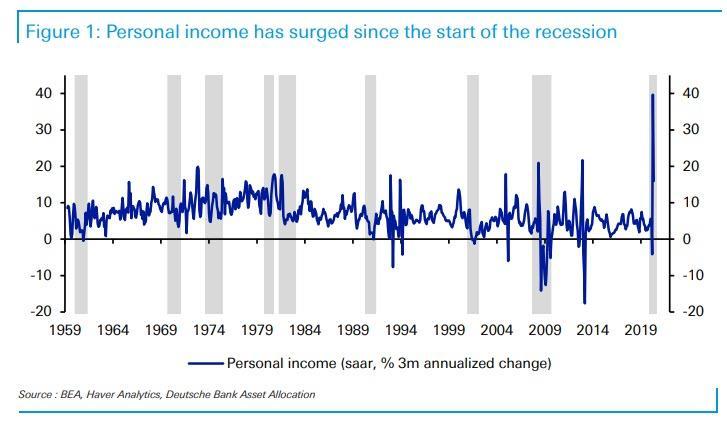
The covid-related shutdowns were expected to result in unprecedented economic devastation, and for the most part they did, although that as bad as the US economy suffered in Q1 and Q2, it would have been far, far worse had the government not stepped in. Recall that as DB’s Jim Reid pointed out in July, this has been the strangest recession in history“, one defined by a surge in personal income – very much unlike the usual collapse observed during recessions.

The reason for this is simple: as we explained a few weeks prior to Reid’s report, the massive fiscal stimulus unleashed by the US government led to the biggest surge in personal income in history…
… making government transfer payments an unheard of 30% of all personal income!
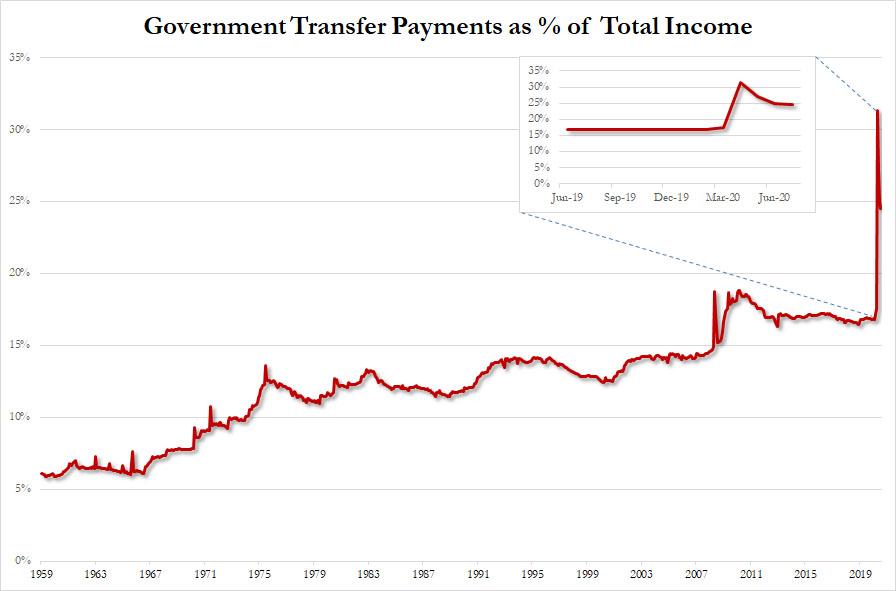
Putting that number in perspective, in the 1950s and 1960s, transfer payment were around 7%. This number rose in the low teens starting in the mid-1970s (or right after the Nixon Shock ended Bretton-Woods and closed the gold window). The number then jumped again after the financial crisis, spiking to the high teens. And now, the coronavirus has officially sent this number into the mid-20% range, after hitting a record high 31% in April.

So for all those who claim that the Fed is now (and has been for the past decade) subsidizing the 1%, that’s true, but with every passing month, the government is also funding the daily life of an ever greater portion of America’s poorest social segments.

Of course, many won’t object to such reliance on the government: after all “welfare for everyone” means more money for doing nothing (and if the Fed gets its way and it can deposit digital dollars directly, it means much more money – all with the intent of inflating away the debt).

The problem is that should this firehose of benefits slow – or close completely – the economic collapse that was mitigated drastically thanks to the covid fiscal stimulus, will come back with a horrific vengeance. Alas, with Congress gridlocked on a 5th fiscal stimulus round, and the economy clearly rolling over as we warned one month ago following the July 31 fiscal cliff which led to a collapse in spending among people who receive unemployment insurance…
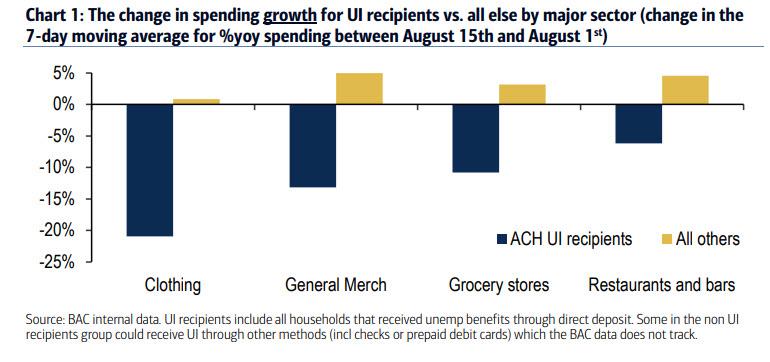
… the result of continued inaction could be catastrophic. Here’s why.

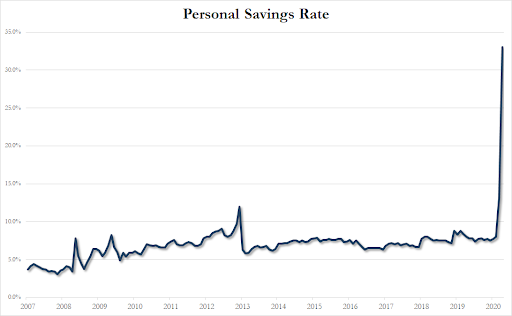
As BofA writes this morning, the Brookings institution regularly updates a model that estimates the impact of fiscal policy— Federal State and Local and “automatic stabilizers” —on GDP growth. The impacts depend on both the “multiplier effect” of each action on spending and the lags. For example, the model assumes that people spend 90 cents out of every dollar of unemployment benefits, but that the “propensity to consume” for a number of other programs is much lower. After all a lot of the stimulus funds went to households and firms that are not in distress. Hence the surge in the savings rate.
And, as the chart below shows, according to their estimates, stimulus resulted in a huge 14.1% boost to GDP growth in the second quarter. Since actual GDP fell by 31.7% this implies that the stimulus offset almost a third of the shock to the economy (= 14.1 / (31.7 + 14.1)). It also means that without stimulus, the GDP collapse could have been nearly 50%!
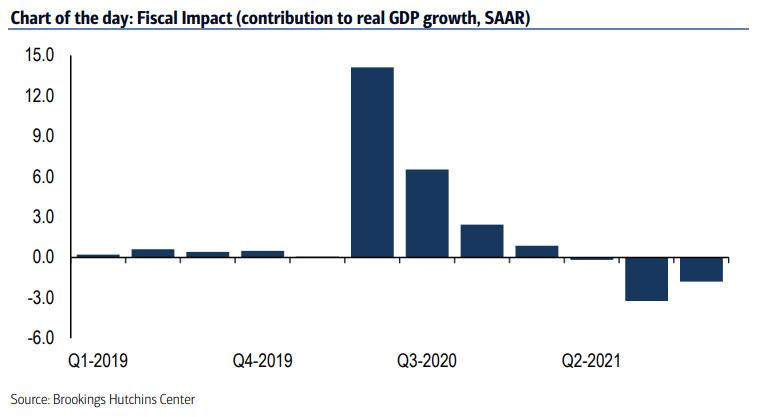
So far so good, but while the record stimulus kept the party going until now, the stimulus is rapidly fading and turns negative starting in the second quarter of next year.

It gets worse: as BofA chief global economist Ethan Harris writes, “the Fiscal Impact data also reminds us of the dangers of policy gridlock coming out of a major recession. The last recession also featured a huge fiscal stimulus—the $831bn (5.8% of GDP) American Recovery and Reinvestment Act of 2009 (ARRA). However, that proved to be the one and only stimulus package.”

As a result, Democrats lost the House in 2010 as a wave of “Tea Party” Republican’s came into the House, freezing discretionary spending. From the end of 2010 to the end of 2015 fiscal policy sliced an average of 1.0% off of GDP growth. The  result was a slow recovery, chronic low inflation and sustained super easy Fed policy.

Needless to say, Americans want more, and as we reported earlier this week, a Gallup poll found that 90% of US consumers demand a new stimulus, while blaming republicans and democrats equally. Meanwhile, as Harris adds, polls suggest that gridlock is one of the more likely outcomes in this election, with Democrats taking the House and White House, but Republicans retaining the Senate; that is also BofA’s baseline forecast. At the same time, Senate Republicans have already begun pushing back against more deficit financed spending, and that is happening before an election and with a Republican President who wants a package.

Naturally, Senate republicans may be even more resistant to deficit spending after the election, particularly if there is a Democrat in the White House. The problem as the final chart shows, is that absent a new stimulus, not only will the delayed aftereffects of the existing stimulus come back to haunt the economy…
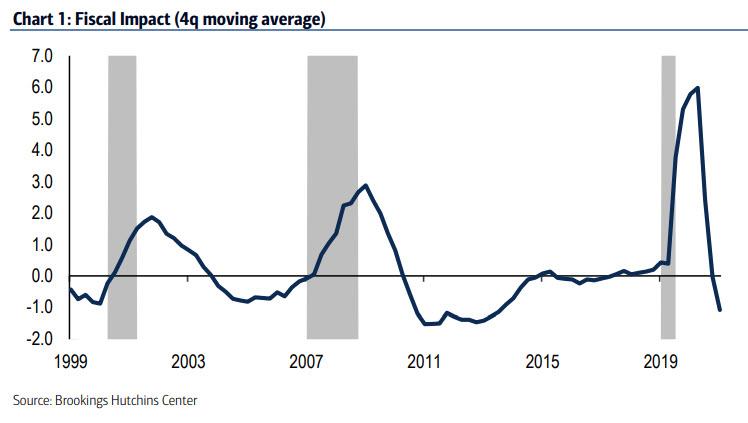
… but the lack of new spending will result in a massive double whammy crashing the economy in 2021, which averted a full blown meltdown in Q2, but will find itself scrambling in the coming quarters as the mother of all double dips emerges, and which incidentally is also why the market has been sliding for the past two weeks as the reality of an indefinite stimulus-free future looms all too real.

via ZeroHedge News https://ift.tt/3hY2evO Tyler Durden
The Reckoning Is Upon Us: Precious Metal Plunge Is “True Dip-Buying Opportunity”

The Reckoning Is Upon Us: Precious Metal Plunge Is “True Dip-Buying Opportunity”

Tyler Durden

Fri, 09/25/2020 – 13:50

Authored by Kevin Smith and Tavi Costa via Crescat Capital,

Dear Investors:

The Reckoning Is Upon Us

Decades of fiscal profligacy are culminating in an explosion of government debt that is poised to bring simmering monetary debasement to a boiling point. Central bank interventions have aided and abetted reckless government spending that has obfuscated poor underlying organic growth fundamentals. Instead of laying the groundwork for future real economic growth, monetary authorities have fostered a euphoric investment environment with delusional asset valuations. Paradoxically, we are past the point of no return where the stimulative policies that have created this frenzy are the death knell for the economy. The world is suffering from a debt overdose. It now must face the inevitability of collapsing financial asset prices and synchronized fiat currency devaluation.

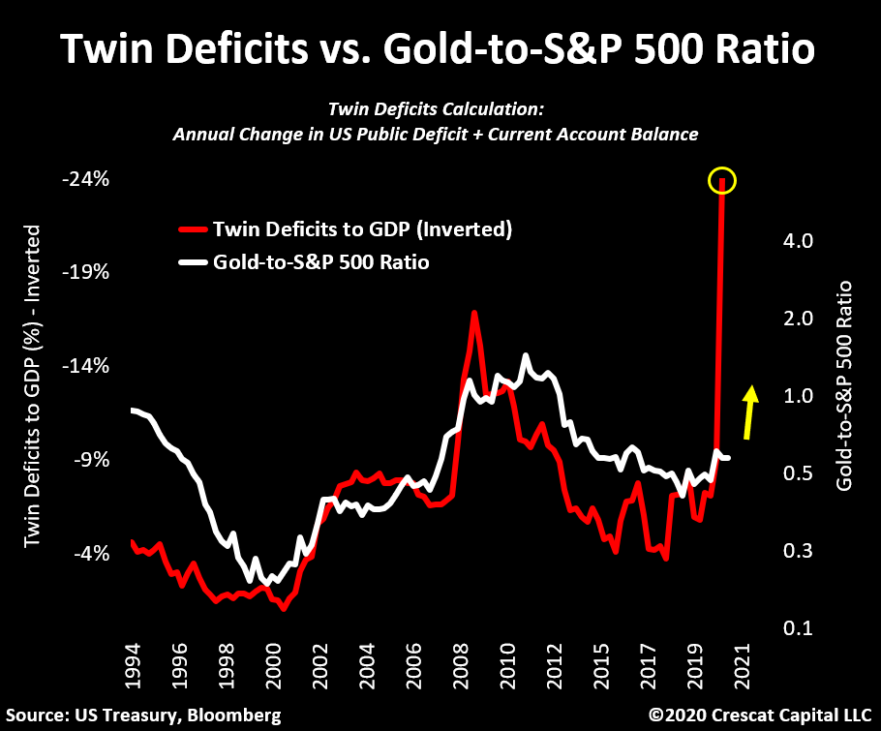
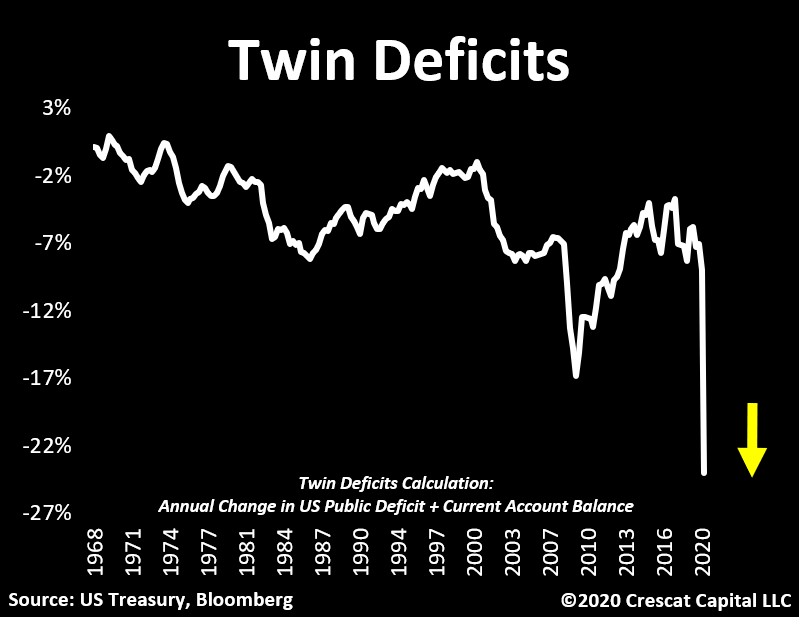
In the US, we have recently seen a precipitous increase in government deficits to World War II levels, which are now accompanied by a significant decline in the trade balance. The recent shrinkage in net exports strongly suggests that a deep new slump in the current account is underway. Based on Crescat’s estimates, the US twin deficit is on track to reach over 25% of nominal GDP which should soon be the worst level ever reported.

Fortunately, the severity of these long-standing macro imbalances helps set the stage for an incredibly optimistic outlook for precious metals, especially relative to equity markets. In the chart below, we can see a clear relationship between twin deficits (inverted) and the gold-to-S&P 500 ratio. During times of fiscal disorder, monetary metal tends to outperform overall stocks which suggests that a significant move in this ratio is still ahead of us. Let us not forget that this time around policy makers are also fighting “deflation” tooth and nail. The necessary expansion of the monetary base to suppress interest rates and thereby create a negative and declining real interest environment should serve as a major tailwind for the gold-to-S&P 500 ratio to continue to rise.

A Forthcoming of a Key Macro Event

By the end of 2021, $8.5 trillion of US Treasuries will be maturing and, at the current macro conditions, the US government will have no option but to roll over its debt obligations. Consequentially, this will likely cause a shift in the role of monetary policy. Allow us to elaborate. Foreign investors now own the lowest percentage of outstanding US government securities in 20 years. Historically, they funded over 50% of all marketable Treasury securities. Today, that number has dropped to 35%. The Federal Reserve, meanwhile, has increasingly become the buyer of last resort. It now owns a record 22% of all marketable Treasuries. This convergence of ownership is particularly dangerous and appears irreversible. Given the current record government debt to GDP, high unemployment, and large budget deficit, we expect the Fed to monetize the government’s debt burdens at the highest rate ever, from now through 2021. To reiterate our views from prior letters, over-indebtedness and the need for further monetary expansion is a global phenomenon that we believe will lead to the value destruction of all fiat currencies relative to gold, not just the US dollar.

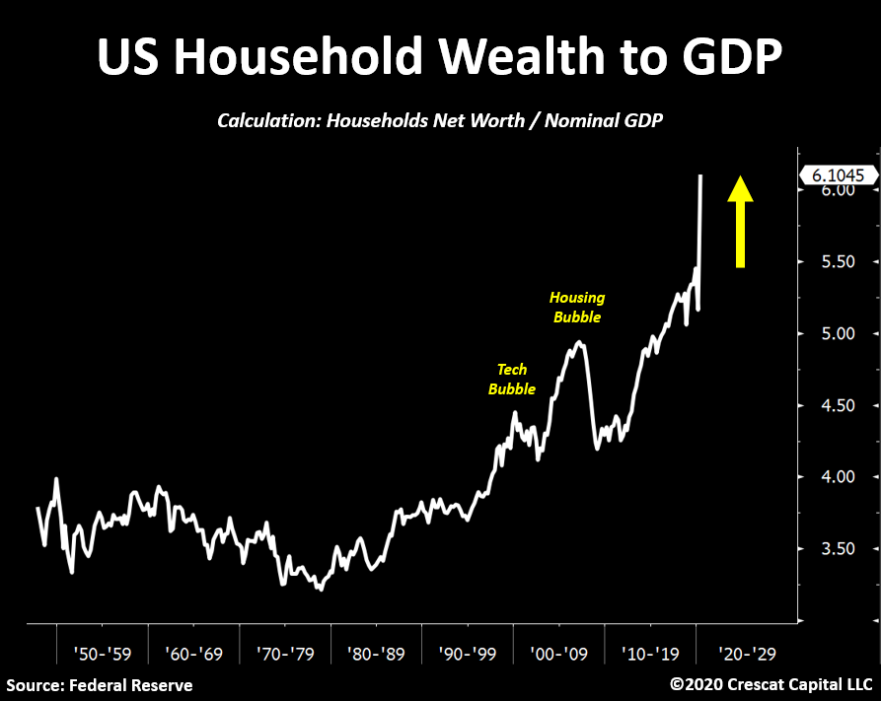
Policy makers are indeed hamstrung. The dependency on extreme monetary policies to maintain the stability of financial markets has become a key part of every central bank mandate. What is puzzling however, is the fact that asset prices have never been so detached from underlying fundamentals. US households are now worth over 6x today’s GDP, a number far higher than any other Fed-induced asset bubble, including both the dotcom mania in 2000 and the housing bubble that preceded the 2008 global financial crisis. Today’s excesses are anything but business cycle low behavior. It is quite the opposite. We are still at a major asset bubble peak. Meanwhile, the economy is already in a recession, one that is pre-destined to linger based on our macro analysis. As we have seen throughout history, the unwinding process from absurd asset valuations leads to real damage in the overall economy. Asset bubbles always burst. There is a business cycle and it is intertwined with security prices. Today, the two have diverged in the short term in a perverse and unsustainable way based on massive raw speculation. There will be a reckoning.

There Is Only One Way Out: Monetary Debasement

The overarching message from central banks remains consistent; none of them can sustainably afford having a strong currency. The set-up of artificially low rates combined with ballooning fiscal deficits, extreme monetary dilution, and inflated risky assets creates, in our view, a veritable utopia for gold and silver. We are in a debt trap globally. Monetary debasement is unavoidable. In such scenario, precious metals miners remain one of the very few industries with substantial fundamental improvement in the stock market today. Balance sheets are notably cleaner across most mining names. Capital spending also remains historically constrained and, in combination with strong cash flow growth, median free cash flow for the top 20 miners more than doubled in the last 12 months. It is astonishing that an entire industry which truly benefits from today’s macro backdrop is worth less than 3.5x the market cap of Apple! The level of asymmetry remains insanely attractive, especially after the recent pull back in precious metals prices over the last week. We believe gold and silver stocks are poised to move significantly higher in the months and years ahead.

A Stellar Month for our New Precious Metals Fund

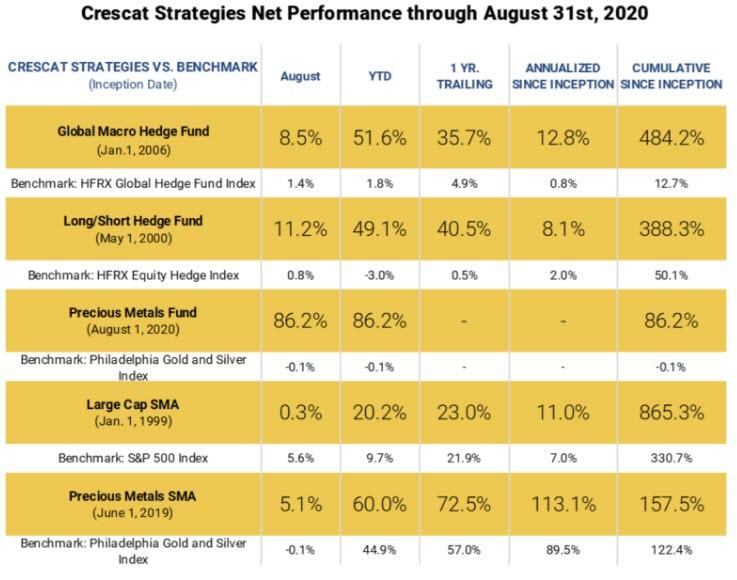
We are pleased to report that the Crescat Precious Metals Fund was up 86.2% net in its debut month. This was the biggest single month’s performance for any Crescat strategy ever. It was accomplished in an overall flat market for the precious metals industry in August. In our view, the strong relative performance is important early validation for the potential of our activist strategy. While the fund cannot not have such incredibly strong performance every month, and there will be pullbacks along the way, we strongly believe there is substantial return potential over the next several years in this fund. Our macro analysis shows that we are in the early stages of a new secular bull market for precious metals.

Crescat’s Hedge Funds Lead the Pack Again

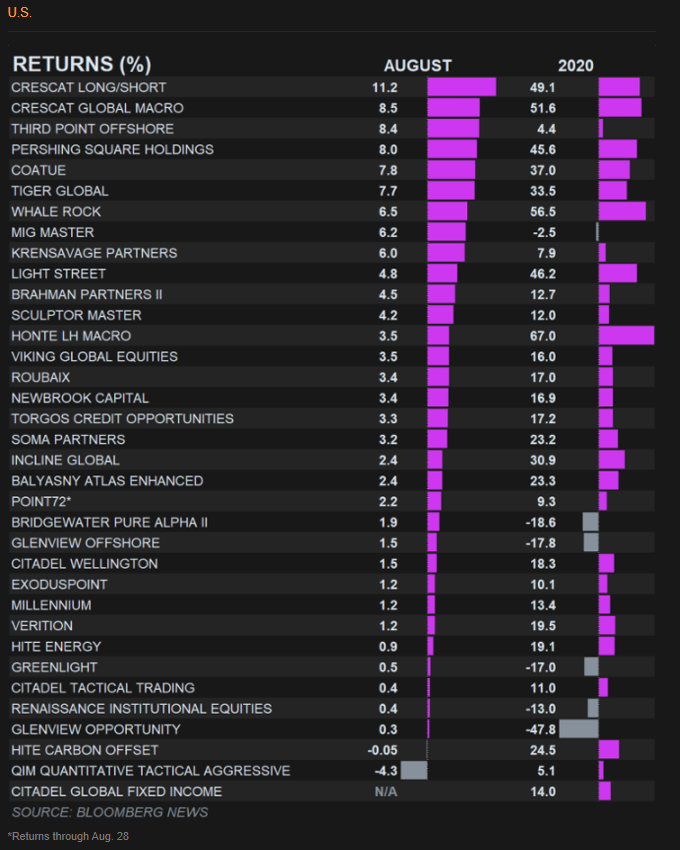
We are also excited to share that our Global Macro and Long/Short hedge funds made the top of Bloomberg News’ hedge fund monthly performance table for the third straight month and the fourth month this year with net performance of +8.5% and +11.2% respectively in August. These two funds are up 51.6% and 49.1% net year-to-date. It is important to note that Crescat’s two hedge funds were also at the top of Bloomberg’s table in March, the month when the market crashed. We capitalized overall on that environment via our short positions, even though our long gold positions underperformed at that time. We remain significantly short today in both hedge funds and are determined to capitalize on the re-ignition of a new tactical bear market that we foresee based on our macro models.

Performance Across All Crescat Strategies

Global Macro Fund Profit Attribution by Theme

September Selloff in Precious Metals Likely a True Dip-Buying Opportunity

After we published our Blood in the Streets letter on March 17 saying it was time to buy gold stocks, precious metals miners have been far and away the best performing industry in the stock market. From April through July, the Crescat Precious Metals SMA Composite delivered a 142.2% net return versus 96.1% for our benchmark Philadelphia Gold and Silver Index.

Since the benchmark’s recent highs on August 5, it has retraced about 15.8% of its gains through yesterday’s close with most of the correction happening in just three of the last four trading sessions.

A pullback from such strong levels is not only natural but healthy at what we believe is only the early stages of a new precious metals cycle after a ten-year bear market.

The stock market at large has been selling off and remains extremely over-valued, unlike gold stocks. It is more likely the beginning of a much bigger downturn for stocks. Meanwhile, in our analysis, gold mining stocks are still highly undervalued today and setting up to diverge to the upside like historical analogs in 1930-32, 1973-74, and 2000-02.

Fed Balance Sheet Expansion Set to Resume to New Record Levels

In the past several days, it seems the combination of gold bulls, stock market bulls, and dollar bears are getting nervous that the Fed balance sheet expansion has stalled since its peak in early June. In our analysis, Fed liquidity injections have been the number-one driver for gold since the Fed’s quantitative tightening experiment in 2018 and the repo crisis which pivoted it back to quantitative easing in late 2019 as shown in the chart below.

We believe there are at least six structural forces that will pressure the Fed to further expand its balance sheet at new record levels and propel undervalued gold and silver prices much higher in the near term:

  1. The stock market bubble bursts and the Fed must intervene

  2. The Treasury needs the money and the Fed must intervene ($8.5 trillion in Treasuries coming due by year end 2021 and a record budget deficit that must be funded)

  3. Left to their own devices, interest rates start rising and the Fed must intervene

  4. Unemployment remains too high and the Fed must intervene

  5. Inflation remains to too low and the Fed must intervene

  6. The dollar keeps strengthening versus other fiat currencies and the Fed must intervene

Today, the precious metals industry represents a deep value, high growth industry that has only just begun to shine after a long bear market.

With the help of world-renowned exploration geologist, Quinton Hennigh, PhD, Crescat is investing in a portfolio of the most promising new, large, and high-grade gold and silver deposits in viable jurisdictions across the planet in our hedge funds and precious metals strategies. We believe we can unlock tremendous value through de-risked, high probability future discovery and growth in this portfolio.

Strong outperformance over complete business cycles remains Crescat’s goal. We are particularly excited about our potential to perform over the next few years because of our macro research supporting where we sit in both the precious metals cycle and the overall stock market and business cycle. We believe there is a strong opportunity to extract performance on both fronts over this time frame given our firmwide position at this critical juncture in the global economy and stock market today.

On the activist precious metals front, we have many incredible new funding opportunities in front of us right now for October, the type of activist deals like those we had teed up in July that led to our great August.

In our strong view, this is a much-needed correction in gold stocks to shake out the weak hands. We strongly believe it is an excellent buying opportunity in what is still the very early stages of a new secular bull market for precious metals. We encourage those who want to take advantage of this buying opportunity to contact us before the end of this month.

Download PDF Version here…

via ZeroHedge News https://ift.tt/3cuJGlI Tyler Durden

Louisiana School Threatens 9-Year-Old Boy with Expulsion for Having BB Gun During Virtual Class

Screen Shot 2020-09-25 at 12.52.59 PM

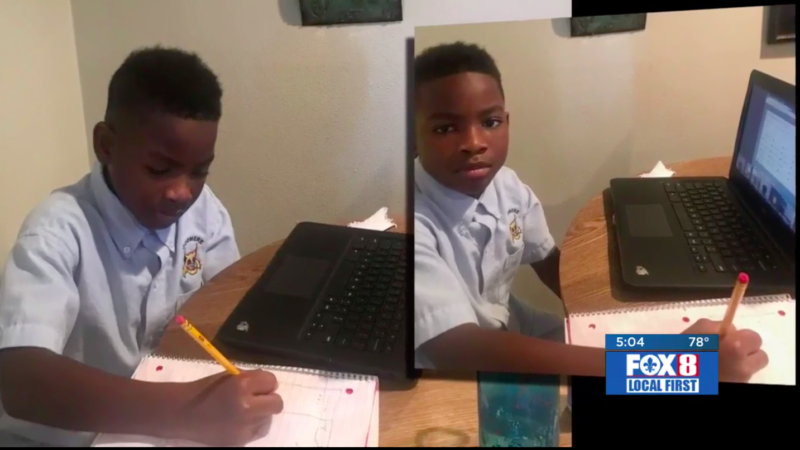
Ka Mauri Harrison is a nine-year-old boy in Harvey, Louisiana. Earlier this month, he was taking a social studies test—during a virtual classroom session—when one of his younger siblings entered the room and knocked over an unloaded toy BB gun. Harrison picked up the fake weapon, which made it briefly visible on screen.

Readers can probably guess what happened next: The district, Jefferson Pariah Schools, threatened Harrison with expulsion for having a lookalike weapon in class—as if his home is now an extension of the school. The Washington Post reports that the expulsion was later reduced to a six-day suspension .

“This is an injustice. It’s a systemic failure,” Chelsea Cusimano, the family’s attorney, declared in a statement. “They’re applying on-campus rules to these children, even though they’re learning virtually in their own homes.”

Schools have doled out similarly harsh punishments to other students who inadvertently violated policies that don’t make any sense when applied to at-home instruction. Inflexibly taking a rules-are-rules approach to school discipline makes even less sense now than it did when kids were actually going to school. Dealing with Zoom-based learning is difficult enough; kids and parents shouldn’t have to worry about what might appear in the background. It’s an extra penalty on families that have more kids to deal with or less access to stress-reducing resources.

Note also the difficulty that Harrison’s teacher had when she wanted to talk to him about the toy gun. She waved at him to get his attention, but he had the computer on mute because he was taking a test. By the time he could unmute, the video feed cut out. These are the struggles and impracticalities that thousands of children all over the country are dealing with—even in districts where the COVID-19 infection rates are low and in-person instruction could probably resume safely.

Louisiana Attorney General Jeff Landry has taken an interest in Harrison’s case and the broader issue of “blatant government overreach by the school system.”

“I have begun investigating this matter and plan to take action in defense of this young man and his family and all families who could suffer the same invasion of their homes and constitutional rights,” Landry announced.

That’s good news. School districts need crystal-clear instructions from state authorities that they should not make life even more difficult for kids like Harrison.

from Latest – Reason.com https://ift.tt/3kS7TFp
via IFTTT

Fargo Goes Full Gangster in Season Four

Fargo4_1160x653_1161x653

Fargo. FX. Sunday, September 27, 9 p.m.

Halfway through the plague-abbreviated fall broadcast TV rollout, it’s time for a break. Actually, there are two new NBC shows debuting this week. One is Connecting, a stab at a Friends for quarantine times. The other is a remake of the pillory-the-contestants quiz show The Weakest Link, with Jane Lynch of Glee replacing Brit Anne Robinson in the Ilsa-She-Wolf-of-the-Game-Show-SS role as hostess. But NBC didn’t make either of them available to critics in time for review, generally not a sign of intellectual heft, cutting-edge humor or even bare intelligibility, so watch at your own risk—the usual Reason warranty on lost or damaged brain cells is not in effect.

Happily, the cupboard is not bare. FX’s Fargo returns after an absence of three years, with no discernible diminution of bloodlust, contempt for its fellow man, or general weirdness.

In one fundamental way, Fargo—an anthology series with no returned characters or plot continuity, based on the 1996 Coen brothers film of the same name—is quite different from previous seasons. Usually the show kicks off a little story about ordinary people. Something happens, typically a crime, things go out of control, and we get to see how leeringly evil regular human beings can turn.

Perhaps series creator Noah Hawley thinks his point about our core immorality is made, because this edition of Fargo—set in Kansas City in 1950—makes no pretense of human decency. From the first frame, it’s a tale of ethnocentric gang warfare: the Jewish mafia against its Irish counterparts, the Irish against the Italians, and—finally, center stage—the Italians against the blacks.

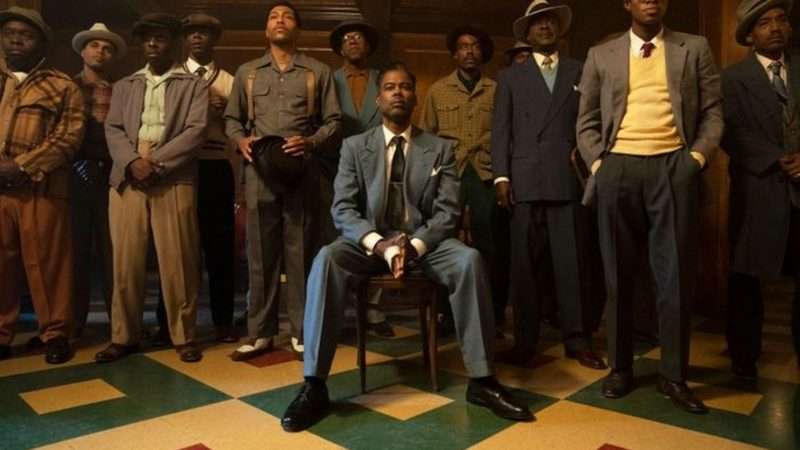
The story plays out as cockeyed, multicultural version of The Godfather, with sidebars on immigration, assimilation and, inevitably, race. Black gang boss Loy Cannon, played by Chris Rock, owns a bank, is a deacon in his church and a loving father to his children. But he also fixes fights and runs numbers and prostitution rackets.

His Italian rivals, the Fadda brothers, are almost directly out of The Godfather. Josto (Jason Schwartzman, The French Dispatch), prematurely seated family chief after the accidental death of his father, is a slightly less flighty version of Fredo Corleone, uncertain and disposed to compromise rather than clashes. His brother Gaetano (Italian TV star Salvatore Esposito), only recently arrived from Sardinia, is an even more hotheaded version of Sonny Corleone, squirming with sociopathic impulses.

With Cannon wanting to expand his territory and the Faddas not interested in giving anything up, conflict seems likely. The bosses try to work things out like a couple of midwestem Franz Fanons. “I know you think being part of an American is standing on my neck,” Cannon tells the Italians. “But I’ve seen the window signs. ‘NO COLORED, NO ITALIANS.’ So we’re both in the gutter together, like it or not.”

But post-colonial theory is no match for mafioso rage. And the presence of some oddball interlopers doesn’t help.

The most problematic is a Mormon federal marshal (Timothy Olyphant) on the hunt for some escaped bank robbers, who dispenses breezy bits of racist 1950s folk wisdom with the same alacrity with which he ignores rules about search warrants and other law enforcement niceties. “I tracked a one-eyed Mexican all the way to the ocean once,” he boasts during a stakeout. “I caught him trying to paddle to China.”

Much as his career anecdotes enliven surveillance shifts, the pinwheel-eyed nurse Oraetta Mayflower (Jessie Buckley of HBO’s Chernobyl) goes him one better as she dispenses unsolicited handjobs to Italian mobsters spying on the black gang. The mobsters might be even further diverted if they knew she’s pulled off more hits than they have, dispatching her patients with poisonous injections and crimped oxygen hoses on fits of macabre whimsy.

Buckley’s daft performance is the star turn of a very talented cast. (Exception: Rock, who lacks the gravitas necessary to play a mafia boss, tries hard, but can’t rid himself of a little half-smirk that makes him look continuously on the verge of breaking into an old Saturday Night Live monologue.)

Evaluating the rest of the show, however, is more difficult, particularly its attempt to establish a moral footing for itself. (If, indeed, that’s supposed to be taken seriously; Fargo‘s ability to needle itself should never be underestimated.) I’m certain America has no shortage of racism, but somehow I’m not very moved by a lack of awareness of all the barriers to advancement to ethnic gangsterism. And in any event, Fargo’s body-count is a salute to an equal-opportunity America. Advises one character: “There’s a place for all of us on this earth. We just have to find it.” In Fargo, that’s almost always in a coffin.

from Latest – Reason.com https://ift.tt/3mSym7W
via IFTTT

Louisiana School Threatens 9-Year-Old Boy with Expulsion for Having BB Gun During Virtual Class

Screen Shot 2020-09-25 at 12.52.59 PM

Ka Mauri Harrison is a nine-year-old boy in Harvey, Louisiana. Earlier this month, he was taking a social studies test—during a virtual classroom session—when one of his younger siblings entered the room and knocked over an unloaded toy BB gun. Harrison picked up the fake weapon, which made it briefly visible on screen.

Readers can probably guess what happened next: The district, Jefferson Pariah Schools, threatened Harrison with expulsion for having a lookalike weapon in class—as if his home is now an extension of the school. The Washington Post reports that the expulsion was later reduced to a six-day suspension .

“This is an injustice. It’s a systemic failure,” Chelsea Cusimano, the family’s attorney, declared in a statement. “They’re applying on-campus rules to these children, even though they’re learning virtually in their own homes.”

Schools have doled out similarly harsh punishments to other students who inadvertently violated policies that don’t make any sense when applied to at-home instruction. Inflexibly taking a rules-are-rules approach to school discipline makes even less sense now than it did when kids were actually going to school. Dealing with Zoom-based learning is difficult enough; kids and parents shouldn’t have to worry about what might appear in the background. It’s an extra penalty on families that have more kids to deal with or less access to stress-reducing resources.

Note also the difficulty that Harrison’s teacher had when she wanted to talk to him about the toy gun. She waved at him to get his attention, but he had the computer on mute because he was taking a test. By the time he could unmute, the video feed cut out. These are the struggles and impracticalities that thousands of children all over the country are dealing with—even in districts where the COVID-19 infection rates are low and in-person instruction could probably resume safely.

Louisiana Attorney General Jeff Landry has taken an interest in Harrison’s case and the broader issue of “blatant government overreach by the school system.”

“I have begun investigating this matter and plan to take action in defense of this young man and his family and all families who could suffer the same invasion of their homes and constitutional rights,” Landry announced.

That’s good news. School districts need crystal-clear instructions from state authorities that they should not make life even more difficult for kids like Harrison.

from Latest – Reason.com https://ift.tt/3kS7TFp
via IFTTT

Fargo Goes Full Gangster in Season Four

Fargo4_1160x653_1161x653

Fargo. FX. Sunday, September 27, 9 p.m.

Halfway through the plague-abbreviated fall broadcast TV rollout, it’s time for a break. Actually, there are two new NBC shows debuting this week. One is Connecting, a stab at a Friends for quarantine times. The other is a remake of the pillory-the-contestants quiz show The Weakest Link, with Jane Lynch of Glee replacing Brit Anne Robinson in the Ilsa-She-Wolf-of-the-Game-Show-SS role as hostess. But NBC didn’t make either of them available to critics in time for review, generally not a sign of intellectual heft, cutting-edge humor or even bare intelligibility, so watch at your own risk—the usual Reason warranty on lost or damaged brain cells is not in effect.

Happily, the cupboard is not bare. FX’s Fargo returns after an absence of three years, with no discernible diminution of bloodlust, contempt for its fellow man, or general weirdness.

In one fundamental way, Fargo—an anthology series with no returned characters or plot continuity, based on the 1996 Coen brothers film of the same name—is quite different from previous seasons. Usually the show kicks off a little story about ordinary people. Something happens, typically a crime, things go out of control, and we get to see how leeringly evil regular human beings can turn.

Perhaps series creator Noah Hawley thinks his point about our core immorality is made, because this edition of Fargo—set in Kansas City in 1950—makes no pretense of human decency. From the first frame, it’s a tale of ethnocentric gang warfare: the Jewish mafia against its Irish counterparts, the Irish against the Italians, and—finally, center stage—the Italians against the blacks.

The story plays out as cockeyed, multicultural version of The Godfather, with sidebars on immigration, assimilation and, inevitably, race. Black gang boss Loy Cannon, played by Chris Rock, owns a bank, is a deacon in his church and a loving father to his children. But he also fixes fights and runs numbers and prostitution rackets.

His Italian rivals, the Fadda brothers, are almost directly out of The Godfather. Josto (Jason Schwartzman, The French Dispatch), prematurely seated family chief after the accidental death of his father, is a slightly less flighty version of Fredo Corleone, uncertain and disposed to compromise rather than clashes. His brother Gaetano (Italian TV star Salvatore Esposito), only recently arrived from Sardinia, is an even more hotheaded version of Sonny Corleone, squirming with sociopathic impulses.

With Cannon wanting to expand his territory and the Faddas not interested in giving anything up, conflict seems likely. The bosses try to work things out like a couple of midwestem Franz Fanons. “I know you think being part of an American is standing on my neck,” Cannon tells the Italians. “But I’ve seen the window signs. ‘NO COLORED, NO ITALIANS.’ So we’re both in the gutter together, like it or not.”

But post-colonial theory is no match for mafioso rage. And the presence of some oddball interlopers doesn’t help.

The most problematic is a Mormon federal marshal (Timothy Olyphant) on the hunt for some escaped bank robbers, who dispenses breezy bits of racist 1950s folk wisdom with the same alacrity with which he ignores rules about search warrants and other law enforcement niceties. “I tracked a one-eyed Mexican all the way to the ocean once,” he boasts during a stakeout. “I caught him trying to paddle to China.”

Much as his career anecdotes enliven surveillance shifts, the pinwheel-eyed nurse Oraetta Mayflower (Jessie Buckley of HBO’s Chernobyl) goes him one better as she dispenses unsolicited handjobs to Italian mobsters spying on the black gang. The mobsters might be even further diverted if they knew she’s pulled off more hits than they have, dispatching her patients with poisonous injections and crimped oxygen hoses on fits of macabre whimsy.

Buckley’s daft performance is the star turn of a very talented cast. (Exception: Rock, who lacks the gravitas necessary to play a mafia boss, tries hard, but can’t rid himself of a little half-smirk that makes him look continuously on the verge of breaking into an old Saturday Night Live monologue.)

Evaluating the rest of the show, however, is more difficult, particularly its attempt to establish a moral footing for itself. (If, indeed, that’s supposed to be taken seriously; Fargo‘s ability to needle itself should never be underestimated.) I’m certain America has no shortage of racism, but somehow I’m not very moved by a lack of awareness of all the barriers to advancement to ethnic gangsterism. And in any event, Fargo’s body-count is a salute to an equal-opportunity America. Advises one character: “There’s a place for all of us on this earth. We just have to find it.” In Fargo, that’s almost always in a coffin.

from Latest – Reason.com https://ift.tt/3mSym7W
via IFTTT

Traders Get Whiplash After Fastest Ever Fund Flow Swing From Euphoria To Despair

Traders Get Whiplash After Fastest Ever Fund Flow Swing From Euphoria To Despair

Tyler Durden

Fri, 09/25/2020 – 13:30

For those following retail order flow as an indicator of how to trade, well… you just got stopped out.

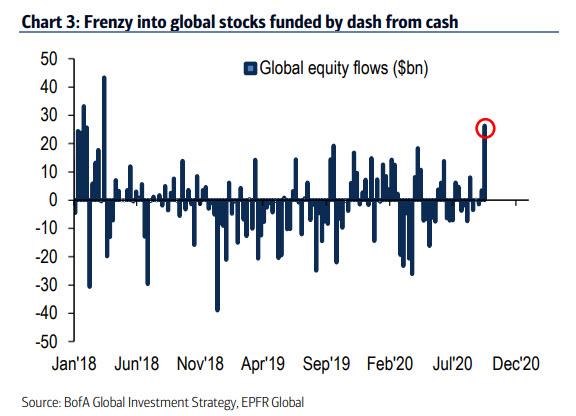
Last Friday we observed that in the week ending Sept 16, which saw $26.3BN of new capital deployed into equities, the largest inflow since March 18…

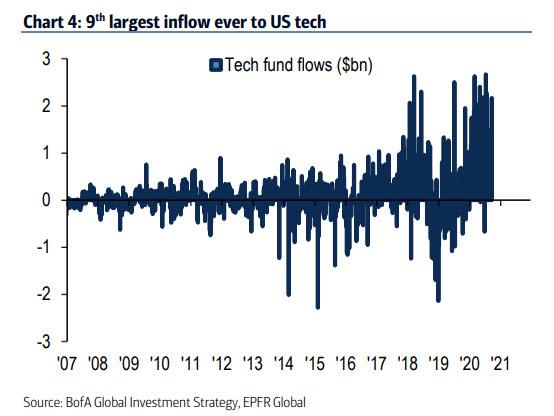
… investors flooded into tech names with the weekly inflow into tech funds the 9th largest on record.

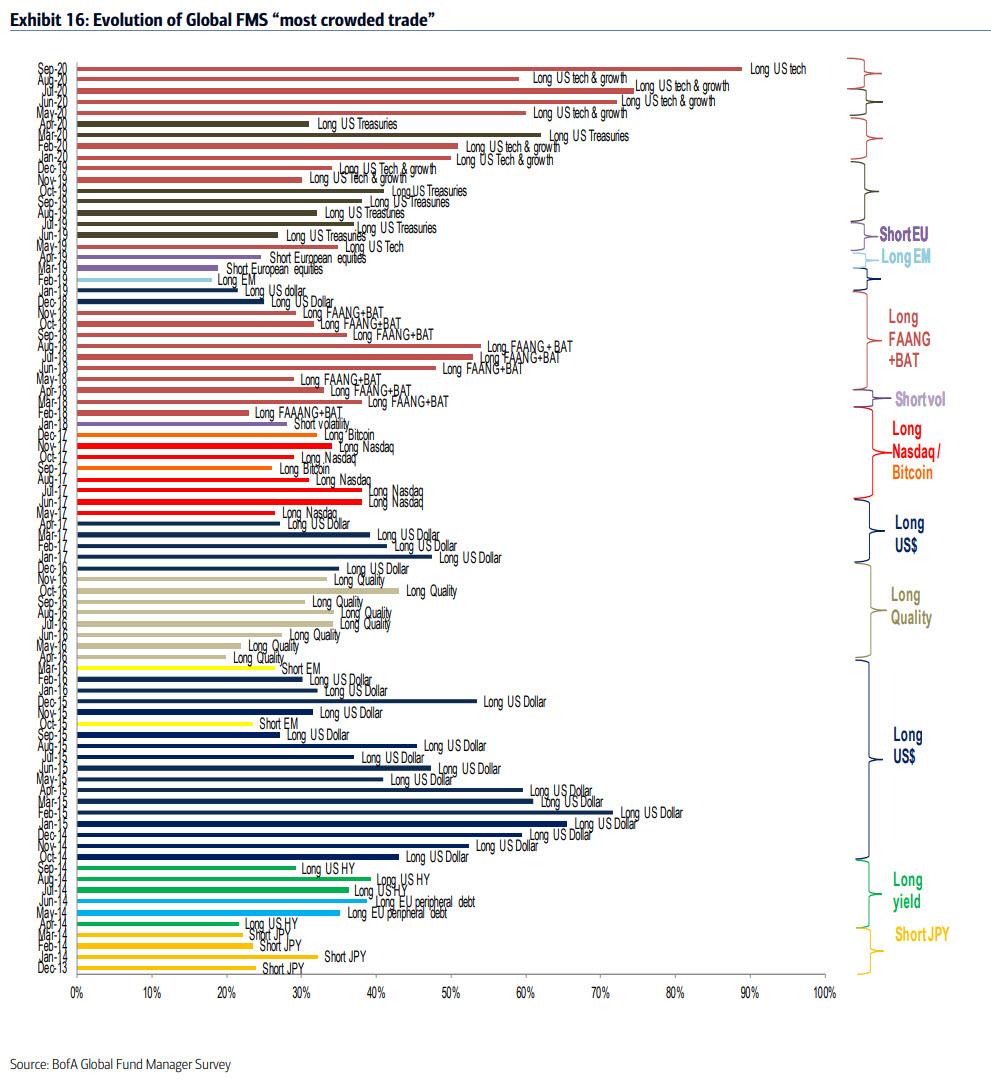
While this may have been sparked by hopes of a BTFD rally following the early September swoon in tech names, we mused that investors are flooding into the very names which according to Wall Street professionals were the “most crowded trade” of all time…

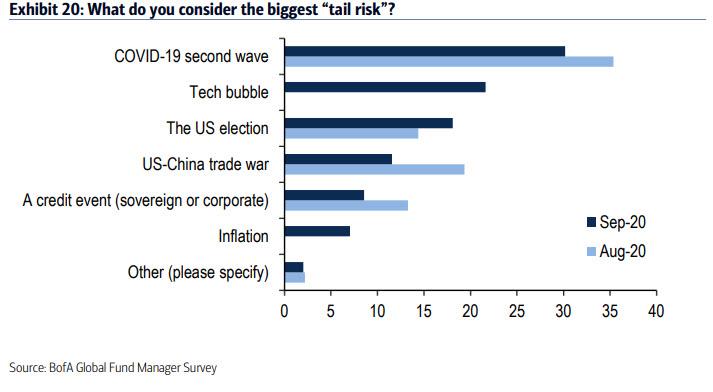
… with fund managers telling BofA in its latest Fund Manager Survey that the “tech bubble” is now the second biggest tail risk for the market after a “second wave” of COVID-19.

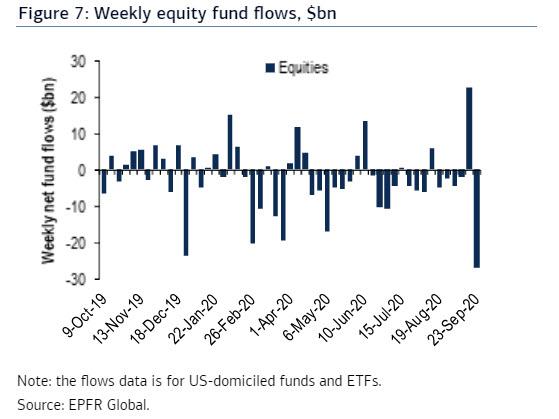
Well, maybe someone read our bemused commentary on the persistently schizophrenic state of the market, or more likely, investors were disappointed by the lack of upward momentum in stocks coupled with the whiplash-inducing surge in volatility, because just one week later, EPFR reported that after last week’s near record inflows, US equity funds and ETFs reported $26.87 BN of outflows, the largest weekly outflow since December 2018 and the third largest outflow ever, more than reversing a $22.67bn inflow one week earlier.

This was the biggest weekly swing in fund flows in history, and shows just how extreme market sentiment has become, and how it can seemingly swing overnight from  euphoria to despair.

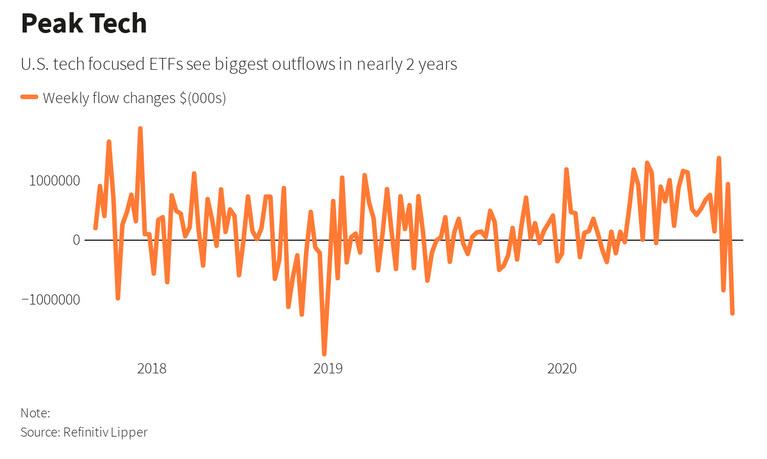
Not surprisingly, tech funds which saw the 9th biggest inflow ever last week were rocked by the biggest redemption since Jun’19, as passive investors – who have been the backbone of the Nasdaq’s rally this year –  seem to have lost their nerve according to Reuters, which added that in the week ending Sept. 23, tech-focused ETFs suffered $1.23 billion worth of outflows, the largest since December 2018, when global stock markets tanked, according to Lipper data. September was also the first month of outflows for the tech sector since the March crash.

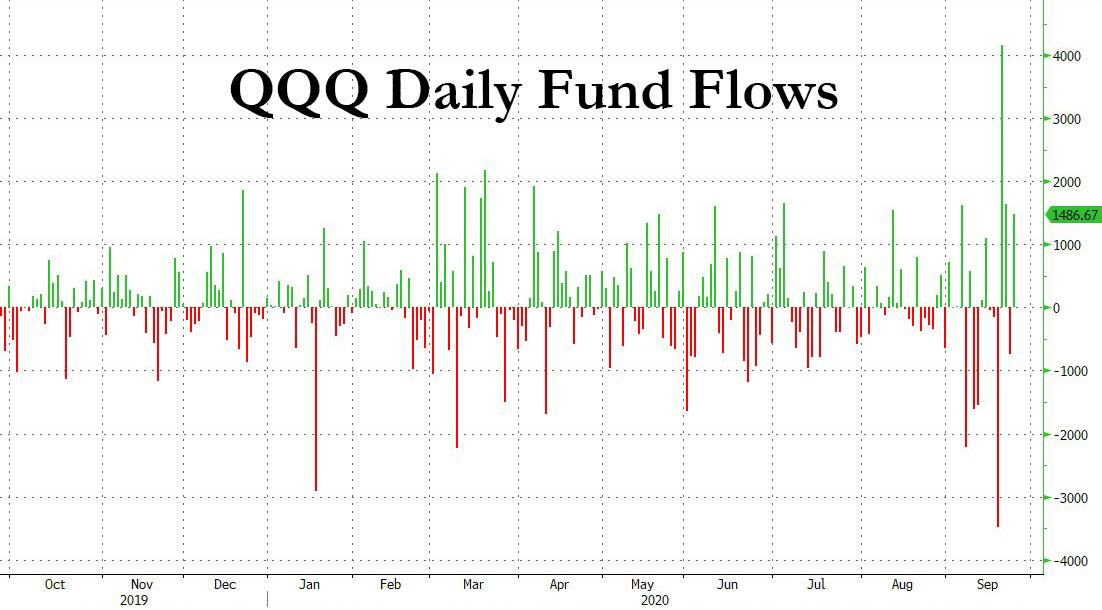
The figures are significant because ETFs such as the QQQ Nasdaq tracker have taken some $20 billion between January and July, however in recent days we have seen some rather massive swings in QQQ flows: for instance, the QQQ fund posted record $3.5 billion outflows on Monday amid a Nasdaq slump, then got $4 billion the following day as sentiment recovered.

“We think the latest pullback in U.S. equities, from frothy levels, is a chance for investors to diversify their allocation to those parts of the equity market so far left behind, which could benefit Europe,” said Maneesh Deshpande, a U.S. equity strategist at Barclays.

According to Saxo Bank’s Peter Garnry, QQQ volatility pointed to “widespread speculation in U.S. technology stocks and that this is increasingly becoming the leading index for sentiment.”

Other ETF service providers also showed outflows. On a three-month rolling basis, the most active ETFs tracking the U.S. technology and growth sectors saw $1.7 billion of outflows, the first negative reading this year, according to Wisdom Tree.

To be sure the reversal is long overdue: for much of the past 6 months, money has poured in to chase the outperformance of technology shares. Total net assets for a group of technology focused ETFS nearly doubled to $113 billion at the end of August from $64 billion a year ago, according to Morningstar data.

The whiplash has been painful: the giga techs are down more than 13% from a September peak and account for nearly half of the S&P 500 decline over that period. Even with that correction, valuations remain in nosebleed territory, near 22 times forward earnings for the S&P 500 index, the highest since the dotcom bubble in early 2000. Multiples of some tech stocks are as high as 100 times forward earnings.

For many, however, this is just another opportunity to buy the dip: Sumant Wahi, a portfolio manager at Fidelity International, said this is just a temporary correction: “I think the market is digesting some of the large flows we have seen in recent weeks and this is a temporary correction. “Big tech is here to stay.”

Sumant is probably correct: with central bank liquidity injections tapering, Congress gridlocked over fiscal stimulus and stocks sliding, it is only a matter of time before the Fed is forced to launch another market bailout.

via ZeroHedge News https://ift.tt/332pVyV Tyler Durden

Ron Paul Appears To Suffer Medical Emergency During Live Show

Ron Paul Appears To Suffer Medical Emergency During Live Show

Tyler Durden

Fri, 09/25/2020 – 13:12

It appears that former Texas Congressman and longtime Libertarian icon Dr. Ron Paul just had a stroke – or some other type of serious medical issue – during a live stream of his “Liberty Report” web series, which garners hundreds of thousands of viewers with every episode.

A flood of tweets wishing Paul well followed the emergence of the footage above on social media.

We have yet to receive any kind of confirmation about the Congressman’s status from the Paul camp. Notably, his son, Rand Paul, is currently serving as the junior Senator from Kentucky.

After the popularity of his 2008 presidential bid, Paul announced in July 2011 that he would forgo seeking another term in Congress to focus on his 2012 bid for the presidency. After performing strongly once again, Paul refused to endorse the Republican nominations of John McCain and Mitt Romney during their respective 2008 and 2012 campaigns, and on May 14, 2012, Paul announced that he would not be competing in any other presidential primaries but that he would still compete for delegates in states where the primary elections had already been held.

Paul’s fervid supporters helped him achieve the second highest tallies for delegates during both the 2008 and 2012 Republican National Conventions, behind only McCain and Romney respectively. In January 2013, Paul retired from Congress, though he continued to speak at colleges and work on his “Liberty Report” program.

via ZeroHedge News https://ift.tt/3cvsM6w Tyler Durden

#RemoveRogan – Spotify Staffers Threaten Strike Unless ‘Hate-Filled’ Podcasts Removed

#RemoveRogan – Spotify Staffers Threaten Strike Unless ‘Hate-Filled’ Podcasts Removed

Tyler Durden

Fri, 09/25/2020 – 12:45

Who could have seen this coming?

Having blown $100 million to lock in infamously-outspoken-and-uncensored podcaster Joe Rogan, Spotify is facing an internal revolt from the woke mob who have demanded broad-based editorial control, censorship, and even removal of the world’s most-popular podcasts… or else!!

Just  three weeks ago, we reported that dozens of Rogan’s past episodes with “controversial guests” like Alex Jones, David Seaman, Owen Benjamin, Stefan Molyneux, Milo Yiannopoulos, Gavin McInnes, Charles C. Johnson, and Sargon of Akkad did not make the migration over to Spotify, according to Entertainment Weekly.

And now, the ‘woke’ are demanding more…

As DigitalMusicNews.com reports, Spotify employees were demanding direct editorial oversight over the recently-acquired Joe Rogan Experience podcast

That would include the ability to directly edit or remove sections of upcoming interviews, or block the uploading of episodes deemed problematic.

The employees also demanded the ability to add trigger warnings, corrections, and references to fact-checked articles on topics discussed by Rogan in the course of his multi-hour discussions.

If they are not granted these ‘ministry of truth’ oversights, the mostly-New-York-based staff have threatened to walkout or strike.

As DigitalMusicNews (DMN) notes, for Spotify, the decision to offer some concessions may have only emboldened demands for wide-scale editorial oversight.

It is worth remembering the words of Joe Rogan himself, who said of the deal in the past:

“They want me to just continue doing it the way I’m doing it right now. It’s just a licensing deal, so Spotify won’t have any creative control over the show. It will be the exact same show. We’re going to be working with the same crew doing the exact same show.”

While the c-suite may want that (and the eyeballs, or earholes?), it seems the outrage mob of employees does not.

Finally, one wonders why exactly Spotify should give a shit… doesn’t America have 20-30 million suddenly unemployed people who we are sure would appreciate the opportunity to work in a large and growing tech company and could manage to leave their political/social-justice-virtue-signaling egos at home.

As DMN notes, Spotify employees reportedly enjoy comfortable salaries in the $120-$130,000 annual range, with considerable perks and benefits.  These are plum jobs in extremely uncertain economic times, making a strike a risky move. It also appears that Spotify management – including CEO Daniel Ek – has a limited tolerance for the mutiny on deck (especially since Rogan’s entire identity revolves around unfiltered discussion and opinion, and audiences could abandon the podcast if it becomes censored or controlled).

via ZeroHedge News https://ift.tt/366f5tF Tyler Durden

World War II memorial cancelled for being too white

Just when you think it couldn’t get more bizarre… we give you this week’s absurdity.

Mural dedicated to WWII Vets cancelled for being too white

70 years ago, a decorated Veteran from World War II painted a mural on the campus of the University of Rhode Island to honor the fallen who lost their lives in the war.

The 95 year old artist is still alive today, to see his artwork being cancelled.

Students complained that the lack of diversity in the mural made them feel uncomfortable. There were too many white people depicted, and not enough minorities.

The university quickly bowed to the mob, covered up the painting, and plans to remove it entirely.

It’s ironic that in 2020, questioning the woke mob is liable to have you labeled a Nazi.

So a man who had the balls to fight the actual Nazis will have his memorial painting destroyed to appease the snowflakes who can’t even look at a painting without an emotional fit.

Click here to read the full story.

Former Marine commits suicide after the mob targets him

A Nebraska bar owner, Jake Gardner, was inside his bar when the windows were shattered by “peaceful protesters.”

Gardner, a former Marine who served in Iraq, went outside to try to diffuse the situation. He saw his father (a man in his 60s) shoved violently to the ground by peaceful protestors. But still, Gardner maintained his composure.

A video then shows that Gardner tried backing away from three men when they attacked him.

Gardner ends up on the ground, with an attacker on top of him. Gardner fired his weapon, and the attacker died.

The county prosecutor reviewed the video evidence and confirmed that Gardner acted properly and in self defense. The video confirms this. And he stated that he would NOT charge Gardner.

But the mob was not willing to accept this outcome. So they surrounded the courthouse and peacefully protested… at which point the Grand Jury caved and decided to charge Gardner with manslaughter.

This sadly appeared to put Gardner over the edge. And he took his own life last week.

Click here to read the full story.

Escaped Prisoner in UK tried to turn himself in seven times

An British inmate incarcerated in the UK recently escaped; apparently he was worried about his mother and wanted to visit her.

But once the visit was over, he was ready to go back to prison and serve out the remainder of his sentence.

So he went down to the local police station to turn himself in. But they refused to arrest him. It appeared there was no outstanding warrant for his arrest.

It took SEVEN tries before this escaped convict was able to successfully turn himself in to police.

Perhaps the cops were too busy trying to catch people illegally watching TV without a license (seriously, that’s a thing in the UK).

Click here to read the full story.

Election supervisor investigates a toilet

A homeowner in Michigan put a toilet on his front lawn, along with a sign that says “place mail-in ballots here.”

For anyone familiar with the debate about whether mail-in ballots increase voter fraud, the display is an obvious joke.

However the local election supervisor thinks it’s a crime, so she called the police to investigate.

She said, “It is a felony to take illegal possession of an absentee ballot… Elections in this country are to be taken seriously and there are many people who are voting by mail for the first time this election.”

Such sensitive little authoritarians…

Let’s hope that any eligible voter would not mistake the front yard toilet for an actual official ballot depository.

And if that’s the level of intelligence among voters, we have bigger problems to worry about.

Click here to read the full story.

New Jersey Doubles Down on Chasing the Rich Away

About 4 years ago, billionaire David Tepper left New Jersey and moved to Florida.

New Jersey instantly lost hundreds of millions of dollars every year in tax revenue just from this one guy.

But it wasn’t only Tepper fleeing New Jersey’s 8.97% income tax rate. In 2018, for example, New Jersey lost 5,700 millionaires.

Not coincidentally, 2018 was the same year that New Jersey hiked it’s income tax rate to 10.75% for those earning more than $5 million.

And now, with a massive government budget shortfall thanks to COVID shutdowns, New Jersey will double down on its bad idea.

They didn’t learn their lesson in 2018… so now the state will increase its tax rate to 10.75% for everyone earning more than $1 million per year.

Click here to read the full story.

Tased and arrested for not wearing a mask

An Ohio mother sat with her family in the stands at her son’s middle school football game.

They were outside, and a good 15 feet from any other fan.

But the school resource officer confronted the woman, and asked her to put a mask on.

She refused, citing asthma. She wasn’t sitting near anyone and was properly distanced, so she clearly posed no threat.

That really should have been the end of it. But instead the woman ended up being tased and forcibly removed from the stands.

Ironically the police officer had his mask hanging around his neck the whole time (instead of covering his nose and mouth), and another officer who also responded wasn’t wearing a mask at all.

In the end, it doesn’t even appear that the school’s mask mandate was legally enforceable. So they charged the mom with ‘trespassing’… at her son’s football game.

Click here to read the full story.

Source

from Sovereign Man https://ift.tt/3i1cvYg
via IFTTT