Civil libertarians on both sides of the aisle and in both chambers of Congress have joined forces to call for canceling a little-known executive power.
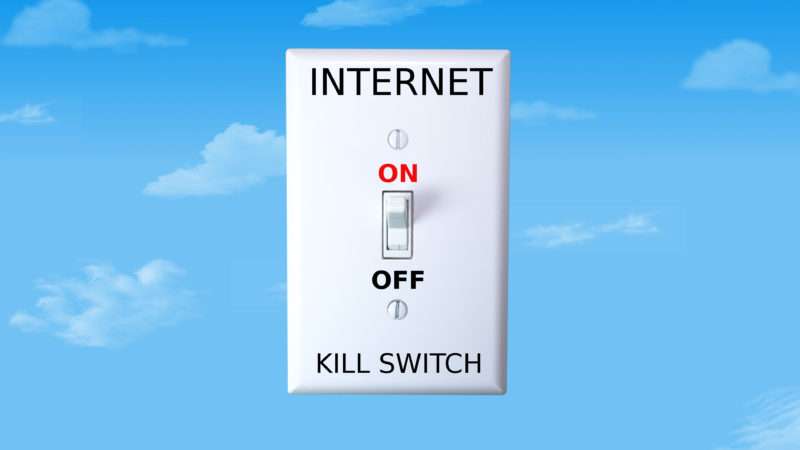
Sens. Rand Paul (R–Ky.), Ron Wyden (D–Ore), and Gary Peters (D–Mich.), along with Reps. Tulsi Gabbard (D–Hawaii) and Thomas Massie (R–Ky.), introduced bills this week to abolish the so-called “internet kill switch”—a sweeping emergency executive authority over communications technology that predates World War II.
“No president from either party should have the sole power to shut down or take control of the internet or any other of our communication channels during an emergency,” Paul argued in a statement announcing the Unplug the Internet Kill Switch Act.
The bill aims to revoke Section 706 of the Communications Act of 1934. When that law was passed, there was no internet. But the broad language included in Section 706 means that it could be invoked today to give a president “nearly unchallenged authority to restrict access to the internet, conduct email surveillance, control computer systems, and cell phones,” Gabbard explained in her statement on the bill.
It’s even worse than that. As Michael Socolow wrote in Reason last year, the law is so broad that it effectively gives the president the ability to commandeer any electronic device that emits radiofrequency transmissions. These days, Socolow noted, that includes “everything from your implanted heart device to the blow dryer for your hair. It includes your electric exercise equipment, any smart device (such as a digital washing machine), and your laptop—basically everything in your house that has electricity running through it.”
Like many presidents before him, Trump seems willing to use whatever powers Congress has foolishly granted to the executive branch to the fullest extent. Congress should claw back what it can.
“With so many Americans relying on the internet to do everything from online banking to telehealth to education, it’s essential that federal law reflect today’s digital world, not the analog world of World War II,” Carl Szabo, general counsel for NetChoice, a nonprofit that advocates for a free and open internet, tells Reason.
How much the federal government could actually do to shut down the internet remains a subject of debate. The very nature of the net—a diffuse network of interconnected computers and servers—makes it virtually impossible for the government to flip a literal on/off switch or push a stereotypical big red button to cut off all Americans.
But the Department of Homeland Security does have protocols for shutting down wireless networks during an emergency, which the agency argues could be used to stop a terrorist from detonating a remote bomb. Given that authoritarian leaders in other countries have shut down wide swaths of internet access during periods of unrest, it’s not unfathomable that something similar could happen here.
“When governments around the world turn off internet access, they do significant harm to their national economies and their citizens’ civil rights,” Massie noted in a statement.
In the midst of an election season in which partisan lines have grown more rigid than ever and when neither major political party seems all that interested in pro-freedom policies, this team-up of libertarian-friendly lawmakers is a little heartwarming. Gabbard, Massie, Paul, and Wyden may not find many allies in Congress on this issue—and, indeed, they don’t always agree with one another—but this is one of those issues that might not seem to matter much until suddenly it really does. It’s better not to wait for that moment.
“The internet,” Wyden declared in a statement, “is far too essential to nearly every part of our democratic system—everything from work, to school and free speech—for any president to have unilateral power to turn it off.”
from Latest – Reason.com https://ift.tt/3mQzn0b
via IFTTT
Over the past few months, I’ve been writing a lot about Event-Driven strategies, mainly because I see an unusual amount of opportunity there. That said, Event-Driven remains a small piece of my book. The core of what I do is inflection investing—finding a theme that’s inflecting better and get there before anyone else realizes it.
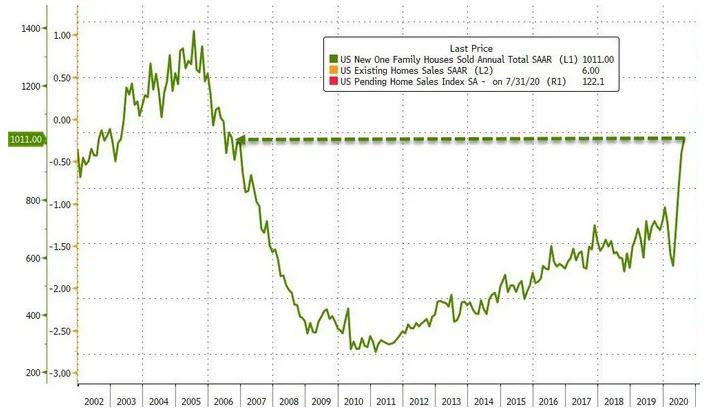
With that preamble out of the way, today the government announced that seasonally adjusted new home sales for August hit 1.011 million. For those keeping score at home, this is the highest that this figure has been since 2006 and up 43% from last year.
Of course, that figure is backwards looking. Fortunately, two prominent home builders announced results this week giving us some added color on future trends. I’ll let them tell the story;
Beazer Homes (BZH – USA) today announced that, based on preliminary operating results, net new orders for the first two months of its fiscal fourth quarter were up 37% year-over-year with a 26% increase in July and a 48% increase in August. This performance was primarily related to a higher pace, as sales per community per month rose to 4.4 from 3.0 in the previous year.
Meanwhile at KB Home (KBH – USA)
“Housing market conditions strengthened during the third quarter, fueled by the combination of historically low mortgage interest rates, a limited supply of resale inventory and consumers’ desire to own a single-family home,” continued Mezger. “Reflecting this strength, our net orders expanded 27% year over year, with growth in each of our four regions. We achieved a monthly absorption pace that accelerated to 5.9 orders per community, an increase of 36%, while we also increased prices in most of our communities. We believe that our Built-to-Order model is a key factor driving our sales pace, with this quarter’s results underscoring the robust demand for the choice and personalization we offer to our homebuyers….”
Net orders for the quarter grew 27% to 4,214, the Company’s highest third-quarter level since 2005 (my bolding), with net order value increasing by $367.5 million, or 29%, to $1.64 billion. Both net orders and net order value increased in all of the Company’s four regions.
The Company’s net order growth accelerated during the quarter, with monthly net orders up 11% in June, 23% in July and 50% in August. The Company’s cancellation rate as a percentage of gross orders for the quarter improved to 17% from 20%.
Company-wide, net orders per community averaged 5.9 per month, compared to 4.3.
I hope you get the point; things in housing are good and getting better. When it comes to inflection investing, if you cannot answer the “why,” you’re just a slave to monthly data. With that in mind, what’s driving sales growth? I think it is the confluence of many trends, from generationally low interest rates and affordability pressures in cities, to a decade of below-trend housing construction caused by Millennials postponing family creation until now. However, you could have said the same thing a few years ago and not made money. The real catalyst is the sudden panic migration from cities.
Remember when cities were awesome back in January?? They were full of great food and bars—all your friends were around and there was always something interesting going on. Then COVID hit and the restaurants closed down and they won’t allow you into the bars. A 600-foot studio apartment is fine if you never spend any time there. If there’s nowhere else to go, a studio feels like a prison. Even worse, everyone is now doing some version of Work From Home (WFH), so those four walls are all you see each day. Suddenly, a home sounds attractive. However, in my mind the real catalyst isn’t COVID, it’s the riots.
I don’t know why Democrats think that burning their cities is going to bring about social justice, but lots of things suddenly make little sense to me. Rather than go into politics, it’s useful to remember that increased crime, arson and tear-gas don’t make things enjoyable in a city—especially when your rent is eating up most of your paycheck. As a result, there’s been a massive flight from cities by those who can afford to leave. As these macro and social trends converge, there’s been a huge increase in demand for single family and multi-family property in the suburbs and exurbs—particularly in more affordable parts of the country.
As many of us have learned, homebuilding is a mediocre business at best. Instead, I’m playing this trend through the suppliers to single-family and multi-family homebuilders. These suppliers have had dramatic consolidation during the decade-long bear market in housing and as a result have some pricing power in what should be a commodity industry.
Let’s look at Cornerstone Building Brands (CNR – USA). CNR is one of the largest US players in multiple verticals including; vinyl windows, doors, siding, trim, gutters, shutters, stone façade and plenty of others—essentially the components of a home. While they also have a commercial business that has been suffering a bit lately, warehouses and medical have been white hot.
Normally, I’d think of these component manufacturers as mediocre sorts of businesses, but when you run the numbers, over the past year, CNR has earned a low-20% adjusted return on tangible assets. Assuming that they can achieve the planned merger synergies (CNR is a roll-up of various businesses), the return would likely be in the mid-20% (indicative of an unusually good business). Now, if I’m right about the macro and both revenue and margins increase, why couldn’t they earn around 30% on tangible capital. Throw a few turns of debt on that and you’re earning pretty stunning returns on equity for many years into the future, as I tend to think this trend towards the suburbs has multi-year legs.
Of course, inflection investing is all about the price you pay in order to see the upside. In this case, the company had $215 million of free cash flow to equity over the past 12 months and that includes two weak quarters with COVID—not so bad when you consider that the market cap is around $900 million—though the valuation is much more stretched on an enterprise value basis.
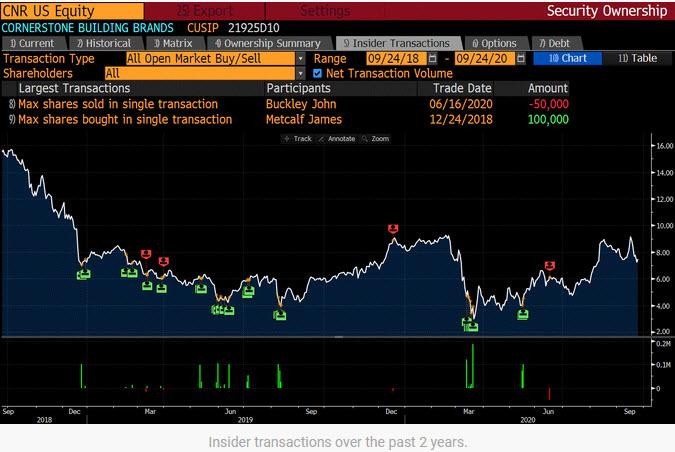
When I look at inflections, I often gravitate towards the more financially and operationally leveraged players once it is clear that the inflection is happening. While you take on more risk if you get it wrong, you also take on a whole lot more upside. With that in mind, CNR has a lot of debt, some may even say it has too much debt—a legacy of multiple acquisitions. As a result, the risks are elevated here. Then again, a quick look at insider buying (they’ve bought millions worth of stock when a lot less was going right), ought to tell you that when they talk about de-leveraging, they’re probably serious about it.
I had planned to write about CNR and a few others earlier this summer—then they all ran like they stole something and I chose to hold off saying anything. With the recent pullback into the low-$7s, I’ve added to my already chunky exposure and figured I might as well flag it for those who care—especially as housing is my largest sector exposure.
Caveat Emptor
via ZeroHedge News https://ift.tt/3hXNf52 Tyler Durden
Citadel Now Controls 41% Of All Retail Trading… And Is Making A Killing In The Process Tyler Durden
Fri, 09/25/2020 – 12:05
The last time we heard from Citadel was two weeks ago when, in the aftermath of the furious “gamma meltup” reversal, investors and regulators starting asking pointed questions about who was behind all this option frenzy. It was then that David Silber, the head of institutional equity derivatives at Citadel Securities decided to preemptively come to the defense of option-heavy market-makers, such as Citadel, and told Bloomberg to stop blaming options for the recent market drop.
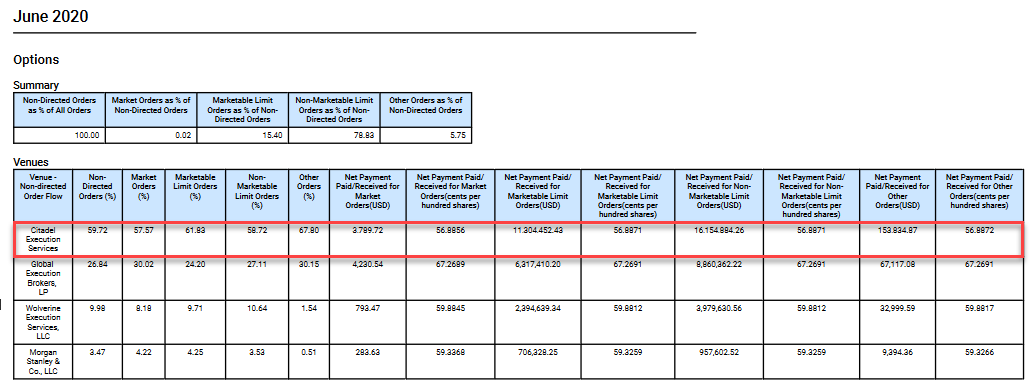
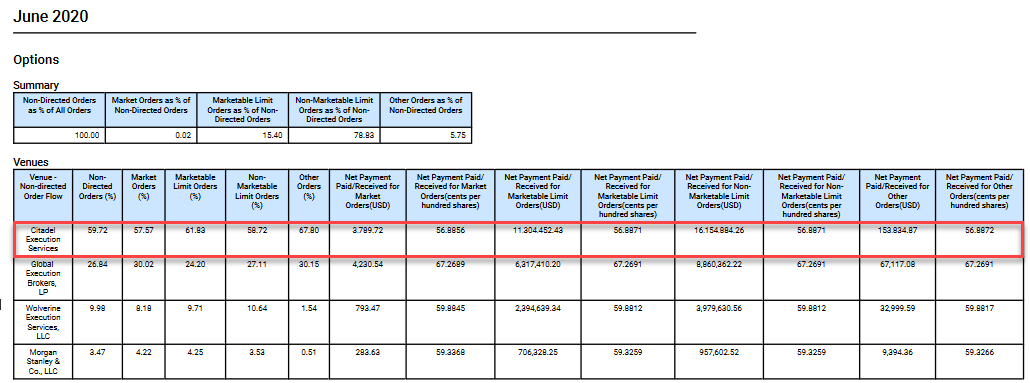
Going a little further back to July, we reported that Citadel Securities – one of the world’s biggest market-makers – had just been find by industry regulator FINRA (the whopping sum of $700,000) for frontrunning of at least 559 client orders while masking “hundreds of thousands” of orders from its pre-trade control logic. This happened at a time when Citadel emerged as the biggest Robinhood client, paying hundreds of millions to route retail investor orderflow (something that we first reported in 2018 in “Robinhood Is Said To Get 40% Revenue From HFT Firms Like Citadel ) in both stocks and options, as the latest Robinhood 606 reveals:
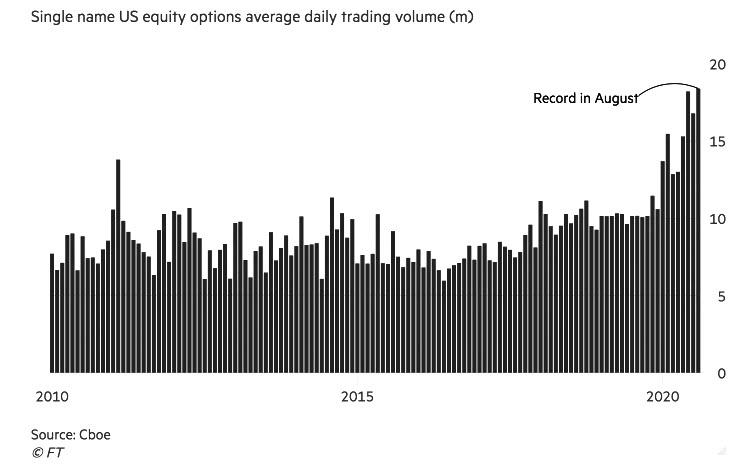
Needless to say, whether with or without frontrunning orderflow, Citadel hit the jackpot because in the past few months, option trading – mostly by retail accounts – has exploded with traded volumes doubling over the past year and hitting a record 18.4 million in August according to the CBOE.
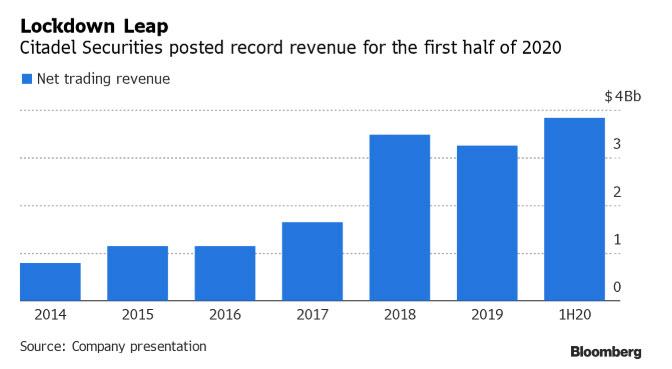
As a result of some combination of the facts above, coupled with Citadel Securities’ unprecedented domination of US equity markets, the Chicago based market-maker has made an absolute killing and as Bloomberg reports, Citadel’s trading operation, which is separate from Griffin’s hedge fund business, generated $3.84 billion of revenue in just six months, more than the $3.26 billion for all of 2019. Net income was $2.36 billion in the first six months of 2020, more than double the $982 million for the same period a year earlier.
The numbers were revealed, ironically enough, in a presentation to Citadel investors which is seeking a $300 million loan (it appears Citadel’s massive organic cash flow is not enough for whatever Citadel owner Ken Griffin has planned next).
To be sure, it’s not just “benefitting” from the historic retail option trading frenzy that led to this revenue bonanza: while most of its competitors were scrambling to figure out continuity plans in March when institutional trading on Wall Street was effectively frozen, Citadel Securities abandoned its Chicago and New York offices and set up shop at the Four Seasons Palm Beach, moving dozens of employees and their families as Bloomberg reported at the time, while others went to an emergency facility in Connecticut in moves designed to keep his market-making firm operating seamlessly as the rest of the financial world dealt with wild swings and extraordinary trading volumes from makeshift home offices.
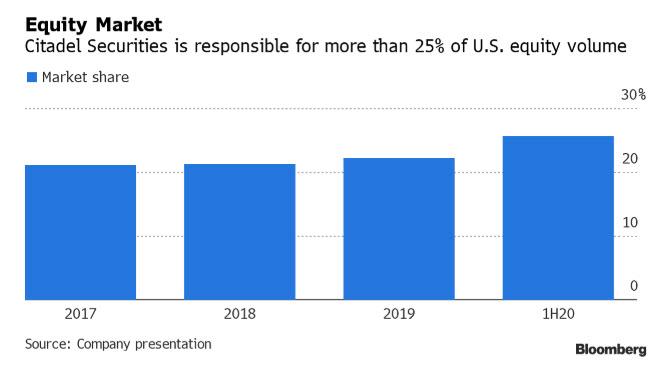
The efforts clearly paid off, and Citadel Securities has now become a behemoth of unprecedented proportions, with Bloomberg reporting that it now handles more than a quarter of all U.S. equity volume in the first half of the year.
One wonders if there is a magic number of market dominance that will prompt the FTC and/or DOJ, which are busy pursuing Google and Facebook for antitrust, to take a look at Citadel Securities’ creeping monopolization of the entire US equity market.
If there is, it clearly has not been reached, and meanwhile Citadel Securities, led by CEO Peng Zhao, has continued to increase its market share, and in the U.S. options market, it climbed to 32% from 27%. In the three months through August, 28% of U.S. equity volume went through Citadel, up from 22% in 2019.
That’s right: one-in-four stock trade and one-in-three option trades taking place now effectively goes through the Citadel pipe. Meanwhile, in the retail market, Citadel dominates with an mindblowing 41% of the marketshare! And now you know why been paying so generously to dominate Robinhood’s orderflow.
As a result of this creeping monopolization, Citadel’s owner is about to get even richer. Ken Griffin owns 85% of the securities business and has a $15.3 billion fortune, according to estimates by the Bloomberg Billionaires Index.
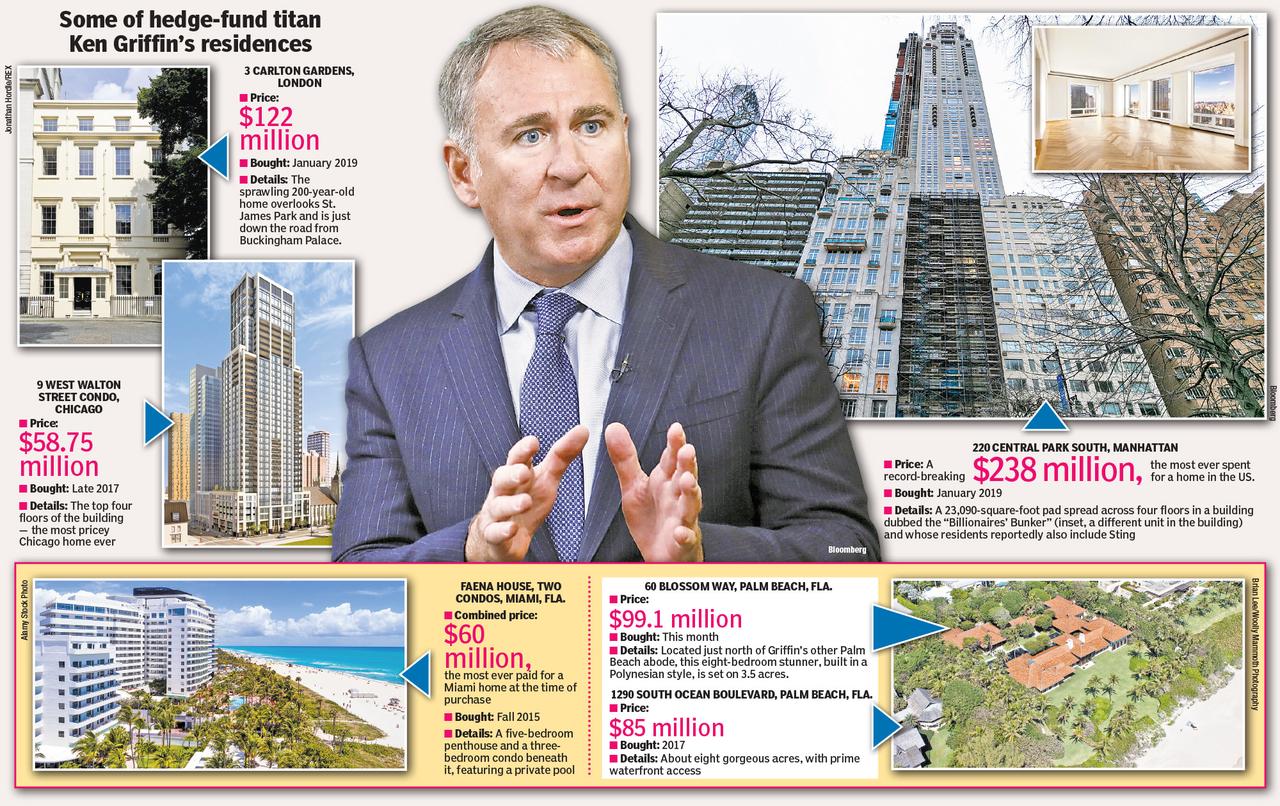
Bottom line: having already purchased the trophy properties many of the world’s most desirable cities, Ken Griffin will soon be in the market for even more homes…
… showing the Robinhooders – with their get rich quick dreams and whose furious daytrading makes Griffen richer by the day – what to do if they too miraculous somehow strike it rich one day.
via ZeroHedge News https://ift.tt/3cujNTb Tyler Durden
“As everyone knows, I made it clear that my first choice for the Supreme Court will make history as the first African American woman justice.”
So Joe Biden promised. Since the death of Justice Ruth Bader Ginsburg, however, Biden has refused to produce a list of Black female judges and scholars whom he would consider for the now-vacant seat.
What is his problem?
Donald Trump had no such reluctance. In 2016, he listed a slew of candidates from among whom he promised to pick his justices. True to his word, Trump elevated federal appellate court judges Neil Gorsuch and Brett Kavanaugh.
Since the Kavanaugh confirmation, Judge Amy Coney Barrett has been openly discussed as a potential Trump choice to succeed liberal icon Ginsburg. Why is Biden so reluctant to reveal some highly qualified Black female judges? His refusal suggests that the kind of high court judges that America wants is not the liberals’ issue. It is Trump’s issue.
The president will announce his choice Saturday, after the mourning period for Ginsburg is over. Mitch McConnell’s Senate is expected to confirm the new justice in late October.
With the court’s ideological balance at stake, the battle from now to Nov. 3 is thus for all the marbles: control of the House, the Senate, the presidency and the U.S. Supreme Court.
Rarely has there been an election in which the stakes were so high, the ideological gulf so great and the outcome in such doubt.
The polls show Biden ahead, but Democrats are visibly nervous. Of greatest concern — the possibility that, Tuesday night, Biden, in the first debate, with his verbal and mental lapses occurring frequently now, could kick it all away in front of millions of voters.
On the court issue, Democrats are exhibiting something akin to panic. They are warning that if a conservative jurist like Barrett is confirmed, Democrats may retaliate by “packing” the Supreme Court — increasing the number of justices from nine to 11 and installing two new liberals — if they win the presidency and Senate.
If a Scalia constitutionalist is nominated and confirmed this year, says Sen. Chuck Schumer, “nothing is off the table next year.”
Other Democrats are threatening to pack the Senate by granting statehood to D.C. and Puerto Rico. This would add four new Democratic Senators and formally convert the United States into a bilingual nation.
Nancy Pelosi has threatened a new impeachment of the president if he appoints a new justice to fill Ginsburg’s seat. Yet, this is what Article II of the Constitution directs Trump to do.
Activists are talking about “burning down” the system, and given what we have witnessed in Portland, Seattle, Minneapolis and Louisville, the BLM crowd and its media camp followers should be taken seriously.
Should Democrats win the Senate and White House, they will face one obstacle to imposing the Biden-Bernie-Socialist-AOC agenda on the nation. Only the filibuster, the ability of a Senate minority, through extended debate, to delay, and occasionally frustrate, the will of the majority, would stand in the way of their turning their radical agenda into law, as LBJ did with his massive majorities in 1965.
This is no idle threat. Even Barack Obama is calling for abolition of the filibuster, stripping a Republican Senate minority of its last weapon of resistance in the world’s greatest deliberative body.
Another danger facing the GOP is its demographic demise if it fails to control immigration.
Currently, white folks, who produce the vast majority of GOP votes, are 60% of the nation. The Black population is 12-13%, Hispanics 18%, Asian Americans 7%.
The GOP demographic crisis: The white population is steadily diminishing as a share of the electorate. Hispanics and Asians, who vote 2-1 Democratic in presidential elections, are the fastest-growing minorities and are being fed by the largest streams of migration.
A few years hence, the GOP will face the fate it failed to avert in California. Once the Golden State was Nixon and Reagan country, as those two Republicans carried California on all seven presidential tickets on which they ran from 1952 to 1984.
Moreover, former red states such as Florida, Georgia, North Carolina and Arizona are now swing states, and Texas is trending that way.
Democrats, too, have a white folks problem.
At the party’s apex are Speaker Pelosi and Majority Whip Steny Hoyer, both octogenarian white folks. Senate Minority leader Schumer and Minority Whip Dick Durbin are white septuagenarians.
Presidential nominee Joe Biden is a 77-year-old white man who would be older than our oldest president, Ronald Reagan, was the day he left office.
The last white man appointed to the Supreme Court by a Democratic president was Stephen Breyer back in 1994. At 82, he is now the oldest justice serving.
The days of white liberals dominating the rising party of America’s people of color may be over this decade.
via ZeroHedge News https://ift.tt/330JTtF Tyler Durden
Fire Breaks Out At Huawei’s 5G Antenna Research Lab Tyler Durden
Fri, 09/25/2020 – 11:35
As the seemingly never-ending squabbling over TikTok’s deal with Oracle and Walmart drags on, the Trump administration’s battle with tech giant Huawei Technologies has seemingly taken a backseat over the last couple of weeks to this newest distraction.
But in a shocking new developing, a Huawei research lab in Dongguan caught fire on Friday, according to Reuters and local Chinese press.
The Chinese state-controlled Global Times confirmed reports of the fire but assured the public that nobody was injured.
“The lab in the city’s Songshan Lake area is a steel structure and the main material burning is sound-absorbing cotton,” Dongguan city fire-rescue department said in a statement.
The lab is allegedly the site for where the tech giant conducts testing for 4G and 5G antennas related to Huawei’s base station business, sources told Reuters.
The Global Times noted the building was under construction at the time of the blaze. Videos from social media show thick black smoke pouring from the research lab.
NBC’s Janis Mackey Frayer tweeted a picture of the blaze.
“There are images on Chinese social media of a big fire at Huawei’s Dongguan campus near Shenzhen. More to come…,” Frayer tweeted.
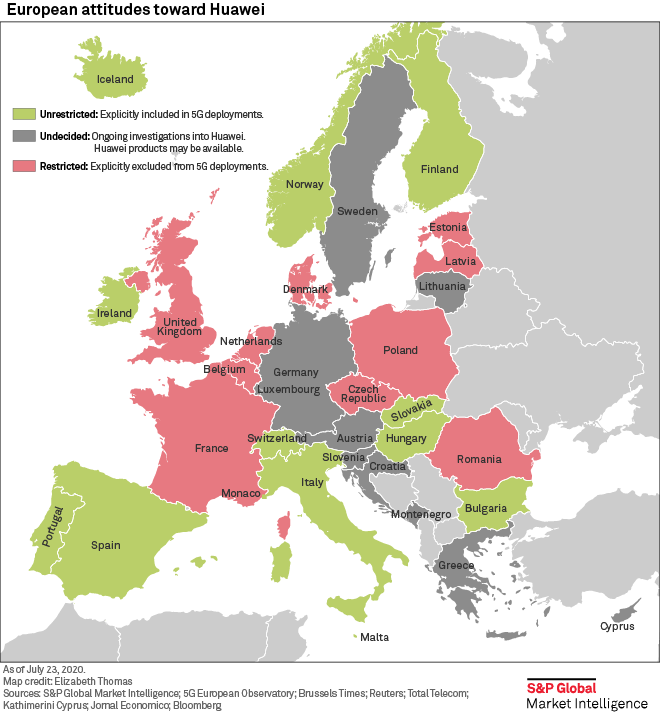
The fire comes at a critical time for Huawei, as it has continued to supply components for 5G infrastructure to many European nations, much to the Trump Administration’s chagrin.
As for the cause of the fire, right now it’s unclear. But we’re certainly curious to learn more.
via ZeroHedge News https://ift.tt/3kNOMwu Tyler Durden
Civil libertarians on both sides of the aisle and in both chambers of Congress have joined forces to call for canceling a little-known executive power.
Sens. Rand Paul (R–Ky.), Ron Wyden (D–Ore), and Gary Peters (D–Mich.), along with Reps. Tulsi Gabbard (D–Hawaii) and Thomas Massie (R–Ky.), introduced bills this week to abolish the so-called “internet kill switch”—a sweeping emergency executive authority over communications technology that predates World War II.
“No president from either party should have the sole power to shut down or take control of the internet or any other of our communication channels during an emergency,” Paul argued in a statement announcing the Unplug the Internet Kill Switch Act.
The bill aims to revoke Section 706 of the Communications Act of 1934. When that law was passed, there was no internet. But the broad language included in Section 706 means that it could be invoked today to give a president “nearly unchallenged authority to restrict access to the internet, conduct email surveillance, control computer systems, and cell phones,” Gabbard explained in her statement on the bill.
It’s even worse than that. As Michael Socolow wrote in Reason last year, the law is so broad that it effectively gives the president the ability to commandeer any electronic device that emits radiofrequency transmissions. These days, Socolow noted, that includes “everything from your implanted heart device to the blow dryer for your hair. It includes your electric exercise equipment, any smart device (such as a digital washing machine), and your laptop—basically everything in your house that has electricity running through it.”
Like many presidents before him, Trump seems willing to use whatever powers Congress has foolishly granted to the executive branch to the fullest extent. Congress should claw back what it can.
“With so many Americans relying on the internet to do everything from online banking to telehealth to education, it’s essential that federal law reflect today’s digital world, not the analog world of World War II,” Carl Szabo, general counsel for NetChoice, a nonprofit that advocates for a free and open internet, tells Reason.
How much the federal government could actually do to shut down the internet remains a subject of debate. The very nature of the net—a diffuse network of interconnected computers and servers—makes it virtually impossible for the government to flip a literal on/off switch or push a stereotypical big red button to cut off all Americans.
But the Department of Homeland Security does have protocols for shutting down wireless networks during an emergency, which the agency argues could be used to stop a terrorist from detonating a remote bomb. Given that authoritarian leaders in other countries have shut down wide swaths of internet access during periods of unrest, it’s not unfathomable that something similar could happen here.
“When governments around the world turn off internet access, they do significant harm to their national economies and their citizens’ civil rights,” Massie noted in a statement.
In the midst of an election season in which partisan lines have grown more rigid than ever and when neither major political party seems all that interested in pro-freedom policies, this team-up of libertarian-friendly lawmakers is a little heartwarming. Gabbard, Massie, Paul, and Wyden may not find many allies in Congress on this issue—and, indeed, they don’t always agree with one another—but this is one of those issues that might not seem to matter much until suddenly it really does. It’s better not to wait for that moment.
“The internet,” Wyden declared in a statement, “is far too essential to nearly every part of our democratic system—everything from work, to school and free speech—for any president to have unilateral power to turn it off.”
from Latest – Reason.com https://ift.tt/3mQzn0b
via IFTTT
This week, Britain’s government imposed new pandemic restrictions, threatening a second full-scale lockdown if people don’t comply. Israel is already in the midst of renewed strictures on schools, “non-essential” businesses, and other gatherings. Some American officials, too, favor reviving harsh stay-at-home orders in an effort to slow the spread of COVID-19.
Standing in their way is public fatigue with mandated disruptions to life. That rebellious spirit may simultaneously give governments the excuses they seek to impose restrictions while guaranteeing that lockdowns will be vastly less effective than voluntary measures.
In the U.K., where the rules now ban meetings of more than six people from different households, Prime Minister Boris Johnson warned: “If people don’t follow the rules we have set out, then we must reserve the right to go further.”
That he’ll likely have all the excuse he could want “to go further” is clear from Johnson’s own finger-wagging as well as from expert commentary.
“People won’t have the same level of buy-in because of the sense of unfairness that has been built up,” behavioral psychologist Nilu Ahmed told the U.K.’s Metro. “There’s only so much the police can do and it relies on trust and people singing from the same hymn sheet. There was a very definite shift when people in authority were seen as not following the rules.”
That echoes advice the British government received directly from its own Scientific Advisory Group for Emergencies (SAGE). Renewed restrictions are likely to be met by “silent compliance, critical compliance or visible resistance,” the group cautioned in June. “There has been an increase in resistance to social distancing measures in recent weeks,” SAGE added, with COVID concerns competing with other priorities for people’s attention.
Israel’s government received similar warnings when it imposed a new lockdown last week. “A lockdown will kill those businesses who have only just recovered,” insisted opposition leader Yair Lapid. “I’m against civil disobedience but the public won’t obey the rules. For five months the government has driven them crazy.”
So far, most jurisdictions in the United States have resisted urgings to further limit gatherings and close businesses as part of the effort to slow coronavirus spread. Many places—including California and Texas—have been loosening rules rather than tightening them.
But that trend is bucked elsewhere. Utah imposed new restrictions in Provo and Orem, two cities with rising caseloads. Almost simultaneously, Wisconsin’s governor declared a new health emergency and ordered state residents to wear masks in public.
Some officials openly support renewed restrictions, despite an obvious lack of public patience for them.
“We’re looking at 40,000 new cases per day. That’s unacceptable,” Anthony Fauci, director of the National Institute of Allergy and Infectious Diseases, commented this week.
Fauci objected earlier this month to loosened controls on indoor activities and warned that life won’t return to normal until “towards the end of 2021.”
Likewise, Democratic presidential candidate Joe Biden wants a national mask mandate. “The question is whether I have the legal authority or not,” he concedes. “I think I do. If I did, I would” issue an order.
Even before reported cases of COVID-19 ticked up recently (deaths attributed to the disease remain flat), Neel Kashkari, president of the Federal Reserve Bank of Minneapolis, joined with Michael T. Osterholm, director of the Center for Infectious Disease Research and Policy at the University of Minnesota, to demand a lockdown for the whole country.
“We should mandate sheltering in place for everyone but the truly essential workers. By that, we mean people must stay at home and leave only for essential reasons: food shopping and visits to doctors and pharmacies while wearing masks and washing hands frequently,” they argue.
That doesn’t mean that Americans are doomed to a repeat of the wave of restrictions that plagued our lives in March and April, let alone something worse imposed from coast-to-coast. Many European countries are fighting a second wave of COVID-19 with measures that (so far) don’t approach the nearly full suspension of life they suffered in the spring.
“European governments and citizens want to avoid returning to the full-blown lockdowns of early 2020, including widespread business closures and stay-at-home orders, which broke the pandemic’s first wave but also froze European economies,” the Wall Street Journalnotes.
The U.S. suffered similar economic injuries from policies intended to limit the spread of infection, from which we’ll be recovering for years to come. Those policies were met with mass protests and growing defiance. The prospect of more such pain will evoke reactions that are bound to dwarf earlier resistance.
But there’s an alternative that doesn’t just let the pandemic run wild. Officialdom could do something that doesn’t come naturally: give people information and let them make their own decisions.
In a study published September 22, researchers from Louisiana State University (LSU) analyzed cellphone data to study the how and why of pandemic social distancing. What they found has important implications for health policy going forward.
“Social distancing in the U.S. during the Covid-19 pandemic was initially voluntary rather than a response to governmental jurisdictional restrictions,” LSU reports of the study’s findings. “The analysis suggests that stay-at-home behavior increased by over nine times from late January through late March, and then decreased by about 50% through mid-June. Findings indicate that demographic factors drove these changes to a substantially greater degree, signifying the importance of individual behavior in social distancing (either due to voluntary distancing or to differential compliance with mandated distancing).”
“An important implication of these outcomes is that encouraging voluntary distancing could be an effective and lower-cost alternative to governmental restrictions. Such encouragement could boost acceptance of restrictions and thus increased compliance with distancing rules, resulting in an even greater degree of distancing,” LSU adds.
Imagine that. People can take steps on their own to reduce health risks in the absence of compulsion and can do so without drama and conflict. Since we’re perfectly capable of protecting ourselves and our neighbors from infection, it’s time for government officials to back off their lockdown fantasies.
from Latest – Reason.com https://ift.tt/3mUaHE7
via IFTTT
This week, Britain’s government imposed new pandemic restrictions, threatening a second full-scale lockdown if people don’t comply. Israel is already in the midst of renewed strictures on schools, “non-essential” businesses, and other gatherings. Some American officials, too, favor reviving harsh stay-at-home orders in an effort to slow the spread of COVID-19.
Standing in their way is public fatigue with mandated disruptions to life. That rebellious spirit may simultaneously give governments the excuses they seek to impose restrictions while guaranteeing that lockdowns will be vastly less effective than voluntary measures.
In the U.K., where the rules now ban meetings of more than six people from different households, Prime Minister Boris Johnson warned: “If people don’t follow the rules we have set out, then we must reserve the right to go further.”
That he’ll likely have all the excuse he could want “to go further” is clear from Johnson’s own finger-wagging as well as from expert commentary.
“People won’t have the same level of buy-in because of the sense of unfairness that has been built up,” behavioral psychologist Nilu Ahmed told the U.K.’s Metro. “There’s only so much the police can do and it relies on trust and people singing from the same hymn sheet. There was a very definite shift when people in authority were seen as not following the rules.”
That echoes advice the British government received directly from its own Scientific Advisory Group for Emergencies (SAGE). Renewed restrictions are likely to be met by “silent compliance, critical compliance or visible resistance,” the group cautioned in June. “There has been an increase in resistance to social distancing measures in recent weeks,” SAGE added, with COVID concerns competing with other priorities for people’s attention.
Israel’s government received similar warnings when it imposed a new lockdown last week. “A lockdown will kill those businesses who have only just recovered,” insisted opposition leader Yair Lapid. “I’m against civil disobedience but the public won’t obey the rules. For five months the government has driven them crazy.”
So far, most jurisdictions in the United States have resisted urgings to further limit gatherings and close businesses as part of the effort to slow coronavirus spread. Many places—including California and Texas—have been loosening rules rather than tightening them.
But that trend is bucked elsewhere. Utah imposed new restrictions in Provo and Orem, two cities with rising caseloads. Almost simultaneously, Wisconsin’s governor declared a new health emergency and ordered state residents to wear masks in public.
Some officials openly support renewed restrictions, despite an obvious lack of public patience for them.
“We’re looking at 40,000 new cases per day. That’s unacceptable,” Anthony Fauci, director of the National Institute of Allergy and Infectious Diseases, commented this week.
Fauci objected earlier this month to loosened controls on indoor activities and warned that life won’t return to normal until “towards the end of 2021.”
Likewise, Democratic presidential candidate Joe Biden wants a national mask mandate. “The question is whether I have the legal authority or not,” he concedes. “I think I do. If I did, I would” issue an order.
Even before reported cases of COVID-19 ticked up recently (deaths attributed to the disease remain flat), Neel Kashkari, president of the Federal Reserve Bank of Minneapolis, joined with Michael T. Osterholm, director of the Center for Infectious Disease Research and Policy at the University of Minnesota, to demand a lockdown for the whole country.
“We should mandate sheltering in place for everyone but the truly essential workers. By that, we mean people must stay at home and leave only for essential reasons: food shopping and visits to doctors and pharmacies while wearing masks and washing hands frequently,” they argue.
That doesn’t mean that Americans are doomed to a repeat of the wave of restrictions that plagued our lives in March and April, let alone something worse imposed from coast-to-coast. Many European countries are fighting a second wave of COVID-19 with measures that (so far) don’t approach the nearly full suspension of life they suffered in the spring.
“European governments and citizens want to avoid returning to the full-blown lockdowns of early 2020, including widespread business closures and stay-at-home orders, which broke the pandemic’s first wave but also froze European economies,” the Wall Street Journalnotes.
The U.S. suffered similar economic injuries from policies intended to limit the spread of infection, from which we’ll be recovering for years to come. Those policies were met with mass protests and growing defiance. The prospect of more such pain will evoke reactions that are bound to dwarf earlier resistance.
But there’s an alternative that doesn’t just let the pandemic run wild. Officialdom could do something that doesn’t come naturally: give people information and let them make their own decisions.
In a study published September 22, researchers from Louisiana State University (LSU) analyzed cellphone data to study the how and why of pandemic social distancing. What they found has important implications for health policy going forward.
“Social distancing in the U.S. during the Covid-19 pandemic was initially voluntary rather than a response to governmental jurisdictional restrictions,” LSU reports of the study’s findings. “The analysis suggests that stay-at-home behavior increased by over nine times from late January through late March, and then decreased by about 50% through mid-June. Findings indicate that demographic factors drove these changes to a substantially greater degree, signifying the importance of individual behavior in social distancing (either due to voluntary distancing or to differential compliance with mandated distancing).”
“An important implication of these outcomes is that encouraging voluntary distancing could be an effective and lower-cost alternative to governmental restrictions. Such encouragement could boost acceptance of restrictions and thus increased compliance with distancing rules, resulting in an even greater degree of distancing,” LSU adds.
Imagine that. People can take steps on their own to reduce health risks in the absence of compulsion and can do so without drama and conflict. Since we’re perfectly capable of protecting ourselves and our neighbors from infection, it’s time for government officials to back off their lockdown fantasies.
from Latest – Reason.com https://ift.tt/3mUaHE7
via IFTTT
We have recently been discussing the lack of performance in value versus growth. Such is historically the case during the late-stage, exuberance-driven, bull markets. However, not everything classified as a “value stock” is necessarily a value. The problem today, more so than at any point previously, is the astonishing lack of value in “value.”
The chart is pretty stunning but needs some explanation.
The Problem With Book
Valuing a company is not a simple task. Every fundamental analyst uses different measures and adjustments to calculate a fair valuation. Importantly, there is no precise method, and each presents a different version with varying results. Such is why “value” investors often use several valuation methods in combination to gain a better perspective of the underlying business.
One such method of valuation is “book value.” Theoretically, book value represents the total amount a company is worth under a liquidation scenario. Such is the amount that the company’s creditors can expect to receive.
Book value analysis, and buying companies with low “price-to-book” ratios, has historically been a profitable venture. Companies with machinery, inventory, and equipment, and financial assets tend to have large book values. Significantly, these types of assets are easily valued and liquidated in the event of financial stress or bankruptcy.
However, today, as shown in the tweet above, such is no longer the case. With the rise in gaming, software, database, consultancies, etc., the increase in “intangible assets” has surged. Items such as patents, licenses, human capital, etc. now make up a significant portion of many company’s “value.” These types of assets are hard to value, and more difficult to liquidate. Such is especially the case with human capital, or a measure of the economic value of an employee’s skill set.
The Intangibility Of The Intangible
Here is the issue with intangible assets.
“Intangible assets are typically nonphysical assets used over the long-term. Intangible assets are often intellectual assets. Proper valuation and accounting of intangible assets are often problematic. Such is due in large part to how intangible assets are handled. The difficulty assigning value stems from the uncertainty of their future benefits. Also, the useful life of an intangible asset can be either identifiable or non-identifiable. Most intangible assets are long-term assets meaning they have a useful life of more than a year.” – Investopedia
Read the bolded sentence again.
In many cases, the value of intangible assets is often overly optimistic assumptions about the companies worth. The companies website, brand, software, permits, etc. may indeed have recognizable value today. However, in many cases, those values can change rapidly. Such is the case where there are few barriers to entry, rapid changes in consumer demand, or economic or political interference,
In other words, a company with large amounts of property, plant, and equipment has a greater definable value than one with large amounts of “human capital.”
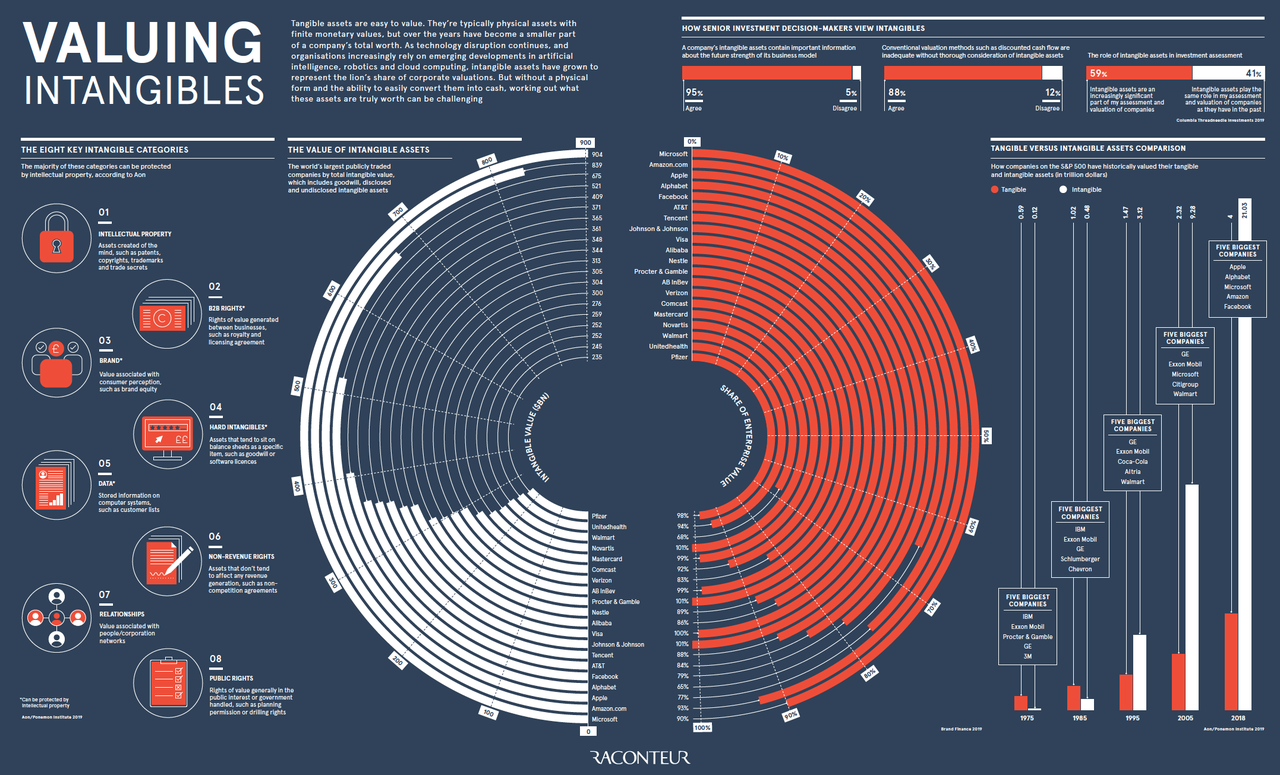
Here is the entirety of the problem summed up nicely by Raconteur:
“Tangible assets are easy to value. They’re typically physical assets with finite monetary values, but over the years have become a smaller part of a company’s total worth. Technology disruption continues in artificial intelligence, robotics and cloud computing. As such, intangible assets have grown to represent the lion’s share of corporate valuations. But without a physical form and the ability to easily convert them into cash, working out what these assets are truly worth can be challenging.”
A Pervasive Problem
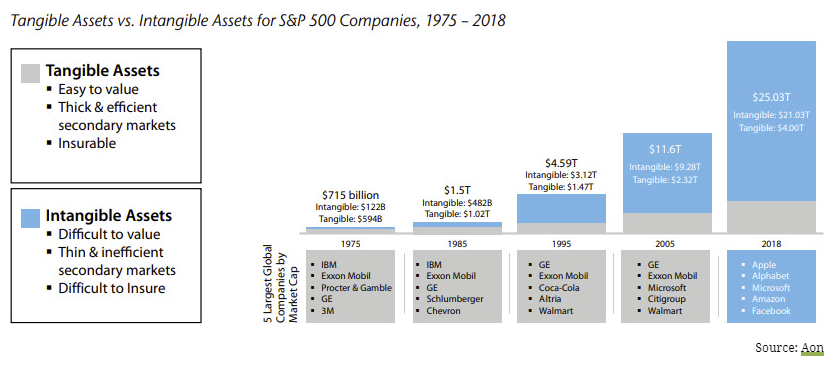
Just recently, Visual Capitalist prepared an infographic for Raconteur.
“In 2018, intangible assets for S&P 500 companies hit a record value of $21 trillion. These assets, which are not physical in nature and include things like intellectual property, have rapidly risen in importance compared to tangible assets like cash.”
Click To Enlarge
As shown, in recent years, the surge in intangible assets has become a larger share of enterprise value. The largest contributors to intangible assets are:
Intellectual Property
B2B Rights
Brand
Hard Intangibles Like “Goodwill”
Data
Non-Revenue Rights (Non-Compete Agreements)
Relationships
Public Rights
You should almost immediately grasp that while these assets may have “value” to the company, they may not hold much value during a liquidation process. Or rather, “one man’s riches are another man’s trash.”
The Evolution
“Intangibles used to play a much smaller role than they do now, with physical assets comprising the majority of value for most enterprise companies. However, an increasingly competitive and digital economy has placed the focus on things like intellectual property, as companies race to out-innovate one another.
To measure this historical shift, Aon and the Ponemon Institute analyzed the value of intangible and tangible assets over nearly four and a half decades on the S&P 500. Here’s how they stack up:” – Visual Capitalist
“In just 43 years, intangibles have evolved from a supporting asset into a major consideration for investors – today, they make up 84% of all enterprise value on the S&P 500, a massive increase from just 17% in 1975.
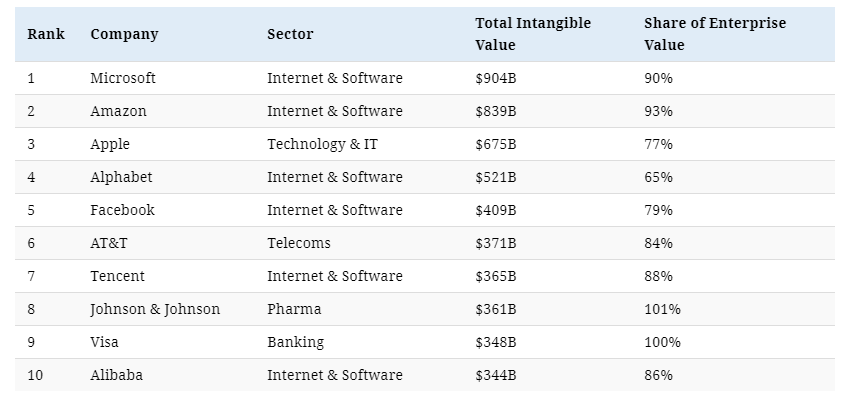
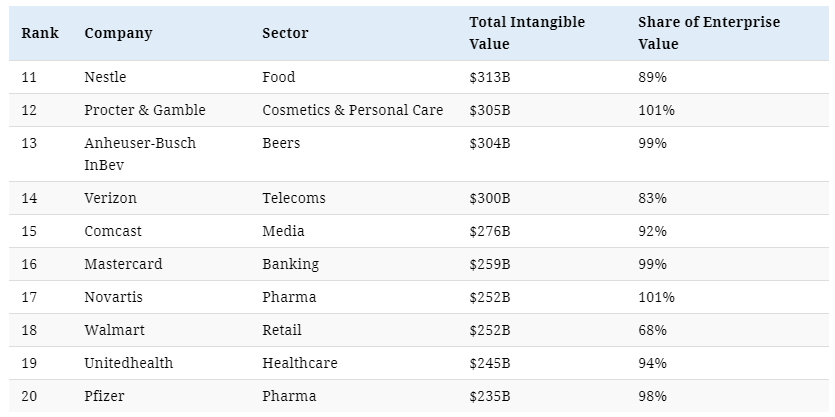
Digital-centric sectors, such as internet & software and technology & IT, are heavily reliant on intangible assets. Brand Finance, which produces an annual ranking of companies based on intangible value, has companies in these sectors taking the top five spots on the 2019 edition of their report.” – Visual Capitalist
While the issues of “intangibles” should undoubtedly be a concern for “value” investors, another issue further compounding the problem. Debt and accounting gimmicks.
A Compounded Problem
As discussed previously in “EBITDA Is Bull****,“ the heavy use of accounting gimmicks is obfuscating the real value of publicly traded companies. As noted:
“An in-depth study by Audit Analytics revealed that 97% of companies in the S&P 500 used non-GAAP financials in 2017, up from 59% in 1996, while the average number of different non-GAAP metrics used per filing rose from 2.35 to 7.45 over two decades.
This growing divergence between the earnings calculated according to accepted accounting principles, and the ‘earnings’ touted in press releases and analyst research reports,has put investors at a disadvantage of understanding exactly what they are paying for.”
Compound the problem accounting issues with surging levels of corporate debt, and the issue becomes more apparent.
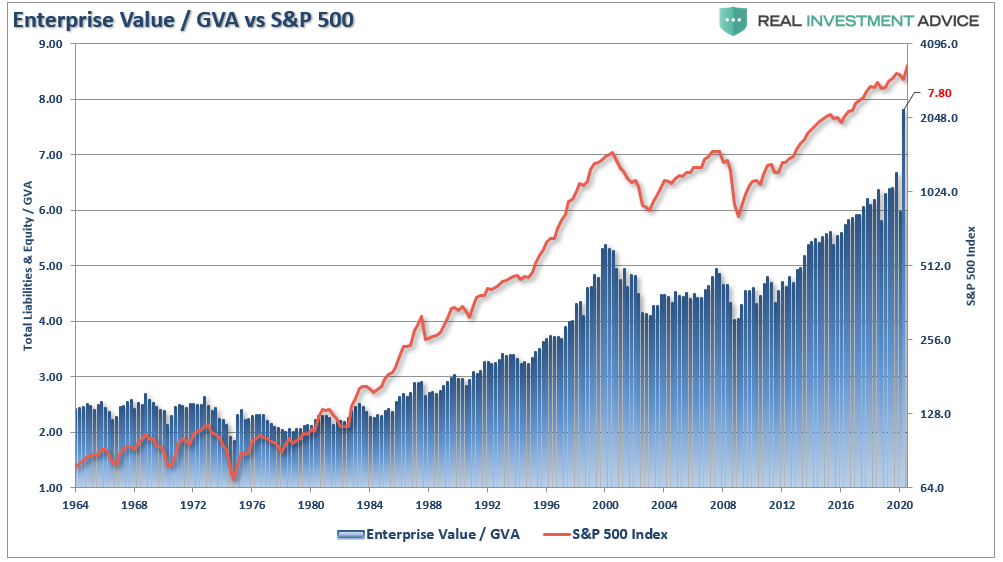
Since the onset of the pandemic, the enterprise value to GVA (gross value added) ratio has surged.
Given the Federal Reserve’s monetary injections and suppression of interest rates, it is not surprising to see companies leveraging their balance sheets. As interest rates have plunged, corporations have hit a record issuance of debt to pay dividends and other non-productive purposes.
The increased leverage of corporate balance sheets is problematic, particularly given already weak revenue growth for S&P 500 companies.
Lack Of Disclosure
The debt, accounting gimmicks, and intangible assets make it increasingly difficult for investors to determine the actual “value” of the companies they are investing in.
Currently, given the speculative nature of the investing environment, such certainly seems to be an irrelevant problem. However, in the long-run, “value” always matters in the end.
The problem, when it comes to investors, is understanding and identifying these issues, particularly in the case of intangibles. As shown in the tables above, most investors are unaware that intangible assets make up such a large percentage of overall enterprise value.
When you combine that issue with the surge in corporate debt and level of debt relative to enterprise value, it is easy to visualize the risk investors are taking on.
Visual Capitalist’s conclusion is appropriate:
“The majority of intangibles are not reported on balance sheets because accounting standards do not recognize them until a transaction has occurred to support their value. While many accounting managers see this as a prudent measure to stop unsubstantiated asset values, it means that many highly valuable intangibles never appear in financial reporting. In fact, 34% of the total worthof the world’s publicly traded companies is made up of undisclosed value.
Brand Finance believes that companies should regularly value each intangible asset, including the key assumptions management made when deriving their value. This information would be extremely useful for managers, investors, and other stakeholders.”
Conclusion
Without better disclosures, a return to “mark-to-market” accounting practices, and tighter restrictions on “accounting gimmicks,” investors remain exposed to increased risks.
Of course, when executives’ compensation benefits from manipulating their earnings and speculative investors benefit during bull markets, you can understand why the rules won’t change.
That is, of course, until investors once again lose a majority of their invested wealth.
As Warren Buffett once quipped: “Price is what you pay, value is what you get.”
With a “lack of value” in value, just make sure you know what you are paying for.
via ZeroHedge News https://ift.tt/3j4BR8K Tyler Durden
LA Driver Crossing BLM Protest Gets Chased, Beaten And Arrested On Live TV Tyler Durden
Fri, 09/25/2020 – 10:54
The driver of a white Toyota Prius who had carefully weaved through a BLM protest was heckled, chased down by a black pick-up truck leading the protests, and then assaulted on Thursday night. The driver was then arrested.
“It wasn’t traveling at a fast speed — it was inching forward, trying to get past, and that upset people,” said photojournalist Christian Monterrosa.
A Prius runs through a crowd of people on Sunset Boulevard and North Cahuenga Boulevard during a protest held for Breonna Taylor in Hollywood. (Josie Norris/Los Angeles Times)
People in the crowd began striking the car’s windows and doors, the news footage shows. After the Prius cleared the crowd, a black pickup truck with several people sitting in the bed gave chase, accelerated ahead of the Prius and pulled to an abrupt halt. A man got out of the truck and, according to the footage, appeared to try to pull the driver out of the Prius.
The Prius reversed and collided with a green Mustang convertible, which was associated with the protest, according to the LAPD. A person got out of the convertible and began striking the Prius with a flagpole, the footage shows, and another person arrived on a skateboard, which he used to smash the Prius’ windshield. The motorist drove off but was detained a few blocks away by the LAPD. No one was injured in the incident, according to police. –Los Angeles Times
Watch:
So the mob blocks the streets in LA, driver drives through pretty carefully with strobe flashing, the mob chases after him in multiple vehicles, box driver in, beat him, smash his car, driver escapes before they pull him out and police arrest the driver?! pic.twitter.com/ZfV6nSABGP
According to the Los Angeles Police Department (LAPD), approximately 300 people gathered near the Hollywood Forever Cemetery before marching through Hollywood.
The incident with the white Prius comes after a truck struck one of the protesters, according to the Los Angeles Times.
A protester who was hit by a car is attended to as paramedics arrive on Sunset Boulevard. (Wally Skalij/Los Angeles Times)
On Thursday, the group in Hollywood was walking down Sunset Boulevard, video posted to Twitter and YouTube shows, when a dark-colored pickup accelerated among the protesters, striking one directly and hurtling the person backward. The truck then sped down Sunset Boulevard, nearly hitting other people who leaped out of the way, the footage shows.
Capt. Steve Lurie, who leads the Los Angeles Police Department’s Hollywood Division, said officers stopped and identified the motorist, although they didn’t immediately arrest him. The motorist told them that protesters had attacked his car first, according to Lurie, who added that officers have noted damage to the car. -LA Times
According to Monterrosa, the truck was traveling against the flow of the crowd when protesters began crowding the vehicle, trying to stop it.
According to the LAPD, police have identified both motorists, and detectives are reviewing the cases. The drivers maintain they were accosted by protesters.
An LAPD captain said the protest was mostly peaceful – with the exception of around 20 “violent” individuals.
I don’t care how unpopular this is with some folks but the mob who’s flashing strobe lights, hitting cars and scaring people are the ones who need to be arrested, not the scared drivers who try to escape. Arrest the mob.