Kraft gets off while Orchids of Asia workers still face 25 prostitution charges each. After nearly two years, Florida prosecutors are finally giving up on prosecuting New England Patriots owner Robert Kraft for twice paying an adult woman in Palm Beach County for a hand job. The state had little choice, since a court said the video evidence of this sex act was illegally obtained.
Florida cops had pretended to be hunting a “human trafficking” ring in order to get a warrant for the secret surveillance cameras—which ultimately showed no signs of forced work, forced sex, child labor, or illegal immigration. What they caught was licensed, adult, immigrant masseuses sometimes providing manual sexual stimulation at the end of a client’s massage.
But authorities went forward with the “trafficking” lie anyway, holding a press conference that garnered a huge amount of media coverage. Readers and viewers across the country were told that an international “sex trafficking ring” forced “girls” to have unprotected sex with 1,000 men a year and did not let them leave. Major outlets such as The New York Times, CNN, and NPR relayed the government’s account.
Palm Beach District Attorney Dave Aronberg declared that this was “modern day slavery” and that the women providing sex acts to Kraft and company were “trafficking victims.” This wasn’t a story “about lonely old men and victimless crimes,” Aronberg said; it was “about forcing women into our country for forced labor and sex.” Another local sheriff called the prostitution stings “a rescue operation.”
And now, those “rescued” women may be the only ones still in legal trouble.
On Thursday, state prosecutors announced that they had dropped the two “soliciting another to commit prostitution” charges against Robert Kraft. The announcement comes after two Florida courts ruled that the video evidence of his alleged crime was not admissible. The court also ruled it off-limits in cases against the other men charged with soliciting prostitution at Orchids of Asia and the massage parlor workers who were facing prostitution-related felonies. Solicitation cases against at least 13 other men charged at the same time as Kraft are now listed as closed.
The video footage was all cops had on Kraft and most of the other men arrested for soliciting. But when it comes to the women involved, police do have other potential evidence, since they spent months doing things like rooting through their trash cans (with the help of a Homeland Security agent), following them around, and sending in undercover agents.
Hua Zhang, the 59-year-old owner of Orchids of Asia owner, and 41-year-old Lei Wang—one of two women whom Kraft allegedly patronized—were charged with 22 counts apiece of “soliciting another to commit prostitution,” as well as one count each of maintaining a house of prostitution, deriving support from proceeds of prostitution, and renting space to be used for prostitution. The other woman accused of servicing Kraft, 60-year-old Shen Mingbi, was charged with one count of deriving support from the proceeds of prostitution and 10 counts of soliciting another to commit prostitution.
Aronberg did not respond to Reason‘s request for more information on what would become of the charges against these women.
But cases against all three are still listed as open in Palm Beach County court records, while Kraft’s is now listed as closed. And a status check in the Zhang and Wang cases is scheduled for December 2, 2020.
On August 31—more than a year and a half after she was first charged—Zhang was granted permission to seek employment again.
Unlike the men arrested for solicitation, Zhang and Wang also had many of their assets seized.
No one in this case was ever charged with human trafficking. No victims were ever produced. Yet Zhang and Wang have had to spend the past 19 months fighting for their freedom, their reputations, their property, and their livelihoods, and it looks like they’ll have to continue fighting it.
All for touching parts of men that the state says they can’t touch for money—and while the men that paid to be touched go free.
(This is not to say that these men faced no consequences. They’ve had to fight criminal charges, fight the release of the surveillance video, and watch as the papers publish their names as people who patronize “sex slaves.” Nor should they should be punished. But the fact that they aren’t makes the continued prosecution of the women all the more egregious.)
People have been aghast at how these massage-parlor stings played out. But police departments and prosecutors’ offices around the country have been engaging in similar charades, generally with the help of Immigration and Customs Enforcement (ICE) and Homeland Security Investigations agents. Here are a few other examples I’ve covered recently:
Under DHS's new proposed rule, if you were born in, or are a citizen of, one of the countries on this map, you would be banned from getting a four-year degree in the United States, with a student visa limited to two years maximum.
• “The FBI and the U.S. attorney for the Middle District of Pennsylvania said Thursday that they are investigating ‘potential issues’ with nine military ballots in one county,” reports NPR. “They believe the ballots were opened improperly, though they have not filed any charges or taken official action.”
from Latest – Reason.com https://ift.tt/3j2R6zh
via IFTTT
Election Contention Can Catch Volatility Off Guard Tyler Durden
Fri, 09/25/2020 – 09:25
By Laura Cooper, macro strategist who writes for Bloomberg
Investors’ U.S. election playbooks should look different this year with a lengthy contested outcome an underpriced tail risk that can spike equity volatility through early 2021. Narrowing polls, a surge in mail-in ballots and amped up partisanship make a challenged U.S election outcome a risk not seen in nearly 150 years, but it’s yet to be captured in bets on S&P 500 volatility.
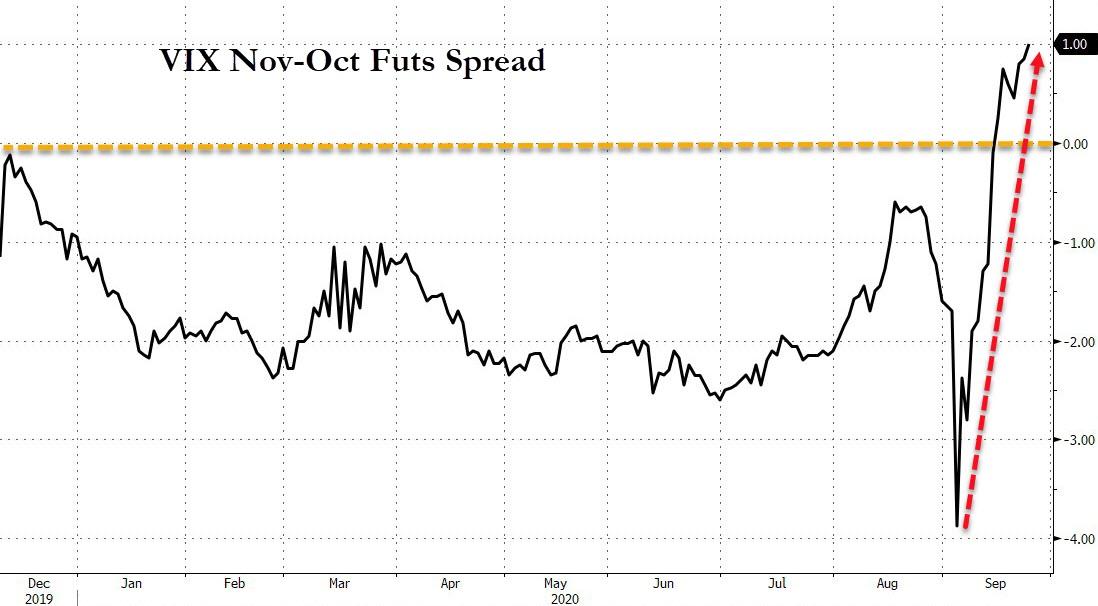
Widely traded CBOE VIX futures, which capture the market’s expected swings in the S&P 500 over 30 days, show investors bracing for uncertainty around the Nov. 3 vote. The spread between the front-month futures contract and spot VIX is near the highest since 2012, but it’s more muted further out the curve.
Traders aren’t commanding a higher-than-normal volatility premium beyond the second-month contract, which matures in November. The shape of the VIX curve at the December and January contracts relative to spot VIX aren’t outliers to history.
A fractious political climate aggravated by President Trump’s pending Supreme Court nomination adds a layer of uncertainty in this election cycle, particularly in light of an already ambiguous dispute resolution mechanism.
The last contested election was in the 2000 race between Republican George W. Bush and Democrat Al Gore and centered on voting count disputes. It landed in the Supreme Court, which stopped a recount in Florida on Dec. 12. If that hadn’t happened, the dispute could’ve ended up in Congress, which has ultimate responsibility for counting electoral college votes.
This time could be different, with one having to go as far back as the 1876 election between Rutherford B. Hayes and Samuel Tilden to find a precedent, according to a 2019 Ohio State working paper. Back then, the deadlock lasted until just two days before the inauguration. Should Congress receive conflicting electoral vote counts from some states this time, the constitutional provisions for resolving the conflict are ambiguous and “vulnerable to partisan posturing.”
The timeline of the current three-phase resolution process suggests the risk of a deadlock extending through early 2021 is non-negligible, but it still isn’t captured in longer-dated volatility futures contracts. The spread between the December-expiring contract and the November one remains deeply negative.
The addition of a wave of mail-in ballots because of the coronavirus only amplifies the chances of a disputed vote count amid warnings that the results may not be known “for months or for years.”
Modeling political uncertainty is a fool’s errand. But prediction markets can act as a proxy for contested election risks. A narrowing spread between the absolute probability of a Trump presidency and a Biden win raises uncertainty, increasing the perceived odds of a coin-flip outcome. Mapping this proxy against the spot VIX shows a surprising degree of co-movement.
Of course, a smooth, uncontested outcome is possible. And it’s worth noting that the poll-tracking website FiveThirtyEight gives Biden a 77% chance of winning.
But the tail risk of a prolonged disputed election outcome widened this week, and hedging through relatively cheap longer-dated volatility bets looks prudent. After all, this could turn out to be a once in a 144-year event.
via ZeroHedge News https://ift.tt/3mNuZz7 Tyler Durden
“Stop The Defund Or Abolish The Cops Crap”: NBA Legend Charles Barkley Defends Police In Breonna Taylor Shooting Tyler Durden
Fri, 09/25/2020 – 09:05
The “woke mob” is in a rage after NBA legend Charles Barkley offered up some much needed common sense yesterday prior to the Los Angeles Lakers and Denver Nuggets playoff game.
In a league that, like the NFL, is seeing ratings impacted presumably by the overwhelming message of social justice that seems to be taking away from the actual games, Barkley was one of the first voices to speak out and defend the police as the nation grappled with the result of the Breonna Taylor verdict.
During the pre-game show, Barkley said he thought that Taylor’s case had be “lumped in” with the George Floyd killing and reminded the viewing audience that Taylor’s boyfriend actually shot at police who were executing a no-knock warrant first, before police returned fire, tragically killing Taylor.
Barkley said: “I don’t think this one was like George Floyd or Ahmaud Arbery and things like that. I feel sad that this young lady lost her life. I think this one was — the no-knock warrant is something we need to get rid of … across the board. But I am worried to lump all these situations in together.”
He continued, “And I just feel bad that the young lady lost her life. But we do have to take into account that her boyfriend shot at the cops and shot a cop. So like I say, even though I am really sorry she lost her life, I just don’t think we can put this in the same situation as George Floyd or Ahmaud Arbery.”
Additionally, Barkley took exception with the idea of defunding the police, stating: “Who are black people supposed to call? Ghostbusters? When we have crime in our neighborhood? We need to stop that defund or abolish the cops crap.“
Charles Barkley on defunding the police “Who are black people supposed to call Ghost Busters when we have crime in our neighborhood? We need to stop the defund or abolish the police crap” pic.twitter.com/uEIsnX729g
Shaquille O’Neal weighed in, agreeing with Barkley: “I have to agree with Charles, this one is sort of lumped in. You have to get a warrant signed and some states do allow no-knock warrants. And everyone was asking for murder charges. When you talk about murder, you have to show intent. A homicide occurred and we’re sorry a homicide occurred. When you have a warrant signed by the judge, you are doing your job, and I would imagine that you would fire back.”
Charles Barkley says you can’t put the Breonna Taylor case in the same situation as George Floyd, Ahmaud Arbery because her boyfriend shot at the police pic.twitter.com/8dMjVMZp39
Chairman of the Senate Judiciary Committee Lindsey Graham hinted more than a week ago that more bombshell information regarding the FBI’s handling of its probe into President Donald Trump’s campaign and Russia was about to be public. He was right because it was Graham’s committee that discovered the information.
In a bombshell letter released a letter Thursday night by Graham’s committee from Justice Department Attorney General William Barr revealed a declassified summary from the bureau indicating that former British spy Christopher Steele’s primary sub-source in his debunked dossier was believed to be a Russian spy. Not only was the sub source believed to be a spy but the FBI knew about it and had conducted a counterintelligence investigation on the individual.
“In light of this newly declassified information, I will be sending the FISA Court the information provided to inform them how wide and deep the effort to conceal exculpatory information regarding the Carter Page warrant application was in 2016 and 2017,” said Graham.
“A small group of individuals in the Department of Justice and FBI should be held accountable for this fraud against the court. I do not believe they represent the overwhelming majority of patriotic men and women who work at the Department of Justice and FBI.”
One of those individuals being investigated by Connecticut Prosecutor John Durham is former FBI Deputy Director Andrew McCabe, who was fired from the FBI by former Attorney General Jeff Sessions for lying to the Inspector General on multiple occasions. He is now in Durham’s crosshairs, along with multiple other former senior FBI officials that were involved in the investigation, according to a source with direct knowledge.
“McCabe and others were suppressing information, misrepresenting it or lying about the information that they had in order to purposefully undermine the Trump candidacy and that turned into the predication for undermining the Trump presidency”
McCabe, along with other FBI officials, withheld that information from the Foreign Intelligence Surveillance Court, as well as some of the FBI special agents investigating Trump’s campaign and its alleged ties to Russia, according to the source.
“McCabe and others were suppressing information, misrepresenting it or lying about the information that they had in order to purposefully undermine the Trump candidacy and that turned into the predication for undermining the Trump presidency,” said a source with direct knowledge of the situation.
The source, who is familiar with the ongoings of the senior brass at the FBI, told this reporter the FBI Director Christopher Wray, along with Deputy Director David Bowdich, were contacted last week by the DOJ and were warned that a “shit storm was heading their way.”
The source alleged that McCabe is now a central figure in Durham’s investigation, along with several other senior FBI officials who were aware of the information but failed to disclose it. McCabe could not be immediately reached for comment but this story will be updated if and when he responds.
Neither the FBI press office, nor Thomas Carson, a spokesman for Durham’s office commented for this story despite repeated requests.
The explosive information shed even more light on the internal corruption inside the bureau at the highest levels and the purposeful misuse of the agency to target a political presidential opponent. In fact, it raises serious concerns that these actions were not an aberration but could have been occurring for sometime inside the FBI and intelligence community, several U.S. intelligence officials and former FBI officials told this columnist.
“It’s beyond the pale and what’s worse no one has paid the price for attempting to oust – coup – a U.S. president,” said one former senior intelligence official. “What makes it worse is politicians who are using this information for political purposes – they do so at the detriment of the American system and republic.”
It just so happened, according to a press release by Graham that the information was revealed during a “request for oversight of the reliability of the Steele dossier,” which led the Justice Department to recently declassify a key footnote in Inspector General Michael Horowitz’s report.
“The footnote states Christopher Steele’s Primary Sub-source “was the subject of an FBI counterintelligence investigation from 2009 to 2011 that assessed his/her documented contacts with suspected Russian intelligence officers,” stated the letter.
Graham stated in his press release that the “failure of the FBI to inform the court that the Primary Sub-source was suspected of being a Russian agent is a breach of every duty owed by law enforcement to the judicial system.”
In fact, the FBI summary provided to the Senate Judiciary Committee revealed that the FBI’s Crossfire Hurricane team was aware of this information in December 2016. Meaning former FBI Special Agent Peter Strzok, and FBI attorney Lisa Page, were aware of the information and failed to inform the Foreign Intelligence Surveillance Court.
Further, they continued to seek three FISA warrant applications using the Steele dossier as a basis and knowing that the information was more than likely Russian disinformation.
“The now famous email Susan Rice sent to herself on Inauguration Day where she states that President Obama said that everything has to be done ‘by the book’ has become highly suspect,” said Graham. “If this investigation is ‘by the book,’ then the book we’re using is the Kremlin playbook.
The Sub-Source and Primary Sub-Source
Graham’s letter revealed that “a review of FBI databases revealed that the Primary Sub-source had contact in 2006 with the Russian Embassy and known Russian intelligence officers.”
“In September 2006, the Primary Sub-source was in contact with a known Russian intelligence officer. During these conversations, the Russian Intelligence Officer invited the Primary Sub-source to the Russian Embassy to see his office.
The Primary Sub-source told the Russian Intelligence Officer that he/she was interested in entering the Russian diplomatic service one day. The two discussed a time when the Primary Sub-source was to visit. Four days later, the Russian Intelligence Officer contacted the Primary Sub-source and informed him/her they could meet that day to work “on the documents and then think about future plans.”
Later in October 2006, the Primary Sub-source contacted the Russian Intelligence Officer seeking a reply “so the documents can be placed in tomorrow’s diplomatic mail pouch.”
FBI information further identified, in 2005, the Primary Sub-source making contact with a Washington, D.C.–based Russian officer. It was noted that the Russian officer and the Primary Sub-source seemed very familiar with each other.”
“As part of its investigation, the FBI conducted interviews with the Primary Sub-source’s associates. One individual indicated that the Primary Sub-source was not anti-American but wanted to return to Russia one day. Another described the Primary Sub-source as pro-Russia and indicated that he/she always interjected Russian opinions during policy discussions. While both stated that they did not recall the Primary Sub-source asking directly about their access to classified information, one interviewee did note that the Primary Sub-source persistently asked about the interviewee’s knowledge of a particular military vessel.”
From Graham’s Press Release/ Key takeaways from the FBI’s declassified summary:
The Crossfire Hurricane team knew in December 2016 that Christopher Steele’s Primary Sub-source was an individual who the FBI had indicated in 2009 “could be a threat to national security.”
In May 2009, Steele’s source reportedly attempted to recruit two individuals connected to an influential foreign policy advisor connected to President Obama, offering that if the two individuals “‘did get a job in the government and had access to classified information’ and wanted ‘to make a little extra money,’ [Steele’s source] knew some people to whom they could speak.”
FBI databases revealed Steele’s source “had contact in 2006 with the Russian Embassy and known Russian intelligence officers, [including contacting a known Russian intelligence officer] ‘so the documents can be placed in tomorrow’s diplomatic pouch.’”
One individual interviewed by the FBI noted that “the Primary Sub-source persistently asked about the interviewee’s knowledge of a particular military vessel.”
Significantly, the “record documenting the closing of the investigation [of the Primary Sub-source] stated that consideration would be given to re-opening the investigation in the event that the Primary Sub-source returned to the United States.”
Key Findings:
First, the primary source for the Steele dossier was likely a Russian agent.
Second, the Primary Sub-source was suspected by the FBI in 2009 of being a Russian agent, and there had been an active counterintelligence investigation of this individual. That FBI investigation revealed the Primary Sub-source was suspected of providing information to the Russian Embassy and was in contact with known Russian intelligence officers, and made offers to people connected to incoming Obama Administration officials that any classified information they provided could be paid for. In addition, during this investigation it was disclosed that the Primary Sub-source persistently asked individuals about a particular military vessel of the United States.
Third, the information provided shows that in December 2016, the FBI knew of the previous counterintelligence investigation of the Primary Sub-source and the source’s ties to Russian intelligence services. However, they failed to inform the FISA Court. In fact, not only did they not inform the FISA Court the Primary Sub-source was likely a Russian agent, they continued to use the Steele dossier to seek warrants against Carter Page. They told the court the Primary Sub-source was truthful and cooperative. Specifically the three FISA applications filed after December 2016 make no mention of the previous counterintelligence investigation against the Primary Sub-source and the last two FISA applications additionally misled the court about the results obtained of the interviews of the Primary Sub-source in January and March of 2017.
via ZeroHedge News https://ift.tt/3mTNIJl Tyler Durden
US Durable Goods Orders Disappoint In August As Recovery Stalls Tyler Durden
Fri, 09/25/2020 – 08:35
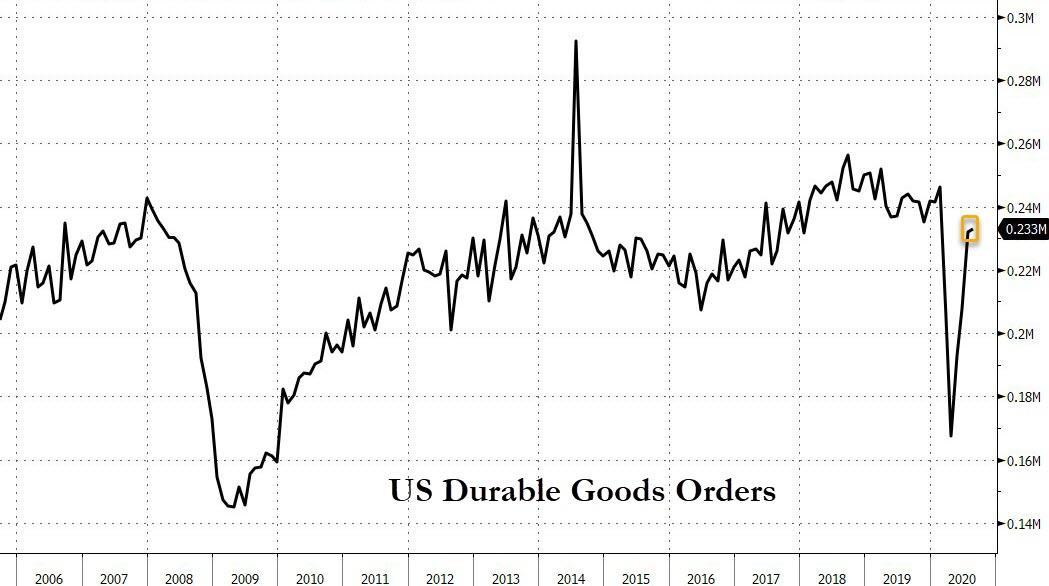
After three straight months of aggressive rebounds, analysts expected preliminary August durable goods orders data to slow dramatically, but the actual print was even worse then expected – rising just 0.4% MoM (vs +1.5% MoM exp)…
Source: Bloomberg
On a year-over-basis, durable goods orders are down 6.3%, and appear to have reached the zenith of the recovery.
Source: Bloomberg
On the bright side – capital goods shipments non-defense, ex-air – a proxy for business investment, rose 1.5% MoM (better than the expected 0.8% MoM).
via ZeroHedge News https://ift.tt/3042aVa Tyler Durden
Environmentalists have won the latest battle in California’s water wars, as California American Water just announced it is temporarily withdrawing its application to build a desalination plant on an old sand mine in the largely low-income town of Marina near Monterey.
The proposal faced a tough approval process at the California Coastal Commission after local activists complained about its effects on their community.
In a recent article, the Los Angeles Times asked this loaded question in its headline: “Is California serious about environmental justice? This water fight is a test.” The issue is simple, according to a former coastal commissioner interviewed by the Times reporter: “Who’s got the garbage? Who’s got the landfill? Who’s got all of it? Marina.…If the commissioners can’t see that now, their environmental justice policy is meaningless.”
Local communities have every right to be concerned about the siting of industrial facilities, but the worst way to promote “environmental justice” is to halt a facility that could provide much-needed water to a region that has, as even the article noted, “limited water options.” Cal Am proposed the desalination plant a decade ago to mitigate other, pressing environmental concerns—and still keep the water flowing to its thirsty customers.
As the Times continued, the investor-owned utility has been over-pumping the Carmel River for several decades. That has obliterated the river’s steelhead trout populations. The utility previously proposed building a dam and a larger, more intrusive desal plant, but environmentalists opposed those projects, also. (Big surprise, right?) As a result, Cal Am provides “some of the most expensive water in the country to cities that could not flourish without it.”
Read that last line slowly and carefully, as it is an allegory for California’s ongoing water problems. If California officials don’t invest in water infrastructure and expand our capacity to meet a still-growing population, then water will become much costlier—or will end up being rationed by state edict. It’s easy to pick nits with any potential project, but communities—and especially low-income ones—cannot flourish without abundant water.
The Marina project highlights the state’s inability to make meaningful tradeoffs. We’d all prefer parks along the coast, but an existing industrial site seems like a perfectly reasonable place to put a new industrial facility. Any project must be analyzed for its cost and benefits (“desal” is relatively costly), but that’s hardly what environmentalists are doing.
This fracas reinforces the theme of my forthcoming book, Winning the Water Wars. As summarized in its subtitle: “California can meet its water needs by promoting abundance rather than managing scarcity.” California needs to build infrastructure that stores more water during wet years, so we have it during dry years. It must better maintain its existing infrastructure, lest we relive the near-disaster at Oroville Dam’s spillways in 2017.
It needs to invest in desalination, water-recycling and allow private investors—such as those attempting to tap a Rhode Island-sized aquifer in the Mojave Desert—to find new water sources. We need a better pricing system that encourages sales and trading, so that companies can buy and sell water like anything else. Unfortunately, the state fights environmental battles over almost any attempt to accomplish those sensible goals.
California hasn’t built major water infrastructure since the 1970s, when its population was roughly half its current size. Anyone who proposes a water-infrastructure system must spend years developing environmental reports and fighting environmental groups, which often function like litigation machines. I’d like to see those who oppose such projects be required to provide reports on where alternative supplies will come from.
As the Marina desalination project shows, stopping water projects in the name of “environmental justice” does nothing for poor people who face escalating water bills—and it often hurts the environment, as well. (Marina doesn’t benefit directly from the plant, but will benefit if there’s more water in the system.) Without the plant, the utility will continue to rely on the river.
It will not be able to, as the article added, provide discounted water to a local farming community. Current water limits harm California’s farm regions the most. Those areas have the largest number of low-income residents. Certainly, a planned water-recycling plant near Monterey is a good idea—but it’s wise to build multiple sources.
Environmentalists don’t only oppose desalination plants because of siting issues, but because of concerns about their effect on a minuscule number of plankton in the nearly measureless Pacific. They oppose new dams—and the raising of existing ones—over concerns about rivers and fish. We must address legitimate environmental issues, but often they are a Trojan horse for opponents’ real goals of limiting growth.
If Californians are serious about “environmental justice,” they need to find ways to pump more water into our remarkable infrastructure systems. Actually, the current situation is unjust and environmentally destructive. A policy of abundance is the obvious fix.
This column was first published in the Orange County Register.
from Latest – Reason.com https://ift.tt/307qINa
via IFTTT
Environmentalists have won the latest battle in California’s water wars, as California American Water just announced it is temporarily withdrawing its application to build a desalination plant on an old sand mine in the largely low-income town of Marina near Monterey.
The proposal faced a tough approval process at the California Coastal Commission after local activists complained about its effects on their community.
In a recent article, the Los Angeles Times asked this loaded question in its headline: “Is California serious about environmental justice? This water fight is a test.” The issue is simple, according to a former coastal commissioner interviewed by the Times reporter: “Who’s got the garbage? Who’s got the landfill? Who’s got all of it? Marina.…If the commissioners can’t see that now, their environmental justice policy is meaningless.”
Local communities have every right to be concerned about the siting of industrial facilities, but the worst way to promote “environmental justice” is to halt a facility that could provide much-needed water to a region that has, as even the article noted, “limited water options.” Cal Am proposed the desalination plant a decade ago to mitigate other, pressing environmental concerns—and still keep the water flowing to its thirsty customers.
As the Times continued, the investor-owned utility has been over-pumping the Carmel River for several decades. That has obliterated the river’s steelhead trout populations. The utility previously proposed building a dam and a larger, more intrusive desal plant, but environmentalists opposed those projects, also. (Big surprise, right?) As a result, Cal Am provides “some of the most expensive water in the country to cities that could not flourish without it.”
Read that last line slowly and carefully, as it is an allegory for California’s ongoing water problems. If California officials don’t invest in water infrastructure and expand our capacity to meet a still-growing population, then water will become much costlier—or will end up being rationed by state edict. It’s easy to pick nits with any potential project, but communities—and especially low-income ones—cannot flourish without abundant water.
The Marina project highlights the state’s inability to make meaningful tradeoffs. We’d all prefer parks along the coast, but an existing industrial site seems like a perfectly reasonable place to put a new industrial facility. Any project must be analyzed for its cost and benefits (“desal” is relatively costly), but that’s hardly what environmentalists are doing.
This fracas reinforces the theme of my forthcoming book, Winning the Water Wars. As summarized in its subtitle: “California can meet its water needs by promoting abundance rather than managing scarcity.” California needs to build infrastructure that stores more water during wet years, so we have it during dry years. It must better maintain its existing infrastructure, lest we relive the near-disaster at Oroville Dam’s spillways in 2017.
It needs to invest in desalination, water-recycling and allow private investors—such as those attempting to tap a Rhode Island-sized aquifer in the Mojave Desert—to find new water sources. We need a better pricing system that encourages sales and trading, so that companies can buy and sell water like anything else. Unfortunately, the state fights environmental battles over almost any attempt to accomplish those sensible goals.
California hasn’t built major water infrastructure since the 1970s, when its population was roughly half its current size. Anyone who proposes a water-infrastructure system must spend years developing environmental reports and fighting environmental groups, which often function like litigation machines. I’d like to see those who oppose such projects be required to provide reports on where alternative supplies will come from.
As the Marina desalination project shows, stopping water projects in the name of “environmental justice” does nothing for poor people who face escalating water bills—and it often hurts the environment, as well. (Marina doesn’t benefit directly from the plant, but will benefit if there’s more water in the system.) Without the plant, the utility will continue to rely on the river.
It will not be able to, as the article added, provide discounted water to a local farming community. Current water limits harm California’s farm regions the most. Those areas have the largest number of low-income residents. Certainly, a planned water-recycling plant near Monterey is a good idea—but it’s wise to build multiple sources.
Environmentalists don’t only oppose desalination plants because of siting issues, but because of concerns about their effect on a minuscule number of plankton in the nearly measureless Pacific. They oppose new dams—and the raising of existing ones—over concerns about rivers and fish. We must address legitimate environmental issues, but often they are a Trojan horse for opponents’ real goals of limiting growth.
If Californians are serious about “environmental justice,” they need to find ways to pump more water into our remarkable infrastructure systems. Actually, the current situation is unjust and environmentally destructive. A policy of abundance is the obvious fix.
This column was first published in the Orange County Register.
from Latest – Reason.com https://ift.tt/307qINa
via IFTTT
4 Wounded In “Meat Cleaver” Attack Near Site Of 2015 Charlie Hebdo Massacre Tyler Durden
Fri, 09/25/2020 – 08:14
Four people were wounded Friday near the former offices of the satirical newspaper Charlie Hebdo, CNN reported, the site of a brutal 2015 terrorist attack and mass shooting during which 12 people were killed.
Four people have been wounded in a knife attack near the former offices of satirical magazine Charlie Hebdo in Paris, French police have said.
Just weeks ago, Charlie Hebdo republished the “Mohammed Cartoons” under the title “Tout ça pour ça” (“All of that for this”) – but it was unclear among local authorities if the attack was related to the newspaper’s latest publication.
Jean Castex, the French prime minister, tweeted, “a stabbing attack was perpetrated near the former premises of the weekly Charlie Hebdo.” He cut short a scheduled speech in the Parisian suburb of Seine-Saint-Denis, saying that a “serious event” had unfolded int the capital.
A Paris police spokesperson said two of the four injured were in critical condition. According to BBC, a suspect has been “detained in the nearby Bastille area after police said at least one person had fled the area by metro.”
#France#Latest Public TV now confirms that 2 injured by knife attack in #Paris are workers of TV news agency Premieres Lignes, located near the former offices of Charlie Hebdo. Not clear if it was a targetted attack. Same agency that filmed #CharlieHebdo attackers 5yrs ago. https://t.co/JurGt0PNPE
French media is reporting the suspect, who has been arrested, had blood on his clothing. The weapon, used in the incident, was described as a “meat cleaver” – was recovered at the scene.
BREAKING – Paris police at the area where 4 people were injured in a knife attack near Charlie Hebdo offices. pic.twitter.com/RXgfOuuakw
It’s unclear whether the attack was motivated by Charlie Hebdo’s latest publication of Mohammed Cartoons or whether it was random. Notably, the attack comes as a high-profile trial has begun of 14 people accused of supporting two jihadists who carried the 2015 attack on the newspaper.
via ZeroHedge News https://ift.tt/332wfXi Tyler Durden
S&P Futures, Global Stocks Slump As European Banks Crash To All-Time Low Tyler Durden
Fri, 09/25/2020 – 08:10
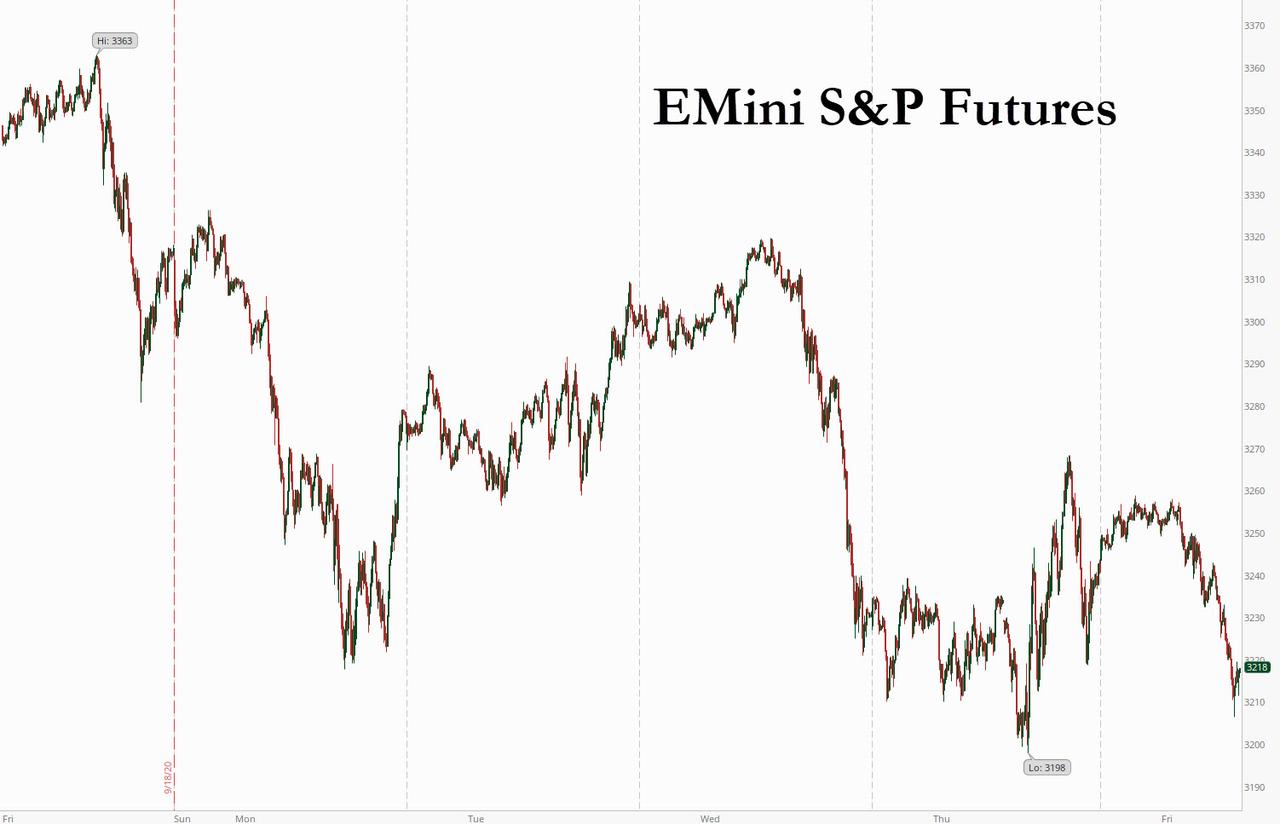
US equity futures and European stocks slumped as investor skepticism for a new American stimulus deal grew against a sharp uptick in global coronavirus cases. Both bonds and the dollar advanced amid the flight from risk. The Emini was down 0.5% last, set to retest Thursday’s lows.
Costco Wholesale Corp fell 2.5% as the warehouse chain recorded high coronavirus-related costs for the second straight quarter, overshadowing its better-than-expected results. The FAAMG tech mega-caps headed lower after leading gains on Wall Street in the previous session. Nikola fell another 5.2% in premarket trading, with the stock heading for the worst weekly performance on record, already being down 44% in a rout fueled by the resignation of its founder and executive chairman.
Boeing Co inched higher after Europe’s chief aviation safety regulator said the planemaker’s grounded 737 MAX could receive regulatory approval to resume flying in November and enter service by the end of the year. United Airlines, Southwest Airlines and Alaska Air Group were little changed in premarket trading even as airline unions hoped further aid would be announced before the current program ends on Oct. 1. After weeks of stalemate in talks over a fifth coronavirus relief bill, a key lawmaker said on Thursday Democrats in the U.S. House of Representatives were working on a $2.2 trillion package that could be voted on next week. Failure to reach a deal by then would result in another round of mass furloughs.
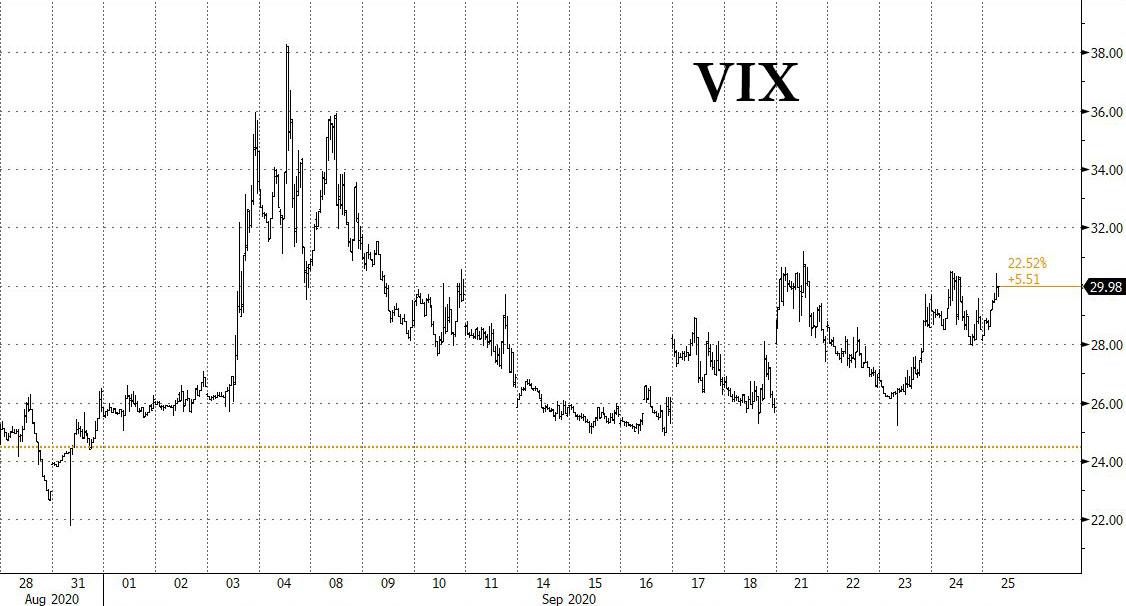
As futures slid, the VIX spiked above 30 with amid fears it could surge even more toward the end of the quarter next week as well as the Nov. 3 presidential election.
Incidentally, overnight Goldman said investors are overestimating the risk of the U.S. election upending markets, while Republican lawmakers vowed that the presidential transition after November’s election will occur without disruption, in a rebuke to President Donald Trump’s refusal to commit to a peaceful transfer of power.
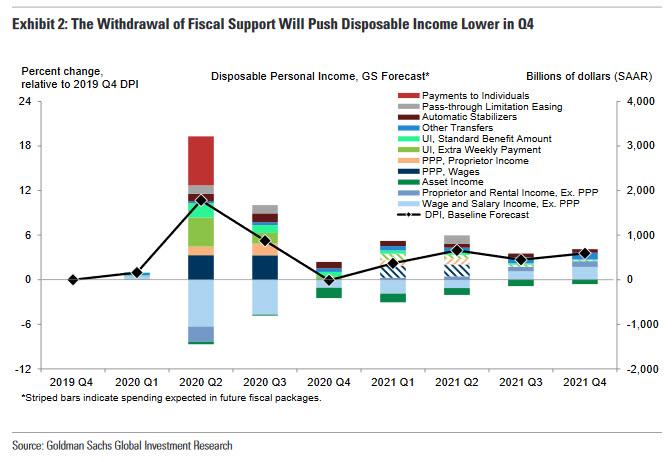
Investors remain glued to all the latest news from DC where Democrats proposed a new $2.4 trillion stimulus bill to try to break the deadlock with Republicans, but chances of getting it passed before the November election appear slim. The risk of a slowdown in the economic recovery has risen with the lack of another package, prompting Goldman and JPMorgan to cut their forecast for U.S. growth in the fourth quarter.
“The odds of Phase 4 stimulus are a close call,” wrote Aneta Markowska, chief economist at Jefferies LLC in New York. “While still possible, there is a high risk that it does not happen this year. Without it, we would expect the economy to hit a major speed bump in Q4.”
In Europe, the Stoxx 600 index tumbled 1% after fluctuating between gains and losses earlier, and was poised for its biggest weekly drop since June. Automotive and travel & leisure companies led the decline with losses of 2.1% and 1.6%, respectively. Airliners including Lufthansa AG, Ryanair Holdings Plc and IAG were among the biggest decliners as European leaders grappled with bringing infections back under control as hospitalizations climb again.
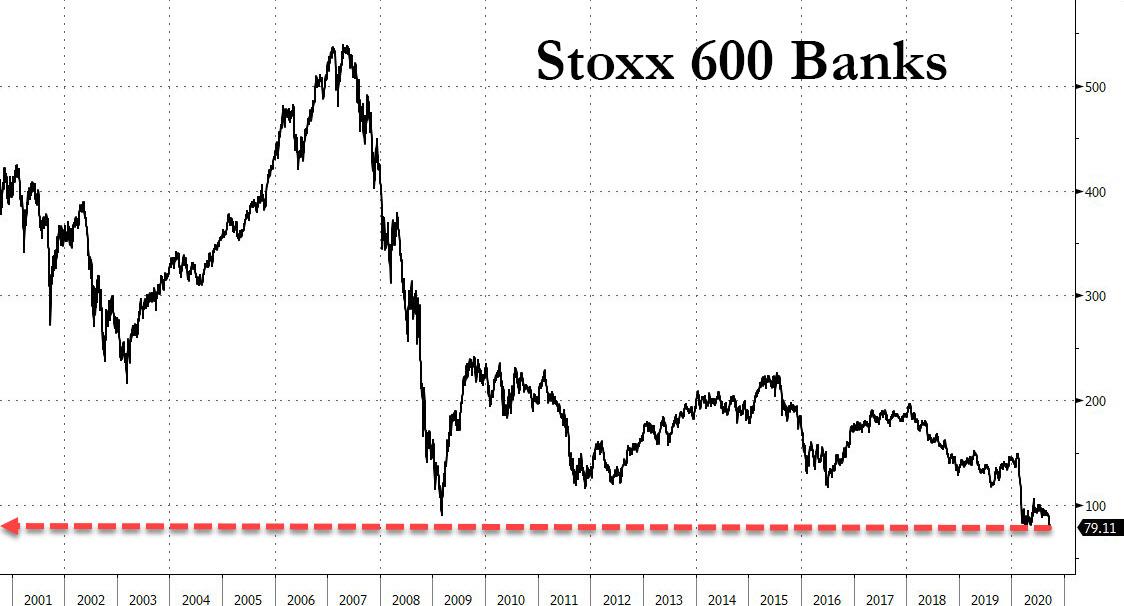
Also of note, the Stoxx Europe 600 Banks index dropped to an all time low as banks on the content continued to get punished.
Asian stocks were mixed, with materials and finance posting gains, after falling in the last session. The Jakarta Composite and India’s S&P BSE Sensex Index rose, while Hong Kong’s Hang Seng Index and Taiwan’s Taiex Index fell. The Topix gained 0.5%, with Moresco and Niitaka rising the most. The Shanghai Composite Index retreated 0.1%, with New East New Materials and Tianjin Benefo Tejing Electric posting the biggest slides.
In rates, Treasuries gained as stocks slumped. Yields were down by up to 2bp across long-end of the curve, flattening 5s30s by almost 1bp; 10-year yields around 0.655% and richer by 1bp on the day, although underperforming bunds, gilts by 1bp and 1.5bp. German bonds edged higher along with most of the euro area, outperforming Treasuries.
In FX, the dollar recovered from early losses, and was set to conclude its best week since April. The Bloomberg Dollar Spot Index climbed 0.2%, after earlier falling as much as 0.2%, as the euro slipped in early London trading. Risk sensitive Group-of-10 currencies traded mixed against the dollar; the New Zealand dollar held an advance, trimming heavy losses over the week, while the Norwegian krone was the worst performer among peers, extending its slide versus the greenback to a seventh day, the longest since February 2019. The Swiss franc and the yen hovered. The Turkish Lira performed the best in EMFX, rallying sharply after the Turkish banking regulator eased trading restrictions for foreign investors.
In commodities, crude futures return to flat on the day near $40.25, failing twice to breach Wednesday’s highs. Spot gold holds a tight range, trading near $1,862/oz near its Asian lows. Base metals are mixed: LME nickel outperform, lead drops ~1%.
Market Snapshot
S&P 500 futures up 0.5% to 3,225.25
STOXX Europe 600 down 0.1% to 355.40
MXAP up 0.5% to 168.48
MXAPJ up 0.5% to 547.38
Nikkei up 0.5% to 23,204.62
Topix up 0.5% to 1,634.23
Hang Seng Index down 0.3% to 23,235.42
Shanghai Composite down 0.1% to 3,219.42
Sensex up 1.8% to 37,193.57
Australia S&P/ASX 200 up 1.5% to 5,964.92
Kospi up 0.3% to 2,278.79
Brent futures up 0.6% to $42.18/bbl
Gold spot up 0.2% to $1,871.20
U.S. Dollar Index little changed at 94.41
German 10Y yield fell 1.6 bps to -0.517%
Euro down 0.2% to $1.1655
Italian 10Y yield rose 4.3 bps to 0.69%
Spanish 10Y yield fell 1.4 bps to 0.237%
Top Overnight News from Bloomberg
ECB policy maker Francois Villeroy Galhau signaled that he’s open to letting inflation rise above the institution’s goal and changing the language it has used for nearly two decades to set its objective
EU negotiators have agreed not to allow their opposition to Boris Johnson’s plan to break international law distract them from trying to secure a deal over the bloc’s relationship with the U.K. after Brexit
Germany’s federal government plans to sell a record of almost 419 billion euros ($489 billion) in bonds and bills in 2021, as it maintains a spending splurge designed to put the economy back on track
European leaders are grappling with how to bring the coronavirus back under control as hospitalizations climb following a surge in cases to record levels in some countries
Chinese sovereign bonds have won inclusion into FTSE Russell’s benchmark bond index a year after they were rejected
Increasingly alarmed at the prospect of a White House without Donald Trump, Russia is trying to determine what that’ll mean for sensitive issues from nuclear arms to relations with China, energy exports, sanctions and far-flung global conflicts, according to people familiar with the efforts
A quick look at global markets courtesy of NewsSquawk
Asian equity markets were mostly higher amid tailwinds from Wall St where stocks finished a choppy session in the green as the tech sector rebounded, but with the gains in the US major indices only marginal amid mixed data which showed higher than expected jobless claimants. Nonetheless, the regional bourses were positive with ASX 200 (+1.5%) outperformance spurred by the largest weighted financials sector as the government seeks to repeal the responsible lending obligations legislation in an effort to spur more lending, while Nikkei 225 (+0.5%) was helped by a softer currency and after reports that Japan is mulling a corporate tax cut for SME’s to encourage M&A. Hang Seng (-0.3%) and Shanghai Comp. (-0.1%) swung between gains and losses despite the recent announcement by FTSE Russell to include China in the World Government Bond Index effective October 2021 and pending confirmation in March, which Morgan Stanley sees to likely spur inflows of as much as USD 90bln from September next year. However, the initial advances in Chinese markets were reversed amid ongoing uncertainty regarding the TikTok deal ahead of looming deadlines with the Trump administration given until 14:30EDT/19:30BST later today to notify the court whether it will postpone the ban set for midnight on Sunday, or file a motion of opposition to the preliminary injunction, which the court would then have to consider on Sunday. There were also jitters caused by China’s second largest developer Evergrande after it warned of a cash crunch that could result to systemic risks if its restructuring/listing plan doesn’t get government approval by January 31st, which saw its shares whipsaw and pressured bond prices to trigger a trading halt of its 5-year bonds in Shanghai due to abnormal fluctuations. Finally, 10yr JGBs were lower amid similar uninspired trade in T-notes with demand sapped by the gains in equities and the lack of BoJ’s presence in the market today.
Top Asian News
Evergrande Faces Crisis of Confidence Over $120 Billion Debt
Turkey Approaches France to Procure European Missile Defense
Thai Parliament Stalls Charter Decision, Angering Protesters
HNA Unit CWT Jumps as Trading Resumes After 17-Month Suspension
A tentative session thus far in Europe, major Euro-bourses drift lower in early hours (Euro Stoxx 50 -1.2%) with the overall picture in Europe now lower and bourses remain at session lows, following on from a mixed APAC handover. News-flow in early hours has been light with no real catalysts to spur or influence price action. Nonetheless, the FTSE 100 (-0.2%), AEX (-0.3%) and IBEX (-0.5%) are somewhat cushioned on the back of Consumer Staples, Utilities, and Telecoms– the only sectors in the green. Meanwhile, the DAX (-1.2%) and CAC (-1.1%) are pressured by losses in some large-cap cyclical names such as SAP (-1.8%) and Airbus (-2.3%) as the IT and Industrial sectors post losses. That being said, no real risk profile can be derived from either the broader sectors nor the breakdown, with the latter also seeing Travel & Leisure at the bottom of the pile on COVID-19 fears for the sector as UK and France reported a fresh record number of new cases and further Madrid lockdowns are announced. The sector also sees additional downside from the likes of easyJet (-2.5%) and Ryanair (-5.2%) after the Italian Antitrust regulators opened up a probe into the Cos, among other names, regarding the provision of vouchers and no refunds for consumers with flights cancelled owed to the pandemic. In terms of other movers and shakers, Bayer (-0.5%) shares were initially supported by reports that the Co. is continuing to resolve thousands of cases regarding its Roundup weedkiller, and therefore the prospects for the USD 11bln deal to end litigation is seen to be improving. Meanwhile, Suez (+4.6%) is among the top gainers in the Stoxx 600 after Veolia (+0.7%) CEO said the Co. will present a better offer to Engie (+0.3%) for its Suez stake. Finally, Lagardere (+31%) tops the charts as investor Bernard Arnault revealed he has built up a direct stake in the group.
Top European News
Villeroy Says ECB Should Consider Tweaking Its Inflation Goal
Veolia CEO Says He Will Raise Offer Price for Suez Stake
Russia Weighs Euro Debt Sale by Year-End Despite Volatility
Germany Plans Record Gross Borrowing in 2021 to Help Stem Crisis
In FX, it makes some sense that the Kiwi and Aussie are front-running major currency recovery gains vs the Greenback having been amongst the biggest losers when their US counterpart was in the ascendency and DXY reached its 94.601 peak. Nzd/Usd has bounced firmly from yesterday’s low not far from 0.6500 towards the round number above and Aud/Usd is back in the high 0.7000s after shaving the level by a similar margin on Thursday, with some impetus from CBA’s counter view on the RBA holding fire at October’s policy meeting after 2 forecasts for a 15 bp cut. Meanwhile, the US Dollar has regrouped from initial consolidation and resides at the top-end of a current 94.186-94.558 band. Such movement comes ahead of the notoriously erratic durable goods data and 2 scheduled speeches from Fed’s Williams, but still monitoring the broad risk tone for direction, particularly as US participants arrive, after further progress on the stopgap spending bill as the Senate approved the proposal overwhelmingly.
GBP – The Pound continues to hold off worst levels with some hope that latest fiscal support will cushion the UK economy against further COVID-19 collateral damage. Cable is hovering just above 1.2700 after failing to sustain a 1.2800+ push, while Eur/Gbp has rebounded from a breach of 0.9150 amidst conflicting Brexit reports, as Britain’s chief negotiator Frost and EU peer Barnier are said to have laid foundations for formal negotiations next week. but some in the UK press suggest that Brussels is still not optimistic and indeed gloomy after latest informal talks.
CHF/CAD/JPY/EUR – All narrowly mixed vs the Greenback in fairly subdued, aimless trade compared to the whippy sessions to date this week, as the Franc pivots 0.9260 (and 1.0800 against the Euro) following little fresh inspiration from the SNB, the Loonie straddles 1.3350 and Yen flirts with a key Fib retracement at 105.53 that looks more inclined to keep it compressed than more decent option expiry interest at the 105.00 strike (1.3 bn rolling off at Friday’s NY cut). Elsewhere, the Euro has regained some poise around the 1.1650 mark, but remains technically weak under 1.1700, a Fib and the 50 HMA at 1.1691 and 1.1670 respectively.
SCANDI/EM – Some calm for the underperforming Swedish Krona, but the Norwegian Crown is struggling to stop the rot after the Norges Bank pushed back rate hike intentions in stark contrast to the CBRT that has backed up its monetary policy aggression with a 50 bp hike in swap rates, while increasing limits between local and foreign banks. Hence, Usd/Try has tested support into 7.5000 from record highs circa 7.7160 pre-2 full percent blanket tightening. Conversely, Usd/Mxn is hovering above 22.1500 after Banxico eased 25 bp and noted ample slack in the economy.
Turkish Banking Watchdog says they have increased TRY swap limits of local banks with foreign entities. Additionally, CBRT increase TRY swap market rates to 10.25% vs. Prev. 9.75%. (Newswires)
In commodities, WTI and Brent front month futures are essentially unchanged at present, in what looks to be a continuation of APAC price action, but with complex-specific newsflow rather scarce; most recently, price action has deteriorated in-line with the broader market sentiment. In terms of where we stand, the demand side of the equation continues to be clouded by the COVID-19 resurgence in Europe and elsewhere, with eyes remaining on fuel demand as air travel falters. Meanwhile on the supply-side, eyes remain on any OPEC+ commentary in relation to the COVID-19 case rises alongside the situation in Libya and production ramp ups and exports are underway, with the country expected to output some 260k BPD by next week. OPEC earlier this week noted that the situation will be monitored for continuity, in which the OPEC member will then likely be issued am output quota as it is currently exempt. WTI resides around the 40.30/bbl mark (vs. low 40.13/bbl), while its Brent counterpart resides north of USD 42/bbl (vs. low 47.75/bbl). Precious metals meanwhile are uneventful and largely trade in tandem with a caged USD, with spot gold around the 1865/oz mark and spot silver just above USD 22/oz. In terms of base metals, LME copper gave up earlier gains in sympathy of downside seen in European stocks, whilst Dalian iron ore futures ended the day lower amid a lacklustre performance in China.
US Event Calendar
8:30am: Durable Goods Orders, est. 1.4%, prior 11.4%; Durables Ex Transportation, est. 1.0%, prior 2.6%
8:30am: Cap Goods Orders Nondef Ex Air, est. 0.95%, prior 1.9%; Cap Goods Ship Nondef Ex Air, est. 0.8%, prior 2.4%
Central Bank Speakers
9am: Fed’s Williams Talks With Community Development Leaders
12:15pm: Fed’s George to Speak about Community Banks
3:10pm: Fed’s Williams Discusses the Covid-19 Job Market
DB’s Jim Reid concludes the overnight wrap
The NASDAQ rose +0.37% as tech (+0.62%) took a back seat to Utilities (+1.17%), Consumer Staples (+0.76%) and Materials (+0.70%) stocks. Europe lagged behind however as it caught up with the US slide the previous evening, with the FTSE 100 (-1.30%), the CAC 40 (-0.83%) and the DAX (-0.29%) all moving lower. The STOXX 600 was also down -1.02% and at a 3-month low, and there was a further widening in both sovereign bond and corporate credit spreads. For reference European Crossover widened +21bps and is now +63bps above its intra-day post pandemic tights seen on September 16th. The same numbers for US CDX HY were +3bp yesterday and +54 wider from the absolute tights. In sovereign bond markets, there was a selloff later in the European session, and by the close yields on 10yr bunds (+0.4bps), OATs (+1.8bps) and BTPs (+4.3bps) had all moved higher. US Treasuries made a modest advance, and 10yr yields fell -0.8bps, though there was another decline in inflation expectations, as 10yr breakevens fell -2.0bps to 1.584%, their lowest since early August. The dollar fell in the New York afternoon for the first time all week, after the dollar index had reached a 2-month high. It finished -0.04%.
As discussed above, the coronavirus pandemic dominated the agenda, and with it concerns that a spike in cases would hamper the economic recovery. Yesterday’s news didn’t give much cause for hope on that front, with Europe being a source of concern once again. Indeed, the ECDC released their latest risk assessment, which found that non-pharmaceutical interventions such as social distancing had not been sufficient when it came to reducing or controlling exposure to the virus, and the Commissioner for Health and Food Safety warned that “This might be our last chance to prevent a repeat of last spring.” The numbers didn’t offer much cause for optimism either. Italy, which has been protected from the second wave so far, reported 1,786 new cases (vs. 1,640 the previous day) and is slowly edging higher. Meanwhile Poland (1,136), France (16,096) and the UK (6,648) all recorded record one day rises in new cases albeit with a much higher level of testing than during the first wave. In the US weekly cases have risen to over 300,000 again after falling under that level back at the end of August. The country may be seeing the start of another round of infections. On the vaccine front, New York Governor Andrew Cuomo said he didn’t trust the Trump administration and that the state would review any vaccine authorised by the federal government. Meanwhile, President Trump said overnight that Americans in the Medicare program for the elderly and disabled will be sent $200 discount cards for prescription drugs within weeks. Trump didn’t explain in his speech what program or authority would allow the government to provide the cards which are likely to cost c. $6.6bn, according to Bloomberg.
When it came to policy support, there were some promising noises on a stimulus in the US yesterday, with Treasury Secretary Mnuchin saying that “If the Democrats are willing to sit down, I’m willing to sit down anytime for bipartisan legislation, let’s pass something quickly”. On the Democratic side, Speaker Pelosi also said that “We’ll be, hopefully soon, going to the table with them”. So the question will be whether the public willingness of both sides to talk to each other will translate into actual talks. It could be both sides are preparing to blame the other when talks don’t go anywhere.
It was also reported that the House Democrats were drafting a stimulus proposal of $2.4 trillion late yesterday, which is far more than Senate Republicans have said they are comfortable with, but is closer to the $1.5 trillion plan the President has shown support for. We will know far more on Monday, after the President names a Supreme Court nominee, about how serious the sides are on stimulus and if something can get done or whether the confirmation process becomes too distracting.
Here in the UK we did get some concrete fresh measures, as Chancellor Sunak announced a package to boost employment heading through the winter. The main policy was a new Job Support Scheme that will come into place at the start of November for 6 months once the furlough scheme finishes. This will see the government subsidise workers’ wages, so long as they’re working at least a third of their usual hours. For the hours not worked, both the government and the employer will each pay a third of the employee’s normal salary, subject to a cap on government contributions. This new scheme will run for 6 months, and is available to small and medium-sized businesses, as well as large ones that can demonstrate they’ve been adversely affected by the pandemic. In addition, the temporary VAT reduction for the hospitality sector has been extended to the end of March, and has also extended four temporary loan schemes for businesses.
Overnight in Asia, markets are mostly trading higher outside of the Hang Seng (-0.21%) and Shanghai Comp (-0.24%) which are both down. The Nikkei (+0.38%), Kospi (+0.64%), Asx (+1.18%) and Indian’s Nifty (+1.0%) are all up along with S&P 500 futures which are trading +0.44%. Futures in Europe are also pointing to a positive open with those on the Stoxx 50 +0.41%. In Fx, the onshore yuan is up +0.16% on expected inflows post the FTSE Russell saying overnight that it would include Chinese sovereign bonds in its flagship World Government Bond Index. The inclusion will start in October 2021.
Back to yesterday now, and investor sentiment wasn’t helped by the weak economic data that came through from the US. The weekly initial jobless claims for the week through September 19 were at an above-expected 870k (vs. 840k expected) and the previous week’s number was also revised up +6k. For context, it’s worth remembering that although the 870k reading is well below the peak of 6.867m back in late March, that’s still higher than the pre-Covid record of 695k back in 1982, and exceeds even the worst week of the financial crisis, raising concerns that labour market progress is stalling in the US.
The poor data was the backdrop for a third straight day of Fed Chair Powell testifying before Congress, this time in front of the Senate Banking Committee. The Main Street lending vehicle again came up with Chair Powell indicating that by the end of the year the facility could grow from less than $2 billion now to as much as $10-30 billion in outstanding loans to mid-size companies. When pressed by Republican Senators on the unused funds in some Fed facilities, the Chair indicated the government’s Paycheck Protection Program and additional unemployment benefits would have greater impact. In fact the Chair indicated, like many of his colleagues in the previous 24 hours, that the lack of additional fiscal aid was a ”downside risk” to the economy. But as we indicated above, discussions have yet to restart and there are ample distractions.
Wrapping up with yesterday’s other data now, and the US reported better-than-expected new home sales in August, which rose to an annualised rate of 1.011m (vs. 890k expected). Meanwhile in Germany, the Ifo’s business climate index rose to 93.4 (vs. 93.8 expected). Though this was the 5th consecutive monthly increase, it was also the smallest monthly gain in the reading seen since the trough in April. That said, the expectations reading was at a stronger 97.7, which was the highest since November 2018.
To the day ahead now, and the data highlights include the UK public finances for August, Euro Area M3 money supply for August, and Italy’s consumer confidence index for September. Meanwhile in the US, we’ll get the preliminary readings for August’s durable goods orders and nondefence capital goods orders ex air. From central banks, we’ll hear from the Fed’s Williams, and the ECB’s Villeroy and Hernandez de Cos.
via ZeroHedge News https://ift.tt/3j45wz5 Tyler Durden
Madrid Expands Lockdown To More Than 1 Million People; Global COVID-19 Cases Top 32MN After Record Surge: Live Updates Tyler Durden
Fri, 09/25/2020 – 08:00
Summary:
Netherlands posts new case record
Madrid imposes local lockdown on more than 1 million people
China vaccine test subjects have antibodies 6 months later
China can produce $1 billion vaccines a year
World added more than 361k new cases
Poland prepares new restrictions
Madrid braces for possible lockdown
UK’s Tesco imposes new limits on items like wipes and toilet paper
Russia, Iran team up for vaccine production
North Dakota, Wisconsin report records, near-records
Germany records most new infections since late April
* * *
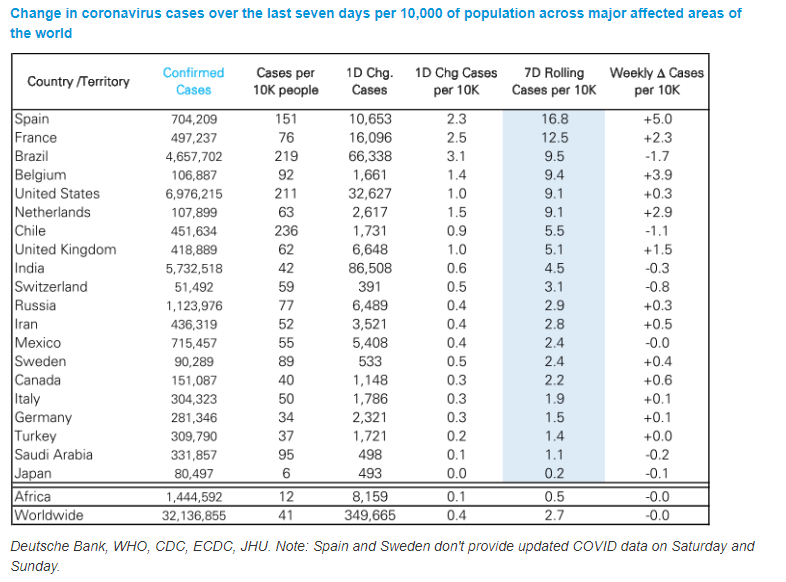
Update (0825ET): A team of analysts at Deutsche Bank have just put together the rankings showing the biggest outbreaks relative to population around the world over the past week.
Spain, France and Belgium are all among the leaders in terms of the weekly change in proportion to their respective populations.
Meanwhile, the Netherlands just reported 2,777 cases, a new record tally, as Europe’s ‘second wave’ of the outbreak continues to worsen.
* * *
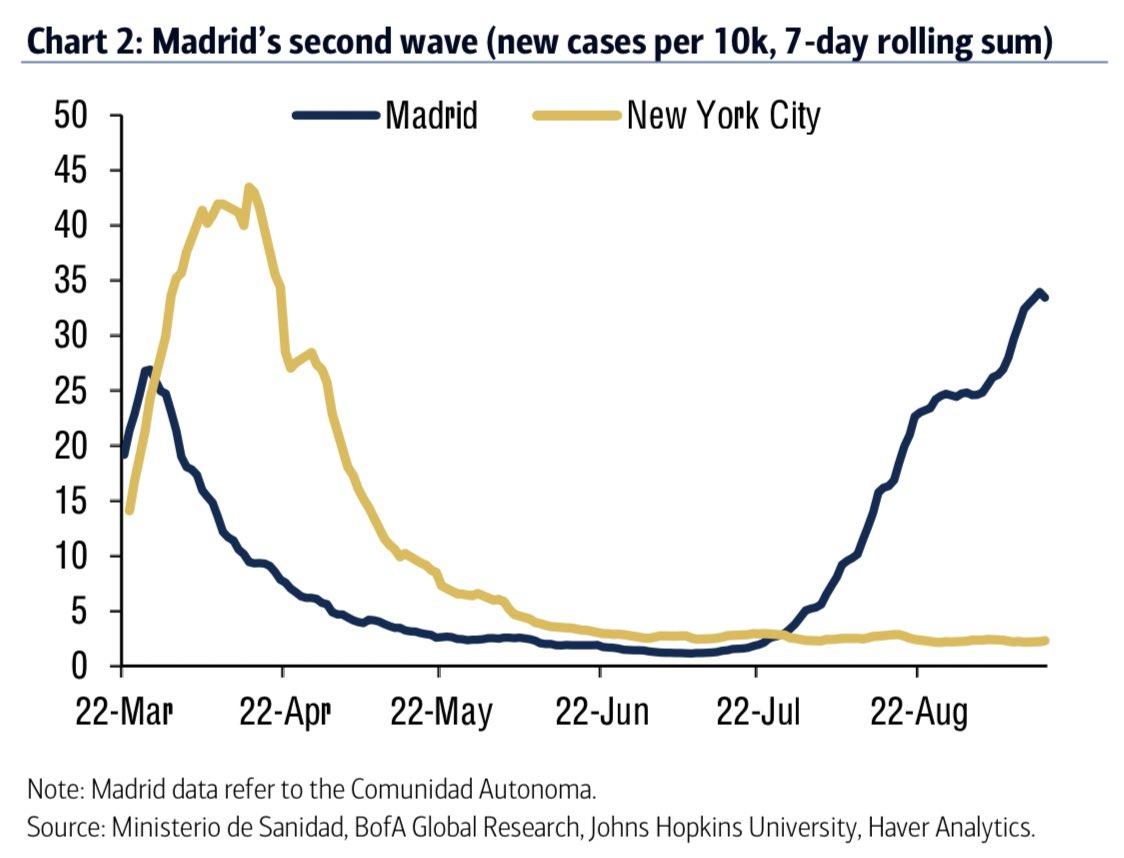
Update (0750ET): Madrid’s regional deputy health minister has just confirmed that the broader Madrid ‘local lockdown’ will be expanded to impact more than 1 million (some 1,025,000) people.
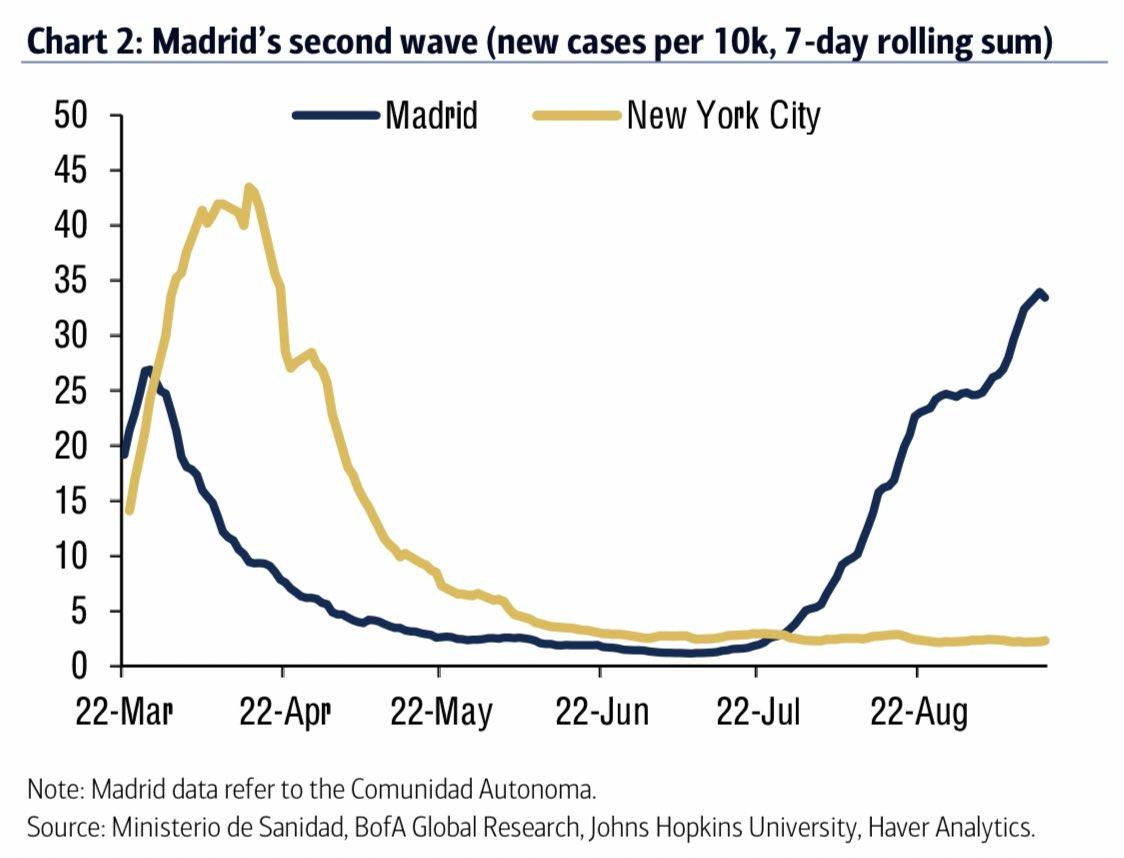
Yesterday, the FT published a deep dive comparing Madrid’s handling of the virus to NYC’s. It appears some Bank of America analysts have followed that up with a chart comparing the various ‘waves’ of outbreaks, Sputnik reported.
In other news, researchers in China reported Friday that some test subjects from a vaccine trial that started way back in March still have evidence of antibodies six months later.
Participants in China’s COVID-19 vaccine clinical trials retain a relatively high level of antibodies six months after inoculation, Zeng Guang, a leading epidemiologist at the Chinese Center for Disease Control and Prevention, said on Friday.
China approved clinical trials of its first coronavirus vaccine on March 16. The vaccine was developed by a team led by Chen Wei, an academician of the Academy of Military Medical Sciences, which headed to Wuhan in January to start research.
“At present, there are already relatively positive results, and serological tests show that the level of antibodies in the very first participants in clinical trials of the COVID-19 vaccine in our country is still quite high,” Zeng said at a briefing.
According to the researcher, “this indicates that the vaccine may have a fairly long protection period.”
China has been carrying out clinical trials of its first COVID-19 vaccine since March 16.
Now, Europe’s biggest economies are struggling to bring the coronavirus back under control as hospitalizations and newly confirmed cases soar. After announcing new curbs earlier this month, Madrid’s local government is expected to decide on Friday whether to expand restrictions on movement within the city of Madrid and its suburbs, with nearly 40% of ICU beds in the region around the Spanish capital filled with COVID-19 patients. France earlier this week just expanded restrictions in and around Marseilles.
Poland, which has continued to report record after record in terms of new cases, is expected to introduce new restrictions next week to combat the virus.
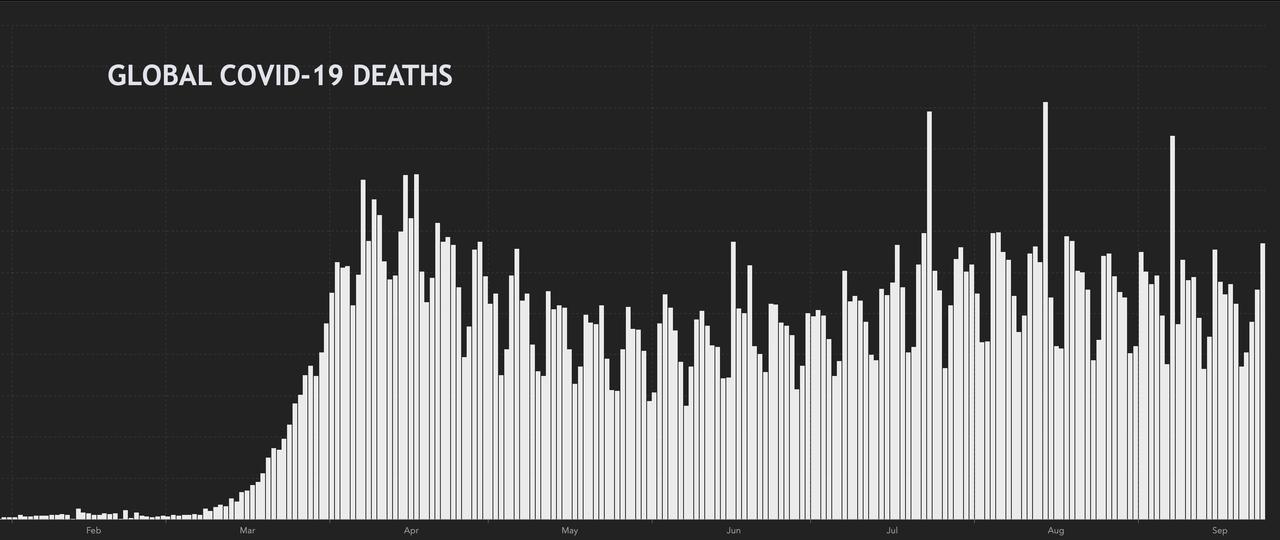
Globally, cases have surpassed 32 million, while deaths have surpassed 980k. The exact numbers as of 0630ET Friday were 32,261,676 cases and 983,492 deaths. Yesterday, the world saw a record surge, according to JHU data, with more than 361,000 new cases reported.
Another 6,704 deaths were reported, too.
Meanwhile, in the US, cases topped 7 million on Thursday – 20% of the global total – as outbreaks in Midwestern states continue to spread.
Even Sweden is introducing new social distancing guidelines as European cases climb. However, there’s also mounting evidence that lockdowns aren’t effective. Israel confirmed a record 7,527 new cases in a single day, bringing its total to 214,458, including 1,378 fatalities, after PM Benjamin Netanyahu moved ahead with another lockdown as cases in the small Levantine nation surge. Mounting paranoia among Britons fearing another lockdown has led to runs on supermarkets like we saw in March and April. On Friday, British supermarket Tesco introduced new restrictions on certain goods: 3 items per customer for flour, dried pasta, toilet paper, baby wipes, and anti-bacterial wipes.
In China, after reporting its first asymptomatic case in more than a month, authorities said they’re aiming to have 610 million vaccine doses ready by the end of the year, enough to vaccinate roughly half of China’s population. Yesterday, a government scientist warned max vaccination could take up to 2 years. By the end of 2021, it’s believed China will be able to produce up to 1 billion doses.
Here’s a roundup of the other big news this morning:
Sovereign wealth fund of Iran and Russia are discussing a joint production deal for a COVID-19 vaccine. (Source: Nikkei)
The WHO supports China’s decision to start administering experimental coronavirus vaccines to people, even as clinical trials are still underway (Source: Nikkei).
The Japanese government is planning to offer up to 1 million yen ($9,500) to people who move to rural areas while continuing to do their jobs in Tokyo remotely (Source: Nikkei).
Indonesia reported yet another new daily record tally of new cases for the third straight day, with 4,823 new infections and 113 additional deaths. The totals have reached 266,845 cases and 10,218 fatalities from COVID-19 (Source: Nikkei).
Russia’s daily tally of new cases hit its highest level since June 23, as officials reported 7,212 infections across the country, bringing the national tally to 1,136,048. The surge is largely being driven by Moscow, where new cases are up almost 50% overnight to 1,560 from 1,050 (Source: Nikkei).
India reports 86,052 cases in the last 24 hours, slightly down from 86,508 the previous day, bringing the country’s tally to over 5.8 million. The death toll jumped by 1,141 to 92,290. Of India’s total confirmed cases, 16.67% are active patients, while 81.74% have recovered, the health ministry says in its latest update, adding that the country’s COVID-19 mortality rate is at 1.59% (Source: Nikkei).
Germany recorded 2,321 new infections, the most since late April and taking the total to 281,346, according to data from Johns Hopkins University. It was the first figure above 2,000 since Saturday. Germany has seen an uptick in new cases since the start of August, though its daily rate remains well below 7,000 (Source: Bloomberg).
New York City health inspectors will start entering private schools in several Brooklyn and Queens neighborhoods experiencing an outbreak, the city health department announced Thursday. Officials are adding enforcement personnel to ensure people comply with mask and social distancing requirements. The city may tighten rules to ban gatherings of more than 10 people in those areas, close schools or impose fines if mask standards aren’t met (Source: Bloomberg).
North Dakota reported eight new deaths, matching the record reached last weekend. Among the total 211 fatalities, 64 have been reported in September. Another 471 new cases were reported in Wisconsin yesterday, among the highest daily tallies yet, pushing the state’s total to a still-meager 19,451 cases. The state also hit a record of active cases, 3,483. However, positive-test rates were 18%, compared with less than 1% in New York (Source: Bloomberg).
via ZeroHedge News https://ift.tt/3i0HKT9 Tyler Durden