Here’s How Central Banks Will Finally Unleash Inflation: The Shenzhen Case Study

Here’s How Central Banks Will Finally Unleash Inflation: The Shenzhen Case Study

Tyler Durden

Sun, 11/29/2020 – 19:05

Back in 2009, when the Fed first launched QE, a majority of traders and strategists were convinced that the Fed would spark an inflationary inferno as a result of the hundreds of billions of dollars (back then, that was a big number) of liquidity injected into markets and which – using the Weimar Republic as an example – consensus expected would find their way to the broader economy triggering sharply higher prices as a result of global currency devaluation.

And while one part of this forecast turned out to be true, with asset prices indeed hyperinflating in the subsequent decade, the flood of central bank reserves did little to boost benign broader economy inflation, i.e., wages.

It’s also why a decade later, with central banks now injecting a berserk $300BN each month, the 10Y continues to trade well below 1% – the simple reason is that having failed to spark broader inflation, the market is convinced that nothing the Fed and its central bank peers do can change this default dynamic.

But if consensus was dead wrong about the economic outcome of the first QE back in 2009, could consensus be just as wrong now, and with most expecting deflation no matter how big the QE, could central banks finally “succeed” in sparking runaway inflation?

The answer is yes and it will come in the form of digital currencies which we – and DoubleLine – have discussed extensively in the past year, which while the biggest economic and financial story of the year by far, has been successfully drowned in the noise surrounding covid and the US presidential election.

But before we get into the specifics of how, here is another take on why, courtesy of BofA Chief Investment Officer Michael Hartnett, who believes that the key theme of the next decade will be “Dollar Debasement & Digital Currencies”, to wit:

2020 saw $21tn of global fiscal and monetary stimulus. The US federal deficit skyrocketed to 25% of GDP, second only to WWII (27%). Global debt is expected to hit $277tn or 365% of GDP by year end, an all-time high while global interest rates are at their lowest level in 5,000 years. In the coming decade, loss of central bank independence, shift towards digital currencies as conduits for policy (UBI, “helicopter drops”, student debt forgiveness), introduction of Yield Curve Control & stealth Modern Monetary Theory, the end of era of “financial engineering” and considerable public sector deficits are all reasons we think the US will find it tougher to finance current account surpluses in coming years…the dollar likely will decline, bullish for commodities & EM.

But while all that sounds great in theory, the real question as always is how does it work in practice.

The answer, as so often happens when it comes to financial experimentation, comes from China which is the most advanced nation in the development and rollout of digital currencies. Culminating a monetary revolution process that has been 6 years in the making, China started ramping up trials with the digital yuan last April, when it ran a pilot program that reportedly included US companies like McDonald’s and Subway…
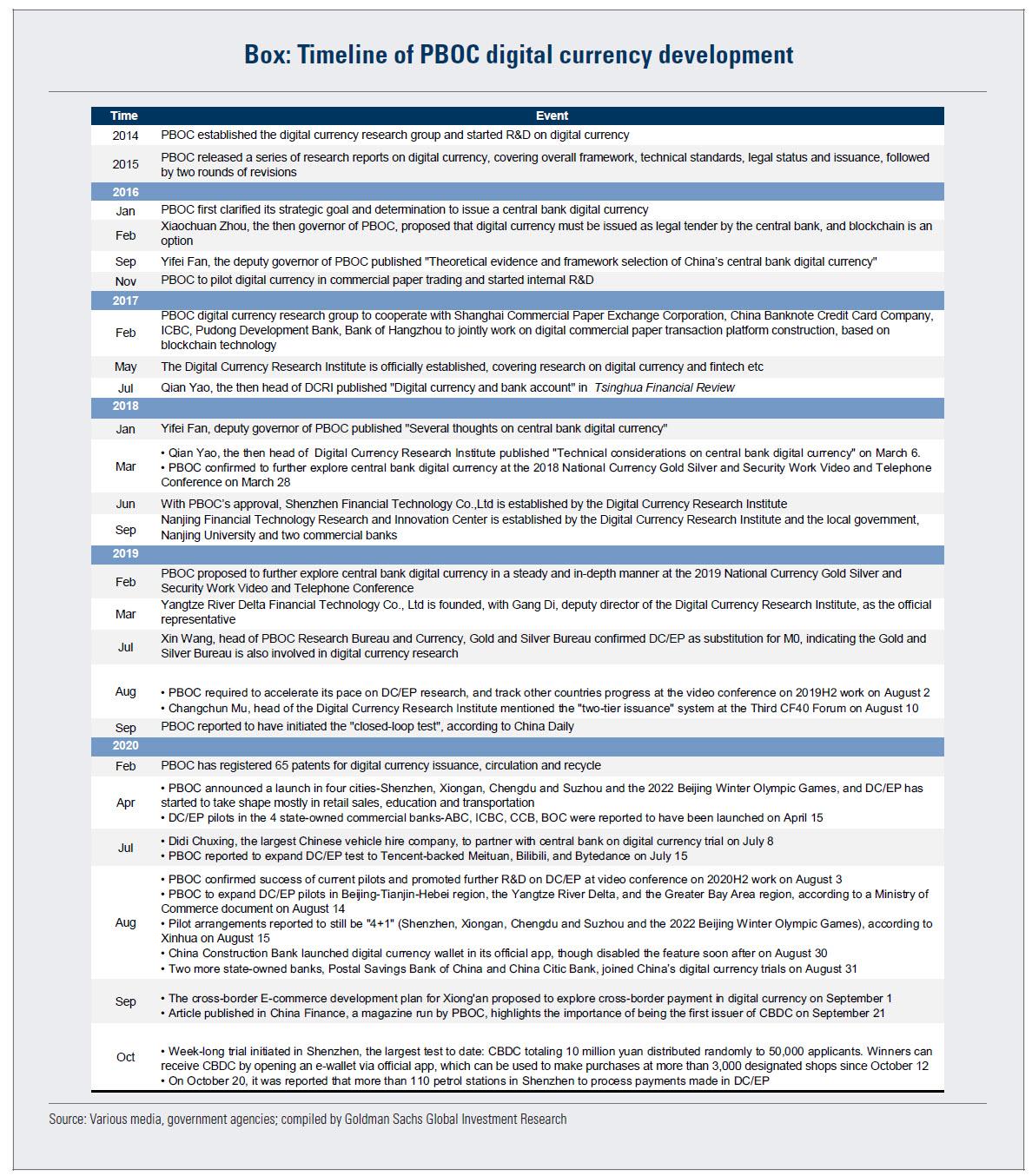
… and then in October, China launched one of the biggest real-world trials for its digital currency, when the government in Shenzhen carried out a lottery to give away a total of 10 million yuan (about $1.5 million) worth of the digital currency. Nearly 2 million people applied and 50,000 people actually won.

Shenzhen

The winners are required to download a digital Renminbi app in order to receive a “red packet” worth 200 digital yuan ($30), which they can then spend at over 3,000 designated retailers in Shenzhen’s Luohu district, according to China Daily. After that, they’ll be able to buy goods from local pharmacies, supermarkets and even Walmart.

The idea was to not only test the technology involved, but boost consumer spending in the wake of the COVID-19 pandemic. In short, China is not only subsidizing the centrally-planned economy by manipulating the supply-side of the question- it now can prop up demand by handing out digital currency to anyone (or everyone).

Of course, unlike traditional central bank account-based currencies such as reserves, or decentralized cryptocurrencies like bitcoin, China’s digital currency would be controlled by the country’s central bank and will be instantly made available at a moment’s notice to anyone who can receive it.

China’s adoption of digital central bank tokens is expected to be seamless as most of the nation’s digital payments already pass through companies like TenCent and AliPay and are already very popular in the country.

The successful Shenzhen test means that a broad rollout is just a matter of time.

As we have discussed repeatedly in recent months, central banks around the world are rushing to roll out the idea of issuing digital currencies. In October, the Bank for International Settlements and seven central banks published a framework for central bank digital currencies, or CBDCs.

Needless to say, without any consumer-facing liability – it’s not a loan or a debt – the propensity to spend the digital currency is virtually instant and without limitation. After all, it’s money that the central bank (in this case PBOC) created out of thin air and has handed out to whoever it so chooses – a form of massive universal basic income or unprecedented population subsidy – in hopes of sparking higher prices.

Consider it a way for central banks to atone for the fact that their policies were unable to boost wages in the past decade; instead, they will now simply hand out money with little regard for the consequences, as long as the consequences are sufficiently reflationary they allow some of the global massive debt tsunami which is now at $277 trillion, or 365% of GDP, to be inflated away.

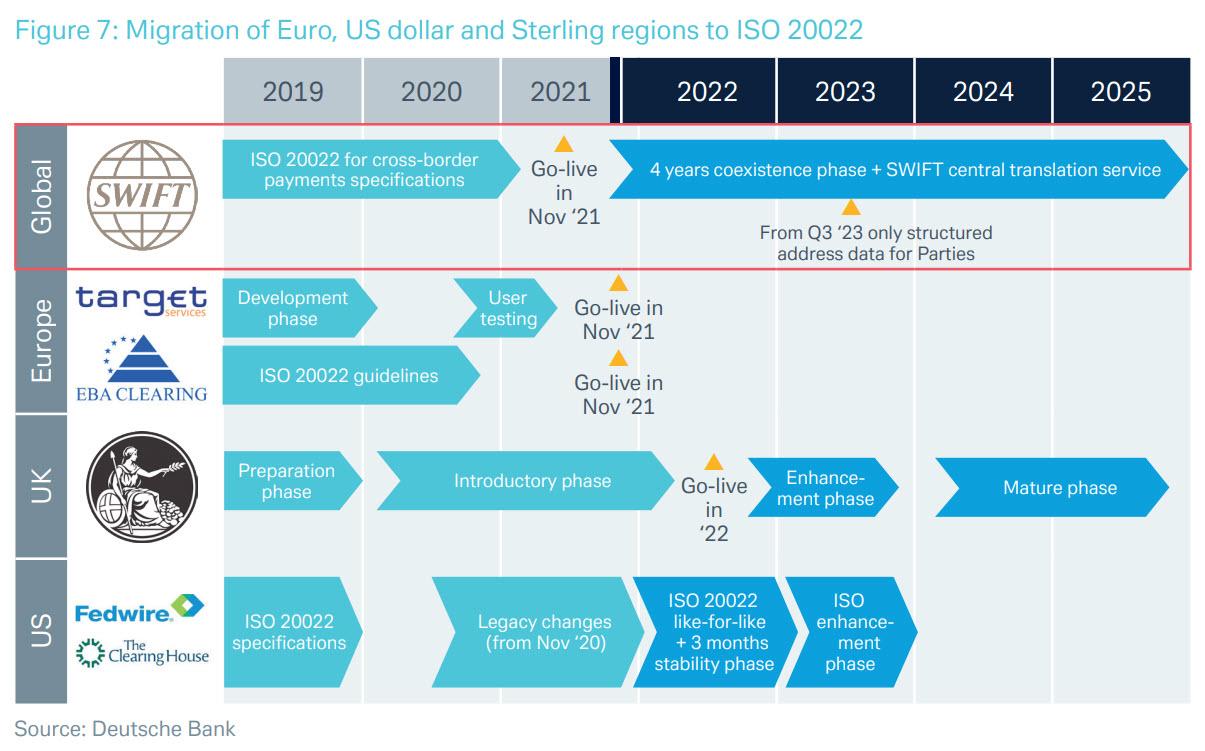
Finally timing: according to tentative estimates for the rollout of ISO 20022, which is the required universal transaction standard which will make payment in digital currencies possible, we are looking at a 2022 launch date.
via ZeroHedge News https://ift.tt/2JhYZE4 Tyler Durden

Newt Gingrich: 2020 Election May Be Biggest Presidential Theft Since 1824

Newt Gingrich: 2020 Election May Be Biggest Presidential Theft Since 1824

Tyler Durden

Sun, 11/29/2020 – 18:40

Authored by Ivan Pentchoukov via The Epoch Times,

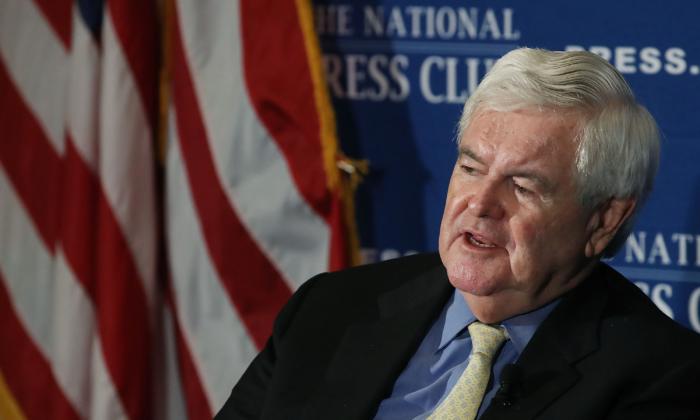
Former Republican House Speaker New Gingrich said on Friday that the 2020 election may have been subject to the biggest theft in nearly two centuries.

“The more data comes out on vote anomalies that clearly are not legitimate the more it looks like 2020 may be the biggest Presidential theft since Adams and Clay robbed Andrew Jackson in 1824. State legislatures should demand recounts,” Gingrich wrote on Twitter.

President Donald Trump and his allies are waging legal battles in several states in a bid to identify and disqualify potential illegal votes or to invalidate the election results there entirely. The lawsuits have served as vehicles for the release of sworn affidavits from witnesses who detailed widespread malpractice and alleged fraud in the 2020 election.

In an op-ed for The Epoch Times written earlier the same week, Gingrich said that the “thieves” who stole the 2020 election “got sloppy.”

“Stealing the 2020 election was a mammoth undertaking, involving widespread lawlessness and illicit partnerships between private actors and public officials. They’ve been working to cover their tracks since Election Day, but they didn’t work fast enough,” Gingrich said.

“Now, the courts need to stop them from destroying any more evidence so that the people of Pennsylvania—and the rest of the country—can accurately assess the ramifications of their wrongdoing.”

Recounts were ongoing on Sunday in Georgia and Wisconsin.

Rudy Giuliani, the attorney leading Trump’s post-election legal effort, testified in a special session held by Pennsylvania state lawmakers last week. The lawmakers also heard from a number of witnesses who alleged fraudulent activity taking place during the processing, counting, and reporting of the votes.

“This voter fraud that took place, which as you will see from the witnesses that we call, had several dimensions to it, several different ways in which it was done. The most dangerous thing is, it is very, very similar in at least six states that we’ve been able to study,” Giuliani said.

Following the hearing, Pennsylvania’s Republican state lawmakers said they were gathering support for a resolution to decertify the state’s election results and appoint presidential electors through the legislature.

Trump’s legal team said a hearing similar to the one in Pennsylvania will take place in Arizona on Monday.

via ZeroHedge News https://ift.tt/2JopTde Tyler Durden

Sixth Circuit Buries South Bay, but Distinguishes Diocese

Earlier today, Eugene blogged about Kentucky ex rel. Danville Christian Academy, Inc. v. Beshear. The Kentucky Governor, a Democrat, prohibited in-person instruction at all public and private schools. The Kentucky Attorney General, a Republican, challenged the constitutionality of that order. The District Court ruled before Diocese, and found that the order violated the Free Exercise Clause. The District Court entered a Commonwealth-wide injunction that applied to all religious schools. On appeal, a panel of the Sixth Circuit stayed the injunction.

The sweetest sentence came on the penultimate page:

In determining that plaintiffs are unlikely to succeed on the merits of their Free Exercise claim, we also have no need to rely upon either South Bay United Pentecostal Church v. Newsom, 140 S. Ct. 1613 (2020) (Mem.) (Roberts, C.J., concurring), or Jacobson v. Massachusetts, 197 U.S. 11 (1905).

Amen. No court should have ever relied on those precedents. Earlier this week, I wrote that Diocese marked the end of the South Bay “Superprecedent.” So far, so good.

The panel proceeded to distinguish this case from Diocese.

Moreover, the order at issue in Roman Catholic Diocese treated schools, factories, liquor stores, and bicycle repair shops, to name only a few, “less harshly” than houses of worship. 2020 WL 6948354 at *2; see also id. at *4 (Gorsuch, J., concurring). Similarly, the orders at issue in Roberts and Maryville Baptist Church excepted from their requirements airlines, funeral homes, liquor stores, and gun shops, again to name only a few. See Roberts, 958 F.3d at 414; Maryville Baptist Church, 957 F.3d at 614. No such comparable exceptions apply to Executive Order 2020-969. And the exceptions expressly provided for in the order—for “small group in-person targeted services” and “private schools conducted in a home”—are nothing like “the four pages of exceptions in the orders” addressed in Roberts, 958 F.3d at 413. The contours of the order at issue here also in no way correlate to religion, and cannot be plausibly read to contain even a hint of hostility towards religion. Cf. Roman Catholic Diocese, 2020 WL 6948354, at *1.

The panel also looked favorably to Justice Kavanaugh’s concurrence.

Justice Kavanaugh has reasoned that, under Smith, 494 U.S. 872, we should look “not [to] whether religious worship services are all alone in a disfavored category, but why they are in the disfavored category to begin with.” Calvary Chapel Dayton Valley v. Sisolak, 140 S. Ct. 2603, 2614 (2020) (Mem.) (Kavanaugh, J., dissenting). Here, religious schools are in the category of “K–12 schools” because the reasons for suspending in-person instruction apply precisely the same to them. See Church of Lukumi, 508 U.S. at 543. Any burden on plaintiffs’ religious practices is “incidental” and therefore not subject to strict scrutiny. See Roberts, 958 F.3d at 413. In Justice Kavanaugh’s concurrence in Roman Catholic Diocese, he emphasized that, “[i]n light of the devastating pandemic, . . . the State[ has the] authority to impose tailored restrictions—even very strict restrictions—on attendance at religious services and secular gatherings alike.” 2020 WL 6948354, at *8 (Kavanaugh, J., concurring). Executive Order 2020-969 does just that. Unlike in Roman Catholic Diocese, there is no evidence that the challenged restrictions were “targeted” or “gerrymandered” to ensure an impact on religious groups. Id. at *1. In addition, while many of the houses of worship in Roman Catholic Diocese could seat well over 500 people, they were subject to attendance caps of ten or twenty-five persons, while retail businesses were not. See id. at *2. There is no comparable harsh requirement aimed at religious institutions here.

The panel–judges Moore, Rogers, and White–was a very favorable draw for the Governor, given the Sixth Circuit’s current makeup. I think Judge Moore was wise to cite Justice Kavanaugh. But she completely missed his “most favored” right methodology. She was trying to cert-proof her opinion. It won’t work.

Perhaps the Attorney General could seek the equivalent of en banc review of the stay application. I’m not sure if the Sixth Circuit permits such an application for en banc. (The validity of that procedure is an open question in the Fifth Circuit.) Or the Attorney General could seek a stay application from the Supreme Court. I hope the Court can clarify, now or later, precisely what makes a law not neutral. And here we have a slightly different context: religious schools, rather than houses of worship.

On appeal, this case may shake out differently than Diocese. Here, the District Court granted an injunction. The Chief would not have to issue an injunction. He would simply decide whether to stay the Court of Appeals’s stay.

from Latest – Reason.com https://ift.tt/3le3X1K
via IFTTT

France’s Highest Court Orders Easing of Church Attendance Limits

Reuters (Gilles Guillaume & Antony Paone) reports that the court (the State Council)  “ordered the government to review a law limiting the number of people in churches during religious services to 30”:

“The claimants are right in saying that the measure is disproportionate in light of protecting the public’s health … thus it is a serious and illegal infringement on the freedom of worship,” the council said….

“No other activity is limited by such a limitation regardless of surface area,” [the Conference of French Bishops] said.

Catholic organisations are proposing to allow churches to utilise 30% of their seating capacity.

Thanks to Prof. Howard Friedman (Religion Clause) for the pointer.

from Latest – Reason.com https://ift.tt/3fLTAB4
via IFTTT

Former Overstock CEO Paying ‘Team Of Hackers And Cybersleuths’ To Prove Trump Won Election

Former Overstock CEO Paying ‘Team Of Hackers And Cybersleuths’ To Prove Trump Won Election

Tyler Durden

Sun, 11/29/2020 – 18:15

Patrick Byrne, former CEO of Overstock.com, says he’s funding a group of ‘hackers, cybersleuths, and other people with odd skills’ to prove that Democrats cheated in the 2020 election, and that President Trump rightfully won.

“I’ve funded a team of hackers and cybersleuths, other people with odd skills,” Byrne told One America News.

The 57-year-old multimillionaire also appeared on several podcasts, including a November 23 appearance in which he said: “I’m a free agent, and I’m self-funded, and I’m funding this army of various odd people,” according to the Daily Beast.

“It’s really going to make a great movie someday,” he added.

Byrne claims he’s funding teams of “hackers and crackers” who realized all the way back in August that Dominion voting machines could be used to steal the election from Trump. Since the election, those voting machines have figured prominently in Trump supporters’ allegations of fraud, despite the company’s repeated denials and any actual proof the voting tallies were changed. –Daily Beast

Byrne says he’s been communicating with former Trump attorney Sidney Powell for weeks – who last week filed two lawsuits in Michigan and Georgia alleging massive schemes to rig the election for Joe Biden.

According to Powell’s Georgia lawsuit: “Old-fashioned ballot-stuffing” has been “amplified and rendered virtually invisible by computer software created and run by domestic and foreign actors for that very purpose,” adding that “Mathematical and statistical anomalies rising to the level of impossibilities, as shown by affidavits of multiple witnesses, documentation, and expert testimony evince this scheme across the state of Georgia.”

In Michigan, Powell claims that “hundreds of thousands of illegal, ineligible, duplicate, or purely fictitious ballots” enabled by “massive election fraud” facilitated Biden’s win in the state.

The suit claimed that election software and hardware from Dominion Voting Systems used by the Michigan Board of State Canvassers helped facilitate the fraud.

More via Natural News:

Speaking to Christopher McDonald of The McFiles in a recent interview, the former head of a $200 billion e-commerce company that has never once gotten hacked revealed that Dominion Voting Systems were used to perform a “Drop and Roll” technique of voter fraud that slyly padded the vote for Biden in at least five key swing areas of the country.

Atlanta, Detroit, Milwaukee, Philadelphia, and Maricopa County, Arizona (Phoenix) were all rigged prior to election day to strip President Trump of his rightful win in each of these states. Byrne also mentioned Clark County, Nevada (Las Vegas) as another election fraud locale, though this one was more secondary.

According to Byrne, who is not a supporter of President Trump but rather a “small l” libertarian, these five (or six if you include Clark County) areas are where a bulk of the election fraud took place. It did not have to be widespread because these were the key swing areas that Biden needed to “win” in order to steal the election.

By cheating those five counties, you flip five key states, you flip the electoral college,” Byrne says. “In places where Trump lost by 10,000, there may be 300,000 fake, illegal votes for Biden. So this isn’t even close.

He further contends that the election systems that govern elections in America “are a joke,” especially those run by Dominion Voting Systems and Smartmatic software.

*  *  *

Is Byrne’s ‘army’ Sidney Powell’s research team?

via ZeroHedge News https://ift.tt/2JlXTHc Tyler Durden

Biden’s Economic, Communications Team Is Full Of Women

Biden’s Economic, Communications Team Is Full Of Women

Tyler Durden

Sun, 11/29/2020 – 18:08

Following his recent decision to appoint Janet Yellen as new Treasury Secretary, Joe Biden has decided to fill many of the key economic advisory spots with female staffers, all close to either Obama or Hillary Clinton.

Biden is turning to longtime Hillary Clinton ally and Democratic policy staffer Neera Tanden to lead his Office of Management and Budget, while Cecilia Rouse will be head the Council of Economic Advisers, according to Bloomberg.

Tanden, who currently leads the the liberal think-tank Center for American Progress, worked on the Obama administration’s health-care reform and was a close adviser to Hillary Clinton on her failed 2016 campaign. 

Rouse also worked in the Obama administration as a member of the CEA and is currently dean of Princeton University’s School of Public and International Affairs.

Biden will also nominate Adewale “Wally” Adeyemo to be deputy treasury secretary. Previously Wally worked as President of the Obama Foundation.

Biden isn’t stopping there, and according to a separate Bloomberg report Biden’s senior communications team is composed entirely of women, including Jen Psaki as White House press secretary. Psaki, a former Obama White House communications director and State Department spokeswoman, has been an on-camera spokeswoman for Biden’s transition office. 

Other women who will be tasked with interpreting Biden’s “communications” include:

  • Kate Bedingfield, deputy campaign manager and communications director during the 2020 campaign, who will be Biden’s White House communications director.
  • Karine Jean-Pierre will be principal deputy press secretary after serving as a senior adviser during the campaign. She also worked on Barack Obama’s two presidential campaigns and in his White House as a regional political director.
  • Pili Tobar, the Biden campaign’s communications director for coalitions, will be deputy communications director.
  • Liz Alexander, whose work with Biden dates back to his time in the Senate, will be communications director for Jill Biden.

President-in-waiting Kamala Harris is also betting heavily on women:

  • Ashley Etienne, a former communications director and senior adviser to House Speaker Nancy Pelosi, will be Vice President-elect Kamala Harris’s communications director.
  • Symone Sanders, one of Biden’s most visible campaign aides, will be senior adviser and chief spokesperson for Harris. Sanders advised Harris and traveled with her during the final weeks of the campaign, a task she’s continued in during the transition.

via ZeroHedge News https://ift.tt/3fNOYKD Tyler Durden

Sixth Circuit Buries South Bay, but Distinguishes Diocese

Earlier today, Eugene blogged about Kentucky ex rel. Danville Christian Academy, Inc. v. Beshear. The Kentucky Governor, a Democrat, prohibited in-person instruction at all public and private schools. The Kentucky Attorney General, a Republican, challenged the constitutionality of that order. The District Court ruled before Diocese, and found that the order violated the Free Exercise Clause. The District Court entered a Commonwealth-wide injunction that applied to all religious schools. On appeal, a panel of the Sixth Circuit stayed the injunction.

The sweetest sentence came on the penultimate page:

In determining that plaintiffs are unlikely to succeed on the merits of their Free Exercise claim, we also have no need to rely upon either South Bay United Pentecostal Church v. Newsom, 140 S. Ct. 1613 (2020) (Mem.) (Roberts, C.J., concurring), or Jacobson v. Massachusetts, 197 U.S. 11 (1905).

Amen. No court should have ever relied on those precedents. Earlier this week, I wrote that Diocese marked the end of the South Bay “Superprecedent.” So far, so good.

The panel proceeded to distinguish this case from Diocese.

Moreover, the order at issue in Roman Catholic Diocese treated schools, factories, liquor stores, and bicycle repair shops, to name only a few, “less harshly” than houses of worship. 2020 WL 6948354 at *2; see also id. at *4 (Gorsuch, J., concurring). Similarly, the orders at issue in Roberts and Maryville Baptist Church excepted from their requirements airlines, funeral homes, liquor stores, and gun shops, again to name only a few. See Roberts, 958 F.3d at 414; Maryville Baptist Church, 957 F.3d at 614. No such comparable exceptions apply to Executive Order 2020-969. And the exceptions expressly provided for in the order—for “small group in-person targeted services” and “private schools conducted in a home”—are nothing like “the four pages of exceptions in the orders” addressed in Roberts, 958 F.3d at 413. The contours of the order at issue here also in no way correlate to religion, and cannot be plausibly read to contain even a hint of hostility towards religion. Cf. Roman Catholic Diocese, 2020 WL 6948354, at *1.

The panel also looked favorably to Justice Kavanaugh’s concurrence.

Justice Kavanaugh has reasoned that, under Smith, 494 U.S. 872, we should look “not [to] whether religious worship services are all alone in a disfavored category, but why they are in the disfavored category to begin with.” Calvary Chapel Dayton Valley v. Sisolak, 140 S. Ct. 2603, 2614 (2020) (Mem.) (Kavanaugh, J., dissenting). Here, religious schools are in the category of “K–12 schools” because the reasons for suspending in-person instruction apply precisely the same to them. See Church of Lukumi, 508 U.S. at 543. Any burden on plaintiffs’ religious practices is “incidental” and therefore not subject to strict scrutiny. See Roberts, 958 F.3d at 413. In Justice Kavanaugh’s concurrence in Roman Catholic Diocese, he emphasized that, “[i]n light of the devastating pandemic, . . . the State[ has the] authority to impose tailored restrictions—even very strict restrictions—on attendance at religious services and secular gatherings alike.” 2020 WL 6948354, at *8 (Kavanaugh, J., concurring). Executive Order 2020-969 does just that. Unlike in Roman Catholic Diocese, there is no evidence that the challenged restrictions were “targeted” or “gerrymandered” to ensure an impact on religious groups. Id. at *1. In addition, while many of the houses of worship in Roman Catholic Diocese could seat well over 500 people, they were subject to attendance caps of ten or twenty-five persons, while retail businesses were not. See id. at *2. There is no comparable harsh requirement aimed at religious institutions here.

The panel–judges Moore, Rogers, and White–was a very favorable draw for the Governor, given the Sixth Circuit’s current makeup. I think Judge Moore was wise to cite Justice Kavanaugh. But she completely missed his “most favored” right methodology. She was trying to cert-proof her opinion. It won’t work.

Perhaps the Attorney General could seek the equivalent of en banc review of the stay application. I’m not sure if the Sixth Circuit permits such an application for en banc. (The validity of that procedure is an open question in the Fifth Circuit.) Or the Attorney General could seek a stay application from the Supreme Court. I hope the Court can clarify, now or later, precisely what makes a law not neutral. And here we have a slightly different context: religious schools, rather than houses of worship.

On appeal, this case may shake out differently than Diocese. Here, the District Court granted an injunction. The Chief would not have to issue an injunction. He would simply decide whether to stay the Court of Appeals’s stay.

from Latest – Reason.com https://ift.tt/3le3X1K
via IFTTT

2016 and 2020: Progressives Counted Their SCOTUS Chickens Before They Hatched

Flash back to October 2016. Justice Scalia’s seat was vacant. Hillary Clinton was almost President-elect. And a quasi-conservative majority would soon be a thing of the past. Forget Merrick Garland. The Court would now have a permanent liberal majority for a generation. And progressives were ecstatic. Conservative precedents like HellerCitizens UnitedShelby County, and others cases were on the chopping block. Originalism was dead. And then election day happened. Trump won and appointed Justice Gorsuch to the Court. Then, Justice Kennedy retired, and was replaced by Justice Kavanaugh.

Now, flash back to September 2016. Joe Biden was almost President-elect. He would be ushered into Congress by a blue wave. Large majorities in both houses of Congress would eliminate the filibuster, and pass “Court Reform” legislation. Nine is a good number, but eleven is better. Conservative precedents like HellerCitizens UnitedShelby County, and others cases were once again on the chopping block. But once again, things did not go according to plan. Justice Ginsburg passed away. President Trump filled the vacancy with Justice Barrett. Biden won the election, but there was no blue wave. The Democratic majority shrank. And, best case scenario, the Democrats will have 50 votes in the Senate. “Court Reform” is off the table, at least for the next two, and probably four years.

This loss must be so difficult, because victory was so close. For the second election cycle in a row, progressives counted their SCOTUS chickens before they hatched. I don’t take joy in this loss–call it Garlandfreude. Instead, I take away an important lesson. Over the next two-to-four years, when progressives criticizes the Court–as they certainly will–I will frame that criticism in terms of what could have been. Every Kagan dissent could have been a Kagan majority. Every Gorsuch concurrence could have been a Gorsuch dissent. Every conservative cert grant should have been a cert denied. Every circuit vacancy that remains vacant should have been filled with a shortlister. Every conservative circuit en banc opinion should have been a conservative dissental. And so on.

Conservatives can commiserate. Stevens. O’Connor. Bork. Ginsburg. Kennedy. Souter. Roberts. Victory was so close, they could taste it. And so on.

from Latest – Reason.com https://ift.tt/3mkruiT
via IFTTT

France’s Highest Court Orders Easing of Church Attendance Limits

Reuters (Gilles Guillaume & Antony Paone) reports that the court (the State Council)  “ordered the government to review a law limiting the number of people in churches during religious services to 30”:

“The claimants are right in saying that the measure is disproportionate in light of protecting the public’s health … thus it is a serious and illegal infringement on the freedom of worship,” the council said….

“No other activity is limited by such a limitation regardless of surface area,” [the Conference of French Bishops] said.

Catholic organisations are proposing to allow churches to utilise 30% of their seating capacity.

Thanks to Prof. Howard Friedman (Religion Clause) for the pointer.

from Latest – Reason.com https://ift.tt/3fLTAB4
via IFTTT

Judge Blocks, Then Unblocks Georgia From Wiping Or Resetting Election Machines

Judge Blocks, Then Unblocks Georgia From Wiping Or Resetting Election Machines

Tyler Durden

Sun, 11/29/2020 – 17:48

Authored by Ivan Pentchoukov and Petr Svab via The Epoch Times,

A federal judge presiding over a major election lawsuit in Georgia on Sunday issued and then reversed an order directing the state to cease and desist wiping or resetting election machines.

“Defendants are ordered to maintain the status quo & are temporarily enjoined from wiping or resetting any voting machines in the State of Georgia until further order of the court,” Judge Timothy Batten wrote in an emergency order issued Nov. 29.

The judge reversed the order not long after, explaining that the defendants are not in possession of the machines.

“Plaintiffs’ request fails because the voting equipment that they seek to impound is in the possession of county election officials. Any injunction the Court issues would extend only to Defendants and those within their control, and Plaintiffs have not demonstrated that county election officials are within Defendants’ control. Defendants cannot serve as a proxy for local election officials against whom the relief should be sought,” the judge wrote.

The change of course by the judge drew a flabbergasted response from Lin Wood, an attorney associated with the Trump campaign.

“What??? Judge reversed order based on Defendants’ claim that GA Counties control voting machines,” Wood wrote on Twitter, adding that the machines are owned by the state and that the Georgia secretary of state administers elections.

“Why are GA officials determined to wipe these machines clean [by] resetting them?”

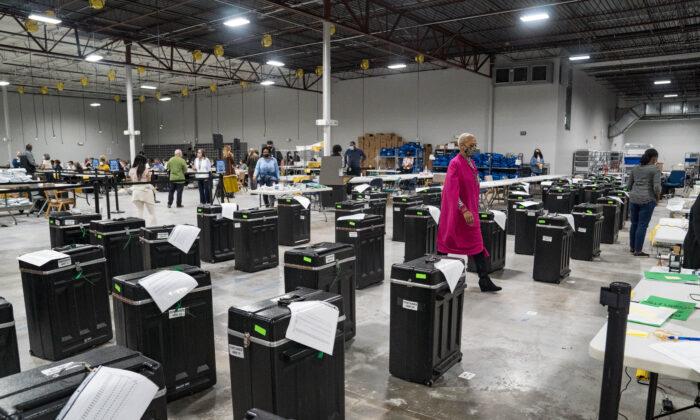
The plaintiffs in the lawsuit on Sunday filed an emergency motion which included an affidavit featuring a Nov. 25 message from an election official stating that the ballot-counting machines would be reset to zero on Monday, Nov. 30, before performing a recount.

“The process will begin with an L & A – resetting the machine to ‘zero’ to begin the recount,” the text of the message stated before describing the specifics of the recount process.

The affidavit was written by a GOP poll worker who says he or she addressed concerns about wiping the machines to the election manager.

“Because the plan on Monday is to wipe the voting machines clean, and start from 0 so that we can recount using those machines, I’m concerned by what I am reading online,” the poll worker wrote, according to the affidavit.

“I am seeing lots of notices from lawyers about possibly impounding the machines. Lawyers are now saying that the machines should be confiscated immediately before this happens to protect forensic data. They are saying those machines need to be impounded ASAP. Yikes. Maybe I’m being overly paranoid but let’s be sure this is what we’re supposed to be doing.”

The supervisor responded, “It’s what we are supposed to do. It will take a court order to stop this process—so I guess we need to keep watching the news. If we get a court order to stop, we will see it in our SOS information. The issue is, the Atlanta area has already started,” the elections manager wrote.

When the poll worker asked if the reset will wipe the forensic info from the machines, the manager said that “Atlanta already did it.”

The lawsuit in question is being litigated by Sidney Powell, an attorney who defended former national security adviser Lt. Gen. Michael Flynn. President Donald Trump pardoned Flynn earlier this week. The Trump campaign has said that Powell is not part of its legal team.

Georgia Republican Party Chairman David Shafer wrote on Twitter after the judge issued the order that election officials in Fulton County were updating the software on voting systems earlier the same day.

“Our Republican recount monitors at the World Congress Center waited today for four hours while Fulton County elections officials ‘updated the software.’ The explanation given to me—‘just the usual Fulton County incompetence’—is completely unacceptable,” Shafer wrote on Twitter.

“It is outrageous that we cannot rely on Fulton County elections officials to do their jobs without unexplained four hour delays, interventions by private attorneys and federal court orders.”

Voting Systems

The lawsuit makes a number of allegations regarding the voting machines and software supplied by Dominion Voting Systems, which is used in Georgia and many other states.

The lawsuit cites an affidavit written by a former electronic intelligence analyst under 305th Military Intelligence Battalion, who testified that the software used by the Dominion machines was accessed by agents of malicious actors, such as China and Iran, “in order to monitor and manipulate elections,” including the 2020 election.

The suit further alleges that the machines are connected to the internet, even though they aren’t supposed to be, and are easily hacked, based on multiple expert declarations. The machines have built-in functions that allow operators to manipulate the results, several experts cited in the lawsuit said.

Dominion has vehemently denied that its machines were used to manipulate vote counts.

“Servers that run Dominion software are located in local election offices, and data never leaves the control of local election officials,” the company’s website states.

“All U.S. voting systems must provide assurance that they work accurately and reliably as intended under federal U.S. EAC and state certifications and testing requirements. Dominion’s voting systems are certified for the 2020 elections.”

via ZeroHedge News https://ift.tt/2JrcgtX Tyler Durden