Visualizing 50 Years Of Gaming History, By Revenue Stream (1970-2020)

Visualizing 50 Years Of Gaming History, By Revenue Stream (1970-2020)

Tyler Durden

Sat, 11/28/2020 – 22:30

Every year it feels like the gaming industry sees the same stories—record sales, unfathomable market reach, and questions of how much higher the market can go.

We’re already far past the point of gaming being the biggest earning media sector, with an estimated $165 billion revenue generated in 2020.

But as Visual Capitalist’s Omri Wallach illustrates in the infographic below, it’s important to break down shifting growth within the market.
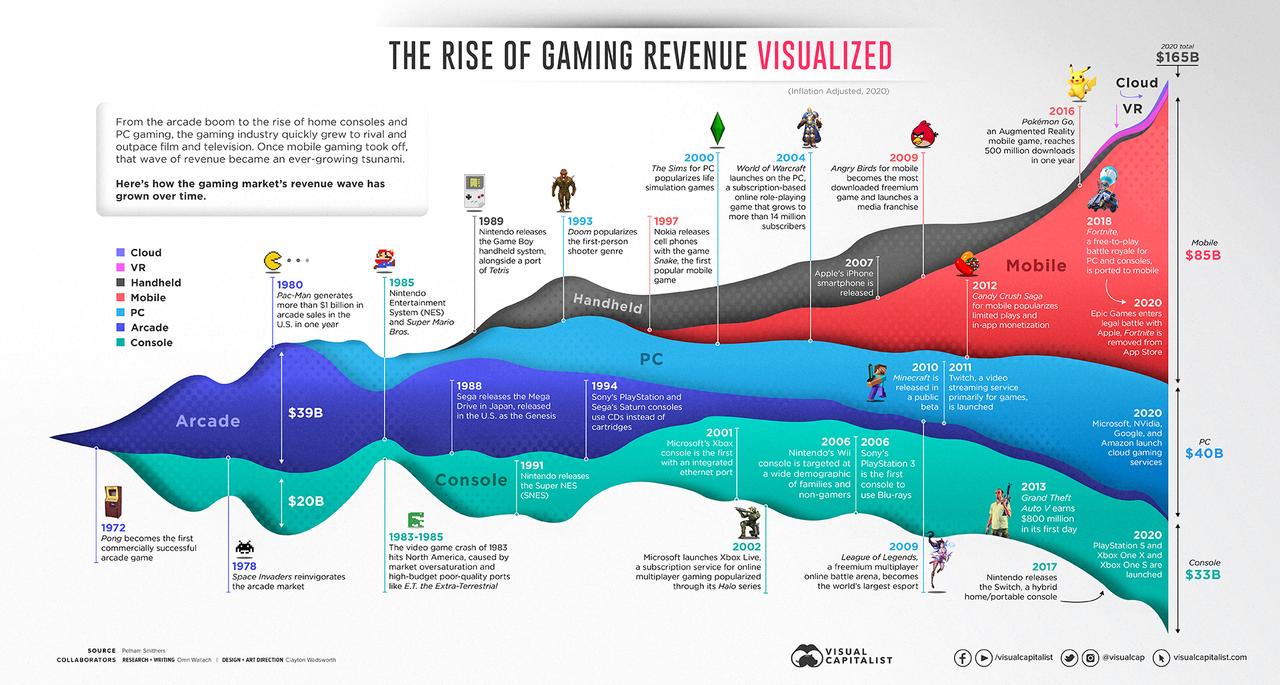
Research from Pelham Smithers shows that while the tidal wave of gaming has only continued to swell, the driving factors have shifted over the course of gaming history.

1970–1983: The Pre-Crash Era

At first, there was Atari.

Early prototypes of video games were developed in labs in the 1960s, but it was Atari’s release of Pong in 1972 that helped to kickstart the industry.

The arcade table-tennis game was a sensation, drawing in consumers eager to play and companies that started to produce their own knock-off versions. Likewise, it was Atari that sold a home console version of Pong in 1975, and eventually its own Atari 2600 home console in 1977, which would become the first console to sell more than a million units.

In short order, the arcade market began to plateau. After dwindling due to a glut of Pong clones, the release of Space Invaders in 1978 reinvigorated the market.

Arcade machines started to be installed everywhere, and new franchises like Pac-Man and Donkey Kong drove further growth. By 1982, arcades were already generating more money than both the pop music industry and the box office.

1985–2000: The Tech Advancement Race

Unfortunately, the gaming industry grew too quickly to maintain.

Eager to capitalize on a growing home console market, Atari licensed extremely high budget ports of Pac-Man and a game adaptation of E.T. the Extra Terrestrial. They were rushed to market, released in poor quality, and cost the company millions in returns and more in brand damage.

As other companies also looked to capitalize on the market, many other poor attempts at games and consoles caused a downturn across the industry. At the same time, personal computers were becoming the new flavor of gaming, especially with the release of the Commodore 64 in 1982.

It was a sign of what was to define this era of gaming history: a technological race. In the coming years, Nintendo would release the Nintendo Entertainment System (NES) home console in 1985 (released in Japan as the Famicom), prioritizing high quality games and consistent marketing to recapture the wary market.

On the backs of games like Duck HuntExcitebike, and the introduction of Mario in Super Mario Bros, the massive success of the NES revived the console market.

Estimated Total Console Sales by Manufacturer (1970-2020)
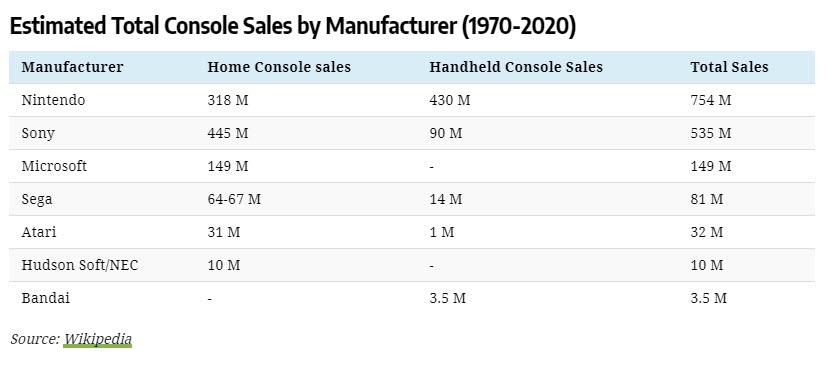
Nintendo looked to continue its dominance in the field, with the release of the Game Boy handheld and the Super Nintendo Entertainment System. At the same time, other competitors stepped in to beat them at their own game.

In 1988, arcade company Sega entered the fray with the Sega Mega Drive console (released as the Genesis in North America) and then later the Game Gear handheld, putting its marketing emphasis on processing power.

Electronics maker Sony released the PlayStation in 1994, which used CD-ROMs instead of cartridges to enhance storage capacity for individual games. It became the first console in history to sell more than 100 million units, and the focus on software formats would carry on with the PlayStation 2 (DVDs) and PlayStation 3 (Blu-rays).

Even Microsoft recognized the importance of gaming on PCs and developed the DirectX API to assist in game programming. That “X” branding would make its way to the company’s entry into the console market, the Xbox.

2001–Present: The Online Boom

It was the rise of the internet and mobile, however, that grew the gaming industry from tens of billions to hundreds of billions in revenue.

A primer was the viability of subscription and freemium services. In 2001, Microsoft launched the Xbox Live online gaming platform for a monthly subscription fee, giving players access to multiplayer matchmaking and voice chat services, quickly becoming a must-have for consumers.

Meanwhile on PCs, Blizzard was tapping into the Massive Multiplayer Online (MMO) subscription market with the 2004 release of World of Warcraft, which saw a peak of more than 14 million monthly paying subscribers.

All the while, companies saw a future in mobile gaming that they were struggling to tap into. Nintendo continued to hold onto the handheld market with updated Game Boy consoles, and Nokia and BlackBerry tried their hands at integrating game apps into their phones.

But it was Apple’s iPhone that solidified the transition of gaming to a mobile platform. The company’s release of the App Store for its smartphones (followed closely by Google’s own store for Android devices) paved the way for app developers to create free, paid, and pay-per-feature games catered to a mass market.

Now, everyone has their eyes on that growing $85 billion mobile slice of the gaming market, and game companies are starting to heavily consolidate.

Major Gaming Acquisitions Since 2014
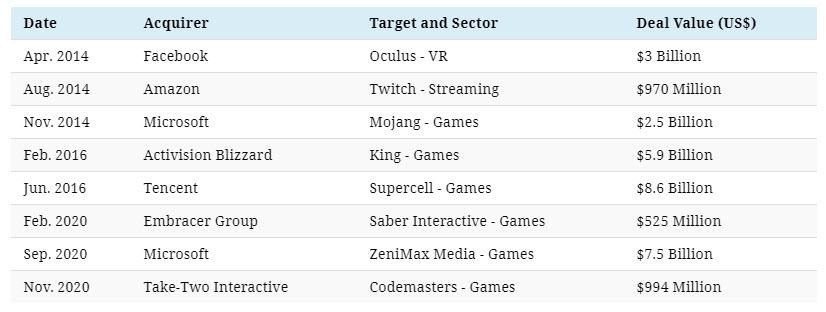
Console makers like Microsoft and Sony are launching cloud-based subscription services even while they continue to develop new consoles. Meanwhile, Amazon and Google are launching their own services that work on multiple devices, mobile included.

After seeing the success that games like Pokémon Go had on smartphones—reaching more than $1 billion in yearly revenue—and Grand Theft Auto V’s record breaking haul of $1 billion in just three days, companies are targeting as much of the market as they can.

And with the proliferation of smartphones, social media games, and streaming services, they’re on the right track. There are more than 2.7 billion gamers worldwide in 2020, and how they choose to spend their money will continue to shape gaming history as we know it.

via ZeroHedge News https://ift.tt/37k5YEr Tyler Durden

2021 Would Be A Great Time To Audit The Fed

2021 Would Be A Great Time To Audit The Fed

Tyler Durden

Sat, 11/28/2020 – 22:00

Authored by Nick Hankoff via The Mises Institute,

Gone are the days of the Federal Reserve hiding in the shadows. Now it’s a woke central bank fighting for climate and racial justice. Progressives must not fall for this but instead team up with the populist right to audit the Fed and demand transparency.

Let the healing begin! If it is going to be President Joe Biden a couple months from now, then there will be all the more incentive for antiestablishment Democrats to join forces with populist Republicans. What better issue than auditing the Federal Reserve System?

There is strong precedent for progressives and the populist right to unite around an “Audit the Fed” movement. In early 2009, Congressman Ron Paul introduced the Federal Reserve Transparency Act, which garnered 320 House cosponsors by the summer of 2010.

Since then, the antiestablishment factions of both parties have grown and at least one of the 2009 House cosponsors now holds a Senate seat. Audit the Fed has passed the House on three occasions, so it could see as much or more success this coming session.

Another development over the last eleven years is the Fed’s evolving public image. Before Ron Paul’s 2008 presidential run, the central bank lurked in near-total darkness. Two thousand nine was a breakout year for its public relations campaign, and the Fed has failed to return to its prior obscurity. 

Now the secretive power center larps as a super–social justice warrior, fighting for climate and racial justice, the top pet issues of the progressive left. Many grassroots progressives expressed their distaste for Hillary Clinton and Joe Biden, but even those who held their noses to vote for them shouldn’t feel at all obliged to apologize for the Fed’s virtue signaling.

Meanwhile, inflationary monetary policy most harms those people and communities whom the progressive left claims to champion. Saving becomes more difficult or impossible, while prices of goods rise.

All the more reason for the Fed to adopt the likeness of a woke institution. Just as it has blamed “irrational exuberance” for boom-bust cycles, it can now blame systemic racism or climate change for poor economic growth that’s actually fueled by its own monetary policy.

This week, the Fed officially sought membership in the Network for Greening the Financial System, an assemblage of central banks and other international forces that “support the transition toward a sustainable economy” for the sake of the climate.

This past summer, Fed chairman Jerome Powell promised to improve “diversity” within the Fed’s structure. Will the new friendlier, kinder, and woker Federal Reserve System win the trust of progressives or irk them for stealing their thunder and undermining their vision?

Most Americans already don’t trust the Fed, especially Democrats, people forty-nine and under, and those making less than $50,000 a year. Those would be natural progressive constituencies.

Republicans in the House and Senate, especially if the president is unable to secure a second term, will be in a strong position to take on the Fed. Trump has long criticized the bank and its chairman, whom he picked. Although more recent frustration expressed was over interest rates not being low enough, Trump also supported auditing the Fed during his 2016 campaign.

Republicans will also likely control the Senate, so any other Fed-related bills that Democrats might propose would have more trouble finding enough votes for passage. Take for instance the Federal Reserve Racial and Economic Equity Act recently introduced by Senators Elizabeth Warren and Kirsten Gillibrand and cosponsored by Bernie Sanders.

This FRREE Act seeks to “minimize and eliminate racial disparities in employment, wages, wealth, and access to affordable credit.” That amounts to overhauling the Congress’s instructions for the Fed, which have focused the bank’s duties on job creation and price stabilization since 1977.

Unfortunately, its champions Warren and Sanders have opposed auditing the Fed in the past. It will take a groundswell of grassroots pressure to turn them around, but it can be done.

Any hope for real political unity that actually benefits the American people depends on the success of projects like Audit the Fed. If populist movements from the left and right can coalesce on this one thing, they will find their time well spent. 

Even if a President Biden or Trump vetoed the legislation, it would amount to progress in the pursuit of transparency at the Fed. Both the left and right side of grassroots politics could claim a piece of the same victory. That would be a nice turnaround from 2020.

via ZeroHedge News https://ift.tt/3qa8Psp Tyler Durden

Cali Mansion Once Listed For $100 Million Sells For “Only” $48.4 Million

Cali Mansion Once Listed For $100 Million Sells For “Only” $48.4 Million

Tyler Durden

Sat, 11/28/2020 – 21:30

Today in “a look into a luxury real estate market you will never likely participate in” news…

A famous L.A. mansion called “Opus” that was once listed for $100 million and has been on the market for over three years has finally sold – at a more than 50% haircut.

The 20,000 square foot mansion sold for $48.4 million this week, furniture included, according to Bloomberg. It is also the latest canary in the luxury real estate coal mine, selling for a large discount during a pandemic which has seen foreign buyers dry up and an exodus from city areas.

Additionally, as we have noted this year, California is seeing an outflow of residents as poor state management, higher taxes and more government are driving citizens to tax havens like Florida and Texas. 

Source: BBG

Jonathan Miller, president of appraiser Miller Samuel told Bloomberg of the original price tag: “It was never worth that to begin with. High-end properties are moving, but they’re not moving for prices that are disconnected from the market.”

The house sports 7 bedrooms and 11 bathrooms, and was custom built by movie producer turned real estate developer (of course) Nile Niami. He first tried to sell the house “with a PR campaign involving a hyper-sexualized video of mostly-naked women in different parts of the house, including one shot of four women slathered in gold paint posing around a golden Lamborghini”.

When that didn’t work, we guess he ran out of ideas and simply decided to start cutting the price 3 years ago. 

Niami is currently developing a $500 million private residence called “The One” that has 4 swimming pools, a nightclub and a bowling alley. We can’t prove it, but we’re sure this insanity is somehow Neel Kashkari’s fault. Niami says he won’t budge on the $500 million price tag. 

Umansky said of the project: “He just won’t listen to the market. If he would just sell and not try to hit a grand slam on every deal, he would be great.”

Source: BBG

The lack of a bid in general is isolated to speculative luxury homes over $100 million, the article notes (we can’t imagine why). The rest of the real estate market has been showing signs of lack of supply, mirroring demand nationally in places like South Florida, the Hamptons and Greenwich, Connecticut.

Mauricio Umansky, chief executive officer of the Agency, said: “There’s a big gap between what the owners are willing to sell for and buyers are willing to pay. They didn’t underwrite correctly.”

While the bid/ask spread on real estate has narrowed, some celebrity real estate sales have seen their prices drop. Lori Loughlin, before heading to jail, sold her Bel Air mansion for almost 50% less than the $35 million she was asking. Ellen DeGeneres and Portia de Rossi also recently sold their home for $33.3 million after it was originally listed at $40 million.

via ZeroHedge News https://ift.tt/2J8ud0B Tyler Durden

The Strangely Unscientific Masking Of America

The Strangely Unscientific Masking Of America

Tyler Durden

Sat, 11/28/2020 – 21:00

Authored by Jenin Younes via The American Institute for Economic Research,

I remember vividly the day, at the tail end of March, when facemasks suddenly became synonymous with morality: either one cared about the lives of others and donned a mask, or one was selfish and refused to do so. The shift occurred virtually overnight. 

Only a day or two before, I had associated this attire solely with surgeons and people living in heavily polluted regions. Now, my friends’ favorite pastime during our weekly Zoom sessions was excoriating people for running or socializing without masks in Prospect Park. I was mystified by their certitude that bits of cloth were the only thing standing between us and mass death, particularly when mere weeks prior, the message from medical experts contradicted this new doctrine.

On February 29, the U.S. surgeon general infamously tweeted:

“Seriously people – STOP BUYING MASKS. . . They are NOT effective in preventing general public from catching #Coronavirus.”

Anthony Fauci, the best-known member of the coronavirus task force, advised Americans not to wear masks around this time. 

Similarly, in the earliest weeks of the pandemic, the CDC maintained that masks should be worn only by individuals who were symptomatic or caring for a sick person, a position that the WHO stood by even longer.

As rapidly as mask use became a matter of ethics, the issue transformed into a political one, exemplified by an article printed on March 27 in the New York Times, entitled “More Americans Should Probably Wear Masks for Protection.” The piece was heavy on fear-mongering and light on evidence.  While acknowledging that “[t]here is very little data showing that flat surgical masks, in particular, have a protective effect for the general public,” the author went on to argue that they “may be better than nothing,” and cited a couple of studies in which surgical masks ostensibly reduced influenza transmission rates.  

One report reached its conclusion based on observations of a “dummy head attached to a breathing simulator.”  Another analyzed use of surgical masks on people experiencing at least two symptoms of acute respiratory illness. Incidentally, not one of these studies involved cloth masks or accounted for real-world mask usage (or misusage) among lay people, and none established efficacy of widespread mask-wearing by people not exhibiting symptoms.  There was simply no evidence whatsoever that healthy people ought to wear masks when going about their lives, especially outdoors.  Yet by April, to walk the streets of Brooklyn with one’s nose and mouth exposed evoked the sort of reaction that in February would have been reserved for the appearance of a machine gun.

In short order, the politicization intensified. President Trump refused to wear a mask relatively early on, so resistance to them was equated with support for him. By the same token, Democratic politicians across the board eagerly adopted the garb; accordingly, all good liberals were wearing masks religiously by the beginning of April. Likewise, left-leaning newspapers such as the New York Times and the Washington Post unequivocally promoted mask-wearing after that March 27 article, with no real analysis or consideration of opposing views and evidence.

The speed with which mask-wearing among the general public transitioned from unheard of to a moral necessity struck me as suspicious. After all, if the science was as airtight as those around me claimed, surely masks would have been recommended by January or February, not to mention during prior infectious disease outbreaks such as the 2009 swine flu. It seemed unlikely that the scientific proof became incontrovertible sometime between late February and late March, particularly in the absence of any new evidence surfacing during that time period. 

Perhaps none of this is particularly surprising in this hyper-political era. What is shocking is the scientific community’s participation in subverting evidence that does not comport with the consensus. A prime example is the Institute of Health Metrics Evaluation’s (“IHME”) rather astounding claim, published in the journal Nature-Medicine and echoed in countless articles afterward, that the lives of 130,000 people could be saved with a nationwide mask mandate.  

As my colleague Phil Magness pointed out in an op-ed in the Wall Street Journal, the IHME model was predicated upon faulty data:  it assumed that 49% of Americans were wearing masks based on a survey conducted between April and June, while claiming that statistic represented the number of Americans wearing masks as of September 21.  In fact, by the summer, around 80% of Americans were regularly wearing them.  (Ironically, had Dr. Fauci and the Surgeon General not bungled the message in March, mask use probably would have reached much higher rates much earlier on).

This called into question the accuracy of the 130,000 figure, since many more people habitually used masks than the study presumed. 

Although Magness contacted Nature-Medicine to point out the problem, after stalling for nearly two weeks, the journal declined to address it.  Needless to say, the damage had been done:  newspapers such as the New York Times undoubtedly would fail to correct the error and any retractions certainly would be placed far from the front page, where the initial article touting the IHME figure appeared. Thus, as expected, the unfounded claim that 130,000 lives could be saved with a nationwide mask-mandate continues to be repeated, including by president-elect Joe Biden and National Institutes of Health Director Francis Collins. 

That the science behind mask-wearing is questionable at best is further exemplified by a letter to the editor written in response to Magness’s article. Dr. Christopher Murray acknowledged that rates of mask-wearing have steadily increased, but then concluded that masks should be used because they are “our first line of defense against the pandemic” and current IHME modeling indicates that “if 95% of U.S. residents were to wear masks when leaving home, we could prevent the deaths of tens of thousands of Americans” because “masks work,” and “much deeper pain is ahead if we refuse to wear them.”  

None of this accounts for the failure of either Nature-Medicine or the IHME modelers to recognize and correct the error.  Moreover, neither the IHME modelers nor Dr. Murray provide any evidence that masks work. They assume masks are extremely effective at preventing spread of the coronavirus, and then claim that the model is correct for that reason. This sort of circular reasoning is all-too typical of those who so vociferously insist that masks are effective without going to the trouble of substantiating that contention – or differentiating what is likely a modest benefit from mask-wearing in specific indoor locations and around high-risk individuals from the media-driven tendency to depict masks as a silver bullet for stopping the virus in all circumstances. 

Coverage of a recent mask study conducted in Denmark likewise epitomizes the failure of the scientific community to rigorously engage with results that do not fit the prevailing masks-as-a-panacea narrative. The first randomized and controlled study of its kind, it found an absence of empirical evidence that masks provide protection to people wearing them, although it apparently did not assess whether they prevent infection of those who encounter the wearer.  The report was covered in a New York Times article bearing the patronizing headline, “A New Study Questions Whether Masks Protect Wearers. You Need to Wear Them Anyway.”  

Noting that the results “conflict with those from a number of other studies,” primarily “laboratory examinations of the particles blocked by materials of various types,” the author remarked that, therefore, this research “is not likely to alter public health recommendations in the United States.” Notably, laboratory examinations, as opposed to the Danish study, do not account for the realities of everyday mask usage by non-medical professionals. 

The author then quotes Susan Ellenberg, a biostatistician at the University of Pennsylvania, who claims that the study indicates a trend: “‘in the direction of benefit’ even if the results were not statistically significant. ‘Nothing in this study suggests . . . that it is useless to wear a mask,’” according to Dr. Ellenberg. 

Nor does anything in this study suggest that it is useful to wear a mask, a fact that Dr. Ellenberg (and the headline) conveniently ignores. Furthermore, if a result is statistically insignificant, it should not be used to make the case for any proposition — as even I, a layperson, know.  

Scientists ought to dispassionately analyze data that contradicts their biases and assumptions, and be open to changing their beliefs accordingly. That the results of the only randomized, controlled study were and continue to be automatically discounted demonstrates that, when it comes to the subject of masks, anything approximating the scientific method has gone out the window. That is all the more evident given the lack of interest that mask proponents have shown in conducting a randomized, controlled study themselves.

An article in the Los Angeles Times went even further: it twisted the findings of the Danish study to argue, incomprehensibly, that the research demonstrated more mask-wearing is warranted.  The author cited, as supposedly compelling evidence that masks work, the low Covid-19 death rates in Singapore, Vietnam, and Taiwan.  Indeed, according to the latest YouGov poll, administered in mid-November, 83% of Americans now wear masks in public, higher rates than Vietnam (77%) and Taiwan (82%).

Furthermore, there are other explanations, apart from widespread mask usage, for the remarkably low death rates in these countries.   Some scientists believe that previous exposure to other coronaviruses in these regions may confer partial or total immunity to SARS-CoV-2. Others have speculated that obesity, environment or genetics could be the reason that Europe and the United States have substantially higher death rates than many Asian and African countries; after all, obesity is one of the most significant risk factors for severe illness. 

To conclude on the basis of low death rates in several countries that masks prevent coronavirus transmission is patently absurd, illogical, and unscientific. A casual observer might also note that coronavirus cases (albeit not necessarily deaths) are rising in many parts of the world, regardless of mask mandates or rates of implementation. While not a controlled experiment, this fact at least ought to be addressed when making such sweeping claims. 

Ultimately, I do not have the credentials to determine whether or not –or to what extent — masks work. But it is obvious that the issue has become so politicized that mainstream media outlets, politicians, and even scientists seize upon the slightest bit of favorable evidence, dismiss out of hand anything that conflicts with their theory, and most egregiously of all misrepresent the data, to support the conclusion that masks worn by asymptomatic people prevent coronavirus transmission.  

And masks are only one part of this story: school closures, lockdowns, and social distancing all have been dogmatically embraced as a means of controlling infection. The substantial evidence that these mechanisms are not effective, particularly beyond their duration, has been automatically rejected for too long. This is not science: it is politics, and those within the profession who have refused to examine their confirmation biases, or manipulated the evidence to score political points, are utterly unqualified for the job. 

via ZeroHedge News https://ift.tt/3mk4gt0 Tyler Durden

The 2021 Liquidity Supernova: Step Aside Fed – US Treasury Will Unleash $1.3 Trillion In Liquidity

The 2021 Liquidity Supernova: Step Aside Fed – US Treasury Will Unleash $1.3 Trillion In Liquidity

Tyler Durden

Sat, 11/28/2020 – 20:30

One of the most poignant (and painful to some) lessons of the past decade – especially to contrarian, bearish investors such as Odey and Horseman – is that the Fed can keep print money far longer than any short can remain solvent. And while it was considered in poor taste until earlier this year to admit that the market levitation is entirely due to the Fed’s manipulation of markets- a task best left to fringe, tinfoil wearing blogs – all pretense disappeared after Jerome Powell nationalized the bond market in March, and just last week Morgan Stanley’s chief rates strategist, Matthew Hornbach, admitted that central bank liquidity is the most critical component of rising macro markets: “It both greases the wheels of transactional finance and changes the opportunity set available to investors.”

It’s also why Morgan Stanley has been especially bullish on markets in 2021: as Hornbach summarized it simply: “When it comes to liquidity, our focus is on both “narrow” and “broad” measures… We expect both types of liquidity to expand in 2021.

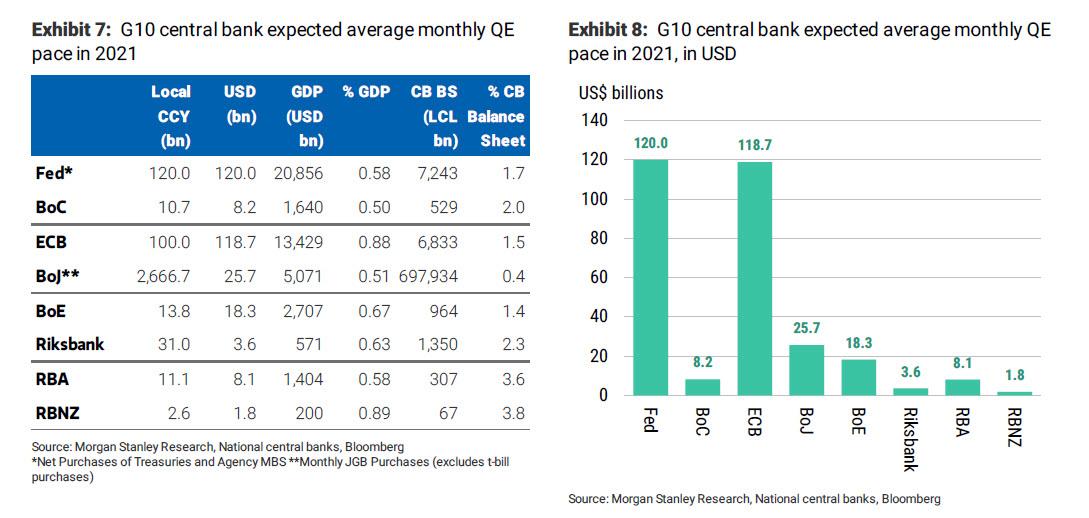
Last Monday we discussed the expansion of the first type of liquidity, namely that provided by central banks. The math was, in a word, staggering: combined, the 8 DM central banks are expected to purchase US$304 billion of securities ($238 billion of which will be government bonds), on average, from private markets every month in 2021 (with the Fed and the ECB naturally doing most of the buying).

Putting this number in context, in total these 8 central banks are expected to add liquidity worth 0.7% of annual nominal GDP, on average, every month in 2021. “That is a rapid pace of global liquidity injection, the likes of which we haven’t seen outside of 2020” Hornbach casually inserts.

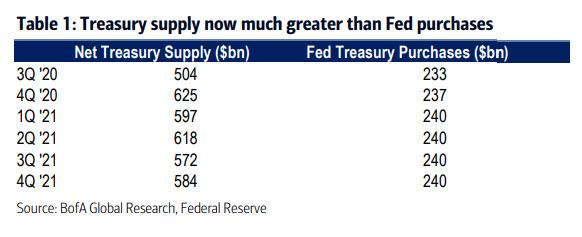
What is even more striking is that this may not be enough: as we showed two weeks ago, after the Fed monetized virtually every dollar of net Treasury issuance in 2020, in 2021 Treasury supply will significantly outstrip Fed purchases (and this is even without factoring in the possibility of another major fiscal stimulus).

Said otherwise, while the Treasury faces net Treasury issuance of roughly $2.4 trillion, the Fed is expected to monetize less than half of this total, or $960 billion. Considering that in 2020 under the auspices of “helicopter money” (from which we remind readers there is simply no coming back) the Fed will have monetized virtually every dollar of net issuance, this is a huge cliff and one which could lead to a shock drop in Treasury prices if the market reprices (lower) its expectations for Fed monetizations.

In other words, the Fed needs to more than double its scheduled monthly QE in 2021 just to catch up to where it was in 2020; and the Fed is hardly alone – in just the past month, the RBA, the BOE and most recently, the Riksbank, all announced expansions to their current QE.

And here comes the twist, because in what may come as a surprise to some, in 2021 liquidity injections won’t be limited to QE.

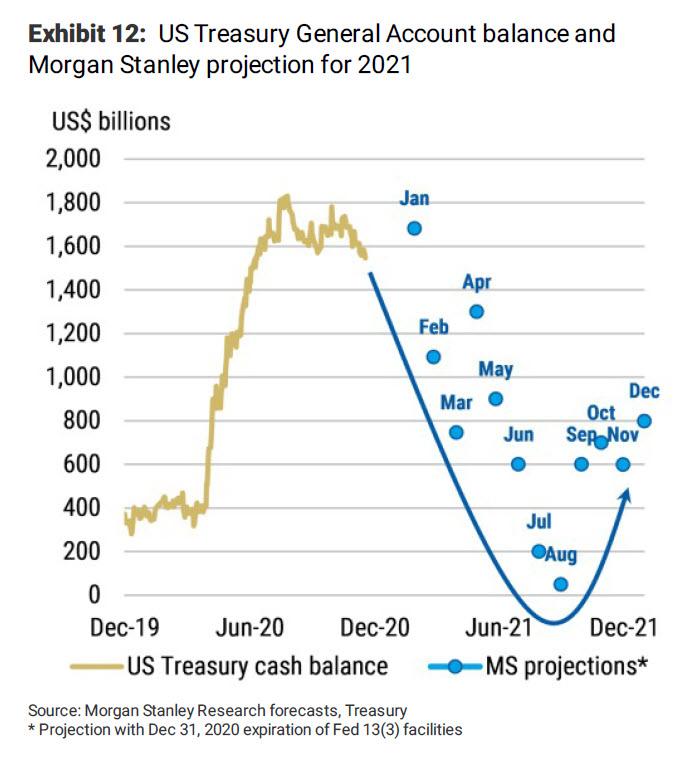
As traders who lived through the reserve squeeze of Sept 2019 recall all too vividly, central bank purchases of securities via QE aren’t the only way liquidity can find its way into markets. In the US, the Treasury can increase liquidity by allowing its cash balance – held at the Federal Reserve – to decline. When Treasury issues debt, it can either spend the money on government mandates or it can keep the money in its checking account at the Fed, known as the Treasury General Account (TGA).

To be sure, from a liquidity perspective Treasury debt issuance and the subsequent spending does not impact liquidity on net, in general. When Treasury issues debt, banking system reserves decrease. And when Treasury spends the money, banking system reserves increase.

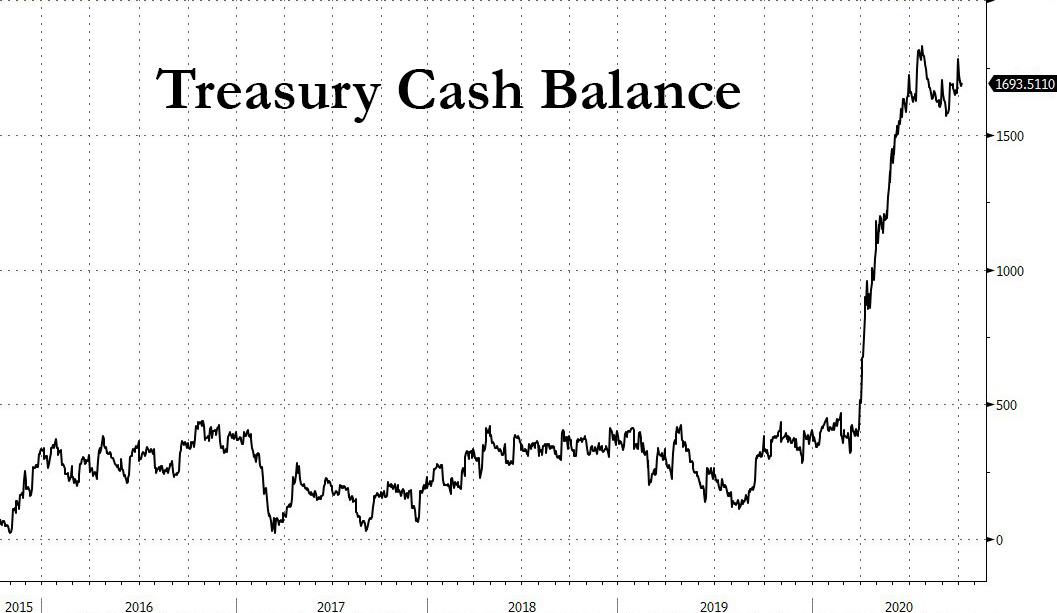
However, as Hornbach reminds us, 2020 was unique in that Treasury issued lots of debt without spending the money, resulting in over $1.6 trillion in Treasury cash available for deployment at a moment’s notice, yet due to Congress’ inability to reach agreement on a fiscal stimulus, this money was never spent (and may have cost Trump a victory in the election).

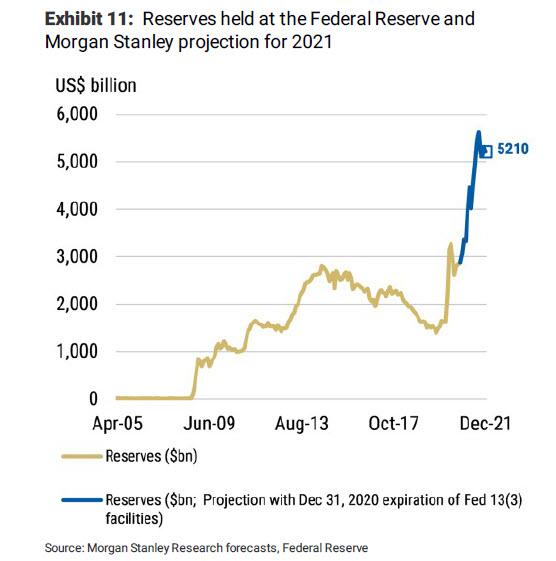
As a result, the cash balance in the TGA increased dramatically, resulting in a massive liquidity drain; in fact were it not for other sources of liquidity injection – such as the Fed injecting hundreds of billions with monthly periodicity – that may have been a huge problem for markets. In any event, as the chart below shows, despite the Treasury’s liquidity drain reserves increased in 2020 regardless, surpassing a record $5 trillion.

So what happens in 2021 with all this cash already sloshing around?

Well, as Hornbach writes, in 2021 the Treasury General Account will experience more volatility due to the debt ceiling deadline, but will initially result in a very large injection of liquidity. The debt ceiling deadline is August 1, 2021. On this date, the US Treasury will not be able to issue any additional debt above and beyond what it needs to cover existing debt obligations. However, what few may be aware of, is that there is a clause written into the law that prohibits the TGA from rising above levels prior to the debt ceiling deadline, which was in 2019.

This means that based on the 2019 debt ceiling, the Treasury cash will need to be at $200 billion by August 1, 2021. As such, there will be significant T-bill paydowns in 2021 through August in order for Treasury to reduce its cash balance – leading to a massive increase in reserves which is entirely apart from those injected via Fed QE, which continues at a pace of $120 billion per month. With the TGA cash currently at just under $1.5 trillion, it means that the US Treasury will unlock $1.3 trillion in liquidity over the next 8 months, more than doubling the liquidity coming from the Fed over the same time period which will be roughly $1 trillion ($120 x 8 months)!

We hope this massive liquidity injection explains why Biden was so interested in getting a former Fed chair – Janet Yellen – in charge of the Treasury. After all, the amount of liquidity to be injected by the Treasury Department will match, almost dollar for dollar, what Jerome Powell will do in 2021.

So when will this liquidity impact markets?

The Fed first announced its QE-driven foray into liquidity provision on Sunday, March 15, and as Morgan Stanley notes, “it took a couple weeks for the liquidity to flow to where it was needed most: the S&P 500 bottomed and the Fed’s broad trade-weighted US dollar index topped on March 23.”

Since then, the US dollar index has lost 9.4% and the S&P 500 index is up 60%. In addition, US 10y real yields have fallen 100bp while 10y breakeven inflation rates have risen 100bp. In that sense, the injection of liquidity in 2020 has already had an immense impact on markets.

So how do we know markets will feel the impact again in 2021? In the end, liquidity doesn’t have to find its way around markets if it doesn’t have an incentive. And it certainly doesn’t have to find its way into risky assets.

As we saw ahead of the US election, US$ 1 trillion found its way into money market funds (MMFs), given the uncertainty of a well-telegraphed risk event. However, according to Hornbach, in 2021, the sheer size of liquidity entering markets will make it hard for investors to keep it sitting in cash accounts, earning next to nothing. And, given virtual guarantees that most central bank policy rates will remain at effective lower bounds (ELBs) in 2021, and many will remain there in 2022 as well, Hornbach concludes that “investors will have a (performance) incentive to move cash into higher yielding assets.”

In the end, it’s not possible for us to say exactly when the liquidity will impact market prices throughout the year. Still, once the race for returns begins as we enter the new calendar year (the new fiscal year for many investors), we expect liquidity to venture out of its safe-haven cash-cave – just as long as new, unforeseen uncertainties aren’t mounting at the same time.

Translation: buy everything ahead of an unprecedented dollar devaluation orgy.

via ZeroHedge News https://ift.tt/33sPqZX Tyler Durden

Watch: CNN Admits There Are “Legal & Constitutional” Ways For Trump To Stay In Office

Watch: CNN Admits There Are “Legal & Constitutional” Ways For Trump To Stay In Office

Tyler Durden

Sat, 11/28/2020 – 20:00

Authored by Paul Joseph Watson via Summit News,

In a video released before the election but attracting fresh attention, CNN’s Fareed Zakaria explained the “legal and constitutional” case by which President Trump could stay in office even if he loses the election.

In a moment of actual journalistic integrity, which is incredibly rare these days for CNN, Zakaria outlined how Trump could retain the presidency “without actually winning the vote.”

Explaining how the system worked, Zakaria said electors are determined by that state’s popular vote, but that this is “not a constitutional obligation.”

The host then outlined the exact scenario that happened on election day, with Trump leading on November 3rd but then mail-in ballots swinging the result for Biden, prompting a flurry of challenges and lawsuits.

“Taking account of the confusion, legislatures decide to choose the electors themselves,” said Zakaria before pointing out that eight out of nine key swing states have Republican legislatures.

“If one or more decide that balloting is chaotic and marked by irregularities, they could send what they regard as the legitimate slate of electors, which would be Republican.”

Adding to the confusion, Democrats from the same states would also send their electors to Washington, which Zakaria suggested could be “part of the Republican plan.”

“Because you see when Congress convenes on January 6 to tally the electors’ votes, there would be challenges to the legitimacy of some electors,” explained Zakaria.

This would prompt Congressional Republicans to argue that disputed states should not be counted, which would ensure Biden’s could not reach 270 electoral college votes.

“At that point, the constitution clearly directs that the House of Representatives vote to determine the presidential election, but it does so with each state casting a single ballot,” said Zakaria, noting that this process would result in the re-election of Donald Trump.

“Trump doesn’t have to do anything other than accept this outcome, which is constitutional,” concluded Zakaria.

The video has caused consternation amongst some Biden supporters, who are eagerly pointing out that it was released before the election.

However, this makes no difference whatsoever. Zakaria’s explanation of how Trump could still win is still in play.

*  *  *

New limited edition merch now available! Click here. In the age of mass Silicon Valley censorship It is crucial that we stay in touch. I need you to sign up for my free newsletter here. Support my sponsor – Turbo Force – a supercharged boost of clean energy without the comedown. Also, I urgently need your financial support here.

via ZeroHedge News https://ift.tt/3fI1lIk Tyler Durden

The Supreme Court’s Bar Membership Is Not “Shrouded in Secrecy.”

The Georgetown Policy Review published an essay by Henry Baumgarten titled, “Open the Bar: Toward Greater Supreme Court Transparency.” It begins:

The United States Supreme Court conceals the names of lawyers that belong to the Supreme Court Bar. This lack of transparency is unusual and raises multiple concerns. If the Supreme Court fails to follow the example set by courts across the country and publicize its bar membership, then Congress ought to intervene.

Later, the essay concludes, “For the time being, the Supreme Court Bar’s membership remains shrouded in secrecy.”

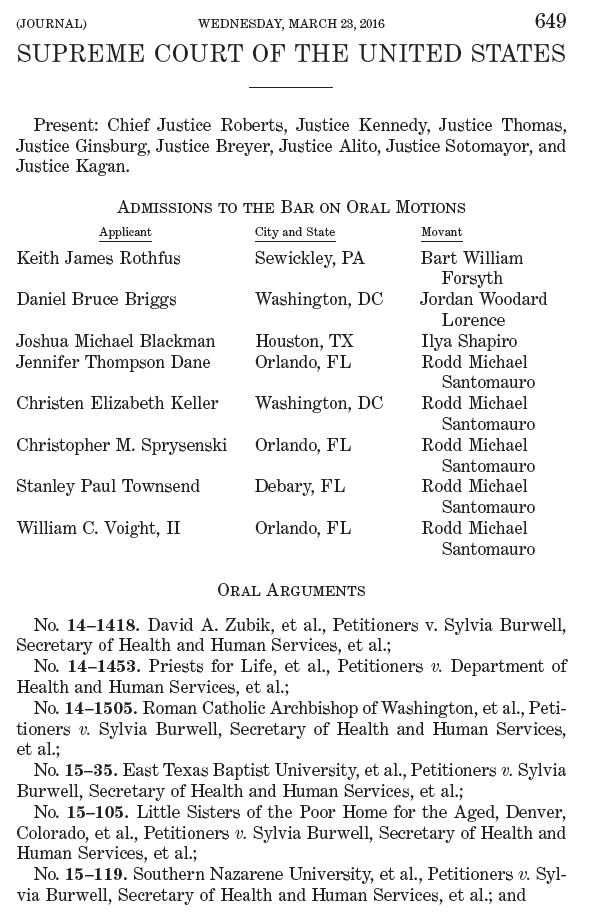
Hardly. The Supreme Court publishes the name of every member admitted, as well as the name of every member who is subject to discipline. Where is this information recorded? Most people, and perhaps the author of the essay, are unaware of the Journal of the Supreme Court. It is published annually, and posted on the Court’s web site.

For example, turn to page 649 of the October 2015 Journal. You will find the notation of my admission to the Supreme Court bar. (Zubik v. Burwell was argued that day).

The Journal also indicates all members who are disbarred.

True enough, the Supreme Court does not have a searchable database of all members. And there is no easy way to determine whether members have passed away. But it is simply not true that the membership of the Court is “shrouded in secrecy.”

from Latest – Reason.com https://ift.tt/36eJKEO
via IFTTT

The Supreme Court’s Bar Membership Is Not “Shrouded in Secrecy.”

The Georgetown Policy Review published an essay by Henry Baumgarten titled, “Open the Bar: Toward Greater Supreme Court Transparency.” It begins:

The United States Supreme Court conceals the names of lawyers that belong to the Supreme Court Bar. This lack of transparency is unusual and raises multiple concerns. If the Supreme Court fails to follow the example set by courts across the country and publicize its bar membership, then Congress ought to intervene.

Later, the essay concludes, “For the time being, the Supreme Court Bar’s membership remains shrouded in secrecy.”

Hardly. The Supreme Court publishes the name of every member admitted, as well as the name of every member who is subject to discipline. Where is this information recorded? Most people, and perhaps the author of the essay, are unaware of the Journal of the Supreme Court. It is published annually, and posted on the Court’s web site.

For example, turn to page 649 of the October 2015 Journal. You will find the notation of my admission to the Supreme Court bar. (Zubik v. Burwell was argued that day).

The Journal also indicates all members who are disbarred.
True enough, the Supreme Court does not have a searchable database of all members. And there is no easy way to determine whether members have passed away. But it is simply not true that the membership of the Court is “shrouded in secrecy.”

from Latest – Reason.com https://ift.tt/36eJKEO
via IFTTT

“I Want To Build A World Where Someone Like Me Is Impossible” – Meet The Trust Fund Brats Trying To Destroy Capitalism

“I Want To Build A World Where Someone Like Me Is Impossible” – Meet The Trust Fund Brats Trying To Destroy Capitalism

Tyler Durden

Sat, 11/28/2020 – 19:30

Roughly 18 months have passed since New York Magazine published a cover story declaring that, in the age of President Trump, all the new “it” kids in Brooklyn (we use the term “kids” loosely; most are well into their 30s) are avowed socialists.

As the reporter explains, the new generation of Brooklyn cool kids have blue check marks on twitter and low-paying editorial jobs at digital magazines like the (now defunct) Outline, Deadspin (a media outlet ostensibly dedicated to sports but realistically covered whatever its reporters and editors felt like writing about on any given day) or Jacobin, a magazine that has been described by some as “straight up Marxist” in its editorial slant. Almost all of them were white women, the most oppressed class.

One year later, a staff uprising at the NYT exposed just how deeply embedded these new crypto-marxist values have become in the modern American media environment. Staffers successfully ousted Opinion Page editor James Bennett over his decision to curate an essay from Republican Sen. Tom Cotton despite the fact that the opinion page is supposed to be an entirely separate editorial entity from the NYT’s newsgathering operation.

This week, the NYT has published a story about a handful of wealthy heirs who have embraced the socialist credo, and who see their massive piles of inherited wealth as a symbol of shame, not a blessing for which they should be extremely grateful.

Take 25-year-old Sam Jacobs, for example. Described as “a socialist since college”, he reportedly sees his family’s “‘extreme plutocratic wealth’ as both a moral and economic failure”.

“I want to build a world where someone like me, a young person who controls tens of millions of dollars, is impossible,” he said.

Fortunately for Jacobs, his grandfather was one of the founders of Qualcomm, the ubiquitous chipmaker. And even if he gives $30 million away, he’ll still have another $70 million or so coming to him over the course of his lifetime. And what’s more, he’s not alone. As the NYT reports, for all their kvetching about student loans, American millennials will soon become the beneficiaries of what social scientists are calling “the great wealth transfer”: tens of trillions of dollars are expected to pass from the hands of baby boomers to their millennial and Gen X spawn over the coming decade.

However, most American millennials won’t inherit anything, except for “debt, dim job prospects” and a “figment” of the social safety net (that seems like an exaggeration, especially considering that literally every single American citizen who reaches the required age will receive a monthly check from the federal government, part of a program called “social security”, not to mention medicare/medicaid).

But as both a “trust-fund kid and an anticapitalist”, Jacobs “is in a rare position among leftists fighting against economic inequality”. And he’s hardly along in trying to navigate “what it means to be with the 99%, when you’re the 1%” – embracing the type of reductive, us-vs.-them thinking promoted by Bernie Sanders and his allies.

30-year-old Rachel Gelman is another example. Her wealthy family gave generously to liberal causes growing up. Now, as a 30-year-old preparing to inherit millions from her parents, Gelman is trying to find a way to give back since most of her family’s money “comes from stocks…which means it comes from underpaying and undervaluing working-class people, and that’s impossible to disconnect from the economic legacies of Indigenous genocide and slavery.”

Of course, no story about modern day socialism would be complete without a quote from professor Richard Wolff, an “economist” who currently teaches at the New School in Manhattan (an overpriced university dedicated to serving the overprivileged elite who could score high enough on their SATs to get into NYU).

As Wolff, known to millions of millennials for his guest appearances on the left wing podcast “Chapo Trap House”, explains, all the money being inherited by today’s millennials came from “a mammoth redistribution away from the working masses, creating a super-rich tiny minority at the expense of a fleeting American dream.”

Later on in the story, one of the heirs whose wealth comes from a chain of strip malls, said the business model just reeks of “intersectional oppression”.

Heirs whose wealth has come from a specific source sometimes use that history to guide their giving. Pierce Delahunt, a 32-year-old “socialist, anarchist, Marxist, communist or all of the above,” has a trust fund that was financed by their former stepfather’s outlet mall empire. (Mx. Delahunt takes nongendered pronouns.)

“When I think about outlet malls, I think about intersectional oppression,” Mx. Delahunt said. There’s the originally Indigenous land each mall was built on, plus the low wages paid to retail and food service workers, who are disproportionately people of color, and the carbon emissions of manufacturing and transporting the goods. With that on their mind, Mx. Delahunt gives away $10,000 a month, divided between 50 small organizations, most of which have an anticapitalist mission and in some way tackle the externalities of discount shopping.

In reality, most of the wealth held by baby boomers wasn’t redistributed, but was in fact created during the 20th century during the post-war economic boom – an economic movement that generated more prosperity, and dragged more people out of poverty, than any earlier period in human history.

via ZeroHedge News https://ift.tt/36dCSrc Tyler Durden

Glenn Greenwald Opines On Ilhan Omar’s Misguided Defense Of John Brennan

Glenn Greenwald Opines On Ilhan Omar’s Misguided Defense Of John Brennan

Tyler Durden

Sat, 11/28/2020 – 19:00

Authored by Glenn Greenwald via greenwald.substack.com

The right to dissent from, and to work against, the official foreign policy of the U.S. Government is vital: foundational to Constitutional liberties. There is very little such dissent in the U.S. Congress, where many of the core tenets of the Foreign Policy Community (from CIA drone warfare and clandestine coups to steadfast support for Gulf State and Middle East tyrannies as well as Israel) enjoy overwhelming, at times virtually unanimous, bipartisan support.

That is one of the reasons that — as I’ve said repeatedly — I am glad that there are now members of Congress such as Congresswomen Ilhan Omar of Minnesota and Rashida Tlaib of Michigan who so vocally and unflinchingly dissent from this general foreign policy orientation and especially from those policies which most members of Congress either cannot or do not want to denounce.

Whether or not one agrees with these two lawmakers on every issue, having members of Congress questioning and objecting to highly consequential foreign policies is inherently healthier than full-scale agreement or fear-driven acquiescence. Dissent strengthens all democracies. That is why I have relentlessly defended Congresswoman Omar, even in the face of less-than-ideally-phrased proclamations, from what I regard as bad faith accusations of bigotry and a lack of patriotism (just as I denounced moronic claims that Trump was a “traitor”): bad faith accusations of bigotry or treason are often designed to demonize attempts to question pieties and ostracize those who do it.

For that very reason, I was quite surprised to see that late Friday night, Congresswoman Omar, in response to something I wrote, defended not only former CIA Director John Brennan — who as Obama’s CIA Director presided over the bombing of numerous countries including Somalia — but also The Logan Act. The Logan Act is nothing more than an unconstitutional attempt to criminalize foreign policy dissidents, like her, and is so dangerous in the hands of the CIA, FBI and federal prosecutors precisely because it lacks any clear definition or meaning.

Despite this, Congresswoman Omar depicted that ancient statute not as what it is — an impossibly vague and overly broad attempt to criminalize the core Constitutional right to dissent — but instead as some kind of specific, precisely defined, and well-established precedent, the contours of which are clearly established and easily applied. None of that is true.

This 219-year-old statute is one of the most unconstitutional and dangerous laws in the U.S. Code. Because it has never been used to prosecute anyone, and was only used to obtain an indictment one time in its entire history — back in 1803, against someone who wrote an op-ed criticizing U.S. foreign policy toward France — nobody knows what it actually prescribes or allows because there is no binding judicial precedent interpreting what it means. It is precisely because it has never been used to prosecute anyone that there is no judicial clarity about what it means, and that’s how the U.S. Government wants it (for the same exact reason, the DOJ has never made good on its threats to prosecute any journalist who publishes classified information under the Espionage Act of 1917: they prefer to weaponize the fear of uncertainty regarding the law’s scope and application rather than prosecute journalists under it and thus risk a judicial ruling declaring it unconstitutional or inapplicable to journalists).

The wildly broad vagueness and lack of clarity is what makes it so dangerous to leave the Logan Act on the books. These are exactly the kinds of ambiguous laws that can serve as an abusive pretext in the hands of the FBI, empowering it to investigate anyone it wants under the rubric of this archaic, ambiguous law. A law can be so vague that it can be unconstitutional for that reason alone: a failure to clearly advise citizens of what is and is not legal violates the right of due process.

But while all such vague laws are dangerous, the Logan Act is particularly menacing to those who dissent from core U.S. foreign policy and are thus often accused of disloyalty, such as Congresswoman Omar. All members of Congress, but particularly foreign policy dissidents, should be working to repeal this ancient and repressive law, not wielding it as a weapon against adversaries and pretending that it is some highly specific, clear and valid criminal constraint on the conduct and speech of U.S. citizens.

*  *  *

The context of the exchange with Congresswoman Omar, and the key role played in it by former Obama CIA Director John Brennan, is necessary to understand Rep. Omar’s point. Far more importantly, this context illustrates the severe, ongoing dangers of allowing this dangerous law to fester on the books.

On Friday, reports emerged that, just days after Israeli Prime Minister Benjamin Netanyahu met with Saudi Crown Prince Mohammed bin Salman, a key Iranian nuclear scientist was ambushed and murdered by gunmen. U.S. officials told The New York Times that Israel was behind the assassination — which should be unsurprising given that Israel assassinated several senior Iranian nuclear scientists during the Obama years.

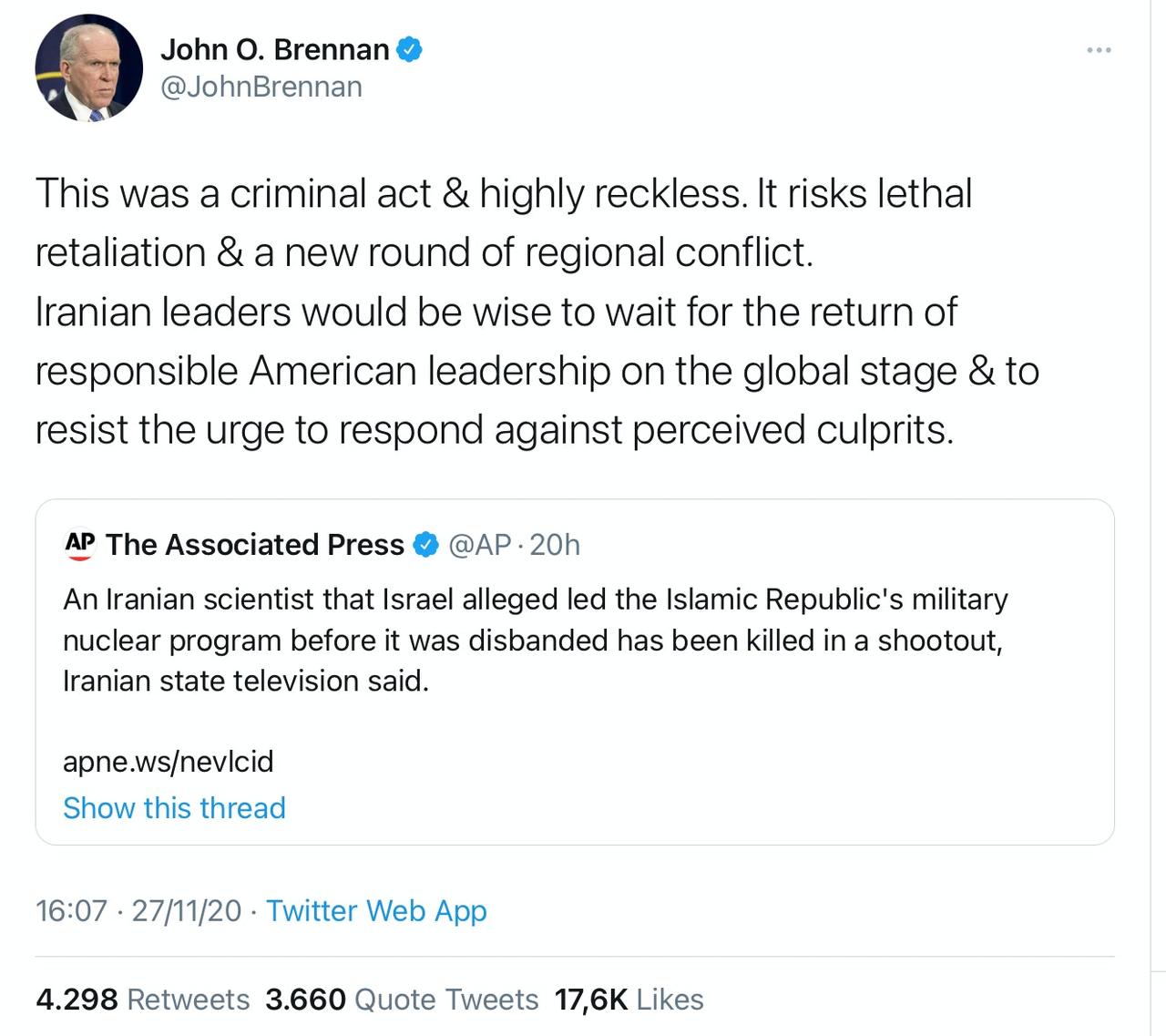
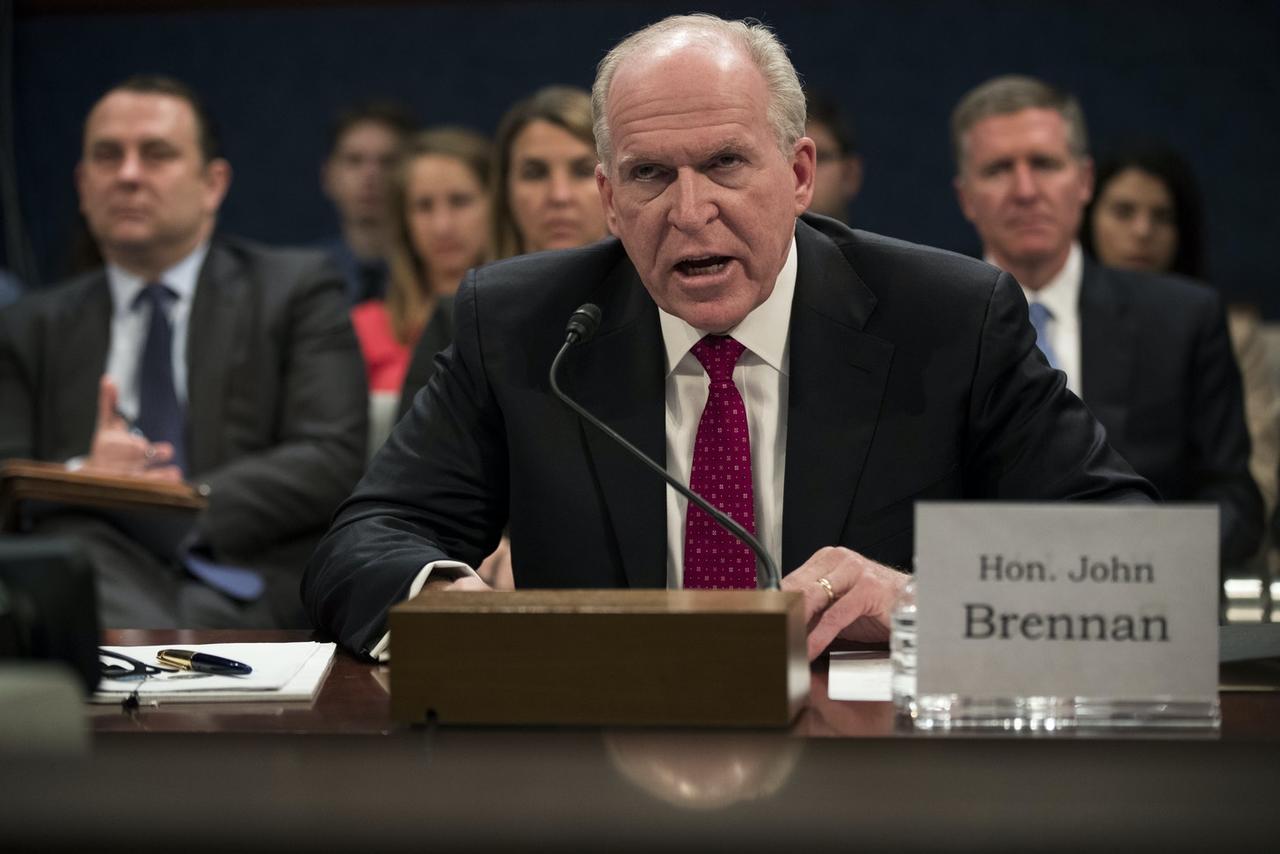
This news provoked indignation from MSNBC’s John Brennan, formerly Obama’s Director of the CIA, an agency heralded worldwide for its righteous opposition to assassinations. Along with condemning the assassination of this Iranian scientist as “a criminal act and highly reckless,” Brennan also used his tweet to send an explicit message to Iranian officials: urging them not to retaliate but instead to wait for the Biden administration to take over, promising the new U.S. administration would “respond against perceived culprits.”

In other words, Brennan, like many people (including myself), is concerned that the Trump administration and Israel are seeking to escalate tensions with Iran during the transition — either because they seek war with Tehran or, more likely, because they want to provoke a cycle of retaliation that would prevent the incoming Biden administration from re-implementing the Iran Deal which Trump nullified and which Israel vehemently opposes.

Thus, Brennan sought to subvert what he perceives as the current foreign policy of the U.S. Government — to provoke and punish Iran — by encouraging Iranian officials to ignore the provocation and therefore not derail efforts by the incoming U.S. administration to establish better relations once Biden is inaugurated:

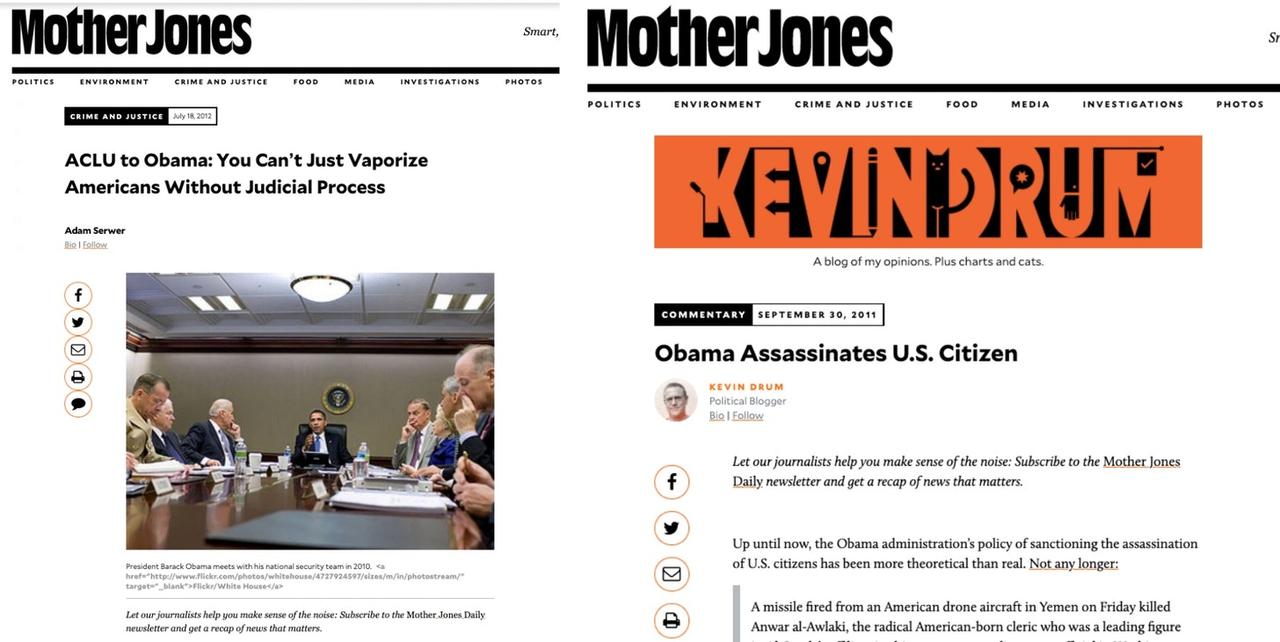
There are so many amazing ironies to this Brennan statement. To begin with, it’s just stunning to watch Obama’s Chief Assassin — who presided over a global, years-long, due-process-free campaign of targeted assassinations, under which the official “kill list” of who was to live and who was to die was decreed by Judge, Jury and Executioner Brennan in a secret White House meeting that bore the creepy designation “Terror Tuesdays” — now suddenly posture as some kind of moral crusader against assassinations. I have denounced these Israeli assassinations as terrorism — both in the past and yesterday — but I have also denounced with equal vigor the Obama/Brennan global assassination program.

The audacity of Brennan’s moral posturing became even more evident as he tried to explain why his and Obama’s assassination program was noble and legal, while the one that resulted in Friday’s killing in Iran was immoral and criminal. After all, this is the same John Brennan who got caught red-handed lying about how many innocent civilians were killed by Obama’s global assassination program, and who even claimed the right to target American citizens for execution by drone without any transparency let alone due process: a right they not only claimed but exercised.

When you’re reduced to sitting on Twitter trying to distinguish your own global assassination program from the one you’re condemning, that is rather potent evidence that you are among the absolute last persons on earth with the moral credibility to denounce anything. That’s particularly true when you directed your unilateral assassination powers onto your own citizens, ending several of their lives.

But that’s the Trump era in a nutshell: the most bloodthirsty monsters and murderers successfully whitewash their own history of atrocities by deceiving people into believing that none of this was done prior to Trump, and that their flamboyant opposition to Trump — based far more in stylistic distaste for him and loss of their own access than substantive policy objections — absolves them of their own prior, often-worse monstrosities. Call it the David Frum Syndrome.

But to me the most glaring irony — as I pointed out — is how similar is the transition message sent by Brennan on Friday to the Iranians when compared to the one sent by Gen. Michael Flynn to the Russians during the 2016 transition after the Obama administration sanctioned Moscow. The message of both Flynn and Brennan was virtually identical: don’t over-react or excessively retaliate: a new administration will soon take power and wants to work with you, so don’t do anything rash now that could prevent that from happening.

But the difference is that while Brennan was predictably celebrated for his message to the Iranians, with viral likes and re-tweets, Flynn was criminally investigated by Jim Comey’s FBI for his. After Comey, then the FBI Director, ordered the investigation into Flynn’s ties to Moscow closed at the start of 2017 due to lack of evidence, FBI agents deeply hostile to Trump seized on Flynn’s December, 2016, intercepted phone call with Russian Ambassador Sergey Kislyak — when Flynn was a national security transition official just weeks away from taking over — to continue the criminal investigation on the ground that he may have violated the Logan Act by attempting to subvert current U.S. foreign policy with his message to Moscow not to overreact and instead to wait for the new administration.

Read the rest of the report here.

via ZeroHedge News https://ift.tt/3qbJIpa Tyler Durden