Hungary And Poland Create The Unbridgeable Gap Of The Great Reset

Hungary And Poland Create The Unbridgeable Gap Of The Great Reset

Tyler Durden

Sun, 11/29/2020 – 08:10

Authored by Tom Luongo via Gold, Goats, ‘n Guns blog,

There comes a point where negotiation becomes surrender. Those actively undermining you will always demand more than their right. Those behind the Great Reset have been creating no-win situations for voters for decades to this exact end.

Over the summer Hungary’s Viktor Orban and Poland’s Mariusz Moraweicki led the opposition to the EU’s budget and COVID-19 relief package standing firm that funds not be tied to any internal political decisions member EU states make.

Both of these countries have incurred the wrath of German Chancellor Angela Merkel over things they do she doesn’t like, invoking Article 7 against Poland over changes made to its Supreme Court, for example.

So, this is nothing new. Neither is the way the EU conducts itself in negotiations.

For the past four years we’ve watched the EU put the United Kingdom through the worst kind of psychological torture over Brexit negotiations which have been anything but.

Fishy Brexit Talks

It’s been a calculated and cynical campaign coordinated with global media, foreign governments, paid political propagandists and intelligence agency operatives.

Through bullying, bad arguments, derision and shaming the relentless pressure of sociopaths and psychopaths wears most people down to the point where they negotiate away something that they didn’t have to.

They get you to agree to putting on a mask to make people feel better, accepting “sensible” gun legislation, voting for the guy who promises to only take 25% of your income versus that guy that wants 40%, etc.

In Brexit talks the EU tried to cleave off Northern Ireland as a cost to Brexit or maintain control over British law through the European Court of Justice.

Negotiation is a natural part of human interaction. There’s nothing inherently wrong with it, as long as both sides approach the negotiation honestly.

But, in politics, especially when dealing with those of a particularly self-righteous leftism so common today — as as shorthand I’ll just call them Commies — negotiation for them is a tactic in a strategic war.

Because at the core of their argument is always the threat of violence at worst and emotional blackmail at best. And that forms the basis for a negotiation that truly isn’t one, but made to look like you have a say in the outcome.

But in reality you don’t. They want all that you have and are willing to take it from you one bite at a time. In fact, the most psychotic of them truly enjoy this process of consuming you slowly.

Brexit negotiations have supposedly come down to how much French fishermen will still be able to plunder British fishing waters even though the U.K. is supposedly a sovereign country. The latest offer from the clueless Michael Barnier is the Brits get tithed 15 to 18% of what the French steal.

This is supposed to be seen as a breakthrough, according to the breathless regime media. But really it’s an insult. If the U.K. is sovereign and by international law these waters are theirs, then the EU has no rights to them unless the Brits grant them access.

But it seems on this small issue, which has now become symbolic of the entire Brexit process, the U.K. is still saying no. Negotiating even this small point is tantamount to surrender.

And they are right. Because agreeing to anything with these people is ultimately telling them what your price is.

Cigarettes and Blindfolds?

This is why, in all things political from the local to the trans-national, every small victory codified into some rule or same treaty is used as a springboard to the next victory and so on. There is no end to the war until one side achieves total domination or the other side, backed into a corner, stands its ground.

While I’ve used Brexit talks as the metaphor here, it’s not really apropos because Brexit, legally, already happened. In a little over a month there may be no formal relationship between the U.K. and the EU.

For Hungary and Poland, however, the situation is far more existential. And it is why they had to veto the 7-year EU budget and with it the COVID-19 relief package two weeks ago.

This piece of news is truly one of the most historic decisions made by any national leader in 2020. And if not for the U.S. presidential election fraud it may well have been the biggest story of the past month.

Neither Hungary nor Poland have the economic or political power of even the U.K. Together they aren’t close to the U.K. in global influence. And because of that have much more to lose in angering the EU gods in Brussels than the Brits ever did.

It’s why both Prime Ministers Orban and Moraweicki tread lightly and go along with so many terrible edicts that come from the EU — really from France and Germany — against their will.

Both men understand the difficult position their countries are in, trapped between no less than three major powers — the U.S., the EU and Russia. The balancing act between those three powers is, at best, a difficult one. At worst, it’s a complete nightmare.

So them standing tall here is truly a momentous event and most probably a harbinger of big changes coming to the EU. They’ll both be under the most intense pressure to cave. Expect activation of Soros-bots in Hungary.

The smartest thing either could do right now is to open up new rounds of talks with the Russians who just announced they are pretty much done with negotiating anything more with the EU.

That would give them both tremendous leverage with Brussels, by cutting down their list of ‘enemies’ from three to two, even if it means courting further sanctions from Merkel and her new Stasi.

Where the State, as an institution, is at its most pernicious is in providing a vector by which these people, when their arguments are rejected via persuasion, can force them into being through the ballot box or legislative fiat.

And since we all agreed to be governed by these rules, so the argument goes, then you have to submit to the outcome otherwise there is chaos. And that’s the rhetorical and psychological wedge tyrants use to separate you from your liberty and, most importantly, your money.

When in the Course of Human Events…

But what happens when the people in the negotiations lie, cheat, manipulate and bend the rules? What happens when negotiations at one point in time, say July at the European Council Summit, yield one outcome and the final legislation says the exact opposite?

If you are Viktor Orban and Mariusz Moraweiki you stand your ground and realize that anything less than outright rejection is full on surrender, no different than the argument over EU fishing access to UK waters.

This is what these men had to do. Because by tying vague EU standards of what constitutes violations of the ‘rule of law’ to disbursement of funds under the budget is far more than what Hungarians or Poles signed up for when they entered the EU in the first place.

It is precisely because of this creeping centralization of control to the unelected bureaucracy in Brussels that the Brits voted for Brexit, in effect, twice. The second time they did so even more emphatically than in 2016.

Hungary and Poland are very clear as to what their problems are and why they will not budge. Read their joint statement here. The most important part is the final paragraph however.

Our common proposal is to facilitate the speedy adoption of the financial package by establishing a two-track process. On the one hand, to limit the scope of any additional budgetary conditionality to the protection of the financial interests of the Union in accordance with the July conclusions of the European Council. On the other hand, to discuss in the European Council, whether a link between the Rule of Law and the financial interests of the Union should be established. If it is so decided, then the appropriate procedures foreseen by the Treaties, including convening an intergovernmental conference, should be considered in order to negotiate the necessary modification of the Treaties.

Note they use the word ‘negotiation.’ But they also tie the outcome of that negotiation to a modification of the Treaties signed by each member state. In effect, saying, we as heads of state will negotiate the best possible offer, but it will still be up to you, the people, to ratify this.

And if you turn us down, then so be it.

This, of course, is anathema to the World Economic Forum, Open Society Foundation and the rest of the burgeoning technocracy being built through the expansion of powers wielded by the European Commission, which this budget and relief package sought to greatly expand.

We all know how voters choose in Europe when it comes to the European Union and the vote is open, fair and the people well-informed. The EU would never survive such a vote on the amendment of the Treaties which form it.

Orban, especially, knows this. And he has taken on the leadership role in this fight. You know he is effective because they despise him, drawing him up as a cartoonishly evil cross between Snidely Whiplash and Vlad the Impaler.

And despite the massive amount of money Soros spends in Hungary to overthrow Orban it hasn’t worked. So, something will have to be done quickly to remove him from the game board or we’ve reach Peak EU.

Reset This!

Because the Great Reset is predicated on a few things occurring.

  1. The EU having a budget and mechanism in place where the Commission has tax/spend and debt issuance capability.

  2. This gives them the political bludgeon necessary to consolidate power in Brussels the same way income tax redistribution undermined Federalism in the U.S.

  3. Extending the COVID-19 narrative to purposefully destroy what’s left of the middle class in Europe and the U.S.

  4. Donald Trump being overthrown as President of the U.S. restoring power there to those loyal to the WEF.

  5. All Populist leaders in Europe – like Matteo Salvini, Geert Wilders, Boris Johnson, Germany’s AfD, Austria’s Freedom Party — neutralized leaving Orban alone against Angela Merkel.

  6. Brexit undermined to the point where either Boris Johnson’s government falls or the U.K. collapses into a failed police state indistinguishable from V for Vendetta.

  7. Control not only over traditional television media but also the flow of information through the newer social media networks, limiting access to any countervailing narratives.

Most of these are in place.

Johnson’s personal weakness has squandered one of the greatest political victories of the past century in less than a year.

Trump’s chances of overturning a fraudulent election are at best a coin flip, and realistically, vanishingly small.

AfD has been neutralized in Germany. Italy’s electoral situation is mixed. Austria has been consolidated under a fake populist Sebastian Kurz.

Local police are openly despotic in enforcing the most draconian lockdown regulations.

But Orban and Moraweicki have stood their ground. Trump is standing his ground. David Frost in the U.K., not Boris Johnson, is standing his ground. Will their example inspire others to do the same?

It’s a good question. The sheer desperation of articles like one from the Spectator, entitled “The Visegrád bloc are threatening to tear apart the EU,” speaks volumes when the author realizes the Visegrads don’t hate the EU for its freedom:

It is tempting to focus only on the individuals involved in the budget crisis: to dismiss Orbán and Morawiecki as rogue despots with no public mandate for their actions and to assume that, if full and fair democratic processes were observed, both Poland and Hungary would favour policies similar to those found in Northern and Western Europe.

Yet such a view does not chime with the democratic elections held in the V4 region this year: Duda won the Polish presidency in an affirmation of socially conservative values, while elections in the Czech Republic and Slovakia saw very strong performances by anti-immigration parties. It also ignores the fact that the Visegrád Four – whose histories of war, occupation, and communist authoritarian rule in the twentieth century differ so greatly from their northern and western counterparts – have long pursued policies in opposition to some of the EU’s core tenets.

And what core tenets do the EU practice other than extortion, bribery, backroom dealing and arm-twisting, pray tell? Because on display right now all across Europe, from where I’m sitting, there ain’t a lotta tolerance, equality and compassion.

Oh, right, those are ‘mostly peaceful’ water cannons they’re using in Berlin.

Negotiating with Terrorists

And up until the past two weeks or so, decent, productive people have negotiated, they have bargained in the Kubler-Ross model of grief, rather than accept the need to openly confront the real problems in their governments.

The lesson of 2020 to this point has been that negotiation is no longer an option. There can be no settlement on fishing for the Brits, the rule-of-law for EU member states.

For Americans all negotiating has achieved is a terminally corrupt central government running sham elections with a compliant and hostile media telling them they are deplorable scum.

We are now expected to accept the results because they said so. Um, yeah, no.

The only way to accept the current reality is to believe the very people who you wouldn’t buy a used couch from no less lead your government are telling you the unvarnished truth.

Accepting any version of the narrative that this was a close election in the U.S. is the most pathetic form of negotiating your own surrender I’ve seen in quite a long time.

This is the unbridgeable gap of modern politics. It is the infinite gulf between surrender and negotiating with terrorists.

The realization is fast dawning on the people across the West that the terrorists don’t wear odd clothes, carry Ak-47s and speak in foreign tongues.

They are the ones telling you to let Grandma die of loneliness in a nursing home, forbidding you from buying a Turkey for Christmas that can feed more than 6 people and spitting on people for not wearing a mask in public.

*  *  *

Join My Patreon if you are a Thanksgiving dissident

Donate via crypto:
BTC: 3GSkAe8PhENyMWQb7orjtnJK9VX8mMf7Zf
LTC: MWWdCHbMmn1yuyMSZX55ENJnQo8DXCFg5k
DASH: XjWQKXJuxYzaNV6WMC4zhuQ43uBw8mN4Va
XMR: 48Whbhyg8TNXiNV2LNkjeuJJU55CNt5m1XDtP3jWZK2xf5GNsbU2ZwHLDJTQ5oTU3uaJPN8oQooRpSQ2CPMJvX8pVTqthmu

via ZeroHedge News https://ift.tt/3lkmTMn Tyler Durden

Delta And Alitalia Offer “Quarantine-Free” Flights In First Push To Jump Start Travel Industry

Delta And Alitalia Offer “Quarantine-Free” Flights In First Push To Jump Start Travel Industry

Tyler Durden

Sun, 11/29/2020 – 07:35

It appears the airline industry is ready to move forward and break free from the significant pressure Covid has put on its businesses over the last year. To do this, airlines have to convince people to start traveling again.

And what better way to do this than to offer a taste of the days of yonder? 

That’s why Delta and Alitalia are now offering “quarantine free” flights between the US and Italy, according to FT. They are the first flights between the U.S. and Europe not subject to quarantines in months. 

Passengers on “select flights” from Atlanta to Rome will no longer have to self-isolate if they test negative for Covid 3 times on their flight. They are going to be asked to take a PCR test 72 hours before departure and then rapid tests at both the Atlanta and Italian airports.

This comes as part of a broader push by airlines to allow this type of testing to replace quarantine restrictions. 

Airlines and airports are also pushing for a softening of rules about takeoff and landing slots into next year. The rules, during normal operations, dictate carriers could lose slots if they aren’t used 80% of the time. 

The rules have been suspended due to Covid but are due to come back online at the end of March. Three major aviation bodies are calling for the rule to be waived for another 6 months. 

The Airports Council International, International Air Transport Association and the Worldwide Airport Coordinators Group said in a joint statement said: “The existing slot rules were never designed to cope with a prolonged industry collapse.”

While it’s not a flash flood-style reopening of travel as it once was, the quarantine-free flights and continued flexibility from airports could mark two of the first necessary and preliminary steps the industry has to take in order to help itself start normalizing heading into 2021. 

via ZeroHedge News https://ift.tt/3fJcRmM Tyler Durden

Azerbaijani Troops Enter Largest Armenian Gold Mine

Azerbaijani Troops Enter Largest Armenian Gold Mine

Tyler Durden

Sun, 11/29/2020 – 07:00

Submitted by SouthFront.org,

This week, the Armenian leadership has reached an unprecedented height in its state management achievements. Prime Minsiter Nikol Pashinayan and his government did not stop at the successful campaign to undermine the Armenian regional position and the loss in the Second Nagorno-Karabakh War. Now, they are losing their largest gold mine, which was controlled by the Armenians for the last few decades.

On November 26, Azerbaijani troops entered the Sotk gold mine, which is located in the Gegharkunik province of Armenia, right on the border with the disputed region of Nagorno-Karabakh. The mine reserves are estimated at more than 130 tons. GEOPROMINING GOLD, which operates this mine, is one of the largest taxpayers and employers in Armenia. According to Armenian sources, the company paid $34 million into the Armenian budget in the period just between January to September of 2020.

Sotk gold mine

A total of over 80 Azerbaijani soldiers entered the gold mine and the nearby town, claiming that the area should be handed over to Baku and gave workers one hour to leave the mine. For years, the Armenian state border with Azerbaijan in this area did not exist and there was no established border line since the fall of the USSR, Baku is now claiming that at least a half of the gold mine belongs to it.

On November 25, Armenian forces returned control of the district of Kalbajar bordering Gegharkunik to Azerbaijan as a part of the ongoing implementation of the Armenian-Azerbaijani ceasefire deal reached to end the hostilities in Nagorno-Karabakh. Thus, the Azerbaijanis also obtained access to the Sotk mine.

The Armenian government tried to hide these developments from the public and the Defense Ministry even called reports about Azerbaijani troops in the Sotk area fake news. However, later, it had to change the official version claiming that ‘parts’ of the mine appear to be on the Azerbaijani side of the border and Azerbaijani troops entered only their side of the mine. How this became possible without any monitoring by the Armenian military and why the Defense Ministry was not aware about Azerbaijani troop movements remain a big secret. Now, Yerevan says that Azerbaijani forces established 3 posts near the gold mine, while the boundary settlement process is ongoing under the supervision of the Russians.

Armenia did not reveal who would operate the gold mine after this process, but according to claims of the Armenian General Staff the status of the mine is being settled in the Russian-Azerbaijani talks. By these claims, the Pashinyan government likely tries to lay blame for the fact that they somehow forgot to secure its largest gold mine and guarantee Armenian interests on the process of the settlement of this question.

In the current conditions, Baku is likely considering to push even further in an attempt to establish control of the entire mine. And the only factor that is preventing it from doing this is the presence of the Russian forces and business interests in this area.

via ZeroHedge News https://ift.tt/39pDGLJ Tyler Durden

Bourgeois Libertarianism Could Save America

topicsideas

As the streets of various U.S. cities descended into disorder set off by anger and anguish over police brutality, the domestic tranquility for which Americans theoretically surrender large chunks of their fortunes and freedom to the government seemed out of reach. Some protests devolved into generalized orgies of destruction and even arson—the most fiendishly destructive thing the average person can do in dense cities, and an act committed with careless glee dozens of times.

In the public debate between angry forces on the left and right wings, too many Americans insist on recapitulating the stark choices Germany seemed to offer its citizens between the world wars a century ago: a controlling, decadent left out to destroy private property, and a right embracing harsh, violent authoritarianism and viewing outsiders of all stripes with suspicion.

Each side seems so obviously, intolerably evil to the other that both sides agree the only moral or prudential choice is to come out swinging against the other side. The blood on the streets of Kenosha, Wisconsin, where in August a right-wing 17-year-old shot three people during a protest is a small preview of where that path leads. Radicals on both left and right seem to agree that traditional American libertarianism either supports the evil side (wittingly or unwittingly) or, at best, provides a pusillanimous, pie-in-the-sky distraction from the necessary business of seizing state power to crush the enemy. But that old-school, nonrevolutionary, bourgeois libertarianism is, in fact, the only peaceful way out for our troubled country.

It is one of libertarianism’s staid tenets that it’s a mistake—both morally wrong and likely ineffective—to use government force to solve most social problems. As this year’s urban unrest has shown, police power in the conventional sense can’t keep cities secure if even a small number of people are unwilling to play by the nonviolent rules. If you actually care about a functioning civilization, it is never enough to have the state controlled by the “right side.”

What makes civilization work is people roughly hewing to “live and let live” principles. Fortunately, most of us do so even when we are not governed in a libertarian manner. Most people, most of the time, simply want to live in their justly owned space, work for a living, engage in mutually beneficial commerce, and thus contribute to the web of peaceful interactions that makes our lives rich in every sense.

Civilization collapses, on the other hand, when people relentlessly seek state (or state-like) solutions to their grievances—particularly when they act in ways that threaten their fellow citizens’ liberty to live, think, express themselves, work, save, and do business in peace. Such violations of peaceful people’s lives are not justified even if what you are protesting against are indeed evils that ought to be halted.

In a more libertarian world, police would not be continually engaged in overly aggressive assaults on citizens, whether those citizens were suspected of crimes or not. We suffer that now because police, as representatives of the state, are not subject to the same discipline that the rest of us are, and because they’re charged with enforcing, potentially through violence, all sorts of petty or flagrantly unjust dictates, from traffic laws to drug laws.

In a more libertarian world, we also would not see angry, threatening mobs insisting that random fellow citizens join them in public expressions of political piety or setting fire to buildings and breaking windows. However honorable the cause may be, such actions tear at the roots of our prosperity: the ability to possess wealth and space and to use them to offer goods and services for a price, helping others while peacefully bettering ourselves.

American “movement libertarianism” is revolutionary—but only intellectually so. Most American libertarians, even in the face of obscene injustices inflicted by the state, do not conclude that transforming the civic order into a battlefield is the just or prudent response. The mission has always been convincing people that they would benefit from more libertarian governance and voluntary ways of life.

Some react to injustice by insisting, “No justice, no peace.” But given the libertarian’s limited sense of when violence against people or their property can be justified, even righteous anger at recalcitrantly evil policing does not justify vandalism, arson, and assault against bystanders.

When it comes to domestic battles to change government policy or public attitudes—as when it comes to overseas wars—most libertarians don’t think the lives and property of innocent people are acceptable collateral damage. That is especially true when the connection between the violence or destruction and righting the relevant wrongs is obscure.

The standard American libertarian has been traditionally and boringly bourgeois. While preserving life is indeed a higher priority than preserving property, libertarians understand that property’s vital role in human flourishing means it should not be blithely sacrificed merely to show how angry you are or even to follow a dimly lit path to “justice” for others.

Bloody extremism never really appealed to most libertarians, at home or abroad. Our love of liberty, and of the peace and prosperity it helps secure, inclines us to think that truly effective and secure social change comes not from violence, chaos, and force but from treating fellow humans with respect—as ends rather than means—and working to persuade them that libertarian ideas should shape social life.

The fanatical insistence on “no justice, no peace” makes any reasonably desirable civic life impossible, no matter how great the wrongs you aim to right. Sacrificing peace in a way that alienates too many of your fellow citizens likely will damage your chances of getting the justice you say you want. Such potentially alienating actions include denying people the right to use public streets unmolested and ruining their livelihoods, especially since history teaches us that violent unrest can destroy a neighborhood’s prosperity for decades.

What America needs most right now, then, is boring old bourgeois libertarianism: the lived philosophy of peacefully enjoying life and property while mostly minding your own business. That philosophy rules out attempts to enforce orthodoxies of thought and expression, no matter how good the cause, and refuses to treat other people’s lives and property as dispensable in the pursuit of political goals, no matter how noble.

When people reject those principles, they create civic spaces where no one can thrive—in the long run, not even them.

from Latest – Reason.com https://ift.tt/2HMy16P
via IFTTT

Bourgeois Libertarianism Could Save America

topicsideas

As the streets of various U.S. cities descended into disorder set off by anger and anguish over police brutality, the domestic tranquility for which Americans theoretically surrender large chunks of their fortunes and freedom to the government seemed out of reach. Some protests devolved into generalized orgies of destruction and even arson—the most fiendishly destructive thing the average person can do in dense cities, and an act committed with careless glee dozens of times.

In the public debate between angry forces on the left and right wings, too many Americans insist on recapitulating the stark choices Germany seemed to offer its citizens between the world wars a century ago: a controlling, decadent left out to destroy private property, and a right embracing harsh, violent authoritarianism and viewing outsiders of all stripes with suspicion.

Each side seems so obviously, intolerably evil to the other that both sides agree the only moral or prudential choice is to come out swinging against the other side. The blood on the streets of Kenosha, Wisconsin, where in August a right-wing 17-year-old shot three people during a protest is a small preview of where that path leads. Radicals on both left and right seem to agree that traditional American libertarianism either supports the evil side (wittingly or unwittingly) or, at best, provides a pusillanimous, pie-in-the-sky distraction from the necessary business of seizing state power to crush the enemy. But that old-school, nonrevolutionary, bourgeois libertarianism is, in fact, the only peaceful way out for our troubled country.

It is one of libertarianism’s staid tenets that it’s a mistake—both morally wrong and likely ineffective—to use government force to solve most social problems. As this year’s urban unrest has shown, police power in the conventional sense can’t keep cities secure if even a small number of people are unwilling to play by the nonviolent rules. If you actually care about a functioning civilization, it is never enough to have the state controlled by the “right side.”

What makes civilization work is people roughly hewing to “live and let live” principles. Fortunately, most of us do so even when we are not governed in a libertarian manner. Most people, most of the time, simply want to live in their justly owned space, work for a living, engage in mutually beneficial commerce, and thus contribute to the web of peaceful interactions that makes our lives rich in every sense.

Civilization collapses, on the other hand, when people relentlessly seek state (or state-like) solutions to their grievances—particularly when they act in ways that threaten their fellow citizens’ liberty to live, think, express themselves, work, save, and do business in peace. Such violations of peaceful people’s lives are not justified even if what you are protesting against are indeed evils that ought to be halted.

In a more libertarian world, police would not be continually engaged in overly aggressive assaults on citizens, whether those citizens were suspected of crimes or not. We suffer that now because police, as representatives of the state, are not subject to the same discipline that the rest of us are, and because they’re charged with enforcing, potentially through violence, all sorts of petty or flagrantly unjust dictates, from traffic laws to drug laws.

In a more libertarian world, we also would not see angry, threatening mobs insisting that random fellow citizens join them in public expressions of political piety or setting fire to buildings and breaking windows. However honorable the cause may be, such actions tear at the roots of our prosperity: the ability to possess wealth and space and to use them to offer goods and services for a price, helping others while peacefully bettering ourselves.

American “movement libertarianism” is revolutionary—but only intellectually so. Most American libertarians, even in the face of obscene injustices inflicted by the state, do not conclude that transforming the civic order into a battlefield is the just or prudent response. The mission has always been convincing people that they would benefit from more libertarian governance and voluntary ways of life.

Some react to injustice by insisting, “No justice, no peace.” But given the libertarian’s limited sense of when violence against people or their property can be justified, even righteous anger at recalcitrantly evil policing does not justify vandalism, arson, and assault against bystanders.

When it comes to domestic battles to change government policy or public attitudes—as when it comes to overseas wars—most libertarians don’t think the lives and property of innocent people are acceptable collateral damage. That is especially true when the connection between the violence or destruction and righting the relevant wrongs is obscure.

The standard American libertarian has been traditionally and boringly bourgeois. While preserving life is indeed a higher priority than preserving property, libertarians understand that property’s vital role in human flourishing means it should not be blithely sacrificed merely to show how angry you are or even to follow a dimly lit path to “justice” for others.

Bloody extremism never really appealed to most libertarians, at home or abroad. Our love of liberty, and of the peace and prosperity it helps secure, inclines us to think that truly effective and secure social change comes not from violence, chaos, and force but from treating fellow humans with respect—as ends rather than means—and working to persuade them that libertarian ideas should shape social life.

The fanatical insistence on “no justice, no peace” makes any reasonably desirable civic life impossible, no matter how great the wrongs you aim to right. Sacrificing peace in a way that alienates too many of your fellow citizens likely will damage your chances of getting the justice you say you want. Such potentially alienating actions include denying people the right to use public streets unmolested and ruining their livelihoods, especially since history teaches us that violent unrest can destroy a neighborhood’s prosperity for decades.

What America needs most right now, then, is boring old bourgeois libertarianism: the lived philosophy of peacefully enjoying life and property while mostly minding your own business. That philosophy rules out attempts to enforce orthodoxies of thought and expression, no matter how good the cause, and refuses to treat other people’s lives and property as dispensable in the pursuit of political goals, no matter how noble.

When people reject those principles, they create civic spaces where no one can thrive—in the long run, not even them.

from Latest – Reason.com https://ift.tt/2HMy16P
via IFTTT

Fragile And Unsustainable Lies

Fragile And Unsustainable Lies

Tyler Durden

Sun, 11/29/2020 – 00:00

Authored by Robert Wright via The American Institute,

Many times throughout history, policymakers have doubled down on their own mistakes, refusing to believe that they were wrong or hoping that somehow doing the wrong thing twice or thrice would somehow make things right. Then it all came crashing down at once and the rulers lost their minds, and sometimes their necks or heads.

Economic, governance, and social systems often rely on each other in ways not readily discerned by narrow technocrats. When one crumbles, the others fall in rapid succession while all the putative experts express surprise. Look at the way that the U.S.S.R, one of the world’s two “super” powers, fell apart in the late 1980s when it lost enough feathers from its peacock tail in Afghanistan that its lies about the superiority of its command economy became obvious even to its own systematically deluded subjects.

When NPR proved inadequate to prevent Americans from seeing the few feathers left in America’s peacock tail, as evidenced by the surprise victory of Trump and his MAGA messaging in 2016, mass media joined forces with various “progressive” elements to create a propaganda machine that puts the old clunky Soviet state media to shame. 

Precisely because it is ostensibly private and domestic, America’s mass media, tarnished as its reputation is becoming, retains more credibility than any state-run media ever possessed. Many pundits have noted how 2020 resembles 1984, except the propaganda so far has come from a political resistance movement backed by parts of the government (FBI, CDC) rather than “the” state per se

The phalanx of private media and sundry have convinced tens of millions of Americans that: 

  • we are better off imposing lockdowns that cause far more harm than the virus itself (and sundry cognates, like the virus is super serious and novel, spreads easily via asymptomatic people, yet is stopped by irrational policies like curfews, as if people won’t simply start drinking earlier!); 

  • the current president is somehow illegitimate (Russian election interference, Ukrainian quid pro quo); 

  • nation-altering Constitutional reforms are necessary (de facto elimination of the electoral college, creation of additional states, SCOTUS enlargement); 

  • calling all people of Euroamerican descent racist isn’t itself racist;

  • a virus can differentiate between good protests (pro-BLM and pro-Biden) and bad ones (anti-lockdown and pro-Trump);

  • the American people chose a candidate who essentially did not campaign or set forth a coherent policy platform over one who, for all his faults, was president when the economy finally palpably improved and made enough progress in the Middle East to be nominated for a Nobel Peace Prize.

Most impressive of all has been the way the mass media censored or downplayed Biden’s many weaknesses, his deplorable record on race, his almost half-century of self-serving political machinations, and his family’s dealings with Ukraine and China.

Thankfully, the Truth always prevails, it is just a matter of when and how. When the real world is heavily involved, Lies quickly die. So many a hubristic tyrant from ancient times to Hitler has fallen in war; many a fiat currency, including confederal Continentals and Confederate graybacks, has evaporated when their nominal value in circulation rapidly outstripped the real value of goods brought to market. 

The most robust, sustainable Lies cannot even be properly called such because they make no real world predictions at all but instead appeal to emotion and faith, to Revealed Truth. Some have lasted for millennia and though less popular than previously in many places they will surely outlast 2020’s Lies, even though some of those have appealed to faith, oddly in the name of “science,” as in phrases like “follow the science” reminiscent of Sunday sermons beseeching congregants to “follow Scripture.”

But religion appeals to people’s inner worlds so it can get by on dodgy slogans like “God works in mysterious ways.” The Lies of 2020, by contrast, make real world predictions and no amount of media censorship, irrational analysis, or outright obfuscation can permanently hide the fact that lockdowns impose large net burdens, Trump is no more incompetent or flawed than previous presidents, Constitutional checks and balances need to be strengthened and not dismantled, and Americans/America are no more racist than any other people/country.

Just as a fiat currency can quickly lose value through the self-interested actions of market participants, so too can lockdowns dissolve. In fact, in both cases governmental attempts to bolster its Lie (that its monetary policies or lockdowns work) will serve to speed the inevitable. If policymakers do not take the “Thanksgiving Rebellion” as a serious warning, they are dumber or more hubristic than even the most pessimistic have claimed. 

In fact, Americans should use social media, a tool like all tools that can be used for good as well as evil, to pick a time to sing some vintage Twisted Sister in unison to underscore the point: “Oh, we’re not gonna take it anymore! … This is our life … oh You’re so condescending/Your gall is never ending … If that’s your best, your best won’t do. … We’re right … We’re free … We’ll Fight … You’ll see.”

I practice what I preach and drove 12 hours from Georgia to New Jersey to spend time with my family this Thanksgiving, which as usual is gathering near one of the branches of the Atilis Gym, the owners of which gained fame earlier this year by proving the state’s restrictions on places of exercise was not just wrong but wrongheaded. To this day, not a single case of coronavirus has been linked to the establishment and, in fact, its regular patrons stand (and run, bike, squat, and row) as bulwarks against the spread of the coronavirus.

What kind of public health system bemoans the fact that 40 percent of the population is so unhealthy that they are at higher risk of developing complications from the coronavirus and then shutters workout facilities (and even at points boardwalks, parks, etc.)? A coercive state that truly cared about its people would have forced them to exercise instead of shuttering gyms, walking paths, and bike trails!

The longer policymakers allow the pandemic to play out through forced restrictions on natural interaction, the more Americans who will conclude that the public health system and Big Medicine have formed a “complex” akin to the military-industrial and scientific-technical-research complexes that Dwight D. Eisenhower warned Americans about when he left office in 1961, in the wake of another election apparently won with the aid of dead Democrats

This third complex is not interested in Americans’ health but rather their debility. Its goal is to make people dependent on pills and fancy vaccines (the kind now being tested, not the much easier and cheaper live vaccines that might have provided safe, voluntary herd immunity in a month or two, without lockdowns) and to charge through the nose for them, indirectly through taxes or insurance premia. Indirect billing renders the exorbitant costs easier to hide, but like all Lies with real world implications its effects are fragile and unsustainable as even indirect healthcare expenses become unbearable. That led to dropout (most uninsured Americans rationally opted out of insurance that was too costly relative to the expected benefit) and calls for “reforms,” all of which attempt to force everyone to pay tribute to the healthcare complex.

The big risk that I see is that some Americans are coming to understand 2020’s Lies much more quickly and clearly than others. There is a chance, therefore, that instead of The People rising up against feckless government tyrants a la Twisted Sister, tensions between the Still Masked and the Unmaskers, which started in March and intensified over the summer, may boil over into violence. That would be lamentable and counterproductive and could cause the deaths of more Americans in a single day than have perished thus far during the entire pandemic. Violence is a contagion to which nobody can become immune.

via ZeroHedge News https://ift.tt/2Jj6D0X Tyler Durden

CCP Imposes Tough New ‘Social Credit Score’ Rules

CCP Imposes Tough New ‘Social Credit Score’ Rules

Tyler Durden

Sat, 11/28/2020 – 23:30

China will consider individuals who seriously endanger people’s health and safety, or disrupt markets’ fair competition and normal social order, as threats to society under its new social credit guidelines.

State broadcaster CCTV reported that the measures were discussed during a recent meeting of the state council citing a state council meeting led by Premier Li Keqiang, President Xi’s point man for handling the fallout for the coronavirus.

Among these new punitive measures, China will promote quality development of the credit reporting industry, while encouraging the  sharing of credit information related to finance, government administration and public utilities Speed up orderly use of government-related data Strengthen information security and privacy protection.

The meeting, chaired by Premier Li Keqiang on Wednesday, decided on measures to refine the bad-faith deterrent mechanism to promote the orderly and healthy development of the social credit system.

The principles include adhering to laws and regulations, protecting rights and interests, taking a prudent and appropriate approach and implementing list-based managemen The scope and procedures of credit information shall be formulated in a science-based way, while those for sharing credit information shall be standardized, the meeting said.

For those who aren’t familiar with it, Fox News explains that China’s social credit system is a government program being implemented the People’s Republic of China regulate its citizens’ behavior based on a point system.

Citizens with higher scores have had an easier time getting bank loans, free medical checkups and discounts on heating. Points have been deducted for traffic violations, selling faulty products or defaulting on loan payments. In some cases, people with bad social credit scores have been barred from buying airline or train tickets.

Other infractions including smoking in non-smoking areas, along with buying – or playing – too many video games, according to various media reports.

via ZeroHedge News https://ift.tt/3o0vkOo Tyler Durden

Inequality And The Gold Standard

Inequality And The Gold Standard

Tyler Durden

Sat, 11/28/2020 – 23:00

Authored by David Howden via The Mises Institute,

[First published by Mises Canada, December 2013.]

Imagine that you earn $40,000 a year and your boss doubles you at $80,000 a year. Business was good to you both in 2013, and you received a 25% raise for your efforts. Not bad, and your boss gets to share in this good fortune too with an extra $25,000 (about 30%). You’re going to make $50,000 in 2014 and your boss will pull in $105,000.

Are you happy with this deal? Probably. But wait, income inequality just increased! Your boss originally outpaced you by 100%, but now his salary is 110% higher than yours.

To read the brouhaha going around right now, this situation is cause for alarm. Income inequality has increased and despite the fact that everyone is doing better than they once were, one group is doing relatively better.

What about if we reverse the example, starting from the original salaries? Instead of having a great year, imagine things were very bad and salary cuts are going around. You get a 25% pay cut so that you will now be earning $30,000 a year, and because he has more responsibility about the direction of the business and its lack of success, your boss gets a larger pay cut of $25,000. (This situation is the mirror image of the first example.)

You are making much less than you did last year. Are you upset about this? Probably. But wait, apparently there is a silver lining. Your boss now “only” makes about 80% more money than you, versus the 100% salary differential that existed last year. Income inequality decreased!

Apparently you can take solace in knowing that the playing field has been levelled, even if your kids are going to have a tough Christmas morning one year from now.

This is admittedly a very simple example. What I am trying to show is that the income inequality debate is not as straight forward as it is commonly framed. It is not just a question of one group getting a larger piece of the pie, but of increasing the size of the pie so that everyone can benefit.

John Cassidy recently entered the melee with a very digestible look at American income inequality over time. In his “six charts” there is some of the same (the top 1% of earners have seen their share of the pie rise rapidly over the past decades) and also some surprises.

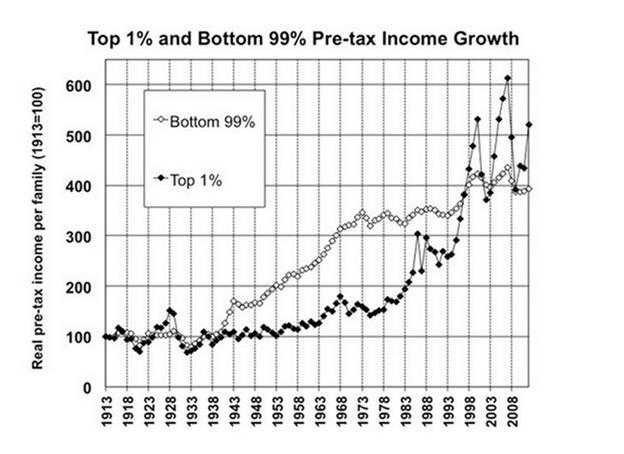
Relying on data from Berkeley economist Emmanuel Saez, Cassidy shares the following graph showing changes in real income growth over the past century.

First let’s look at the top 1%. There seem to be about three distinct periods their incomes have gone through. The first from 1913 to roughly 1973 is more or less flat. Real incomes for the top 1% were no higher in 1973 than they were around 1930. After 1973 however there is a sharp and mostly uninterrupted spike upwards which seems to stop around the year 2000. After 2000 their real incomes have ebbed and flowed, primarily in response to capital gains and losses on their stock portfolios. Even though the volatility of their income has increased, it still remains quite high relative to any time over the past 100 years.

Compare this with the bottom 99%. There seem to be about four distinct periods of real income growth. From 1913 until the end of the Great Depression, real income remained more or less constant. The 1940s, 50s and 60s saw a rapid increase in real income growth, far more rapid than what the 1% experienced. This came to a sudden end around 1973 and a stagnation until the early 1990s. Then from 1993 onwards we see the same final stage as the 1%. Increasing real incomes (though much slower than the 1%) but more volatility as well.

There are many things which are the same in these two trends, but the one year that probably pops out for people who think income inequality is a bad thing is 1973.

This year marked the end of the steady advance for the 99%’s real income gains and set in motion the rapid advance of the 1%. In other words, the marked income inequality we see today is a product of the post-1973 world.

So what happened in 1973? Many things as it turns out. Decreased unionization was getting underway in the U.S. economy around this time, as was the spike in the price of oil.

Russ Roberts over at Café Hayek has a different explanation. He thinks it has to do with changes to the family unit. Large increases in the divorce rate and a steady increase in the number of households headed by women could be to blame for the sudden jump in income inequality.

Maybe, but although this could be a reason why, I doubt it is the primary reason.

Let’s try an informal test. What was the biggest event to occur in 1973?

Americans probably will answer Roe v. Wade, the completion of the World Trade Center as the world’s tallest building or the beginnings of the Watergate hearings. Maybe the start of withdrawal of troops from Vietnam or Britain joining the European Economic Community. Or for sports fans it could be Secretariat winning the Triple Crown and getting immortalized on the cover of Time.

Actually the most important thing to happen in 1973 actually happened in 1971, August 15th to be exact.

On that date Richard Nixon closed the gold window. The U.S. dollar was convertible by foreign governments into gold under the then-existing Bretton Woods system at the great price of $35 per ounce. Continued redemption demands by some belligerent countries (primarily France) drained the U.S. of its gold reserves until the breaking point when it became questionable how much longer this could continue for. In what could have been the most important day of the 20th century, Richard Nixon decided to renege on the U.S.’s promises to foreign governments and essentially default on its currency. No longer was the U.S. dollar tied to gold and the U.S. no longer had to worry about spending beyond its means.

Well, almost no longer. While there was no convertibility into gold after 1971 there was still that old bugaboo of fixity in the exchange rate. The U.S. dollar still functioned on a fixed exchange rate standard relative to gold until 1973, even if there was no convertibility. This meant that the U.S. was still not free to expand its money supply or incur ever increasing budget deficits at will. It had to target a dollar price of gold, which was reset a little higher in 1971 to $38/oz. Even though there was no redeemability, the U.S. was legally obliged to target this gold price, something which tied its hands concerning the extent to which deficits could be run and expansionary of the money supply policies could be pursued.

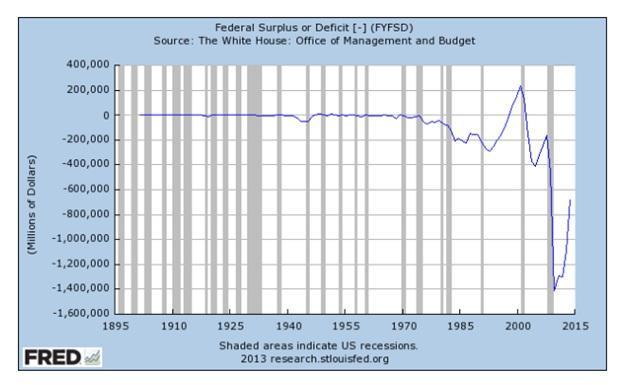
The effect on the deficit is easy to understand in light of this.

Since the late 1880s (and before) the U.S. government ran a somewhat balanced budget. Minor blips appeared during the two World Wars, but by-and-large the deficit hovered very close to the zero line. In the late 1960s we can witness the a growing deficit, partly in response to the cost of the Vietnam War but even that is relatively mild to what would come later. Likewise, 1971 also witnessed a growing deficit but the year which defines the point of no return is clearly 1973. At that point the U.S. deficit went into freefall and besides a few surplus years in the late 1990s it has never recovered.

The effect was also pronounced on prices.

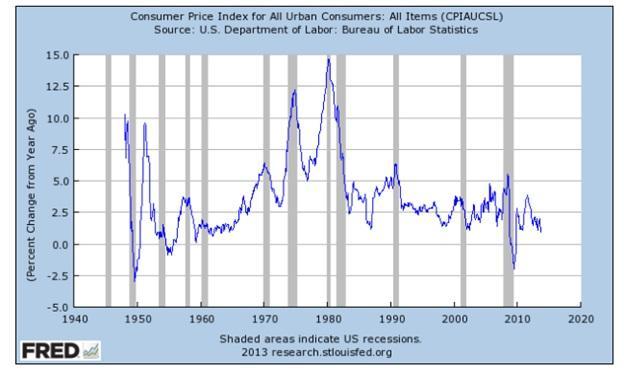
Prices were indeed climbing throughout the 1960s, but 1973 was also the year that set off the most inflationary episode in America´s history. Being unhinged from that relic of gold, the Federal Reserve could increase the money supply and monetize the Federal government’s budget as it wanted. This culminated with 15% annual inflation in 1980 something which took a very strong-minded Federal Reserve chairman by the name of Paul Volker to tame by putting the breaks on money supply growth.

Inflation looks tame today, though the experience following the 1973 decoupling showed what happens when you let the government spend at will without any restraint. Gold provided restraint, just as political gridlock should today. But in the period of the mid to late 1970s there was no such luck.

All this takes us back to the original question: why did income inequality increase so much after 1973? We can look to two factors both related to the loss of the gold exchange standard in 1971 and the arrival of flexible exchange rates two years later.

  • First, as the U.S. government no longer had to worry about redeeming U.S. debt held overseas in gold, it was able to spend without restraint. Of course, this created a large budget deficit quickly, something which needed a solution.

  • This brings us to the second point. By monetizing the U.S. budget deficits, the Federal Reserve set off a period of high price inflation.

The reason why there is growing income inequality since 1973 is a direct result of this monetary mayhem. All this new money needs an entry point into the economy. Someone has to get it first and spend it. When they spend this newly created money they do so at the existing set of prices, but in the course of making these expenditures prices will rise. Those who get the money first “win” in the sense that they get a free lunch – they have a greater income and can spend it before prices rise. Those who get the money last are the “losers” – they get access to this money eventually as it is spent (trickles down?) but by the time that occurs, prices have already risen. They are no better off.

The 99% that have become relatively poorer over the past 40 years are those who get access to this new money last. (Remember however that these people are still, thankfully, wealthier than they were 40 years ago.)

Who are the remaining 1%, then? Well, who gets the money first?

Government officials and contractors, to the extent that they gets the proceeds of all the newly created money are the first and primary beneficiaries. Big banks and financial institutions also win as they are the enablers who help this newly created money enter the economy. Incidentally, 99 times out of 100, when we think of someone in the 1% who is getting ahead of the rest of us, they probably either work for the higher echelons of the government or are involved in the financial industry.

Coincidence? I doubt it, and you just have to go back in time to 1973 to understand why.

via ZeroHedge News https://ift.tt/3mjhiqV Tyler Durden