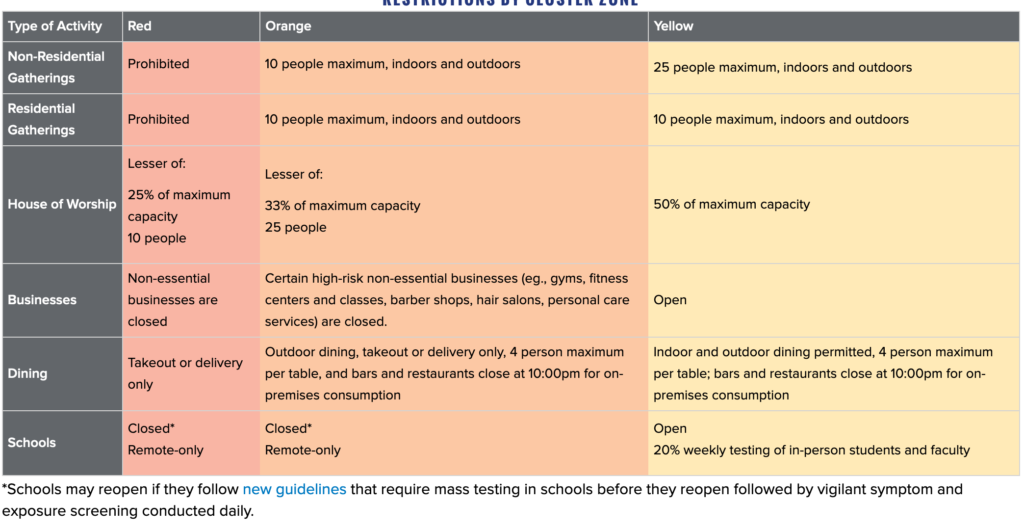
In October, New York imposed strict requirements on houses of worship in so-called “microclusters.”
In “Red” zones, houses of worship were limited to the lesser of 25% of maximum capacity, or 10 people. In virtually every house of worship, the 10 person limit controlled.
In “Orange” zones, houses of worship were limited to the lesser of 33% of maximum capacity, or 25 people. In virtually every house of worship, the 25 person limit controlled.
In “Yellow” zones, houses of worship did not have a hard capacity cap. Rather, they were subject to a 50% occupancy limit.
In Roman Catholic Diocese of Brooklyn v. Cuomo, the Court declared the 10- and 25-person caps unconstitutional with respect to the applicants. As things stand now, none of the applicants are in Red or Orange Zones. Some of the churches and synagogues are in Yellow zones.
I made an error in Part VI of my series. I wrote that the applicants would not be subject to any limitations. I was wrong. The houses of worship in yellow zones are still subject to the 50% maximum occupancy limit. And if New York City snaps to an Orange Zone, the houses of worship would become subject to the 33% maximum capacity cap. And, if any microclusters are placed in the Red Zone, the 25% cap would remain. The applicants did not challenge the percentage caps, and the Supreme Court had no occasion to rule on them.
Now, all houses of worship in yellow zones are subject to the 50% cap. Indeed, my understanding is that houses of worship in “white” zone–that is, are not subject to a microcluster rule–are also subject to the 50% cap.
The Supreme Court’s injunction will stretch until the disposition of the certiorari grant. At this point, the Second Circuit’s proceedings will have no impact on the state of affairs in New York.
from Latest – Reason.com https://ift.tt/3fGQf6k
via IFTTT
While GMU economist Tyler Cowen may have dismissed the idea of more pandemic lockdowns as being “a straw man” and saying that the extreme measures that started in March of this year “are now behind us,” it seems that governors and other politicians around the country have failed to get the message.
More and more states have begun to once again impose ruinous lockdowns. The media and Twitter are filled with self-righteous scolds shrieking about the impending doom of families gathering together for Thanksgiving. CNN host Jake Tapper suggested that “Christmas is probably not gonna be possible.”
If such people had their way, everyone would remain under veritable house arrest and not see anyone else for months or even years, as the duration of such onerous impositions has gone from “fifteen days to slow the spread” to months or even years into the future. That such ideas are even being considered demonstrates just how out of touch with human reality much of our “expert” class and their hordes of lemming-like followers are.
Things have not changed much from when I addressed some of the disastrous unintended material consequences of lockdowns in April of this year. However, as 2020 has dragged on, it has made clear that at least some of the lockdown logic is rooted in a fundamentally flawed and relatively recent conception of human nature.
Nearly every culture and religion throughout human history has held that humans are both material and spiritual beings. However, living in the secular age as we do, the material aspect of our existence has supplanted the spiritual to such an extent that it is barely recognized to exist.
Russell Kirk goes so far as to claim that the dividing line in contemporary politics hinges on this difference in understanding, stating that “on one side of that line are all those men and women who fancy that the temporal order is the only order, and that material needs are their only needs, and that they may do as they like with the human patrimony. On the other side of that line are all those people who recognize an enduring moral order in the universe, a constant human nature, and high duties toward the order spiritual and the order temporal.”
A purely material outlook on human existence will of course lead to certain policy prescriptions, especially in the face of a pandemic. To deny the spiritual existence of man is to deny the possibility of life after death—only the void of annihilation awaits. From this perspective, it makes sense that one might conclude that earthly life must continue on at any cost—that no tradeoff is too high to put off the coming oblivion.
In contrast, those who retain a more traditional conception of human nature, no matter the specific religion or creed to which they belong, can easily see an entire world of costs to lockdowns that those with a purely materialist perspective are not even capable of understanding.
Humans are social beings. Our very existence and development as human persons rests upon this social nature. Social contract thinkers like Hobbes, Locke, and Rousseau may fantasize about a solitary human existence, but all evidence from feral or isolated children indicates that without other humans a solitary individual would swiftly perish, not to mention fail to develop self-awareness or the ability to think and speak with language.
Some personalist scholars, such as political theorist David Walsh, argue that our entire conception of self can only be formed in relation to other persons. In contrast to Descartes’s famous line that “I think, therefore I am” a personalist would argue that we are not even capable of understanding the existence of “I” until we have first understood the existence of an “I” in others. Much like we can never truly see our own face, but only the faces of others, which in turn allows us to understand our own unseen face, we cannot become aware of ourselves until we find ourselves in the context of others, and through them recognize the mutual nature of our interior lives that makes us persons.
Many religions, in some form or another, speak of the interconnectedness of the world and of people and of the illusion of separation. While most often associated with Eastern religions such as Buddhism, this spiritual unity is not foreign to Christianity and the West. Indeed, the Christian Trinity is understood to be one God in three persons. Jesus Christ references this unity in the seventeenth chapter of the Gospel of John when he prays “that all of them may be one, Father, just as you are in me and I am in you…that they may be one as we are one—I in them and you in me—so that they may be brought to complete unity.”
Leaving the specific religious implications aside, humans have recognized for millennia that when persons gather together we enter into one another on a spiritual level through the recognition of our mutual personhood. However, this spiritual unity that is so essential to our very existence as human persons does not occur in a vacuum, but rather in the context in which we gather in the material world.
Humans could acquire all the nutrients we need by imbibing Soylent Green in solitude, but instead, we often turn our meals into ritualistic social occasions. Shared meals not only provide material nourishment but spiritual sustenance as well. Dancing alone in your kitchen is all well and good, but it pales in comparison to experiencing a crowd of thousands moshing at an electronic dance music festival or the pounding feet of a Sufi sect dancing the dhikr. We are fortunate to be able to access great art at the click of a mouse, but watching Swan Lake home alone on YouTube is no substitute for the experience of seeing it live in a crowded hall as every person is moved to tears.
There are few events more brimming with the spiritual unity of the attendees than a wedding, a celebration of the literal unity of two persons as one in the presence of their friends and loved ones with feasting, singing, and dancing.
Yet how many weddings have been canceled or celebrated in private this year thanks to lockdowns? How many shared meals have not been eaten? Dances left undanced, songs left unsung, conversations not had? How many parents and grandparents in nursing homes did not get to see their loved ones before they departed this earth? How many children have suffered in front of a screen alone all day? These are not mere frivolous luxuries that we humans can do without. The dual material and spiritual contexts of our personhood cannot be separated. These contexts of our families and communities are not nice additions to life, they are human life itself.
There is no denying that during a pandemic there will be a need to alter one’s behavior, but just as no state bureaucrat can successfully plan the economy, no public health official is capable of centrally planning a response for hundreds of millions of people who are all in different conditions of life, with different material and spiritual needs.
Every person must decide for himself what the proper course of action is in light of his unique life circumstances. Ripping these decisions from every person and placing them in the hands of public health bureaucrats has yielded disaster.
Suicide rates are up all around the country, in some places as much as 70 percent compared to the same time last year. Military suicides are up 20 percent. Drug overdose deaths are on track to reach an all-time high. The RAND Corporation has found an upswing in heavy drinking this year. The Associated Pressreports on the horrific conditions in nursing homes around the country that may have led to the deaths of tens of thousands of residents in excruciating and horrific circumstances, as their families have been forbidden from caring for them. What’s more, it seems many patients simply withered away, their spirits broken from being locked in veritable solitary confinement with no contact with friends or family for months.
Medical central planning that doesn’t even recognize the spiritual and social aspect of human existence has caused the deaths of untold numbers of people around the country, perhaps more than the virus itself in the long run.
Our vaunted leaders may act like pure materialists when it comes to their dictatorial decrees obliterating society and our very humanity, but on some level they obviously understand the importance of their own spiritual health. Why else would the leaders of California be breaking their own rules to dine at luxurious restaurants or flying to Hawaii for meetings and not be content with takeout and Zoom like the rest of us peasants? But what else can be expected from a system of top-down control?
Humans are both material and spiritual beings. Just as we have material needs that central planners cannot anticipate, so too do we have spiritual needs that can only be filled in a myriad of ways that central planners cannot plan for, especially when they don’t even recognize they are needs at all. When they are not fulfilled, our physical health suffers just as assuredly as if we had a virus. The social and communal aspects of human life, whether a holiday dinner with family, going to church, having a wedding, or even the mundane relations of everyday life are not mere luxuries that can be dispensed with, they are human life itself. People must be free to navigate these difficult times armed with the knowledge of their circumstances that only they possess.
via ZeroHedge News https://ift.tt/39kXUGh Tyler Durden
The U.S. Court of Appeals for the Third Circuit roundly rejected the Trump campaign’s appeal in its effort to challenge the election results in Pennsylvania. Jude Stephanos Bibas wrote the opinion for the panel, which also included Judges Smith and Chagares.
The opinion is brief, and pulls no punches. Here is how it begins:
Free, fair elections are the lifeblood of our democracy. Charges of unfairness are serious. But calling an election unfair does not make it so. Charges require specific allegations and then proof. We have neither here.
The Trump Presidential Campaign asserts that Pennsylvania’s 2020 election was unfair. But as lawyer Rudolph Giuliani stressed, the Campaign “doesn’t plead fraud. . . . [T]his is not a fraud case.” Mot. to Dismiss Hr’g Tr. 118:19–20, 137:18. Instead, it objects that Pennsylvania’s Secretary of State and some counties restricted poll watchers and let voters fix technical defects in their mail-in ballots. It offers nothing more. This case is not about whether those claims are true. Rather, the Campaign appeals on a very narrow ground: whether the District Court abused its discretion in not letting the Campaign amend its complaint a second time. It did not.
Most of the claims in the Second Amended Complaint boil down to issues of state law. But Pennsylvania law is willing to overlook many technical defects. It favors counting votes as long as there is no fraud. Indeed, the Campaign has already litigated and lost many of these issues in state courts.
The Campaign tries to repackage these state-law claims as unconstitutional discrimination. Yet its allegations are vague and conclusory. It never alleges that anyone treated the Trump campaign or Trump votes worse than it treated the Biden campaign or Biden votes. And federal law does not require poll watchers or specify how they may observe. It also says nothing about curing technical state-law errors in ballots. Each of these defects is fatal, and the proposed Second Amended Complaint does not fix them. So the District Court properly denied leave to amend again.
Nor does the Campaign deserve an injunction to undo Pennsylvania’s certification of its votes. The Campaign’s claims have no merit. The number of ballots it specifically challenges is far smaller than the roughly 81,000-vote margin of victory. And it never claims fraud or that any votes were cast by illegal voters. Plus, tossing out millions of mail-in ballots would be drastic and unprecedented, disenfranchising a huge swath of the electorate and upsetting all down-ballot races too. That remedy would be grossly disproportionate to the procedural challenges raised. So we deny the motion for an injunction pending appeal.
The opinion concludes:
Voters, not lawyers, choose the President. Ballots, not briefs, decide elections. The ballots here are governed by Pennsylvania election law. No federal law requires poll watchers or specifies where they must live or how close they may stand when votes are counted. Nor does federal law govern whether to count ballots with minor state-law defects or let voters cure those defects. Those are all issues of state law, not ones that we can hear. And earlier lawsuits have rejected those claims.
Seeking to turn those state-law claims into federal ones, the Campaign claims discrimination. But its alchemy cannot transmute lead into gold. The Campaign never alleges that any ballot was fraudulent or cast by an illegal voter. It never alleges that any defendant treated the Trump campaign or its votes worse than it treated the Biden campaign or its votes. Calling something discrimination does not make it so. The Second Amended Complaint still suffers from these core defects, so granting leave to amend would have been futile.
And there is no basis to grant the unprecedented injunction sought here. First, for the reasons already given, the Campaign is unlikely to succeed on the merits. Second, it shows no irreparable harm, offering specific challenges to many fewer ballots than the roughly 81,000-vote margin of victory. Third, the Campaign is responsible for its delay and repetitive litigation. Finally, the public interest strongly favors finality, counting every lawful voter’s vote, and not disenfranchising millions of Pennsylvania voters who voted by mail. Plus, discarding those votes could disrupt every other election on the ballot.
We will thus affirm the District Court’s denial of leave to amend, and we deny an injunction pending appeal. The Campaign asked for a very fast briefing schedule, and we have granted its request. Because the Campaign wants us to move as fast as possible, we also deny oral argument. We grant all motions to file overlength responses, to file amicus briefs, and to supplement appendices. We deny all other outstanding motions as moot. This Court’s mandate shall issue at once.
For those who care about such things, Judge Bibas was among President Trump’s first nominees to the federal appellate bench. He is widely admired for his intellect and is generally considered quite conservative. A former law professor (most recently at the University of Pennsylvania, where he co-taught a seminar on conservative thought with Professor Amy Wax), he was regular speaker at Federalist Society events prior to his nomination. Judges Smith and Chagares were both appointed by President George W. Bush.
from Latest – Reason.com https://ift.tt/2KGrnjz
via IFTTT
The Pentagon Has Closed Ten Bases In Afghanistan Amid Hastened Draw Down Tyler Durden
Fri, 11/27/2020 – 13:50
Amid ongoing US negotiations with the Taliban which are aimed at reaching terms that would allow for a complete American troop withdrawal from Afghanistan, which is Washington’s longest running war in history, at least ten US military bases have been closed since last February, The Washington Post reports.
This also comes after President Trump controversially ordered the Pentagon earlier this month to initiate adrawdown of troops in Afghanistan and Iraq of up to 2,500 from each nation.
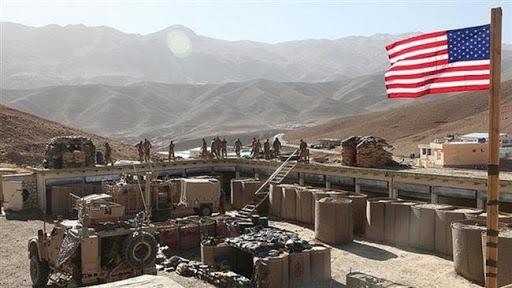
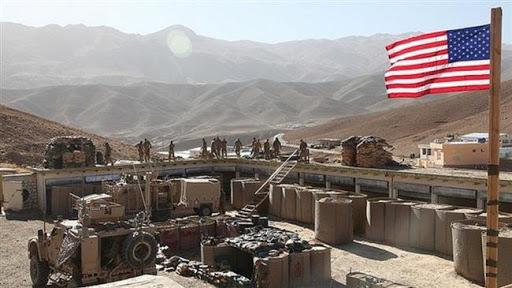
US military file image: small base in west-central Afghan province of Parwan.
While the military has not formally confirmed the closure of the bases, which remains classified given the sensitive security nature of troop departures, the WaPo report cited both top US and Afghan officials.
The future status of the shuttered bases remains unclear in terms whether they were handed over to Afghan national forces, or if they were simply vacated or possibly destroyed.
“Little is known about what remains of those bases, many in Afghanistan’s most volatile provinces where U.S. support for Afghan operations has been critical in pushing back the Taliban,” the Post report reads.
“Some have been completely handed over to Afghan security forces. Others may have been vacated and left in place in a way in which they could be occupied again in the future if U.S. and Afghan officials consider it necessary. It is also unclear how much equipment — more difficult to move than people — is left at each of the closed installations.”
As of the start of 2020, this US had up to 14,000 troops in Afghanistan, but this number has since been gradually reduced:
In the case of small special forces bases in Syria that were vacated within the past two years – some reportedly had equipment there destroyed by departing US troops while some were promptly taken over by Syrian Army and Russian forces.
The fact that at least ten bases in Afghanistan have been closed is a good sign, however, suggesting the US is actually serious about disengaging from what many have seen as an “endless” occupation and war which has bore little fruit for US interests and has remained very unpopular in US public opinion.
via ZeroHedge News https://ift.tt/3q9ODGU Tyler Durden
The U.S. Court of Appeals for the Third Circuit roundly rejected the Trump campaign’s appeal in its effort to challenge the election results in Pennsylvania. Jude Stephanos Bibas wrote the opinion for the panel, which also included Judges Smith and Chagares.
The opinion is brief, and pulls no punches. Here is how it begins:
Free, fair elections are the lifeblood of our democracy. Charges of unfairness are serious. But calling an election unfair does not make it so. Charges require specific allegations and then proof. We have neither here.
The Trump Presidential Campaign asserts that Pennsylvania’s 2020 election was unfair. But as lawyer Rudolph Giuliani stressed, the Campaign “doesn’t plead fraud. . . . [T]his is not a fraud case.” Mot. to Dismiss Hr’g Tr. 118:19–20, 137:18. Instead, it objects that Pennsylvania’s Secretary of State and some counties restricted poll watchers and let voters fix technical defects in their mail-in ballots. It offers nothing more. This case is not about whether those claims are true. Rather, the Campaign appeals on a very narrow ground: whether the District Court abused its discretion in not letting the Campaign amend its complaint a second time. It did not.
Most of the claims in the Second Amended Complaint boil down to issues of state law. But Pennsylvania law is willing to overlook many technical defects. It favors counting votes as long as there is no fraud. Indeed, the Campaign has already litigated and lost many of these issues in state courts.
The Campaign tries to repackage these state-law claims as unconstitutional discrimination. Yet its allegations are vague and conclusory. It never alleges that anyone treated the Trump campaign or Trump votes worse than it treated the Biden campaign or Biden votes. And federal law does not require poll watchers or specify how they may observe. It also says nothing about curing technical state-law errors in ballots. Each of these defects is fatal, and the proposed Second Amended Complaint does not fix them. So the District Court properly denied leave to amend again.
Nor does the Campaign deserve an injunction to undo Pennsylvania’s certification of its votes. The Campaign’s claims have no merit. The number of ballots it specifically challenges is far smaller than the roughly 81,000-vote margin of victory. And it never claims fraud or that any votes were cast by illegal voters. Plus, tossing out millions of mail-in ballots would be drastic and unprecedented, disenfranchising a huge swath of the electorate and upsetting all down-ballot races too. That remedy would be grossly disproportionate to the procedural challenges raised. So we deny the motion for an injunction pending appeal.
The opinion concludes:
Voters, not lawyers, choose the President. Ballots, not briefs, decide elections. The ballots here are governed by Pennsylvania election law. No federal law requires poll watchers or specifies where they must live or how close they may stand when votes are counted. Nor does federal law govern whether to count ballots with minor state-law defects or let voters cure those defects. Those are all issues of state law, not ones that we can hear. And earlier lawsuits have rejected those claims.
Seeking to turn those state-law claims into federal ones, the Campaign claims discrimination. But its alchemy cannot transmute lead into gold. The Campaign never alleges that any ballot was fraudulent or cast by an illegal voter. It never alleges that any defendant treated the Trump campaign or its votes worse than it treated the Biden campaign or its votes. Calling something discrimination does not make it so. The Second Amended Complaint still suffers from these core defects, so granting leave to amend would have been futile.
And there is no basis to grant the unprecedented injunction sought here. First, for the reasons already given, the Campaign is unlikely to succeed on the merits. Second, it shows no irreparable harm, offering specific challenges to many fewer ballots than the roughly 81,000-vote margin of victory. Third, the Campaign is responsible for its delay and repetitive litigation. Finally, the public interest strongly favors finality, counting every lawful voter’s vote, and not disenfranchising millions of Pennsylvania voters who voted by mail. Plus, discarding those votes could disrupt every other election on the ballot.
We will thus affirm the District Court’s denial of leave to amend, and we deny an injunction pending appeal. The Campaign asked for a very fast briefing schedule, and we have granted its request. Because the Campaign wants us to move as fast as possible, we also deny oral argument. We grant all motions to file overlength responses, to file amicus briefs, and to supplement appendices. We deny all other outstanding motions as moot. This Court’s mandate shall issue at once.
For those who care about such things, Judge Bibas was among President Trump’s first nominees to the federal appellate bench. He is widely admired for his intellect and is generally considered quite conservative. A former law professor (most recently at the University of Pennsylvania, where he co-taught a seminar on conservative thought with Professor Amy Wax), he was regular speaker at Federalist Society events prior to his nomination. Judges Smith and Chagares were both appointed by President George W. Bush.
from Latest – Reason.com https://ift.tt/2KGrnjz
via IFTTT
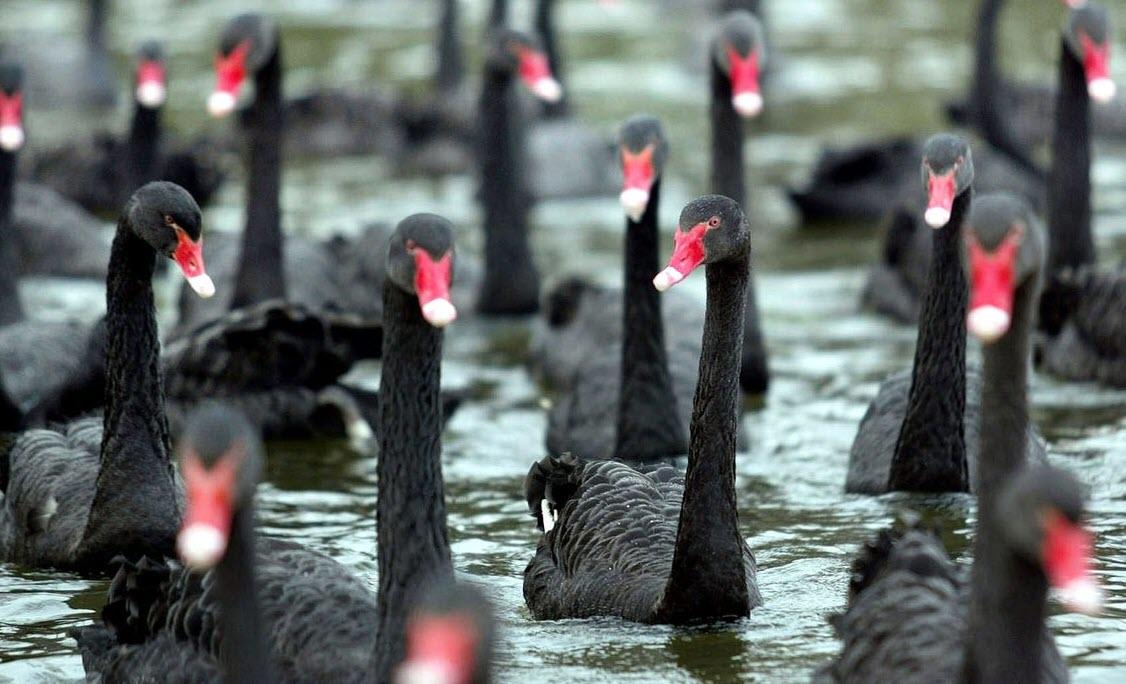
On this ’Black Friday’, it’s good to remember that we are currently surrounded by a flock of emergent “Black Swans”.
To recap, a Black Swan is an improbable, generally unforeseen, yet high-impact event. Such events are usually thought to include earthquakes and other natural disasters, collapses of large buildings and bridges and, in some cases, financial collapses.
In March, we labelled the coronavirus pandemic a Black Swan, notably contrary to the view of the creator of the concept, Nassim Nicholas Taleb. His view is that pandemics are nothing new. He also warned that the outbreak might, without drastic action, become more widespread, in a paper co-authored with Yaneer Bar-Yam and Joe Norman published on the 26th of January.
However, we considered the pandemic to be an economic Black Swan, in a sense that very few originally understood, due to its potential to unleash global economic mayhem. To be precise, we warned on the 30th of January about the possibility of global pandemic and economic collapse caused by the coronavirus.
Currently, the question is, what other Black Swans may be lurking under the surface of the global economy?
True Black Swans and forecasting
Events that can be classified as Black Swans are directly related to our ability—or inability—to forecasts events.
The annihilation of Pompeji in a volcanic catastrophe in 79 BC or the destruction of prosperous Greek coastal city of Helike in 373 BC by earthquake and tsunami would probably still count as a Black Swans. But our ability to forecast certain natural events has improved markedly.
For example, the ‘Great Storm of 1900’ that devastated the coastal city of Galveston outside Houston, Texas, was as seen a Black Swan at the time. Almost no warning was given before the deadliest natural disaster in the U.S. Nowadays, hurricanes do not strike “out of the blue”, but are tracked by the minute and their path forecast with reasonable accuracy at least several days ahead.
Some also consider the financial crisis of 2007–2008 to be a Black Swan. However it was no such thing, as we have explained in our 10th anniversary blog on the Global Financial Crisis. The approaching crisis was observable about a year before from the stresses building in the banking system. Those who understood the fragile nature of the major financial innovation of that time, the ‘Collateralized Debt Obligation’, or CDO, could even see the crisis coming a few years before its onset.
So, whether an event qualifies as a Black Swan is inherently related to our ability to analyze the current situation and to forecast future events.
Economic Black Swans turn into grey Swans
In March 2017, we warned on the possibility of a global economic collapse. We stated that
[…] it is our view that the bubble in the world economy has just come too big to avoid a massive correction. Without some kind of “divine intervention”, the bubble will burst and the world economy will crash. We just do not know the exact date of its demise.
And, we continued
The policy makers still have tools in their disposal to delay the inevitable. The big question is what they will do next and this makes forecasting the onset of a crisis exceptionally challenging.
The latter point has become a reality. Analyzing objectively, the crisis started at the turn of the year from 2018 to 2019 or, at the latest, in September 2019, which we detail in this blog.
But this economic collapse, forced into motion by the pandemic, should not have come as a surprise. One just needs to follow standard economics to understand that something has not been right, and that trouble has been brewing for a long time.
For starters, an economy needs to grow without constant monetary support. As we detailed in October 2017, the world’s economic growth had been dominated by Chinese debt-stimulus which it enacted in 2009.
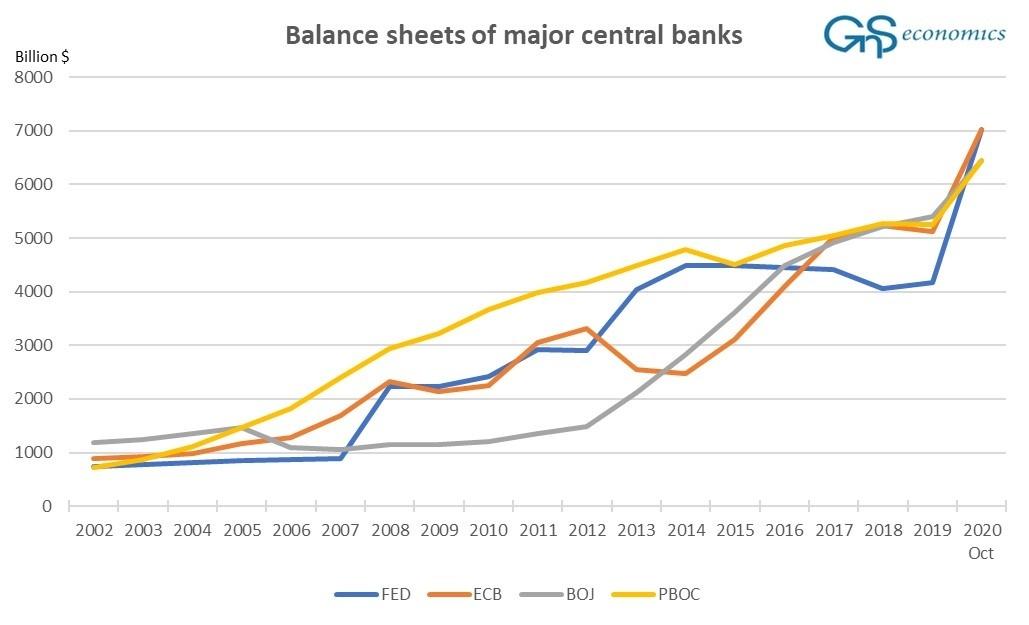
Moreover, stimulative monetary policies and especially programs of quantitative easing had been in incessant operation globally since 2008. The latter led to ballooning balance sheets among major central banks (see Figure).
Effectively, central banks have ‘hollowed out‘ the global economy and financial markets, as also recently noted by former BIS Chief Economist, William White.
Running on empty
And so we have reached a point where the coronavirus pandemic has turned many of our economic Black Swans into a grey ones (unlikely, yet forecastable significant events). Now, it’s only the question of where to look.
Do you buy the futile, panicked assertion by governments and central bankers that more stimulus is essential to avoid the collapse? Or do you acknowledge the reality that the fragile global economy has already collapsed and that all the current “emergency” measures, like central bank support and debt-moratoria, are there just to mask the collapse?
If you believe the former, you might want to reconsider—or keep on dreaming. If you admit the latter, you should try to assess what is the best way forward for you and your assets, but also for the economy as a whole.
It is plain that the central bank-run economic governance model has reached the end of its lifespan. We desperately need a more open and free economy and less intervention and continuous “rescues”. This path will not be easy, but the current end-point, global economic dystopia, courtesy of global central banks, is much worse.
More than anything, we need true political leadership—the statesmanship, courage, and wisdom to see through the scare-mongering and distorted economic information. We must confront dominant elitist economic shibboleths relentlessly to move past what is first and foremost an intellectual dead-end.
via ZeroHedge News https://ift.tt/2V6d8GW Tyler Durden
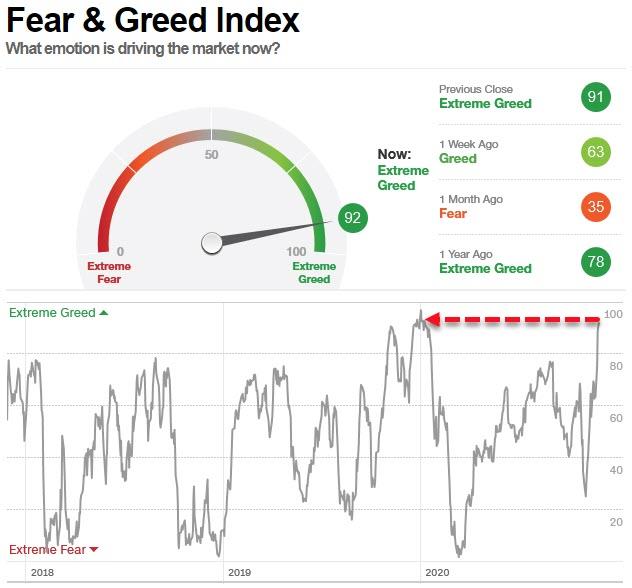
This level of extreme greed didn’t end well last time.
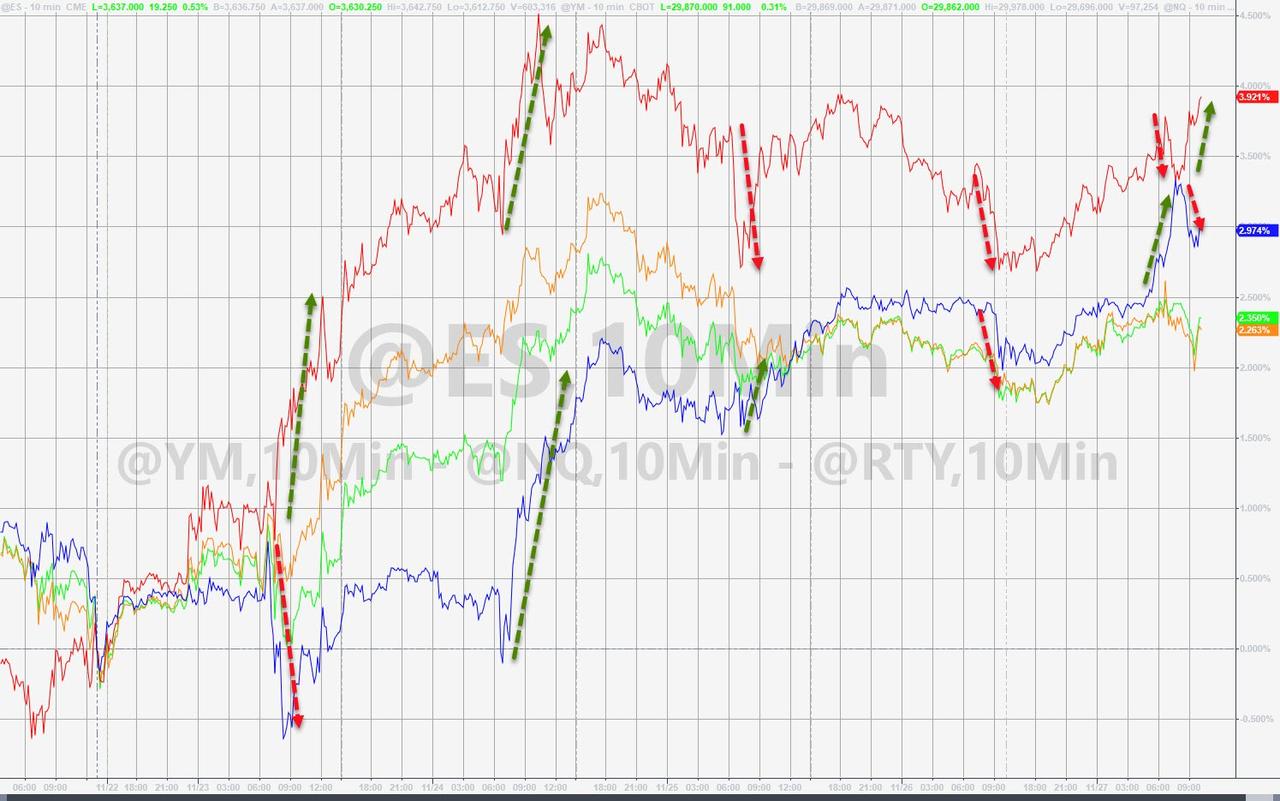
Interestingly, as the week progressed, Nasdaq caught up with Small Caps early-week outperformance, stalling the ‘rotation’ trend. The Dow was the week’s laggard but still managed solid gains…
As a reminder, the recent vaccine headlines have put global and european-specific stock markets on track for their best month ever…
Source: Bloomberg
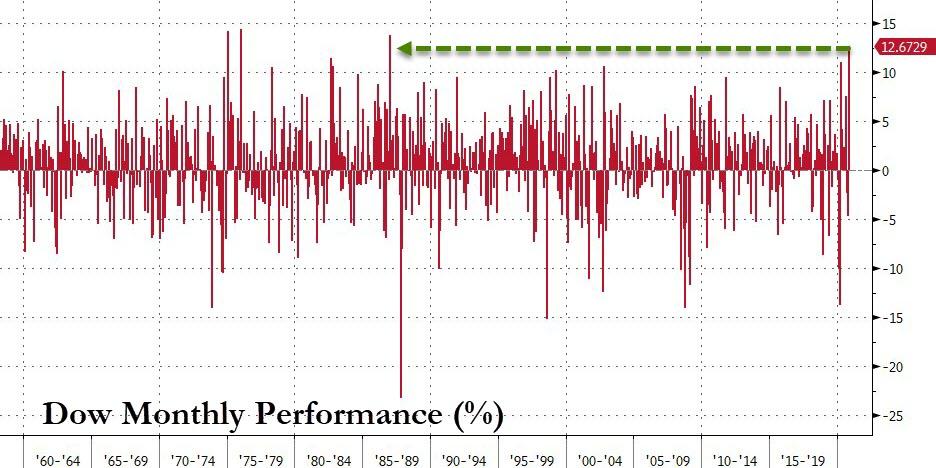
And the major US equity indices on track for their best month since 1987…
Source: Bloomberg
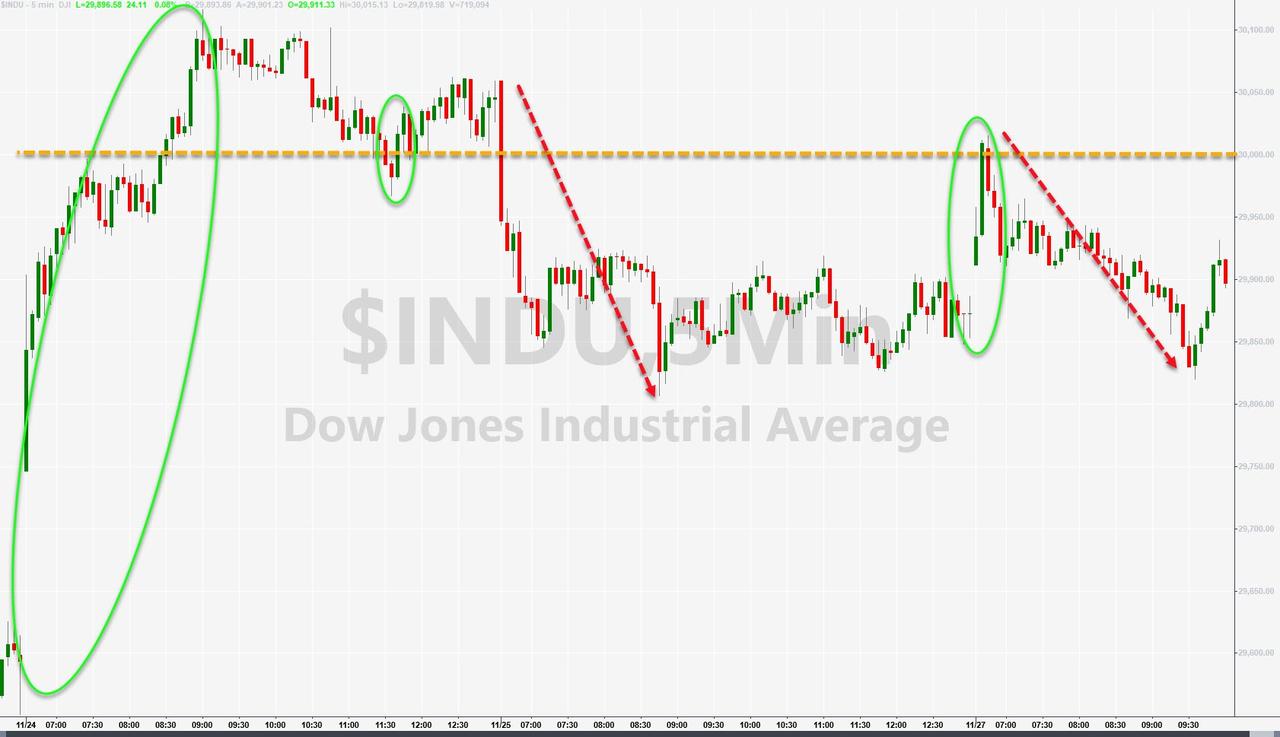
The Dow broke above 30k for the first time ever early in the week but was unable to maintain it…
Energy stocks continued their massive surge this week (though faded a little today) as Utes lagged…
Source: Bloomberg
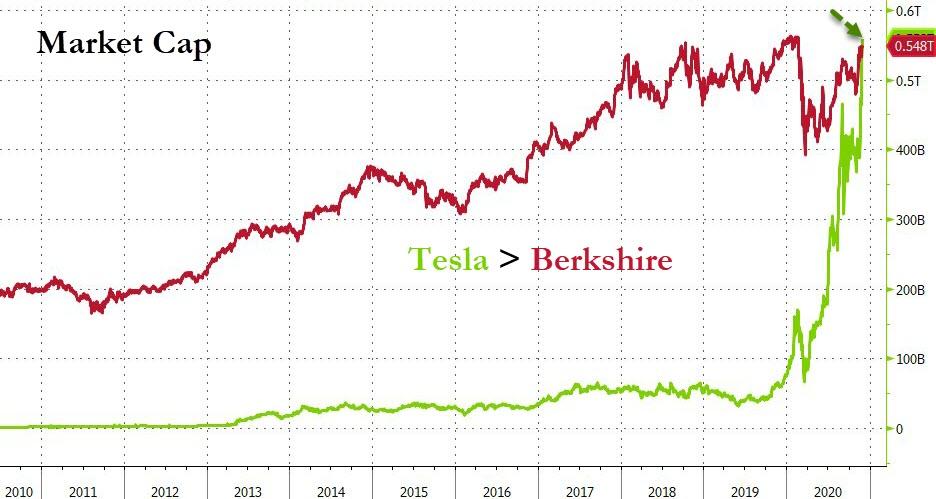
And as we noted earlier, Tesla surpassed Berkshire Hathaway in market cap for the first time ever…
Source: Bloomberg
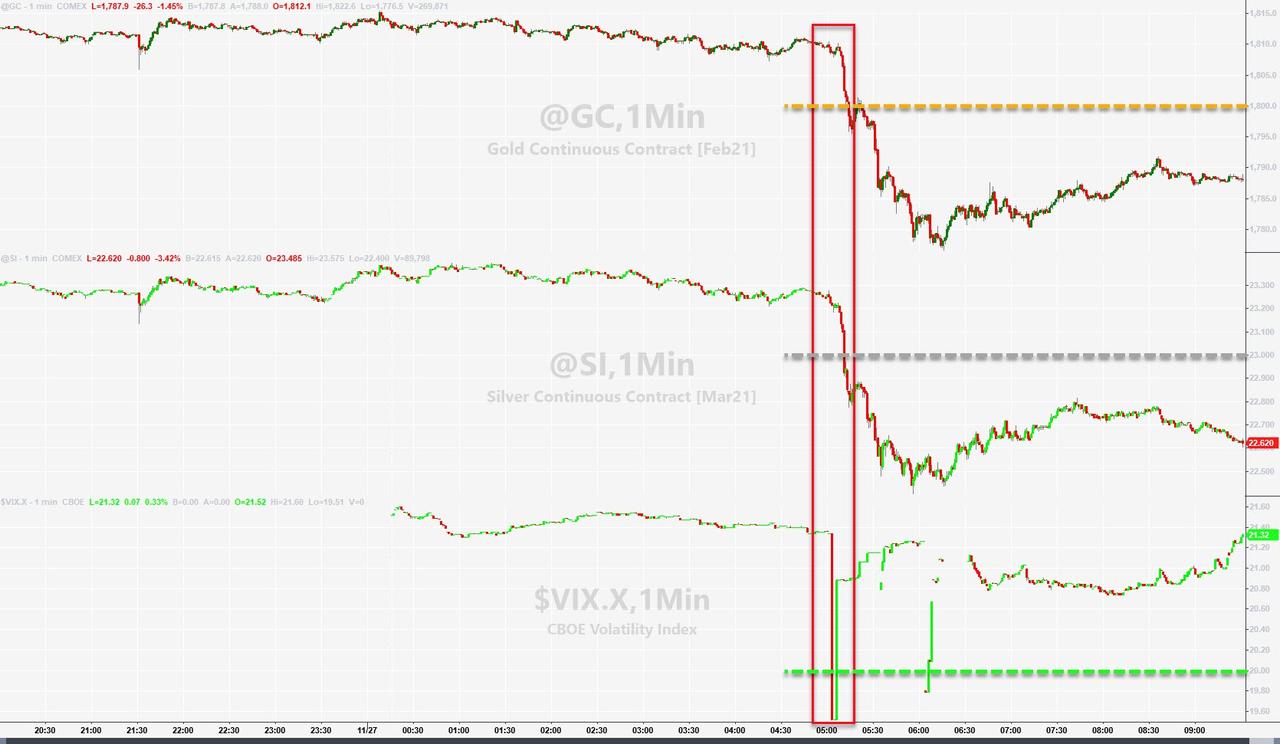
VIX flash-crashed intraday below 20 – its lowest since February…
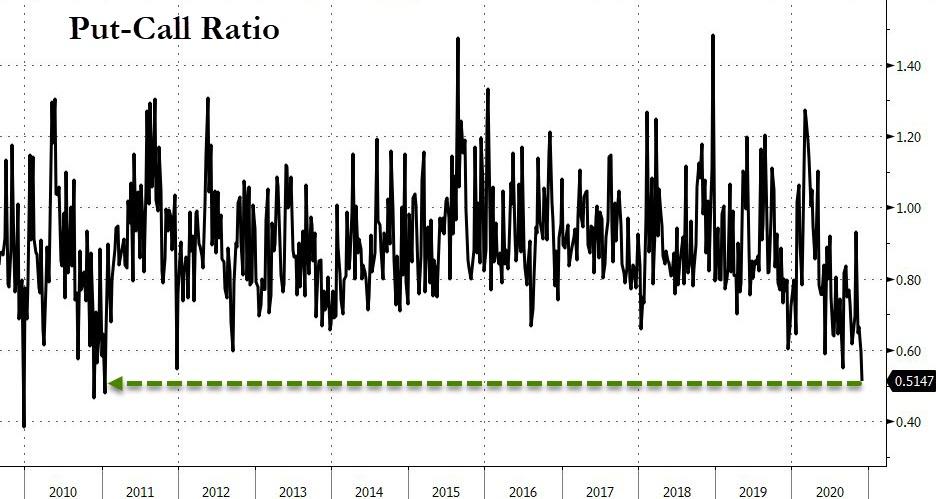
As traders dumped puts in favor of calls by the most since 2010…
Source: Bloomberg
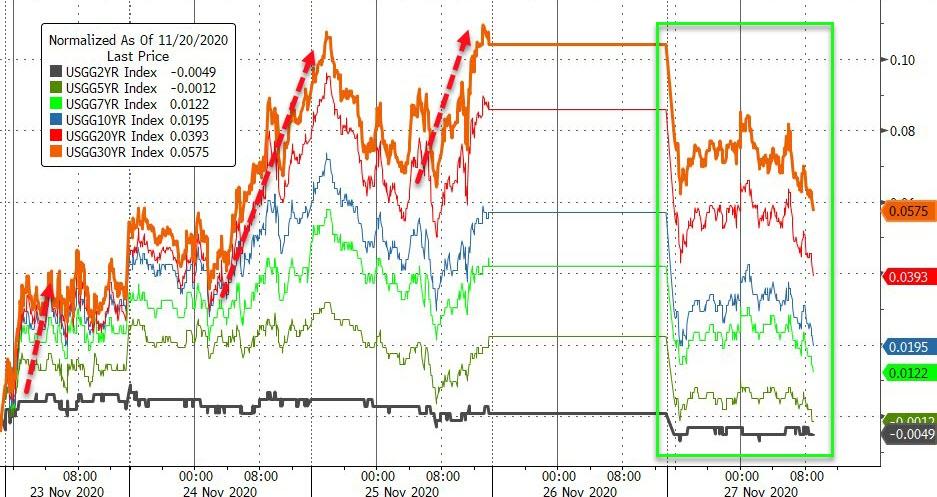
Treasury yields fell today after rising into Thanksgiving. 30Y remains up around 5bps on the week, 2Y unch…
Source: Bloomberg
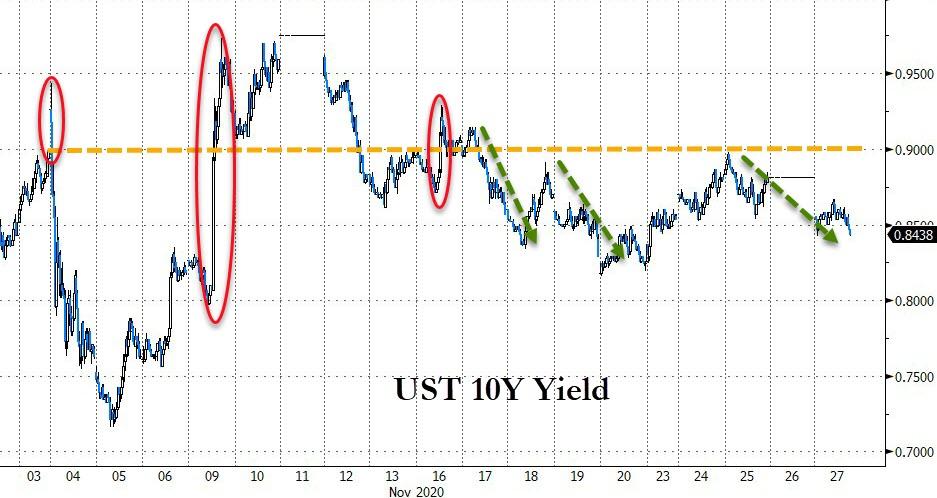
10Y yields rolled over at pre-election-spike levels (around 90bps) once again, shrugging off any vaccine growth hopes…
Source: Bloomberg
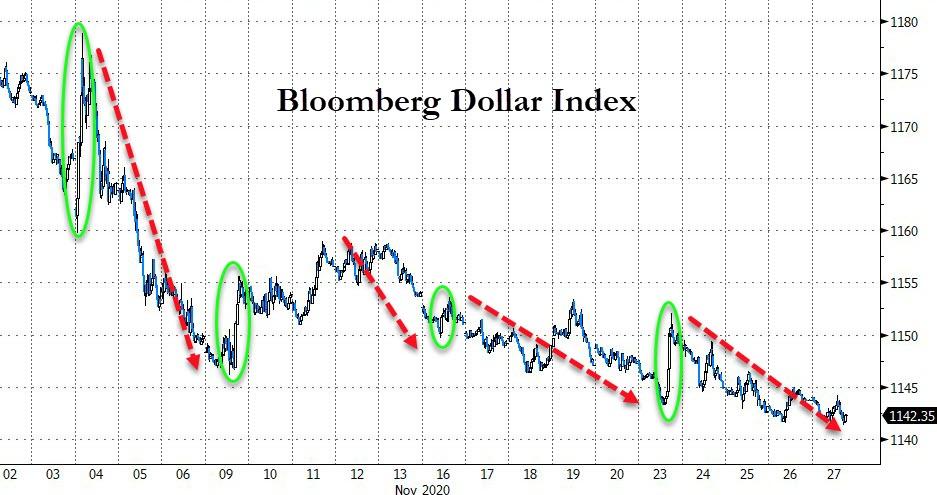
The dollar tumbled for the 3rd week in the last 4, having plunged almost non-stop since the election…
Source: Bloomberg
…closing at its weakest vs its fiat peers since April 2018 (and unchanged since Jan 2015)…
Source: Bloomberg
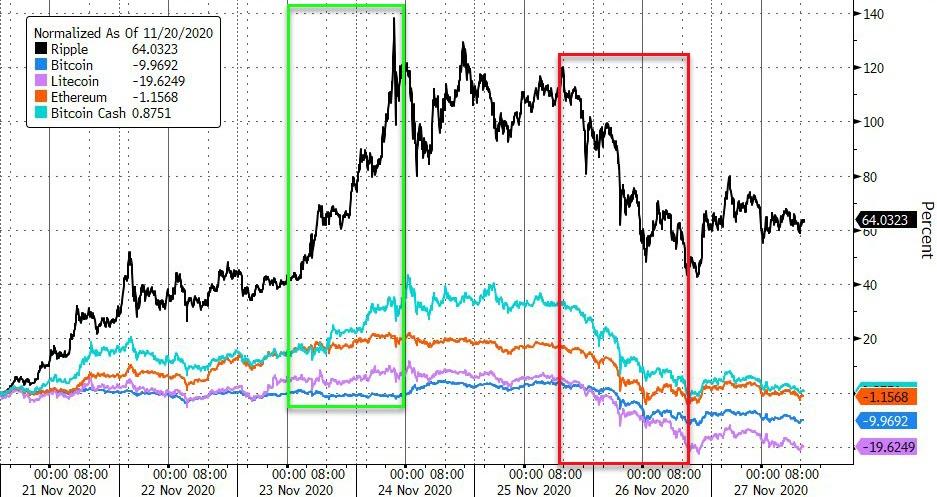
Cryptos started the week strongly with Bitcoin closing at a record high, but ended weak with ETH flat and BTC -10% (and yes Ripple was up 140% on the week on Tuesday!)…
Source: Bloomberg
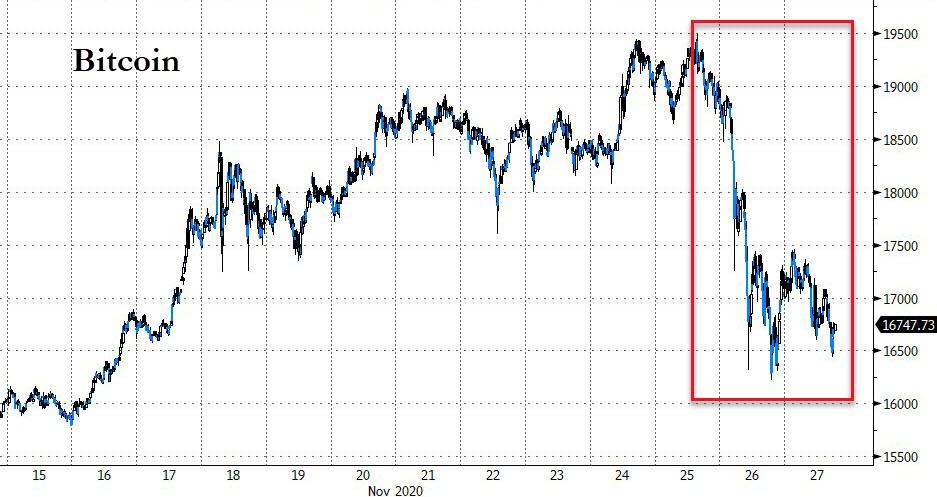
Bitcoin fell from $19500 to $16500…
Source: Bloomberg
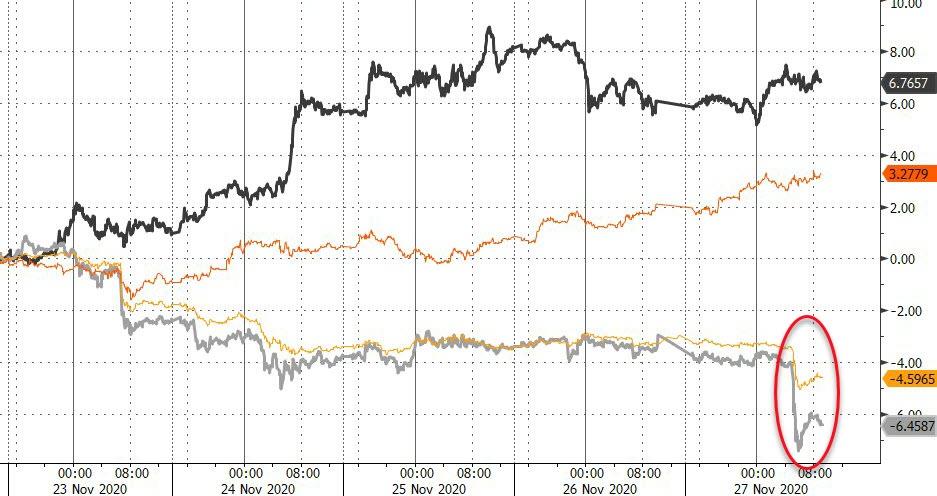
On the week, copper and crude surged as PMs were purged…
Source: Bloomberg
Gold and Silver were monkeyhammered this morning (coinciding with a forceful flash-crash in VIX)…
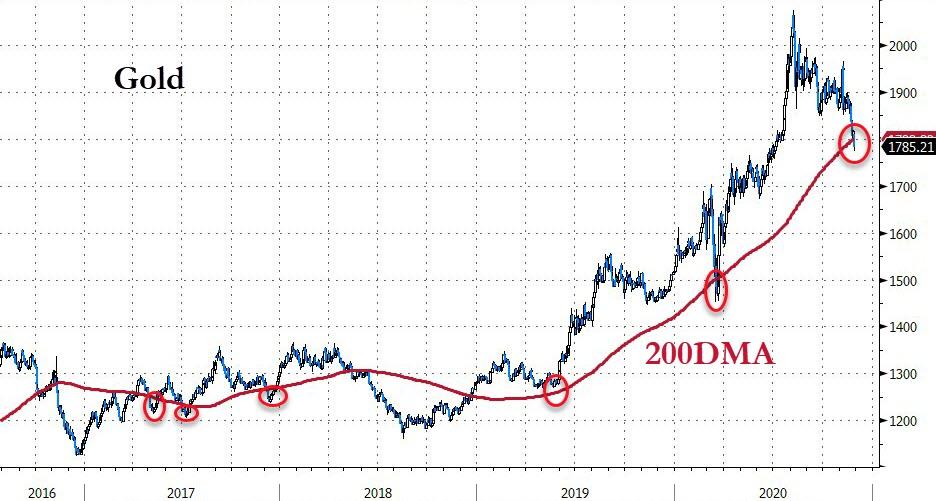
Gold is heading for its 3rd straight weekly decline, its 4th straight monthly drop and worst month since Nov 2016, breaking (and closing) below its 200DMA…
Thanksgiving Melt Up Anomaly. The average S&P 500 gain for 12 of the past 14 ten-day periods concluding November, was 3.5%. The only two exceptions, 2015 and 2018, were preceded by significant market corrections.
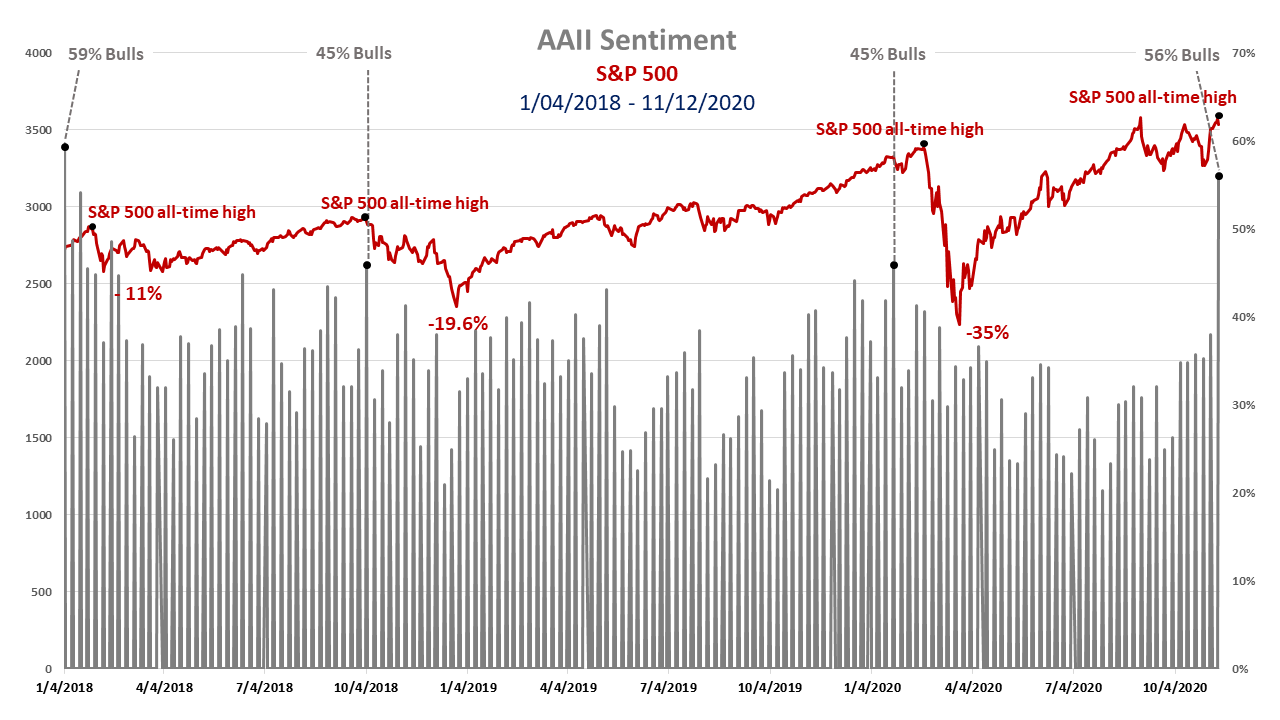
Bullish Sentiment Anomaly. Currently, there is a high probability for the S&P 500 to decline by 12.7%. Such would be from its recent 2020 high and would conclude by December 20, 2020. Based on the previous behavior, there is a 66% probability the S&P 500 could continue its decline in 2021.
The Thanksgiving Melt Up Anomaly is now driving the S&P 500 to a higher November all-time high.
The Bullish Sentiment Anomaly is the cause of a violent correction for the S&P 500 to begin in early December 2020.
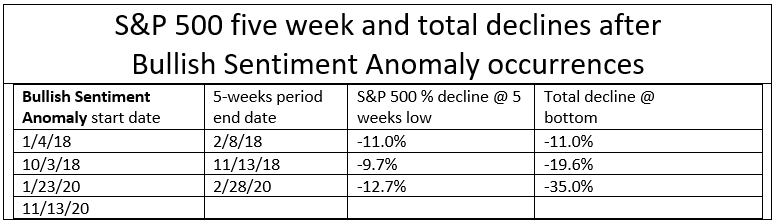
The chart below depicts the four 45% to 59% Bullish sentiment readings which occurred near the all-time highs for the S&P 500. (2018 to November 13, 2020)
Within five weeks of the three prior Bullish Sentiment Anomalies occurring, the S&P 500 declined by a minimum of 9.7%. Two of the three total declines depicted in the table below were more than 100% greater than the five-week drops.
There exists a risk of decline from November 13, 2020, through Christmas Day. Such is likely to occur precisely because no one expects it to.
Trade accordingly.
via ZeroHedge News https://ift.tt/3lhZYBc Tyler Durden
A federal appeals court has tossed an attempt by the Trump campaign to revive a lawsuit seeking to undo Pennsylvania’s certification of Joe Biden’s irregularity-plagued victory in the state.
The Friday decision potentially sets the stage for a US Supreme Court showdown, in which the 6-3 (arguably) conservative majority could overturn the results of the election.
That said, according to Bloomberg – citing ‘experts’ – it’s unlikely that the high court will take up a case if the evidence is lacking, and which won’t affect the outcome of the election – given that Biden would still win the White House without Pennsylvania’s 20 electoral votes.
“Voters, not lawyers, choose the president,” reads the opinion from the appeals court, adding “Ballots, not briefs, decide elections. The ballots here are governed by Pennsylvania election law. No federal law requires poll watchers or specifies where they must live or how close they may stand when votes are counted. Nor does federal law govern whether to count ballots with minor state-law defects or let voters cure those defects.”
The Trump campaign sought to have a federal court invalidate Pennsylvania’s certification, and then get the state’s General Assembly to select Trump electors to the Electoral College – which campaign attorney Marc Scaringi wrrote to the US Court of Appeals for the 3rd Circuit (via CNBC).
“The Pennsylvania General Assembly has the power to appoint the Commonwealth’s presidential electors,” wrote Scaringi, adding “A decision by the District Court that President Trump won the legal votes may have significant impact on the General Assembly.”
The campaign has alleged widespread voting fraud.
via ZeroHedge News https://ift.tt/37bETmY Tyler Durden
Iran Accuses Israel Of Seeking To Provoke “Full-Blown War” With Brazen Assassination Tyler Durden
Fri, 11/27/2020 – 12:32
Since news broke hours ago of the assassination of Iran’s top nuclear scientist, Mohsen Fakhrizadeh, on the streets in a city just east of Tehran, Iranian leaders have blamed an Israeli assassination plot.
Iranian Foreign Minister Javad Zarif said there were “Serious indications of Israeli role” in killing of Fakhrizadeh, who subsequently died of his wounds in a hospital. What Iran has dubbed a terrorist attack reportedly involved a hail of machine gun fire and a suicide bomber explosion.
And a top military adviser to Iran’s supreme leader and former IRGC general issued a similar allegation on Twitter. Hossein Dehghan wrote:
“In the last days of their gambling ally’s political life, the Zionists seek to intensify and increase pressure on Iran to wage a full-blown war,” Dehghan wrote, appearing to refer to U.S. President Donald Trump. “We will descend like lightning on the killers of this oppressed martyr and we will make them regret their actions!”
Terrorists murdered an eminent Iranian scientist today. This cowardice—with serious indications of Israeli role—shows desperate warmongering of perpetrators
Iran calls on int’l community—and especially EU—to end their shameful double standards & condemn this act of state terror.
According to Iran Front Page News, Fakhrizadeh was killed by shooting, but before the shootout, his car has been stopped with an explosion at Mostafa Khomeini Blvd. Several others are also reportedly killed in the incident, but haven’t been identified yet. Tasnim reported further details as follows:
At 2:30 PM Iran time, a Nissan commercial vehicle exploded near Fahrizadeh’s car. Immediately afterwards the assassins fired at Fahrizadeh & his bodyguard. Fahrizadeh was rushed by helicopter to the hospital where he died of his wounds.
Fakhrizadeh was a brigadier general in the Iranian Revolutionary Guards Corp (IRGC) and headed Iran’s nuclear weapons project. He was a professor of physics at the Imam Hussein University in Tehran and was former head of Iran’s Physics Research Center.
He was widely considered “father of Iran’s nuclear program” – but which the Islamic Republic has long insisted has remained for peaceful domestic energy purposes.
.@RealdonaldTrump is trying:
1. Drag #Iran to war or
2. Toughen Iran’s position to violate the level of enrichment
3. Spoil a US deal with Iran#US administration led by President-elect @JoeBiden has one choice: Reinstall the nuclear deal without any modification or negotiation.
“Unfortunately, the medical team did not succeed in reviving (Fakhrizadeh), and a few minutes ago, this manager and scientist achieved the high status of martyrdom after years of effort and struggle,” Iran’s armed forces said in a subsequent statement carried by state media.
Multiple Middle East and Iran observers in the West were quick acknowledge that Iran’s suspicions of an Israeli covert plot are legitimate.
In past brazen killings of Iranian scientists, foreign intelligence agencies are believed to have worked through local proxies such as the Iranian opposition movement and paramilitary group Mujahedin-e-Khalq (MEK).
via ZeroHedge News https://ift.tt/3mdofcR Tyler Durden
New York City Mayor Bill de Blasio on Wednesday said that he is taking sole responsibility for closing the city’s public schools without a reopening plan in place.
“Honestly, I have to hold myself responsible,” de Blasio said during a press conference when asked why there wasn’t a school reopening plan in place when 1.1 million public school students switched to all-remote learning last Thursday after the citywide CCP virus infection rate hit the three percent threshold.
In summer, the de Blasio administration established that the city’s public schools would have to end in-person learning if the citywide CCP virus infection rate hit three percent on a rolling seven-day average. The city reached the threshold last Wednesday, causing all public schools to shut their doors the next day.
“The better situation would have been, clearly, to have that plan all worked through in advance,” the Democratic mayor said, arguing that there is no reopening plan for schools because his administration has invested most of the energy into avoiding going past the three percent threshold in the first place.
“That’s really where our energy was going, deploying the testing, trying to take actions that we thought might avert the original measure being hit,” de Blasio explained.
“I think we didn’t have a plan-B and we should’ve had a plan-B, but I also understand why we didn’t because we were really dealing with so many day-to-day, hour-to-hour issues, and trying to find a way to avert getting to that three percent,” he continued.
“The important point is getting to the three percent meant something. It meant there was a problem. It meant that we were dealing with this second wave bearing down on us. That’s a real thing.”
De Blasio also promised that the details of a staged reopening plan will be announced next week.
Meanwhile, Councilman Mark Treyger, who heads the City Council’s Education Committee, said that he has offered a re-opening plan in July, only to be ignored by the City Hall.
“I think it’s important for the public to be aware that [de Blasio] chose for it to be this way,” Treyger said, reported New York Post.
“This is not the best that New York City can do, this is the best that he can do.”
The latest data from New York City’s health department shows that the city has a 3.05 percent infection rate on a seven-day rolling average, while the daily citywide positivity rate is at 2.74 percent.
via ZeroHedge News https://ift.tt/33qdY5Y Tyler Durden