Please enjoy the latest edition of Short Circuit, a weekly feature from the Institute for Justice.
Friends, Season 2 of Bound By Oath, “No Right Without a Remedy,” commenced this very week. It is a very excellent podcast. We know because we made it.
Martin Van Buren, an employee of D.C.’s Metro transit system, grows angry after a fellow employee helps a customer operate a fare card machine in Arlington, Va.—and thus beats his colleague so badly he required hospitalization. Yes, you read that right. D.C. Circuit: The injured employee must look to Virginia’s workers compensation law for a remedy.
Fifteen-year-old gang member participates in the execution-style killing of four teenage members of a rival gang. The district court, departing downwards from federal sentencing guidelines, sentences the juvenile to 55 years in prison with no possibility of parole. Second Circuit: We assume, without deciding, that the lengthy sentence here (which technically falls short of a life sentence) requires consideration of the factors the Supreme Court has identified as relevant when sentencing juveniles to life without parole. We also note that allowing eligibility for parole would encourage rehabilitation and facilitate prison discipline. Still, given the brutality of the offense, the sentence is affirmed.
The Oneida Indian Nation once occupied over 6 million acres of land in an area that would later become New York State. The U.S. recognized 300k acres of that land as a reservation in the 1794 Treaty of Canandaigua. A series of treaties further selling and dividing the land followed, leading to an ownership dispute over a nearly 20-acre parcel between the Nation and a member of the Nation who has attempted to create a separate tribe on several occasions. The Second Circuit rules for the Nation, featuring a debate between the majority and concurrence over whether tribal sovereign immunity affects a federal court’s jurisdiction.
After being denied Social Security disability benefits, two disappointed applicants take their cases to federal court. Yowzer! While their cases are pending, the Supreme Court decides that all of the Administrative Law Judges employed by the Securities Exchange Commission have been unconstitutionally appointed. Can the applicants raise the same argument against the ALJs at the Social Security Administration? Fourth Circuit: Indeed they can; no need to have raised it at the administrative level.
Allegation: Unarmed, mentally ill man flees from Gretna, La. police, curls up into a fetal position. They pin him down, making it impossible to comply with their commands. They tase him repeatedly and strike him in face, back, scrotum, and testes as he pleads for his mother. He dies. Fifth Circuit: No qualified immunity for two officers who administered the beating, but several other officers who failed to intervene are off the hook.
Following the release of secretly recorded videos showing abortion providers discussing making fetal tissue available to researchers, Texas deems several abortion providers “not qualified” to provide services, terminates them from participating in Medicaid. Overruling a 2017 panel decision, the en banc Fifth Circuit holds that people who received or sought services from the providers do not have standing to challenge the state’s determination that the providers are not qualified.
Chicago man convicted of double murder receives a new trial, leading to his acquittal. He subsequently sues police and the city for fabricating evidence. After his first trial ends in a mistrial and his second ends with a verdict for $80k, he asks for and receives a third trial. The jury returns a verdict for $22 million. Seventh Circuit: Good for him. Dissent: There were no grounds for the third trial.
Allegation: Seeking to question guest at Blaine, Wash. bed-and-breakfast, CBP agent enters the driveway, ignores the owner’s request that he leave, and then shoves the owner to the ground. (Turns out the guest is in the country legally.) When the owner complains to his superiors, the agent retaliates by, among other things, trying to get the IRS to investigate the owner. Ninth Circuit: It’s well-established that you can sue federal officers for excessive force. And, though there’s no precedent saying you can sue officers for retaliating as the agent did, there’s no reason not to allow that claim to proceed either. Case un-dismissed.
Per court order, guards at Pelican Bay prison in California conduct welfare checks every half hour around the clock. Allegation: And create far more noise than necessary, depriving inmate of sleep at night. Ninth Circuit (over a dissent): It’s clearly established that sleep deprivation via constant illumination is unconstitutional, but there’s no precedent about excessive noise arising from compliance with court-ordered welfare checks. Nor do we establish it here.
San Francisco police officer spies a car with no plates parked at a gas pump. Unable to approach the driver’s side, he walks up to the passenger’s side, opens the door, and leans in to talk to the driver. Upon discovering that the driver has a suspended license, the officer arrests the driver, and an inventory search of the car turns up a handgun. The driver is convicted of being a felon in possession. Ninth Circuit: But opening the door and leaning into the car violated the Fourth Amendment, so the evidence is excluded. And although we would normally consider this argument forfeited, having been raised only in a footnote before the trial court, the gov’t forfeited its forfeiture objection.
And in en banc news, the Ninth Circuit will not revisit its earlier conclusion that a California resident—who is now the husband of a U.S. citizen—can seek to overturn a 1998 deportation order on the ground that the conviction on which it was based (involving facts that occurred in 1988, when the gentleman was 14 years old) was expunged over twenty years ago. Twelve judges dissent from denial, arguing that the decision gives rise to an 8-1 circuit split and is contrary to the unambiguous text of the statute.
from Latest – Reason.com https://ift.tt/36dySXL
via IFTTT
We are about to enter the ninth month of our COVID world. In many regards, time feels like it is standing still. Every day has a monotony like the one before. Yet, these past nine months have been a time of radical growth and transformation in ways that we really do not appreciate. Things that I thought were really important turned out to be unimportant. Things that I thought were impossible turned out to be quite easy. And things I thought I could never do have become old habit.
Perhaps my most profound lesson during this entire time is to never doubt the human capacity to evolve to meet new challenges. And I think this lesson has extended to higher education. At the outset of the pandemic, I was quite pessimistic about the ability of universities in general, and law schools in general, to cope with the pandemic. This skepticism was borne of my observations over the past decade: legal academia is a conservative (lowercase c) institution that evolves at a glacial pace. I did not think administrations and professors could move with enough agility to adapt to constantly-changing circumstances. I looked to elite institutions like Harvard Law School, which shut down entirely, as the canary in the kale mine: if HLS thinks it is too dangerous to stay open, how will less-prestigious schools stay open. And I also expected state and local governments to impose new draconian lockdown measures to shut down campuses.
I was wrong. Some universities preemptively shut down. In hindsight, those decisions may have been too rash. Other universities tried to open up, but failed miserably, and had to shut down. But the bulk of institutions opened up successfully, and stayed open throughout the semester.
Here, I can speak from personal experience. The South Texas College of Law Houston made it through the entire semester without any outbreaks. In a short period of time, we built several new classrooms to promote social distancing. We established elaborate protocols to ensure safety. And 1Ls were able to take the bulk of their classes in a “hybrid” model. We had very, very few positive cases, and almost all of them were off campus. I did not see any evidence of community spread in the building. I commend my Dean, administration, colleagues, staff, and students for creating an entire online university in the span of months. It is truly remarkable what was accomplished in such a short time. For the spring, we are offering a larger number of upper-level classes on campus. And I suspect colleagues at other schools can tell similar success stories. There are also some colleagues who have some not-so-successful stories.
Moreover, the online model of learning became surprisingly normal–and effective. I have not yet graded exams, but my general sense is that students have roughly the same level of comprehension as in a normal semester. I feared there would be a huge disparity in retention, but that has not proven true. I also worried that there would be a serious burnout towards the end of the semester. I think concerns about “Zoom fatigue” are a bit exaggerated. Every year, I discern a drop in participation as the end of the semester nears. The late-term decline this year was no greater than usual. I resist the urge to blame the normal ebbs and flows of eduction on Zoom. The normal limitations of students exist, whether online or in person. Online education is not a perfect, or even a good substitute for in-person learning. But it has proven to be a far more effective substitute than I expected.
Yet, I recognize that online education has other costs. This year, I met with each of my students to review their midterms (over Zoom, of course). I would hold office hours on Saturdays and Sundays for much of October and November. In total, I spent about 20-30 minutes with each of my 100+ students. I found this time very effective, as it allowed me to forge a personal connection with a virtual student. I asked each student the same question: How is online education treating you? Consistently, students felt the lack of human connection. Chatting with classmates before class. Hanging out in the student lounge. Walking with a professor back to his office after class. These are interactions that Zoom can never, ever replace. Many students–especially those who lived alone–felt isolated and alone. (Students with families expressed the exact opposite problem, and worried that they could never get alone time!)
Eventually, law schools will be able to resume classes without social distancing requirements. A lecture hall that was built for 90 students will once again be able to seat 90 students. Will everything suddenly go back to “normal”? For many students, the answer is “YES!” Some of our students would be happy to never log onto Zoom ever again. Good luck with that. I think the legal practice will be forever transformed. Client meetings and court hearings will stay on Zoom, even after the pandemic passes.
For other students, however, the answer is not so clear. Part-time students, as well as commuter students, could benefit from having at least part of their education structured in a hybrid model. For example, I have some students that work from 9-5, then drive an hour downtown in rush hour, to begin four hours of class sessions. Other full-time students can have a 2+ hour commute each way. Perhaps, these students would be given the option to attend class in person two days a week, and attend hybrid classes two days a week.
I don’t see any reason to simply abandon all of the hard work done to improve hybrid education, given that there would be a serious demand. Students who want in-person learning only would get it. And students who want hybrid learning, and are willing to sacrifice the in-person interaction, would get it as well.
At the end of the spring 2020 semester (the infernal semester that would never end), I was pessimistic about the fall 2020 semester. But at the end of the fall 2020 semester, I am cautiously, and guardedly optimistic about the spring 2021 semester.
from Latest – Reason.com https://ift.tt/39n0nzS
via IFTTT
Iconic Shopping Tradition Dies As “Blasé Friday” Means No More Stampedes Or Frenzied Crowds Tyler Durden
Fri, 11/27/2020 – 15:30
With the post-Thanksgiving shopping frenzy having already been downgraded to “Blasé Friday” in prior years due to the continued devastation of bricks and mortar retail, it will hardly come as a surprise that today – when online spending surpassed in store purchases for the first time ever…
… due to ongoing covid lockdowns, one can officially put the time of death on one of the fondest traditions of American consumerism: The sprinting, shoving, punching grabfest that was the annual Friday midnight pilgrimage to your local mall, better known as Black Friday, is no more.
As Bloomberg notes, the sluggish in-person traffic reported in 2019 is only expected to thin out further this year, as mall-wary shoppers trade in midnight doorbusters for digital deals and the comfort of their own homes.
And while it is still shaping up to be a record year for holiday retail sales between traditional and online purchases, not everyone will be a winner. The biggest lowers: off-price department stores that eschew e-commerce to rely on the in-person “treasure hunt” experience will likely see a tough season. So will some small business without a strong online presence, though a push to buy local this year will offer some relief. But for those big retailers who’ve handily mastered online ordering and fulfillment, it’s going to be a very merry Christmas indeed.
Courtesy of Bloomberg, here are several snapshots of how Blase Friday is progressing in the US:
Big Malls, Small Crowds
As the shopping day gets underway, crowds remain thinner than normal across the U.S. A Target store in Chicago’s Logan Square neighborhood which in years past was packed with deal-hunting consumers, was almost empty, with a calm and peaceful scene at 9 a.m. local time. Why? Due to covid restrictions, the location that opened two hours earlier has capped customer capacity at just 50.
The store was stocked neatly with discounted Legos, sweaters for 30% off, Ghirardelli holiday chocolates and Native skincare items. Two women browsed the health-care aisle, while another grabbed a small basket for shopping – not the full-size carts Black Friday used to require.
At International Plaza and Bay Street mall in Tampa, Florida, a half-full parking lot still allowed shoppers to easily find a spot shortly after the stores opened at 9 a.m. Lindsay Grinstead, marketing and sponsorship director at the mall, said traffic has been strong since it reopened in May. New safety measures have helped the mall gain shoppers’ trust: It provided the stores with a virtual-line app that allows customers to scan a QR code and save their spot in the queue without having to physically stand in line. The mall also doubled the curbside pick-up capacity to more than 100 parking spaces. Masks are required inside the mall as well as in the stores, with some, like Hollister and Forever 21, even providing masks at their entrances.
“We have been really pleasantly surprised that people have wanted to come back out and been shopping,” Grinstead said. “I can imagine that will continue through the holiday season.”
Empty Department Stores
The busiest shopping event of the year at Macy’s Herald Square, the biggest department store in the U.S., looking like something out of the Walking Dead. In a typical year, crowds stream in through the flagship’s main entrance as TV cameras document the frenzy. In 2020, it was barely a trickle.
There are virtually no customers at Macy’s Manhattan store during Black Friday on November 27, 2020
The massive, 2.5 million-square-foot Manhattan store is one of the worst performers in Macy’s network due to the ongoing tourism boycott of New York, with few of the international visitors and office workers it relies upon for sales. Still, Macy’s dressed up the windows to welcome those venturing out for deals on shoes and handbags. CEO Jeff Gennette even planned to be on hand to rally his staff. “I’ll be looking for happy colleagues and engaged customers,” Gennette said last week in an interview. Today, he will be hard pressed to find either.
Macy’s and its department store rivals are begging for a strong holiday after a dismal year, unfortunately it doesn’t look good. With weak foot traffic at urban locations, they’ll need robust e-commerce sales to carry them through the final quarter of the year. Department stores typically get about a quarter of their annual sales in November and December.
No early shoppers
Gone are the days of massive lines in front of stores at midnight: at many big U.S. retailers, the morning crowds have been thin, if any. Joseph Feldman, senior managing director and assistant director of research at Telsey Advisory Group, visited a Best Buy and a Dick’s Sporting Goods around dawn in Westchester County, just north of New York City, and things were “quite quiet.” Neil Saunders, managing director of GlobalData Retail, said a Best Buy he checked out in Scottsdale, Arizona, had barriers set up in the parking lot for crowd control – but no crowds.
Still, those shoppers who woke up for the event came ready to spend. “Conversion is high. Anyone out this early is buying something,” Feldman said in an email, with mainstays such as TVs and home-office equipment likely the big sellers at Best Buy, Feldman said in an interview on Bloomberg TV. At Dick’s, sportswear from Nike, Adidas and Under Armour appeared to be hot items.
“People are still focused on the main areas of fitness, home, home office, and trying to find some joy,” he said.
A Fifth of the Usual Traffic on Fifth Avenue
As Bloomberg notes, “Fifth Avenue without tourists is just a regular city sidewalk, even on Black Friday.” New Yorkers going about their day seemed to outnumber those visiting stores. Case in point: the line outside the Philippine Consulate was longer than the tiny queue to get into Zara.
Despite the sense of doomed desperation permeating every storefront, the street’s cornerstones tried their best, with Saks Fifth Avenue fully adorned in Christmas decor and holiday lights to welcome the few shoppers inside. To watch the annual light show, passers-by can scan a barcode to see it virtually –- the usual in-person event didn’t happen this year. Apple set up crowd-control ropes outside its glass cube to guide people to the side entrance, but they didn’t seem needed since there wasn’t a line. Best Buy’s barricades weren’t so useful either.
Other luxury stores, including Bergdorf Goodman and Louis Vuitton, decided it wasn’t worth the trouble to open early, and won’t let shoppers in until late in the morning.
Not just the US
It’s not just the US that celebrates Black Friday: the official launch of the holiday shopping season begins across Europe as well, although this year it has been… complicated. With full and partial lockdowns still underway in many European countries, including England, many shops are not open. That means most Black Friday promotions are online only, presenting a logistical challenge for many retailers who have to simultaneously cope with increased online traffic while preparing to reopen stores in December post-lockdowns.
Many of Europe’s retailers have offered promotions throughout all of November rather than on Black Friday itself in a bid to spread out the demand. Others, including Marks & Spencer Group and Next, are not participating in Black Friday this year at all, arguing they offer good value all year round. Barclaycard Payments, which says it processes nearly one out of every three pounds spent in the U.K., said the volume of payments was down 16.7% at 4 p.m. local time compared to Black Friday last year.
It’s even worse in France, where Black Friday has taken on a political tone with small shopkeepers complaining that government-mandated store closures are gifting market share to Amazon. The fallout has resulted in Amazon and some of France’s biggest retailers agreeing to delay Black Friday until all stores, including small operators, have reopened next month.
Big Drop in Thanksgiving Spending
While Thanksgiving Day online spending came in nearly $1 billion lower than predicted in the U.S., it still set a record, signaling retailers’ efforts to pull shopping earlier actually worked. Digital spending on Thursday totaled $5.1 billion, according to Adobe Analytics. While that’s a record for the day and a 21.5% boost year on year, it is nearly 20% below the $6 billion number the company had been predicting just one day ago.
“While yesterday was a record-breaking Thanksgiving Day with over $5 billion spent online, it didn’t come with the kind of aggressive growth rate we’ve seen with the start of the pandemic,” Taylor Schreiner, director at Adobe Digital Insights, said in an email, noting that many customers are also still waiting for Cyber Monday to pull the trigger on big-ticket items.
The silver lining: Online spending Growth
If there is one silver lining to the decimation of what was formerly a US consumerist tradition, Salesforce projected that Black Friday’s web sales will grow 18% today from a year ago to $56.5 billion. U.S. growth will be 15% and reach $11.9 billion, according to the provider of e-commerce tools. However, this will likely not be enough to offset yet another plunge in traditional, in-store spending.
Salesforce vice president Rob Garf said that the online surge could set up a shipping crunch for retailers: “We are seeing a shopping surge during Cyber Week that will challenge logistical capabilities of many retailers,” Garf said. “The winners and losers this holiday season will be defined by shipping and their ability to get gifts to the doorstep for the remainder of the holiday season.”
Not everyone is optimistic however: Cowen predicts that physical-store traffic will drop 30% to 40% for the Black Friday holiday period, which is this week including Sunday, which won’t be offset by stellar cyber sales growth rates which could climb 70% or even higher. Based on the firm’s store and mall observations in the early Black Friday morning hours, electronics, video game consoles, accessories and activewear were among the “better performing categories,” analyst Oliver Chen wrote in a note to clients. He reported foot traffic was busiest at Kohl’s, Target and American Eagle Outfitters.
The one thing everyone wants…
The fact that there are no crowds does not mean that there were no “must have” items this year: gaming consoles were the hot-ticket item today. After retailers saw online releases sell out within minutes in recent days, it seems that camping might be the only way to get your hands on one now – for retail prices, at least. From Norfolk, Virginia, to Denver and Salinas, California, shoppers lined up as soon as Thursday afternoon at GameStop locations – some set up tents – to get their hands on the coveted Playstation 5 and Xbox consoles, which are selling for as much as$60,000 on Ebay.
“There’s always an item, or a few items, people can’t find. The big hot item this year is Sony PlayStation 5 and Xbox from Microsoft,” Telsey’s Feldman, said in a Friday morning interview on Bloomberg Surveillance. “Those are the two new items that I keep hearing people ask for, especially at Best Buy and GameStop, and you just can’t find them right now.” To limit crowds, Best Buy chose to only release the newest consoles online.
Avoid Crowds
Once upon a time gathering in crowds to shop was fun. Not anymore, and certainly not with the threat of an immediate arrest if you violate someone’s 6-feet of social distancing space.
“In years past, I feel like Black Friday seemed like a time where people kind of hung out and got together and sort of had a little bit of a reunion,” said Jenna Lynn Pogorzelski, a retail leader at Deloitte. This year, not so much. The food courts at the King of Prussia Mall in Pennsylvania were almost completely empty, she said, and shoppers “went into the stores they wanted to and did some browsing and then they got out pretty quickly.”
Bobby Stephens, a leader in Deloitte Digital’s retail and consumer products practice, witnessed a similar trend. Most of the in-person shopping is “with a purpose, to make a purchase specifically,” he said. “It’s not your typical browsing, get a group of people together, have brunch, walk around for several hours.”
Better luck next year.
Despite the clear death of the tradition that is Black Friday, some are still hopeful its zombie will emerge from the grave in coming years:
“I expect doorbusters to return next year,” said Poonam Goyal, a Bloomberg Intelligence analyst. With the virus hopefully gone and capacity limits no longer an issue, retailers will try to make the shopping day feel festive again. “Retailers will aim to strike a better balance with online and stores as they move forward.”
Or maybe they won’t: by November 2021, Amazon’s monopoly status will be that much greater, and what little retail outlets are left will likely become fulfillment centers and warehouse for the handful of dominant retailers who have sucessfully rolled up the entire retail sector.
via ZeroHedge News https://ift.tt/2KBCVof Tyler Durden
Please enjoy the latest edition of Short Circuit, a weekly feature from the Institute for Justice.
Friends, Season 2 of Bound By Oath, “No Right Without a Remedy,” commenced this very week. It is a very excellent podcast. We know because we made it.
Martin Van Buren, an employee of D.C.’s Metro transit system, grows angry after a fellow employee helps a customer operate a fare card machine in Arlington, Va.—and thus beats his colleague so badly he required hospitalization. Yes, you read that right. D.C. Circuit: The injured employee must look to Virginia’s workers compensation law for a remedy.
Fifteen-year-old gang member participates in the execution-style killing of four teenage members of a rival gang. The district court, departing downwards from federal sentencing guidelines, sentences the juvenile to 55 years in prison with no possibility of parole. Second Circuit: We assume, without deciding, that the lengthy sentence here (which technically falls short of a life sentence) requires consideration of the factors the Supreme Court has identified as relevant when sentencing juveniles to life without parole. We also note that allowing eligibility for parole would encourage rehabilitation and facilitate prison discipline. Still, given the brutality of the offense, the sentence is affirmed.
The Oneida Indian Nation once occupied over 6 million acres of land in an area that would later become New York State. The U.S. recognized 300k acres of that land as a reservation in the 1794 Treaty of Canandaigua. A series of treaties further selling and dividing the land followed, leading to an ownership dispute over a nearly 20-acre parcel between the Nation and a member of the Nation who has attempted to create a separate tribe on several occasions. The Second Circuit rules for the Nation, featuring a debate between the majority and concurrence over whether tribal sovereign immunity affects a federal court’s jurisdiction.
After being denied Social Security disability benefits, two disappointed applicants take their cases to federal court. Yowzer! While their cases are pending, the Supreme Court decides that all of the Administrative Law Judges employed by the Securities Exchange Commission have been unconstitutionally appointed. Can the applicants raise the same argument against the ALJs at the Social Security Administration? Fourth Circuit: Indeed they can; no need to have raised it at the administrative level.
Allegation: Unarmed, mentally ill man flees from Gretna, La. police, curls up into a fetal position. They pin him down, making it impossible to comply with their commands. They tase him repeatedly and strike him in face, back, scrotum, and testes as he pleads for his mother. He dies. Fifth Circuit: No qualified immunity for two officers who administered the beating, but several other officers who failed to intervene are off the hook.
Following the release of secretly recorded videos showing abortion providers discussing making fetal tissue available to researchers, Texas deems several abortion providers “not qualified” to provide services, terminates them from participating in Medicaid. Overruling a 2017 panel decision, the en banc Fifth Circuit holds that people who received or sought services from the providers do not have standing to challenge the state’s determination that the providers are not qualified.
Chicago man convicted of double murder receives a new trial, leading to his acquittal. He subsequently sues police and the city for fabricating evidence. After his first trial ends in a mistrial and his second ends with a verdict for $80k, he asks for and receives a third trial. The jury returns a verdict for $22 million. Seventh Circuit: Good for him. Dissent: There were no grounds for the third trial.
Allegation: Seeking to question guest at Blaine, Wash. bed-and-breakfast, CBP agent enters the driveway, ignores the owner’s request that he leave, and then shoves the owner to the ground. (Turns out the guest is in the country legally.) When the owner complains to his superiors, the agent retaliates by, among other things, trying to get the IRS to investigate the owner. Ninth Circuit: It’s well-established that you can sue federal officers for excessive force. And, though there’s no precedent saying you can sue officers for retaliating as the agent did, there’s no reason not to allow that claim to proceed either. Case un-dismissed.
Per court order, guards at Pelican Bay prison in California conduct welfare checks every half hour around the clock. Allegation: And create far more noise than necessary, depriving inmate of sleep at night. Ninth Circuit (over a dissent): It’s clearly established that sleep deprivation via constant illumination is unconstitutional, but there’s no precedent about excessive noise arising from compliance with court-ordered welfare checks. Nor do we establish it here.
San Francisco police officer spies a car with no plates parked at a gas pump. Unable to approach the driver’s side, he walks up to the passenger’s side, opens the door, and leans in to talk to the driver. Upon discovering that the driver has a suspended license, the officer arrests the driver, and an inventory search of the car turns up a handgun. The driver is convicted of being a felon in possession. Ninth Circuit: But opening the door and leaning into the car violated the Fourth Amendment, so the evidence is excluded. And although we would normally consider this argument forfeited, having been raised only in a footnote before the trial court, the gov’t forfeited its forfeiture objection.
And in en banc news, the Ninth Circuit will not revisit its earlier conclusion that a California resident—who is now the husband of a U.S. citizen—can seek to overturn a 1998 deportation order on the ground that the conviction on which it was based (involving facts that occurred in 1988, when the gentleman was 14 years old) was expunged over twenty years ago. Twelve judges dissent from denial, arguing that the decision gives rise to an 8-1 circuit split and is contrary to the unambiguous text of the statute.
from Latest – Reason.com https://ift.tt/36dySXL
via IFTTT
We are about to enter the ninth month of our COVID world. In many regards, time feels like it is standing still. Every day has a monotony like the one before. Yet, these past nine months have been a time of radical growth and transformation in ways that we really do not appreciate. Things that I thought were really important turned out to be unimportant. Things that I thought were impossible turned out to be quite easy. And things I thought I could never do have become old habit.
Perhaps my most profound lesson during this entire time is to never doubt the human capacity to evolve to meet new challenges. And I think this lesson has extended to higher education. At the outset of the pandemic, I was quite pessimistic about the ability of universities in general, and law schools in general, to cope with the pandemic. This skepticism was borne of my observations over the past decade: legal academia is a conservative (lowercase c) institution that evolves at a glacial pace. I did not think administrations and professors could move with enough agility to adapt to constantly-changing circumstances. I looked to elite institutions like Harvard Law School, which shut down entirely, as the canary in the kale mine: if HLS thinks it is too dangerous to stay open, how will less-prestigious schools stay open. And I also expected state and local governments to impose new draconian lockdown measures to shut down campuses.
I was wrong. Some universities preemptively shut down. In hindsight, those decisions may have been too rash. Other universities tried to open up, but failed miserably, and had to shut down. But the bulk of institutions opened up successfully, and stayed open throughout the semester.
Here, I can speak from personal experience. The South Texas College of Law Houston made it through the entire semester without any outbreaks. In a short period of time, we built several new classrooms to promote social distancing. We established elaborate protocols to ensure safety. And 1Ls were able to take the bulk of their classes in a “hybrid” model. We had very, very few positive cases, and almost all of them were off campus. I did not see any evidence of community spread in the building. I commend my Dean, administration, colleagues, staff, and students for creating an entire online university in the span of months. It is truly remarkable what was accomplished in such a short time. For the spring, we are offering a larger number of upper-level classes on campus. And I suspect colleagues at other schools can tell similar success stories. There are also some colleagues who have some not-so-successful stories.
Moreover, the online model of learning became surprisingly normal–and effective. I have not yet graded exams, but my general sense is that students have roughly the same level of comprehension as in a normal semester. I feared there would be a huge disparity in retention, but that has not proven true. I also worried that there would be a serious burnout towards the end of the semester. I think concerns about “Zoom fatigue” are a bit exaggerated. Every year, I discern a drop in participation as the end of the semester nears. The late-term decline this year was no greater than usual. I resist the urge to blame the normal ebbs and flows of eduction on Zoom. The normal limitations of students exist, whether online or in person. Online education is not a perfect, or even a good substitute for in-person learning. But it has proven to be a far more effective substitute than I expected.
Yet, I recognize that online education has other costs. This year, I met with each of my students to review their midterms (over Zoom, of course). I would hold office hours on Saturdays and Sundays for much of October and November. In total, I spent about 20-30 minutes with each of my 100+ students. I found this time very effective, as it allowed me to forge a personal connection with a virtual student. I asked each student the same question: How is online education treating you? Consistently, students felt the lack of human connection. Chatting with classmates before class. Hanging out in the student lounge. Walking with a professor back to his office after class. These are interactions that Zoom can never, ever replace. Many students–especially those who lived alone–felt isolated and alone. (Students with families expressed the exact opposite problem, and worried that they could never get alone time!)
Eventually, law schools will be able to resume classes without social distancing requirements. A lecture hall that was built for 90 students will once again be able to seat 90 students. Will everything suddenly go back to “normal”? For many students, the answer is “YES!” Some of our students would be happy to never log onto Zoom ever again. Good luck with that. I think the legal practice will be forever transformed. Client meetings and court hearings will stay on Zoom, even after the pandemic passes.
For other students, however, the answer is not so clear. Part-time students, as well as commuter students, could benefit from having at least part of their education structured in a hybrid model. For example, I have some students that work from 9-5, then drive an hour downtown in rush hour, to begin four hours of class sessions. Other full-time students can have a 2+ hour commute each way. Perhaps, these students would be given the option to attend class in person two days a week, and attend hybrid classes two days a week.
I don’t see any reason to simply abandon all of the hard work done to improve hybrid education, given that there would be a serious demand. Students who want in-person learning only would get it. And students who want hybrid learning, and are willing to sacrifice the in-person interaction, would get it as well.
At the end of the spring 2020 semester (the infernal semester that would never end), I was pessimistic about the fall 2020 semester. But at the end of the fall 2020 semester, I am cautiously, and guardedly optimistic about the spring 2021 semester.
from Latest – Reason.com https://ift.tt/39n0nzS
via IFTTT
My Psychedelic Love Story. Showtime. Sunday, November 29, 9 p.m.
“In order to use your head, you have to go out of your mind,” LSD guru Timothy Leary once told a reporter. It’s an aphorism that Joanna Harcourt-Smith, one of his many girlfriends, took to heart. After a whirlwind and drug-addled romance with Leary, she spent nearly four years trying to get him out of prison, lying and whoring and snitching and plotting murders and stinging his followers with fake drug deals in the process. Her reward was to get unceremoniously dumped almost immediately after he was released.
My Psychedelic Love Story is Harcourt-Smith’s nutty post-mortem torch song to Leary (he died in 1996, she last month) as well as a half-hearted attempt to settle some old feuds with her 1970s companions. It’s also a sign that that the celebrated documentarian Errol Morris, who adapted this documentary from a 2013 memoir by Harcourt-Smith, is as talented as ever—maybe more so—but also on the verge of becoming dangerously unhinged.
Morris is known for documentaries featuring penetrating investigations and incisive interviews. But his last one, Wormwood, an account of the death of a CIA germ warfare researcher who sailed out a window after being secretly dosed with LSD, was hugely speculative and dismayingly flighty. My Psychedelic Love Story wanders further and perhaps irretrievably down that path.
Only baby boomers—and perhaps few of them—are likely to recognize Harcourt-Smith, the documentary’s main subject. Hers was, for a brief interlude, a household name in the post-1960s counterculture as the handmaiden of Leary, a Harvard psychologist whose research into LSD turned him into a giddy Johnny Acidseed, spreading the good word about the drug while preaching his gospel of “turn on, tune in, drop out.” In 1972, she hooked up with him in Switzerland, where he was hiding out after escaping from a California prison with the aid of the Weather Underground and the Black Panthers.
Harcourt-Smith was barely aware of who Leary was when they first met. But the news that the FBI was after him titillated her (“I always wanted to be with an outlaw”), and she was certainly no stranger to drugs. Seeking political asylum for Leary (Switzerland had just warned him that he couldn’t stay there), they crisscrossed the continent for several weeks in a journey that, to hear Harcourt-Smith tell it, was right out of a Barbara Cartland novel: “We had traveled across Europe like shooting stars…plunging into the maddest romantic relationship you could ever imagine.” Well, maybe Cartland as translated by the editors at High Times. On the eight-hour drive from Switzerland to Austria alone, they imbibed a prodigious quantity of acid, snorted cocaine and smoked hash to “ballast the LSD,” then took Quaaludes washed down with aquavite for dessert.
Their journey ended in a truly hellish hangover. In Afghanistan, where they went because it had no extradition treaty with the United States, they were strong-armed onto a flight eventually ended back in California, where Leary was arrested for his escape from prison. Preposterously, he thought he’d be released on bail within a few days. He was surprised to learn that lots of judges consider prison escapees to be flight risks.
Facing more than three decades in possible prison sentences from old drug charges, Leary shocked his friends in the counterculture and the New Left by turning informer. Joanna, as she recounts with daft good cheer, enthusiastically joined in, wearing a wire for the Drug Enforcement Administration (DEA) to entrap Leary’s old friends and keeping his spirits up with detailed accounts of her profligate sex life outside the walls.
Even so, some of her most glorious exploits, disclosed previously to journalists, aren’t mentioned in My Psychedelic Love Story. She tried to seduce California Gov. Jerry Brown in hopes of winning Leary a pardon and nearly succeeded—at the seduction, not the pardon—and then did the same with U.S. Attorney General William Saxbe, with whom her wiles proved less alluring. Snapped Saxbe: “If I were your father, I’d spank you.”
This is a wildly entertaining, if often incoherent, tale. Even when she is idiotic, amoral, or nearly indecipherable—which is pretty often—Harcourt-Smith is a charming storyteller as she weaves the Leary story through a kaleidoscopic loop of Eurotrash adventures, from Gstaad and San Moritz to Paris and Hollywood, from arms traffickers to Anita van Pallenberg to the Rolling Stones to Francis Ford Coppola to George McGovern to Andy Warhol. Morris has enlivened her narrative by scattering it with throbbing day-glo colored graphics and old film clips— for instance, a scene of Sean Connery as James Bond, tied up as a laser ray advances toward his junk, inserted as Harcourt-Smith remembers a hostile interrogation by an arms-dealer boyfriend.
How much of her story is true is much harder to divine. Leary was a serial liar and fantasist—among other things he expected we would all be launched into space by the 1973 appearance of Comet Kahoutek—and Harcourt-Smith, as she chatters way for the cameras, boasts of many instances of doing the same. At times her muddled narrative departs from what she’s previously told of her life (though, admittedly, most of the major points are the same).
Even the avowed point of the film suggests what an unreliable narrator she is. In 1974, after it got out that Leary was spilling his guts to the DEA, his associates—who of course included hordes of dealers, not to mention political bandits like the Panthers and the Weathermen—were outraged. Many accused Harcourt-Smith of being some sort of Nixon administration Mata Hari who first led Leary into the hands of the cops, then seduced him into informing. There neither was nor is any evidence of that; Leary’s own letters and memoirs make it plain he was desperate to avoid spending the rest of the century in San Quentin.
But when she saw the lurid CIA fantasies in his last film, Harcourt-Smith tells Morris, it occurred to her that maybe they were right: “It’s while watching Wormwood that I said to myself, maybe I was a CIA plant….Was I being manipulated, and if I was being manipulated, how far back did it go?”
That the Nixon administration, obsessed with its war on drugs, considered Leary Public Enemy No. 1 is beyond dispute. Morris has even found a clip from the White House tapes released during Watergate in which somebody, as Nixon rants about drugs, interjects a curse about “this guy Leary.” Retorts Nixon: “I’ve got room in the prison.” But Nixon had armies of cops, including the FBI and the DEA, to pursue Leary, who in any event made his own capture almost inevitable by being such a boob. Once, traveling in Europe with a squad of Black Panther security escorts, Leary nearly missed the plane because he wandered off to look at cameras in the duty-free store.
So there was no need for a deep-cover legion of CIA zombies to infiltrate Harcourt-Smith’s teenage life and induce her to boinking arms dealers—the episode, by her own account, that triggered her crossing of Ellberg’s path. And neither she nor Morris come up with even the slightest hint of CIA involvement. What they do manage to do, with their tales of duplicity, self-aggrandizement, and trivial hedonism, is to verify Jerry Rubin’s verdict when the news of Leary’s squealing broke: “This is the end of the ’60s.”
from Latest – Reason.com https://ift.tt/3fIyuDC
via IFTTT
My Psychedelic Love Story. Showtime. Sunday, November 29, 9 p.m.
“In order to use your head, you have to go out of your mind,” LSD guru Timothy Leary once told a reporter. It’s an aphorism that Joanna Harcourt-Smith, one of his many girlfriends, took to heart. After a whirlwind and drug-addled romance with Leary, she spent nearly four years trying to get him out of prison, lying and whoring and snitching and plotting murders and stinging his followers with fake drug deals in the process. Her reward was to get unceremoniously dumped almost immediately after he was released.
My Psychedelic Love Story is Harcourt-Smith’s nutty post-mortem torch song to Leary (he died in 1996, she last month) as well as a half-hearted attempt to settle some old feuds with her 1970s companions. It’s also a sign that that the celebrated documentarian Errol Morris, who adapted this documentary from a 2013 memoir by Harcourt-Smith, is as talented as ever—maybe more so—but also on the verge of becoming dangerously unhinged.
Morris is known for documentaries featuring penetrating investigations and incisive interviews. But his last one, Wormwood, an account of the death of a CIA germ warfare researcher who sailed out a window after being secretly dosed with LSD, was hugely speculative and dismayingly flighty. My Psychedelic Love Story wanders further and perhaps irretrievably down that path.
Only baby boomers—and perhaps few of them—are likely to recognize Harcourt-Smith, the documentary’s main subject. Hers was, for a brief interlude, a household name in the post-1960s counterculture as the handmaiden of Leary, a Harvard psychologist whose research into LSD turned him into a giddy Johnny Acidseed, spreading the good word about the drug while preaching his gospel of “turn on, tune in, drop out.” In 1972, she hooked up with him in Switzerland, where he was hiding out after escaping from a California prison with the aid of the Weather Underground and the Black Panthers.
Harcourt-Smith was barely aware of who Leary was when they first met. But the news that the FBI was after him titillated her (“I always wanted to be with an outlaw”), and she was certainly no stranger to drugs. Seeking political asylum for Leary (Switzerland had just warned him that he couldn’t stay there), they crisscrossed the continent for several weeks in a journey that, to hear Harcourt-Smith tell it, was right out of a Barbara Cartland novel: “We had traveled across Europe like shooting stars…plunging into the maddest romantic relationship you could ever imagine.” Well, maybe Cartland as translated by the editors at High Times. On the eight-hour drive from Switzerland to Austria alone, they imbibed a prodigious quantity of acid, snorted cocaine and smoked hash to “ballast the LSD,” then took Quaaludes washed down with aquavite for dessert.
Their journey ended in a truly hellish hangover. In Afghanistan, where they went because it had no extradition treaty with the United States, they were strong-armed onto a flight eventually ended back in California, where Leary was arrested for his escape from prison. Preposterously, he thought he’d be released on bail within a few days. He was surprised to learn that lots of judges consider prison escapees to be flight risks.
Facing more than three decades in possible prison sentences from old drug charges, Leary shocked his friends in the counterculture and the New Left by turning informer. Joanna, as she recounts with daft good cheer, enthusiastically joined in, wearing a wire for the Drug Enforcement Administration (DEA) to entrap Leary’s old friends and keeping his spirits up with detailed accounts of her profligate sex life outside the walls.
Even so, some of her most glorious exploits, disclosed previously to journalists, aren’t mentioned in My Psychedelic Love Story. She tried to seduce California Gov. Jerry Brown in hopes of winning Leary a pardon and nearly succeeded—at the seduction, not the pardon—and then did the same with U.S. Attorney General William Saxbe, with whom her wiles proved less alluring. Snapped Saxbe: “If I were your father, I’d spank you.”
This is a wildly entertaining, if often incoherent, tale. Even when she is idiotic, amoral, or nearly indecipherable—which is pretty often—Harcourt-Smith is a charming storyteller as she weaves the Leary story through a kaleidoscopic loop of Eurotrash adventures, from Gstaad and San Moritz to Paris and Hollywood, from arms traffickers to Anita van Pallenberg to the Rolling Stones to Francis Ford Coppola to George McGovern to Andy Warhol. Morris has enlivened her narrative by scattering it with throbbing day-glo colored graphics and old film clips— for instance, a scene of Sean Connery as James Bond, tied up as a laser ray advances toward his junk, inserted as Harcourt-Smith remembers a hostile interrogation by an arms-dealer boyfriend.
How much of her story is true is much harder to divine. Leary was a serial liar and fantasist—among other things he expected we would all be launched into space by the 1973 appearance of Comet Kahoutek—and Harcourt-Smith, as she chatters way for the cameras, boasts of many instances of doing the same. At times her muddled narrative departs from what she’s previously told of her life (though, admittedly, most of the major points are the same).
Even the avowed point of the film suggests what an unreliable narrator she is. In 1974, after it got out that Leary was spilling his guts to the DEA, his associates—who of course included hordes of dealers, not to mention political bandits like the Panthers and the Weathermen—were outraged. Many accused Harcourt-Smith of being some sort of Nixon administration Mata Hari who first led Leary into the hands of the cops, then seduced him into informing. There neither was nor is any evidence of that; Leary’s own letters and memoirs make it plain he was desperate to avoid spending the rest of the century in San Quentin.
But when she saw the lurid CIA fantasies in his last film, Harcourt-Smith tells Morris, it occurred to her that maybe they were right: “It’s while watching Wormwood that I said to myself, maybe I was a CIA plant….Was I being manipulated, and if I was being manipulated, how far back did it go?”
That the Nixon administration, obsessed with its war on drugs, considered Leary Public Enemy No. 1 is beyond dispute. Morris has even found a clip from the White House tapes released during Watergate in which somebody, as Nixon rants about drugs, interjects a curse about “this guy Leary.” Retorts Nixon: “I’ve got room in the prison.” But Nixon had armies of cops, including the FBI and the DEA, to pursue Leary, who in any event made his own capture almost inevitable by being such a boob. Once, traveling in Europe with a squad of Black Panther security escorts, Leary nearly missed the plane because he wandered off to look at cameras in the duty-free store.
So there was no need for a deep-cover legion of CIA zombies to infiltrate Harcourt-Smith’s teenage life and induce her to boinking arms dealers—the episode, by her own account, that triggered her crossing of Ellberg’s path. And neither she nor Morris come up with even the slightest hint of CIA involvement. What they do manage to do, with their tales of duplicity, self-aggrandizement, and trivial hedonism, is to verify Jerry Rubin’s verdict when the news of Leary’s squealing broke: “This is the end of the ’60s.”
from Latest – Reason.com https://ift.tt/3fIyuDC
via IFTTT
On the eve of Thanksgiving, I am reading the news as I have my coffee, as is my regular morning routine, and much of what I read is about the recently reimposed restrictions on multiple aspects of our lives due to COVID-19. The mayor of Los Angeles is calling for people to cancel “non-essential” travel, with the threat of fines and citations for noncompliance. We’ve seen the same thing for several months in several other states, notably New York, New Jersey, and Michigan. And it is all being done in the name of public safety. They’re only concerned with our well-being…right?
Given that the left is so focused on science — mainly when it helps leftists’ agenda to do so, mind you — I will cite a recent study from the Annals of Internal Medicine, also cited in an article on American Thinker, that found that the real “death rate” of COVID-19, measured as the Infection Fatality Rate (IFR) is actually 0.26%, or about a quarter of one percent. Matt Rowe’s article does a good job of describing fully the definition of IFR, so I won’t repeat it all here, but it’s essentially the actual rate of death caused by COVID-19 specifically without other underlying causes.
The point is that the science, time and again, does not seem to support the extreme reactions by those in power. The thing that bothers me is how quickly and easily our mayors and governors have used the pandemic as an excuse to flex their dictatorial muscles, and what frightens and angers me is how quickly and easily they’ve wiped their collective bottoms with the Constitution, with the requisite flush of our rights once their business is completed.
Invasive forms required at the airport, COVID checkpoints at key crossing points in and out of New York City, police checkpoints, and mandatory quarantine periods are all part of the plan to “keep us safe.” Neighbors and even children are being encouraged to spy on and report those who would dare oppose the Almighty. I’ve read enough about 1930s and early 1940s–era Germany to recognize what’s going on. Will those who disobey be forced to wear a distinguishing mark of some kind on their clothing?
What is disturbing to me is how quickly and easily so many people fall right into line and accept every new edict and imposition on their freedoms. As in 1930s–1940s Germany, those who were silent and compliant were in many ways complicit in the crimes. We’ve all heard the famous poem by Martin Niemoller, “First They Came for the Jews.” It feels eerily similar to me.
I am not a COVID denier. I know it’s dangerous, and with elderly in-laws, the last thing I want is be the one who kills Grandma or Grandpa, so I wear the mask, and I am keeping my hands clean and social distancing. I get it. I just do not accept the massive government overreach in our lives, especially when the science doesn’t seem to support it.
The good news is that it does seem as though many people are starting to reach the limits of their patience and tolerance with the overreach. Those not tuned in to CNN, MSNBC, et al. have seen far too many instances of the so-called authorities on COVID getting things really wrong, or simply lying to us about what is going on. Many have read reports of the fudging of numbers at hospitals and even the CDC, and they’re starting to stand their ground. There is a movement for impeachment of Gretchen Whitmer, governor of Michigan, and even for Gavin Newsom, the head of the Politburo in California.
Sheriffs and police departments across the country are saying they will not enforce the heavy-handed policies of those in charge, at least partly because those in charge have repeatedly shown us that their lockdowns and mask mandates do not apply to themselves or their wealthy friends and donors. More and more people are saying, “That’s enough” and opposing or simply ignoring the diktats and going about their lives.
A group of St. Louis restaurant-owners are now fighting for their livelihoods against the oppressive and arbitrary ban on indoor dining as winter approaches and outdoor dining becomes all but impossible. Those restaurateurs have followed every new health and safety rule, and even gone beyond in many cases, to put the safety of their guests and employees at the highest priority level, but that isn’t good enough for the St. Louis County Council, led by county executive Dr. Sam Page. No, Dr. Page apparently is bent on putting these entrepreneurs and small business leaders, as well as all of their employees, out of business and onto the welfare rolls.
All around the country, people are finally saying, “Enough is enough,” and they are pushing back against the restrictions and regulations. The true American spirit is showing itself, as it did in the latter half of the 18th century against a previous oppressive regime. Generally, I believe that Americans are patient and tolerant people…well, at least roughly half of them are, anyway…but their patience and tolerance are not infinite. I think that patience is starting to run thin.
via ZeroHedge News https://ift.tt/3le1qVh Tyler Durden
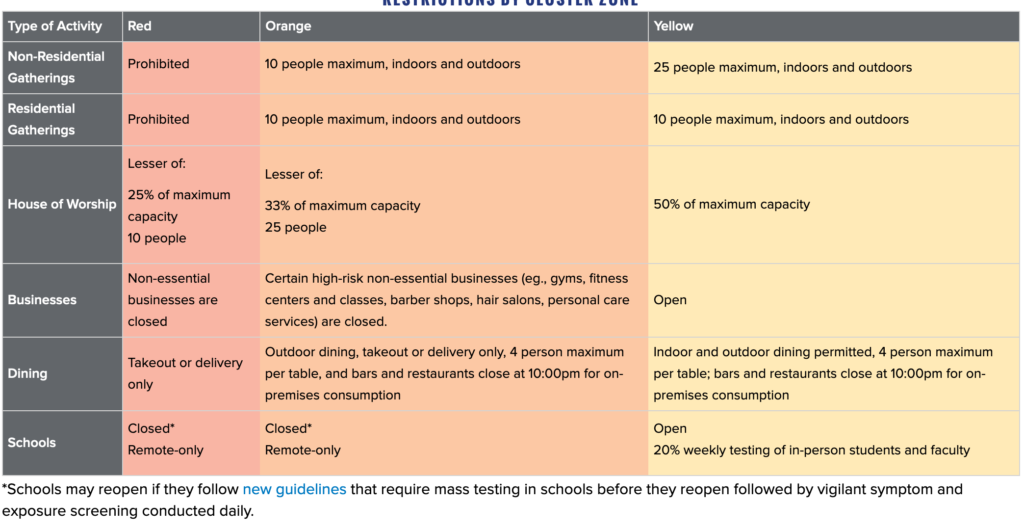
In October, New York imposed strict requirements on houses of worship in so-called “microclusters.”
In “Red” zones, houses of worship were limited to the lesser of 25% of maximum capacity, or 10 people. In virtually every house of worship, the 10 person limit controlled.
In “Orange” zones, houses of worship were limited to the lesser of 33% of maximum capacity, or 25 people. In virtually every house of worship, the 25 person limit controlled.
In “Yellow” zones, houses of worship did not have a hard capacity cap. Rather, they were subject to a 50% occupancy limit.
In Roman Catholic Diocese of Brooklyn v. Cuomo, the Court declared the 10- and 25-person caps unconstitutional with respect to the applicants. As things stand now, none of the applicants are in Red or Orange Zones. Some of the churches and synagogues are in Yellow zones.
I made an error in Part VI of my series. I wrote that the applicants would not be subject to any limitations. I was wrong. The houses of worship in yellow zones are still subject to the 50% maximum occupancy limit. And if New York City snaps to an Orange Zone, the houses of worship would become subject to the 33% maximum capacity cap. And, if any microclusters are placed in the Red Zone, the 25% cap would remain. The applicants did not challenge the percentage caps, and the Supreme Court had no occasion to rule on them.
Now, all houses of worship in yellow zones are subject to the 50% cap. Indeed, my understanding is that houses of worship in “white” zone–that is, are not subject to a microcluster rule–are also subject to the 50% cap.
The Supreme Court’s injunction will stretch until the disposition of the certiorari grant. At this point, the Second Circuit’s proceedings will have no impact on the state of affairs in New York.
from Latest – Reason.com https://ift.tt/3fGQf6k
via IFTTT
Chicago University Economic Thinktank Poll: Forgiving Student Loans Likely A “Net-Regressive” Idea Tyler Durden
Fri, 11/27/2020 – 14:40
The widely respected Initiative on Global Markets is a research center at the University of Chicago Booth School of Business that’s well known for weekly polls “it conducts of its Economics Experts Panel, a panel of 51 leading economists in United States universities.”
Last week, they posed several questions about student loan forgiveness. The group of experts seemed to widely agree that paying off student debt is likely a net regressive idea that won’t nearly be as fruitful as many on the left claim.
They first asked whether or not paying off student loans would be net regressive. All answers ranged from “Uncertain” to “Strongly Agree” with 0% of respondents answering that they disagreed or strongly disagreed.
David Autor, Ford Professor of Economics at MIT, said: “Alongside my kids’ student loans, I’d like the government to pay off my mortgage. If the latter idea shocks you, the first one should too.”
Anil Kashyap, Professor of Economics in Chicago, said of the second question: “Depends on the threshold and the limit, but chosen carefully this could be progressive. There are still major fairness issues with this idea.”
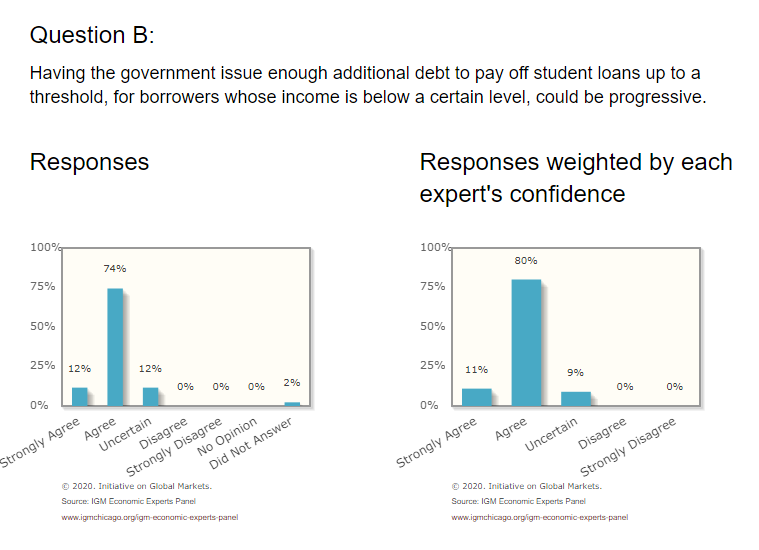
They were then asked whether or not paying off the loans could be progressive if the government is limited in the amount of debt they issue, and if the payoffs are directed to borrowers below certain income levels. 86% of the group either “Agreed” or “Strongly Agreed” that this type of nuance in distributing the assistance would be progressive.
On the second question, Autor commented: “This could create terrible incentives, both for labor supply and (bad) educational investments. Proceed with great caution.”
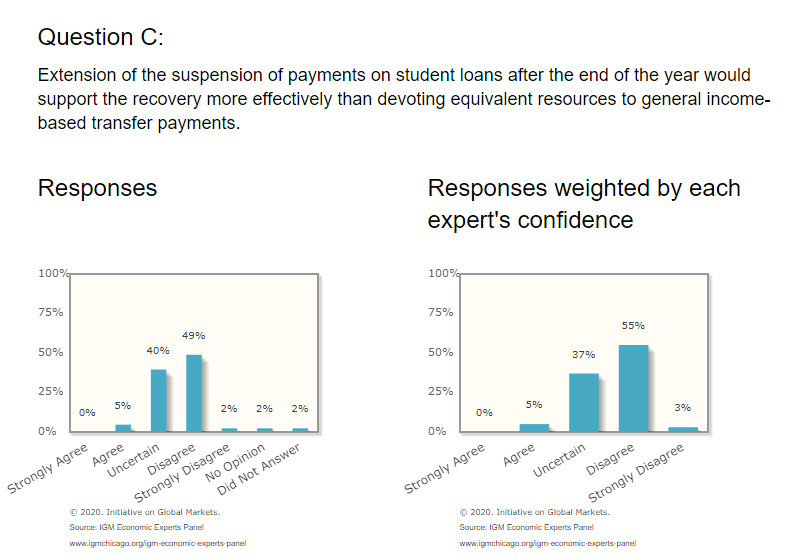
Finally, the group was asked whether suspending payments on student loans would help the recovery more than helicopter money. 49% of the group disagreed, while 40% said they were uncertain.
Survey participant Ray Fair, Professor, Cowles Foundation, Department of Economics at Yale, said of all of the questions: “It depends on how the government debt will eventually be paid off.”
News flash, Ray: it won’t be.
The IGM, per its website, “brings together policymakers, financial leaders, and top scholars from Chicago Booth and beyond to examine key issues facing the global economy and international business. By facilitating the exchange of ideas, IGM helps improve financial and economic decision-making around the world.”
You can view the survey results in more detail and the list of participants in the poll here.
via ZeroHedge News https://ift.tt/36ayBEX Tyler Durden