After Correctly Calling The 10% Stock Correction, MS Now Sees An Imminent 100bps Surge In Yields

After Correctly Calling The 10% Stock Correction, MS Now Sees An Imminent 100bps Surge In Yields

Tyler Durden

Mon, 11/02/2020 – 17:20

Just over a month after warning to “brace for a very difficult trading environment over the next five weeks” and two weeks after he (correctly) predicted that US stocks were due for their second 10% correction in as many months as “investors were a bit too complacent on the uncertainty surrounding the election outcome, unlikely passage of a fiscal stimulus before the election and second wave of Covid-19”, the S&P 500 has indeed fallen 9% while the Nasdaq and Russell 2000 have fallen 10% and 7%, respectively.

So does that mean the correction is over?

That’s the question Wilson asks in his latest note to clients, and answers that “the short answer is that the worst of the correction is over in our view but we still think the next month is likely to remain volatile and uncertain as we navigate what is shaping up to be a much closer election than expected just a few weeks ago and risk of further lockdowns as the virus runs its course.”

As the strategist explains, a key part of his bearish call was based on the view that the equity risk premium should have a larger buffer built in given these very visible risks/events. Fast forward to today and that’s exactly what’s happened, with the Equity Risk Premium widening by approximately 30 bps to 405 bps from the 375 bps level when he made his first call. At the same time, with interest rates remaining steady rather than falling as they typically do when equity markets sell off, the P/E has compressed by approximately 10%. Putting it all together, Wilson suggested a 50bps buffer to where ERP should trade based on realized vol would be appropriate going into the election.
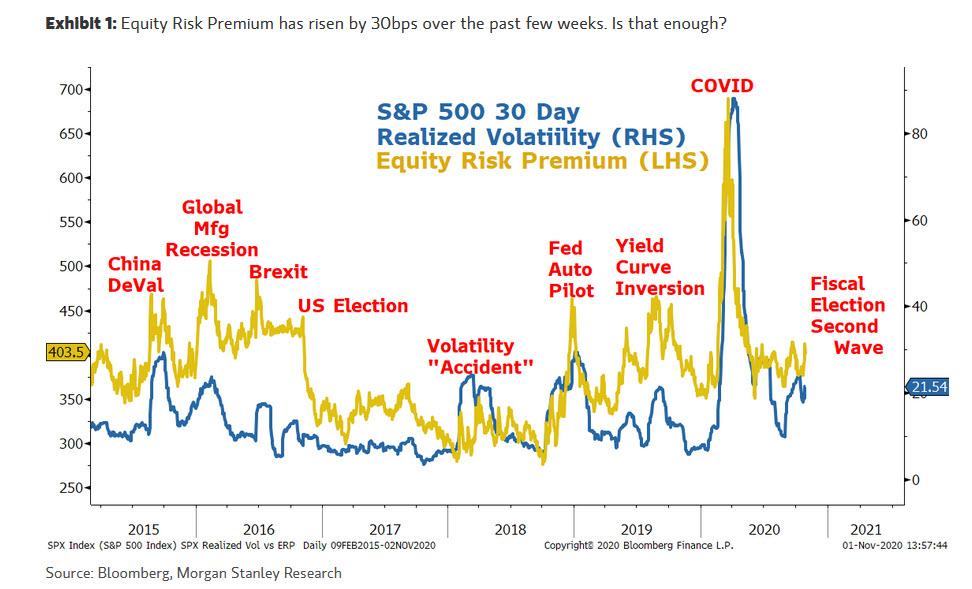
Well, at the end of last week, the ERP buffer was approximately 40bps which is quite close to his +50bps target (indicatively, a further widening of 10 bps would take the S&P 500 down another 2% which lines up more closely with the bank’s stated technical support at the 200 day moving average, or 3130).

The bottom line for Wilson is that “the correction we expected is now mostly finished and adding to equities on further weakness this week is recommended.”

So is it smooth sailing ahead?

Well, while Wilson says he is comfortable telling clients to add risk into further weakness this week or even near current prices, he also believe “it could take some time for the S&P 500 to resume its bull trend in earnest. In other words, equity markets will need to sort out the impact from the election outcome, a second wave of the virus and potential for further lockdowns and perhaps most importantly, higher back end interest rates” (more on that shortly). In a nutshell, Morgan Stanley recommends buying stocks that are likely to have the greatest positive revisions to 2021 earnings estimates, and not those relying on further multiple expansion.

Here a quick tangent on the implications of the election.

Wilson writes that while in isolation, a closer election shouldn’t be a bad thing for equity market valuations, “in a year when more voters are doing so by mail, it could mean the results are delayed or even challenged by the losing side.” This goes for Congressional elections as much as who will be in the White House. What that means is uncertainty, and that usually comes with higher, not lower equity risk premiums. Add to that the arrival of the second wave of COVID-19 without additional fiscal stimulus coming and as Wilson hedges, “one could argue the buffer on Equity Risk Premium is still too skinny.” In any case, and as discussed above, at 405bps in the ERP, “it makes sense to start adding to your favorite stocks again.”

But there is one giant flashing red light: the risk of surging yields. Recall that a month ago, Goldman first predicted that yields would spike by 50bps in case of a Blue Sweep. Well, to Morgan Stanley that number is too low by half.

As Wilson explains, the other component to a Price/Earnings ratio is 10 year yields and here the MS strategist argues that “evidence is starting to mount that our call for much higher rates is going to be right” and the greatest evidence is the fact that as stocks were correcting 10 percent over the past few weeks, 10 year yields are actually up 10 bps in what has been a vary painful shock to 60/40 and risk parity funds.

If that weren’t enough, the yield is now poking its head above its 200 day moving average for the first time in almost 2 years.
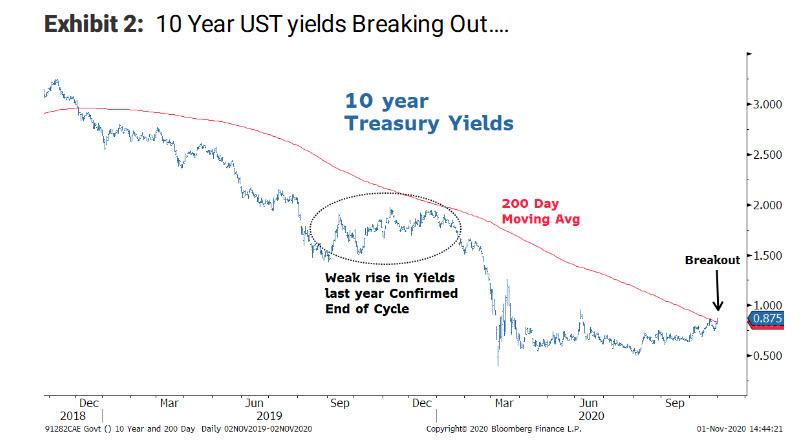
As Wilson stated one month ago when he first touched on the possibility of a “rate scare”, this set up looks very similar to 2016 on so many levels except with greater magnitude. After the election in 2016, 10 year yields move higher by 120bps in a few short weeks. So “could we be looking at a repeat this time around” Wilson asks and answers: yes.
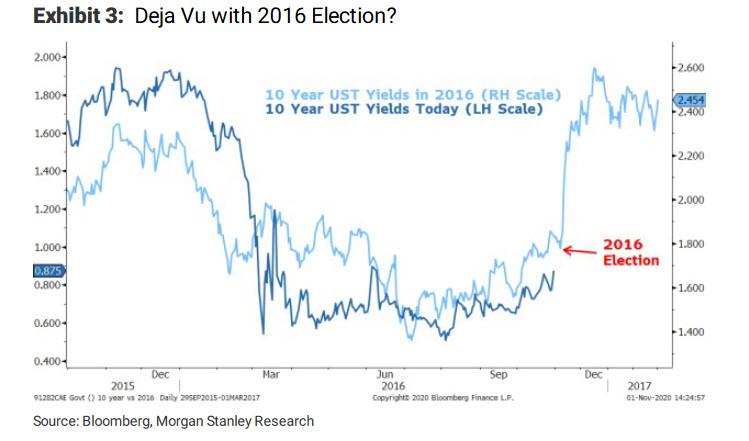
So going back to the biggest wildcard in Morgan Stanley’s forecast – and this should be taken seriously because unlike his pals at Goldman and JPM, Michael Wilson tends to be rather spot on in his predictions – he thinks “10 year yields are about to rise significantly and a 100 bps move cannot beruled out. In fact, we think it should be expected.”

Needless to say, given the “long duration” nature of the S&P 500’s star performers, where tech stocks are effectively a bet on deflation and duration, such a sharp adjustment would have a dire impact on risk assets, with even Wilson admitting that it will “have a net negative impact on P/Es initially as the equity risk premium won’t fall fast enough to fully offset such a rise in rates.”

Such an adjustment should be most painful for those companies with the highest multiples (i.e., very expensive growth stocks such as the FAAMGs) and those companies whose earnings are most negatively correlated to higher rates (defensives). Conversely, the damage should be least on lower P/E companies and those that benefit from higher rates (financials and cyclicals), and may explain why today we saw a selloff in tech coupled with a surge in small caps, cyclicals and energy names.

Summarizing Wilson’s reco: “add to stocks this week but keep a bias toward those stocks that are more fairly priced should a big rate rise occur” with the driver of the next leg in this bull market likely to be earnings, not mlutiples/valuations which will need to adjust drastically lower for higher rates.

via ZeroHedge News https://ift.tt/327MYY3 Tyler Durden
What Are the Best and Worst Things About Donald Trump and Joe Biden?

TrumpBidenDebate

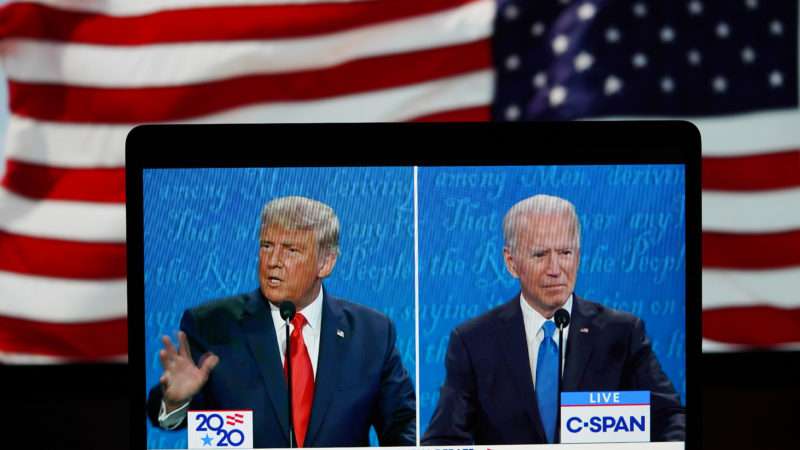
Though 100 million of you have already cast your ballots, and there never really were many undecided voters to begin with this time around, let us not look this gift horse(‘s ass) of an election in the mouth. Today’s Reason Roundtable podcast provides some last-minute shopping analysis of the two main candidates in our national elderly man contest.

On this episode, Nick Gillespie, Peter Suderman, Matt Welch, and Katherine Mangu-Ward try our level best to say something nice about the existing presidency of Donald Trump and prospective presidency of Joe Biden, while of course perhaps spending a wee bit more time talking about the worst aspects of both. Along the way we discuss pre-election window-plywooding, post-election scenarios for weirdness, and our colleague Damon Root‘s excellent new book, A Glorious Liberty: Frederick Douglass and the Fight for an Antislavery Constitution.

Audio production by Ian Keyser and Regan Taylor.

Music: “Bring to Light” by Max H. https://artlist.io/song/9547/bring-to-light

Relevant links from the show:

The Case Against Trump: Donald Trump Is an Enemy of Freedom,” by Matt Welch

The Case Against Biden: Joe Biden’s Politics of Panic,” by Jacob Sullum

Why Biden is a Lesser Evil than Trump,” by Ilya Somin

11 Trillion Reasons To Fear Joe Biden’s Presidency,” by Nick Gillespie

How Will Reason Staffers Vote in 2020?” by Reason Staff

Major Cities Spend Weekend Prepping for Possible Election Night Riots,” by Elizabeth Nolan Brown

Republicans Are Trying To Cancel More Than 100,000 Votes in a Deep Blue Part of Texas,” by Eric Boehm

Supreme Court Ruling Means We Probably Won’t Know Who Won Pennsylvania Until Days After Election,” by Eric Boehm

Make Elections Not Matter So Much Again,” by J.D. Tuccille

Don’t Freak Out About the Election,” by John Stossel

Shrooms Are on the D.C. Ballot,” by Max Dunat

Why Electing Biden (or Trump) Won’t Settle Anything for Long,” by Nick Gillespie

from Latest – Reason.com https://ift.tt/2GqlpSm
via IFTTT

Watch: National Guard Troops Arrive In Multiple US Cities Ahead Of Election Night Chaos 

Watch: National Guard Troops Arrive In Multiple US Cities Ahead Of Election Night Chaos 

Tyler Durden

Mon, 11/02/2020 – 17:00

In preparation for any emergencies, including widespread social unrest following election results on Tuesday night, the National Guard has been deployed in several states.

Fears of election night chaos have gripped state governments for the last month, forcing Gov. Charlie Baker of Massachusetts on Monday to “activate” 1,000 Massachusetts National Guard members. 

And in Oregon, Gov. Kate Brown, for the second time in two months, declared a state of emergency for the Portland metro area, citing potential social unrest surrounding the election. 

Governors have also mobilized Guard forces in Texas, Alabama, and Arizona to major cities in their respective states in anticipation of violence.

Last week, the Pennsylvania National Guard was deployed to the Philadelphia metro area amid a couple of nights of social unrest following the police killing of a black man. Guard troops have been since positioned to handle potential unrest come Tuesday night.

According to NBC sources, at the White House, beginning tomorrow, a “non-scalable” fence will be erected around the complex with 250 Guard troops on standby. 

As of Monday afternoon, Guard troops have been spotted in several cities, preparing for Tuesday night. 

Guard troops were spotted at a Best Buy in South Philadelphia. 

Guard troops spotted outside of Philadelphia City Hall. 

Guard soldiers spotted outside a retail complex in West Philadelphia.

Guard troops in a Humvee outside a Target in Philadelphia. 

Guard troops at “Park West Town Center shopping plaza. Looters have targeted this place in May/June and last week,” said one Twitter user. 

No location was confirmed on this Guard deployment. Check out what could be special forces UTVs.  

Retailers have been boarding up their brick and mortar stores from coast to coast in anticipation of looting. 

Guard arrives in Chicago. 

Convoy of Guard troops spotted on a highway heading towards Chicago. 

National Guard on standby in Massachusetts. 

Guess what’s back on city street corners – piles of bricks (read here & here for what this could suggest). 

via ZeroHedge News https://ift.tt/3oU8uJU Tyler Durden

What Are the Best and Worst Things About Donald Trump and Joe Biden?

TrumpBidenDebate

Though 100 million of you have already cast your ballots, and there never really were many undecided voters to begin with this time around, let us not look this gift horse(‘s ass) of an election in the mouth. Today’s Reason Roundtable podcast provides some last-minute shopping analysis of the two main candidates in our national elderly man contest.

On this episode, Nick Gillespie, Peter Suderman, Matt Welch, and Katherine Mangu-Ward try our level best to say something nice about the existing presidency of Donald Trump and prospective presidency of Joe Biden, while of course perhaps spending a wee bit more time talking about the worst aspects of both. Along the way we discuss pre-election window-plywooding, post-election scenarios for weirdness, and our colleague Damon Root‘s excellent new book, A Glorious Liberty: Frederick Douglass and the Fight for an Antislavery Constitution.

Audio production by Ian Keyser and Regan Taylor.

Relevant links from the show:

The Case Against Trump: Donald Trump Is an Enemy of Freedom,” by Matt Welch

The Case Against Biden: Joe Biden’s Politics of Panic,” by Jacob Sullum

Why Biden is a Lesser Evil than Trump,” by Ilya Somin

11 Trillion Reasons To Fear Joe Biden’s Presidency,” by Nick Gillespie

How Will Reason Staffers Vote in 2020?” by Reason Staff

Major Cities Spend Weekend Prepping for Possible Election Night Riots,” by Elizabeth Nolan Brown

Republicans Are Trying To Cancel More Than 100,000 Votes in a Deep Blue Part of Texas,” by Eric Boehm

Supreme Court Ruling Means We Probably Won’t Know Who Won Pennsylvania Until Days After Election,” by Eric Boehm

Make Elections Not Matter So Much Again,” by J.D. Tuccille

Don’t Freak Out About the Election,” by John Stossel

Shrooms Are on the D.C. Ballot,” by Max Dunat

Why Electing Biden (or Trump) Won’t Settle Anything for Long,” by Nick Gillespie

from Latest – Reason.com https://ift.tt/2GqlpSm
via IFTTT

Want Hope And Real Growth? Let The Dead Forest Of Corruption And Fed Manipulation Burn Down

Want Hope And Real Growth? Let The Dead Forest Of Corruption And Fed Manipulation Burn Down

Tyler Durden

Mon, 11/02/2020 – 16:40

Authored by Charles Hugh Smith via OfTwoMinds blog,

Wake up, America, and see the Fed for what it really is: a totalitarian tool of kleptocracy.

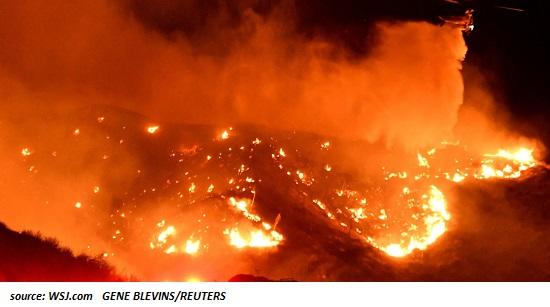
You know what happens when fire suppression policies limit forest fires: deadwood piles up and all the trees killed by bark beetles are awaiting a spark to ignite. Sure enough, a random lightning strike provides the ignition, and the entire forest is consumed in an out-of-control conflagration made inevitable by the policy of suppressing fires as “bad” for lumber companies and tourism, i.e. the politically influential.

This is a remarkably apt analogy for the central banks’ policy of suppressing business cycle recessions that burn down dead zombie corporations and all the deadwood suppressing new growth.

The Yellowstone Analogy and The Crisis of Neoliberal Capitalism (May 18, 2009)

No Recession Ever Again? The Yellowstone Analogy (November 8, 2019)

If you’re an insider using Federal Reserve “free money for financiers” to milk your zombie corporation, you love the Fed’s suppression of actual capitalism. Fed free money enable you to continue to borrow cheaply and buy back your zombie company’s shares, enriching insiders even though the company doesn’t even earn enough to service its ballooning debts.

If you’re not yet aware of the ballooning number of zombie companies, please read: Welcome To The Zombie Global Economy.

Recall that free-market capitalism’s business cycle of over-investment and excessive risk-taking must be followed by a reduction in debt, the liquidation of bad loans and excess inventory, limiting exposure to risk, etc.–in other words, a fast-burning forest fire which incinerates all the deadwood, clearing space for the next generation of growth.

Some seeds will only open if exposed to heat. If the Fed makes sure there’s never any risk of fire touching too big to fail/jail companies, cartels, monopolies and the soaring number of zombie corporations, then the seeds of real growth can’t possibly open.

Welcome to the hopeless result of Fed manipulation: stagnation, soaring inequality and rampant corruption. Fed manipulation and widespread corruption are not separate dynamics: Fed manipulation–distributing trillions of dollars to those at the apex of the wealth-power pyramid–has fueled corruption by giving the most sociopathic, greediest few the means to buy political protection of their monopoly/cartel (Big Tech, Big Pharma, Big Ag, Big Defense, and so on) by influencing narratives (buying up the media), regulators and elected officials.

There is no way America would be as corrupt as it now is if the Fed hadn’t provided trillions of dollars to those most anxious to corrupt every institution that might limit their greed and power. If money wasn’t free, the predators, parasites, zombies and monopolists couldn’t borrow such enormous sums to jack up their share price and buy political influence to protect their winnings.

The Fed’s policy of permanent, expanding manipulation has picked the winners in our economy–the predators, parasites, zombies and monopolists who use Fed free money to strangle competition, eliminate transparency and corrupt anything that might represent the public interest or the common good, because these are anathema to the predators, parasites, zombies and monopolists.

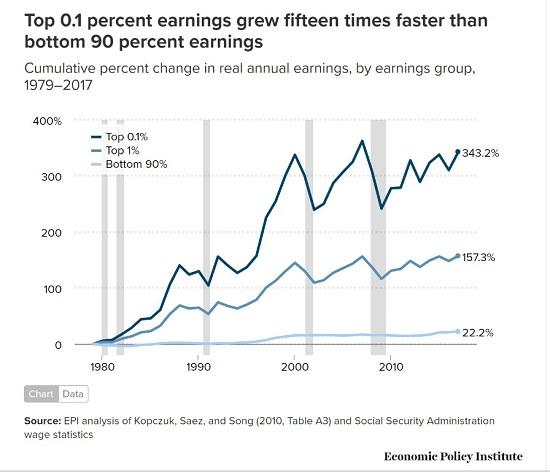
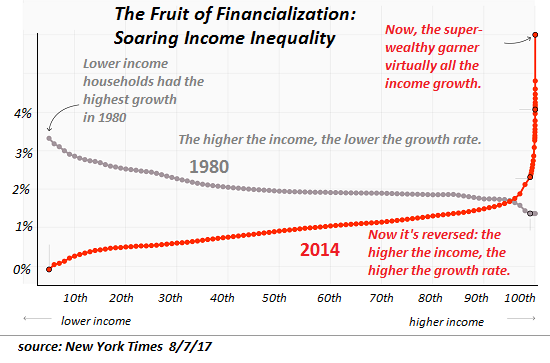
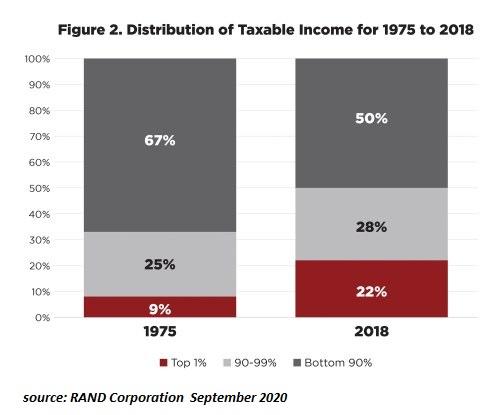
The Fed has also picked the losers–the bottom 99%, and especially the bottom 90%, as these charts make abundantly clear. Have you looked at what you earned in interest on your nestegg? $2? This is the perversity of the Fed’s incentives: to even hope to keep up with real-world inflation, everyone must sink their savings into dead trees that are just awaiting a spark to burn to the ground.

Some readers tell me that they feel depressed after reading my blog posts. Well cheer up, all we need to do is to let the Fed’s manipulated, corrupt dead forest burn down. Once all the corruption and deadwood that the Fed has protected from market forces (i.e. competition and transparency) and any effort to promote the public interest and the common good burns down, then hope and new enterprises will finally have the open ground and sunlight to germinate and thrive.

Wake up, America, and see the Fed for what it really is: a totalitarian tool of kleptocracy.

*  *  *

My recent books:

A Hacker’s Teleology: Sharing the Wealth of Our Shrinking Planet (Kindle $8.95, print $20, audiobook coming soon) Read the first section for free (PDF).

Will You Be Richer or Poorer?: Profit, Power, and AI in a Traumatized World
(Kindle $5, print $10, audiobook) Read the first section for free (PDF).

Pathfinding our Destiny: Preventing the Final Fall of Our Democratic Republic ($5 (Kindle), $10 (print), ( audiobook): Read the first section for free (PDF).

The Adventures of the Consulting Philosopher: The Disappearance of Drake $1.29 (Kindle), $8.95 (print); read the first chapters for free (PDF).

Money and Work Unchained $6.95 (Kindle), $15 (print) Read the first section for free (PDF).

*  *  *

If you found value in this content, please join me in seeking solutions by becoming a $1/month patron of my work via patreon.com.
 

via ZeroHedge News https://ift.tt/383lJ4G Tyler Durden

Michigan Governor Whitmer Goes Full Orwell, Demands Full Names, Phone Numbers For All Restaurant Customers

Michigan Governor Whitmer Goes Full Orwell, Demands Full Names, Phone Numbers For All Restaurant Customers

Tyler Durden

Mon, 11/02/2020 – 16:21

Effective this week, diners in Michigan are now going to be required to produce their full name and contact information simply for wanting to eat out at a restaurant or bar.

Ironically, it’s likely more information than citizens are required to produce in order to vote. 

Democratic Governor Gretchen Whitmer has moved her state one step closer to a true Orwellian paradise, asking her citizens to surrender their privacy every time they want a cheeseburger and a coke at their local diner. Whitmer has already been struck down once by the Supreme Court over trying to unilaterally extend the state’s emergency declarations, The Western Journal noted. 

A new release from the Michigan Department of Health and Human Services said: “Like many other businesses in Michigan, bars and restaurants will also be required to take names and contact information to support effective contact tracing if necessary.”

But who can be worried about such mundane things as rights in the midst of an unstoppable pandemic that is slightly more deadly than the flu, right?

That was the Michigan DHS’s take. They said: “Michigan presently has 172 cases per million people and positivity of tests has increased from about 2% to 5.5% and both indicators have been increasing for over four weeks. Hospitalizations for COVID-19 have doubled over the last three weeks while the state death rate has increased for five consecutive weeks.”

The order also reduced the amount of people that can gather in the state for weddings and parties: “As part of the newly extended orders, MDHHS today reduces from 500 persons to 50 persons the maximum gathering size for indoor gatherings such as weddings, parties, and banquets which occur in nonresidential settings without fixed seating.”

It added: “For bars, restaurants, and social events outside private homes, indoor party sizes at a single table are now restricted to six people.”

Violating the order could result in a $1,000 fine, a misdemeanor, and potentially imprisonment, the DHS said: “Violations are punishable by a civil fine up to $1,000 and may also be treated as a misdemeanor punishable by imprisonment for not more than six months or a fine of not more than $200, or both. In addition, failure to comply with orders may violate a business or professional’s licensure requirements or present a workplace safety violation.”

Unsurprisingly, Michigan businesses are not happy about the new order. 

Michigan Licensed Beverage Association Executive Director Scott Ellis concluded: “Again, what’s this data gathering if the data is not truthful, how do we know how good it is? Our front-line servers have already had trouble dealing with masks and mandates and mandating masks. We did de-escalation training and all kinds of other things to help with that and now we’re taking to the next level. We have to gather someone’s personal information?”

via ZeroHedge News https://ift.tt/35XgbpJ Tyler Durden

The Rust Belt Made Trump President. The Bet Hasn’t Paid Off.

polspphotos316108

Four years ago, Donald Trump’s final pitch to voters came during a near-midnight rally in Grand Rapids, Michigan, on the eve of the election.

“If we win Michigan, we will win this historic election, and then we truly will be able to do all of the things we want to do,” Trump said. “They won’t be taking our jobs any longer.”

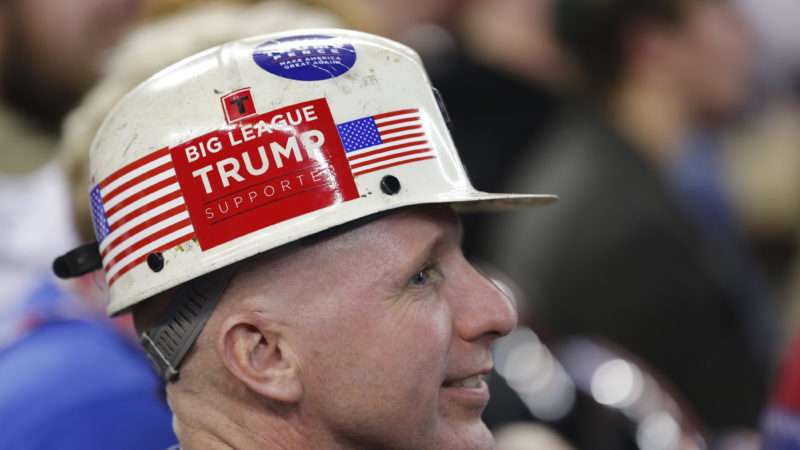
He did win Michigan—and Ohio, and Pennsylvania, and Wisconsin. A Rust Belt sweep carried Trump to his unlikely victory in 2016. Those same four states will probably play an outsized role tomorrow in determining whether Trump gets another four years in the White House. There will be many ways to read the outcome of this week’s presidential election, but on some level it is undoubtedly a referendum on the promises Trump made to voters in the industrial (and post-industrial) parts of the country.

Within days of the 2016 election, Trump and his top economic advisor, Peter Navarro, were talking about helping those Rust Belt voters by slapping tariffs on goods from Canada and Mexico. It took until March 2018 for Trump’s long-sought trade war to get going, and until July of that year for it to become focused on China. Now, more than two years later, the tariffs Trump imposed on steel, aluminum, washing machines, solar panels, and loads of goods made in China have cost American consumers and businesses more than $57 billion annually.

Trump has always claimed that China is paying the cost of the tariffs, and that has always been a lie. More articulate proponents of the president’s trade policy claim that the cost of the tariffs is worth their benefits: There’s no gain without some pain, they argue.

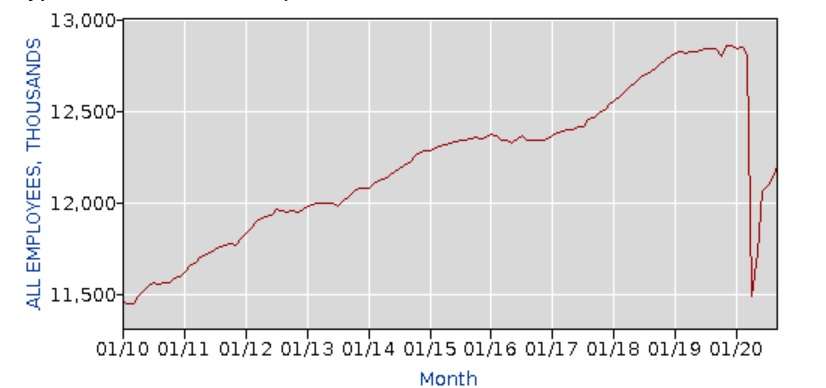
But as the president faces re-election, the gains are hard to find. And that’s especially true in the Rust Belt. Manufacturing job growth in those four key 2016 swing states slowed almost to a standstill even before the COVID-19 pandemic hit, as Trump’s tariffs hiked costs for imported goods and materials used by American manufacturers. Those higher import taxes, in turn, blunted business owners’ ability to make the investments that create new jobs.

The economic data tell the most obvious part of the story. When Trump was inaugurated in January 2017, those four crucial states were home to 2.33 million manufacturing jobs, according to the Bureau of Labor Statistics. By July 2018, a few months after Trump launched its tariffs on steel and aluminum and the same month the White House announced its first round of tariffs against Chinese-made goods, the number of manufacturing jobs in those four states had climbed to 2.38 million.

In February 2020, the last full month before the pandemic struck America, those same four states reported nearly exactly the same total: 2.38 million manufacturing jobs. Over the course of those 20 months from July 2018 through February 2020, the number of manufacturing jobs in Michigan declined by about 40,000, while the other three states reported small gains.

The story is similar across the rest of the country: From mid-2018 through the first two months of 2020, manufacturing job growth has been effectively flat after nearly a decade of consistent if unspectacular pre-trade-war growth. The tariffs that were supposed to revitalize American manufacturing instead caused a lost year.

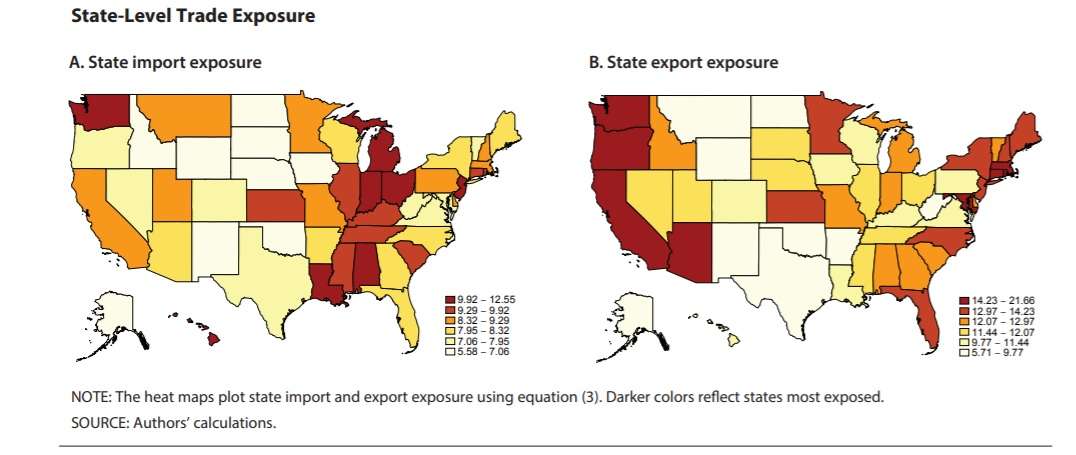
Dig deeper, and it becomes even more clear that the Rust Belt paid an outsized price for Trump’s trade policies. A new study from the St. Louis Federal Reserve looks at how “exposed” each of the 50 states is to disruptions in global trade—that is, which states have industries most dependant on importing industrial components, for example, or exporting farm goods.

Unsurprisingly, the report concludes that “states that were more exposed to trade with the world have performed worse [during the trade war] in terms of employment and output growth than have states that were less exposed.” Among the worst-hit states are Michigan and Ohio.

The trade war has also coincided with a flat-lining of domestic business investment, as Trump’s tariffs have taken a bite out of companies’ bottom lines. “Increasing tariffs also creates greater economic uncertainty, potentially dampening business investment and creating a further drag on growth,” warned the Congressional Research Service in a report published earlier this year. Overall, the tariffs have had a “negative aggregate effect on the U.S. manufacturing sector,” the report found, as the economic benefits of increased protectionism were overwhelmed by increased input costs created by the tariffs.

The steel industry, which was supposed to be a prime beneficiary of Trump’s trade policies, is facing a “dim future” as job growth vanishes and price slump, The Wall Street Journal reported last week.

None of this surprised the vast majority of economists, who already knew that tariffs are “costly, ineffective and politically messy,” writes Scott Lincicome, a senior fellow in economic studies with the libertarian Cato Institute, in a thorough run-down of Trump’s trade failures in The Dispatch.

Yet Trump has vowed to keep his tariffs in place if he wins a second term, and he has bragged on the campaign trail and in debates about the “billions and billions” of dollars the federal government has collected in tariff revenue—most of which has been doled out to farmers harmed by other aspects of Trump’s trade war.

On Thursday, Navarro told MSNBC that he sees the upper Midwest as “the Trump Prosperity Belt.” And on Monday night, Trump will once again visit Grand Rapids, Michigan, for his final campaign rally before Election Day.

If the vote turns out differently this time around, Trump should blame his own economic policies. Rust Belt voters gave Trump the chance to do what he wanted to do—but the trade barriers that were supposed to resurrect American manufacturing have done more harm than good.

from Latest – Reason.com https://ift.tt/3jRAJFc
via IFTTT

The Rust Belt Made Trump President. The Bet Hasn’t Paid Off.

polspphotos316108

Four years ago, Donald Trump’s final pitch to voters came during a near-midnight rally in Grand Rapids, Michigan, on the eve of the election.

“If we win Michigan, we will win this historic election, and then we truly will be able to do all of the things we want to do,” Trump said. “They won’t be taking our jobs any longer.”

He did win Michigan—and Ohio, and Pennsylvania, and Wisconsin. A Rust Belt sweep carried Trump to his unlikely victory in 2016. Those same four states will probably play an outsized role tomorrow in determining whether Trump gets another four years in the White House. There will be many ways to read the outcome of this week’s presidential election, but on some level it is undoubtedly a referendum on the promises Trump made to voters in the industrial (and post-industrial) parts of the country.

Within days of the 2016 election, Trump and his top economic advisor, Peter Navarro, were talking about helping those Rust Belt voters by slapping tariffs on goods from Canada and Mexico. It took until March 2018 for Trump’s long-sought trade war to get going, and until July of that year for it to become focused on China. Now, more than two years later, the tariffs Trump imposed on steel, aluminum, washing machines, solar panels, and loads of goods made in China have cost American consumers and businesses more than $57 billion annually.

Trump has always claimed that China is paying the cost of the tariffs, and that has always been a lie. More articulate proponents of the president’s trade policy claim that the cost of the tariffs is worth their benefits: There’s no gain without some pain, they argue.

But as the president faces re-election, the gains are hard to find. And that’s especially true in the Rust Belt. Manufacturing job growth in those four key 2016 swing states slowed almost to a standstill even before the COVID-19 pandemic hit, as Trump’s tariffs hiked costs for imported goods and materials used by American manufacturers. Those higher import taxes, in turn, blunted business owners’ ability to make the investments that create new jobs.

The economic data tell the most obvious part of the story. When Trump was inaugurated in January 2017, those four crucial states were home to 2.33 million manufacturing jobs, according to the Bureau of Labor Statistics. By July 2018, a few months after Trump launched its tariffs on steel and aluminum and the same month the White House announced its first round of tariffs against Chinese-made goods, the number of manufacturing jobs in those four states had climbed to 2.38 million.

In February 2020, the last full month before the pandemic struck America, those same four states reported nearly exactly the same total: 2.38 million manufacturing jobs. Over the course of those 20 months from July 2018 through February 2020, the number of manufacturing jobs in Michigan declined by about 40,000, while the other three states reported small gains.

The story is similar across the rest of the country: From mid-2018 through the first two months of 2020, manufacturing job growth has been effectively flat after nearly a decade of consistent if unspectacular pre-trade-war growth. The tariffs that were supposed to revitalize American manufacturing instead caused a lost year.

Dig deeper, and it becomes even more clear that the Rust Belt paid an outsized price for Trump’s trade policies. A new study from the St. Louis Federal Reserve looks at how “exposed” each of the 50 states is to disruptions in global trade—that is, which states have industries most dependant on importing industrial components, for example, or exporting farm goods.

Unsurprisingly, the report concludes that “states that were more exposed to trade with the world have performed worse [during the trade war] in terms of employment and output growth than have states that were less exposed.” Among the worst-hit states are Michigan and Ohio.

The trade war has also coincided with a flat-lining of domestic business investment, as Trump’s tariffs have taken a bite out of companies’ bottom lines. “Increasing tariffs also creates greater economic uncertainty, potentially dampening business investment and creating a further drag on growth,” warned the Congressional Research Service in a report published earlier this year. Overall, the tariffs have had a “negative aggregate effect on the U.S. manufacturing sector,” the report found, as the economic benefits of increased protectionism were overwhelmed by increased input costs created by the tariffs.

The steel industry, which was supposed to be a prime beneficiary of Trump’s trade policies, is facing a “dim future” as job growth vanishes and price slump, The Wall Street Journal reported last week.

None of this surprised the vast majority of economists, who already knew that tariffs are “costly, ineffective and politically messy,” writes Scott Lincicome, a senior fellow in economic studies with the libertarian Cato Institute, in a thorough run-down of Trump’s trade failures in The Dispatch.

Yet Trump has vowed to keep his tariffs in place if he wins a second term, and he has bragged on the campaign trail and in debates about the “billions and billions” of dollars the federal government has collected in tariff revenue—most of which has been doled out to farmers harmed by other aspects of Trump’s trade war.

On Thursday, Navarro told MSNBC that he sees the upper Midwest as “the Trump Prosperity Belt.” And on Monday night, Trump will once again visit Grand Rapids, Michigan, for his final campaign rally before Election Day.

If the vote turns out differently this time around, Trump should blame his own economic policies. Rust Belt voters gave Trump the chance to do what he wanted to do—but the trade barriers that were supposed to resurrect American manufacturing have done more harm than good.

from Latest – Reason.com https://ift.tt/3jRAJFc
via IFTTT

Is there a Moral Duty to Vote in an Election Where the Stakes are Unusually High?

ballot_1161x653

Most arguments for a moral duty to vote cast it as a general obligation of citizenship. At least as a general rule, they hold that citizens are morally required to vote in elections—regardless of how big the difference between the opposing candidates is, and regardless of which candidate the voter in question prefers. I have criticized such claims in previous writings, most recently here.

But there is another, more limited justification for a duty to vote in at least some elections. It’s the idea that we have an obligation vote in cases where the stakes are especially high. Maybe there’s no duty to cast a ballot when there is little difference between the opposing candidates, or when the differences between them won’t have much effect. But things are different if one side is vastly better than the other. That intuition underlies the oft-heard sentiment that you must vote because “this is the most important election of our lifetime” and other similar claims. And, as polarization has grown, we hear such claims more often.

There is a kernel of truth to the claim that you have a duty to vote if the stakes are high enough. But the resulting moral duty applies far less often than advocates of the argument tend to assume. And the same reasoning actually implies many people have a moral duty not to vote.

Let’s start with the kernel of truth. Imagine there’s an election for a powerful political office that pits Gandalf (the benevolent wizard in J.R.R. Tolkien’s Lord of the Rings) against Sauron, the despotic dark lord from the same story. If Sauron prevails, millions of people will die or be enslaved, while Gandalf would rule justly if he manages to win. And all you have to do to ensure Gandalf’s victory is check his name on a ballot. If you do so, Gandalf wins; if not, Sauron does.

In this scenario, it seems like you have a moral duty to vote for Gandalf, at least barring some kind of extraordinary exigent circumstance. In real election, of course, the odds that your vote will make a difference are far smaller than in this stylized example. In an American presidential election, they are, on average, about 1 in 60 million, though higher in swing states.

However, a large enough difference between the two candidates could potentially justify a duty to vote for the “right” candidate, even if the odds of casting a decisive ballot are very low. For example,let’s say you live in a swing state, and you have a 1 in 1 million chance of casting a decisive vote for Gandalf over Sauron. But if your vote does turn out to be decisive, you will save 1 million people from death, and 10 million from being enslaved. Some simple math leads to the conclusion that the expected value of your vote (the benefit of Gandalf’s victory divided by the likelihood of having an impact) is one live saved, and ten people saved from slavery.

Here too, it may be you have a duty to vote. At the very least, there can be at least some scenarios where you have a duty to vote even if the likelihood of having a decisive impact is fairly low.

But notice that the duty in question is not an obligation to participate in the process for its own sake. It’s a duty to help good triumph over evil in a situation where you can do so at little or no cost. If you have a moral duty to vote for Gandalf in these types scenario, it follows that you also have a moral duty not to vote for Sauron. Indeed, the person who votes for Sauron is more worthy of condemnation than the one who merely abstains. The former is actively helping evil win, while the latter “merely” chooses not to stop it.

While Gandalf supporters may have a duty to vote, Sauron supporters actually have a duty to abstain from doing so. Ideally, they should stop supporting Sauron entirely. But they at least should not take any actions that increase the likelihood of his victory.

All of the above analysis assumes that the voter knows which candidate is superior and to what degree. But, in reality, we have widespread political ignorance, and most voters often don’t even know very basic facts about how government and politics work. Most are also highly biased in their evaluation of the information they do know, functioning more as “political fans” cheering on Team Red or Team Blue, than as truth-seekers.

There is much that people can do to become better voters. But most will not actually do so, because such action requires a lot of time and energy, and may be psychologically painful. Unless and until a voter becomes well-informed about the issues and at least reasonably objective in his or her evaluation of political information, she has good reason to question her judgment about which candidate is superior, much less by how much. Thus, she cannot conclude she has a duty to vote to help the “right” side win. She may instead have a presumptive duty to abstain from voting until she meets at least some minimal threshold of political knowledge.

Perhaps the relatively ignorant and biased voter might conclude he still should vote, because he is at least less ignorant and biased than average. Thus, casting a vote would slightly improve the average quality of the electorate and perhaps slightly increase the odds of the right candidate winning. That could be true. But notice that figuring out whether you are better informed than the average voter itself requires time and effort and a certain level of preexisting knowledge. It also requires resisting the psychological temptation to think you must be better than average. Any duty to vote in such circumstances is likely to be greatly attenuated, at best.

Many people will resist this conclusion on the grounds that figuring out which side is the “right” one is actually easy, because the gap between the opposing sides is so great. All you have to do is open your eyes!

I myself think that there is a substantial gap between Biden and Trump, and that the former is the lesser evil here. It may not be quite as clearcut as Gandalf vs. Sauron; but it is perhaps roughly analogous to Sauron vs. Cersei Lannister—not good vs. evil, but a  great evil vs. a much smaller one.

But if the difference between the two sides were really so obvious that almost anyone can easily figure it out, then there would be no need to worry about the election outcome! Those not otherwise inclined to vote can simply leave the decision to that portion of the population that actually enjoys voting, secure in the knowledge that the latter will easily figure out that Gandalf (or even Cersei) is preferable to Sauron.

If, on the other hand, it looks like Sauron has the support of 40% or more of the population, and therefore has something like a 10% chance of winning, that suggests discerning his relative evil is a tougher task than you might at first assume. And if the task is that difficult, your own judgment about Sauron could also be defective, unless you are relatively well-informed and unbiased.

Even if you do have good reason to be confident about your judgment about the candidates, and you justifiably believe that one is vastly superior to the other, you still might not have a duty to vote if doing so is unusually costly (for example, casting a ballot would divert you from some very important task). You might also be “excused” if you have already contributed to the public interest in some other way, as per philosopher Jason Brennan’s argument in his excellent book The Ethics of Voting. But at least there might be a presumptive obligation to vote here.

Perhaps you also have a duty to become a well-informed and unbiased voter in the first place. But that requires a lot of time and effort, and may be especially difficult in a world where government policy extends to so many issues, thereby requiring extensive knowledge to understand more than a small fraction of them. It’s hard to justify the idea that we have a duty to devote that much time to politics. It’s certainly a far cry from the initial intuitive scenario where you have a duty to help Gandalf defeat Sauron, because all you need do is check the right box on a ballot.

To sum up, there can potentially be a duty to vote in a situation where 1) there is a big difference between the two sides, 2) your vote has a significant chance of being decisive, and 3) you have good reason to think you are right about which candidate is best (or at least to conclude that your reasoning is better than than that of the average voter). In that world, you also have a duty to avoid voting for the “bad” candidate. If you have an inclination to do the latter, it is better for you to abstain than to vote.

But these circumstances apply to a relatively small subset of voting decisions. In most elections, the differences between candidates are not as great, there is more uncertainty about which one is better, and a high percentage of the potential electorate have good reason to doubt the quality of their judgment.

The absence of a moral duty to vote in a given election doesn’t necessarily mean you should abstain. Unless you have a moral duty not to vote (as in the Sauron supporter case discussed above), then you can vote or note vote without fear of condemnation. In my view, you do have at least a presumptive obligation to become relatively informed if you do choose to vote. But that’s different from having an obligation to vote, as such.

Neither the duty to vote (where it exists) nor the duty to abstain (where that exists) are ones that should be enforced by the government. I oppose mandatory voting, and I am also skeptical that the government can be trusted to discern who is likely to be a good voter and who isn’t, beyond perhaps some very minimal standards. These are moral obligations that individual voters should fulfill of their own accord, though we know many may fail to do so.

If this state of affairs seems unsatisfying, then I would suggest it strengthens the case for systemic reform to reduce our reliance on the knowledge and insight of voters, who often have strong incentives to be ignorant and biased in their judgments. I discuss potential options in my book Democracy and Political Ignorance, and here. In my most recent work, how we can empower people to have greater control over the policies they live under by expanding opportunities for them to “vote with their feet.”

In the meantime, we should take seriously the possibility that there is sometimes a duty to vote to defeat a (great enough) evil. But we should also recognize the limits of such claims.

UPDATE: In this 2014 post, I criticized the related oft-heard claim that “if you don’t vote, you have no right to complain.”


from Latest – Reason.com https://ift.tt/2HXaoZq
via IFTTT

Despite Tech Tumble; Stocks, Bonds, Gold, & The Dollar Rally On Election Eve

Despite Tech Tumble; Stocks, Bonds, Gold, & The Dollar Rally On Election Eve

Tyler Durden

Mon, 11/02/2020 – 16:01

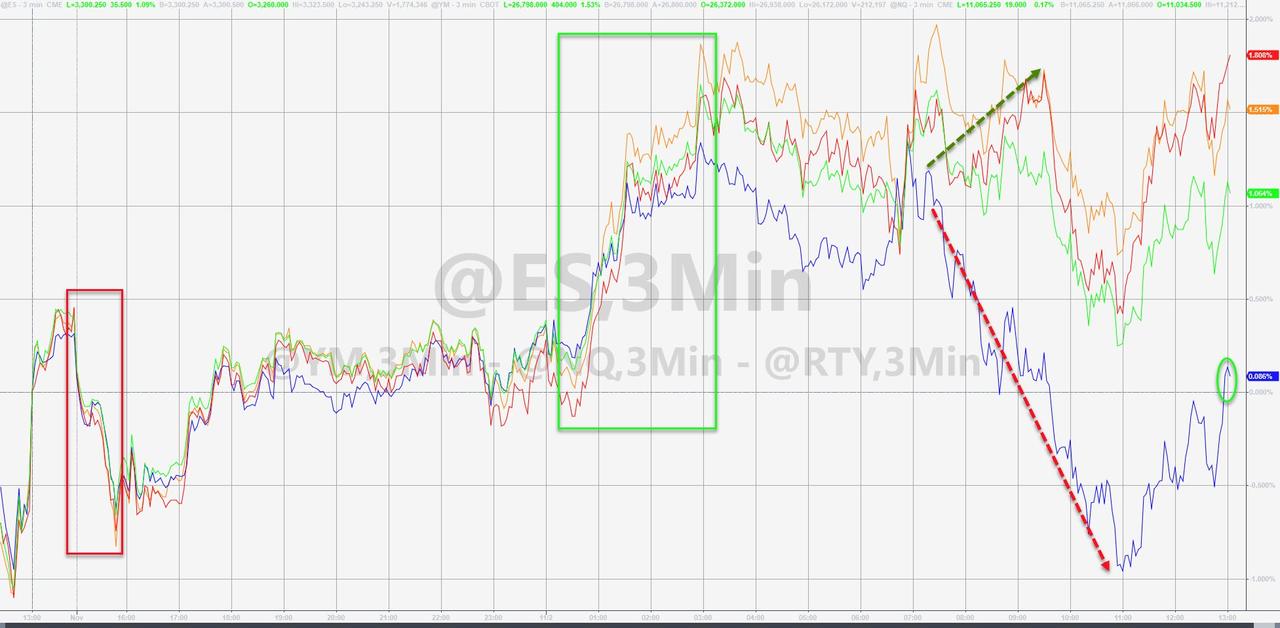
As Asia closed and Europe opened, US equity futures were panic bid up 400-plus Dow points overnight, clung to gains into the US cash open when Nasdaq was dumped and Small Caps pumped along with The Dow. Last minute buying panics ramped Nasdaq barely into the green…

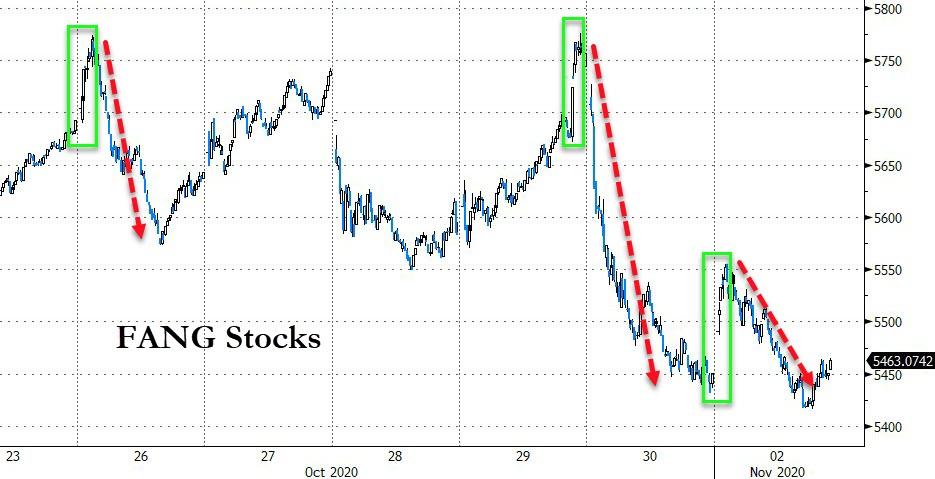
Weakness in Nasdaq was driven by the mega-tech names with AMZN taking a good hit…

Source: Bloomberg

Brace yourself for some vol in the next 24 hours…

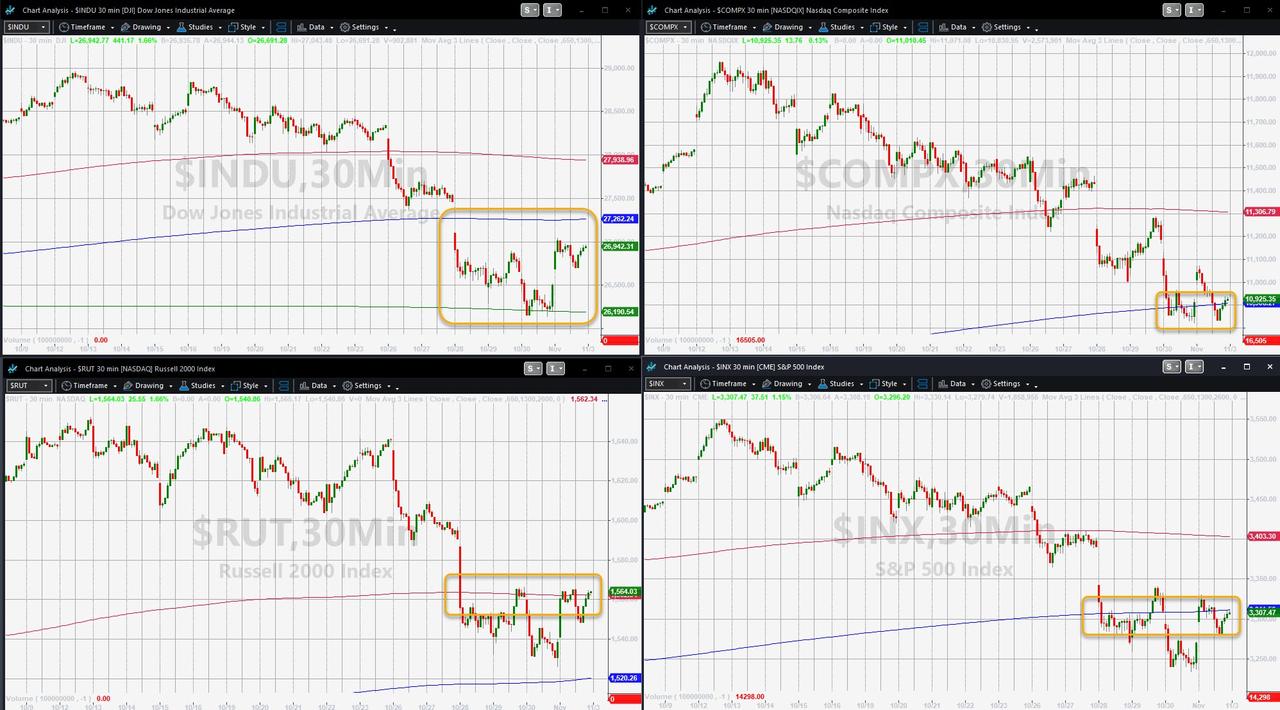
All the major US indices are at critical technical levels ahead of the election night malarkey…

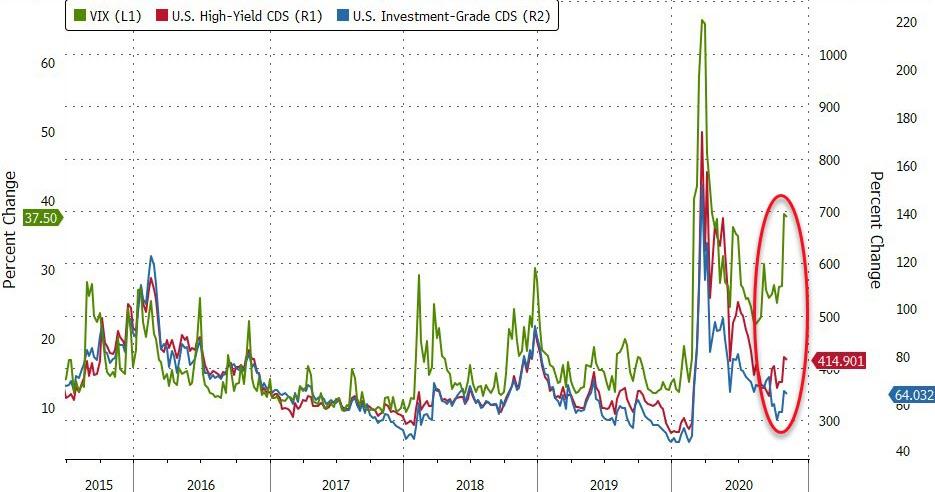
And equity risk remains very rich relative to credit risk…

Source: Bloomberg

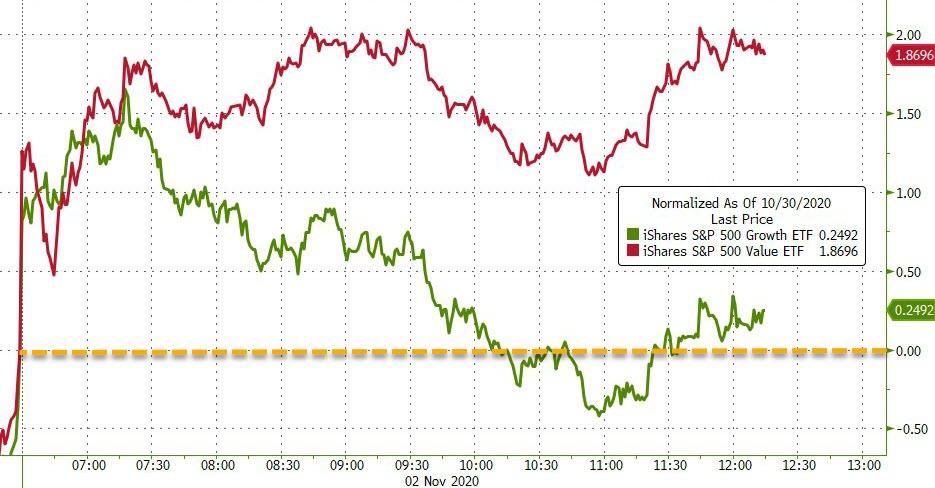
Value stocks were bid today…

Source: Bloomberg

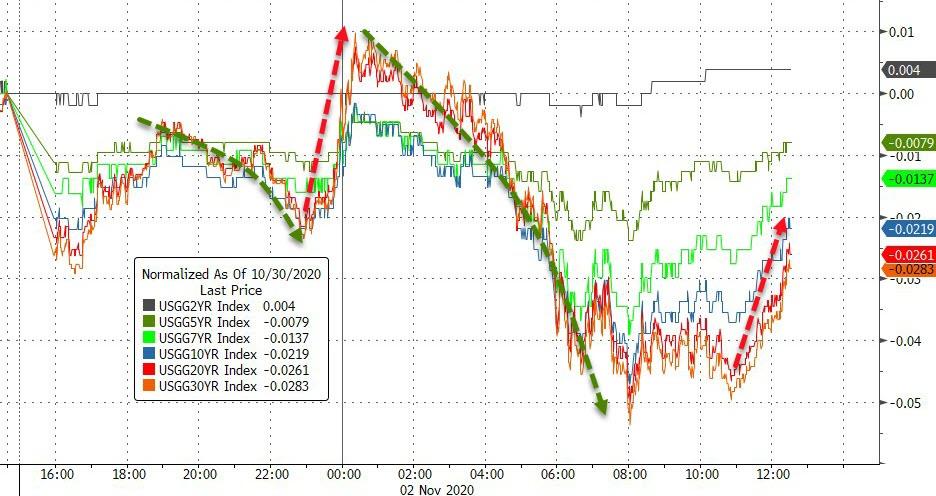
Despite broad stock market gains, bonds were also bid with the long-end outperforming…

Source: Bloomberg

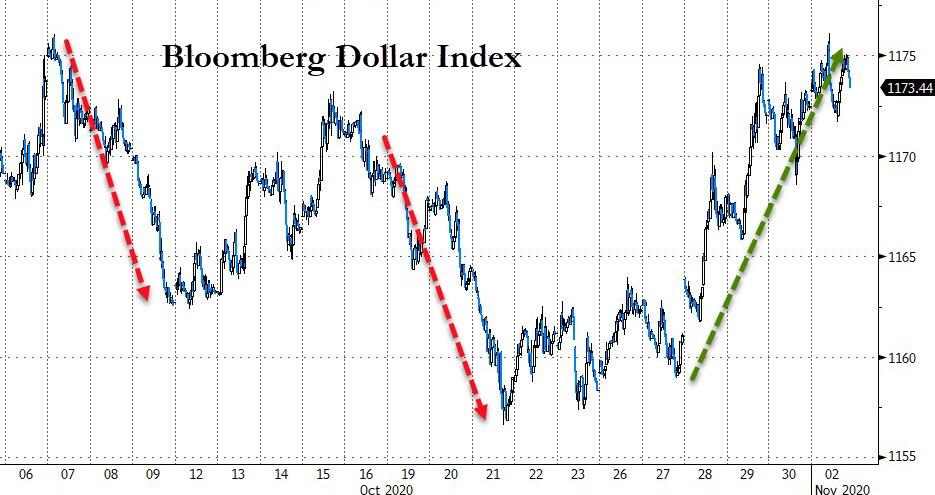
The dollar rallied for the 4th straight day back to its strongest since early October…

Source: Bloomberg

Bitcoin was dumped overnight when stocks ramped but has been bid back in the last few hours…

Source: Bloomberg

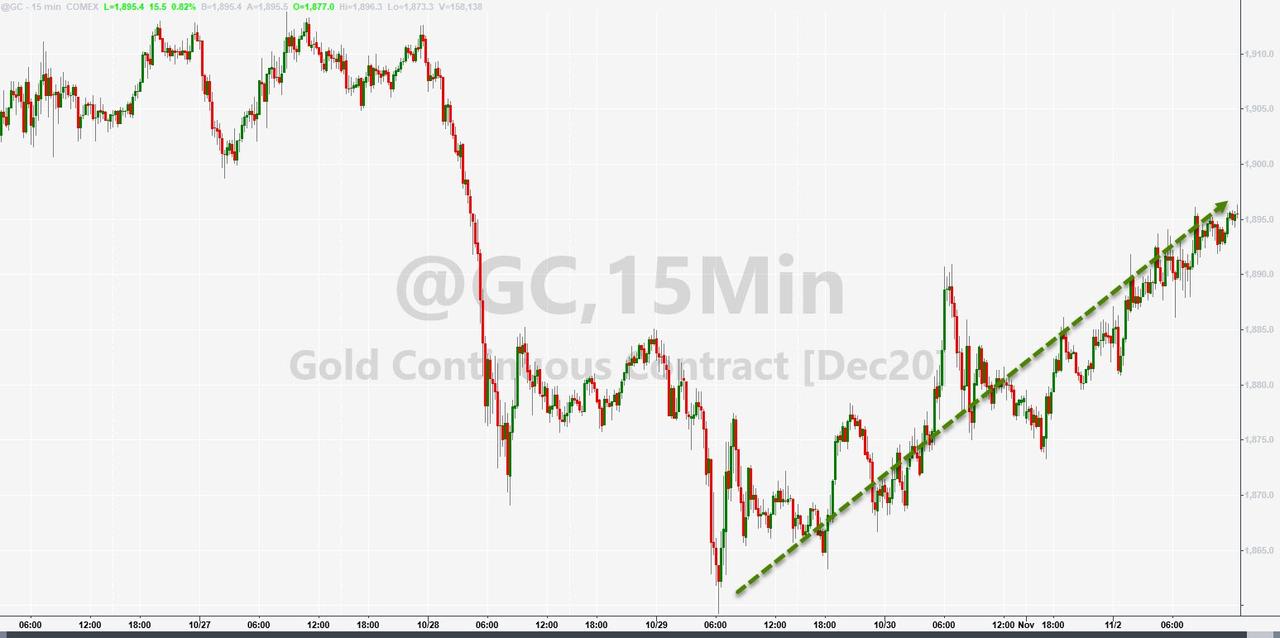
Gold was bid, despite USD gains, pushing back up towards $1900…

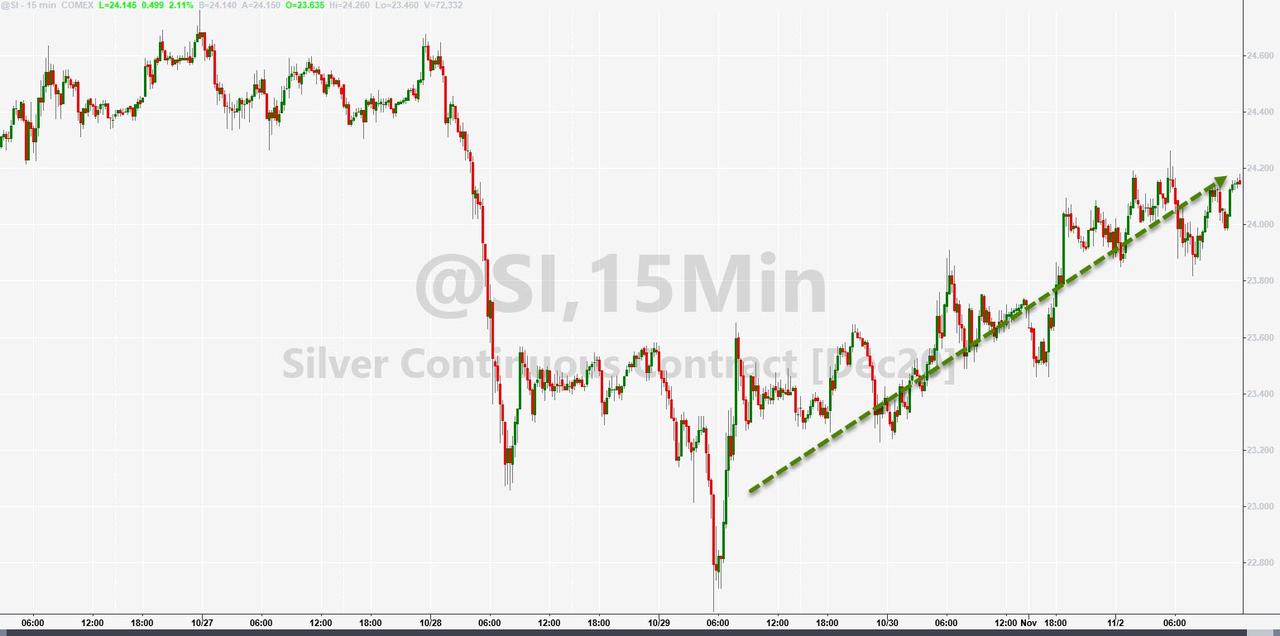
As did Silver…

Oil prices exploded higher after crashing to a $33 handle overnight. The rebound was catalyzed by Russia comments on OPEC+ output cuts…


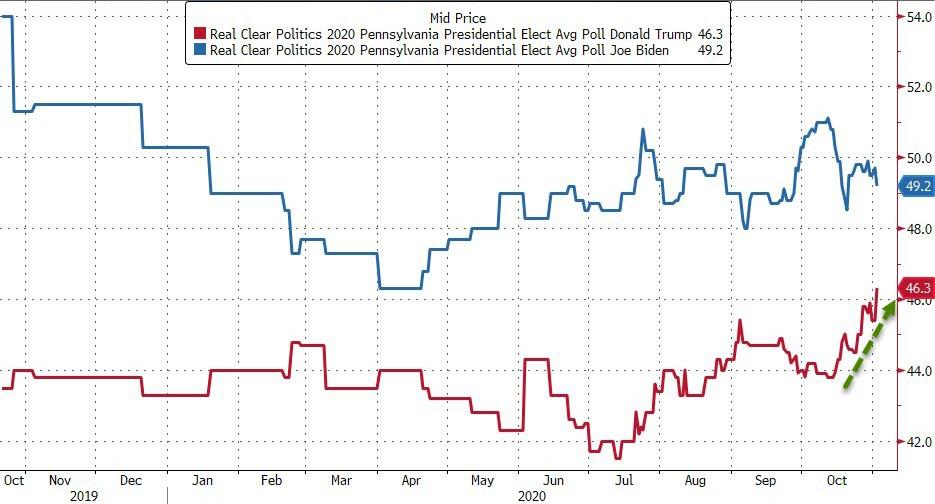
Finally, all eyes on Pennsylvania…

Source: Bloomberg

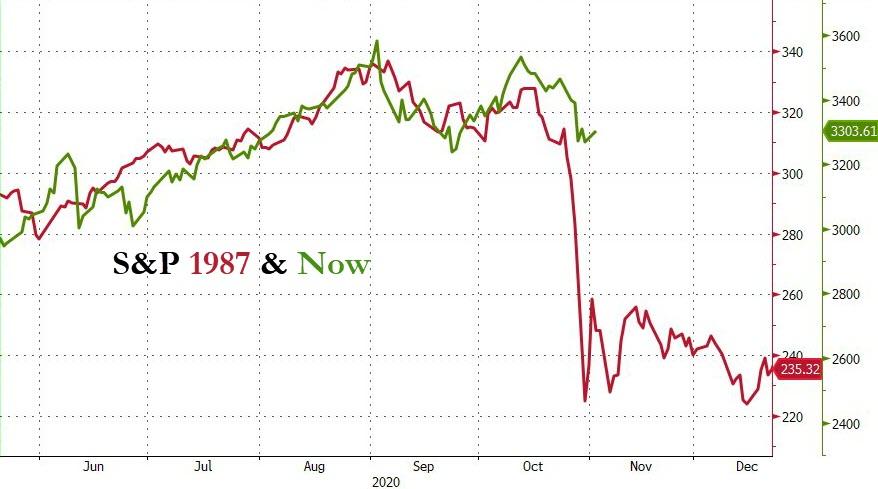
What’s the worst that could happen?

Source: Bloomberg

via ZeroHedge News https://ift.tt/2I1LXtl Tyler Durden