Federal Judge Tosses Texas GOP Bid To Invalidate Nearly 127,000 Drive-Through Votes

Federal Judge Tosses Texas GOP Bid To Invalidate Nearly 127,000 Drive-Through Votes

Tyler Durden

Mon, 11/02/2020 – 15:57

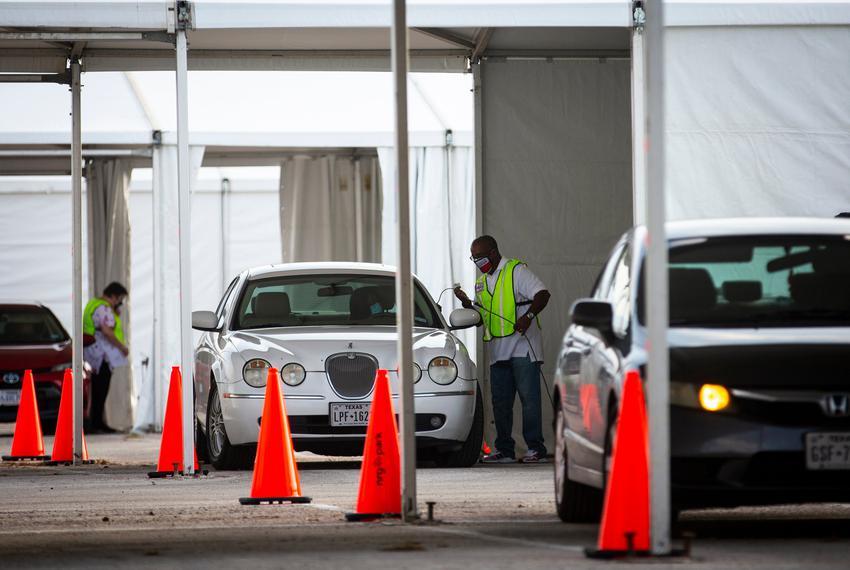
A federal judge in Texas threw out a bid by Republican activists to toss nearly 127,000 drive-through ballots cast in the most populous county in Texas, which leans Democratic.

“For lack of a nicer way of saying it, I ain’t buying it,” said US District Judge Andrew Hansen of the last-minute challenge to voting rules, adding that the activists lack standing.

“You have a tough uphill row to hoe,” Hanen told the plaintiffs earlier, adding that they would have to do a “fair amount of convincing” in a very short period of time before Tuesday’s general election.

“A lot of people would say, ‘Gee, if I had known there was a question about voting drive-in, I would have parked my car and walked to the polls,” Hansen added.

According to Bloomberg, the hearing took place just one day after the Texas Supreme Court denied efforts to reject drive-through votes in Harris County, which includes the Houston metropolitan area  – home to roughly 4.7 million people which voted for Hillary Clinton by 161,959 ballots.

Republicans argued that drive-through voting is an illegal extension of curbside voting, which is designed for people who are sick or have a physical disability – a method implemented by Harris County officials to limit the spread of COVID-19 during the election.

On Monday, attorney Christina Ford – representing Democratic parties which intervened in the case – said that provisional ballots do not have any way to indicate that they were cast at a drive-thru location, and that invalidating their ballots “would cause mass confusion” and lead to a “frantic situation with voters trying to figure out if they could cast a provisional ballot.”

“Plaintiffs argue that drive-thru voting would result in fraud and corruption,” said Ford, adding “There’s no evidence of that.

Plaintiffs plan to appeal the ruling to the circuit, and if need be, the Supreme Court.

via ZeroHedge News https://ift.tt/3kR1mv7 Tyler Durden

Is there a Moral Duty to Vote in an Election Where the Stakes are Unusually High?

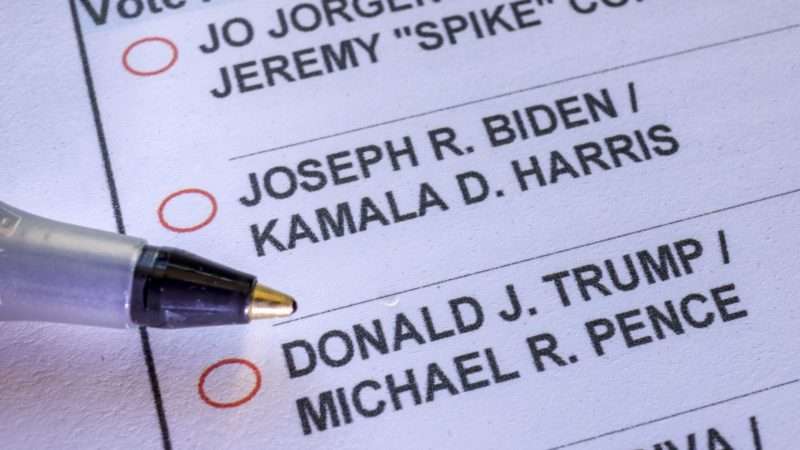
ballot_1161x653

Most arguments for a moral duty to vote cast it as a general obligation of citizenship. At least as a general rule, they hold that citizens are morally required to vote in elections—regardless of how big the difference between the opposing candidates is, and regardless of which candidate the voter in question prefers. I have criticized such claims in previous writings, most recently here.

But there is another, more limited justification for a duty to vote in at least some elections. It’s the idea that we have an obligation vote in cases where the stakes are especially high. Maybe there’s no duty to cast a ballot when there is little difference between the opposing candidates, or when the differences between them won’t have much effect. But things are different if one side is vastly better than the other. That intuition underlies the oft-heard sentiment that you must vote because “this is the most important election of our lifetime” and other similar claims. And, as polarization has grown, we hear such claims more often.

There is a kernel of truth to the claim that you have a duty to vote if the stakes are high enough. But the resulting moral duty applies far less often than advocates of the argument tend to assume. And the same reasoning actually implies many people have a moral duty not to vote.

Let’s start with the kernel of truth. Imagine there’s an election for a powerful political office that pits Gandalf (the benevolent wizard in J.R.R. Tolkien’s Lord of the Rings) against Sauron, the despotic dark lord from the same story. If Sauron prevails, millions of people will die or be enslaved, while Gandalf would rule justly if he manages to win. And all you have to do to ensure Gandalf’s victory is check his name on a ballot. If you do so, Gandalf wins; if not, Sauron does.

In this scenario, it seems like you have a moral duty to vote for Gandalf, at least barring some kind of extraordinary exigent circumstance. In real election, of course, the odds that your vote will make a difference are far smaller than in this stylized example. In an American presidential election, they are, on average, about 1 in 60 million, though higher in swing states.

However, a large enough difference between the two candidates could potentially justify a duty to vote for the “right” candidate, even if the odds of casting a decisive ballot are very low. For example,let’s say you live in a swing state, and you have a 1 in 1 million chance of casting a decisive vote for Gandalf over Sauron. But if your vote does turn out to be decisive, you will save 1 million people from death, and 10 million from being enslaved. Some simple math leads to the conclusion that the expected value of your vote (the benefit of Gandalf’s victory divided by the likelihood of having an impact) is one live saved, and ten people saved from slavery.

Here too, it may be you have a duty to vote. At the very least, there can be at least some scenarios where you have a duty to vote even if the likelihood of having a decisive impact is fairly low.

But notice that the duty in question is not an obligation to participate in the process for its own sake. It’s a duty to help good triumph over evil in a situation where you can do so at little or no cost. If you have a moral duty to vote for Gandalf in these types scenario, it follows that you also have a moral duty not to vote for Sauron. Indeed, the person who votes for Sauron is more worthy of condemnation than the one who merely abstains. The former is actively helping evil win, while the latter “merely” chooses not to stop it.

While Gandalf supporters may have a duty to vote, Sauron supporters actually have a duty to abstain from doing so. Ideally, they should stop supporting Sauron entirely. But they at least should not take any actions that increase the likelihood of his victory.

All of the above analysis assumes that the voter knows which candidate is superior and to what degree. But, in reality, we have widespread political ignorance, and most voters often don’t even know very basic facts about how government and politics work. Most are also highly biased in their evaluation of the information they do know, functioning more as “political fans” cheering on Team Red or Team Blue, than as truth-seekers.

There is much that people can do to become better voters. But most will not actually do so, because such action requires a lot of time and energy, and may be psychologically painful. Unless and until a voter becomes well-informed about the issues and at least reasonably objective in his or her evaluation of political information, she has good reason to question her judgment about which candidate is superior, much less by how much. Thus, she cannot conclude she has a duty to vote to help the “right” side win. She may instead have a presumptive duty to abstain from voting until she meets at least some minimal threshold of political knowledge.

Perhaps the relatively ignorant and biased voter might conclude he still should vote, because he is at least less ignorant and biased than average. Thus, casting a vote would slightly improve the average quality of the electorate and perhaps slightly increase the odds of the right candidate winning. That could be true. But notice that figuring out whether you are better informed than the average voter itself requires time and effort and a certain level of preexisting knowledge. It also requires resisting the psychological temptation to think you must be better than average. Any duty to vote in such circumstances is likely to be greatly attenuated, at best.

Many people will resist this conclusion on the grounds that figuring out which side is the “right” one is actually easy, because the gap between the opposing sides is so great. All you have to do is open your eyes!

I myself think that there is a substantial gap between Biden and Trump, and that the former is the lesser evil here. It may not be quite as clearcut as Gandalf vs. Sauron; but it is perhaps roughly analogous to Sauron vs. Cersei Lannister—not good vs. evil, but a  great evil vs. a much smaller one.

But if the difference between the two sides were really so obvious that almost anyone can easily figure it out, then there would be no need to worry about the election outcome! Those not otherwise inclined to vote can simply leave the decision to that portion of the population that actually enjoys voting, secure in the knowledge that the latter will easily figure out that Gandalf (or even Cersei) is preferable to Sauron.

If, on the other hand, it looks like Sauron has the support of 40% or more of the population, and therefore has something like a 10% chance of winning, that suggests discerning his relative evil is a tougher task than you might at first assume. And if the task is that difficult, your own judgment about Sauron could also be defective, unless you are relatively well-informed and unbiased.

Even if you do have good reason to be confident about your judgment about the candidates, and you justifiably believe that one is vastly superior to the other, you still might not have a duty to vote if doing so is unusually costly (for example, casting a ballot would divert you from some very important task). You might also be “excused” if you have already contributed to the public interest in some other way, as per philosopher Jason Brennan’s argument in his excellent book The Ethics of Voting. But at least there might be a presumptive obligation to vote here.

Perhaps you also have a duty to become a well-informed and unbiased voter in the first place. But that requires a lot of time and effort, and may be especially difficult in a world where government policy extends to so many issues, thereby requiring extensive knowledge to understand more than a small fraction of them. It’s hard to justify the idea that we have a duty to devote that much time to politics. It’s certainly a far cry from the initial intuitive scenario where you have a duty to help Gandalf defeat Sauron, because all you need do is check the right box on a ballot.

To sum up, there can potentially be a duty to vote in a situation where 1) there is a big difference between the two sides, 2) your vote has a significant chance of being decisive, and 3) you have good reason to think you are right about which candidate is best (or at least to conclude that your reasoning is better than than that of the average voter). In that world, you also have a duty to avoid voting for the “bad” candidate. If you have an inclination to do the latter, it is better for you to abstain than to vote.

But these circumstances apply to a relatively small subset of voting decisions. In most elections, the differences between candidates are not as great, there is more uncertainty about which one is better, and a high percentage of the potential electorate have good reason to doubt the quality of their judgment.

The absence of a moral duty to vote in a given election doesn’t necessarily mean you should abstain. Unless you have a moral duty not to vote (as in the Sauron supporter case discussed above), then you can vote or note vote without fear of condemnation. In my view, you do have at least a presumptive obligation to become relatively informed if you do choose to vote. But that’s different from having an obligation to vote, as such.

Neither the duty to vote (where it exists) nor the duty to abstain (where that exists) are ones that should be enforced by the government. I oppose mandatory voting, and I am also skeptical that the government can be trusted to discern who is likely to be a good voter and who isn’t, beyond perhaps some very minimal standards. These are moral obligations that individual voters should fulfill of their own accord, though we know many may fail to do so.

If this state of affairs seems unsatisfying, then I would suggest it strengthens the case for systemic reform to reduce our reliance on the knowledge and insight of voters, who often have strong incentives to be ignorant and biased in their judgments. I discuss potential options in my book Democracy and Political Ignorance, and here. In my most recent work, how we can empower people to have greater control over the policies they live under by expanding opportunities for them to “vote with their feet.”

In the meantime, we should take seriously the possibility that there is sometimes a duty to vote to defeat a (great enough) evil. But we should also recognize the limits of such claims.


from Latest – Reason.com https://ift.tt/2HXaoZq
via IFTTT
Why Is Donald Trump So Mad at Anthony Fauci?

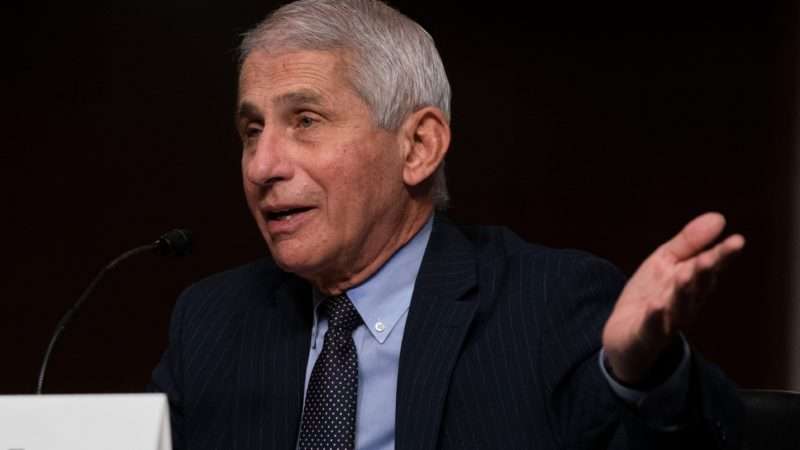
Anthony-Fauci-9-23-20-Newscom-cropped

During a campaign rally in Miami this morning, President Donald Trump suggested he might fire COVID-19 adviser Anthony Fauci after tomorrow’s election. Trump was complaining about press coverage of the epidemic when shouts of “Fire Fauci!” erupted from the crowd. Trump’s response: “Don’t tell anybody, but let me wait until a little bit after the election. I appreciate the advice.”

Trump has been openly critical of Fauci, who has directed the National Institute of Allergy and Infectious Diseases since 1984, for months. “People are tired of hearing Fauci and these idiots, all these idiots who got it wrong,” Trump said during a phone call with campaign staff last month, calling Fauci a “disaster.” At that point, Trump was reacting to a 60 Minutes interview in which Fauci contradicted the president’s rosy outlook on the epidemic. Fauci’s most recent sin was a Washington Post interview last week in which he did the same thing.

Fauci’s comments are obviously inconvenient for a president who has repeatedly claimed that “we’re rounding the corner” on COVID-19, which supposedly is “going away.” But is there any substance to Trump’s complaint that Fauci “got it wrong” when he advised the president and the public about how to deal with the threat posed by the disease?

Trump’s spat with Fauci is not simply a matter of optimism vs. pessimism about the course of the epidemic. Last spring, Trump embraced an utterly implausible worst-case scenario that projected as many as 2.2 million deaths in the United States based on the counterfactual assumption of “no intervention.” The White House continues to rely on that projection, claiming “President Trump’s Coronavirus Response Has Saved Over 2 Million Lives.”

Leaving aside the fact that the worst-case scenario was never realistic, the administration’s math is puzzling. The current U.S. death toll is about 231,000, which does not leave “over 2 million lives” for the president to have saved, even if you assume no one else will die from COVID-19 and you implausibly ascribe the entire difference between reality and the fantastical projection to Trump’s policies.

Nor is the current White House claim consistent with what Trump was saying last spring. “By very vigorously following these [social distancing] guidelines,” President Donald Trump declared on March 30, “we could save more than 1 million American lives. Think of that: 1 million American lives.” That estimate was also dubious, but it was less than half the number of deaths Trump is now claiming he prevented.

Even as the Trump administration was citing the worst-case scenario to urge dramatic changes in behavior last spring, Fauci was telling Americans not to put much stock in those numbers. During a March 29 interview on CNN, Jake Tapper asked Fauci how many COVID-19 cases the United States can expect to see. “To be honest with you, we don’t really have any firm idea,” Fauci said. “There are things called models. And when someone creates a model, they put in various assumptions. And the model is only as good and as accurate as your assumptions. And whenever the modelers come in, they give a worst-case scenario and a best-case scenario. Generally, the reality is somewhere in the middle. I have never seen a model of the diseases that I have dealt [with] where the worst-case scenario actually came out. They always overshoot. So when you use numbers like a million, a million-and-a-half, 2 million [deaths], that almost certainly is off the chart. Now, it’s not impossible, but very, very unlikely.”

When it was politically convenient, Trump promoted a highly pessimistic scenario that Fauci deemed “very, very unlikely,” and he continues to rely on that scenario to make his policies look good. If the question is who “got it wrong” when it came to predicting how many Americans COVID-19 might kill, Fauci’s measured comments certainly look better than Trump’s scaremongering.

Perhaps Trump means that Fauci “got it wrong” by favoring lockdowns as a response to the pandemic. But during his debate with Democratic presidential nominee Joe Biden last month, Trump strongly implied that lockdowns had helped reduce the death toll; he even tried to take credit for those sweeping restrictions, which were actually imposed at the state level. “As you know, 2.2 million people, modeled out, were expected to die,” he said. “We closed up the greatest economy in the world in order to fight this horrible disease.”

One way in which Trump explicitly says Fauci “got it wrong” concerns the utility of face masks in curtailing transmission of the coronavirus. During his first debate with Biden in September, Trump noted that Fauci had changed his position on that issue. “He said very strongly, ‘Masks are not good,'” Trump observed. “Then he changed his mind. He said, ‘Masks are good.'”

Although The New York Times and other anti-Trump news outlets frequently imply that Fauci’s initial position was based purely on a desire to avoid shortages of face masks for health care workers, that is not true. Fauci did mention that concern in the early stages of the epidemic, but he was also skeptical that general mask wearing would do much good.

“There’s no reason to be walking around with a mask,” Fauci said during a March 8 interview with 60 Minutes. “When you’re in the middle of an outbreak, wearing a mask might make people feel a little bit better, and it might even block a droplet. But it’s not providing the perfect protection that people think that it is. And often, there are unintended consequences. People keep fiddling with the mask, and they keep touching their face….When you think ‘masks,’ you should think of health care providers needing them.”

Fauci is singing a different tune these days, saying “there should be universal wearing of masks.” He ascribes that change to accumulating scientific evidence concerning the effectiveness of masks and the importance of asymptomatic transmission. “As you get further information,” he told CNN in September, “you have to be humble enough and flexible enough to make your statements and your policy and your recommendation based on the evidence that you now have, which may actually change some of the policy.”

If Fauci initially “got it wrong” on face masks, of course, that implies his current position is right. But that is not what you would gather from Trump’s persistently muddled messages about the value of this precaution. Although the weight of the evidence indicates that it’s a good idea to wear a mask when you are indoors and in close proximity to strangers, the views Trump has expressed on the subject are agnostic at best, and his behavior suggests the same reflexive hostility toward masks that many of his supporters express. While Fauci says his opinion of masks changed based on evolving science, Trump has swung wildly between calling face coverings “patriotic” and dismissing them as a partisan affectation.

Which brings us to the current dispute between Trump and Fauci. Notwithstanding the recent spike in newly identified infections, which have reached record levels during the last few weeks, Trump insists we have “turned the corner.” During his interview with the Post last Friday, Fauci strongly disagreed.

“We’re in for a whole lot of hurt,” Fauci said. “It’s not a good situation. All the stars are aligned in the wrong place as you go into the fall and winter season, with people congregating at home indoors. You could not possibly be positioned more poorly.”

That last part seems like hyperbole. The United States would be positioned more poorly, for instance, if the case fatality rate had not fallen dramatically since mid-May, partly because of changing patient demographics and partly because of improvements in treatment. But it is surely reasonable for Fauci to worry about the course of the epidemic as Americans spend more time indoors, and he is right that we are apt to see a further increase in daily deaths, although probably not nearly as big as the increase in cases, let alone as big as the huge surge that Biden has predicted.

Fauci not only contradicted Trump’s excessive optimism. He made the mistake of contrasting the Biden campaign, which he said “is taking [COVID-19] seriously from a public health perspective,” with the Trump administration, which he said is focused on “the economy and reopening the country.”

The angry White House response to Fauci’s comments noted the falling case fatality rate but was otherwise not exactly substantive. “It’s unacceptable and breaking with all norms for Dr. Fauci, a senior member of the President’s Coronavirus Task Force and someone who has praised President Trump’s actions throughout this pandemic, to choose three days before an election to play politics,” said White House spokesman Judd Deere. “As a member of the Task Force, Dr. Fauci has a duty to express concerns or push for a change in strategy, but he’s not done that, instead choosing to criticize the President in the media and make his political leanings known by praising the President’s opponent—exactly what the American people have come to expect from The Swamp.”

In short, Deere is telling us that Fauci is a Swamp creature determined to prevent Trump’s reelection, not a scientist giving his honest take on COVID-19 trends. If the White House thinks that take is wrong, it should be telling us why. Instead, the White House is telling Americans to accept the word of a desperate politician whose allegiance to the truth is tenuous even in the best of circumstances.

from Latest – Reason.com https://ift.tt/3kXC0vW
via IFTTT

The Best And Worst Performing Assets In October

The Best And Worst Performing Assets In October

Tyler Durden

Mon, 11/02/2020 – 15:45

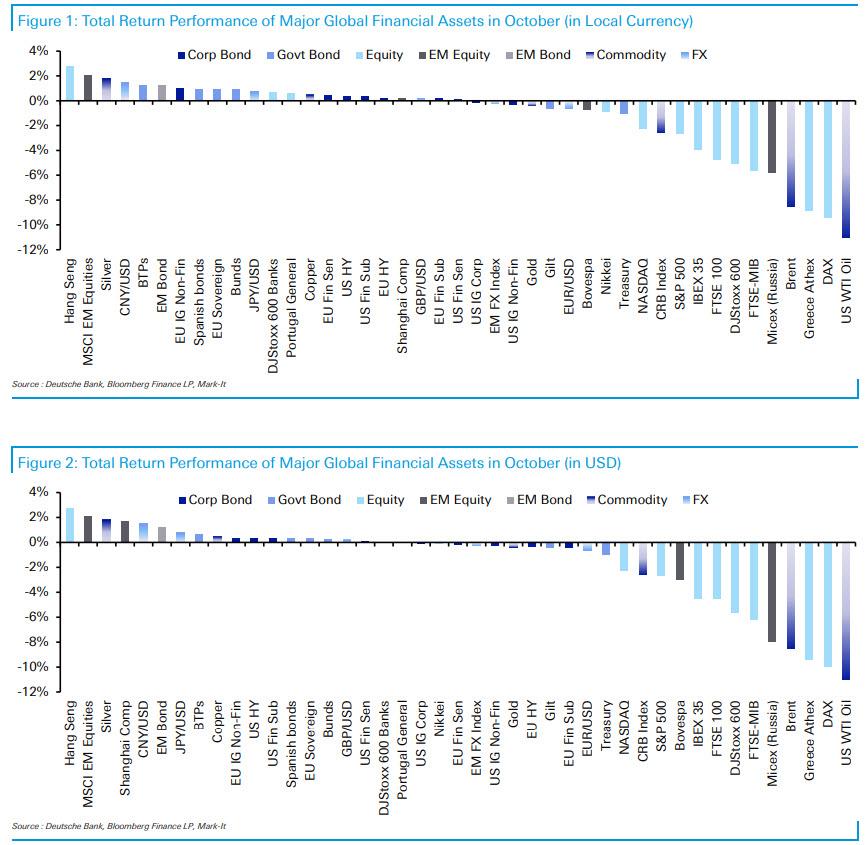
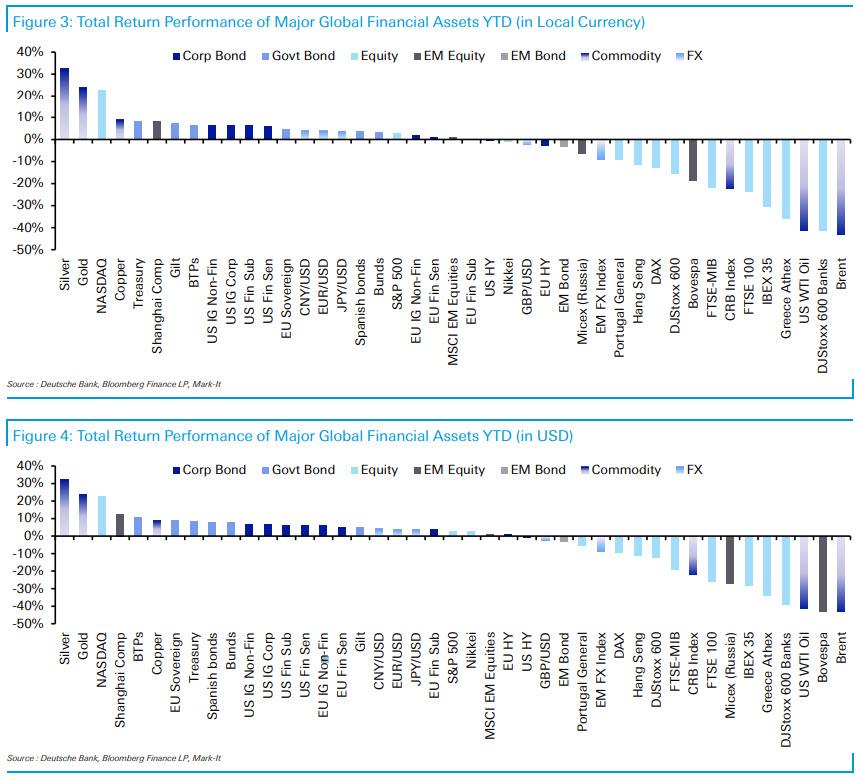
In a continuation of the September weakness across markets, October saw a further decline in risk sentiment across financial markets from the post-covid highs of late-Summer as case counts are rising to new highs across Europe and the US. And, as Deutsche Bank’s Karthik Nagalingam writes in his October performance review note, European equities and oil in particular were among the worst performers last month, while EM assets were among the best.

With partial national shutdowns announced in the two largest European economies and further restrictions across the continent in the face of quickly rising Covid-19 cases, indices such as the German DAX (-9.4%), Greek Athex (-8.8%) and Italian FTSE-MIB (-5.6%) had their worst months since March. The negative sentiment was partly shared on the other side of the Atlantic, with cases there reaching record highs as well, as the S&P 500 (-2.7%) and the Nasdaq (-2.3%) declined for a second straight month. It was not all bad news as Asian markets partly rallied, with the Hang Seng gaining +2.8% last month.

WTI (-11.0%) was the worst performing instrument, with Brent crude (-8.5%) not far behind as global demand worries on the back of further government shutdowns hurt energy prices. Both measures of oil are now at their lowest levels since late May. Not all commodities were lower in October however, as some metals saw a modest rise over the last month. Silver rose +1.8% and copper gained +0.5%, while gold declined -0.4% over the month.

Meanwhile, in fixed income, sovereign bonds rallied in Europe with the risk off tone and indications that the ECB would continue and possibly expand on its bond buying programme. BTPs led the way (+1.3%) for a second straight month, with Spanish debt (+1.0%) following, while bunds (+0.9%) advanced similarly. US Treasuries, on the other hand fell – 1.0%.

In terms of FX movements, the big move was in Asian currencies as the Chinese Renminbi strengthened +1.5% against the US dollar, while the Japanese Yen rose +0.8%. The Euro fell -0.6%, while the EM FX index dropped -0.3% as the dollar index rose +0.2% in its smallest monthly move since April.

via ZeroHedge News https://ift.tt/3mIBBOc Tyler Durden

Not The Onion: Most Common Female Name For A Biden Voter Is “Karen”

Not The Onion: Most Common Female Name For A Biden Voter Is “Karen”

Tyler Durden

Mon, 11/02/2020 – 15:30

Authored by Paul Joseph Watson via Summit News,

A study by the New York Times and Siena College has revealed that the most common female name for someone voting for Joe Biden is ‘Karen’.

The figures show that Karens are more likely to vote for Biden over Trump by a 60/40 margin.

The most common female name for a Trump voter is ‘Nancy’, while the most common male name is ‘Richard’.

The ‘Karen’ meme – which came to prominence earlier this year, describes an overly interfering, obnoxious, self-entitled female who always tries to police other people’s behavior and ‘complain to the manager’.

The left tried to hijack the meme by asserting that its common stereotype was a white woman, almost always a Trump supporter, who unfairly called the police on black people because she is racist.

Its other main trope was a mentally deficient but loudly boisterous white woman who got into arguments with store employees and other customers by refusing to wear a face mask.

However, as the video below highlights, anecdotal evidence suggests ‘Karens’ are just as likely to be vehement leftist control freaks who are righteously indignant in lecturing others about not wearing masks or maintaining ‘social distancing’.

While ‘Karen’ is just a meme used to describe the behavior of people who may not actually be called Karen, the fact that a clear majority of Karens are voting for Biden goes some way to overturning the meme being used as a pejorative to ridicule people on the right and Trump supporters.

*  *  *

New limited edition merch now available! Click here.

In the age of mass Silicon Valley censorship It is crucial that we stay in touch. I need you to sign up for my free newsletter here. Also, I urgently need your financial support here.

via ZeroHedge News https://ift.tt/3kQzUhj Tyler Durden

Why Is Donald Trump So Mad at Anthony Fauci?

Anthony-Fauci-9-23-20-Newscom-cropped

During a campaign rally in Miami this morning, President Donald Trump suggested he might fire COVID-19 adviser Anthony Fauci after tomorrow’s election. Trump was complaining about press coverage of the epidemic when shouts of “Fire Fauci!” erupted from the crowd. Trump’s response: “Don’t tell anybody, but let me wait until a little bit after the election. I appreciate the advice.”

Trump has been openly critical of Fauci, who has directed the National Institute of Allergy and Infectious Diseases since 1984, for months. “People are tired of hearing Fauci and these idiots, all these idiots who got it wrong,” Trump said during a phone call with campaign staff last month, calling Fauci a “disaster.” At that point, Trump was reacting to a 60 Minutes interview in which Fauci contradicted the president’s rosy outlook on the epidemic. Fauci’s most recent sin was a Washington Post interview last week in which he did the same thing.

Fauci’s comments are obviously inconvenient for a president who has repeatedly claimed that “we’re rounding the corner” on COVID-19, which supposedly is “going away.” But is there any substance to Trump’s complaint that Fauci “got it wrong” when he advised the president and the public about how to deal with the threat posed by the disease?

Trump’s spat with Fauci is not simply a matter of optimism vs. pessimism about the course of the epidemic. Last spring, Trump embraced an utterly implausible worst-case scenario that projected as many as 2.2 million deaths in the United States based on the counterfactual assumption of “no intervention.” The White House continues to rely on that projection, claiming “President Trump’s Coronavirus Response Has Saved Over 2 Million Lives.”

Leaving aside the fact that the worst-case scenario was never realistic, the administration’s math is puzzling. The current U.S. death toll is about 231,000, which does not leave “over 2 million lives” for the president to have saved, even if you assume no one else will die from COVID-19 and you implausibly ascribe the entire difference between reality and the fantastical projection to Trump’s policies.

Nor is the current White House claim consistent with what Trump was saying last spring. “By very vigorously following these [social distancing] guidelines,” President Donald Trump declared on March 30, “we could save more than 1 million American lives. Think of that: 1 million American lives.” That estimate was also dubious, but it was less than half the number of deaths Trump is now claiming he prevented.

Even as the Trump administration was citing the worst-case scenario to urge dramatic changes in behavior last spring, Fauci was telling Americans not to put much stock in those numbers. During a March 29 interview on CNN, Jake Tapper asked Fauci how many COVID-19 cases the United States can expect to see. “To be honest with you, we don’t really have any firm idea,” Fauci said. “There are things called models. And when someone creates a model, they put in various assumptions. And the model is only as good and as accurate as your assumptions. And whenever the modelers come in, they give a worst-case scenario and a best-case scenario. Generally, the reality is somewhere in the middle. I have never seen a model of the diseases that I have dealt [with] where the worst-case scenario actually came out. They always overshoot. So when you use numbers like a million, a million-and-a-half, 2 million [deaths], that almost certainly is off the chart. Now, it’s not impossible, but very, very unlikely.”

When it was politically convenient, Trump promoted a highly pessimistic scenario that Fauci deemed “very, very unlikely,” and he continues to rely on that scenario to make his policies look good. If the question is who “got it wrong” when it came to predicting how many Americans COVID-19 might kill, Fauci’s measured comments certainly look better than Trump’s scaremongering.

Perhaps Trump means that Fauci “got it wrong” by favoring lockdowns as a response to the pandemic. But during his debate with Democratic presidential nominee Joe Biden last month, Trump strongly implied that lockdowns had helped reduce the death toll; he even tried to take credit for those sweeping restrictions, which were actually imposed at the state level. “As you know, 2.2 million people, modeled out, were expected to die,” he said. “We closed up the greatest economy in the world in order to fight this horrible disease.”

One way in which Trump explicitly says Fauci “got it wrong” concerns the utility of face masks in curtailing transmission of the coronavirus. During his first debate with Biden in September, Trump noted that Fauci had changed his position on that issue. “He said very strongly, ‘Masks are not good,'” Trump observed. “Then he changed his mind. He said, ‘Masks are good.'”

Although The New York Times and other anti-Trump news outlets frequently imply that Fauci’s initial position was based purely on a desire to avoid shortages of face masks for health care workers, that is not true. Fauci did mention that concern in the early stages of the epidemic, but he was also skeptical that general mask wearing would do much good.

“There’s no reason to be walking around with a mask,” Fauci said during a March 8 interview with 60 Minutes. “When you’re in the middle of an outbreak, wearing a mask might make people feel a little bit better, and it might even block a droplet. But it’s not providing the perfect protection that people think that it is. And often, there are unintended consequences. People keep fiddling with the mask, and they keep touching their face….When you think ‘masks,’ you should think of health care providers needing them.”

Fauci is singing a different tune these days, saying “there should be universal wearing of masks.” He ascribes that change to accumulating scientific evidence concerning the effectiveness of masks and the importance of asymptomatic transmission. “As you get further information,” he told CNN in September, “you have to be humble enough and flexible enough to make your statements and your policy and your recommendation based on the evidence that you now have, which may actually change some of the policy.”

If Fauci initially “got it wrong” on face masks, of course, that implies his current position is right. But that is not what you would gather from Trump’s persistently muddled messages about the value of this precaution. Although the weight of the evidence indicates that it’s a good idea to wear a mask when you are indoors and in close proximity to strangers, the views Trump has expressed on the subject are agnostic at best, and his behavior suggests the same reflexive hostility toward masks that many of his supporters express. While Fauci says his opinion of masks changed based on evolving science, Trump has swung wildly between calling face coverings “patriotic” and dismissing them as a partisan affectation.

Which brings us to the current dispute between Trump and Fauci. Notwithstanding the recent spike in newly identified infections, which have reached record levels during the last few weeks, Trump insists we have “turned the corner.” During his interview with the Post last Friday, Fauci strongly disagreed.

“We’re in for a whole lot of hurt,” Fauci said. “It’s not a good situation. All the stars are aligned in the wrong place as you go into the fall and winter season, with people congregating at home indoors. You could not possibly be positioned more poorly.”

That last part seems like hyperbole. The United States would be positioned more poorly, for instance, if the case fatality rate had not fallen dramatically since mid-May, partly because of changing patient demographics and partly because of improvements in treatment. But it is surely reasonable for Fauci to worry about the course of the epidemic as Americans spend more time indoors, and he is right that we are apt to see a further increase in daily deaths, although probably not nearly as big as the increase in cases, let alone as big as the huge surge that Biden has predicted.

Fauci not only contradicted Trump’s excessive optimism. He made the mistake of contrasting the Biden campaign, which he said “is taking [COVID-19] seriously from a public health perspective,” with the Trump administration, which he said is focused on “the economy and reopening the country.”

The angry White House response to Fauci’s comments noted the falling case fatality rate but was otherwise not exactly substantive. “It’s unacceptable and breaking with all norms for Dr. Fauci, a senior member of the President’s Coronavirus Task Force and someone who has praised President Trump’s actions throughout this pandemic, to choose three days before an election to play politics,” said White House spokesman Judd Deere. “As a member of the Task Force, Dr. Fauci has a duty to express concerns or push for a change in strategy, but he’s not done that, instead choosing to criticize the President in the media and make his political leanings known by praising the President’s opponent—exactly what the American people have come to expect from The Swamp.”

In short, Deere is telling us that Fauci is a Swamp creature determined to prevent Trump’s reelection, not a scientist giving his honest take on COVID-19 trends. If the White House thinks that take is wrong, it should be telling us why. Instead, the White House is telling Americans to accept the word of a desperate politician whose allegiance to the truth is tenuous even in the best of circumstances.

from Latest – Reason.com https://ift.tt/3kXC0vW
via IFTTT

Here’s What Stocks Will Do After The Election According To Options Traders

Here’s What Stocks Will Do After The Election According To Options Traders

Tyler Durden

Mon, 11/02/2020 – 15:15

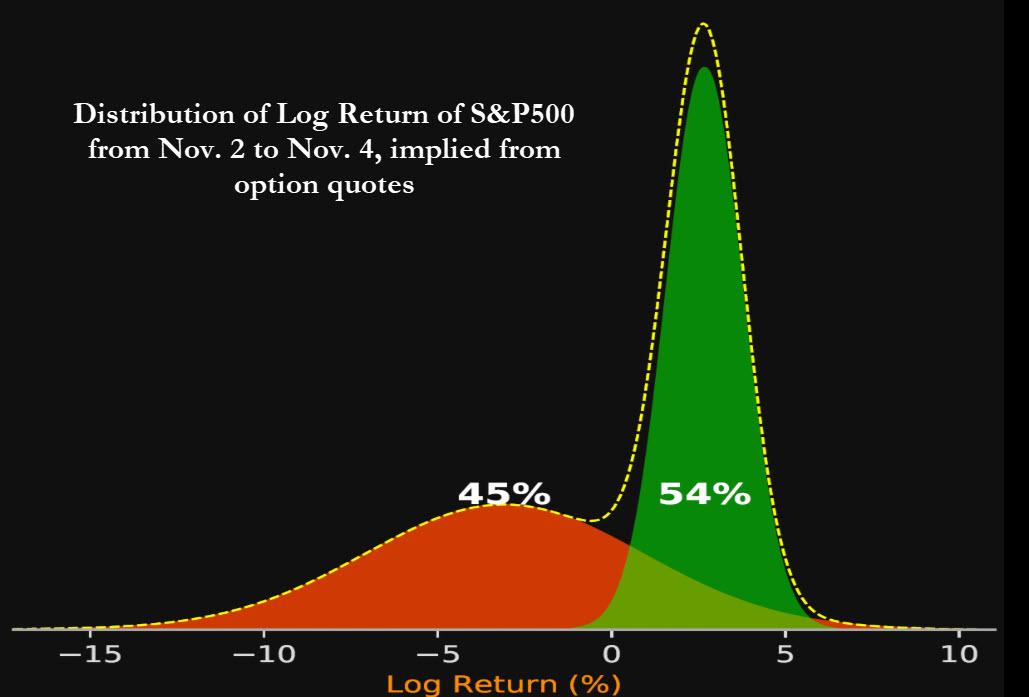
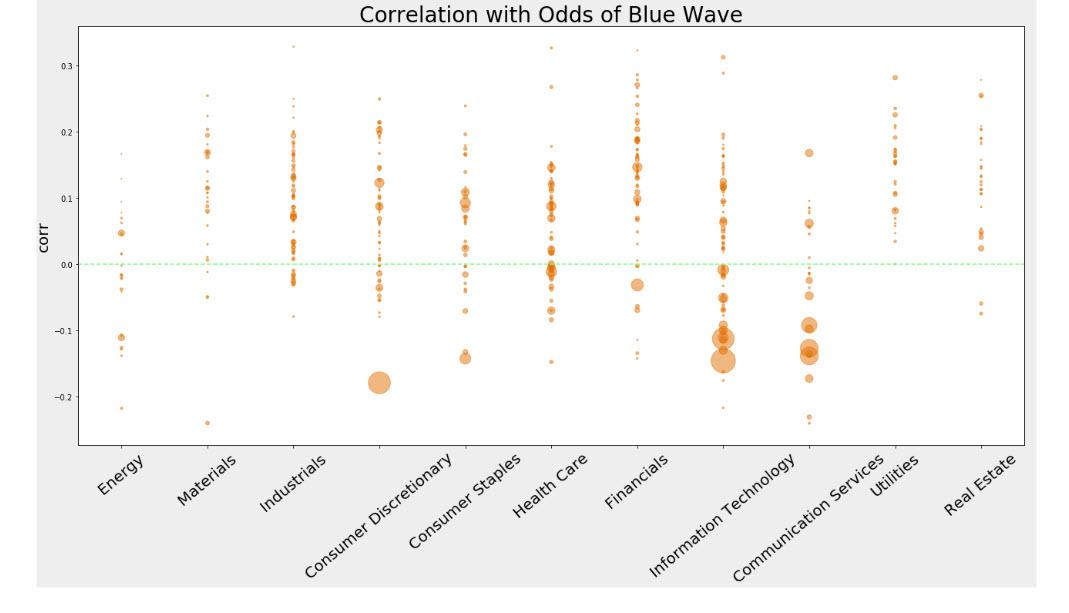
According to a study by Bloomberg’s quants Lily Gu and Bryan Liang, who looked at how options markets are positioned for the election, the market is split in two in terms of what it expects will happen on Nov 4: as shown in the chart below, the equity options market showed a 54% chance of a upside movement (+2.7%) between Nov. 2 and Nov. 4, and 45% chance of a larger drop (-3%).

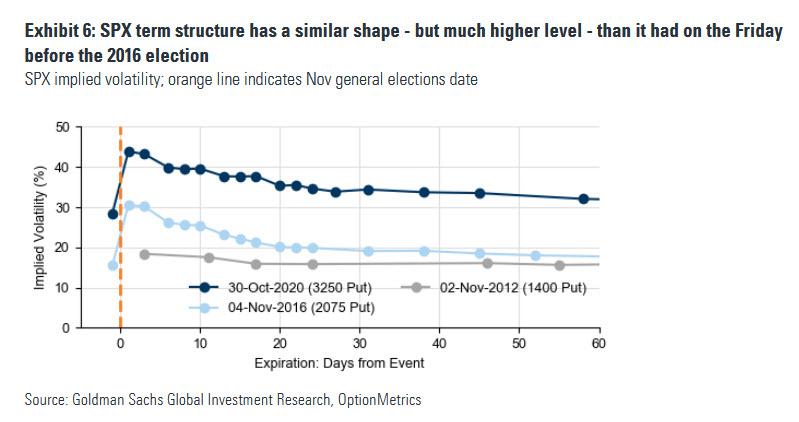
Looking at the option market in general as the next chart from Goldman shows, traders seem to be far more on edge today than the day before the 2016 election: while the SPX term structure has a similar shape, it has a much higher level than it had on the Friday before the 2016 election:

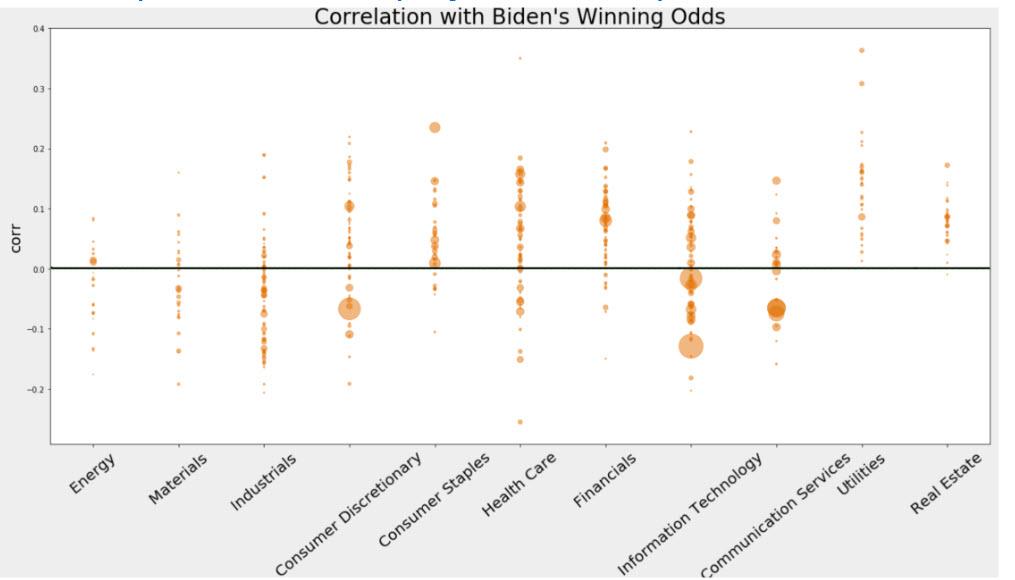
Some other findings from the Bloomberg analysis, as summarized by Bloomberg’s Ye Xie:

  • Utilities and real estate are the most positively correlated to with Biden’s winning odds implied in the betting market, while mega tech companies are negatively correlated with Blue Wave odds, as a Dem sweep would likely result in a burst in reflation trades.

  • Most sectors are more positively correlated with the combined odds of the Democrats taking over both the White House and Senate, rather than just a Biden victory.

In other words, “Markets seem to be expecting that a blue wave, which may bring about a largest spending package, is risk positive, at least initially.

via ZeroHedge News https://ift.tt/3emcIop Tyler Durden

Reported ‘Terror Attack’ Underway At Vienna Synogogue

Reported ‘Terror Attack’ Underway At Vienna Synogogue

Tyler Durden

Mon, 11/02/2020 – 15:05

A potential terror attack is currently underway in Vienna, where gunshots have been reported at a synagogue that stands as the epicenter of what remains of the city’s Jewish population.

The number of casualties and deaths is presently unclear.


via ZeroHedge News https://ift.tt/3kMxobI Tyler Durden

Pro-Trump Black Voters Shamed Again After Maxine Waters ‘Disowns’

Pro-Trump Black Voters Shamed Again After Maxine Waters ‘Disowns’

Tyler Durden

Mon, 11/02/2020 – 14:59

Authored by Sara Carter via SaraACarter.com,

Rep. Maxine Waters told SiriusXM’s ‘The Joe Madison Show’ Friday that she would never forgive young black voters that consider voting for President Donald Trump.

Does she even realize that young black voters aren’t asking for her forgiveness or her permission. The nerve of Democratic politicians to think that they somehow own particular groups of people in America. It doesn’t matter that Waters, a California Democrat, is Black because what she is saying is insulting.

It’s not about the color of your skin, or how much or little money you make, it’s about your own individuality and right to choose what’s best for you. I don’t think young Black voters are tossing and turning at night over what Waters thinks is best for them or the choices that they make.

It’s sad that the Democratic Party can’t see the hypocrisy in their own actions. The way many Democratic leaders speak about the Black community, or for that matter any minority community, you would think they own them. It’s plain wrong and un-American.

Let’s look at what Waters said. She said it was “shameful” that young black voters might consider casting a ballot for Trump.”

She said she was angry about “black young men who think somehow they can align themselves with Trump.”

But look at the Rasmussen Reports latest poll that suspects roughly one-third of black voters will vote for Trump in the election.

“It just hurts me so bad to see blacks talking about supporting Trump. I don’t know why they would be doing it. I don’t know why it is on their minds,” she added.

What hurts Waters, and Democrats like her the most, is the fact that some of America’s youth and the Black community in general is awakening to the truth and failed policies of Democratic leaders.

How can she with a straight face call Trump “a racist.:

She said “he does not have any appreciation for black people and black women in particular.He has no respect for us. He is not doing anything for us. For those black young men who think somehow they can align themselves with Trump, not only are they terrible mistaken, any of them showing their face, I will never, ever forgive them for undermining the possibility to help their own people and their own communities.”

It’s all lies. Trump’s economic policies prior to COVID-19 outbreak led to the lowest unemployment rate for Black Americans, Latinos and other minorities in U.S. history. He is also the first President to keep his promises to the Black community by reversing the dangerous policies established in the U.S. criminal justice system that led to massive incarceration of young Black men.

Trump passed the First Step Act and his White House has been open to all people regardless of their economic, cultural or political status. It’s the reason so many Black rap artists, businessmen and religious leaders have shifted from the Democratic Party to the Trump administration.

via ZeroHedge News https://ift.tt/386aOay Tyler Durden

D.C. Schools Suddenly Abandon Plans To Reopen After Teachers Union Objects

dreamstime_xxl_190040447

D.C. public schools were scheduled to reopen next week, but Lucy has yanked the football away again: The district announced today that distance learning will continue for most students.

“While we planned to offer in-person learning at the start of Term 2 for select elementary school students, this timeline will need to be adjusted,” wrote Lewis Ferebee, chancellor of D.C. Public Schools, in an email to parents.

This reversal came after the Washington Teachers Union voted to oppose the reopening plan. The union also instructed teachers to take a “mental health day” on Monday and refuse to teach virtually, as a show of force.

Much like the union’s earlier efforts to thwart the city’s reopening plans—which involved dumping fake body bags in front of district headquarters and staging drive-by protests—the tactics have succeeded: Officials caved to union demands without any fight whatsoever. As a result, parents who had made arrangements to send their kids back to school just a few days from now will be thrown for yet another loop.

This same dynamic—district announces a reopening date, teachers protest, district relents, working parents suffer—is playing out in large districts across the country: Chicago, New York City, San Francisco, and others. The Fairfax Education Association, which represents public school teachers in northern Virginia, doesn’t want its members returning for in-person instruction until at least the fall of 2021.

Teachers unions claim that their goal in thwarting reopenings is to keep students and teachers safe. But we know from schools that have reopened that doing so is relatively safe; meanwhile, virtual education is a completely disaster for many kids. Unfortunately, the teachers unions’ incentives are totally at odds with what families need. Students need in-person instruction, whereas public school teachers will be paid regardless of whether they actually have to show up to work.

Imagine if public education dollars followed individual students instead of automatically lining the pockets of institutions that aren’t serving students particularly well.

from Latest – Reason.com https://ift.tt/3oYa51l
via IFTTT