The Kids Are All Right

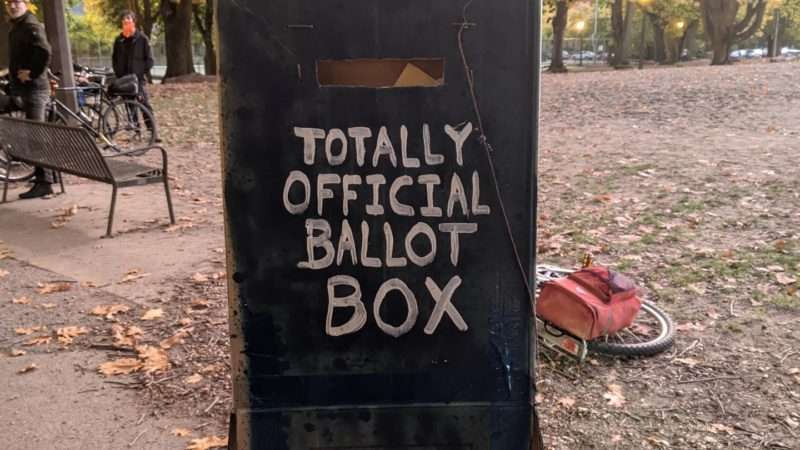
Ballot Box costume

The scene at Irving Park in northeast Portland at 6 p.m. on Halloween looks pretty much like any other Saturday night in the park: Kids shoot hoops on the north end, people play tennis on the south, dogs run in the center. Tonight there’s also a Day of the Dead celebration, with singing and lighting candles and little kids in costumes spinning and eating cake.

Watching from the adjoining hillside are about 60 people in costumes of their own, the all-black clothing, face masks, and helmets of black bloc, here for tonight’s “Capitalism is Spooky” rally. That every other rally and march I’ve been to has appeared livelier and better-attended than this one may be due to participation burnout; Portland is on Night 158 of continual protests, with a few days taken off during the wildfires in September. Where there’s previously been pep and sloganeering, tonight there are hillside sitters looking bored with the Day of the Dead crew, with the toddlers dancing with their moms, maybe even with other people taking over a public space when, for the past four months, those have been their domain—parks and streets and Mayor Ted Wheeler’s apartment complex—their places to make a stand, and wasn’t it time for these others to clear out? So they could get on with their important work?

Tonight’s important work, per the online flyer, includes “No Cameras. No Peace Police. Total Abolition.” But by 6:30, there are no tricks or treats, no music, and, with the exception of some guy wearing a paper mask of Andy Ngo on the back of his head, no costumes. By all lights, it is a no-fun zone. 

Would there at least maybe be a speaker, maybe mayoral candidate Sarah Iannarone, who just the day before had been endorsed by Vermont Sen. Bernie Sanders and who, as of late, has been trolling people with her communist-leaning enthusiasms? I mean, who better to talk up the evils of capitalism? And did the chubby black bloc guy drinking a Bud next to me think she’d show up? 

Bud doesn’t seem particularly interested in the question, though he does offer, “Anybody is better than Ted Wheeler, who needed to pick a lane and stick to it.” He also thinks there’s a pretty good showing tonight, “Maybe 75 people.” 

Sure, though previously there’ve been ten times as many. Then again, it’s Halloween, maybe people have plans, or kids.

“Most of these people are kids,” Bud says, looking at a few people in black bloc setting out the usual water and first aid. With the exception of one guy carrying a big red flag without insignia, there’s no color and no zip and the whole thing feels like a love affair gone flaccid. Though if we’re following script, the fireworks will start later, or the fires will. Does Bud guy think there will be marching tonight?

“Of course,” he says, though he doesn’t know where they’ll go; maybe the police station up in north Portland. What he does know is that there will be no filming, no livestreaming; that that’s been an edict since the Day of Rage on October 11, “when they pulled the statues down,” he says, before lumbering off, which is when I notice a brilliant blue sky streaked with pink cumulus clouds, and hear the Rolling Stones’ “Satisfaction” playing from the not-yet-dead Day of the Dead event.

I head to the dog run, where there are people in costume (tonight’s maybe-winner: a little girl dressed as a poop emoji) and plenty of laughing.

“Have you voted?” asks a guy dressed as a voting booth. I fill out a “ballot” and drop it in, then walk toward a dozen high school kids at a picnic table. Kanye West’s “Gold Digger” plays from some device; there’s the thwock thwock of the tennis, and it occurs to me that what is happening in Irving Park, a park I lived within six blocks of for 15 years, has very little to do with the people in black bloc sitting all sour on a hillside; that they are not the story the people of Portland are telling themselves.

One of the high school kids calls to me, “How’s your night going?” 

Good, good. How about them? 

“Good, I mean, it’s Halloween,” says the kid, who’s as beautiful as Taylor Hanson, as is the kid who sits beside him, who rolls a skateboard beneath his feet. Are they in tenth grade?

“Ninth,” Hanson 1. “At Central Catholic.”

Cool. My daughter went to Grant High School.

“Sick,” says Hanson 2. 

Did they see the people in black over on the hill? Do they know what’s going on?

“I saw a big flag,” says Hanson 1. “What is it?”

It’s the folks who call themselves black bloc, anarchists, antifa.

“Oh, antifa, yeah,” he says. “Are they over there?”

Yes, some event they’re calling “Capitalism is Spooky,” after which they’ll probably march somewhere and set things on fire.

“Sounds like antifa,” he says.

Have they heard about antifa and what they do?

“Yes, it’s very controversial,” says a girl in a sparkly face mask. “They do break stuff and set stuff on fire but honestly, I understand why.”

“I don’t,” says Hanson 1.

“I think protesting is one thing. But breaking shit and setting stuff on fire isn’t the best,” says Hanson 2. “I support the protests, but not the riots.”

“It’s not doing much except destroying our city,” says Hanson 1. 

“Originally, when they started doing that stuff, and having all the media cover it, was a huge step in bringing attention to it,” says Sparkle. “The continuation of it is honestly not, like, [good].”

Do their parents talk to them about this—the fires and stuff?

“My parents kind of support it but also they don’t support some of the things,” says Sparkle. “They support what they stand for but not the actions.”

“I know some people involved in it,” says a kid who looks a little like Pete Sampras. “I’m not going to say their names, but my parents know them too and are kind of… in charge of them; it’s an individual thing where like, ‘You’re old enough to be making your own decisions, but is this how you think change is going to be made?'”

Does he think this is how change is going to be made in Portland?

“I mean, I think it’s made their voices heard, but I think there are definitely other ways they could have done it than to riot,” he says. “But that’s kind of the way it went and they’re all just super angry about it. I think it’s just angry young people not liking whatever the government says.”

Young people can be angry or happy but black bloc in its current iteration seems so joyless, plus have they seen any changes yet that are positive?

“Not yet,” says Sparkle. 

Their mission seems bent on destruction, I offer.

“Isn’t that antifa?” says Hanson 1. “Plus there’s a lot of controversy going on around politics right now, so it’s difficult.”

“I mean, the election’s in three days,” says Hanson 2.

What do they think is going to happen? 

“Blue sweep,” says the lanky kid to my left, pulling on a giant spliff. 

“I hope so,” says Sparkle. “It might be another thing like 2016, where Biden takes the popular vote but Trump wins the Electoral College.”

If they were in charge of changing things in Portland, what would they do?

“I’d redistribute the wealth of the police,” says Sampras. “I don’t want to totally defund them but they don’t need their total budget. And change some of their responsibilities regarding mental health.”

“It can be looked at,” says a girl who’s not yet spoken, a petite blond in what appears to be a Dallas Cowboys cheerleader costume. “The whole idea of ACAB [All Cops Are Bastards] and abolishing the police is good, but it would be really hard to do. But something that maybe needs to be done—not so there’s no police force—is to train people for certain situations so that you don’t have people trained less than electricians and hairdressers coming into situations that require serious mental health background knowledge. It’s just not fair to basically give basic people a savior complex and expect them to handle any situation.”

“She’s way too smart,” says Hanson 1, and, when I ask if I can take their picture, looks at the joint in his hand and says, “We’re kinda good.”

Thanks so much guys, happy Halloween, thanks for talking to me.

“Thanks for talking to us,” says Hanson 1.

I walk out of the park, past the black blockers—a few more bodies now, if still no music—and think how they are not the future, and they are not the future because people do not want to be told no all the time—no pictures, no interviews, no joy unless countenanced by a crew that, from the sourpuss looks tonight, are having no fun at all. I think, too, how a bunch of semi-stoned 14-year-olds not only are adorable and generous, but are grappling with ideas about how to fix the city in ways the black bloc folks are not, maybe even in ways the mayor is not.

Instead of following the black bloc into the night, where it will turn out they break into businesses and threaten people on-camera with things like, “We know who you are,” I head home, to pass out candy to trick-or-treaters, which seems the sweetest thing I can do, considering how sweet some kids have just been to me.

from Latest – Reason.com https://ift.tt/3272xiP
via IFTTT
Supreme Court Sends DeRay Mckesson Black Lives Matter Protest Case Down to the Louisiana Supreme Court

From today’s unsigned (per curiam) Supreme Court 7-1opinion in McKesson v. Doe (Justice Thomas dissented without opinion, and Justice Barrett didn’t participate):

Petitioner DeRay Mckesson organized a demonstration in Baton Rouge, Louisiana, to protest a shooting by a local police officer. The protesters, allegedly at Mckesson’s direction, occupied the highway in front of the police headquarters. As officers began making arrests to clear the highway, an unknown individual threw a “piece of concrete or a similar rock-like object,” striking respondent Officer Doe in the face. Officer Doe suffered devastating injuries in the line of duty, including loss of teeth and brain trauma.

Though the culprit remains unidentified, Officer Doe sought to recover damages from Mckesson on the theory that he negligently staged the protest in a manner that caused the assault… [T]he Fifth Circuit … panel majority held that a jury could plausibly find that Mckesson breached his “duty not to negligently precipitate the crime of a third party” because “a violent confrontation with a police officer was a foreseeable effect of negligently directing a protest” onto the highway…. The panel majority also rejected Mckesson’s argument that NAACP v. Claiborne Hardware Co. (1982), forbids liability for speech-related activity that negligently causes a violent act unless the defendant specifically intended that the violent act would result. [The panel dissent, and the dissent from the denial of petition for rehearing en banc, disagreed. -EV] …

The question presented for our review is whether the theory of personal liability adopted by the Fifth Circuit violates the First Amendment. When violence occurs during activity protected by the First Amendment, that provision mandates “precision of regulation” with respect to “the grounds that may give rise to damages liability” as well as “the persons who may be held accountable for those damages.” Claiborne Hardware. Mckesson contends that his role in leading the protest onto the highway, even if negligent and punishable as a misdemeanor, cannot make him personally liable for the violent act of an individual whose only association with him was attendance at the protest.

We think that the Fifth Circuit’s interpretation of state law is too uncertain a premise on which to address the question presented. The constitutional issue, though undeniably important, is implicated only if Louisiana law permits recovery under these circumstances in the first place. The dispute thus could be “greatly simplifie[d]” by guidance from the Louisiana Supreme Court on the meaning of Louisiana law.

Fortunately, the Rules of the Louisiana Supreme Court … specify that the federal courts of appeals may certify dispositive questions of Louisiana law on their own accord or on motion of a party.  Certification is by no means “obligatory” merely because state law is unsettled; the choice instead rests “in the sound discretion of the federal court.” Federal courts have only rarely resorted to state certification procedures, which can prolong the dispute and increase the expenses  incurred  by   the  parties. Our system of “cooperative judicial federalism” presumes federal and state courts alike are competent to apply federal and state law.

In exceptional instances, however, certification is advisable before addressing a constitutional issue. Two aspects of this case, taken together, persuade us that the Court of Appeals should have certified to the Louisiana Supreme Court the questions (1) whether Mckesson could have breached a duty of care in organizing and leading the protest and (2) whether Officer Doe has alleged a particular risk within the scope of protection afforded by the duty, provided one exists.

First, the dispute presents novel issues of state law peculiarly calling for the exercise of judgment by the state courts. To impose a duty under Louisiana law, courts must consider “various moral, social, and economic factors,” among them “the fairness of imposing liability,” “the historical development of precedent,” and “the direction in which society and its institutions are evolving.” “Speculation by a federal court about” how a state court would weigh, for instance, the moral value of protest against the economic consequences of withholding liability “is particularly gratuitous when the state courts stand willing to address questions of state law on certification.”

Second, certification would ensure that any conflict in this case between state law and the First Amendment is not purely hypothetical. The novelty of the claim at issue here only underscores that “[w]arnings against premature adjudication of constitutional questions bear heightened attention when a federal court is asked to invalidate a State’s law.” The Louisiana Supreme Court, to be sure, may announce the same duty as the Fifth Circuit. But under the unusual circumstances we confront here, we conclude that the Fifth Circuit should not have ventured into so uncertain an area of tort law—one laden with value judgments and fraught with implications for First Amendment rights—without first seeking guidance on potentially controlling Louisiana law from the Louisiana Supreme Court….

I do think that the Louisiana Supreme Court might well conclude that there would be no liability here under state law, for reasons I discussed when the Fifth Circuit decision was handed down:

[1.] It seems to me that the Fifth Circuit’s general negligence theory is plausible: The claim is that Mckesson’s actions (and not just inaction) indirectly and foreseeably caused the injury to Doe—he organized a protest that illegally went into the highway, which foreseeably led to the police enforcing the law by clearing the highway, which foreseeably read to a physical attack on Doe.

As I wrote before, say that John Smith organizes an illegal protest in an abortion clinic’s parking lot—illegal because it’s a trespass (analogously to how Mckesson’s protest was, according to the Fifth Circuit, plausibly pleaded to be an illegal blocking of a public street). Unsurprisingly, and thus foreseeably, some clinic employees come out to try to get the protesters to leave, and even use lawful defensive force (pushing) to eject the protesters. Unsurprisingly, and thus equally foreseeably, one of the protesters (Mary Baker) punches the employee who is pushing him. (Indeed, perhaps this has happened before at this group’s protests, so it is indeed foreseeable.)

Would Smith be liable under normal tort law negligence principles for the injury to the employee? Yes, I think so. By organizing the protest, he caused a foreseeable risk that an employee will be injured. And because the protest involved trespass, it’s pretty likely that this would be viewed as unreasonable conduct.

(This is not just on the so-called “negligence per se” theory, under which criminal conduct is treated as automatically negligent; that theory isn’t recognized in Louisiana, and in any event might not apply here. Rather, it’s because of broader unreasonableness principles: It’s unreasonable to violate the law in a way that puts third parties in a position where they have to lawfully use force to defend their or others’ rights against the crimes your followers are committing, and where they therefore risk injury from other foreseeable crimes.)

Nor does it matter that the injury comes from a third party (here, Baker), so long as the third party’s conduct is foreseeable. As the Restatement (Second) of Torts put it,

An act or an omission may be negligent if the actor realizes or should realize that it involves an unreasonable risk of harm to another through the conduct of the other or a third person which is intended to cause harm, even though such conduct is criminal.

This is particularly so when “the actor acts with knowledge of peculiar conditions which create a high degree of risk of intentional misconduct,” for instance (continuing from the Restatement),

The employees of the A Railroad are on strike. They or their sympathizers have torn up tracks, misplaced switches, and otherwise attempted to wreck trains. A fails to guard its switches, and runs a train, which is derailed by an unguarded switch intentionally thrown by strikers for the purpose of wrecking the train…. C, a traveler upon an adjacent highway, [is] injured by the wreck. A Company may be found to be negligent toward … C.

Note that this is not an affirmative duty to protect third parties from crimes as such: That is generally imposed only when there is a “special relationship” between the plaintiff and the defendant, for instance when the defendant is a commercial property owner and the plaintiff is a customer. I don’t have a duty to protect you from being attacked on the street, even if I’m nearby and can easily save you (or at least call the police to save you).

Rather, this is a duty not to unreasonably create a risk of crime (or increase such a risk). In the Restatement example, the railroad is affirmatively running a train on a track that it knows can be easily and foreseeably sabotaged. This affirmative act, which creates “an unreasonable risk of harm to another through the conduct of … a third person which is intended to cause harm, even though such conduct is criminal,” is what makes the railroad potentially liable. Or, to give an example from a famous 1918 case, which held a railroad liable when its train had struck a wagon and injured the driver, thus also leading bystanders to steal the contents of the wagon:

The negligence which caused the collision resulted immediately in such a condition of the driver of the wagon that he was no longer able to protect his employer’s property; the natural and probable result of his enforced abandonment of it in the street of a large city was its disappearance; and the wrongdoer cannot escape making reparation for the loss caused by depriving the plaintiff of the protection which the presence of the driver in his right senses would have afforded….

“The act of a third person … contributing a condition necessary to the injurious effect of the original negligence, will not excuse the first wrongdoer, if such act ought to have been foreseen.”

Of course, there is then the question whether the First Amendment should preempt this standard negligence rule when the defendant’s (Smith’s or Mckesson’s) conduct, though unlawful, nonetheless involves organizing a political protest. I think the answer is complicated, for reasons I discuss here.

[2.] But I think the Louisiana Supreme Court can and should avoid all this because of a well-established limit on negligence liability:  police officers generally can’t sue for negligence over on-the-job injuries. This used be called the “fireman’s rule” and is still often called the “firefighter’s rule,” but it also covers police officers. Louisiana law calls it the “Professional Rescuer’s Doctrine“:

[A] professional rescuer, such as a fireman or a policeman, who is injured in the performance of his duties, “assumes the risk” of such an injury and is not entitled to damages … [when the] risks arise from the very emergency that the professional rescuer was hired to remedy. The assumption rationale bars recovery from most [such] risks except when (1) the … risks encountered by the professional rescuer are so extraordinary that it cannot be said that the parties intended the rescuers to assume them, or (2) the conduct of the defendant [is] so blameworthy that tort recovery should be imposed for the purposes of punishment or deterrence.

Police officers are hired to protect others from criminal activities, are expected to effect arrests as part of their duties, and could expect a criminal to resist arrest. Accordingly, the risk of being injured while carrying out an arrest is a … [risk] arising out of the specific problem which the police officer was hired to remedy. Therefore, in order for a police officer to recover for injuries received while attempting to arrest a criminal who is resisting, the risk created by the arrestee’s conduct must either be so extraordinary that it cannot be said that the parties intended the police officer to assume them, or the conduct of the arrestee in resisting must be so blameworthy that tort recovery should be imposed for purposes of punishment or deterrence.

In the case I’m quoting, the Louisiana Court of Appeals applied this reasoning to conclude that a police officer couldn’t recover damages from a drunk arrestee who injured the officer (apparently accidentally) while the officer was handcuffing him. But the underlying doctrine applies more broadly, to all sorts of ways that police officers or firefighters can get injured.

Under this doctrine, Mckesson should win easily: The police officers were acting in the line of duty, dealing with the very sorts of risks they were hired to deal with; the risks were certainly not “extraordinary.” Mckesson’s conduct, according to Doe’s theory, was negligent, so it wasn’t especially “blameworthy” (the way the rock-thrower’s conduct may have been). Clear result under Louisiana law (which is consistent with the dominant tort law view throughout the country).

You can search in vain through the Fifth Circuit opinion for any discussion of the professional rescuer’s doctrine or the firefighter’s rule—because, as best I can tell, you can search in vain through the briefing before the Fifth Circuit or in the District Court for any such discussion. For whatever reason, Mckesson’s lawyers didn’t raise the argument, and, unsurprisingly, the courts didn’t consider it.

It may well be that the Louisiana Supreme Court would therefore also not consider the professional rescuer’s doctrine, on the ground that the failure to raised it waived the argument. But now that the U.S. Supreme Court has sent down the case, precisely to determine whether Louisiana state law provides some way to avoid a thorny First Amendment question, I think the state court could and probably should bring this up (perhaps, if necessary, after ordering the parties to brief the question). The important legal issue raised in this case shouldn’t be litigated in a highly artificial posture that ignores a major legal principle—and a legal principle that could avoid a possible First Amendment violation.

from Latest – Reason.com https://ift.tt/34ORz33
via IFTTT

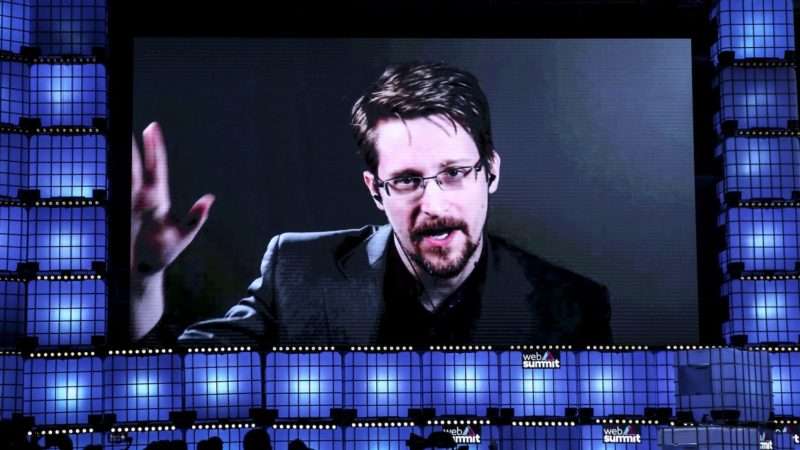
Snowden Announces Plans To Become Russian Citizen

edwardsnowdenrussia_1161x653

Surveillance whistleblower Edward Snowden is applying for Russian citizenship in preparation for his son’s birth.

Snowden and his wife, Lindsay Mills, revealed the pregnancy last week. Today, Snowden announced that he and Mills are applying for dual citizenship. He tweeted: “Lindsay and I will remain Americans, raising our son with all the values of the America we love—including the freedom to speak his mind. And I look forward to the day I can return to the States, so the whole family can be reunited.”

Snowden famously took refuge in Russia, essentially forced there to escape espionage charges from the Department of Justice under President Barack Obama. Snowden pulled the curtain back to expose the vast extent of domestic digital surveillance that the National Security Agency (NSA) had implemented after the passage of the PATRIOT Act. Internet and phone records of millions of Americans were being collected, stored, and accessed without our knowledge, all on the insistence that it would help the government catch terrorists. It did not—not that such a massive end run around the Fourth Amendment would have been acceptable if it had.

Snowden’s whistleblowing has led to attempts to reform some surveillance regulations to better protect Americans from unwarranted snooping by the feds. The NSA is supposed to be directing its surveillance to other countries, not to us.

But even though Snowden’s leaks have proven valuable information for Americans to know, he’s still being treated like a criminal. President Donald Trump flirted with pardoning Snowden, and that garnered the support of the likes of Sen. Rand Paul (R–Ky.), but on the eve of the election, there’s little sign of any actual mercy coming from the embattled incumbent.

As for Democratic presidential nominee and former Vice President Joe Biden, it was under Obama’s Justice Department that Snowden was charged. And Snowden told MSNBC in 2019 that, as veep, Biden threatened countries considering giving Snowden asylum, saying there would be “consequences” if they did. Rafael Correa, Ecuador’s former president, said in 2013 (when Snowden leaked the NSA files to the press and fled the country) that Biden called him to ask him not to grant Snowden asylum as he had previously done for WikiLeaks’ Julian Assange. There’s not much evidence that a Biden administration would grant Snowden a pardon or that Biden’s position that Snowden should stand trial has changed.

Snowden was granted permanent residency in Russia in late October. Due to recent changes in Russia’s laws, Snowden won’t have to give up citizenship as an American to become a Russian citizen. So, in the event that either Trump or Biden changes his mind and pardons Snowden, he’ll still be able to return to his home country.

from Latest – Reason.com https://ift.tt/3mPzRTd
via IFTTT

Supreme Court Sends DeRay Mckesson Black Lives Matter Protest Case Down to the Louisiana Supreme Court

From today’s unsigned (per curiam) Supreme Court 7-1opinion in McKesson v. Doe (Justice Thomas dissented without opinion, and Justice Barrett didn’t participate):

Petitioner DeRay Mckesson organized a demonstration in Baton Rouge, Louisiana, to protest a shooting by a local police officer. The protesters, allegedly at Mckesson’s direction, occupied the highway in front of the police headquarters. As officers began making arrests to clear the highway, an unknown individual threw a “piece of concrete or a similar rock-like object,” striking respondent Officer Doe in the face. Officer Doe suffered devastating injuries in the line of duty, including loss of teeth and brain trauma.

Though the culprit remains unidentified, Officer Doe sought to recover damages from Mckesson on the theory that he negligently staged the protest in a manner that caused the assault… [T]he Fifth Circuit … panel majority held that a jury could plausibly find that Mckesson breached his “duty not to negligently precipitate the crime of a third party” because “a violent confrontation with a police officer was a foreseeable effect of negligently directing a protest” onto the highway…. The panel majority also rejected Mckesson’s argument that NAACP v. Claiborne Hardware Co. (1982), forbids liability for speech-related activity that negligently causes a violent act unless the defendant specifically intended that the violent act would result. [The panel dissent, and the dissent from the denial of petition for rehearing en banc, disagreed. -EV] …

The question presented for our review is whether the theory of personal liability adopted by the Fifth Circuit violates the First Amendment. When violence occurs during activity protected by the First Amendment, that provision mandates “precision of regulation” with respect to “the grounds that may give rise to damages liability” as well as “the persons who may be held accountable for those damages.” Claiborne Hardware. Mckesson contends that his role in leading the protest onto the highway, even if negligent and punishable as a misdemeanor, cannot make him personally liable for the violent act of an individual whose only association with him was attendance at the protest.

We think that the Fifth Circuit’s interpretation of state law is too uncertain a premise on which to address the question presented. The constitutional issue, though undeniably important, is implicated only if Louisiana law permits recovery under these circumstances in the first place. The dispute thus could be “greatly simplifie[d]” by guidance from the Louisiana Supreme Court on the meaning of Louisiana law.

Fortunately, the Rules of the Louisiana Supreme Court … specify that the federal courts of appeals may certify dispositive questions of Louisiana law on their own accord or on motion of a party.  Certification is by no means “obligatory” merely because state law is unsettled; the choice instead rests “in the sound discretion of the federal court.” Federal courts have only rarely resorted to state certification procedures, which can prolong the dispute and increase the expenses  incurred  by   the  parties. Our system of “cooperative judicial federalism” presumes federal and state courts alike are competent to apply federal and state law.

In exceptional instances, however, certification is advisable before addressing a constitutional issue. Two aspects of this case, taken together, persuade us that the Court of Appeals should have certified to the Louisiana Supreme Court the questions (1) whether Mckesson could have breached a duty of care in organizing and leading the protest and (2) whether Officer Doe has alleged a particular risk within the scope of protection afforded by the duty, provided one exists.

First, the dispute presents novel issues of state law peculiarly calling for the exercise of judgment by the state courts. To impose a duty under Louisiana law, courts must consider “various moral, social, and economic factors,” among them “the fairness of imposing liability,” “the historical development of precedent,” and “the direction in which society and its institutions are evolving.” “Speculation by a federal court about” how a state court would weigh, for instance, the moral value of protest against the economic consequences of withholding liability “is particularly gratuitous when the state courts stand willing to address questions of state law on certification.”

Second, certification would ensure that any conflict in this case between state law and the First Amendment is not purely hypothetical. The novelty of the claim at issue here only underscores that “[w]arnings against premature adjudication of constitutional questions bear heightened attention when a federal court is asked to invalidate a State’s law.” The Louisiana Supreme Court, to be sure, may announce the same duty as the Fifth Circuit. But under the unusual circumstances we confront here, we conclude that the Fifth Circuit should not have ventured into so uncertain an area of tort law—one laden with value judgments and fraught with implications for First Amendment rights—without first seeking guidance on potentially controlling Louisiana law from the Louisiana Supreme Court….

I do think that the Louisiana Supreme Court might well conclude that there would be no liability here under state law, for reasons I discussed when the Fifth Circuit decision was handed down:

[1.] It seems to me that the Fifth Circuit’s general negligence theory is plausible: The claim is that Mckesson’s actions (and not just inaction) indirectly and foreseeably caused the injury to Doe—he organized a protest that illegally went into the highway, which foreseeably led to the police enforcing the law by clearing the highway, which foreseeably read to a physical attack on Doe.

As I wrote before, say that John Smith organizes an illegal protest in an abortion clinic’s parking lot—illegal because it’s a trespass (analogously to how Mckesson’s protest was, according to the Fifth Circuit, plausibly pleaded to be an illegal blocking of a public street). Unsurprisingly, and thus foreseeably, some clinic employees come out to try to get the protesters to leave, and even use lawful defensive force (pushing) to eject the protesters. Unsurprisingly, and thus equally foreseeably, one of the protesters (Mary Baker) punches the employee who is pushing him. (Indeed, perhaps this has happened before at this group’s protests, so it is indeed foreseeable.)

Would Smith be liable under normal tort law negligence principles for the injury to the employee? Yes, I think so. By organizing the protest, he caused a foreseeable risk that an employee will be injured. And because the protest involved trespass, it’s pretty likely that this would be viewed as unreasonable conduct.

(This is not just on the so-called “negligence per se” theory, under which criminal conduct is treated as automatically negligent; that theory isn’t recognized in Louisiana, and in any event might not apply here. Rather, it’s because of broader unreasonableness principles: It’s unreasonable to violate the law in a way that puts third parties in a position where they have to lawfully use force to defend their or others’ rights against the crimes your followers are committing, and where they therefore risk injury from other foreseeable crimes.)

Nor does it matter that the injury comes from a third party (here, Baker), so long as the third party’s conduct is foreseeable. As the Restatement (Second) of Torts put it,

An act or an omission may be negligent if the actor realizes or should realize that it involves an unreasonable risk of harm to another through the conduct of the other or a third person which is intended to cause harm, even though such conduct is criminal.

This is particularly so when “the actor acts with knowledge of peculiar conditions which create a high degree of risk of intentional misconduct,” for instance (continuing from the Restatement),

The employees of the A Railroad are on strike. They or their sympathizers have torn up tracks, misplaced switches, and otherwise attempted to wreck trains. A fails to guard its switches, and runs a train, which is derailed by an unguarded switch intentionally thrown by strikers for the purpose of wrecking the train…. C, a traveler upon an adjacent highway, [is] injured by the wreck. A Company may be found to be negligent toward … C.

Note that this is not an affirmative duty to protect third parties from crimes as such: That is generally imposed only when there is a “special relationship” between the plaintiff and the defendant, for instance when the defendant is a commercial property owner and the plaintiff is a customer. I don’t have a duty to protect you from being attacked on the street, even if I’m nearby and can easily save you (or at least call the police to save you).

Rather, this is a duty not to unreasonably create a risk of crime (or increase such a risk). In the Restatement example, the railroad is affirmatively running a train on a track that it knows can be easily and foreseeably sabotaged. This affirmative act, which creates “an unreasonable risk of harm to another through the conduct of … a third person which is intended to cause harm, even though such conduct is criminal,” is what makes the railroad potentially liable. Or, to give an example from a famous 1918 case, which held a railroad liable when its train had struck a wagon and injured the driver, thus also leading bystanders to steal the contents of the wagon:

The negligence which caused the collision resulted immediately in such a condition of the driver of the wagon that he was no longer able to protect his employer’s property; the natural and probable result of his enforced abandonment of it in the street of a large city was its disappearance; and the wrongdoer cannot escape making reparation for the loss caused by depriving the plaintiff of the protection which the presence of the driver in his right senses would have afforded….

“The act of a third person … contributing a condition necessary to the injurious effect of the original negligence, will not excuse the first wrongdoer, if such act ought to have been foreseen.”

Of course, there is then the question whether the First Amendment should preempt this standard negligence rule when the defendant’s (Smith’s or Mckesson’s) conduct, though unlawful, nonetheless involves organizing a political protest. I think the answer is complicated, for reasons I discuss here.

[2.] But I think the Louisiana Supreme Court can and should avoid all this because of a well-established limit on negligence liability:  police officers generally can’t sue for negligence over on-the-job injuries. This used be called the “fireman’s rule” and is still often called the “firefighter’s rule,” but it also covers police officers. Louisiana law calls it the “Professional Rescuer’s Doctrine“:

[A] professional rescuer, such as a fireman or a policeman, who is injured in the performance of his duties, “assumes the risk” of such an injury and is not entitled to damages … [when the] risks arise from the very emergency that the professional rescuer was hired to remedy. The assumption rationale bars recovery from most [such] risks except when (1) the … risks encountered by the professional rescuer are so extraordinary that it cannot be said that the parties intended the rescuers to assume them, or (2) the conduct of the defendant [is] so blameworthy that tort recovery should be imposed for the purposes of punishment or deterrence.

Police officers are hired to protect others from criminal activities, are expected to effect arrests as part of their duties, and could expect a criminal to resist arrest. Accordingly, the risk of being injured while carrying out an arrest is a … [risk] arising out of the specific problem which the police officer was hired to remedy. Therefore, in order for a police officer to recover for injuries received while attempting to arrest a criminal who is resisting, the risk created by the arrestee’s conduct must either be so extraordinary that it cannot be said that the parties intended the police officer to assume them, or the conduct of the arrestee in resisting must be so blameworthy that tort recovery should be imposed for purposes of punishment or deterrence.

In the case I’m quoting, the Louisiana Court of Appeals applied this reasoning to conclude that a police officer couldn’t recover damages from a drunk arrestee who injured the officer (apparently accidentally) while the officer was handcuffing him. But the underlying doctrine applies more broadly, to all sorts of ways that police officers or firefighters can get injured.

Under this doctrine, Mckesson should win easily: The police officers were acting in the line of duty, dealing with the very sorts of risks they were hired to deal with; the risks were certainly not “extraordinary.” Mckesson’s conduct, according to Doe’s theory, was negligent, so it wasn’t especially “blameworthy” (the way the rock-thrower’s conduct may have been). Clear result under Louisiana law (which is consistent with the dominant tort law view throughout the country).

You can search in vain through the Fifth Circuit opinion for any discussion of the professional rescuer’s doctrine or the firefighter’s rule—because, as best I can tell, you can search in vain through the briefing before the Fifth Circuit or in the District Court for any such discussion. For whatever reason, Mckesson’s lawyers didn’t raise the argument, and, unsurprisingly, the courts didn’t consider it.

It may well be that the Louisiana Supreme Court would therefore also not consider the professional rescuer’s doctrine, on the ground that the failure to raised it waived the argument. But now that the U.S. Supreme Court has sent down the case, precisely to determine whether Louisiana state law provides some way to avoid a thorny First Amendment question, I think the state court could and probably should bring this up (perhaps, if necessary, after ordering the parties to brief the question). The important legal issue raised in this case shouldn’t be litigated in a highly artificial posture that ignores a major legal principle—and a legal principle that could avoid a possible First Amendment violation.

from Latest – Reason.com https://ift.tt/34ORz33
via IFTTT

Two Major Mall Landlords File Bankruptcy Amid Retail “Carnage”

Two Major Mall Landlords File Bankruptcy Amid Retail “Carnage”

Tyler Durden

Mon, 11/02/2020 – 13:10

While the Wall Street crowd has since moved on from shorting malls, aka the “Big Short 2.0”, in some distinct cases with massive profits, to shorting hotels which as we first presented here earlier this year has emerged as the “Big Short 3.0” trade, this weekend we got a vivid reminder of what Bloomberg dubbed “carnage” among mall tenants when two major mall landlords filed for bankruptcy this weekend, following their constantly growing list of bankrupt clients into Chapter 11 protection.

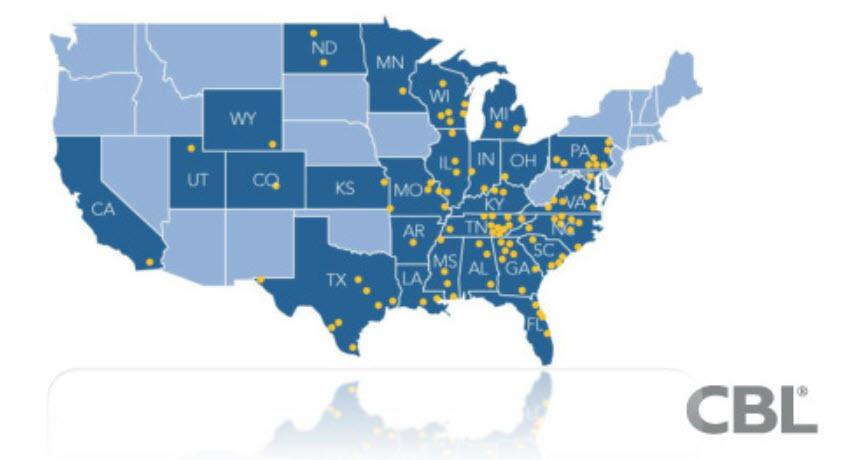
Two mall REITs, Pennsylvania Real Estate Investment Trust and CBL & Associates Properties filed for Chapter 11 protection on Sunday, citing pandemic-induced pressures on their tenants and, by implication, themselves. Together the two REITs account for 87 million square feet of real estate across the U.S., according to court filings.

CBL, based in Chattanooga, counts 107 properties in 26 states in its portfolio, including enclosed malls, outlets and open-air retail centers…

… while Philadelphia-based PREIT owns malls in Pennsylvania, New Jersey, Virginia, Maryland and Michigan, according to its website.

While the brick and mortar retail “apocalypse” was already a fixture of the US economy ahead of the covid pandemic thanks to the destructive effect of Amazon on legacy retailers, the pandemic worsened the already dire situation as a steady stream of chains imploded as their customers shifted to online shopping. J.C. Penney, J. Crew and Ann Taylor are among the dozens of chains that have sought court protection since Covid-19 lockdowns devastated in-store shopping this year.

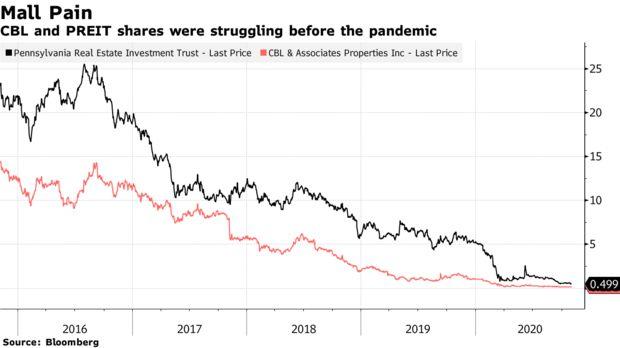
In the end, for mall landlords like PREIT and CBL, which own less productive malls than rivals such as Simon Property Group and Macerich according to Bloomberg Intelligence analyst Lindsay Dutch, this hurdle proved insurmountable, although judging by their stock price, their collapse was hardly a surprise.

“There’s too much retail real estate in the U.S.,” said Dutch, a REIT equity analyst. “Retailers continue to reduce their store footprints, and while brick and mortar is here to stay, the focus is on high-quality locations.”

According to the Bloomberg analyst, many of their properties are known in the industry parlance as B-class malls, which bring in fewer sales per square foot than their better-placed peers. They may be located outside major metropolitan areas or upscale regions, making them vulnerable as middle-class customers struggle to make ends meet, and they were hit hard by the pullback of anchor stores like J.C. Penney and Sears.

And while shareholders face total loss, the good news for employees is that some may keep their jobs: the mall owners obtained pre-petition support of creditors for restructuring plans prior to their bankruptcy filings, shortening their trips through bankruptcy. PREIT’s plan would, pending court approval, push out debt maturities and bring in $150 million of additional capital. CBL’s plan would slash debt by $1.5 billion and also extend certain maturities, according to Bloomberg.

via ZeroHedge News https://ift.tt/3mRpIpr Tyler Durden

The Execution Of Americans’ Free Speech

The Execution Of Americans’ Free Speech

Tyler Durden

Mon, 11/02/2020 – 12:55

Authored by Ben Garrison via GrrrGraphics.com,

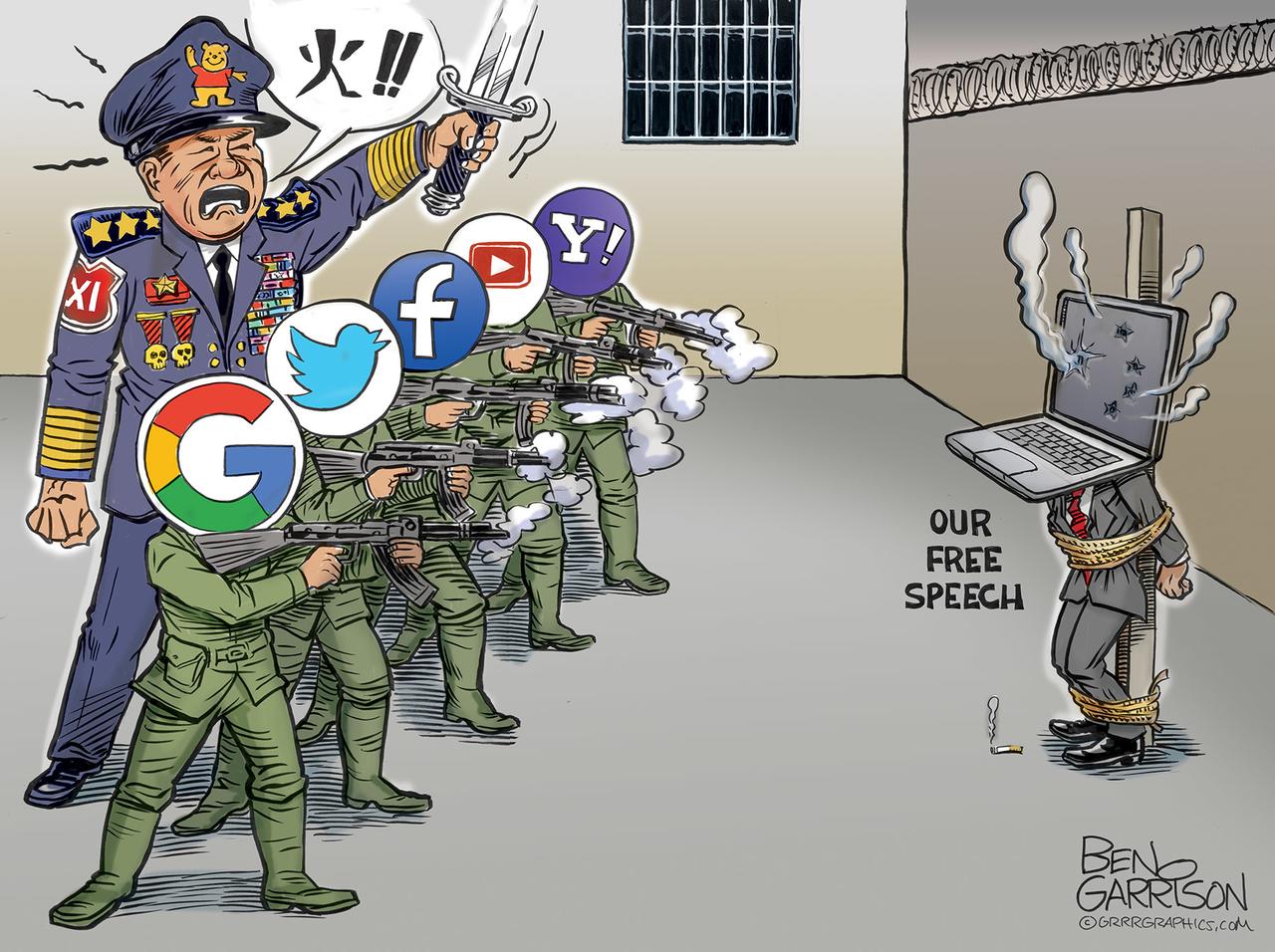
FIRE!

The Silicon Valley billionaires who control social media want to control our free speech. Not all of it…we are still free to talk about our pets, our favorite drink or restaurant, or post pictures of our vacations.

We simply can’t post anti-Deep State views about politics. We especially can’t question the medical tyrants who own and control ‘science.’ We could get banned for that! Questioning state authority could lead to a gulag for Chinese citizens. American citizens get warned, banned, or deleted. The Silicon Valley billionaires are part of the Deep State and we aren’t allowed to criticize their state. They are in alignment with Communist China, whom they admire. They all want a social credit system and a cashless society in order to bring more power and control.

I got my first rude awakening about censorship when I wrote an email to a friend in Germany. I was using Yahoo mail as a backup. For many years I traded occasional emails about classical music and culture with him. This time I typed an email concerning the corona virus and I expressed some doubt about what our ‘authorities’ had been asserting. I sent the email and a few minutes later it got kicked back to me by Yahoo. They said my mail had been censored for spreading ‘misinformation.’ That’s hard core censorship. It was as if the Post Office had opened my private mail, and returned it as undeliverable because the post master didn’t agree with my opinion. Shortly thereafter, Yahoo banned all commentary to their news stories. I often skipped their biased stories and went straight to the comments. Most of the commenters were onto the bias. So what did Yahoo do? They simply shut everyone up.

Since then, such censorship has become commonplace and growing steadily worse. Americans have not sufficiently pushed back. Many simply accept getting silenced as a new reality. Our Fourth Amendment has been obliterated and now the First Amendment has been under assault. We are no longer allowed to assemble unless we are socialist protestors. Mandatory vaccines are on the horizon. If we speak out against it, we’ll be censored. Joe Biden is owned by China, but our watchdog media has stood down. Not only aren’t they investigating Joe’s obvious corruption, they’re helping ban those who do. Adam Schiff says it’s all Russian propaganda. How long will the Deep State keep resorting to that canard? It doesn’t matter if we believe it or not, as long as we are rendered quiescent as they murder our free speech.

Welcome to the United States of Communist China.

*  *  *

Ben Garrison Original Cartoon- Now Available, Reserve your Original Today- Click to view

Join Us on Subscribe Star, a free speech alternative to Patreon- Support Cartoons see New Cartoons Early before Public release! 

via ZeroHedge News https://ift.tt/2HNuHsn Tyler Durden

The Execution Of Americans’ Free Speech

The Execution Of Americans’ Free Speech

Tyler Durden

Mon, 11/02/2020 – 12:55

Authored by Ben Garrison via GrrrGraphics.com,

FIRE!

The Silicon Valley billionaires who control social media want to control our free speech. Not all of it…we are still free to talk about our pets, our favorite drink or restaurant, or post pictures of our vacations.

We simply can’t post anti-Deep State views about politics. We especially can’t question the medical tyrants who own and control ‘science.’ We could get banned for that! Questioning state authority could lead to a gulag for Chinese citizens. American citizens get warned, banned, or deleted. The Silicon Valley billionaires are part of the Deep State and we aren’t allowed to criticize their state. They are in alignment with Communist China, whom they admire. They all want a social credit system and a cashless society in order to bring more power and control.

I got my first rude awakening about censorship when I wrote an email to a friend in Germany. I was using Yahoo mail as a backup. For many years I traded occasional emails about classical music and culture with him. This time I typed an email concerning the corona virus and I expressed some doubt about what our ‘authorities’ had been asserting. I sent the email and a few minutes later it got kicked back to me by Yahoo. They said my mail had been censored for spreading ‘misinformation.’ That’s hard core censorship. It was as if the Post Office had opened my private mail, and returned it as undeliverable because the post master didn’t agree with my opinion. Shortly thereafter, Yahoo banned all commentary to their news stories. I often skipped their biased stories and went straight to the comments. Most of the commenters were onto the bias. So what did Yahoo do? They simply shut everyone up.

Since then, such censorship has become commonplace and growing steadily worse. Americans have not sufficiently pushed back. Many simply accept getting silenced as a new reality. Our Fourth Amendment has been obliterated and now the First Amendment has been under assault. We are no longer allowed to assemble unless we are socialist protestors. Mandatory vaccines are on the horizon. If we speak out against it, we’ll be censored. Joe Biden is owned by China, but our watchdog media has stood down. Not only aren’t they investigating Joe’s obvious corruption, they’re helping ban those who do. Adam Schiff says it’s all Russian propaganda. How long will the Deep State keep resorting to that canard? It doesn’t matter if we believe it or not, as long as we are rendered quiescent as they murder our free speech.

Welcome to the United States of Communist China.

*  *  *

Ben Garrison Original Cartoon- Now Available, Reserve your Original Today- Click to view

Join Us on Subscribe Star, a free speech alternative to Patreon- Support Cartoons see New Cartoons Early before Public release! 

via ZeroHedge News https://ift.tt/2HNuHsn Tyler Durden

Snowden Announces Plans To Become Russian Citizen

edwardsnowdenrussia_1161x653

Surveillance whistleblower Edward Snowden is applying for Russian citizenship in preparation for his son’s birth.

Snowden and his wife, Lindsay Mills, revealed the pregnancy last week. Today, Snowden announced that he and Mills are applying for dual citizenship. He tweeted: “Lindsay and I will remain Americans, raising our son with all the values of the America we love—including the freedom to speak his mind. And I look forward to the day I can return to the States, so the whole family can be reunited.”

Snowden famously took refuge in Russia, essentially forced there to escape espionage charges from the Department of Justice under President Barack Obama. Snowden pulled the curtain back to expose the vast extent of domestic digital surveillance that the National Security Agency (NSA) had implemented after the passage of the PATRIOT Act. Internet and phone records of millions of Americans were being collected, stored, and accessed without our knowledge, all on the insistence that it would help the government catch terrorists. It did not—not that such a massive end run around the Fourth Amendment would have been acceptable if it had.

Snowden’s whistleblowing has led to attempts to reform some surveillance regulations to better protect Americans from unwarranted snooping by the feds. The NSA is supposed to be directing its surveillance to other countries, not to us.

But even though Snowden’s leaks have proven valuable information for Americans to know, he’s still being treated like a criminal. President Donald Trump flirted with pardoning Snowden, and that garnered the support of the likes of Sen. Rand Paul (R–Ky.), but on the eve of the election, there’s little sign of any actual mercy coming from the embattled incumbent.

As for Democratic presidential nominee and former Vice President Joe Biden, it was under Obama’s Justice Department that Snowden was charged. And Snowden told MSNBC in 2019 that, as veep, Biden threatened countries considering giving Snowden asylum, saying there would be “consequences” if they did. Rafael Correa, Ecuador’s former president, said in 2013 (when Snowden leaked the NSA files to the press and fled the country) that Biden called him to ask him not to grant Snowden asylum as he had previously done for WikiLeaks’ Julian Assange. There’s not much evidence that a Biden administration would grant Snowden a pardon or that Biden’s position that Snowden should stand trial has changed.

Snowden was granted permanent residency in Russia in late October. Due to recent changes in Russia’s laws, Snowden won’t have to give up citizenship as an American to become a Russian citizen. So, in the event that either Trump or Biden changes his mind and pardons Snowden, he’ll still be able to return to his home country.

from Latest – Reason.com https://ift.tt/3mPzRTd
via IFTTT

Nasdaq Tumbles Into Red, Erases Overnight Gains, Bonds Bid

Nasdaq Tumbles Into Red, Erases Overnight Gains, Bonds Bid

Tyler Durden

Mon, 11/02/2020 – 12:47

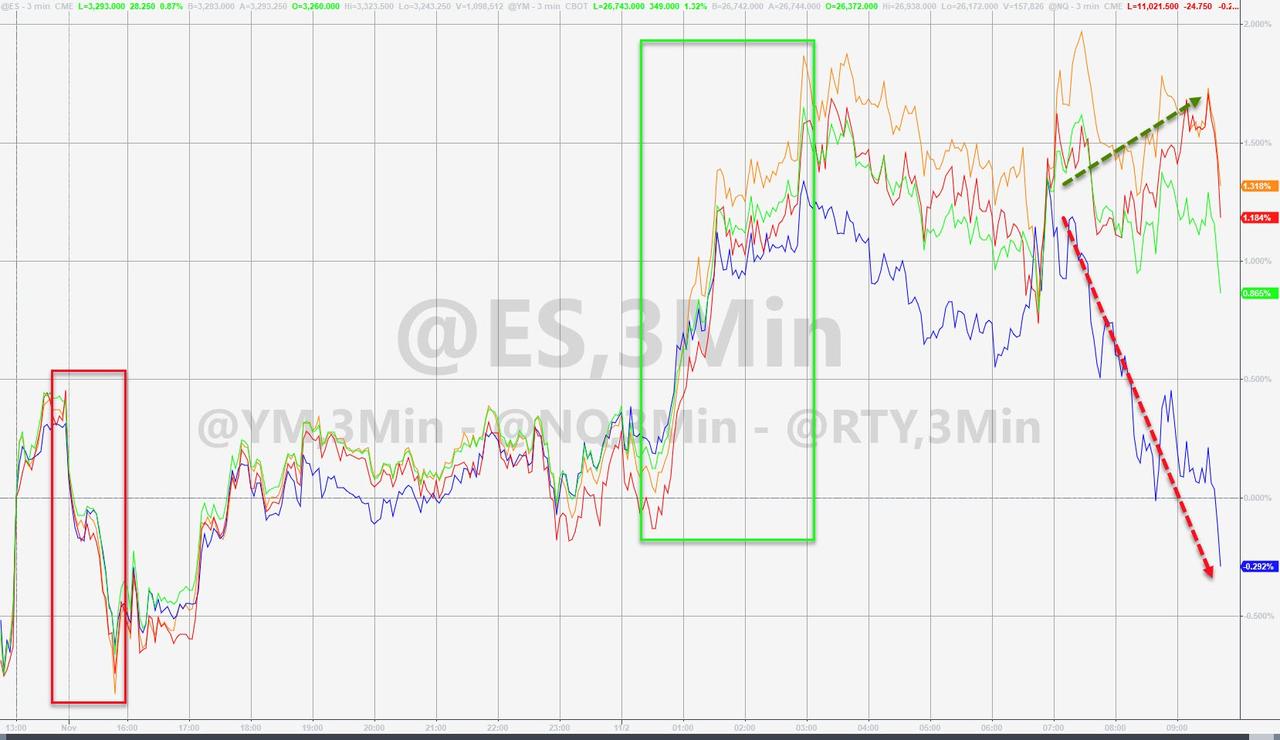
A lack of comprehension at the overnight panic-bid has been complemented by a lack of comprehension for the down-draft in Nasdaq since the US equity market opened.

Small Caps were outperforming out of the gate relative to mega-cap tech but the entire market is rolling over now…

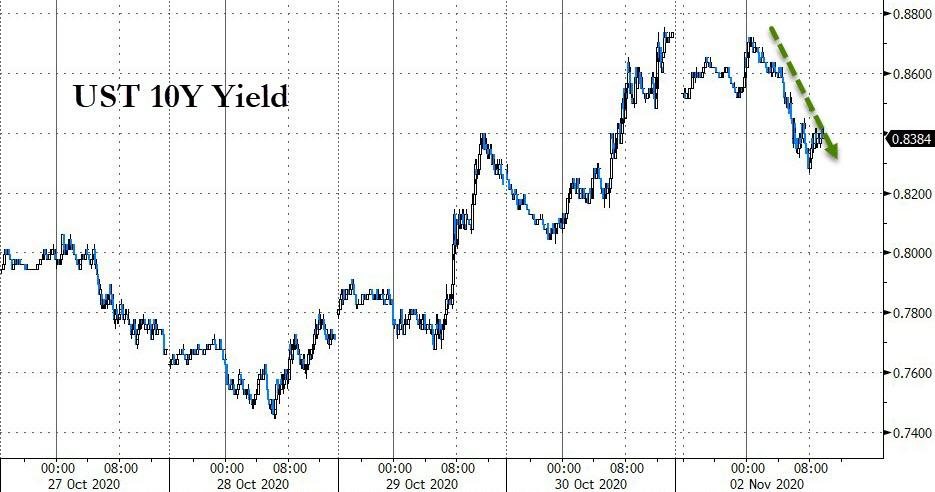
Bonds were bid all night, ignoring equity’s exuberance…

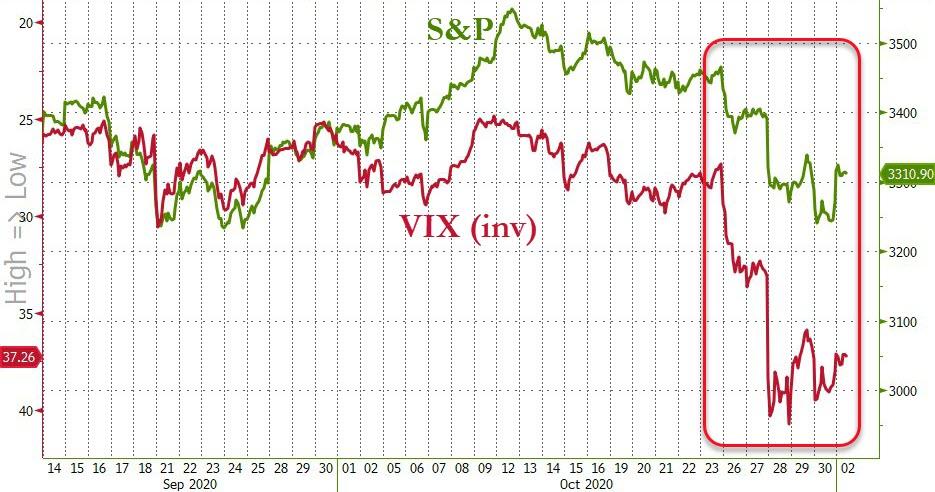
With vol so high, it should be no surprise that stocks are fading the uncertainty…

via ZeroHedge News https://ift.tt/34UGAFH Tyler Durden

3 Reasons Why There Really Is No Housing Shortage

3 Reasons Why There Really Is No Housing Shortage

Tyler Durden

Mon, 11/02/2020 – 12:30

Authored by Lance Roberts via RealInvestmentAdvice.com,

One of the most recent mantras in the financial media is that housing prices rise because there is an inventory shortage. While it is an excellent headline for “getting clicks,” the are 3-reasons why there really is NO housing shortage.

A Quick Story

In 2007, as the housing market was going crazy, I lived in a quiet, gated community. I had no intention of selling my house. However, one day, a knock came at my door from a realtor who had a client willing to pay me much more than I ever imagined for the house.

I sold the next day.

Then, In October of 2008, I bought a house from a distressed seller relocated back to England. It was the “perfect” house, next to a prime school my kids could walk to, and extremely convenient to everything. It was my “forever” house.

In 2015, I received a knock at my door from a realtor representing a client moving from Montana to work for an oil and gas company. I guess he was “The Godfather” because he “made me an offer I could not refuse.”

I sold the next day.

The moral of the story is that “supply” is only a function of “price.” My homes were never “part” of the calculated inventory because they were never listed. However, they did become part of the “supply” when the “demand” fostered the right price.

Everyone will sell at a certain price. Supply is never a problem as long as prices rise and mortgage rates are accommodative.

However, therein lies “the rest of the story.”

The Myth Of A Supply Problem

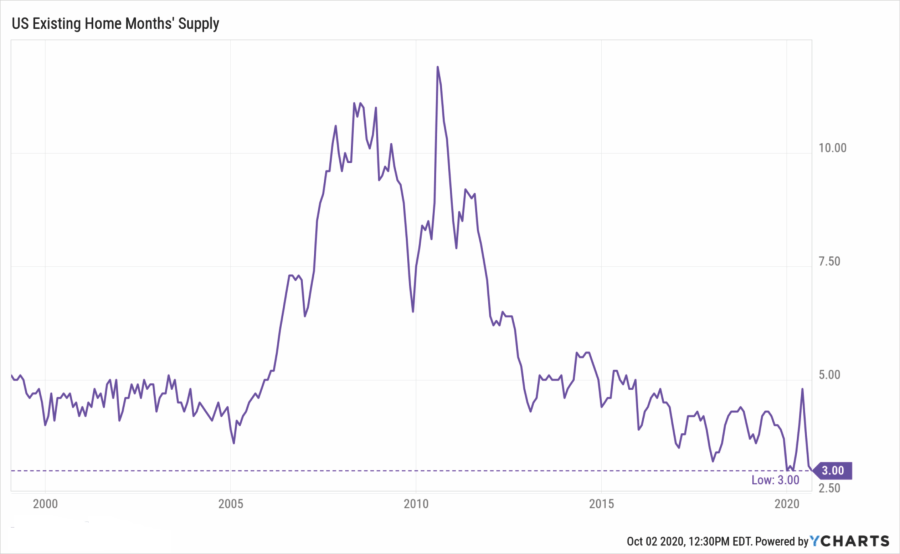
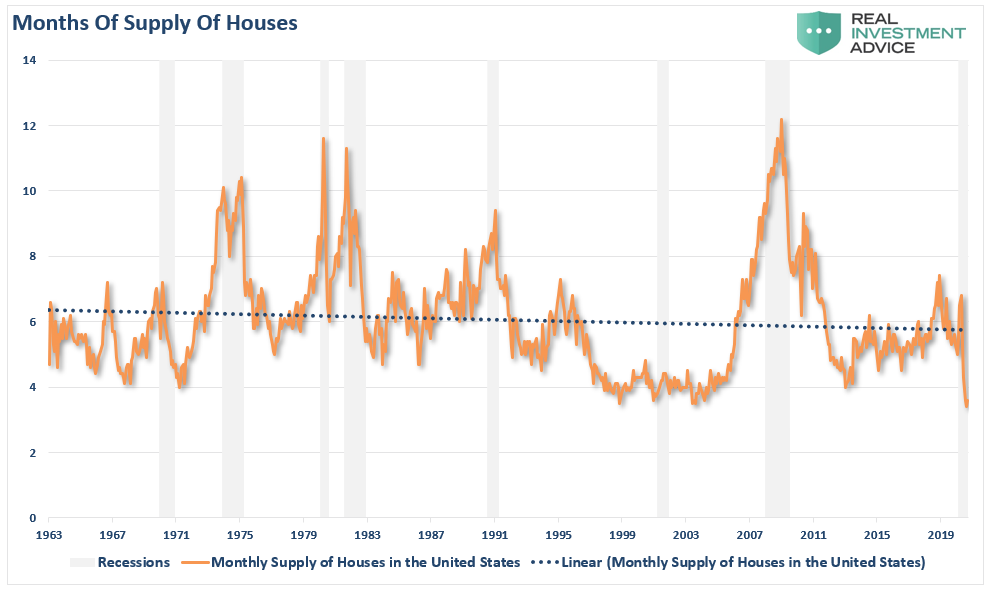
The “inventory shortage” argument comes from the following chart: the “months of supply” of homes. At just 3-months of supply, you can understand why the media believes there is a shortage. However, that is NOT what the chart is detailing.

The chart only tells us that if NO more homes come to market at the current transaction rate, all homes currently for sale will get sold in 3-months. Such also assumes the current demand for homes remains the same.

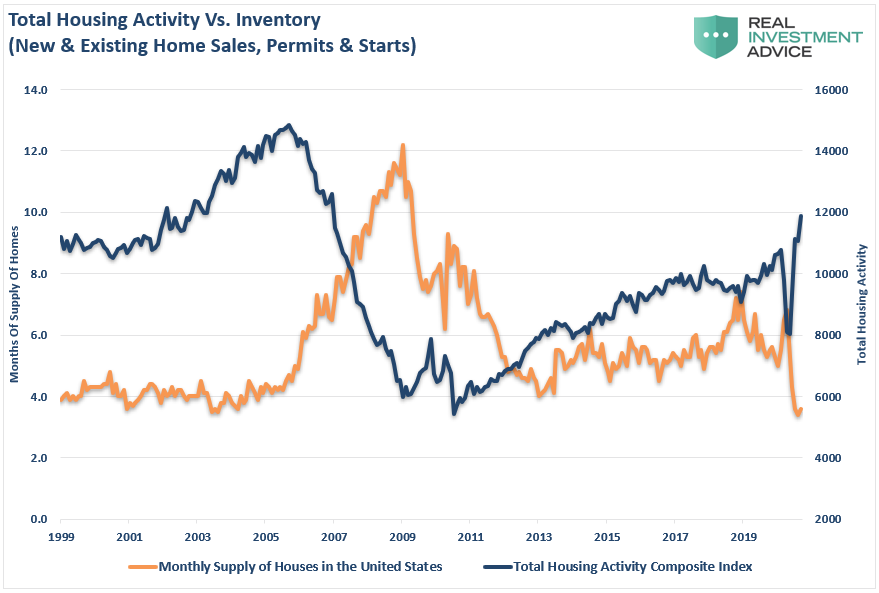
Now, take a look at 2005.

The same “housing shortage” story existed then. Almost overnight, the real estate market went from a shortage of inventory to excess. 

Were a massive number of homes built almost overnight? Of course not.

So what happened?

At The Margin

The problem with the mainstream analysis is the inability to interpret data correctly. When it comes to data based on the housing market’s transactional side, it only represents what is happening at the “margin” of the entire housing market. The economic importance of housing is more than just the relatively few individuals compared to the total population, who are actively seeking to buy, rent, or sell a home each month.

Let’s go back to that earlier question of what happened in 2005?

There are three primary issues which lead to changes in the supply of housing:

  1. Prices rise to the point that sellers come into the market.

  2. Interest rates rise, pulling buyers out of the market.

  3. An economic recession which removes buyers due to job loss.

When any of those things occur, transactions slow down, and “inventory” rises sharply.

Price Increases For Some, Not Most

Let’s start with housing prices.

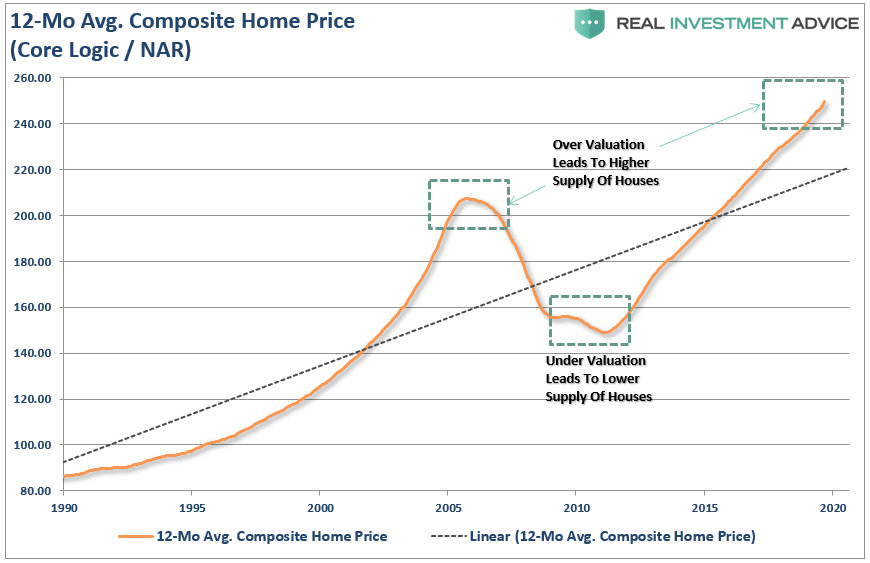
The chart below is the composite index of the NAR and Corelogic home prices over time.

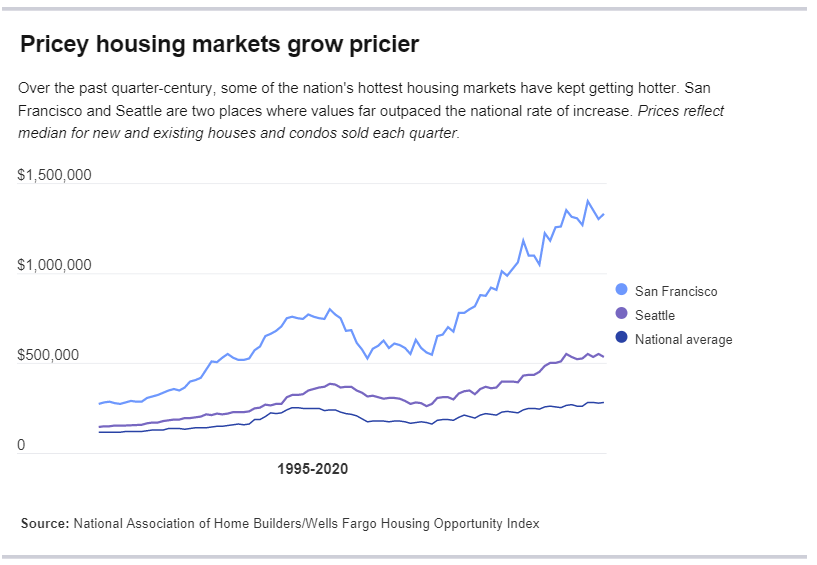
As stated, when prices of homes become inflated, individuals who weren’t previously considering selling will list their homes.

Yes, elevated prices exist but only in a small fraction of the country. While there is undoubtedly a “shortage of inventory” in those few markets, prices increases nationally are a far different story, as shown below.

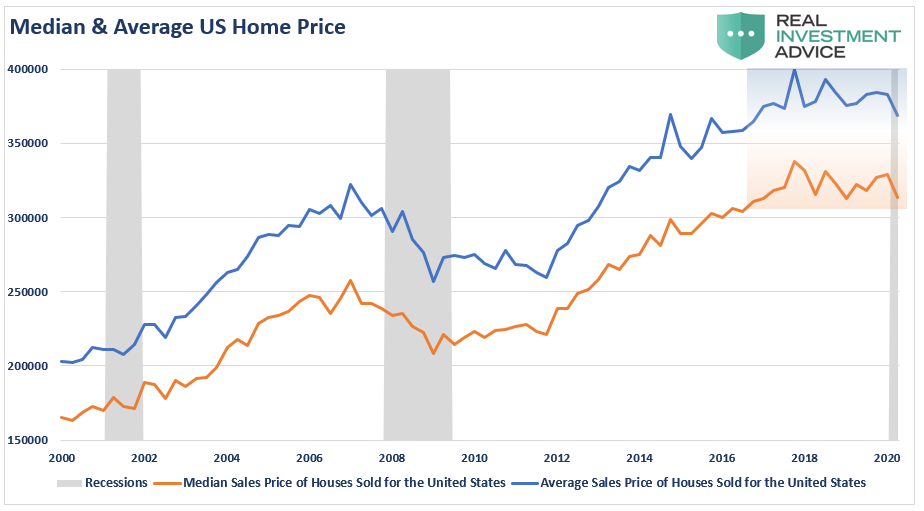
When we look at the median and average home prices nationally, a very different picture emerges.

Given the vast majority of homeowners have not seen prices increase to a great degree since 2016, there is little incentive to “list homes for sale.”

People Buy Payments – Not Houses

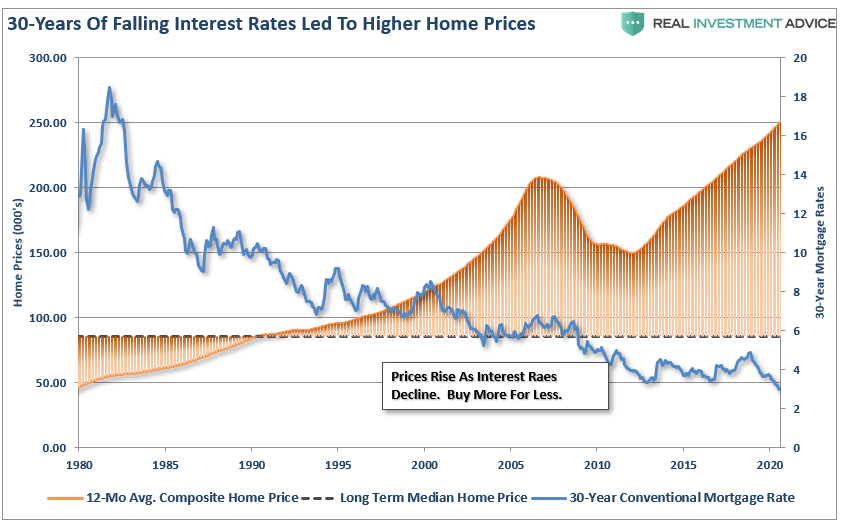
People do not buy houses – they buy a payment. The payment is what drives how much house they buy. Why is this important? Because it is all about interest rates.

Over the last 30-years, a significant driver of home prices has been the unabated decline of interest rates. When declining interest rates collided with lax lending standards – home prices soared off the chart. No money down, ultra-low interest rates, and easy qualification gave individuals the ability to buy much more home for their money.

As shown, home prices have remained well above the long-term median price since the late 1990s. Low-interest rates and lax lending standards only supported those prices.

It’s Not The Millennials

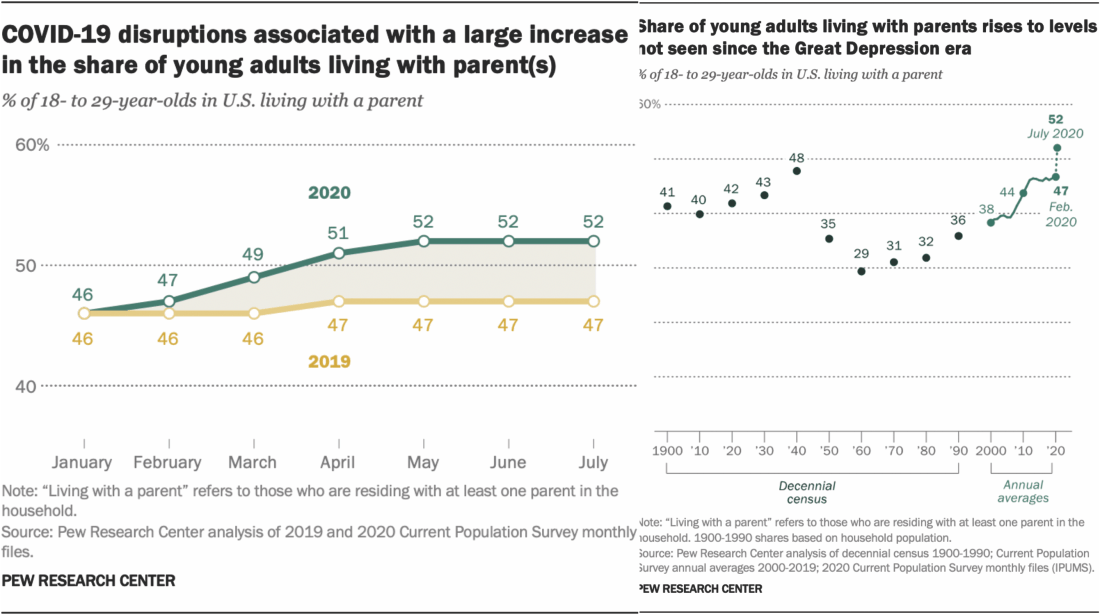
As noted, the current surging prices and home sales reside in only a select few cities on a national basis. The hope has been that “Millennials” were finally coming of age and buying homes. As noted by Pew Research, such is hardly the case.

“In July, 52% of young adults resided with one or both of their parents, up from 47% in February. The number living with parents grew to 26.6 million, an increase of 2.6 million from February.”

“The share of young adults living with their parents is higher than in any previous measurement (based on current surveys and decennial censuses). Before 2020, the highest measured value was in the 1940 census at the end of the Great Depression, when 48% of young adults lived with their parents. The peak may have been higher during the worst of the Great Depression in the 1930s, but there is no data for that period.” – PEW

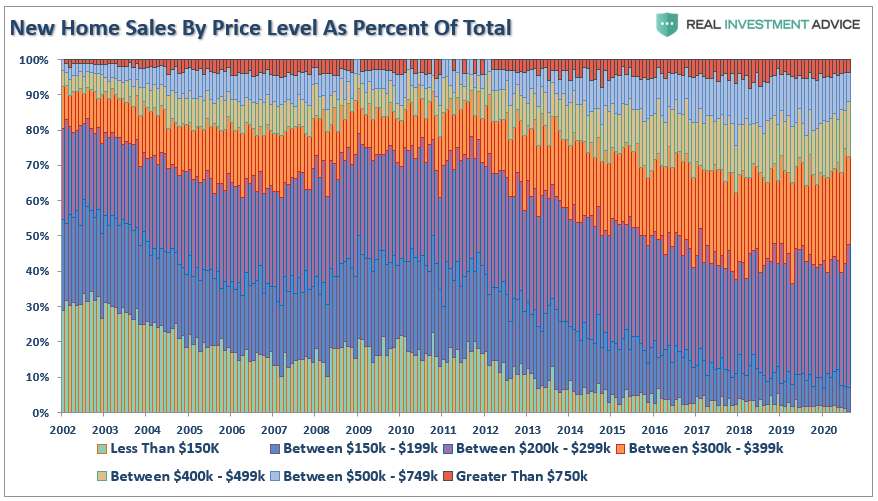
Such is why, on a national basis, there isn’t a massive demand for housing, except in the few major cities noted above. “New home” sales also tell us much the same. Higher priced homes seeing the most activity are between $200,000 and $500,000. While a $400,000 home is not a “starter home” in Texas, it may well be in California. There have been ZERO sales below $150,000.

The problem for “Millennials” is low mortgage rates supporting the purchase of higher-priced homes with reduced monthly payments. Unfortunately, for many, a mortgage requires nearly perfect credit and steady income. With mortgage credit availability tightening as banks react to the recession, the pool of buyers is shrinking rapidly.

Recessions Increase Supply

Not surprisingly, recessions have a nasty habit of rapidly increasing the housing supply. As job losses mount, the available pool of buyers who can afford to buy a home sharply contracts. Given that “housing inventory” is a function of buyers versus the number of houses for sale, the numerator’s reduction matters much.

As shown in the long-term chart of housing inventory, recessions matter when it comes to inventory levels. The long-term linear trend of “supply” has remained at about 6-months on average since 1963.

The Return Of Supply

The current plunge in “available inventory” is not actually about the size of the “home buying cohort.” It says more about the current economy where a large portion of the economy is “unable” to move. When currently un- or underemployed, there is no option to “sell” their current home, as they cannot qualify to buy a “new” home.

Besides, there is plenty of supply waiting in the wings. There are a large number of homes whose mortgages are in forbearance and delinquent. If not cured, when the moratorium lifts in January, they will have to be sold. As noted by Wolf Richter

“There is lots of supply waiting in the wings, including:

  • A portion of the homes whose mortgages are in forbearance and delinquent will have to be sold to cure the delinquent mortgage.
  • Homes whose owners moved into their recently-bought new home which will end up on the market;
  • And homes owned by investors for vacation rentals which will end up on the market if vacation rentals continue to be a drag in those cities.”

As we saw in 2005, and at every period in history leading up to a recession, the surge in supply can happen suddenly.

If interest rates rise sharply, more layoffs occur, banks tighten lending standards further, or if there is just a change in buyers’ attitude, inventory will surge higher.

The other problem is if the Federal Reserve becomes concerned that they have been complicit in juicing the housing market. With their aggressive buying of Mortgage-Backed Securities, they artificially suppressed rates encouraging a wave of refinancing and purchase activity.

As Wolf concludes:

[The fed] is seeing this housing insanity, and after having already quietly mothballed its corporate bond-buying program, its repos, and its dollar liquidity swaps, it would be an unsurprising next step.”

Conclusion

As we head into 2021, potentially higher rates and continued economic weakness could collide with elevated housing prices in some areas. Such will result in the rapid reversion of “housing activity” and a surge in “supply.”

The next time you hear someone in the media saying the housing market will never go down again because of an “inventory shortage,” it may be worth questioning their view.

As with all data, it is crucial to understand the data’s calculation to derive its real meaning. The problem with most analysis by the media is they tend to extrapolate a current data point into an infinite future.

Reality rarely works that way.

via ZeroHedge News https://ift.tt/3jOsGsQ Tyler Durden