China Poised To Ban Australian Lobster, Copper & Sugar Amid Spiraling Trade Dispute Tyler Durden
Mon, 11/02/2020 – 09:45
The South China Morning Post cited multiple trade sources on Monday to say China’s customs is delaying imports of lobster from Australia, and is further expected to impose bans on Australian imports of copper ore, copper concentrate, and sugar at some point this week – at a moment relations between the two countries have hit the lowest point in decades. This after last week a ban was placed on some timber and barely shipments, commonly used in animal fodder and beer production, already partially banned since September 1.
Further Australia’s Seafood Trade Advisory Group noted that some Australian lobster shipments have been subject of increased import inspections once arriving in China, causing most exporters to temporarily halt their shipments there until more is known. Local media reports have said in at least one instance tons of premium shellfish were left on a Chinese airport tarmac.
Via Australian 7 News
Australia’s agriculture minister David Littleproud said he has “serious concerns” over reports of what appears the unnecessary excuse of inspectors checking for trace elements of minerals and metals (given it’s already tested upon leaving Australia) and questioned why such actions are being taken.
Crucially, China accounts for 94% of Australian rock lobster exports, estimated at over half a billion dollars in 2018-2019. Imports of premium shellfish only stay fresh for three days unless quickly put into holding tanks. Barley was also recently hit with tariffs while wine was subject of additional stringent import procedures.
Australia’s Trade Ministry is protesting the delays and significant rumors of further import bans, with Trade Minister Simon Birmingham urging “Chinese authorities should rule out the use of any suchdiscriminatory actions.” In the Monday statement he said that all importers must be treated equally.
This also as the government probes both China’s suspension of imports of Australian coal and possibly fiber used by Chinese cotton mills.
“So far as any industry concerns imply a breach of World Trade Organisation or China-Australia Free Trade Agreement commitments, Chinese authorities should rule out the use of any such discriminatory actions,” Birmingham said.
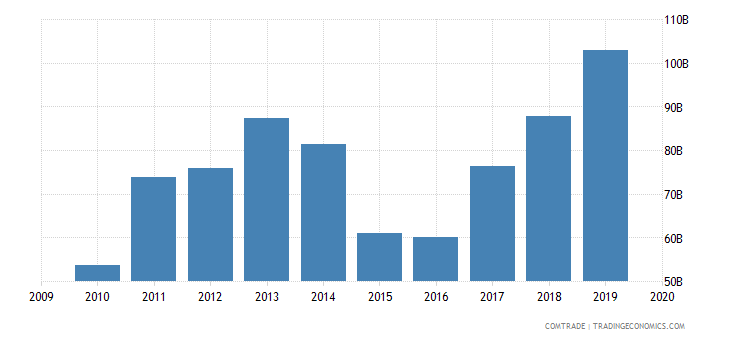
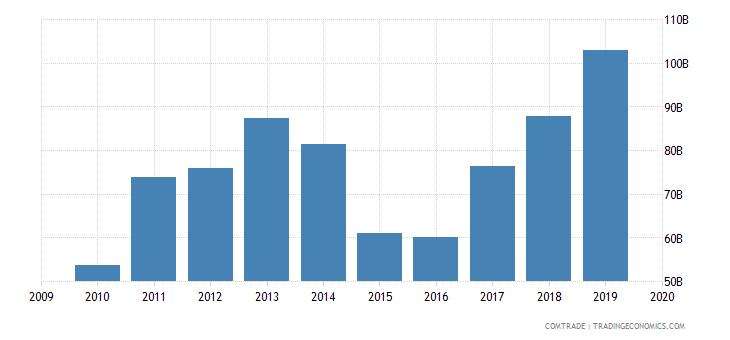
Source: Trading Economics
Via Trading Economics: Australia exports to China was US$103 Billion during 2019, according to the United Nations COMTRADE database on international trade.
Prime Minister Scott Morrison has recently slammed Australia’s biggest trading partner as practicing blatant “economic coercion” with regard to an increasing array of its exports. This following political leaders over the summer spotlighting Beijing for its role and neglect in the spread of the COVID-19 pandemic.
Things took a more intense turn when Beijing recently began discouraging tourists and students from visiting Australia, also as China detained some high profile Aussie media figures working in the country.
Prior to the pandemic, Chinese travelers made up by far the largest source of tourism for Australia, according to one industry report accounting for $12.4 billion of the $45.4 billion tourism brought into to the country each year.
via ZeroHedge News https://ift.tt/326rVVN Tyler Durden
On the one hand, all the boarded-up businesses and at-the-ready riot cops seem a bit overwrought. Americans have disagreed passionately about candidates and even presidential election results before without taking to the streets and burning shit down.
But Trump and Republicans have spent the past several months telling their supporters that voter fraud would be widespread this year, and in the past week they’ve only kicked up attempts to delegitimize election results should Democrats prove victorious. If victory is called for Joe Biden, there could be a lot of folks genuinely convinced that the results are a sham—and ready to do something about it.
Meanwhile, Biden supporters (or those who at least consider him the lesser of two evils) have seen weeks of polls and pundits telling them their guy will almost definitely win, while watching the GOP try hard to cast any scenario where Trump doesn’t win as suspect. And, according to Axios, Trump told those close to him that he will declare victory if he happens to have a lead as election night closes—all those yet-to-be-counted ballots be damned—though he has also publicly denied this.
Should anything like that happen, a lot of Americans will be justifiably irate and ready to do something about it. But with anger over Trump as intense as it is, even a seemingly legitimate victory would be likely to produce suspicion and some protests.
The White House on lockdown: A federal law enforcement source tells NBC that beginning tomorrow, crews will build a “non-scalable” fence to secure the WH complex, Ellipse and Lafayette Square.
250 National Guardsmen have been put on standby, reporting to Metro Police officials.
If history is any indication, whichever group might take to the streets on Tuesday night will be filled largely with law-abiding Americans who merely want to make their voices heard. But a minority who want to use more than just their voices can still be a seriously destructive force.
Businesses near city centers and protest hot spots aren’t crazy to take precautionary measures. What’s worrisome is the extra law enforcement cities are allegedly enlisting. If there’s one thing that can turn a boisterous-but-peaceful protest violent very quickly, it’s overzealous cops amped up on premonitions of chaos and fate-of-democracy-in-our-hands fantasies.
Faced with excessive action by authorities, even otherwise peaceful people may feel like more extreme action is justified and perhaps even helpful.
But “the first imperative of civil resistance is nonviolence—that is, maintaining the discipline not to strike out or strike back,” Judith Shulevitz reminds people at The Atlantic. And if the moral aspect isn’t enough, then think of practicality:
Nonviolence is effective for two reasons: The obvious one is that vandalism or fighting attributed to protesters, rightly or wrongly, will serve as an excuse for a crackdown. The less obvious but probably more important reason is that the ensuing chaos is sure to alienate the silent members of the public not yet sure which side to join.
In that sense, nonviolence undergirds the second rule of a winning protest strategy: It must pull in the mainstream. …. A prodemocracy movement’s most important constituencies are the institutions that keep society running: banks, businesses, the military, schools, the media, government bureaucracies, police, the judiciary.
FREE MINDS
More research disputes the conventional wisdom that the internet has led to people only consuming news that conforms to their biases. “The abundance of media options is a central feature of today’s information environment. Many accounts, often based on analysis of desktop-only news use, suggest that this increased choice leads to audience fragmentation, ideological segregation, and echo chambers with no cross-cutting exposure,” states the abstract of a new paper published in Proceedings of the National Academy of Sciences. And yet:
Contrary to many of those claims, this paper uses observational multiplatform data capturing both desktop and mobile use to demonstrate that coexposure to diverse news is on the rise, and that ideological self-selection does not explain most of that coexposure. We show that mainstream media outlets offer the common ground where ideologically diverse audiences converge online, though our analysis also reveals that more than half of the US online population consumes no online news, underlining the risk of increased information inequality driven by self-selection along lines of interest. For this study, we use an unprecedented combination of observed data from the United States comprising a 5-y time window and involving tens of thousands of panelists. Our dataset traces news consumption across different devices and unveils important differences in news diets when multiplatform or desktop-only access is used.
FREE MARKETS
Oregon will vote on lessening penalties for possession of all sorts of drugs. An initiative on the state’s 2020 ballot—Measure 110—would be a huge step forward, even if it’s not exactly the decriminalization measure many are making it out to be. If Measure 110 passes, Oregonians caught with small amounts of LSD, heroin, cocaine, and other “hard drugs” would no longer face incarceration or other harsh penalties, the Associated Press reports. But possession would still invite interaction with the cops and result in either a $100 fine or mandatory attendance at state-sponsored anti-drug classes.
“Oregon’s measure is backed by the Oregon Nurses Association, the Oregon chapter of the American College of Physicians and the Oregon Academy of Family Physicians,” A.P. notes.
ELECTION 2020
The Texas Supreme Court yesterday said no to an attempt to get nearly 127,000 ballots tossed. With no comment, the court rejected “a bid by three Republican candidates and a GOP activist to toss out almost 127,000 votes cast from drive-thru lanes in the emerging Democratic stronghold of Harris County,” reports the Austin American-Statesman. But these ballots are still in jeopardy:
A federal judge will hold an emergency hearing Monday morning — less than 21 hours before polls open on Election Day — to hear arguments on a similar challenge filed by the same group of Republicans, who say that state law prohibits drive-thru voting, so every vote cast from cars during the early voting period should be tossed out as illegal.
At the same hearing, U.S. District Judge Andrew Hanen will weigh a request by Democratic organizations and the party’s U.S. Senate candidate, MJ Hegar, to join the case in defense of drive-thru voting — and the 126,911 votes cast that way.
QUICK HITS
• Actor Johnny Depp lost his libel suit against the British tabloid that called him a “wife beater.”
“10,940 federal prisoners applied for compassionate release from March through May, stated the findings by the Marshall Project, and wardens only approved 156.” @LaurenMedlicott today https://t.co/nT9ls3tC0A
“Devastating” Hurricane Eta To Strike Nicaragua Early Tuesday Tyler Durden
Mon, 11/02/2020 – 09:29
With about a month left of the hurricane season, Tropical Storm Eta was upgraded Monday morning to a Category 1 hurricane while moving towards Central America, the U.S. National Hurricane Center (NHC) reported.
Eta is the 28th named storm and the 12th hurricane in a super active season. The hurricane could strengthen to a Category 2 or 3 before making landfall in Nicaragua on Tuesday morning.
As of Monday morning, Eta had maximum sustained winds of 90 mph, an increase of 15 mph from 75 mph in the overnight hours. The hurricane’s center was about 140 miles east of the Nicaragua-Honduras border and moving west at 10 mph.
Nicaragua and Honduras could see upwards of 25 inches of rain, life-threatening storm surge, damaging winds, and flash flooding.
According to CBS News’ David Parkinson, Eta “will jump from a Category 1 to a Category 3” before making landfall Tuesday morning as a major hurricane.
Parkinson said the hurricane would be “devastating” to Central America.
Philip Klotzbach, a research scientist at Colorado State University in Fort Collins, tweeted that only three other Atlantic hurricane seasons on record had recorded 12 hurricanes: “1969 (12 hurricanes), 2005 (15 hurricanes) and 2010 (12 hurricanes).”
#Eta is now a #hurricane – the 12th hurricane of the 2020 Atlantic hurricane season to date. Only 3 other full Atlantic hurricane seasons on record have had 12+ hurricanes: 1969 (12 hurricanes), 2005 (15 hurricanes) and 2010 (12 hurricanes). pic.twitter.com/vlALX2ZzH4
Key Events In The Coming “Huge Week” For Global Markets Tyler Durden
Mon, 11/02/2020 – 09:17
The coming week will be the busiest and most important 5 days of the year, if not decade. It is a “huge week” for investors with the election, a Fed decision, 128 S&P earnings, October payrolls, ongoing pandemic lockdowns and a ton of economic data all due.
“Whichever way you look at it, this coming week will be huge for U.S. and global markets,” said Simon Ballard, chief economist at First Abu Dhabi Bank PJSC. “We see the potential for a sharp rise in volatility around these events — and all in the context of a still deteriorating Covid-19 situation across much of the U.S., Europe and elsewhere.”
Starting with the pandemic, as DB’s Jim Reid writes this morning, Europe is facing up to a harsh winter ahead. The question to be asked to all the European countries is can they come out of these measures in some form towards the end of November/early December as is hoped or will they be extended further. The hit to the U.K. economy which just announced a new round of lockdowns will be softened by an extension of the furlough scheme but that will only add more to the debt. The hope everywhere is that well before the winter/spring peak virus season is over we’ll have the start of a vaccine program or more realistically in the near term a huge advance in rapid result testing. The latter has to be the greatest hope of restrictions being eased before a vaccine has mass rollout. Meanwhile, overnight Bloomberg reported that Italy might tighten restrictions further today with PM Conte wanting more localised curbs depending on virus transmissions – something some regional authorities are resisting.
Covid aside, of course the top event this week be tomorrow’s US election off the front pages for the next few days: 93.29 million have already voted so far, which is 67.7% of 2016’s total, and as Reid notes, “It’s fair to say markets could look very different on Wednesday morning as a “Blue Wave”, if it happens, should get the stimulus junkies hungry to buy and a divided government could remind people of the long winter ahead. So a very big week.“
While it is possible that we will not know the winner tomorrow night, due to the high number of mail-in ballots and the various state procedures around them, we will likely have some indication of how the race is leaning, according to DB. Florida and North Carolina could give a firm signal on the state of the race early on, as both have seen large numbers of early voters and are able to process and count mail-in ballots ahead of tomorrow’s poll closures. Without either of those states, President Trump’s path to re-election narrows. Polling averages continue to show a consistent lead for former Vice President Joe Biden, who is ahead by +8.5pts in the FiveThirtyEight national average, and by +7.2pts in the RealClearPolitics average. However, he leads by a lesser +3.3pt margin in RCP’s average of top battleground states. There will also be a big focus on the Senate races, with the FiveThirtyEight model giving Democrats a 76% chance to win control as we type.
Looking forward, attention will also be back on central banks for a second straight week, with both the Federal Reserve and the Bank of England announcing their latest monetary policy decisions on Thursday. Starting with the Fed, the central bank is expected to remain in a holding pattern this meeting but may lay groundwork for action at future ones. We are also likely to hear even more on the need for fiscal stimulus, as the minutes from the last meeting showed that many central bankers had included it in their outlooks. It could also be interesting to hear how the election results, if we have them, alter that outlook. For the Bank of England meeting that’s also on Thursday, our economists expect (link here) a dovish committee, with the November Monetary Policy Report highlighting further downside risks to the UK and the external growth outlook. They also see the majority of the MPC voting for additional stimulus, with £60bn added to the Bank’s Asset Purchase Facility. The latest lockdown could easily see this increased or see the probability of greater action.
On the data front, the final October global manufacturing PMIs continue today in addition to the US ISM reading, before we see services and composite PMIs on Wednesday and Thursday. Also on Wednesday, we will see October inflation data for the Euro area. The week will end with US October payrolls and unemployment data on Friday. Never has payrolls been so far down the pecking order.
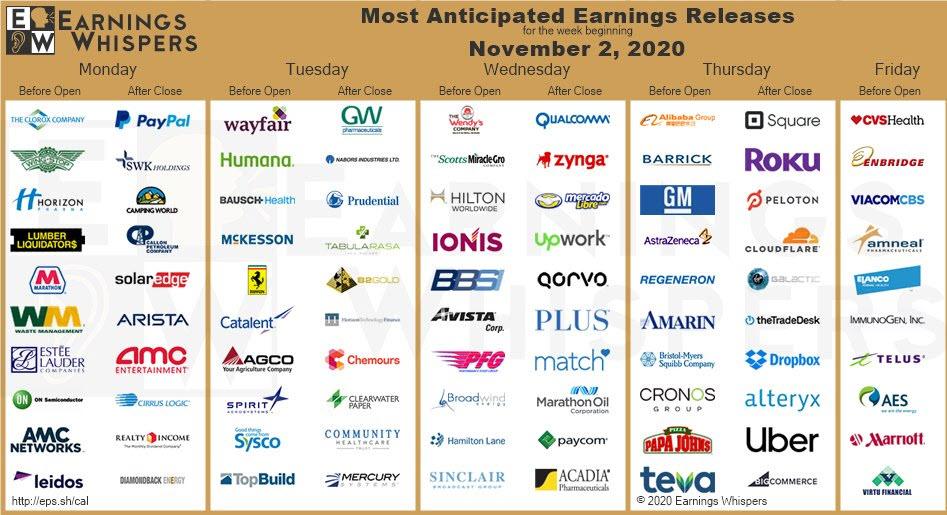
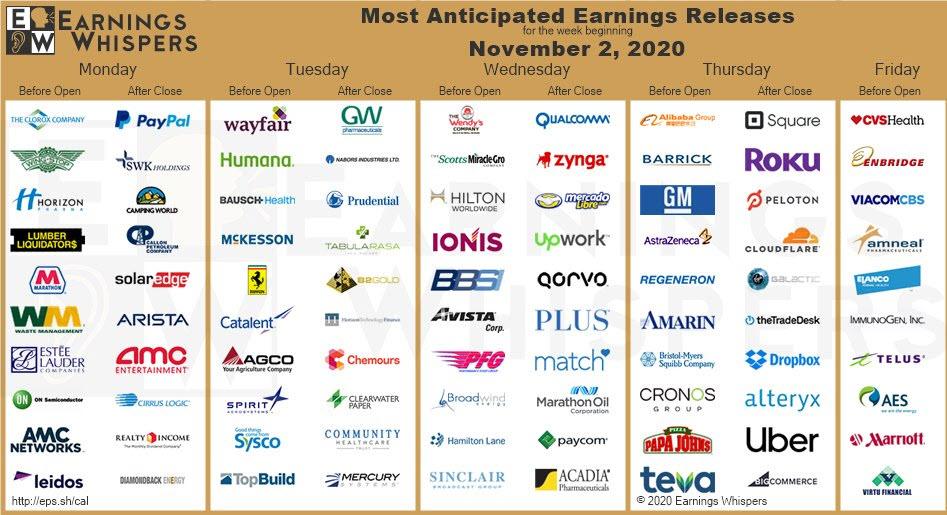
Lastly, it’s another big week on the earnings side too, with a total of 128 companies in the S&P 500 reporting over the week, along with a further 96 from the STOXX 600. In terms of the main highlights, today we’ll hear from Siemens, Clorox, Estee Lauder, PayPal Holdings and SBA Communications. Then on Tuesday, we’ll get releases from BNP Paribas, Bayer, Ferrari, Johnson Controls International, Humana, and Eversource Energy. Wednesday then sees reports from Danske Bank, Consolidated Edison, Vestas Wind Systems, QUALCOMM, MetLife, Allstate Corp and Public Storage. Then on Thursday, releases include Bristol-Myers Squibb Co, Zoetis, Linde, AstraZeneca, Regeneron Pharmaceuticals, Microchip Technology, Electronic Arts, American International Group and T-Mobile US. Lastly, on Friday, there’s Hershey, Allianz SE, CVS Health Corp and Marriott International.
Source: Earnings Whispers
Day-by-day calendar of events, courtesy of Deutsche Bank:
Monday
Data: Final October manufacturing PMI in Japan, China, Spain, Italy, France, Germany, Euro area, UK, and US, US ISM manufacturing and new orders, and September construction spending
Data: France September budget balance, US September factory orders, durable goods, durables ex-transportation and October total vehicle sales
Central Banks: Minutes of Bank of Japan September Meeting
Earnings: BNP Paribas SA, Sinch AB, Bayer AG, Eaton Corp PLC, Emerson Electric Co, Sysco Corp, Ferrari NV, Johnson Controls International, Exelon Corp, Humana Inc, WEC Energy Group Inc, Securitas AB, Eversource Energy
Politics: Voting ends in the US Election
Wednesday
Data: Final October services and composite PMIs for China, Spain, Italy, France, Germany, Euro area, UK and US, Euro area PPI, US ADP employment change, trade balance and ISM services
Earnings: Danske Bank, Consolidated Edison, Vestas Wind Systems, QUALCOMM Inc, MetLife Inc, Allstate Corp, American Water Works Co, Public Storage
Thursday
Data: Final October services and composite PMIs for Japan, October construction PMIs for Germany and the UK, Germany September factory orders, UK October new car registrations, Euro area September retail sales, US weekly initial jobless claims, continuing claims and preliminary Q3 nonfarm productivity
Central Banks: Federal Reserve rate decision and Fed Chair press conference, Bank of England rate decision and BoE Governor press conference
Earnings: Bristol-Myers Squibb Co, Zoetis, Linde, AstraZeneca, Regeneron Pharmaceuticals, Dominion Energy, Ball Corp, Parker-Hannifin Corp, Cigna Corp, Duke Energy Corp, General Motors Co, Microchip Technology, Electronic Arts, American International Group, T-Mobile US Inc
Friday
Data: Germany September industrial production, France 3Q private sector payrolls, September trade balance, current account balance, preliminary wages data, US October change in nonfarm payrolls, unemployment rate, average hourly earnings, final September wholesale inventories and consumer credit
Earnings: Hershey Co, Allianz SE, CVS Health Corp, Marriott International Inc
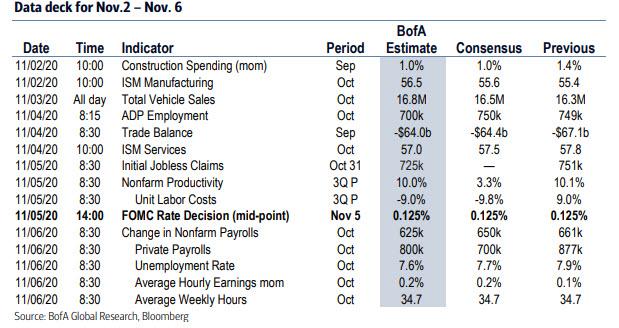
Finally looking at just the US, where Goldman notes that the key economic data releases this week are the ISM manufacturing report on Monday, ISM non-manufacturing report on Wednesday, jobless claims on Thursday, and the employment report on Friday. The November FOMC meeting is this week, with the release of the statement at 2:00 PM ET on Thursday followed by Chair Powell’s press conference at 2:30 PM. There are no other scheduled speaking engagements from Fed officials this week reflecting the FOMC blackout period. Election Day is on Tuesday, and states will report results over the course of the night.
Monday, November 2
10:00 AM ISM manufacturing index, October (GS 56.1, consensus 55.8, last 55.4): We expect the ISM manufacturing index to edge up by 0.7pt to 56.1 in the October report, reflecting strength in regional manufacturing surveys and foreign PMIs.
10:00 AM Construction spending, September (GS +1.2%, consensus +1.0%, last +1.4%): We estimate a 1.2% increase in construction spending in September, with scope for increases in private residential and public construction.
Tuesday, November 3
Election Day: Results for 435 House elections, 35 Senate elections, and the presidential election will be reported over the course of the night.
10:00 AM Factory orders, September (GS +0.9%, consensus +1.0%, last +0.7%); Durable goods orders, September final (last +1.9%); Durable goods orders ex-transportation, September final (last +0.8%); Core capital goods orders, September final (last +1.0%); Core capital goods shipments, September final (last +0.3%): We estimate factory orders increased by 0.9% in September following a 0.7% increase in August. Durable goods orders rose by 0.8% in the September advance report, and core capital goods orders rose by 1.0%.
Wednesday, November 4
08:15 AM ADP employment report, October (GS +575k, consensus +650k, last +749k); We expect a 575k gain in ADP payroll employment, reflecting jobless claims declining at a slower pace in October.
08:30 AM Trade balance, September (GS -$63.6, consensus -$63.9, last -$67.1bn); We estimate the trade deficit decreased by $3.5bn in September, reflecting a decline in the goods trade deficit.
10:00 AM ISM non-manufacturing index, October (GS 57.0, consensus 57.5, last 57.8); We estimate the ISM non-manufacturing index declined by 0.8pt to 57.0 in October, reflecting sequential weakness in retail, leisure, and hospitality. In addition, the index appears elevated compared to regional surveys.
Thursday, November 5
08:30 AM Initial jobless claims, week ended October 31 (GS 745k, consensus 735k, last 751k); Continuing jobless claims, week ended October 24 (consensus 7,350k, last 7,756k): We estimate initial jobless claims decreased to 745k in the week ended October 31.
08:30 AM Nonfarm productivity, Q2 preliminary (GS +5.3%, consensus +5.0%, last +10.1%); Unit labor costs, Q2 preliminary (GS -10.5%, consensus -10.0%, last +9.0%): We estimate nonfarm productivity grew by 5.3% in Q3 (qoq saar), reflecting a relatively larger increase in business output than in hours worked. We expect Q3 unit labor costs—compensation per hour divided by output per hour—to decrease by 10.5% qoq ar.
02:00 PM FOMC statement, November 4-5 meeting: As discussed in our FOMC preview, we expect the FOMC to eventually provide a timeline for asset purchases, but not at the November meeting. Without further discussion of policy changes, the meeting should be fairly quiet, and we expect few changes to the FOMC statement.
Friday, November 6
08:30 AM Nonfarm payroll employment, October (GS +500k, consensus +600k, last +661k); Private payroll employment, October (GS +600k, consensus +700k, last +877k); Average hourly earnings (mom), October (GS +0.1%, consensus +0.2%, last +0.1%); Average hourly earnings (yoy), October (GS +4.5%, consensus +4.6%, last +4.7%); Unemployment rate, October (GS 7.7%, consensus 7.7%, last 7.9%): We estimate nonfarm payrolls rose 500k in October after +661k in September. The smaller number of workers on temporary layoff (4.6mn in September, down from 18.1mn in April) reduces the scope for the rapid job gains seen in the summer, and the virus resurgence and softer Big Data employment signals are consistent with a deceleration in underlying job growth. While continuing claims declined sharply during the payroll month, much of the drop reflected the expiration of program eligibility (as opposed to reemployment). Our forecast also reflects a decline in retail payrolls due to the accelerating shift to ecommerce in the upcoming holiday season. We also expect another weak education reading due to virtual schooling (the October seasonal factors assume half a million support staff returning to work). We also expect a 125k drop in Census jobs in Friday’s report. We estimate the unemployment rate declined by two tenths to 7.7%, reflecting an increase in household employment partially offset by higher labor force participation. We estimate average hourly earnings rose 0.1% month-over-month, lowering the year-on-year rate by two tenths to 4.5%. This forecast reflects a continuing unwind of the composition shift from lower – to higher-paid workers.
10:00 AM Wholesale inventories, September final (consensus -0.1%, last -0.1%)
Source: Deutsche Bank, BofA, Goldman
via ZeroHedge News https://ift.tt/3oNuG8g Tyler Durden
I am happy to pass along this guest post from Professor Stephanie Barclay (Notre Dame). She writes about the history of the Free Exercise Clause, and how it affects Fulton v. City of Philadelphia.
From an originalist perspective, how should we think about protections for individual rights when government has expanded to regulate spheres of society that were dominated by private activity during the Founding-era? This question is relevant in many constitutional contexts, but it has particular salience for the meaning of Free Exercise protections in Fulton v. City of Philadelphia, a case the Supreme Court will hear oral argument in this week. This post discusses a historical example involving the Ursuline nuns in New Orleans that may shed light on this question. But first, it’s helpful to understand how this issue arises in Fulton.
One of the issues before the Supreme Court in Fulton is whether the government has the right to exclude a Catholic ministry from providing foster care services to vulnerable children. Catholic Social Services (CSS) has been engaged in providing foster care for over 200 years in Philadelphia. Some might say that CSS basically invented the practice in the City.
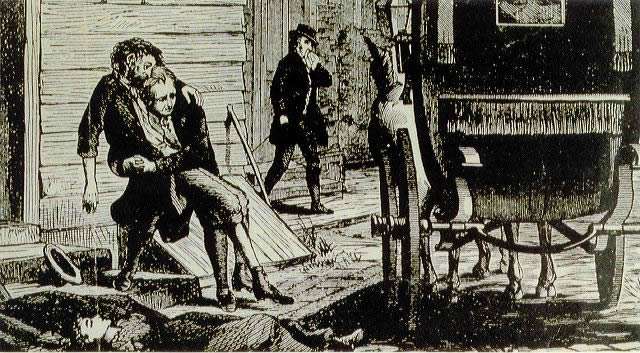
In the 1790s, Philadelphia was hit hard by the yellow fever epidemic, and countless children were suddenly left parentless. (As an interesting side note, the Supreme Court actually shut down one of its terms because of the severity of this outbreak.)
This image depicts volunteers collecting the dead and dying in Philadelphia. Over 5,000 residents died from this epidemic.
In response to this crisis, religious groups, including Catholics and Jews, established orphanages in the area. The first Catholic orphanage in Philadelphia—and one of the first orphanages in the United States—was founded in 1798. See Timothy A. Hacsi, Second Home: Orphan Asylums and Poor Families in America 18 (Harvard 1997). The Sisters of St. Joseph took over St. John’s Orphan Asylum in 1847, and by 1910 they were caring for 26,000 children in the City. This ministry included foster care, where the Catholic Children’s Bureau would find homes for children in need instead of just keeping them in an orphanage.
Over time, the government became more involved in foster care. Today, the government exercises exclusive control over the power to remove children from their homes and to decide which agencies get to provide core foster care services to families that take in foster children. For example, CSS’s representative testified in proceedings below that it would be “breaking the law” for that agency to provide foster care services to foster families without a contract. And the City acknowledged that the foster families currently relying on CSS must either “find a new agency” to work with, or stop fostering children.
This government control of foster care itself hasn’t necessarily been a problem, until just two years ago when the City sought to close CSS down unless it agreed to violate its religious beliefs and certify same-sex couples. No couple had ever actually asked for this service from CSS, but the City still wants a commitment in advance that CSS would be willing to violate its beliefs as a condition of being able to continue serving foster families in the City. Because CSS couldn’t agree to violate their religious beliefs about marriage, they now stand to lose the ability to continue their longstanding foster care ministry.
In a word, government has expanded to control an activity previously within the realm of private religious ministries. And now, through government’s monopoly power, religious groups are forced to choose between violating their beliefs and performing the ministry the government’s way or being kicked out altogether. Given that the baseline of a large welfare state didn’t exist at our country’s Founding, can history shed any light on the original meaning of the Constitution in this type of conflict?
The Founding-era historical example involving the Ursuline nuns seems to support the idea that religious ministries should retain important protections for their original sphere of freedom, even if government exerts control over new aspects of society. Beginning in 1727, Catholic nuns in New Orleans operated a convent that included a school for poor children. When the U.S. Government completed the Louisiana Purchase, the convent fell within the boundaries of the newly acquired territory. As a result, it could have easily been assumed that this property now fell to the ownership and control of the federal government. The nuns wrote a letter in 1804 seeking clarification about the future of their ministry. The nuns stated, “it is not therefore [the nuns’] own cause but that of the Public which they plead — it is the cause of the Orphan, of the helpless child of Want.”
Jefferson responded and assured the nuns that “the principles of the constitution” provided a “sure guarantee” that the property would be “preserved to you sacred and inviolate,” and that the convent “will be permitted to govern itself according to its own voluntary rules, without interference from the civil authority.” He then said that “whatever diversity of shade may appear in the religious opinions of our fellow citizens,” the “charitable objects of your institution . . . cannot fail to ensure it the patronage of the government it is under.”
Note that this was not just a pledge Jefferson was making magnanimously—he believed that the “principles of the constitution” required preserving this religious ministry, notwithstanding the recent government acquisition of the Louisiana territory. And he did not think that preserving the ministry meant forcing the nuns to run their ministry according to the government’s new rules. Rather, he noted that the ministry had a “sure guarantee” that they would operate according to its “own voluntary rules, without interference from the civil authority.”
Mark Storslee has written about how examples like this illustrate that the Establishment Clause does not prohibit religious ministries operating even in the context of government funding or property. And I agree. But one could potentially take a further lesson from this example. Specifically, one could argue that there were certain spheres of liberty the Founders understood that religious groups and institutions would be able to operate within free from government interference, notwithstanding government expansion. Or, at the very least, these ministries would receive thick constitutional protection within these spheres even as government exercised control over new realms.
The ministry of churches caring for orphans was widely recognized and appreciated during the early history of our country, and there is (to my knowledge) no Founding-era evidence that government could—or even tried to—interfere with such ministries. Given the expansion of the modern welfare state into these previously private spheres of religious activity, the burden should still remain on the government to justify that it has originalist/historical support for its modern intrusion, not the other way around.
So how would one operationalize this sort of original understanding into a doctrinal test? Two alternatives present themselves. First, to the extent that Employment Division v. Smith remains good law, perhaps certain spheres of liberty where government did not interfere with religious practice during the Founding period operate as an exception to Smith‘s deferential rule. The Fulton context of religious ministries to orphans seems like a prime candidate for this sort of exception. The Ursuline Nuns that Jefferson wrote to were also caring for destitute children, after all. (At least three other amicus briefs in Fulton discussed this history of religious organizations providing adoption and foster care services in our country. See here, here, and here.)
However, under this first approach, it would likely be fairly easy for religious organizations to argue that religious exemption conflicts are caused by government regulation that extends beyond what was understood as the accepted scope of government during the Founding era. This may be true both in terms of subject matter, but also in terms of volume. As former Attorney General Edwin Meese’s amicus brief notes, “Given the ever-increasing encroachment of the modern administrative state into daily life, a course-correction becomes more vital to preserve the Framers’ intent that religious duties will take precedence over the demands of the government.” In a similar vein, Keith Whittington has noted that the volume of statutes passed by legislatures at the Founding period was much lower than it is now. In fact, “the output of Congress” measured by the number of pages in the Statutes at Large “has far outstripped the judicial review activity of the Supreme Court.” Keith E. Whittington, Repugnant Laws: Judicial Review of Acts of Congress From the Founding to the Present 27 (2019). And the amount of policies and regulations passed by agencies dwarfs that ballooning legislative activity by Congress. Thus, higher numbers of judicially created religious exemptions would likely be necessary to even attempt to maintain the scope of religious freedom that was originally understood in the context of free exercise protections.
All of this points to a second alternative doctrinal test supported by the Ursuline nuns’ example: overrule Smith altogether and allow for a default rule of heightened scrutiny in religious exemption conflicts. Such a background norm is consistent with the idea that government should justify its ability to burden religious exercise in spheres of liberty government largely left uninhibited during the Founding period. And where government can point to a use of its power that actually advances an interest originally understood as one sufficient to limit religious exercise, such government regulation would likely satisfy strict scrutiny.
On the other hand, if the Court does not adopt at least one of these approaches, the risk is that government could obliterate the “promise of the free exercise of religion” simply through the reality of its never-ending expansion. All the government need do is license or exert control over a new activity, and then condition religious groups’ continued participation on their willingness to forfeit their religious beliefs and practices. Whatever the Free Exercise Clause meant, surely it could not have been that.
Stephanie Hall Barclay is an Associate Professor of Law at the Notre Dame Law School, where she also leads the Law School’s Religious Liberty Initiative. Elsewhere, she has written about other historical, normative, and doctrinal reasons that support overruling Smith.
from Latest – Reason.com https://ift.tt/34NZNsd
via IFTTT
Today the Supreme Court will hear oral argument for the first time since the confirmation of Justice Amy Coney Barrett. In some respects, this may represent the start of the new Roberts Court, as distinguished from the early Roberts Court—what many called the “Kennedy Court” because of Justice Kennedy’s pivotal and decisive role in the Court’s jurisprudence during that period.
The Kennedy Court ended when Justice Anthony Kennedy was replaced by Justice Brett Kavanaugh. Yet even then the Court was closely divided, regularly producing 5-4 splits in which the justices did not align purely along ideological lines. Although the Chief Jsutice was seen as the median justice after Kennedy’s departure, every conservative justice joined the courts liberals to produce a majority at least once during the brief period between the confirmations of Justice Kavanaugh and Justice Barrett. Now it will take two conservative justices to produce a majority with the Court’s liberal wing. This will almost certainly result in a shift to the Right, but how much and in what manner are yet to be determined.
As a wise sage once said, “It’s tough to make predictions, especially about the future.” We can, however, say something about the past, and use recent experience as a benchmark against which to evaluate what comes ahead. With this in mind, I think it’s useful to clarify the record of the Roberts Court to date, so that we may accurately identify how the New Roberts Court’s behavior departs from recent trends, if it does.
While some commentators have described the Roberts Court as ultra-conservative, radical, or reactionary, it has, in fact, been a stare decisis court, and arguably the most restrained in decades. Up until now, the Court under Chief Justice Roberts has been more deferential to Congress and more respectful of precedent than any other post-WWII court.
As I detailed in this post from 2018, the Roberts Court overturns prior Court precedents at a significantly lower rate than did the Warren, Burger, and Rehnquist Courts, a pattern that continued up through this past term. There are important caveats to be made, including that not all precedents are created equal, and overtunring some is more important than overturning others. Still, the overall rate over a significant period of time is notable. If the Court begins to upend precedents at a significant rate, this will be a departure from how the Court has behaved since 2005.
Similarly, the Roberts Court has invalidated federal statutes, in whole or in part, at a lower rate than did the Warren, Burger, and Rehnquist Courts. Here the best reference is my co-blogger Keith Whittington’s award-winning book, Repugnant Laws: Judicial Review of Acts of Congress from the Founding to the Present. Here is what he finds:
Cases per annum invalidating federal statutes:
Warren Court 2.57
Burger Court 3.17
Rehnquist Court 3.63
Roberts Court 2.08
(See Table 7-1 at p. 238)
Maybe this is too many federal statutes to invalidate. Maybe it is too few. Maybe it depends on which laws are up for review. The point here is that—contrary to the claims of some commentators—the Roberts Court has given Congress a wider berth than has its predecessors and has been more reluctant to hold federal statutes unconstitutional than have prior courts. As with precedents, if the Court begins to invalidate federal laws at a more rapid rate, this will be a departure from what we have seen from the Roberts Court thus far.
It is important to underscore that the account I provide here is purely descriptive. This is what the Roberts Court has and has not done. There are some who think the Court should be systematically deferential and oriented toward maintaining the status quo, but most have preferences about the underlying substance of the relevant decisions. Whether the Court was correct to declare a given statute unconstitutional or overturn a given precedent depends upon the particulars of the given case—and is a question upon which I suspect many readers and I would disagree (as will readers among themselves). So, too, with the decisions the Court will make in the years ahead.
What will the New Roberts Court bring? We will have to see. I suspect the newly constituted Court will conform to some expectations and confound others. It will almost certainly be more “conservative,” but what that means in particular cases or subject areas may well surprise. Much as the early Roberts Court was more restrained and status quo oriented than many might have suspected, the New Roberts Court may well turn out differently than many expect.
from Latest – Reason.com https://ift.tt/2I09QSt
via IFTTT
This is going to be… a very “interesting” week. The Global Pandemic, US Elections, Central Bank meetings and a veritable deluge of signs, portents and warnings of greater pain and strife to come. In any normal world, investors would be running for the hills and shelter. Not this week… this is not a normal world. This is a world where doom, gloom and imminent catastrophe spells only one thing – More Stimulus! Yay!
Despite last week’s slide, and the fact October proved a down month, markets are holding up better than a rational man would expect. The upside is how resilient parts of the global economy are proving despite the pandemic – stemming contraction as new tech is quickly adopted. It’s the mainstream economy that’s increasing suffering – and will suffer more. We’ve got stories of imminent disaster in hospitality, airlines and oil is another couple of dollars cheaper.
Markets seem immune, buoyed by expectations of large, larger or massively larger US stimulus packages to follow the election, while renewed lockdowns in Europe will cause the EBC and BOE to dig deeper into the pots of gold they are apparently sitting on.
It’s a sad state of affairs when the main driver on markets is going to be the largesse of governments and monetary authorities.
Occidental markets are pricing in QE Infinity, NIRP (Negative Interest Rates) and further stimulus for eternity – and its ultimately unsustainable. Every financial professional knows that… but it’s little wonder an increasing number of retail investors, and even smarter middle aged savers, increasingly believe stocks can only continue rising.
It’s a dangerous notion.. Blain’s Number One Market Mantra is screaming in my ear: The Market Has But One Objective: To Inflict the Maximum Amount of Pain on the Maximum Number of Participants.
When the bubble pops… it won’t be an “Ouch” moment. Check out the Wilhelm Scream!
The upside is that we all know governments and central banks can’t risk a market meltdown unravelling what fragile confidence is keeping the economy together.
Without the implicit promise of further support, I suspect we’d not only be looking at negative interest rates, but negative financial asset prices as well! That’s a fascinating concept – could we ever get to a stage where zombie companies come at negative stock prices…? Limited liability makes that improbable in equity (unless laws change to allow dividends to be recouped… (like maybe in some Private Equity scams? why not?)) … but in real terms financial asset stagflation has pushed essentially valueless insolvent assets to record levels in the face of economic meltdown… if the situation was to change, I could see a position where worthless and illiquid stocks and bonds are valued less than zero in real terms. Park that thought…
There isn’t much point saying anything about the US election this morning – but I suppose I must. Whatever the Democrats want to believe, Trump has been narrowing the gap. Cutting through the noise and multiple polls, it looks like a slim 5-6 point Biden lead. That’s better than Clinton had in 2016, but no guarantee of success. The Democrats need to power through to the finish even as Trump finds new legs.
Key States look tied – Florida, North Carolina, Georgia, Iowa, Ohio and Texas. Then there are Pennsylvania, Arizona and Michigan which look Biden marginals. Penn will be the one to watch. If Trump wins all the ties, and Biden takes all his marginals, then it’s a new man in Washington – but its tight. Much has been written about how the polls are wrong, and why they are right..
If the polls are right, then it looks like a toss up between Biden plus a Democratic Congress (both Senate and Representatives) or a Biden Presidency and Republican Senate because many of the Senate races also look like ties – coin tosses too close to call.
If the polls are wrong then we get 4 more years of Donald. There is a chance we get Trump plus a Democrat senate – which will leave China rolling on the floor convulsed with hysterical laughter… (Who ever thought a mild new flu would so utterly convulse and destabilise democracies so effectively..)
Unfortunately.. it won’t end on Wednesday morning as Trump warns he’s already planning to go to the lawyers. There is plenty to worry about in terms of immediate and post-election volatility and uncertainty – but everyone already knows that. The likelihood is a still divided, polarized US and the prospect of another four years of low grade, weak and/or chaotic government – at the time when strong, intelligent leadership has never been more necessary to address the Pandemic, Climate Change and China.
The long-term immediate consequence will be felt in the dollar and an increasing investment shift to real growth and returns from Asia – meaning China. That’s hardly the result Trump intended when he identified the China threat. For all his “efforts” to repatriate manufacturing and seize back the initiative, China will emerge stronger.
Thus far the US, and UK, stand out for their chronic dither through the pandemic crisis. Believe what you want to believe, but the virus is not fake. It’s a massive challenge to the West to steer economies to avoid hospital’s being swamped while minimising economic damage. Null points thus far to both nations.
Over here in Blighty..
When the only good news is that a Brexit agreement on Fish is apparently in reach, you just know it’s likely to be yet another hope about to be dashed. Some fisherman down in Cornwall will be interviewed saying something about being “stabbed in the back” by the Tories, and that’ll be-that.
The UK will enter Pandemic lockdown later this week through till December…. It will just be another tick on the lengthening list of reasons to sell the UK and buy… just about anything else. At some point either things get better or UK financial asset prices will be so cheap we won’t be able to resist buying.. but buy what?
Name me a world class and world-size UK firm that screams its worth buying? HSBC? BP? Rolls Royce? Or what about Aston Martin (CCC rated and just paid 10.5% to borrow another billion..) PLEASE, but no to all of them. Brits have an awesome reputation for being inventive & innovative so why isn’t there a single UK big tech firm anyone has ever heard of? We’ve more Nobel Prize winners than you can shake a sharp pointy stick at and nothing to show for it.. Our big companies are decaying dinosaurs or struggling anachronisms, while our embryonic unicorns are carved up while still far below the viable stage.
Why?
Some grown up policies on industrial strategy and growth might help. A focus on reform, social and physical infrastructure, education and health…? Zero chance. Brexit uncertainty and the Pandemic hitting harder than anywhere else share the common source of crap government. As we keep being reminded, last year the UK was reckoned to be one of the countries most likely to cope well with the “big one” epidemic when it came. Instead we’ve tripped over everything from PPE, ‘world-class test and trace..” and communication.
I think its God’s way of punishing me for Voting for Boris. It’s all so depressing… I’m thinking of becoming a Liberal…
Finally…
If I come down with a ranging dose of the dreaded lurgi I know who to blame. She-who-is-Mrs-Blain and I spent the weekend on the Isle of Wight – a Yoga retreat. (Yep.. I know what you are thinking: I may be the least likely Yogi ever… but it gives me a perverse sense of achievement to gracelessly morph from Sphinx into Warrior pose… or something like that.)
Our trip home was “challenging” – catching an incredibly busy Ferry, which was then delayed for hours because of a “welfare incident” involving one person struggling with mental health issues refusing to get off the boat we’d boarded.
The situation was pretty tragic – but over 1000 passengers were crammed into tiny public spaces on a warm, dank ferry that must have favoured virus transmission for hours as the Ferry crew tried to resolve the situation over the one passenger. I’m told the police initially declined to intervene while the crew attempted to contact local mental health support on the Island (good luck at 4.30 pm on a damp Sunday afternoon.) Eventually passengers were calling 999 and she was removed. It was tragic, pretty awful and upsetting to hear the woman screaming.
It must have been terrible for the crew. Mental health is in crisis, but there were over 1000 people, including loads of unmasked kids running around, while elderly people were visibly upset. We were all trapped on a virus incubator. It must have been even worse for passengers on another ferry stuck out in the Solent (the sea between the Isle of Wight and the real world) waiting for the ferry berth to become free – it was blowing a Force 9 gale on Sunday evening!
The correct response would have been immediate police and medical response to protect all the passengers swiftly – but no.. we had to go through a bureaucratic litany of delay and frustration… Pretty much the whole UK in miniature. If I start coughing…
via ZeroHedge News https://ift.tt/2JowdBn Tyler Durden
I am happy to pass along this guest post from Professor Stephanie Barclay (Notre Dame). She writes about the history of the Free Exercise Clause, and how it affects Fulton v. City of Philadelphia.
From an originalist perspective, how should we think about protections for individual rights when government has expanded to regulate spheres of society that were dominated by private activity during the Founding-era? This question is relevant in many constitutional contexts, but it has particular salience for the meaning of Free Exercise protections in Fulton v. City of Philadelphia, a case the Supreme Court will hear oral argument in this week. This post discusses a historical example involving the Ursuline nuns in New Orleans that may shed light on this question. But first, it’s helpful to understand how this issue arises in Fulton.
One of the issues before the Supreme Court in Fulton is whether the government has the right to exclude a Catholic ministry from providing foster care services to vulnerable children. Catholic Social Services (CSS) has been engaged in providing foster care for over 200 years in Philadelphia. Some might say that CSS basically invented the practice in the City.
In the 1790s, Philadelphia was hit hard by the yellow fever epidemic, and countless children were suddenly left parentless. (As an interesting side note, the Supreme Court actually shut down one of its terms because of the severity of this outbreak.)
This image depicts volunteers collecting the dead and dying in Philadelphia. Over 5,000 residents died from this epidemic.
In response to this crisis, religious groups, including Catholics and Jews, established orphanages in the area. The first Catholic orphanage in Philadelphia—and one of the first orphanages in the United States—was founded in 1798. See Timothy A. Hacsi, Second Home: Orphan Asylums and Poor Families in America 18 (Harvard 1997). The Sisters of St. Joseph took over St. John’s Orphan Asylum in 1847, and by 1910 they were caring for 26,000 children in the City. This ministry included foster care, where the Catholic Children’s Bureau would find homes for children in need instead of just keeping them in an orphanage.
Over time, the government became more involved in foster care. Today, the government exercises exclusive control over the power to remove children from their homes and to decide which agencies get to provide core foster care services to families that take in foster children. For example, CSS’s representative testified in proceedings below that it would be “breaking the law” for that agency to provide foster care services to foster families without a contract. And the City acknowledged that the foster families currently relying on CSS must either “find a new agency” to work with, or stop fostering children.
This government control of foster care itself hasn’t necessarily been a problem, until just two years ago when the City sought to close CSS down unless it agreed to violate its religious beliefs and certify same-sex couples. No couple had ever actually asked for this service from CSS, but the City still wants a commitment in advance that CSS would be willing to violate its beliefs as a condition of being able to continue serving foster families in the City. Because CSS couldn’t agree to violate their religious beliefs about marriage, they now stand to lose the ability to continue their longstanding foster care ministry.
In a word, government has expanded to control an activity previously within the realm of private religious ministries. And now, through government’s monopoly power, religious groups are forced to choose between violating their beliefs and performing the ministry the government’s way or being kicked out altogether. Given that the baseline of a large welfare state didn’t exist at our country’s Founding, can history shed any light on the original meaning of the Constitution in this type of conflict?
The Founding-era historical example involving the Ursuline nuns seems to support the idea that religious ministries should retain important protections for their original sphere of freedom, even if government exerts control over new aspects of society. Beginning in 1727, Catholic nuns in New Orleans operated a convent that included a school for poor children. When the U.S. Government completed the Louisiana Purchase, the convent fell within the boundaries of the newly acquired territory. As a result, it could have easily been assumed that this property now fell to the ownership and control of the federal government. The nuns wrote a letter in 1804 seeking clarification about the future of their ministry. The nuns stated, “it is not therefore [the nuns’] own cause but that of the Public which they plead — it is the cause of the Orphan, of the helpless child of Want.”
Jefferson responded and assured the nuns that “the principles of the constitution” provided a “sure guarantee” that the property would be “preserved to you sacred and inviolate,” and that the convent “will be permitted to govern itself according to its own voluntary rules, without interference from the civil authority.” He then said that “whatever diversity of shade may appear in the religious opinions of our fellow citizens,” the “charitable objects of your institution . . . cannot fail to ensure it the patronage of the government it is under.”
Note that this was not just a pledge Jefferson was making magnanimously—he believed that the “principles of the constitution” required preserving this religious ministry, notwithstanding the recent government acquisition of the Louisiana territory. And he did not think that preserving the ministry meant forcing the nuns to run their ministry according to the government’s new rules. Rather, he noted that the ministry had a “sure guarantee” that they would operate according to its “own voluntary rules, without interference from the civil authority.”
Mark Storslee has written about how examples like this illustrate that the Establishment Clause does not prohibit religious ministries operating even in the context of government funding or property. And I agree. But one could potentially take a further lesson from this example. Specifically, one could argue that there were certain spheres of liberty the Founders understood that religious groups and institutions would be able to operate within free from government interference, notwithstanding government expansion. Or, at the very least, these ministries would receive thick constitutional protection within these spheres even as government exercised control over new realms.
The ministry of churches caring for orphans was widely recognized and appreciated during the early history of our country, and there is (to my knowledge) no Founding-era evidence that government could—or even tried to—interfere with such ministries. Given the expansion of the modern welfare state into these previously private spheres of religious activity, the burden should still remain on the government to justify that it has originalist/historical support for its modern intrusion, not the other way around.
So how would one operationalize this sort of original understanding into a doctrinal test? Two alternatives present themselves. First, to the extent that Employment Division v. Smith remains good law, perhaps certain spheres of liberty where government did not interfere with religious practice during the Founding period operate as an exception to Smith‘s deferential rule. The Fulton context of religious ministries to orphans seems like a prime candidate for this sort of exception. The Ursuline Nuns that Jefferson wrote to were also caring for destitute children, after all. (At least three other amicus briefs in Fulton discussed this history of religious organizations providing adoption and foster care services in our country. See here, here, and here.)
However, under this first approach, it would likely be fairly easy for religious organizations to argue that religious exemption conflicts are caused by government regulation that extends beyond what was understood as the accepted scope of government during the Founding era. This may be true both in terms of subject matter, but also in terms of volume. As former Attorney General Edwin Meese’s amicus brief notes, “Given the ever-increasing encroachment of the modern administrative state into daily life, a course-correction becomes more vital to preserve the Framers’ intent that religious duties will take precedence over the demands of the government.” In a similar vein, Keith Whittington has noted that the volume of statutes passed by legislatures at the Founding period was much lower than it is now. In fact, “the output of Congress” measured by the number of pages in the Statutes at Large “has far outstripped the judicial review activity of the Supreme Court.” Keith E. Whittington, Repugnant Laws: Judicial Review of Acts of Congress From the Founding to the Present 27 (2019). And the amount of policies and regulations passed by agencies dwarfs that ballooning legislative activity by Congress. Thus, higher numbers of judicially created religious exemptions would likely be necessary to even attempt to maintain the scope of religious freedom that was originally understood in the context of free exercise protections.
All of this points to a second alternative doctrinal test supported by the Ursuline nuns’ example: overrule Smith altogether and allow for a default rule of heightened scrutiny in religious exemption conflicts. Such a background norm is consistent with the idea that government should justify its ability to burden religious exercise in spheres of liberty government largely left uninhibited during the Founding period. And where government can point to a use of its power that actually advances an interest originally understood as one sufficient to limit religious exercise, such government regulation would likely satisfy strict scrutiny.
On the other hand, if the Court does not adopt at least one of these approaches, the risk is that government could obliterate the “promise of the free exercise of religion” simply through the reality of its never-ending expansion. All the government need do is license or exert control over a new activity, and then condition religious groups’ continued participation on their willingness to forfeit their religious beliefs and practices. Whatever the Free Exercise Clause meant, surely it could not have been that.
Stephanie Hall Barclay is an Associate Professor of Law at the Notre Dame Law School, where she also leads the Law School’s Religious Liberty Initiative. Elsewhere, she has written about other historical, normative, and doctrinal reasons that support overruling Smith.
from Latest – Reason.com https://ift.tt/34NZNsd
via IFTTT
Today the Supreme Court will hear oral argument for the first time since the confirmation of Justice Amy Coney Barrett. In some respects, this may represent the start of the new Roberts Court, as distinguished from the early Roberts Court—what many called the “Kennedy Court” because of Justice Kennedy’s pivotal and decisive role in the Court’s jurisprudence during that period.
The Kennedy Court ended when Justice Anthony Kennedy was replaced by Justice Brett Kavanaugh. Yet even then the Court was closely divided, regularly producing 5-4 splits in which the justices did not align purely along ideological lines. Although the Chief Jsutice was seen as the median justice after Kennedy’s departure, every conservative justice joined the courts liberals to produce a majority at least once during the brief period between the confirmations of Justice Kavanaugh and Justice Barrett. Now it will take two conservative justices to produce a majority with the Court’s liberal wing. This will almost certainly result in a shift to the Right, but how much and in what manner are yet to be determined.
As a wise sage once said, “It’s tough to make predictions, especially about the future.” We can, however, say something about the past, and use recent experience as a benchmark against which to evaluate what comes ahead. With this in mind, I think it’s useful to clarify the record of the Roberts Court to date, so that we may accurately identify how the New Roberts Court’s behavior departs from recent trends, if it does.
While some commentators have described the Roberts Court as ultra-conservative, radical, or reactionary, it has, in fact, been a stare decisis court, and arguably the most restrained in decades. Up until now, the Court under Chief Justice Roberts has been more deferential to Congress and more respectful of precedent than any other post-WWII court.
As I detailed in this post from 2018, the Roberts Court overturns prior Court precedents at a significantly lower rate than did the Warren, Burger, and Rehnquist Courts, a pattern that continued up through this past term. There are important caveats to be made, including that not all precedents are created equal, and overtunring some is more important than overturning others. Still, the overall rate over a significant period of time is notable. If the Court begins to upend precedents at a significant rate, this will be a departure from how the Court has behaved since 2005.
Similarly, the Roberts Court has invalidated federal statutes, in whole or in part, at a lower rate than did the Warren, Burger, and Rehnquist Courts. Here the best reference is my co-blogger Keith Whittington’s award-winning book, Repugnant Laws: Judicial Review of Acts of Congress from the Founding to the Present. Here is what he finds:
Cases per annum invalidating federal statutes:
Warren Court 2.57
Burger Court 3.17
Rehnquist Court 3.63
Roberts Court 2.08
(See Table 7-1 at p. 238)
Maybe this is too many federal statutes to invalidate. Maybe it is too few. Maybe it depends on which laws are up for review. The point here is that—contrary to the claims of some commentators—the Roberts Court has given Congress a wider berth than has its predecessors and has been more reluctant to hold federal statutes unconstitutional than have prior courts. As with precedents, if the Court begins to invalidate federal laws at a more rapid rate, this will be a departure from what we have seen from the Roberts Court thus far.
It is important to underscore that the account I provide here is purely descriptive. This is what the Roberts Court has and has not done. There are some who think the Court should be systematically deferential and oriented toward maintaining the status quo, but most have preferences about the underlying substance of the relevant decisions. Whether the Court was correct to declare a given statute unconstitutional or overturn a given precedent depends upon the particulars of the given case—and is a question upon which I suspect many readers and I would disagree (as will readers among themselves). So, too, with the decisions the Court will make in the years ahead.
What will the New Roberts Court bring? We will have to see. I suspect the newly constituted Court will conform to some expectations and confound others. It will almost certainly be more “conservative,” but what that means in particular cases or subject areas may well surprise. Much as the early Roberts Court was more restrained and status quo oriented than many might have suspected, the New Roberts Court may well turn out differently than many expect.
from Latest – Reason.com https://ift.tt/2I09QSt
via IFTTT
Philadelphia Firefighters Union Breaks From National Biden Endorsement To Endorse President Trump Tyler Durden
Mon, 11/02/2020 – 08:50
The Philadelphia firefighters union’s endorsement of President Donald Trump wasn’t without its bumps in the road – but heading into election day, it looks to be here to stay.
Philadelphia’s Firefighter and Paramedics Union broke from its international arm’s endorsement of Joe Biden, which was made back in 2019 by the International Association of Firefighters.
After the Firefighters Local 22 endorsed President Trump on September 29, they were sued by a member group of black firefighters called “Club Valiants”, who claimed the endorsement violated the union’s laws on political activity. Some members are also trying to push out Local 22 President Mike Bresnan over the endorsement.
“It’s a very polarizing, emotional issue. I knew that was going to happen,” Bresnan said at the time.
As a result of the controversy, the union cancelled its regularly scheduled meetings for October and November and instead focused on a mail-in referendum on whether or not it should uphold its endorsement of Trump.
The vote, put forth last week, saw 1,444 votes returned in favor of the endorsement and 782 votes to rescind it. Roughly 47% of the union’s 4,700 members voted, according to Firehouse.
William Tung, a Local 22 member who was part of the group fighting against the endorsement, said: “We’re not arguing that we should endorse Biden. We’re just saying we should stay out of it.”
Trump has also been backed by the 335,000 member Fraternal Order of Police and the 241,000 member National Association of Police Organizations. The International Union of Police Associations, the New York City Police Benevolent Association and the Florida Police Benevolent Association have also thrown their support behind the President.