Renewing my speculation: A Resignation in Time, that Saved Nine

A few days after Justice Ginsburg passed away, I speculated that Chief Justice Roberts could let President Biden replace him to avoid Court packing. I am renewing this speculation. If Diocese is any prediction, Roberts will consistently find himself in dissent. And the troika of progressive no longer have any incentive to join him. He will consistently stand alone.  I am unable to think of a Chief Justice in history who consistently voted alone, in dissent, or in the majority.

And this solo act will not be fun. He is not like Justice Thomas, who spent decades writing solo opinions. Indeed, the Chief really seemed wounded by Justice Gorsuch’s barbs. I suspect that feud has been simmering for some time, but has only now become public.

Roberts’s moment in the sun passed in the blink of an eye. I would not be surprised if he steps down soon. To cement his legacy (in his mind at least), the Chief will let a Democratic President and a sharply-divided Congress replace him. And I think President Biden would be prudent to elevate Elena Kagan as Chief Justice. She would be confirmed.

from Latest – Reason.com https://ift.tt/33g5Q7Z
via IFTTT

Download Edited Version of Roman Catholic Diocese of Brooklyn v. Cuomo

I’ve edited Roman Catholic Diocese of Brooklyn v. Cuomo for the 2021 Barnett/Blackman supplement. You can download it here. I trimmed the case down from 33 to pages to about 9 pages. I omitted most of the back-and-forths between Gorsuch and Roberts. I doubt students will have much use for those barbs. If the Court ultimately grants certiorari in this case, I will edit that decision accordingly.

from Latest – Reason.com https://ift.tt/2Jhbq2R
via IFTTT

Renewing my speculation: A Resignation in Time, that Saved Nine

A few days after Justice Ginsburg passed away, I speculated that Chief Justice Roberts could let President Biden replace him to avoid Court packing. I am renewing this speculation. If Diocese is any prediction, Roberts will consistently find himself in dissent. And the troika of progressive no longer have any incentive to join him. He will consistently stand alone.  I am unable to think of a Chief Justice in history who consistently voted alone, in dissent, or in the majority.

And this solo act will not be fun. He is not like Justice Thomas, who spent decades writing solo opinions. Indeed, the Chief really seemed wounded by Justice Gorsuch’s barbs. I suspect that feud has been simmering for some time, but has only now become public.

Roberts’s moment in the sun passed in the blink of an eye. I would not be surprised if he steps down soon. To cement his legacy (in his mind at least), the Chief will let a Democratic President and a sharply-divided Congress replace him. And I think President Biden would be prudent to elevate Elena Kagan as Chief Justice. She would be confirmed.

from Latest – Reason.com https://ift.tt/33g5Q7Z
via IFTTT

Snitchgiving: Americans Are Being Urged To Report Families Gathering For The Holiday

Snitchgiving: Americans Are Being Urged To Report Families Gathering For The Holiday

Tyler Durden

Thu, 11/26/2020 – 15:00

Authored by Daisy Luther via The Organic Prepper blog,

Imagine you’re sitting around the table with your family, inhaling the aroma as grandpa begins to carve the turkey, and there’s a knock at the door.

Is it a late guest? A neighbor dropping by?

No, it’s a health official or the police there to quell your gathering because somebody snitched on you for making the decision to spend time with the people you love.

It certainly sounds dystopian, doesn’t it? Or like something from a country under enemy rule? But it is indeed the United States of America where government officials are urging people to rat out their neighbors for having more visitors on Thanksgiving than they see fit. Stay up to date with all the insanity by subscribing here.

We’ve already talked about the massive overreach of governments telling people how they are or are not allowed to celebrate Thanksgiving in their own homes. Now let’s take it up a notch while watching our neighbors get turned into Brownshirts for “the greater good.”

Lots of folks are willing to narc on their neighbors.

Don’t fool yourself into thinking your neighbors wouldn’t do such a thing. More than a third of the people who took part in a Rassmussen poll would rat out the folks next door in a heartbeat.

Thanksgiving is just around the corner, and this year promises to be an enjoyable and festive day of “narcing out” your beloved neighbors!

According to a 2020 survey by Rasmussen, 36% of American patriots would be willing to call the cops on their neighbors if they noticed an egregious violation of government-mandated social-distancing rules. (source)

Here are just a few examples from the headlines. This list is by no means comprehensive. Totalitarianism is spreading faster than the virus.

Michigan

The Michigan Department of Health and Human Services (MDHHS) wants to “save lives” by requesting gatherings be limited and relying on individuals to report non-compliance.

The Michigan Department of Health and Human Services (MDHHS) issued a new emergency order today that enacts a three-week pause targeting indoor social gatherings and other group activities in an effort to curb rapidly rising COVID-19 infection rates.

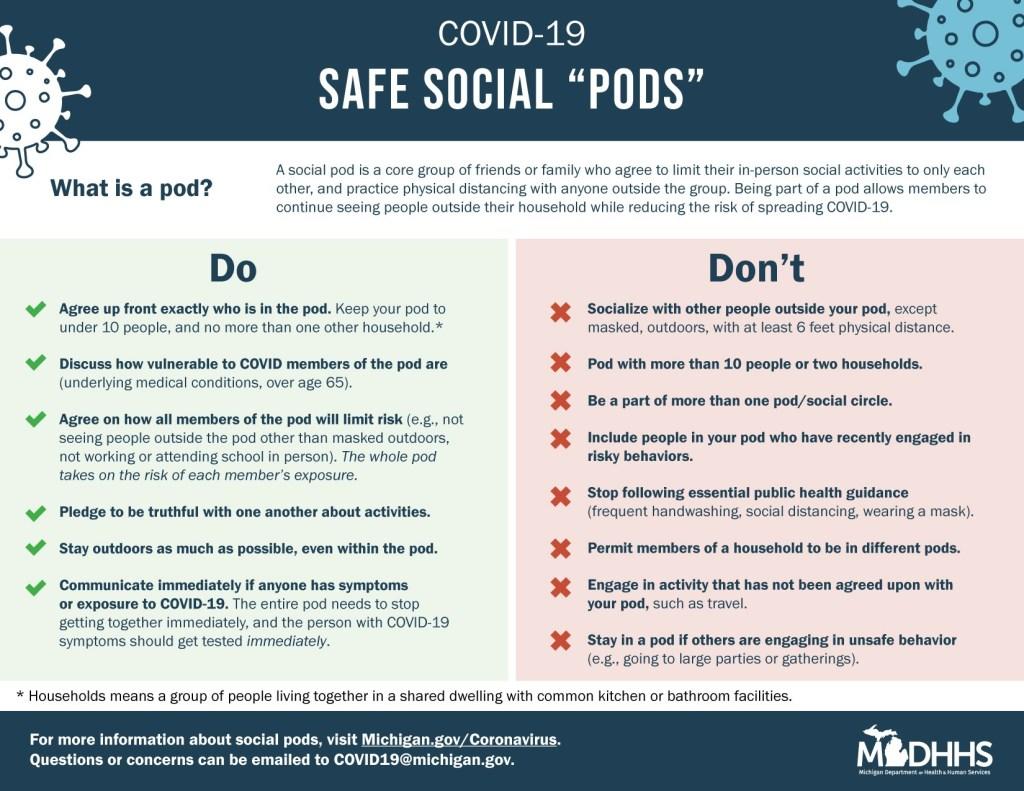
Under this order, indoor residential gatherings are limited to two households at any one time. However, MDHHS strongly urges families to pick a single other household to interact with over the next three weeks, consistent with new guidance released by the department. The order is aimed at limiting residential and non-residential gatherings where COVID-19 spreads rapidly. (source)

People should create “social pods” (I swear I could not make this up) to determine with whom you can “safely” spend time.

If you disobey and are busted having more than two households together at a time, you could face misdemeanor charges, thousand dollar fines, or even imprisonment.

For violations, MDHHS set forth rules instituting a civil fine up to $1,000. Violations may also be treated as a misdemeanor punishable by imprisonment for up to six months. Michigan’s official website also provides information for individuals to report violators to the state.

“If MDHHS receives an allegation of a violation of the department’s order, the department will refer the matter to the local health department or law enforcement,” said Lynn Sutfin, spokeswoman for MDHHS, as reported by Michigan Capitol Confidential.

“The first remediation method is to discuss the situation with the person responsible for the violation and attempt to resolve the situation without issuing a citation,” Sutfin told Michigan Capitol Confidential. “The local health department or MDHHS — as a referral from the Michigan State Police — may issue an administrative citation for violating the department’s order. The department hopes that residents will do the right thing and follow these orders to save lives and protect their family, friends and community from further spread of COVID-19.” (source)

Albuquerque, New Mexico

The Albuquerque PD is spread thin but they’ll still dispatch officers if a large gathering is reported.

Because of COVID health concerns, the state public health order does not allow large gatherings. That includes Thanksgiving. KOAT asked how APD would handle it if someone called to report neighbors having a large gathering.

“It would ultimately be dispatched but it would be a lower priority than an emergency call with somebody being injured or a crime in progress,” said APD Deputy Chief Mike Smathers.

He says APD would make sure violators are aware of health concerns.

“To hopefully just educate people but if it came to it we would have to enforce the public health order,” Smathers said.

He said if people are warned but continue to disregard the health order, they could face a $100 fine. (source)

So remember, it’s cheaper to get busted in New Mexico than in Michigan.

New York

New York Gov. Andrew Cuomo has said no more than ten guests can be present in a household but that enforcement is up to individual local authorities to enforce the mandate.

Niagara County Sheriff Michael Filicetti said he’s not going to send officers around to patrol for violators, but they’ll “investigate” reports.

Of course, as is the case with any law enforcement agency, the Niagara County Sheriff’s Office would investigate a complaint if one were lodged and provided it had someone available to respond.

When asked what a deputy might do if someone called in on a neighbor and alleged they had more people in their home for dinner than Cuomo’s executive order would allow, Filicetti replied, “If we responded to that type of complaint, we can certainly advise a homeowner of what the new protocol is. But as far as taking enforcement action, I just don’t see that.”

Filicetti said none of his deputies will be directed to enter homes and count heads, or order anyone away from the Thanksgiving table.

Filicetti noted this is also in part because his department has yet to receive any enforcement guidelines from the state when it comes to gatherings in private homes. (source)

Don’t hold your breath on New York remaining mellow on enforcement – NYC wants to pay people to snitch on those who park illegally and Mayor de Blasio already tried to start a tip line for social distance violators, so it’s not a huge stretch of the imagination to believe they’d also welcome Thanksgiving snitching.

Oregon

Governor Kate Brown of Oregon heartily encourages citizens to call the cops and rat out their neighbors who have more than 6 people gathered.

Days before Thanksgiving, Oregon Gov. Kate Brown said she believes residents who know their neighbors are violating the most recent round of COVID-19 protocols, which includes capping the number of people allowed in your home at six, should call the police.

“This is no different than what happens if there’s a party down the street and it’s keeping everyone awake,” Brown said in an interview Friday. “What do neighbors do [in that case]? They call law enforcement because it’s too noisy. This is just like that. It’s like a violation of a noise ordinance.” (source)

Oregonian violators could “face up to 30 days in jail, $1,250 in fines or both.”

The University of Chicago

Reporting your fellow humans has never been easier than it is at the University of Chicago, where they’ve got a handy-dandy form you can fill out and snitch anonymously.

Please make sure you call 123 (on-campus phone) or 773.702.8181 (off-campus phone) for accidents to ensure the appropriate emergency response personnel are notified.

Involved individuals, supervisors, affected persons, or witnesses can submit reports. Anonymous reporting is available for events that do not require medical treatment. For more information about UCAIR, visit the FAQs page.

Please use this form to report any concerns about COVID-19 related public health violations (including anonymously, if preferred), such as:

*   Concerns about PPE usage
*   Concerns about social distancing and density
*   Concerns about cleaning and disinfection
*   Concerns about individuals at work who should not be (please describe)
*   Any other COVID-19 related public health concern

Vermont

Just in case teaching university age kids to snitch isn’t indoctrinating our youth early enough, Vermont has upped the game. Vermont has prohibited all gatherings of more than one household and Governor Phil Scott is urging schools to interrogate the kiddos when they return to school after the holiday.

According to Governor Scott there’s absolutely no excuse to have an in-person Thanksgiving this year.

At least one person in Vermont is grateful for the Stasi…I mean Mao…I mean Gov. Scott…for getting children to snitch on their parents. She made her thoughts known with this fawning reply.

Officials hope people will tell the truth.

Vermont Education Secretary Dan French told the Burlington Free Press that state officials hope that families will be honest in answering their questions about Thanksgiving plans.

“Schools operate on trust with their parents and their students, and we’re hopeful this guidance will give them some additional tools to help everyone do the right thing and keep school safe,” French said.

The outlet noted that the rules against households interacting does not apply in the workplace, at retail stores, or in schools. (source)

Happy Snitchgiving

With all the mistrust already brewing in our nation, this will be like throwing gasoline onto the fire.

via ZeroHedge News https://ift.tt/2JdJX23 Tyler Durden

Rabobank: “Should We Be Thankful For This Central-Bank Support?”

Rabobank: “Should We Be Thankful For This Central-Bank Support?”

Tyler Durden

Thu, 11/26/2020 – 14:35

By Michael Every of Rabobank

Today is Thanksgiving in the US, a public holiday that generally confuses non-Americans, but which all understand involves markets and businesses closing. Most of America is therefore out today. Not that we weren’t short of news in the run-up, which all of us get to digest globally while Americans do the same with their Turkeys.

First and foremost, US economic data yesterday were not much to be thankful for in some key areas: initial claims in particular spiked again to 778K, far worse than the 730K expected; durable goods then surprised to the upside with a 1.3% rise and an upward revision to the previous month; that was followed by personal income, which collapsed -0.7% m/m while spending was up 0.5%; and then new home sales came in stronger than expected at 999K.

The FOMC minutes also underlined that fact. Nothing changed in election week, as expected. However, the message they send is that we are likely to see further changes (read ‘increases’) to QE as soon as the mid-December meeting.

Should we be thankful for this central-bank support or not? Where would we be without it? Yet where are we going with it? And what is it doing to us while we are doing it? It is akin to having a Thanksgiving dinner consisting of two whole cans of cranberry sauce alongside a small serving of Turkey with no trimmings: better than nothing if you are hungry, fun for some perhaps, and certainly a sugar high – but a great way to get acid reflux, diabetes, heart disease, and dental problems if you keep it up.

Thanksgiving is also traditionally a time of coming together and unity. However, despite the usual statesmanlike homilies for the same from the Biden camp, there is still little evidence of such today.

Out of the spotlight of a US media which has so many socks to look at and so little time, the Pennsylvania State Senate yesterday held a public hearing where the Trump legal team produced a flood of complaints of election irregularities (that only mentioned Hugo Chavez as a tangent); Michigan and Arizona legislatures will hold public hearings next week; a Nevada judge has allowed an evidentiary hearing on 3 December; the partial recount in Wisconsin drags on; new court cases have been filed over the constitutionality of the voting process in several states; and recall only after a state vote-count is certified can its public file an actual election contest – which will now surely follow. In short, this is probably going to drag on into December and could likely end up in the Supreme Court. Yes, a Trump legal reversal is still a long shot; but his defeat is going to be polarizing rather than uniting.

Relatedly, President Trump also elicited a bipolar response with a pardon for his ex-national security advisor Flynn yesterday (‘In like Flynn’ is now ‘Out like Flynn’): those who believe the 2016 election was somehow rigged are furious; those who believe the 2020 election was somehow rigged are ecstatic. Equally, initial Biden policy proposals being floated will appeal to his base but not Trump’s: amnesty for 11m illegal aliens; cancelling student loan-debt; and taxing ownership of guns. In short, K-street in DC, where the lobbyists play, is going to have a K-shaped economy and society as its backdrop: which it has long had, of course – but now it’s far, far worse. Is that an environment that says higher or lower rates? Does it say a stronger or weaker USD? Part of that depends on what the rest of the world is doing too, of course.

Isn’t the above also a backdrop that suggests the need for more unity via the one thing everyone in Congress now seems to agree on: China-hawkery? Which might explain why Beijing offered an olive branch yesterday via its press and its official congratulations to Biden. (And as an aside, note an official order from China’s Premier yesterday to “tell the truth” about the economy.)

Meanwhile, the rest of the world carries on as usual. That means further uncertainty over where we stand in the Brexit process, even as final deadline after final deadline continues to pass. The French are now accusing the British of foot-dragging, and the EU and UK sides remain “extremely far apart”, apparently. Well, there is a lot of that about. The coming days will be “decisive”, says the EU’s von der Leyen. How many times have we heard that one? Perhaps the Brits could try to synchronise with the US Supreme Court for maximum market attention(?)

Within the EU, the stand-off between Poland and Hungary (and Slovenia) over the rule of law element of the proposed Rubicon-crossing USD2 trillion fiscal stimulus package also continues. Hungary’s PM Orban has told German Chancellor Merkel that what she’s asking for is political ‘suicide’, and Orban and Polish leader Morawiecki will meet today. One wonders what they will say. Like I said, there is a lot of “extremely far apart” about.

Regardless, we do all have something to be thankful for – the virus vaccines that appear to offer some of us (at first) light at the end of at least one dark, cramped, locked-down tunnel. It’s just that the other end of the tunnel is still quite far off for many, very far off for poorer emerging markets, and still does not lead back into a landscape of sunshine and roses by any means, as we see above.

Yet markets really do have so much to be thankful for. The fear and greed index is all the way up to ‘greed’, longs are all in and short are all caught, and global equities continue to gorge themselves on can after can after can of quivering, crimson, tart-yet-sugary central-bank cranberry sauce. After all, in this case it is other people who will be getting the acid reflux, diabetes, heart disease, and dental problems.

Happy Thanksgiving!

via ZeroHedge News https://ift.tt/39n7Fnl Tyler Durden

Roman Catholic Diocese Part VI: The Scope of the Court’s Remedy

This post is the sixth installment in my series on Roman Catholic Diocese of Brooklyn v. Cuomo. Part I focused on the end of the South Bay “superprecedent.” Part II focused on Jacobson v. Massachusetts. Part III focused on the Free Exercise Clause. Part IV focused on mootness. Part V focused on the distinction between “essential” and “non-essential” services.

What happens now? This case arose in a very unique context. The Diocese and Agudath Israel sought an injunction pending the Second Circuit’s disposition of the appeal. Here is how the Court described its remedy in the Diocese case:

Respondent is enjoined from enforcing Executive Order 202.68’s 10- and 25-person occupancy limits on applicant pending disposition of the appeal in the United States Court of Appeals for the Second Circuit and disposition of the petition for a writ of certiorari, if such writ is timely sought. Should the petition for a writ of certiorari be denied, this order shall terminate automatically. In the event the petition for a writ of certiorari is granted, the order shall terminate upon the sending down of the judgment of this Court.

The Court issued a similar order in the Agudath Israel case:

Respondent is enjoined from enforcing Executive Order 202.68’s 10-and 25-person occupancy limits on applicants, including Agudath Israel of America’s current New York-based affiliates, pending disposition of the appeal in the United States Court of Appeals for the Second Circuit and disposition of the petition for a writ of certiorari, if such writ is timely sought. Should the petition for a writ of certiorari be denied, this order shall terminate automatically. In the event the petition for a writ of certiorari is granted, the order shall terminate upon the sending down of the judgment of this Court.

Justice Kavanaugh’s concurrence offered a more succinct version of the order:

I vote to grant the applications of the Roman Catholic Diocese of Brooklyn and Agudath Israel of America for temporary injunctions against New York’s 10-person and 25- person caps on attendance at religious services. On this record, temporary injunctions are warranted because New York’s severe caps on attendance at religious services likely violate the First Amendment. Importantly, the Court’s orders today are not final decisions on the merits. Instead, the Court simply grants temporary injunctive relief until the Court of Appeals in December, and then this Court asappropriate, can more fully consider the merits.

But at present, the 10- and 25- person occupancy limits do not currently apply to the applicants. So does anything actually change?

According to Governor Cuomo, nothing changes. From the New York Times:

Mr. Cuomo, a third-term Democrat, insisted that the 5-4 decision “doesn’t have any practical effect” because the restrictions on religious services in Brooklyn, as well as similar ones in Queens and the city’s northern suburbs, had since been eased after the positive test rates in those areas had declined.

But the 10- and 25-person limits are in effect for other parts of New York, including my hometown of Staten Island. Cuomo’s counsel argued that the Court’s order did not apply statewide, but only with respect to the applicants in Brooklyn:

After Mr. Cuomo’s remarks, Beth Garvey, his legal counsel, said that the state believed the court’s opinion affected only the now-lapsed restrictions in Brooklyn, and that the other six zones would remain intact. Still, she added that officials would “be looking around the state at the other zones” and evaluating capacity restrictions in the most infected areas, also suggesting the state would continue to argue the case at a lower court level.

Here, Cuomo is arguing against a statewide injunction. My general view is that relief must be limited to the parties. But this decision has set an important new precedent (assuming the shadow docket can even establish precedents). And other courts will now have to follow that precedent.

What will Cuomo do? Justice Breyer offered some advice in his dissent:

I add that, in my view, the Court of Appeals will, and should, act expeditiously. The State of New York will, and should, seek ways of appropriately recognizing the religious interests here at issue without risking harm to the health and safety of the people of New York. But I see no practical need to issue an injunction to achieve these objectives.

If I had to guess, Cuomo will eliminate the hard cap, and peg the number of attendees to the size of the venue. Maybe 10 or 20% of the occupancy limit? A temple that holds at thousand people can safely hold 100 worshippers. Cuomo should have taken this approach at the outset. Of course, if Cuomo does nothing, then temples and churches can meet without any occupancy limit. He will take some temporary measure.

The Second Circuit will probably rule by the end of the year. At which point, the Supreme Court can grant certiorari, and maybe argue the case by March or April. At that point, the case will be squarely presented before the Court, outside the context of an injunction pending appeal. And, I think, the Chief would rule for the Diocese.

from Latest – Reason.com https://ift.tt/39ft55X
via IFTTT

SCOTUS Blocks New York’s COVID-19 Restrictions on Houses of Worship, Saying They Are Not ‘Narrowly Tailored’

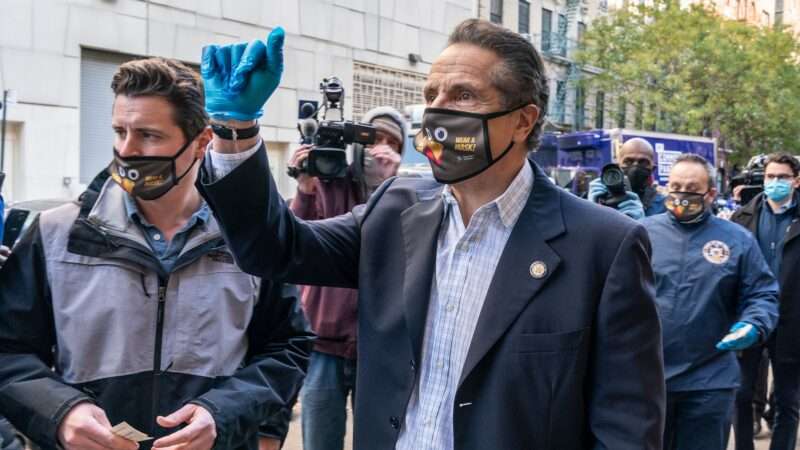
Andrew-Cuomo-11-25-20-Newscom-cropped

The Supreme Court yesterday enjoined enforcement of New York Gov. Andrew Cuomo’s COVID-19 restrictions on “houses of worship,” concluding that they probably violate the First Amendment’s guarantee of religious freedom. The Brooklyn churches and synagogues that challenged Cuomo’ rules, which limit attendance at religious services to 10 people in “red” zones and 25 in “orange” zones, “have made a strong showing that the challenged restrictions violate ‘the minimum requirement of neutrality’ to religion,” five justices concluded.

This is the third time that the Court has considered applications for emergency injunctions against pandemic-inspired limits on religious gatherings. In the two earlier cases, involving restrictions imposed by California and Nevada, the Court said no. Those decisions were backed by Chief Justice John Roberts, along with Justices Ruth Bader Ginsburg, Stephen Breyer, Elena Kagan, and Sonia Sotomayor. Justices Clarence Thomas, Samuel Alito, Neil Gorsuch, and Brett Kavanaugh dissented both times. This time around, the replacement of Ginsburg with Amy Coney Barrett proved decisive, as the recently confirmed justice sided with Thomas et al. in granting the injunction sought by the Roman Catholic Diocese of Brooklyn and Agudath Israel of America, which sued on behalf of the Orthodox synagogues it represents.

The Court has said the First Amendment’s Free Exercise Clause does not require religious exemptions from neutral, generally applicable laws. But it also has said laws are presumptively unconstitutional when they discriminate against religion.

New York’s restrictions “cannot be viewed as neutral because they single out houses of worship for especially harsh treatment,” the majority says. In red zones, businesses deemed “essential”—including supermarkets, convenience stores, hardware stores, pet stores, liquor stores, laundromats, acupuncturists, banks, and various offices—operate without capacity limits. “The disparate treatment is even more striking in an orange zone,” the Court notes. “While attendance at houses of worship is limited to 25 persons, even non-essential businesses may decide for themselves how many persons to admit.”

Those distinctions “lead to troubling results,” the justices point out. “A health department official testified about a large store in Brooklyn that could ‘literally
have hundreds of people shopping there on any given day,'” they say. “Yet a
nearby church or synagogue would be prohibited from allowing more than 10 or 25 people inside for a worship service. And the Governor has stated that factories and
schools have contributed to the spread of COVID–19, but they are treated less harshly than the Diocese’s churches and Agudath Israel’s synagogues, which have admirable safety records.”

Since Cuomo’s rules are not neutral, the Court says, they can be upheld only if they survive “strict scrutiny,” which requires that they be “narrowly tailored” to serve a “compelling” state interest. “Stemming the spread of COVID–19 is unquestionably a compelling interest, but it is hard to see how the challenged regulations can be regarded as ‘narrowly tailored,'” it says. “They are far more restrictive than any
COVID–related regulations that have previously come before the Court, much tighter than those adopted by many other jurisdictions hard-hit by the pandemic, and far more severe than has been shown to be required to prevent the spread of the virus at the applicants’ services.”

Cuomo’s order was prompted by COVID-19 clusters tied to some Haredi institutions in Brooklyn. But both Roman Catholic churches and synagogues affiliated with Agudath Israel in the borough have been carefully following COVID-19 safeguards, and neither have seen any outbreaks since reopening.

“Not only is there no evidence that the applicants have contributed to the spread of COVID–19,” the Court says, “but there are many other less restrictive rules that could be adopted to minimize the risk to those attending religious services. Among
other things, the maximum attendance at a religious service could be tied to the size of the church or synagogue.” Under the challenged rules, the 10-person and 25-person limits apply regardless of a building’s size. “It is hard to believe that admitting more than 10 people to a 1,000-seat church or 400-seat synagogue would create a more serious health risk than the many other activities that the State allows,” the justices observe.

In a concurring opinion, Justice Gorsuch questions the relevance of Jacobson v. Massachusetts, a 1905 precedent often cited as a justification for COVID-19 restrictions. “Jacobson hardly supports cutting the Constitution loose during a pandemic,” he says.

In that case, the Court rejected Henning Jacobson’s argument that requiring him to be vaccinated against smallpox (or pay a fine for failing to do so) violated his right to “bodily integrity,” which he said was protected by “substantive due process” under the 14th Amendment. The Court “essentially applied rational basis review,” Gorsuch says, which is consistent with its current approach in 14th Amendment cases that do not involve a fundamental right or a suspect classification such as race. Here, by contrast, the Court’s free exercise precedents require strict scrutiny, a much tougher test.

Gorsuch also notes that Jacobson, unlike the plaintiffs in this case, was not relying on a specifically enumerated right. “Even if judges may impose emergency restrictions on rights that some of them have found hiding in the Constitution’s penumbras,” he says, “it does not follow that the same fate should befall the textually explicit right to religious exercise.”

Finally, Gorsuch says, New York’s restrictions on religious services are notably harsher than the vaccine mandate to which Jacobson objected. “In Jacobson, individuals could accept the vaccine, pay the fine, or identify a basis for exemption,” he notes. “The imposition on Mr. Jacobson’s claimed right to bodily integrity, thus, was avoidable and relatively modest….Here, by contrast, the State has effectively sought to ban all traditional forms of worship in affected ‘zones’ whenever the Governor decrees and for as long as he chooses. Nothing in Jacobson purported
to address, let alone approve, such serious and long-lasting intrusions into settled constitutional rights. In fact, Jacobson explained that the challenged law survived only because it did not ‘contravene the Constitution of the United States’ or ‘infringe any right granted or secured by that instrument.'”

Gorsuch, like Alito and Kavanaugh, is worried that the COVID-19 pandemic has become a rationale for suspending well-established constitutional rights. “Government is not free to disregard the First Amendment in times of crisis,” he writes. “At a minimum, that Amendment prohibits government officials from treating religious exercises worse than comparable secular activities, unless they
are pursuing a compelling interest and using the least restrictive means available. Yet recently, during the COVID pandemic, certain States seem to have ignored these long-settled principles….While the pandemic poses many grave challenges, there is no world in which the Constitution tolerates color-coded executive edicts that reopen liquor stores and bike shops but shutter churches, synagogues, and mosques.”

Writing in dissent, Roberts says there is no need to grant an injunction right now, because Cuomo recently changed the color coding of the neighborhoods where the plaintiffs’ churches and synagogues are located. “None of the houses of worship identified in the applications is now subject to any fixed numerical restrictions,” he writes. “At these locations, the applicants can hold services with up to 50% of capacity, which is at least as favorable as the relief they currently seek.” But as the majority notes, that mid-litigation switch does not eliminate the threat posed by the power Cuomo is asserting, since he can reimpose the original restrictions whenever he wants.

Breyer, joined by Kagan and Sotomayor, cites the same rationale for denying an injunction. But he also thinks “it’s far from clear” that the original capacity caps, which “are indeed low,” violate the Free Exercise Clause. “We have previously recognized that courts must grant elected officials ‘broad’ discretion when they ‘undertake to act in areas fraught with medical and scientific uncertainties,'” he says, quoting Roberts’ concurring opinion in the California case. “That is because the ‘Constitution principally entrusts the safety and the health of the people to the
politically accountable officials of the States.'”

In a dissenting opinion joined by Kagan, Sotomayor questions the plaintiffs’ argument that New York is treating houses of worship differently from secular venues that pose similar risks of virus transmission. The right comparison, she says, is not between religious services and the myriad secular activities that are not subject to occupancy limits. Rather, Sotomayor thinks, religious services are in the same class as “comparable secular gatherings” in theaters, lecture and music halls, and sports stadiums where “large groups of people gather in close proximity for extended periods of time.” As long as a state does not treat those venues more leniently than churches and synagogues, Sotomayor says, its rules are neutral, and “that should be enough to decide this case.”

Although that argument appeals to defenders of broad COVID-19 restrictions, it breaks down when you consider the reality of what New York is allowing vs. what it is prohibiting. “Large groups gather in close proximity for extended periods of time” in many of the businesses that New York has given more leeway than it allows houses of worship, including supermarkets, restaurants, factories, and big-box stores like Target.

“Even a pre-COVID Catholic Mass—typically lasting less than an hour on Sundays, less on weekdays—was shorter than many trips to a supermarket or big-box store, not to mention a nine-to-five office job,” the Roman Catholic Diocese of Brooklyn notes. “Mass is now even shorter, thanks to measures undertaken proactively and voluntarily by the Diocese.” As for “close proximity,” that has been addressed by the physical distancing rules that the diocese and Agudath Israel both enforce.

Agudath Israel synagogues “have carefully and successfully complied with mask requirements, social distancing, and capacity constraints,” the organization says. “Yet the Governor’s guilt-by-religious-association restrictions have made it impossible for Applicants and their members to exercise their religious faith.”

The plaintiffs in this case are prepared to follow the same rules that apply to secular establishments where the risk of virus transmission is similar. But they understandably object to rules that explicitly impose special burdens on houses of worship, especially when they are accompanied by rhetoric implying that the governor decided to target an entire religious community for the lapses of some members.

As Agudath Israel notes, Cuomo “threatened ‘members of the ultra-Orthodox community’ that ‘[i]f you do not agree to enforce the rules, then we’ll close the [religious] institutions down.'” He described the COVID-19 cluster in Brooklyn as “predominantly an ultra-Orthodox cluster” and “identified ‘the ultra-Orthodox community’ as causing the ‘problem,’ putting any doubt regarding his religious targeting to rest.”

Cuomo himself described his policy as “a fear-driven response,” saying, “This is not a policy being written by a scalpel. This is a policy being cut by a hatchet.” The Supreme Court is saying, as it has for many years, that more care is required when the government impedes religious freedom.

from Latest – Reason.com https://ift.tt/33mWZRT
via IFTTT

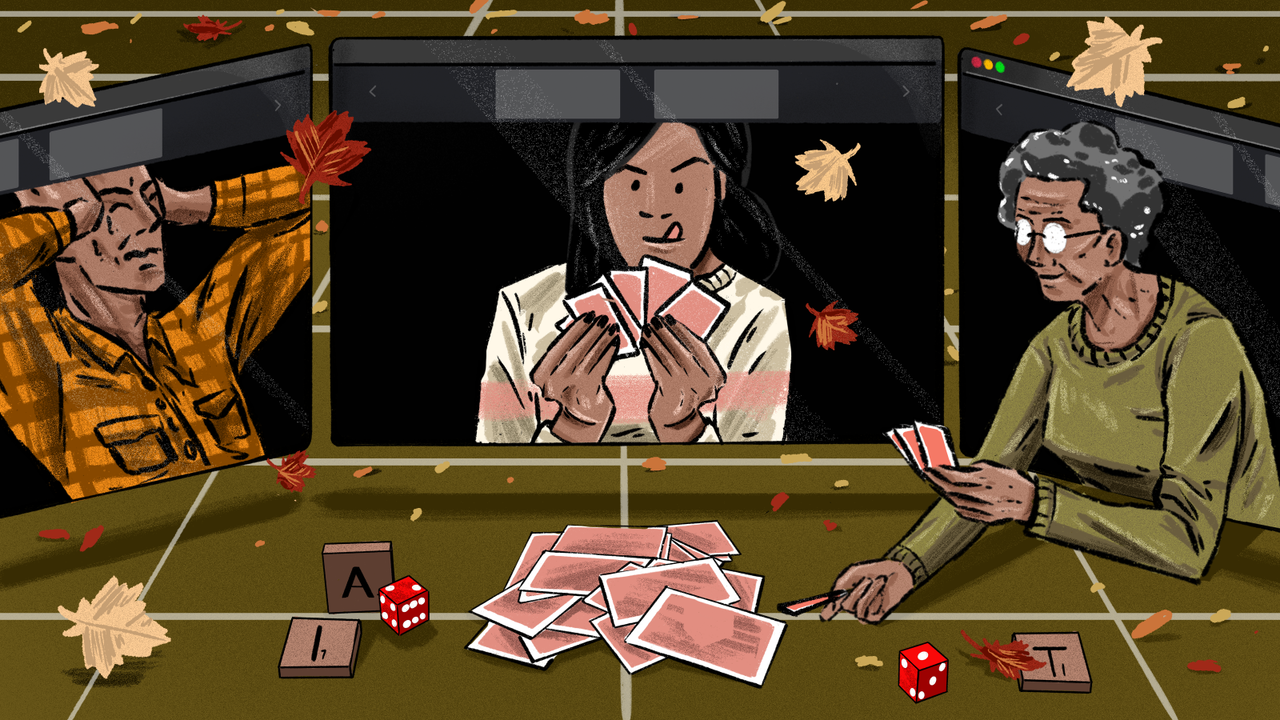
11 Games You Can Play With The Family Remotely Over Zoom For Thanksgiving

11 Games You Can Play With The Family Remotely Over Zoom For Thanksgiving

Tyler Durden

Thu, 11/26/2020 – 14:10

Authored by David Nield via Gizmodo.com,

Unless you spend every year sheltering in place and worrying about a global pandemic, the upcoming holiday season is going to be different for a lot of us.

Video calling apps like Zoom can keep us in touch with each other even while we’re apart, and these online and offline games will save you from having to make up small talk at the same time.

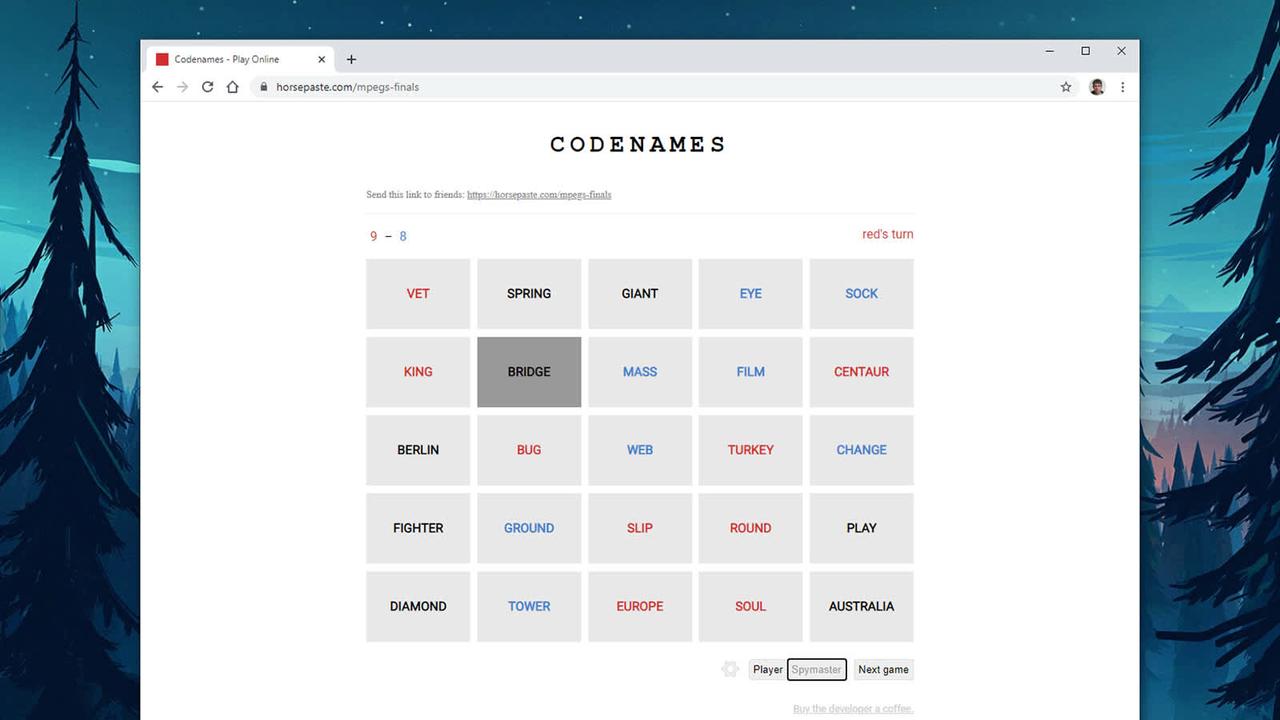
1) Codenames (Free)

Screenshot: Codenames

Codenames sees two teams compete on a shared online grid filled with words: The aim is to clear your team’s words as quickly as possible. Each team nominates a spymaster who must give clues to their teammates to guess as many words as possible each time—so “day” would be a clue for both “time” and “light” for example. The more words hit with the fewest clues, the quicker the board is cleared, and the greater your chance of victory.

2) Scavenger Hunt (free)

A good one for getting people up and moving, and even working in teams if there are several different people crowded around each laptop or webcam. You can make the scavenger hunt as long and hard or as short and easy as you like, with the objective to collect specific objects, or objects that match certain criteria, from around the home. Add points for speed and for the creativity of the choice of objects to keep it competitive. Good Housekeeping has a solid list of ideas for clues to start with.

3) Kahoot (freemium)

Screenshot: Kahoot

You can easily do a Zoom quiz with pens and paper of course, but if you want something digital then Kahoot can help. Essentially it lets you create a slideshow of multiple choice questions, which everyone shares through their web browser, and Kahoot handles all the admin when it comes to voting and tallying the scores. The free plan lets you share a Kahoot quiz with up to 10 people at once, with customized options for timing and points.

4) Wikipedia Races (free)

For this game every player needs to have Wikipedia open on a device, whether it’s a laptop, a tablet or a phone. You then give players the same starting page and ending page, and the person to make their way from one to the other in the quickest time is the winner. The key rule is that you can only get around the encyclopedia by clicking or tapping on Wikipedia links—so players need to think smartly about which links they decide to follow. The Wiki Game is a good site to use if you don’t want to come up with your own criteria.

5) Scattergories (free)

Screenshot: Swellgarfo

This particular online version of the classic game gives you and your fellow Zoomers a simple interface, which one person will have to screen share. As always, the aim of the game is to come up with words starting with the same letter that fit the categories listed: An animal, form of transport, place and object starting with M, perhaps. You can easily customize the number of categories required, and the time limit to come up with words.

6) Empires (free)

A classic group game that works fine over video chat: One adjudicator privately asks for a word or phrase from everyone else, which could be based on food, animals, movies, places, or anything else. The whole list then gets read out, and players take turns to match words or phrases to other players—guess right, and that person joins your ‘empire’ and you collectively get to guess again. The biggest empire when everyone is matched wins.

7) Drawful 2 ($10)

Screenshot: Drawful 2

Jackbox Games makes a ton of games suitable for sharing over Zoom, but Drawful 2 is probably our favorite, and it’s well worth the price of admission. Everyone needs access to two devices (like a laptop and a phone), and the game puts up weird and wacky individual prompts for you to draw quick sketches to. Players then guess the original prompts from the final pictures, with points dished out for both artistic prowess and guessing ability.

8) Charades (free)

Look, sometimes the classic games are the best—even if you’re only meeting family members over Zoom, you can still get a game of charades set up virtually. You’ll need to split everyone up into two or more teams, and then get together a list of prompts to act out or have people come up with their own. There are all kinds of variations you can come up with too, from making the prompts themed to limiting the sort of actions that can be used.

9) The Hike (free)

Screenshot: The Hike

Originally written as a team building exercise for employees working remotely, The Hike is now available for anyone to try for free. One storyteller guides the rest of the group, split up into competing teams, with shared slides that create a ‘choose your own adventure’ experience—you’ll need to make group decisions via an instant messaging platform of your choice to make sure your team survives the night and makes it out of the woods.

10) Pictionary (free)

You can make use of the shared whiteboard on Zoom for a game of Pictionary, where the aim is to get your teammates to be able to guess particular prompts from your drawing of them. The prompts could be words or phrases, or movies, or places in the world, or even members of the family. If drawing on the screen in Zoom isn’t something that everyone is comfortable with, then you can always use old-fashioned paper and pens instead.

11) No More Jockeys (free)

Screenshot: YouTube

As invented by three British comedians, this game requires nothing but imagination and a good memory. When it’s your turn, you name a well-known person (e.g. George Clooney) and a category they fit into (e.g. actors)—future submissions must then avoid all previous categories. You’ll quickly be limited in what you can say, as contestants suggest no more singers, no more left-handers, no more Biblical characters, or indeed no more jockeys.

via ZeroHedge News https://ift.tt/33kcIkG Tyler Durden

Roman Catholic Diocese Part VI: The Scope of the Court’s Remedy

This post is the sixth installment in my series on Roman Catholic Diocese of Brooklyn v. Cuomo. Part I focused on the end of the South Bay “superprecedent.” Part II focused on Jacobson v. Massachusetts. Part III focused on the Free Exercise Clause. Part IV focused on mootness. Part V focused on the distinction between “essential” and “non-essential” services.

What happens now? This case arose in a very unique context. The Diocese and Agudath Israel sought an injunction pending the Second Circuit’s disposition of the appeal. Here is how the Court described its remedy in the Diocese case:

Respondent is enjoined from enforcing Executive Order 202.68’s 10- and 25-person occupancy limits on applicant pending disposition of the appeal in the United States Court of Appeals for the Second Circuit and disposition of the petition for a writ of certiorari, if such writ is timely sought. Should the petition for a writ of certiorari be denied, this order shall terminate automatically. In the event the petition for a writ of certiorari is granted, the order shall terminate upon the sending down of the judgment of this Court.

The Court issued a similar order in the Agudath Israel case:

Respondent is enjoined from enforcing Executive Order 202.68’s 10-and 25-person occupancy limits on applicants, including Agudath Israel of America’s current New York-based affiliates, pending disposition of the appeal in the United States Court of Appeals for the Second Circuit and disposition of the petition for a writ of certiorari, if such writ is timely sought. Should the petition for a writ of certiorari be denied, this order shall terminate automatically. In the event the petition for a writ of certiorari is granted, the order shall terminate upon the sending down of the judgment of this Court.

Justice Kavanaugh’s concurrence offered a more succinct version of the order:

I vote to grant the applications of the Roman Catholic Diocese of Brooklyn and Agudath Israel of America for temporary injunctions against New York’s 10-person and 25- person caps on attendance at religious services. On this record, temporary injunctions are warranted because New York’s severe caps on attendance at religious services likely violate the First Amendment. Importantly, the Court’s orders today are not final decisions on the merits. Instead, the Court simply grants temporary injunctive relief until the Court of Appeals in December, and then this Court asappropriate, can more fully consider the merits.

But at present, the 10- and 25- person occupancy limits do not currently apply to the applicants. So does anything actually change?

According to Governor Cuomo, nothing changes. From the New York Times:

Mr. Cuomo, a third-term Democrat, insisted that the 5-4 decision “doesn’t have any practical effect” because the restrictions on religious services in Brooklyn, as well as similar ones in Queens and the city’s northern suburbs, had since been eased after the positive test rates in those areas had declined.

But the 10- and 25-person limits are in effect for other parts of New York, including my hometown of Staten Island. Cuomo’s counsel argued that the Court’s order did not apply statewide, but only with respect to the applicants in Brooklyn:

After Mr. Cuomo’s remarks, Beth Garvey, his legal counsel, said that the state believed the court’s opinion affected only the now-lapsed restrictions in Brooklyn, and that the other six zones would remain intact. Still, she added that officials would “be looking around the state at the other zones” and evaluating capacity restrictions in the most infected areas, also suggesting the state would continue to argue the case at a lower court level.

Here, Cuomo is arguing against a statewide injunction. My general view is that relief must be limited to the parties. But this decision has set an important new precedent (assuming the shadow docket can even establish precedents). And other courts will now have to follow that precedent.

What will Cuomo do? Justice Breyer offered some advice in his dissent:

I add that, in my view, the Court of Appeals will, and should, act expeditiously. The State of New York will, and should, seek ways of appropriately recognizing the religious interests here at issue without risking harm to the health and safety of the people of New York. But I see no practical need to issue an injunction to achieve these objectives.

If I had to guess, Cuomo will eliminate the hard cap, and peg the number of attendees to the size of the venue. Maybe 10 or 20% of the occupancy limit? A temple that holds at thousand people can safely hold 100 worshippers. Cuomo should have taken this approach at the outset. Of course, if Cuomo does nothing, then temples and churches can meet without any occupancy limit. He will take some temporary measure.

The Second Circuit will probably rule by the end of the year. At which point, the Supreme Court can grant certiorari, and maybe argue the case by March or April. At that point, the case will be squarely presented before the Court, outside the context of an injunction pending appeal. And, I think, the Chief would rule for the Diocese.

from Latest – Reason.com https://ift.tt/39ft55X
via IFTTT

SCOTUS Blocks New York’s COVID-19 Restrictions on Houses of Worship, Saying They Are Not ‘Narrowly Tailored’

Andrew-Cuomo-11-25-20-Newscom-cropped

The Supreme Court yesterday enjoined enforcement of New York Gov. Andrew Cuomo’s COVID-19 restrictions on “houses of worship,” concluding that they probably violate the First Amendment’s guarantee of religious freedom. The Brooklyn churches and synagogues that challenged Cuomo’ rules, which limit attendance at religious services to 10 people in “red” zones and 25 in “orange” zones, “have made a strong showing that the challenged restrictions violate ‘the minimum requirement of neutrality’ to religion,” five justices concluded.

This is the third time that the Court has considered applications for emergency injunctions against pandemic-inspired limits on religious gatherings. In the two earlier cases, involving restrictions imposed by California and Nevada, the Court said no. Those decisions were backed by Chief Justice John Roberts, along with Justices Ruth Bader Ginsburg, Stephen Breyer, Elena Kagan, and Sonia Sotomayor. Justices Clarence Thomas, Samuel Alito, Neil Gorsuch, and Brett Kavanaugh dissented both times. This time around, the replacement of Ginsburg with Amy Coney Barrett proved decisive, as the recently confirmed justice sided with Thomas et al. in granting the injunction sought by the Roman Catholic Diocese of Brooklyn and Agudath Israel of America, which sued on behalf of the Orthodox synagogues it represents.

The Court has said the First Amendment’s Free Exercise Clause does not require religious exemptions from neutral, generally applicable laws. But it also has said laws are presumptively unconstitutional when they discriminate against religion.

New York’s restrictions “cannot be viewed as neutral because they single out houses of worship for especially harsh treatment,” the majority says. In red zones, businesses deemed “essential”—including supermarkets, convenience stores, hardware stores, pet stores, liquor stores, laundromats, acupuncturists, banks, and various offices—operate without capacity limits. “The disparate treatment is even more striking in an orange zone,” the Court notes. “While attendance at houses of worship is limited to 25 persons, even non-essential businesses may decide for themselves how many persons to admit.”

Those distinctions “lead to troubling results,” the justices point out. “A health department official testified about a large store in Brooklyn that could ‘literally
have hundreds of people shopping there on any given day,'” they say. “Yet a
nearby church or synagogue would be prohibited from allowing more than 10 or 25 people inside for a worship service. And the Governor has stated that factories and
schools have contributed to the spread of COVID–19, but they are treated less harshly than the Diocese’s churches and Agudath Israel’s synagogues, which have admirable safety records.”

Since Cuomo’s rules are not neutral, the Court says, they can be upheld only if they survive “strict scrutiny,” which requires that they be “narrowly tailored” to serve a “compelling” state interest. “Stemming the spread of COVID–19 is unquestionably a compelling interest, but it is hard to see how the challenged regulations can be regarded as ‘narrowly tailored,'” it says. “They are far more restrictive than any
COVID–related regulations that have previously come before the Court, much tighter than those adopted by many other jurisdictions hard-hit by the pandemic, and far more severe than has been shown to be required to prevent the spread of the virus at the applicants’ services.”

Cuomo’s order was prompted by COVID-19 clusters tied to some Haredi institutions in Brooklyn. But both Roman Catholic churches and synagogues affiliated with Agudath Israel in the borough have been carefully following COVID-19 safeguards, and neither have seen any outbreaks since reopening.

“Not only is there no evidence that the applicants have contributed to the spread of COVID–19,” the Court says, “but there are many other less restrictive rules that could be adopted to minimize the risk to those attending religious services. Among
other things, the maximum attendance at a religious service could be tied to the size of the church or synagogue.” Under the challenged rules, the 10-person and 25-person limits apply regardless of a building’s size. “It is hard to believe that admitting more than 10 people to a 1,000-seat church or 400-seat synagogue would create a more serious health risk than the many other activities that the State allows,” the justices observe.

In a concurring opinion, Justice Gorsuch questions the relevance of Jacobson v. Massachusetts, a 1905 precedent often cited as a justification for COVID-19 restrictions. “Jacobson hardly supports cutting the Constitution loose during a pandemic,” he says.

In that case, the Court rejected Henning Jacobson’s argument that requiring him to be vaccinated against smallpox (or pay a fine for failing to do so) violated his right to “bodily integrity,” which he said was protected by “substantive due process” under the 14th Amendment. The Court “essentially applied rational basis review,” Gorsuch says, which is consistent with its current approach in 14th Amendment cases that do not involve a fundamental right or a suspect classification such as race. Here, by contrast, the Court’s free exercise precedents require strict scrutiny, a much tougher test.

Gorsuch also notes that Jacobson, unlike the plaintiffs in this case, was not relying on a specifically enumerated right. “Even if judges may impose emergency restrictions on rights that some of them have found hiding in the Constitution’s penumbras,” he says, “it does not follow that the same fate should befall the textually explicit right to religious exercise.”

Finally, Gorsuch says, New York’s restrictions on religious services are notably harsher than the vaccine mandate to which Jacobson objected. “In Jacobson, individuals could accept the vaccine, pay the fine, or identify a basis for exemption,” he notes. “The imposition on Mr. Jacobson’s claimed right to bodily integrity, thus, was avoidable and relatively modest….Here, by contrast, the State has effectively sought to ban all traditional forms of worship in affected ‘zones’ whenever the Governor decrees and for as long as he chooses. Nothing in Jacobson purported
to address, let alone approve, such serious and long-lasting intrusions into settled constitutional rights. In fact, Jacobson explained that the challenged law survived only because it did not ‘contravene the Constitution of the United States’ or ‘infringe any right granted or secured by that instrument.'”

Gorsuch, like Alito and Kavanaugh, is worried that the COVID-19 pandemic has become a rationale for suspending well-established constitutional rights. “Government is not free to disregard the First Amendment in times of crisis,” he writes. “At a minimum, that Amendment prohibits government officials from treating religious exercises worse than comparable secular activities, unless they
are pursuing a compelling interest and using the least restrictive means available. Yet recently, during the COVID pandemic, certain States seem to have ignored these long-settled principles….While the pandemic poses many grave challenges, there is no world in which the Constitution tolerates color-coded executive edicts that reopen liquor stores and bike shops but shutter churches, synagogues, and mosques.”

Writing in dissent, Roberts says there is no need to grant an injunction right now, because Cuomo recently changed the color coding of the neighborhoods where the plaintiffs’ churches and synagogues are located. “None of the houses of worship identified in the applications is now subject to any fixed numerical restrictions,” he writes. “At these locations, the applicants can hold services with up to 50% of capacity, which is at least as favorable as the relief they currently seek.” But as the majority notes, that mid-litigation switch does not eliminate the threat posed by the power Cuomo is asserting, since he can reimpose the original restrictions whenever he wants.

Breyer, joined by Kagan and Sotomayor, cites the same rationale for denying an injunction. But he also thinks “it’s far from clear” that the original capacity caps, which “are indeed low,” violate the Free Exercise Clause. “We have previously recognized that courts must grant elected officials ‘broad’ discretion when they ‘undertake to act in areas fraught with medical and scientific uncertainties,'” he says, quoting Roberts’ concurring opinion in the California case. “That is because the ‘Constitution principally entrusts the safety and the health of the people to the
politically accountable officials of the States.'”

In a dissenting opinion joined by Kagan, Sotomayor questions the plaintiffs’ argument that New York is treating houses of worship differently from secular venues that pose similar risks of virus transmission. The right comparison, she says, is not between religious services and the myriad secular activities that are not subject to occupancy limits. Rather, Sotomayor thinks, religious services are in the same class as “comparable secular gatherings” in theaters, lecture and music halls, and sports stadiums where “large groups of people gather in close proximity for extended periods of time.” As long as a state does not treat those venues more leniently than churches and synagogues, Sotomayor says, its rules are neutral, and “that should be enough to decide this case.”

Although that argument appeals to defenders of broad COVID-19 restrictions, it breaks down when you consider the reality of what New York is allowing vs. what it is prohibiting. “Large groups gather in close proximity for extended periods of time” in many of the businesses that New York has given more leeway than it allows houses of worship, including supermarkets, restaurants, factories, and big-box stores like Target.

“Even a pre-COVID Catholic Mass—typically lasting less than an hour on Sundays, less on weekdays—was shorter than many trips to a supermarket or big-box store, not to mention a nine-to-five office job,” the Roman Catholic Diocese of Brooklyn notes. “Mass is now even shorter, thanks to measures undertaken proactively and voluntarily by the Diocese.” As for “close proximity,” that has been addressed by the physical distancing rules that the diocese and Agudath Israel both enforce.

Agudath Israel synagogues “have carefully and successfully complied with mask requirements, social distancing, and capacity constraints,” the organization says. “Yet the Governor’s guilt-by-religious-association restrictions have made it impossible for Applicants and their members to exercise their religious faith.”

The plaintiffs in this case are prepared to follow the same rules that apply to secular establishments where the risk of virus transmission is similar. But they understandably object to rules that explicitly impose special burdens on houses of worship, especially when they are accompanied by rhetoric implying that the governor decided to target an entire religious community for the lapses of some members.

As Agudath Israel notes, Cuomo “threatened ‘members of the ultra-Orthodox community’ that ‘[i]f you do not agree to enforce the rules, then we’ll close the [religious] institutions down.'” He described the COVID-19 cluster in Brooklyn as “predominantly an ultra-Orthodox cluster” and “identified ‘the ultra-Orthodox community’ as causing the ‘problem,’ putting any doubt regarding his religious targeting to rest.”

Cuomo himself described his policy as “a fear-driven response,” saying, “This is not a policy being written by a scalpel. This is a policy being cut by a hatchet.” The Supreme Court is saying, as it has for many years, that more care is required when the government impedes religious freedom.

from Latest – Reason.com https://ift.tt/33mWZRT
via IFTTT