Since the outset of the pandemic, Governors have separated between “essential” and “non-essential” services. Indeed, I titled my article, What rights are essential? These distinctions can be truly arbitrary. I think many of these orders flunk even the most deferential rational basis review. For example, in Michigan, hardware stores couldn’t sell paint. These distinctions can only be upheld if the Court says “not interested.” In Diocese, the Court did not crack down on these arbitrary distinctions–yet. But the per curiam opinion seems very, very skeptical of these gradations.
The Court explained:
In a red zone, while a synagogue or church may not admit more than 10 persons, businesses categorized as “essential” may admit as many people as they wish. And the list of “essential” businesses includes things such as acupuncture facilities, camp grounds, garages, as well as many whose services are not limited to those that can be regarded as essential, such as all plants manufacturing chemicals and microelectronics and all transportation facilities. . . . The disparate treatment is even more striking in an orange zone. While attendance at houses of worship is limited to 25 persons, even non-essential businesses may decide for themselves how many persons to admit.
Justice Gorsuch’s brawling concurrence was far more incensed at the essential/non-essential distinction.
At the same time, the Governor has chosen to impose no capacity restrictions on certain businesses he considers “essential.” And it turns out the businesses the Governor considers essential include hardware stores, acupuncturists, and liquor stores. Bicycle repair shops, certain signage companies, accountants, lawyers, and insurance agents are all essential too. So, at least according to the Governor, it may be unsafe to go to church, but it is always fine to pickup another bottle of wine, shop for a new bike, or spend the afternoon exploring your distal points and meridians. Who knew public health would so perfectly align with secular convenience?
Gorsuch is right. Essential is a synonym for what the Governor finds important. Liberal governors deemed marijuana dispensaries essential. And conservative governors deemed houses of worship essential. A preference for secular convenience, Gorsuch writes, is barred by the First Amendment:
As almost everyone on the Court today recognizes, squaring the Governor’s edicts with our traditional First Amendment rules is no easy task. People may gather inside for extended periods in bus stations and airports, in laundromats and banks, in hardware stores and liquor shops. No apparent reason exists why people may not gather, subject to identical restrictions, in churches or synagogues, especially when religious institutions have made plain that they stand ready, able, and willing to follow all the safety precautions required of “essential” businesses and perhaps more besides. The only explanation for treating religious places differently seems to be a judgment that what happens there just isn’t as “essential” as what happens in secular spaces. Indeed, the Governor is remarkably frank about this: In his judgment laundry and liquor, travel and tools, are all “essential” while traditional religious exercises are not. That is exactly the kind of discrimination the FirstAmendment forbids.
Nor is the problem an isolated one. In recent months, certain other Governors have issued similar edicts. At the flick of a pen, they have asserted the right to privilege restaurants, marijuana dispensaries, and casinos over churches, mosques, and temples In far too many places, for far too long, our first freedom has fallen on deaf ears.
Gorsuch concludes.
It is time—past time—to make plain that, while the pandemic poses many grave challenges, there is no world in which the Constitution tolerates color-coded executive edicts that reopen liquor stores and bike shops but shutter churches, synagogues, and mosques.
Soon enough, the Court will have to confront these lines between essential and non-essential services. This distinction cannot form the basis for prolonged deprivation of rights.
from Latest – Reason.com https://ift.tt/3ocehJF
via IFTTT
Since the outset of the pandemic, Governors have separated between “essential” and “non-essential” services. Indeed, I titled my article, What rights are essential? These distinctions can be truly arbitrary. I think many of these orders flunk even the most deferential rational basis review. For example, in Michigan, hardware stores couldn’t sell paint. These distinctions can only be upheld if the Court says “not interested.” In Diocese, the Court did not crack down on these arbitrary distinctions–yet. But the per curiam opinion seems very, very skeptical of these gradations.
The Court explained:
In a red zone, while a synagogue or church may not admit more than 10 persons, businesses categorized as “essential” may admit as many people as they wish. And the list of “essential” businesses includes things such as acupuncture facilities, camp grounds, garages, as well as many whose services are not limited to those that can be regarded as essential, such as all plants manufacturing chemicals and microelectronics and all transportation facilities. . . . The disparate treatment is even more striking in an orange zone. While attendance at houses of worship is limited to 25 persons, even non-essential businesses may decide for themselves how many persons to admit.
Justice Gorsuch’s brawling concurrence was far more incensed at the essential/non-essential distinction.
At the same time, the Governor has chosen to impose no capacity restrictions on certain businesses he considers “essential.” And it turns out the businesses the Governor considers essential include hardware stores, acupuncturists, and liquor stores. Bicycle repair shops, certain signage companies, accountants, lawyers, and insurance agents are all essential too. So, at least according to the Governor, it may be unsafe to go to church, but it is always fine to pickup another bottle of wine, shop for a new bike, or spend the afternoon exploring your distal points and meridians. Who knew public health would so perfectly align with secular convenience?
Gorsuch is right. Essential is a synonym for what the Governor finds important. Liberal governors deemed marijuana dispensaries essential. And conservative governors deemed houses of worship essential. A preference for secular convenience, Gorsuch writes, is barred by the First Amendment:
As almost everyone on the Court today recognizes, squaring the Governor’s edicts with our traditional First Amendment rules is no easy task. People may gather inside for extended periods in bus stations and airports, in laundromats and banks, in hardware stores and liquor shops. No apparent reason exists why people may not gather, subject to identical restrictions, in churches or synagogues, especially when religious institutions have made plain that they stand ready, able, and willing to follow all the safety precautions required of “essential” businesses and perhaps more besides. The only explanation for treating religious places differently seems to be a judgment that what happens there just isn’t as “essential” as what happens in secular spaces. Indeed, the Governor is remarkably frank about this: In his judgment laundry and liquor, travel and tools, are all “essential” while traditional religious exercises are not. That is exactly the kind of discrimination the FirstAmendment forbids.
Nor is the problem an isolated one. In recent months, certain other Governors have issued similar edicts. At the flick of a pen, they have asserted the right to privilege restaurants, marijuana dispensaries, and casinos over churches, mosques, and temples In far too many places, for far too long, our first freedom has fallen on deaf ears.
Gorsuch concludes.
It is time—past time—to make plain that, while the pandemic poses many grave challenges, there is no world in which the Constitution tolerates color-coded executive edicts that reopen liquor stores and bike shops but shutter churches, synagogues, and mosques.
Soon enough, the Court will have to confront these lines between essential and non-essential services. This distinction cannot form the basis for prolonged deprivation of rights.
from Latest – Reason.com https://ift.tt/3ocehJF
via IFTTT
“Zero Masks And Zero Concern”: Underground Parties Rage In Los Angeles In Defiance Of COVID-19 Restrictions Tyler Durden
Thu, 11/26/2020 – 13:45
With COVID-19 cases continuing to spike throughout Los Angeles County – forcing bars, restaurants and nightclubs to shut their doors to remain in compliance with state mandates, ‘underground parties with hundreds of people continue to take place every weekend,’ according to FoxLA, which has been conducting an undercover investigation for several months.
As coronavirus case numbers continue to rise and we face tighter restrictions, it’s restaurants that are paying the price. Restaurant owners have expressed fear that the outdoor dining ban, which kicked in Wednesday night, may put them out of business for good.
However, evidence shows it’s private parties and large gatherings that are fueling the spread. And so far, nothing has been able to slow it down.
On Wednesday night in Beverly Hills, just hours before the outdoor dining ban kicked in for LA County restaurants, SkyFOX was over a large gathering with dozens of people congregated together. The type of gathering health officials haven’t been able to stop. –FoxLA
According to the report, this past weekend alone they witnessed “masses of young people crowded into a house party like sardines drinking, dancing, not practicing social distancing,” with “zero masks and zero concern.”
As L.A. County restaurants are about to unfairly pay the price for a surge in #COVID19 cases in LA, we continue our investigations into the ongoing underground party scene. More massive ragers this past wknd. But the county thinks restaurants are the problem? Story 10pm @FOXLApic.twitter.com/anR8FwDDxC
“The partygoers scattered when gunshots rang out in front of our cameras.”
Investigators with Fox11 also witnessed cops show up to a house in Pomona, talk with someone, then simply drive away. Later in the evening, the same cop came back a second time, spoke with a young man at the house – who was laughing – and then drove away again. The cop came out a third time as the party was wrapping up, and did nothing as the crowd “spills out into the streets.”
In Van Nuys, another ‘massive party was taking place’ after it was promoted over social media.
“Different location but same story: no masks, no social distancing. A scene that would make any health official wince.”
via ZeroHedge News https://ift.tt/2JdA2tl Tyler Durden
Historically, the Supreme Court has moved at a glacial pace. Change happened gradually, if at all. Even when new members of the Court were appointed, doctrine took time to evolve. And often, the middle of the Court moved slightly. Even the most famous changes were really works in progress. For example, the so-called “switch in time that saved nine” was not an immediate response to FDR’s Court Packing plan. Rather, President Hoover had selected several progressive-friendly judges years earlier.
We rarely see a sudden, prompt reversal in doctrine. The five months between South Bay and Diocese represent such an avulsive shift. In May 2020, Chief Justice Roberts was at the apogee of his power. As the decisive vote, he single-handedly established a super precedent that a hundred judges treated as gospel. On Blue Monday, Roberts pushed away any Second Amendment cases from the docket. And in Blue June, Roberts cast the deciding vote in critical cases that ran against the Trump Administration.
But in September, Justice Ginsburg passed away. And barely a month later, Justice Barrett was confirmed. Almost overnight, the Court’s center of power shifted. Roberts could no longer command a convenient majority on demand. He would now have to work for five votes. In the past, Justices Breyer, Sotomayor, and Kagan would have gladly joined Robert’s mushy middle if there were five votes, but now they ignored him. He no longer serves a purpose. Now the Chief stands all alone.
The new Roberts Court has arrived. Red Thursday bid farewell to Blue Monday.
from Latest – Reason.com https://ift.tt/37hzj2G
via IFTTT
Thanksgiving is normally a time of family festivities, when relatives and good friends come together for a fine meal, catching up with what has been happening in everyone’s life, and a general good cheer. A month later Christmas and New Year’s brings an end to the old year and the start of another. But things are very different this time around because of the coronavirus and the government response.
Government regulations restrict or ban other than minimal sized groups gathering in one place. Everyone is cautioned or commanded to wear face masks and stay at least six feet apart. And the Centers for Disease Control (CDC) strongly recommends that people not travel for Thanksgiving, and instead isolate at home with no one else or only with the smallest number of others.
The idea that people should be free and at liberty to make their own best judgments on such matters without the heavy-handed control and command of the government seems to be a thing of the past – at least for now. We far too willingly and easily allow our self-responsibilities and our self-governance to be taken away and transferred to the decision-making of political paternalists who presume to know how we should act, with whom, and for what purposes.
Political Paternalism Thwarts Self-Responsibility
But don’t we need government to take on these duties and responsibilities for us, since we oftentimes seem irresponsible and thoughtless in our actions in general, and certainly in the company of others? But even if this may sometimes be so, how shall people be expected to learn how to act more wisely in terms of themselves and others, if the need and opportunity to act in more thoughtful and responsible ways are increasingly narrowed or taken away by government agents telling us, instead, what to do and not do, and where and when?
In one of his famous essays, the 19th century British social philosopher, John Stuart Mill (1806-1873), suggested that less responsible people can only hope for a benevolent dictator to guide them until they have matured enough for self-rule. His British contemporary, the historian, Thomas B. Macaulay (1800-1859), replied that such a prescription reminded him of the fool in the old story who said that he would not go into the water until he knew how to swim. If you wait under paternalism until you are ready for self-responsibility, you will never have learned the lessons through the necessities of everyday life by which the ability for more mature and thoughtful decision-making are acquired.
Now we are facing an acceleration of such paternalism with a new incoming presidential administration in Washington, D.C. starting in January 2021 that proposes and promises even more political paternalism at ever-increasing costs. These increasing costs will come not only in the form, perhaps, of higher taxes and increased business regulation and more income redistribution, but in the rising cost of less personal liberty of choice and decision-making in more corners of our lives.
Embracing or Avoiding the Word, “Socialism”
The use of the word “socialism” is being bandied about in the face of these prospective political changes in the United States. There are some more radical “progressives” who say that we should embrace it and not be afraid. Others are afraid of it, not because they don’t support a more and bigger government, but due to the fact that it carries a negative connotation that some of those holding or running for political office do not want as an ideological albatross around their neck when facing the voters.
Others use “socialism” as a word of criticism and condemnation. But sometimes some of those using it in this fashion, it turns out, are conscious or unwitting advocates, themselves, for a larger orbit of activist government policies without thinking a bit that some of what they take for granted or propose are also aspects or variations on the socialist theme.
Few are the voices, I would suggest, who really understand that a free society is one with a lot less, indeed, a far more minimal, government than most people realize or can conceive as feasible because they have lived so long under forms of political paternalism that they cannot imagine life without it. (See my book, For a New Liberalism [2019].)
The Plymouth Colonists Practiced Plato’s Communism
It is not surprising, then, how few Americans really know and appreciate the meaning and relevance of Thanksgiving in terms of its origin in the history of the Puritans – the “Pilgrim Fathers” – who came 400 years in November 1620 to the New World, landing at what today we know as Plymouth, Massachusetts. Desiring to turn their back on what they saw and considered as the material corruption of the Old World, they wanted to erect a New Jerusalem that would not only be religiously devout but be built on a new foundation of communal sharing and social altruism.
Their goal was the communism of Plato’s Republic, in which all would work and share in common, knowing neither private property nor self-interested acquisitiveness. What resulted is recorded in the diary of Governor William Bradford, the head of the colony. The colonists collectively cleared and worked the land, but they brought forth neither the bountiful harvest they hoped for, nor did it create a spirit of shared and cheerful brotherhood.
The less industrious members of the colony came late to their work in the fields, and were slow and easy in their labors. Knowing that they and their families were to receive an equal share of whatever the group produced, they saw little reason to be more diligent in their efforts. The harder working among the colonists became resentful that their efforts would be redistributed to the more malingering members of the colony. Soon they, too, were coming late to work and were less energetic in the fields.
Collective Work Equaled Individual Resentment
As Governor Bradford of the Plymouth Colony explained in his old English (though with the spelling modernized):
“For the young men that were able and fit for labor and service did repine that they should spend their time and strength to work for other men’s wives and children, without recompense. The strong, or men of parts, had no more division of food, clothes, etc. then he that was weak and not able to do a quarter the other could; this was thought injustice. The aged and graver men to be ranked and equalized in labor, and food, clothes, etc. with the meaner and younger sort, thought it some indignant and disrespect unto them. And for men’s wives to be commanded to do service for other men, as dressing their meat, washing their clothes, etc. they deemed it a kind of slavery, neither could husbands brook it.”
Because of the disincentives and resentments that spread among the population, crops were sparse and the rationed equal shares from the collective harvest were not enough to ward off starvation and death. Two years of communism in practice had left alive only a fraction of the original number of the Plymouth colonists.
Private Property as Incentive to Industry
Realizing that another season like those that had just passed would mean the extinction of the entire community, the elders of the colony decided to try something radically different: the introduction of private property rights and the right of the individual families to keep the fruits of their own labor.
As Governor Bradford put it:
“And so assigned to every family a parcel of land, according to the proportion of their number for that end . . . This had a very good success; for it made all hands very industrious, so as much more corn was planted then otherwise would have been by any means the Governor or any other could use, and saved him a great deal of trouble, and gave far better content. The women now went willingly into the field, and took their little-ones with them to set corn, which before would a ledge weakness, and inability; whom to have compelled would have been thought great tyranny and oppression.”
The Plymouth Colony experienced a great bounty of food. Private ownership meant that there was now a close link between work and reward. Industry became the order of the day as the men and women in each family went to the fields on their separate private farms. When the harvest time came, not only did many families produce enough for their own needs, but also they had surpluses that they could freely exchange with their neighbors for mutual benefit and improvement.
In Governor Bradford’s words:
“By this time harvest was come, and instead of famine, now God gave them plenty, and the face of things was changed, to the rejoicing of the hearts of many, for which they blessed God. And the effect of their planting was well seen, for all had, one way or other, pretty well to bring the year about, and some of the abler sort and more industrious had to spare, and sell to others, so as any general want or famine hath not been amongst them since to this day.”
Rejecting Collectivism for Individualism
Hard experience had taught the Plymouth colonists the fallacy and error in the ideas that since the time of the ancient Greeks had promised paradise through collectivism rather than individualism. As Governor Bradford expressed it:
“The experience that was had in this common course and condition, tried sundry years, and that amongst the Godly and sober men, may well convince of the vanity and conceit of Plato’s and other ancients; — that the taking away of property, and bringing into a common wealth, would make them happy and flourishing; as if they were wiser than God. For this community (so far as it was) was found to breed confusion and discontent, and retard much employment that would have been to their benefit and comfort.”
Was this realization that communism was incompatible with human nature and the prosperity of humanity to be despaired or be a cause for guilt? Not in Governor Bradford’s eyes. It was simply a matter of accepting that altruism and collectivism were inconsistent with the nature of man, and that human institutions should reflect the reality of man’s nature if he is to prosper. Said Governor Bradford:
“Let none object this is man’s corruption, and nothing to the curse itself. I answer, seeing all men have this corruption in them, God in his wisdom saw another course fitter for them.”
The desire to “spread the wealth” and for government to plan and regulate people’s lives is as old as the utopian fantasy in Plato’s Republic. The Pilgrim Fathers tried and soon realized its bankruptcy and failure as a way for men to live together in society.
They, instead, accepted man as he is: hardworking, productive, and innovative when allowed the liberty to follow his own interests in improving his own circumstances and that of his family. And even more, out of his industry result the quantities of useful goods that enable men to trade to their mutual benefit.
Giving Thanks for the Triumph of Freedom
In the wilderness of the New World, the Plymouth Pilgrims had progressed from the false dream of communism to the sound realism of capitalism. Whether our family gatherings this Thanksgiving be small or almost nonexistent due to the regulations and intimidations of government, we need to recall and remember the lesson to be learned from that first Thanksgiving.
Too many in the halls of higher education, from the bully pulpits of social and mass media, or from those newly elected in 2020 or already running for the elections in 2022, are making calls for the collectivism that those first Plymouth colonists learned to reject. It is 400 years, this year, since those Pilgrims arrived in America in November 1620 and began that failed “experiment” in socialism within the Plymouth colony.
It is time to take their experience to heart and celebrate not the collectivism with which they began their start in the New World, but the spirit of liberty, private property, self-responsibility, and freedom of enterprise which they and those who came to America in the following centuries left to us as a legacy of individual freedom, limited government, and the prosperity that only can come from the competitive liberty of the free and voluntary marketplace.
via ZeroHedge News https://ift.tt/3nZ5BG9 Tyler Durden
Historically, the Supreme Court has moved at a glacial pace. Change happened gradually, if at all. Even when new members of the Court were appointed, doctrine took time to evolve. And often, the middle of the Court moved slightly. Even the most famous changes were really works in progress. For example, the so-called “switch in time that saved nine” was not an immediate response to FDR’s Court Packing plan. Rather, President Hoover had selected several progressive-friendly judges years earlier.
We rarely see a sudden, prompt reversal in doctrine. The five months between South Bay and Diocese represent such an avulsive shift. In May 2020, Chief Justice Roberts was at the apogee of his power. As the decisive vote, he single-handedly established a super precedent that a hundred judges treated as gospel. On Blue Monday, Roberts pushed away any Second Amendment cases from the docket. And in Blue June, Roberts cast the deciding vote in critical cases that ran against the Trump Administration.
But in September, Justice Ginsburg passed away. And barely a month later, Justice Barrett was confirmed. Almost overnight, the Court’s center of power shifted. Roberts could no longer command a convenient majority on demand. He would now have to work for five votes. In the past, Justices Breyer, Sotomayor, and Kagan would have gladly joined Robert’s mushy middle if there were five votes, but now they ignored him. He no longer serves a purpose. Now the Chief stands all alone.
The new Roberts Court has arrived. Red Thursday bid farewell to Blue Monday.
from Latest – Reason.com https://ift.tt/37hzj2G
via IFTTT
Ernst & Young Should Face Criminal Investigation Over Wirecard Work, German Regulator Recommends Tyler Durden
Thu, 11/26/2020 – 12:55
Following revelations that Ernst & Young ignored warnings from whistleblowers and others, Germany’s parliament is demanding more detailed reports from the ‘Big Four’ auditor about its time supervising Wirecard, the erstwhile fintech darling that was forced to file for bankruptcy protection earlier this year after an independent audit exposed a $2 billion hole in its balance sheet.
The result is possibly the biggest scandal involving a Big Four firm since the collapse of Enron, which took down Arthu Andersen’s audit business (AA’s consulting business was spun off and re-branded “Accenture”). Wirecard’s former CEO Markus Braun has been arrested and is probably facing upwards of ten years in prison. The company’s former COO, Jan Marsalek, is suspected of having absconded with a large sum of embezzled money. The executive has been exposed as a Russian intelligence asset who may be hiding out in Russia despite the Interpol red notice issued in his name.
What’s more, on Thursday, Germany’s audit watchdog reportedly told prosecutors that EY may have acted criminally during its work for Wirecard. The accusations “significantly escalates the legal and reputational risks for the accounting firm”. It’s just the latest sign that EY might not simply wash its hands of Wirecard as thousands of employees had expected.
Apas, Germany’s auditor watchdog, recently sent a report to prosecutors, becoming the first international regulator to suggest that EY may have broken the law during its 10-year business relationship Wirecard.
Laypeople are probably wondering right about now: why aren’t prosecutors taking EY’s transgressions more seriously? Munich prosecutors told the Financial Times they were evaluating the evidence that was filed by Apas and had not yet come to a conclusion. Prosecutors have not launched a criminal investigation into current or former EY staff.
The report comes ahead of what’s expected to be a contentious hearing Thursday afternoon, as EY partners are set to clash with German MPs over how much they are allowed to reveal about their work for Wirecard without violating strict confidentiality rules. Apas last year launched an investigation into EY’s work auditing Wirecard. EY Germany delivered the following comment to the FT:
EY Germany told the FT that it had “no knowledge of such an Apas document”, adding that “based on our current state of knowledge, our colleagues conducted the audits professionally and in good faith” and that there were “absolutely no indications for criminally relevant misconduct by EY auditors in the Wirecard case”.
After that, prosecutors in Munich also accused Wirecard of twisting their words once again .
However, Munich prosecutors on Thursday took issue with the statement, saying that EY had taken the quote out of context as it did not refer to the Apas letter. “We cannot confirm EY’s assessment that there are no indications for criminally relevant misconduct by EY in the Wirecard case as this is still being scrutinised,” the prosecutors added.
Fabio De Masi, an MP for Germany’s leftwing Die Linke party, urged Merkel’s government to “act immediately” and stop doling out government contracts to EY until all questions of criminal conduct have be approved. We can’t help but wonder why Merkel’s center-right government is taking such extreme steps to safeguard Wirecard. But it certainly seems reasonable that some punishment is in orderl
via ZeroHedge News https://ift.tt/3fFav8A Tyler Durden
New York Reports Most New Cases In 7 Months, AstraZeneca Plans New Global Vaccine Study: Live Updates Tyler Durden
Thu, 11/26/2020 – 12:37
Summary:
US cases near 12.8 million
Deaths hit 262k
BoJo delivers speech to UK
NY reports most new cases in 7 months
Delta launches pilot program for international flights on-site testing
Norway sovereign wealth fund head stricken with COVID
India outbreak sees marginal day over day rise
* * *
It’s Thanksgiving Day in the US, and as millions of Americans ignore the CDC’s warnings about traveling, AstraZeneca has just announced that it’s likely to conduct another global trial after the data it has released so far has raised more questions than answers – and, to be sure, it also neglected to enroll enough elderly patients.
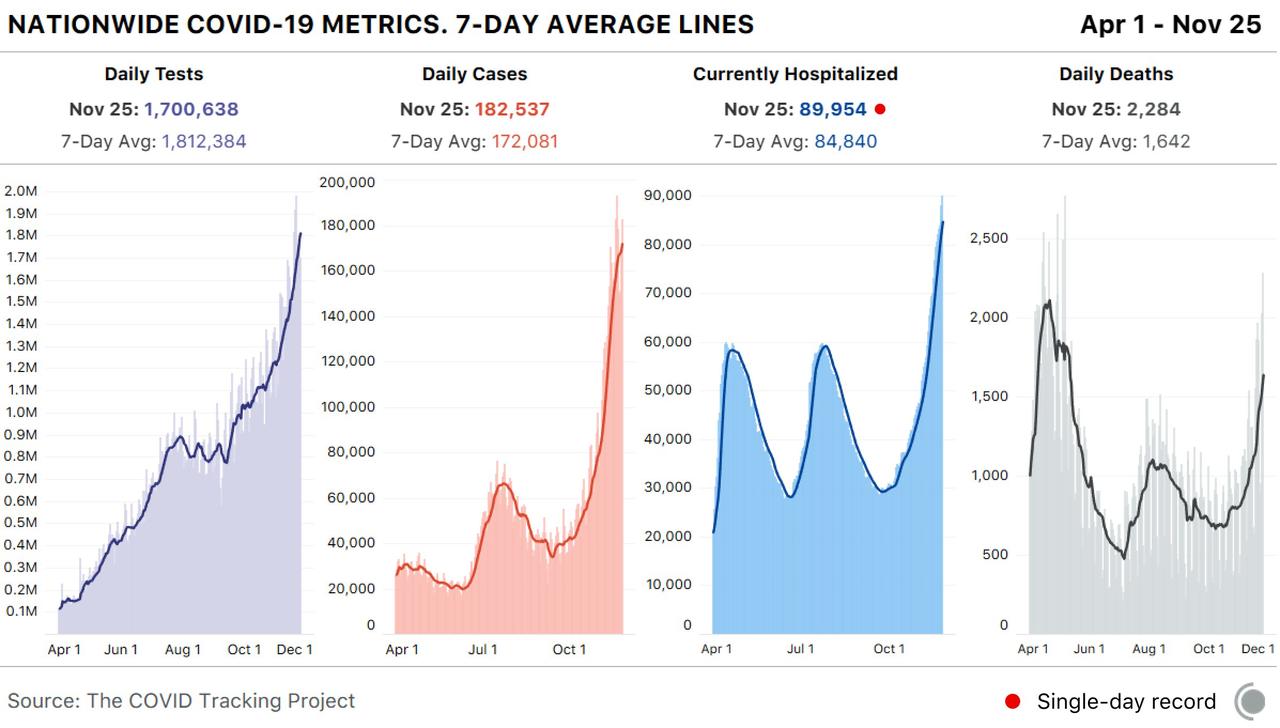
Yesterday, global COVID-19 cases topped 60 million, while global deaths recently topped 1.4 million. In the US, the confirmed case tally is nearing 12.8 million, while the death toll is at 262,446.
According to remarks from the CEO, the new trial will be launched instead of adding an arm to an ongoing US trial. It will be designed specifically to evaluate the lower “half dose” which was accidentally found to be more effective than a full dose.
“Now that we’ve found what looks like a better efficacy we have to validate this, so we need to do an additional study,” said CEO Pascal Soriot in his first interview since the data were released. It will probably be another “international study, but this one could be faster because we know the efficacy is high so we need a smaller number of patients.”
Although Soriot said he didn’t expect the additional trials to hold up regulatory approvals in Europe and the UK, it’s possible the FDA might take longer to approve the vaccine longer.
Even though this technically isn’t good news, to the algorithms responsible for much of the trading in today’s markets, any vaccine headline has the potential to spark another rotation into ‘value’.
*ASTRA LIKELY TO RUN A NEW GLOBAL COVID VACCINE TRIAL, CEO SAYS
Another surge for value stocks at 645am on Monday then?
In other vaccine news, a group of doctors from around the world warned that side effects from COVID-19 vaccine administration could cause patients to miss a day or two of work. Doctors warned that these risks should be advertised so the public so they don’t come as a surprise, and the CDC agreed to develop a plan for hospitals to avoid mass staff outages.
New York, meanwhile, topped yesterday’s multi-month high in new cases Thursday morning when it reported hospitalizations in the state topped 3,000 to their highest level since June 1, and new infections hit 6,933, the highest tally for seven months.
Today’s update on the numbers:
Of the 217,721 tests reported yesterday, 6,933 were positive (3.18% of total).
Finally, with the risks tied to travel on everybody’s mind, Delta Air Lines said Thursday it would test passengers for COVID on flights to Rome in a pilot program marking the latest attempt by the airline industry to open up trans-Atlantic travel.
And in the UK, PM Boris Johnson delivered a speech advising the country that while he is “sorry” about the return to the tiering system in England now that the countrywide lockdown is over (for now, at least), that for every Briton “your tier is not your destiny” and that a strong cooperative effort would make it easier to loosen restrictions around the holidays as planned.
“If we ease off now, we risk losing control of this virus all over again… forcing us back into a new year national lockdown with all the damage that would mean”
Here’s some more COVID-19 news from Thursday morning and overnight:
Nicolai Tangen, the chief executive officer of Norway’s $1.2 trillion sovereign wealth fund, tested positive for the coronavirus. The CEO said he took a test on Wednesday afternoon, “after feeling a bit under the weather, but my symptoms are mild” (Source: Bloomberg).
Prime Minister Boris Johnson confirmed England’s national lockdown will end next week, to be replaced by a tougher three-tier system of regional restrictions (Source: Bloomberg).
India reports 44,489 new cases in the last 24 hours, marginally up from 44,376 the previous day, bringing the national tally to 9.27 million. The death toll jumped by 524 to 135,223 (Source: Nikkei).
via ZeroHedge News https://ift.tt/3mcaJpR Tyler Durden
In a move in early November which is already causing controversy, self-styled gold market authority, the bullion-bank controlled London Bullion Market Association (LBMA), issued a letter to a group of leading bullion markets around the world, threatening to blacklist gold bullion from any country that fails to meet new LBMA recommendations covering gold sourcing and supply chains, the elimination of cash transactions, and the support for artisanal and small scale mining (ASM).
These recommendations, which have no legal standing, attempt to coerce the bullion markets into examining and verifying the supply chains of gold, while forcing co-operation with regional and international organizations.
The LBMA letter, dated 6 November, is addressed to national authorities in the following major bullion markets, markets which the LBMA refers to as International Bullion Centres (IBCs): China, Hong Kong, India, Russia, Japan, Singapore, Turkey, United Arab Emirates, South Africa, Switzerland, the United States, and the United Kingdom.
LBMA, established and run by bullion banks and never elected by anyone to be an authority, now ups the ante in bullying international gold bullion markets – “Gold market authority threatens to blacklist UAE and other centres” | Reuters https://t.co/pa6MvTqFTr
Ostensibly pitched as an initiative in support of both the OECD Due Diligence Guidance on Responsible Mineral Supply Chains and the Financial Action Task Force’s (FATF) guidance on money laundering, the LBMA’s real agenda, as is often the case, is otherwise, with the letter and the LBMA’s recommendations taking particular aim at bullion centres in the United Arab Emirates (Dubai) and India.
This is clearly illustrated in a report on ‘the Letter’ from none other than the LBMA’s favorite reporting mouthpiece – Reuters, and its LBMA embedded reporter Peter Hobson, who in an ‘exclusive’ dated 12 November titled “Gold market authority threatens to blacklist UAE and other centres” says that:
“The world’s most influential gold market authority is threatening to stop bullion from countries including the United Arab Emirates entering the mainstream market if they fail to meet regulatory standards, a letter seen by Reuters showed.”
Hobson then spends a good portion of the remainder of the Reuters article discussing Dubai, revealing that drafting the letter was a team effort, and that the main reason for this LBMA smokescreen is to target Dubai:
“The LBMA letter did not target any centre in particular, but four people involved in drafting it told Reuters the gold industry in Dubai in the United Arab Emirates (UAE) was the main focus.”
“The whole bullion centres initiative is because of serious issues in Dubai,” one of the sources said. “Unless they shape up, the LBMA by early next year will say refiners can’t source from Dubai.”
Some clues as to identities of the behind the scenes actors who influenced the writing of the LBMA letter are also provided by Reuters:
“The LBMA is a trade group rather than a state agency but it holds sway over the market because the large international banks that dominate gold trading typically only deal with metal from refineries the association has accredited.”
The UAE is one of the world’s largest gold hubs and exports bullion worth billions of dollars to refiners accredited by the LBMA each year. The Financial Action Task Force (FATF), an intergovernmental anti- money laundering monitor, has criticised its controls, as have non-governmental organsations (NGOs).
Off the bat, we can therefore say that LBMA bullion banks, the OECD’s FATF, and the politically backed so-called NGOs are part of the behind the scenes influencers.
Elsewhere in the letter to the International Bullion Centres (a letter which by the way has not been published anywhere), Reuters reveals that the LBMA has asked:
“recipients to declare their support for the LBMA’s standards by 11 December and share an action plan for their implementation by the end of January, if they have not been met.”
If this sounds eerily similar to the ”you’re either with us or against us“ bullying tactics of major political powers when forcing unaligned powers into conflict, you would be correct – it is. But it gets worse, since the letter says that:
“A lack of cooperation or unwillingness to publicly commit to these standards and share a proposed timeline with the LBMA will mean LBMA may no longer permit GDL Refiners to source material which has originated from or passed through the International Bullion Centre.”
Sounding more like a head-mistress of a girls’ school than a CEO, the LBMA Chief Executive Ruth Crowell told Reuters: “We are also committed to act if there is not meaningful and effective improvement”.
“’The ultimate stick is that we could say to these jurisdictions that they are no longer considered credible and therefore not responsible sources of gold’, Ruth Crowell, chief executive of the LBMA, told the Financial Times.”
Reeks of Hypocrisy
Beyond the fact that the LBMA is not a global authority on telling bullion markets what they can and cannot do, these latest moves show the gross hypocrisy of the LBMA in lecturing others about ethics and business practices when all the while some of the LBMA’s most powerful member banks, banks that essentially run and control the LBMA, have recently been prosecuted and fined for the manipulation of precious metals prices in both criminal and civil actions. Such actions have been brought by both the US Department of Justice (DoJ) and the Commodities Futures Trading Commission (CFTC).
All of these banks are and were the most powerful members of the LBMA. JP Morgan, Scotiabank, HSBC, and UBS are four of the five members of the LBMA’s London Precious Metals Clearing Limited (LPMCL), the group of banks which clears all precious metals trades in the London market. JP Morgan and HSBC operate the two biggest precious metals vaults in the LBMA’s London vaulting system.
JP Morgan, Scotiabank, HSBC, and UBS are all market making members of the LBMA. Market making members are the most important trading members of the LBMA. JP Morgan and HSBC are direct participants in the LBMA’s daily Gold Price and Silver Price auctions, the successors to the LBMA’s London Gold Fixing and London Silver Fixing auctions.
As recently as September 2020, two former Deutsche Bank precious metals traders were found guilty by the US DoJ of fraudulent and manipulative trading practices in precious metals futures contracts on the COMEX exchange. One of these individuals, James Vorley, was even a director of the London Gold Fixing company during the time period for which he has been convicted of precious metals price manipulation.
On 16 September 2019, the US Department of Justice charged JP Morgan traders with a multi-year market manipulation racketeering conspiracy to manipulate precious metals futures contracts. One of these traders is Michael Nowak, who was JP Morgan’s head of precious metals trading and who, when charged, was on the LBMA Board! It was only after the DoJ charged Nowak, that the LBMA was forced to remove Nowak from the LBMA board on 20 September 2019.
Until recently, representatives from these powerful banks such as JP Morgan and Scotiabank were the core contingent (market making member representatives) on the Board of Directors of the LBMA.
In 2017, the LBMA implemented its Global Precious Metals Code, a code which claims to “promote a fair effective and transparent market” and a code to which all LBMA members, including JP Morgan, have attested their conformance to by signing a Statement of Commitment. In the words of LBMA CEO Rutch Crowell:
“The Global Precious Metals Code is a code of conduct which promotes a fair effective and transparent market. It provides market participants with Principles and Guidance to uphold high standards of business conduct. All of this creates confidence in the market for all participants.”
Despite this, manipulation in the precious metals markets continued, with LBMA heavy weights such as JP Morgan and Scotia involved in bigger and bigger gold and silver price manipulations.
This huge litany of criminal manipulations by the powerful bullion bank members of the LBMA shows that the LBMA is not supportive of the physical precious metals markets. In fact, quite the opposite. The banks which run the LBMA have been proven to be undermining the physical gold and silver markets on a global scale through price manipulation and market misconduct. The LBMA is also Orwellian in calling for transparency and ethics, yet stacked to the rafters with criminal bullion banks whose opaque bullion dealings around the world go unchecked.
Dubai’s DMCC is not Impressed
It didn’t take long for some of the bullion centres on the LBMA hitlist to retort with their responses, responses which basically boiled down to:
How do the LBMA have the audacity thinking that they can blacklist and cut off major financial centres from the bullion market?
On what basis does the LBMA think that it’s the global authority on precious metals?
Not surprisingly, the most forceful response to date has come from Dubai, specifically from the executive chairman of the Dubai Multi Commodities Centre (DMCC), Ahmed Bin Sulayem. In a strongly-worded post dated 17 November which will raise a few eyebrows, Bin Sulayem writes that:
“LBMA’s authoritarian approach to maintain its majority control through conjecture and double standards has worn out its welcome with the rest of the world which increasingly believes it is time for a fully transparent regulator, composed of an international coalition that is equipped to authorise or blacklist stakeholders based on meritocracy and not self-serving interests.”
Bin Sulayem goes on:
“Should LBMA make good on its proposed strategy, it will be the first time a market or state authority has raised the possibility of cutting off the bullion industry in a major financial centre, a ploy akin to changing the rules of Monopoly on a discretionary basis in order to keep other players off the board.”
“I wonder if anyone at LBMA is concerned about being sued by the World Trade Organisation or UK Courts for attempting to maintain its cartel-like control over an industry by imposing its own discretionary brand of blacklisting, without being a democratically elected trade body?”
“Similarly, to the NGOs that peddle the same narrative with zero accountability, there is an increasing awareness that LBMA’s purpose has become one of industrial hegemony with an agenda to disrupt any centres that threaten its market share.”
And there’s more. Bin Sulayem continues:
“In a sense, LBMA’s approach is understandable, given its origins in a bygone era where control was seized, not negotiated and while the British Empire may have had the power to enforce its position a hundred years ago, it is certainly less compelling in today’s increasingly transparent marketplace.”
“perhaps it is time for the sun to set on LBMA and its delusional leadership in order for it to make way for an effective, untied, democratically elected regulator that functions under a policy of inclusion, not subjugation.”
In his response, Bin Sulayem also highlighted the double standards of the LBMA, asking why the the London based association did not call for a ban on gold imports from the United States when two former LBMA member refiners based in the US, Republic Metals Corporation and NTR Metals, declared for bankruptcy “after being unable to account for large amounts of precious metal or be charged by federal prosecutors in Miami for buying $3.6bn in illegal gold from criminal groups in Latin America respectively”.
The Indian Reaction
Across the Arabian sea to the east of Dubai, Indian financial publication MoneyControl, in an article dated 13 November, captures the Indian bullion sector’s reaction to the LBMA letter, saying that:
“The LBMA letter has irked the Indian bullion industry, which feels that the London body has acted arbitrarily. There are suggestions that the Indian bullion trade join hands with Dubai trade and come out with their own standards that will be widely acceptable.”
The LBMA letter has also led to fears that it could lead to vested interests monopolising the trade and this is one reason why Indian players think that main gold buying nations such as India and China could come together and set new norms in bullion trade.
The article continues that the Indian sector is suspicious about why the LBMA is only targeting selective bullion trading markets such as Dubai and India, and not the gold mining countries (such as in Africa) that it has issues with over the origin of gold.
According to MoneyControl, the general view from the Indian bullion sector is that LBMA is an association set up to protect the interest of its members and that “the initiative should probably come from the United Nations Security Council in the [same] way it passed a resolution on “blood” diamonds.”
A further article from the same Indian publication, dated 20 November, says that the Indian bullion sector is now also “questioning the LBMA letter on the grounds that the London association is trying to implement monopolistic policies” and that the Indian bullion industry is in discussions on formulating its own policy. The same article also reveals that “Russia has also questioned LBMA’s letter”, according to trade sources”.
Delusions of Grandeur
At this conjuncture let’s consider how the LBMA can think that it is the “global authority for precious metals”, as is frequently claimed on the LBMA website and in the various LBMA publications such as here.
Because at the end of the day, the LBMA is all about the world’s most powerful banks controlling the global bullion market. Remember that the LBMA was set up in 1987 by a group of powerful bullion banks at the behest of the Bank of England. The founding banks were the six powerful banks involved in the London bullion market, namely N.M. Rothschild & Sons, Morgan Guaranty Trust Company of New York (part of JP Morgan), J.Aron & Company (now part of Goldman Sachs), Mocatta & Goldsmid Ltd (acquired by Scotia), the old Sharps Pixley (acquired by Deutsche Bank), and Rudolf Wolff & Company. The original registered office of the LBMA when it was established in December 1987 was N.M. Rothschilds’ offices in New Court, St Swithin’s Lane, London.
Upon establishment, the consortium expanded to include the powerful Swiss bullion banks UBS and Credit Suisse, as well as the long-standing Midland Montagu and Edmond Safra’s Republic (both of which were subsumed into HSBC). Along the way additional banks came on board, such as Barclays (tapped by Rothschild), Standard Chartered, and Standard Bank – evolving into the cartel of banks that you see more recently in the composition of the LBMA Board, the LBMA market makers lists (JP Morgan Chase, HSBC, Bank of Nova Scotia, UBS Goldman Sachs, ICBC Standard, Standard Chartered, Citibank, Morgan Stanley, BNP Paribas, Merrill Lynch, Toronto-Dominion Bank), and the LBMA bank members of the unallocated metals clearing system LPMCL (JP Morgan, Scotia, HSBC, UBS and ICBC Standard).
The LBMA is an association so dominated by bullion banks that it might be more correctly called the London Bullion Bank Market Association. In short, the LBMA is a joint-venture and a cartel, a consortium of banks that between them control everything about the bullion market, from the gold mines which these banks finance, to the control of gold price discovery using unallocated gold and gold futures, to the control of the international cross-border gold flow trade, and through to gold refining. And all under the watchful eye of the Bank of England.
LBMA is the global authority for precious metals only because it (the trade association that fronts the bullion bank cartel) says so. Why should the LBMA be the global regulator of the gold market?
In regards to the LBMA’s call for international bullion centers to eliminate cash transactions, this is also a demand which primarily serves the vested interests of its bullion bank members. Of course the establishment international bullion banks want to eliminate cash transactions, precisely because they want to control all financial transactions and be judge and jury on who can trade or not.
OECD – LBMA – COVID Opportunism
So where has this new attack by the LBMA arisen from and how has it been pitched?
Following the publication of its letter to the International Bullion Centres (IBCs) in early November, the LBMA issued a press release on 17 November, stating that its letter and recommendations that it expects bullion markets “to adopt” was undertaken so as “to support the OECD Due Diligence Guidance framework and recognise the key findings from the Financial Action Task Force”.
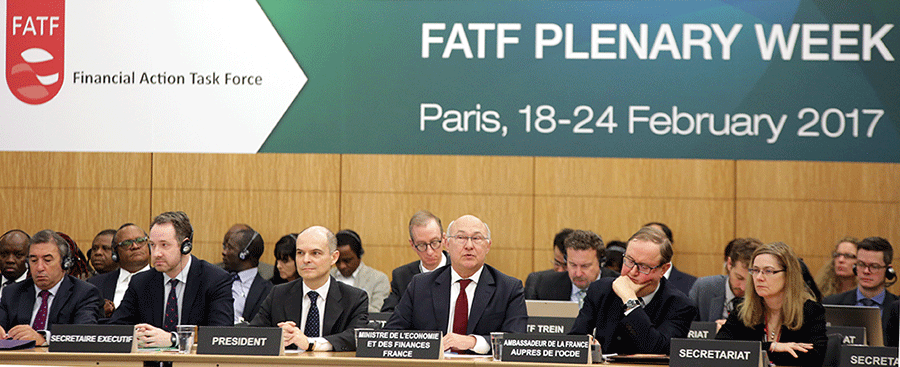
As a reminder, the OECD is the Organisation for Economic Co-operation and Development, the globalist club of rich countries headquartered in Paris. The Financial Action Task Force of FATF is a construct of the Group of Seven (G7) western industrial nations (including the US, UK, Germany and Canada), which focuses on money laundering and terrorist financing, and has a remit to police the global financial sector. The FAFT Secretariat is also, surprise, surprise, located in the OECD headquarters in Paris. In this context, the OECD and FATF are two sides of the same coin.
The FATF recommendations on money laundering that the LBMA now refers to are not recent in the slightest, having been published in July 2015 as the Money Laundering and Terrorist Financing Risks and Vulnerabilities associated with Gold. That’s over 5 years ago.
Like the EU war against physical gold transactions, FATF, using the money laundering risk narrative, is on a mission to crack down on cash transactions for gold because the international fiat banking system is not able to control the ultimate money which has no counterparty risk – gold. Hence, the LBMA targeting of bullion markets which it says process large amounts of recycled gold, and the smokescreen accusation about money laundering.
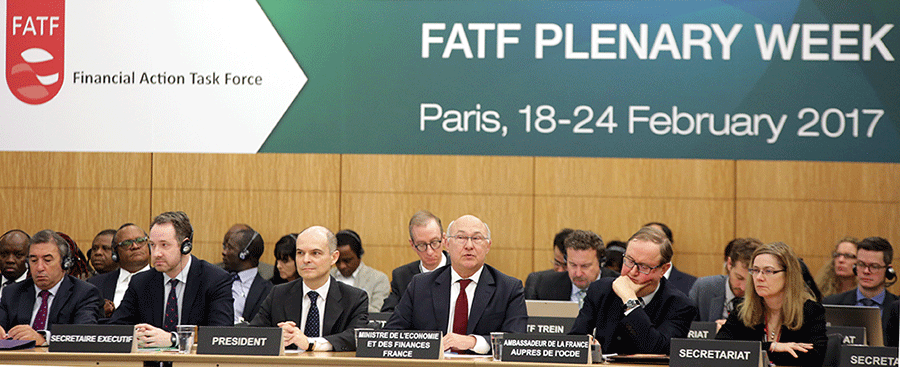
FATF head honchos at the OECD in Paris, France
Why then is the LBMA latching on to this OECD – FAFT narrative now? The answer is that, like governments and globalist organizations around the world such as the World Economic Forum (WEF), World Health Organisation (WHO) and United Nations (UN) who are conveniently using the COVID pandemic to push forward their agendas, the OECD has lost no time in opportunistically issuing a “COVID-19 Call to Action for Responsible Mineral Supply Chains” (on 6 May 2020), to push forward its own agenda.
This OECD Covid-19 Call to Action was issued in the form of a statement from what the OECD calls its ”Multi-Stakeholder Steering Group” the committee in charge of pushing forward this OECD guidance. This “call to action” statement can be read in the pdf document here, and is nothing more than a Covid smokescreen to push the existing OECD guidance. The LBMA then took this OECD pronouncement and ran with it.
Not surprisingly, LBMA is a member of this Multi-Stakeholder Steering Group. Not only that, but the LBMA’s CEO Ruth Crowell is vice-chair of this Multi-Stakeholder Steering Group. Interestingly, Dubai’s DMCC is also a member of the Multi-Stakeholder Steering Group, but for how much longer?
NGOs – Peddling the Narrative
Another group or entities aligned with the LBMA letter and the OECD Covid bogeyman ‘call to action’ are the so-called Non-Governmental Organisations, many of which have their headquarters in Washington DC and London, and which as you will recall from above, the DMCC’s Bin Sulayem describes as “the NGOs that peddle the same narrative [as the LBMA] with zero accountability”.
These NGOs (including Global Witness, The Sentry, IMPACT, and RESOLVE), are increasingly making an appearance in this LBMA overreach drama, from being quoted in the mainstream media (Reuters and FT), to being cosignatories of the OECD Covid call to action, and importantly, to being prominent speakers in the LBMA webinars about responsible sourcing that have taken place this year. Global Witness (headquartered in London) and IMPACT (headquartered in Ottawa, Canada) are also members of the above OECD Multi-Stakeholder Steering Group.
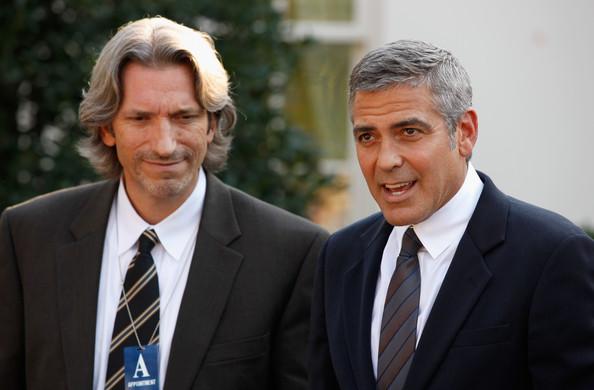
Per the above Reuters article: “This [LBMA] initiative has the leverage that could meaningfully impact conflict gold traders and refiners,” said Sasha Lezhnev, deputy director of policy at The Sentry, an NGO which published a report on Dubai’s gold industry on Tuesday.” The Sentry report in question can be seen here and it states that most gold from artisanal gold mining and refining in conflict areas of eastern and central Africa “is traded through Dubai in the United Arab Emirates”. Convenient for the LBMA. Note that the Sentry is headquartered in Washington DC, and was cofounded by George Clooney and John Prendergast (a long time high level US Government insider).
Per the above FT article: “If the public and the markets are to have faith that the gold certified by the LBMA is not tainted by human rights abuses or money laundering, then it will need to flex its muscles and suspend those not playing by the rules,” said Anneke Van Woudenberg, of the London-based NGO Raid.
Perhaps most interestingly, in April this year the LBMA held a series of webinars on “Responsible Sourcing”. The webinars can be seen here. Among the featured lineup was a FATF and OECD insider (Mark Pieth), a policy director from The Sentry (Sasha Lezhnev), a US State Department advisor (Pamela Fierst-Walsh), a director of RESOLVE (Jennifer Peyser), and an executive director from IMPACT (Joanne Lebert). Like The Sentry, RESOLVE operates out of Washington DC.
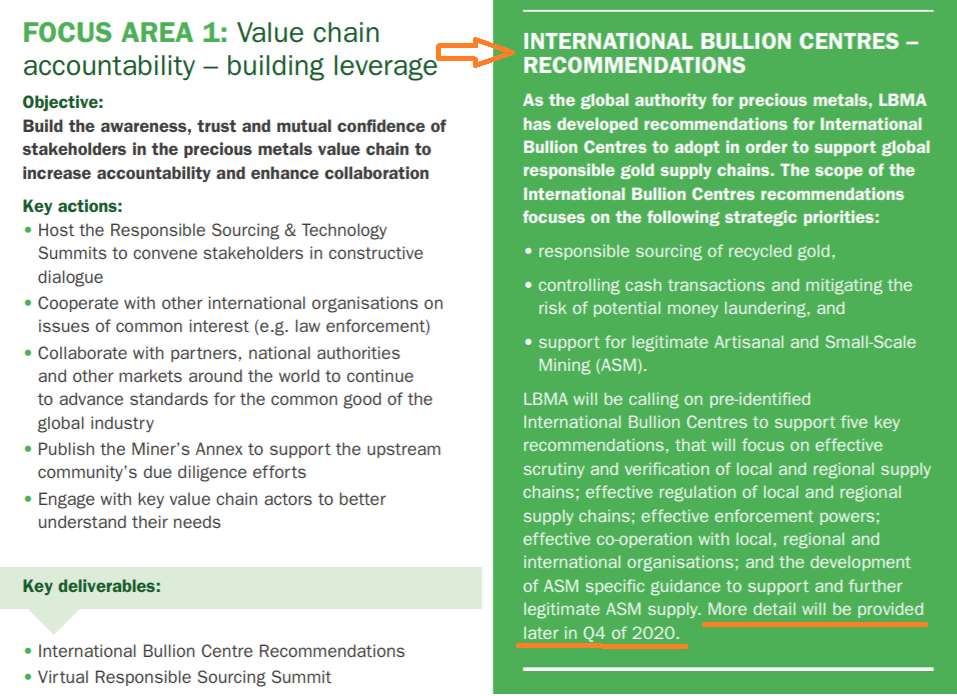
For anyone observing these things, the recent threats from the LBMA towards bullion markets around the world were signaled at least a few months ago in the LBMA’s first Responsible Sourcing Report published in September 2020. That report, on page 32, laid out everything that is in the LBMA recommendations, saying that “LBMA will be calling on pre-identified International Bullion Centres to support five key recommendations” and that “more detail will be provided in Q4”, but did not however mention the subsequent bullying nature of those calls.
For large gold trading and gold refining centres, it’s notable that not one gold refinery in Dubai or in the wider United Arab Emirates (UAE) (and there are over ten refineries) is accredited by the LBMA, and that only one gold refinery in India, a joint venture between Swiss PAMP and India’s MMTC (called MMTC-PAMP) is LBMA accredited. And there are at least twenty gold refineries in India if not more.
In October, gold refinery expert Corey Keller was interviewed for the BullionStar Perspectives video series, and prophetically, we discussed a lot of the issues which the latest LBMA maneuvering has raised as regards the Dubai refineries, the LBMA as a refining accreditor, and the role of the NGOs in criticizing gold sourcing.
As regards Dubai, Corey explained that the DMCC’s qualifications are exactly the same as the LBMA. The DMCC has the DMCC list, and their certification has the exact same standards that every refiner has to go through. I asked Corey if it is political that refineries in India and Dubai are not on the LBMA Good Delivery List. He replied as follows:
“Originally the LBMA had a great idea, and I think they are exclusive and not inclusive currently, and that’s why refineries are being left out, because they are being exclusive.”
“I don’t know whether it’s a political [issue], as more of a protectionist, protectionism in the group [LBMA]”.
See BullionStar video section “The LBMA and the representativeness of the Gold Delivery List” here.
As regards the NGO’s, I also asked Corey did he think that there might be political pressure being funneled through by bullion banks into those entities, Global Witness and RAID, just to target e.g. Dubai or India, because they want to protect the existing establishment?”
Corey’s response: “Yes.. They are absolutely politically motivated, …they [the NGOs] should be discharged with the vigor that they attack the industry with.” See section “Protectionism and the complaints of NGOs such as Global Witness” here.
That the bullion bank establishment has a vendetta against Dubai refineries was brought into focus a few months ago when on 31 July without explanation, the CME Group removed Dubai DMCC’s Al Etihad gold refinery from the COMEX GC 100 gold brand refiner list, having only approved and added the same refinery to the COMEX approved refiner list on 9 July, a mere three weeks earlier. Market rumor at the time had it that Al Etihad was removed from the COMEX approved gold refiner list due to an intervention by JP Morgan.
Despite what the LBMA may want the world to believe, Dubai, through the Dubai Multi Commodities Centre (DMCC) does have gold refinery accreditation initiatives, in fact it has two such initiatives, namely Dubai Good Delivery (DGD) and Market Deliverable Brand (MDB), and the Al Etihad and Emirates Gold DMCC refineries are on the current DGD list.
Per the DMCC website:
“The DGD standard was developed by DMCC in 2005 and is regarded as the international benchmark for quality and technical specification for the production of gold and/or silver. For gold refineries, the certification also includes responsible sourcing of gold in accordance with the ‘DMCC Rules for Risk-Based Due Diligence for Gold and Precious Metals’.”
The standard says that the DMCC is also aligned with the globally accepted OECD Guidance on Responsible Sourcing. DMCC also has an “Independent Governance Committee (IGC) for Responsible Sourcing which oversees the DMCC Authority (DMCCA) Responsible Sourcing of Gold and Precious Metals Programme”. In fact, Matthew Keen, previously an LBMA insider and Deutsche Bank gold fixing director, has recently, through his Evidens Consultancy DMCC, been on this DMCC Independent Governance Committee.
Beyond its Mandate
These latest attacks from the LBMA and its demands do indeed appear to be the delusional rantings of a power-hungry dictator. Not content with managing its own Good Delivery List of approved refiners, LBMA is now going after entire bullion markets in various countries, and with threatening language.
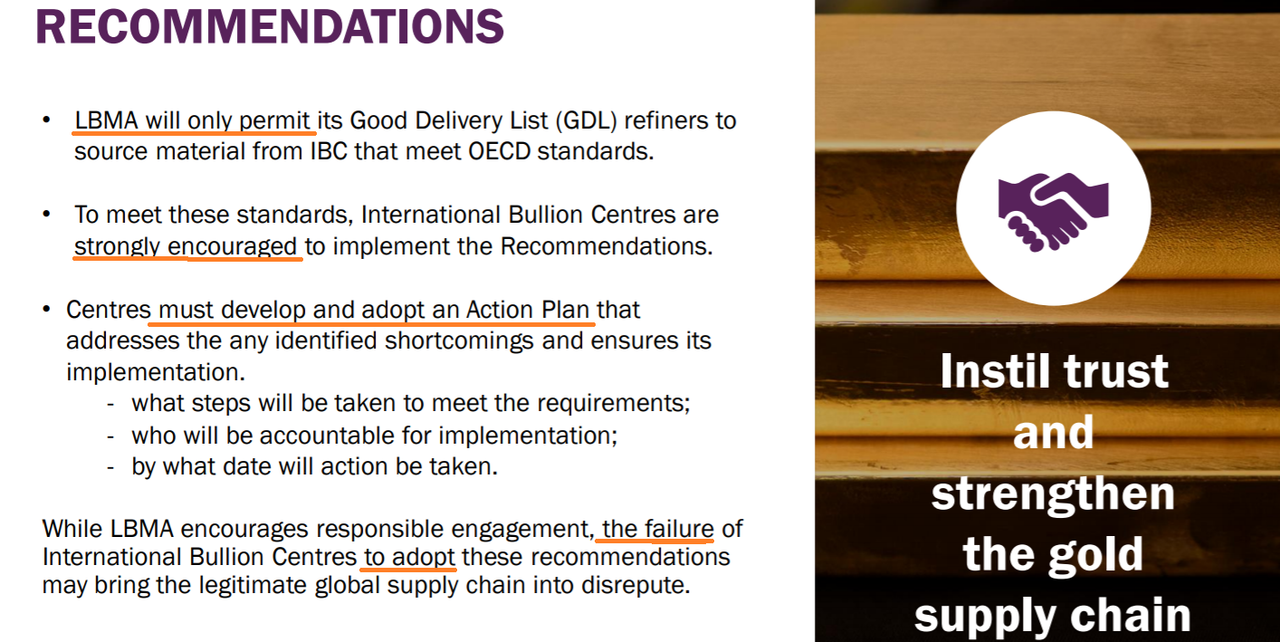
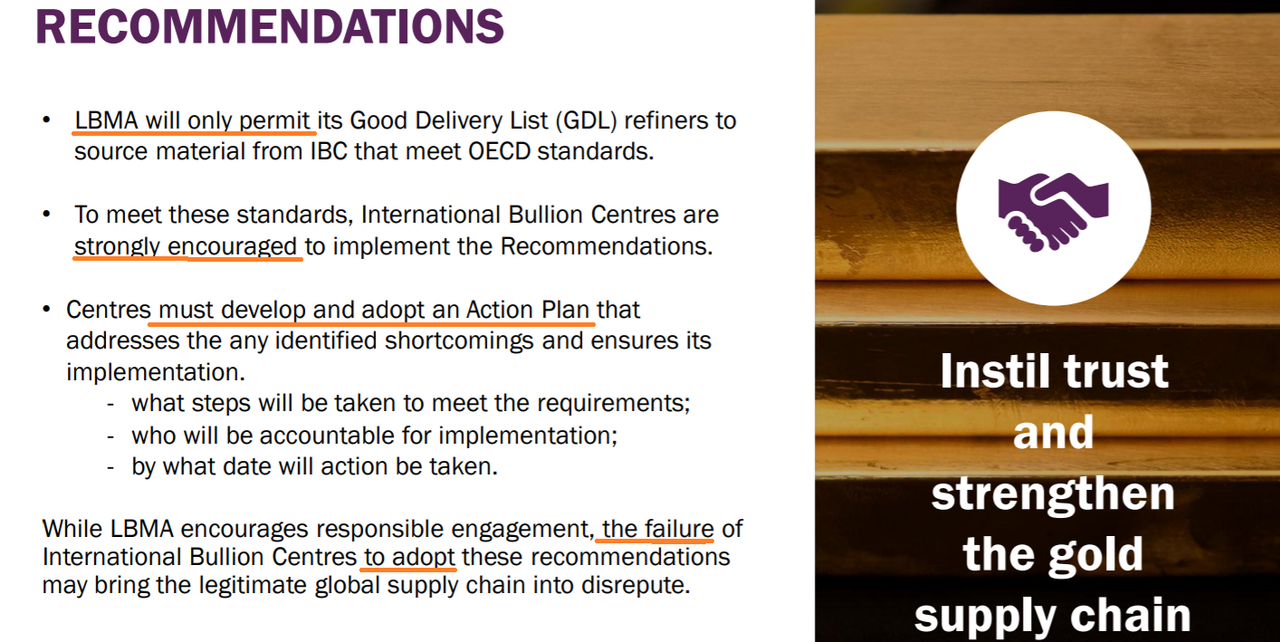
On 17 November, the LBMA CEO Ruth Crowell also made a presentation to the OECD about the LBMA initiative against the targeted bullion markets. In the presentation slides (page 10), the language used is also inflammatory and tyrannical, such as “LBMA will only permit”, “Centres must develop and adopt an Action Plan”, and “failure of International Bullion Centres to adopt these recommendations”.
LBMA presentation to OECD about its moves against bullion markets, Page 17
In the case of the UAE and India, as well as not having any of their refineries on the London Good Delivery List (save the MMTC-PAMP joint venture), the LBMA is now putting pressure on the actual governments of these jurisdictions and threatening to exclude all the gold from these centers being allowed into LBMA accredited refineries. This also goes against the entire concept of OECD responsible sourcing, whose very thrust is to approve responsibly sourced gold (from anywhere) making it to market.
And how in practice does the LBMA think it can enforce any of these threats against sovereign governments? As well as being delusional, courts of law would most likely rule that this is illegal and in breach of international trade agreements.
An organization whose most powerful members have engaged in criminal corruption against the interests of the physical precious metals market and its investors and participants (as per the above DoJ and CFTC cases), therefore cannot be trusted to be a global authority on anything related to the international bullion markets.
The LBMA states in its ‘Call to Action” (17 November) that:
“Currently, not all IBCs operate to the same responsible sourcing standards. These inconsistencies in standards could have a significant impact on the international market should they remain unaddressed.”
What then about LBMA bullion bank members being criminal enterprises? The membership of the LBMA by powerful banks which have been prosecuted for precious metals price manipulation is also an inconsistency in standards which could have a significant impact on the international bullion market should it remain unaddressed.
The LBMA is untrustworthy and it is not credible. The LBMA works against the interests of the physical precious metals industry, not for the physical precious metals industry.
As the LBMA has issued recommendations to the ‘International Bullion Markets”, we would like to issue some recommendations to the LBMA. These recommendations to the LBMA are as follows:
Support the actual physical gold market instead of just the paper gold market run by and manipulated by your criminal member banks.
Support the continued use of cash transactions in the international physical bullion markets as this eliminates counterparty risk by avoiding exposure to the electronic banking system run by these criminal banks.
In line with the LBMA Global Precious Metals Code which prohibits precious metals price manipulation, penalize and remove from your membership LBMA member banks that have been prosecuted and charged by the DoJ the CFTC and that are in breach of the LBMA Global Precious Metals Code.
EU Rift Widens Into Diplomatic War: Hungary Agrees Not To Accept Budget If Poland Doesn’t Tyler Durden
Thu, 11/26/2020 – 12:05
The internal European Union rift has widened and is threatening to turn into full diplomatic war as Poland and Hungary have remained resolute in blocking the new EU budget.
On Thursday Hungary’s Prime Ministery Viktor Orbán announced that after Germany’s failed attempt to “harmonize positions” over the proposed 1.8 trillion-euro ($2.1 trillion) budget, he signed a joint statement with his Polish ally pledging that neither will accept unless both do.
Prior file image of Polish prime minister Mateusz Morawiecki (R) and Hungarian prime minister Viktor Orban (L), via EPA/EFE
“Hungarian Prime Minister Viktor Orbán on Thursday said his country would have Poland’s backing in the continued row over the European Union’s insistence that its member states respect the rule of law or lose access to budget funds,” Reuters reports.
Both are standing firm against linking ‘Rule of Law’ and the ‘financial interests’ of the Union, which remains the central issue they want to press in debate before the European Council, which appears a political ploy to undermine sovereignty of member states.
“Orban, standing alongside Poland’s premier Mateusz Morawiecki, said in a press statement in Budapest that the current proposal on the EU’s table was unacceptable to Budapest and Warsaw, who will form a tandem in the debate after a joint veto, which Orban called a legitimate tool in the dispute,” Reuters continues.
This after mounting pressure in the past few days which saw the French and German Ambassadors to Warsaw demand that Hungary and Poland “show solidarity” during the COVID-19 pandemic.
What’s turning into an EU game of chicken over the vital budget is fairly straightforward, which perhaps has made each side harden in their demands:
Hungary and Poland, with the backing of Slovenia, remain adamant in their refusal to approve the bloc’s $2.1 trillion budget while rule-of-law conditions remain in place for countries to receive money from a separate $750 million coronavirus recovery fund.
Brussels and western Europeans seem equally determined to leverage coronavirus relief money to force compliance with the standards they say are necessary to block democratic backsliding by Hungary and Poland.
The EU has targeted both countries as part of an investigation related to the independence of courts and the media.
Poland and Hungary are taking an aggressive stand against what many see as the European Union’s attempt to “force foreign values upon member nations” – this after West European nations have frequently derided Polish President Andrzej Duda and Hungary’s Orbán as “authoritarian regimes” – something also echoed widely in US and UK media.
The current budget and coronavirus relief proposal before the EU would block funds to member countries seen as not adhering to “democratic standards”. This language was put in place from the start of November, thus Hungary and Poland see signing off on it as self-destructive, as it would be further detrimental to their own sovereignty.
Previously Orbán told a state radio broadcaster that “Hungary can’t be blackmailed,” explaining further that: “The rule-of-law debate sounds like it’s about the law but it’s a political debate.”
via ZeroHedge News https://ift.tt/39hQ1RW Tyler Durden