Stocks Slammed As Month-End Selling Accelerates, Yellen Tweets

Stocks Slammed As Month-End Selling Accelerates, Yellen Tweets

Tyler Durden

Mon, 11/30/2020 – 10:46

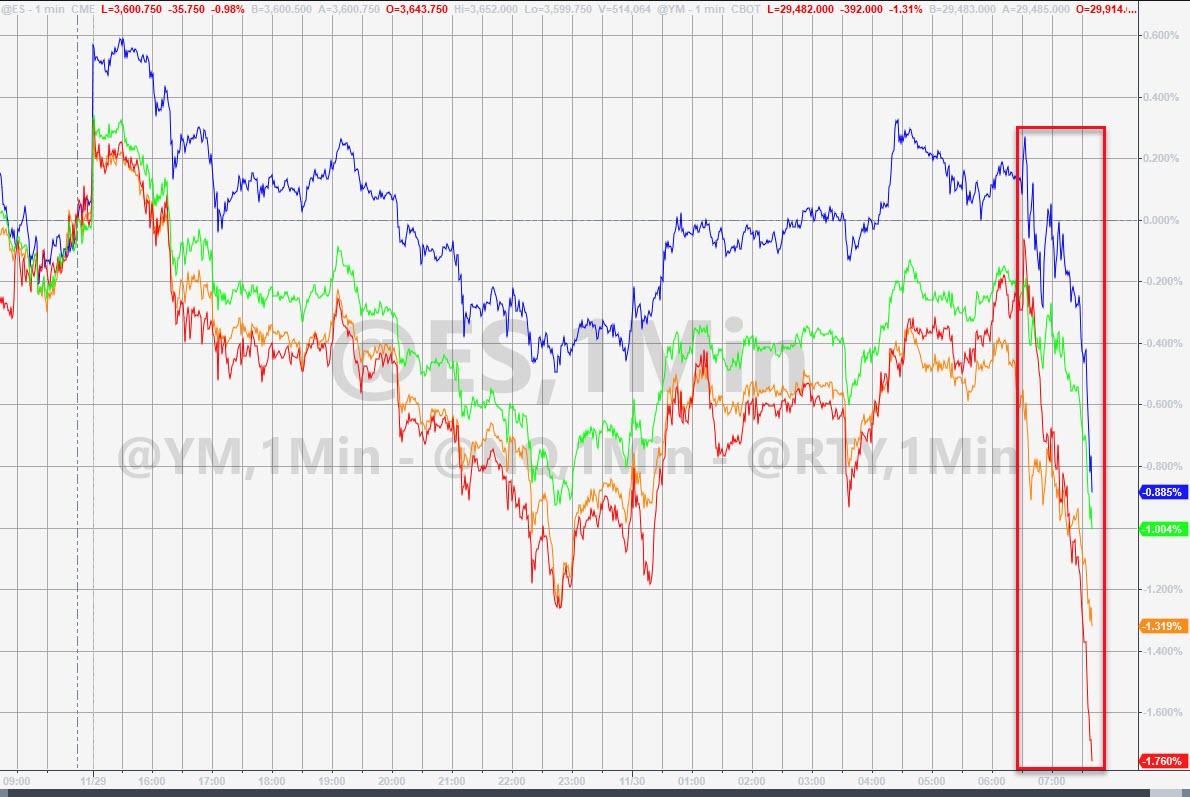
Today’s selling began as Joe Biden announced his economic team – coincidence?

Janet Yellen – Biden’s nominee for Treasury Secretary – tweeted for the first time:

And stocks tanked…

Additional selling catalysts include major month-end selling, as JPMorgan recently noted.

According to Panigirtzoglou, “if the picture in Figure 1 is a true reflection of how balanced mutual funds have been positioned in recent weeks, then there would be some vulnerability in equity markets in the near term from balanced mutual funds having to sell equities to revert to their 60:40 equity:bond target allocation, either by the end of November or by the end of December at the latest.”
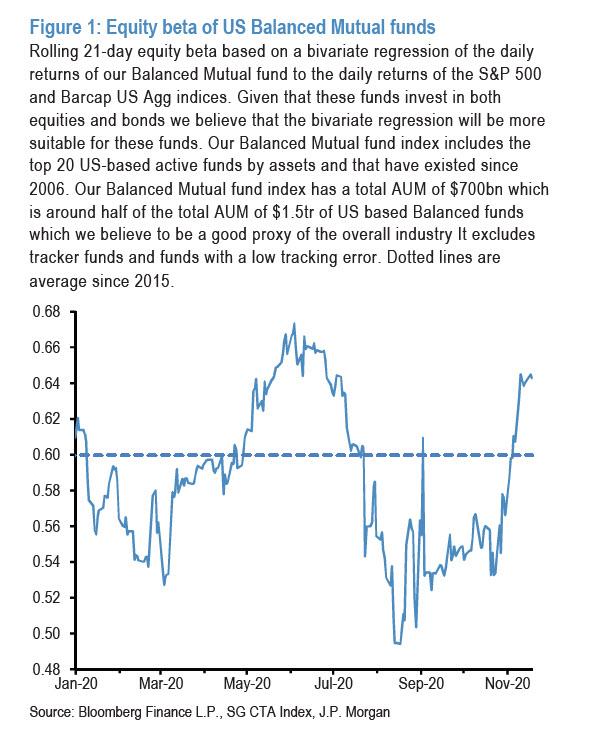
There’s more: according to JPM, the equity rebalancing flow is likely to also be an issue into year or quarter-end, i.e. the end of December, especially if equity markets continue to grind higher into December. This is because of likely negative pending rebalancing by entities that tend to rebalance on a quarterly basis, such as US defined benefit pension plans, Norges Bank, i.e. the Norwegian  oil fund, and the Japanese government pension plan, GPIF.

  • US defined benefit pension plans are a big $7.5tr AUM universe. They tend to rebalance more slowly over 1-2 quarters or so. Assuming they were fully rebalanced at the end of September, and by taking into account the QTD performance of US equities and bonds, JPM believes that the pending equity rebalancing flow by US defined benefit pension plans into the current quarter-end is negative at around -$110bn.

  • By doing the same calculation for Norges Bank, a $1.2tr AUM entity, the bank estimates that the pending equity rebalancing flow by Norges Bank into the current quarter-end is likely negative at around $15bn.

  • A similar calculation for the giant Japanese government pension plan, GPIF, a $1.5tr AUM entity, JPM estimates that the pending equity rebalancing flow by GPIF into the current quarter-end is likely negative at around -$25bn.

In all, Panigirtzoglou echoes Goldman’s month/quarter end year-end selling concerns, writing that he sees “some vulnerability in equity markets in the near term from balanced mutual funds, a $7tr universe, having to sell around $160bn of equities globally to revert to their target 60:40 allocation either by the end of November or by the end of December at the latest.”

Of course, if this is the real catalyst, there is a lot more downside here, but did these massive managers really leave their allocation shift until the last day of the month?


via ZeroHedge News https://ift.tt/36kAq24 Tyler Durden
Goldman Sees Oil Rising To $65 In 2021 But Turbulence In The Near-Term

Goldman Sees Oil Rising To $65 In 2021 But Turbulence In The Near-Term

Tyler Durden

Mon, 11/30/2020 – 10:43

As the global economy makes its way through the covid pandemics, the question asked by all economists is when do we return to normal; one asset class that is especially interested in the answer is oil, having suffered tremendous losses in a year when virtually every other asset generated tremendous returns on the back of a liquidity firehose from central banks, even though oil prices did reach their highest post-COVID levels last week, with Brent spot near $48/bbl, supported by encouraging vaccine results as well as rising tensions in the Middle East.

One attempt to answer the question of when oil will “normalize” comes from Goldman commodity strategy Damien Courvalin who wrote overnight that he expects further oil price upside to $65/bbl through 2021 “as the oil market rebalances due to a large vaccine-led demand rebound as well as an only modest non-OPEC supply response.”

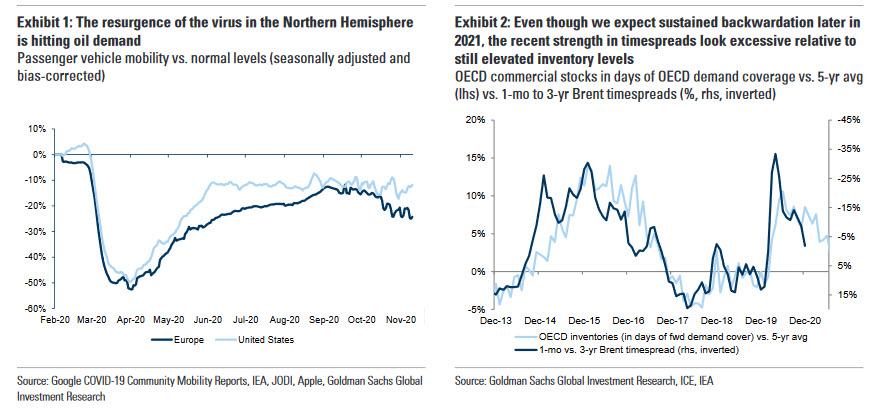
Where there is uncertainty is what happens in the next few months: as he adds, “in the short-term, however, the oil market faces spreading lockdowns with demand declining in Europe and the range of infections likely asymmetric to the upside through the winter. We expect this winter wave to generate a 3 mb/d hit to global oil demand, only partially offset by heating, EM and restocking demand, although this demand hit has so far been masked by strong Asian crude buying and restocking.

As such, Goldman expects these “muddied short-term fundamental signals” and the opposite pulls of lockdowns vs. vaccines to keep oil prices volatile in coming weeks. These cross-currents will further complicate OPEC+’s decision this week to delay or implement its scheduled 1.9 mb/d January production increase. Indeed, moments ago the first OPEC meeting closed with no resolution on whether to extend production cuts over objections from UAE and Kazakhstan. Here is Goldman on what happens next:

While we base-case a 3-month delay to prevent a return to a global oil surplus through 1Q21, not all producers appear onboard, with a lack of extension representing $5/bbl downside from current spot levels on our modeling, further contributing to short-term price gyrations.

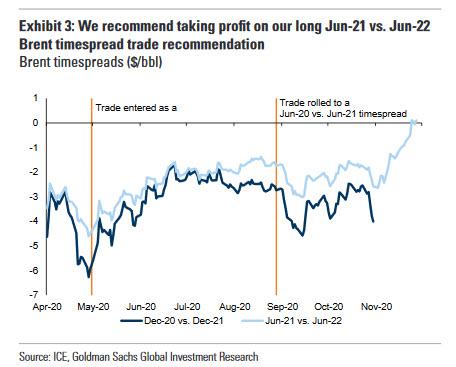
That said, while spot prices are likely to remain unanchored, Goldman sees crude timespreads as physically bound and screen as too strong relative to still elevated inventory levels, buoyed by recent short-covering financial flows and transient Asian crude buying. The bank therefore expects a pull-back in Brent timespreads, with sustainable backwardation not likely until 2H21:

We therefore recommend taking profit on our long Jun-21 vs. Jun-22 Brent timespread trade recommendation, first recommended on May 1, for a total potential profit of $4.82/bbl (as of market open on Sunday, November 29).

In conclusion, the Goldman strategist who correctly called April’s WTI plunge into negative over a month before it happened, believes “that these winter headwinds are just speed bumps on the path to a tightening oil market, with the winter COVID wave delaying but not derailing the oil market rebalancing, with normalized OECD stocks, OPEC+ spare capacity returning to 1Q20 levels and finally needed shale production growth all occurring by 4Q21.”

The bank’s recommendation: “go long Dec-21 Brent forwards, our preferred expression of oil’s 2021 rally, as well as for producers to wait to hedge.”

via ZeroHedge News https://ift.tt/37nZAvV Tyler Durden

Baltimore County Schools Closed Monday, Tuesday Due To Ransomware Attack

Baltimore County Schools Closed Monday, Tuesday Due To Ransomware Attack

Tyler Durden

Mon, 11/30/2020 – 10:30

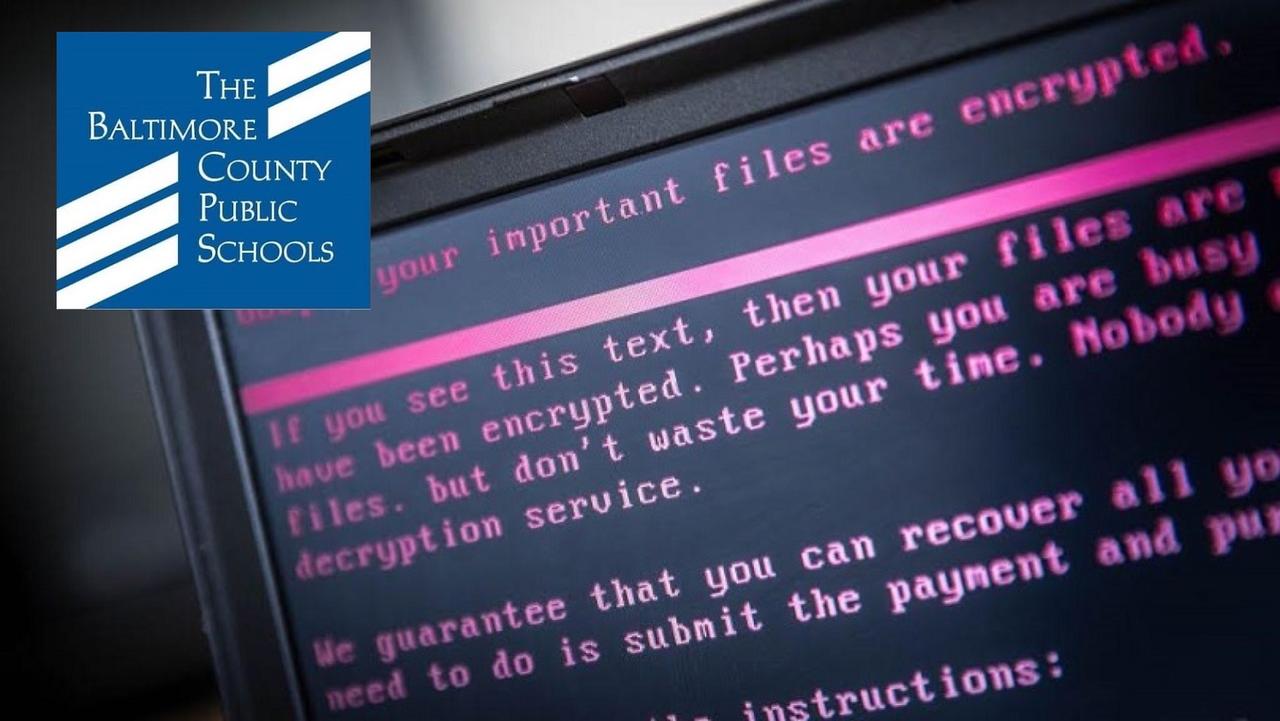
Well, it’s becoming evident in Baltimore, Maryland, that teaching remotely in the pandemic is not sustainable as hackers have hit Baltimore County Public Schools (BCPS) with a ransomware attack, forcing the school system to close schools for Monday and Tuesday, reported CBS Baltimore

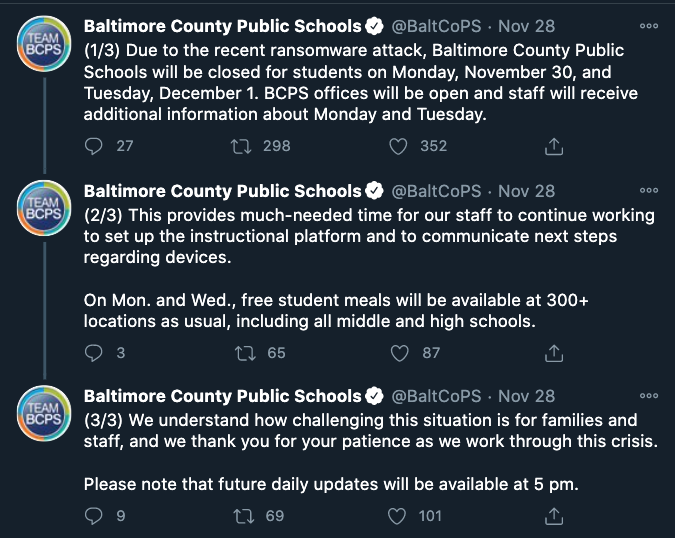
“Due to the recent ransomware attack, Baltimore County Public Schools will be closed for students on Monday, November 30, and Tuesday, December 1. BCPS offices will be open and staff will receive additional information about Monday and Tuesday,” BCPS tweeted.

In another post, BCPS said, “this provides much-needed time for our staff to continue working on setting up the instructional platform and to communicate next steps regarding devices. On Mon. and Wed., free student meals will be available at 300+ locations as usual, including all middle and high schools.”

The school system ended the statement by saying, “We understand how challenging this situation is for families and staff, and we thank you for your patience as we work through this crisis. Please note that future daily updates will be available at 5 pm.”

On Friday, the 11 News I-Team reported that Maryland state auditors found significant risks within the BCPS network.

Days before the ransomware attack was discovered, early last week, findings from the Office of Legislative Audits showed BCPS did not properly secure sensitive personal information. 

At the moment, there’s still no source behind the ransomware attack or much money hackers want to restore computer network systems. 

Last month, the public school system in Yazoo County, Mississippi, revealed that it paid upwards of $300k to help recover its network that was overrun by a ransomware incident.

There have been major US hospital systems hit with “paralyzing” ransomware attacks this fall. 

So the real consequence of a school system going offline because of a ransomware attack is that children may not be able to learn for as long as the systems are down – as seen in Baltimore this week.  

via ZeroHedge News https://ift.tt/3qdDcxX Tyler Durden

New “Flex” Scalia Law Part-Time JD

Over my many years of blogging, I’ve heard from quite a few VC readers who live and work in the D.C. area and were interested in getting a law degree at George Mason Law (Scalia Law), but (a) didn’t want to give up their current job; and (b) due to work and family obligationscouldn’t swing the 5(!) nights of in-person class a week we required.

So I thought it was worth mentioning that the law school has a new “flex” JD program, in which students can attend classes in person as few as two nights per week, and still receive their part-time JD in the standard four years.

from Latest – Reason.com https://ift.tt/2Jqmb2X
via IFTTT

How easy it is to be “dangerous”

Early in the morning around 3am on March 24, 1603, Queen Elizabeth I died after ruling over England for more than four decades.

Her successor was proclaimed only hours later– James Charles Stuart, who at the time was serving as King of Scotland.

James was known as a religious hardliner. He became obsessed with hunting down witches during his reign in Scotland, and even personally supervised the torture and execution of young women who had been accused of witchcraft.

And almost immediately upon being crowned King of England, he issued harsh warnings to anyone who wasn’t strictly following the faith.

England had established its own church back in 1534– known as the Church of England– and James (as the titular head of the Church) made it clear that he would not tolerate any religious dissent.

Yet there was a growing movement of people across England who had become disillusioned with the Church. They believed in the principal tenants of Christianity, but they didn’t believe in the Church’s rituals, politics, or hierarchy.

These people called themselves Separatists, and they were forced to gather and worship in secret.

One large group of separatists was based in the small town of Gainsborough in central England. Coincidentally, one of them was my great-great++ grandfather, a local noblemen who held secret worship services in his home.

They were eventually caught. And in late 1607, the Separatists had to flee England.

This was no small task at the time; emigrating required a special permit, which they were unable to acquire.

But eventually the Separatists were able to sneak into Amsterdam, which had a great deal more freedom. And after gathering people and resources over the next decade, they ultimately hired a ship– the Mayflower– and sailed across the ocean to build a new life for themselves.

I thought of this story when I read a few days ago about various religious groups in the US and United Kingdom being forced to gather in secret to hold worship services.

One group in England congregates in a barn. Another gathers in open fields, the location of which is revealed by SMS only an hour before the services begin.

This sounds like some underground church service in China or North Korea… or the harsh restrictions under King James more than 400 years ago.

As one churchgoer told the Guardian newspaper, “The fact that we have to sneak around to worship God, in fear of criminal prosecution, is alarming.”

It’s similar in the Land of the Free. If you belong to the Catholic church or Jewish faith in states like New York or California, for example, the governor-dictators there have decreed that you are no longer free to worship.

Such is life now in western civilization: you can now be considered a danger to the public for what you believe.

If your faith requires that you gather to worship, you’re considered a danger to public health and subject to arrest–

— unless, of course, you belong to the Holy Church of Black Lives Matter, in which case you are free to burn, assault, loot, and riot your way to salvation, mask-free, with no restrictions whatsoever.

And it’s not just religion.

If you’re one of the tens of millions of people who did not vote for Joe Biden because you have different ideological beliefs, the new ruling political elite considers you an intellectual danger to society.

Not only that, they “have a list” and want to ban you from serving in office, on company boards, and from “polite society”.

Similar hate is reserved for those who express different opinions about social justice issues. For example, if you dare to commit the blasphemy of saying that everyone’s life matters, people will claim to feel ‘unsafe’ around you, i.e. you’re dangerous.

Talented people have been fired for this, or canceled by the Twitter mob. Or had their businesses ruined, or their property torched.

The big tech companies have also resorted to extreme censorship to thwart the free flow of information that they deem, in their sole discretion, to be dangerous.

And we can already see the writing on the wall with regard to Covid vaccines.

There are dozens of vaccines in the works, and a few that have already received provisional approval.

To me, this is also an individual choice: if people want the vaccine, good for them. But there will be countless citizens who have concerns about an unproven vaccine devoid of any long-term studies.

These concerns are completely reasonable. Yet we’re already seeing signs that you’ll be regarded as a public danger if you don’t get vaccinated.

There’s even a term for it already: “vaccine resisters”.

Joe Biden told George Stephanopoulos in last month’s softball Q&A love-fest that “we should be thinking about making [vaccines] mandatory,” though he acknowledged that enforcement would be difficult.

Not really. Enforcement of mandatory vaccination will come down to the private sector closing ranks and refusing to serve anyone who doesn’t get pricked.

Australia’s Qantas Airlines is the first to say that you won’t be able to fly certain routes unless you’re vaccinated. Based on their policy, Australians won’t be able to leave the country without being vaccinated.

The airline industry is notoriously monkey see, monkey do. So it’s likely only a matter of time before Delta, Air Canada, British Airways, etc. follow along.

More importantly, an old Supreme Court precedent from 1905 (Jacobson v. Massachusetts) established clear authority for the state to mandate vaccination, or severely penalize those who refuse.

(“Pro choice” apparently only applies to abortions, not to the Covid vaccine.)

At a minimum, anyone who doesn’t receive a vaccine can at least expect to be ridiculed and shunned by people who you thought were your friends; they’ll say you’re ‘endangering’ them.

Who knew you could be so dangerous without even trying?

But this is the world we’re living in. And as I frequently point out, why it’s so important to have a Plan B.

Source

from Sovereign Man https://ift.tt/36mP8py
via IFTTT

New “Flex” Scalia Law Part-Time JD

Over my many years of blogging, I’ve heard from quite a few VC readers who live and work in the D.C. area and were interested in getting a law degree at George Mason Law (Scalia Law), but (a) didn’t want to give up their current job; and (b) due to work and family obligationscouldn’t swing the 5(!) nights of in-person class a week we required.

So I thought it was worth mentioning that the law school has a new “flex” JD program, in which students can attend classes in person as few as two nights per week, and still receive their part-time JD in the standard four years.

from Latest – Reason.com https://ift.tt/2Jqmb2X
via IFTTT

Online Shopping Wins Black Friday

Online Shopping Wins Black Friday

Tyler Durden

Mon, 11/30/2020 – 10:10

Submitted by MarketCrumbs,

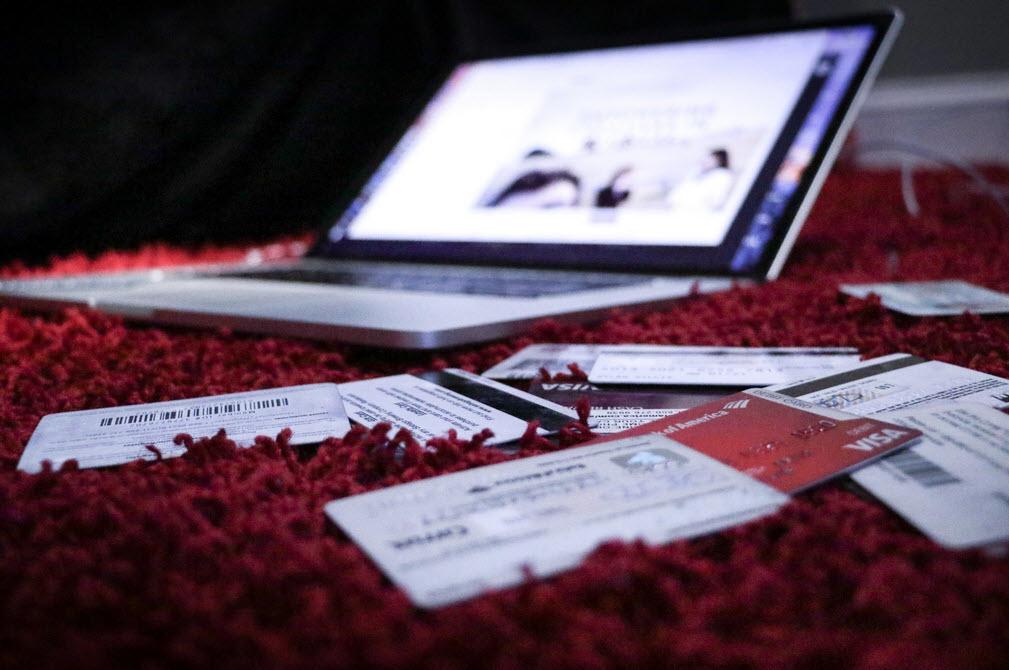
It’s not surprising that online shopping stole the spotlight on Black Friday as Covid-19 continues to limit the amount of time people want to spend in public.

Online spending on Black Friday jumped by 21.6% to a record $9 billion, according to data from Adobe Analytics, which analyzed transactions from 80 of the top 100 U.S. online retailers. The total makes this year’s Black Friday the second-largest single day for online shopping in U.S. history behind last year’s Cyber Monday, when shoppers spent $9.4 billion.

The total breaks down to $6.3 million spent per minute online, according to Adobe. Consumers increasingly shopped from the palm of their hands as spending from smartphones jumped by more than 25% to $3.6 billion, accounting for 40% of the day’s total online spending.

“New consoles, phones, smart devices and TVs that are traditional Black Friday purchases are sharing online shopping cart space this year with unorthodox Black Friday purchases such as groceries, clothes and alcohol, that would previously have been purchased in-store,” Adobe Digital Insights director Taylor Schreiner said.

Online spending on Thanksgiving also hit a record this year as consumers spent $5.1 billion, according to Adobe. Despite jumping more than 21% compared to last Thanksgiving, the total fell shy of Adobe’s estimate of $6 billion.

“While yesterday was a record-breaking Thanksgiving Day with over $5 billion spent online, it didn’t come with the kind of aggressive growth rate we’ve seen with the start of the pandemic,” Schreiner said. “Heavy discounts and aggressive promotions starting in early November succeeded at getting consumers to open their wallets earlier.”

As for today’s Cyber Monday, Adobe expects it to break last year’s record with sales totaling between $10.8 billion and $12.7 billion, which would be an increase of 15% to 35% from last year.

With Americans largely at home shopping online, foot traffic at stores fell by more than 52% compared to last year’s Black Friday, according to Sensormatic Solutions. Traffic on Thanksgiving fell by 94.9% as retailers such as Walmart and Target closed their stores this year.

“We knew Black Friday [traffic] was going to be down, we just didn’t know how much it was going to be down,” Sensormatic Solutions senior director of global retail consulting Brian Field said. “Black Friday this year, from a traffic impact perspective, looked a lot like a typical Saturday after a Black Friday.”

With Covid-19 giving e-commerce a boost, it will be interesting to see if the days of people trampling over each other to get into stores on Thanksgiving and Black Friday will ever make a comeback.

via ZeroHedge News https://ift.tt/39upaCq Tyler Durden

Pending Home Sales Unexpectedly Slide In October, High Prices Blamed

Pending Home Sales Unexpectedly Slide In October, High Prices Blamed

Tyler Durden

Mon, 11/30/2020 – 10:04

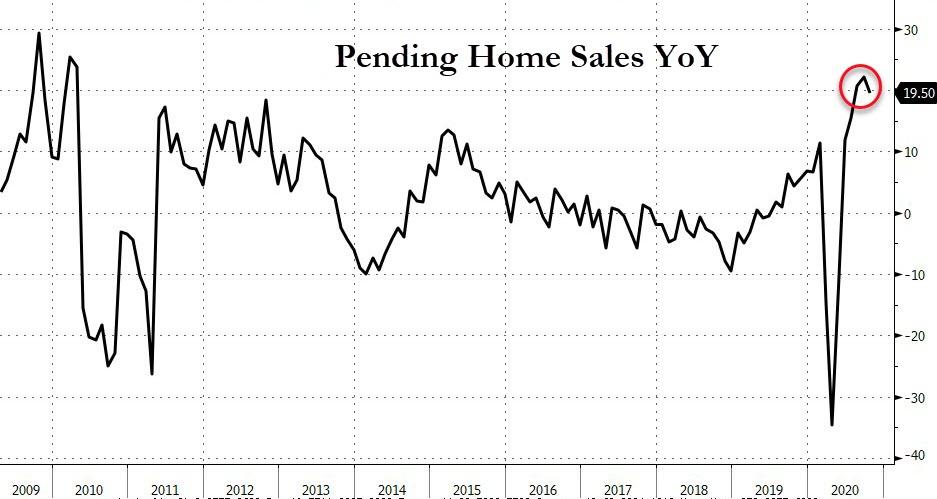
Today’s pending home sales data  (expected to rise modestly MoM) is October’s tie-breaker after new home sales dipped and existing home sales ripped. After unexpectedly dropping in September, pending homes also unexpectedly fell in October (down 1.1% MoM vs +1.0% MoM exp).

Source: Bloomberg

This is the second monthly decline in a row.

“The housing market is still hot, but we may be starting to see rising home prices hurting affordability,” Lawrence Yun, chief economist at the NAR, said in a statement.

The combination of low rates, lean inventory and “very strong demand has pushed home prices to levels that are making it difficult to save for a down payment, particularly among first-time buyers.”

On a YoY basis, sales remained impressive (up 19.5%) but that also slowed.

Source: Bloomberg

By region, pending home sales declined in two of four major U.S. regions, including a 5.9% decrease in the Northeast and a 0.7% drop in the Midwest. The gauge of contract signings in the South crept up 0.1%, while the index was unchanged for the West.

via ZeroHedge News https://ift.tt/3lvwf8d Tyler Durden

France Sees COVID Cases Fall To 7-Week Low; Global Deaths Near 1.5 Million: Live Updates

France Sees COVID Cases Fall To 7-Week Low; Global Deaths Near 1.5 Million: Live Updates

Tyler Durden

Mon, 11/30/2020 – 09:55

Summary:

  • Moderna sends in emergency application
  • Hong Kong orders civil servants to work from home
  • Italy approves fourth stimulus package
  • California tops 15k cases
  • France sees fewest new cases in nearly 2 months
  • Germany’s Merkel says Germany can’t continue compensating companies for lost sales
  • Hong Kong imposes new restrictions
  • Canada expands travel ban
  • UK’s Johnson says tiered system will have ‘sunset’ date of Feb. 3

* * *

As we joked earlier, yet another Q4 Monday has been dominated by news about COVID-19 vaccines as Moderna is moving  to submit its emergency use application to the FDA for approval. Meanwhile, a new update to Moderna’s research shows that out of 196 cases of the virus, researchers determined that the vaccine was 94.1% effective, in line with preliminary findings released earlier this month. None of the participants in the trial who’d received the vaccine developed severe Covid-19.

What’s more, all 30 severe cases observed in the study occurred in participants who received placebo shots.

In other news from earlier in the day, Hong Kong has ordered civil servants to return to a ‘work from home’ arrangement, with Chief Executive Carrie Lam urges private sector employers to implement a similar order. Restaurants must now limit diners to two per table, down from the current rule of four. Gyms and sports venues will be allowed to stay open for now, while this round of restrictions will start on Wednesday and last for two weeks, Lam said. The city reported 76 cases on Monday, most of them local including nine of unknown origins. Hong Kong’s  COVID cases have surged by double digits for 11 straight days.

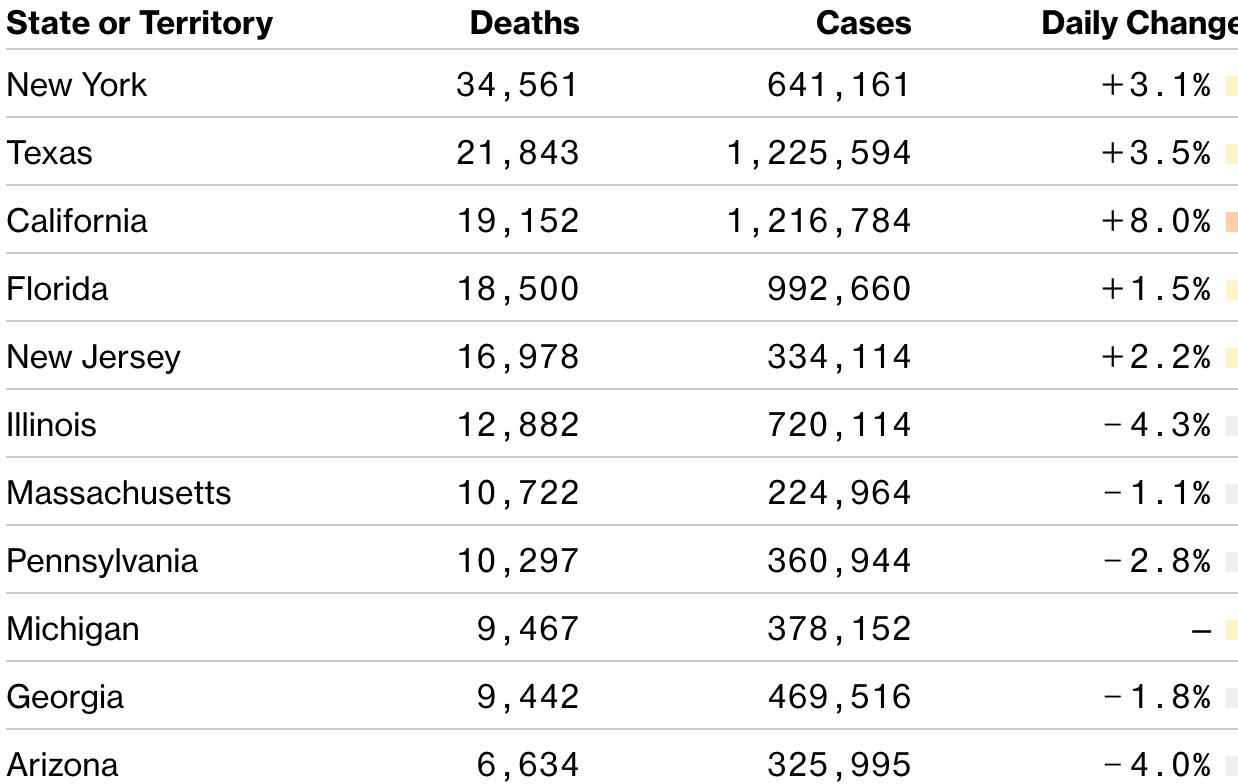
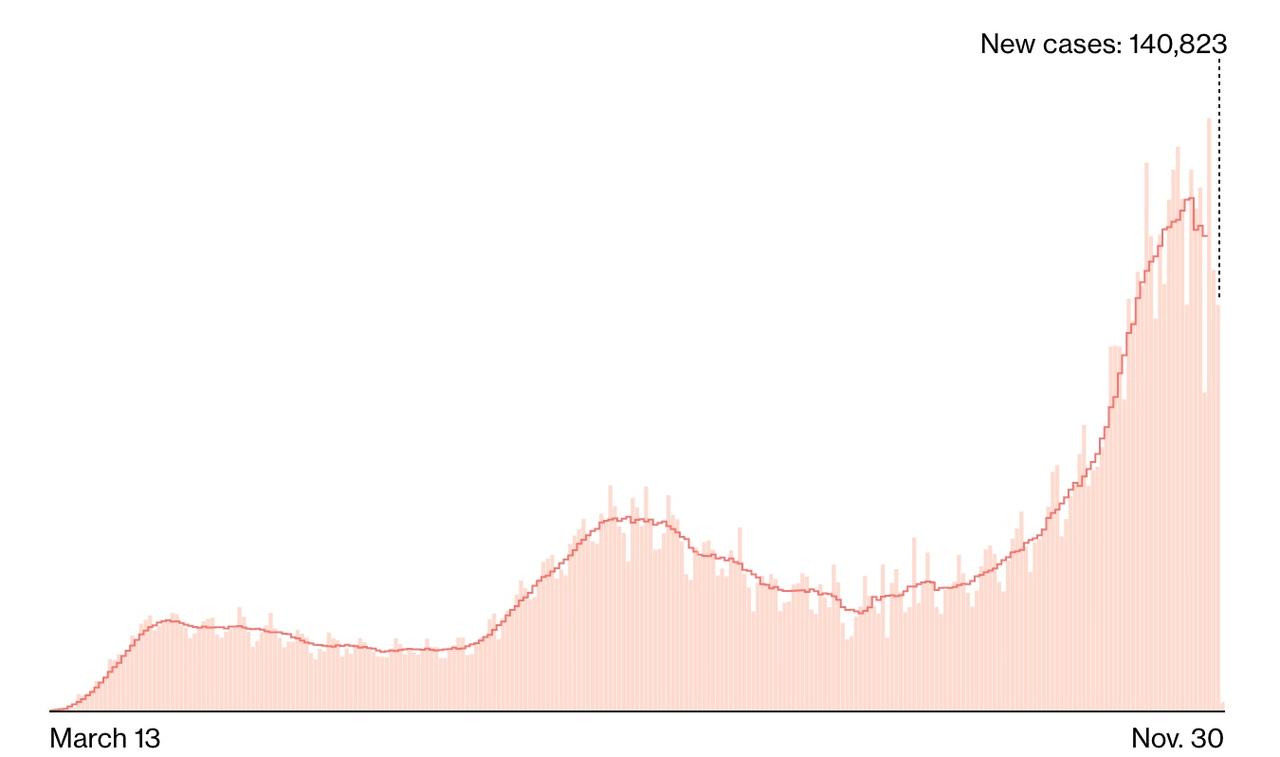
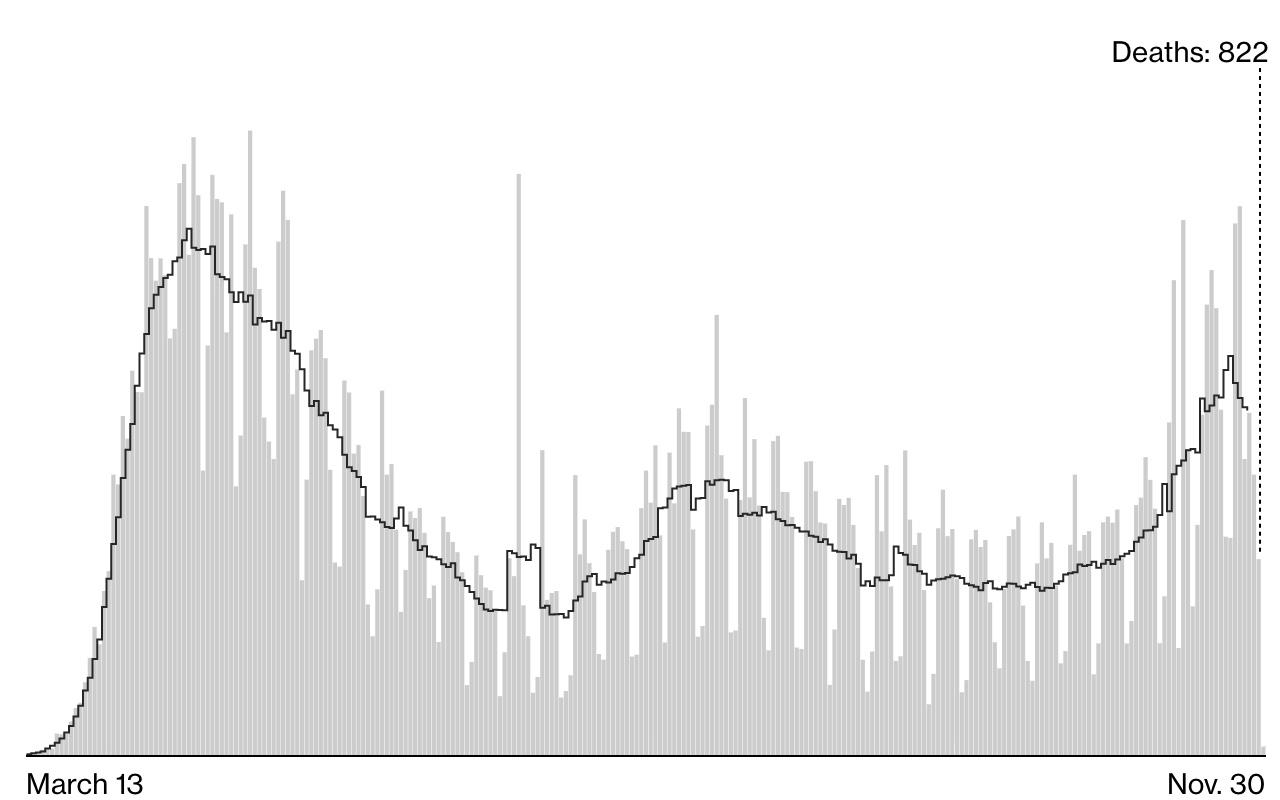
California reported 15,614 new cases, pushing the 14-day average to a record. The total number of infections in the state now stands at almost 1.2 million. Another 32 new deaths were reported, with fatalities at 19,121.

In California, the COVID-19 positivity rate reached 6.1%, the highest since the end of August, while the state’s two most prominent cities, Los Angeles and San Francisco, imposed new curbs in the past two days as case numbers surged. The rate of positive tests fell to 11.1%, just over half, roughly half its level from December. The number of patients in intensive care continued to decline from a peak almost two weeks ago. Deaths linked to the virus increased by 198 to 52,325, the smallest daily increase in a month.

Back in Europe, Italy’s government has approved a fourth stimulus package to support businesses hit by the latest restrictions to stem the spread of the coronavirus. The package is worth 8 billion euros ($9.6 billion), according to a Monday statement. It delays tax deadlines for companies and expands cash handouts for workers

France added 9,784 cases, with the seven-day average falling to 11,1182, the lowest since Oct. 2. The rate of positive tests fell to 11.1%.

Finally, in Germany, Chancellor Angela Merkel warned the company can’t continue compensating businesses for lost sales beyond next month. Instead, more targeted measures will be needed.

Globally, the number of COVID-19 cases exceed 62.7 million, while deaths topped 1.45 million.

Here’s some more news from overnight and Monday morning:

US COVID-19 total cases rose to around 13.14mln from a previous of around 13.00mln and total death rose to around 265.2k from around 264.0k. (Newswires)

New York City Mayor De Blasio announced that the city’s public schools will begin to resume in-person classes from December 7th. (Newswires)

Canada extended its travel restriction for arrivals from US until at least December 21st, while it will extend mandatory isolation order and temporary travel restrictions from other countries aside from US to January 21st. (Newswires)

UK COVID-19 cases +12,155 (prev. +15,871) and deaths +215 (prev. +479), while Italy cases +20,648 (prev. +26,323) and deaths +541 (prev. +686). (Newswires)

UK PM Johnson said the tiered virus system would have a sunset of February 3rd in which he promised to give parliament another chance to vote on the system in early February to avoid a mass Tory rebellion. It was separately reported that UK PM Johnson appointed Junior Business Minister Nadhim Zahawi as the minister in charge of vaccine distribution (Newswires/Telegraph/Sky News).

UK is set to become the first western country to approve a COVID-19 vaccine in which the regulator could grant approval to Pfizer and BioNTech’s vaccine within days, while reports added that deliveries would start within hours of the approval and first injections could begin from December 7th. (FT) European Medicines Agency is set to consider approval of Pfizer/BioNTech vaccine next month and will also consider Moderna’s vaccine (FT).

Moderna (MRNA) announced amendment of current supply agreement with the UK government for an additional 2mln doses of its COVID-19 vaccine in which the UK government has now secured 7mln doses of MRNA-1273 (Newswires).

German Economy Minister Altmaier stated that the partial shutdown could be extended until early spring 2021. There were separate reports that Italy was reported to loosen COVID restrictions in Lombardy, Piedmont, Calabria, Milan, Turin from Sunday, while Ireland PM Martin unveiled a plan to lift the lockdown and stated that they are encouraged by falling virus numbers (Newswires).

via ZeroHedge News https://ift.tt/3mqY6Yq Tyler Durden

Supreme Court Considers Whether Trump Can Block Immigrants From Census Counts

sipaphotosten948896

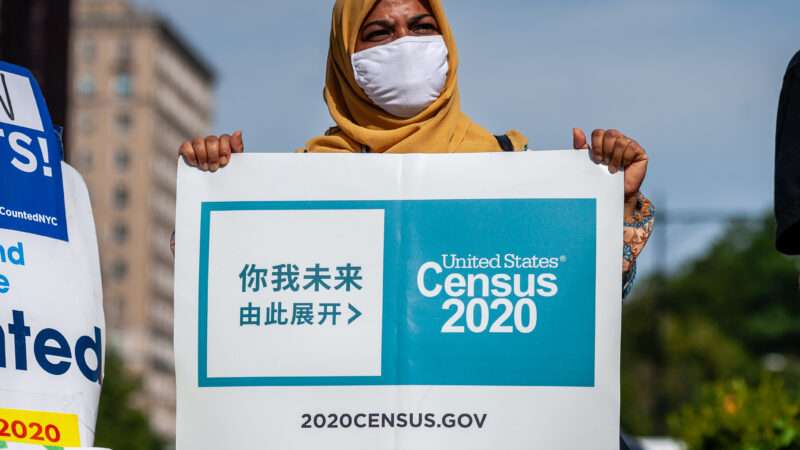
Fourth time’s the charm? Three federal courts have told the Trump administration that it’s not OK to exclude undocumented immigrants from U.S. census counts. Today, the issue comes before the U.S. Supreme Court.

The Court is slated to hear oral arguments Monday in a case called Trump v. New York.

Some background:

In July Trump issued a memorandum ordering the Census Bureau to send him two sets of numbers. The first set was for the whole number of persons in each state. And the second set — for apportionment of the number of seats in each state — was to subtract the number of undocumented immigrants from the total count.

As the memorandum candidly admitted, that might mean that California, for instance, would lose two congressional seats. Trump’s stated aim was to “not reward” states where large numbers of undocumented immigrants live….

So far the president has lost his argument in three lower courts, with both Democratic and Republican-appointed judges ruling against him unanimously.

Legal blogger Amy Howe explains the SCOTUS stakes:

If the court upholds the plan and the administration is able to implement it before leaving office, the new method of apportioning House seats could shift political power away from states with large immigrant populations and toward states with fewer immigrants.

The Supreme Court will also consider a case today on federal hacking law.

In Van Buren v. United States, the Court will, for the first time, “weigh in on the wide range of digital conduct that is potentially criminalized under a federal anti-hacking law known as the Computer Fraud and Abuse Act,” explains James Romoser at SCOTUSBlog. More on that case here.


ELECTION 2020

The Pennsylvania Supreme Court ruled against a Republican challenge to mail-in ballots. “Petitioners sought to invalidate the ballots of the millions of Pennsylvania voters who utilized the mail-in voting procedures,” the court noted in its Saturday ruling. “Alternatively, Petitioners advocated the extraordinary proposition that the court disenfranchise all 6.9 million Pennsylvanians who voted in the General Election and instead ‘direct the General Assembly to choose Pennsylvania’s electors.'”


FREE MINDS

Could correcting the misalignment between who hands out prison sentences and who pays for them bring about better criminal justice outcomes? A new paper suggests yes:


FREE MARKETS


Reminder:


QUICK HITS

• “Nike and Coca-Cola are among the major companies and business groups lobbying Congress to weaken a bill that would ban imported goods made with forced labor in China’s Xinjiang region,” reports The New York Times.

• For the fourth time, a California governor has blocked Charles Manson follower Leslie Van Houten from being paroled. Van Houten was 19 when she helped kill Leno and Rosemary LaBianca in 1969.

• From victims of the Drug War to legal cannabis entrepreneurs

• Another case of a police officer experiencing no consequences for extorting sex from folks he arrests.

• Local sheriffs are still opting out of enforcing state orders banning social gatherings.

• New York City will start opening schools again for in-person learning next week.

• People are suing Tecate beer for not being Mexican.

from Latest – Reason.com https://ift.tt/2HR9ZaS
via IFTTT