Biden Appointee Neera Tanden Spread the Conspiracy That Russian Hackers Changed Hillary’s 2016 Votes To Trump: Greenwald

Biden Appointee Neera Tanden Spread the Conspiracy That Russian Hackers Changed Hillary’s 2016 Votes To Trump: Greenwald

Tyler Durden

Mon, 11/30/2020 – 09:45

Authored by Glenn Greenwald via greenwald.substack.com (emphasis ours)

The announcement that Joe Biden intends to nominate Neera Tanden as his Director of the Office of Management and Budget — a critical position overseeing U.S. economic and regulatory policy — triggered a wide range of mockery, indignation and disgust from both the left and the right. That should not be surprising: though a thoroughly mediocre and ordinary D.C. swamp creature from the perspective of both ideology and competence, Tanden’s uniquely unhinged, venomous, corrupt and pathologically dishonest conduct as a Clinton Family and DNC apparatchik and President of the corporatist-and-despot-funded Center for American Progress (CAP) has earned her a list of enemies far longer and more impressive than her accomplishments.

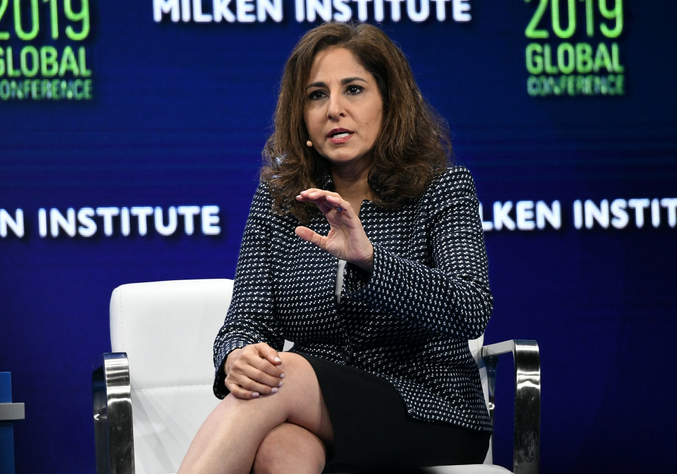
Neera Tanden participates in a panel discussion during the annual Milken Institute Global Conference at The Beverly Hilton Hotel on April 29, 2019 in Beverly Hills, California. (Photo by Michael Kovac/Getty Images)

When news of her appointment broke, many of the journalists and activists she has spent years abusing, slandering, and lying about instantly stepped forward to compile just some of her worst political and behavioral lowlights. And some preliminary signs emerged that she might encounter difficulty in obtaining the Senate confirmation needed for her to assume this position. The Communications Director for GOP Senator John Cornyn of Texas announced that “Tanden stands zero chance of being confirmed” by the Senate.

Former Sanders campaign aide David Sirota hypothesized that “it is not a coincidence that they are putting Neera Tanden — the single biggest, most aggressive Bernie Sanders critic in the United States of America — specifically at OMB while Sanders is Senate Budget Committee ranking/chair.” Sirota’s statement suggests Biden’s nomination of Tanden was intended as yet more humiliation doled out to the Democratic-loyal Sanders left by cucking the Vermont Senator even further by forcing him to shepherd the confirmation of one of his most vicious and amoral attackers (who Sanders himself in 2019 vehemently denounced). But Sirota’s point also raises the prospect that Tanden’s nomination could even encounter trouble from that side of the aisle as well (given Sanders’ compliant and disciplined conduct over the last six months, it’s more likely we will see him roll out a literal red carpet for Tanden to walk on, gently toss red roses on it before she passes, and then serve her a glass of Chardonnay rather than meaningfully obstruct her confirmation).

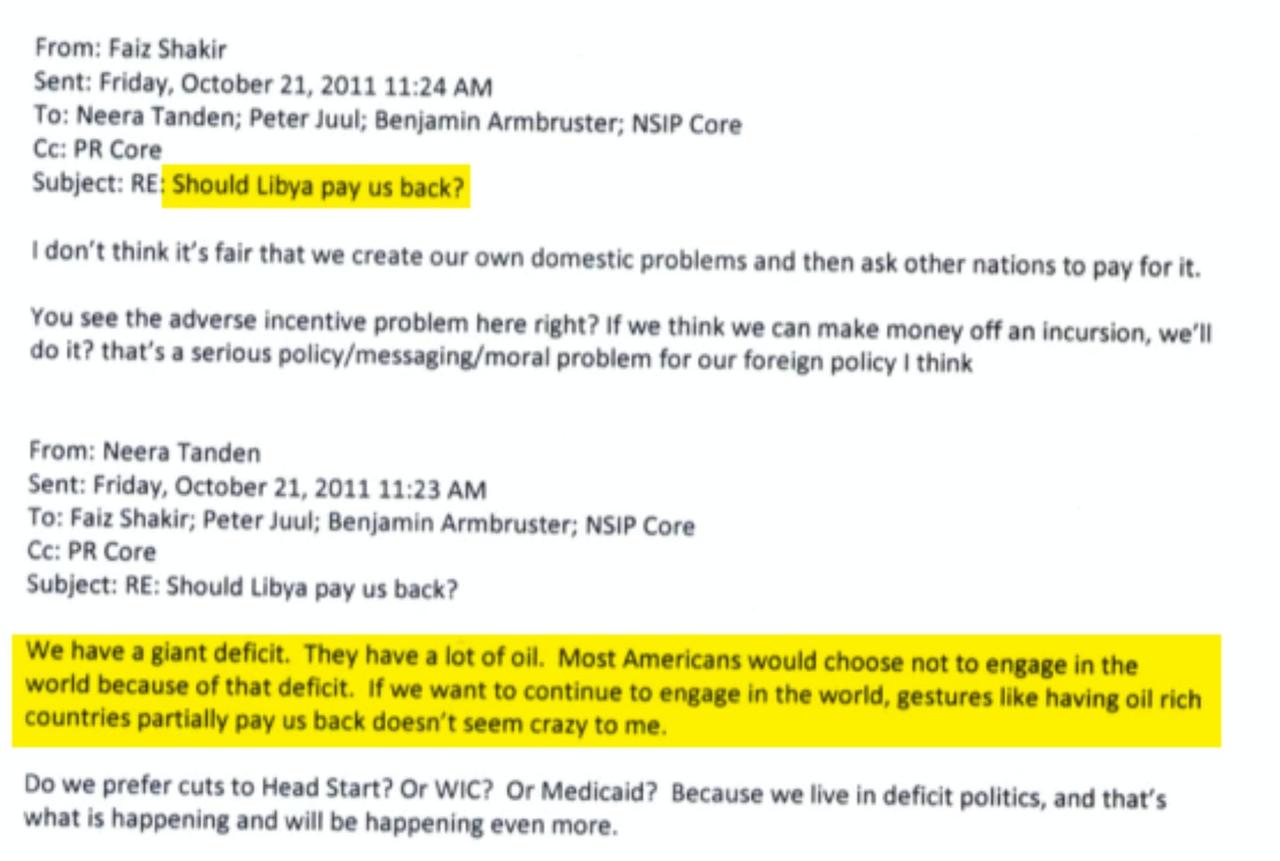
The list of sociopathic and even monstrous acts from Tanden is too long to list comprehensively. She punched one of her own employees, a reporter for CAP’s now-abolished blog ThinkProgress, after he had the temerity to ask Hillary Clinton in 2008 about her support for the Iraq War (Tanden claimed she “merely” had “pushed,” not punched, her undeferential reporter). In 2011, as the Obama administration was participating in the NATO bombing of Libya, Tanden suggested in internal CAP discussions that the U.S. steal Libya’s oil as a way of reducing the U.S. deficit (a story I was able to report only because Tanden had abused and alienated so many of her employees that they worked together to leak her incriminating emails to me).
During her tenure as CAP’s President, Tanden accepted millions of dollars  from the regime of the United Arab Emirates, which built Dubai and Abu Dhabi using slave labor, along with massive donations from Facebook, Google, Microsoft, J.P. Morgan, the Walton Family and Michael Bloomberg, while hiding the identity of some of her think tank’s largest donors. A huge chapter on the NYPD’s abusive policies toward Muslims under Mayor Michael Bloomberg was removed from a CAP report after Boomberg donated more than $1 million to Tanden’s organization, and he continued to donate even more after that courteous gesture.

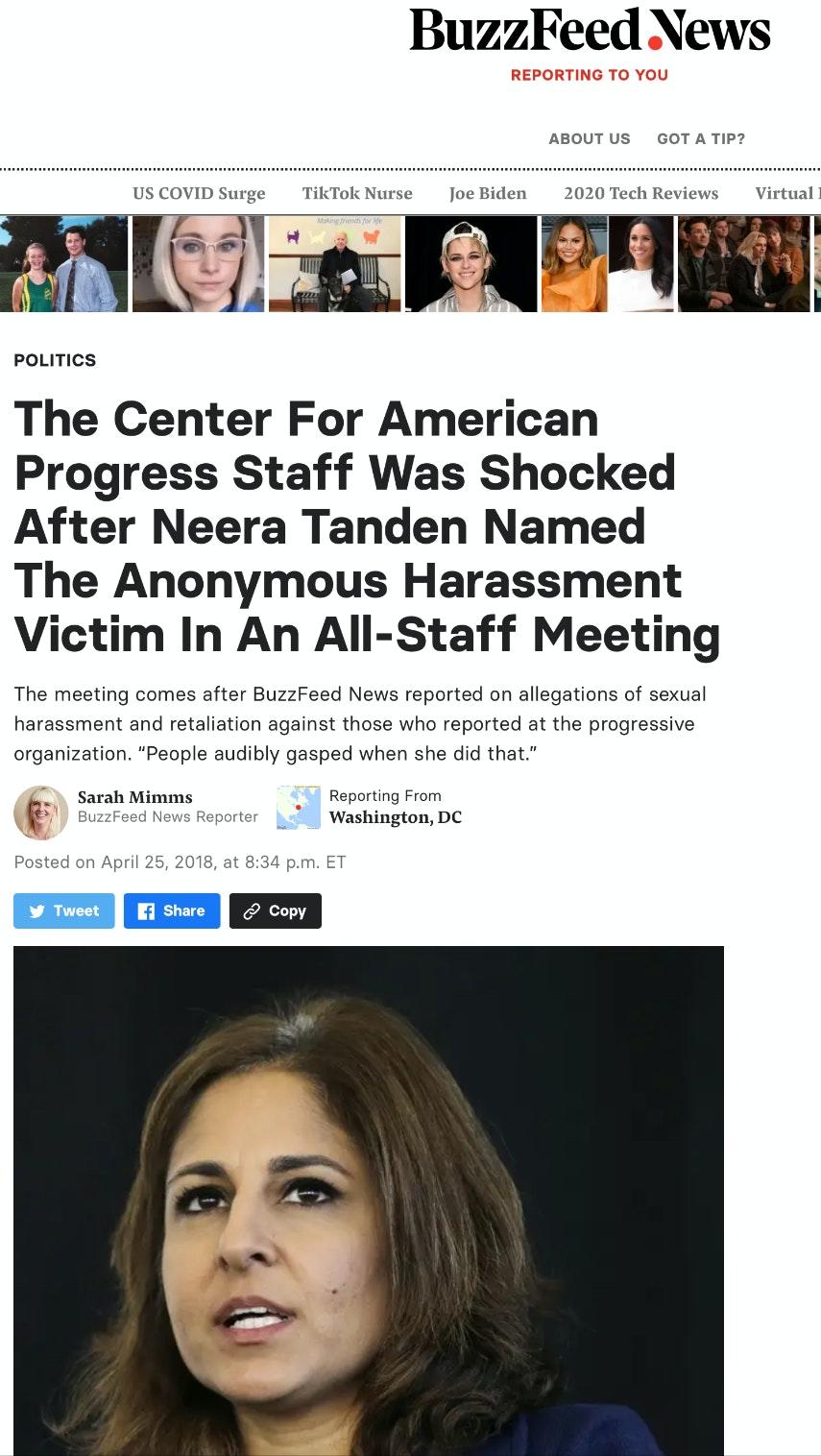
She ordered the supposedly independent journalists of the ThinkProgress blog, including Muslim writers, to stop writing critically about Israel after key CAP donors, including Barney Frank’s sister Ann Lewis and long-time Clinton advisor Howard Wolfson, complained. She and Wolfson plotted in 2016 how to weaponize female journalists and people of color against Hillary’s critics as well to use their identity to stigmatize and thus stop undesirable coverage from The New York Times. In 2018, she outed a CAP employee at a staff-wide meeting who had filed an anonymous complaint of sexual harassment and retaliation against one of Tanden’s male allies. Secure with her UAE-and-corporate-funded large salary, she has long urged cuts to Social Security. The list goes on and on.
One can reasonably view Biden’s choice of Tanden as a positive. She is no different in character or ideology than any of the faceless, more obscure DNC operatives who would occupy this position if she did not. But because of how well-known her sociopathy, militarism and corporatism are to many on the liberal-left, her face serves as an undeniable and unavoidable reminder of what the Biden administration and the Democratic Party really are. She illuminates the truth about their real aims.

But beyond things like wanting to steal Libya’s oil after bombing it into oblivion, outing sexual harassment complainants, and physically assaulting and censoring her own employees, there is one uniquely abominable feature of Neera Tanden. She is one of the most deranged conspiracy theorists in the United States, and has done more than almost any other Washington functionary to contaminate Democrats’ mental health, capacity to reason, and faith in the legitimacy of U.S. elections.


Tanden owes her entire career to the patronage of Hillary Clinton, and her devotion to Hillary approaches restraining-order levels of creepiness (here you can watch Tanden beam with adoration as then-Senator Hillary Clinton, on the Senate floor in 2004, explains her steadfast opposition to marriage equality for same-sex couples on the ground that “marriage is a sacred bond between a man and a woman” and “exists between a man and a woman going back into the mists of history” for the primary purpose of raising children — just a few short years before Democrats changed views on this, after which it instantly became the hallmark of an unreconstructed hateful bigot to say this).

Few people took Hillary’s 2016 loss to Donald Trump as hard as Tanden, or handled it as poorly. Indeed, she refused to believe it really happened, and encouraged others to similarly refuse to accept its reality.

In the weeks after Trump’s victory, Tanden joined numerous Democrats in encouraging electors of the Electoral College to ignore their states’ votes and refuse to elect Trump as President (many rationale were invoked for this: Tanden’s was a CAP article promoting #Resistance fanatic Richard Painter’s argument that Trump’s violations of the Emolument Clause precluded an Electoral College win). She insisted that Hillary lost because of Russia, claiming the “Russians did enough damage to affect more than 70k votes in 3 states.” And she was not only one of the first to push the Steele Dossier’s claim that Russia held blackmail power over Trump but also one of the last to do so — insisting in 2018 that “the dossier been mostly proven to be true” and claiming as late as 2019 that nothing in this discredited junk report had been disproven.

But what really distinguished Tanden when it came to unhinged and toxic behavior was her repeated (and obviously baseless) claims that Hillary only lost because Russian hackers invaded the U.S. voting system and clandestinely changed Hillary’s votes to Trump’s, costing the real winner — Hillary — her rightful place on the throne, behind the Resolute Desk.

Four days after the 2016 election, Tanden began strongly implying, if not outright stating, that Russian hackers changed the vote totals, and that this is why “Trump was as surprised as everyone else” by his victory. When I highlighted her conspiratorial claims, she did not deny their obvious meaning, but rationalized them by insisting that her conspiracies were not as bad as Trump’s refusal, in advance of the election, to acknowledge the legitimacy of an election that had not yet taken place:
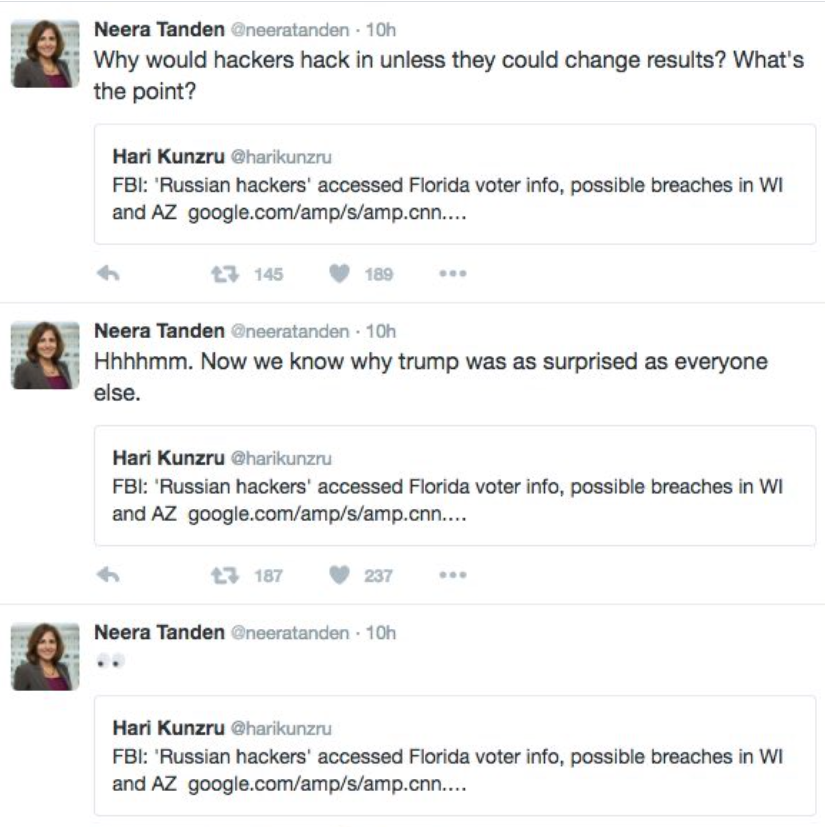
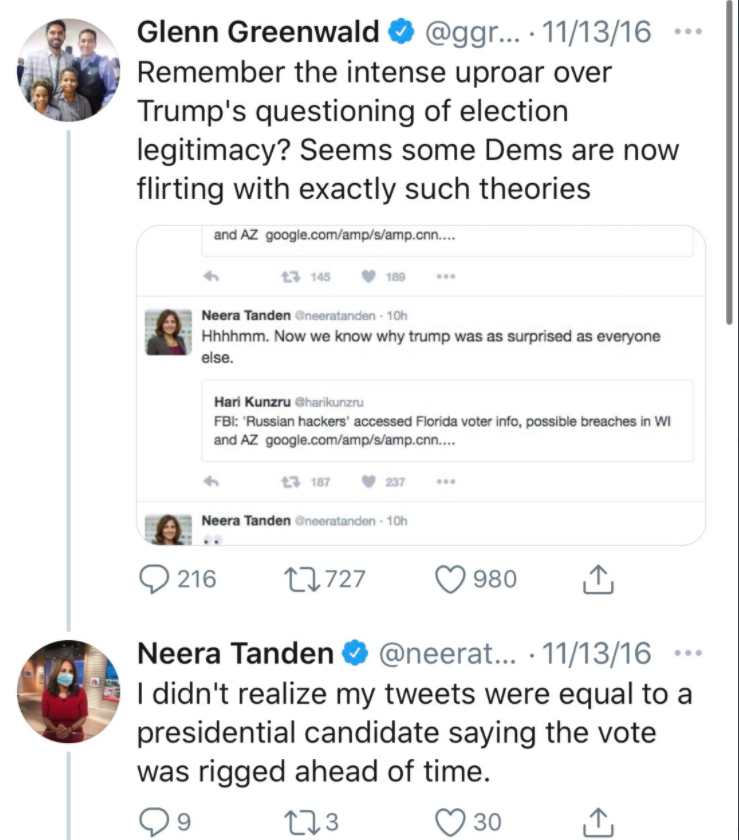
Tanden’s insistence that Russia changed the voting results through hacking did not once her traumatic shock in the weeks after Hillary’s loss dissipated (if it ever did). After The Intercept  published an anonymous, evidence-free document in June, 2017, allegedly sent by NSA employee Reality Winner, which led that site to claim that “Russian military intelligence executed a cyberattack on at least one U.S. voting software supplier and sent spear-phishing emails to more than 100 local election officials,” Tanden returned to pushing this bizarre conspiracy theory, demanding that I “retract” my post-election criticism of her for peddling this Russia-changed-the-votes madness — as if this NSA document published by The Intercept proved vote-changing hacking by Russia.

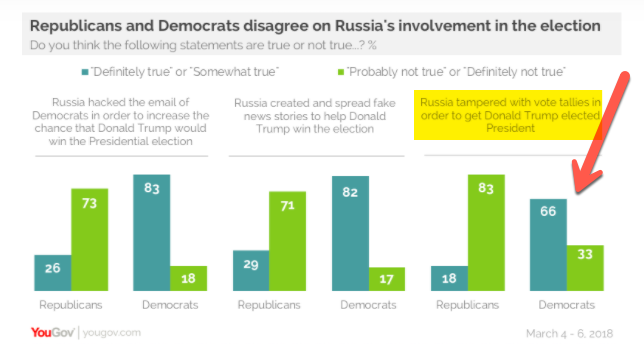
This conspiracy-mongering led by Tanden and other prominent liberal activists had a corrosive effect on the ability of Democrats to perceive basic reality, to put that mildly. A 2018 poll from Economist/YouGov — conducted more than a year after Trump’s inauguration — found that a large majority of Democrats (66%) believe that “Russia tampered with vote tallies in order to get Donald Trump elected President.”
Thereafter, Hillary herself took to calling Trump an “illegitimate” president, further fueling the destruction of confidence and faith among Democrats in the legitimacy of the vote totals and specifically the outcome of the 2016 presidential election.

Democratic leaders and their media allies love to patronizingly warn that conservative media outlets and their audiences are prone to spread and believe crazy conspiracy theories. They purport particular worry when such conspiracies are designed to undermine faith and trust in the U.S. electoral system itself.

Yet few have done more to destroy such confidence and faith than Neera Tanden, achieved by disseminating over the course of several years some of the most unhinged, evidence-free and deranged conspiracy theories in which she deliberately deceived Democratic partisans into believing that Moscow’s dastardly hackers invaded the sanctity of the U.S. voting system to change Hillary’s votes to Trump’s. And it worked: at least as of 2018, large majorities of Democrats believe that this utterly unproven but dangerous assertion is true.

If Joe Biden succeeds in empowering someone like Neera Tanden without extreme opposition from supposedly adversarial journalists, not only Democrats but also these media outlets will lose whatever lingering credibility they have to denounce conspiracy theories and to defend the legitimacy of U.S. elections. And they will deserve that fate. You can’t run around expecting people will take you seriously when you warn of the dangers of toxic, moronic conspiracy theories when you yourself embrace, elevate and promote the most prolific and reckless purveyors of them.

*  *  *

NOTE TO READERS: We are in the process attempting to expand the content we provide on this Substack platform, including featuring more writers and voices for podcasts, videos, articles and other content in conjunction with my own. I am grateful to those who have subscribed thus far and made our launch a success: further subscriptions will enable us to expand further and do ever more with our journalism here: SUBSCRIBE NOW

via ZeroHedge News https://ift.tt/39rRYva Tyler Durden
Biden Confirms Janet Yellen As Treasury Secretary Pick

Biden Confirms Janet Yellen As Treasury Secretary Pick

Tyler Durden

Mon, 11/30/2020 – 09:42

Confirming the leaked rumors and strawmen (sorry, straw-people) from last week, Joe Biden, who has placed a premium on diversity in his selection of Cabinet nominees and key advisers, is looking to notch at least a few firsts with his economic team selections.

Here is today’s new entrants to a potential Biden admin…

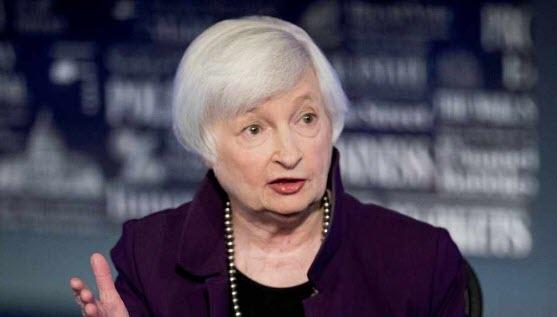
Janet Yellen is nominated to serve as Secretary of the Treasury. If confirmed, she will be the first woman to lead the Treasury Department in its 231-year history, and the first person to have served as Treasury Secretary, Chair of the Council of Economic Advisers, and Chair of the Federal Reserve. She has previously been confirmed by the Senate on four separate occasions.

Neera Tandem, whose career has focused on pursuing policies designed to support working families, foster broad-based economic growth, and curb rampant inequality, is nominated to serve as Director of the Office of Management and Budget. If confirmed, Tanden would be the first woman of color and first South Asian American to lead the OMB.

Wally Adeyemo, a veteran of the Executive Branch and expert on macro-economic policy and consumer protection with deep national security experience, is nominated to serve as Deputy Secretary of the Treasury, having previously served as Deputy Director of the National Economic Council, Deputy National Security Advisor, and the first Chief of Staff of the Consumer Financial Protection Bureau. If confirmed, Adeyemo would be the first African American Deputy Secretary of the Treasury.

Cecilia Rouse, a leading labor economist and the Dean of the Princeton School of Public and International Affairs, is nominated to serve as Chair of the Council of Economic Advisers, having previously been confirmed by the Senate as a member of the CEA in eooq. If confirmed, she will become the first African American and just the fourth woman to lead the CEA in the 74 years of its existence.

Jared Bernstein, who previously served as Chief Economist to President-elect Biden in the first years of the Obama-Biden Administration, will serve as a member of the Council of Economic Advisers.

Heather Boushey, a distinguished economist focused on economic inequality and the President, CEO, and co-founder of the Washington Center for Equitable Growth, will serve as a member of the Council of Economic Advisers.

via ZeroHedge News https://ift.tt/3o2JL4C Tyler Durden

Supreme Court Considers Whether Trump Can Block Immigrants From Census Counts

sipaphotosten948896

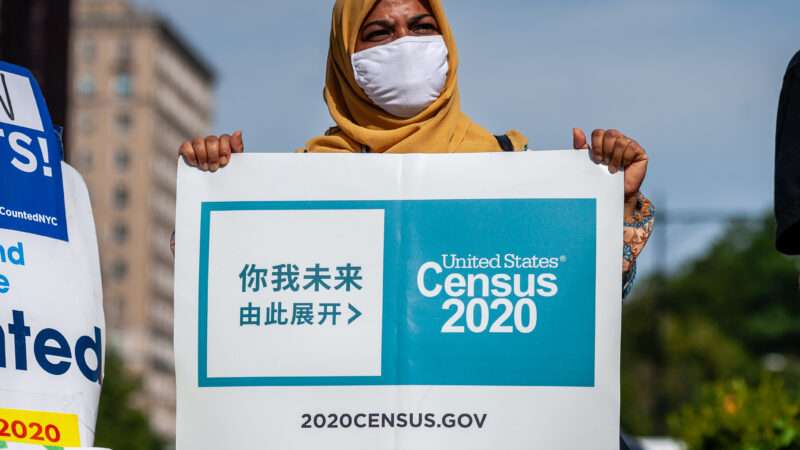
Fourth time’s the charm? Three federal courts have told the Trump administration that it’s not OK to exclude undocumented immigrants from U.S. census counts. Today, the issue comes before the U.S. Supreme Court.

The Court is slated to hear oral arguments Monday in a case called Trump v. New York.

Some background:

In July Trump issued a memorandum ordering the Census Bureau to send him two sets of numbers. The first set was for the whole number of persons in each state. And the second set — for apportionment of the number of seats in each state — was to subtract the number of undocumented immigrants from the total count.

As the memorandum candidly admitted, that might mean that California, for instance, would lose two congressional seats. Trump’s stated aim was to “not reward” states where large numbers of undocumented immigrants live.

[…] So far the president has lost his argument in three lower courts, with both Democratic and Republican-appointed judges ruling against him unanimously.

Legal blogger Amy Howe explains the SCOTUS stakes:

If the court upholds the plan and the administration is able to implement it before leaving office, the new method of apportioning House seats could shift political power away from states with large immigrant populations and toward states with fewer immigrants.

The Supreme Court will also consider a case today on federal hacking law.

In Van Buren v. United States, the Court will, for the first time, “weigh in on the wide range of digital conduct that is potentially criminalized under a federal anti-hacking law known as the Computer Fraud and Abuse Act,” explains James Romoser at SCOTUSBlog. More on that case here.


ELECTION 2020

The Pennsylvania Supreme Court ruled against a Republican challenge to mail-in ballots. “Petitioners sought to invalidate the ballots of the millions of Pennsylvania voters who utilized the mail-in voting procedures,” the court noted in its Saturday ruling. “Alternatively, Petitioners advocated the extraordinary proposition that the court disenfranchise all 6.9 million Pennsylvanians who voted in the General Election and instead ‘direct the General Assembly to choose Pennsylvania’s electors.'”


FREE MINDS

Could correcting the misalignment between who hands out prison sentences and who pays for them bring about better criminal justice outcomes? A new paper suggests yes:


FREE MARKETS


Reminder:


QUICK HITS

• “Nike and Coca-Cola are among the major companies and business groups lobbying Congress to weaken a bill that would ban imported goods made with forced labor in China’s Xinjiang region,” reports The New York Times.

• For the fourth time, a California governor has blocked Charles Manson follower Leslie Van Houten from being paroled. Van Houten was 19 when she helped kill Leno and Rosemary LaBianca in 1969.

• From victims of the Drug War to legal cannabis entrepreneurs

• Another case of a police officer experiencing no consequences for extorting sex from folks he arrests.

• Local sheriffs are still opting out of enforcing state orders banning social gatherings.

• New York City will start opening schools again for in-person learning next week.

• People are suing Tecate beer for not being Mexican.

from Latest – Reason.com https://ift.tt/2HR9ZaS
via IFTTT

Key Events In The Coming Busy Week: Jobs, PMIs, And Central Banks

Key Events In The Coming Busy Week: Jobs, PMIs, And Central Banks

Tyler Durden

Mon, 11/30/2020 – 09:39

With just a handful of trading days left until the end of what has been an absolutely insane 2020, it’s shaping up to be a fairly busy week for data but as DB’s Jim Reid writes, “how much markets will care is a moot point as everyone knows we’re on a short-term path to a double dip but that the short to medium term is a path covered in potential golden vaccine petals.”

Data releases include the US jobs report (Friday) and the November PMIs (tomorrow and Thursday), while Fed Chair Powell and ECB President Lagarde will both be speaking through the week. Otherwise, attention will remain on the Brexit negotiations, with just a month remaining until the year-end deadline and less time given any deal has to be ratified across the continent.

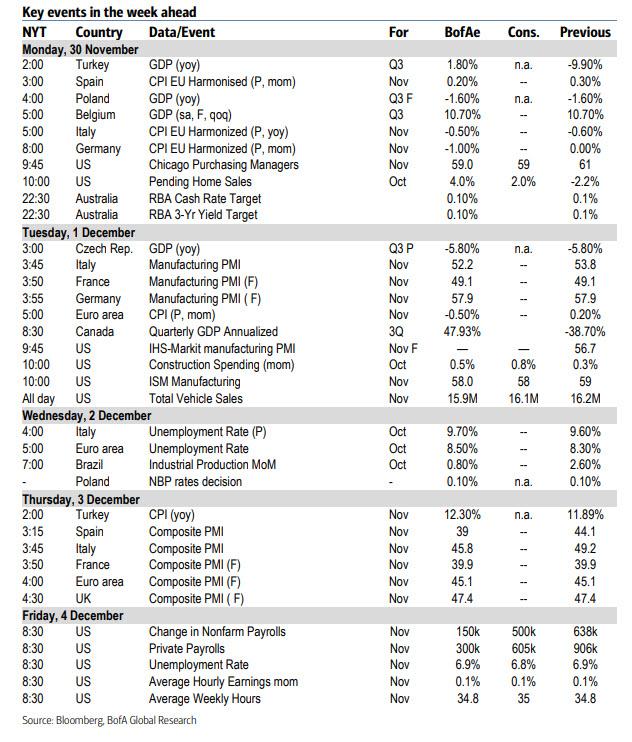
A full breakdown of key events is shown below:

Looking into more detail, the US jobs report for October on Friday sees consensus at +500k and a fall in the unemployment rate to 6.8% from 6.9%. Though this would be further progress from the situation in the spring, it would still be the slowest monthly jobs growth since the massive contractions in March and April, and leave the total nonfarm payrolls number over 9.5m beneath its pre-Covid peak back in February. Of some concern is the recent weekly initial jobless claims trend which have risen more than expected for the last couple of weeks. So it feels like a difficult month or so ahead for the US economy.

Meanwhile on the PMIs, the flash readings we’ve already had showed a noticeable deterioration in Europe as much of the continent headed into renewed lockdowns. It’ll be interesting to gauge what’s happening in the countries where there aren’t flash readings however, including a number of emerging markets. Also in focus will be the Euro Area’s flash CPI estimate for November tomorrow as for the previous 3 months it’s been in deflationary territory.

Elsewhere on Brexit, face to face talks are back with we are running low on days to ratify a deal. In terms of the current state of play, it has been reported that the last big remaining obstacle in the talks is fishing rights with the UK Foreign Secretary Dominic Raab asking the EU to recognize that regaining control over British waters is a question of sovereignty for the UK. Meanwhile, on other key obstacles of competition rules and state aid, Raab said that he could see “a landing zone”. If fishing is truly now the only stumbling block this is very good news as the numbers here are minuscule compared to the cost of no deal. Sterling is up +0.21% to 1.3339 overnight.

Finally, there are a number of important central bank speakers this week, with Fed Chair Powell and Treasury Secretary Mnuchin appearing before the Senate Banking Committee tomorrow and the House Financial Services Committee on Wednesday. Meanwhile ECB President Lagarde will be speaking today at the European Policy Center Forum, before she appears at an Atlantic Council event tomorrow. The Fed will also be releasing their Beige Book on Wednesday.

Below, courtesy of Deutsche Bank, here is a day-by-day calendar of events

Monday November 30

  • Data: China November composite, manufacturing and non-manufacturing PMIs, Japan October housing starts, UK October mortgage approvals, Italy preliminary November CPI, Germany preliminary November CPI, Canada October building permits, US November MNI Chicago PMI, Dallas Fed manufacturing index, October pending home sales, Japan October jobless rate (23:30UK time)
  • Central Banks: ECB President Lagarde and BoE’s Tenreyro speaks

Tuesday December 1

  • Data: November Manufacturing PMIs from Indonesia, South Korea, Japan, China, India, Russia, Turkey, Italy, France, Germany, South Africa, Euro Area, UK, Brazil, Canada, US and Mexico, Japan November vehicle sales, Germany November unemployment change, Euro Area November flash CPI estimate, Canada September GDP, US November ISM manufacturing
  • Central Banks: Fed Chair Powell, ECB President Lagarde and the Fed’s Brainard, Daly and Evans speak, Reserve Bank of Australia monetary policy decision
  • Other: OECD publishes Economic Outlook

Wednesday December 2

  • Data: Euro Area October unemployment rate, US weekly MBA mortgage applications, November ADP employment change
  • Central Banks: Federal Reserve releases Beige Book, Fed Chair Powell and Fed’s Williams speak

Thursday December 3

  • Data: November services and composite PMIs from Japan, China, India, Russia, Italy, France, Germany, Euro Area, UK, Brazil and the US, Euro Area October retail sales, US weekly initial jobless claims, November ISM services index
  • Central Banks: Fed’s Bowman and BoE’s Tenreyro speak

Friday December 4

  • Data: Germany October factory orders, November construction PMI, Italy October retail sales, UK November construction PMI, Canada November net change in employment, US November nonfarm payrolls, unemployment rate, average hourly earnings, October trade balance, factory orders, final October durable goods orders, nondefence capital goods orders ex air
  • Central Banks: Reserve Bank of India monetary policy decision

Finally, looking at the US alone, the key economic data releases this week are the ISM manufacturing report on Tuesday, ISM non-manufacturing report and jobless claims on Thursday, and the employment report on Friday. There are several speaking engagements from Fed officials this week, including Chair Powell on Tuesday and Wednesday. Here is Goldman’s take on what to expect:

Monday, November 30


  • 09:45 AM Chicago PMI, November (GS 60.1, consensus 59.1, last 61.1); We estimate that the Chicago PMI edged down by 1.0pt to 60.1 in November. Our forecast reflects resilience in the manufacturing sector.
  • 10:00 AM Pending home sales, October (GS -1.5%, consensus +1.0%, last -2.2%): We estimate that pending home sales declined by 1.5% in November, reflecting a further deceleration in regional home sales data.

Tuesday, December 1

  • 09:45 AM Markit Flash US manufacturing PMI, November final (consensus 56.7, last 56.7)
  • 10:00 AM ISM manufacturing index, November (GS 58.3, consensus 57.8, last 59.3): We expect the ISM manufacturing index to edge down by 1.0pt to 58.3 in the November report, reflecting resilience in the manufacturing sector. Our GS Manufacturing Tracker stands at 57.2 in November, compared to 58.2 in October.
  • 10:00 AM Construction spending, October (GS +1.0%, consensus +0.8%, last +0.3%): We estimate a 1.0% increase in construction spending in October, with scope for increases in private residential and public construction.
  • 10:00 AM Fed Chair Powell (FOMC voter) speaks: Fed Chair Powell will appear before the Senate Banking Committee to discuss the CARES Act. Prepared text is expected.
  • 12:00 PM Fed Governor Brainard (FOMC voter) speaks: Fed Governor Brainard will take part in an online discussion of the modernization of the Community Reinvestment Act. Prepared text and moderated Q&A are expected.
  • 01:15 PM San Francisco Fed President Daly (FOMC non-voter) speaks: San Francisco Fed President Daly will speak at a virtual economic forecast luncheon hosted by Arizona State University. Prepared text and Q&A with audience and media are expected.
  • 03:00 PM Chicago Fed President Evans (FOMC non-voter) speaks: Chicago Fed President Evans will make opening remarks at a community forum on Milwaukee’s future hosted by the Chicago Fed.

Wednesday, December 2

  • 08:15 AM ADP employment report, November (GS 525k, consensus 440k, last 365k); We expect a 525k gain in ADP payroll employment, reflecting a decline in jobless claims and firmness in private payrolls in November.
  • 10:00 AM Fed Chair Powell (FOMC voter) speaks: Fed Chair Powell will appear before the House Financial Services Committee to discuss the CARES Act. Prepared text is expected.
  • 01:00 PM New York Fed President Williams (FOMC voter) speaks: New York Fed President Williams will brief the press on the economic impact of Covid-19. Prepared text is not expected.

Thursday, December 3

  • 08:30 AM Initial jobless claims, week ended November 28 (GS 760k, consensus 765k, last 778k); Continuing jobless claims, week ended November 21 (consensus 5,811k, last 6,071k):We estimate initial jobless claim decreased to 760k in the week ended November 28. Our forecast assumes that the worse virus situation continues to put upward pressure on initial claims, but that the DOL’s seasonal adjustment understates the decline in filings due to the Thanksgiving holiday.
  • 09:45 AM Markit Flash US services PMI, November final (consensus 57.6, last 57.7)
  • 10:00 AM ISM non-manufacturing index, November (GS 55.5, consensus 56.1, last 56.6): We estimate the ISM non-manufacturing index declined by 0.6pt to 55.5 in November, reflecting a likely pullback in leisure, food services, and other services. Our GS Non-Manufacturing Tracker stands at 55.2, compared to 56.1 in October.

Friday, December 4

  • 08:30 AM Nonfarm payroll employment, November (GS +450k, consensus +500k, last +638k); Private payroll employment, November (GS +525k, consensus +608k, last +906k); Average hourly earnings (mom), November (GS +0.1%, consensus +0.1%, last +0.1%); Average hourly earnings (yoy), November (GS +4.2%, consensus +4.2%, last +4.5%); Unemployment rate, November (GS 6.8%, consensus 6.8%, last 6.9%): We estimate nonfarm payrolls rose 450k in November after +638k in October. The broad-based resurgence of the coronavirus and related business restrictions are consistent with a deceleration in job growth, and Big Data employment signals were softer on net. While continuing claims declined during the payroll month, much of the drop reflected the expiration of program eligibility (as opposed to reemployment), and initial claims have started rising again. We also expect a 90k drop in Census jobs in Friday’s report. On the positive side, we estimate strong growth in the construction industry and in trucking, courier, and delivery categories, reflecting favorable weather and the accelerating shift to ecommerce this holiday season, respectively.
  • We estimate the unemployment rate declined a tenth to 6.8%, reflecting an increase in household employment and a pause in the labor force participation rebound (itself related to the third wave of the virus). We estimate average hourly earnings rose 0.1% month-over-month, lowering the year-on-year rate by three tenths to 4.2%. This forecast reflects negative calendar effects and a continuing unwind of the composition shift from lower-paid workers to higher-paid workers.
  • 08:30 AM Trade balance, October (GS -$65.0bn, consensus -$64.8bn, last -$63.9bn): We estimate the trade deficit increased by $1.1bn in October, reflecting an increase in the goods trade deficit. Goods imports have returned to their pre-pandemic level, but monthly goods exports are still about $15bn below their pre-pandemic level. Both imports and exports of services have recovered only slightly from their Q2 troughs.
  • 10:00 AM Factory orders, October (GS +0.7%, consensus +0.8%, last +1.1%); Durable goods orders, October final (last +0.5%); Durable goods orders ex-transportation, October final (last +0.3%); Core capital goods orders, October final (last +0.7%); Core capital goods shipments, October final (last +2.3%): We estimate factory orders increased by 0.7% in October following a 1.1% increase in September. Durable goods orders rose by 1.3% in the October advance report, and core capital goods orders rose by 0.7%.
  • 10:00 AM Fed Governor Bowman (FOMC voter) speaks: Fed Governor Bowman will discuss community banking and fintech in an online event hosted by the Independent Community Bankers of America. Prepared text and moderated Q&A are expected.

Source: Deutsche Bank, BofA, Goldman

via ZeroHedge News https://ift.tt/36kfsQU Tyler Durden

Reports Of Libor’s Death Are Greatly Exaggerated: Fed Extends Libor Life From End-2021 To June 2023

Reports Of Libor’s Death Are Greatly Exaggerated: Fed Extends Libor Life From End-2021 To June 2023

Tyler Durden

Mon, 11/30/2020 – 09:21

In recent years we have repeatedly predicted that plans to phase out Libor by the end of 2021 will never play out because the banking world is simply unprepared to transition to Libor’s replacement rate – the SOFR – which suffered catastrophic volatility and outsizied moves during the March crash, which would have crushed most entities that have exposure to SOFR, and confirming that it is nowhere near ready to serve as a benchmark rate for hundreds of trillions of floating rate securities.

Moments ago the Fed confirmed as much when it announced that the administrator of dollar libor, the ICE Benchmark Administration, is set to extend the key tenors on the “discredited” interest-rate benchmark until the end of June 2023, and could extend three-month dollar Libor one-and-a-half years beyond its previously anticipated retirement date, which had been expected at the end of 2021. Six-month and 12-month dollar Libor could also be extended.

Nonetheless, in a statement, the Fed said that “the Federal Reserve Board, Federal Deposit Insurance Corporation and Office of the Comptroller of the Currency today issued a statement encouraging banks to cease entering into new contracts that use USD LIBOR as a reference rate as soon as practicable and in any event by December 31, 2021, in order to facilitate an orderly—and safe and sound— LIBOR transition.”

Alas, since SOFR is structurally flawed by its very definition – a definition which makes it responsible to market forces without the possibility for human overrides, manipulative or ortherwise – means that this extension will not be the last.

In recent years, regulators have been seeking to phase out Libor, or the London interbank offered rate, which is one of the bedrocks of the global financial system and underpins hundreds of trillions of dollars in financial assets, following countless manipulation scandals and the drying up of trading data used to inform the rate, but those efforts have been waylaid during the coronavirus pandemic. The IBA will consult on plans to cease publishing one-week and two-month Libor on time, according to the statement.

“Extending the publication of certain USD Libor tenors until June 30, 2023 would allow most legacy USD Libor contracts to mature before Libor experiences disruptions,” they said.

A senior Federal Reserve official said the path being set out calls for banks to stop writing new U.S. dollar Libor contracts by the end of 2021, but allows most legacy contracts that were written before that to mature before Libor stops.

The full statement from the Fed is below:

via ZeroHedge News https://ift.tt/3lgniPS Tyler Durden

China Trolls Australia With “Repugnant” Doctored Image, Refuses To Apologize

China Trolls Australia With “Repugnant” Doctored Image, Refuses To Apologize

Tyler Durden

Mon, 11/30/2020 – 09:00

The developing China-Australia trade row which initially sprang out of Australia’s joining other countries in criticizing Beijing’s handling of the coronavirus crisis has just taken a bizarre and sinister turn.

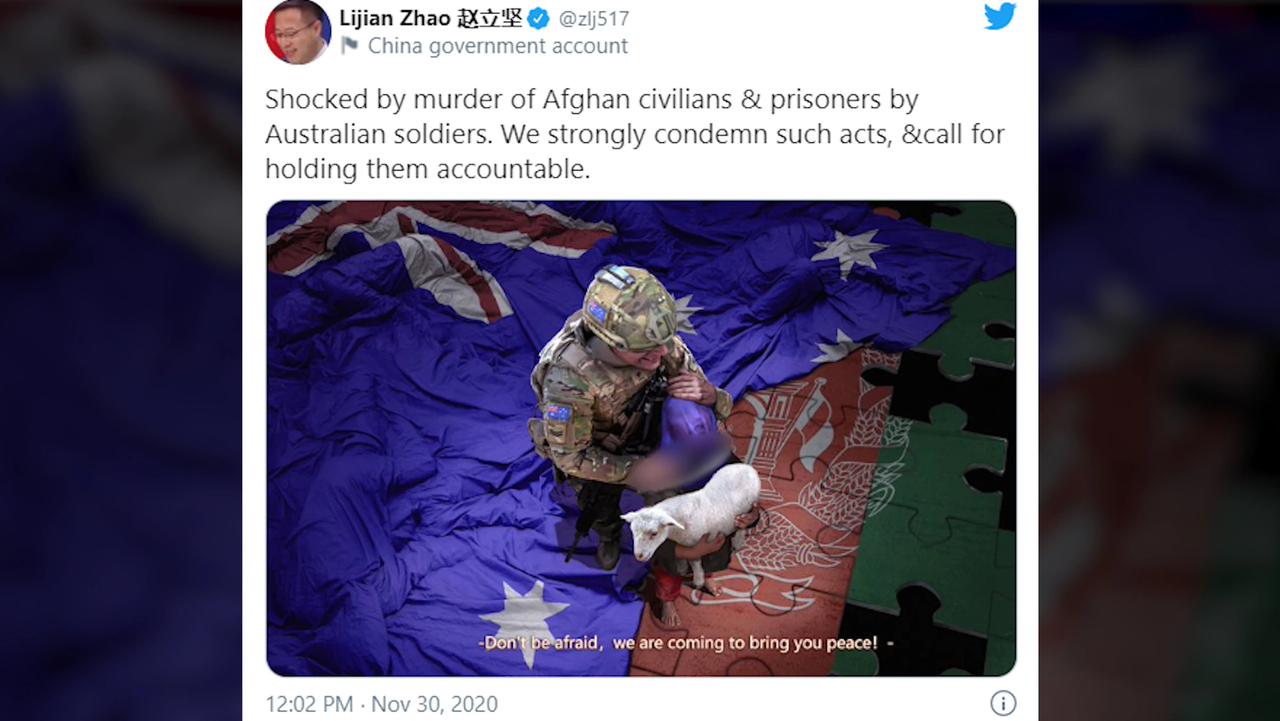
It started early Monday when China’s foreign ministry spokesman Zhao Lijian posted a disturbing image to Twitter depicting an Aussie soldier about to slit the throat of a child in Afghanistan. The grinning soldier held a bloody knife to the distressed child, who is seen holding a lamb, which is a symbol of innocence. 

Australian leaders and media were quick to point out it is a doctored or “fake” image and demanded that Lijian remove it immediately, and that Twitter take action over the account. 

“It is utterly outrageous and cannot be justified on any basis,” Australian Prime Minister Scott Morrison said. “The Chinese government should be utterly ashamed of this post. It diminishes them in the world’s eyes.”

Morrison and others demanded a formal apology out of China over the “repugnant” image and tweet. But China’s foreign ministry refused calls to apologize, instead doubling down on its charge that Australia appears less ashamed over its egregious war crimes in Afghanistan and more concerned over public embarrassment based on a tweet.

It comes after earlier this month Australia was rocked by scandal when a detailed investigation known as the Brereton War Crimes report revealed that Aussie special forces were implicated in up to 39 or more “unlawful killings” of Afghan civilians and prisoners. At least 13 Australian soldiers are facing criminal charges after horrific details emerged that they were killing random civilians essentially for sport, in something they called “blooding” – or initiating a special forces new join into war by orchestrating their first kill and then covering it up.

Here’s how China responded to the demands for an apology:

“It is the Australian government who should feel ashamed for their soldiers killing innocent Afghan civilians,” said Hua Chunying, China’s foreign ministry spokeswoman, when asked about Morrison’s comments.

The image posted by her colleague shows people’s “indignation,” said Hua, speaking at a regular news conference in Beijing on Monday. Whether it will be taken down is a matter between Twitter and the Australian government, she said.

It is indeed clear that the tweet was meant to highlight the shocking history of well-documented war crimes by Australia in central Asia, and is the latest in Canberra being forced to play on the defensive with China, after major commodities exports earlier this month were blocked and/or were hit with huge tariffs by China.

Zhao had written on Twitter alongside the image: “Shocked by murder of Afghan civilians & prisoners by Australian soldiers. We strongly condemn such acts, & call for holding them accountable.”

As of late in the day Monday (local time), the tweet is still up and has not been blocked or taken down by Twitter.

via ZeroHedge News https://ift.tt/2VfjfIW Tyler Durden

Bitcoin Tops $19k, Bounces Back From Black Friday FUD Fall

Bitcoin Tops $19k, Bounces Back From Black Friday FUD Fall

Tyler Durden

Mon, 11/30/2020 – 08:41

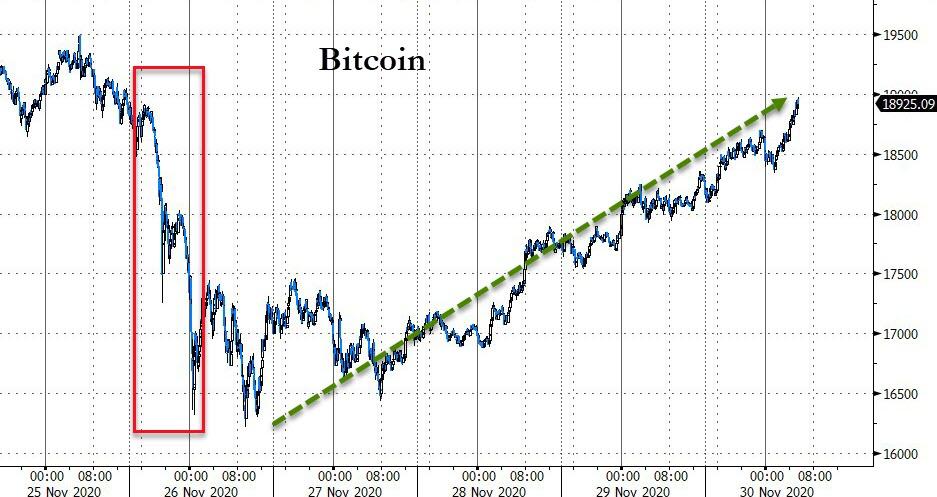
Bitcoin’s recent tumble cleared some speculative “froth” but further declines remain possible, according to JPMorgan, and that appears to have been confirmed as Bitcoin roars back to $19,000 this morning…

Momentum traders such as commodity trading advisors and other quantitative funds likely played a big role in the slide by unwinding long Bitcoin futures positions, strategists led by Nikolaos Panigirtzoglou wrote in a Nov. 27 note.

“The previous froth in momentum traders’ positioning has been cleared to a large extent,” they wrote, while adding momentum signals will continue to deteriorate unless Bitcoin recovers quickly.

Amid last week’s Black-Friday special slump in Bitcoin prices, cryptocurrency traders seemed beset on all sides by fear, uncertainty, and doubt. However, as CoinTelegraph’s Andrew Thurman reports, Dermot McGrath, head of research at blockchain investment firm Sino Global Capital, said the firm prefers taking a long term view. 

Shortly after a Thanksgiving Bitcoin dip to $16,200, news broke that the Chinese government had seized $4.2 billion in cryptocurrencies as part of the Plustoken Ponzi scheme court proceedings. Rumors swirled that those tokens were poised to be dumped on the open market, crashing prices further.

However, Sino Global CEO Matthew Graham wrote on Twitter that he believed the majority of the Plustoken Bitcoin had been sold:

Additionally, whether the tokens have been sold or not, in an interview with Cointelegraph McGrath recommended that traders learn to look beyond immediate headlines. 

“In the crypto and blockchain ecosystems it is important to be able to ‘cut through the noise,’” he said. “We are long term bullish on Bitcoin and we continue to see the industry professionalize and mature as an asset class.”

McGrath also weighed in on a common boogeyman for Western crypto traders — Chinese cryptocurrency miners. Many have speculated that Chinese miners could conduct a 51% attack on the network, and they’ve long been derided by some for controlling vast swaths of the BTC supply:

McGrath, however, rejects both notions.

“Some of the reason that “Chinese miners” have been a “boogeyman” to western traders is simply a lack of understanding,” he said. “In theory, of course we know that 51% attacks can occur, but the level of centralization/coordination and incentives simply does not exist among the Chinese miner community for top cryptos.”

“As far as dumping of mined coins, etc. It is possible that Chinese miners are impacted by external factors that would cause them to manage mined coins differently. This is to be expected across different geographies,” he added.

When asked about price targets, McGrath declined to make moonshot calls. He did, however, shed some light on Sino’s investment philosophy.

“Pick projects and teams in which you share a vision and have conviction. Invest for the long-term and don’t get caught up in day to day market fluctuations,” he said. “We invest in teams and projects where we share a vision and have conviction. If we can find, support, and incubate these projects – we’ve done our job.”

As cryptoasset prices resume their uptrend and we continue on into a new bull market, perhaps McGrath’s wisdom is worth considering.

*  *  *

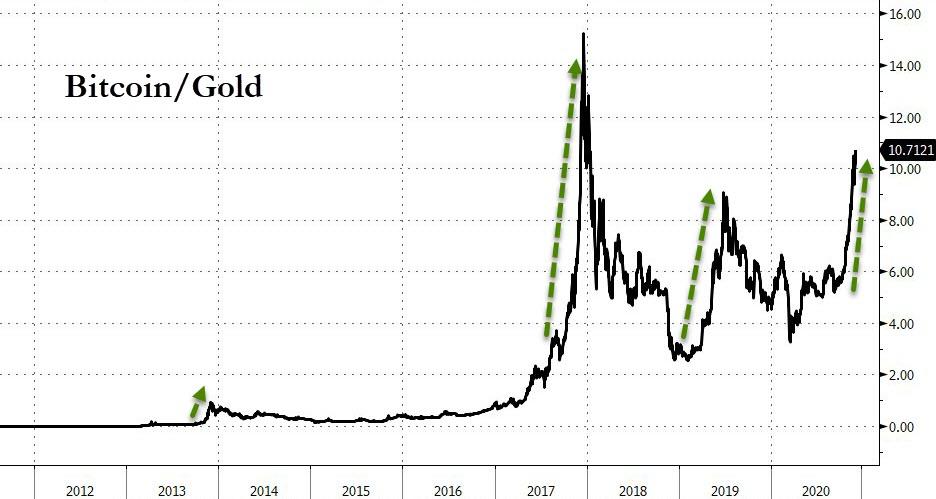
Despite last week’s drop, the gold-to-bitcoin rotation appears to be continuing…

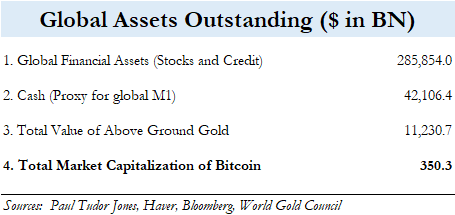
…and as the following table shows, Bitcoin has a long way to go to equilibrate to Gold’s ‘market cap’…

As Bloomberg’s Eddie van der Walt noted this morning, what doesn’t kill Bitcoin, appears to make it stronger.

via ZeroHedge News https://ift.tt/2HS8r0p Tyler Durden

OPEC Meeting Begins: Full Preview Of What To Expect

OPEC Meeting Begins: Full Preview Of What To Expect

Tyler Durden

Mon, 11/30/2020 – 08:24

Submitted by NewsSquawk

  • OPEC and OPEC+ producers will meet November 30th and December 1st respectively, with Monday’s meeting scheduled at 13:00GMT/08:00EST
  • Over the weekend, OPEC+ failed to agree on a delay to output hikes, with UAE and Kazakhstan reportedly opposing extensions
  • Market expectations are still leaning towards current cuts being extended following Sunday’s meeting
  • Some sources suggested a 2-3 month extension, others three and the most recent 3-4 months, with some officials not on board with the full “plan”
  • OPEC+ failure to extend could trigger an oil price decline, whilst “buy the rumour, sell the fact” play cannot be dismissed

OVERVIEW:

OPEC and OPEC+ producers are meeting November 30th and December 1st respectively, to discuss and draft a potential tweak to the current Declaration of Cooperation (DoC), rolled out in light of the pandemic to recalibrate the demand /supply imbalance. Monday’s meeting is slated for 13:00GMT, subject to delays. The current DoC is split into three phases:

  1. 9.7mln BPD total output reduction between May and July 2020.
  2. 7.7mln BPD total output reduction between July and December 2020.
  3. 5.7mln BPD total output reduction between January 2021 and April 2022 (subject to review in December 2021).

Market expectations are still leaning towards the second tranche (7.7mln BPD cuts) being extended through Q1 2021, a view which was also backed by Goldman Sachs, ING and UBS, despite positive vaccine developments and amid rising production in Libya. Recent sources also noted OPEC+ is still leaning towards a rollover of the current tranche notwithstanding the recent oil price rally, albeit with some sources suggesting by 2-3 months and some through Q1 whilst the most recent sources suggested 3-4 months- with Russia also likely to agree to the full quarter if necessary. However, enthusiasm for cuts is not universal – with some OPEC+ officials cited by EnergyIntel not on board with the full “plan” on Sunday. Russia is also said to insists on gradual monthly increases in output from January, sources stated.

SUNDAY JMMC MEETING

The informal consultation between the Russia, Saudi and JMMC heads was moved to Sunday ahead of the decision-making meeting. The panel of OPEC+ ministers could not reach an agreement on the extension of current cuts, with most participants reportedly supporting a delay of hikes through Q1 2021, but UAE and Kazakhstan opposing. Tass citing sources said the Russia and Saudi have reached consensus on extending the current level of cuts through the first months of next years, but the two producers still had to “coordinate ‘certain details and the mechanism’ of the extension”. Meanwhile, sources cited via Argus Media on Sunday said “A rollover would most likely be for one quarter… This would avoid flooding the market in January-March – a period of typically slower demand.”

NOVEMBER JMMC FALLOUT

The Joint Ministerial Monitoring Committee (JMMC) statement on November 17th gave no detail on its recommendations but said it will be provided on December 1st. The Committee reiterated the “critical importance of adhering to full conformity and compensating the overproduced volumes, in order to achieve the objective of market rebalancing and to avoid undue delay in the process.” There was also chatter that OPEC+ is mulling deeper production cuts, though this was dismissed by delegates on Sunday who suggested no talk of collective deeper cuts.

COMPLIANCE COMPLICATIONS

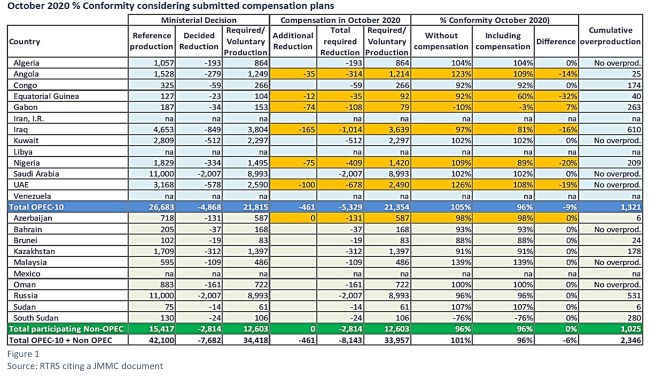
Compliance among producers remain an issue as the latest October figures from the JMMC suggest sub-par conformity, namely from UAE, Nigeria, Iraq, Gabon, Equatorial Guinea, Angola and Azerbaijan for a total group cumulative overproduction of 2.346mln BPD (see Figure 1).

Some sources suggested that OPEC+ compliance could still be an issue, however, EnergyIntel’s Bakr noted that “The expectation among delegates is that the “‘catch up cuts’ plan will be extended into 2021 to allow a number of states to reach their quotas”

Desks did not expect these compliance difficulties to be a near-term risk given the “vigilant and proactive” stance signalled by OPEC+ in recent meetings, with the group likely to reaffirm its stance on full compliance and specifics likely to be ironed out in the coming months with further compensation quotas.

DEMAND AND OIL PRICE DEVELOPMENTS

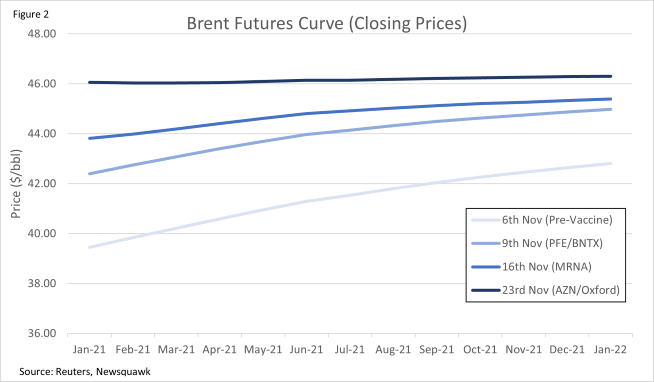
The positively received vaccine updates from Pfizer/BioNTech (PFE /BNTX), Moderna (MRNA), AstraZeneca (AZN/Oxford) and the Russian Direct Investment Fund (RDIF) have provided a rosier (or less dire) demand outlook for the complex due to the prospect of a recovery in activity and jet fuel demand. Still, re-emerging COVID-19 cases and uncertain timeframes for mass rollouts of approved vaccines continue to cloud near-term outlook. Analysts at Goldman Sachs indicate that this solidifies the argument for an extension of current cuts. Further, IEA’s November OMR also suggested “it is far too early to know how and when vaccines will allow normal life to resume. For now, our forecasts do not anticipate a significant impact in the first half of 2021.” Nonetheless, the vaccine fanfare this month has provided the crude market with a boost, resulting in the Brent curve edging back into backwardation (theoretically a near-term bullish signal) – Figure 2 below indicates the shallowing contango following the releases of each of the three major vaccine updates.

However, ING is sceptical about the recent Brent backwardation into early 2022 given the soft near-term demand outlook and fragile balance sheet over Q1 2021, whilst the WTI curve makes more sense, with timespreads in contango in the near term (reflecting weaker fundamentals) but with backwardation commencing from the May 2021 contract.

  • PRICE RALLY: The recent rally has prompted some to question the eagerness of some members to get onboard with extended cuts. “Clearly, if the market continues to strengthen between now and then, there is the risk that a growing number of members of the deal will become increasingly reluctant to rollover cuts”, ING says, “the group would likely be more open to rolling over cuts if prices were trading around the US$40/bbl level, however with Brent quickly approaching US$50/bbl, there might be some opposition within the group to delay an easing in cuts.” Hence, the bank sees risk skewed to the downside – “it is unlikely that OPEC+ surprise with a six-month rollover given the latest move in prices, while the three-month rollover is already largely priced in. So anything less than a three-month extension will likely be seen as bearish.”

SUPPLY SITUATION

The oil producers will have to factor in supply side developments since the rollout of the DoC, events that were not foreseen nor assumed at the time:

  • LIBYA: Libyan crude output has been on a steep upswing in the past couple of months following the lifting on blockades which saw exports from five key oil terminals halted in January, translating to an output slump to ~70k BPD vs ~1.1mln BPD pre-blockade, the latest Libyan production printed at ~1.2mln BPD. Libya is currently exempt from OPEC quotas, and the NOC head stated it will join the allocations once production reaches 1.7mln BPD. OPEC previously stated it will be keeping an eye on sustained production from Libya. On that note, an armed group attempted to break into the headquarters of Libya’s NOC on November 23rd, in turn reigniting fears of the country’s fragile output.
  • UAE: Some desks are also eyeing potential complications by UAE to raise its baseline quota, thus translating to higher output from the nation. However, this risk is unlikely to materialise as the country’s energy minister recently noted “that all Opec-plus members should achieve full compliance with the existing agreement before the current level of cuts can be extended into next year”, according to EnergyIntel, whilst Goldman Sachs also warns unilateral production hikes will likely trigger a price war.
  • IRAN: A Biden administration has raised the likelihood of Iranian oil returning to the market as expectations are titled towards the Democrat unwinding some restrictions put in place by the Trump admin. That being said, this return is unlikely to take place until end-2021/22, ING believes, “by that stage, oil demand should have recovered enough for the market to be able to absorb additional supply”, contingent on COVID-19 and vaccine developments.
  • NIGERIA: Desks note that Nigeria has been complicating matters as it has advocated the exclusion of output from its Agbami oil field from its quota on grounds that its output should be clasified as condensate as opposed to crude oil.

FORECASTS:

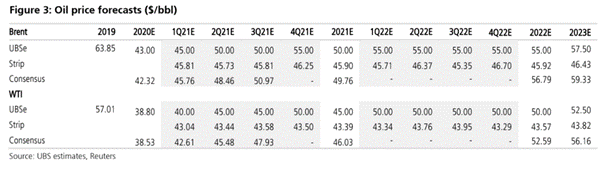
Analysts at GS forecast Brent to average USD 47/bbl in Q1 2021 assuming a three-month extension of current cuts, whilst an adherence to the current DoC (i.e. a 2mln BPD production increase) would warrant USD 42/bbl in the period. “This illustrates once again how short-term revenue maximization always comes through production cuts, as a 2 mb/d production increase but $5/bbl negative price impact would end up reducing core-OPEC and Russia’s 1Q21 fiscal revenues by more than $5 bn”, GS says. Meanwhile, UBS sees a Brent average of USD 45/bbl in Q1 next year (see Figure 3 below), with the assumption of a vaccine rollout in 2021. “A 3-month extension protects price downside as policy struggles to mitigate winter virus waves. 2021 is a year of price recovery and normalization”, the bank states. 

The Newsquawk real-time social media OPEC monitoring tool is available here

via ZeroHedge News https://ift.tt/3o8a9dp Tyler Durden

AirBnB, DoorDash Raise Share Price Targets As US IPO Market Booms

AirBnB, DoorDash Raise Share Price Targets As US IPO Market Booms

Tyler Durden

Mon, 11/30/2020 – 06:00

Update (0810ET): DoorDash has just confirmed its pricing range, with 33 million shares priced at between $75 and $85 per share, roughly the same range printed by WSJ earlier.

  • DOORDASH PLANS IPO OF 33M SHARES, SEES PRICING $75-$85/SHARE

* * *

DoorDash and Airbnb are seeking to take advantage of one of the hottest IPO markets in recent memory by asking for a premium from investors when they go public in December.

With stocks at record highs despite one of the worst underlying economic backdrops in memory, the two companies, which have benefited from the pandemic in different ways, are upping the valuation they’re seeking from investors in a move that is faintly reminiscent of WeWork’s quest for a higher valuation.

Here’s more from WSJ:

Airbnb is planning to target a range of around $30 billion to $33 billion—using a fully diluted share count—when the home-rental startup kicks off its investor roadshow Tuesday, according to people familiar with the matter. That is greater than $30 billion people close to the offering had expected.

DoorDash, meanwhile, plans to target a range of around $25 billion to $28 billion on a fully diluted basis, excluding the more than roughly $3 billion in cash and proceeds expected after the IPO. That is greater than the $25 billion people close to the offering had expected. DoorDash’s roadshow is expected to begin Monday.

The naked cash grab is a notable departure from how companies typically handle IPOs, where valuations are initially set conservatively, then moved higher as more demand materializes.

Both companies are on track to list in mid-December, which is typically a quiet month for offerings, ending a banner year for IPOs with a bang. There has already been a record amount of money raised in new issues on US exchanges as soaring technology valuations entice more private companies to take advantage of the frothy demand.

So far this year, more than $140 billion has been raised in 383 initial public offerings on U.S. exchanges, far exceeding the previous full-year record high set at the height of the dot-com boom in 1999, according to Dealogic data that dates back to 1995.

via ZeroHedge News https://ift.tt/3o9DN28 Tyler Durden

The History of Textiles Is the History of Human Ingenuity

FabricOfCivilization

I was flattered but also surprised when Eugene Volokh kindly invited me to contribute a week of guest posts, since my new book, The Fabric of Civilization: How Textiles Made the World, is not about the law. It examines the central role textiles have played in the history of innovation, from pre-history to the near future. Fortunately, Eugene and his fellow conspirators are as guided by intellectual curiosity as by legal reasoning, and mixing it up, he assured me, would make the blog “fun and eclectic.”

In this post, drawn from the book’s introduction, I start with an insight from the influential computer scientist Mark Weiser, writing in 1991. “The most profound technologies are those that disappear,” he wrote. “They weave themselves into the fabric of everyday life until they are indistinguishable from it.”

Do you see what he did there?

We hairless apes co-evolved with our cloth. From the moment we’re wrapped in a blanket at birth, we are surrounded by textiles. They cover our bodies, bedeck our beds, and carpet our floors. Textiles give us seatbelts and sofa cushions, tents and bath towels, bandages and duct tape. They are everywhere.

But, to reverse Arthur C. Clarke’s famous adage about magic, any sufficiently familiar technology is indistinguishable from nature. It seems intuitive, obvious—so woven into the fabric of our lives that we take it for granted. We no more imagine a world without cloth than one without sunlight or rain.

We drag out heirloom metaphors—”on tenterhooks,” “tow-headed,” “frazzled“—with no idea that we’re talking about fabric and fibers. We repeat threadbare clichés: “whole cloth,” “hanging by a thread,” “dyed in the wool.” We catch airline shuttles, weave through traffic, follow comment threads. We speak of lifespans and spinoffs and never wonder why drawing out fibers and twirling them into thread looms so large in our language. Surrounded by textiles, we’re largely oblivious to their existence, and to the knowledge and efforts embodied in every scrap of fabric.

Cloth-making is a creative act, analogous to other creative acts. It is a sign of mastery and refinement. “Can we expect, that a government will be well modelled by a people, who know not how to make a spinning-wheel, or to employ a loom to advantage?” wrote philosopher David Hume in 1742. The knowledge is all but universal. Rare is the people that does not spin or weave and rare, too, the society that does not engage in textile-related trade.

The global story of textiles illuminates the nature of civilization itself. I use this term not to imply moral superiority or the end state of an inevitable progression but in the more neutral sense suggested by Mordecai Kaplan’s definition: “the accumulation of knowledge, skills, tools, arts, literatures, laws, religions and philosophies which stands between man and external nature, and which serves as a bulwark against the hostility of forces that would otherwise destroy him.” This description captures two critical dimensions that together distinguish civilization from related concepts, such as culture.

First, civilization is cumulative. It exists in time, with today’s version built on previous ones. A civilization ceases to exist when that continuity is broken. Minoan civilization disappeared. Conversely, a civilization may evolve over a long stretch of time while the cultures that make it up pass away or change irrevocably. The Western Europe of 1980 was radically different in its social mores, religious practices, material culture, political organization, technological resources, and scientific understanding from the Christendom of 1480, yet we recognize both as Western civilization.

The story of textiles demonstrates this cumulative quality. It lets us trace the progress and interactions of practical techniques and scientific theory: the cultivation of plants and breeding of animals, the spread of mechanical innovations and measurement standards, the recording and replication of patterns, the manipulation of chemicals. We can watch knowledge spread from one place to another, sometimes in written form but more often through human contact or the exchange of goods, and see civilizations become intertwined.

Second, civilization is a survival technology. It comprises the many artifacts—designed or evolved, tangible or intangible—that stand between vulnerable human beings and natural threats and that invest the world with meaning. Providing protection and adornment, textiles are themselves among such artifacts. So, too, are the innovations they inspire, from better seeds to weaving patterns to new ways of recording information.

Along with the perils and discomforts of indifferent nature, civilization protects us from the dangers posed by other humans. Ideally, it allows us to live in harmony. Eighteenth-century thinkers used the term to refer to the intellectual and artistic refinement, sociability, and peaceful interactions of the commercial city. But rare is the civilization that exists without organized violence. At best, civilization encourages cooperation, curbing humanity’s violent urges; at worst, it unleashes them to conquer, pillage, and enslave. The history of textiles reveals both aspects.

Every scrap of cloth  represents the solution to innumerable difficult problems. Many are technical or scientific: How do you breed sheep with thick, white fleeces? How do you maintain enough tension to spin fibers together without breaking them? How do you prevent dyes from fading? How do you construct a loom that can weave complex patterns?

Some of the trickiest, however, are social: How do you finance a crop of silkworms or cotton, a new spinning mill, or a long-distance caravan? How do you record weaving patterns so someone else can duplicate them? How do you pay for textile shipments without physically sending currency? What do you do when the law forbids the cloth you want to make or use?

In the posts that follow, I’ll concentrate on some of the institutions and practices—”social technologies”—that addressed these types of questions.

from Latest – Reason.com https://ift.tt/2VkFRrs
via IFTTT