Here Come The Most Stunning Base-Effect Charts Since The Great Depression

Here Come The Most Stunning Base-Effect Charts Since The Great Depression

In just a few days, US high frequency economic data will lap March 2020 when the US economy literally shut down and sent all economic indicators in freefall to a degree not seen since the Great Depression (and in many cases, more).

When that happens, while March/April economic data will rise only modestly compared to the previous month, it will be a veritable explosion compared to the shutdown a year ago. This is the so-called “base effect” and while many economists will ignore it, especially when it comes to inflation data, the impact for many will be jarring especially when investors see charts that have gone, for lack of a better word, vertical.

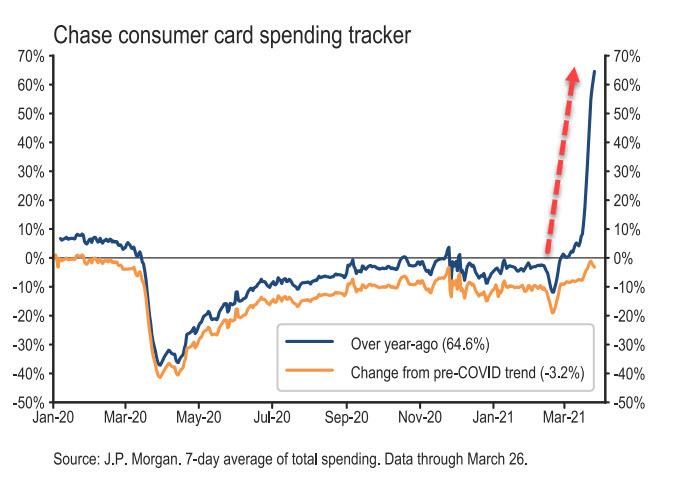
To preview the annual change base effect that is coming in everything from retail sales, to income and spending, to housing data, to jobs and unemployment, we have pulled some of the most representative real-time indicators available from JPMorgan and Bank of America, starting with what is perhaps the most illustrative chart of all: JPM’s spending tracker on the bank’s own consumer (debit and credit) cards.

Here the 65% surge in spending is not because of an actual surge in spending March, but because spending last March imploded. Which is why to normalize for the post-March 2020 shock, banks will likely show not just the Y/Y chart, but also a chart comparing to 2-year ago or, better yet, a pre-covid blended trend as JPM has done in the chart above.

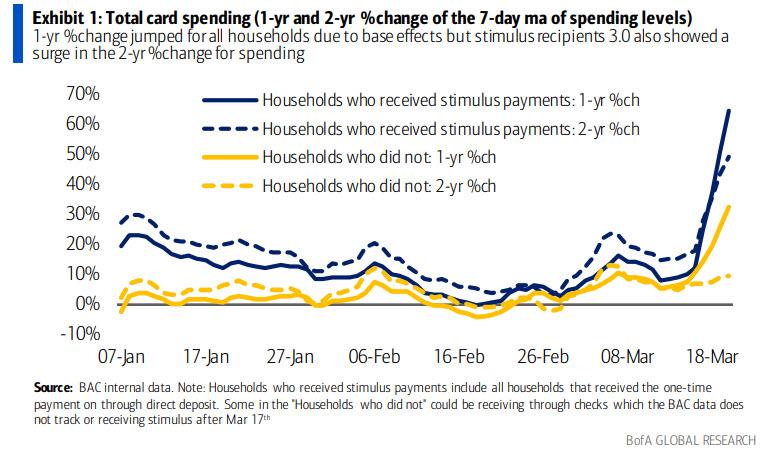
Bank of America published a similar chart, showing a huge jump in Y/Y card spending, especially among households who received stimulus payments – and this time on both a 1 and 2 year basis – while household that did not receive stimulus saw a roughly 30% jump in Y/Y spending due to the base effect, and only a modest increase in 2Y spending.

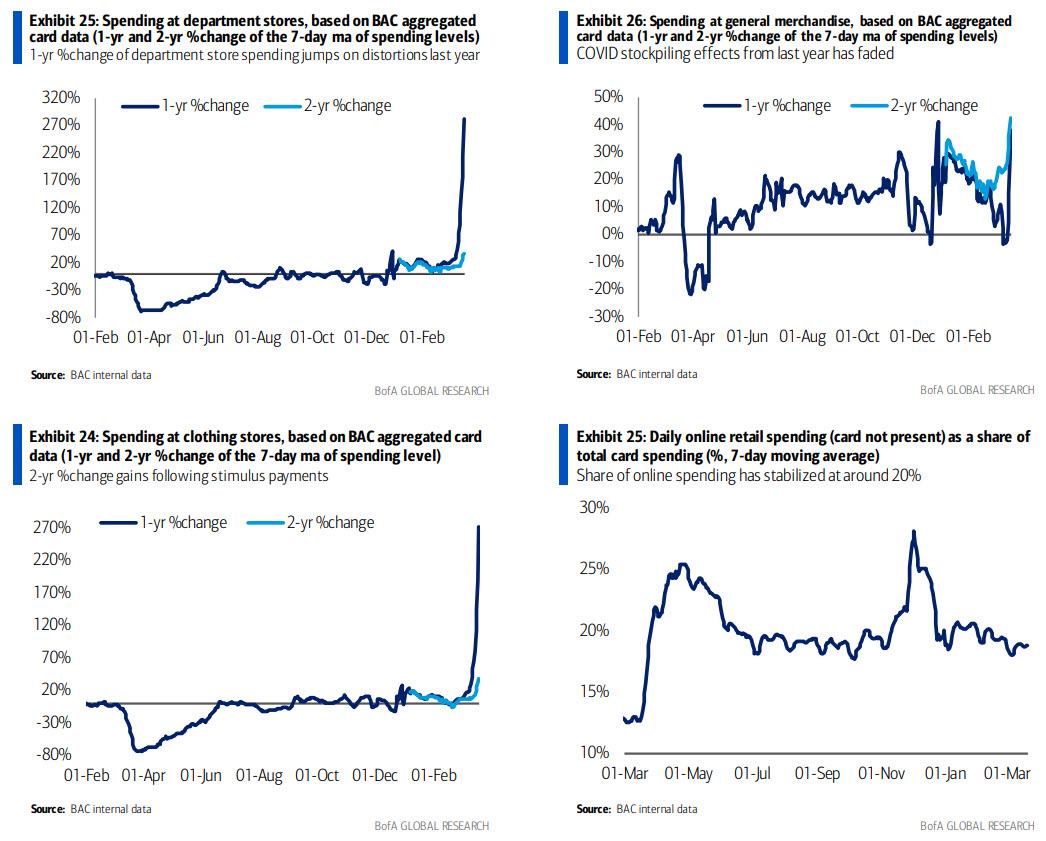
Here are some other charts showing how the 1-Year, but not 2-Year change, has gone vertical:

… And some more.

… And even more…

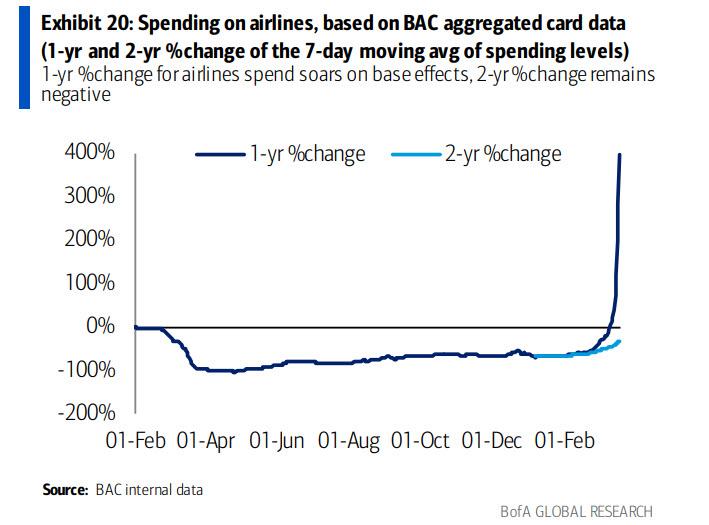
But nowhere is the base effect more visible than in the 1-year spending on airlines, where we see a very clear “lift off” formation in progress.

Tyler Durden
Tue, 03/30/2021 – 19:05

via ZeroHedge News https://ift.tt/3djDcXH Tyler Durden

Journal of Free Speech Law pre-Call For Papers: Student Speech and Associational Privacy,

This Term, the Court is considering two important First Amendment issues—K-12 student speech (in Mahanoy Area School District v. B.L.) and associational privacy (Americans for Prosperity Foundation v. Becerra).

The Journal of Free Speech Law, a new peer-reviewed, faculty-edited journal, will quickly publish two to four articles on each of these subjects, as a symposium issue. We seek not case notes as such, but rather articles on the broader subjects in light of the new decisions. And given our publication speed, these will likely be the first such articles to be published in a full-fledged law journal.

Our plan:

  1. Since the cases will likely come down July 1, we’d need to see submissions by Aug. 1. But given the short timeline, we’ll be open for rougher submissions than usual. What we want to see, to make our decision, is a clear explanation of the key novel, interesting, and useful contributions that the article would make.
  2. We require exclusive submissions (via Scholastica, https://ift.tt/3mhwEx3), but we will give an answer within two weeks (our average response time so far is under a week). Thus, if we say no, there will be plenty of time to submit to other journals in the August submission cycle.
  3. We plan on publishing the articles online and on Westlaw as soon as the author provides a publishable version, which could be as quickly as early September (or longer, if the author so requires).
  4. Our journal also publishes in print. We expect the print edition to come out towards the end of the year, depending on the timeline for the articles; but we expect that these days the important thing is getting the article out quickly online.
  5. We will set up online symposia on the drafts, so that authors can get feedback from the other authors and from other First Amendment scholars.
  6. All this would of course be contingent on the Court saying something interesting, rather than just dismissing the case on unrelated procedural grounds (such as what the Court did in U.S. v. Sineneng-Smith, for instance).
  7. We will resend this announcement when the cases come down, but we wanted to alert prospective authors in advance.

Our journal was just founded this year, and will publish its inaugural symposium issue (on regulation of social media platforms) this Summer; the issue we discuss here will be our second. Our robe-and-gown editorial board consists of:

Prof. Amy Adler
Prof. Jane Bambauer
Prof. Ashutosh Bhagwat
Judge Stephanos Bibas
Prof. Vincent Blasi
Judge José A. Cabranes
Prof. Clay Calvert
Dean Erwin Chemerinsky
Prof. Alan Chen
Justice Mariano-Florentino Cuéllar
Judge Douglas H. Ginsburg
Prof. Jamal Greene
Prof. Heidi Kitrosser
Prof. Andrew Koppelman
Prof. Ronald J. Krotoszynski, Jr.
Prof. Toni Massaro
Prof. Michael McConnell
Prof. Helen Norton
Prof. Robert Post
Judge A. Raymond Randolph
Judge Neomi Rao
Prof. Jennifer Rothman
Judge Robert Sack
Prof. Frederick Schauer
Dean Rodney A. Smolla
Prof. Geoffrey Stone
Judge David R. Stras
Judge Jeffrey S. Sutton
Prof. Rebecca Tushnet
Prof. Eugene Volokh
Prof. James Weinstein
Judge Diane Wood

If you have any questions, please e-mail JournalOfFreeSpeechLaw@gmail.com; and please pass this along to others who are interested.

Jane Bambauer
Ashutosh Bhagwat
Eugene Volokh
Executive Editors

from Latest – Reason.com https://ift.tt/3rDfzyk
via IFTTT

1.8 Million Jobs On Friday?

1.8 Million Jobs On Friday?

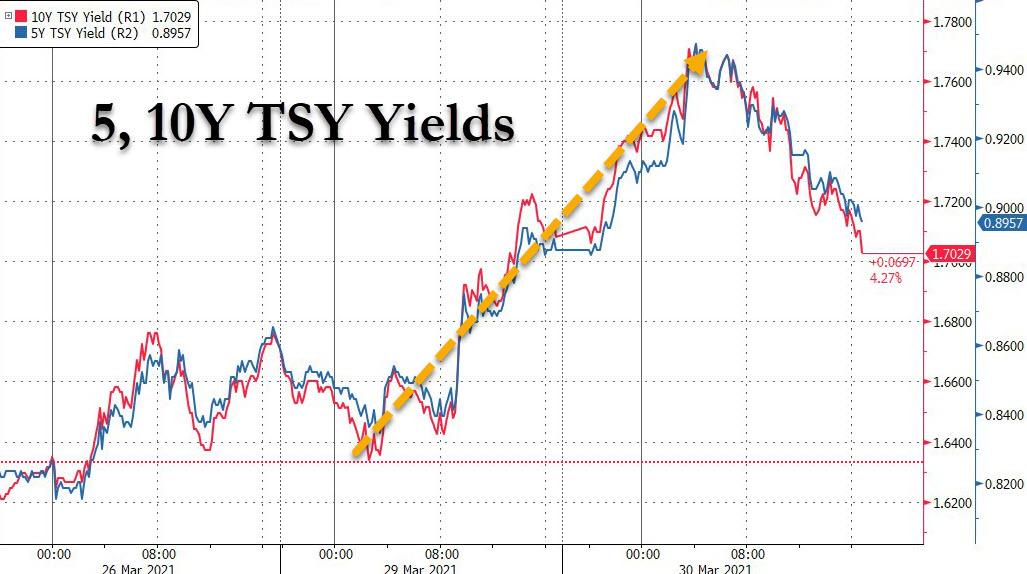
Treasury yields blew out overnight (with the belly in particular feeling the heat: 5s +5.5bps, 10s +6.0bps) during the Asian session in continuation of yesterday’s move higher, as the usual suspects – Japanese commercial banks – resumed selling in droves (see “Morgan Stanley Identifies The Source Of Massive Treasury Selling“), although it wasn’t clear what if any catalyst sparked the selling.

Trying to make some sense of the latest move in yields Nomura’s Charlie McElligott offered three reasons for the return of the reflation theme:

  1. vaccine renormalization
  2. fiscal stimulus now circulating into the “real economy”, and
  3. the expected large upside surprise in Friday’s NFP data now increasingly being priced-in, whose release McElligott notes “comes dangerously on the illiquid ‘Good Friday’ holiday-shortened session, risking a disorderly move”

We won’t focus much on topics 1 and 2 which we have covered extenisvely elsewhere on multiple occasions, but instead we will preview what may be a truly blockbuster payrolls report on Friday, coming right at a time when stocks are closed and when bonds are open only until noon.

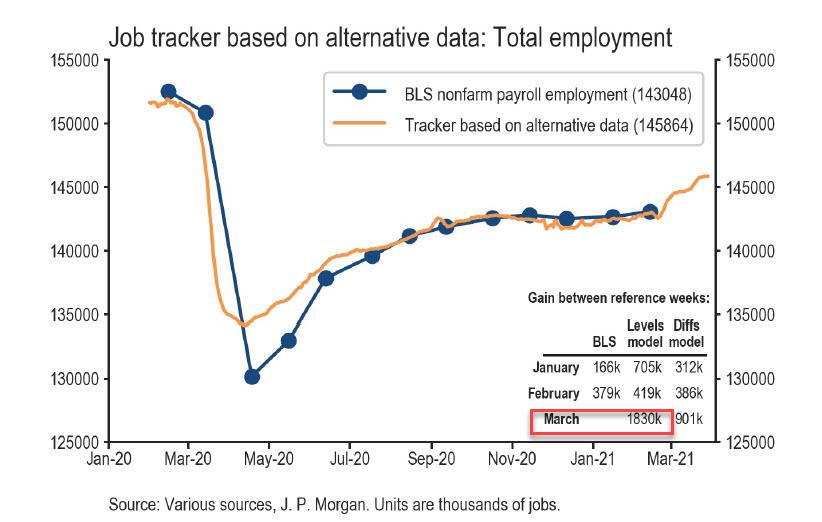
So why focus on Friday’s jobs report? Because one month after the February Payrolls printed at 379K, nearly double the consensus estimate of 198K, Wall Street expects the labor market to resume its torrid upward trajectory with a whopping 650K print.

While on the surface this will likely send yields sharply higher as it provides fresh fuel to the reflation narrative, a chart published today by JPMorgan took our breath away. In the bank’s latest “quant and econ dashboard report”, JPMorgan compares the BLS payrolls series with its own alternative data-based tracker of jobs data. Remarkably, it found that after a period of almost uniform convergence between the two series, the March “alternative data” print was a whopper, one which implies the matched BLS print will be around 1.8 million jobs!

To be sure there are several other reflationary considerations laid out by McElligott, which we note below…

  • With the market sniffing the pull-forward of US QE taper in addition to then likelihood of “front-loaded” Fed hikes, 5s are in a really tricky spot, and this is why 5s30s—which was really the “reflation steepener” of choice for so long last year—has now actually stalled-out, sitting around this 1.50 level for approximately two months now
  • The better the reopening data gets, the more likely it is that we more of this inflection from phase 1 steepening “reflation feel-good” as the long-end reflects higher growth- and inflation- expectations, to the phase 2 flattening “Fed tightening” stage, where the front-end / belly leading the repricing ahead of Fed policy adjustment—with the potential for this to begin evidencing itself to markets by the time of the next Fed SEP in June potentially needing to reflect an improved forecast

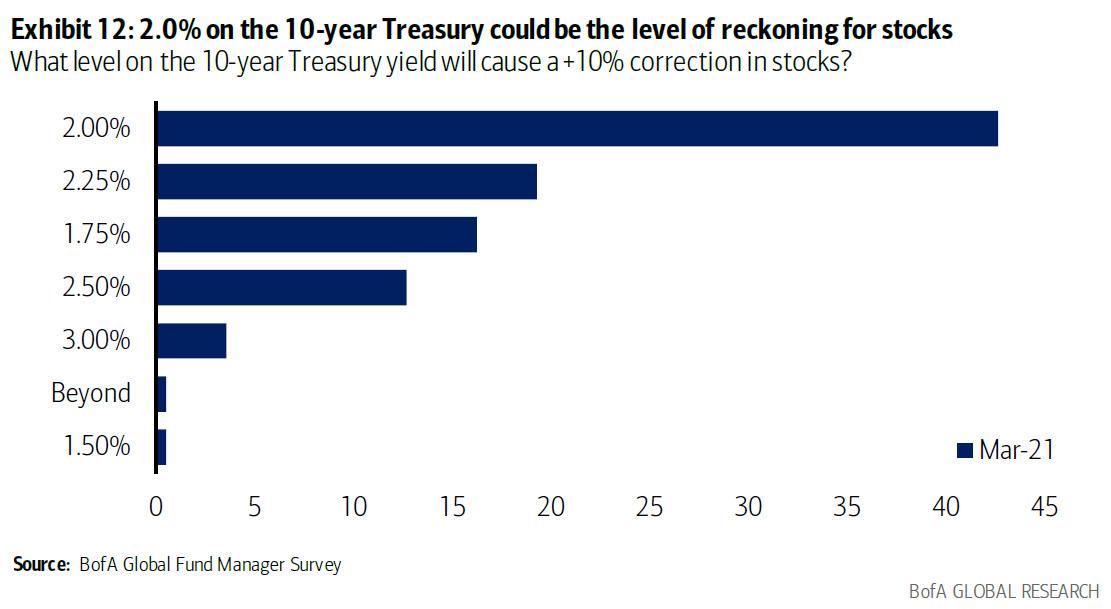
In this context, imagine what happens to the 10Y – and certainly the belly and the 5Y – if we do get a 1.8MM print (which has quickly emerged as the whisper number for Friday), smashing expectations by 3x, and unleashing a volley of TSY selling as the herd panics and dumps Treasurys faster than you can say a “failed 7Y auction.” Perhaps the only question in this “blowout payrolls” scenario is whether the 10Y – which today rose as high as 1.78% will find support at 2.00% or will it blow out above the level most on Wall Street (according to the latest BofA Fund Manager Survey)…

… agrees is the trigger for chaos not just in the bond but also stock market.

Tyler Durden
Tue, 03/30/2021 – 18:45

via ZeroHedge News https://ift.tt/3sBYTIR Tyler Durden

Virgin Galactic Unveils Next-Generation Spaceship Series 

Virgin Galactic Unveils Next-Generation Spaceship Series 

Virgin Galactic has billed itself as a space tourism company, and that reality is no longer a distant dream for virtually everyone. 

On Tuesday, Virgin unveiled the first SpaceShip III in its expanding fleet, VSS Imagine, that will capitalize on space tourism by taking passengers to low Earth orbit. 

“For us to make the business start to scale, at the places that we’re aspiring towards, we need two things: We need many more ships than we have right now and we also need the ships that we bring forward to be built in a way that they’re able to be maintained in a way that we can have much quicker [turnaround times between flights] than what we have with Unity,” Virgin Galactic CEO Michael Colglazier told CNBC.

The expansion of Virgin’s fleet is an essential milestone towards allowing everyone’s access to space (well, for those who can afford it). 

Virgin will commence ground testing, with glide flights of VSS Imagine later this summer from Spaceport America in New Mexico. 

The breakthrough livery design, finished entirely with a mirror-like material, reflects the surrounding environment, constantly changing color and appearance as it travels from earth to sky to space. Along with providing thermal protection, this dynamic material is naturally appealing to the human eye, reflecting our inherent human fascination with space and the transformative experience of spaceflight.

Leveraging a modular design, the SpaceShip III class of vehicles are built to enable improved performance in terms of maintenance access and flight rate. This third generation of spaceship will lay the foundation for the design and manufacture of future vehicles. -Virgin press release 

The introduction of the SpaceShip III class of spaceships is an important milestone in Virgin’s multi-year effort that targets flying 400 flights per year.

Michael Colglazier, CEO of Virgin Galactic, stated in a company press release: 

“Today we unveiled our SpaceShip III class of vehicles, marking the beginning of the Virgin Galactic fleet. VSS Imagine and Inspire are stunning ships that will take our future astronauts on an incredible voyage to space, and their names reflect the aspirational nature of human spaceflight. Congratulations to our dedicated team who worked so brilliantly to achieve this milestone.”

Richard Branson, Founder, Virgin, commented:

“Virgin Galactic spaceships are built specifically to deliver a new, transforming perspective to the thousands of people who will soon be able to experience the wonder of space for themselves. As a SpaceShip III class of vehicle, Imagineis not just beautiful to look at, but represents Virgin Galactic’s growing fleet of spaceships. All great achievements, creations and changes start with an idea. Our hope is for all those who travel to space to return with fresh perspectives and new ideas that will bring positive change to our planet.”

At the moment, a 90-minute sub-orbital flight costs around $250,000, and more than 600 people have already signed up. Flights are expected to begin in 2022. 

Besides low earth orbit travel, Virgin has also unveiled conceptual images of a supersonic commercial jet, sort of like the Concord. 

Tyler Durden
Tue, 03/30/2021 – 18:25

via ZeroHedge News https://ift.tt/3rzcfEt Tyler Durden

Journal of Free Speech Law pre-Call For Papers: Student Speech and Associational Privacy,

This Term, the Court is considering two important First Amendment issues—K-12 student speech (in Mahanoy Area School District v. B.L.) and associational privacy (Americans for Prosperity Foundation v. Becerra).

The Journal of Free Speech Law, a new peer-reviewed, faculty-edited journal, will quickly publish two to four articles on each of these subjects, as a symposium issue. We seek not case notes as such, but rather articles on the broader subjects in light of the new decisions. And given our publication speed, these will likely be the first such articles to be published in a full-fledged law journal.

Our plan:

  1. Since the cases will likely come down July 1, we’d need to see submissions by Aug. 1. But given the short timeline, we’ll be open for rougher submissions than usual. What we want to see, to make our decision, is a clear explanation of the key novel, interesting, and useful contributions that the article would make.
  2. We require exclusive submissions (via Scholastica, https://ift.tt/3mhwEx3), but we will give an answer within two weeks (our average response time so far is under a week). Thus, if we say no, there will be plenty of time to submit to other journals in the August submission cycle.
  3. We plan on publishing the articles online and on Westlaw as soon as the author provides a publishable version, which could be as quickly as early September (or longer, if the author so requires).
  4. Our journal also publishes in print. We expect the print edition to come out towards the end of the year, depending on the timeline for the articles; but we expect that these days the important thing is getting the article out quickly online.
  5. We will set up online symposia on the drafts, so that authors can get feedback from the other authors and from other First Amendment scholars.
  6. All this would of course be contingent on the Court saying something interesting, rather than just dismissing the case on unrelated procedural grounds (such as what the Court did in U.S. v. Sineneng-Smith, for instance).
  7. We will resend this announcement when the cases come down, but we wanted to alert prospective authors in advance.

Our journal was just founded this year, and will publish its inaugural symposium issue (on regulation of social media platforms) this Summer; the issue we discuss here will be our second. Our robe-and-gown editorial board consists of:

Prof. Amy Adler
Prof. Jane Bambauer
Prof. Ashutosh Bhagwat
Judge Stephanos Bibas
Prof. Vincent Blasi
Judge José A. Cabranes
Prof. Clay Calvert
Dean Erwin Chemerinsky
Prof. Alan Chen
Justice Mariano-Florentino Cuéllar
Judge Douglas H. Ginsburg
Prof. Jamal Greene
Prof. Heidi Kitrosser
Prof. Andrew Koppelman
Prof. Ronald J. Krotoszynski, Jr.
Prof. Toni Massaro
Prof. Michael McConnell
Prof. Helen Norton
Prof. Robert Post
Judge A. Raymond Randolph
Judge Neomi Rao
Prof. Jennifer Rothman
Judge Robert Sack
Prof. Frederick Schauer
Dean Rodney A. Smolla
Prof. Geoffrey Stone
Judge David R. Stras
Judge Jeffrey S. Sutton
Prof. Rebecca Tushnet
Prof. Eugene Volokh
Prof. James Weinstein
Judge Diane Wood

If you have any questions, please e-mail JournalOfFreeSpeechLaw@gmail.com; and please pass this along to others who are interested.

Jane Bambauer
Ashutosh Bhagwat
Eugene Volokh
Executive Editors

from Latest – Reason.com https://ift.tt/3rDfzyk
via IFTTT

Top Paid LA Lifeguards Earned Up To $392,000 In 2019

Top Paid LA Lifeguards Earned Up To $392,000 In 2019

Authored by Adam Andrzejewski via Forbes.com,

Being a lifeguard in California can be unbelievably lucrative. If we had only known, many of us would have packed our bags and headed west for a career on the California beach.

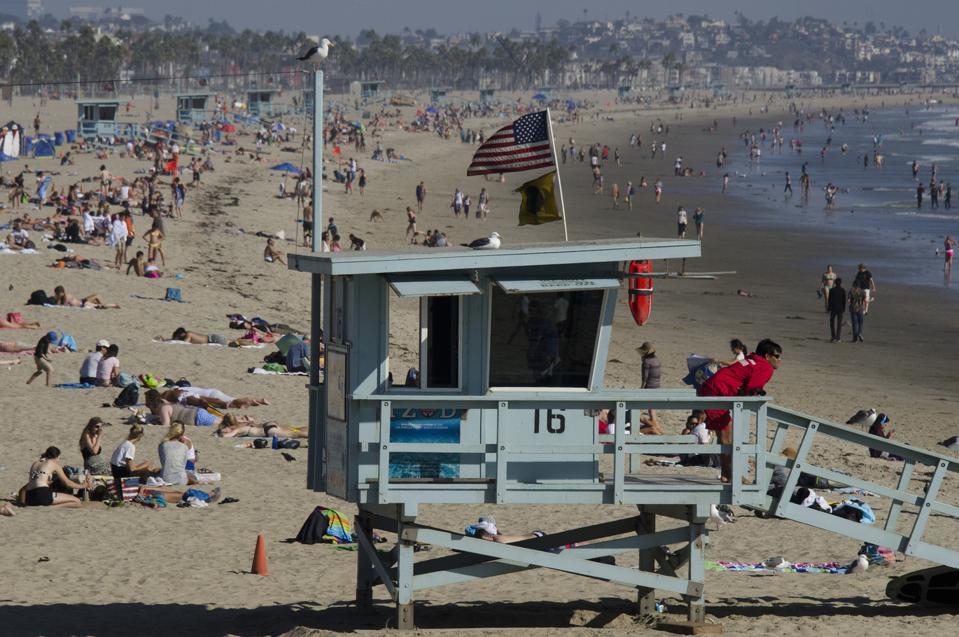
Our auditors at OpenTheBooks.com found that lifeguards make a fortune in Los Angeles County. Seven lifeguards made more than $300,000 and 82 lifeguards had total earnings that exceed $200,000 in 2019, the latest year available.

Fernando Boiteux was the most highly paid and earned $391,971. As the “acting chief lifeguard,” he out-earned 1,000 of his peers: salary ($205,619), perks ($60,452), and benefits ($125,900).

The second highest paid, Captain Daniel Douglas, pulled down $140,706 in base pay, and a whopping $131,493 in overtime pay, with $21,760 in “other pay” and $74,709 in benefits. Total compensation amounted to $368,668.

Overtime pay drove earnings into corporate executive range.

Thirty-one lifeguards made between $50,000 and $131,493 in overtime during the year. For example, Daniel Douglas (comp: $368,668; overtime: $131,493), Jaro Snopek (comp: $292,455; overtime:$119,669) and James Orr (comp: $281,270; overtime: $113,015) each made over $100,000 in overtime alone.

OPENTHEBOOKS.COM

Furthermore, we found that most of the top-paid lifeguards were men. In fact, only two of the top-twenty high-earners were women: Virginia Rupe ($281,000), a captain, and Christine Linkletter ($279,980), a section chief.

You might assume that high pay rewarded great heroism, but you’d be wrong. We found that many of the lifeguards who won the Medal of Valor –  exhibiting bravery for saving lives – failed to crack the top of the county’s payroll.

The 2020 Medal of Valor winner, Edward “Nick” Macko, an ocean lifeguard specialist, earned “only” $134,144 in compensation. His compensation ranked 167th out of the 1,001 employees in the L.A. lifeguard corps.

Macko jumped into the rough waters in a remote Palos Verdes gorge and pulled a man to safety through potentially skull-crushing swells and over razor-sharp rocks. Most of his rescue was captured on video and shows why he earned the honor.

The 2019 Valor award winners, Ocean Lifeguard Specialists Shaun Gudmundsson (comp: $165,761) and Ruben Carmona (comp: $194,919), “performed an extremely dangerous nighttime water rescue” of two trapped fishermen from hurricane-caused rising tides and surf.

Another 2019 Valor winner, Jon Van Duinwyk (comp: $238,434), singlehandedly rescued a 70-year-old man trapped inside a 25-foot sailboat during a huge storm surf off Dockweiler Beach. The lifeguard “risked his life to enter the vessel, extricate the elderly man, as the boat was breaking up in the 8 foot shore pound.”

Beach lifeguard pay dwarfs that of their colleagues at the pools. We found 332 pool lifeguards in L.A. County, but the highest paid “senior pool lifeguard” made only $46,997, including pay and benefits.

Why beach lifeguards earn so much money is a question L.A. taxpayers might start asking. A lifeguard’s job can be dangerous, but it’s unclear why residents should foot the bill for so much overtime when the state’s public employees already cost taxpayers $45 billion a year.

Our auditors at OpenTheBooks.com compiled these numbers from Freedom of Information Act requests as well as benefit data listed at Transparent California.

*  *  *

Further Reading

  • LA’s 2020 Beach Closure Order

  • On March 27, 2020, L.A.’s Department of Public Health closed all its beaches, which stayed closed until May 13, 2020. It said the closure was necessary “to both enforce social distancing measures and stem the spread of COVID-19 within the community.” The L.A. beaches closed again over Fourth of July weekend “due to concerns about excessive crowds,” reopened the following Monday, and have stayed open since.

  • 2017 Beach Awards news

  • 2019 Beach Awards news and news

  • Forbes: Why California Is In Trouble – 340,000 Public Employees With $100,000+ Paychecks Cost Taxpayers $45 Billion.

*  *  *

Adam Andrzejewski (say: And-G-F-ski) is the CEO/Founder of OpenTheBooks.com. Our mission: “Every Dime, Online, In Real Time.”

Tyler Durden
Tue, 03/30/2021 – 18:05

via ZeroHedge News https://ift.tt/39w9mOu Tyler Durden

Daily Briefing: Archegos’s Leveraged Blow-Up: Danger Under the Hood?

Daily Briefing: Archegos’s Leveraged Blow-Up: Danger Under the Hood?

What does the leveraged blow-up of Archegos Capital Management mean for risk assets? Tony Greer of TG Macro joins Real Vision senior editor Ash Bennington to answer this question and update his outlook on stocks, bonds, housing, the U.S. Dollar, and gold as the bond rout shows little sign of stopping. Tony notes that the forced liquidation of Archegos ceased to impair stocks today—for now, at least—but remains as a potential sign that there is some market danger underneath the hood. Tony cites this as a reason why, on the margin, he is moving somewhat into cash and gold and out of stocks. Tony makes sense of the action in Treasury yields and tells Ash why he thinks the U.S. Dollar has been driving higher, especially against the yen. Tony speculates as to why commodities have proved resilient in the face of this dollar strength, which is normally a headwind. Lastly, Ash tells Tony about his evolving journey in the crypto world from a fan’s creation of Ash’s very own non-fungible token (NFT) to Ash’s experience buying Ethereum for the first time.

Tyler Durden
Tue, 03/30/2021 – 16:00

via ZeroHedge News https://ift.tt/3m4dLgK Tyler Durden

Derek Chauvin Argues That His Use of Force Was Appropriate and Did Not Kill George Floyd


Eric-Nelson-Chauvin-trial-3-29-21-Newscom

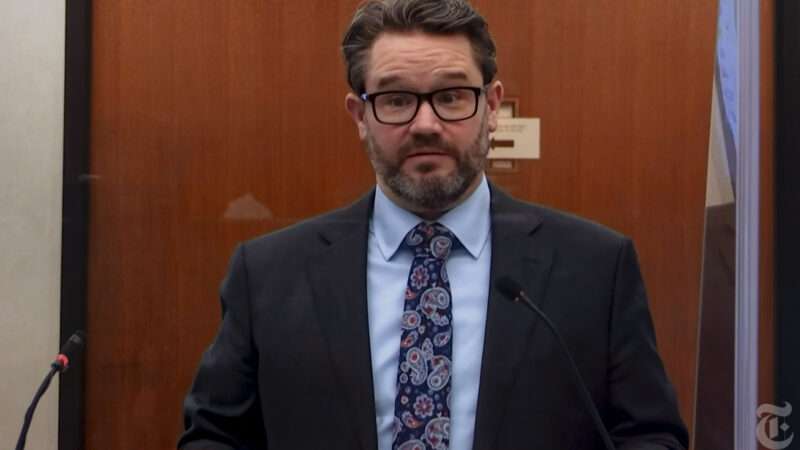
Derek Chauvin’s defense against the charge that he murdered George Floyd is based on two dubious claims. First, defense attorney Eric Nelson argued in his opening statement yesterday, the force that the former Minneapolis police officer used while restraining Floyd was appropriate in the circumstances. Second, Nelson said, Chauvin’s use of force did not cause Floyd’s death.

Nelson noted that Floyd resisted Officers Thomas Lane and J. Alexander Kueng as they attempted to place him in their squad car after arresting him for buying cigarettes with a counterfeit $20 bill on May 25. He noted that Floyd was more than six feet tall and weighed 223 pounds, which he said made it difficult to restrain him. Nelson maintained that Floyd’s resistance continued even after he was handcuffed and pinned face down on the pavement, held there by Lane, Kueng, and Chauvin. “You will see and hear them continue to struggle with Mr. Floyd, as he’s attempting to kick,” Nelson said.

That version of events seems inconsistent with the widely viewed bystander video of Floyd’s arrest. Although Floyd moves his head and his right shoulder, complains that he cannot breathe, and begs for relief, he does not appear violent. In circumstances like these, the officers may have interpreted as “resistance” what bystanders perceived as a man’s desperate attempt to avoid asphyxiation.

Nelson also seemed to contradict the video by implying that Chauvin did not kneel on Floyd’s neck. In Nelson’s telling, “Mr. Chauvin used his [left] knee to pin Mr. Floyd’s left shoulder blade and back to the ground and his right knee to pin Mr. Floyd’s left arm to the ground.” Floyd’s shoulder, of course, was right next to his neck, and the video shows Chauvin kneeling on both—for more than nine minutes, according to prosecutors.

“Derek Chauvin did exactly what he had been trained to do over the course of his 19-year career,” Nelson said. “The use of force is not attractive, but it is a necessary component of policing.”

Nelson undermined that claim by suggesting that Chauvin and his colleagues were distracted by the angry bystanders who were objecting to their treatment of Floyd. “They’re called names,” he said. “They’re screaming at them, causing the officers to divert their attention from the care of Mr. Floyd to the threat that was growing in front of them.” If everything the officers did was by the book, one might wonder, why is this distraction relevant?

Nelson noted that Floyd had ingested black-market “Percocet” tablets that contained fentanyl and methamphetamine, which he suggested helped explain Floyd’s panic. But even if that is true, the propriety of the force Chauvin used has to be judged based on the threat Floyd posed after he was handcuffed and pinned, not on his previous struggle with Lane and Kueng.

An autopsy report from the Hennepin County Medical Examiner’s Office said Floyd’s death was caused by “cardiopulmonary arrest complicating law enforcement subdual, restraint, and neck compression.” An independent analysis commissioned by Floyd’s family concluded that he died from “mechanical asphyxiation.” Both reports agreed that the manner of death was homicide.

Nelson, by contrast, said “there was no evidence that Mr. Floyd’s airflow was restricted” and no “telltale signs of asphyxiation.” Rather, Floyd “died of a cardiac arrhythmia that occurred as a result of hypertension, his coronary disease, the ingestion of methamphetamine and fentanyl, and the adrenaline flowing through his body, all of which acted to further compromise an already compromised heart.”

That explanation, of course, elides the crucial question of whether Floyd would have died but for the force that Chauvin and his colleagues used against him. By deeming his death a homicide, both the autopsy report and the independent analysis imply that Floyd would have survived this encounter if the police had treated him differently.

Nelson was keen to distract jurors from what the bystander video seems to show, saying “the evidence is far greater than nine minutes and 29 seconds.” He was referring to prosecutor Jerry Blackwell’s opening statement, in which he urged the jurors to focus on “those nine minutes and 29 seconds when Mr. Derek Chauvin was applying this excessive force to the body of Mr. George Floyd.” As Blackwell described it, Chauvin “put his knees upon [Floyd’s] neck and his back, grinding and crushing him…until the very life was squeezed out of him.”

While Chauvin did that, Blackwell said, he “was well aware that Mr. Floyd was unarmed, that Mr. Floyd had not threatened anyone, that Mr. Floyd was in handcuffs.” Chauvin knew that Floyd was “defenseless” and “completely in the control of the police.” Under Chauvin’s knee, Blackwell noted, Floyd complained 27 times that he was having trouble breathing, cried out for his mother, and repeatedly exclaimed that “they’re going to kill me.”

Although Blackwell did not mention it, Lane twice suggested that Floyd should be rolled off his stomach and onto his side. “I am worried about excited delirium or whatever,” Lane said at one point. Chauvin rejected his suggestions.

This was the horrifying spectacle to which outraged bystanders—some of whom testified today—were responding. Although Blackwell thinks their reaction reinforces the impression that Chauvin was using excessive force, Nelson argues that it somehow mitigates his actions, since it distracted him from “the care of Mr. Floyd.”

For nearly a minute toward the end of his life, Blackwell noted, Floyd was “completely silent and virtually motionless with just sporadic movements.” Blackwell described those “involuntary movements” as a “part of an anoxic seizure” caused by oxygen deprivation. But judging from Nelson’s description of the movements that supposedly justified  Floyd’s continued restraint, Chauvin may have thought Floyd was “attempting to kick.”

Even after Chauvin is twice informed that Floyd has no detectable pulse, Blackwell said, “he does not let up” and “he does not get up.” Chauvin maintains his position for “four minutes and 44 seconds” after Floyd is no longer responsive, even after an ambulance arrives. He does not remove his knee until paramedics “want to move the lifeless body of George Floyd onto the gurney.”

Police are “not allowed to use any more force that is necessary to bring a person under their control,” Blackwell noted, and “the use of force must be evaluated from one moment to the next moment,” since “what may be reasonable in the first minute may not be reasonable in the second minute, the fourth minute or the ninth minute.” He said he would be presenting testimony from experts who think Chauvin’s use of force was patently unreasonable by that standard.

Once Chauvin was unconscious, Blackwell said, the officers had a duty to render aid. Yet “when Mr. Floyd was in distress, Mr. Chauvin wouldn’t help him,” and “he stopped anybody else from being able to help him.” Here, presumably, is where the angry bystanders come into play for the defense, since they allegedly “divert[ed]” Chauvin’s attention “from the care of Mr. Floyd.”

Nelson is certainly right that the jury needs to understand the context of Chauvin’s actions, which can be illuminated by evidence that goes beyond what the bystander video shows. But that video raises an obvious question that Nelson will have trouble answering: What threat did Floyd pose that justified continuing to restrain him in the position where he spent the last moments of his life?


from Latest – Reason.com https://ift.tt/31vBmxh
via IFTTT
Joe Scarborough Slams “Idiots” Who Oppose Vaccine Passports: “They’re Living In Ignorance And Stupidity”

Joe Scarborough Slams “Idiots” Who Oppose Vaccine Passports: “They’re Living In Ignorance And Stupidity”

As we have reported numerous times, at this point, the reality that vaccine passports will essentially become an individual’s ‘passport to life’ seems like a foregone conclusion. The EU is already working on rolling out a digital system to allow residents to prove their vaccination status in a desperate attempt to save the summer tourism season, which faced devastation last year because of the pandemic.

As the Biden Administration works with the private sector to develop a standardized way for Americans to prove their status (an effort that’s being led by airlines and their consultants), MSNBC’s Joe Scarborough, a frequent and early GOP critic of President Trump, wants Americans to know that if they don’t support vaccine passports, then they’re “an idiot” and a “moron” who should probably “crawl back to your cave.”

We imagine Scarborough’s corporate sponsors, who are depending on the scheme to entice people to get out and consume,

Republicans and civil liberties advocates have criticized vaccine passports as s step toward “totalitarian communism”, and even Florida Gov. Ron DeSantis has vowed not to let them become a requirement in the state of Florida.

But that apparently didn’t occur to Scarborough as he chided Americans for “following conspiracy theories” and for living in “ignorance and stupidity.”

“They’re being stupid, they’re following conspiracy theories…they don’t understand because maybe they’re such morons,” he thundered. “If they don’t want to take the vaccine and they want to die, that’s their right as Americans. They can live in ignorance and stupidity.”

“Our government, our sports teams, our concert promoters damned well better put together something where you can show your vaccine receipt,” he said.

“This anti-science idiocy, you know, let them do that under a rock or in their caves,” he added, concluding that “the time to try to reason with these people has long passed.”

Scarborough was instantly blasted online for his rant, which some called out as “totally unhinged.”

With enough enthusiasm from the private sector, the US government may only step in to ensure standardization. Speaking to reporters on Monday, White House Press Secretary Jen Psaki said that “we want to drive the market toward meeting public interest goals.” The government “is not viewing its role as the place to create a passport, nor a place to hold the data of citizens,” Andy Slavitt, a White House Covid-19 adviser, added during Psaki’s briefing.

Of course, views on vaccines are much different in Europe, where Germany on Tuesday is reportedly planning to bar the AstraZeneca jab, limiting to only patients under the age of 60. The effort follows publication of new research purporting to link the AstraZeneca jab with rare, but deadly, blood clots that have occurred in a small number of patients. The EMA and WHO haven’t denied a connection, but continue to insist that benefits of the jab far outweigh the costs.

Tyler Durden
Tue, 03/30/2021 – 17:45

via ZeroHedge News https://ift.tt/3rKISzn Tyler Durden

Derek Chauvin Argues That His Use of Force Was Appropriate and Did Not Kill George Floyd


Eric-Nelson-Chauvin-trial-3-29-21-Newscom

Derek Chauvin’s defense against the charge that he murdered George Floyd is based on two dubious claims. First, defense attorney Eric Nelson argued in his opening statement yesterday, the force that the former Minneapolis police officer used while restraining Floyd was appropriate in the circumstances. Second, Nelson said, Chauvin’s use of force did not cause Floyd’s death.

Nelson noted that Floyd resisted Officers Thomas Lane and J. Alexander Kueng as they attempted to place him in their squad car after arresting him for buying cigarettes with a counterfeit $20 bill on May 25. He noted that Floyd was more than six feet tall and weighed 223 pounds, which he said made it difficult to restrain him. Nelson maintained that Floyd’s resistance continued even after he was handcuffed and pinned face down on the pavement, held there by Lane, Kueng, and Chauvin. “You will see and hear them continue to struggle with Mr. Floyd, as he’s attempting to kick,” Nelson said.

That version of events seems inconsistent with the widely viewed bystander video of Floyd’s arrest. Although Floyd moves his head and his right shoulder, complains that he cannot breathe, and begs for relief, he does not appear violent. In circumstances like these, the officers may have interpreted as “resistance” what bystanders perceived as a man’s desperate attempt to avoid asphyxiation.

Nelson also seemed to contradict the video by implying that Chauvin did not kneel on Floyd’s neck. In Nelson’s telling, “Mr. Chauvin used his [left] knee to pin Mr. Floyd’s left shoulder blade and back to the ground and his right knee to pin Mr. Floyd’s left arm to the ground.” Floyd’s shoulder, of course, was right next to his neck, and the video shows Chauvin kneeling on both—for more than nine minutes, according to prosecutors.

“Derek Chauvin did exactly what he had been trained to do over the course of his 19-year career,” Nelson said. “The use of force is not attractive, but it is a necessary component of policing.”

Nelson undermined that claim by suggesting that Chauvin and his colleagues were distracted by the angry bystanders who were objecting to their treatment of Floyd. “They’re called names,” he said. “They’re screaming at them, causing the officers to divert their attention from the care of Mr. Floyd to the threat that was growing in front of them.” If everything the officers did was by the book, one might wonder, why is this distraction relevant?

Nelson noted that Floyd had ingested black-market “Percocet” tablets that contained fentanyl and methamphetamine, which he suggested helped explain Floyd’s panic. But even if that is true, the propriety of the force Chauvin used has to be judged based on the threat Floyd posed after he was handcuffed and pinned, not on his previous struggle with Lane and Kueng.

An autopsy report from the Hennepin County Medical Examiner’s Office said Floyd’s death was caused by “cardiopulmonary arrest complicating law enforcement subdual, restraint, and neck compression.” An independent analysis commissioned by Floyd’s family concluded that he died from “mechanical asphyxiation.” Both reports agreed that the manner of death was homicide.

Nelson, by contrast, said “there was no evidence that Mr. Floyd’s airflow was restricted” and no “telltale signs of asphyxiation.” Rather, Floyd “died of a cardiac arrhythmia that occurred as a result of hypertension, his coronary disease, the ingestion of methamphetamine and fentanyl, and the adrenaline flowing through his body, all of which acted to further compromise an already compromised heart.”

That explanation, of course, elides the crucial question of whether Floyd would have died but for the force that Chauvin and his colleagues used against him. By deeming his death a homicide, both the autopsy report and the independent analysis imply that Floyd would have survived this encounter if the police had treated him differently.

Nelson was keen to distract jurors from what the bystander video seems to show, saying “the evidence is far greater than nine minutes and 29 seconds.” He was referring to prosecutor Jerry Blackwell’s opening statement, in which he urged the jurors to focus on “those nine minutes and 29 seconds when Mr. Derek Chauvin was applying this excessive force to the body of Mr. George Floyd.” As Blackwell described it, Chauvin “put his knees upon [Floyd’s] neck and his back, grinding and crushing him…until the very life was squeezed out of him.”

While Chauvin did that, Blackwell said, he “was well aware that Mr. Floyd was unarmed, that Mr. Floyd had not threatened anyone, that Mr. Floyd was in handcuffs.” Chauvin knew that Floyd was “defenseless” and “completely in the control of the police.” Under Chauvin’s knee, Blackwell noted, Floyd complained 27 times that he was having trouble breathing, cried out for his mother, and repeatedly exclaimed that “they’re going to kill me.”

Although Blackwell did not mention it, Lane twice suggested that Floyd should be rolled off his stomach and onto his side. “I am worried about excited delirium or whatever,” Lane said at one point. Chauvin rejected his suggestions.

This was the horrifying spectacle to which outraged bystanders—some of whom testified today—were responding. Although Blackwell thinks their reaction reinforces the impression that Chauvin was using excessive force, Nelson argues that it somehow mitigates his actions, since it distracted him from “the care of Mr. Floyd.”

For nearly a minute toward the end of his life, Blackwell noted, Floyd was “completely silent and virtually motionless with just sporadic movements.” Blackwell described those “involuntary movements” as a “part of an anoxic seizure” caused by oxygen deprivation. But judging from Nelson’s description of the movements that supposedly justified  Floyd’s continued restraint, Chauvin may have thought Floyd was “attempting to kick.”

Even after Chauvin is twice informed that Floyd has no detectable pulse, Blackwell said, “he does not let up” and “he does not get up.” Chauvin maintains his position for “four minutes and 44 seconds” after Floyd is no longer responsive, even after an ambulance arrives. He does not remove his knee until paramedics “want to move the lifeless body of George Floyd onto the gurney.”

Police are “not allowed to use any more force that is necessary to bring a person under their control,” Blackwell noted, and “the use of force must be evaluated from one moment to the next moment,” since “what may be reasonable in the first minute may not be reasonable in the second minute, the fourth minute or the ninth minute.” He said he would be presenting testimony from experts who think Chauvin’s use of force was patently unreasonable by that standard.

Once Chauvin was unconscious, Blackwell said, the officers had a duty to render aid. Yet “when Mr. Floyd was in distress, Mr. Chauvin wouldn’t help him,” and “he stopped anybody else from being able to help him.” Here, presumably, is where the angry bystanders come into play for the defense, since they allegedly “divert[ed]” Chauvin’s attention “from the care of Mr. Floyd.”

Nelson is certainly right that the jury needs to understand the context of Chauvin’s actions, which can be illuminated by evidence that goes beyond what the bystander video shows. But that video raises an obvious question that Nelson will have trouble answering: What threat did Floyd pose that justified continuing to restrain him in the position where he spent the last moments of his life?


from Latest – Reason.com https://ift.tt/31vBmxh
via IFTTT