Elderly Asian Woman Attacked On New York Street… Security Guard Responds By Closing Door

Elderly Asian Woman Attacked On New York Street… Security Guard Responds By Closing Door

Authored by Jonathan Turley,

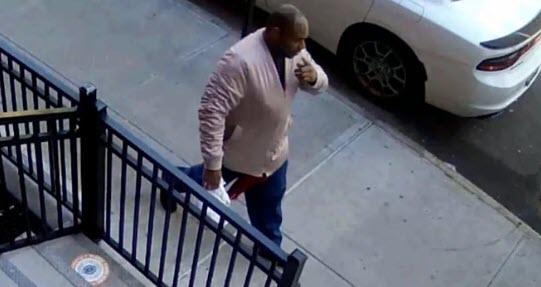
New York City Police are searching for this man who attacked a 65-year-old Asian woman in broad daylight in Midtown on the sidewalk on West 43rd Street near Ninth Avenue.

In a press release, police say they are “asking for the public’s assistance in identifying the following individual wanted in connection to a hate crime assault incident.

Police Commissioner Dermot Shea speaking on CNN affiliate NY1 Tuesday called this most recent attack “very disturbing.”

“It’s really disgusting when you see the video,” he said.

“We’re calling on all New Yorkers, anyone with information, we put out a pretty good picture of the, the individual that we want to talk to that was seen walking away, and you just try to make sense of it…and you can’t,” he said.

The New York Post reported that the suspect yelled anti-Asian statements while he beat the woman, including, “F**k you, you don’t belong here.”

The video below shows a man inside a building just a few feet away watching the attack. Like others, he does nothing.

One person who did act was a security guard who walks over and closes the door. Another man stops undoing packages to watch the entire attack without intervening.

The Post reports that the guard insisted that he was unaware of the attack. However, he could at a minimum clearly see the woman in distress on the ground.

*  *  *

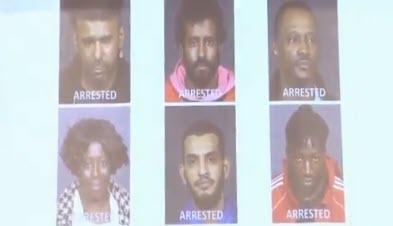
The New York police department has recorded a 1,300 percent increase in hate crimes against Asian Americans during the pandemic and as we previously noted, they held a press conference last week to highlight the assailants…

[ZH: Spot the ‘white supremacist’ in the booking photos of the Asian hate-crime perpetrators…]

[ZH: As we previously highlighted, if you rely on The New York Times, the Democratic Party or CNN – they are interchangeable – for your perception of reality, you now believe America is reeling from the latest expression of white supremacy: Anti-Asian racism. The New York Times, the leader in mass hysterias fomented by the left – hysteria is the oxygen of the left – printed this headline last week: “Attacks on Asian-Americans in New York Stoke Fear, Anxiety and Anger.” And the subhead reads: “Hate crimes involving Asian-American victims soared in New York City last year.”

If one reads past the headline – which most people do not – the article gives the actual numbers: “The number of hate crimes with Asian-American victims reported to the New York Police Department jumped to 28 in 2020, from just three the previous year.”

report by the Center for the Study of Hate and Extremism drew national media attention for identifying a 149% increase in anti-Asian hate crimes in 2020 compared to 2019 in 16 of our largest cities. A startling number — until you learn the actual number of hate crimes in those cities rose from 49 to 122 in a country of 330 million people.

So, to cut through the gaslighting, here are the facts according to the most recent FBI crime data (2019):

  • White Americans make up 70% of the population and are cited for 52% of all hate crimes (nearly 20% below the percentage of the white population).

  • Black Americans are 13% of the population but are cited for 24% of all hate crimes (nearly double the percentage of the black population).

  • Black Americans are also cited for over 50% of all violent crime in the nation.

But, in what could be called “compound lying,” the Times did blame “former President Donald J. Trump, who frequently used racist language to refer to the coronavirus.”

Of course, the Times did not provide an example of Trump’s racist language with regard to the coronavirus. One must assume that blaming the Chinese government for the virus or referring to the virus as the “China virus” or “Wuhan virus” is regarded as racist, even though virtually every prior epidemic was named after its city or region of origin: the “Spanish Flu,” “Hong Kong Flu,” “Ebola Virus,” etc.

Meanwhile, the blanketing of the country with the Atlanta lie and the anti-Asian violence continues. The cover of this week’s Time features a drawing of a young Asian woman under the headline: “We Are Not Silent: Confronting America’s Legacy of Anti-Asian Violence.”

We look forward to seeing what President Biden will do about this wave of African American violence against Asian Americans…

Tyler Durden
Tue, 03/30/2021 – 17:25

via ZeroHedge News https://ift.tt/3wfWk1i Tyler Durden

White House Press Secretary: Joe Biden’s Opposition to Legalizing Marijuana Hasn’t Changed


Biden stylized

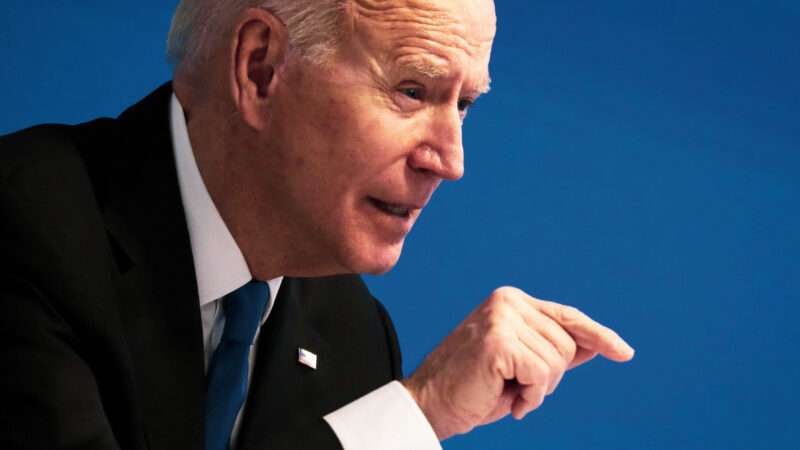
White House Press Secretary Jen Psaki told reporters at a press conference today that President Joe Biden’s opposition to legalizing marijuana hasn’t changed since taking office.

“He spoke about this on the campaign,” Psaki said in response to a question about marijuana legalization. “He believes in decriminalizing the use of marijuana, but his position has not changed.”

The Biden White House has—unsurprisingly, given both Biden and Vice President Kamala Harris’ past criminal justice records—been decidedly unchill about jazz cigarettes. Psaki’s comments come after reports earlier this month that the White House had sanctioned staffers for past marijuana use.

Democrats may force Biden’s hand, though. In February, Senate majority leader Chuck Schumer (D–N.Y.), joined by Sens. Corey Booker (D–N.J.) and Ron Wyden (D–Ore.) said they will pursue comprehensive marijuana reform now that Democrats control both the Senate and the House of Representatives.

“The War on Drugs has been a war on people—particularly people of color,” the senators said in a press release. “Ending the federal marijuana prohibition is necessary to right the wrongs of this failed war and end decades of harm inflicted on communities of color across the country.”

At the state level, New York is on the verge of legalizing marijuana, and about a third of the U.S. population now lives in states where the drug is legal for recreational use.

Internationally, the grass may soon be greener across both the northern and southern U.S. border. Mexico is expected to pass legislation in April legalizing marijuana.

If the White House wants to continue to insist that decriminalization, drug courts, and mandatory rehab are an acceptable substitute for individual autonomy, or anything other than a low-grade continuation of the drug war, it may do so, but it will find that position is becoming awfully lonely.

As Reason‘s Jacob Sullum wrote recently, “there is no moral justification for foisting ‘rehabilitation’ on people who do not want it and may not even be addicted. That policy strips people of their liberty, dignity, and moral agency simply because they consume psychoactive substances that politicians do not like.”

from Latest – Reason.com https://ift.tt/3fs1fXh
via IFTTT

Cops Tried To Force a Man To Delete a Video of Them Beating a Suspect. They Got Qualified Immunity.


131

In August 2014, Levi Frasier filmed Denver cops beating a suspect during an arrest for an alleged drug deal. The officers punched the accused six times in the face, and when a woman approached the scene screaming, a different cop clutched her ankle, tossing her to the ground—all captured on film.

The officers didn’t take kindly to the latter point. After the arrest, they surrounded Frasier, searched his tablet without a warrant, and attempted to delete the resulting video. In doing so, a federal court this week acknowledged that the officers violated the First Amendment, with the judges noting that the city’s police training had taught the officers as much: There’s a constitutional right to record government agents making a public arrest.

The same court ruled that the cops are protected by qualified immunity, the legal doctrine that shields state actors from accountability in civil court unless a previous court precedent outlines a case with almost exactly the same factual circumstances.

Known as the “clearly established law” test, that standard is supposed to protect public officials from shallow litigation. In reality, it often allows the government to skirt responsibility for alleged misconduct, no matter how blatant. Consider the cops who allegedly stole $225,000 while executing a search warrant, or the cops who assaulted and arrested a man for standing outside of his own house, or the cop who shot a 10-year-old child. All were given qualified immunity—not because their conduct wasn’t unconscionable, but because pre-existing case law didn’t expressly say so.

That standard is alive and well here. “[T]he district court was wrong to deny the officers qualified immunity based on their knowledge of Mr. Frasier’s purported First Amendment rights that they gained from their training,” wrote Judge Jerome A. Holmes of the U.S. Court of Appeals for the 10th Circuit. “Judicial decisions are the only valid interpretive source of the content of clearly established law; whatever training the officers received concerning the First Amendment was irrelevant to the clearly-established-law inquiry.”

In other words: Although the officers knew their behavior was unlawful, the public cannot hold them accountable because, in the eyes of qualified immunity, they weren’t equipped with that knowledge in the right way. A court precedent is the only avenue in which a public servant can appropriately and unquestionably know what conduct violates someone’s rights, wrote Holmes, as if cops are casually perusing case law texts for instruction.

Frasier also brought a civil conspiracy claim against the officers, who again sought protection under qualified immunity. The district court denied them that request. The 10th Circuit reversed.

“Because we have concluded that the officers are entitled to qualified immunity on Mr. Frasier’s First Amendment retaliation claim based on the absence of clearly established law,” the court said, “it necessarily follows that they also are entitled to qualified immunity on his conspiracy claim insofar as it alleges a conspiracy to retaliate against him in violation of the same First Amendment right.”

The Supreme Court has notoriously been unwilling to conduct a wholesale reevaluation of qualified immunity. In fact, the Court specifically demurred at the opportunity to review every qualified immunity case mentioned above.

It’s a rich refusal considering that the Court itself breathed qualified immunity into existence. Though it is not the job of nine justices to legislate for the country, that’s precisely what they did in creating the first iteration of the legal doctrine in Pierson v. Ray (1967), refining it to its current application—that “clearly established” part—as outlined in Harlow v. Fitzgerald (1982).

In its current session, the Supreme Court has been willing to send subtler messages to lower courts about just how rigorous a standard qualified immunity should be. In November, the justices reversed the ruling in Taylor v. Riojas (2020), in which the U.S Court of Appeals for the 5th Circuit awarded qualified immunity to a group of prison guards who forced a naked psychiatric-unit inmate into two filthy cells, one lined with “massive amounts” of human feces and the other with raw sewage overflowing from a clogged floor drain. The Court did the same last month when it ordered the 5th Circuit to reconsider a decision in which they gave qualified immunity to a correctional officer who pepper-sprayed an inmate without provocation.

Holmes recognized this trend, tipping his hat to the recent decision in Taylor. As with any guidance from the high court, he conceded that it should be his lodestar. And yet such guidance still isn’t enough here, he concluded.

“Mr. Frasier’s attempt to distill a clearly established right applicable here from the general First Amendment principles protecting the creation of speech and the gathering of news,” the judge said, “runs headfirst into the Supreme Court’s prohibition against defining clearly established rights at a high level of generality.”

As with any qualified immunity decision, the ruling rests on reasonableness. A reasonable officer could reasonably believe that the First Amendment doesn’t apply to filming public arrests, Holmes explained. Basic principles attached to both the free press and free speech didn’t make it obvious enough. The courses the officers received in which the government explicitly told them that their actions infringed on the Constitution didn’t make it obvious enough.

What, then, would make such an act unreasonable? If an armed agent of the state cannot be expected to apply his or her training to the job, then perhaps we’re holding the government to too low a standard.

from Latest – Reason.com https://ift.tt/2PM1Isc
via IFTTT

White House Press Secretary: Joe Biden’s Opposition to Legalizing Marijuana Hasn’t Changed


Biden stylized

White House Press Secretary Jen Psaki told reporters at a press conference today that President Joe Biden’s opposition to legalizing marijuana hasn’t changed since taking office.

“He spoke about this on the campaign,” Psaki said in response to a question about marijuana legalization. “He believes in decriminalizing the use of marijuana, but his position has not changed.”

The Biden White House has—unsurprisingly, given both Biden and Vice President Kamala Harris’ past criminal justice records—been decidedly unchill about jazz cigarettes. Psaki’s comments come after reports earlier this month that the White House had sanctioned staffers for past marijuana use.

Democrats may force Biden’s hand, though. In February, Senate majority leader Chuck Schumer (D–N.Y.), joined by Sens. Corey Booker (D–N.J.) and Ron Wyden (D–Ore.) said they will pursue comprehensive marijuana reform now that Democrats control both the Senate and the House of Representatives.

“The War on Drugs has been a war on people—particularly people of color,” the senators said in a press release. “Ending the federal marijuana prohibition is necessary to right the wrongs of this failed war and end decades of harm inflicted on communities of color across the country.”

At the state level, New York is on the verge of legalizing marijuana, and about a third of the U.S. population now lives in states where the drug is legal for recreational use.

Internationally, the grass may soon be greener across both the northern and southern U.S. border. Mexico is expected to pass legislation in April legalizing marijuana.

If the White House wants to continue to insist that decriminalization, drug courts, and mandatory rehab are an acceptable substitute for individual autonomy, or anything other than a low-grade continuation of the drug war, it may do so, but it will find that position is becoming awfully lonely.

As Reason‘s Jacob Sullum wrote recently, “there is no moral justification for foisting ‘rehabilitation’ on people who do not want it and may not even be addicted. That policy strips people of their liberty, dignity, and moral agency simply because they consume psychoactive substances that politicians do not like.”

from Latest – Reason.com https://ift.tt/3fs1fXh
via IFTTT

Cops Tried To Force a Man To Delete a Video of Them Beating a Suspect. They Got Qualified Immunity.


131

In August 2014, Levi Frasier filmed Denver cops beating a suspect during an arrest for an alleged drug deal. The officers punched the accused six times in the face, and when a woman approached the scene screaming, a different cop clutched her ankle, tossing her to the ground—all captured on film.

The officers didn’t take kindly to the latter point. After the arrest, they surrounded Frasier, searched his tablet without a warrant, and attempted to delete the resulting video. In doing so, a federal court this week acknowledged that the officers violated the First Amendment, with the judges noting that the city’s police training had taught the officers as much: There’s a constitutional right to record government agents making a public arrest.

The same court ruled that the cops are protected by qualified immunity, the legal doctrine that shields state actors from accountability in civil court unless a previous court precedent outlines a case with almost exactly the same factual circumstances.

Known as the “clearly established law” test, that standard is supposed to protect public officials from shallow litigation. In reality, it often allows the government to skirt responsibility for alleged misconduct, no matter how blatant. Consider the cops who allegedly stole $225,000 while executing a search warrant, or the cops who assaulted and arrested a man for standing outside of his own house, or the cop who shot a 10-year-old child. All were given qualified immunity—not because their conduct wasn’t unconscionable, but because pre-existing case law didn’t expressly say so.

That standard is alive and well here. “[T]he district court was wrong to deny the officers qualified immunity based on their knowledge of Mr. Frasier’s purported First Amendment rights that they gained from their training,” wrote Judge Jerome A. Holmes of the U.S. Court of Appeals for the 10th Circuit. “Judicial decisions are the only valid interpretive source of the content of clearly established law; whatever training the officers received concerning the First Amendment was irrelevant to the clearly-established-law inquiry.”

In other words: Although the officers knew their behavior was unlawful, the public cannot hold them accountable because, in the eyes of qualified immunity, they weren’t equipped with that knowledge in the right way. A court precedent is the only avenue in which a public servant can appropriately and unquestionably know what conduct violates someone’s rights, wrote Holmes, as if cops are casually perusing case law texts for instruction.

Frasier also brought a civil conspiracy claim against the officers, who again sought protection under qualified immunity. The district court denied them that request. The 10th Circuit reversed.

“Because we have concluded that the officers are entitled to qualified immunity on Mr. Frasier’s First Amendment retaliation claim based on the absence of clearly established law,” the court said, “it necessarily follows that they also are entitled to qualified immunity on his conspiracy claim insofar as it alleges a conspiracy to retaliate against him in violation of the same First Amendment right.”

The Supreme Court has notoriously been unwilling to conduct a wholesale reevaluation of qualified immunity. In fact, the Court specifically demurred at the opportunity to review every qualified immunity case mentioned above.

It’s a rich refusal considering that the Court itself breathed qualified immunity into existence. Though it is not the job of nine justices to legislate for the country, that’s precisely what they did in creating the first iteration of the legal doctrine in Pierson v. Ray (1967), refining it to its current application—that “clearly established” part—as outlined in Harlow v. Fitzgerald (1982).

In its current session, the Supreme Court has been willing to send subtler messages to lower courts about just how rigorous a standard qualified immunity should be. In November, the justices reversed the ruling in Taylor v. Riojas (2020), in which the U.S Court of Appeals for the 5th Circuit awarded qualified immunity to a group of prison guards who forced a naked psychiatric-unit inmate into two filthy cells, one lined with “massive amounts” of human feces and the other with raw sewage overflowing from a clogged floor drain. The Court did the same last month when it ordered the 5th Circuit to reconsider a decision in which they gave qualified immunity to a correctional officer who pepper-sprayed an inmate without provocation.

Holmes recognized this trend, tipping his hat to the recent decision in Taylor. As with any guidance from the high court, he conceded that it should be his lodestar. And yet such guidance still isn’t enough here, he concluded.

“Mr. Frasier’s attempt to distill a clearly established right applicable here from the general First Amendment principles protecting the creation of speech and the gathering of news,” the judge said, “runs headfirst into the Supreme Court’s prohibition against defining clearly established rights at a high level of generality.”

As with any qualified immunity decision, the ruling rests on reasonableness. A reasonable officer could reasonably believe that the First Amendment doesn’t apply to filming public arrests, Holmes explained. Basic principles attached to both the free press and free speech didn’t make it obvious enough. The courses the officers received in which the government explicitly told them that their actions infringed on the Constitution didn’t make it obvious enough.

What, then, would make such an act unreasonable? If an armed agent of the state cannot be expected to apply his or her training to the job, then perhaps we’re holding the government to too low a standard.

from Latest – Reason.com https://ift.tt/2PM1Isc
via IFTTT

Biden Declines Invitation To Throw Nationals’ First Pitch On Opening Day

Biden Declines Invitation To Throw Nationals’ First Pitch On Opening Day

Following the November election, President Joe Biden was invited by the Washington Nationals to throw the first pitch on Opening Day 2021. And with the long-awaited start of baseball season just around the corner, the president and his team have finally gotten around to answering – with a very diplomatic “no thanks.”

A baseball reporter for the Washington Post reports (and the Nats have confirmed) that Biden has declined the offer to appear on Opening Day, but he reportedly left the door open to making similar moves in the future. A spokesman for the franchise said “we look forward to welcoming President Biden to Nationals Park in the future.”

The Nats are set to play their season opener against the newly-acquired (by notorious hedge fund billionaire Steve Cohen) New York Mets on Thursday.

Members of Biden’s team have made headlines in recent months for first-pitch-related mishaps. Who can forget the time Dr. Anthony Fauci took a break from his 20-hour workdays to throw the first pitch at a Nats game. The pitch landing in the dirt about 20 feet to the left of home plate, and made some light-hearted headlines the next day. Dr. Fauci chalked up the wayward heave to a lack of preparation.

While Dr. Fauci played basketball in high school, Biden was a standout player on his old high school’s baseball squad, and previously threw out the opening pitch during an Oriole’s game back in 2009. The tradition of president’s throwing out the first pitch in Washington dates back to 1910, when William Howard Taft, a notoriously heavy-set gentleman, was in office. However, President Trump ended it (despite also having reportedly been a member of his high school squad).

But Biden is still getting over breaking his foot while playing with his German Shepard, Major, back in November (Major, along with the Biden’s older dog, Champ, was later sent back to Delaware after a “biting incident” involving a secret service member).

Of course, judging by Biden’s his performance at last week’s press conference (the first official briefing with the press corp attended by President Joe Biden since taking office), as well as that tumble he took climbing the stairs to Air Force One (which the White House blamed on the wind), one can only imagine how a Biden first pitch would go.

We suspect he would probably make 50 Cent look like Roger Clemens.

Tyler Durden
Tue, 03/30/2021 – 17:05

via ZeroHedge News https://ift.tt/3sBLlwZ Tyler Durden

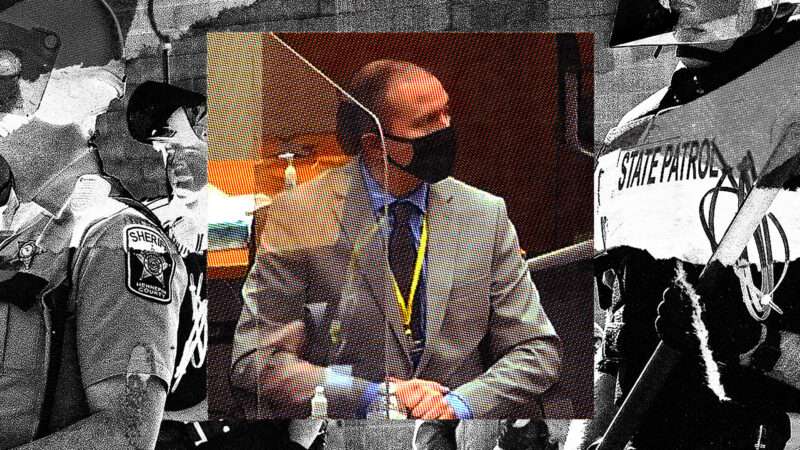
The Derek Chauvin Trial Begins: Dispatch From Minneapolis


121

Cursory impression: Minneapolitans do not like police, or rather, they don’t like Minneapolis police.

I am not talking about the people one might expect to show antipathy toward cops on the day former Minneapolis Police Officer Derek Chauvin goes on trial for the murder of George Floyd: The activists (or whoever) spray-painted ACAB (“All Cops Are Bastards”) on an overpass near the Target store that was looted two days after Floyd’s death. I am not talking about the girl who offered us cake at the “Land Back Now!” cookout near the Basilica of Saint Mary, or the security guy who, after he tells us about his eight kids, including triplets, the boys identical and the girl fraternal (“The OBGYN said, ‘Boy, you got some crazy sperm if you can do that in 24 hours'”), says George Floyd Square, which he sometimes patrols, “is about peace.”

I am talking about middle-of-the-road locals, the white journalist who says to her 30-year-old son, “The Minneapolis police have been terrible since before you were born.” The son who calls the former head of the police union, Bob Kroll, “the Antichrist.” The full-blooded Native American who tells me, “The last time a cop here pulled a gun on me, it was for walking down the street with my hands in my pockets.”

Since the death of George Floyd, I’ve had in my mind two images of Minneapolis: as a city under siege and as a place moving, if somewhat jerkily, toward necessary healing. It’s hard to argue that Chauvin kneeling on Floyd’s neck for nine minutes and 29 seconds (upped yesterday, from 8:46, in opening statements by the prosecution) is not a tactic the Minneapolis Police Department (or any police department) should rethink or do away with. That those minutes have exploded into the consciousness on a worldwide level is undeniable. This morning, I have two people—one in Portland, Oregon, the other in London—arguing on my Instagram about Floyd’s death and proportionality and how “one might wonder if there is a bit more going on here.”

As someone who covered the protests in Portland during the summer and fall of 2020, I know about proportionality, know there is more going on here, know that no amount of fire setting and window breaking, of tear gassing or neck kneeling, will satisfy those who seek healing through destruction. We’ve taken sides; don’t, as my late father used to say, “confuse me with the facts.”

I came to Minneapolis yesterday naïve about the situation on the ground, but for one aspect: The city, just after Floyd’s death, had touched off days of massive street violence, hundreds of buildings torched, and a five-mile stretch of Lake Street sustaining heavy property damage. I knew that law enforcement had been overwhelmed. And I wondered, with the Chauvin trial underway, if there was a sense of dread that, should the outcome be unsatisfying, the city would burn again. Were Minneapolitans afraid? Resigned? Hopeful? What had they done in the wake of Floyd’s death and what were they doing and feeling today? I’m asking people of different stripes, people who might usually not be interested in varying perspectives, might have recently or long ago decided that Person X is the enemy. I offer the perspectives anyway. Call me Pollyanna.

First up: two active duty Minneapolis-area officers, who spoke to me separately and on the condition of anonymity (and identified here as J and N), the night before the trial began, about their deployment immediately after Floyd’s death and what happens now. Comments have been edited for length and clarity.

J: “Almost as soon as we arrived at our staging area, we were ordered to put on our riot gear—which we had never worn—and deployed to defend the Fifth Precinct. This was [May 28], one day after the Third Precinct burned to the ground. We marched in from about five blocks through crowds screaming, throwing bottles, launching fireworks at us from both sides of the street…Later in the evening, a woman almost ran us over in her vehicle while we stood on a riot line.

“The radio traffic sounded like a fucking zombie movie, with the Minneapolis Police Department officers screaming they were facing massive crowds and could not hold their positions without relief. The cops looked absolutely wrecked. Every squad car had a broken window and many were held together with duct tape. I had to tell family to hunker down and not bother calling 911, because nobody was coming; one of the guys I know at MPD sent me a text telling me there was nobody left to answer calls.”

N: “Everybody had to go in and it was an absolute shit show because nobody knew what to do or where to go. We had never dealt with anything like that. I don’t think the city has seen anything like this ever…Almost immediately there were rental cars everywhere, with the plates taken off of them, people driving a hundred miles an hour up and down streets, it was the Wild West, I mean, it was lawless and then some.”

J: “There was a huge commercial building threatening an adjacent public housing complex that was occupied. Normally, if you have a large fire like that, law enforcement is going to evacuate the adjacent buildings. That area of Lake Street is largely controlled at this point by rioters. So we need to move these people out of there to get the fire department in there. Law enforcement, they’re using a lot of that stuff; just an ungodly amount of ordnance that gets dropped there: less-lethal rounds, tear gas, impact munitions.

“One of the things that’s very frustrating to me about this whole thing is: Now Portland can’t use tear gas. Now Seattle can’t use tear gas. It’s like, if you want to take that away from us, you’re leaving us with sticks and bats. The only reason those officers didn’t have to basically engage in medieval hand-to-hand combat with these people is because of the overwhelming superiority of less lethal munitions we have there.

“So the crowd gets pushed back. Then we actually get approached by two of the [black bloc] ‘medics.’ And they’re like, ‘You guys need to go help the people in that [burning] building, people that need help.’ It’s like, okay well, maybe stop setting buildings on fire then?

“If you watch Portlandia, the jokes also make sense in Minneapolis. It’s a very similar city, culturally; Minneapolis has a huge contingent of the anarcho-socialist, crust-punk, antifa-type milieu, in the same way Portland does. My impression of the people that were engaging law enforcement in the area where we were was, they’re all wearing black; some of them have their little anarchist banners or whatever. And they were equipped in a way that made me think, we were dealing with kind of the white anarchist crowd, because those folks know what to bring. They have their bike helmets and their kneepads and elbow pads and they’re covering their face in a more intelligent way to deal with tear gas than the average protestor, because they’d read all those CrimethInc. manuals and stuff.”

N: “The narrative that was pushed out to the media was, ‘The only people who caused destruction were from out of town, it was all out of state.’ Well, that’s fucking bullshit. I saw plenty of local assholes mixed into this. These riots were happening in every city and it wasn’t like, everyone’s just switching teams for the night.”

J: “The next day [May 29], 300 troops were deployed to the state Capitol to, to defend it from no one. There were National Guard and armored vehicles on a completely empty lawn, protecting the governor’s office from an empty square. The media showed up, took pictures, and left; the governor issued a tough-sounding press release. Meanwhile, they could see the smoke columns rising over Minneapolis in the distance. It was a complete failure of leadership and massive misuse of resources.”

N: [With the Chauvin trial underway], “there’s intelligence coming out that folks from Portland, Seattle, New York, Austin, and other activist cities are traveling to Minneapolis to be there for this. You’re not only dealing with the hometown contingent. You’ve got a lot of out-of-town people. I mean, those folks are not going to miss the trial.”

J: “There’s probably a solid core of at least 300 [local activists] that you can reliably count on. That’s me just guessing based on what I’ve seen in the past…The issue is, we have rules we have to follow—as we should—and they don’t. They’re drawing on years and years of theory of how to effectively engage government forces in a psychological warfare campaign. All these people, they’ve read Mao, they’ve read [activist] Saul Alinsky. Their purpose is to provoke the appearance of a disproportionate response from law enforcement, to bring more people to their cause and gain a greater critical mass on the street. That’s going to be a real question with this upcoming stuff: How much do we hold back versus, just snuff it out right away and make the arrests we need to make and remove the accelerants from the equation?”

N: “You have to arrest the main instigators. You just have to arrest people, period. And we didn’t do that [last time]. There was no infrastructure in place for it. It’s still a logistical nightmare for mass arrest.

“The National Guard has already been activated, so they’re going to help in a preemptive way, versus responding two days later away. We’ll already have them; we’re much more prepared. We’re not caught with our pants down, like last time.

“Our higher-ups are saying, ‘We’re preparing for the worst.’ [The day the trial starts], we go into not ’emergency level,’ but a more heightened state, through the length of the trial. I think [what happens to the city] totally depends on the verdict. I think if Chauvin’s acquitted, we’re fucked. There’s no other way to put it.”

J: “There’s folks out there that are going to take any excuse to engage in civil unrest with us. [The jury] going for the manslaughter and not the murder, I think, will be good enough for them [to riot].”

N: “The jury is from Hennepin County. I can’t imagine, in the back of their minds, they’re not thinking, ‘Boy, I can’t say not guilty, regardless of the circumstances, because I don’t want my city to burn.’ I feel like that’s going to play into it. I’m just speculating, but I feel sorry for those folks. I really do. I would not want to be in that position.

“I’d like to think that we’re more prepared, but I just don’t know if this [trial] is going to be a magnet for crazies from all over the U.S. to come here and wreak havoc. My guess is there will be fewer just regular folks who are just out protesting because they’re upset, and there’ll be less of those people to hide amongst. I don’t know. Maybe I’m just being hopeful.”

from Latest – Reason.com https://ift.tt/3fwIHF9
via IFTTT
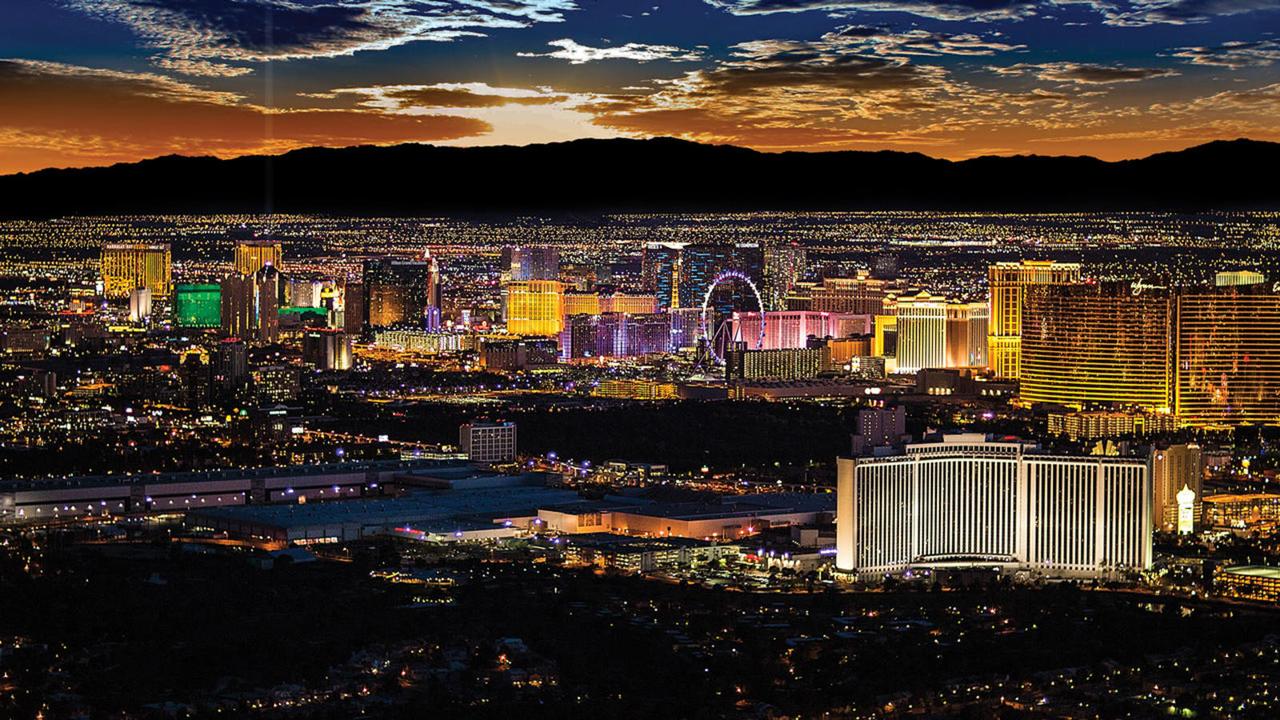
Can Las Vegas Recover From COVID?

Can Las Vegas Recover From COVID?

Authored by Doug French via The Mises Institute,

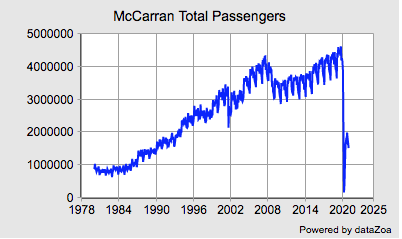
The Clark County Commissioners voted recently to rename McCarran Airport to Harry Reid International Airport. The vote was unanimous among those who rule the Las Vegas Strip. The public doesn’t understand why Las Vegas International Airport wouldn’t do if McCarran’s past is so perturbing. Not everyone is so wild about Harry.

There was a time when 40 million plus visitors passed through McCarran, during the boom years. But January 2021 saw visitor traffic fall 64 percent from a year ago. This sort of traffic has The Motley Fool wondering, “Are There Too Many Casinos in Las Vegas?” After all, convention traffic is nil, and “[a] concrete industry convention this summer is seen as the first real test of whether Las Vegas can come back soon,” writes Rich Dumprey.

These days the convention center is housing covid vaccinations. The creator of the Las Vegas convention industry, Sheldon Adelson (SGA), just passed away, and had lined up a sale of all Las Vegas Sands properties before his death. LVS is all about Macau, Singapore and … Texas? That’s right, Sands money flooded into Austin in hopes of moving the legalized gaming needle, and convention business, in LVS’s direction. 

What did SGA see that the rest of the town didn’t and doesn’t? As the Fool explains, “There are around 30 casinos on the Las Vegas Strip, about two dozen more nearby (such as on Fremont Street), and dozens more elsewhere. Yet with so many gambling halls available and so few people to fill them, casino operators could delay their recovery by continuing to operate them all. Perhaps the new normal for Vegas should be fewer casinos.”

As for convention space, in a piece for mises.org, I wrote, “Las Vegas convention attendance first topped 6 million in the boom year of 2005. Since then, the number of yearly convention visitors has bounced between just short of 4.5 million in 2009 and again in 2010 … ” In 2019, 6.6 million conventoineers hit town, while in 2020 let’s just say very few arrived.

Meanwhile, the Las Vegas Convention Authority has added “1.4 million square feet to its facility, including six hundred thousand square feet of new leasable exhibit space,” supposedly because, as LVCVA chief Steve Hill said in 2019, “It’s pretty remarkable what’s going on in Las Vegas right now, but it’s in response to demand.”

Elon Musk finished an underground people mover at the LVCVA site and has been signed on to dig more tunnels.

So, SGA saw thousands of rooms to compete with and the government (LVCVA) continuing to compete with subsidized rates for conventions. You see, hotels pay the LVCVA fees to bring business to Las Vegas and with those fees are able to offer lower convention space rates. Texas doesn’t sound so crazy after all.

As for Harry’s airport, one wonders when folks will want to fill the friendly skies again. The New York Times’s Farhad Manjoo writes, “Face-to-face interactions were said to justify the $1.4 trillion spent globally on business travel in 2019. In 2020, business travel was slashed in half, our faces were stuck in screens, and yet many of the companies used to spending boatloads on travel are doing just fine.”

Manjoo gives plenty of space to the carbon footprint of the average business traveler, but, more importantly, he interviewed Darren Marble, an entrepreneur based in Los Angeles, who learned face-to-face is not all it’s cracked up to be. “Rapport is overrated,” Marble told Manjoo.

And while I may think having a carbon-neutral footprint is overrated, younger folks put it much higher on their preference scales. The Global Business Travel Association predicts business travel will return to 2019 levels by 2025.

For Las Vegas and Reid International, 2025 won’t be soon enough.

Tyler Durden
Tue, 03/30/2021 – 16:45

via ZeroHedge News https://ift.tt/2PDxoQG Tyler Durden

The Derek Chauvin Trial Begins: Dispatch From Minneapolis


121

Cursory impression: Minneapolitans do not like police, or rather, they don’t like Minneapolis police.

I am not talking about the people one might expect to show antipathy toward cops on the day former Minneapolis Police Officer Derek Chauvin goes on trial for the murder of George Floyd: The activists (or whoever) spray-painted ACAB (“All Cops Are Bastards”) on an overpass near the Target store that was looted two days after Floyd’s death. I am not talking about the girl who offered us cake at the “Land Back Now!” cookout near the Basilica of Saint Mary, or the security guy who, after he tells us about his eight kids, including triplets, the boys identical and the girl fraternal (“The OBGYN said, ‘Boy, you got some crazy sperm if you can do that in 24 hours'”), says George Floyd Square, which he sometimes patrols, “is about peace.”

I am talking about middle-of-the-road locals, the white journalist who says to her 30-year-old son, “The Minneapolis police have been terrible since before you were born.” The son who calls the former head of the police union, Bob Kroll, “the Antichrist.” The full-blooded Native American who tells me, “The last time a cop here pulled a gun on me, it was for walking down the street with my hands in my pockets.”

Since the death of George Floyd, I’ve had in my mind two images of Minneapolis: as a city under siege and as a place moving, if somewhat jerkily, toward necessary healing. It’s hard to argue that Chauvin kneeling on Floyd’s neck for nine minutes and 29 seconds (upped yesterday, from 8:46, in opening statements by the prosecution) is not a tactic the Minneapolis Police Department (or any police department) should rethink or do away with. That those minutes have exploded into the consciousness on a worldwide level is undeniable. This morning, I have two people—one in Portland, Oregon, the other in London—arguing on my Instagram about Floyd’s death and proportionality and how “one might wonder if there is a bit more going on here.”

As someone who covered the protests in Portland during the summer and fall of 2020, I know about proportionality, know there is more going on here, know that no amount of fire setting and window breaking, of tear gassing or neck kneeling, will satisfy those who seek healing through destruction. We’ve taken sides; don’t, as my late father used to say, “confuse me with the facts.”

I came to Minneapolis yesterday naïve about the situation on the ground, but for one aspect: The city, just after Floyd’s death, had touched off days of massive street violence, hundreds of buildings torched, and a five-mile stretch of Lake Street sustaining heavy property damage. I knew that law enforcement had been overwhelmed. And I wondered, with the Chauvin trial underway, if there was a sense of dread that, should the outcome be unsatisfying, the city would burn again. Were Minneapolitans afraid? Resigned? Hopeful? What had they done in the wake of Floyd’s death and what were they doing and feeling today? I’m asking people of different stripes, people who might usually not be interested in varying perspectives, might have recently or long ago decided that Person X is the enemy. I offer the perspectives anyway. Call me Pollyanna.

First up: two active duty Minneapolis-area officers, who spoke to me separately and on the condition of anonymity (and identified here as J and N), the night before the trial began, about their deployment immediately after Floyd’s death and what happens now. Comments have been edited for length and clarity.

J: “Almost as soon as we arrived at our staging area, we were ordered to put on our riot gear—which we had never worn—and deployed to defend the Fifth Precinct. This was [May 28], one day after the Third Precinct burned to the ground. We marched in from about five blocks through crowds screaming, throwing bottles, launching fireworks at us from both sides of the street…Later in the evening, a woman almost ran us over in her vehicle while we stood on a riot line.

“The radio traffic sounded like a fucking zombie movie, with the Minneapolis Police Department officers screaming they were facing massive crowds and could not hold their positions without relief. The cops looked absolutely wrecked. Every squad car had a broken window and many were held together with duct tape. I had to tell family to hunker down and not bother calling 911, because nobody was coming; one of the guys I know at MPD sent me a text telling me there was nobody left to answer calls.”

N: “Everybody had to go in and it was an absolute shit show because nobody knew what to do or where to go. We had never dealt with anything like that. I don’t think the city has seen anything like this ever…Almost immediately there were rental cars everywhere, with the plates taken off of them, people driving a hundred miles an hour up and down streets, it was the Wild West, I mean, it was lawless and then some.”

J: “There was a huge commercial building threatening an adjacent public housing complex that was occupied. Normally, if you have a large fire like that, law enforcement is going to evacuate the adjacent buildings. That area of Lake Street is largely controlled at this point by rioters. So we need to move these people out of there to get the fire department in there. Law enforcement, they’re using a lot of that stuff; just an ungodly amount of ordnance that gets dropped there: less-lethal rounds, tear gas, impact munitions.

“One of the things that’s very frustrating to me about this whole thing is: Now Portland can’t use tear gas. Now Seattle can’t use tear gas. It’s like, if you want to take that away from us, you’re leaving us with sticks and bats. The only reason those officers didn’t have to basically engage in medieval hand-to-hand combat with these people is because of the overwhelming superiority of less lethal munitions we have there.

“So the crowd gets pushed back. Then we actually get approached by two of the [black bloc] ‘medics.’ And they’re like, ‘You guys need to go help the people in that [burning] building, people that need help.’ It’s like, okay well, maybe stop setting buildings on fire then?

“If you watch Portlandia, the jokes also make sense in Minneapolis. It’s a very similar city, culturally; Minneapolis has a huge contingent of the anarcho-socialist, crust-punk, antifa-type milieu, in the same way Portland does. My impression of the people that were engaging law enforcement in the area where we were was, they’re all wearing black; some of them have their little anarchist banners or whatever. And they were equipped in a way that made me think, we were dealing with kind of the white anarchist crowd, because those folks know what to bring. They have their bike helmets and their kneepads and elbow pads and they’re covering their face in a more intelligent way to deal with tear gas than the average protestor, because they’d read all those CrimethInc. manuals and stuff.”

N: “The narrative that was pushed out to the media was, ‘The only people who caused destruction were from out of town, it was all out of state.’ Well, that’s fucking bullshit. I saw plenty of local assholes mixed into this. These riots were happening in every city and it wasn’t like, everyone’s just switching teams for the night.”

J: “The next day [May 29], 300 troops were deployed to the state Capitol to, to defend it from no one. There were National Guard and armored vehicles on a completely empty lawn, protecting the governor’s office from an empty square. The media showed up, took pictures, and left; the governor issued a tough-sounding press release. Meanwhile, they could see the smoke columns rising over Minneapolis in the distance. It was a complete failure of leadership and massive misuse of resources.”

N: [With the Chauvin trial underway], “there’s intelligence coming out that folks from Portland, Seattle, New York, Austin, and other activist cities are traveling to Minneapolis to be there for this. You’re not only dealing with the hometown contingent. You’ve got a lot of out-of-town people. I mean, those folks are not going to miss the trial.”

J: “There’s probably a solid core of at least 300 [local activists] that you can reliably count on. That’s me just guessing based on what I’ve seen in the past…The issue is, we have rules we have to follow—as we should—and they don’t. They’re drawing on years and years of theory of how to effectively engage government forces in a psychological warfare campaign. All these people, they’ve read Mao, they’ve read [activist] Saul Alinsky. Their purpose is to provoke the appearance of a disproportionate response from law enforcement, to bring more people to their cause and gain a greater critical mass on the street. That’s going to be a real question with this upcoming stuff: How much do we hold back versus, just snuff it out right away and make the arrests we need to make and remove the accelerants from the equation?”

N: “You have to arrest the main instigators. You just have to arrest people, period. And we didn’t do that [last time]. There was no infrastructure in place for it. It’s still a logistical nightmare for mass arrest.

“The National Guard has already been activated, so they’re going to help in a preemptive way, versus responding two days later away. We’ll already have them; we’re much more prepared. We’re not caught with our pants down, like last time.

“Our higher-ups are saying, ‘We’re preparing for the worst.’ [The day the trial starts], we go into not ’emergency level,’ but a more heightened state, through the length of the trial. I think [what happens to the city] totally depends on the verdict. I think if Chauvin’s acquitted, we’re fucked. There’s no other way to put it.”

J: “There’s folks out there that are going to take any excuse to engage in civil unrest with us. [The jury] going for the manslaughter and not the murder, I think, will be good enough for them [to riot].”

N: “The jury is from Hennepin County. I can’t imagine, in the back of their minds, they’re not thinking, ‘Boy, I can’t say not guilty, regardless of the circumstances, because I don’t want my city to burn.’ I feel like that’s going to play into it. I’m just speculating, but I feel sorry for those folks. I really do. I would not want to be in that position.

“I’d like to think that we’re more prepared, but I just don’t know if this [trial] is going to be a magnet for crazies from all over the U.S. to come here and wreak havoc. My guess is there will be fewer just regular folks who are just out protesting because they’re upset, and there’ll be less of those people to hide amongst. I don’t know. Maybe I’m just being hopeful.”

from Latest – Reason.com https://ift.tt/3fwIHF9
via IFTTT
WTI Holds Losses After Surprise Crude Build

WTI Holds Losses After Surprise Crude Build

Oil prices extended their losses today as a panel of OPEC+ technical experts agreed to revise down oil-demand estimates for 2021 after Saudi Arabia suggested that the figure looked too high. This built on supply fears easing as the Suez Canal reopened, and also on demand concerns after the CDC Director’s melt-down yesterday (and lastly a stronger dollar didn’t help)

“While last month saw many positive developments, it also witnessed reminders of the ongoing uncertainties and fragility caused by the COVID-19 pandemic,” Barkindo said at the start of the videoconference of the OPEC+ Joint Technical Committee on Tuesday, according to a statement from the group.

But for now, all (algo) eyes are on the most recent inventory data

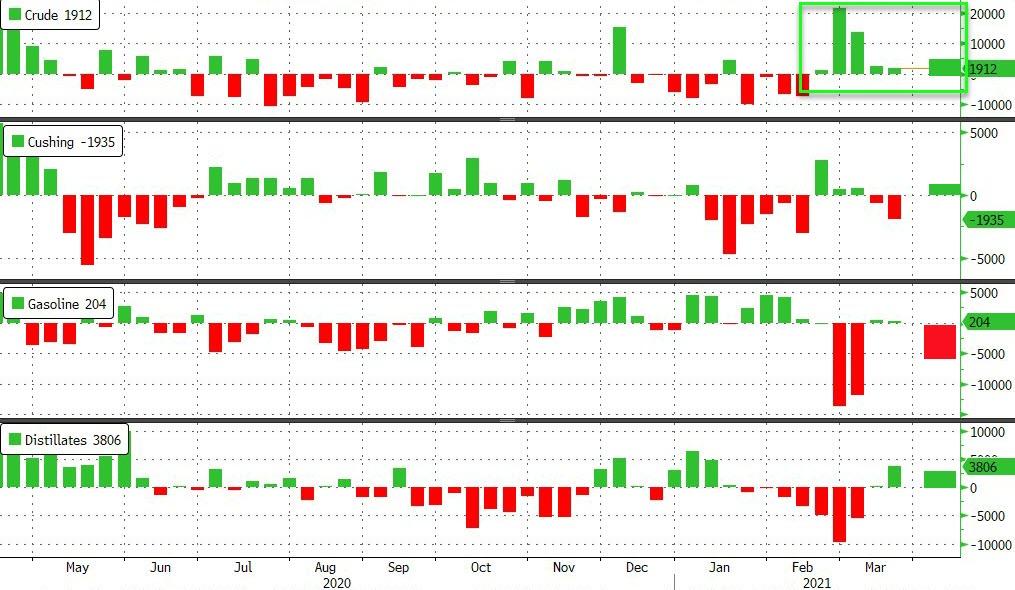
API

  • Crude +3.91mm (-1.5mm exp)

  • Cushing +904k

  • Gasoline -6.012mm (+700k exp)

  • Distillates +2.595mm (+500k exp)

After five straight weeks of builds, analysts expected crude stocks to draw 1.5mm barrels last week but once again they were wrong as crude inventories rose 3.91mm. Gasoline stocks surprised with a big draw but distillates saw a surprisingly large build…

Source: Bloomberg

“The price gains that accumulated during the Suez blockade were, as expected, short-lived and are now being erased with the gradual return to normal traffic,” Rystad Energy’s oil markets analyst Louise Dickson said.

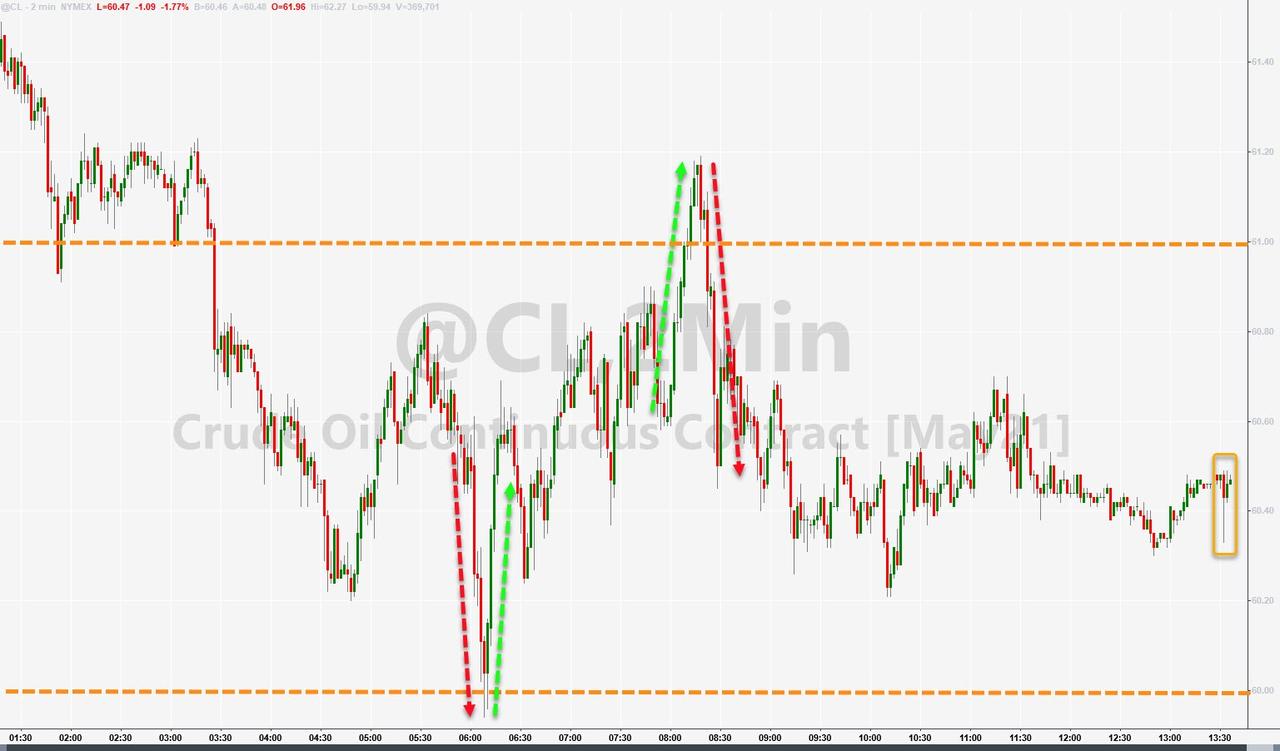
WTI bounced off $60 intraday and hovered around $60.40 ahead of the API data and inched lower after the surprise build…

“The wobble we have seen in prices means that OPEC+ will likely need to take a cautious approach once again,” bank ING said. “We are of the view that the group will likely hold output levels unchanged.”

Finally, on a more optimistic note, OPEC expects the global oil-stockpile surplus that built up during the pandemic to be mostly gone in the next three months, earlier than previously forecast.

Tyler Durden
Tue, 03/30/2021 – 16:35

via ZeroHedge News https://ift.tt/31vlECz Tyler Durden