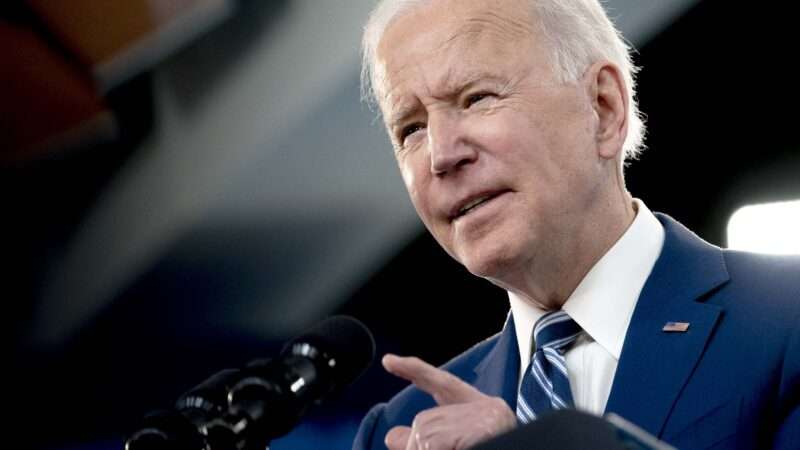
Biden, CDC Warn of ‘Impending Doom’ if States Reopen Because Of Course They Do


covphotos122664

The federal government is once again urging states and citizens to stand firm and abide by COVID-19 restrictions, even as successful efforts to vaccinate the most at-risk members of the population make the worst case scenario—another wave of mass death—not particularly likely.

“This is not a time to lessen our efforts,” said President Biden on Monday. “If we let our guard down now, we could see the virus getting worse, not better.”

Of course, this is a familiar refrain by now: It has never been the time for the public to let its guard down. And according to federal health bureaucrats, it probably never will be.

Sounding a similarly apocalyptic note, Centers for Disease Control (CDC) Director Rochelle Walensky warned of “impending doom” if states reopen too quickly. “Right now, I’m scared,” said a “visibly shaken” Walensky, according to POLITICO.

The CDC continues to recommend that people avoid unnecessary travel, and is urging states to pause their reopening efforts.

It’s true that cases are currently plateauing around 60,000 each day, and hospitalizations have ticked up slightly. What federal health authorities do not seem to understand, however, is that human beings are not just numbers on spreadsheets. We have a desire to socialize, to reopen our schools and businesses, to go outside and start living life again. Mass vaccination was intended to make this dream a reality, and the news is very good. According to the data, vaccination reduces death and severe disease to basically zero, and vaccinated people are much less likely to transmit COVID-19 to others. This means that vaccinated people can reclaim normality with minimal danger—particularly if the activities in question (going to the park or the beach) do not themselves carry much risk in the first place.

If the authorities really believed we were facing impending doom, they should immediately distribute all available vaccines. And yet 30 million doses of the AstraZeneca vaccine are currently sitting unused in a warehouse in Ohio, just waiting for the government to get around to signing off on them. According to the government, the situation is so dire that people should cancel summer travel plans and keep wearing masks even after they’re vaccinated, but not dire enough to tell federal bureaucrats to pick up the pace.

from Latest – Reason.com https://ift.tt/3w8dvSJ
via IFTTT

“The Largest Tax Hike In Generations” Could Pay For Up To 75% Of Biden’s Next Spending Plan

“The Largest Tax Hike In Generations” Could Pay For Up To 75% Of Biden’s Next Spending Plan

On Wednesday, President Biden will unveil the first part of a two-part stimulus plan aimed at infrastructure, climate change, and social programs.

While initial reports pegged the next round of stimulus at $3 trillion, the Washington Post‘s Jeff Stein now reports that new spending could top $4 trillion, while new taxes to pay for it – some of which Biden will also unveil Wednesday – could total over $3 trillion.

The two-pronged package Biden will begin unveiling this week includes higher amounts of federal spending but also significantly more in new tax revenue — with possibly as much as $4 trillion in new spending and more than $3 trillion in tax increases, said the people, who spoke on the condition of anonymity to describe private dynamics. One person familiar with the matter said that the early infrastructure draft did not include every tax increase the White House was eventually considering including in its ultimate proposal, and that the administration believes the tax hikes can also advance its goal of reducing income inequality. -WaPo

There are four main tax increases Biden is immediately eying, according to Axios

  • A corporate tax increase from Trump’s 21% to 28%, raising an estimated $730 billion over a decade, according to the Tax Policy Center.
  • A global minimum tax on profits from global subsidiaries worth $550 billion over the same period.
  • Taxing capital gains for the wealthy as ordinary income, as opposed to the current rate of 20% for those making $441,451 or more per year, and a tax on unrealized capital gains at death: $370 billion
  • Return the top individual tax rate for people earning over $400,000 per year to the pre-Trump rate of 39.6%: $110 billion

Given the slim majority Democrats hold in the Senate, they will need to appeal to centrist Democratic colleagues, most notably Sen. Joe Manchin (D-WV) in order to pass legislation via a budgetary process called reconciliation, which allows for a simple majority as opposed to 60 votes normally required to pass legislation.

Still, the choice to increase the bill’s tax hikes in part because of its effects on the deficit reflects how concerns over the nation’s spending imbalance are shaping the White House’s internal policy debate. But it also sets up the administration for an enormous political challenge in convincing Congress to pass a package of tax increases on wealthy Americans and companies that together would represent the largest tax hike in generations. -WaPo

According to Axios, Democrats close to the White House don’t expect the Biden Administration to fight for certain harder-to-pass proposals – such as one which could raise around $740 billion with new Social Security taxes on the wealthy.

Other items which may not make the final cut per Axios:

  • His campaign plan to impose a 28% minimum rate on the wealthy, which would raise $220 billion, is unlikely to cross the finish line.
  • And making it harder for small businesses to claim deductions, which would bring in $140 billion, will likely encounter serious roadblocks.
  • Changing the ways estates are taxed, which would raise $220 billion, may not make it into the final legislation.

None of the above remotely add up to $3 trillion in new taxes outlined by WaPo‘s Stein, which leads us to wonder just who else is going to pay them?

Tyler Durden
Tue, 03/30/2021 – 14:30

via ZeroHedge News https://ift.tt/3frurxn Tyler Durden

“Missing Prices”: Half The Entire US CPI Is Based On Estimates

“Missing Prices”: Half The Entire US CPI Is Based On Estimates

Submitted by Joe Carson, former chief economist at Alliance Bernstein

Policymakers and analysts involved in the lively debate on the future path of inflation need to consider whether the government statistical agencies have the tools or information to provide an accurate general inflation assessment. According to the Bureau of Labor Statistics (BLS), half of the data comprised in the consumer price index (CPI) was “imputed” in the past year.

Reported inflation can be whatever you want it to be. Still, it needs to be measuring what policymakers believe it is for it to be appropriate as a monetary policy tool. Price mismeasurement is a policy problem and perhaps soon a credibility problem for policymakers, as “missing prices” make inflation-targeting a meaningless policy tool.

CPI – “Missing Prices’

Since the pandemic, the standard practice of personal visits, which historically accounted for three-fourths of price quotes, was temporarily discontinued. Instead, price data was obtained entirely from online sources or through telephone interviews.

According to BLS, the change in data gathering practices has significantly lowered consumer price response rates. For example, the scale of uncollected prices for non-shelter goods and services ran between twenty and thirty-five percent in the past year, more than twice the average. Shelter prices for homeowners, which account for one-fourth of the price index, are regularly “imputed” each month. Taken together, that means price “imputations” and not actual transaction prices have accounted for more than half of the CPI index for the past year.

Price imputations have always been a controversial issue. Government statisticians have used “imputed” prices for things like owner housing since it was conceptually estimating a cost-of-living index and not a standard price index. However, the inclusion of “price imputations” creates ambiguity and subjectivity, lessening its use as a market-based inflation index and a policy tool.

The pandemic has magnified the issue of price imputations. The measurement of owner housing has become more absurd. In the past year, all of the rent data was collected by telephone, far above the two-thirds average. Also, roughly thirty-five percent of rents every month were uncollected. While that sounds high, and it is, before the pandemic uncollected rent response rates ran consistently in the high twenties.

During the pandemic, a record number of rents were unpaid. Still, data collectors classified due rents as fully paid if the landlord “expect payment in full, regardless of when.”

With no proof of current or future payment, word-of-mouth rents are included in the CPI to estimate primary residence rents and implied rents for owner housing. But house prices based on actual transactions, with proof of payment, are not. From an economic and statistical standpoint, why isn’t this called-out to be what it is, “price-construction-trickery. “

The monetary policy oxymoron; price stability drives its decisions but reported price indexes do not offer a stable or steady flow of actual prices. They are replete with ” missing” and “imputed” prices.

In the past few decades, changes in measurement practices coupled with “missing prices” have resulted in the “noise” of inflation being louder than the “signal” (i.e., reported inflation). Policies that follow the noise can preempt inflation cycles and awful economic outcomes, but targeting the signal can’t. During the housing bubble, the Fed ignored the “noise” and followed the “signal.” Will history repeat?

Tyler Durden
Tue, 03/30/2021 – 14:10

via ZeroHedge News https://ift.tt/3fqgikb Tyler Durden

Biden, CDC Warn of ‘Impending Doom’ if States Reopen Because Of Course They Do


covphotos122664

The federal government is once again urging states and citizens to stand firm and abide by COVID-19 restrictions, even as successful efforts to vaccinate the most at-risk members of the population make the worst case scenario—another wave of mass death—not particularly likely.

“This is not a time to lessen our efforts,” said President Biden on Monday. “If we let our guard down now, we could see the virus getting worse, not better.”

Of course, this is a familiar refrain by now: It has never been the time for the public to let its guard down. And according to federal health bureaucrats, it probably never will be.

Sounding a similarly apocalyptic note, Centers for Disease Control (CDC) Director Rochelle Walensky warned of “impending doom” if states reopen too quickly. “Right now, I’m scared,” said a “visibly shaken” Walensky, according to POLITICO.

The CDC continues to recommend that people avoid unnecessary travel, and is urging states to pause their reopening efforts.

It’s true that cases are currently plateauing around 60,000 each day, and hospitalizations have ticked up slightly. What federal health authorities do not seem to understand, however, is that human beings are not just numbers on spreadsheets. We have a desire to socialize, to reopen our schools and businesses, to go outside and start living life again. Mass vaccination was intended to make this dream a reality, and the news is very good. According to the data, vaccination reduces death and severe disease to basically zero, and vaccinated people are much less likely to transmit COVID-19 to others. This means that vaccinated people can reclaim normality with minimal danger—particularly if the activities in question (going to the park or the beach) do not themselves carry much risk in the first place.

If the authorities really believed we were facing impending doom, they should immediately distribute all available vaccines. And yet 30 million doses of the AstraZeneca vaccine are currently sitting unused in a warehouse in Ohio, just waiting for the government to get around to signing off on them. According to the government, the situation is so dire that people should cancel summer travel plans and keep wearing masks even after they’re vaccinated, but not dire enough to tell federal bureaucrats to pick up the pace.

from Latest – Reason.com https://ift.tt/3w8dvSJ
via IFTTT

“Enormous Legal Issues” – Next Chapter Of Suez Crisis Is To Add Up Damages

“Enormous Legal Issues” – Next Chapter Of Suez Crisis Is To Add Up Damages

The giant Ever Given container ship was dislodged from the Suez Canal bank on Monday, and traffic has since resumed, with more than 400 ships waiting to transit the world’s most vital shipping lane. The blockage, one of the longest in half a century, is just the beginning of problems as it could take upwards of ten days to normalize canal traffic. With the Suez crisis abating, it’s now time to tally up the damages. 

“The legal issues are so enormous,” Alexis Cahalan, a partner at Norton White in Sydney, which specializes in transport law, told Bloomberg.

“If you can imagine the variety of cargoes that are there — everything from oil, grain, consumer goods like refrigerators to perishable goods — that is where the enormity of the claims may not be known for a time.”

According to Fitch Ratings, the blockage is expected to dent global reinsurers’ earnings, already crushed by the virus pandemic disrupting global supply chains, winter storms in the US, and flooding in Australia. After the Suez crisis, marine reinsurance is expected to rise. 

According to Inchcape Shipping Services, a maritime services provider, 421 vessels are waiting to transit the canal. The canal handles approximately 50 ships per day and could take 8-10 days to normalize

Suez Canal Authority Chairman Osama Rabie told reporters that it could take more than four days for traffic to return to normal during a presser conference. It was initially noted that it might take about a week. 

“It’s going to take them five or six days to clear up all the backlog of traffic,” Rustin Edwards, the head of fuel-oil procurement at shipping firm Euronav NV, said on a conference call on Tuesday. “You’re going to start seeing congestion at delivery ports when the ships that diverted and the ships that went through start arriving at the same destinations. It’s going to cause a bit of a headache for a lot of container companies for the next couple of weeks.”

As of 1020 ET Tuesday, Ever Given is moored in Greater Bitter Lake, awaiting an inspection of its hull after the grounding incident. 

Still, there’s a massive parking lot of vessels waiting to enter the south and north part of the canal. 

Bloomberg explains the mounting legal action for owners of goods on board Ever Given:

In a potential merry-go-round of legal action, owners of the goods on board the Ever Given and other ships could seek compensation for delays from their insurers. Those insurers for the cargo can in turn file claims against Ever Given’s owners, who will then look to their insurers for protection.

Evergreen says Japan’s Shoei Kisen Kaisha Ltd. — the ship’s owner — is responsible for any losses. Shoei Kisen has taken some responsibility but says charterers need to deal with the cargo owners.

Evergreen’s legal adviser is Ince Gordon Dadds LLP, according to people familiar with the matter, who asked not to be identified because they aren’t authorized to speak to the media. London-based Ince Gordon Dadds and Evergreen declined to comment.

An official at Shoei Kisen said the company hasn’t received any compensation claim yet. The firm is still examining what it is responsible for. The ship’s hull is insured through three Japanese companies.

… and legal action for the grounding of Ever Given has yet to be determined as an investigation is still ongoing. So far, Rabie said the authority isn’t at fault and that the ship’s captain is one to blame. 

Tyler Durden
Tue, 03/30/2021 – 13:52

via ZeroHedge News https://ift.tt/3cySusw Tyler Durden

Biden Has No ‘Intention’ To Meet With N.Korea’s Kim, Vows “Additional Actions”

Biden Has No ‘Intention’ To Meet With N.Korea’s Kim, Vows “Additional Actions”

Authored by Dave DeCamp via AntiWar.com,

President Biden has no “intention” of holding talks with North Korean leader Kim Jong-un, White House Press Secretary Jen Psaki said on Monday.

Tensions between North Korea and the Biden administration are on the rise after the US and South Korea announced they are resuming military drills and Pyongyang conducted missile tests.

At his first press conference last week, President Biden vowed a “response” if North Korea chooses to “escalate” further, but also said he was prepared for “some form of diplomacy” with North Korea.

When asked if Biden’s plans for diplomacy could include meeting with Kim, Psaki said, “I think his approach would be quite different, and that is not his intention.”

Considering what President Biden has said about former President Trump’s meetings with Kim, it’s no surprise the new administration has no plans for face-to-face talks. At the presidential debate last October, Biden slammed Trump for his relationship with Kim.

“He’s talked about his good buddy, who’s a thug,” Biden said of Kim at the time.

“That’s like saying we had a good relationship with Hitler before he invaded Europe — the rest of Europe. Come on.”

Also on Monday, US Ambassador to the UN Linda Thomas-Greenfield said the US was looking at taking “additional actions” in response to the recent missile test, although it’s not clear what actions those actions could be.

The Biden administration is currently reviewing its North Korea policy, but US officials are calling for a denuclearization of the Korean Peninsula, which is a non-starter for negotiations with Pyongyang.

A realistic approach that was explored by the Trump administration would be to offer sanctions relief in exchange for a freeze in North Korea’s nuclear arsenal.

Tyler Durden
Tue, 03/30/2021 – 13:38

via ZeroHedge News https://ift.tt/2PIhZym Tyler Durden

Legislators Override Kentucky Governor’s Veto of School Choice Bill


dreamstime_xl_142595552

Lawmakers in Kentucky successfully overrode Gov. Andy Beshear’s veto of a school choice bill, opening several avenues for families in the state to pursue a better education for their children.

The new law, originally House Bill 563, allows students in Kentucky public schools to switch school districts, and it creates a new tax-advantaged education savings program for families to use for private school tuition, to pay for tutoring, or to cover other educational expenses. The most controversial part of the proposal was the creation of a $25 million scholarship fund—to be filled by donations from private businesses, for which they would receive state tax credits—that students in Kentucky’s largest counties can tap to help pay for private school tuition.

In vetoing the bill last week, Beshear, a Democrat, repeated tired arguments from teachers unions and public school superintendents who fear the erosion of their monopoly control over the state’s education spending.

Thankfully, the Republican-controlled state legislature wasn’t listening. The state House voted 51-42 on Monday evening to override Beshear’s veto and the state Senate followed suit with a vote of 23-14 shortly afterward. (In Kentucky, overriding a veto does not require a supermajority vote.)

“Lawmakers ultimately did the right thing for students, and for the first time, Kentucky families will have access to the schooling options they deserve to find the best fit for their kids,” says Robert Enlow, president and CEO of EdChoice, an organization that backed the bill.

With the passage of the first school choice bill in state history, Kentucky is now the 28th state with some form of school choice, according to the American Federation for Children, a nonprofit that supports school choice.

There may soon be more. The Wall Street Journal notes on Tuesday that more than 50 school choice bills have been introduced in different states this year, with the uptick in legislative interest likely a direct result of teachers unions’ unwillingness to reopen schools as the COVID-19 pandemic abates.

Beshear’s veto demonstrated how the public school establishment continues to exert political pressure on states that try to give families more educational options. But the Kentucky legislature’s swift reversal suggests that the tide is turning.

from Latest – Reason.com https://ift.tt/3dlV7gw
via IFTTT

Morgan Stanley CIO Says Market Showing Signs Of “Fragility”

Morgan Stanley CIO Says Market Showing Signs Of “Fragility”

There has been a clear shift in market mood and sentiment ever since the covid pandemic: whereas previously Fed intervention was always spoken of glowingly, especially by members of the establishment and career finance professionals, this has changed and for the best example of that look no further than Lisa Shalett, Morgan Stanley’s chief investment officer for the company’s massive wealth unit, who said that the Fed’s policy of keeping its “foot on the accelerator” to boost the economy has left the market showing signs of “fragility.”

That said, she was quick to ease concerns about fallout from the implosion of Archegos, saying it doesn’t “threaten” the financial system, although it would be easy for Morgan Stanley to say that – after all, together with Goldman – the bank decided to break ranks with other Prime Brokers and dumped its exposure to the liquidating fund.

“This, unlike some other issues, is not of an order of magnitude where there’s systemic risk,” Shalett says, although for some banks – such as Credit Suisse and Nomura – which lost billions, it certainly does have the taste of systemic risk.

Archegos aside, Shalett admitted that Fed policymakers are making a massive bet, that the liquidity being pumped into the financial system is more important for the economy than the “financial accidents or bubbles” that have popped up as a result.

“It’s time for investors to retool portfolios,” she says, arguing that the shift should be in favor of active management and shorter duration. Economic growth will be “much stronger” than it’s been, and that’s good for cyclicals and good for the labor market, but creates headwinds for the bond market and for stock multiples.

Full clip below

Tyler Durden
Tue, 03/30/2021 – 13:10

via ZeroHedge News https://ift.tt/3dkhRxl Tyler Durden

Legislators Override Kentucky Governor’s Veto of School Choice Bill


dreamstime_xl_142595552

Lawmakers in Kentucky successfully overrode Gov. Andy Beshear’s veto of a school choice bill, opening several avenues for families in the state to pursue a better education for their children.

The new law, originally House Bill 563, allows students in Kentucky public schools to switch school districts, and it creates a new tax-advantaged education savings program for families to use for private school tuition, to pay for tutoring, or to cover other educational expenses. The most controversial part of the proposal was the creation of a $25 million scholarship fund—to be filled by donations from private businesses, for which they would receive state tax credits—that students in Kentucky’s largest counties can tap to help pay for private school tuition.

In vetoing the bill last week, Beshear, a Democrat, repeated tired arguments from teachers unions and public school superintendents who fear the erosion of their monopoly control over the state’s education spending.

Thankfully, the Republican-controlled state legislature wasn’t listening. The state House voted 51-42 on Monday evening to override Beshear’s veto and the state Senate followed suit with a vote of 23-14 shortly afterward. (In Kentucky, overriding a veto does not require a supermajority vote.)

“Lawmakers ultimately did the right thing for students, and for the first time, Kentucky families will have access to the schooling options they deserve to find the best fit for their kids,” says Robert Enlow, president and CEO of EdChoice, an organization that backed the bill.

With the passage of the first school choice bill in state history, Kentucky is now the 28th state with some form of school choice, according to the American Federation for Children, a nonprofit that supports school choice.

There may soon be more. The Wall Street Journal notes on Tuesday that more than 50 school choice bills have been introduced in different states this year, with the uptick in legislative interest likely a direct result of teachers unions’ unwillingness to reopen schools as the COVID-19 pandemic abates.

Beshear’s veto demonstrated how the public school establishment continues to exert political pressure on states that try to give families more educational options. But the Kentucky legislature’s swift reversal suggests that the tide is turning.

from Latest – Reason.com https://ift.tt/3dlV7gw
via IFTTT

Can editorial middleware cut the power of the big platforms?

Our interview this week is with Francis Fukuyama, a fellow and teacher at Stanford and a renowned scholar and public intellectual for at least three decades. He is the coauthor of the Report of the Working Group on Platform Scale, an insightful paper on the power of platforms to suppress and shape public debate. Fukuyama understands the temptation to address those issues through antitrust lens – as well as the reasons why antitrust will fail to counter the threat that platform power poses to our democracy. As a solution, the report proposes forcing the platforms to divest their curatorial authority over what Americans (and the world) reads, creating a host of middleware suppliers who will curate consumers’ feeds in whatever way consumers prefer. We explore the many objections to this approach, from first amendment purists to those, mainly on the left, who really like the idea of suppressing their opponents on the right.  But it remains the one policy proposal that could attract bipartisan support from left and right and at the same time actually make a difference.

In the news roundup, Dmitri Alperovich, Nick Weaver, and I have a spirited debate over the wisdom of Google’s decision to expose and shut down a western intelligence agency’s use of zero day exploits against terrorist targets. I argue that if a vulnerabilities equities process balancing security and intelligence is something we expect from NSA, we should expect the same of Google.

Nate Jones and Dmitri explore the slightly odd policy take on SolarWinds that seems to be coming from NSA and Cyber Command – who are pushing the view that the Russians exploited NSA’s domestic blind spot by using US infrastructure for their attack. That suggests that NSA wants to do more spying domestically, although no such proposal has surfaced. Nate, Dmitri, and I are united in thinking that a better solution is a change in US law, though Dmitri thinks a know your customer rule for cloud providers is the best answer, while I think I persuaded Nate that empowering faster and more automatic warrant procedures for the FBI is doable, a solution that we adopted to the burner phone intercept problem in the 90s.

The courts, meanwhile, seem to be looking for ways to bring back a Potter Stewart style of jurisprudence for new technology and the fourth amendment: “I can’t define it, but I know it when it creeps me out.” The first circuit’s lengthy oral argument on how long video surveillance of public spaces can continue without violating the fourth amendment is a classic of the genre.

Dmitri and Nick weigh in on Facebook’s takedown of Chinese hackers who were using Facebook to target Uighurs abroad. Dmitri thinks we can learn policy lessons from the exposure (and likely sanctioning) of the private Chinese companies that carried out the operation.

Dmitri also explains why CISA’s head is complaining about the refusal of private companies to tell DHS which US government agencies were compromised in SolarWinds. The companies claimed that their NDAs with, say, Treasury meant that they couldn’t tell DHS that Treasury had been pwned. I say that’s an all too familiar example of federal turf fights hurting federal cybersecurity.

In our ongoing feature, This Week in U.S.-China Decoupling, we cover the “Disasta in Alaska,” evaluate the latest bipartisan bill to build an international Western technology sphere to compete with China’s, note the completely predictable ousting of Chinese telecom companies from the US market, and conclude that the financial sector’s effort to defy the gravity of decoupling will be a hard act to maintain.

Always late to embrace a trend, I offer Episode 1 of the Cyberlaw Podcast as a Non-Fungible Token to the first listener who coughs up $150, and Nick explains why it would be cheap at a tenth the price, dashing my hopes of selling NFTs for the next 354 episodes and retiring.

Nick and I have kind words for whoever is doxxing Russian criminal gangs, and I suggest offering the doxxer a financial reward (not just a hat tip in a Brian Krebs column). We have fewer kind words have for the prospect that AI will soon be able to locate, track, and bankrupt problem gamblers. 

I issue a rare correction to an earlier episode, renouncing any suggestion that Israel traded its citizens’ health data for first dibs on the Pfizer vaccine. It turns out that what it offered was “deidentified aggregate health data.” With proper implementation, that data may actually stay aggregate and deidentified, Nick tells me.

And I offer a hat tip to Peter Machtiger, whose student note in an NYU law journal cites the Cyberlaw Podcast, twice!

And more!

Download the 355th Episode (mp3)

You can subscribe to The Cyberlaw Podcast using iTunes, Google Play, Spotify, Pocket Casts, or our RSS feed. As always, The Cyberlaw Podcast is open to feedback. Be sure to engage with @stewartbaker on Twitter. Send your questions, comments, and suggestions for topics or interviewees to CyberlawPodcast@steptoe.com. Remember: If your suggested guest appears on the show, we will send you a highly coveted Cyberlaw Podcast mug!

The views expressed in this podcast are those of the speakers and do not reflect the opinions of their institutions, clients, friends, families, or pets.


from Latest – Reason.com https://ift.tt/3doBvZf
via IFTTT