Can editorial middleware cut the power of the big platforms?

Our interview this week is with Francis Fukuyama, a fellow and teacher at Stanford and a renowned scholar and public intellectual for at least three decades. He is the coauthor of the Report of the Working Group on Platform Scale, an insightful paper on the power of platforms to suppress and shape public debate. Fukuyama understands the temptation to address those issues through antitrust lens – as well as the reasons why antitrust will fail to counter the threat that platform power poses to our democracy. As a solution, the report proposes forcing the platforms to divest their curatorial authority over what Americans (and the world) reads, creating a host of middleware suppliers who will curate consumers’ feeds in whatever way consumers prefer. We explore the many objections to this approach, from first amendment purists to those, mainly on the left, who really like the idea of suppressing their opponents on the right.  But it remains the one policy proposal that could attract bipartisan support from left and right and at the same time actually make a difference.

In the news roundup, Dmitri Alperovich, Nick Weaver, and I have a spirited debate over the wisdom of Google’s decision to expose and shut down a western intelligence agency’s use of zero day exploits against terrorist targets. I argue that if a vulnerabilities equities process balancing security and intelligence is something we expect from NSA, we should expect the same of Google.

Nate Jones and Dmitri explore the slightly odd policy take on SolarWinds that seems to be coming from NSA and Cyber Command – who are pushing the view that the Russians exploited NSA’s domestic blind spot by using US infrastructure for their attack. That suggests that NSA wants to do more spying domestically, although no such proposal has surfaced. Nate, Dmitri, and I are united in thinking that a better solution is a change in US law, though Dmitri thinks a know your customer rule for cloud providers is the best answer, while I think I persuaded Nate that empowering faster and more automatic warrant procedures for the FBI is doable, a solution that we adopted to the burner phone intercept problem in the 90s.

The courts, meanwhile, seem to be looking for ways to bring back a Potter Stewart style of jurisprudence for new technology and the fourth amendment: “I can’t define it, but I know it when it creeps me out.” The first circuit’s lengthy oral argument on how long video surveillance of public spaces can continue without violating the fourth amendment is a classic of the genre.

Dmitri and Nick weigh in on Facebook’s takedown of Chinese hackers who were using Facebook to target Uighurs abroad. Dmitri thinks we can learn policy lessons from the exposure (and likely sanctioning) of the private Chinese companies that carried out the operation.

Dmitri also explains why CISA’s head is complaining about the refusal of private companies to tell DHS which US government agencies were compromised in SolarWinds. The companies claimed that their NDAs with, say, Treasury meant that they couldn’t tell DHS that Treasury had been pwned. I say that’s an all too familiar example of federal turf fights hurting federal cybersecurity.

In our ongoing feature, This Week in U.S.-China Decoupling, we cover the “Disasta in Alaska,” evaluate the latest bipartisan bill to build an international Western technology sphere to compete with China’s, note the completely predictable ousting of Chinese telecom companies from the US market, and conclude that the financial sector’s effort to defy the gravity of decoupling will be a hard act to maintain.

Always late to embrace a trend, I offer Episode 1 of the Cyberlaw Podcast as a Non-Fungible Token to the first listener who coughs up $150, and Nick explains why it would be cheap at a tenth the price, dashing my hopes of selling NFTs for the next 354 episodes and retiring.

Nick and I have kind words for whoever is doxxing Russian criminal gangs, and I suggest offering the doxxer a financial reward (not just a hat tip in a Brian Krebs column). We have fewer kind words have for the prospect that AI will soon be able to locate, track, and bankrupt problem gamblers. 

I issue a rare correction to an earlier episode, renouncing any suggestion that Israel traded its citizens’ health data for first dibs on the Pfizer vaccine. It turns out that what it offered was “deidentified aggregate health data.” With proper implementation, that data may actually stay aggregate and deidentified, Nick tells me.

And I offer a hat tip to Peter Machtiger, whose student note in an NYU law journal cites the Cyberlaw Podcast, twice!

And more!

Download the 355th Episode (mp3)

You can subscribe to The Cyberlaw Podcast using iTunes, Google Play, Spotify, Pocket Casts, or our RSS feed. As always, The Cyberlaw Podcast is open to feedback. Be sure to engage with @stewartbaker on Twitter. Send your questions, comments, and suggestions for topics or interviewees to CyberlawPodcast@steptoe.com. Remember: If your suggested guest appears on the show, we will send you a highly coveted Cyberlaw Podcast mug!

The views expressed in this podcast are those of the speakers and do not reflect the opinions of their institutions, clients, friends, families, or pets.


from Latest – Reason.com https://ift.tt/3doBvZf
via IFTTT
The Hazardous Detour On The Road To “Recovery” Few Foresee

The Hazardous Detour On The Road To “Recovery” Few Foresee

Authored by Charles Hugh Smith via OfTwoMinds blog,

As the level of Fed smack and crack needed to maintain the high increases, system fragility increases geometrically.

You know the plot point in the horror film where the highway is blocked and a detour sign directs the car full of naive teens off onto a rutted track into the wilderness? We’re right there in the narrative of “the road to recovery”: the highway that everyone expected would be smooth and wide open is about to be detoured into a rutted track that peters out in a wilderness without any lights or signage.

Oops–no cell coverage out here either. Is that the road over there? Guess not–we just careened into a canyon alive with the roar of a raging river. Our vehicle keeps sliding downhill, even with the brakes locked… this trip to “recovery” was supposed to be so quick and easy, and now there’s no way out… what’s that noise?

You know the rest: the naive, trusting teens are picked off one by one in the most horrific fashion. Substitute naive punters in the stock market and you have the script for what lies ahead.

The “recovery” has an unfortunate but all-too accurate connotation: recovery from addiction. The “recovery” we’ve been told is already accelerating at a wondrous pace does not include any treatment of the market’s addiction to Federal Reserve free money for financiers; rather, the “recovery” is entirely dependent on a never-ending speedball of Fed smack and crack and a booster of Fed financial meth.

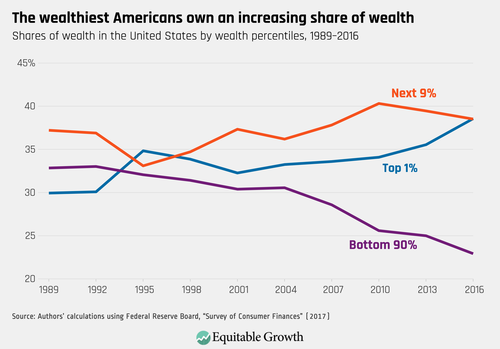
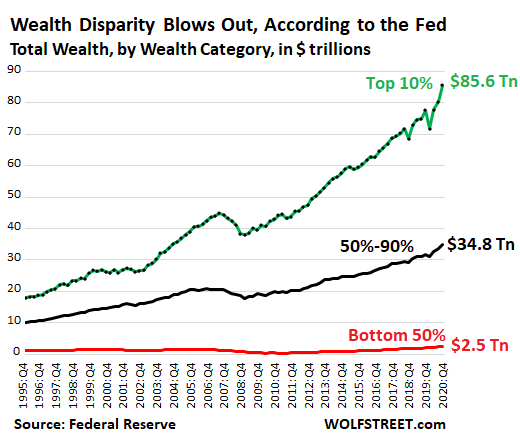
The addiction to Fed speedballs had already turned the entire financial sector into a casino of lunatic junkies who delusionally believe they’re all geniuses. Beneath the illusory stability of the god-like Fed has our back, the addiction to free money has completely destabilized America’s social, political and economic orders by boosting wealth and income inequality to unprecedented extremes.

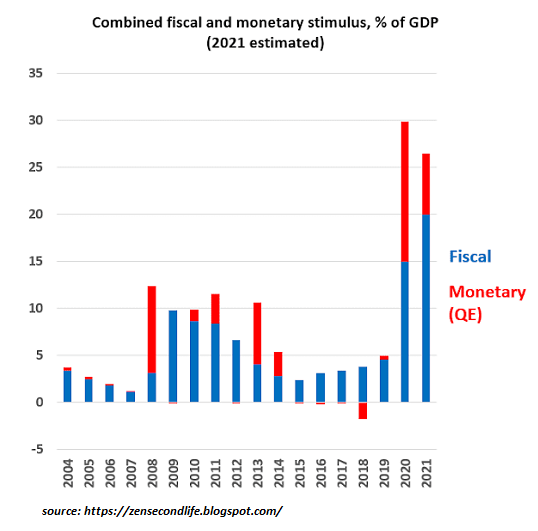
While it’s convenient to blame the carnage on the response to the Covid pandemic, the damage to the speedball-addicted financial system had already reached extremes before the pandemic: the addiction began decades ago, but like all addictions, the amount of stimulus needed to maintain the high keeps expanding, and eventually the need can’t be met without toxic doses: then the junkie / addicted system collapses.

The ever-greater doses of Fed speedballs have unleashed both deflation (smack) and inflation (crack): real returns on ordinary savings have been crushed to zero (deflation of ordinary income), and as the cost of capital/credit have been dropped to near-zero, then the purchasing power of wages has deflated while the speculative gains of those who own assets have soared (asset inflation).

By lowering the cost of capital to zero, the Fed has generated fatally perverse incentives. With the cost of capital at zero, it makes sense to buy labor-saving technologies to replace costly labor– labor that is costly to employers because of America’s perverse sickcare system, which burdens employers with ever-higher costs.

Not only have the Fed’s free-money speedballs made it essentially free for financiers to speculate in the stock market casino, the Fed has rigged the game and bailed out its cronies whenever their bets soured. This has fueled infinite moral hazard: Go ahead and gamble with free money from the Fed, and go ahead and leverage it up 10-to-1 because the Fed will bail you out if you lose, but if you win, the stupendous gains are yours to keep.

The problem with addiction is you’re dependent on the high, no matter what the eventual consequences may be. Long-term consequences are ignored because all that matters to the addict is to get the next Fed speedball and throw it on the gambling table to keep the high going.

Our entire economy is now dependent on ever-expanding speculative gains. Should the casino winnings falter, our economy will crash, and given the primacy of money and consumption in our society and political system, the financial collapse of the Fed’s casino lunacy will sweep those systems over the falls.

As the level of Fed smack and crack needed to maintain the high increases, system fragility increases geometrically. The irony of addiction is that when the crack/meth kicks in, the addict feels god-like, in control, invulnerable. This artificial confidence is entirely illusory, a deadly combination of delusion and hubris.

In this delusional state of supreme confidence, the addict loses touch with reality, i.e. the fatal consequences of the addiction. That’s the detour we’ve taken in becoming addicted to the Fed’s free-money speedballs. Now the rutted road has ended in a trackless wilderness. There is no way back and no way forward. The addict’s addled confidence will push them into the ice-cold river, and as they’re swept over the falls, the realization that it was all a drug-induced delusion will come too late to make a difference.

*  *  *

This essay was first published as a weekly Musings Report sent exclusively to subscribers and patrons at the $5/month ($54/year) and higher level. Thank you, patrons and subscribers, for supporting my work and this free blog. If you found value in this content, please join me in seeking solutions by becoming a $1/month patron of my work via patreon.com.

*  *  *

My recent books:

A Hacker’s Teleology: Sharing the Wealth of Our Shrinking Planet (Kindle $8.95, print $20, audiobook $17.46) Read the first section for free (PDF).

Will You Be Richer or Poorer?: Profit, Power, and AI in a Traumatized World (Kindle $5, print $10, audiobook) Read the first section for free (PDF).

Pathfinding our Destiny: Preventing the Final Fall of Our Democratic Republic ($5 (Kindle), $10 (print), ( audiobook): Read the first section for free (PDF).

The Adventures of the Consulting Philosopher: The Disappearance of Drake $1.29 (Kindle), $8.95 (print); read the first chapters for free (PDF)

Money and Work Unchained $6.95 (Kindle), $15 (print) Read the first section for free (PDF).

Tyler Durden
Tue, 03/30/2021 – 12:50

via ZeroHedge News https://ift.tt/31wyGQ3 Tyler Durden

A “Very Surprised” JPMorgan Calculates The Damage From The Archegos Collapse

A “Very Surprised” JPMorgan Calculates The Damage From The Archegos Collapse

Unlike the devastating London Whale debacle in 2012, which was all JPMorgan eventually drawn and quartered quite theatrically before Congress (and was a clear explanation of how banks used Fed reserves to manipulate markets, something most market participants had no idea was possible), this time JPMorgan was nowhere to be found in the aftermath of the historic margin call that destroyed hedge fund Archegos. Which is may explain why JPMorgan bank analyst Kian Abouhossein admits he is quite “puzzled” by the recent fallout from the Archegos implosion (or maybe JPM simply was not a Prime Broker of the notorious Tiger cub), which however does not prevent him from trying to calculate the capital at risk from the Archegos collapse.

In a note published this morning, Kian writes after Nomura yesterday confirmed (at least) a $2Nn potential claim and fellow Japanese bank Mitsubishi UFJ Securities Holdings announcing today of another potential $300MM loss – which as the JPM strategist admits “for a likely non-material PB player is surprising to us” – JPMorgan now expects losses well beyond normal unwinding scenario for the industry: and explains that it now sees “the losses as very material in relation to lending exposure for a business that is mark-to-market and holds liquid collateral” and makes Nomura’s indication of potentially losing $2bn and press speculation of CSG $3-4bn losses “as not an unlikely outcome” according to the JPM strategist.

So why is JPM surprised?

Because as Abouhossein writes, in normal circumstances… we would have suspected industry losses of $2.5-5bn. We now suspect losses in the range of $5-10bn.”To get there, JPM estimates that Archegos was highly leveraged at 5-8x (i.e. $50-80bn of exposure for $10bn of equity) – using Total Return Swaps and Certificates for Difference to lever up so massively as we discussed yesterday – and it was this use of equity-swaps tha “tincreased the inability of PBs to see the concentration risk in holdings within the hedge fund in question.”

Even so, Kian admits that he remains “puzzled why Credit Suisse (CSG) and Nomura have been unable to unwind all their positions at this point – as we would expect to get an announcement as soon as this is the case, on the scale of potential losses (especially in the case of CSG which hasn’t provided numerical impact)” although we have gotten some headlines suggesting the total loss could be as big as $7 billion.

That said the JPM analyst expects full disclosure by the end of the week at the latest from CSG and would keep an eye on credit agencies statements as well. And in the harshest slam of JPM’s competitors, Kian says he suspects “potentially poor risk mgmt being an issue here considering i) late unwinding, and ii) possibly significant more leverage than for GS/MS similar exposures.”

Alternatively, one could argue that it was Goldman and Morgan Stanley who rushed to break ranks with the syndicate of Prime Brokers and started dumping blocks of Archegos shares for one reason or another on Friday morning as we detailed yesterday, which meant that while they suffered the least losses, those banks – like CS, Nomura and Wells – which were slow to start selling, would end up with the largest losses (for more see “How Goldman And Morgan Stanley Broke Ranks And Triggered The Biggest Margin Call Since Lehman“).

In terms of actual loss estimates with an empahsis on Credit Suisse which so far appears to be the hardest hit, here is a breakdown from JPMorgan of what is known:

In terms of capital at risk, based on press articles, Credit Suisse seems to have bigger issues than Nomura assuming press speculation of  $3-4bn are correct and Grensill could potentially lead to additional litigation cost of $1-3bn. In the case of Nomura, JPM has reduced the share buyback for FY2020 from ¥75 billion to ¥10 billion; if the press speculation losses are correct, it would expect CS at a minimum will have to cancel its share buyback for 2021, preserving the dividend and we assume no buyback for the next 2 years assuming Basel 4 implementation as of Jan 2023.

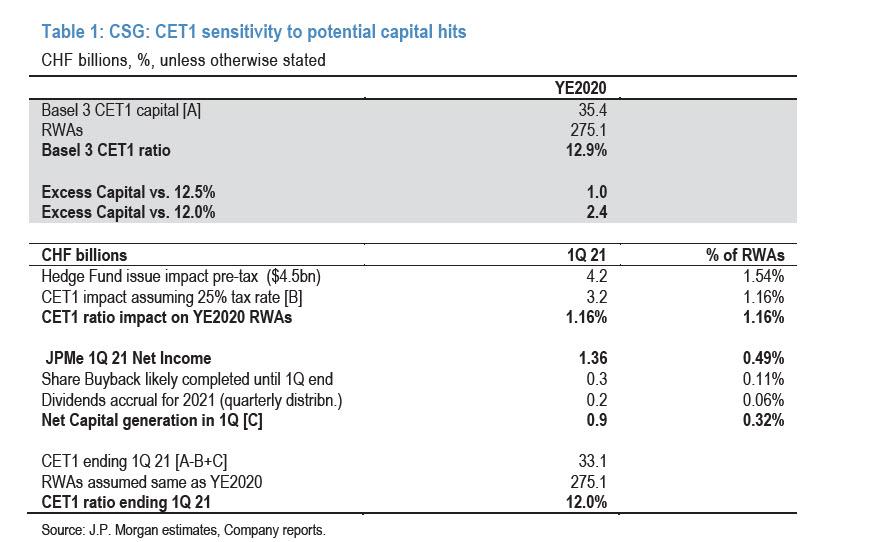
Assuming no RWA growth vs. YE2020 levels, JPM calculates that CS can absorb a max. one-time pre-tax hit of c$4.5bn (CHF 4.2bn) for Archegos which post-tax is 116bps of CET1 capital offset by 32bps of Retained earnings (1Q Net Income less 1Q dividend accrual of CHF 0.2bn and share buyback of CHF 0.3bn completed YTD) and still reach 12% by end of 1Q 21 which is seen as an acceptable level for S/Hs under Basel 3 – with further hits to come (see below). The minimum CET1 requirement is 10% and every additional $1bn pre-tax hit is 26bps of CET1 capital based on YE2020 RWAs and hence “any hits beyond $5bn pre-tax from Archegos will call into question the capital position in our view”, JPM warns.

Finally, JPM tries to answer a key question for many investors, namely what has happened with holdings (as speculated in the press ) of Archegos Capital?

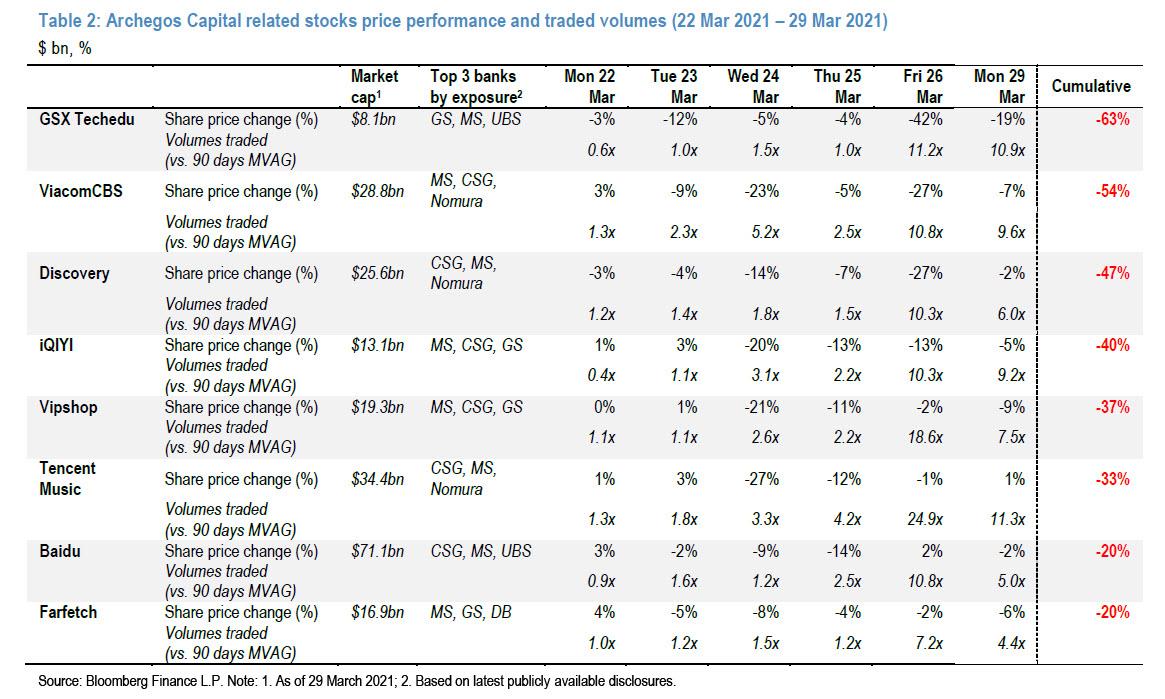
As Kian writes, the share price of Arhcegos Capital linked stocks fell by -39% on avg. since the beginning of last week. According to press reports (Bloomberg), Archegos Capital was forced to sell large shareholdings in eight online and entertainment companies (GSX Techedu, ViacomCBS, Discovery, iQIYI, Tencent Music, Vipshop, Baidu, Farfetch) to cover potential losses after some positions moved against the fund. Once Archegos Captial failed to meet its margin commitments, the sell-off intensified further as banks started offloading via sizeable block trades the holdings posted by the fund as collateral, prompting more declines.

Based on the latest publicly available disclosure the banks with the largest exposure to the mentioned companies were Morgan Stanley, Credit Suisse, Goldman Sachs, Nomura and to a lesser extent UBS and DB (more details below). On Friday alone, both ViacomCBS and Discovery saw their largest ever daily decline, with each falling by more than -27%. Traded volumes for the eight companies peaked on Friday with daily volumes being on avg. more than 13x the 90 days moving average. The sell-off continued on Monday 29th with the aforementioned stocks falling further -6% on average.

Based on latest available public filings, JPM calculates that the banks which had the largest holdings in the eight Archegos Capital-linked stocks mentioned by the press were Morgan Stanley, Credit Suisse, Goldman Sachs and Nomura. Morgan Stanley exposure was relatively broad based with 5%+ holdings in all but one companies and with 10%+ stake in both GSX Techedu and iQIYI. Credit Suisse exposure was also broad based with holdings in all but one companies and with the largest exposure being its 9% stake in Discovery. Goldman Sachs exposure was mainly concentrated in GSX Techedu (22% stake), while Nomura had exposure in all but one companies and a relatively large holding of 7% in GSX Techedu. Other banks such as Bank of America, Citi, UBS, Deutsche and Barclays also had holdings above 2% in some the mentioned companies (mainly GSX Techedu and Discovery).

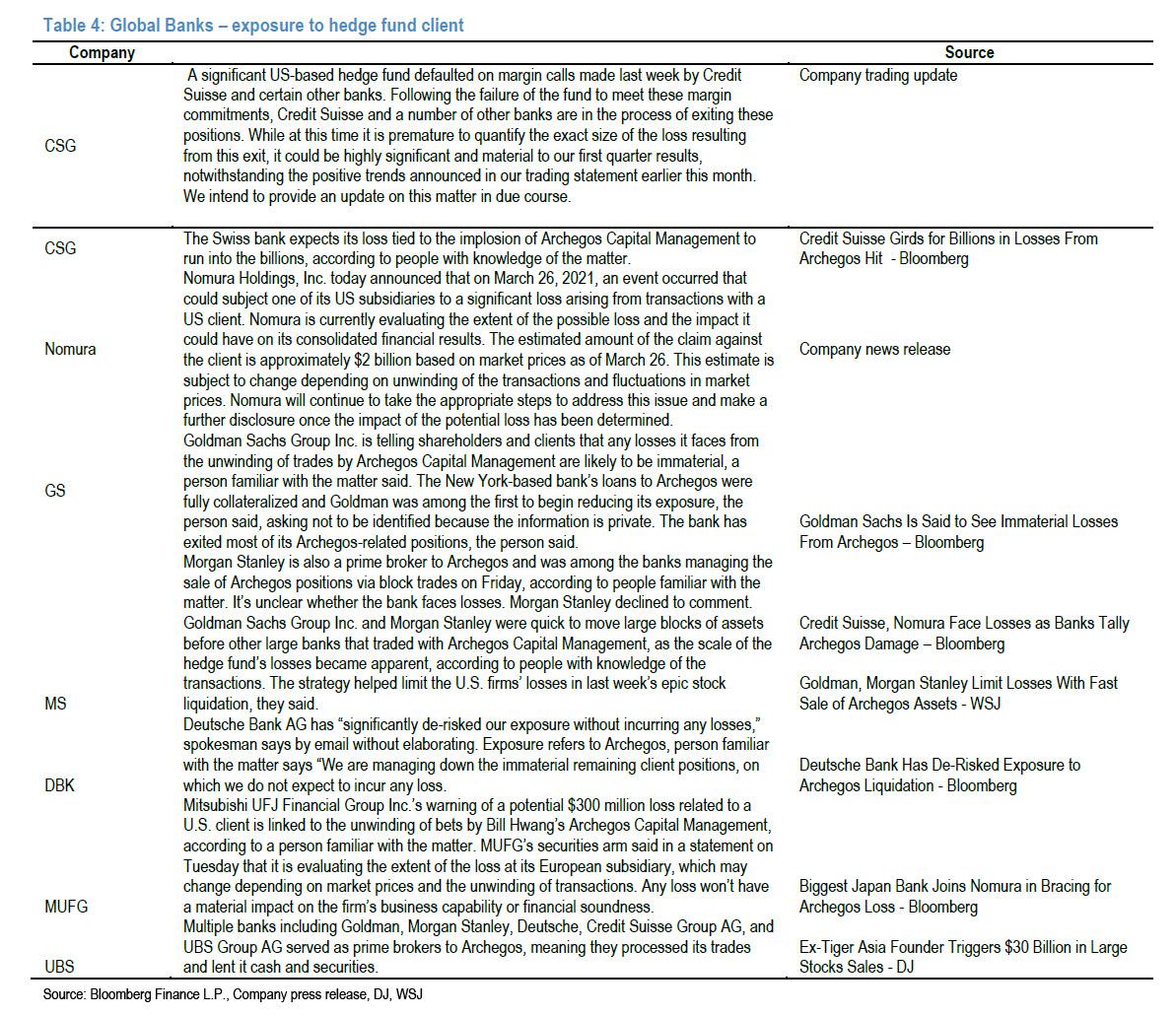
Finally, courtesy of JPM, here is a summary of all the latest publicly available information disclosing what exposure each bank may have had – and still has – to Archegos:

Tyler Durden
Tue, 03/30/2021 – 12:37

via ZeroHedge News https://ift.tt/39oKmZy Tyler Durden

Biden Describes Filibuster As A “Jim Crow Relic”, Democrats Used It 327 Times Last Year: Report

Biden Describes Filibuster As A “Jim Crow Relic”, Democrats Used It 327 Times Last Year: Report

Authored by Jack Cowhick via The Western Journal,

The Democrats are masters of self-sabotage.

In yet another attempt at virtue-signaling to the masses, President Joe Biden said in his first solo news conference that the filibuster is a “Jim Crow relic” in solidarity with former President Barack Obama.

The president also said that the procedure is “being abused in a gigantic way,” according to an official White House transcript of his remarks. But that statement requires some context.

Fox News’ John Roberts tweeted Friday that last year, while Republicans only used the filibuster once, Democrats used it “327 times.”

Somehow, the filibuster is implicitly racist even while Democrats have used it hundreds of times when they were the minority party in the Senate?

On top of this clear contradiction, Biden made his support for the filibuster clear in 2005.

During a speech on the Senate floor, Biden argued against the “nuclear option” of abolishing the filibuster of judicial nominees, saying, “[getting] rid of the filibuster has long-term consequences.”

“If there’s one thing I’ve learned in my years here, once you change the rules and surrender the Senate’s institutional power, you never get it back.”

But now, the filibuster is a relic of Jim Crow we must abolish, lest we revert to our pre-enlightened selves. Would that make Biden and every one of his Democratic colleagues who’ve used the filibuster rampant and unrepentant racists?

It’s nonsense.

Members of Congress also believe as much and have begun to stand against Biden’s claims. Republican Sen. Tim Scott of South Carolina described in a Fox News interview on Friday how Democrats used the filibuster to stop his police reform bill from being voted on.

Scott said of the moment his bill was blocked, “It was a frustrating, irritating moment where the Democrats used a filibuster to block police reform that would’ve positively impacted — disproportionately — African-American communities.

“Here’s what we know about the Democrats: They were for the filibuster before they were against the filibuster. I keep asking myself, will the real Chuck Schumer please stand up?”

Whereas both Obama and Biden formerly supported the filibuster, Scott said, “Now of course, they use the word ‘racist’ whenever they’re trying to scare people into their corner.”

“It has nothing to do with race, but they don’t care.”

Advertisement – story continues below

Scott is absolutely right. Rather than focus on drafting the bipartisan legislation as he promised, Biden is now attempting to use scare tactics in order to convince people of his position.

It’s deceptive and despicable, but it’s also what Americans have come to expect from the Democratic Party.

Tyler Durden
Tue, 03/30/2021 – 12:14

via ZeroHedge News https://ift.tt/3m2y4LE Tyler Durden

Berlin Halts AstraZeneca Jab As Germany Weighs Limiting It To Older Patients

Berlin Halts AstraZeneca Jab As Germany Weighs Limiting It To Older Patients

The spread of SARS-CoV-2 and the confirmed “mutant” strains has accelerated (though daily numbers remain well below their record highs reached in late January) over the past month, and just after the European Union finally reached a deal with the UK to try and ensure vaccine “reciprocity” (at least for developed, wealthy, western countries). But more than a week after troubled vaccine-maker AstraZeneca released a revised analysis of its Phase 3 research following a squabble with an obscure US regulator, German Capital Berlin has just announced that it’s banning jabs going to patients over the age of 60.

The reason? New research from a team of German scientists suggesting that there is indeed a link between the AstraZeneca jabs and the dangerous blood clots that have killed a small handful of patients in Europe. To arrive at this conclusion, the team examined 9 cases of the rare blood clots isolated in Austria and Germany. The 9 patients (8 female; median age, 36 [range, 22—49) presented with thrombosis beginning 4 to 16 days post-vaccination: 7 patients had cerebral venous thrombosis (CVT), 1 had pulmonary embolism, and 1 had splanchnic vein thrombosis and CVT. Ultimately, 4 patients died.

Researchers concluded that “the AZD1222 vaccine is “associated with development of a prothrombotic disorder”. Dilek Kalayci, the city’s top health official, said that both Germany’s independent STIKO vaccine commission, which is supported by the RKI public-health institute, and the Federal Institute for Vaccines will make new recommendations on how to proceed. Those could be published as soon as Tuesday.

What’s more, regional German health ministers will also discuss the Astra vaccine with federal government officials during a special meeting later on Tuesday. RKI spokeswoman Susanne Glasmacher confirmed that the vaccine commission is parsing the latest research about the vaccine’s health risks. Meanwhile, Germany’s vaccine authority STIKO recommended use of AstraZeneca vaccine only for men and women older than 60. Initially, when German regulators first approved the AstraZeneca jab, they limited it to those under 65.

“We have to wait for the recommendations but we wanted to take this step as a precaution,” Kalayci said at a news conference, adding that pending appointments will be canceled. “This vaccine does prevent severe symptoms, and that is very valuable, but we have to be careful with it nonetheless.”

Of course, the EMA acknowledged these side-effect risks during its safety review earlier this month. Both the EMA and WHO have insisted that the potential benefits of the vaccines far outweigh the risks.

Vaccination rates in EU nations remain well below those in the US, which is on the cusp of doling out some 3MM jabs per day, the fastest rate in the world.

Other European nations, including Norway, where the blood clots have become a major news story after three health-care workers all came down with the clots, and one died, have added, or refused to drop, restrictions following the EMA assessment. Even Canada has suspended plans to give the Astra jab to younger people over the blood-clotting risks.  Denmark announced last week plans to extend its halt for the AstraZeneca shot pending the results of a local investigation. France has also moved to impose age restrictions, while Sweden – like Germany –  is considering withholding the AstraZeneca jab from anyone under the age 55, according to an interview in the Swedish newspaper Dagens Nyheter.

During the interview, Tegnell explained that the decision was one of risk-cost benefit. Younger people must weigh the risks of side effects with the risk posed by the disease, and make a choice. “If you are under 50-55 years old, the risks are very small when it comes to the disease, so then maybe you should think about the risk-benefit balance.”

Read the full research report below:

ebd0055b-50ad-4a8e-9d42-b967d0d8b132 by Joseph Adinolfi Jr. on Scribd

Tyler Durden
Tue, 03/30/2021 – 11:50

via ZeroHedge News https://ift.tt/2Pk6r4H Tyler Durden

Some NFT Sales Could Be Illegal: SEC Commissioner Hester Peirce

Some NFT Sales Could Be Illegal: SEC Commissioner Hester Peirce

Authored by Will Gottsegen via Decrypt.co,

In brief

  • SEC commissioner Hester Peirce – sometimes known as “Crypto Mom” – said investors should be wary of creating unregistered investment products with NFTs.

  • Fractionalized NFTs could potentially be securities, she said.

The hype around NFTs, or non-fungible tokens, refuses to die down, and regulators are taking notice.

SEC commissioner Hester Peirce, affectionately known as “Crypto Mom” within the cryptocurrency industry, warned investors yesterday that some NFTs could be considered unregistered securities under certain circumstances.

“The whole concept of an NFT is [it’s] supposed to be non-fungible, so it’s supposed to be unlike anything else,” Peirce said during a Security Token Summit webinar on Thursday.

Which means that it’s, I think, in general, less likely to be a security, but people are being very creative in the types of NFTs they’re putting out there. It’s a wonder what some people will pay for. And so I think, given that creativity, as with anything else, you should be asking questions.”

NFTs are cryptographically secured digital assets—essentially just a token attached to an image or video file. They’ve been selling for ridiculous amounts of money (the digital artist Beeple sold a single NFT for $69 million at Christie’s), and have been used to promote musicdigital arttweets, and journalism.

They’ve also posed problems for investors. There are potential copyright issues, as well as ethical concerns around the Ethereum network’s energy consumption; some have suggested that crypto art might make a good vehicle for money laundering (sort of like physical art).

Peirce explained that certain kinds of fundraising efforts tied to NFTs might “raise the same kinds of questions that ICOs have raised.”

“If you’re doing something where you are saying, ‘I’m going to sell you this thing and I’m going to put a lot of effort into building something so that this thing that you’re buying has a lot of value,” those kinds of sales will attract more regulatory scrutiny.

ICOs, or “initial coin offerings,” have been a thorn in the SEC’s side for years; they give early investors in crypto startups the chance to buy into a company’s cryptocurrency, with the promise of return down the line. The issue is that the SEC has taken the position that just about every token ever sold through an ICO is unregistered security, and the Commission has come down hard against these token issuers in lawsuit after lawsuit.

Peirce also suggested fractionalized NFTs (i.e. selling partial interest in a single, expensive NFT) could run the risk of being unregistered securities.

Peirce’s comments add yet another new wrinkle to the NFT gold rush. “You’ve always got to ask those questions,” she said. “As we’ve seen, the definition of a security can be pretty broad.”

Tyler Durden
Tue, 03/30/2021 – 11:35

via ZeroHedge News https://ift.tt/3fvSsU3 Tyler Durden

China Furious As 1st US Ambassador To Visit Taiwan Since 1979 Calls It A “Country” 

China Furious As 1st US Ambassador To Visit Taiwan Since 1979 Calls It A “Country” 

Despite repeat warnings out of Beijing for Washington to stop “playing with fire” in its support to pro-democracy and independence forces in Taiwan, on Monday into Tuesday a US ambassador visited the island, marking the first time an American ambassador made an official visit to Taiwan in 42 years

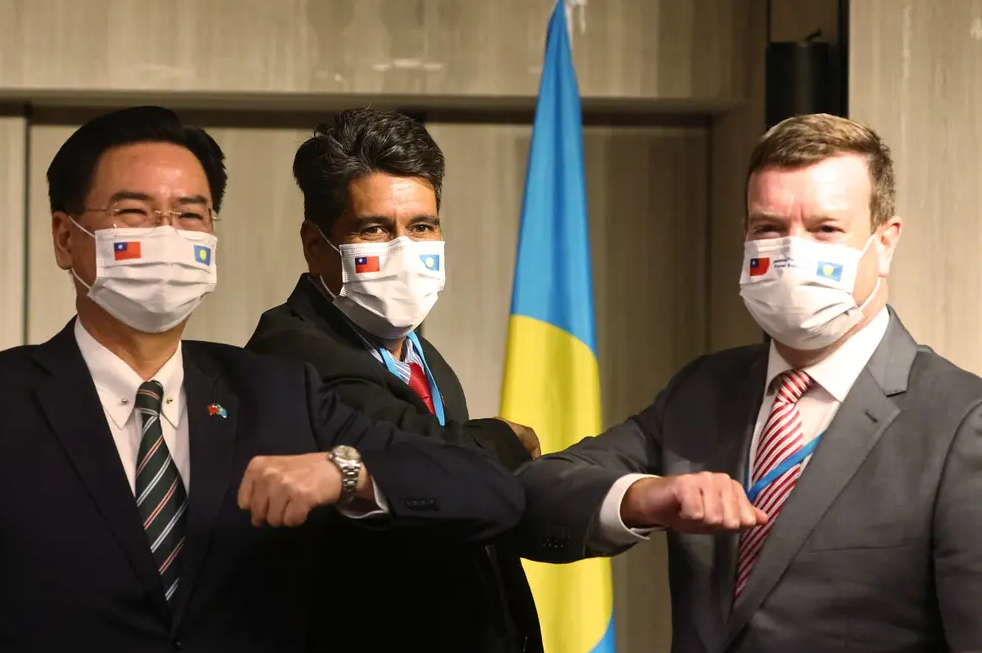
Palau John Hennessey-Niland is the ambassador to the tiny country of Palau, an archipelago of over 500 islands in the Micronesia region in the western Pacific Ocean. The country is among 15 nations that formally recognize Taiwan over China. Amb. Hennessey-Niland accompanied a delegation led by Palaun President Surangel Whipps Jr. to Taipei early this week.

Palau President Surangel Whipps, Taiwan foreign minister Joseph Wu and US Ambassador to Palau John Hennessey-Niland on Monday. Reuters

As Reuters underscores, he’s now “the first US ambassador to visit Taiwan in an official capacity since former President Jimmy Carter cut ties with Taipei in favor of Beijing in 1979.”

And Reuters noted further:

Whipps said the ambassador – who did not take questions from reporters – was there to demonstrate a shared commitment to democracy and freedom in the region.

“As a small nation we can easily be infiltrated and we depend on our partners to protect us and give us security,” Whipps said.

On the very same day (Monday), China’s air force sent another ten military aircraft to breach Taiwan’s air defense identification zone, coming days after Friday’s “largest ever” such incursion involving 20 aircraft. 

China’s foreign ministry spokesperson Zhao Lijian lashed out when asked about the US ambassador’s visit Monday, saying, “I want to stress that the one China principle is a universally recognized norm for international relations and a common consensus recognized, accepted and practiced by the vast majority of countries in the world.”

He again laid down China’s “red line”

The US must “fully recognize that the Taiwan question is highly sensitive, and that it should abide by the one China principle and the three China-US joint communiques,” the spokesman said. 

It must stop any official interaction with Taiwan, refrain from sending any wrong signals to Taiwan independence forces, stop any attempt to cross the bottom line, and properly handle Taiwan-related issues with prudence, lest it should damage China-US relations as well as peace and stability across the Taiwan Strait,” Zhao stressed.

Apparently undeterred, on Tuesday Hennessey-Niland was actually cited in regional media as provocatively referring to Taiwan as a recognized country

“I know that here in Taiwan people describe the relationship between the United States and Taiwan as real friends, real progress and I believe that description applies to the three countries  the United States, Taiwan and Palau,” he was cited in Reuters and AFP as saying.

Should such language become the “norm” at the State Department under the Biden administration, this is certain to set the US and China on a collision course in the region at a much faster rate of unraveling than previously thought was likely.

Tyler Durden
Tue, 03/30/2021 – 11:14

via ZeroHedge News https://ift.tt/3sDuIB4 Tyler Durden

If You Like Tariffs, You Should Have Cheered the Clogged Suez Canal


131

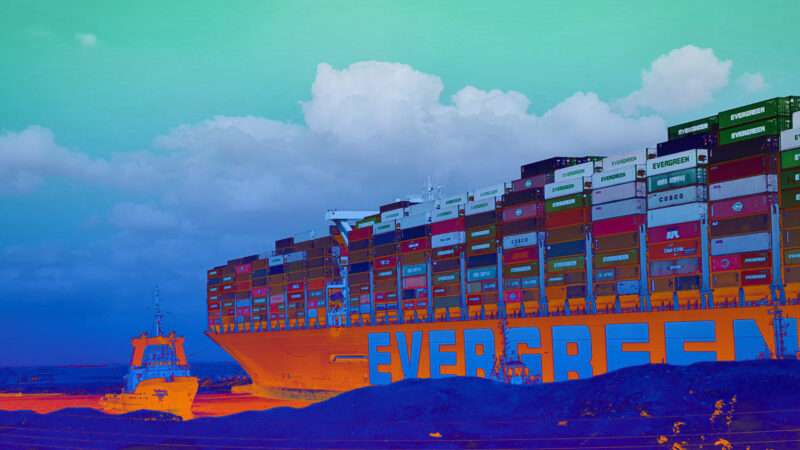
Now that the Ever Given has been freed from the sandy banks of the Suez Canal, we can safely return to ignoring the modern miracle of global trade that tends to be noticed only on the rare occasion when it doesn’t work as smoothly as we’re accustomed.

Before that happens, let’s take a moment to appreciate it.

An estimated $9 billion worth of trade flows through the Suez Canal every day, according to Lloyd’s List, a London-based shipping journal—an amount considerably larger than the entire annual economic output of dozens of countries. All of it is the result of individuals and businesses engaged in mutually beneficial transactions despite being separated by thousands of miles. Each and every item shipped through the canal is evidence that trade grows the world’s economic pie—simply because you can sell more goods when you have access to more customers, whose standards of living are raised by having access to more goods.

The Ever Given running aground was (presumably) an accident. Unfortunately, other disruptions to the global trading system are deliberate acts of sabotage carried out by political leaders who don’t cheer for a giant ship being stuck in the Egyptian mud, even though the effect is exactly what they are trying to accomplish in other, less obvious ways.

But whether it’s a big boat unexpectedly stuck in the middle of the Suez Canal or billions of dollars of tariffs imposed with little advance warning, surprising disruptions to the flow of global trade generally have the same two consequences. First, they make trade more expensive (and therefore reduce the economic benefits that it bestows). Second, trade keeps on happening anyway.

That’s exactly what would have happened if the Ever Given hadn’t been quickly dislodged. With more than 300 ships stuck behind the Ever Given, some were already making plans to do the really old-fashioned thing and sail around the tip of Africa. That would have added 6,000 miles and several weeks to the journey from the Indian Ocean to the Atlantic Ocean. The added fuel costs would raise shipping prices by as much as $300,000 for some ships, Bloomberg reported.

In short: Trade wouldn’t stop. It would just become more expensive.

Hey, that might sounds familiar. When the U.S. and China raised tariffs against one another in 2018—tariffs that are still in place—it caused similarly weird disruptions in the flow of goods. China effectively cut off purchases of American-grown soybeans, for example, so the soybean trade rerouted itself. South American soybeans suddenly started flowing into China, and American soybeans were exported to Brazil in larger quantities. Trade didn’t stop, it just found new routes.

Meanwhile, U.S. tariffs on goods imported from China have spurred some companies to route their purchases through Canada to avoid the higher costs. Others are just stuck paying higher prices. In some cases, the tariffs have contributed to shortages of important items. If there was a massive ship blocking access to all U.S. ports, the results would be pretty much the same.

The big difference is that when a boat gets stuck in the Suez Canal, it’s a major crisis that gets fixed as quickly as possible so trade can continue flowing unimpeded. When tariffs cause the same sorts of disruptions, however, America’s political class is increasingly in agreement that there is no crisis at all.

Commerce Secretary Gina Raimondo says the Trump administration’s tariff policies have been “effective.” Biden’s trade representative, Katherine Tai, told Congress during her confirmation hearing that tariffs are “a legitimate tool” and that she hopes to “accomplish similar goals” as the Trump administration did on the trade front.

But if former President Donald Trump had deliberately crashed a ship into the Suez Canal, and Biden’s advisers were standing around saying they had no immediate plans to remove the ship and, in fact, maybe the right thing to do is smash more ships into more canals around the world…that would rightly be recognized as policy insanity.

Why is it any different now?

from Latest – Reason.com https://ift.tt/2PL4TQX
via IFTTT

24 World Leaders Call For More Globalism In Wake Of Pandemic

24 World Leaders Call For More Globalism In Wake Of Pandemic

Authored by Steve Watson via Summit News,

Twenty four world leaders have signed a letter calling for more globalism to combat future pandemics, citing the the coronavirus outbreak as an opportunity to consign nationalism to the dustbin of history.

UK prime minister Boris Johnson, German chancellor Angela Merkel, and French president Emmanuel Macron are the leading figures behind the pledge, with 21 other heads of state signing the letter.

It states that “nobody is safe until everyone is safe,” and that a “global community” must be further implemented in order to combat ‘inevitable’ future pandemics.

“At a time when Covid-19 has exploited our weaknesses and divisions, we must seize this opportunity and come together as a global community for peaceful cooperation that extends beyond this crisis,” the letter states.

“Building our capacities and systems to do this will take time and require a sustained political, financial and societal commitment over many years,” it adds.

The letter compares the situation to the aftermath of the Second World War, and urges an end to “isolationism and nationalism”.

The pledge calls for a strengthening of the World Health Organisation’s infrastructure, despite the global health body’s documented failures in regards to the pandemic, and continued charges that it has facilitated the communist Chinese government’s lies and deceptions.

WHO director general Dr Tedros Adhanom Ghebreyesus also signed the letter, having repeatedly slammed nations including Britain and the US for putting their own populations first when it comes to recovery.

The letter specifically calls for a global treaty on pandemics to be signed to establish international ‘rules and norms’ for vaccine production and distribution, as well as coordination on ‘alert systems, data-sharing and research’.

Presumably any global treaty would also address restrictions to be put in place under future pandemics, although that is not made clear in the letter.

Below is the full Letter signed by 24 world leaders (emphasis ours):

The Covid-19 pandemic is the biggest challenge to the global community since the 1940s. At that time, following the devastation of two world wars, political leaders came together to forge the multilateral system. The aims were clear: to bring countries together, to dispel the temptations of isolationism and nationalism, and to address the challenges that could only be achieved together in the spirit of solidarity and cooperation: namely, peace, prosperity, health and security.

Today, we hold the same hope that as we fight to overcome the Covid-19 pandemic together, we can build a more robust international health architecture that will protect future generations. There will be other pandemics and other major health emergencies. No single government or multilateral agency can address this threat alone. The question is not if, but when. Together, we must be better prepared to predict, prevent, detect, assess and effectively respond to pandemics in a highly coordinated fashion. The Covid-19 pandemic has been a stark and painful reminder that nobody is safe until everyone is safe.

We are, therefore, committed to ensuring universal and equitable access to safe, efficacious and affordable vaccines, medicines and diagnostics for this and future pandemics. Immunisation is a global public good and we will need to be able to develop, manufacture and deploy vaccines as quickly as possible. This is why the Access to Covid-19 Tools Accelerator (ACT-A) was set up in order to promote equal access to tests, treatments and vaccines and support health systems across the globe. ACT-A has delivered on many aspects but equitable access is yet to be achieved. There is more we can do to promote global access.

To that end, we believe that nations should work together towards a new international treaty for pandemic preparedness and response. Such a renewed collective commitment would be a milestone in stepping up pandemic preparedness at the highest political level. It would be rooted in the constitution of the World Health Organisation, drawing in other relevant organisations key to this endeavour, in support of the principle of health for all. Existing global health instruments, especially the International Health Regulations, would underpin such a treaty, ensuring a firm and tested foundation on which we can build and improve.

The main goal of this treaty would be to foster an all-of-government and all-of-society approach, strengthening national, regional and global capacities and resilience to future pandemics. This includes greatly enhancing international cooperation to improve, for example, alert systems, data-sharing, research, and local, regional and global production and distribution of medical and public health countermeasures, such as vaccines, medicines, diagnostics and personal protective equipment.

It would also include recognition of a ‘One Health’ approach that connects the health of humans, animals and our planet. And such a treaty should lead to more mutual accountability and shared responsibility, transparency and cooperation within the international system and with its rules and norms.

To achieve this, we will work with heads of state and governments globally and all stakeholders, including civil society and the private sector. We are convinced that it is our responsibility, as leaders of nations and international institutions, to ensure that the world learns the lessons of the Covid-19 pandemic.

At a time when Covid-19 has exploited our weaknesses and divisions, we must seize this opportunity and come together as a global community for peaceful cooperation that extends beyond this crisis. Building our capacities and systems to do this will take time and require a sustained political, financial and societal commitment over many years.

Our solidarity in ensuring that the world is better prepared will be our legacy that protects our children and grandchildren and minimises the impact of future pandemics on our economies and our societies. Pandemic preparedness needs global leadership for a global health system fit for this millennium. To make this commitment a reality, we must be guided by solidarity, fairness, transparency, inclusiveness and equity.’

Boris Johnson, Prime Minister of the United Kingdom; Emmanuel Macron, president of France; Angela Merkel, chancellor of Germany; Dr Tedros Adhanom Ghebreyesus, director-general of the World Health Organisation and 21 other world leaders.

Health ministers of nations are set to meet in May at the World Health Assembly, and could discuss a global treaty there.

Tyler Durden
Tue, 03/30/2021 – 10:54

via ZeroHedge News https://ift.tt/3dilvIb Tyler Durden

If You Like Tariffs, You Should Have Cheered the Clogged Suez Canal


131

Now that the Ever Given has been freed from the sandy banks of the Suez Canal, we can safely return to ignoring the modern miracle of global trade that tends to be noticed only on the rare occasion when it doesn’t work as smoothly as we’re accustomed.

Before that happens, let’s take a moment to appreciate it.

An estimated $9 billion worth of trade flows through the Suez Canal every day, according to Lloyd’s List, a London-based shipping journal—an amount considerably larger than the entire annual economic output of dozens of countries. All of it is the result of individuals and businesses engaged in mutually beneficial transactions despite being separated by thousands of miles. Each and every item shipped through the canal is evidence that trade grows the world’s economic pie—simply because you can sell more goods when you have access to more customers, whose standards of living are raised by having access to more goods.

The Ever Given running aground was (presumably) an accident. Unfortunately, other disruptions to the global trading system are deliberate acts of sabotage carried out by political leaders who don’t cheer for a giant ship being stuck in the Egyptian mud, even though the effect is exactly what they are trying to accomplish in other, less obvious ways.

But whether it’s a big boat unexpectedly stuck in the middle of the Suez Canal or billions of dollars of tariffs imposed with little advance warning, surprising disruptions to the flow of global trade generally have the same two consequences. First, they make trade more expensive (and therefore reduce the economic benefits that it bestows). Second, trade keeps on happening anyway.

That’s exactly what would have happened if the Ever Given hadn’t been quickly dislodged. With more than 300 ships stuck behind the Ever Given, some were already making plans to do the really old-fashioned thing and sail around the tip of Africa. That would have added 6,000 miles and several weeks to the journey from the Indian Ocean to the Atlantic Ocean. The added fuel costs would raise shipping prices by as much as $300,000 for some ships, Bloomberg reported.

In short: Trade wouldn’t stop. It would just become more expensive.

Hey, that might sounds familiar. When the U.S. and China raised tariffs against one another in 2018—tariffs that are still in place—it caused similarly weird disruptions in the flow of goods. China effectively cut off purchases of American-grown soybeans, for example, so the soybean trade rerouted itself. South American soybeans suddenly started flowing into China, and American soybeans were exported to Brazil in larger quantities. Trade didn’t stop, it just found new routes.

Meanwhile, U.S. tariffs on goods imported from China have spurred some companies to route their purchases through Canada to avoid the higher costs. Others are just stuck paying higher prices. In some cases, the tariffs have contributed to shortages of important items. If there was a massive ship blocking access to all U.S. ports, the results would be pretty much the same.

The big difference is that when a boat gets stuck in the Suez Canal, it’s a major crisis that gets fixed as quickly as possible so trade can continue flowing unimpeded. When tariffs cause the same sorts of disruptions, however, America’s political class is increasingly in agreement that there is no crisis at all.

Commerce Secretary Gina Raimondo says the Trump administration’s tariff policies have been “effective.” Biden’s trade representative, Katherine Tai, told Congress during her confirmation hearing that tariffs are “a legitimate tool” and that she hopes to “accomplish similar goals” as the Trump administration did on the trade front.

But if former President Donald Trump had deliberately crashed a ship into the Suez Canal, and Biden’s advisers were standing around saying they had no immediate plans to remove the ship and, in fact, maybe the right thing to do is smash more ships into more canals around the world…that would rightly be recognized as policy insanity.

Why is it any different now?

from Latest – Reason.com https://ift.tt/2PL4TQX
via IFTTT