9th Woman Accuses Cuomo Of Sexual Harassment, Unwanted Kiss

9th Woman Accuses Cuomo Of Sexual Harassment, Unwanted Kiss

Another woman has accused NY Gov. Andrew Cuomo of sexual improprieties, including a forcible kiss on the lips, marking the second woman who has accused Cuomo of such a transgression. And what’s more, the accuser, named Sherry Vill, has proof.

The 55-year-old accuser said Cuomo grabbed her face and kissed her on the cheek in front of her home in 2017. She described the kiss as an “inappropriate sexual gesture.”

“I know the difference between an innocent gesture and a sexual one,” Vill said during a virtual press conference. “I never felt as uncomfortable as I did the day Governor Cuomo came to my house. His actions were very overly sexual, highly inappropriate and disrespectful to me and my family.”

She said Cuomo told her she was beautiful and acted in a “highly flirtatious and inappropriate manner.”

Vill, who was married at the time of the alleged incident, said Cuomo visited her home in Greece, NY, to survey flood damage, according to her attorney, noted feminist #MeToo champion Gloria Allred.

Allred said during a press conference that she would be contacting the state AG’s office to volunteer her client’s cooperation with the investigation into allegations of sexual harassment by Cuomo.

Afterward, Cuomo tried to brush off the inappropriate contact as something that was normal. “He said that’s what Italians do, kiss both cheeks,” Vill said.

Vill’s daughter apparently took a photo of the incident and shared it on social media at the time. That marks the second photo of Cuomo delivering an ungainly kiss to an unsuspecting woman.

The governor has insisted that he never forcibly touched a woman who didn’t want to be touched.

Meanwhile, the Washington Post reported new details yesterday of Cuomo’s abuse of office by using state resources to fast-track COVID testing for friends and family members. Sometimes, the governor would go as far as to ask state workers to personally travel to the homes of family members and test them.

One such example of this was when Chris Cuomo, the governor’s CNN anchor brother, was sick with the virus last spring. Cuomo reportedly received several hours-long visits from a state public health official and doctor, according to WaPo.

And a top state physician whose pandemic portfolio involved coordinating testing in nursing homes was dispatched multiple times to the Hamptons home of CNN host Chris Cuomo, the governor’s brother, in testing visits that sometimes stretched hours, according to two people with knowledge of the consultations.

No fewer than seven anonymous sources told WaPo that insiders including fashion designer Kenneth Cole (the governor’s brother in law) were allowed to cut the line for scarce tests. They told WaPo that they were heavily pressured to meet Cuomo’s demands, and even developed a special designation for priority individuals demanded by the governor.

But people familiar with the efforts said they were also told to treat individuals differently because of their connections to the governor. The individuals — who spoke at length to The Washington Post on the condition of anonymity out of fear of retribution by Cuomo’s office — described the behind-the-scenes operations and their feelings of discomfort with a system that they believed at times prioritized political connections over medical need.

During the early frenetic weeks in March 2020, officials working at testing sites rapidly assembled a system that gave special treatment to people described by staff as “priorities,” “specials,” “inner circle” or “criticals,” according to five people, including three nurses, who described how resources were redirected to serve those close to the governor and other cases that were fast-tracked.

At one of the first pandemic operations hubs in the state, the testing priority status of more than 100 individuals were logged in an electronic data sheet that was kept separate from a database for the general public, according to a person with direct knowledge of the practice.

The NY Department of Public Health denied accusations of preferential treatment. Yesterday, Cuomo announced that he would lower the minimum vaccination age to 30 as he continues to push his plans to reopen the Empire State, despite warnings from Dr. Anthony Fauci and other federal officials that states need to take it easy.

Tyler Durden
Tue, 03/30/2021 – 10:38

via ZeroHedge News https://ift.tt/3sxglye Tyler Durden

NIMBY Group Asks Residents To Donate Poop


reason-phily3

A neighborhood group in Philadelphia is asking opponents of a proposed apartment building to mail in poop samples as part of a study on how gentrification impacts cancer rates.

“We understand you may be concerned about the development of 48th Street and Chester Ave,” reads a letter signed by West Philly United Neighbors President Ang Sun, reports The Philadelphia Inquirer, referencing a proposed 83-unit development slated for vacant land that was once a dog park.

“To fight gentrification, we are collaborating with biomedical researchers to investigate if development would adversely affect neighbors’ microbiota and increase risk of developing colorectal cancer,” the letter continues. “For research purposes, could you please donate your fecal sample (fingernail size)?”

Another flyer put out by the group, and posted to Twitter, fleshes out the link between cancer and gentrification by saying that deadly carcinogens could be released by “irresponsible demolition, excavation, and construction.”

“Donate Your Fecal/Stool Sample to Help Fight Gentrification & Irresponsible Development In West Philly” reads the title of that particular emoji-covered flier.

The study for which the poop samples would be collected is one proposed by Sun himself, who also works as a cancer researcher at Temple University. A spokesperson for the university told the Inquirer that Sun’s research required Institutional Review Board approval given that it involved human subjects—a process that it had yet to undergo.

Sun told the paper that he couldn’t comment on his research until it was approved by his employer.

The story of Sun’s request for poop samples initially broke on Reddit and Twitter, where people noted the absurdity of the ask, and the potential for violation of ethics guidelines governing scientific research.

While Sun’s stool solicitation is unusual, cancer concerns being used to slow down development are not. Frequently, “not in my backyard” (NIMBY) activists in California will argue in environmental lawsuits that the cancer-causing effects of new condos or commercial developments need to be studied further before a particular project can proceed.

Whatever the merits of Sun’s proposed study, its merger with his anti-development activism certainly calls into question whether he’s truly motivated by the pursuit of scientific truth.

One wonders if his flier got any other local NIMBYs to stop flinging poo at the idea of new development long enough to send some toward Sun.

from Latest – Reason.com https://ift.tt/3cAIpeI
via IFTTT

NIMBY Group Asks Residents To Donate Poop


reason-phily3

A neighborhood group in Philadelphia is asking opponents of a proposed apartment building to mail in poop samples as part of a study on how gentrification impacts cancer rates.

“We understand you may be concerned about the development of 48th Street and Chester Ave,” reads a letter signed by West Philly United Neighbors President Ang Sun, reports The Philadelphia Inquirer, referencing a proposed 83-unit development slated for vacant land that was once a dog park.

“To fight gentrification, we are collaborating with biomedical researchers to investigate if development would adversely affect neighbors’ microbiota and increase risk of developing colorectal cancer,” the letter continues. “For research purposes, could you please donate your fecal sample (fingernail size)?”

Another flyer put out by the group, and posted to Twitter, fleshes out the link between cancer and gentrification by saying that deadly carcinogens could be released by “irresponsible demolition, excavation, and construction.”

“Donate Your Fecal/Stool Sample to Help Fight Gentrification & Irresponsible Development In West Philly” reads the title of that particular emoji-covered flier.

The study for which the poop samples would be collected is one proposed by Sun himself, who also works as a cancer researcher at Temple University. A spokesperson for the university told the Inquirer that Sun’s research required Institutional Review Board approval given that it involved human subjects—a process that it had yet to undergo.

Sun told the paper that he couldn’t comment on his research until it was approved by his employer.

The story of Sun’s request for poop samples initially broke on Reddit and Twitter, where people noted the absurdity of the ask, and the potential for violation of ethics guidelines governing scientific research.

While Sun’s stool solicitation is unusual, cancer concerns being used to slow down development are not. Frequently, “not in my backyard” (NIMBY) activists in California will argue in environmental lawsuits that the cancer-causing effects of new condos or commercial developments need to be studied further before a particular project can proceed.

Whatever the merits of Sun’s proposed study, its merger with his anti-development activism certainly calls into question whether he’s truly motivated by the pursuit of scientific truth.

One wonders if his flier got any other local NIMBYs to stop flinging poo at the idea of new development long enough to send some toward Sun.

from Latest – Reason.com https://ift.tt/3cAIpeI
via IFTTT

Archegos? Argh, Chaos More Like

Archegos? Argh, Chaos More Like

By Michael Every of Rabobank

I noted yesterday that the expected market turbulence caused by the Archegos sell-off was not representative of the underlying structural issues that will guide markets going forwards. I stick by that claim, but even so what a messy day it was. Some individual stocks got hit hard, and US bond yields were up, presumably due to the need to sell anything to get liquidity, while the USD see-sawed. Archegos? ‘Argh, chaos’ more like.

This overshadowed the good news that the Suez Canal is now open again. However, there is a link between the two: both stories reveal how stupid the key infrastructure of the global economy and financial system still is. ‘Too big to sail and too big to fail’, as some dub the two halves of this dyad: and Joe Public can again see our system encourages entities to get so large and complex that when a simple incident happens, everything gets stuck. Something surely needs to change, unless we are going to assume there can’t be any more ‘Argh, chaos’ “because markets”, or any more stuck giant ships in the Suez Canal “because boats”.

So, change? Fed Governor Waller spoke to the Peterson Institute for International Economics yesterday, where he rejected any suggestions the Fed was close to embracing the MMT: he wanted to “definitively put that narrative to rest. It is simply wrong”. Borrowing costs are not being kept low to help finance the government, apparently. (It’s all inflation; and unemployment; and social justice; and the climate?) Clearly there won’t be any need for an Operation Twist and Shout or for Yield Curve Control then…but can we get that in writing?

At the same time, the press reports the Biden administration is planning a further Covid relief bill separate from a key infrastructure bill to be launched Wednesday; and the latter is now rumored to be for as much as USD4 trillion, or close to 20% of GDP, funded by USD3 trillion of tax hikes on businesses and the rich, the largest hike in a generation, as opposed to the original idea of USD3 trillion in spending funded by USD1 trillion of taxes.

If the larger stimulus package is the one put forward, it means there is no sign of MMT in the White House either, because the net spend of USD1 trillion (over a decade) is hardly in the money-printing category. Instead, there is a redistributive fiscal package that presumes USD3 trillion the rich have can be spent more productively on bridges, roads, and ports, etc., than on $100m condos filled with gold-dusted caviar or stock buybacks. Cue a shift of political debate from ‘MMT’ vs. ‘no MMT’ to ‘The government doesn’t know what it’s doing!’ vs. ‘The rich do know what they are doing – turning the US into an oligarchic kleptocracy’. And may the best lobbyists win.

As a linked aside, yesterday I saw 1963 US plans for an alternative to the Suez Canal, because at the time Egypt was a Soviet client state. This was to use *530* nukes to blow a 160-mile long, 1,500 foot deep channel through Israel from its Mediterranean coast to the Red Sea, which would “probably contribute greatly to the economic development of the surrounding area”(!) That underlines the idiocy of central planning and of Cold War thinking. Which is doubly worrying given any new Cold War is again very likely going to see key global infrastructure in the hands of states not aligned with US geostrategic interests, and the US is already talking about its own Belt and Road rival (as China seems to slowly back away from the economic drain of its own). Beware Americans bearing nukes.

Yet the economic national-security Hamiltonian model, the ideas of Henry George, and the fact Eisenhower built the US inter-state highway network partially to prevent Soviet invasion from either coast, still all hold as much water as the glow-in-the-dark 160-mile long monstrosity through Israel would have.

Meanwhile, as the US and nukes and the Middle East make headlines for different reasons today, but still leaving much of Israel feeling antsy, BOJ Governor Kuroda just stated he will continue to buy ETFs within a JPY12 trillion cap “with a close eye on markets” even after Covid is over; he won’t sell the BOJ’s stock of ETFs; and the inflation target stays at 2% (ROFL!). He also thinks that it is “natural for the government to deploy fiscal stimulus flexibly, though Japan must also maintain market trust over its medium- and long-term fiscal health.” (Will the people in the market who associate Japan with long-term fiscal health please stand up?) The BOJ will also “support various entities’ efforts towards reform as Japan faces challenges in the post-Covid world”: does he mean the local Olympic Games Committee? In short, more of the same is on offer from the BOJ – which has worked so magnificently for it so far.

That’s another lesson for the US. Structural reform needs to be structural, not just cementing over river beds – or blowing up the Negev desert.

On which note, the FTSE Bond Index just announced that it is about to include Chinese government bonds (CGBs) in its world index, allowing global investors to buy both sides of the Cold War bet and all related public expenditures. But there is a sting in the tail: the FTSE CGB weighting will be just 5.25%, not the 6.5% expected, starting October 29, and this will be tapered in over 36 months, not 12 months as originally believed.

A few months ago, when China was seeing too much capital flow in for its liking, that slower pace might have been welcome. Indeed, and ironically, much of the capital that went in to Chinese markets from foreign funds is believed to have been encouraged to flow straight back out again via different channels to prevent excess appreciation pressure on the currency (and note that China’s FX reserves have hardly soared). Yet CNY and CNH are starting to move markedly lower again; and genuine capital outflows are being experienced as US yields rise, even despite bumper Covid-related trade surpluses (which will fade with the virus does). Moreover, with the geopolitical backdrop this Cold, how could this most political of all FX crosses not eventually respond in kind?

One wonders what the Fed (and ECB and BOJ) would make of any sustained move lower in CNY, given what it will mean for inflation; and the White House, given what it means for jobs.

Tyler Durden
Tue, 03/30/2021 – 10:15

via ZeroHedge News https://ift.tt/3u7KTXL Tyler Durden

US Consumer Confidence Explodes Higher In March

US Consumer Confidence Explodes Higher In March

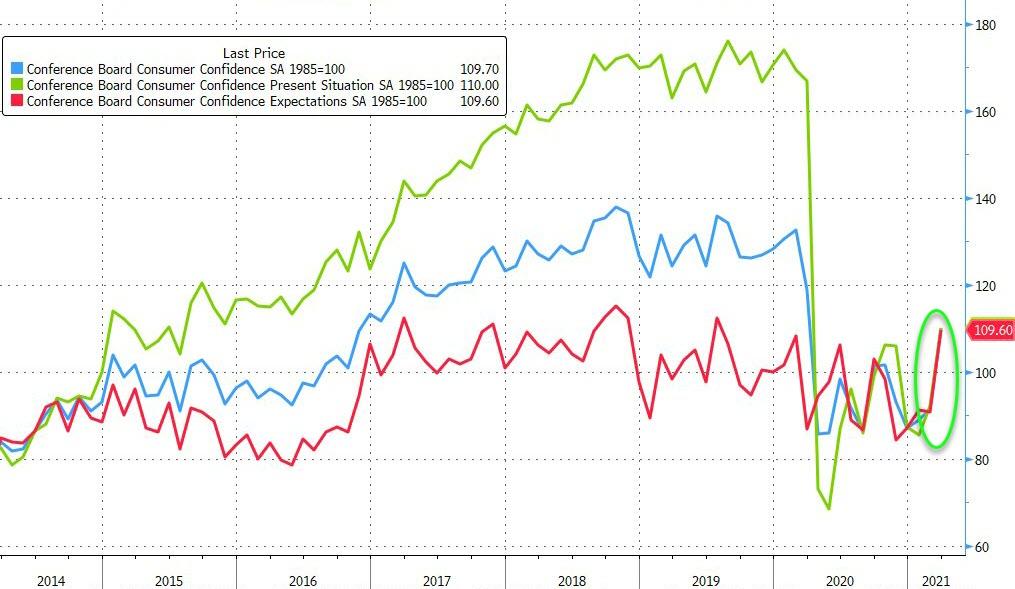
After a mixed picture in February (expectations down, current conditions up), analysts expected a big jump in Conference Board Consumer Confidence in March… and they got it.

March Consumer Confidence exploded from 90.4 (revised lower) in Feb to 109.7 in March – the highest since March 2020.

The underlying components also smashed expectations:

  • Present situation confidence rose to 110.0 vs. 89.6 last month.

  • Consumer confidence expectations rose to 109.6 vs. 90.9 last month – highest since July 2019

Source: Bloomberg

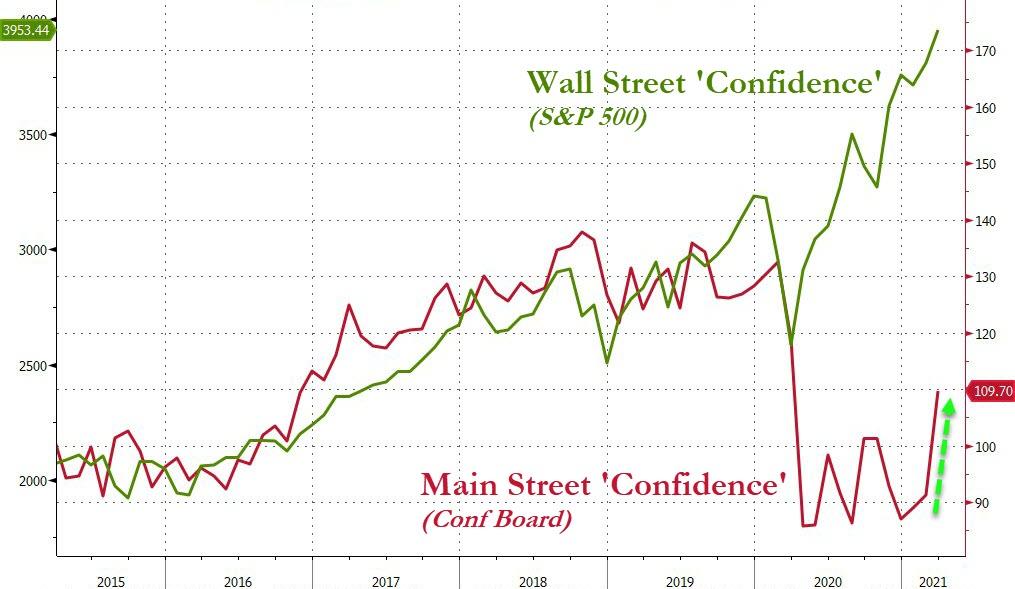
Still, putting these levels in context, they are still dramatically below the pre-COVID levels of confidence…

Source: Bloomberg

Maybe with just a few more trillion dollars of helicopter cash, that Main Street confidence will catch up?

Tyler Durden
Tue, 03/30/2021 – 10:04

via ZeroHedge News https://ift.tt/39s7rKK Tyler Durden

Americans Reject Far-Left Rhetoric About the Rich, Have Positive Views of Tech CEOs


david-suarez-w-OYS4IHWFg-unsplash

Billionaires not a threat to democracy; tech CEOs seen favorably. The left-leaning media outlet Vox teamed up with progressive think tank Data for Progress to poll people on their views about the super-rich. But in what may have been something of a disappointment, Americans overwhelmingly rejected far-left rhetoric about wealth, tech companies, and the place of billionaires in society.

Eighty-two percent said billionaires should be allowed to exist (while only 13 percent said they shouldn’t), and 68 percent disagreed with the statement that “it‘s immoral for society to allow people to become billionaires.” This stands in contrast to some leftist and even mainstream liberal rhetoric that the government should forcibly “abolish billionaires.”

Asked if it was a good or bad thing “that there are some people in this country who have personal fortunes of a billion dollars or more,” 28 percent of respondents said good, 18 percent said bad, and more than half—54 percent—said it was neither a good nor bad thing.

Survey respondents gave the ultra-rich high marks for giving back:

Asked whether billionaires do a good job at giving away their money through philanthropy. 47 percent say they agree; only 33 percent say they don’t.

And they rejected the idea that billionaires are a threat to democracy, with 54 percent disagreeing with that statement and only 28 percent in agreement.

Unsurprisingly, Democrats were more likely than Republicans to view billionaires in general with suspicion (38 percent of Democrats had “somewhat negative” and 14 percent “strongly negative” feelings, compared to 30 percent and 10 percent for Republicans).

But Republicans were more likely to say that billionaires had too much influence on the 2020 election. Sixty-two percent of Republican respondents agreed with that statement, compared to 55 percent of Democrats.

The poll of 1,234 likely voters was conducted in February 2021. It has a margin of error of plus or minus 3 percentage points.

Not all of the answers about the ultra-rich were positive:

By a wide gap — 72 percent to 19 percent — voters polled say it was unfair that billionaires got wealthier during the pandemic….

Only 23 percent of those polled said they consider billionaires to be good role models for the country, and 65 percent said they don’t.

Mostly, however, results were pretty evenly mixed. For instance, asked if billionaires had done more good than bad for society during the COVID-19 pandemic, 40 percent said yes, 36 percent said no, and a quarter said they didn’t know.

Overall, 36 percent of people surveyed felt positively about billionaires and 49 percent felt negatively. “Black Americans said they had much more positive feelings about billionaires than did members of other racial subgroups: 45 percent said they felt positively, with only 39 percent saying they felt negatively,” notes Vox.

Asked about specific billionaires, people also had mixed feelings.

Bill Gates and Elon Musk elicited significantly more favorable views than not—55 percent favorable versus 35 percent unfavorable for Gates and 50 percent versus 23 percent for Musk—while Amazon founder Jeff Bezos broke about even, with 36 percent viewing him favorably and 38 percent unfavorably.

The only one of the tech CEOs to receive a majority of unfavorable views was Facebook CEO Mark Zuckerberg, with 54 percent seeing him negatively and just 31 percent seeing him positively.

Asked if they agreed that “American tech companies have done more good than bad for me and my family during the pandemic,” 37 percent agreed, 38 percent disagreed, and 26 percent said they didn’t know.


FREE MINDS


FREE MARKETS

The vaccine passport debate heats up:

Both sides seem intent on pushing authoritarian answers here, with some demanding that vaccine passports become national policy and others—like Florida Gov. Ron DeSantis—proposing that private businesses be banned from making entry contingent on vaccine status.


QUICK HITS

• “New York must immediately begin to offer Covid vaccines to all incarcerated people in the state’s prisons and jails, a judge ruled on Monday, making the state one of few in the nation to provide doses to such a broad population behind bars,” The New York Times reports.

• Glenn Greenwald pushes back on the idea that it’s wrong to criticize a (highly illiberal) USA Today article because it was co-written by an intern.

• Over-regulation is creating a child care crisis in California.

• This is just weird:

• Kat Murti and I discuss how capitalism and economic liberty are good for women:

from Latest – Reason.com https://ift.tt/2QIGADO
via IFTTT

Regulators Grill Banks About Archegos Blowup As Market Ponders Broader Risks

Regulators Grill Banks About Archegos Blowup As Market Ponders Broader Risks

Traders across Wall Street and on the buy side are anxiously waiting to see if any more big block trades in names like VIAC, GXU, TME and the other constituents of Archegos founder Bill Hwang’s busted portfolio will wander across the tape. As journalists, regulators and academics question how Hwang was ever allowed to take on so much leverage (a question that has yet to be thoroughly answered), Bloomberg reports that regulators have already started asking prime brokers tough questions about how this was allowed to happen.

Bloomberg reported that the prime brokers spent Monday briefing US regulators as Washington starts to dig in into a historic fund blowup that could have broader implications for market stability. According to the report, the SEC hastily summoned banks for meetings on what triggered the forced sale, while Finra, the industry self-regulator, asked brokerages about the impact to their operations and credit risks, people familiar said.

“We have been monitoring the situation and communicating with market participants since last week,” an SEC spokesperson said in emailed statement. A Finra spokesman declined to comment.

But that’s not all the Achegos news we’re seeing Tuesday morning. Mitsubishi Financial Group has just become the latest major bank to warn about losses tied to the Archegos blowup, reporting that $300MM might be at risk. Of course, that’s a paltry sum compared to the potential $2 billion claim reported by Nomura, Bloomberg.

MUFG’s securities arm said in a statement on Tuesday that it is evaluating the extent of the loss at its European subsidiary, which may change depending on market prices and the unwinding of transactions.

Mitsubishi UFJ Securities Holdings Co. said any loss won’t have a material impact on the firm’s business capability or financial soundness. A representative for the firm declined to comment beyond what it said in the statement.

Mitsubishi wasn’t among the prime brokers who met last week to try and manage the unwind of Archegos’s positions in a way that wouldn’t saddle them all with huge losses – though Goldman and MS’s decisions to break ranks with a series of block trades helped trigger the fire sale. And it’s possible that more banks could come forward with losses.

Bill Hwang

As more details about the blow-up have emerged over the past 24 hours, academics like Boston University finance lecturer Mark Williams have been quoted in the press criticizing apparent shortcomings in banks’ risk-management. “In this environment, where information flows quickly and you have to move quickly, this demonstrates a significant weakness on the part of Nomura’s risk management,” Williams said. “Did they not understand the risks they entered into, or did they ignore them because they wanted to grow?”

Put another way: Did Archegos mislead its prime brokers about its total leverage and exposure? Or did the intense competition among PB desks incentivize them to simply ignore these risks (perhaps figuring that, if Hwang’s positions went tits up, competitors would be incentivize to cooperate and work out out a solution)?

What’s more, Larry Peruzzi, director of international trading at Mischler Financial says the Archegos Capital block-trade incident could lead to calls for new regulations such as limiting the size of blocks or prohibiting off-board discounted prints on the open and close, or during the first or last 30 minutes of trading. It “will be tough, though, as exchanges and investors like liquidity,” Peruzzi said in a statement reportedly emailed to Bloomberg. “These types of swings seem to be another factor in pushing more trading into passive strategies”.

At any rate, Fed Chairman Jerome Powell has repeatedly touted the resilience of post-GFC banking regs. “We actually monitor financial conditions very, very broadly and carefully. And we didn’t do that before the global financial crisis 12 years ago. Now we do,” Powell said during the post-FOMC Q&A on March 17. Unfortunately for him, the biggest hedge fund blowup since LCTM has revived talk about the risks of “leverage gone wrong,” as Bloomberg pointed out in a piece published last night,

Sameer Samana, Wells Fargo Investment Institute’s senior global market strategist, added that “[w]hat it does make me think of is how much leverage in aggregate has now built up in the system” in brokerage accounts, options and credit, Samana said. “If a broader stock market pullback were to take shape, especially in the more widely owned areas of technology and technology-related stocks, a much bigger unwind would have to take place.”

But as Bloomberg‘s Brian Chappatta pointed out (and as we have mentioned several times), Archegos’ use of CFDs, an opaque derivative reserved for institutional clients, allowed his firm to crank up its exposure to ViacomCBS and the other companies without needing to file ownership disclosures. The shares themselves remained securely with the banks. This arrangement, Chappatta continued, could represent “a blind spot” for regulators, and raising the prospect that the market could see more hedge fund or “family office” blowups in the near future, should equities face further broad-based selling pressure.

“The world has already been battling a once-in-a-century pandemic,” Chappatta wrote. “The last thing it needs is big banks heaping on risk in search of profits, leaving someone else to hold the bag.” That’s well put.

While AOC and her fellow progressive Democrats haven’t publicly called for a hearing, at least not yet, we imagine the big banks will swiftly turn on their client, placing the blame for what happened squarely with Achegos. Though JPM managed to escape the drama, one twitter wit captured this point with a meme.

Tyler Durden
Tue, 03/30/2021 – 09:50

via ZeroHedge News https://ift.tt/2QS2chh Tyler Durden

Americans Reject Far-Left Rhetoric About the Rich, Have Positive Views of Tech CEOs


david-suarez-w-OYS4IHWFg-unsplash

Billionaires not a threat to democracy; tech CEOs seen favorably. The left-leaning media outlet Vox teamed up with progressive think tank Data for Progress to poll people on their views about the super-rich. But in what may have been something of a disappointment, Americans overwhelmingly rejected far-left rhetoric about wealth, tech companies, and the place of billionaires in society.

Eighty-two percent said billionaires should be allowed to exist (while only 13 percent said they shouldn’t), and 68 percent disagreed with the statement that “it‘s immoral for society to allow people to become billionaires.” This stands in contrast to some leftist and even mainstream liberal rhetoric that the government should forcibly “abolish billionaires.”

Asked if it was a good or bad thing “that there are some people in this country who have personal fortunes of a billion dollars or more,” 28 percent of respondents said good, 18 percent said bad, and more than half—54 percent—said it was neither a good nor bad thing.

Survey respondents gave the ultra-rich high marks for giving back:

Asked whether billionaires do a good job at giving away their money through philanthropy. 47 percent say they agree; only 33 percent say they don’t.

And they rejected the idea that billionaires are a threat to democracy, with 54 percent disagreeing with that statement and only 28 percent in agreement.

Unsurprisingly, Democrats were more likely than Republicans to view billionaires in general with suspicion (38 percent of Democrats had “somewhat negative” and 14 percent “strongly negative” feelings, compared to 30 percent and 10 percent for Republicans).

But Republicans were more likely to say that billionaires had too much influence on the 2020 election. Sixty-two percent of Republican respondents agreed with that statement, compared to 55 percent of Democrats.

The poll of 1,234 likely voters was conducted in February 2021. It has a margin of error of plus or minus 3 percentage points.

Not all of the answers about the ultra-rich were positive:

By a wide gap — 72 percent to 19 percent — voters polled say it was unfair that billionaires got wealthier during the pandemic….

Only 23 percent of those polled said they consider billionaires to be good role models for the country, and 65 percent said they don’t.

Mostly, however, results were pretty evenly mixed. For instance, asked if billionaires had done more good than bad for society during the COVID-19 pandemic, 40 percent said yes, 36 percent said no, and a quarter said they didn’t know.

Overall, 36 percent of people surveyed felt positively about billionaires and 49 percent felt negatively. “Black Americans said they had much more positive feelings about billionaires than did members of other racial subgroups: 45 percent said they felt positively, with only 39 percent saying they felt negatively,” notes Vox.

Asked about specific billionaires, people also had mixed feelings.

Bill Gates and Elon Musk elicited significantly more favorable views than not—55 percent favorable versus 35 percent unfavorable for Gates and 50 percent versus 23 percent for Musk—while Amazon founder Jeff Bezos broke about even, with 36 percent viewing him favorably and 38 percent unfavorably.

The only one of the tech CEOs to receive a majority of unfavorable views was Facebook CEO Mark Zuckerberg, with 54 percent seeing him negatively and just 31 percent seeing him positively.

Asked if they agreed that “American tech companies have done more good than bad for me and my family during the pandemic,” 37 percent agreed, 38 percent disagreed, and 26 percent said they didn’t know.


FREE MINDS


FREE MARKETS

The vaccine passport debate heats up:

Both sides seem intent on pushing authoritarian answers here, with some demanding that vaccine passports become national policy and others—like Florida Gov. Ron DeSantis—proposing that private businesses be banned from making entry contingent on vaccine status.


QUICK HITS

• “New York must immediately begin to offer Covid vaccines to all incarcerated people in the state’s prisons and jails, a judge ruled on Monday, making the state one of few in the nation to provide doses to such a broad population behind bars,” The New York Times reports.

• Glenn Greenwald pushes back on the idea that it’s wrong to criticize a (highly illiberal) USA Today article because it was co-written by an intern.

• Over-regulation is creating a child care crisis in California.

• This is just weird:

• Kat Murti and I discuss how capitalism and economic liberty are good for women:

from Latest – Reason.com https://ift.tt/2QIGADO
via IFTTT

SpaceX Launches Starship SN11, But “Fails” During Flight Descent

SpaceX Launches Starship SN11, But “Fails” During Flight Descent

Elon Musk’s SpaceX launched Starship prototype rocket Serial Number 11, or SN11, on Tuesday morning as high as 10 kilometers, or about 32,800 feet in altitude. Preliminary reports state the rocket may have experienced trouble during a landing maneuver. 

Senior Transportation Correspondent for ABC News, David Kerley, tweeted an image of the SN11 debris raining down on the launch pad, suggesting the spaceship experienced some disaster. 

Here’s the video of pieces of SN11 falling from the sky. 

SpaceX is developing Starship to launch cargo to the moon and Mars. 

The SN11 flight is similar to prior ones (SN8, SN9, and SN10) in the past four months – all have launched successfully and completed multiple development objectives but usually end in disaster. 

Tyler Durden
Tue, 03/30/2021 – 09:31

via ZeroHedge News https://ift.tt/3cA2bXN Tyler Durden

ARK’s “Space Exploration” ETF, Which Includes Names Like Netflix And John Deere, Starts Trading Today

ARK’s “Space Exploration” ETF, Which Includes Names Like Netflix And John Deere, Starts Trading Today

ARK Invest’s forthcoming Space Exploration ETF – which will trade beginning Tuesday under ARKX – was the talk of the town on Monday.

But it may not have been for the right reasons. ARK released the components to its forthcoming ETF, which had many on social media baffled as to some of its choices for its new product.

For example, some asked why the “Uber Eats of China” would be included in a Space Exploration ETF.

We questioned why the ETF would include names like John Deere…

While others pointed out that ARK’s ETFs are now apparently investing substantial size in other ARK ETFs – a strategy that seems slightly dangerous.

Among other notable names in the “Space Exploration” ETF were Netflix and online Chinese retailer JD.com. Regardless of what type of reasoning has been concocted behind the scenes at ARK to justify these purchases, we will soon which way the winds are going to blow on the new ETF, as ARKX will begin trading today, Tuesday.

ARKX is the first new “product” from Cathie Wood and ARK since 2019. Wood already has five actively managed funds and two that track indexes. While 2021 has been rocky for many of them, ARK continues to get play in the financial media due to ARKK’s meteoric rise of 154% over the last 12 months (which, again, was mostly attributable in our opinion to a gamma squeeze in Tesla and the NASDAQ). 

Matt Benkendorf, chief investment officer of Vontobel Quality Growth, said: “It’s certainly what the market has appetite for right now. Ark has shown a tremendous propensity to attract money, and all eyes are on them.”

“They’ve certainly built up a loyal following of investors that will seed that fund well. It just seems like a good encapsulation of the market moment that we started the year in, with all the money going into these super high-growth, long-term ideas,” said Ross Mayfield, investment strategy analyst at Baird.

Retail investor Mark Leclair told Bloomberg he “already set aside some money” to invest in ARKX: “I’m going to jump all over that. Cathie is doing her own research and analysis, and she is making conclusions that the Street just doesn’t see. It really aligns with what I believe in which is trying to make smart investments in industry disruptors.”

We noted months ago that short interest in ARK funds had “exploded” after ARK’s banner 2020. Short interest as a percentage of shares outstanding for the firm’s flagship $21 billion ARK Innovation ETF spiked to an all time high of 1.9% from just 0.3% two months ago, according to data from IHS Markit Ltd. and Bloomberg. 

We were one of the first to highlight how the law of large numbers could eventually stand in the way of Cathie Wood’s success. So far, Wood has been able to avoid catastrophic collapse – but if you feel the gamma squeeze ending in the NASDAQ has only just started the volatility, the rest of 2021 could be one for the ages. 

Recall, days ago, we said the ETF could launch as soon as this week. 

Tyler Durden
Tue, 03/30/2021 – 09:30

via ZeroHedge News https://ift.tt/3frCUAQ Tyler Durden