“Willfully Blind” Bulls Run As Liquidity Floods Market

“Willfully Blind” Bulls Run As Liquidity Floods Market

Authored by Lance Roberts via RealInvestmentAdvice.com,

As liquidity floods the market, the bulls continue to run the market. However, was the recent consolidation enough to reset market exuberance?

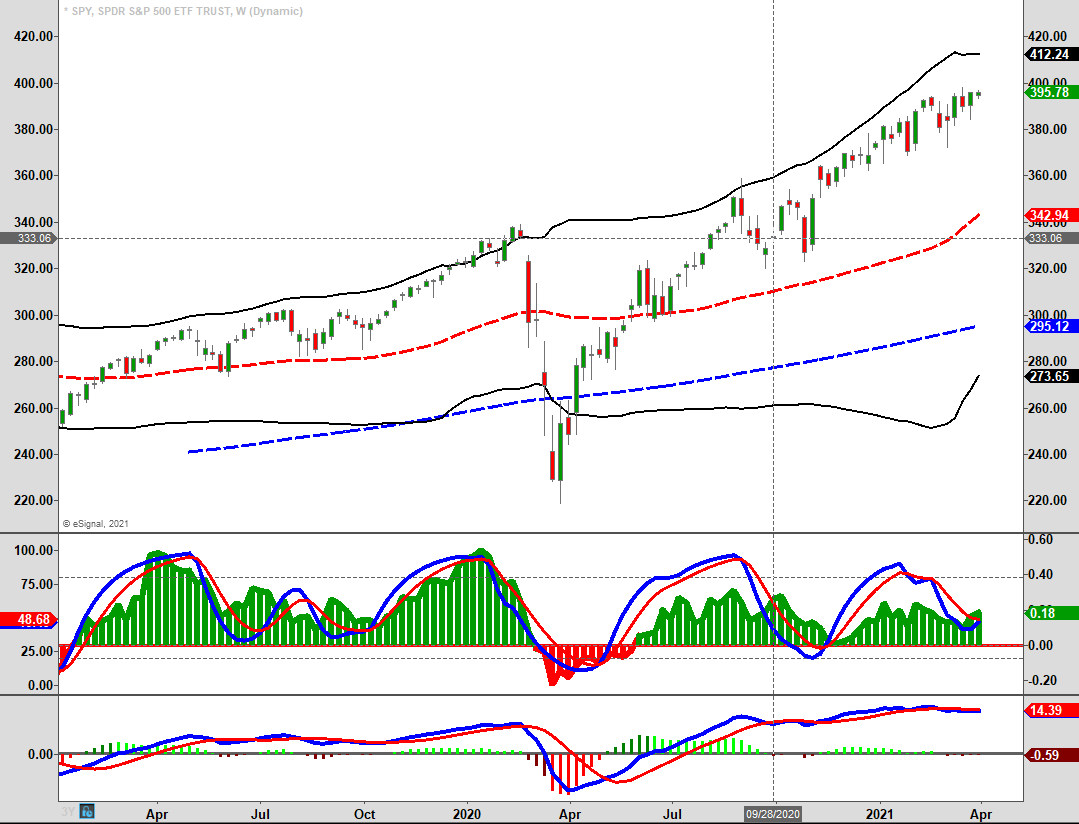
Over the last few weeks, I discussed the weekly “sell signals.” Such suggested upside would be somewhat limited for markets near-term. However, that flood of liquidity also limited the downside. Such has indeed been the case, as volatile markets made little headway since February, but dips continue to get bought.

With “stimmy” checks hitting bank accounts, “retail trading” stocks should get a boost as former gamblers and “pandemic lock-ins” return to Robinhood.

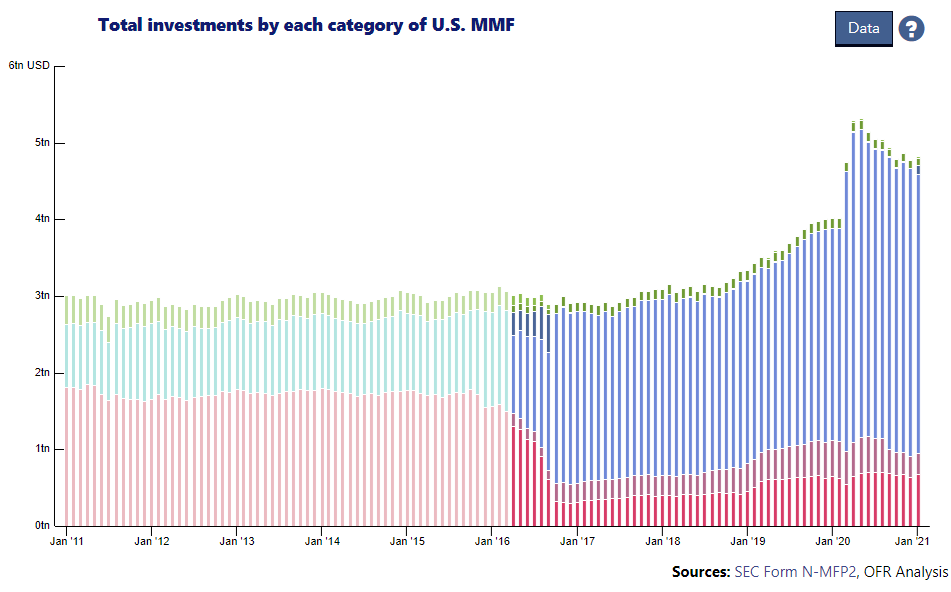
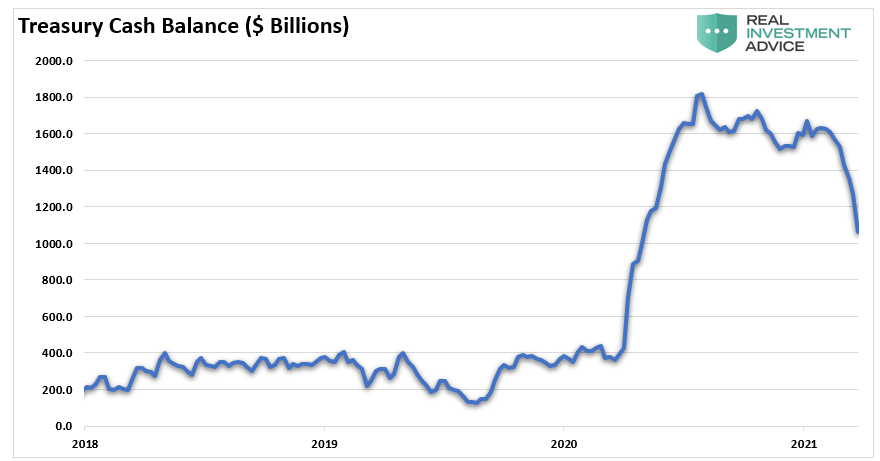
Furthermore, the surge in liquidity from the CARES Act last March is now working its way back into the economy as well. Those Treasury balances are getting drawn down to fund expenditures such as extended unemployment benefits.

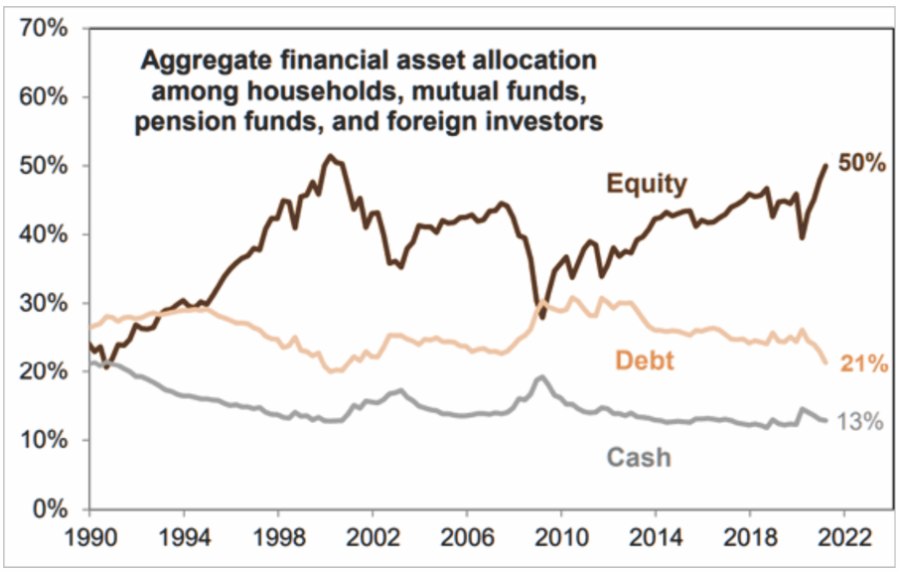
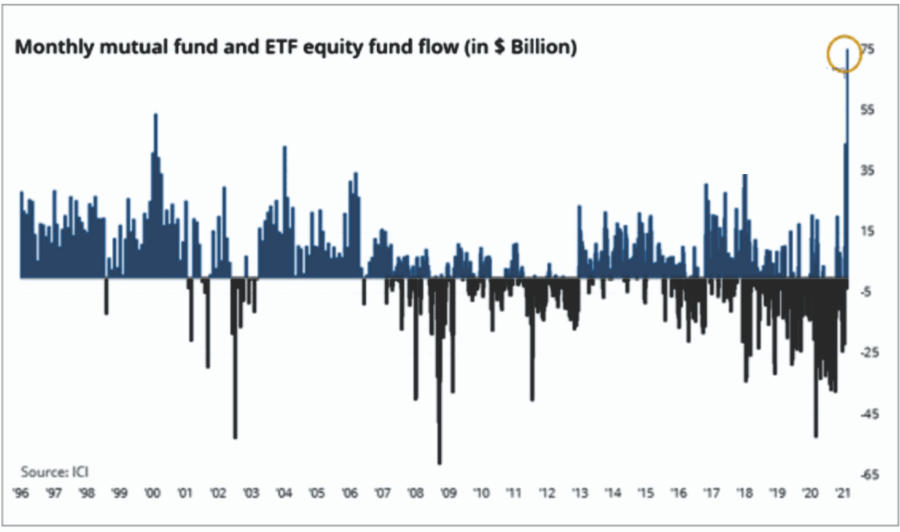
Unsurprisingly, all this liquidity is finding its way into the markets.

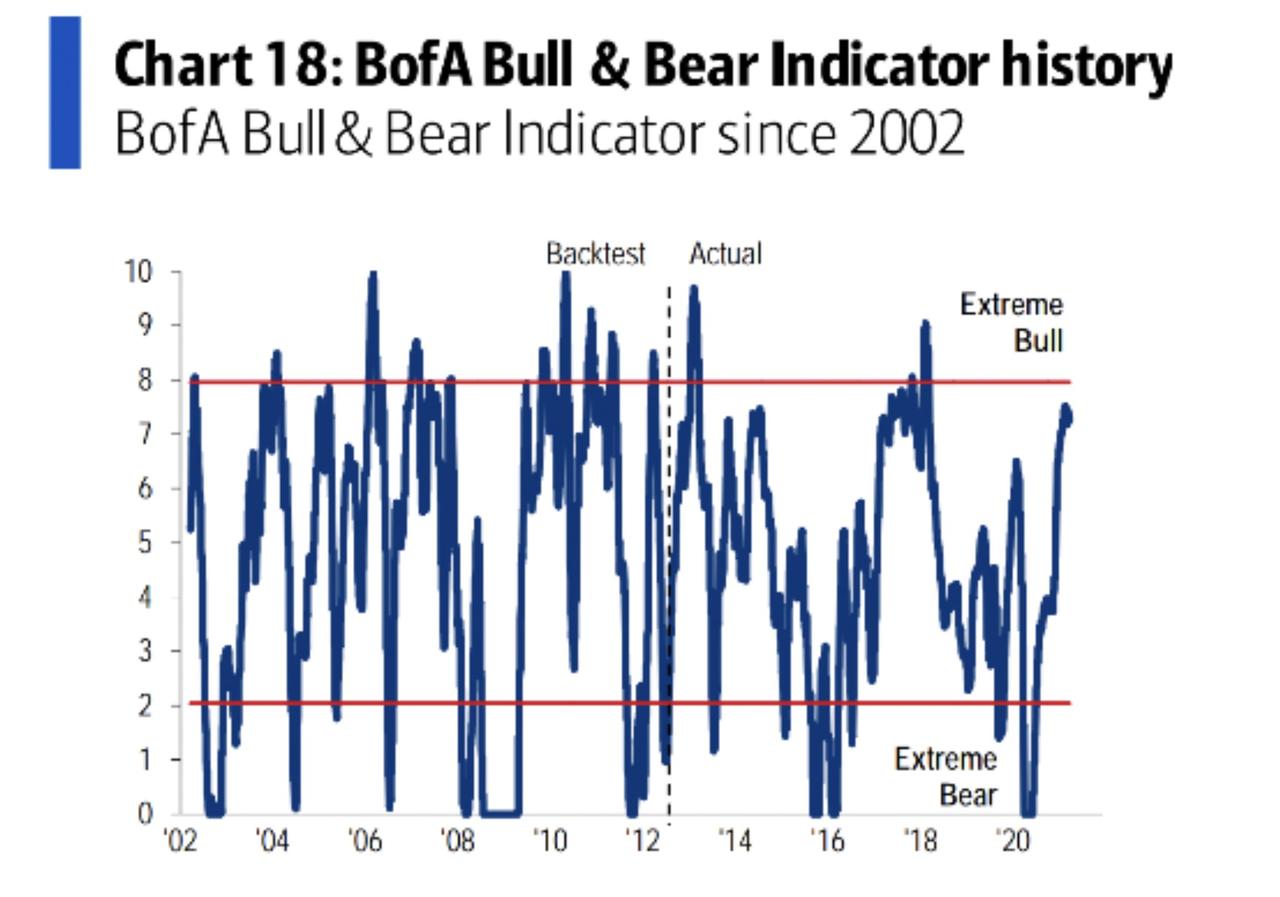
Such has pushed equity allocations to nearly “Dot.com” level highs.

In other words, the bulls see “no risk” in being invested in “risk” assets.

Stock Buybacks Return With A Vengence

As I noted in “Powell’s Easy Money Promise,” stock buybacks have returned with a vengeance.

“No, this is not the ‘cash on the sidelines’ argument which I debunked previously. Following the pandemic, corporations drew down credit lines and hoarded cash due to economic uncertainty. Now, with expectations of recovery, corporations are once again beginning to deploy that cash.”

As I said then, while the mainstream media hope is all this cash will be flowing back into the economy, the reality is that it will primarily go to stock buybacks. Again, while not necessarily bad, it is the “least best” use of the company’s cash. Instead of expanding production, increasing sales, acquiring competitors, or making capital investments, the money gets used for a one-time boost to earnings on a per-share basis.

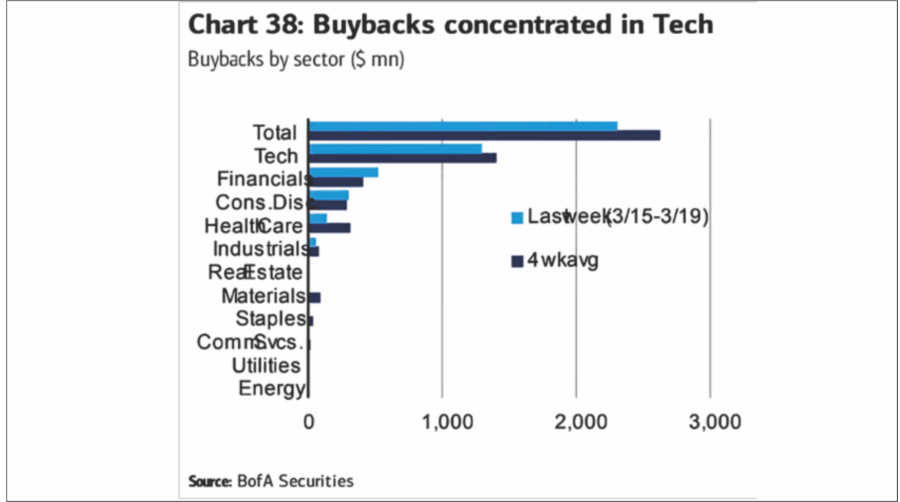
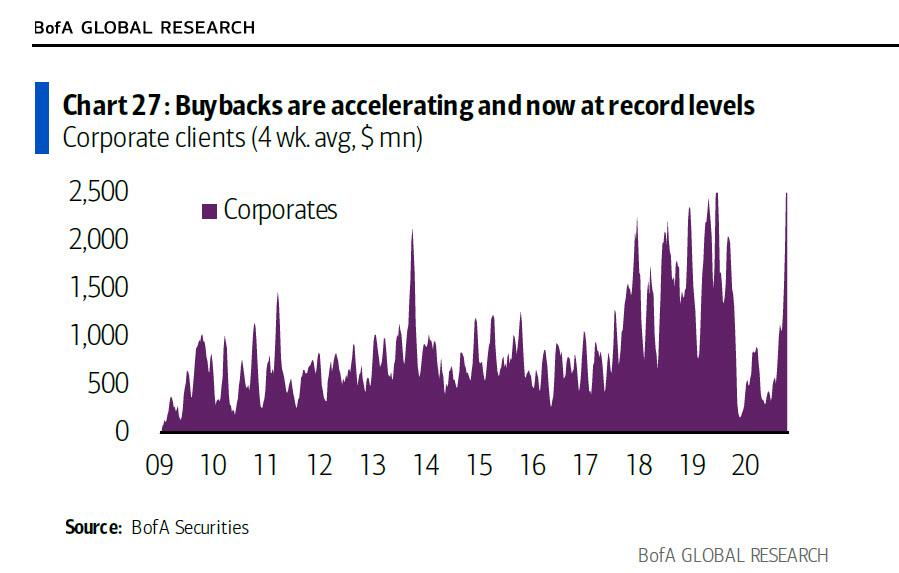
This past week, share buybacks hit a new record.

Not surprisingly, the most prominent players in buybacks are the ones that need to subsidize their earnings the most to beat estimates; technology and financials.

Net Purchases

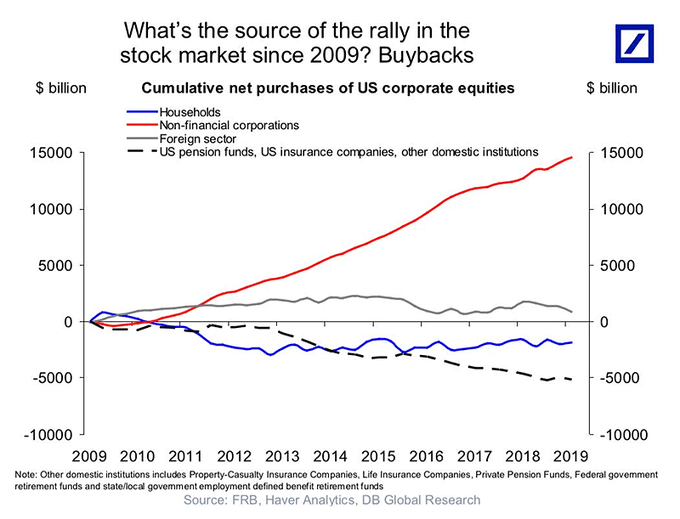
While share buybacks primarily are for the benefit of corporate insiders “cashing out,” it does have the effect of supporting asset prices as well. As I discussed in 2019, when stocks were hitting records amid record share repurchases:

“What is clear, is that the misuse, and abuse, of share buybacks to manipulate earnings and reward insiders has become problematic. As John Authers recently pointed out:

‘For much of the last decade, companies buying their own shares have accounted for all net purchases. The total amount of stock bought back by companies since the 2008 crisis even exceeds the Federal Reserve’s spending on buying bonds over the same period as part of quantitative easing. Both pushed up asset prices.’

In other words, between the Federal Reserve injecting a massive amount of liquidity into the financial markets, and corporations buying back their own shares, there have been effectively no other real buyers in the market.”

I bring this up for two reasons:

  1. The buybacks ARE SUPPORTIVE of asset prices in the short-term; and,

  2. We just had to “bailout” these companies because they couldn’t weather an economic downturn as they have spent years piling into debt and buying back shares.

While Janet Yellen is okay with the buybacks, as she thinks the banks are healthier now, why doesn’t anyone ask the question:

“If banks are so healthy, why do they need a constant monetary stimulus to remain in business and a bailout every time the economy declines?”

It doesn’t sound very healthy to me. But for now, there is only one headline that matters:

The Risk Of “No Risk”

The problem of assuming there is “no risk” is that it leads to “investor complacency.”  As discussed in “Willful Blindness:”

“Willful blindness, also known as willful ignorance or contrived ignorance, is a term used in law. Being ‘willfully blind’ describes a situation where a person seeks to avoid civil or criminal liability for a wrongful act by keeping themselves unaware of the facts that would render them liable or implicated. 

The phrase ‘willful blindness’ also means any situation in which people avoid facts to absolve themselves of their liability. 

‘Investors regularly dismiss the ‘facts’ which run contrary to their current opinion. In behavioral investing terms this is ‘confirmation bias.’ 

As markets rise, investors take on exceedingly more risk with the full knowledge that such actions will have a negative consequence. However, that ‘negative consequence’ is dismissed by the ‘fear of missing out,’ or rather F.O.M.O.

As ‘greed’ overtakes ‘fear,’ investors become emboldened as rising markets reinforce their convictions. When the negative consequence occurs, instead of taking responsibility, they blame the media, Wall Street, or their advisor.”

This currently where we are in the markets today.

As discussed, with investors fully allocated, the risk remains that markets are trading at near-record extensions of longer-term means. The monthly chart below shows the current deviation from the long-term mean. Two things to note:

  • The market is exceptionally overbought longer-term; and,

  • The negative divergence in relative strength is highly concerning.

It is generally near market peaks when investors are the most complacent about risk. While I certainly agree in the shorter-term, the liquidity flood has mitigated downside risk; it only exacerbates longer-term consequences.

Another Surge Coming

Currently, investors are very exuberant about markets, although they can get more so.

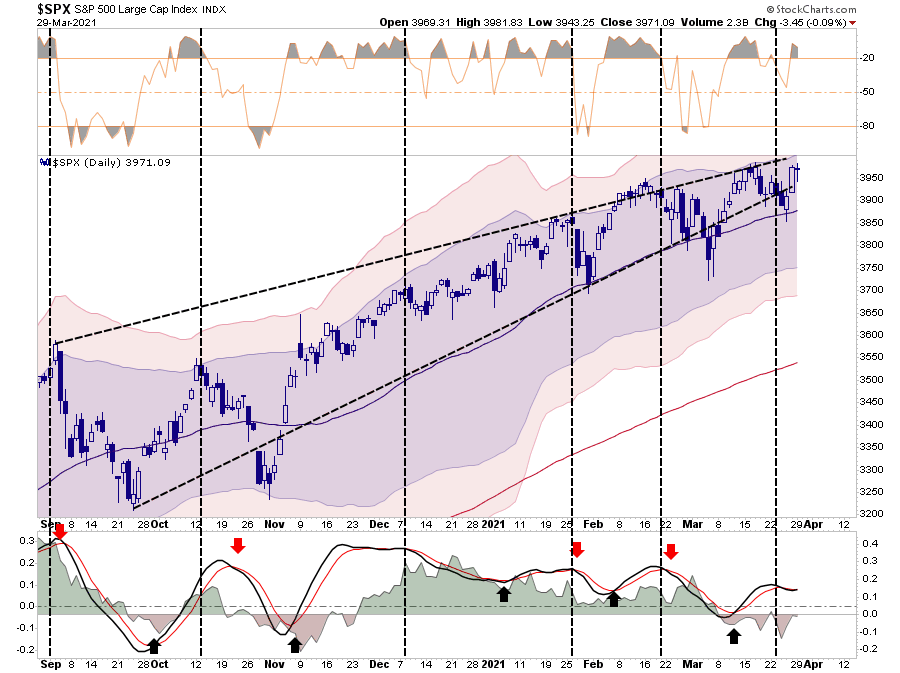
With the flood of stimulus into the market, another surge higher would not be a surprise. Such would correspond both with the peak of liquidity inflows and the peak in earnings and economic growth expectations. From a technical perspective, this also aligns with the weekly “money flow” index, turning positive. Typically, these weekly “buy” signals last roughly two to three months before reversing.

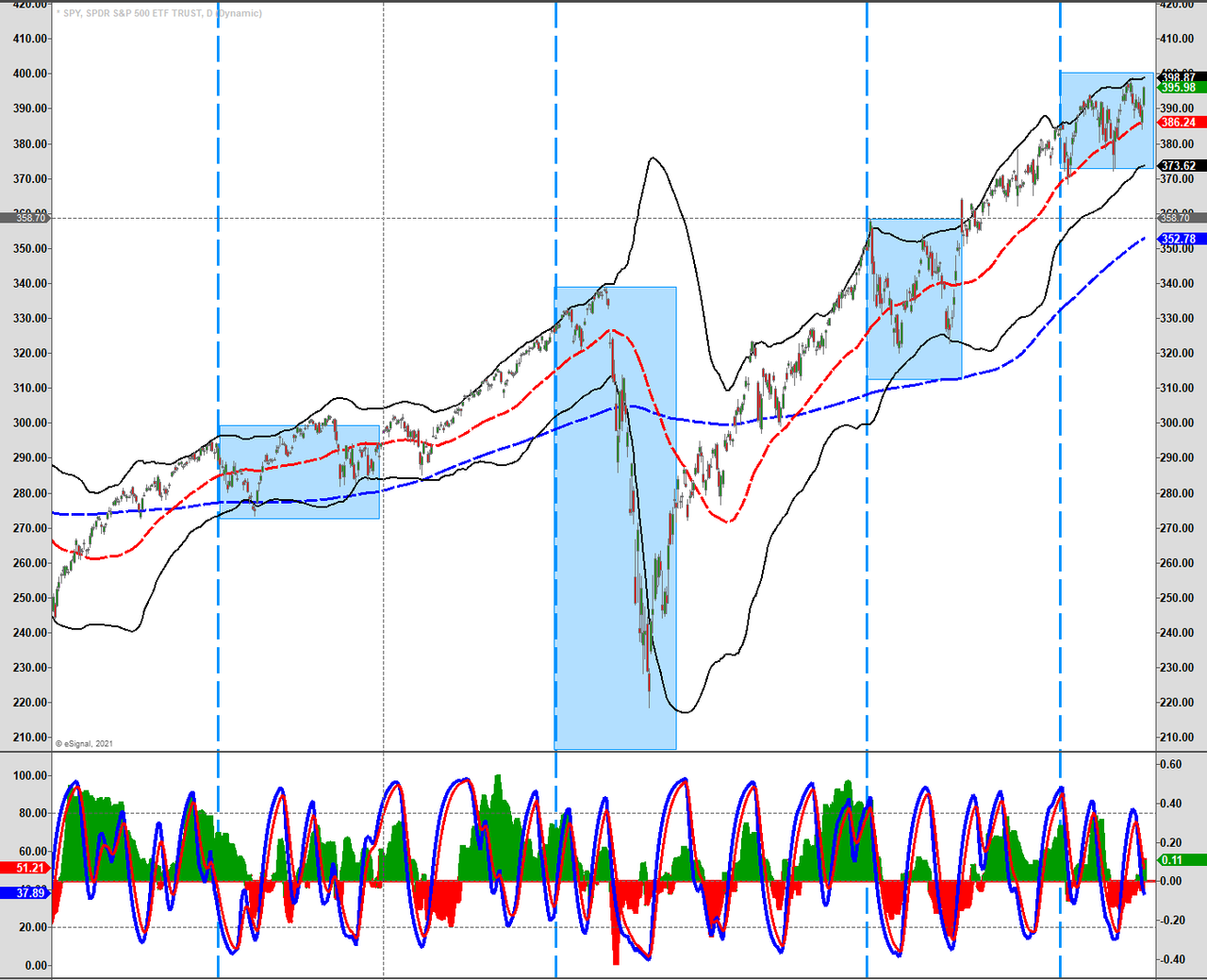
Note the blue vertical dashed lines below. Those lines are the weekly “buy” and “sell” signals overlaid on the daily chart. The blue boxes show where the daily and weekly sell signals converged previously.

When both indicators align on “sell signals,” blue boxes, market volatility rises markedly. However, markets tend to increase when both indicators align with “buy signals.”

With both “buy” signals close to aligning, I would not be surprised to see markets make another advance higher near term. However, focusing back on longer-term market dynamics, the deviation from the longer-term mean is extreme.

Reversions always occur when least expected, and always for a reason “no one sees coming.”

Buy Now, Sell Later

With markets still in the “seasonally strong” period of the year, lots of liquidity, and plenty of exuberance, this is not a time to be “bearish” on markets.

We are using recent weaknesses to add to positions we took profits in recently, such as energy and financials. We will also add to beaten-up “growth” names that have strong earnings trajectories and strong fundamentals.

It should be evident that an honest assessment of uncertainty leads to better decisions.

The problem with “Eternal Bullishness” and “Willful Blindness” is that the failure to embrace uncertainty increases risk, and ultimately loss.

We must be able to recognize and be responsive to changes in underlying market dynamics. If they change for the worse, we must be aware of the portfolio model’s inherent risk. The reality is that we can’t control outcomes. The most we can do is influence the probability of specific outcomes.

Focusing on risk not only removes “willful blindness” from the process, but it is also essential to capital preservation and investment success over time.

In other words, “buy now,” just don’t forget to “sell” later.

Tyler Durden
Tue, 03/30/2021 – 09:15

via ZeroHedge News https://ift.tt/39umHHj Tyler Durden

US Home Prices Are Soaring At The Fastest Pace In 7 Years

US Home Prices Are Soaring At The Fastest Pace In 7 Years

Don’t worry, there’s no inflation – apart from in gas and home prices.

According to AAA, gas prices at the pump are back near their highest in 6 years, up a stunning 42% YoY…

Source: Bloomberg

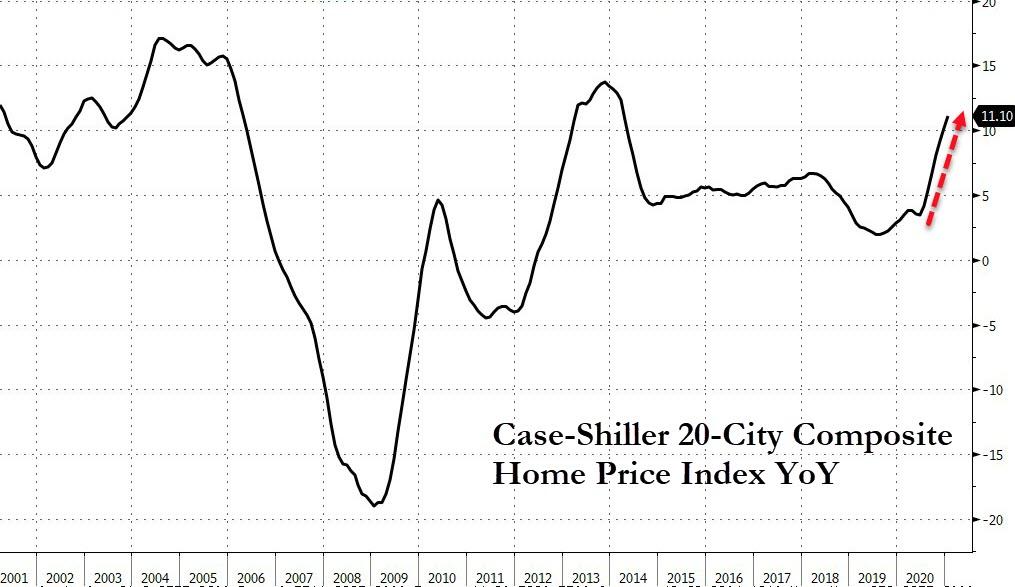
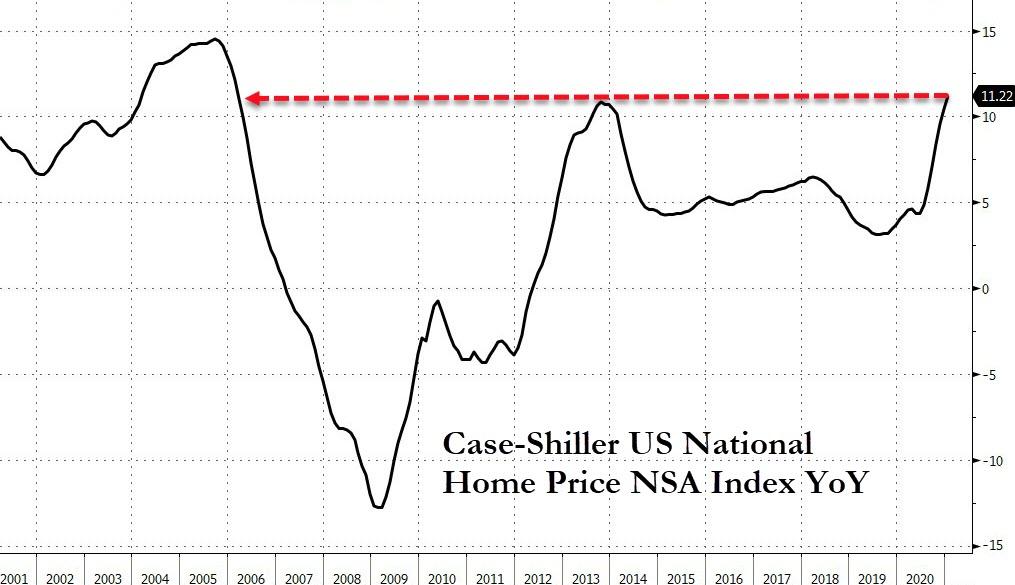
And according to Case-Shiller, US home prices in 20 major cities are up a shocking 11.10% year-over-year

Source: Bloomberg

This is the fastest YoY rise since March 2014.

Away from the 20 major cities, prices are rising even faster, up 11.22% – the fastest YoY price appreciation since Feb 2006…

“The trend of accelerating prices that began in June 2020 has now reached its eighth month,” Craig Lazzara, global head of index investment strategy at S&P Dow Jones Indices, said in statement.

“The market’s strength is broadly-based: all 20 cities rose, and all 20 cities gained more in the 12 months ended in January 2021 than they had gained in the 12 months ended in December 2020.”

Phoenix, Seattle, San Diego reported highest year-over-year gains among 20 cities surveyed.

Tyler Durden
Tue, 03/30/2021 – 09:05

via ZeroHedge News https://ift.tt/3tYGeHE Tyler Durden

Are NFTs Dumb, a Scam, or Secretly Useful?


131

NFTs: so hot right now. You might have heard so much about these eye-popping auctions for weirdo jpegs on the internet that you’re pretty sick of them by now. For those still on the bubbly side of the hype cycle, “non-fungible tokens” can seem like the solution to online art monetization. For everyone else, NFTs seem mostly like a high-tech way to part a fool from his money.

And lots of money is changing hands. One market tracker reports some $500 billion in all time NFT sale volume shuttled through top markets like Cryptopunks, Hashmasks, and Makersplace. But this is a superstar market. Most NFTs go for nothing at all, while a few supernovas go superviral (and strike it super rich).

Beeple, the closest thing we have to an enfant terrible of the NFT art scene, set the record when he sold a collection of digital grotesques for (of course) $69 million through a Christie’s managed auction. This wouldn’t be the art world if a record-setting event wasn’t marred by allegations of self-promotion and possible scamming: The proud purchaser of EVERYDAYS: THE FIRST 5000 DAYS, was revealed to be the Beeple- and crypto-investor MetaKovan, who had a financial interest in pumping up the price of Beeple works and NFTs more generally.

But with numbers like these, it is no wonder so many have rushed to cash in literally and metaphorically on this hot new trend. And these days, the money is cheap.

Taco Bell sold some NFTs. So did Grimes, some $6 million worth. Professional attention seeker Logan Paul took a break from his Pokéhustle to issue a few million worth of NFTs. The worlds of sports, sneakers, and music have all dabbled in some NFT magic to try to build some buzz and a buck. Weeks after the craze kicked off, even New York Times technology columnists are trying to pawn off their scribblings as some kind of new blockchain bling.

How does an NFT work, anyway? What did MetaKovan actually purchase for that $69 million in real world money? Nothing is stopping me or anyone else from right-clicking on that rather unremarkable blur of five thousand images, saving it, and sharing it with the world. How can you say to “own” an inherently non-rivalrous property?

What MetaKovan and the new class of proud NFT owners “own” is the “T” part of the acronym. They own a cryptographic token. The token is unique—hence “non-fungible”—and associated with a specific and verifiable piece of data. The token can’t be divided, duplicated, or destroyed (although the owner could easily lose it). Basically, people are buying a digital keyfile that is associated with the artwork or piece of music or property title in some digital space that is supposed to tell the world: “I own this.”

It does seem stupid. But then again, a lot of things that other people spend their money on seem pretty stupid. If there can be no disputes in matters of taste, there can certainly be boneheaded delivery methods to satisfy them.

One of the biggest problems with NFTs so far is that they have been fairly logistically unworkable. They’ve actually been around for a long time, arguably since 2013 or so, but have failed in each iteration in part for the following inherent problems. How can you tell if the person who sold you an NFT for some work has the “right” to do so? Perhaps that Beeple that you “bought” is just some copy, and the “real” NFT holder has yet to sell. Who verifies which is “real”?

Maybe you say: Well, look at whichever NFT was purchased first. But suppose an NFT pirate simply got there first (there are whole marketplaces that allow people to “sell NFTs” for anyone else’s content). The “real” Beeple was still working through the process with Christie’s. What you bought was some sketchball copy. Looking further ahead, what is to stop Beeple or any other artist from re-issuing the same work at a later date, thereby possibly devaluing your investment? It all starts to look very silly.

These conceptual concerns pale in comparison to existing and common failures in execution, however. In a lot of cases, the NFT you just shelled out good money for might end up merely “proving” that you own a broken link. NFTs need to point to something. Usually, this is in the form of a URL that leads to a JSON metadata file. If whoever is hosting the URL goes out of business or just decides not to host that file anymore, well, tough luck. That association with a broken link is what you “own.” It’s already happening, and it will probably accelerate as the NFT buzz dies down and more of these marketplaces start to wind down.

NFT skeptics will almost certainly get to enjoy their schadenfreude. But this does not mean that the concept of an NFT is utterly useless. In many ways, the ongoing NFT mania is just the latest iteration of a cyclical cryptocurrency craze. First, there were altcoins in 2013-2014. Then, there were initial coin offerings in 2017. Now, NFTs are having their day in the sun.

Yes, there was a lot of stupidity and a lot of scamming going on during each of those manias. But there was real innovation that got kind of ignored amidst the gold rush, too. Developments in altcoins lead to real improvements in privacy technologies in the form of privacycoins. The initial coin offering boom resulted in “decentralized finance,” or DeFi, which is still being worked through and is now seeing integration with the Bitcoin network. NFTs, while maybe nonsensical for art, can have real value in resolving longstanding issues in online identity and address space.

Here’s one example of a non-stupid NFT: Urbit addresses. Urbit is one of the several contenders in the race to build a more decentralized computing infrastructure. In order to access Urbit, you need something called an Urbit ID. Urbit IDs are NFTs. They are unique, indivisible, persistent, and freely traded on NFT marketplaces like OpenSea.

But unlike NFTs for art, Urbit IDs empower holders with a real function: accessing and participating in the Urbit network. It’s a key to an activity and environment, not just an ephemeral trophy establishing that you spent money on some GIF associated with some IPFS link at a point in time.

NFT IDs can provide a more decentralized way to manage address spaces. As the telecommunications theorist Milton Mueller’s Ruling the Root describes, there are entire global multistakeholder organizations that have been created to manage online identity and address space disputes for things like top level domains (e.g. ICANN). Any central authority introduces the potential for control and therefore conflict; consider the brouhaha over the U.S. relinquishing authority over the management of the Domain Name System (DNS).

With Urbit addresses, there is no “ICANN” tasked with adjudicating such resolutions over identity and addresses. Addresses were spawned, randomly granted to early users, and now trade on secondary marketplaces. When you purchase the Urbit ID, you get the cryptographic key that establishes and protects your identity with the Urbit system. It’s self-authenticating. Other examples of NFTs that manage address space include the Ethereum Name Service (ENS) and Handshake, which provide ICANN-like functions through a blockchain, and Decentraland, which manages property titles in a digital world as NFT assets.

In other words, the usefulness of an NFT will depend on exactly what that “T” allows the holder to access. Does the token unlock some useful online function or property, like with an Urbit ID? Or does it just point to a rando JSON file owned by some NFT marketplace? If it’s the latter, you might want to save your money for some old-fashioned real art that you can at least hang in your living room.

One good sign that a craze is winding down is that it gets the Saturday Night Live treatment. If last week’s Janet Yellen rap video is any indication, NFTs may very well be on the cultural way out. But even if you never hear the term “NFT” again in the next few months, it’s a good bet that non-fungible token architecture will stick around as a way to manage address space online, this time with fewer lolcats.

from Latest – Reason.com https://ift.tt/3sBJisZ
via IFTTT

Peter Schiff: The One Promise The Fed Is Going To Keep

Peter Schiff: The One Promise The Fed Is Going To Keep

Via SchiffGold.com,

Since the beginning of the pandemic, government debt and money printing are off the chart. This is creating inflationary pressure. Prices are on the rise. And this is by design. In fact, the Fed has been promising more inflation for years. As Peter Schiff explains, it looks like this is one promise the Fed is going to keep.

The US government blew up the national debt by over $5 trillion in just 18 months. To support all of his borrowing and spending, the Fed turned the printing press up to full speed. The central bank’s balance sheet has expanded to a record $7.72 trillion as it’s created money out of thin air in order to buy trillions in US Treasuries and mortgage-backed securities. Peter said that the Fed is printing about half of the money being spent by the US government.

So, it’s not really borrow-and-spend anymore. It’s print and spend.”

But virtually nobody in the mainstream sees this as a problem.

People seem to think that we’ve stumbled on the equivalent of a monetary fountain of youth. People like to call it Modern Monetary Theory, which is we can have whatever we want as long a government prints the money to pay for it, that there’s no limit, that government is free as long as they print money.”

Why didn’t we figure this out sooner? After all, the printing press has been around for hundreds of years. And Peter raises an interesting question: if this is true, why do we even need to pay taxes?

Of course, the reality is that this is a fantasy — the kind that ends in disaster.

The fantasy is built on a misunderstanding of money. People have come to equate cash with wealth. But there is a big difference between earning money in exchange for producing things and the government running off dollar bills and handing them out.

When people go to work, their labor produces stuff. It increases the supply of goods and services available in the economy. You contribute your labor, and in exchange, you get money. That allows you to buy things from the pool of goods and services that you helped produce. The money itself isn’t wealth. The wealth is made up of the goods and services produced through your labor.

The more productive you are, well, the more you earn, and the greater share of what society produces you are able to enjoy yourself.”

But with government and Fed intervention, we have millions of unemployed people sitting at home just getting a check from the government. They don’t produce anything. They add no goods or services to the economy.

Yet, they can consume goods and services in the same proportions as if somebody had actually done work and actually been a productive member of society.”

What does this do?

It raises prices.

If your work adds to the goods and services, and now you’re consuming the goods and services you helped creates, that’s fine. But if now you start consuming goods and services, and you didn’t help create any of those goods and services, you just have more money chasing a diminished supply of goods and services, and prices are going to go up.”

Peter said with this level of money printing and spending, prices will go up like never before.

Ironically, the Federal Reserve has been promising Americans more inflation.

Well, that’s one promise that they’re going to deliver on. In fact, they’re going to deliver on it beyond their wildest expectations.”

Central bankers and government policymakers claim a little inflation is a good thing. It’s not.

Higher inflation is not making progress.”

Think about it. Do you want higher prices? Of course not. You want a lower cost of living.

When prices go down, that’s progress. That’s capitalism. That’s how capitalism works. When you have real capitalism, businesses become more productive. They become more efficient. They develop economies of scale. And as they do that, the cost of production comes down. And as the cost of production goes down, demand goes up. Because as prices go down, more people can afford to buy more stuff. It’s falling prices that have historically driven a rising standard of living. Well, the government has interrupted that benevolent process through inflation.”

It’s not just that inflation drives prices up. It also prevents prices from going down.

A decline in a price would have been a windfall for the consumer. When the consumer is denied that windfall by government — it’s still a tax. The government is still taking your purchasing power because the goods and services you want to consume are more expensive as a result of the government inflation.”

When you boil it all down, inflation is a promise we’d really rather the government and central bank not keep.

Tyler Durden
Tue, 03/30/2021 – 08:51

via ZeroHedge News https://ift.tt/3ddFEPu Tyler Durden

Are NFTs Dumb, a Scam, or Secretly Useful?


131

NFTs: so hot right now. You might have heard so much about these eye-popping auctions for weirdo jpegs on the internet that you’re pretty sick of them by now. For those still on the bubbly side of the hype cycle, “non-fungible tokens” can seem like the solution to online art monetization. For everyone else, NFTs seem mostly like a high-tech way to part a fool from his money.

And lots of money is changing hands. One market tracker reports some $500 billion in all time NFT sale volume shuttled through top markets like Cryptopunks, Hashmasks, and Makersplace. But this is a superstar market. Most NFTs go for nothing at all, while a few supernovas go superviral (and strike it super rich).

Beeple, the closest thing we have to an enfant terrible of the NFT art scene, set the record when he sold a collection of digital grotesques for (of course) $69 million through a Christie’s managed auction. This wouldn’t be the art world if a record-setting event wasn’t marred by allegations of self-promotion and possible scamming: The proud purchaser of EVERYDAYS: THE FIRST 5000 DAYS, was revealed to be the Beeple- and crypto-investor MetaKovan, who had a financial interest in pumping up the price of Beeple works and NFTs more generally.

But with numbers like these, it is no wonder so many have rushed to cash in literally and metaphorically on this hot new trend. And these days, the money is cheap.

Taco Bell sold some NFTs. So did Grimes, some $6 million worth. Professional attention seeker Logan Paul took a break from his Pokéhustle to issue a few million worth of NFTs. The worlds of sports, sneakers, and music have all dabbled in some NFT magic to try to build some buzz and a buck. Weeks after the craze kicked off, even New York Times technology columnists are trying to pawn off their scribblings as some kind of new blockchain bling.

How does an NFT work, anyway? What did MetaKovan actually purchase for that $69 million in real world money? Nothing is stopping me or anyone else from right-clicking on that rather unremarkable blur of five thousand images, saving it, and sharing it with the world. How can you say to “own” an inherently non-rivalrous property?

What MetaKovan and the new class of proud NFT owners “own” is the “T” part of the acronym. They own a cryptographic token. The token is unique—hence “non-fungible”—and associated with a specific and verifiable piece of data. The token can’t be divided, duplicated, or destroyed (although the owner could easily lose it). Basically, people are buying a digital keyfile that is associated with the artwork or piece of music or property title in some digital space that is supposed to tell the world: “I own this.”

It does seem stupid. But then again, a lot of things that other people spend their money on seem pretty stupid. If there can be no disputes in matters of taste, there can certainly be boneheaded delivery methods to satisfy them.

One of the biggest problems with NFTs so far is that they have been fairly logistically unworkable. They’ve actually been around for a long time, arguably since 2013 or so, but have failed in each iteration in part for the following inherent problems. How can you tell if the person who sold you an NFT for some work has the “right” to do so? Perhaps that Beeple that you “bought” is just some copy, and the “real” NFT holder has yet to sell. Who verifies which is “real”?

Maybe you say: Well, look at whichever NFT was purchased first. But suppose an NFT pirate simply got there first (there are whole marketplaces that allow people to “sell NFTs” for anyone else’s content). The “real” Beeple was still working through the process with Christie’s. What you bought was some sketchball copy. Looking further ahead, what is to stop Beeple or any other artist from re-issuing the same work at a later date, thereby possibly devaluing your investment? It all starts to look very silly.

These conceptual concerns pale in comparison to existing and common failures in execution, however. In a lot of cases, the NFT you just shelled out good money for might end up merely “proving” that you own a broken link. NFTs need to point to something. Usually, this is in the form of a URL that leads to a JSON metadata file. If whoever is hosting the URL goes out of business or just decides not to host that file anymore, well, tough luck. That association with a broken link is what you “own.” It’s already happening, and it will probably accelerate as the NFT buzz dies down and more of these marketplaces start to wind down.

NFT skeptics will almost certainly get to enjoy their schadenfreude. But this does not mean that the concept of an NFT is utterly useless. In many ways, the ongoing NFT mania is just the latest iteration of a cyclical cryptocurrency craze. First, there were altcoins in 2013-2014. Then, there were initial coin offerings in 2017. Now, NFTs are having their day in the sun.

Yes, there was a lot of stupidity and a lot of scamming going on during each of those manias. But there was real innovation that got kind of ignored amidst the gold rush, too. Developments in altcoins lead to real improvements in privacy technologies in the form of privacycoins. The initial coin offering boom resulted in “decentralized finance,” or DeFi, which is still being worked through and is now seeing integration with the Bitcoin network. NFTs, while maybe nonsensical for art, can have real value in resolving longstanding issues in online identity and address space.

Here’s one example of a non-stupid NFT: Urbit addresses. Urbit is one of the several contenders in the race to build a more decentralized computing infrastructure. In order to access Urbit, you need something called an Urbit ID. Urbit IDs are NFTs. They are unique, indivisible, persistent, and freely traded on NFT marketplaces like OpenSea.

But unlike NFTs for art, Urbit IDs empower holders with a real function: accessing and participating in the Urbit network. It’s a key to an activity and environment, not just an ephemeral trophy establishing that you spent money on some GIF associated with some IPFS link at a point in time.

NFT IDs can provide a more decentralized way to manage address spaces. As the telecommunications theorist Milton Mueller’s Ruling the Root describes, there are entire global multistakeholder organizations that have been created to manage online identity and address space disputes for things like top level domains (e.g. ICANN). Any central authority introduces the potential for control and therefore conflict; consider the brouhaha over the U.S. relinquishing authority over the management of the Domain Name System (DNS).

With Urbit addresses, there is no “ICANN” tasked with adjudicating such resolutions over identity and addresses. Addresses were spawned, randomly granted to early users, and now trade on secondary marketplaces. When you purchase the Urbit ID, you get the cryptographic key that establishes and protects your identity with the Urbit system. It’s self-authenticating. Other examples of NFTs that manage address space include the Ethereum Name Service (ENS) and Handshake, which provide ICANN-like functions through a blockchain, and Decentraland, which manages property titles in a digital world as NFT assets.

In other words, the usefulness of an NFT will depend on exactly what that “T” allows the holder to access. Does the token unlock some useful online function or property, like with an Urbit ID? Or does it just point to a rando JSON file owned by some NFT marketplace? If it’s the latter, you might want to save your money for some old-fashioned real art that you can at least hang in your living room.

One good sign that a craze is winding down is that it gets the Saturday Night Live treatment. If last week’s Janet Yellen rap video is any indication, NFTs may very well be on the cultural way out. But even if you never hear the term “NFT” again in the next few months, it’s a good bet that non-fungible token architecture will stick around as a way to manage address space online, this time with fewer lolcats.

from Latest – Reason.com https://ift.tt/3sBJisZ
via IFTTT

Stocks Crushed By Archegos Blowup Start Announcing Buybacks, Spike In Premarket

Stocks Crushed By Archegos Blowup Start Announcing Buybacks, Spike In Premarket

One of the biggest shocks in the aftermath of the Archegos margin call and hedge fund/prime broker blow up, is that the companies that have been swept in the “bath water” liquidation, who in the past had been aggressive buyers of their own stock, had remained suspiciously, almost ominously quiet and made no announcement about stabilizing their share prices by repurchasing their own stock as a result of the forced liquidations.

What made matters even more confusing is that the event that triggered this whole fiasco was Viacom’s stock sale exactly one week ago when Viacom raised $3BN in new capital, including the sale of 20MM shares of common stock at a price of $85. Well, with VIAC stock now trading at roughly half that price, we said two days ago that Viacom should immediately repurchase the same amount of stock not only for an immediate accounting gain but also to show support and belief in its own value.

And while literally moments later, Tencent did announce a $1 billion buyback…

… so far media giants DISCA and VIAC have remained silent, much to out continued amazement, because while stock buybacks are now back at all time highs – as if the Covid crisis never happened – with the market back at a record, as we showed yesterday

… they are missing where they are needed the most – when stocks tumble and when management should give demonstrate faith in its own value.

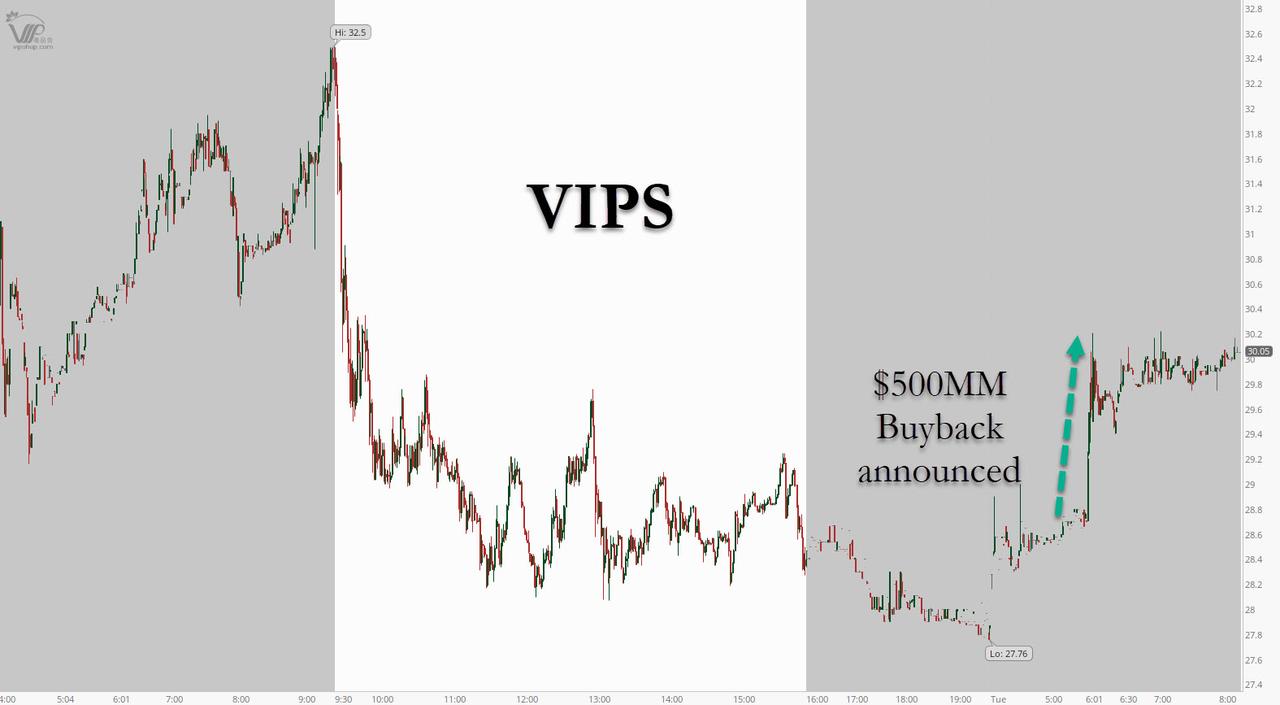
Yet while we wait for Viacom and Discovery to do the right thing, other companies swept up in the Archegos liquidation are stepping up, and in addition to the Tencent Music $1BN buyback noted above, this morning we also got news that Vipshop, one of the companies hammered by the forced unwind of Archegos announced a $500MM stock buyback, sending its stock sharply higher

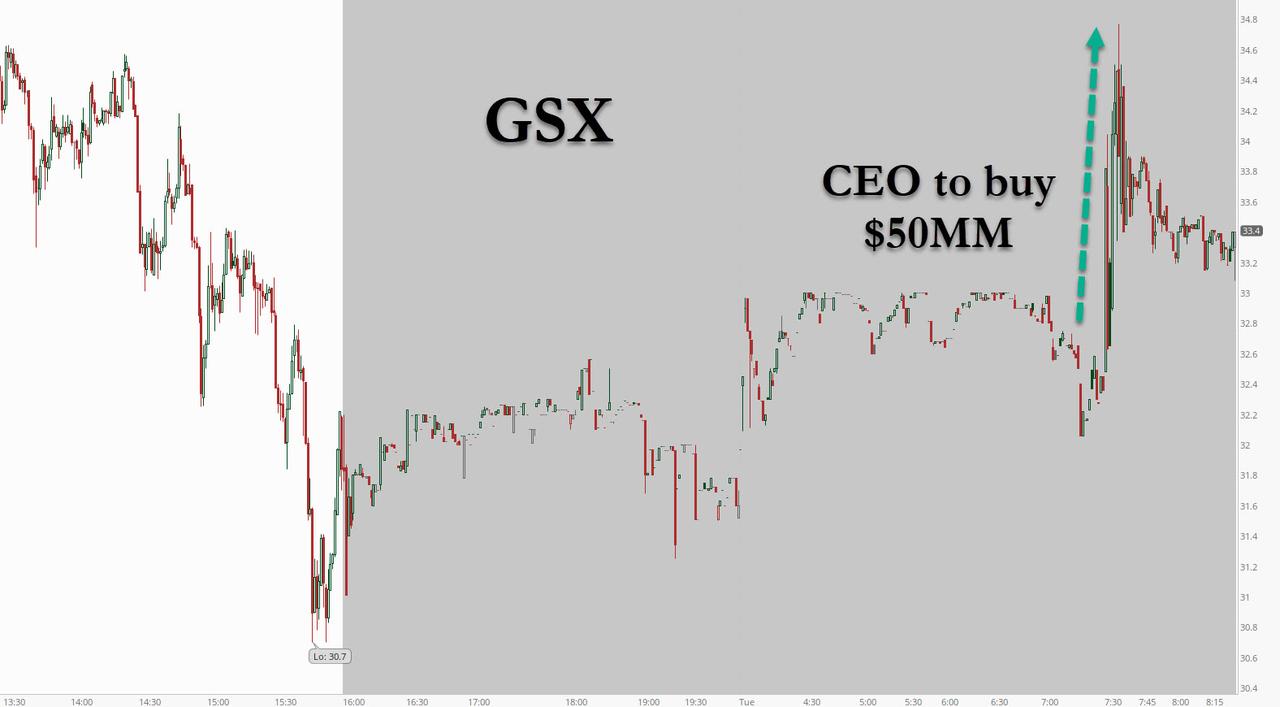
… and moments later, GSX Techedu ADR also soared as much as 9% in premarket trading after saying its founder, Chairman and CEO Larry Xiangdong Chen, announced he intends to use his personal funds to purchase up to $50 million of the company’s shares over the next 12 months. Chen said the company had repurchased $39.8 million of its shares under its up to $150 million share-repurchase program, and said he currently has not pledged any of his equity interest in the Company.

We expect every other name that has been hammered by the Archegos blow up to duly follow suit and to announce their own buybacks or else investors will suspect that something is far more broken with the underlying business and the far lower stock price is justified by something more than just a forced liquidation…

Tyler Durden
Tue, 03/30/2021 – 08:31

via ZeroHedge News https://ift.tt/3wb8714 Tyler Durden

Bonds & Bullion Are Being Dumped As Bitcoin & The Dollar Surge

Bonds & Bullion Are Being Dumped As Bitcoin & The Dollar Surge

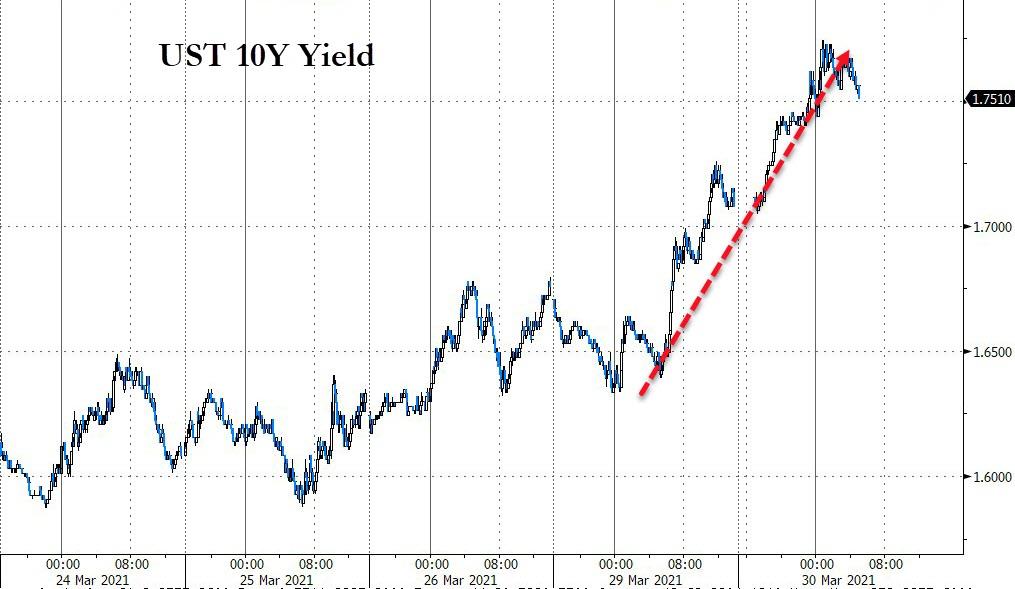
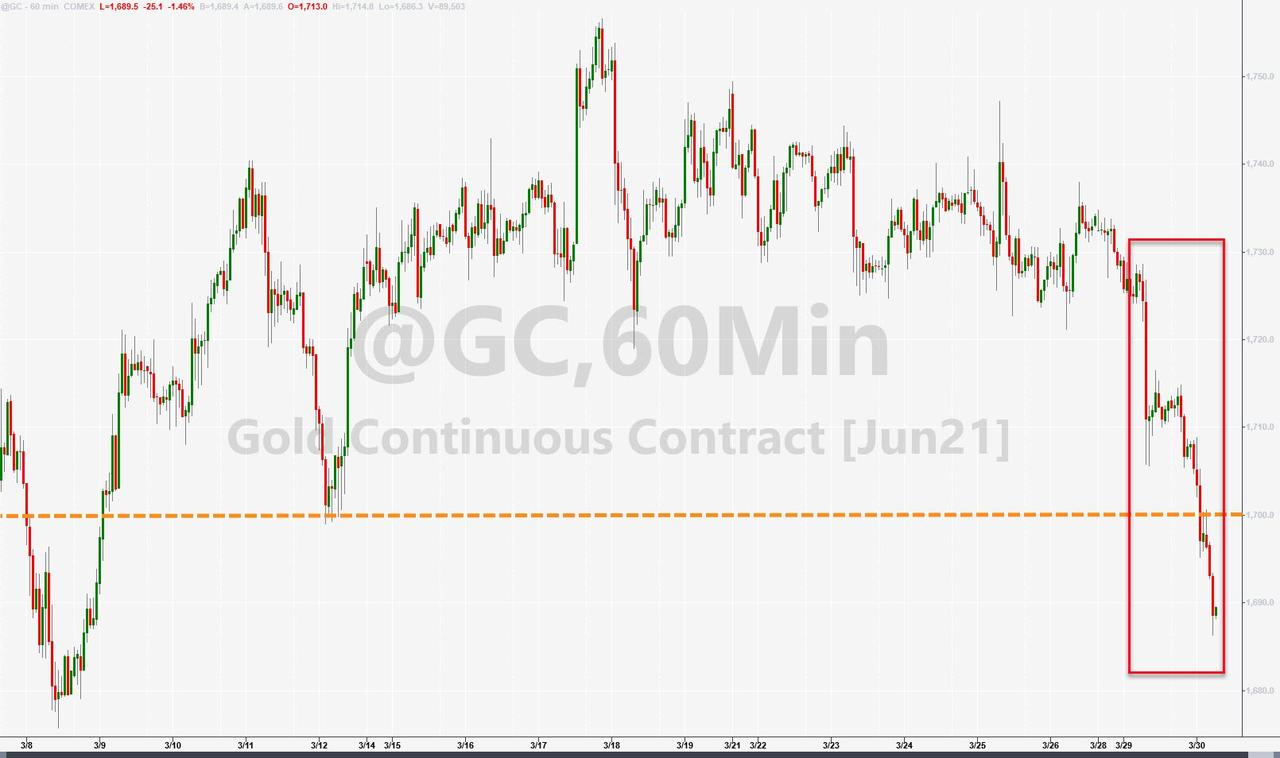
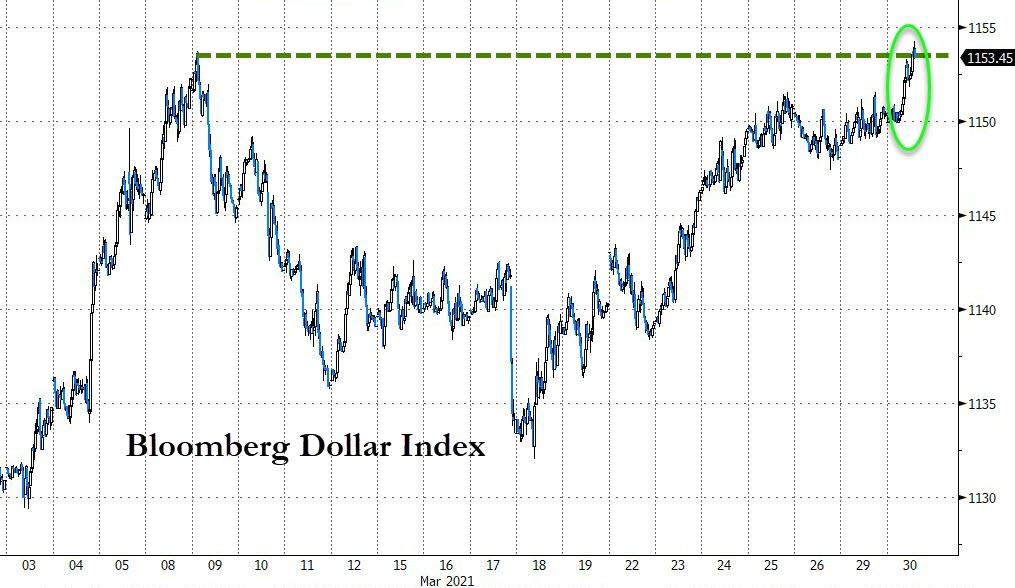
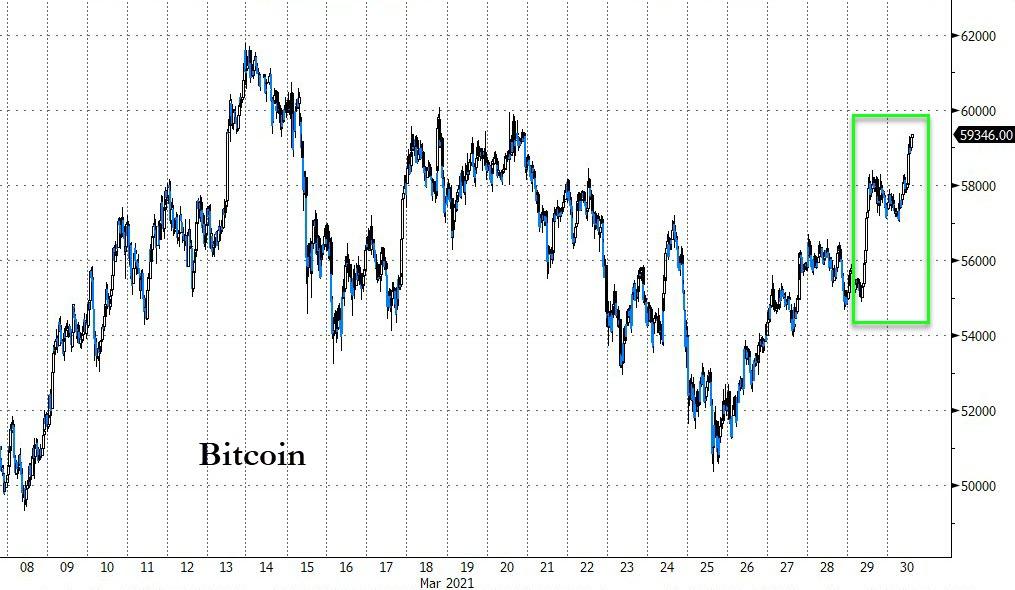
Gold and bonds are getting dumped amid the ongoing fallout from the Archegos debacle, and the dollar is bid, as it appears a broad-based demand for liquidity is trumping any quarter-end rebalancing flows that may have been expected. At the same time, bitcoin has been stable and acted as a source of stability.

Rather unexpectedly, Treasuries are being sold into quarter-end, with 10Y yields back above 1.75%…

Source: Bloomberg

Gold futures are back below $1700 as the sell first, think second plan for liquidity appears to be in play..

And dollar demand has sent the greenback to cycle highs…

Source: Bloomberg

And through all of this, crypto has been bid with Bitcoin surging back up near $60,000…

Source: Bloomberg

While bitcoin’s stability through this volatile last few days has been notable, it has been helped by positive catalysts after last week’s massive option expiration passed (lifting some downward pressuring pin risk), and PayPal’s president and CEO confirmed.this morning that a checkout service will be implemented which waives transaction fees for purchases made using crypto.

CoinTelegraph reports that news broke regarding PayPal’s rumored decision to accept cryptocurrencies early on March 30. Later in the day, the firm’s CEO, Dan Schulman, confirmed to Reuters that the rumors were true and that an official statement would be released imminently.

The new system is expected to feature a crypto checkout service where users can pay for goods and services at approved vendors using their stored coins. The system will reportedly see merchants receive equivalent funds directly in fiat currency after coins are subject to a quick transfer at the time of sale.

The checkout service is expected to be available for all four of PayPal’s supported cryptocurrencies upon launch, consisting of Bitcoin (BTC), Ether (ETH), Litecoin (LTC) and Bitcoin Cash (BCH). Customers who pay with cryptocurrencies will incur no transaction fees on purchases, and only one coin can be used per purchase.

“We think it is a transitional point where cryptocurrencies move from being predominantly an asset class that you buy, hold and or sell to now becoming a legitimate funding source to make transactions in the real world at millions of merchants,” said Schulman, regarding the launch.

The PayPal news comes just 24 hours after Visa announced that it would pilot a new payments system using stablecoins on the Ethereum blockchain. The pilot will see participating merchants agree to settle customers’ fiat transactions using the USDC stablecoin.

Tyler Durden
Tue, 03/30/2021 – 08:22

via ZeroHedge News https://ift.tt/3mfYSs1 Tyler Durden

Russian National Wealth Fund Turning To Gold, Dumping Dollars

Russian National Wealth Fund Turning To Gold, Dumping Dollars

Via SchiffGold.com,

The Russian Finance Ministry has given the green light for the Russian National Wealth fund to diversify and invest in gold and other precious metals. According to a report by RT, this is part of a broader move to de-dollarize the wealth fund.

The National Wealth Fund falls under the direction of the Russian Finance Ministry. One of the fund’s primary purposes is to support the nation’s pension system. According to the fund’s website, “Fund’s primer assignments are to co-finance voluntary pension savings of Russian citizens and to balance the budget of Pension Fund of the Russian Federation.” The fund can also be tapped to cover government budget deficits in times of a crisis. According to RT, as of November, the fund held more than $167 billion in assets, totaling about 12% of Russia’s GDP.

According to RT, the fund’s move into gold and other precious metals is aimed at diversifying assets to ensure the “safety” of the fund “as well as for increasing the yields.”

The Russian central bank has added significant amounts of gold to its reserves in recent years, although halted its buying spree last spring as the coronavirus pandemic gripped the world. Prior to the pause, the central bank added an average of 205 tons of gold to its reserves every year since 2014. In February 2018, Russia passed China to become the world’s fifth-largest gold-holding country.

Meanwhile, the Russian central bank was aggressively divesting itself of US TreasuriesRussia sold off nearly half of its US debt in April 2018 alone, dumping $47.4 billion of its $96.1 billion in US Treasuries. In January, the value of Russia’s gold holdings eclipsed its dollar holdings for the first time ever.

Russia’s shrinking dollar reserves is no accident. It was an intentional “de-dollarization” policy outlined by President Putin to lower the country’s exposure to the United States and shield it from the threat of US sanctions.

Gold now ranks as the second-largest component of Russia’s central bank reserves only behind euros. The Central Bank of Russia has also increased its holdings of yuan. The Chinese currency now makes up about 12% of Russian reserves.

It appears the Russian National Wealth Fund is following this same strategy. According to RT,  the Ministry of Finance reduced the portion of US dollars and euros in the currency structure of its National Wealth Fund from 45% to 35% last month. It has increased holdings of Japanese yen and Chinese yuan. Now it plans to add gold to that mix.

Finance Minister Anton Siluanov previously said he supported the idea of allocating the NWF assets “more efficiently.”

He called precious metals a much more sustainable investment than financial market assets in the long-term.

Tyler Durden
Tue, 03/30/2021 – 08:14

via ZeroHedge News https://ift.tt/3djsEb5 Tyler Durden

Futures Slides As Yields Surge, Archegos Jitters Persist

Futures Slides As Yields Surge, Archegos Jitters Persist

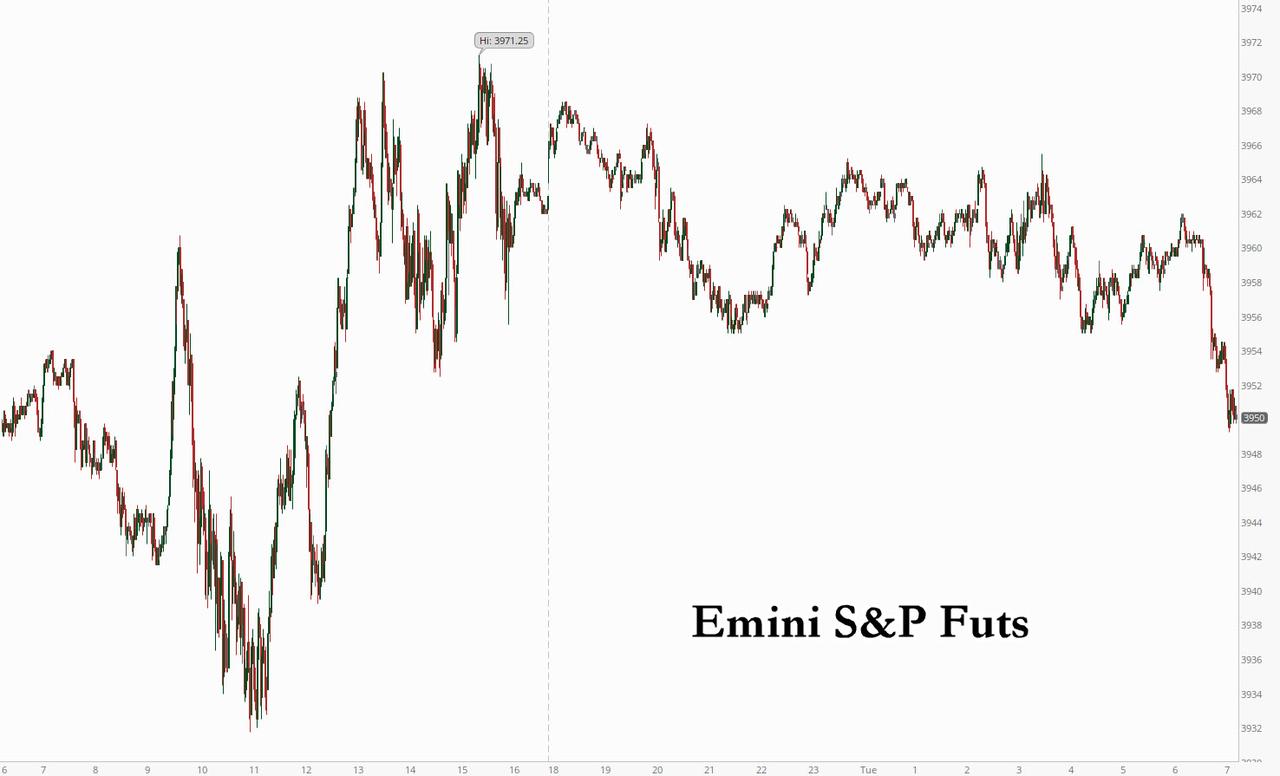
US index future slumped on Tuesday as traders continued to fret over fallout from the implosion of Archegos (especially after Morgan Stanley said it was not done selling residual blocks) and as Treasury yields soared to the highest since Jan 2020.
Emini S&P futures were down 13 points or -0.3% to 3,946, with ViacomCBS shares rising 2.6% premarket; Discovery Inc. and the American Depositary Receipts of Chinese companies linked to the Archegos block trades also posted gains. Tesla fell after a report Xiaomi Corp. plans to invest $15 billion to make electric cars. Industrial stocks and banks such as JPMorgan, Morgan Stanley and Boeing added between 0.9% and 1.4%. American Airlines rose 1.2% after an upgrade from Jefferies. The carrier expects to put most of its fleet back in service in the second quarter on signs of a travel rebound.

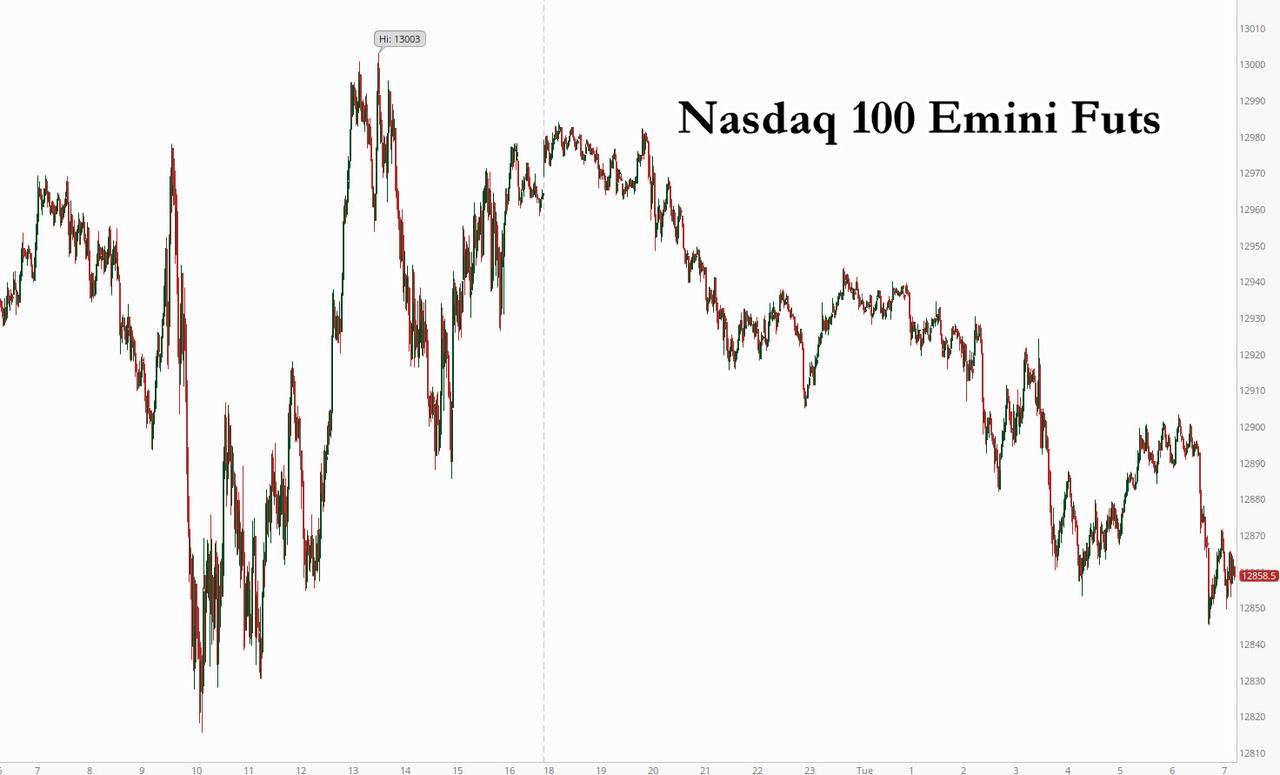
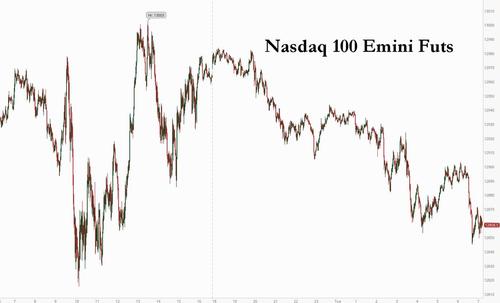
Nasdaq 100 futures slipped 0.7% as the FAAMG stocks dropped between 0.6% and 0.8% premarket, pressured by the latest reflation scare which pushed the 10Y as high as 1.77%. The Nasdaq -which is still about 7% below its all-time closing high, while bets on a speedy economic recovery driven by vaccine distributions and unprecedented stimulus has helped the S&P 500 and the Dow notch record closing highs last week – is set for its first monthly loss since November as rosy economic projections lifted demand for undervalued banks, energy, materials and industrial stocks.
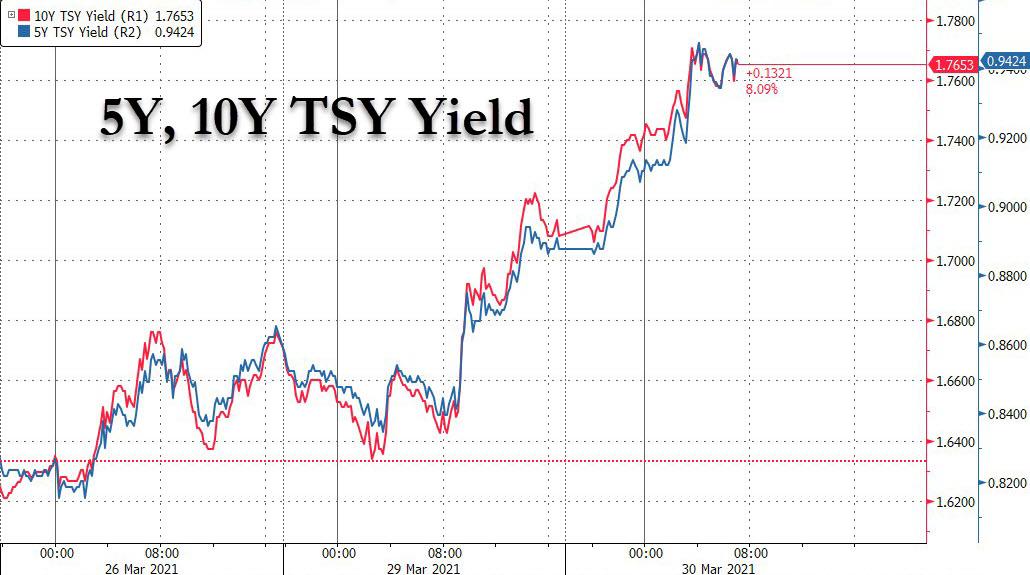
Traders are also focused on 10Y yields which rose as high as 1.77%, and even though there was no specific catalyst for the sharp move higher bonds have been weak ahead of President Joe Biden’s U.S. infrastructure plan details due Wednesday. Breaks of key levels appear to have fueled stops outs of long positions with 5-year yields edging above 0.90% during the Asian session. prompting a block sale in the sector and a similar pattern of follow through selling
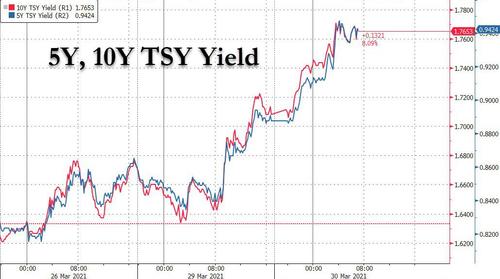
“U.S. Treasuries care more about inflation than Archegos fallout, and they continue their fall,” Steen Jakobsen, chief investment officer at Saxo Bank in Hellerup, Denmark, wrote in a note. “Biden’s speech might be catalyst for a deeper selloff.”

In an address Wednesday in Pittsburgh, Biden will detail a mass expansion of government spending aimed to reducing inequality and strengthening infrastructure. A revamp of the tax code is also part of the plan and is already proving divisive among economists and lawmakers.  The reflation trade was also boosted by the latest vaccine news after the U.S. reached a record three-day stretch of 10 million shots over the weekend, according to the Bloomberg Vaccine Tracker, and plans to offer inoculations to 90% of adults. Investor sentiment is still closely tied to the pace of the global vaccine rollout, said Citigroup equity derivative solutions director Elizabeth Tian. “Investors will also be watching the number of COVID cases as rises in Western Europe and the Philippines see the return of renewed restrictions, while vaccination attempts threaten to stall amidst supply constraints and vaccine nationalism,” Tian said. “While restrictions are increased in Europe, the UK will be relaxing stay-at-home rules.”

Meanwhile, Nomura shares were down a further 1.1% Tuesday after dropping as much as 16% on Monday, when it revealed it might take a $2 billion loss from the hedge fund fallout. “From a market perspective, with contagion looking limited … despite the news flow of further forced liquidations and prime brokerage losses, this looks at this stage to be a positioning-driven sell-off in U.S. futures and various single stock names,” said Eleanor Creagh, market strategist at Saxo Bank. Creagh added that further forced deleveraging was still a risk if prime brokers tighten margin requirements.

MSCI’s All Country World Index, which tracks stocks across 49 countries, traded flat.

In Europe, the Stoxx 600 Index advanced 0.4%, supported by gains in banks and automakers. Britain’s FTSE 100 was up 0.2%, Germany’s DAX 0.6%, Italy’s FTSE MIB rose 0.3%, and France’s CAC 40 rose 0.5%. The banks’ subgroup index rose 1.7%, followed by a 1.5% jump in automakers’ shares.

Earlier in the session, MSCI’s broadest index of Asia-Pacific shares outside Japan was 0.6% higher, after a two-day gain, with losses in Japan and some Southeast Asian markets offsetting a rally in China and South Korea. Mainland China’s CSI300 index rose 1%. Hong Kong’s Hang Seng Index gained 1.2% to reach 28,668, driven up by a rebound in the city’s tech stock index. That index has been under pressure from concern over the Chinese government’s move to increase regulation of tech companies. Japan’s Topix declined 0.8%, halting a three-day rally, as a majority of stocks on the index traded without rights to their next dividends. Nomura Holdings extended losses after plunging by a record on Monday, when the brokerage said it may have incurred a “significant” loss arising from transactions with a U.S. client. Equity gauges in Indonesia and the Philippines were the biggest losers in the region. Sector-wise, financials were the biggest drag on the MSCI Asia Pacific Index. Meanwhile, stocks in China, Hong Kong and South Korea and India rallied, with the CSI 300 Index set for third day of gains. The gauge has been anchored at a key support level as traders awaited further clarity from corporate earnings. Shares of Taiwan-based Appier Group, which offers artificial intelligence-based software, rose 19% in their trading debut on the Tokyo Stock Exchange

Japan’s Topix fell, halting a three-day rally, as a majority of stocks on the index traded without rights to their next dividends. Telecommunication firms and trading companies were the heaviest drags on the Topix as over 1,500 of the gauge’s more than 2,100 firms went ex-dividend. The Nikkei 225 Stock Average gained for a fourth consecutive day even as 188 of its 225 members went ex-dividend. “It was the unique situation with the supply demand that impacted markets today, with shares trading ex-dividend,” said Masahiro Ichikawa, chief market strategist at Sumitomo Mitsui DS Asset Management Co. “The market seems to have calmed somewhat now, but finance-related shares are a bit weak.” Nomura Holdings fell for a second day after announcing Monday that it may have incurred a “significant” loss arising from transactions with a U.S. client. The loss is related to the unwinding of trades by Bill Hwang’s Archegos Capital Management, according to people familiar with the matter. “In the global market of excess liquidity, we can’t be sure that Archegos is the only fund that took such one-sided positions in investing,” said Hideyuki Ishiguro, a senior strategist at Daiwa Securities Co. in Tokyo. “This kind of uncertainty will serve as a drag on the market.”

In rates, 10-Y Treasury yields were 1.76%, rising as much as 6.6bp to 1.774%, the highest since January 2020; into the selloff 5-year yields breached 0.90% for the first time since March 2020. The five-year rate rose as high as 0.95%, a 13-month high, followed by a block sale in the notes. Belly yields remain higher by 5bp-7bp with focal points include U.S. President Biden’s plan for an infrastructure spending package, with details expected Wednesday.Intermediate-led selloff cheapened 2s7s30s fly by 7bp on the day to 25.3bp, widest since 2018. In Europe, Bunds and gilts both trade slightly cheaper vs Treasuries; 10,000 bund contracts were sold via block trade, worth around $1.8m/DV01

As a reminder, quarter-end rebalancing remains a focus, is expected to favor buying of Treasuries. Bank of America sees $41BN inflows for Treasuries while Wells Fargo expects U.S. corporate- defined pensions moving a “historically large” $19b into bonds.

In FX, the Bloomberg Dollar Spot Index rose to its highest level in three weeks and the euro fell to a low of $1.1733 in early London trading; the Bund yield curve bear-steepened in line with developments in Treasuries. The dollar sliced through the key psychological 110 mark versus the yen as elevated U.S. Treasury yields and the improving global economic outlook continue to boost the greenback, and options suggest that the strength is here to stay. The Australian and New Zealand dollars were steady against the rising dollar, with risk appetite supported by a quickening U.S. vaccine rollout and expectations for a continued recovery in China’s economy. The Canadian dollar and the Norwegian krone also held up well against a backdrop of rising oil prices and a new round of OPEC+ talks later this week where the producers believe their defiantly cautious approach is paying off.  China’s yuan consolidated after slumping to the weakest level in almost four months on Monday. The USD/CNY rises as much as 0.2% to 6.5799 before erasing most of the earlier gain; USD/CNH stays in a narrow a range of 6.5683-6.5836. The PBOC weakened the daily reference rate by 0.34% to 6.5641 vsaverage estimate of 6.5643 in a Bloomberg survey; forecasts ranged from 6.5610 to 6.5685.

Bitcoin gained about 2% after Reuters reported that PayPal Holdings Inc is set to announce that it has started allowing U.S. consumers to use their cryptocurrency holdings to pay at millions of its online merchants globally.

In commodities, oil declined for the first time in three days as the Suez Canal opened up after being blocked for days by a grounded supercarrier and as attention turned to an OPEC+ meeting this week, where the extension of supply curbs may be on the table amid new coronavirus pandemic lockdowns. Gold extended a drop, falling out out of a range held since early March as President Joe Biden prepared to unveil big spending plans after announcing major progress on rolling out vaccines

Looking at the day ahead, the data releases from Europe include the Euro Area’s final consumer confidence reading for March and the preliminary German CPI reading for March. Over in the US, there’s the FHFA house price index for January and the Conference Board’s consumer confidence reading for March. Otherwise, central bank speakers include Fed Vice Chair Quarles and New York Fed President Williams, along with the ECB’s Centeno.
Market Snapshot

  • S&P 500 futures little changed at 3,958.75
  • SXXP Index up 0.5% to 429.83
  • German 10Y yield up 5 bps to -0.27%
  • Euro down 0.2% to $1.1742
  • MXAP little changed at 204.97
  • MXAPJ up 0.4% to 680.14
  • Nikkei up 0.2% to 29,432.70
  • Topix down 0.8% to 1,977.86
  • Hang Seng Index up 0.8% to 28,577.50
  • Shanghai Composite up 0.6% to 3,456.68
  • Sensex up 2.3% to 50,144.47
  • Australia S&P/ASX 200 down 0.9% to 6,738.45
  • Kospi up 1.1% to 3,070.00
  • Brent futures down 0.6% to $64.59/bbl
  • Gold spot down 0.7% to $1,699.44
  • U.S. Dollar Index up 0.1% to 93.07

Top Overnight News from Bloomberg

  • Chinese sovereign bonds will have the sixth-largest weighting in FTSE Russell’s flagship World Government Bond Index, though global investors have three times longer than they expected to grow their holdings to that level
  • Germany increased planned bond sales in the second quarter by 2.5 billion euros ($2.9 billion), as the government ramps up borrowing to help offset the impact of the coronavirus pandemic
  • Turkish President Recep Tayyip Erdogan appointed Mustafa Duman, formerly an executive director at Morgan Stanley in Turkey, to the central bank’s interest-rate setting committee, as the shake-up at the monetary authority deepens
  • A European Commission sentiment index increased to 101.0, exceeding all estimates in a Bloomberg survey. Sentiment rose across all sectors of the economy and particularly strongly in Germany, the region’s largest member. Employment expectations jumped
  • Wall Street banks grappling with the implosion of Bill Hwang’sinvestment firm spent Monday briefing U.S. regulators as Washington starts to dig into one of the biggest fund blowups in years
  • More than half of the population of England was estimated to have Covid-19 antibodies in the week ended March 14, illustrating the impact of the U.K.’s vaccination program

A quick look at global markets courtesy of Newsquawk

Asia-Pac stocks just about shrugged off the early indecision following the negative bias stateside where the DJIA posted fresh record levels but most indices declined as sentiment was dampened due to the fallout from the USD 20bln Archegos liquidation and with a rise in yields, as well as ongoing COVID-19 concerns adding to the glum mood. ASX 200 (-0.9%) and Nikkei 225 (+0.2%) swung between gains and losses with the former eventually dragged lower by weakness across commodity-related sectors and reports of further virus cases in Queensland where there is an ongoing 3-day lockdown in the state capital, while the Japanese benchmark lacked firm direction as Nomura shares extended on the prior day’s largest decline on record, triggered by the losses related to the recent Archegos margin call but with losses in the index cushioned by currency weakness and mostly better than expected Unemployment and Retail Sales data. Hang Seng (+0.8%) and Shanghai Comp. (+0.6%) were initially choppy amid a deluge of earnings releases and heading into quarter-end, although Chinese markets eventually gained as participants digested the FTSE Russell announcement for the inclusion of Chinese government bonds to its FTSE World Government Bond Index at a weight of 5.25% which will occur over 36 months from the effective date of 29th October 2021 which HSBC estimated could result to around USD 130bln of inflows to Chinese bonds. Finally, 10yr JGBs were lacklustre amid the spillover selling from USTs and with demand also sapped amid the 2yr JGB auction later which resulted into a lower b/c despite a decline in accepted prices.

Top Asian News

  • Buffett-Backed BYD’s Profit Surges 162% on Electric-Car Boom
  • Toyota Defies Global Semiconductor Crunch as Output Rises
  • Pakistan Starts Marketing Dollar Bond After Resuming IMF Bailout
  • Hyundai Motor to Halt Production on Chips, Parts Shortage

European equities (Eurostoxx 50 +0.2%) have kicked the session off on a firmer footing once again with little in the way of fresh macro newsflow driving the move. One of the key themes for the session thus far has been continued rises in global bond yields with the US 10yr yield taking out its recent 1.7540% peak to breach 1.77% to the upside. In the US, this has placed some pressure on the rate-sensitive e-mini Nasdaq 100 (-0.4%), which lags its stateside counterparts; e-mini S&P U/C and e-mini Russell +0.5%. In the more cyclically-focused European indices, banking names have led the charge higher with the Stoxx 600 Banking Index up by around 2% amid the favourable yield environment. Notable gains have also been observed in Basic Resources, Insurance, Autos and Travel & Leisure. Market participants will be eyeing the sustainability of the latter in lieu of the ongoing third wave of COVID-19 in the Eurozone which has subsequently prompted UK press to speculate that “next week’s review of international travel will likely conclude that it’s too soon to say when the borders can be reopened”, according to The Sun. To the downside, Health Care names reside in negative territory with defensive names shunned in early trade. In terms of stock specifics, Volkswagen (+3.1%) is a notable gainer in the auto sector as market participants continue to weigh up the Co.’s future in the EV space with recent reports suggesting a potential name change for its American unit to Voltswagen of America. In the financial sector Credit Suisse (-1.7%) was initially a beneficiary of the broader impulses in banking names, however, the Co. continues to remain in the news cycle given its exposure to the recent Archegos liquidation – and that initial strength has since reversed. Accordingly, one of the Co.’s. largest shareholders has requested that Chairman, Urs Rohner, receives a pay cut after a series of mistakes while speculation continues to mount around the magnitude of its exposure. In the tobacco space, a “good start to the year” was not enough to prevent Imperial Brands (-1.7%) from delving into the red following its latest trading update with the sector also hampered by comments from the UK Environment Ministry suggesting it could force tobacco names to pay for the clearing up of cigarette butts.

Top European News

  • H&M Should Lay Low Until China Anger Blows Over, EU Chamber Says
  • Germany Increases Bond Sales by $2.9 Billion in Second Quarter
  • PPF Signals Deal Pipeline Intact After Billionaire Owner’s Death
  • Deliveroo Expected to Price London IPO at Bottom of Range

In FX, the Dollar index has finally attained 93.000+ status and is still bid between 92.882-93.176 parameters alongside US Treasury yields that have risen to new cycle highs along certain parts of the curve, but the DXY may have derived sufficient momentum to breach the psychological mark regardless given bullish month end factors, like the strong rebalancing buy signal vs the Yen, or further depreciation in the Euro on 3rd wave pandemic concerns. Indeed, Usd/Jpy has made a clean break above 110.00 to test 110.30 and Eur/Usd down through 1.1750 towards 1.1730 at one stage, leaving little in the way of support from a technical perspective before 110.50 and 1.1700 respectively. Ahead, US consumer confidence and a couple of Fed speakers, as Quarles and Williams orate as neutrals and current FOMC voters.

  • CHF – Not much protection for the Franc via big beat vs consensus in the Swiss KOF indicator as Usd/Chf hovers above 0.9400 and Eur/Chf straddles 1.1050 with very tight confines awaiting official reserves and ZEW investor sentiment on Wednesday.
  • NZD/AUD/GBP/CAD – All managing to hang on to the Greenback’s coattails, with the Kiwi and Aussie benefiting from only isolated and contained COVID-19 outbreaks and a sharp rise in bond yields overnight, while the Pound is also gleaning underlying impetus from the UK’s advanced position on vaccinations that is keeping the roadmap to lifting lockdown intact (for now at least). Nzd/Usd is just holding above 0.7000 as Aud/Usd pivots 0.7650 and Aud/Nzd rotates around 1.0900, while Cable is holding close to 1.3750 and Usd/Cad is keeping tabs on 1.2600 ahead of Canadian average earnings data.
  • SCANDI/EM/PM – Little independent direction for the Norwegian Krona via choppy crude prices or not as weak as expected retail sales, but Eur/Nok is hovering around 10.0500 and Nok/Sek is extending towards 1.0200 as Eur/Sek eyes 10.2500 following somewhat mixed Swedish sentiment indicators and in advance of scheduled comments from Riksbank Governor Ingves. Elsewhere, a sea of red for EM currencies and precious metals, but headline-grabbing declines for the Try following more retaliation against the CBRT for tightening the reins by Turkish President Erdogan who has now fired the Deputy Governor. Meanwhile, Xau has fallen below Usd 1700/oz as Gold folds amidst the Usd and UST squeeze.

In commodities, WTI and Brent front month futures opened the session on a softer footing but in a contained range, however, losses have since accelerated with the complex residing just off session lows. Downward pressure was seen in the wake of traffic resuming through the Suez Canal, however, attention may now begin to switch elsewhere. On this, eyes are expected to turn to the OPEC+ meeting later in the week, where participants will discuss maintaining output cuts. Due to the fragile COVID situation and fresh lockdowns, sources state that Saudi Arabia will support extending oil cuts through June as well as continuing its own 1mln BPD cut. Moreover, this would be in a bid to boost oil prices given the current uncertainty surrounding the virus and the economic outlook. As such, the market expectation is skewed towards an extension of cuts. The May WTI contract trades marginally above USD 61.00/bbl (vs high USD 62.27/bbl) whilst its Brent counterpart trades mid USD 64.00/bbl (vs high USD 65.41/bbl). Spot gold and spot silver are both seeing downside and are continuing to face downward pressure in correlation with Dollar strength and rising US yields. With the DXY reaching a 4-month high and yields a 14-month peak, gold notched its lowest price in more than three weeks as it slipped below USD 1,700/oz in early morning trade. At the time of writing, spot gold trades at USD 1,697/oz (vs high USD 1,714/oz) and silver trades just shy of USD 24.50/oz (vs high USD 24.76/oz). Onto base metals, LME copper saw overnight gains because of strong consumer demand in China, albeit gains have since been trimmed with the metal residing around 0.7% down for the session.

US Event Calendar

  • 9am: Jan. S&P CS Composite-20 YoY, est. 11.20%, prior 10.10%; 20 City MoM SA, est. 1.20%, prior 1.25%
  • 9am: Jan. FHFA House Price Index MoM, est. 1.2%, prior 1.1%
  • 10am: March Conf. Board Consumer Confidence, est. 96.9, prior 91.3; Expectations, prior 90.8; Present Situation, prior 92.0

DB’s Henry Allen concludes the overnight wrap

Following much anticipation ahead of the open as to the consequences of the block trades, the broader market impact proved to be relatively contained yesterday, with the S&P 500 down just -0.09% from its all-time high on Friday. Nevertheless, some of the names at the centre of the trades came under severe pressure, and bank stocks were the worst-performing of the 24 sectors in the S&P, as they shed -2.05% on the day in response, and all 18 members of that industry group moved lower on the day. The most severe impact was actually experienced by non-US banks however, with Nomura (-16.33%) seeing its largest daily move lower ever and Credit Suisse (-13.83%) experiencing its worst performance in over a year, as both warned that they faced sizeable losses in the wake of the selling. Nomura flagged a potential $2 billion loss, while Credit Suisse said that the loss “could be highly significant and material to our first quarter results”. In terms of the other affected companies, ViacomCBS fell a further -4.86%, and has lost more than half its value since a week ago, while Discovery fell another -1.47% – though this was relatively benign after last week’s -45.77% decline.

In terms of the latest overnight, Archegos Capital Management who were behind the forced liquidation finally released a statement on recent events, saying that “All plans are being discussed as Mr. Hwang and the team determine the best path forward.” Meanwhile Bloomberg reported that a Nomura executive had said they were in the process of assessing the cause of the loss, though it was hard to tell when the company would be able to determine the size. Nomura has fallen a further -1.13% lower in Asia this morning after its record fall the previous day, though as in the US, the broader impact seems to be contained at time of writing, with indices including the Nikkei (+0.14%), Shanghai Comp (+0.59%), Hang Seng (+1.17%) and Kospi (+1.14%) all posting gains. Meanwhile futures on the S&P 500 (-0.05%) are also only indicating a small decline at the open.

Elsewhere overnight, the Turkish Lira weakened another -0.77% against the US Dollar after President Erdogan removed central bank Deputy Governor Murat Cetinkaya and replaced him with Mustafa Duman, an ex-Morgan Stanley executive director in Turkey. That follows the removal of the Governor the weekend before last that led to one of the biggest selloffs in Turkish assets for years. Otherwise, data out of Japan has surprised somewhat to the upside, with the jobless rate in February staying at 2.9% (vs. 3.0% expected), and retail sales up +3.1% month-on-month (vs. +0.8% expected).

Back to yesterday, and the other big development was that the Ever Given ship in the Suez Canal was finally freed after nearly a week in place, thus allowing normal traffic to resume. Oil prices fell back in response to the news, though by the end of the session they’d actually moved higher, with Brent Crude (+0.63%) and WTI (+0.97%) both rising on the day. The consequences are still likely to stick around for a while however, with the Suez Canal Authority saying that it could take multiple days to clear the backlog of hundreds of ships that’s built up in recent days. Energy shares in the US fell back regardless of the slight uptick in oil prices with the S&P 500 energy sector down -1.26%, but the STOXX 600 Energy sector rose +0.65%.

More broadly in markets, investors took the block trades story in their stride on the whole as mentioned, with most equity indices seeing little change on the day. In the US, the Dow Jones (+0.30%) hit an all-time high, though the NASDAQ (-0.60%) saw a bigger pullback as tech stocks continued their underperformance. Over in Europe, the STOXX 600 (+0.16%) eked out a small gain to hit a post-pandemic high, and the DAX (+0.47%) advanced to an all-time high, though the STOXX Banks (-1.29%) lost ground in line with bank stocks elsewhere.

Over in the US, increasing details were coming through ahead of tomorrow’s major infrastructure speech by President Biden, with the Washington Post reporting that it would centre on ideas to repair physical infrastructure, invest in R&D and support clean energy, while other measures such as on childcare and healthcare would be unveiled next month. It also said that the plan could have “as much as $4 trillion in new spending and more than $3 trillion in tax increases”, though they’re not expected to make the new expansion of the child tax credit permanent. Meanwhile another notable development yesterday was that multiple outlets including Politico reported that Senate Majority Leader Schumer was prepared to pass not just a second but also a third reconciliation bill this year. For reference, reconciliation is the process where legislation is passed through the Senate that only requires a simple majority, rather than the 60 votes needed to override a filibuster. Normally, this can only be used once per fiscal year, but the fact that there wasn’t a budget resolution passed last year meant that they carried one over to pass the American Rescue Plan that was signed earlier this month. And while ordinarily that would leave just one further attempt remaining, it’s being reported that Schumer thinks that a provision in the 1974 Congressional Budget Act could allow a third attempt, which would offer the Democrats a potential opportunity to pass another bill this fiscal year without needing to rely on Republican votes.

Against this backdrop yields on 10yr US Treasuries rose +3.2bps to 1.708%, which is their highest closing level since the pandemic began, and they’re up a further +3.4bps this morning, to 1.742%, putting them just shy of the recent intraday high of 1.753% a couple of weeks back. Higher real rates (+2.5bps) drove the bulk of the move yesterday, though inflation expectations also reached fresh highs, with 10yr breakevens up +0.6bps to 2.37%, their highest level since 2013. Furthermore, the 2s10s yield curve steepened +3.0bps to 156bps, a level not seen since 2015. Europe similarly saw a move higher in rates, with yields on 10yr bunds (+2.8bps), OATs (+3.3bps) and gilts (+3.1bps) all rising over the session.

On the pandemic, there weren’t a great deal of major developments yesterday, though concern continued to rise in multiple regions as the number of global cases has been steadily rising for over a month now. Though Europe is at the forefront of a potential new wave, the head of the CDC in the US warned that they also risked facing a fresh wave of cases, with the trajectory looking “similar” to what happened in the EU a few weeks ago, as she said that “I just worry that we’ll see the surges we saw over the summer and over the winter again.” The data from John Hopkins shows that although cases fell consistently in the US from their high in early January to early March, since then there’s been a plateauing of the numbers. We did get some more positive news from a CDC report however yesterday, which showed that the Pfizer and Moderna vaccines were 90% effective at preventing infections after two doses, regardless of symptom status. This offers a sliver of optimism for the US where 29% of the population has now received at least one shot, with 16% fully vaccinated. New York was the latest state to announce plans to expand eligibility to all adults in the coming days, joining a majority of states now offering the jab as widely as possible. And President Biden announced that 90% of the US adult population should now be eligible by April 19. The US is on pace to be administering 3 million shots per day, with supply increasing as more Johnson & Johnson production comes online.

Wrapping up with yesterday’s data, the Dallas Fed’s manufacturing activity index for March, which rose to a two-and-a-half year high of 28.9 (vs. 16.8 expected). Notably there were more signs of inflationary pressures building, with the finished goods prices index up to 32.2, which is the highest since 2008. Meanwhile in the UK, mortgage approvals fell more than expected to 87.7k in February (vs. 95.0k expected), which was their lowest level since last August.

To the day ahead now, and the data releases from Europe include the Euro Area’s final consumer confidence reading for March and the preliminary German CPI reading for March. Over in the US, there’s the FHFA house price index for January and the Conference Board’s consumer confidence reading for March. Otherwise, central bank speakers include Fed Vice Chair Quarles and New York Fed President Williams, along with the ECB’s Centeno.
Tyler Durden
Tue, 03/30/2021 – 07:54

via ZeroHedge News https://ift.tt/31u3Bwj Tyler Durden