3/30/1875: U.S. v. Cruikshank argued.
from Latest – Reason.com https://ift.tt/2O46ykc
via IFTTT
another site
3/30/1875: U.S. v. Cruikshank argued.
from Latest – Reason.com https://ift.tt/2O46ykc
via IFTTT
UK Government Minister Says People Should “Call Out” Others For Hugging Their Loved Ones
Authored by Paul Joseph Watson via Summit News,
A government minister appeared on morning television to urge Brits to “call out” others if they were seen engaging “in an odd way,” such as hugging their loved ones.

Yes, really.
Nigel Huddleston, the UK’s minister for tourism and sport, made the remarks during an interview spot on BBC Breakfast.
“Despite the temptation, please don’t risk the health of your loved ones by actually hugging them,” said Huddleston, before going on to suggest that people should intervene if they witness such dreadful behavior.
“If you see someone behaving in an odd way then call them out on it”
Sports Minister, Nigel Huddleston MP says on #BBCBreakfast we should resist temptation to hug our loved ones ⤵️https://t.co/ISAN2H8U3m pic.twitter.com/g2GL3V59vX
— BBC Breakfast (@BBCBreakfast) March 29, 2021
“We all know the rules…if you see somebody behaving in a slightly odd way, then maybe call them out on it in a respectful way, because sometimes some people just forget,” he added.
Huddleston said it was “a little bit awkward” to refuse close physical contact but “in these circumstances it’s the right thing to do.”
Twitter users reacted to the minister’s comments with a mixture of disbelief and scorn.
“Hugging someone is odd? Christ we’ve been taken over by the Borg. Can imagine the lunatics taking photos of busy play areas now walking round with megaphones ‘calling people out’ Smiling face with open mouth and tightly-closed eyes,” said one.
“Odd behaviour as defined by year – 2019: Someone looking shady, potentially holding or carrying a suspicious package, with likely terror related intentions 2021: someone who hugs a close friend/relative,” said another.
Others were defiant in saying they would hug their loves ones, with one remarking, “I’m seeing my kids next weekend for the first time since the end of December! Wild horses wouldn’t stop me hugging them!”
The minister made the remarks on the day that lockdown in England took a further step towards easing, with people being allowed to meet outside in groups of up to six people.
However, as we previously highlighted, other public health officials have asserted that social distancing and mask wearing will continue for years no matter when the pandemic is declared to be over.
* * *
In the age of mass Silicon Valley censorship It is crucial that we stay in touch. I need you to sign up for my free newsletter here. Support my sponsor – Turbo Force – a supercharged boost of clean energy without the comedown. Also, I urgently need your financial support here.
Tyler Durden
Tue, 03/30/2021 – 06:30
via ZeroHedge News https://ift.tt/39o2GSr Tyler Durden
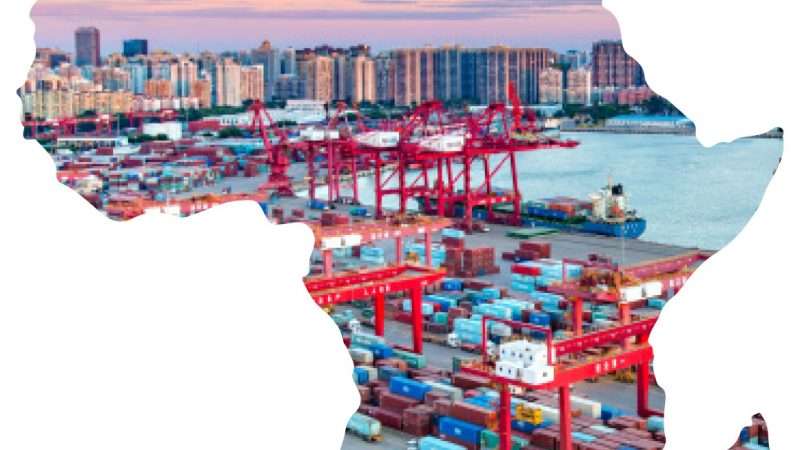
Economic nationalism has plagued Africa since decolonization. In 2021, that is set to change.
On January 1, the long-awaited African Continental Free Trade Area (AfCFTA) came into effect. Aside from the economic benefits that the arrangement will bring to the continent, Africa’s newfound support for free trade and liberalization marks a clear rejection of the socialist ideology that has tormented African politics for decades.
As it stands, 36 of the 55 African Union (A.U.) nations, including the regional economic powerhouses of Nigeria, South Africa, and Egypt (which together make up a third of the continent’s economy), have ratified the free trade area. Another 18 nations have indicated their support by signing the trade agreement and are expected to become full members soon. So strong is the appetite for free trade in Africa that Eritrea—often dubbed “Africa’s Hermit Kingdom”—is the only nation on the continent that remains reluctant to support the agreement.
Eritrea may eventually reconsider. Within 5–10 years, the AfCFTA will ensure that 90 percent of tariffs on goods traded between member states will be abolished. Within 13 years, 97 percent of all tariffs will be removed. By 2035, the World Bank has predicted, this enormous liberalization effort will boost Africa’s gross domestic product by $450 billion, increase wages for both skilled and unskilled workers by 10 percent, and lift more than 30 million people out of extreme poverty, defined as living on less than $1.90 per day. According to the same estimates, by 2035, the AfCFTA will see more than 68 million people rise out of moderate poverty, defined as living on $1.90–$5.50 per day. The “countries with the highest initial poverty rates,” the World Bank says, will see the “biggest improvements.”
The likely economic benefits of the AfCFTA are impressive. These rapid gains are ultimately a consequence of diverging from the economic nationalism that has kept much of the continent impoverished.
Africa’s turbulent relationship with socialism began in the late 1950s and early 1960s, when a plethora of newly independent states rejected the capitalist model. Many of the new leaders viewed capitalism and colonialism as synonymous. “In rejecting the capitalist attitude of mind which colonialism brought into Africa,” Julius Nyerere, the first president of Tanzania, said in 1963, “we must reject also the capitalist methods which go with it.”
In 1957, Ghana became the first African nation to achieve independence. Its leader, Kwame Nkrumah, a self-proclaimed “Marxian socialist,” suggested that only a “socialist transformation would eradicate the colonial structure of Ghana’s economy.” Before long, Nkrumah was encouraging other African states to seek independence so that they, too, could pursue the “complete ownership of the economy by the state.”
Many African leaders followed Ghana’s example. Sékou Touré of Guinea pursued “Marxism in African clothes,” banning all commercial activities not approved by the government. In Tanzania, the new constitution established the nation as a “socialist state” and pledged to “prevent the accumulation of wealth.” Léopold Senghor, the first leader of Senegal, said that after independence, Senegal would be guided “by Marx and Engels.”
The infatuation with socialism among Africa’s intelligentsia has meant that much of the continent’s economy has been mangled by central planning. For decades, debilitating policies such as price and wage controls, expropriation of private property, and inefficient state-owned enterprises were ubiquitous. The dev-astating human and economic costs imposed by these policies have filled the pages of many books.
As Free Africa Foundation President George Ayittey notes, the continent’s continuous love affair with socialism led to nothing but “economic ruin, oppression, and dictatorship.” Thanks to Africa’s recent turn toward liberalism, this abusive relationship may finally be over.
To highlight just how drastically outlooks have changed on the continent, it is worth comparing the A.U. to its predecessor, the Organization of African Unity (OAU). The OAU was set up in 1963 by Nkrumah, Nyerere, and several other socialist leaders. Nkrumah believed that “a united socialist Africa is a necessary condition for the realization of the African personality.” The organization’s founding members argued that the continent could prosper only by uniting behind socialism, rejecting the capitalist system, and disconnecting from the global economy. The OAU therefore was guided by a philosophy of “African socialism.”
By contrast, the A.U. has just implemented the world’s largest free trade area. In 2018, when the AfCFTA was introduced, Rwandan President Paul Kagame, then the union’s chairperson, described himself as an avid free-trader and an ideological disciple of Lee Kuan Yew, the first prime minister of free-trading Singapore. Similarly, the A.U.’s current chairperson, South African President Cyril Ramaphosa, has proclaimed that free trade will “unleash Africa’s economic potential.”
While there’s little doubt that socialism will continue to haunt some parts of the continent, it’s clear that, with the AfCFTA supported by 54 of the 55 A.U. member states, liberal ideas are beginning to gain traction on the world’s poorest continent. As African countries begin to embrace free trade, we can expect tens, if not hundreds, of millions of Africans to rise out of poverty in the coming years.
from Latest – Reason.com https://ift.tt/3sCyavJ
via IFTTT
Economic nationalism has plagued Africa since decolonization. In 2021, that is set to change.
On January 1, the long-awaited African Continental Free Trade Area (AfCFTA) came into effect. Aside from the economic benefits that the arrangement will bring to the continent, Africa’s newfound support for free trade and liberalization marks a clear rejection of the socialist ideology that has tormented African politics for decades.
As it stands, 36 of the 55 African Union (A.U.) nations, including the regional economic powerhouses of Nigeria, South Africa, and Egypt (which together make up a third of the continent’s economy), have ratified the free trade area. Another 18 nations have indicated their support by signing the trade agreement and are expected to become full members soon. So strong is the appetite for free trade in Africa that Eritrea—often dubbed “Africa’s Hermit Kingdom”—is the only nation on the continent that remains reluctant to support the agreement.
Eritrea may eventually reconsider. Within 5–10 years, the AfCFTA will ensure that 90 percent of tariffs on goods traded between member states will be abolished. Within 13 years, 97 percent of all tariffs will be removed. By 2035, the World Bank has predicted, this enormous liberalization effort will boost Africa’s gross domestic product by $450 billion, increase wages for both skilled and unskilled workers by 10 percent, and lift more than 30 million people out of extreme poverty, defined as living on less than $1.90 per day. According to the same estimates, by 2035, the AfCFTA will see more than 68 million people rise out of moderate poverty, defined as living on $1.90–$5.50 per day. The “countries with the highest initial poverty rates,” the World Bank says, will see the “biggest improvements.”
The likely economic benefits of the AfCFTA are impressive. These rapid gains are ultimately a consequence of diverging from the economic nationalism that has kept much of the continent impoverished.
Africa’s turbulent relationship with socialism began in the late 1950s and early 1960s, when a plethora of newly independent states rejected the capitalist model. Many of the new leaders viewed capitalism and colonialism as synonymous. “In rejecting the capitalist attitude of mind which colonialism brought into Africa,” Julius Nyerere, the first president of Tanzania, said in 1963, “we must reject also the capitalist methods which go with it.”
In 1957, Ghana became the first African nation to achieve independence. Its leader, Kwame Nkrumah, a self-proclaimed “Marxian socialist,” suggested that only a “socialist transformation would eradicate the colonial structure of Ghana’s economy.” Before long, Nkrumah was encouraging other African states to seek independence so that they, too, could pursue the “complete ownership of the economy by the state.”
Many African leaders followed Ghana’s example. Sékou Touré of Guinea pursued “Marxism in African clothes,” banning all commercial activities not approved by the government. In Tanzania, the new constitution established the nation as a “socialist state” and pledged to “prevent the accumulation of wealth.” Léopold Senghor, the first leader of Senegal, said that after independence, Senegal would be guided “by Marx and Engels.”
The infatuation with socialism among Africa’s intelligentsia has meant that much of the continent’s economy has been mangled by central planning. For decades, debilitating policies such as price and wage controls, expropriation of private property, and inefficient state-owned enterprises were ubiquitous. The dev-astating human and economic costs imposed by these policies have filled the pages of many books.
As Free Africa Foundation President George Ayittey notes, the continent’s continuous love affair with socialism led to nothing but “economic ruin, oppression, and dictatorship.” Thanks to Africa’s recent turn toward liberalism, this abusive relationship may finally be over.
To highlight just how drastically outlooks have changed on the continent, it is worth comparing the A.U. to its predecessor, the Organization of African Unity (OAU). The OAU was set up in 1963 by Nkrumah, Nyerere, and several other socialist leaders. Nkrumah believed that “a united socialist Africa is a necessary condition for the realization of the African personality.” The organization’s founding members argued that the continent could prosper only by uniting behind socialism, rejecting the capitalist system, and disconnecting from the global economy. The OAU therefore was guided by a philosophy of “African socialism.”
By contrast, the A.U. has just implemented the world’s largest free trade area. In 2018, when the AfCFTA was introduced, Rwandan President Paul Kagame, then the union’s chairperson, described himself as an avid free-trader and an ideological disciple of Lee Kuan Yew, the first prime minister of free-trading Singapore. Similarly, the A.U.’s current chairperson, South African President Cyril Ramaphosa, has proclaimed that free trade will “unleash Africa’s economic potential.”
While there’s little doubt that socialism will continue to haunt some parts of the continent, it’s clear that, with the AfCFTA supported by 54 of the 55 A.U. member states, liberal ideas are beginning to gain traction on the world’s poorest continent. As African countries begin to embrace free trade, we can expect tens, if not hundreds, of millions of Africans to rise out of poverty in the coming years.
from Latest – Reason.com https://ift.tt/3sCyavJ
via IFTTT
“Inflation Is Always A Political Choice”
As Jim Reid leaves the Deutsche Bank credit desk for the next few weeks (“I’ll be taking holiday and sending the kids to Easter holiday camp and playing golf every day as courses in the UK open on Monday for the first time in 3 months”), his last Friday “chart of the day” covers an especially sensitive topic: inflation.
As Reid writes, “there is clearly a lot of talk about inflation at the moment and a lot of talk about whether the Fed and ECB (amongst others) will meet their respective targets” However, for Reid personally, and a statement we wholeheartedly agree with, “inflation is largely a political choice in the fiat currency world that we’ve been in since 1971” and he explains why:
When you have full control over how much money you can print and spend, rather than the money supply be fixed to Gold, you can always create inflation if the inclination is there regardless of demographics, digitalisation, globalisation or weak growth.”
Appropriately, today’s CoTD shows average inflation for all the 87 economies that DB has data on going back to 1971 when the US (and with it the vast majority of rest of the world) cut ties to gold. What is remarkable, is that no economy has managed to keep average annual inflation below 2% since, with Switzerland (2.1%), Japan (2.3%), and Germany (2.5%) the closest. Only 28 out of 87 managed to keep inflation below 5% over the full period. The US is at 3.8%.
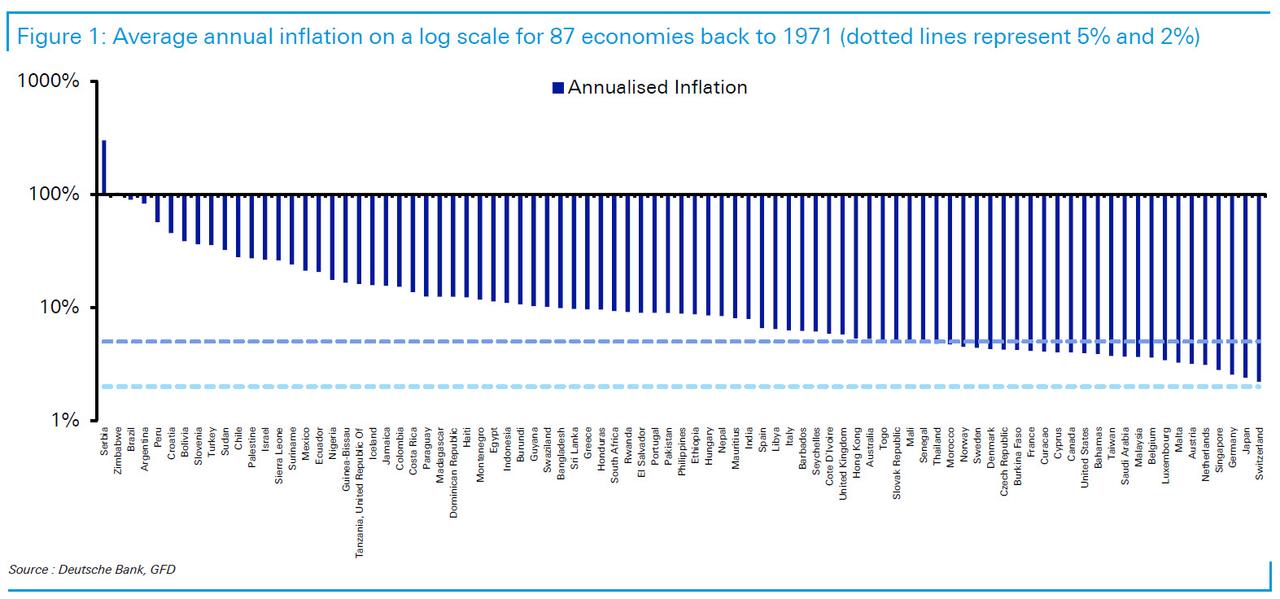
So, as Reid concludes, “inflation is a choice in a fiat money world. The question is whether politicians will choose it or not, advertently or inadvertently.”
To this we will just add that politicians and central bankers have already chosen, but they hope to be able to get away with soaring inflation – the kind that crushes the value of long-term debt – for as long as possible while lying to the population that soaring prices are only a conspiracy theory spread by evil Russian KGB spies.
It’s only after the facade of the deflationary lie falls away – leading to a speech such as this one from Jimmy Carter from October 1978…
… in which the former president called inflation “our most serious domestic problem”, that all hell breaks loose and the resulting panic prompts politicians to try to put the hyperinflation genie back into the bottle.
Good luck with that – back in the early 1980s, only Volcker’s hiking of rates to 20% made this possible. A similar hike now would lead to social collapse and/or war as the value of stocks – which have become the only defacto benchmark by which the status quo measures its success – would collapse by 80% or more, wiping out a majority of the world’s “net worth” and sparking unprecedented social upheaval. And that simply can never be allowed.
Which is why the government is already doing everything in its power to institutionalize universal basic income, “reparations” to blacks and other minorities, and generally boost incomes in what it very well knows will be a time of soaring prices. And the only thing it can do is boost incomes for as long as it can before the tsunami of soaring prices washes everything away.
Tyler Durden
Tue, 03/30/2021 – 05:45
via ZeroHedge News https://ift.tt/3fDL4Gv Tyler Durden
Great Success! US-Backed Fighters Seize US-Made Missiles Heading To Other US-Backed Fighters In Syria
In an unusual turn of events in Syria, militants once backed by the US have seized a shipment of US-made missiles that was heading to fighters currently backed by the US.

The missiles, US-made TOWs, were seized on March 28 by the Syrian Task Force, a joint force of the Turkish Police, Counterterrorism Unit and the National Syrian Army (SNA), near the Turkish-occupied town of Azaz in the northern Aleppo countryside.
According to the Turkish Ministry of Interior, the smugglers confessed that that they had been trying to transfer weapons to the Kurdish People’s Protection Units (YPG) and the Kurdistan Workers’ Party (PKK) in the town of Manbij in the northeastern countryside of Aleppo.
Beside two TOW anti-tank guided missiles (ATGMs), the weapons shipment included 24 AK-type assault rifles, a designated marksman rifle, two gun tubes and ammunition.
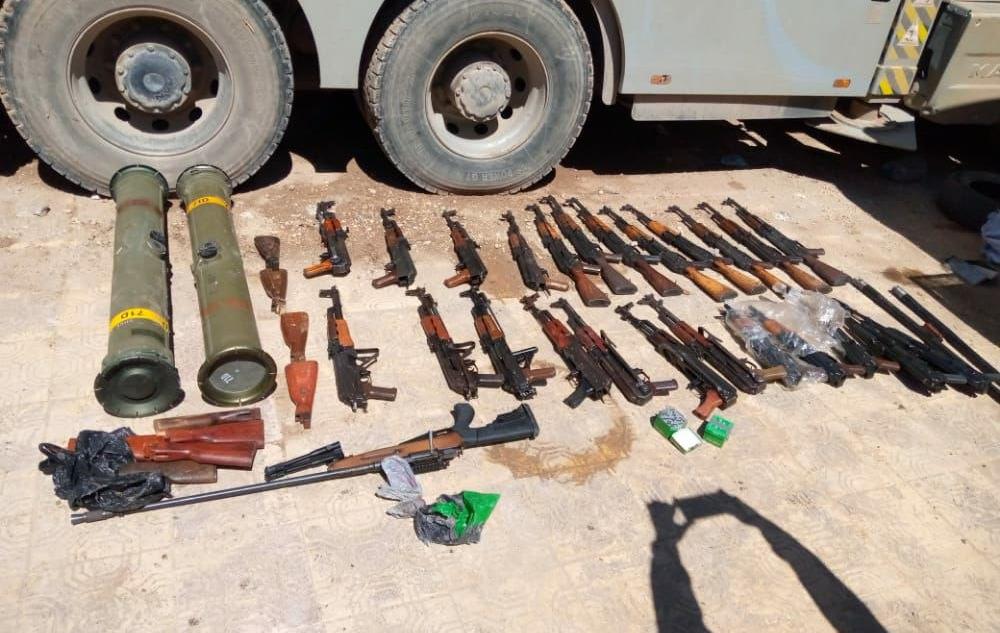
Click to see full-size image. Source: t.me/uom_03
Most SNA factions were once backed by the US, which supplied them with TOW ATGMs until late 2017. The YPG and the PKK, one the other hand, are the core of the Syrian Democratic Forces, which still receive US support.
Between 2012 and 2017, the US shipped loads of weapons and ammunition to rebels in Syria in an attempt to topple the government of President Bashar al-Assad.
The Central Intelligence Agency (CIA) and the Pentagon led these efforts to arm the Syrian rebels with a direct support from US allies in the Middle East, first and foremost Turkey, Jordan, Saudi Arabia and Qatar.
US efforts didn’t only fail to topple the Damascus government, but also ended up turning Syria into a large black market for advanced weapons. Many of the weapons supplied by the US and its allies found their way to the hands of terrorist groups like ISIS and al-Qaeda-linked Hay’at Tahrir al-Sham. Some of these weapons were found in Iraq and even Lebanon.
Today, weapons like TOW ATGMs, are being used by militants once supported by the US against Washington’s current proxies in Syria and vice versa.
The US plans to arm Syrian rebels inflamed the war, threatened neighboring countries and even ended up turning Washington’s tools against each other. Some not very tolerant social media users would call these great achievements a brilliant example of a“clusterf**k.”
Tyler Durden
Tue, 03/30/2021 – 05:00
via ZeroHedge News https://ift.tt/2PmPQ01 Tyler Durden
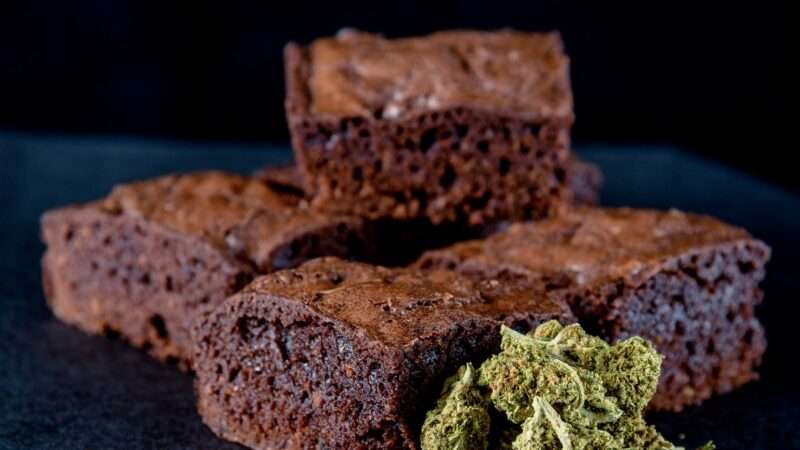
A Schertz, Texas, police detective will be given “employee coaching” after an investigation determined he provided false information to get a search warrant. Cpl. Chris Martinez told Guadalupe County Attorney David Wilborn that an informant had seen marijuana inside a home within the past 24 hours in a search warrant affidavit. Based on that, Wilborn approved a warrant request, and a judge signed the warrant. But Martinez had earlier told two employees of the county attorney’s office that the informant had not seen any drugs. Martinez later admitted the information on the affidavit was false and blamed it on a “cut-and-paste error.” The search found nearly 200 grams of marijuana brownies, but Wilborn says he cannot file any criminal charges because of the misinformation in the warrant.
from Latest – Reason.com https://ift.tt/3rIH3Tz
via IFTTT
Merkel Teases More COVID Restrictions After Bashing German States For Botching Response
After abandoning plans for a “draconian” 5-day Easter Weekend lockdown, German Chancellor Angela Merkel apparently hasn’t given up the fight to impose another economy-crushing round of lockdowns on the German people, who have lived with varying levels of restrictions for a year already.
In an interview that followed what the FT described as “one of the toughest weeks Merkel has faced as Chancellor” Merkel attacked the leaders of Germany’s 16 states, warning that they should not be reopening their economies, while threatening a new national curfew to slow the “third wave” of the virus.
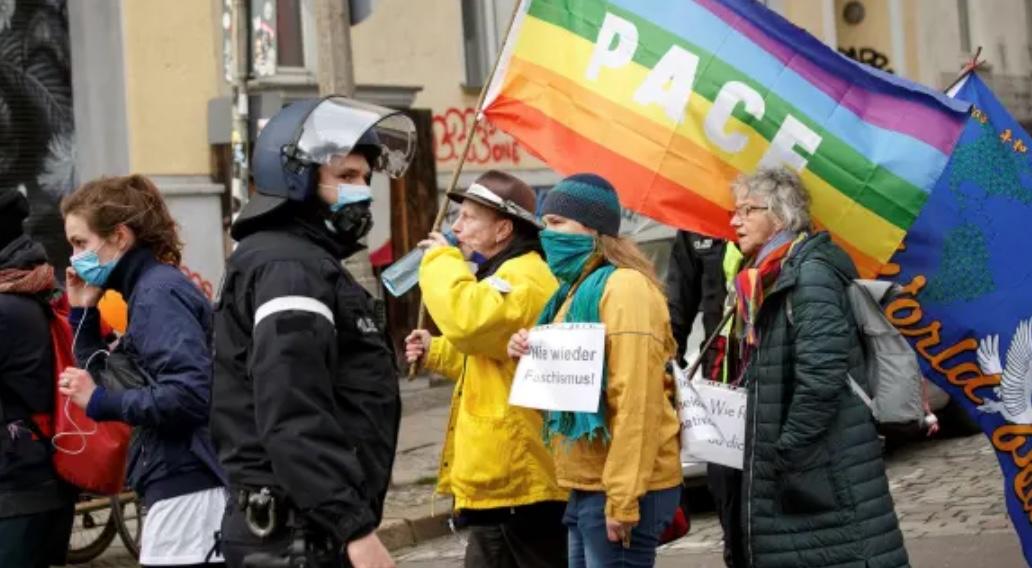
Speaking on Sunday evening, Merkel said Germany may need to take “additional measures” to contain the latest wave of cases. “We have the possibility of curfews, further contact restrictions, further mask-wearing,” she said.
Already, schools must carry out tests on pupils at least twice a week. Employers must allow their staff to work from home, and those who work at the office or factory must also take two tests per week, she added. This rule could soon carry the force of law if Merkel decides to tighten restrictions.
During the wide-ranging interview with German television channel ARD, Merkel faulted several states for failing to implement an “emergency brake” agreed on March 3. The measure requires states to halt plans to relax lockdown measures if the rate of infection in the population ever tops 1/100.
“Unfortunately, it is not being adhered to everywhere,” she said. “There are several states that are interpreting it very broadly, and that doesn’t fill me with joy.”
“What depresses and vexes me is that the good parts of a resolution are implemented…but the difficult part isn’t, as I would wish it to be,” Merkel said.
Specifically, Merkel slammed Armin Laschet, the prime minister of North Rhine-Westphalia, Germany’s most populous state, who was elected leader of her CDU party in January. Laschet has said the emergency brake will be applied only in certain areas where COVID is most prevalent, not the entire state. Merkel said Laschet was violating the principle of the emergency break, but that “he’s not the only one.” These lax enforcement measured caused the response to be “a bit delayed, and that cost us a lot of time and a lot of energy, and now with the third wave it looks like the same thing might be happening again.”
While deaths have continued to slow, Germany has seen its 7-day average for new cases rise to its highest level since January.
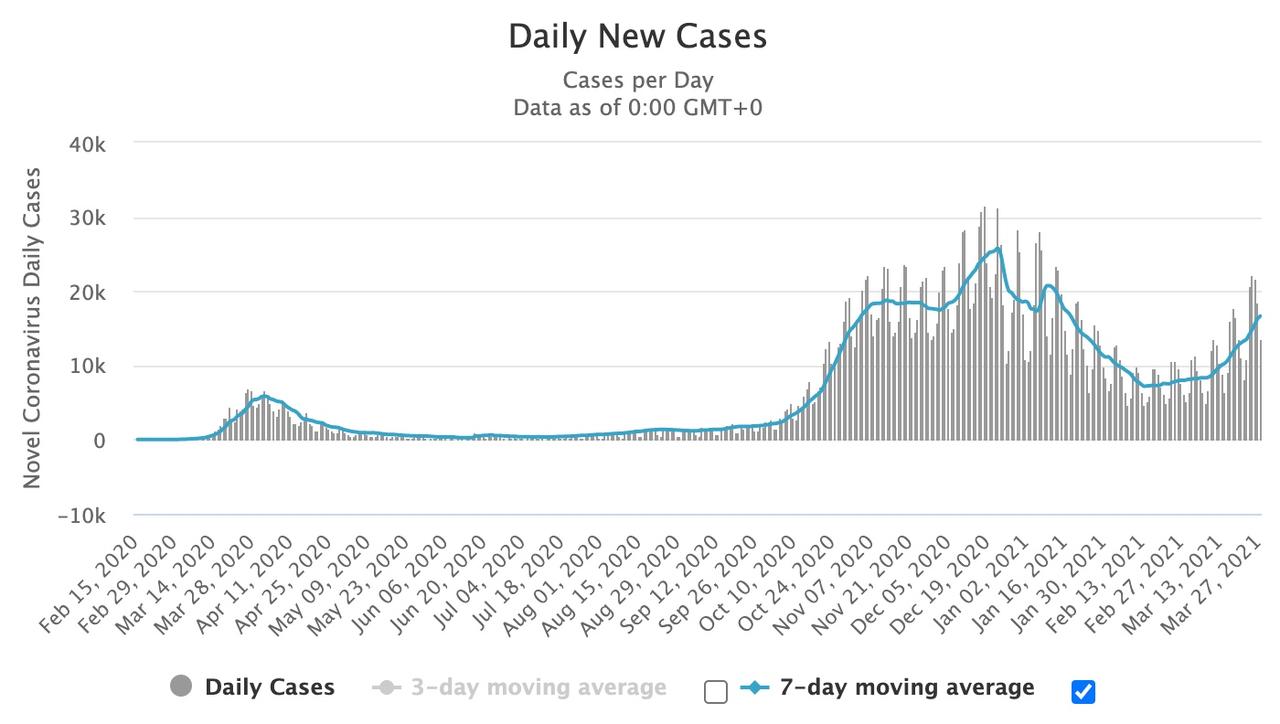

The latest wave of infections continued to grow over the weekend as the incidence of infections per 100,000 people in Germany rose to 130, from 104 a week ago, well above that key 100 threshold. The number of total confirmed cases increased by 17,176 to 2,722,401 on Sunday, while the death toll increased by 90 to 75,870.
Meanwhile, as more European nations move to extend or reinstate lockdown measures, UBS has just published its latest outlook for the eurozone’s economy, saying “longer and/or tighter lockdowns than previously assumed warrant a more cautious outlook for GDP and growth in Q1 and Q2021. Despite some positive payback in Q3 and Q4, we now expect an annual growth rate of 4.3%, down from 5.0% previously – still very decent, but not as impressive as we anticipated a few months ago.”
As for inflation: “we expect inflation to rise over the coming months, from 0.9% y/y in January to 2% or even slightly higher over the second half of the year, pushed up by one-offs and base effects.”
Of course, all these projections will ultimately depend on how many states bow to Merkel’s latest round of browbeating. One state that has vowed to reopen after Easter is the small region of Saarland in western Germany. Merkel acknowledged its infection numbers were relatively low “but they’re not stable…they’re not sinking.”
Tyler Durden
Tue, 03/30/2021 – 04:15
via ZeroHedge News https://ift.tt/39tKBTj Tyler Durden
A Schertz, Texas, police detective will be given “employee coaching” after an investigation determined he provided false information to get a search warrant. Cpl. Chris Martinez told Guadalupe County Attorney David Wilborn that an informant had seen marijuana inside a home within the past 24 hours in a search warrant affidavit. Based on that, Wilborn approved a warrant request, and a judge signed the warrant. But Martinez had earlier told two employees of the county attorney’s office that the informant had not seen any drugs. Martinez later admitted the information on the affidavit was false and blamed it on a “cut-and-paste error.” The search found nearly 200 grams of marijuana brownies, but Wilborn says he cannot file any criminal charges because of the misinformation in the warrant.
from Latest – Reason.com https://ift.tt/3rIH3Tz
via IFTTT
UK Now Considering Digital Face-Scanning To Enter Pubs
Authored by Paul Joseph Watson via Summit News,
The UK government is funding companies that are producing technology which will utilize digital face scans to check people’s vaccination status and allow or block them from entering pubs, stadiums and other venues.

“Britons could have their faces scanned to allow them to access pubs, gigs and sports events under one government-funded plan being drawn up for vaccine passports,” reports the London Times.
Two companies – Mvine and iProov – are working together on the system after being given a £75,000 grant by the government having already worked with the NHS on facial recognition technology in the form of the contact tracing app.
The technology is being proposed as a solution to concerns that presenting vaccination status via an app on a phone will be too slow when multiple people are entering a busy venue.
“Whoever is standing on the door of the pub is going to have to scan the certificate, read the name and date of birth, then ask the person for an ID document, check that the name and date of birth on the ID document are the same, squint at the photograph on the ID document and then make sure that the person in front of them is that person,” iProov CEO Andrew Bud said. “To which the answer is, that’s not going to happen.”
UK went from looking to covid vaccine passports to you need vaccine passports to face scan to enter a fricking pub in less than 6 months.
Face-scanning at pubs could offer key to vaccine passportshttps://t.co/A1C1wyCDm9
— ultrapurwater (@ultrapurwater) March 28, 2021
Bud said that the facial recognition system would reduce this process to a matter of seconds, streamlining the system.
“It speeds the process up and it absolves people of what would otherwise be a very heavy responsibility,” he added.
After months of promising that there would be no domestic vaccine passport, every indication is now that the government is going ahead with it.
Millions of Brits will refuse to submit to digital face scans to go about their everyday business, but the vast majority are likely to accept it without question, creating a two tier society where those who resist the biosecurity surveillance state will remain in a de facto permanent state of lockdown.
This again underscores the fact that the ‘vaccine passport’ is a digital identity card that citizens will be expected to carry at all times and use whenever they want to engage in basic commerce or other normal leisure activity.
* * *
In the age of mass Silicon Valley censorship It is crucial that we stay in touch. I need you to sign up for my free newsletter here. Support my sponsor – Turbo Force – a supercharged boost of clean energy without the comedown. Also, I urgently need your financial support here.
Tyler Durden
Tue, 03/30/2021 – 03:30
via ZeroHedge News https://ift.tt/3ujt7RF Tyler Durden