New COVID-19 Waves Sweep Through Asia

New COVID-19 Waves Sweep Through Asia

New waves of coronavirus infections have been sweeping through several countries in Asia, threatening to become more ferocious than previous outbreaks.

Infographic: New Coronavirus Waves Sweep Through Asia | Statista

You will find more infographics at Statista

Statista’s Katharina Buchholz notes that Philippines broke their record for new cases recorded in a day five times since March 19, recording almost 10,000 new cases on Friday, according to Johns Hopkins University. Looking at new cases in relation to population, the country is also the most affected in Asia. The 7-day rolling average of new cases per one million of population stood at more than 75 Sunday, followed by almost 42 new cases/million in India.

India saw 68,000 new cases Sunday, still below the September peak of almost 98,000, but rising rapidly. Bangladesh, where case numbers are growing at a similar rate to its larger neighbor, came very close to its daily record when it recorded 3,908 new cases that day. The number was just short of the 4,019 new infections that were recorded on July 2, 2020, at the height of the country’s first wave. Mongolia recorded 896 new cases on Sunday after having recorded more than 100 new cases in day for the first time ever on March 7.

Third-most affected in relation to population was Malaysia, but cases in the country have been slowing. Fifth-most affected Indonesia has also seen a light easing of the situation. This is according to numbers collected by research project Our World in Data located at the University of Oxford.

Other growing outbreaks are being monitored in Pakistan and once again in Japan (which would constitute a fourth wave for the country). Countries in Southeast Asia – Vietnam, Cambodia and Thailand – have also seen more new cases than usual. Yet, the overall number of cases in the little-affected region remains low. New infections remained at stable levels in South Korea, Singapore and Nepal.

Tyler Durden
Tue, 03/30/2021 – 02:45

via ZeroHedge News https://ift.tt/2O4igeG Tyler Durden

WaPo: Biden will make 11 judicial nominations on Tuesday

The Washington Post reports that President Biden will make 11 judicial nominations on Tuesday.

First, Judge Ketanji Brown Jackson will be nominated to replace Judge Garland on the D.C. Circuit. She is 50 years old

Second, Zahid N. Quraishi a magistrate judge in New Jersey, will be nominated to some district court. It is unclear which one, though I suspect the District of New Jersey, which has a massive backlog of cases. Quraishi attended Rutgers law school from 1997-2000. According to Law.com, he was born in July 1975, which would make him 44.

Third, Candace Jackson-Akiwumi will be nominated to the Seventh Circuit. She graduated Yale Law School in 2005 and graduated Princeton undergrad in 2000. I couldn’t find an exact birthday, but she is probably in her early 40s.

Fourth, Tiffany Cunningham will be nominated to the Federal Circuit. She graduated Harvard Law School in 2001, and completed a degree at MIT in 1998. She is also probably in her early 40s.

Fifth, Magistrate Judge Deborah Boardman will be nominated to the District of Maryland. She graduated UVA Law in 2000. She is probably in her mid 40s.

Sixth, Judge Lydia Griggsby of the U.S. Court of Federal Claims, will also be nominated to the District of Maryland. She is 53.

Seventh, D.C. Superior Court Judge Florence Y. Pan will be selected to fill Judge Brown Jackson’s seat on the District Court. She is 54.

Eight, Julien Neals, a county counsel and acting Bergen County administrator, will be nominated to serve on the District of New Jersey. He was previously nominated by President Obama in 2015, but his nomination expired in 2017. He is about 55 years old.

Ninth, Regina Rodriguez will serve on the District of Colorado. President Obama previously nominated her in 2016, but her nomination expired. She is about 57.

Tenth, Margaret Strickland will be nominated to the District of New Mexico. She was admitted to the Bar circa 2006. She is probably in her early 40s.

Eleventh, Rupa Ranga Puttagunta will be selected for D.C. Superior Court (a territorial, non-Article III Court). She graduated from Ohio State College of Law in 2007 and from Vassar College in 2002. She is probably in her late 30s.

With the exception of Judge Brown Jackson, I am not familiar with these nominees. None of these seats will have blue slip problems. They are either in DC, or states with two Democratic senators.

from Latest – Reason.com https://ift.tt/3cAQJLk
via IFTTT

WaPo: Biden will make 11 judicial nominations on Tuesday

The Washington Post reports that President Biden will make 11 judicial nominations on Tuesday.

First, Judge Ketanji Brown Jackson will be nominated to replace Judge Garland on the D.C. Circuit. She is 50 years old

Second, Zahid N. Quraishi a magistrate judge in New Jersey, will be nominated to some district court. It is unclear which one, though I suspect the District of New Jersey, which has a massive backlog of cases. Quraishi attended Rutgers law school from 1997-2000. According to Law.com, he was born in July 1975, which would make him 44.

Third, Candace Jackson-Akiwumi will be nominated to the Seventh Circuit. She graduated Yale Law School in 2005 and graduated Princeton undergrad in 2000. I couldn’t find an exact birthday, but she is probably in her early 40s.

Fourth, Tiffany Cunningham will be nominated to the Federal Circuit. She graduated Harvard Law School in 2001, and completed a degree at MIT in 1998. She is also probably in her early 40s.

Fifth, Magistrate Judge Deborah Boardman will be nominated to the District of Maryland. She graduated UVA Law in 2000. She is probably in her mid 40s.

Sixth, Judge Lydia Griggsby of the U.S. Court of Federal Claims, will also be nominated to the District of Maryland. She is 53.

Seventh, D.C. Superior Court Judge Florence Y. Pan will be selected to fill Judge Brown Jackson’s seat on the District Court. She is 54.

Eight, Julien Neals, a county counsel and acting Bergen County administrator, will be nominated to serve on the District of New Jersey. He was previously nominated by President Obama in 2015, but his nomination expired in 2017. He is about 55 years old.

Ninth, Regina Rodriguez will serve on the District of Colorado. President Obama previously nominated her in 2016, but her nomination expired. She is about 57.

Tenth, Margaret Strickland will be nominated to the District of New Mexico. She was admitted to the Bar circa 2006. She is probably in her early 40s.

Eleventh, Rupa Ranga Puttagunta will be selected for D.C. Superior Court (a territorial, non-Article III Court). She graduated from Ohio State College of Law in 2007 and from Vassar College in 2002. She is probably in her late 30s.

With the exception of Judge Brown Jackson, I am not familiar with these nominees. None of these seats will have blue slip problems. They are either in DC, or states with two Democratic senators.

from Latest – Reason.com https://ift.tt/3cAQJLk
via IFTTT

Nuclear Weapons Blazing: Britain Enters The US-China Fray

Nuclear Weapons Blazing: Britain Enters The US-China Fray

Authored by Ramzy Baroud via AntiWar.com,

Boris Johnson’s March 16 speech before the British Parliament was reminiscent, at least in tone, to that of Chinese President Xi Jinping in October 2019, on the 70th anniversary of the founding of the Republic of China. The comparison is quite apt if we remember the long-anticipated shift in Britain’s foreign policy and Johnson’s conservative Government’s pressing need to chart a new global course in search for new allies – and new enemies.

XI’s words in 2019 signaled a new era in Chinese foreign policy, where Beijing hoped to send a message to its allies and enemies that the rules of the game were finally changing in its favor, and that China’s economic miracle – launched under the leadership of Deng Xiaoping in 1992 – would no longer be confined to the realm of wealth accumulation, but would exceed this to politics and military strength, as well.

The Royal Navy Vanguard class nuclear submarine HMS Vengeance, via EPA

In China’s case, XI’s declarations were not a shift per se, but rather a rational progression. However, in the case of Britain, the process, though ultimately rational, is hardly straightforward. After officially leaving the European Union in January 2020, Britain was expected to articulate a new national agenda. This articulation, however, was derailed by the COVID-19 pandemic and the multiple crises it generated.

Several scenarios, regarding the nature of Britain’s new agenda, were plausible:

One, that Britain maintains a degree of political proximity to the EU, thus avoiding more negative repercussions of Brexit;

Two, for Britain to return to its former alliance with the US, begun in earnest in the post-World War II era and the formation of NATO and reaching its zenith in the run up to the Iraq invasion in 2003;

Finally, for Britain to play the role of the mediator, standing at an equal distance among all parties, so that it may reap the benefits of its unique position as a strong country with a massive global network.

A government’s report, “Global Britain in a Competitive Age”, released on March 16, and Johnson’s subsequent speech, indicate that Britain has chosen the second option.

The report clearly prioritizes the British-American alliance above all others, stating that “The United States will remain the UK’s most important strategic ally and partner”, and underscoring Britain’s need to place greater focus on the “Indo-Pacific” region, calling it “the centre of intensifying geopolitical competition”.

Therefore, unsurprisingly, Britain is now set to dispatch a military carrier to the South China Sea, and is preparing to expand its nuclear arsenal from 180 to 260 warheads, in obvious violation of the Non-Proliferation Treaty (NPT). The latter move can be directly attributed to Britain’s new political realignment which roughly follows the maxim of “the enemy of my friend is my enemy”.

The government’s report places particular emphasis on China, warning against its increased “international assertiveness” and “growing importance in the Indo-Pacific”. Furthermore, it calls for greater investment in enhancing “China-facing capabilities” and responding to “the systematic challenge” that China “poses to our security”.

How additional nuclear warheads will allow Britain to achieve its above objectives remains uncertain. Compared with Russia and the US, Britain’s nuclear arsenal, although duly destructive, is negligible in terms of its overall size. However, as history has taught us, nuclear weapons are rarely manufactured to be used in war – with the single exception of Hiroshima and Nagasaki. The number of nuclear warheads and the precise position of their operational deployment are usually meant to send a message, not merely that of strength or resolve, but also to delineate where a specific country stands in terms of its alliances.

The US-Soviet Cold War, for example, was expressed largely through a relentless arms race, with nuclear weapons playing a central role in that polarizing conflict, which divided the world into two major ideological-political camps.

Now that China is likely to claim the superpower status enjoyed by the Soviets until the early 1990s, a new Great Game and Cold War can be felt, not only in the Asia Pacific region, but as far away as Africa and South America. While Europe continues to hedge its bets in this new global conflict – reassured by the size of its members’ collective economies – Britain, thanks to Brexit, no longer has that leverage. No longer an EU member, Britain is now keen to protect its global interests through a direct commitment to US interests. Now that China has been designated as America’s new enemy, Britain must play along.

While much media coverage has been dedicated to the expansion of Britain’s nuclear arsenal, little attention has been paid to the fact that the British move is a mere step in a larger political scheme, which ultimately aims at executing a British tilt to Asia, similar to the US “pivot to Asia”, declared by the Barack Obama Administration nearly a decade ago.

The British foreign policy shift is an unprecedented gamble for London, as the nature of the new Cold War is fundamentally different from the previous one; this time around, the “West” is divided, torn by politics and crises, while NATO is no longer the superpower it once was.

Now that Britain has made its position clear, the ball is in the Chinese court, and the new Great Game is, indeed, afoot.

Tyler Durden
Tue, 03/30/2021 – 02:00

via ZeroHedge News https://ift.tt/31vDHIF Tyler Durden

The Great Unvaxxed – A ‘Fictional’ Look At What Lies Ahead

The Great Unvaxxed – A ‘Fictional’ Look At What Lies Ahead

Authored by TE Creus via Off-Guardian.org,

The vaccine was a resounding success. Yes, there had been a final death rate of 10% among the vaccinated, but this was mostly among the elderly or the already ill, so it was probably not the vaccine’s fault, and if it was, no one could prove it one way or another, and even if they could, well, the vaccine manufacturers were not liable to lawsuits due to the agreements they had made with the various governments.

In any case, the pandemic had ended, that was for sure.

Of course the masks and the lockdown mandates continued to be enforced; the reason was that while the pandemic had most certainly been defeated, the virus still existed in its natural form somewhere out there, and so it was vital to continue with the safety procedures to avoid any possible resurgence of the disease. 

So what? People got used to it, as they had gotten used to so many other things before that. And was wearing a mask in the end much worse than wearing a helmet or a safety belt? Was being forced to stay at home for a few months every year much different than being forced to be at the office working for five days out of the seven in the week? Rules are rules, and those were not as bad as others that had been instituted in the past. 

But there was something that worried the authorities. While most people had predictably complied with the mandatory vaccination campaign, there were a few groups that had refused them, alleging religious or health reasons, and found refuge in rural communities living off the grid. They had abandoned the use of mobile and network technology and so could not be traced so easily, and, since non-digital cash had been abolished, they appeared to have returned to a form of commerce based in the exchange of physical goods.

At first, the authorities ignored them; most people saw them as a minority of loser hicks, “anti-vaxxers” as they had been called in earlier pre-scientific times, and since it was unlikely that too many among the masses would opt for such a harsh lifestyle away from the comforts of modern urban life, they were not seen as a menace. 

But what happened, in the end, was that rumours started to appear, even in the cities, about small communities where no one needed to wear masks, and people were dancing and smiling, and food was delicious and natural and people were even – gasp! – falling in love and procreating in natural ways. 

Of course this was an obvious and mendacious falsity, but the authorities could not permit such fairy tales to gain acceptance among the people at large. So they started to persecute “the great unvaxxed”, as they called them, or the “free renegades” as they preferred to call themselves.
 
Their communities were dispersed. Their leaders were arrested. Planting organic, unmodified seeds became illegal.

It was dangerous, the authorities alleged. Non-genetically modified crops were unsafe and could lead to sickness or birth defects. Many of the people who lived in the previously free rural communities were arrested and forcibly vaccinated, or were killed in shootings with the police. 

But in the end it was not possible to arrest or forcibly vaccinate them all. Now, hidden among the normal population, using fake certificates, there lived an undisclosed number of unvaccinated people, whom the authorities had been unable to locate or identify. 

A young woman named Miranda, who was born in a barn in the literal sense, and never vaccinated, was one of them. When organic farming was prohibited and most of the land was taken over by large companies using mechanized agriculture, she was forced to move to a small village where she subsisted doing odd jobs and occasionally teaching art classes. She had learned drawing and painting sill as a child, and was quite talented; she could sing very well too.
 
She had a fake vaccine certificate that looked for all purposes almost identical to the real ones, and while a bio-test could determine that she had not really taken the shot, or the “jab” as it was popularly called, she was careful never to be in any position that could require any kind of test. 

For a few years she and hundreds of others like her had subsisted in this manner, but it was not ideal and never easy. Because before at least the renegades could live freely in their own communities, under their own rules, but now they had to hide and wear masks and follow dictates like everyone else, so what was the point? If they could not be free in any case, why not do like all the others and just take the jab and be done with it? 

Miranda thought about it sometimes. But she had promised her parents – who had died in a shootout with the police – that she would always remain faithful to their ideals. And so she refused to compromise. She knew, or hoped, that the current tyranny could not be maintained forever. She wanted to believe that it would be possible, one day, to be free again. 

Finally, they got her. It was her own stupid mistake; she was outside, a routine patrol was approaching and she had left her fake certificate at home. This would not normally happen, but she had recently bought a new jacket and had forgotten the certificate in the pocket of the old one.

Walking around without a certificate was illegal, so they had to scan her arm, finding no signs of vaccination, and later a second test found no trace of antibodies in her system. Unable to explain the reason, or to produce a valid vaccine certificate – she knew now that the fake one she had at home would now be microscopically analyzed and would not be useful any longer – she was taken to the local jail, and later to a federal prison. 

“There is an easy way out of this”, said Captain Antoine Huxley-Ehrlich, chief of the Vaccine Resistance Unit. “Just take the jab, and you’ll be free.”
 
“Never”, replied Miranda. “You’ll have to do it by force.”

That was an option, of course, and legally possible with the recent change in the constitution. But it was not what Antoine wanted. No, she had to freely choose the vaccine. Not only because otherwise she could have become a martyr and inspire other rebels, or because people could start to think that there really was something bad or sinister about the vaccine; but because he firmly believed that winning by persuasion was better than winning by force, and he was convinced of his own righteousness.

He could not understand her stubborn refusal – hadn’t he, like all others, voluntarily taken the vaccine? As a member of the upper classes, he reminded her, he was not required to do it at the time; and yet he had volunteered. Why? Because he believed in law and order, but, most of all, because he believed in the vaccine. 

He was sure that sooner or later he would be able to convince her that her uneasiness with the medication had only been caused by the trauma of her childhood experiences, living in a harsh rural area and watching her parents die as criminals fighting the law.  

But Miranda was indeed very stubborn. She refused all the options she was given. She preferred jail to vaccination and denial to compromise. She even refused to see a psychiatrist. So she lingered in prison for months and months.  

One day, the warden brought to her cell a new book that she had requested from the prison library – Civil Disobedience, by Thoreau. As she began to read, she found a handwritten note stuck between the first pages. “When you get your dinner tonight, ask for salt”, it said. “A friend”, it was signed. 

Who could that be? She was puzzled, as it was years since she last had any contact with anyone else from her former community. But later that evening, as the warden brought her dinner, she meekly asked if she could have an extra amount of salt. The warden didn’t betray any sign of recognition or suspicion; she just brought her a small white salt-shaker. There was nothing unusual about it, but when Miranda opened it, from the bottom, she found a small magnetic key and another note inside.

The note explained that the key would open her cell door, and that all the security guards had either been bribed or put out to sleep. She could safely escape. Further instructions indicated how to reach a cabin in the woods nearby where she would be able to join her colleagues from the resistance movement.  

She waited until midnight; when all was silent, she tried the key. It worked. She slowly walked out of her cell, then out of the prison, undisturbed. 

She followed the instructions to cover her face with a mask and her hair with a veil to avoid recognition. She was afraid a patrol would stop her as she left the city, as police presence was constant and sometimes there were curfews, but all the time she saw only a small group of policemen that she had no trouble evading.

She walked for several hours; the note had been clear that she should avoid any form of public transportation. It was already morning when she reached the destination informed, a few miles outside town. 

She knocked. No one answered. But she turned the handle and realized that the door was unlocked. She entered, very quietly, as if afraid to disturb the eerie silence. Finally, she saw a man sitting in an armchair, his back turned to her. He was wearing a dark jacket and a black fedora hat. 

“So you’re finally here”, he said. She seemed to recognize the voice, although she couldn’t quite locate it. Was it perhaps someone from her old community?
 
Then he turned towards her. It was Antoine Huxley-Ehrlich. 

It had been a trap, of course. The idea was to raise her hopes only to crush them, as an additional form of torture, an elaborate cat-and-mouse game. Also, now that she had tried to escape and join a rebel movement, she could be accused of sedition and other charges. She could easily be tried by a military court and condemned to death.

And that was exactly what happened.

She was offered a full pardon in exchange for vaccination, but still she refused. If she had to die, then she might as well die on her own terms. Like Saint Joan or the early Christian martyrs, she’d rather burn at the stake or be thrown to the lions than renege.
 
They could not convince her to get the “jab”, but they also did not want to turn her into some sort of hero for a cause, even if a crazy and hopeless one. So they decided that the execution would be done in secret, and the official story would be that, since she had refused several times the vaccination, she was never immune to the virus and had finally contracted the disease. 

Today Miranda will be shot. She refused all offers for public announcements of regret and even a last meal. She also refused the blindfold; she did not want anything to cover a single part of her face.
 
As the executioners raise their rifles, Miranda is not afraid. Her golden hair flutters in the wind, and she looks up at the soldiers with a confident smile. She knows that they can kill her body, but they cannot touch her soul. 

And as she waits for the bullets to slowly arrive, Miranda sings a song that she remembers from her childhood, a song that her mother taught her and perhaps she also sang before she died: 

And when you come and all the flowers are dying
If I am dead, as dead I well may be
You’ll come and find the place where I am lying
And kneel and say an Ave there for me.


Tyler Durden
Mon, 03/29/2021 – 23:40

via ZeroHedge News https://ift.tt/39tFQsG Tyler Durden

Red Hot: Sacramento House Receives 122 Offers In Two Days 

Red Hot: Sacramento House Receives 122 Offers In Two Days 

The housing boom unleashed by the Federal Reserve during the pandemic was built on historically low mortgage rates (thanks Powell), low inventory, city-dwellers moving to rural areas, and remote-work phenomenon. In the latest installment of the desperate frenzy of buyers fleeing for suburban life in California, one home received 122 offers in just two days. 

Sacramento’s FOX40 reports, a home in the Citrus Heights, a suburb of Sacramento, California, was listed for $399,900, and in just two days, received a mindboggling 122 offers. 

“People would think that it was underpriced. It was not underpriced. It was straight on with the comps,” Deb Brittan, the listing agent for the property, told FOX40. “I had hoped, I thought, maybe if we get 20 offers, that would be amazing.”

Many of the offers were well above the list price and in the seller’s favor. One offer was as high as $500,000. 

Barry and Anita Jackier are the sellers of the house who thought they would receive eight to ten offers. But to their surprise, they severely underestimated the interest they received in such a short span. 

“That’s 121 people who didn’t get a house. And that’s kind of heartbreaking in this market to think that there are so many buyers out there. And if you don’t have an agent that understands how to put a strategic offer in on a house and get it accepted, you’re just out burning your gas and a lot of emotional turmoil because of the nature of our market currently,” Brittan said.

Upon selling the home, Barry and Anita are moving to Idaho, where homes and living costs are more affordable. Many other Californians are doing the same

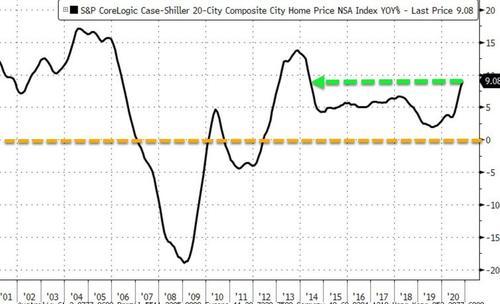
As we noted in the beginning, the Fed’s easy money policies during the pandemic have resulted in a housing boom as city-dwellers flee for suburban life. Housing inventory is extremely low, which has unleashed a bidding war between buyers among properties, pushing prices to bubbly territories. US home prices (as measured by the S&P CoreLogic Case-Shiller index of property values) have recently accelerated at the fastest pace in seven years. 

“This suburbanization trend has been slowly occurring since 2017, and we expect it to accelerate with the COVID-19 disruption,” Cowen analyst John Kernan wrote. “These results are also corroborated by a shift in homeownership.”

The rush to purchase homes in suburbia or rural communities is far from over as America’s metro areas are plagued with violent crime, socio-economic challenges, and declining real estate markets. 

With mortgage rates moving higher. How long will the housing boom last

Tyler Durden
Mon, 03/29/2021 – 23:20

via ZeroHedge News https://ift.tt/3u4VB15 Tyler Durden

First Appellate Court Ruling on CDC Eviction Moratorium Goes Against the Government


Eviction Moratorium

Today was a big day for the Centers for Disease Control eviction moratorium! First, the CDC extended the moratorium until June 30 (I wrote about that development here). Then, the US Court of Appeals for the Sixth Circuit issued the first appellate court ruling in the litigation over the moratorium’s legality. In Tiger Lilly, LLC v. Department of Housing and Urban Development, upheld a trial court decision holding that the moratorium is illegal. The Sixth Circuit’s reasoning is similar to that of the trial court in this same case, and that of one of the two previous district court decisions against the moratorium. Here is the key part of the opinion:

To slow disease transmission, the HHS Secretary, and the CDC by extension, can impose specific restrictions on both property interests, see 42 U.S.C. § 264(a), and liberty interests, see id. § 264(d). As to the former, the Secretary “may provide for such inspection, fumigation, disinfection, sanitation, pest extermination, destruction of animals or articles found to be so infected or contaminated as to be sources of dangerous infection to human beings, and other measures, as in his judgment may be necessary.” Id. § 264(a). The government asserts that a nationwide eviction moratorium is among the “other measures” for disease control that Congress envisioned when drafting the statute.

We disagree. This kind of catchall provision at the end of a list of specific items warrants application of the ejusdem generiscanon, which says that “where general words follow specific words in a statutory enumeration, the general words are construed to embrace only objects similar in nature to those objects enumerated by the preceding specific words.” Circuit City Stores, Inc. v. Adams, 532 U.S. 105, 11415 (2001) (citation omitted). The residual phrase in § 264(a) is “controlled and defined by reference to the enumerated categories...before it,” id. at 115, such that the “other measures” envisioned in the statute are measures like “inspection, fumigation, disinfection, sanitation, pest extermination” and so on, 42 U.S.C. § 264(a). Plainly, government intrusion on property to sanitize and dispose of infected matter is different in nature from a moratorium on evictions. See Terkel v. CDC, No. 6:20cv00564, 2021 WL 742877, at *6 (E.D. Tex. Feb. 25, 2021) (holding that the Halt Order exceeded the scope of the CDC’s authority and observing that “eviction is fundamentally the vindication of the property owner’s possessory interest”). The Halt Order thus falls outside the scope of the statute.

Like the two district court rulings, the Sixth Circuit emphasizes that the government’s interpretation of the statute would raise serious constitutional problems, because it would violate constraints on Congress’ ability to delegate power to the executive branch:

As the district court noted, the broad construction of § 264 the government proposes raises…. concerns about the delegation of legislative power to the executive branch. The government would have us construe the phrase “and other measures, as in his judgment may be necessary,” 42 U.S.C. § 264, as a “broad grant of authority” to impose any number of regulatory actions, provided the Secretary believes those actions will help prevent the spread of disease, regardless of whether they are in any way tethered to the “specific intrusions on private property described in the second sentence” of § 264. “In the absence of a clear mandate in the Act, it is unreasonable to assume that Congress intended to give the Secretary the unprecedented power” of that kind. Indus. Union Dep’t, AFLCIO v. API, 448 U.S. 607, 645 (1980) (plurality opinion). We will not make such an unreasonable assumption.

I have been beating the drum on this nondelegation issue since my very first commentary on the eviction moratorium, back when it was first issued by the Trump administration in September 2020. Many federal judges seem to have the same reservations.

The Sixth Circuit also concludes that the government’s interpretation of the law violates the rule that courts should not interpret federal law to usurp traditional areas of state government authority, unless Congress has clearly indicated its intent to do so:

[E]ven if we were inclined to construe the phrase “other measures” as expansively as the government suggests, we cannot read the Public Health Service Act to grant the CDC the power to insert itself into the landlordtenant relationship without some clear, unequivocal textual evidence of Congress’s intent to do so. Regulation of the landlordtenant relationship is historically the province of the states…. It is an “ordinary rule of statutory construction that if Congress intends to alter the usual constitutional balance between the States and the Federal Government, it must make its intention to do so unmistakably clear in the language of the statute.” Will v. Mich. Dep’t of State Police, 491 U.S. 58, 65 (1989) (quotation marks and citation omitted)… There is no “unmistakably clear” language in the Public Health Service Act indicating Congress’s intent to invade the traditionally Stateoperated arena of landlordtenant relationship.

Technically, today’s ruling is not a final decision on the merits of the case. All it does is reject the federal government’s motion to stay the district court ruling until such time as the appeal process is completed. However, one of the criteria for granting a stay is the appellate court’s assessment of the moving party’s likelihood of prevailing on the merits. For reasons discussed above, the Sixth Circuit panel concluded that the government has little or no chance of prevailing, and that is the reason why it rejected the motion for a stay. Thus, today’s ruling is almost certainly a preview of what the panel will conclude when it does decide on the merits (probably sometime in the next few weeks).

Like the trial court, the Sixth Circuit decision assesses the legality of Biden’s initial revival of the moratorium first issued by Trump. It does not consider today’s additional extension of the moratorium or the additional justifications offered by the CDC in its extension order. It is possible that the Sixth Circuit will reach a different conclusion when it issues its final decision on the merits, and has a chance to consider the latest version of the order. But for reasons I explained in my post about the extension earlier today, I think it is unlikely that courts will view legal rationale for new extension as any stronger than the old. We may soon see whether I am right about that or not.

In sum, we now have four rulings against the eviction moratorium (including the first appellate court ruling), and two in its favor. I analyzed the the previous decisions here, here, and here.

It is, perhaps worth noting that all three of the judges on the Sixth Circuit panel are Republican appointees, as were all three lower court judges who ruled against the moratorium. One GOP appointee and one Democratic one ruled in favor of the government. Thus, it is still possible that we will ultimately see an ideological split over this issue, despite the fact that the eviction order was first adopted by the Trump administration. For reasons I outlined here and here, liberal Democrats have good reason to be skeptical of the legality of this order, as much as do conservative Republicans. But liberal judges may not see it that way.

Be that as it may, it is at least clear that the case against the moratorium has legs. Multiple federal courts have now ruled against it. And the judges who issued those decisions are not easily dismissed as incompetents or wacky extremists. One of the judges on today’s Sixth Circuit panel is Amul Thapar, a George W. Bush nominee who is a major figure in conservative legal circles, and often considered a potential Supreme Court appointee. The fact that he thinks the moratorium is illegal doesn’t automatically prove that it actually is. But it does show that the arguments against it cannot be easily dismissed.

NOTE: The plaintiffs in some of the lawsuits against the eviction moratorium are represented by the Pacific Legal Foundation, where my wife works. I myself have played a minor (unpaid) role in advising PLF on this litigation.

from Latest – Reason.com https://ift.tt/3m1LJ5H
via IFTTT

First Appellate Court Ruling on CDC Eviction Moratorium Goes Against the Government


Eviction Moratorium

Today was a big day for the Centers for Disease Control eviction moratorium! First, the CDC extended the moratorium until June 30 (I wrote about that development here). Then, the US Court of Appeals for the Sixth Circuit issued the first appellate court ruling in the litigation over the moratorium’s legality. In Tiger Lilly, LLC v. Department of Housing and Urban Development, upheld a trial court decision holding that the moratorium is illegal. The Sixth Circuit’s reasoning is similar to that of the trial court in this same case, and that of one of the two previous district court decisions against the moratorium. Here is the key part of the opinion:

To slow disease transmission, the HHS Secretary, and the CDC by extension, can impose specific restrictions on both property interests, see 42 U.S.C. § 264(a), and liberty interests, see id. § 264(d). As to the former, the Secretary “may provide for such inspection, fumigation, disinfection, sanitation, pest extermination, destruction of animals or articles found to be so infected or contaminated as to be sources of dangerous infection to human beings, and other measures, as in his judgment may be necessary.” Id. § 264(a). The government asserts that a nationwide eviction moratorium is among the “other measures” for disease control that Congress envisioned when drafting the statute.

We disagree. This kind of catchall provision at the end of a list of specific items warrants application of the ejusdem generiscanon, which says that “where general words follow specific words in a statutory enumeration, the general words are construed to embrace only objects similar in nature to those objects enumerated by the preceding specific words.” Circuit City Stores, Inc. v. Adams, 532 U.S. 105, 11415 (2001) (citation omitted). The residual phrase in § 264(a) is “controlled and defined by reference to the enumerated categories...before it,” id. at 115, such that the “other measures” envisioned in the statute are measures like “inspection, fumigation, disinfection, sanitation, pest extermination” and so on, 42 U.S.C. § 264(a). Plainly, government intrusion on property to sanitize and dispose of infected matter is different in nature from a moratorium on evictions. See Terkel v. CDC, No. 6:20cv00564, 2021 WL 742877, at *6 (E.D. Tex. Feb. 25, 2021) (holding that the Halt Order exceeded the scope of the CDC’s authority and observing that “eviction is fundamentally the vindication of the property owner’s possessory interest”). The Halt Order thus falls outside the scope of the statute.

Like the two district court rulings, the Sixth Circuit emphasizes that the government’s interpretation of the statute would raise serious constitutional problems, because it would violate constraints on Congress’ ability to delegate power to the executive branch:

As the district court noted, the broad construction of § 264 the government proposes raises…. concerns about the delegation of legislative power to the executive branch. The government would have us construe the phrase “and other measures, as in his judgment may be necessary,” 42 U.S.C. § 264, as a “broad grant of authority” to impose any number of regulatory actions, provided the Secretary believes those actions will help prevent the spread of disease, regardless of whether they are in any way tethered to the “specific intrusions on private property described in the second sentence” of § 264. “In the absence of a clear mandate in the Act, it is unreasonable to assume that Congress intended to give the Secretary the unprecedented power” of that kind. Indus. Union Dep’t, AFLCIO v. API, 448 U.S. 607, 645 (1980) (plurality opinion). We will not make such an unreasonable assumption.

I have been beating the drum on this nondelegation issue since my very first commentary on the eviction moratorium, back when it was first issued by the Trump administration in September 2020. Many federal judges seem to have the same reservations.

The Sixth Circuit also concludes that the government’s interpretation of the law violates the rule that courts should not interpret federal law to usurp traditional areas of state government authority, unless Congress has clearly indicated its intent to do so:

[E]ven if we were inclined to construe the phrase “other measures” as expansively as the government suggests, we cannot read the Public Health Service Act to grant the CDC the power to insert itself into the landlordtenant relationship without some clear, unequivocal textual evidence of Congress’s intent to do so. Regulation of the landlordtenant relationship is historically the province of the states…. It is an “ordinary rule of statutory construction that if Congress intends to alter the usual constitutional balance between the States and the Federal Government, it must make its intention to do so unmistakably clear in the language of the statute.” Will v. Mich. Dep’t of State Police, 491 U.S. 58, 65 (1989) (quotation marks and citation omitted)… There is no “unmistakably clear” language in the Public Health Service Act indicating Congress’s intent to invade the traditionally Stateoperated arena of landlordtenant relationship.

Technically, today’s ruling is not a final decision on the merits of the case. All it does is reject the federal government’s motion to stay the district court ruling until such time as the appeal process is completed. However, one of the criteria for granting a stay is the appellate court’s assessment of the moving party’s likelihood of prevailing on the merits. For reasons discussed above, the Sixth Circuit panel concluded that the government has little or no chance of prevailing, and that is the reason why it rejected the motion for a stay. Thus, today’s ruling is almost certainly a preview of what the panel will conclude when it does decide on the merits (probably sometime in the next few weeks).

Like the trial court, the Sixth Circuit decision assesses the legality of Biden’s initial revival of the moratorium first issued by Trump. It does not consider today’s additional extension of the moratorium or the additional justifications offered by the CDC in its extension order. It is possible that the Sixth Circuit will reach a different conclusion when it issues its final decision on the merits, and has a chance to consider the latest version of the order. But for reasons I explained in my post about the extension earlier today, I think it is unlikely that courts will view legal rationale for new extension as any stronger than the old. We may soon see whether I am right about that or not.

In sum, we now have four rulings against the eviction moratorium (including the first appellate court ruling), and two in its favor. I analyzed the the previous decisions here, here, and here.

It is, perhaps worth noting that all three of the judges on the Sixth Circuit panel are Republican appointees, as were all three lower court judges who ruled against the moratorium. One GOP appointee and one Democratic one ruled in favor of the government. Thus, it is still possible that we will ultimately see an ideological split over this issue, despite the fact that the eviction order was first adopted by the Trump administration. For reasons I outlined here and here, liberal Democrats have good reason to be skeptical of the legality of this order, as much as do conservative Republicans. But liberal judges may not see it that way.

Be that as it may, it is at least clear that the case against the moratorium has legs. Multiple federal courts have now ruled against it. And the judges who issued those decisions are not easily dismissed as incompetents or wacky extremists. One of the judges on today’s Sixth Circuit panel is Amul Thapar, a major figure in conservative legal circles, and often considered a potential Supreme Court appointee. The fact that he thinks the moratorium is illegal doesn’t by itself prove that it actually is. But it does show that the arguments against the moratorium cannot be easily dismissed.

NOTE: The plaintiffs in some of the lawsuits against the eviction moratorium are represented by the Pacific Legal Foundation, where my wife works. I myself have played a minor (unpaid) role in advising PLF on this litigation.

from Latest – Reason.com https://ift.tt/3m1LJ5H
via IFTTT

Matt Taibbi Challenges Joe Scarborough: “Invite Me To Debate Your Network’s Putrid Russiagate Coverage”

Matt Taibbi Challenges Joe Scarborough: “Invite Me To Debate Your Network’s Putrid Russiagate Coverage”

Authored by Matt Taibbi via TK News

Joe Scarborough just had this to say on Morning Joe:

Joe begins his rant by insinuating that those who’ve spent time documenting errors on the Russiagate story are maybe on “Russia’s payroll,” which is nothing new for this network, of course, or frankly for the press in general during this time.

Implying that anyone who didn’t buy into the moral panic on Russia was a traitor was a fairly constant theme in media and politics in the last four years, with NBC’s smear of Tulsi Gabbard as a “favorite” of “Russia’s propaganda machine” being one of the ethical low points of the era. Why should Joe Scarborough be above the same tactics?

The exact quote:

I’m amused by so-called reporters who — I don’t know if they’re useful idiots for Russia, or if they’re on Russia’s payroll … but there are some gifted writers who spend all night and day, trying to dig through, looking for instances where the press screwed up on Russia stories.

He went on to say that yes, there were instances of mistakes, and some bad mistakes, but “more often than not,” the press got it right. Perhaps this could be a new slogan for the network:

MSNBC. We get it right. More often than not.

The full quote:

If you look at the totality of it, the totality of everything — I mean, yeah, the media screwed up at some points, and sometimes they screwed up badly… But more often than not, they got it right.

Obviously, I won’t presume that he’s talking about me when he mentions “some gifted writers” who may or may not be foreign spies, criticizing networks like his. He could be referring to Aaron Mate, or Glenn Greenwald, perhaps even Erik Wemple of the Washington Post, whose critique of Scarborough’s colleague Rachel Maddow’s Russia coverage was scathing enough.

It doesn’t matter, as the universe of people actually doing such work isn’t large. I do have a recent piece out, “Master List Of Official Russia Claims That Proved To Be Bogus,” that sounds like the kind of thing annoying him, so I’m happy to respond on behalf of the group.

The humorous thing about this is that the group of writers who have spoken out on this topic is small enough that we all communicate with each other. We’ve been able to calculate that I was actually the last of the Russiagate skeptics invited on MSNBC, on January 13, 2017 — before Trump’s inauguration — when I joined Chris Hayes and Malcolm Nance to discuss what at the time was a red-hot story.

The irony is that one of the major criticisms of the media’s performance on this issue is that it has not allowed any critics of the story to appear really anywhere in the mainstream press, and particularly not on television, for nearly four years. I doubt they will break that on-air pattern even now. Still, it’s worth asking Scarborough: if you’re so certain this issue is a “joke,” surely you won’t mind discussing it?

If you’d rather not have me on, I’m sure someone on the more critical side would be happy to walk you through exactly how far short of “right, more often than not” your network has been in the last five years or so. Most of the major outlets were terrible on this story, but MSNBC’s particular brand of suckage was visible from space during the key years of Russiagate. Which I’m happy to lay out for you. Come on — no matter how it turns out, it’ll be great TV!

Tyler Durden
Mon, 03/29/2021 – 23:00

via ZeroHedge News https://ift.tt/39qnOHL Tyler Durden

Pennsylvania’s Amish Community May Have Already Reached Herd Immunity

Pennsylvania’s Amish Community May Have Already Reached Herd Immunity

Sometimes, it seems like the last thing public health officials want is to see American return to “normal”, which is perhaps why the head of the CDC unleashed an unhinged, paranoid rand on the American people earlier today.

One month ago, speculation abounded about whether 7 US states might be close to the herd immunity threshold.

Now, local public health officials are speculating about whether Pennsylvania’s famous Amish and Mennonite communities living in Lancaster County have achieved herd immunity.

According to the New York Post, the administrator of a medical center in the heart of Lancaster County’s New Holland Borough has estimated that as many as 90% of the families in the community have had at least one family member infected. And that means practically everybody has been exposed to the virus.

“So, you would think if COVID was as contagious as they say, it would go through like a tsunami; and it did,” said Allen Hoover, an administrator of the Parochial Medical Center.

The center caters to the Amish and has more than 33K patients. While both communities initially complied with the stay at home orders, they reopened churches last spring, where they went back to sharing communion cops and “holy kisses” (described as a special church greeting).

As the virus tore through the community over the summer, by August, the area was reporting daily positivity rates (the share of those tested who test positive) north of 20%. Cases ebbed headed into the fall, but soon started to climb again as the weather turned colder.

Over the past 6 weeks, the parochial medical center hasn’t reported a single case of COVID. Eric Lofgren, an infectious disease epidemiologist at Washington State University, said herd immunity is possible but rare. “It would be the first general population in the United States that’s done it,” Lofgren said.

But although this truism has been widely quoted in the US media, we’d advise readers to remember that the exact threshold for herd immunity isn’t clear. Analysts at Goldman have predicted that most advanced economies will reach herd immunity by the beginning of Q3.

Others warned that previous infections might not protect patients from mutant COVID variants.

The only way to be 100% certain that a community has herd immunity is to vaccinate everybody, including children (the first vaccine trials for children, including young infants, have started as Pfizer tests the jab on children 11 and younger).

And even after that, we still won’t be sure.

Tyler Durden
Mon, 03/29/2021 – 22:40

via ZeroHedge News https://ift.tt/2QKub29 Tyler Durden