The Court Punts by Granting Cert in Cameron v. EMW Women’s Surgical Center

On June 2, 2020, a Sixth Circuit panel declared unconstitutional Kentucky’s regulation of second-trimester abortions. At the time, June Medical was pending before the Supreme Court. Of course, the panel could have waited till the end of June to render its decision. We all knew the decision was coming. But Judges Clay and Merritt decided time was of the essence. In dissent, Judge Bush urged the panel to “delay issuing an opinion in this case pending the Supreme Court’s disposition of June Medical Services.”

After the panel issued its decision, the Secretary for Health and Family Services (a Democrat) declined to defend the statute. The Attorney General (a Republican) tried to intervene. But the panel denied the motion to interview. The Attorney General filed a motion for rehearing. Once again, the panel denied that motion.

On October 30, the Attorney General filed a petition for a writ of certiorari. The petition presented two questions:

1. Whether a state attorney general vested with the power to defend state law should be permitted to intervene after a federal court of appeals invalidates a state statute when no other state actor will defend the law.

2. And if so, whether the Court should vacate the judgment below and remand for further consideration in light of June Medical.

The case was distributed for the March 19 conference, and was relisted for the March 26 conference. Today, the Court granted cert only on the first question presented. In other words, the Court will decide if the Attorney General could intervene.

The case likely will not be decided until June 2022. By granting cert, the Court has managed to keep the status of the abortion law in limbo for about more 15 months. If the Court rules against the Attorney General, then the case is over. And the Court will never decide if the Kentucky law survives June Medical review. But if the Court rules that the Attorney General can intervene, the case will go back to the Clay/Merritt panel. And, if history is any guide, the Attorney General will lose by late 2022 or early 2023. At that point, the Attorney General can seek rehearing en banc. A favorable decision may be had from the en banc court at some point in late 2023 or early 2024. No doubt, a cert petition will follow. And by that point, the Supreme Court may have 11 members. And in June 2025, Chief Justice Vanita Gutpa will write the majority opinion upholding the statute.

This statute was enacted in 2018. Because of the Supreme Court’s cert grant, this law could remain in limbo for 7 years. Nothing prevented the Court from granting cert on both questions. If the Court found the Attorney General could intervene, the Court would not need to decide the merits issue. But if the Attorney General could intervene, the merits question was teed up.

In December, I identified a taxonomy of four types of Supreme Court punts. Today’s order is a new one for me. Here, the Court granted cert on a procedural question, to delay ruling on the merits question. At least 6 Justices did not want to touch the second issue. If Justices Thomas, Alito, Gorsuch, and Kavanaugh/Barrett were ready, the Court could have granted cert on the second question. I half expected to see Thomas dissent, and say he would have granted both questions.

Now, there may be some strategery here. Perhaps the Court will grant one more abortion case next term that will clarify the scope of June Medical. (It surely isn’t Dobbs). Thus, the Court could rule for the Kentucky Attorney General, and remand in light of the new abortion precedent. But if the Court does not decide any abortion cases in OT 2021, the Kentucky issue could linger past the next presidential election.

from Latest – Reason.com https://ift.tt/3dgrnS5
via IFTTT

The Accelerating Rollout of COVID-19 Vaccines Makes Domestic ‘Immunity Passports’ Largely Irrelevant


Immunitypassport

Nearly 181 million doses of COVID-19 vaccines have been distributed in the United States, and more than 143 million of those have been administered. More than 93 million U.S. residents have received at least one dose of a COVID-19 vaccine, and more than 51 million people have been fully vaccinated—including 5 million inoculated with the Johnson & Johnson one-dose vaccine. This means that slightly more than 28 percent of the American population has gotten at least one dose, and 15.5 percent are fully vaccinated.

“When Israel hit about 25 percent of their population vaccinated, that’s when they started to see the [case] declines that were ascribed to the vaccination. We’re right about at that tipping point,” former Food and Drug Administration Commissioner Scott Gottlieb said on CNBC’s Squawk Box.

The latest real-world data show that both the Pfizer/BioNTech and Moderna vaccines are 80 percent effective at preventing both symptomatic and asymptomatic COVID-19 infections after one dose; after two doses, the effectiveness rises to 90 percent. Since both vaccines prevent asymptomatic disease, vaccinated people are unlikely to harbor undetected infections that could transmit the virus to unvaccinated people.

In clinical trials, the Johnson & Johnson vaccine was 85 percent effective at preventing severe disease and the AstraZeneca vaccine 76 percent effective at preventing symptomatic illness. All four vaccines are basically 100 percent effective at preventing COVID-19 hospitalizations and deaths.

Most epidemiologists believe that somewhere between 70 to 85 percent of the population will need to be protected through infection or vaccination to achieve herd immunity against the virus. With herd immunity, the epidemic abates because people who remain susceptible to infection are increasingly surrounded by immune individuals who serve as a barrier, preventing the microbes from reaching them.

Various polls suggest that about 30 percent of Americans are reluctant to get vaccinated against COVID-19. A recent Pew Research poll finds that the percentage of people saying that they will get vaccinated has been increasing as the vaccine rollout proceeds. Nevertheless, this still high percentage of vaccine-hesitant people threatens to undermine the possibility of getting back to normality through achieving herd immunity.

So how to persuade vaccine hesitant folks to get vaccinated? One suggestion is to issue immunity “passports” to fully vaccinated or fully recovered people. This has been happening since last month in Israel, where public health authorities are issuing Green Passes that grant vaccinated or recovered citizens access to social, cultural, and sports events as well as to gyms, hotels, and indoor dining at restaurants and bars. The passport system appears to have encouraged more people, especially the young, to get vaccinated.

Wouldn’t such immunity passports discriminate against people who want to be vaccinated but aren’t able to yet? George Washington University physician and health policy professor Leana Wen and her colleagues acknowledge that concerns about that kind of discrimination are real, but they point out that the “lack of access to vaccines will be a problem for just a matter of months as the distribution speeds up.” Leana and her colleagues argue that the bigger worry is “continued lack of herd immunity,” since that “could extend the current crisis for years to come with significant impacts on all communities.”

My Reason colleague J.D. Tuccille rightly worries that public health authorities could abuse such immunity passports. Nevertheless, since COVID-19 vaccination rates will vary greatly across the world for at least the next couple of years, some form of proof of vaccination will be undoubtedly required for international travel.

Beyond that, the accelerating distribution and administration of COVID-19 shots could make the incentive value of COVID-19 passports more or less moot. President Joe Biden just today announced that 90 percent of American adults will be eligible for the vaccination by April 19. The cohort of vaccine-hesitant Americans will shrink as ever more happily and now safely immune family members, friends, and neighbors urge them to protect themselves and others by getting vaccinated.

Disclosure: I am now two weeks past my second dose of the Moderna vaccine, from which I experienced no side effects whatsoever.

from Latest – Reason.com https://ift.tt/2O8CdRI
via IFTTT

Here’s How Biden’s Proposed Tax Increases Will Affect You


Biden-Cigar-Illustration-Chrom-Ab

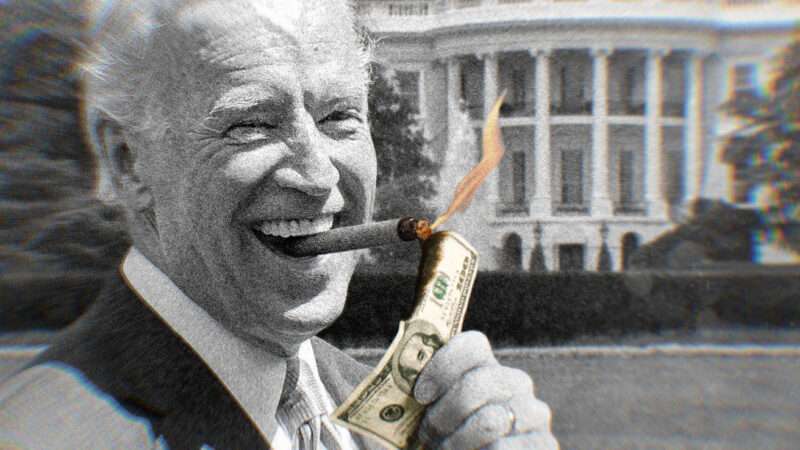
“The largest federal tax increase since 1942,” is how The New York Times, in a front-page news article, is describing President Joe Biden’s plan for the American economy.

The Times doesn’t specify precisely how it is measuring the size of the tax increase—in terms of nominal or real dollars raised or as a percentage of gross domestic product. Whatever the yardstick, it is newsworthy.

One thing that made me chuckle is that it’s only now—months after the inauguration—that the Times is waking up to the scale of Biden’s tax increase plans and sharing the news with its readership at the top of its Sunday front page. This is so even though Biden was fairly open about the details of the plan during the campaign.

Some voices had even been warning about it in advance of the election.

“Read Joe Biden’s Lips: New Taxes” was the headline on a July 2020 Wall Street Journal editorial.

“He has pledged a $4 trillion tax hike on almost all American families, which would totally collapse our rapidly improving economy,” President Trump said in August 2020 at the Republican National Convention.

“Biden’s plan to double the capital gains tax” was the headline over one blog post I wrote on the topic back in October 2020.

Why has reaction, at least so far, been relatively muted?

The pandemic, the Black Lives Matter protests, and the January 6 political violence all distracted from the tax issue.

The radical nature of the Democratic primary field—Sen. Elizabeth Warren (D–Mass.) and Sen. Bernie Sanders (I–Vt.) both favored a wealth tax—made Biden’s tax increases, while vast, seem more moderate by comparison.

And while Biden’s tax plans add up to a hefty hit overall, some of the pieces themselves seem incremental.

He’d increase the top corporate rate to 28 percent. That’s more than the current 21 percent, but still less than the 35 percent that applied between 1993 and 2017.

He’d increase the top individual income tax rate to 39.6 percent. That’s up from the current 37 percent, but it’s a rate that applied from 1993 to 2000 and again from 2013 to 2017, so it’s not exactly unknown ground.

The two most extreme aspects of the Biden tax plan each have political pitches behind them that are at least plausible. The 12.4 percent payroll tax for Social Security’s Old-Age, Survivors, and Disability Insurance is capped for 2021 on a wage base of $142,800. Biden would apply the tax to income above $400,000. That, not the increase to 39.6 percent from 37 percent, would be the real hit to high-income earners in the Biden plan. The combined effect—39.6 percent plus 12.4 percent—would be that at the margin, the federal government would take 52 percent, or more than half, of dollars earned over $400,000. There’s an additional Medicare tax of 3.8 percent, which would take the top federal marginal tax rate up to 55.8 percent.

To my mind, it’s just on its face unjust for the federal government to take more than half of what anyone earns.

The political explanation of this by the Democrats, though, is the combination of “bring back the top individual rates that we had under Clinton and Obama, when you all did pretty well” and “it’s unfair for Warren Buffett to pay a lower tax rate than his secretary,” which is partially a function of the current cap on the base for the Social Security payroll tax.

The other big piece of the Biden tax increase is a plan to bring the capital gains tax rate up to the earned income tax rate. Biden campaigned on that: “I think it’s about time we start rewarding work in this country, not wealth,” he said. “I think it’s time working families get a break and the super wealthy and big corporations pay their fair share. They’re still going to be doing just fine.” Toward the end of the Reagan years, 1988 to 1990, the top capital gains rate, 28 percent, and the top income tax rate, 28 percent, were one and the same, so this idea, too, isn’t entirely unprecedented.

Opponents of a capital gains rate increase point out that it’s partly a tax on inflation, as the government finds a way to tax homeowners or stock owners on the government’s own failure to maintain a currency that is a stable store of value. They also argue that it’s double taxation, as money that produces capital gains has often already been taxed once as income at either the corporate or individual level. Such taxes punish risk-taking and investment, and discourage capital formation.

The arguments about taxation are familiar at this point from being carted out each time a new presidential administration arrives and seeks to reset the rates.

Democrats argue that spending funded by the taxes will contribute to more vigorous and widely distributed growth, reducing inequality.

Republicans argue that the money is spent more wisely by individuals or firms than by politicians, that there is an injustice in a majority ganging up to take away money from hardworking people who have created value, and that the increased taxes will reduce incentives and slow growth.

The debate may feel stale, but as a political matter, it is unresolved. The recent pattern has been that Democrats overreach and raise taxes to the point where Republicans get annoyed and lower taxes. Then the cycle repeats again.

from Latest – Reason.com https://ift.tt/3ubg5FL
via IFTTT

Here’s How Biden’s Proposed Tax Increases Will Affect You


Biden-Cigar-Illustration-Chrom-Ab

“The largest federal tax increase since 1942,” is how The New York Times, in a front-page news article, is describing President Joe Biden’s plan for the American economy.

The Times doesn’t specify precisely how it is measuring the size of the tax increase—in terms of nominal or real dollars raised or as a percentage of gross domestic product. Whatever the yardstick, it is newsworthy.

One thing that made me chuckle is that it’s only now—months after the inauguration—that the Times is waking up to the scale of Biden’s tax increase plans and sharing the news with its readership at the top of its Sunday front page. This is so even though Biden was fairly open about the details of the plan during the campaign.

Some voices had even been warning about it in advance of the election.

“Read Joe Biden’s Lips: New Taxes” was the headline on a July 2020 Wall Street Journal editorial.

“He has pledged a $4 trillion tax hike on almost all American families, which would totally collapse our rapidly improving economy,” President Trump said in August 2020 at the Republican National Convention.

“Biden’s plan to double the capital gains tax” was the headline over one blog post I wrote on the topic back in October 2020.

Why has reaction, at least so far, been relatively muted?

The pandemic, the Black Lives Matter protests, and the January 6 political violence all distracted from the tax issue.

The radical nature of the Democratic primary field—Sen. Elizabeth Warren (D–Mass.) and Sen. Bernie Sanders (I–Vt.) both favored a wealth tax—made Biden’s tax increases, while vast, seem more moderate by comparison.

And while Biden’s tax plans add up to a hefty hit overall, some of the pieces themselves seem incremental.

He’d increase the top corporate rate to 28 percent. That’s more than the current 21 percent, but still less than the 35 percent that applied between 1993 and 2017.

He’d increase the top individual income tax rate to 39.6 percent. That’s up from the current 37 percent, but it’s a rate that applied from 1993 to 2000 and again from 2013 to 2017, so it’s not exactly unknown ground.

The two most extreme aspects of the Biden tax plan each have political pitches behind them that are at least plausible. The 12.4 percent payroll tax for Social Security’s Old-Age, Survivors, and Disability Insurance is capped for 2021 on a wage base of $142,800. Biden would apply the tax to income above $400,000. That, not the increase to 39.6 percent from 37 percent, would be the real hit to high-income earners in the Biden plan. The combined effect—39.6 percent plus 12.4 percent—would be that at the margin, the federal government would take 52 percent, or more than half, of dollars earned over $400,000. There’s an additional Medicare tax of 3.8 percent, which would take the top federal marginal tax rate up to 55.8 percent.

To my mind, it’s just on its face unjust for the federal government to take more than half of what anyone earns.

The political explanation of this by the Democrats, though, is the combination of “bring back the top individual rates that we had under Clinton and Obama, when you all did pretty well” and “it’s unfair for Warren Buffett to pay a lower tax rate than his secretary,” which is partially a function of the current cap on the base for the Social Security payroll tax.

The other big piece of the Biden tax increase is a plan to bring the capital gains tax rate up to the earned income tax rate. Biden campaigned on that: “I think it’s about time we start rewarding work in this country, not wealth,” he said. “I think it’s time working families get a break and the super wealthy and big corporations pay their fair share. They’re still going to be doing just fine.” Toward the end of the Reagan years, 1988 to 1990, the top capital gains rate, 28 percent, and the top income tax rate, 28 percent, were one and the same, so this idea, too, isn’t entirely unprecedented.

Opponents of a capital gains rate increase point out that it’s partly a tax on inflation, as the government finds a way to tax homeowners or stock owners on the government’s own failure to maintain a currency that is a stable store of value. They also argue that it’s double taxation, as money that produces capital gains has often already been taxed once as income at either the corporate or individual level. Such taxes punish risk-taking and investment, and discourage capital formation.

The arguments about taxation are familiar at this point from being carted out each time a new presidential administration arrives and seeks to reset the rates.

Democrats argue that spending funded by the taxes will contribute to more vigorous and widely distributed growth, reducing inequality.

Republicans argue that the money is spent more wisely by individuals or firms than by politicians, that there is an injustice in a majority ganging up to take away money from hardworking people who have created value, and that the increased taxes will reduce incentives and slow growth.

The debate may feel stale, but as a political matter, it is unresolved. The recent pattern has been that Democrats overreach and raise taxes to the point where Republicans get annoyed and lower taxes. Then the cycle repeats again.

from Latest – Reason.com https://ift.tt/3ubg5FL
via IFTTT

Big Tech, Voting Rights, and Weed


a

The Reason Roundtable mixes it up this week with the usual host, Matt Welch, vaccinated and vacationing. In his absence, Peter Suderman leads the weekly discourse with Katherine Mangu-Ward, Nick Gillespie, and a special guest, Senior Editor Elizabeth Nolan Brown. The group breaks down tech regulation, Georgia’s new voting law, and weed.

Discussed in the show:

1:06: The government versus “big tech”: Section 230, antitrust, content moderation.

29:35: Voting bills and voting rights.

47:00: Weekly Listener Question: “Is catcalling freedom of speech? Is it violence?”

52:17: Media recommendations for the week.

This week’s links:

Send your questions either by email to roundtable@reason.com. Be sure to include your social media handle and the correct pronunciation of your name.

Today’s sponsors:

  • Get an up-close look at the history of the Constitution with the Institute for Justice’s new podcast, Bound by Oath. Available wherever you check out podcasts.
  • On October 2, 2018, respected Washington Post journalist Jamal Khashoggi entered the Saudi consulate in Istanbul, Turkey. He was never seen alive again. From Academy Award–winning director Bryan Fogel, The Dissident is now streaming on On Demand.

Audio production by Ian Keyser.
Assistant production by Regan Taylor.
Music: “Angeline,” by The Brothers Steve.

from Latest – Reason.com https://ift.tt/3sA72O9
via IFTTT

Retail Traders Have Lost That Stimmy Feelin’

Retail Traders Have Lost That Stimmy Feelin’

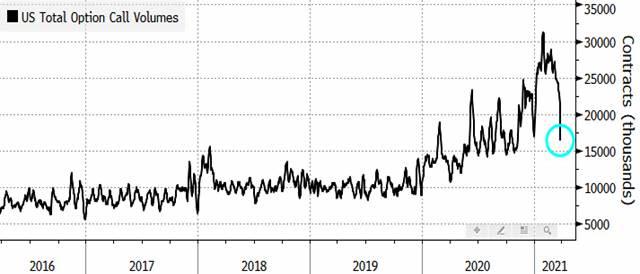
Last Friday, when previewing the month and quarter-end rebalance, Nomura’s Charlie McElligott went on a brief tangent, showing the collapse in marketwide call volumes as the retail frenzy has decidedly cooled off in recent weeks…

… which McElligott attributed to three factors:

  • The weight of not just the overall “stalling-out” in the broad Equities tape again — but particularly, many of these most popular speculative names meaningfully lower over the past few months and bleeding PNL, particularly in YOLO Retail trading accounts
  • Retail selling ahead of tax bills coming-due, particularly with an anticipated hike in the capital gains tax from the Biden administration looking like an inevitability
  • And perhaps the most salient point with a “totally-sane” macro rationale, being that as JPM found last week, the latest round of “stimmy checks” are being re-routed away from speculative assets (which were previously obsessed over during the “Work From Home” screen-time era), but now instead are transitioning back into the real world consumer economy, as we re-open and get back to work in the post-Vaccine paradigm shift

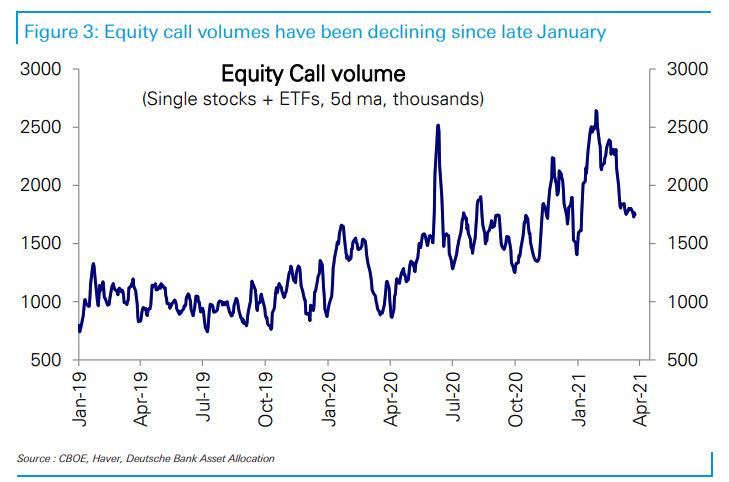
Whatever the reason, but the sudden drop off in retail participation – which as we discussed last week has also manifested itself in more QQQ put buying as even “unsophisticated” investors are now hedging their downside – has become a significant source of market tensions across other banks as well, with Deutsche Bank’s flow strategist Parag Thatte also noting that after call volumes had been rising sharply for over a year, especially since November, “they soared further mid-January, but then fell sharply right after the steep climb and subsequent sell-off in heavily shorted stocks in late January. Volumes then rose briefly but have been declining again since the middle of February.”

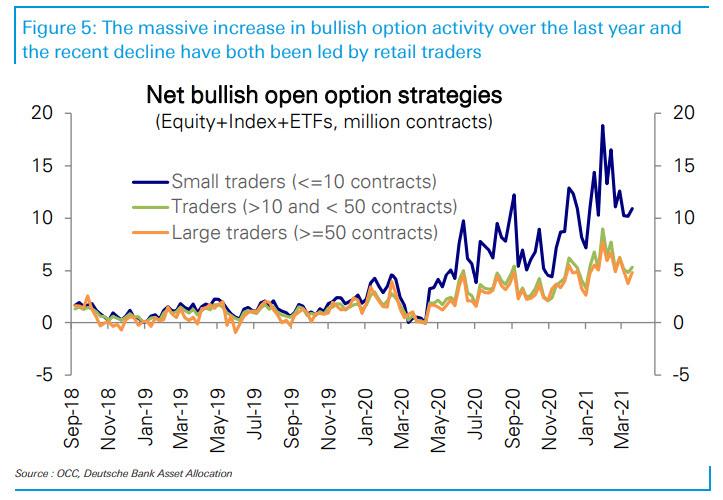
As DB further notes, the prior rise and the subsequent fall “have been both led by trades in the smallest contract sizes, indicative of retail traders.”

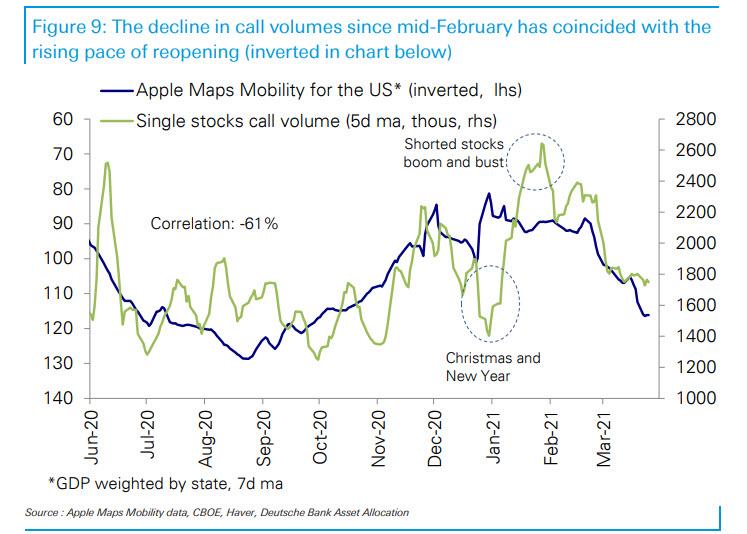
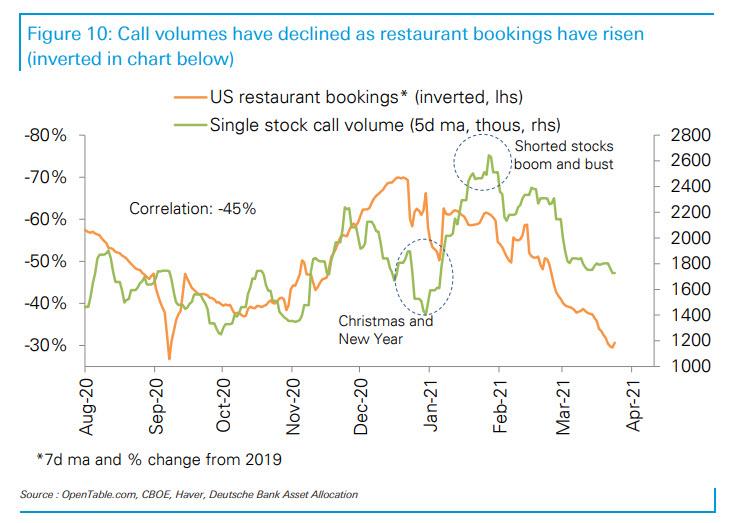
What is behind the dropoff in retail participation? Simple: the opportunity to engage in other, more social activites. As DB notes, over the last few months, call volumes have been inversely correlated with indicators of reopening, with volumes rising as stay-at-home activity rose and falling as reopening gathered pace.

Said otherwise, the economic reopening is bad news for continued gamma squeezes.

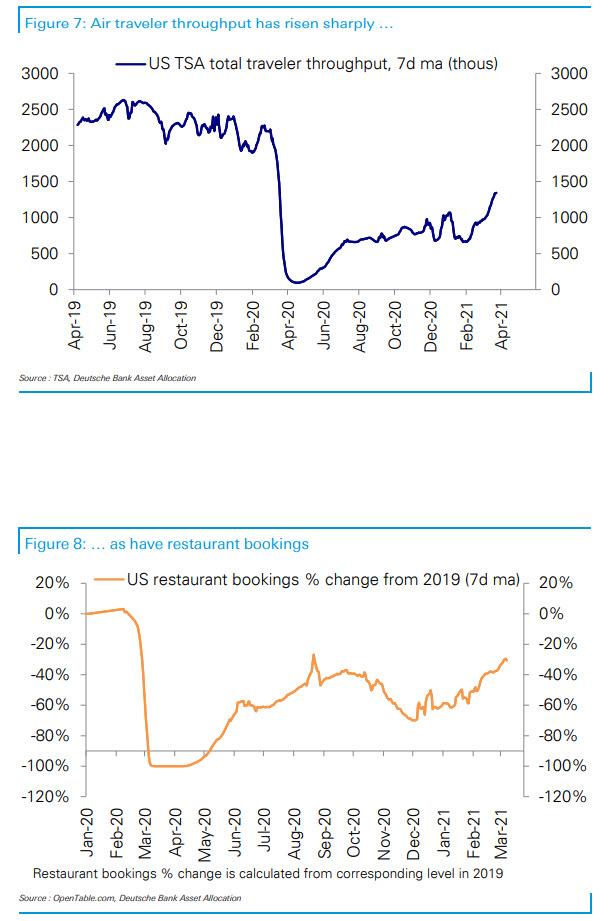
The pace of reopening has accelerated since mid-February as suggested by a variety of metrics.  Mobility indicators, restaurant bookings and air passenger traffic…


have all risen significantly and this has coincided with the decline in retail call volumes.

This jives with DB’s view that “as retail investors have other things to do, the attention focused on the equity market will start to fade.”

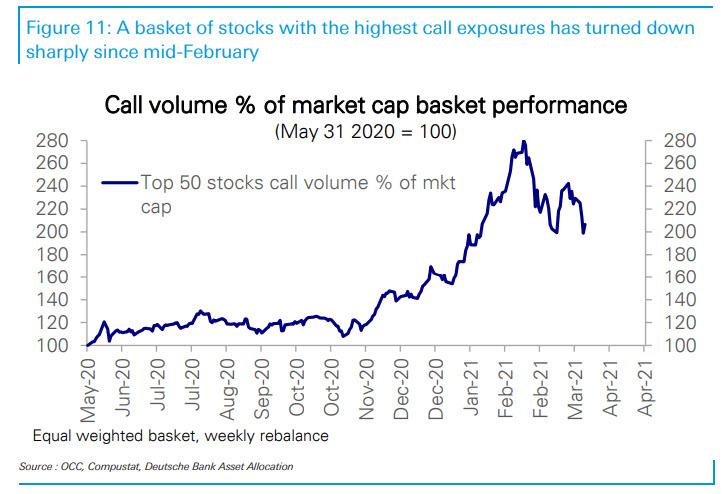
Still, putting it in perspective, DB notes that a basket of stocks with the most exposure to call volumes relative to their market cap the previous week, had been rallying sharply since November, as the twin catalysts of the US election resolution and positive vaccine news unfolded. The basket rose by a massive 160% in just over three months, outperforming the equal-weighted S&P 500 by 130%. Since mid-February however, the basket is down -24%, even as the average stock in the S&P 500 is up slightly. The downturn in the basket’s performance has coincided with the abovementioned decline in call volumes since mid-February

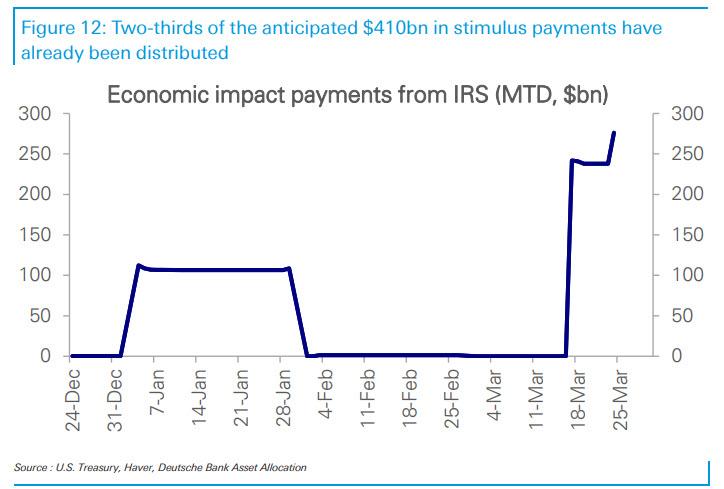
Another notable factor: whereas previously investors put a substantial portion of their stimmy checks in risk assets, this time that does not appear to be the case. According to DB, $276BN or more than two-thirds of the anticipated payments of $410bn have already been distributed as per US Treasury data. This means the incremental impact of stimulus payments should start to fade. This week also saw the first outflow from US equity funds (-$10bn) in 7 weeks, after averaging $23bn a week since early February

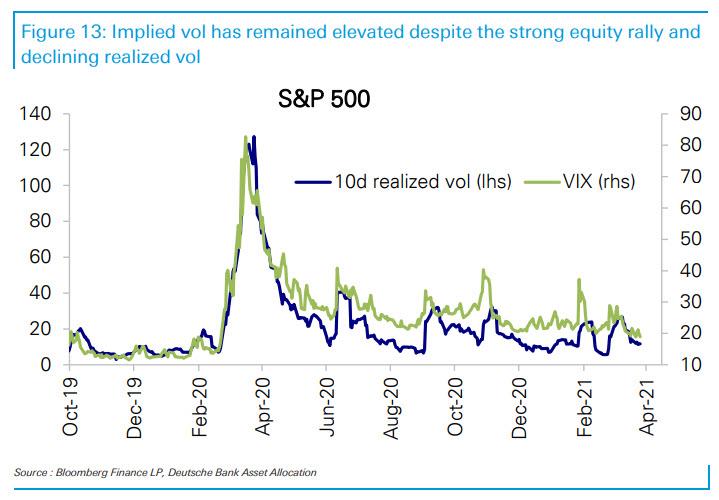
So as what went up is now coming down, vol premiums have also been declining as call volumes have fallen, which has begged the question whether systematic strategies raise equity exposure? While JPMorgan has repeatedly scrambled to create a narrative that systematic funds can’t wait to DB is also now getting on boar with this thesis writing that “a major driver of implied volatility remaining elevated despite the strong equity rally and declines in realized volatility, has been that the vol premium has been very high, and that in turn has been driven by very strong bullish option volumes.” As call volumes have declined, vol premiums and in turn implied vol have also begun to subside, following realized vol and daily ranges lower. “One significant implication of lower volatility is that it can then prompt systematic  trategies to raise allocations to equities.” Whether that happens, however, remains to be seen – consider that after banging the drum on commodities for weeks ahead of last week’s quant rebalance, the day came and went and oil…plunged.

Still, according to DB’s consolidated measure of equity positioning and flows which has been going sideways over the last week at very elevated levels (92nd percentile), the bank’s measure of discretionary investor positioning, which is more focused on institutional investors, is already near all-time highs (98th percentile). It is currently well-supported by the strong global growth outlook but has only limited room to rise further. Systematic strategy exposure on the other hand has remained very low (39th percentile) as vol has remained elevated. If falling vol sees systematic strategies raise allocations, we could see overall positioning grind higher towards the record levels seen in early 2018.

Which means that for all the doom and gloom about retail investors stepping away, their place in capital market hierarchy will be taken by systematic and vol-control funds, whose buying will be triggered by the next sharp dropoff in VIX and realized vol as some sense of stability returns to markets even if it means a sharp decline in WallStreetBets traffic.

Tyler Durden
Mon, 03/29/2021 – 17:20

via ZeroHedge News https://ift.tt/31x0aoE Tyler Durden

Biden Administration Extends CDC Eviction Moratorium Until June 30—the Legal Battle Over it Will Continue


Eviction Moratorium

Earlier today, the Biden administration issued an order extending the Centers for Disease Control nationwide eviction moratorium until June 30. Biden’s previous revival of an order initially issued under the Trump administration is set to expire on March 31.

The new order makes only minor substantive changes to the old one, other than the three-month extension. Those changes will have little, if any, impact on the ongoing litigation over the moratorium’s legality.

That fight is now set to continue for at least another three months. So far, three federal district courts have ruled against the order, while two have upheld it. I analyzed these rulings here, here, and here. These cases will now be reviewed by appellate courts, and other lawsuits against the order will also continue.

In my view, both the original Trump order and Biden’s revival and extension of it are illegal because they go beyond what Congress has authorized the CDC to do; if the statute did go that far, it would be an unconstitutional delegation of legislative power, effectively giving the CDC the power to suppress virtually any activity of any kind.

While the latest version of the order has few substantive changes, it does include an extensive new section defending the moratorium on public health grounds. It is possible this was included in order to bolster the government’s position in the ongoing litigation over the legality of the moratorium.

I could be wrong about this. But, at least at this point, I am skeptical that the justifications in the new order are likely to persuade any judge to uphold it that would otherwise be inclined to strike it down. The main argument the CDC offers is that eviction increases movement, which in turn is likely to increase the spread of the disease:

Although data are limited, available evidence suggests evictions lead to interstate spread of COVID-19 in two ways. First, an eviction may lead the evicted members of a household to move across state lines. Of the 35 million Americans who move each year, 15% move to a new state. Second, even if a particular eviction, standing alone, would not always result in interstate displacement, the mass evictions that would occur in the absence of this Order would inevitably increase the interstate spread of COVID-19. This Order cannot effectively mitigate interstate transmission of COVID-19 without covering intrastate evictions, as the level of spread of SARSCoV-2 resulting from these evictions can lead to SARS-CoV-2 transmission across state borders. Moreover, intrastate spread facilitates interstate spread in the context of communicable disease spread, given the nature of infectious disease. In the aggregate, the mass-scale evictions that will likely occur in the absence of this Order will inevitably increase interstate spread of COVID-19.

As I have previously pointed out (and as emphasized by two of the court decisions striking down the order), the same rationale could be used to justify CDC suppression of almost any other activity that involves movement and, therefore—per the CDC’s reasoning—could facilitate “intrastate spread” of the disease, which in increases the likelihood of interstate spread (the latter is the focus of the authorizing statute,  42 U.S.C. Section 264(a)). Nothing in the statute limits the CDC’s authority based on either the size of the effect or even on the dangerousness of the disease in question. By the same reasoning, the CDC could justify an order suppressing any activity that risks spreading the flu or the common cold—even if the increase in spread the order forestalls was fairly small.

The seemingly limitless nature of the authority claimed by the CDC is the biggest flaw in its case, and the main reason why the moratorium was invalidated by the two most compelling decisions against it (the first ruling against the order is based on much more questionable constitutional grounds). The rationales offered in the latest version of the moratorium order do nothing to fix that problem.

Moreover, the CDC’s logic is premised on the notion that “mass-scale evictions” will occur if the order is not extended. In reality, there is little reason to believe this, for reasons I summarized in my critique of the initial Trump order here.

Finally, for those inclined to argue that courts should defer to the specialized expertise of public health experts, it is worth noting that the eviction moratorium may have been imposed on an unwilling CDC by the Trump White House (and later by Biden). The Washington Post recently reported the following:

Behind the scenes,… some CDC officials have expressed trepidation about the policy. The CDC is reluctant to have the administration use the public health agency’s authority to extend the moratorium again, according to a federal health official who spoke on the condition of anonymity to share an ongoing policy debate. The CDC’s reservations date back to last year, when the White House under Trump first announced the policy, two sources said.

“The previous administration used CDC’s authority to put this program in place in a way that no one at the agency thought it had the authority to do,” said one of the officials, adding that the debate around the most recent extension has been fierce.

But the Biden administration has not identified another agency that might be a better steward of the policy, the two sources said, putting the CDC on track to approve another extension.

As always, it is difficult to evaluate the credibility of anonymous sources. But if what they say is true, this would be just one of many instances during the Covid crisis where the CDC yielded to political pressure from the White House. Trump’s policy of using public health as a pretext for expelling asylum seekers at the border is another example.

As I have previously emphasized, the vulnerability of the CDC to political pressure is yet another reason why people across the political spectrum should be reluctant to allow the agency to claim the vast power it would have should courts uphold the eviction moratorium. If you are a Democrat who trusts the present administration to wield that authority responsibly, do you have similar trust in a future Republican administration led by the likes of Josh Hawley or Ted Cruz. If you are a Republican and you trusted Trump, do you have similar confidence in Biden or potential future Democratic presidents, such as Kamala Harris?

In sum, I remain skeptical of both the legality and wisdom of the CDC moratorium. Whether higher-level courts agree with that assessment remains to be seen. At this point, the one safe prediction is that the legal battle over the moratorium will continue for at least another three months.

NOTE: The plaintiffs in some of the lawsuits against the eviction moratorium are represented by the Pacific Legal Foundation, where my wife works. I myself have played a minor (unpaid) role in advising PLF on this litigation.

from Latest – Reason.com https://ift.tt/3w98GIx
via IFTTT

Captain Underpants Author Self-Cancels Book for ‘Passive Racism’


Screen Shot 2021-03-29 at 4.23.05 PM

Dav Pilkey is the author of the bestselling children’s book series Captain Underpants. He also wrote (and illustrated) a spinoff, The Adventures of Ook and Gluk: Kung-Fu Cavemen from the Future, which was published in 2010.

Now Ook and Gluk is unpublished. Scholastic and Pilkey announced last week that the book would no longer be available.

“Together, we recognize that this book perpetuates passive racism,” said the publisher in a statement. “We are deeply sorry for this serious mistake.”

This act of self-cancelation was prompted in part by a Change.org petition that claimed Ook and Gluk was filled with racist imagery of Asians:

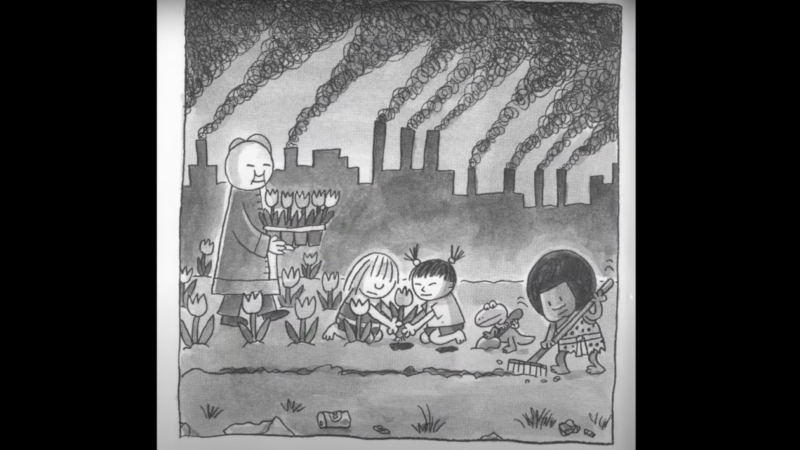
I am a Korean-American father of two young children, ages 5 and 7. Both are huge fans of Dav Pilkey, author of wildly popular series Captain Underpants and Dogman, and recently borrowed “Ook and Gluk: Kung-Fu Cavemen From the Future” by the author from their local library.

I realized the book relied upon multiple instances of racist imagery and stereotypical tropes, including a Kung Fu master; wearing what’s purported to be a traditional-style Tang coat, dashes for eyes for the Asian characters, stereotypical Chinese proverbs, and a storyline that has the Kung Fu master rescued by the non-Asian protagonists using their Kung Fu skills (despite the fact that they were taught said skills from the supposed master).

The originator of that petition was not satisfied with the book merely disappearing from shelves: He also demanded an apology and “accountability” from Pilkey and a donation to “an AAPI [Asian American and Pacific Islander] community organization.” In a statement posted to his YouTube page, Pilkey pledged to meet all of these demands.

“I hope that you, my readers, will forgive me, and learn from my mistake that even unintentional and passive stereotypes and racism is harmful to everyone,” said Pilkey. “I apologize, and I pledge to do better.”

Authors and publishers are free to take their work off the market. Still, there’s cause for some concern here. With this level of apologizing, you might have expected Ook and Gluk to be really, really racist—at least something comparable to the most offensive Dr. Seuss cartoons. As it turns out, the evidence of passive racism here is extremely thin. (The adjective “passive” was sort of a giveaway.) The person who teaches Ook and Gluk about kung fu is indeed drawn as Asian, and he does engage in various traditional Asian activities. If the caricature had been less accurate, would that have made it better or worse?

Most of the characters in Pilkey’s work are drawn to be funny-looking; as best as I can tell, the plots of the stories are absurdist and vaguely scornful of authority. The Captain Underpants series are among the most frequently challenged books in American schools and libraries: The crude humor, offensive language, violence, and pro-LGBT content have often come under attack from social conservatives. Now they’re taking flak from another direction.

from Latest – Reason.com https://ift.tt/3dl669I
via IFTTT

Big Tech, Voting Rights, and Weed


a

The Reason Roundtable mixes it up this week with the usual host, Matt Welch, vaccinated and vacationing. In his absence, Peter Suderman leads the weekly discourse with Katherine Mangu-Ward, Nick Gillespie, and a special guest, Senior Editor Elizabeth Nolan Brown. The group breaks down tech regulation, Georgia’s new voting law, and weed.

Discussed in the show:

1:06: The government versus “big tech”: Section 230, antitrust, content moderation.

29:35: Voting bills and voting rights.

47:00: Weekly Listener Question: “Is catcalling freedom of speech? Is it violence?”

52:17: Media recommendations for the week.

This week’s links:

Send your questions either by email to roundtable@reason.com. Be sure to include your social media handle and the correct pronunciation of your name.

Today’s sponsors:

  • Get an up-close look at the history of the Constitution with the Institute for Justice’s new podcast, Bound by Oath. Available wherever you check out podcasts.
  • On October 2, 2018, respected Washington Post journalist Jamal Khashoggi entered the Saudi consulate in Istanbul, Turkey. He was never seen alive again. From Academy Award–winning director Bryan Fogel, The Dissident is now streaming on On Demand.

Audio production by Ian Keyser.
Assistant production by Regan Taylor.
Music: “Angeline,” by The Brothers Steve.

from Latest – Reason.com https://ift.tt/3sA72O9
via IFTTT

Lockdowns Worsen The Health Crisis

Lockdowns Worsen The Health Crisis

Authored by Kiley Holliday and Jenin Younes via the American Institute for Economic Research,

One of the most infuriating aspects of a year replete with illogical, short-sighted public health mandates has been the utter failure of those within the public health profession to adequately address the role that poor diet and lack of exercise have played in exacerbating the coronavirus crisis.  In fact, many of the decrees ostensibly issued in the name of public health have had the effect only of aggravating the underlying problem.
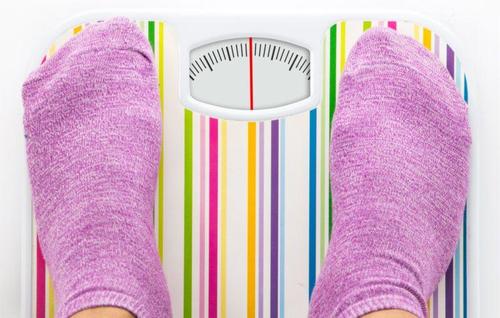
recent global study found that obesity is a “driving factor in COVID-19 deaths,” and that Covid-19 death rates are an astonishing ten times higher in countries where most adults are overweight.  Although advanced age is the strongest indicator of a severe outcome from a coronavirus infection, “being overweight comes a close second,” the report determined.  The CEO of the World Obesity Federation went so far as to blame the “failure to address the root causes of obesity over many decades . . . for hundreds of thousands of preventable deaths.”  While the study makes evident the degree to which poor underlying health is a driving force in coronavirus deaths, we have known almost since the beginning that being overweight or obese significantly increases the risk of a severe outcome.

Given this information, the Anthony Faucis and Eric Feigl-Dings of the world should focus on alerting people to the dangers of being overweight and obese, and expending significant efforts to encourage exercise and healthy diet.  Instead, they have spent the past twelve months urging people to “stay home, save lives” and to wear two masks, if not three or four, a measure not shown to have mitigated coronavirus deaths at all.

In a similar vein, governors around the country have ordered gyms closed, along with countless other businesses.  In New York, gyms have been open since this past summer, but patrons must wear a mask at all times, even while exercising.  Due to the extreme discomfort of exercising while masked, I (Jenin) quit my gym months ago for the first time in two decades and began relying solely on outdoor forms of exercise to stay in shape.  I doubt I am the only one to have done so for similar reasons.

Thus, equally counterproductive are outdoor mask mandates in states like Massachusetts, which have the pernicious effect of discouraging outdoor as well as indoor exercise.  All this, despite the fact that the World Health Organization (WHO) advised against wearing a mask while exercising, pointing to research demonstrating that wearing them even during mild to moderate physical activity can “lead to significant negative cardiovascular and pulmonary effects in both healthy people and those with underlying respiratory diseases.”   (Of course, these findings contradicted the religion of face-coverings that has overtaken our society, so were automatically discounted, not on the merits but because they did not fit within the dominant narrative).  

Likewise, especially at the beginning of the crisis, governors around the nation closed playgroundsnational parks, and hiking trails, another policy choice that simply deprived people of the opportunity to engage in healthy outdoor activities. Mercifully, many of these orders have been reversed following significant pushback from the public, although never with an admission on the part of government officials that such measures were detrimental to public health.

While exercise is vital for overall health, significant research suggests that those who are struggling with obesity require dietary changes in order to lose weight.  Predictably, the shutdown strategy, which entailed people working from home much more often or exclusively, led to a sharp increase in unhealthy eating habits. People began snacking on processed foods in much greater quantities, in large part to ease stress, giving Mondelez International — the manufacturer of Oreos — and other unhealthy, processed snacks cause to celebrate

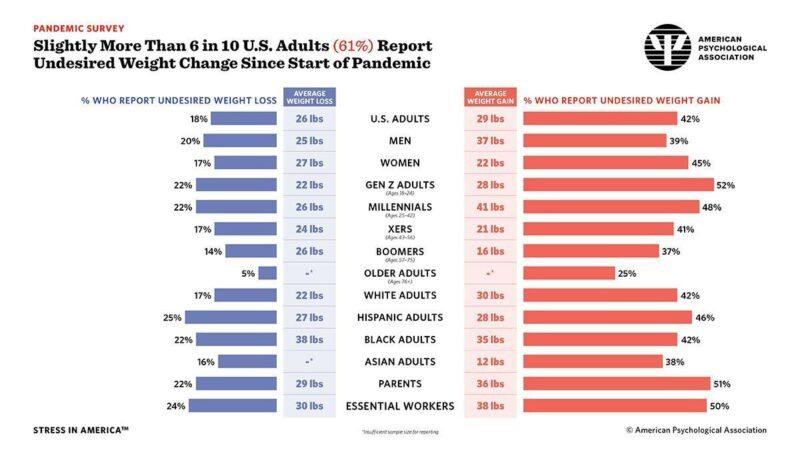
The exhortations of the “stay home” crowd, as well as the implementation of measures such as gym and park closures have had the expected impact, which is that 42 percent of adults in the United States reported undesired weight gain during the past year, with an average of twenty-nine pounds.  Millennials as a group fared the absolute worst, with 48 percent reporting unwanted weight gain, at an average of forty-one pounds.  Suffice it to say, a significant portion of adults who in March of 2020 were not at substantial risk of a severe outcome from coronavirus now can be categorized as in an elevated risk group.
The cause of this national belt-loosening is not merely staying home and moving around less, but anxiety and depression caused by social isolation, both of which have been demonstrated to cause weight gain and obesity.  Society has now organized itself around the principle of depriving people of meaningful social contact with family, friends, and coworkers for the better part of a year.  One need not have a degree in psychology to recognize that such an approach is bound to aggravate the obesity crisis, as indeed it has. In fact, our newly confirmed Surgeon General, Dr. Vivek H. Murthy has written an entire book on health effects of loneliness, arguing that it is associated with increased risk of heart disease, dementia, obesity, and sleep disorders.

Yet despite these circumstances, publications such as the New York Times have been running grossly irresponsible pieces with headlines such as Should You Worry About Your Kid’s Pandemic Weight Gain?  (the answer of the author, Virginia Sole-Smith is, generally speaking, ‘no’). In typical fashion, Sole-Smith ascribes the rising incidence of childhood obesity to the pandemic itself, rather than the decision to shutter classrooms for many months. She contends that because childhood dieting can lead to adult eating disorders, parents should avoid treating their children’s weight gain as a “problem to be solved.” Parents should inquire about the mental health of their children, but also accept that the circumstances causing their depression and late-night stress eating simply cannot be changed, as though it is perfectly reasonable from a public health perspective to prioritize Covid prevention (a virus less harmful to children than the flu) above all things.  

A more recent Times article, by Sandra E. Garcia dodged the issue of underlying health, and instead argued that people whose body mass index (BMI) qualified them for early vaccination should take advantage of that status.  The article quoted Emma Specter of Vogue magazine saying “a metric of health that has long been called into question by fat activists and medical experts alike could stand to actively benefit fat people for the first time.”

Similarly, Garcia quoted a tweet that quipped “because my BMI permits me to get the vaccine tomorrow, and because the vaccination will enable me to protect myself and others, my thick thighs will in fact save lives.”  While BMI is an imperfect measure of an individual’s health and, of course, not all thin people are healthy, the past thirty years has shown us that rising rates of obesity and chronic diseases go hand in hand.  

Apparently, Garcia’s ideological commitment to the narrative of identity politics precludes any admission that being overweight, and particularly obese, is a significant predictor of a severe outcome from a coronavirus infection, and that many people can take steps to lose weight and thereby become healthier and even remove themselves from at-risk categories.  Getting vaccinated will not solve the larger problem, as it can only protect one from the coronavirus and does not cure the various comorbidities resulting from poor diet and a sedentary lifestyle.  

Under the pretense of “body positivity,” the authors of these articles are normalizing a lifestyle that leads to significant health problems.  Instead of questioning the circumstances that create obesity – conditions that have only worsened during the pandemic – they propound against all reason and logic that obesity is not unhealthy, or that it is somehow unhealthier to recognize and deal with it.  This effectively steers people away from drawing the all-too obvious conclusion that the decision to close schools, gyms, and workplaces and force people to shelter in place for months at a time was never in the interest of public health.

Of course, not everyone can lose weight for a variety of reasons, spanning the spectrum from metabolic disorders to inadequate access to healthy food or time to exercise.  The inability of many to lead a healthy lifestyle can be directly tied to significant, systemic problems in our society and country today, and it is not within the scope of this article to address this matter.  Nor do we advocate “fat-shaming,” or any cruelty directed at individuals because they are overweight or obese.  Rather, we are suggesting that the government and public health authorities should not issue and support, respectively, mandates that curtail freedom to the point of fostering depression and disease in the general population.  That includes not only closures of parks and gyms, but measures such as mandatory mask-wearing during exercise and stay-at-home orders, which inevitably leads to social isolation.  

In stark contrast to the approach they have taken, public health authorities, and by extension politicians and the media, ought to encourage the public to maintain a healthy weight, and not just during the pandemic. In fact, it is their moral obligation to address the issue head-on, rather than putting identity politics or political correctness before public health, and to vigorously renounce measures that are creating an unhealthier nation.  

We suspect that one day, the quarantining of entire societies that was carried out in response to the coronavirus pandemic, leading to vast swaths of the population becoming unhealthier overall and ironically more susceptible to severe outcomes from the virus, will be seen as the 21st century version of bloodletting.  As the epidemiologist Martin Kulldorff has observed, public health is not just about one disease, but all health outcomes.  Apparently, in 2020, the authorities forgot this obvious truth.

Tyler Durden
Mon, 03/29/2021 – 17:00

via ZeroHedge News https://ift.tt/3sDd0xF Tyler Durden