
Biden Administration Extends CDC Eviction Moratorium Until June 30—the Legal Battle Over it Will Continue


Eviction Moratorium

Earlier today, the Biden administration issued an order extending the Centers for Disease Control nationwide eviction moratorium until June 30. Biden’s previous revival of an order initially issued under the Trump administration is set to expire on March 31.

The new order makes only minor substantive changes to the old one, other than the three-month extension. Those changes will have little, if any, impact on the ongoing litigation over the moratorium’s legality.

That fight is now set to continue for at least another three months. So far, three federal district courts have ruled against the order, while two have upheld it. I analyzed these rulings here, here, and here. These cases will now be reviewed by appellate courts, and other lawsuits against the order will also continue.

In my view, both the original Trump order and Biden’s revival and extension of it are illegal because they go beyond what Congress has authorized the CDC to do; if the statute did go that far, it would be an unconstitutional delegation of legislative power, effectively giving the CDC the power to suppress virtually any activity of any kind.

While the latest version of the order has few substantive changes, it does include an extensive new section defending the moratorium on public health grounds. It is possible this was included in order to bolster the government’s position in the ongoing litigation over the legality of the moratorium.

I could be wrong about this. But, at least at this point, I am skeptical that the justifications in the new order are likely to persuade any judge to uphold it that would otherwise be inclined to strike it down. The main argument the CDC offers is that eviction increases movement, which in turn is likely to increase the spread of the disease:

Although data are limited, available evidence suggests evictions lead to interstate spread of COVID-19 in two ways. First, an eviction may lead the evicted members of a household to move across state lines. Of the 35 million Americans who move each year, 15% move to a new state. Second, even if a particular eviction, standing alone, would not always result in interstate displacement, the mass evictions that would occur in the absence of this Order would inevitably increase the interstate spread of COVID-19. This Order cannot effectively mitigate interstate transmission of COVID-19 without covering intrastate evictions, as the level of spread of SARSCoV-2 resulting from these evictions can lead to SARS-CoV-2 transmission across state borders. Moreover, intrastate spread facilitates interstate spread in the context of communicable disease spread, given the nature of infectious disease. In the aggregate, the mass-scale evictions that will likely occur in the absence of this Order will inevitably increase interstate spread of COVID-19.

As I have previously pointed out (and as emphasized by two of the court decisions striking down the order), the same rationale could be used to justify CDC suppression of almost any other activity that involves movement and, therefore—per the CDC’s reasoning—could facilitate “intrastate spread” of the disease, which in increases the likelihood of interstate spread (the latter is the focus of the authorizing statute,  42 U.S.C. Section 264(a)). Nothing in the statute limits the CDC’s authority based on either the size of the effect or even on the dangerousness of the disease in question. By the same reasoning, the CDC could justify an order suppressing any activity that risks spreading the flu or the common cold—even if the increase in spread the order forestalls was fairly small.

The seemingly limitless nature of the authority claimed by the CDC is the biggest flaw in its case, and the main reason why the moratorium was invalidated by the two most compelling decisions against it (the first ruling against the order is based on much more questionable constitutional grounds). The rationales offered in the latest version of the moratorium order do nothing to fix that problem.

Moreover, the CDC’s logic is premised on the notion that “mass-scale evictions” will occur if the order is not extended. In reality, there is little reason to believe this, for reasons I summarized in my critique of the initial Trump order here.

Finally, for those inclined to argue that courts should defer to the specialized expertise of public health experts, it is worth noting that the eviction moratorium may have been imposed on an unwilling CDC by the Trump White House (and later by Biden). The Washington Post recently reported the following:

Behind the scenes,… some CDC officials have expressed trepidation about the policy. The CDC is reluctant to have the administration use the public health agency’s authority to extend the moratorium again, according to a federal health official who spoke on the condition of anonymity to share an ongoing policy debate. The CDC’s reservations date back to last year, when the White House under Trump first announced the policy, two sources said.

“The previous administration used CDC’s authority to put this program in place in a way that no one at the agency thought it had the authority to do,” said one of the officials, adding that the debate around the most recent extension has been fierce.

But the Biden administration has not identified another agency that might be a better steward of the policy, the two sources said, putting the CDC on track to approve another extension.

As always, it is difficult to evaluate the credibility of anonymous sources. But if what they say is true, this would be just one of many instances during the Covid crisis where the CDC yielded to political pressure from the White House. Trump’s policy of using public health as a pretext for expelling asylum seekers at the border is another example.

As I have previously emphasized, the vulnerability of the CDC to political pressure is yet another reason why people across the political spectrum should be reluctant to allow the agency to claim the vast power it would have should courts uphold the eviction moratorium. If you are a Democrat who trusts the present administration to wield that authority responsibly, do you have similar trust in a future Republican administration led by the likes of Josh Hawley or Ted Cruz. If you are a Republican and you trusted Trump, do you have similar confidence in Biden or potential future Democratic presidents, such as Kamala Harris?

In sum, I remain skeptical of both the legality and wisdom of the CDC moratorium. Whether higher-level courts agree with that assessment remains to be seen. At this point, the one safe prediction is that the legal battle over the moratorium will continue for at least another three months.

NOTE: The plaintiffs in some of the lawsuits against the eviction moratorium are represented by the Pacific Legal Foundation, where my wife works. I myself have played a minor (unpaid) role in advising PLF on this litigation.

from Latest – Reason.com https://ift.tt/3w98GIx
via IFTTT
Captain Underpants Author Self-Cancels Book for ‘Passive Racism’


Screen Shot 2021-03-29 at 4.23.05 PM

Dav Pilkey is the author of the bestselling children’s book series Captain Underpants. He also wrote (and illustrated) a spinoff, The Adventures of Ook and Gluk: Kung-Fu Cavemen from the Future, which was published in 2010.

Now Ook and Gluk is unpublished. Scholastic and Pilkey announced last week that the book would no longer be available.

“Together, we recognize that this book perpetuates passive racism,” said the publisher in a statement. “We are deeply sorry for this serious mistake.”

This act of self-cancelation was prompted in part by a Change.org petition that claimed Ook and Gluk was filled with racist imagery of Asians:

I am a Korean-American father of two young children, ages 5 and 7. Both are huge fans of Dav Pilkey, author of wildly popular series Captain Underpants and Dogman, and recently borrowed “Ook and Gluk: Kung-Fu Cavemen From the Future” by the author from their local library.

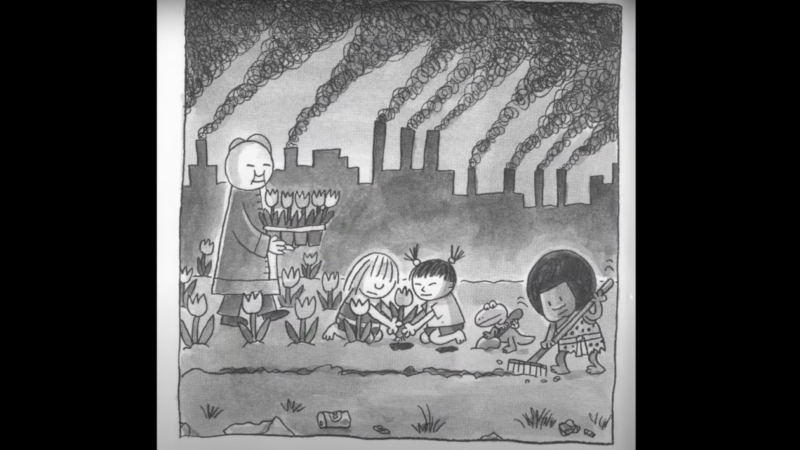
I realized the book relied upon multiple instances of racist imagery and stereotypical tropes, including a Kung Fu master; wearing what’s purported to be a traditional-style Tang coat, dashes for eyes for the Asian characters, stereotypical Chinese proverbs, and a storyline that has the Kung Fu master rescued by the non-Asian protagonists using their Kung Fu skills (despite the fact that they were taught said skills from the supposed master).

The originator of that petition was not satisfied with the book merely disappearing from shelves: He also demanded an apology and “accountability” from Pilkey and a donation to “an AAPI [Asian American and Pacific Islander] community organization.” In a statement posted to his YouTube page, Pilkey pledged to meet all of these demands.

“I hope that you, my readers, will forgive me, and learn from my mistake that even unintentional and passive stereotypes and racism is harmful to everyone,” said Pilkey. “I apologize, and I pledge to do better.”

Authors and publishers are free to take their work off the market. Still, there’s cause for some concern here. With this level of apologizing, you might have expected Ook and Gluk to be really, really racist—at least something comparable to the most offensive Dr. Seuss cartoons. As it turns out, the evidence of passive racism here is extremely thin. (The adjective “passive” was sort of a giveaway.) The person who teaches Ook and Gluk about kung fu is indeed drawn as Asian, and he does engage in various traditional Asian activities. If the caricature had been less accurate, would that have made it better or worse?

Most of the characters in Pilkey’s work are drawn to be funny-looking; as best as I can tell, the plots of the stories are absurdist and vaguely scornful of authority. The Captain Underpants series are among the most frequently challenged books in American schools and libraries: The crude humor, offensive language, violence, and pro-LGBT content have often come under attack from social conservatives. Now they’re taking flak from another direction.

from Latest – Reason.com https://ift.tt/3dl669I
via IFTTT

Video: Maryland Cops Handcuff and Berate Five-Year-Old Boy


copschool

Body camera footage released last Friday shows Maryland police officers berating, threatening, and briefly handcuffing a five-year-old boy who had wandered away from school without permission.

Two officers from the Montgomery County Department of Police picked up the child after he left school grounds in January of last year. According to statements in the video, the boy allegedly was disruptive in class, threw objects, destroyed school property, and struck a teacher. 

“This is why people need to beat their kids,” one officer remarked as they returned the child to school. 

“I hope your momma lets me beat you,” the officer remarked again as the boy began wailing in a school office. The officer then bent down and screamed several times in the child’s face.

After the mother arrived at school to retrieve her son, the other officer pulled out a pair of handcuffs and briefly put them on the boy. “You know what these are for? These are for people who don’t want to listen and don’t know how to act,” the officer said.

As Reason reported Friday, Maryland is one of several states across the country where bills have been introduced to raise the minimum age of arrest in response to public outrage over young children being handcuffed and arrested. 

“It made me sick,” Montgomery County Council member Will Jawando said in a press release about the incident. “We all saw a little boy be mocked, degraded, put in the seat of a police car, screamed at from the top of an adult police officer’s lungs, inches from his face.”

Maryland lawmakers are considering legislation that would divert children under 13 who commit nonviolent misdemeanors away from the criminal justice system. 

Earlier this year, the city of Rochester, New York, released body camera footage of officers pepper spraying a handcuffed 9-year-old girl

Last August, body camera footage emerged showing officers in Key West trying to handcuff an 8-year-old boy whose wrists were too small for the cuffs. An Orlando school cop made national headlines in 2019 when he arrested a 6-year-old girl for allegedly throwing a tantrum in class.

Civil liberties groups say school arrests, suspensions, and the use of physical restraints disproportionately impact minority youth and children with disabilities.

The boy’s mother filed a lawsuit in January over the incident.

The Montgomery County Police Department said in a press release that the two officers in the video were the subject of an internal investigation, the results of which are confidential under Maryland law.

“Both officers remain employed by the Montgomery County Department of Police,” the department wrote. “Due to pending litigation, the department has no further comment.”

from Latest – Reason.com https://ift.tt/2QRf4nN
via IFTTT

The Chauvin Defense? New Research Shows Alarming Increase In Fentanyl Abuse And Deaths

The Chauvin Defense? New Research Shows Alarming Increase In Fentanyl Abuse And Deaths

Authored by Jonathan Turley,

As the trial of former police officer Derek Chauvin starts in Minneapolis, much of the trial will focus on the role of fentanyl in the body of George Floyd as the possible cause for his death. Notably, a new study in the last week reinforces prior research showing an alarming increase in the abuse of this powerful drug and deaths associated from it.  In some counties, there was an almost 75% increase in the first half of 2020 in fatal drug overdoses with fentanyl as the main culprit.

While Floyd denied using drugs, he later said he was “hooping,” or taking drugs. That was confirmed in the autopsy which found that Floyd died from “cardiopulmonary arrest while being restrained by law enforcement officer(s).”

The state’s criminal complaint against Chauvin said the autopsy “revealed no physical findings that support a diagnosis of traumatic asphyxia or strangulation.

Mr. Floyd had underlying health conditions including coronary artery disease and hypertensive heart disease.”

He also was COVID-19 positive.

Andrew Baker, Hennepin County’s chief medical examiner, strongly suggested that the primary cause was a huge amount of fentanyl in Floyd’s system:

“Fentanyl at 11 ng/ml — this is higher than (a) chronic pain patient. If he were found dead at home alone & no other apparent causes, this could be acceptable to call an OD (overdose). Deaths have been certified w/levels of 3.”

Baker also told investigators that the autopsy revealed no physical evidence suggesting Floyd died of asphyxiation. The toxicology report on Floyd’s blood also noted that “in fatalities from fentanyl, blood concentrations are variable and have been reported as low as 3 ng/ml.” Floyd had almost four times the level of fentanyl considered potentially lethal.

That level of fentanyl will be tied to Floyd complaining about being unable to breathe. Floyd stated that he could not breathe while sitting in the police cruiser and before he was ever restrained on the ground. That is consistent with the level of fentanyl in his system that can cause “slowed or stopped breathing.”

Notably, the report shows that Floyd had both fentanyl and methamphetamine in his system. That is the combination discussed in the recent study (and past studies) as a commonly lethal combination.

The new Quest study shows that lethal overdoses overwhelmingly involve combinations with fentanyl, particularly methamphetamine: “Most overdose deaths involving opioids such as fentanyl also involve concurrent use of benzodiazepines, cocaine, or methamphetamine.”

The expert testimony on such combinations will be the key to the trial of Chauvin. Much turns on the result. Indeed, there is a real danger of a cascading failure of all four cases if the jury hangs or acquits.

As I have previously noted, the role of fentanyl does not mean that Chauvin has an insurmountable defense. It makes this a stronger manslaughter than murder case. However, Floyd was clearly in distress and one of the other officers suggested moving him (which Chauvin countermanded). That could still constitute manslaughter if Chauvin knew or should have known that his knee restraint was endangering Floyd’s life.

Tyler Durden
Mon, 03/29/2021 – 16:20

via ZeroHedge News https://ift.tt/3fpMjZK Tyler Durden

Cryptos Jump, Small Caps Dump As ‘Archegeddon’ Hits Banks, Bonds, & Bullion

Cryptos Jump, Small Caps Dump As ‘Archegeddon’ Hits Banks, Bonds, & Bullion

It’s Margin Madness…

Ever Given was freed, but Archegos anxiety provided just enough uncertainty to spook investors about where the next hit is coming from…“… be first, be smartest, or cheat… sell it all…”

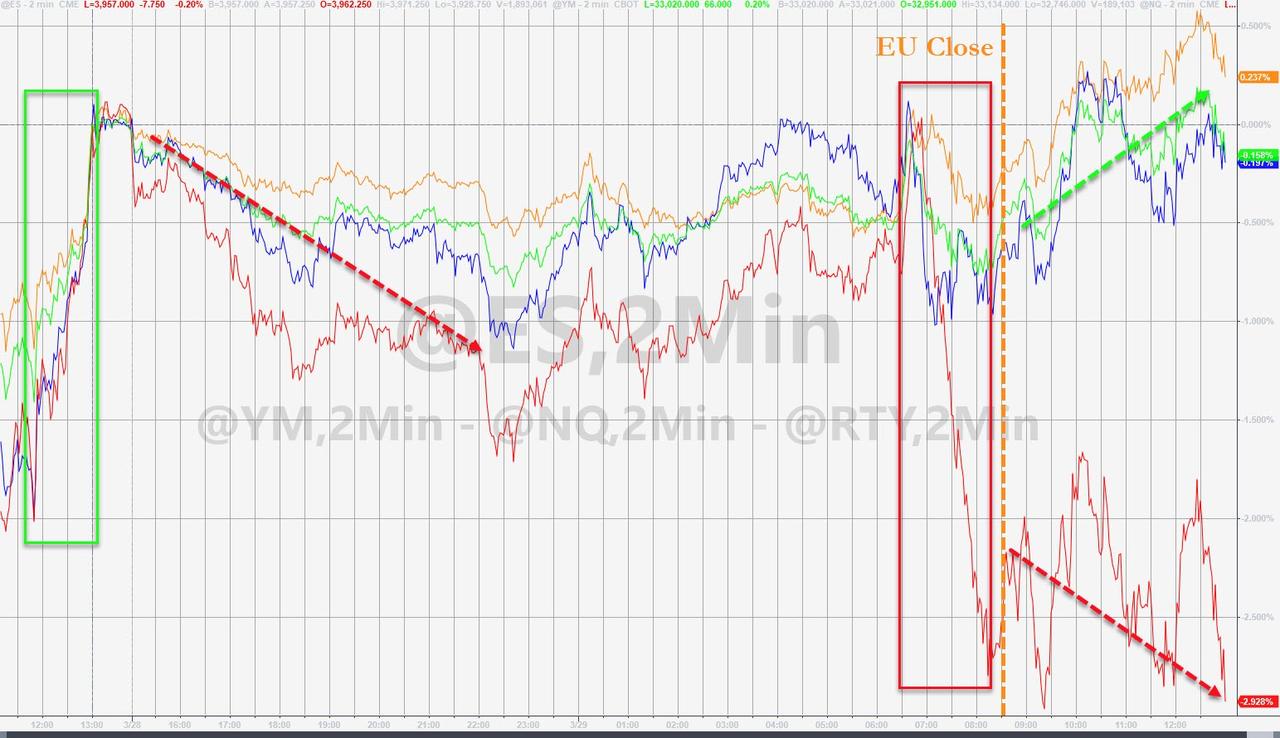
Futures opened weak and stayed so throughout the Asia session as investors sold first and thought later amid Bill Hwang’s bloodbath (and contagion chatter). Europe brought some buying as the machines managed to get futures back to unch just in time for the US cash open which sparked a big puke (led by Small Caps). Stocks then bounced at the EU close, faded, and then ramped again as Morgan Stanley said it had no more blocks to sell. That bounce did not last as headlines hit into the last hour of Wells Fargo selling blocks. But… in an echo of Friday, everything went vertical in the last half hour… The Dow ended the biggest gainer, Small Caps were ugly, ending at the lows of the day despite the attempted bounce…

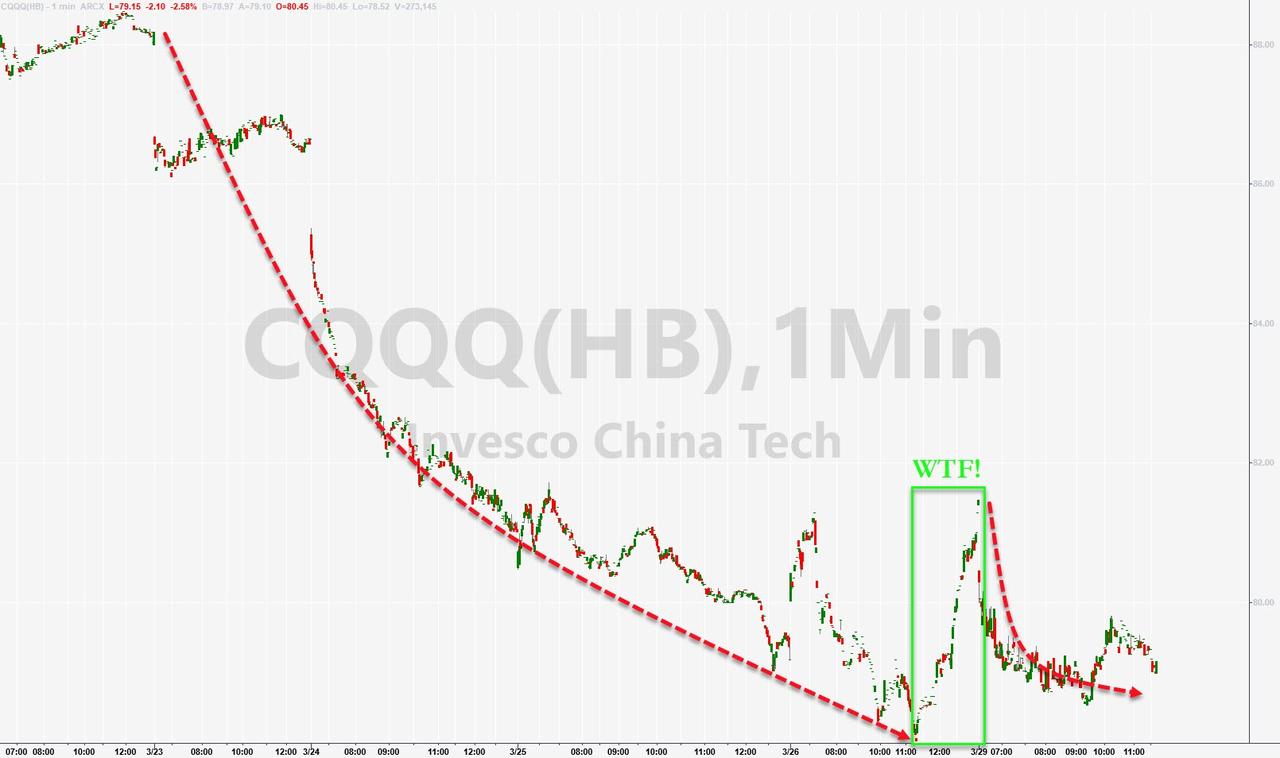
China tech stocks lost the ground they gained in the last hour manic-buying from Friday…

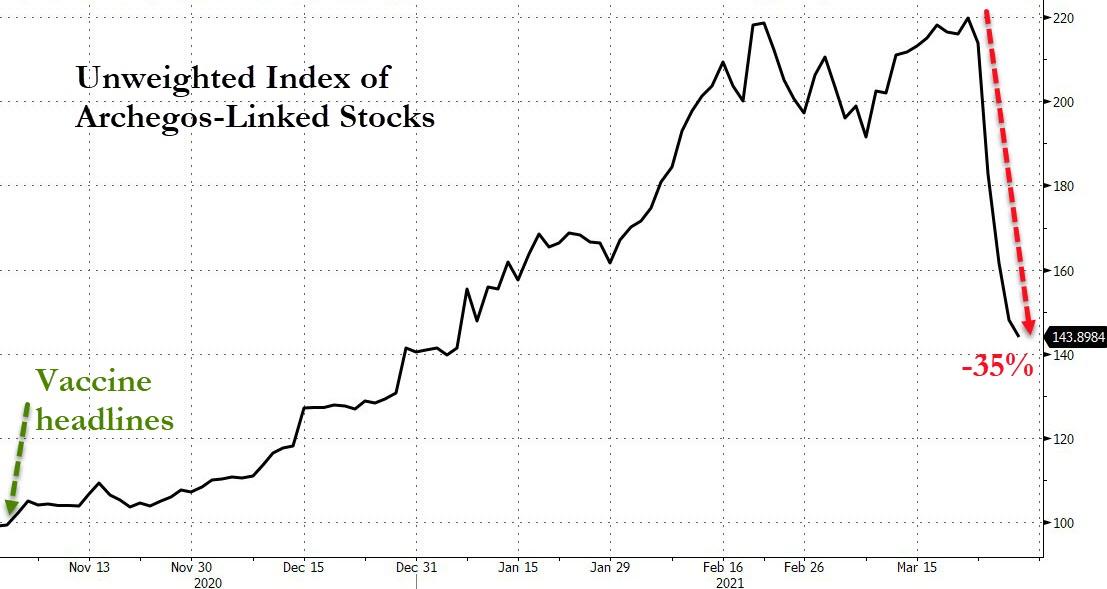
Hwang’s horde of over-levered stocks extended losses today…

Source: Bloomberg

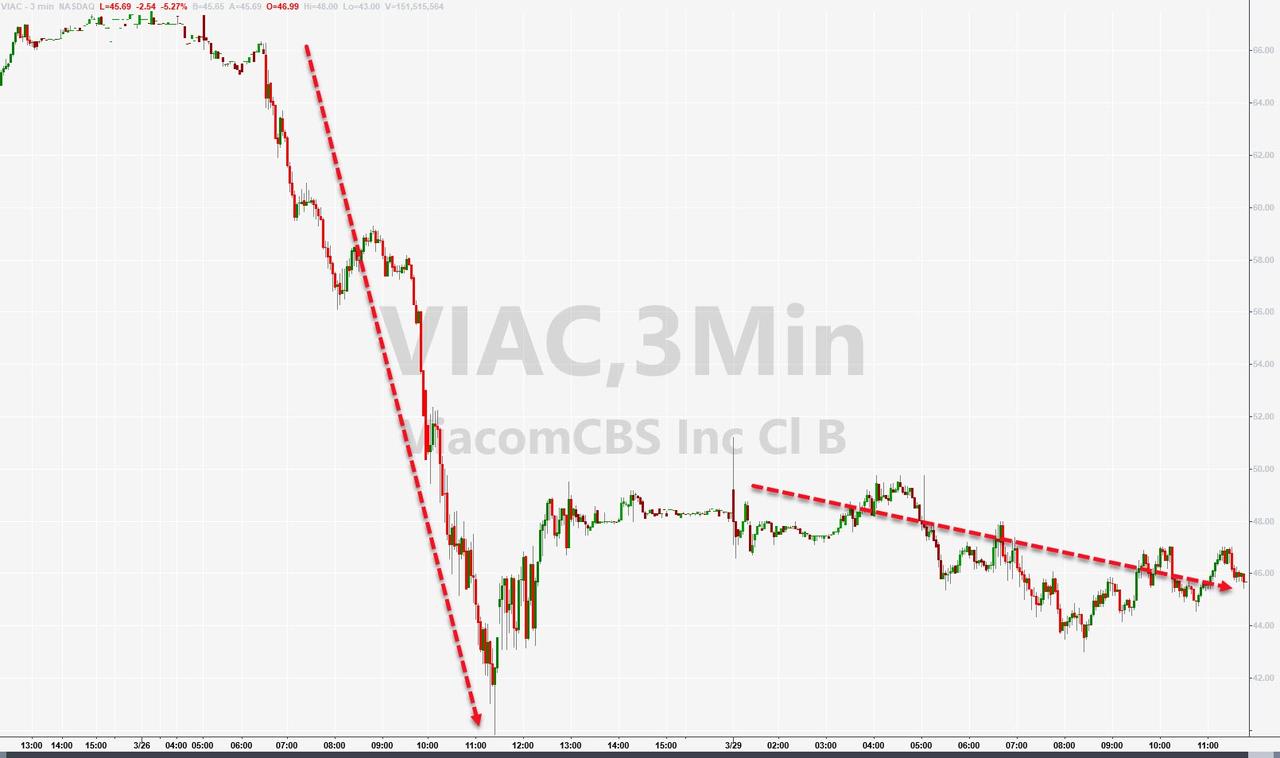
ViacomCBS – which was clubbed like a baby seal on Friday – saw no dead cat bounce and lost further ground…

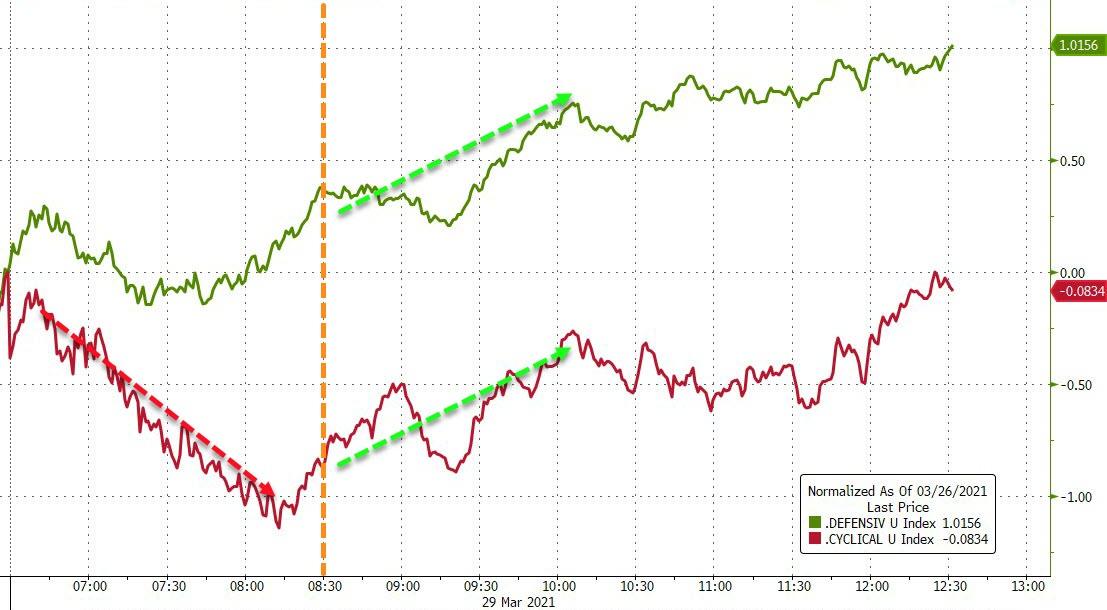
Defensives dominated price action today (but again everything reversed at the EU close)…

Source: Bloomberg

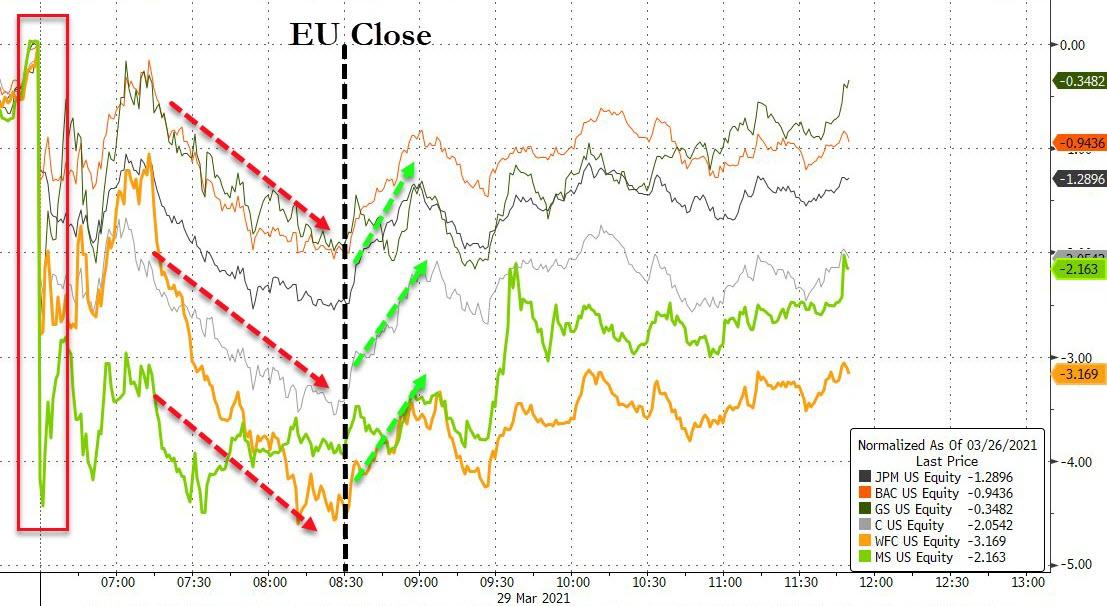
US Bank stocks were ugly (MS, WFC worst on the day extending their losses from Friday)..

Source: Bloomberg

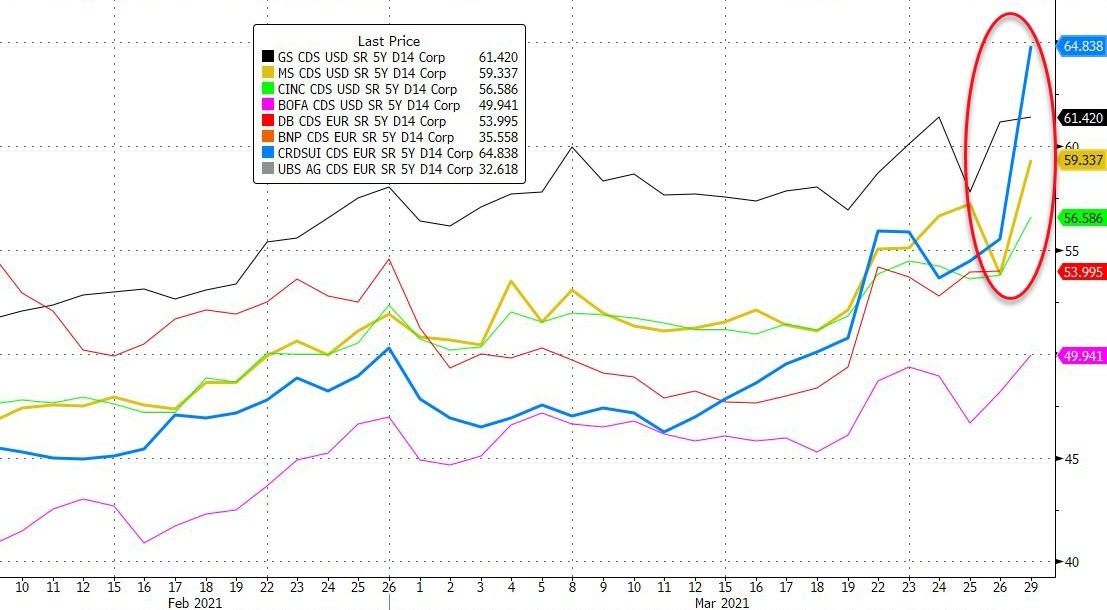
But the real anxiety was in broker CDS…

Source: Bloomberg

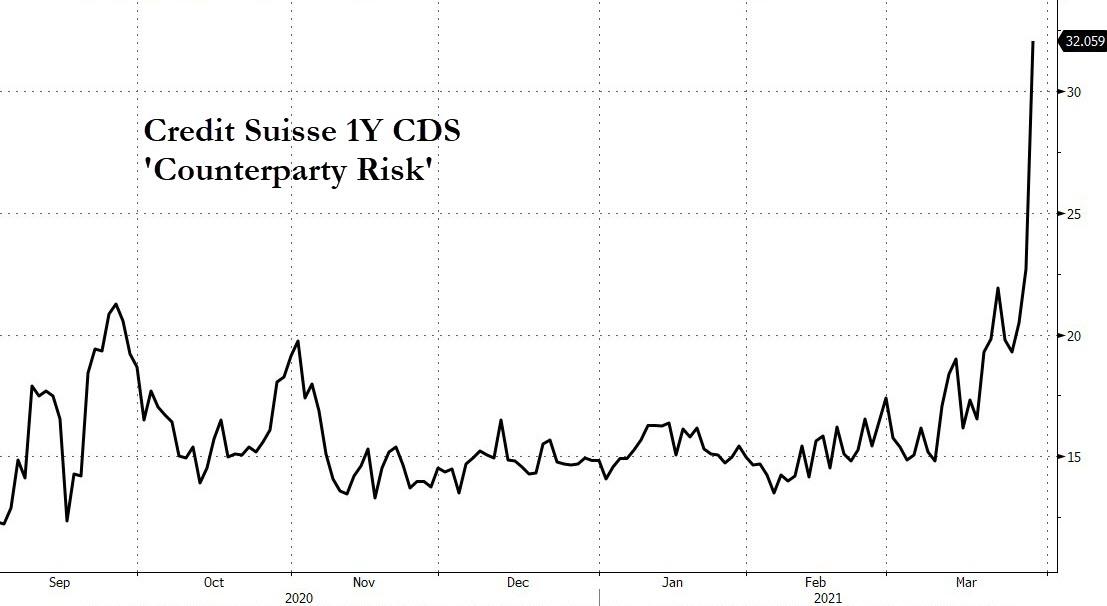
With Credit Suisse 1Y risk exploding (this is where derivatives counterparty risk managers would focus their hedges)

Source: Bloomberg

Amid this shitshow, cryptos were bid (safe haven) with Bitcoin back above $58,000…

Source: Bloomberg

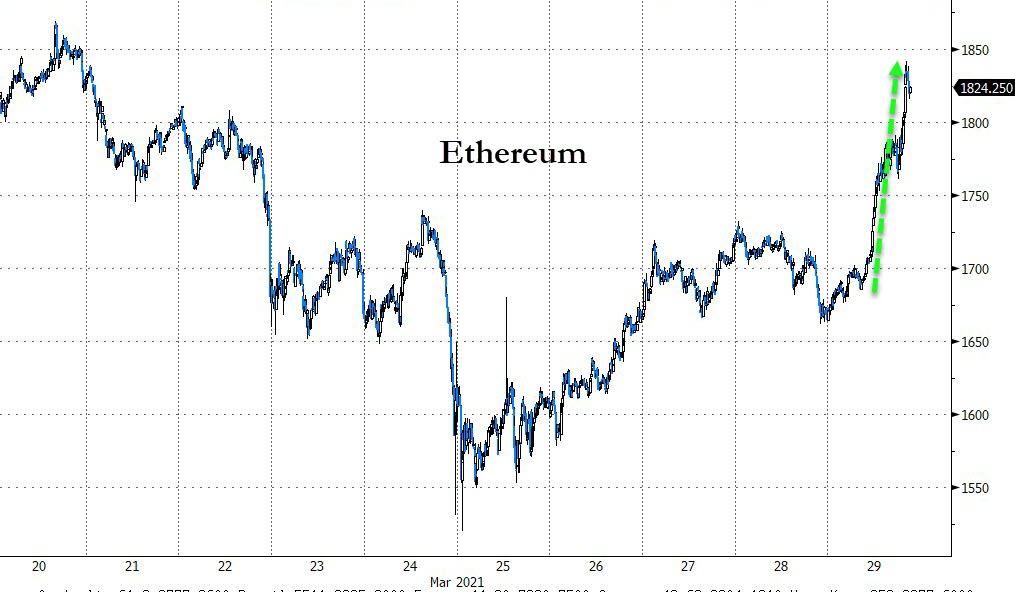
And Ethereum outperforming, spiking near $1850…

Source: Bloomberg

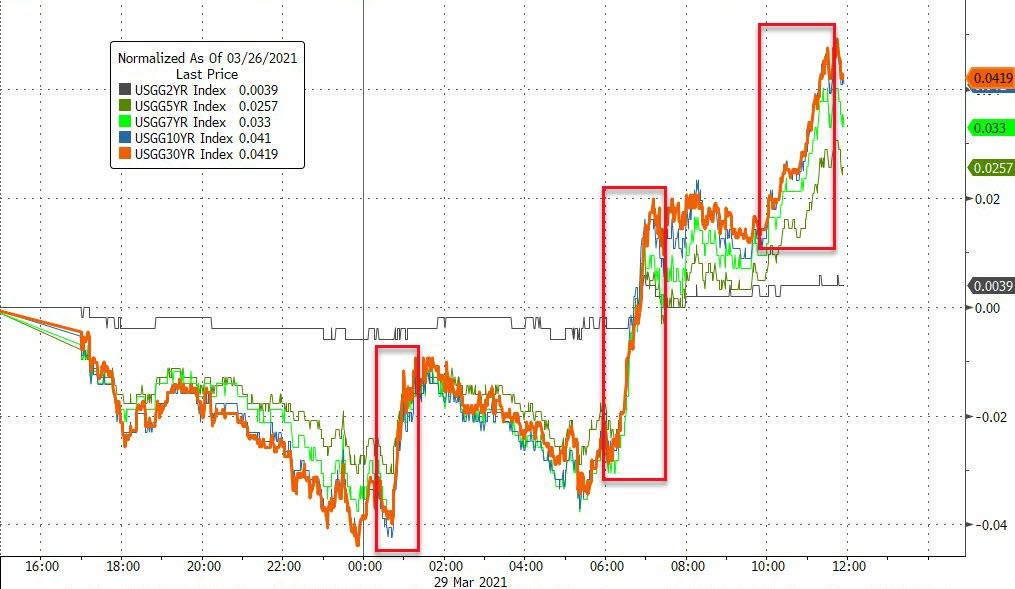
While cryptos were bid, bonds were battered – even as stocks sank and quarter-end rebalancing flows should have been supportive. Some suggested the sales were more liquidations as funds sold anything liquid to meet margin calls (the velocity and urgency of the move suggests that or major rate-locks ahead of some serious issuance)…Selling surges hit at the European open, the US open and after MS said block sales were done…

Source: Bloomberg

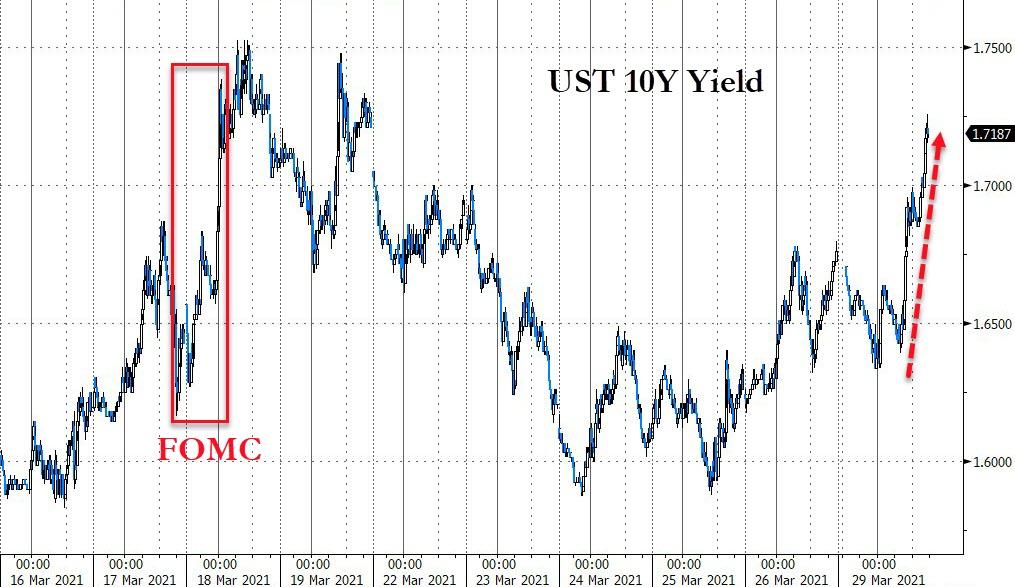
10Y Yields spiked back above 1.70%…

Source: Bloomberg

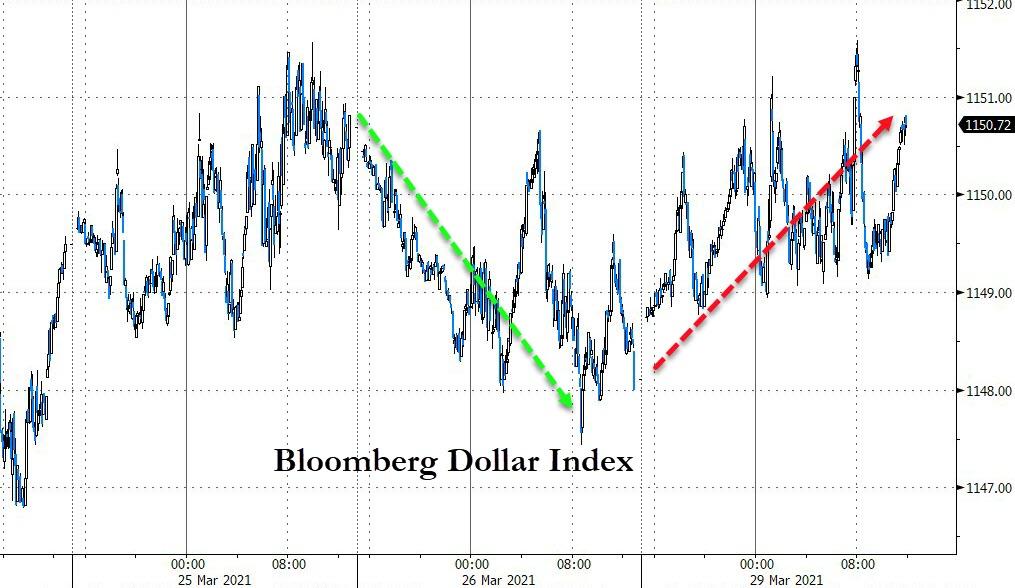
The dollar was a mess today, chopping around but ending marginally higher vs its fiat peers…

Source: Bloomberg

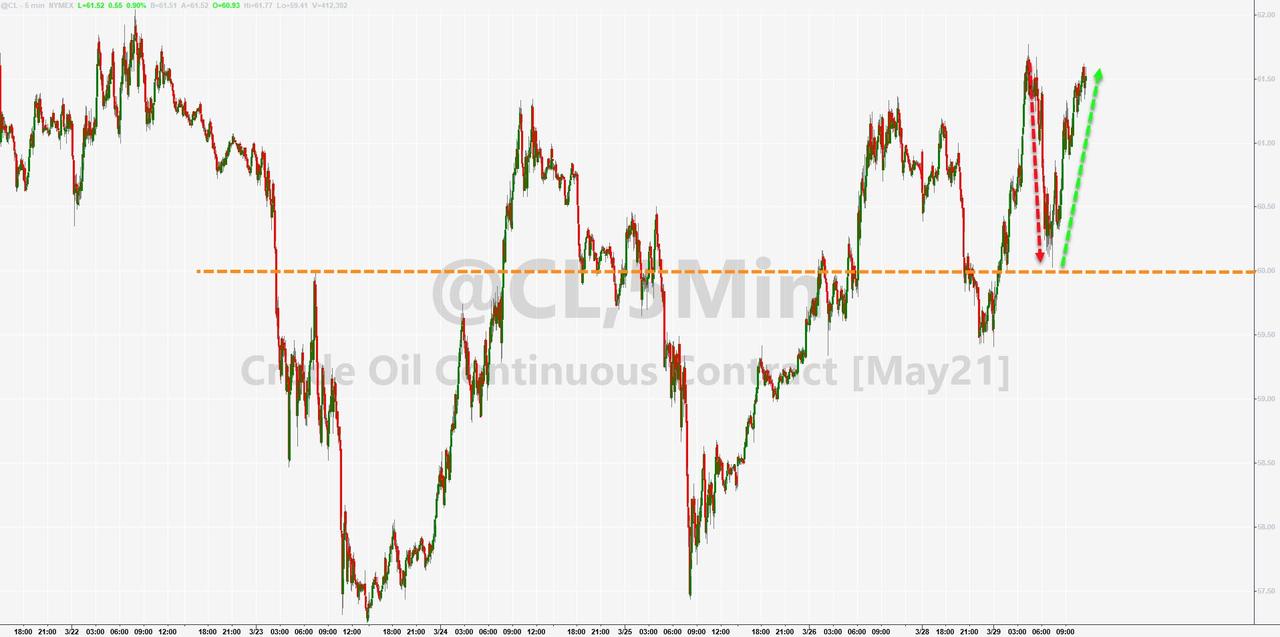
Oil prices remained in their recent range, tumbling on the good news that the Ever Given was freed and the Suez Canal was reopened, but a dip near $60 in WTI sparked a sudden buying urge among ‘traders’…

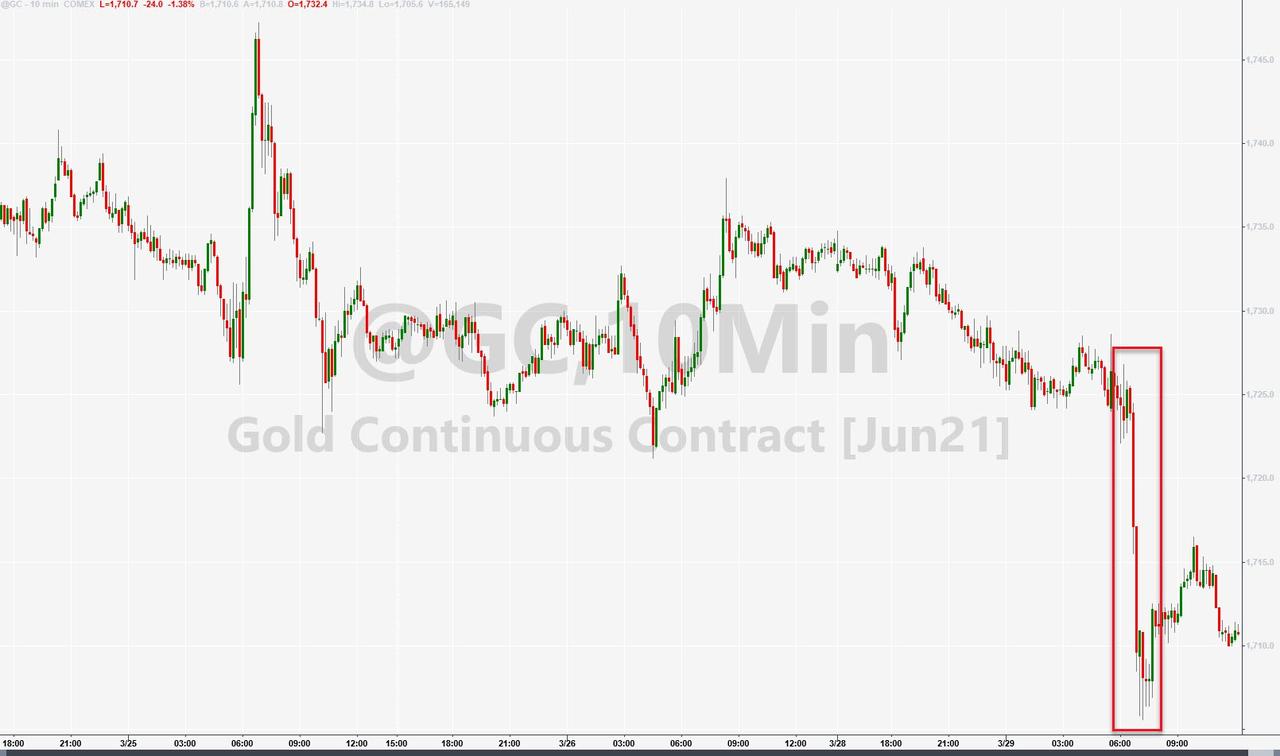
Gold was dumped early on too (at the US cash open) which again had the smell of forced liquidation flows…

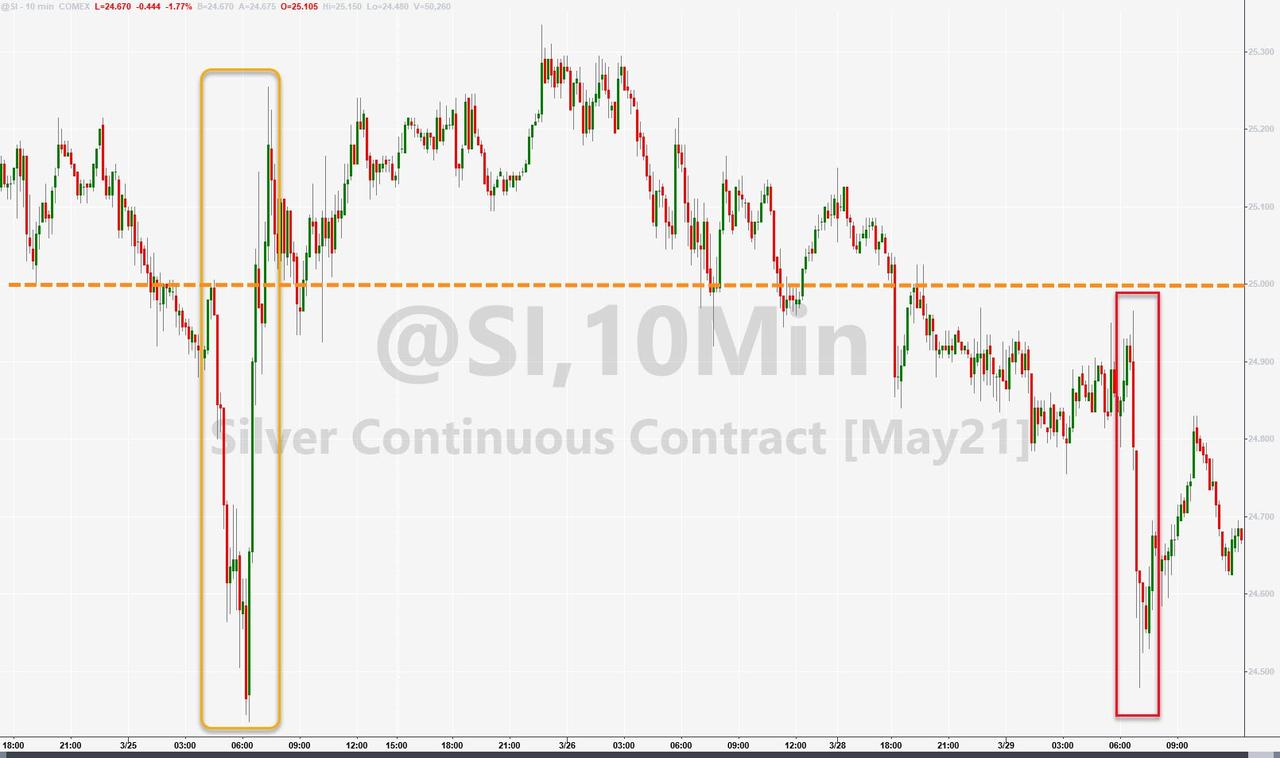
Silver tumbled back below $25, near that spike low liquidation we saw earlier in the week…

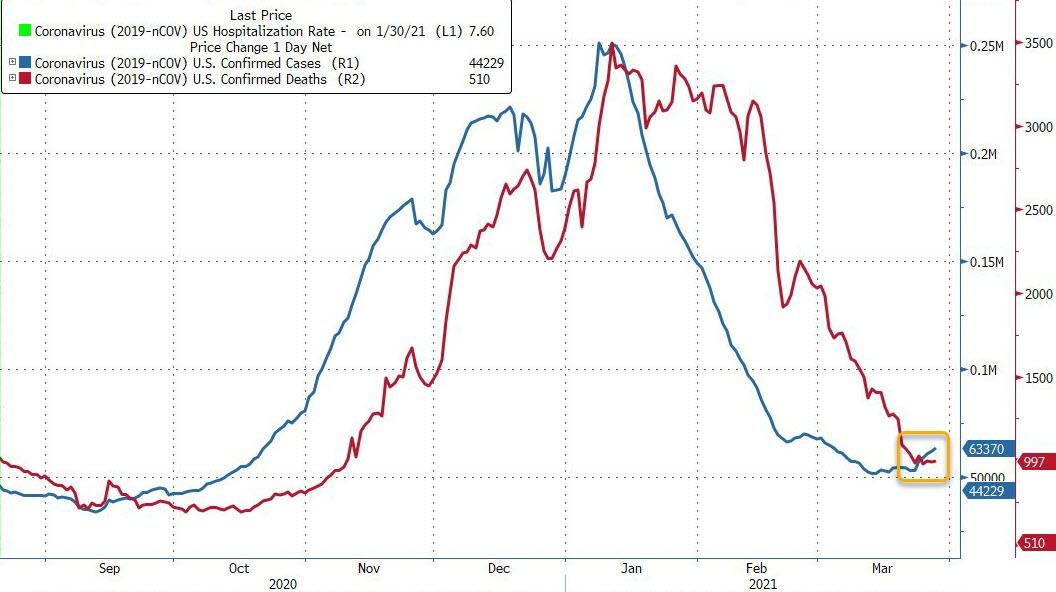
Finally, it’s definitely time to panic – according to the CDC – who took one look at this chart and warned all Americans of “impending doom”…

Source: Bloomberg

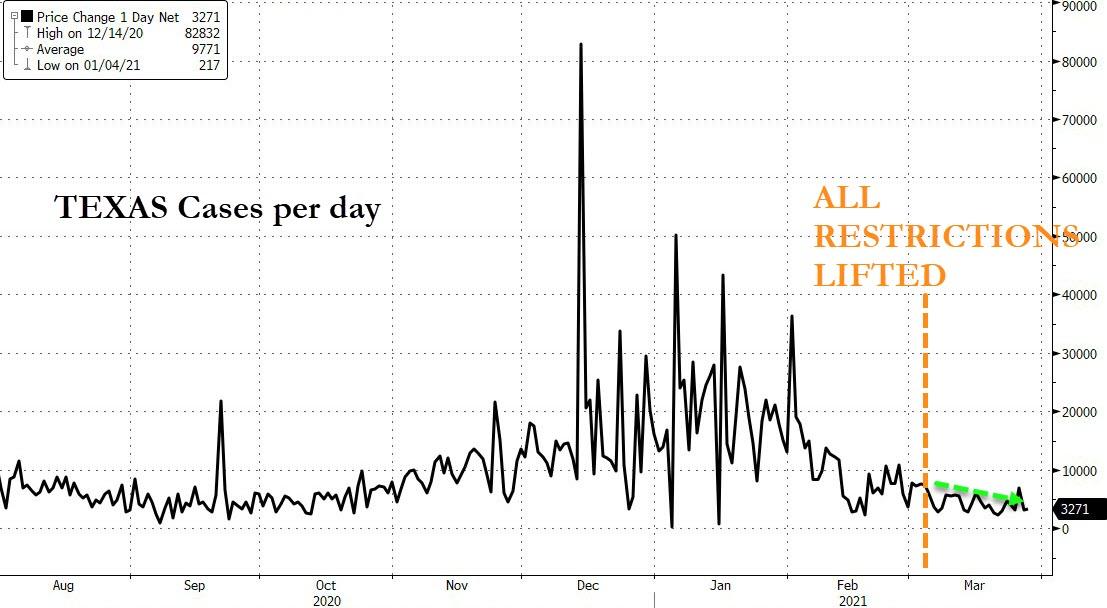
President Biden urged some states to pause reopening… just don’t tell him about Texas!

Source: Bloomberg

Tyler Durden
Mon, 03/29/2021 – 16:01

via ZeroHedge News https://ift.tt/3dm8hKx Tyler Durden

Video: Maryland Cops Handcuff and Berate Five-Year-Old Boy


copschool

Body camera footage released last Friday shows Maryland police officers berating, threatening, and briefly handcuffing a five-year-old boy who had wandered away from school without permission.

Two officers from the Montgomery County Department of Police picked up the child after he left school grounds in January of last year. According to statements in the video, the boy allegedly was disruptive in class, threw objects, destroyed school property, and struck a teacher. 

“This is why people need to beat their kids,” one officer remarked as they returned the child to school. 

“I hope your momma lets me beat you,” the officer remarked again as the boy began wailing in a school office. The officer then bent down and screamed several times in the child’s face.

After the mother arrived at school to retrieve her son, the other officer pulled out a pair of handcuffs and briefly put them on the boy. “You know what these are for? These are for people who don’t want to listen and don’t know how to act,” the officer said.

As Reason reported Friday, Maryland is one of several states across the country where bills have been introduced to raise the minimum age of arrest in response to public outrage over young children being handcuffed and arrested. 

“It made me sick,” Montgomery County Council member Will Jawando said in a press release about the incident. “We all saw a little boy be mocked, degraded, put in the seat of a police car, screamed at from the top of an adult police officer’s lungs, inches from his face.”

Maryland lawmakers are considering legislation that would divert children under 13 who commit nonviolent misdemeanors away from the criminal justice system. 

Earlier this year, the city of Rochester, New York, released body camera footage of officers pepper spraying a handcuffed 9-year-old girl

Last August, body camera footage emerged showing officers in Key West trying to handcuff an 8-year-old boy whose wrists were too small for the cuffs. An Orlando school cop made national headlines in 2019 when he arrested a 6-year-old girl for allegedly throwing a tantrum in class.

Civil liberties groups say school arrests, suspensions, and the use of physical restraints disproportionately impact minority youth and children with disabilities.

The boy’s mother filed a lawsuit in January over the incident.

The Montgomery County Police Department said in a press release that the two officers in the video were the subject of an internal investigation, the results of which are confidential under Maryland law.

“Both officers remain employed by the Montgomery County Department of Police,” the department wrote. “Due to pending litigation, the department has no further comment.”

from Latest – Reason.com https://ift.tt/2QRf4nN
via IFTTT

“Labor Code Violations” – Amazon Sued Over Mistreatment Of Warehouse Workers  

“Labor Code Violations” – Amazon Sued Over Mistreatment Of Warehouse Workers  

Amazon has long promoted its warehouses as “progressive” work environments. But as we read in a new lawsuit, there’s a dark side to working at the company’s warehouses, or at least one of them, that is intense labor, underpaid, and limited breaks. 

A former Amazon fulfillment worker in California filed a lawsuit claiming the company failed to provide adequate work breaks. 

In February, the lawsuit, filed in San Francisco County Superior Court, was shifted to the US District Court California, Northern District last Friday, according to court documents seen by The Verge

Lovenia Scott, a former employee of the Vacaville, California warehouse, also the plaintiff in the lawsuit, said the e-commerce giant failed to provide warehouse workers with rest periods, premium wages, adequate lunch breaks, among other things.

Here’s the complete list that alleges Amazon failed to provide employees with an adequate work environment:  

( I ) failed to provide her and all other similarly situated individuals with meal

periods;

(2) failed to provide them with rest periods;

(3) failed to pay them premium wages for missed meal and’or rest periods;

(4) failed to pay them premium wages for missed meal and or rest periods at the

regular rate of pay;

(5) failed to pay them at least minimum wage for all hours worked;

(6) failed to reimburse them for all necessary business expenses;

(7) failed to provide them with accurate written wage statements; and

(8) failed to pay them all of their final wages following the separation of employment.

“Based on these alleged Labor Code violations. Plaintiff now brings this class action to recover unpaid wages, restitution, and related relief on behalf of herself and all others similarly situated,” the lawsuit read. 

Amazon has gained national attention for a union vote at its fulfillment in Bessemer, Alabama, expected to wrap up Monday. Warehouse workers at Bessemer facility want better pay and working conditions. 

President Biden has backed the Bessemer unionization movement. He told workers to make their “voices heard,” saying it’s up to them to unionize. 

Efforts to unionize across various states have gained momentum since Bessemer. Employees in Baltimore, New Orleans, Portland, Denver, and Southern California have begun examining ways to form unions at their respective warehouses. Many warehouse employees want collective bargaining to fight back against Amazon, which has worked them like dogs. 

Readers may recall last week a Twitter war broke out between progressive Democrats and Amazon – after Sen. Bernie Sanders said he would meet with Amazon workers on Friday to discuss their vote to unionize.

In response to Sanders’ visit, Dave Clark – CEO of worldwide consumer blew his stack, tweeting, “I often say we are the Bernie Sanders of employers, but that’s not quite right because we deliver a progressive workplace for our constituents: a $15 minimum wage, health care from day one, career progression, and a safe and inclusive work environment.”

In response, Rep. Mark Pocan (D-WI) had Bernie’s back-tweeting, “Paying workers $15/hr doesn’t make you a “progressive workplace” when you union-bust & make workers urinate in water bottles.”

Over the past decade, several reports emerged over poor-working conditions at Amazon warehouses and corporate headquarters.

In 2011, the brutal work environment at an Amazon warehouse in Breinigsville, Pennsylvania were reported in the Morning Call.

In 2012, the Seattle Times published a blockbuster report about overworked, underpaid staff who were encouraged to lie about workplace injuries to avoid filing reports. 

In 2015, the New York Times revealed that conditions at Amazon headquarters are cutthroat. 

“Nearly every person I worked with, I saw cry at their desk.” –Bo Olson

And in April of 2018, journalist and author James Bloodworth reported what he saw after going undercover at an Amazon warehouse in Staffordshire, UK, where he found horrendous conditions in which some workers are forced to pee in bottles

“People just peed in bottles because they lived in fear of being ­disciplined over ‘idle time’ and ­losing their jobs just because they needed the loo.” -The Sun

The new lawsuit comes as no surprise as Amazon’s treatment of its warehouse employees appears to be far from a “progressive work environment” but one that would rival a Chinese sweatshop (maybe the pay is a little better). In the coming days, or maybe as soon as tonight or tomorrow, counting for the Bessemer union vote should conclude. 

But here’s the biggest problem if Bessemer unionized and others follow, that is, the higher pay will drive up costs for the company and likely be pushed onto consumers. 

Amazon knows unionization at its warehouses is inevitable, and to counter the movement, over the years it has unveiled robots designed to replace in warehouses. 

Tyler Durden
Mon, 03/29/2021 – 15:40

via ZeroHedge News https://ift.tt/2PaX1IS Tyler Durden

The CDC Keeps Extending Its Illegal Eviction Ban


reason-housing

The Centers for Disease Control and Prevention (CDC) is extending its controversial eviction moratorium, which was set to expire Wednesday, through the end of June.

The order, signed by CDC Director Rochelle Walensky, prevents tenants earning up to $99,000 ($198,000 for joint filers) from being evicted for non-payment of rent, provided they sign written declarations saying, among other things, that they’ve lost income or had unexpected medical bills, that they have made every effort to acquire government assistance, and that their eviction could compel them to move into a homeless shelter or other crowded shared living space.

The order was first imposed under the Trump administration, extended by Congress in late December, and renewed again by the Biden administration in January.

Renters can still be evicted under the CDC order for engaging in on-premises criminal activity, for threatening the health and safety of other residents, for damaging the property, for violating building codes, or for violating lease terms other than not paying rent.

Through each extension, the moratorium’s specifics have remained largely unchanged from the Trump administration’s initial version. That has aggravated some housing advocates who, while supportive of the policy, would like to see it expanded to cover more types of evictions and enforced more robustly.

“While the Biden administration is well aware of the shortcomings in the moratorium order that allow some evictions to proceed during the pandemic, the CDC director did not correct them,” declared the National Low Income Housing Coalition (NLIHC). “She simply extended President Trump’s original order, leaving the loopholes and flaws in place, a disappointing decision that will result in more harmful evictions during the pandemic.”

On the other side of the issue, landlords are dismayed at a moratorium that prevents them from reclaiming their property from nonpaying tenants.

“My clients are now in a position where we’ve had the eviction moratorium since September. It will go through June at least, and could be extended again,” says Caleb Kruckenberg, a lawyer at the New Civil Liberties Alliance (NCLA), which is suing the CDC on behalf of several property owners. “For some of my clients, it will be 18 months since they’ve had tenants who pay rent. It was unsustainable from the beginning.”

The CDC has justified its eviction ban by pointing to public health rules that say the agency can take measures “reasonably necessary” to prevent the interstate spread of communicable disease.

Because evicted tenants might move into crowded living arrangements, the agency argues, a moratorium is needed to mitigate the spread of the pandemic. Walensky’s order stresses that the eviction moratorium remains necessary in spite of falling deaths and the rollout of vaccines.

“It is important to note that despite higher rates of vaccine coverage, the simultaneous roll-back of community mitigation efforts may continue to expose vulnerable populations, such as those targeted in this Order, to higher-than average COVID-19 rates,” it says.

“Every time now the CDC has extended it, it has the feeling of just making excuses. Yes, infection rates are down. Yes, people are being vaccinated. Yet for some inexplicable reason we have to ruin the livelihood of property owners,” says Kruckenberg.

Two separate studies have found that state-level eviction moratoriums have helped suppress COVID-19 infections and deaths while in effect. But neither of those studies measure actual evictions or levels of economic or social activity. That leaves open the possibility that eviction moratoriums are being imposed in places where people are already taking more precautions and are being lifted in states where people are less cautious, and it’s that difference in behavior that’s responsible for higher levels of transmission and death.

The CDC’s new order says that mass evictions would “inevitably” occur if the moratorium is lifted. One commonly cited estimate from last summer put the number of tenants at risk of eviction at 40 million. A recent Census Bureau Household Pulse Survey found 8.3 million Americans were behind on their rent, and about 17 percent of those people said they were “very likely” to be evicted.

“I think that’s like using the number of drivers to say how many people are at risk of dying in a car accident,” says Salim Furth, a housing researcher at George Mason University’s Mercatus Center. “Yes, everyone who gets in a car is at risk of an accident, but that doesn’t give you any sense of the number of people who will actually die in a car accident today.”

Despite ubiquitous warnings over the past year about a coming wave of evictions, the actual number that have taken place during windows where no moratoriums have been in effect has been lower than average almost everywhere.

The difficulty of finding a new, reliable tenant when so many people are out of work means landlords have little to gain from evicting previously good tenants who’ve fallen behind on rent during the pandemic, says Furth.

An analysis published today by the rental listing website Zillow found that actual evictions have come in far below predicted evictions in states where data are available.

The approval of $46.55 billion in rental assistance during the pandemic would, one would think, lessen the risk of eviction for renters behind on their bills even more.

So far, courts have been split on the legality of the CDC’s eviction moratorium.

Three U.S. district courts—in Tennessee, Ohio, and Texas—have rejected the CDC’s power grab in ruling that the agency’s moratorium illegal. The Tennessee and Ohio decisions argue the agency went beyond the power given to it by Congress in banning evictions. The U.S. district court decision in Texas went further by saying that not even Congress had the power to impose an interstate eviction moratorium.

Two other district courts—one in Louisiana, the other in Georgia in the case brought by NCLA—have upheld the CDC’s eviction ban.

Despite a handful of district-level rulings striking down the moratorium, the CDC’s order is still enforceable in most of the country, says Ilya Somin, a law professor at George Mason University and contributor to The Volokh Conspiracy (which is hosted by Reason).

“None of the three decisions striking it down have issued a nationwide injunction, so all of them apply probably only to the parties in their case, and possibly they’ll apply to other cases located in those districts,” he tells Reason. “The order does remain enforceable throughout the country unless and until there is some kind of nationwide injunction or ruling of the Supreme Court.”

The Biden administration’s extension of the order ensures the legal controversy will continue well into the summer.

Bonus video: the victims of New York’s eviction moratorium.

from Latest – Reason.com https://ift.tt/31tYRXB
via IFTTT

The CDC Keeps Extending Its Illegal Eviction Ban


reason-housing

The Centers for Disease Control and Prevention (CDC) is extending its controversial eviction moratorium, which was set to expire Wednesday, through the end of June.

The order, signed by CDC Director Rochelle Walensky, prevents tenants earning up to $99,000 ($198,000 for joint filers) from being evicted for non-payment of rent, provided they sign written declarations saying, among other things, that they’ve lost income or had unexpected medical bills, that they have made every effort to acquire government assistance, and that their eviction could compel them to move into a homeless shelter or other crowded shared living space.

The order was first imposed under the Trump administration, extended by Congress in late December, and renewed again by the Biden administration in January.

Renters can still be evicted under the CDC order for engaging in on-premises criminal activity, for threatening the health and safety of other residents, for damaging the property, for violating building codes, or for violating lease terms other than not paying rent.

Through each extension, the moratorium’s specifics have remained largely unchanged from the Trump administration’s initial version. That has aggravated some housing advocates who, while supportive of the policy, would like to see it expanded to cover more types of evictions and enforced more robustly.

“While the Biden administration is well aware of the shortcomings in the moratorium order that allow some evictions to proceed during the pandemic, the CDC director did not correct them,” declared the National Low Income Housing Coalition (NLIHC). “She simply extended President Trump’s original order, leaving the loopholes and flaws in place, a disappointing decision that will result in more harmful evictions during the pandemic.”

On the other side of the issue, landlords are dismayed at a moratorium that prevents them from reclaiming their property from nonpaying tenants.

“My clients are now in a position where we’ve had the eviction moratorium since September. It will go through June at least, and could be extended again,” says Caleb Kruckenberg, a lawyer at the New Civil Liberties Alliance (NCLA), which is suing the CDC on behalf of several property owners. “For some of my clients, it will be 18 months since they’ve had tenants who pay rent. It was unsustainable from the beginning.”

The CDC has justified its eviction ban by pointing to public health rules that say the agency can take measures “reasonably necessary” to prevent the interstate spread of communicable disease.

Because evicted tenants might move into crowded living arrangements, the agency argues, a moratorium is needed to mitigate the spread of the pandemic. Walensky’s order stresses that the eviction moratorium remains necessary in spite of falling deaths and the rollout of vaccines.

“It is important to note that despite higher rates of vaccine coverage, the simultaneous roll-back of community mitigation efforts may continue to expose vulnerable populations, such as those targeted in this Order, to higher-than average COVID-19 rates,” it says.

“Every time now the CDC has extended it, it has the feeling of just making excuses. Yes, infection rates are down. Yes, people are being vaccinated. Yet for some inexplicable reason we have to ruin the livelihood of property owners,” says Kruckenberg.

Two separate studies have found that state-level eviction moratoriums have helped suppress COVID-19 infections and deaths while in effect. But neither of those studies measure actual evictions or levels of economic or social activity. That leaves open the possibility that eviction moratoriums are being imposed in places where people are already taking more precautions and are being lifted in states where people are less cautious, and it’s that difference in behavior that’s responsible for higher levels of transmission and death.

The CDC’s new order says that mass evictions would “inevitably” occur if the moratorium is lifted. One commonly cited estimate from last summer put the number of tenants at risk of eviction at 40 million. A recent Census Bureau Household Pulse Survey found 8.3 million Americans were behind on their rent, and about 17 percent of those people said they were “very likely” to be evicted.

“I think that’s like using the number of drivers to say how many people are at risk of dying in a car accident,” says Salim Furth, a housing researcher at George Mason University’s Mercatus Center. “Yes, everyone who gets in a car is at risk of an accident, but that doesn’t give you any sense of the number of people who will actually die in a car accident today.”

Despite ubiquitous warnings over the past year about a coming wave of evictions, the actual number that have taken place during windows where no moratoriums have been in effect has been lower than average almost everywhere.

The difficulty of finding a new, reliable tenant when so many people are out of work means landlords have little to gain from evicting previously good tenants who’ve fallen behind on rent during the pandemic, says Furth.

An analysis published today by the rental listing website Zillow found that actual evictions have come in far below predicted evictions in states where data are available.

The approval of $46.55 billion in rental assistance during the pandemic would, one would think, lessen the risk of eviction for renters behind on their bills even more.

So far, courts have been split on the legality of the CDC’s eviction moratorium.

Three U.S. district courts—in Tennessee, Ohio, and Texas—have rejected the CDC’s power grab in ruling that the agency’s moratorium illegal. The Tennessee and Ohio decisions argue the agency went beyond the power given to it by Congress in banning evictions. The U.S. district court decision in Texas went further by saying that not even Congress had the power to impose an interstate eviction moratorium.

Two other district courts—one in Louisiana, the other in Georgia in the case brought by NCLA—have upheld the CDC’s eviction ban.

Despite a handful of district-level rulings striking down the moratorium, the CDC’s order is still enforceable in most of the country, says Ilya Somin, a law professor at George Mason University and contributor to The Volokh Conspiracy (which is hosted by Reason).

“None of the three decisions striking it down have issued a nationwide injunction, so all of them apply probably only to the parties in their case, and possibly they’ll apply to other cases located in those districts,” he tells Reason. “The order does remain enforceable throughout the country unless and until there is some kind of nationwide injunction or ruling of the Supreme Court.”

The Biden administration’s extension of the order ensures the legal controversy will continue well into the summer.

Bonus video: the victims of New York’s eviction moratorium.

from Latest – Reason.com https://ift.tt/31tYRXB
via IFTTT

Ponzis Go Boom!!!!

Ponzis Go Boom!!!!

Via AdventuresInCapitalism.com,

For the past few years, I have been critical of the Ponzi Sector. To me, these are businesses that sell a dollar for 80 cents and hope to make it up in volume. Just because Amazon (AMZN – USA) ran at a loss early on, doesn’t mean that all businesses will inflect at scale. In fact, many of the Ponzi Sector companies seem to have declining economics at scale—largely the result of intense competition with other Ponzi companies who also have negligible costs of capital.

I recently wrote about how interest rates are on the rise. If capital will have a cost to it, I suspect that the funding shuts off to the Ponzi Sector—buying unprofitable revenue growth becomes less attractive if you have other options. Besides, when you can no longer use presumed negative interest rates in your DCF, these businesses have no value. I believe the top is now finally in for the Ponzi Sector and a multi-year sector rotation is starting. However, interest rates are only a small piece of the puzzle.

Conventional wisdom says that the internet bubble blew up due to increasing interest rates. This may partly be true, but bubbles are irrational—rates shouldn’t matter—it is the psychology that matters. I believe two primary forces were at play that finally broke the internet bubble; equity supply and taxes. Look at a deal calendar from the second half of 1999. The number of speculative IPOs went exponential. Most IPOs unlock and allow restricted shareholders to sell roughly 180 days from the IPO. Is it any surprise that things got wobbly in March of 2020 and then collapsed in the months after that? Line up the un-lock window with the IPOs. It was a crescendo of supply—even excluding stock option exercises and secondary offerings. The supply simply overwhelmed the number of crazed retail investors buying worthless internet schemes. Back in 2000, I used to joke that in a scenario where a company wanted to raise equity capital, but insiders wanted to sell, they’d both dump shares on the market—but the insiders would get out first. What do you think that did to share prices as both parties fought for the few available bids?

However, the proximate cause of the internet bubble’s collapse was when people got their tax bills in March and had to sell stocks to pay their taxes in April. What’s the scariest thing in finance? It’s when you owe a fixed tax bill from the prior year, yet your portfolio starts declining. You start selling fast to stop the mismatch. Trust me, I’ve been there. Tax time is pushed back a bit this year, but it is coming.

Admittedly, All 3 Are Full Of Shit…

I bring this all up, because the SPAC market is in the process of detonating and it will take the Ponzi Sector with it. Let’s look back at the internet bubble. A VC firm would IPO 4 million shares at $20, the stock would open at $50 and end the day at $100. Everyone chased it to get in. Then the brokers would upgrade it and the CEO would go on TV. With a 4 million share float, it was easy to manipulate the shares higher. Often, the newly IPO’d company would level out well north of $100 a few weeks later. It was a virtuous cycle and everyone played the game. What was left unsaid was that there were another 46 million shares held by management and VCs and these shares would hit the market 180 days later. At first, the market absorbed the new supply so no one showed concern—then the market choked. I wrote about this when talking about the QS unlock. This process is about to repeat, but now with the odd nuances of SPACs.

A typical SPAC deal involves a few hundred million dollars raised for the SPAC trust—this is the only real float. Then a few hundred million more is raised for the PIPE—these guys are buying at $10 because they plan to flip for a gain as soon as the registration statement becomes effective—which is often a few weeks after the deal closes. When a company merges with a SPAC, billions in newly printed shares are given to the former owners—those shares start to unlock a few months later in various tranches. Finally, the promoters behind the SPAC get to sell. When you look at a pre-merger deal trading at a big premium to the $10 trust value, you’re looking at an iceberg. There might be ten or twenty restricted shares for every free trading share—all of these guys desperately want out. It’s a game theory exercise—how do you find enough bag-holders without destroying the price? Hence, part of why the current price is determined by an artificially restricted float and the unlocks come in tranches. As restricted shares come unlocked, the promoters lose control of the float and the house of cards collapses.

Part of the hilarity of SPACs is that the promoters claim to be aligned with shareholders because they exit last in terms of unlock tranches. What’s left unsaid is that their shares have almost a zero-cost basis—hence when they sell out at well under $10, it’s still all profit. Meanwhile the acquired company insiders often have an even lower cost basis because they founded the company at a negligible cost, there were bidding wars by various SPACs which drove the valuations to nosebleed levels and the acquisition targets are often mostly fake anyway.

When there were only a few high-profile SPACs, this supply could be absorbed—very much like 1999 with internet IPOs. This made people unconcerned about the supply deluge. Now we’re starting to enter the teeth of the unlock window from 2020 vintage SPACs. There are literally tens of billions a week in stock flooding the market—except there’s no natural shareholder base for these things. There are only so many retail punters who wake up and want to buy a fake “green” company with no revenue and no path to revenue—much less profits. When everyone is making money in ESG themed frauds, it draws fresh capital into the bubble and helps inflate things. When the losses start stacking up, capital leaves—yet there are still hundreds of billions of dollars in SPAC shares waiting to be unlocked and dumped. Remember how their cost basis is effectively zero? The insiders and promoters literally do not care what price they sell at. It is the internet bubble all over again.

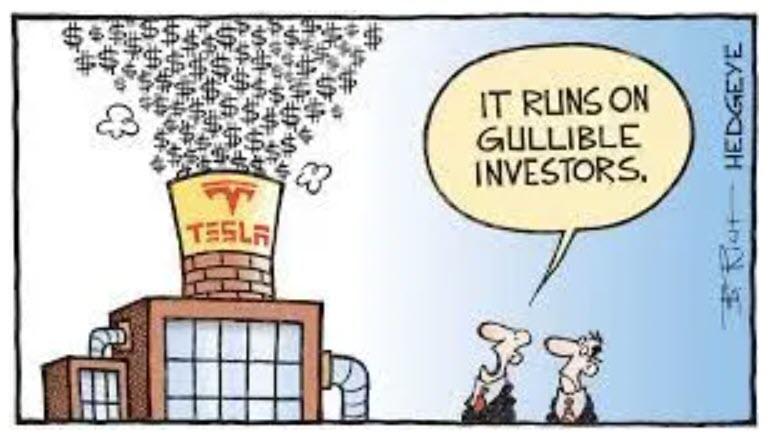
You may wonder how the SPAC bubble will infest the rest of the Ponzi Sector. It comes down to collateral and shareholder bases. On the collateral side, much of the Ponzi Sector bubble is built on leverage. That could be margin debt or YOLO call options, but it’s all leverage. As asset values decline, brokers will force punters to de-lever. This will lead to waves of selling, leading to more forced selling. As for YOLO call options? They’re not exactly firm bedrock when it comes to a bubble. The SPACs and the Ponzi Sector are all tied together, because they all have the same shareholder base. As these owners take losses, they’ll be forced to sell “best in class” Ponzis like Tesla (TSLAQ – USA).

Back in 1999, there were various firms that enabled the internet bubble. They had handshake agreements that they’d be given IPO allocations, on the understanding that they wouldn’t sell—in fact, they frequently bought more in the open market, often at many times the IPO price. This allowed VC firms to tighten up already tight floats and manipulate shares higher. As these firms outperformed, they had inflows, allowing them to continue buying the same companies and pushing shares higher—leading to more inflows. It was a virtuous cycle and many firms worked together as wolf-packs in the same names. When redemptions came, these firms were forced to sell and the process unwound—except it was unusually speedy to the downside as the share prices were artificially propped up.

I have my sights on a certain ETF for this cycle. Go through ARK Innovation ETF’s (ARKK – USA) position list, go through all the quasi-affiliated firms that have copied this position list. All these firms have surprising concentrations in the same names. When it comes tumbling down, you don’t want to own any of these positions—especially the ones where ARKK owns more than 10% of the shares. You won’t want to own positions that are owned by people who own ARKK type positions as they’ll be forced sellers too. You want to be as far away from the Ponzi Sector ecosystem as possible.

I don’t know when it’s going to blow, but if I’m right that the top is in, the deluge isn’t too far off. Bubbles are highly unstable – if they’re not inflating, they’re usually bursting – there isn’t really a middle option. I think the past few weeks are more than a simple pullback—the losses from the SPAC bubble are going to dent the Ponzi Sector psychology. With this in mind, I took my long book way down over the past few weeks (including my GameStop (GME – USA) straddle for a nice score). That said, I don’t have shorts because this is still “Project Zimbabwe.” If I’m wrong, so be it. I’ll do just fine on my Event-Driven book. Besides, 2021 has already been a pretty spectacular year for me.

If you haven’t subscribed yet, go to KEDM.COM

Turning to Grayscale Bitcoin Trust (GBTC – USA), it now trades at a surprising discount to NAV—partly due to the shareholder base’s cross-ownership of other Ponzis. I had told myself that I’d hold GBTC through the sort of shake-outs that Bitcoin is famous for. However, this week when I went through my position sheets, I asked myself if I really needed this much exposure to a Ponzi Scheme, after repeatedly reminding myself that the Ponzi Sector is detonating. As a result, I booked a bit more than half of my GBTC exposure—taking all of my cost basis out and then some. I’m not going to say that my dismount in the mid-$40s was graceful—I wish I had sold it with a $5 handle, but I’m up 4-fold in 8 months and it still feels like quite the victory. For now, I intend to keep the rest of the position, though I’m moving my stop up once again. Will Bitcoin get caught in the downdraft? Who knows; I don’t need a position limit while I find out.

But Kuppy, what about “Project Zimbabwe?” Won’t the Ponzi Sector go up with everything else? My good friend, Kevin Muir, over at The MacroTourist (if you aren’t subscribed, you are missing out), likes to say that we’re “experiencing a period of rolling bubbles.” History says that once a bubble pops it rarely re-inflates. I believe that the Ponzi Sector bubble is now past the apex. With losses stacking up, the bubble psychology will break and people will start looking at things rationally again. How does this square with my “Project Zimbabwe” paradigm? It squares perfectly. We will have a rotation and some other asset class will bubble up next. I suspect it is one where increased cost of capital and massive government interference shuts off supply growth. Could inflation beneficiaries be next? I want exposure where the puck is going, not where it’s overstayed its welcome for far too long. On this pullback, that is where my focus will be.

Disclosure: Funds that I control are long GBTC.

Tyler Durden
Mon, 03/29/2021 – 15:19

via ZeroHedge News https://ift.tt/3m13gLf Tyler Durden