Democrats Demand Bureaucrats Regulate Bureaus More Heavily

reason-blumenthal

Are you sitting down? Well, maybe you shouldn’t be, given the risks posed by America’s stock of dangerously unregulated furniture. A new bill in Congress aims to prevent deaths from tipped-over dressers.

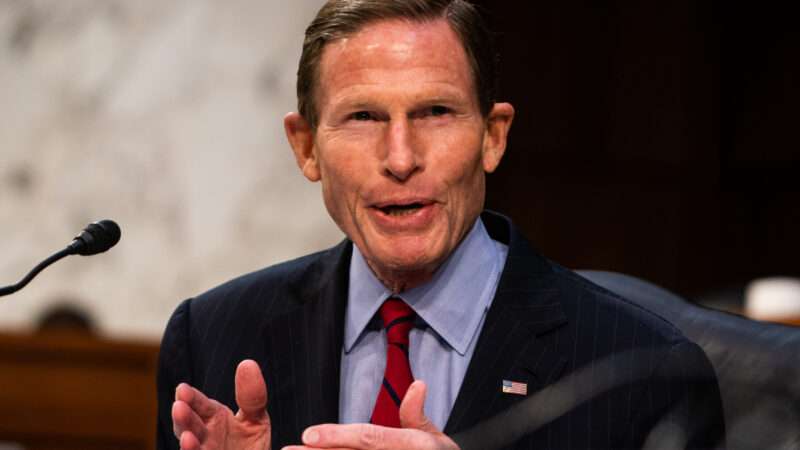
“The furniture industry has been allowed to self-regulate for too long—and with tragic consequences, as a child is injured by tipped furniture every 17 minutes,” said Sen. Richard Blumenthal (D–Conn.) in a press release promoting the Stop Tip-overs of Unstable, Risky Dressers on Youth (STURDY) Act. “As kids spend more time at home due to the pandemic, unanchored or top-heavy furniture poses a greater than ever risk.”

Sens. Blumenthal, Bob Casey (D–Penn.), and Amy Klobuchar (D–Minn.) introduced the STURDY Act last Thursday. The legislation would require the federal Consumer Product Safety Commission (CPSC) to develop more rigorous standards for dressers and other free-standing “clothing storage units” to prevent them from tipping over.

Deaths from falling furniture have attracted increased attention recently. According to the CPSC, which has released a series of reports on these incidents, 571 people, including 451 children, have died in the last 20 years from accidents involving unstable TVs, furniture, and appliances.

Most of these fatalities involved either falling TVs or falling furniture. Incidents involving only a tipped-over dresser or bureau, the subject of the STURDY Act, have produced 115 deaths in two decades.

“The nation’s furniture tip-over epidemic is particularly insidious because the danger is all around us, inside our homes—unless parents, grandparents, and other caregivers use special kits to strap or anchor furniture to wall,” wrote Consumer Reports in its 2018 investigation of the topic.

In that investigation, Consumer Reports conducted tip-over tests on 17 commercially available dressers. They found that nine of these dressers could fall over when a 50-pound weight was hung from the open top drawer. Only five dressers managed to withstand a 60-pound weight being hung from an open top drawer. (The idea was to simulate a child pulling on the front of a dresser.)

Blumenthal’s bill would require dressers and other “clothing storage units” to undergo similar simulations of a 60-pound child pulling on the dresser, as well as other real-world uses that could result in tip-over. It would also require new warning requirements to inform consumers of the danger of these collapsing cabinets.

The STURDY Act was first introduced in 2019. It passed the House but never made it through the Senate.

That same year ASTM International, an organization that develops voluntary technical standards for testing materials and products, revised its dresser stability standard to cover clothing storage units as short as 27 inches. The old standards covered only dressers that were 30 inches or taller.

The American Home Furnishings Alliance (AHFA) has raised a number of issues with the STURDY Act, saying the vague language in the bill would give furniture makers and sellers no clear guidance on how to comply with the new rules. The group also suggested several amendments to the bill, including a proposal that its requirements be limited to products intended for children.

Every preventable death is a tragedy, particularly when the victim is a child. It is nevertheless worth noting that approximately five of the 50 million children in the U.S. under the age of 12 die each year from falling furniture, according to a 2020 CPSC report.

The costs of the new regulations would meanwhile be borne by millions of consumers, including those who don’t have children. Four of the five dressers that withstood Consumer Reports’ 60-pound test cost more than $500. All dressers that cost less than $100 failed the 60-pound test.

A $150, 30-inch-tall dresser from IKEA did pass the 60-pound test, prompting Consumer Reports to say this proves that “a stable, affordable dresser at this height is possible.” But if such a dresser already exists on the marketplace, regulations mandating it into existence are unnecessary. The primary effect of stricter rules would be to eliminate the cheapest products. Would safety be ill-served by allowing childless adults on a budget to continue to purchase those?

Parents concerned about rickety dressers also have the option of securing furniture to the walls with straps and furniture anchors. Since 2015, the CPSC has run an “Anchor It!” educational campaign to encourage parents to do just that. Given the rarity of deaths from wobbly wardrobes and the existence of safe, affordable alternatives, it would be wise for legislators to shelf their STURDY Act proposal.

from Latest – Reason.com https://ift.tt/3bRfv8r
via IFTTT
Democrats Demand Bureaucrats Regulate Bureaus More Heavily

reason-blumenthal

Are you sitting down? Well, maybe you shouldn’t be, given the risks posed by America’s stock of dangerously unregulated furniture. A new bill in Congress aims to prevent deaths from tipped-over dressers.

“The furniture industry has been allowed to self-regulate for too long—and with tragic consequences, as a child is injured by tipped furniture every 17 minutes,” said Sen. Richard Blumenthal (D–Conn.) in a press release promoting the Stop Tip-overs of Unstable, Risky Dressers on Youth (STURDY) Act. “As kids spend more time at home due to the pandemic, unanchored or top-heavy furniture poses a greater than ever risk.”

Sens. Blumenthal, Bob Casey (D–Penn.), and Amy Klobuchar (D–Minn.) introduced the STURDY Act last Thursday. The legislation would require the federal Consumer Product Safety Commission (CPSC) to develop more rigorous standards for dressers and other free-standing “clothing storage units” to prevent them from tipping over.

Deaths from falling furniture have attracted increased attention recently. According to the CPSC, which has released a series of reports on these incidents, 571 people, including 451 children, have died in the last 20 years from accidents involving unstable TVs, furniture, and appliances.

Most of these fatalities involved either falling TVs or falling furniture. Incidents involving only a tipped-over dresser or bureau, the subject of the STURDY Act, have produced 115 deaths in two decades.

“The nation’s furniture tip-over epidemic is particularly insidious because the danger is all around us, inside our homes—unless parents, grandparents, and other caregivers use special kits to strap or anchor furniture to wall,” wrote Consumer Reports in its 2018 investigation of the topic.

In that investigation, Consumer Reports conducted tip-over tests on 17 commercially available dressers. They found that nine of these dressers could fall over when a 50-pound weight was hung from the open top drawer. Only five dressers managed to withstand a 60-pound weight being hung from an open top drawer. (The idea was to simulate a child pulling on the front of a dresser.)

Blumenthal’s bill would require dressers and other “clothing storage units” to undergo similar simulations of a 60-pound child pulling on the dresser, as well as other real-world uses that could result in tip-over. It would also require new warning requirements to inform consumers of the danger of these collapsing cabinets.

The STURDY Act was first introduced in 2019. It passed the House but never made it through the Senate.

That same year ASTM International, an organization that develops voluntary technical standards for testing materials and products, revised its dresser stability standard to cover clothing storage units as short as 27 inches. The old standards covered only dressers that were 30 inches or taller.

The American Home Furnishings Alliance (AHFA) has raised a number of issues with the STURDY Act, saying the vague language in the bill would give furniture makers and sellers no clear guidance on how to comply with the new rules. The group also suggested several amendments to the bill, including a proposal that its requirements be limited to products intended for children.

Every preventable death is a tragedy, particularly when the victim is a child. It is nevertheless worth noting that approximately five of the 50 million children in the U.S. under the age of 12 die each year from falling furniture, according to a 2020 CPSC report.

The costs of the new regulations would meanwhile be borne by millions of consumers, including those who don’t have children. Four of the five dressers that withstood Consumer Reports’ 60-pound test cost more than $500. All dressers that cost less than $100 failed the 60-pound test.

A $150, 30-inch-tall dresser from IKEA did pass the 60-pound test, prompting Consumer Reports to say this proves that “a stable, affordable dresser at this height is possible.” But if such a dresser already exists on the marketplace, regulations mandating it into existence are unnecessary. The primary effect of stricter rules would be to eliminate the cheapest products. Would safety be ill-served by allowing childless adults on a budget to continue to purchase those?

Parents concerned about rickety dressers also have the option of securing furniture to the walls with straps and furniture anchors. Since 2015, the CPSC has run an “Anchor It!” educational campaign to encourage parents to do just that. Given the rarity of deaths from wobbly wardrobes and the existence of safe, affordable alternatives, it would be wise for legislators to shelf their STURDY Act proposal.

from Latest – Reason.com https://ift.tt/3bRfv8r
via IFTTT
“Judgment” or “Judgement”?

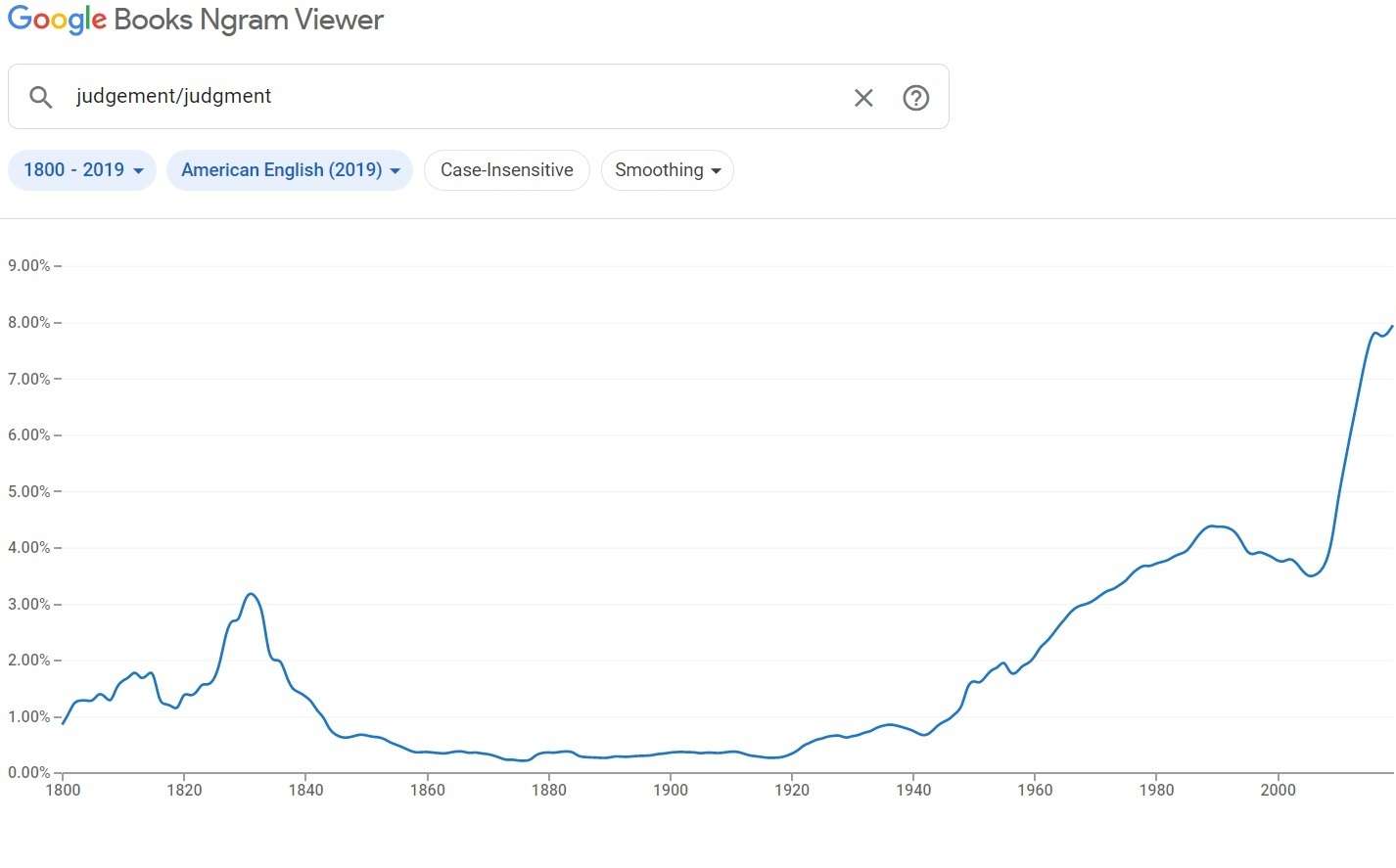
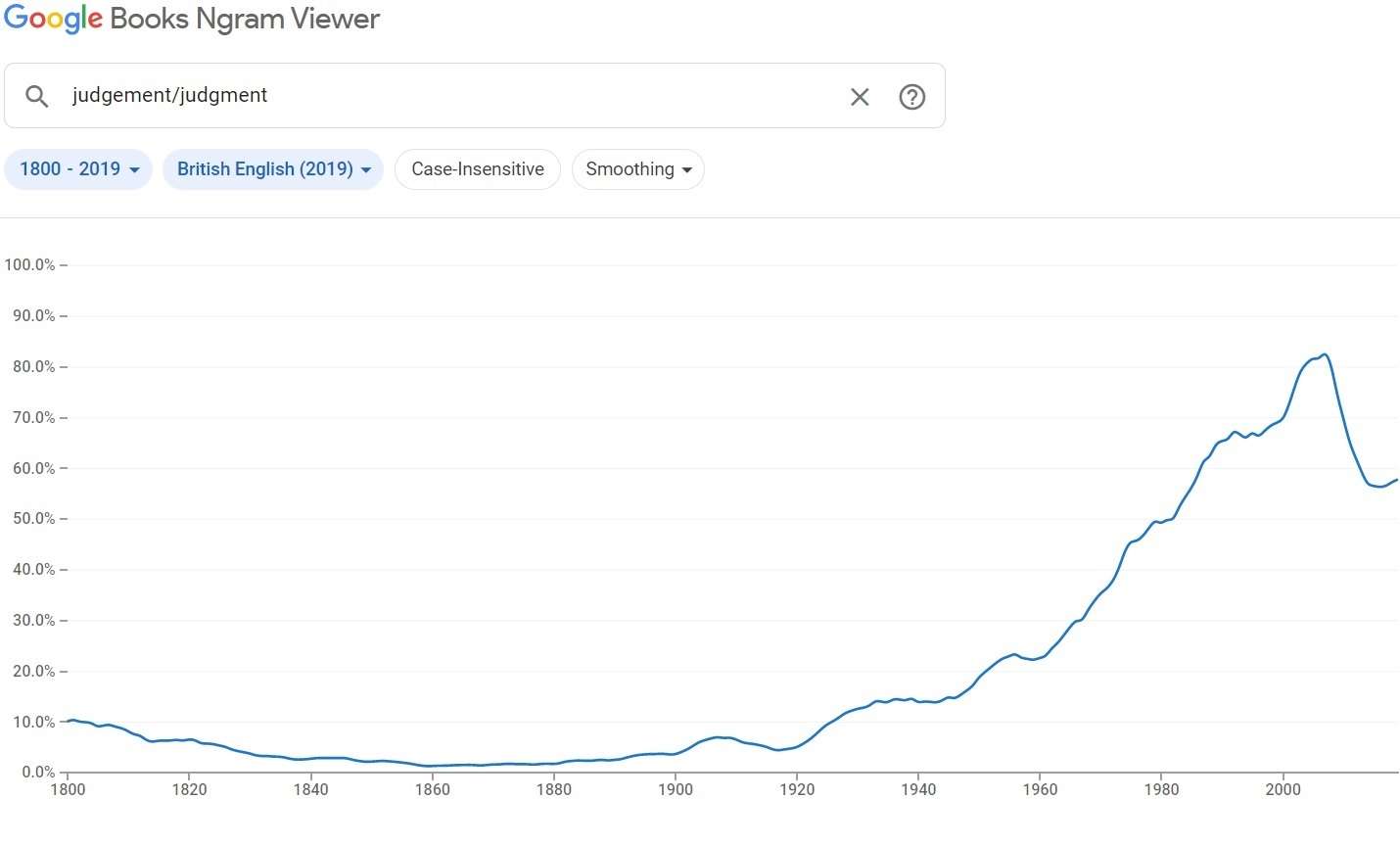
In America, “judgment” remains the sharply dominant spelling, by a factor of more than 10 to 1. The divide was even greater before about 2010:

(The graph shows the ratio of uses of “judgement” divided by the uses of “judgment,” and it’s under 10%.) The divide is likewise stark in American legal sources; a quick Westlaw search over the last week reported 2800 cases mentioning “judgment” and 72 “judgement.”

Curiously, in England, “judgement” has recently become a pretty common variant, being used for a few decades at at least half the rate of “judgment” (so that, of uses of both, a third are with the extra “e”).

I suspect that makes both standard in normal British English (I can’t speak to British legalese), much as “grey” and “gray” are both standard equivalents. But that’s only in Britain; in America, “judgment,” unusually spelled as it may be, is the dominant form, and using the spelling “judgement” is particularly likely to be seen as a mistake.
from Latest – Reason.com https://ift.tt/380EEwd
via IFTTT

These Were The Best And Worst Performing Assets In February And YTD

These Were The Best And Worst Performing Assets In February And YTD

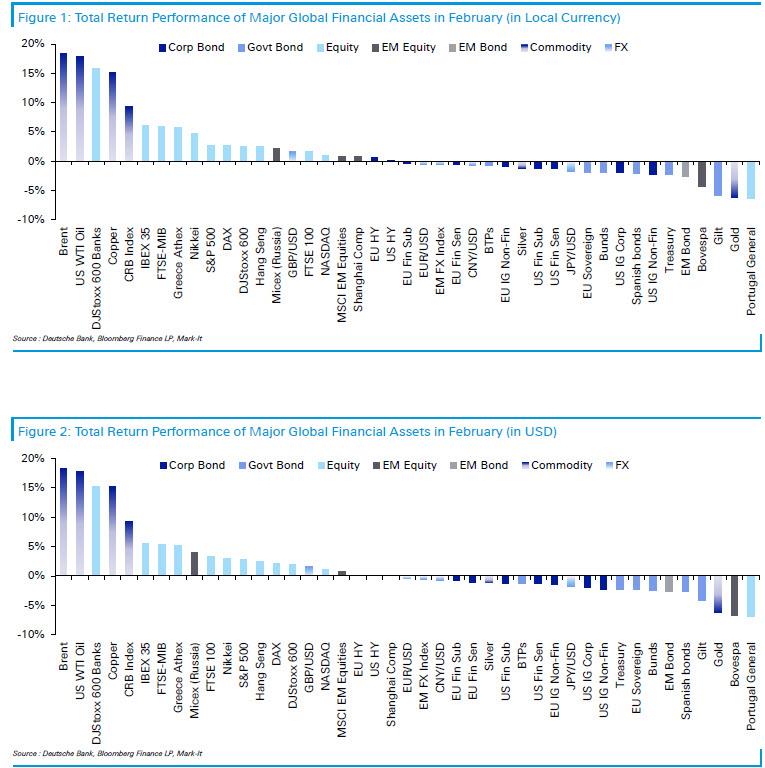
After what DB’s Jim Reid wrote was an incredibly stable January, “February saw no such repeat as investors positioned themselves for the prospects of a much stronger-than-anticipated economic recovery over the coming months.”

The effects, as everyone can recall, were seen across multiple asset classes, with sovereign bonds selling off sharply as investors brought forward their expectations of central bank rate rises. While equities saw modest gains for the most part over the month, the rise in yields meant they fell back from their all-time highs in mid-February.

Over in commodities, those set to take advantage of the recovery performed strongly, such as oil and copper, but gold has been the worst YTD performer in DB’s sample as investors have continued to move out of the traditional safe haven and transition over into “new age” fiat alternatives such as bitcoin which another amazing return, rising 39% in February despite a sharp dip at the end of the month.

Starting with sovereign bonds, all of the countries in DB’s sample saw their government debt lose ground for the second month in a row, as investors became much more optimistic on the prospects of an economic recovery, as well as a potential return of inflation. The changes in sentiment have come amidst better-than-expected economic data, the continued rollout of the vaccine, as well as the likelihood that the Biden administration will pass a large stimulus package in the coming weeks. In response, US Treasuries fell -2.3%, which is their worst monthly performance since November 2016, following the election of Donald Trump when investors similarly reacted to the prospect of much bigger fiscal stimulus.

Over in Europe, Italian BTPs outperformed the other government bonds, only seeing a -0.8% decline, thanks to the positive reaction to former ECB President Draghi becoming Prime Minister. Indeed, the spread of Italian 10yr yields over bunds actually fell beneath 100bps during the month, which is the first time that’s happened since early 2016.

Meanwhile, at the top of the table were commodities, with both Brent crude (+18.3%) and WTI (+17.8%) oil prices leading the sample for the second month in a row, supported by hopes for a stronger economic recovery and tight supplies. In turn, that extended their YTD leads to +27.7% and +26.8% respectively. February marked the 4th consecutive monthly gain for both, and has meant that oil prices are now at their highest level in over a year.

Copper was another which had a great month, rising +15.1% to push the price up to its highest levels in nearly a decade. One commodity that didn’t do so well was gold however, falling -6.1% over February to become the worst YTD performer in the German bank’s sample, having lost -8.7% since the start of the year. The traditional safe haven has lost ground as investor optimism has increased over the recovery, and has also been under pressure from higher yields. This meant that like US Treasuries, gold had its worst month since November.

Over in stocks, even as equities sold off towards the end of the month, most indices still managed to return small but steady gains. The S&P 500 rose +2.8% on a total returns basis, while the STOXX 600 just trails with a +2.5% increase. Banks in particular were one of the top performers with the STOXX 600 banks up +15.8%, supported by the recent rise in bond yields, while tech stocks continued to advance, with the NYSE FANG+ index gaining a further +5.4%. Another outperformer were most of the southern European indices, with Spain’s IBEX 35 (+6.0%), Italy’s FTSE MIB (+5.9%) and Greece’s Athex (+5.7%) all seeing decent gains. One country that didn’t share in this was Portugal, where the PSI All-Share Index fell -6.4% over the month, making it the worst monthly performer against the backdrop of a very large rise in coronavirus cases.

Finally in the FX sphere, the Japanese Yen is currently experiencing its worst start to the year since 2013, being down -3.0% against the US Dollar on a YTD basis. It’s the reverse picture for the British pound however, which recorded its 5th consecutive monthly gain against the US Dollar in February (+1.6%), aided by the continued success of the UK’s vaccine rollout along with the Bank of England pushing back on the prospect of negative rates in the near term.

And once again, it was bitcoin that recorded one of the strongest performance, rising another +38.8% in February to bring its YTD gains to +56.0%.

The February return of assets in DB’s sample (which sadly excludes bitcoin), is shown below…

… and the YTD summary is here:

Tyler Durden
Mon, 03/01/2021 – 16:21

via ZeroHedge News https://ift.tt/3uIFyXT Tyler Durden

Stocks, Crypto, & Bond Yields Surge Amid Commodity Purge

Stocks, Crypto, & Bond Yields Surge Amid Commodity Purge

An odd day.

While China PMIs were ugly, US PMIs signaled record-breaking inflation is on its way to the end-user (and supply chain disruptions means it won’t ease anytime soon)…

Source: Bloomberg

And that came after the House passed Biden’s $1.9 trillion stimulus.

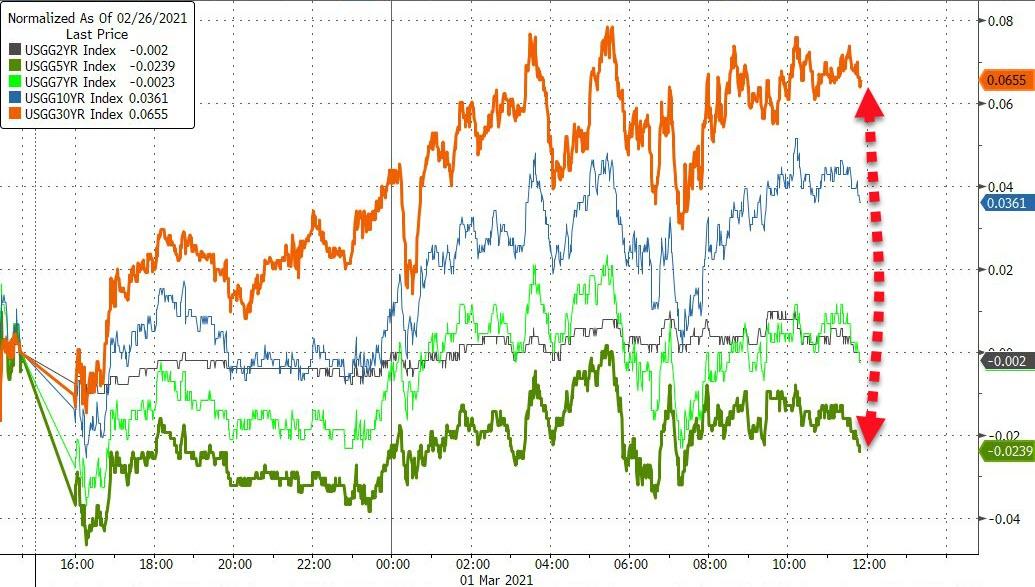
Bond yields rose at the long-end (makes sense – inflation/growth etc), but compressed in the belly (will The Fed say something? The ECB did today)…

Source: Bloomberg

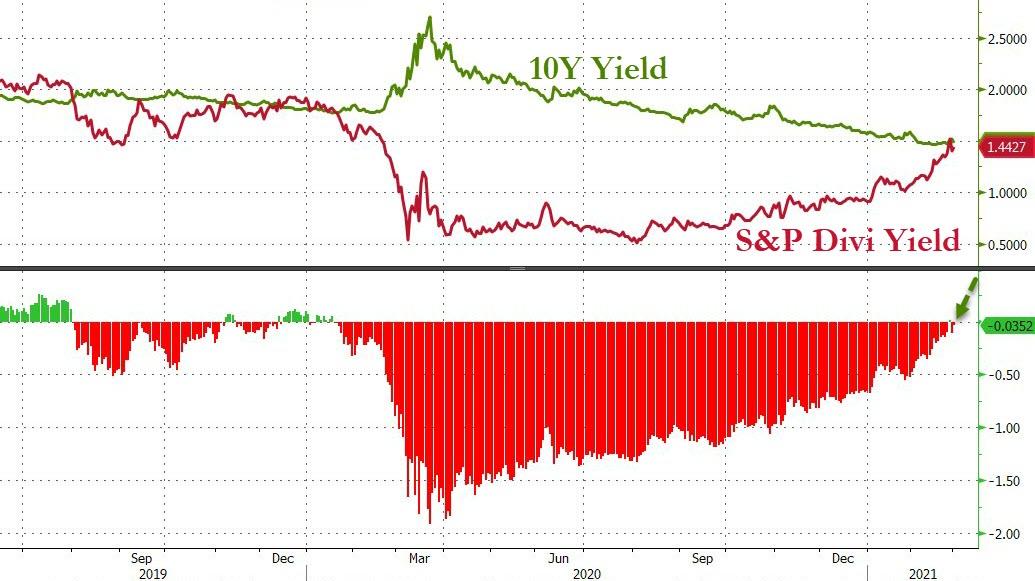
10Y yield rose back to the 1.45% line in the sand…

Source: Bloomberg

With dividend yields and treasury yields back in line…

Source: Bloomberg

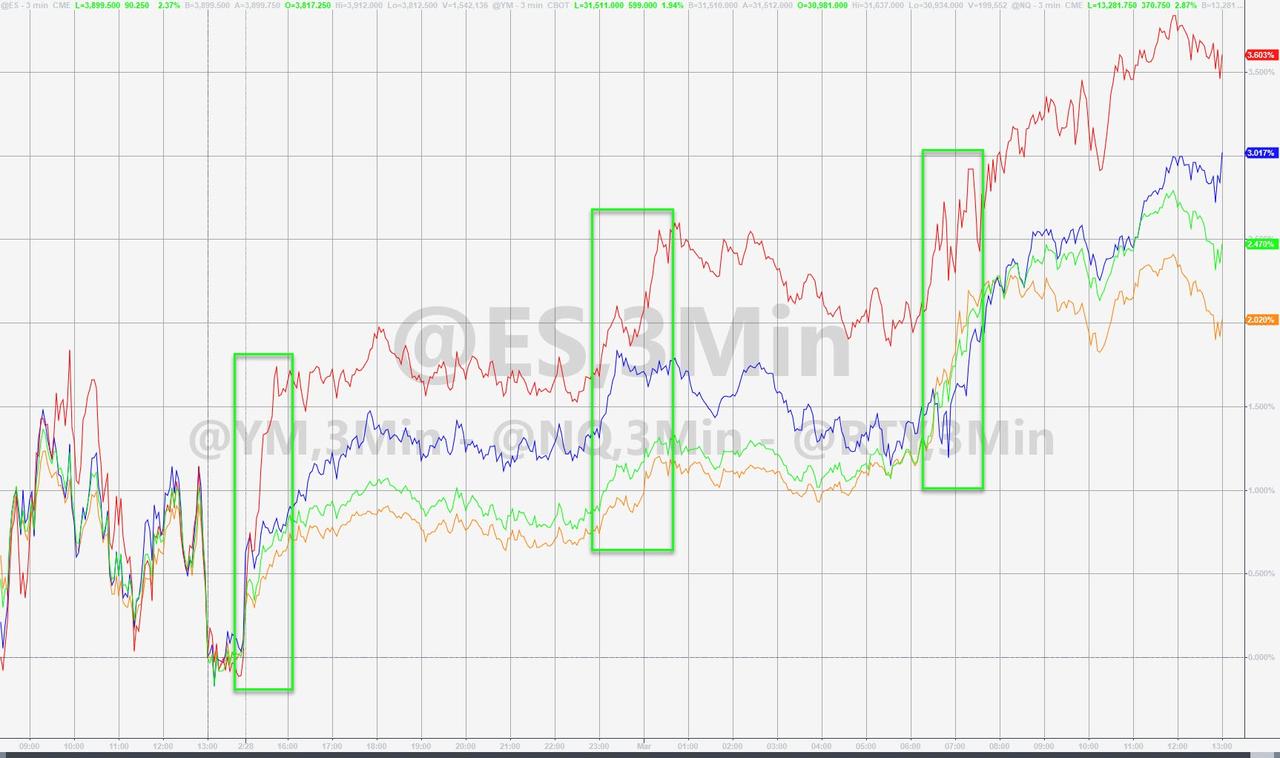
Stocks soared (month-start flows and growth/stimmy hope)… Small Caps and Nasdaq had their best day since the election/vaccine day in early Nov…

NOTE the late day puke on Friday was quickly erased at the futures open but the moves didnt really accelerate until Europe opened.

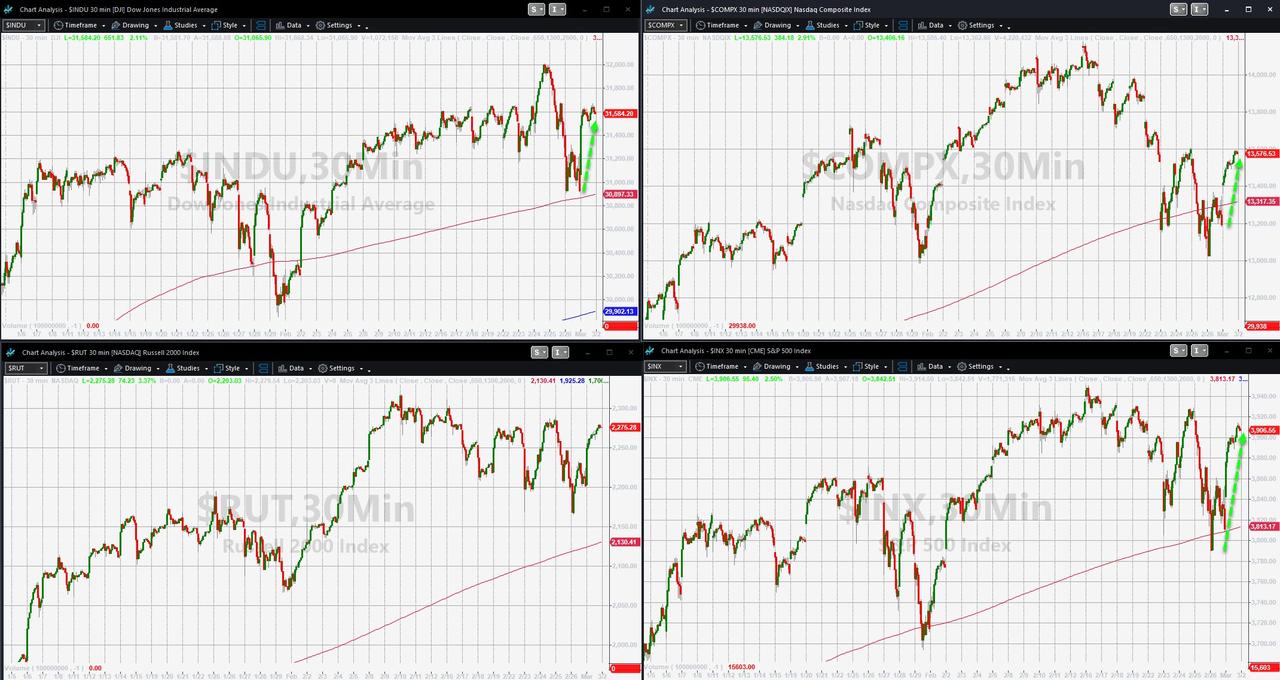
All the major indices bounced off their 50DMAs…

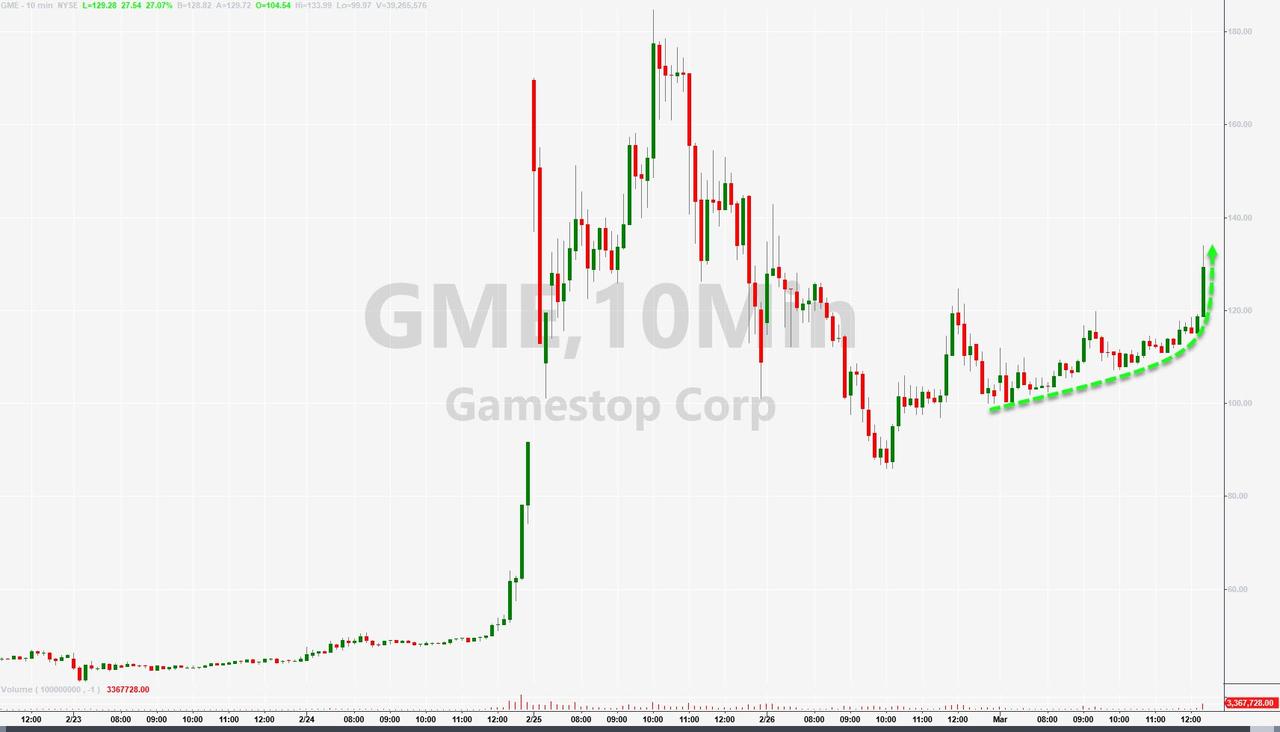
GME was up 30%… just because…

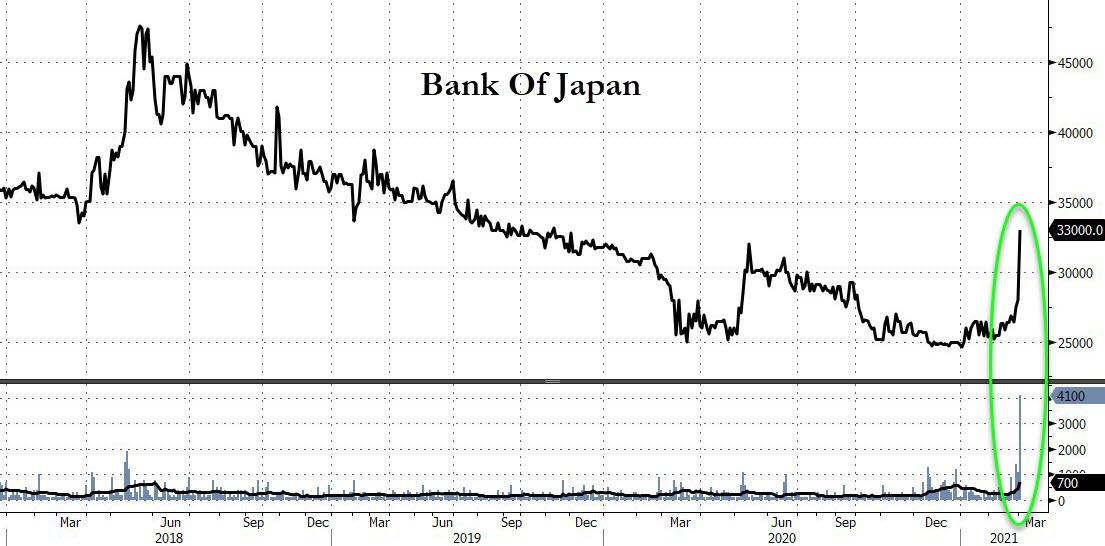
Meanwhile, before we leave equity land, there’s this malarkey. The Bank of Japan (yes the central bank trades publicly), which trades on the Tokyo Stock Exchange’s Jasdaq section, surged by the daily limit of 18%, the most since 2005 on massive volume. The shares, or subscriber certificates as they’re technically called, have no real benefit, with no voting rights and offering very limited dividends.

Source: Bloomberg

But “short-term retail investors don’t care about dividends, they’re looking just for capital gains,” said Tomoichiro Kubota, a senior market analyst at Matsui Securities Co. “They’ll see it as attractive so long as the share price keeps rising and there are buyers.”

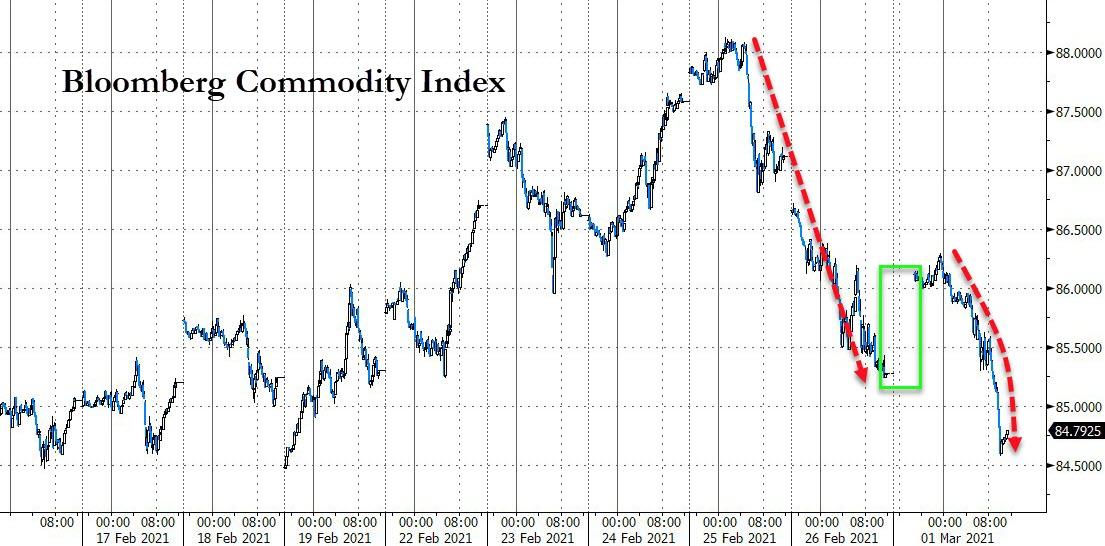
But commodities tumbled (growth/inflation doubts?)…

Source: Bloomberg

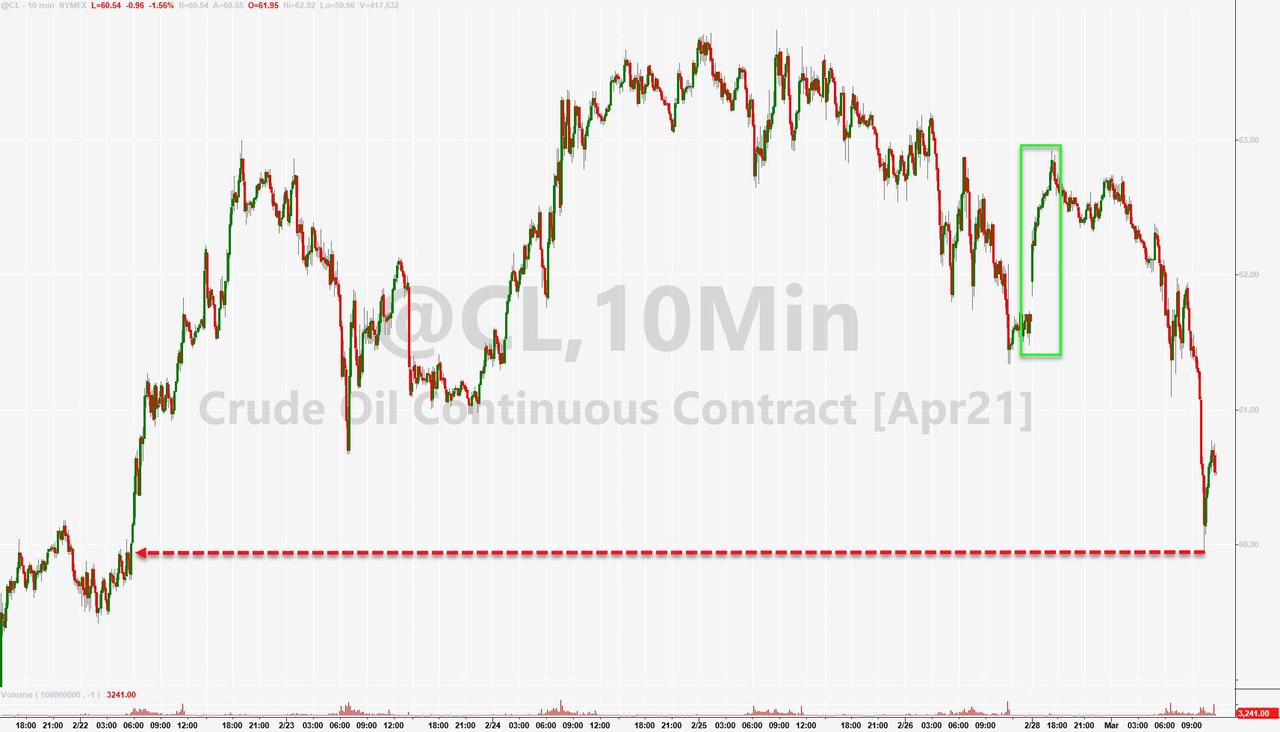
Led by oil (OPEC+ anxiety, China PMI demand fears, and scary virus headlines)…

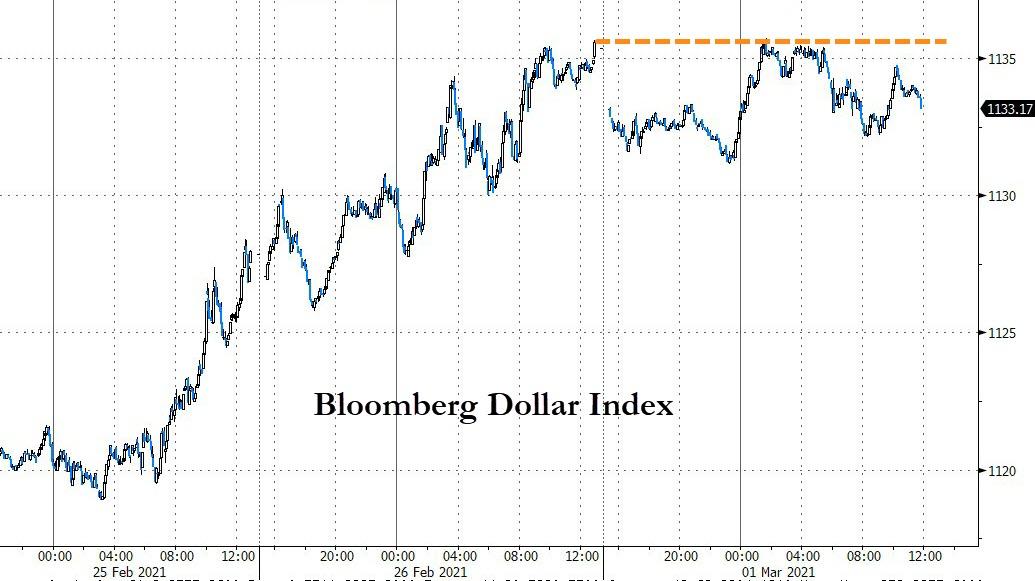
The dollar was flat to lower…

Source: Bloomberg

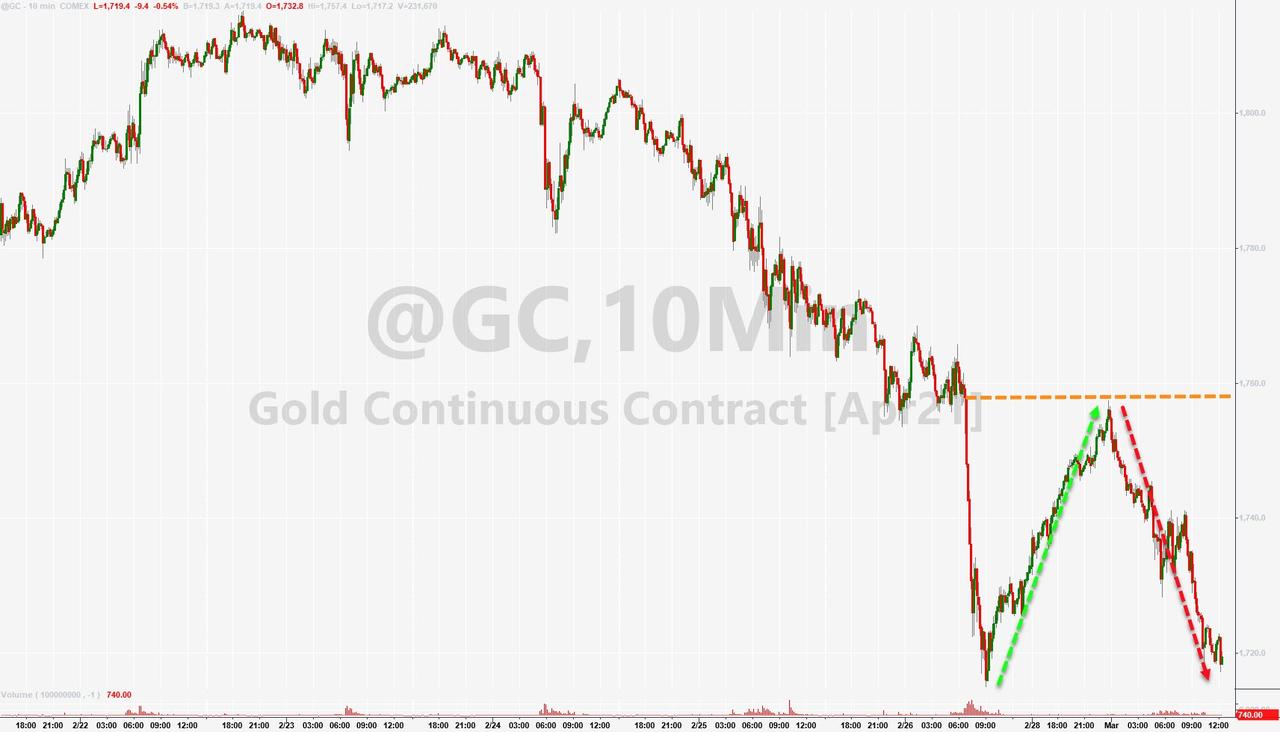
But Gold was dumped…

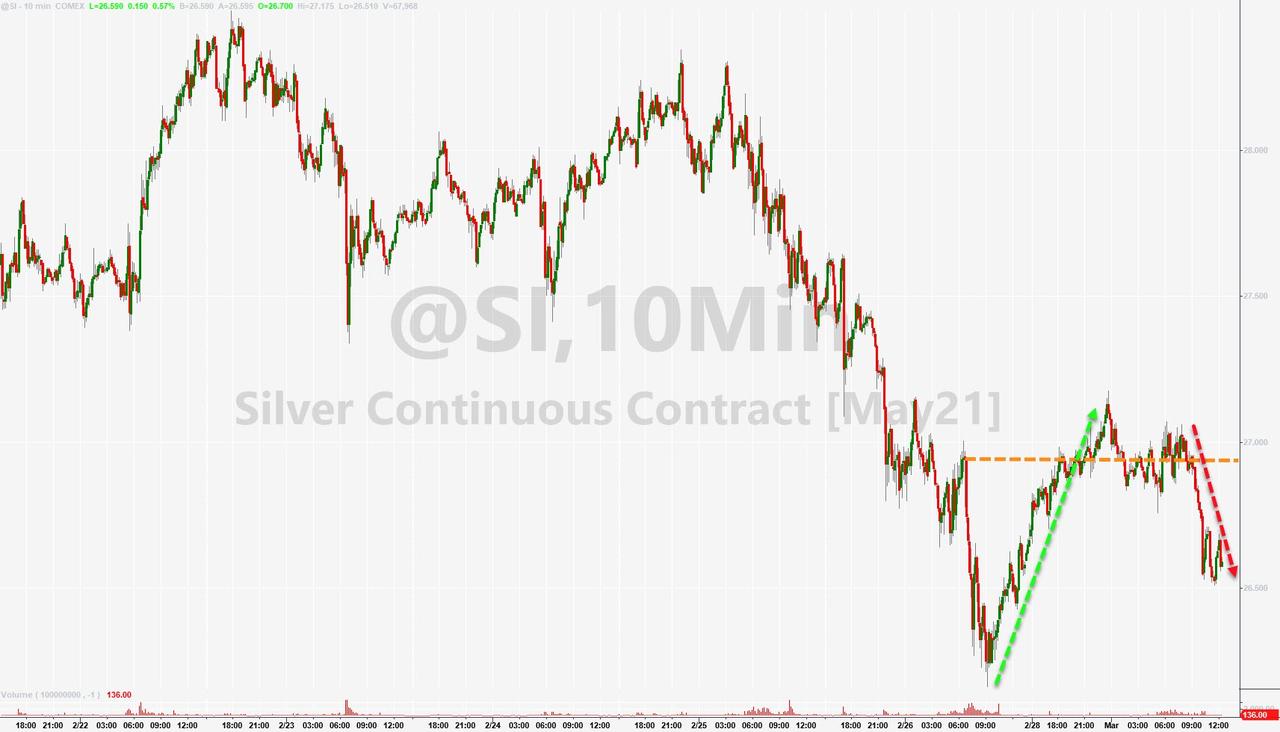
And while silver slipped lower late on, it managed to hold some gains…

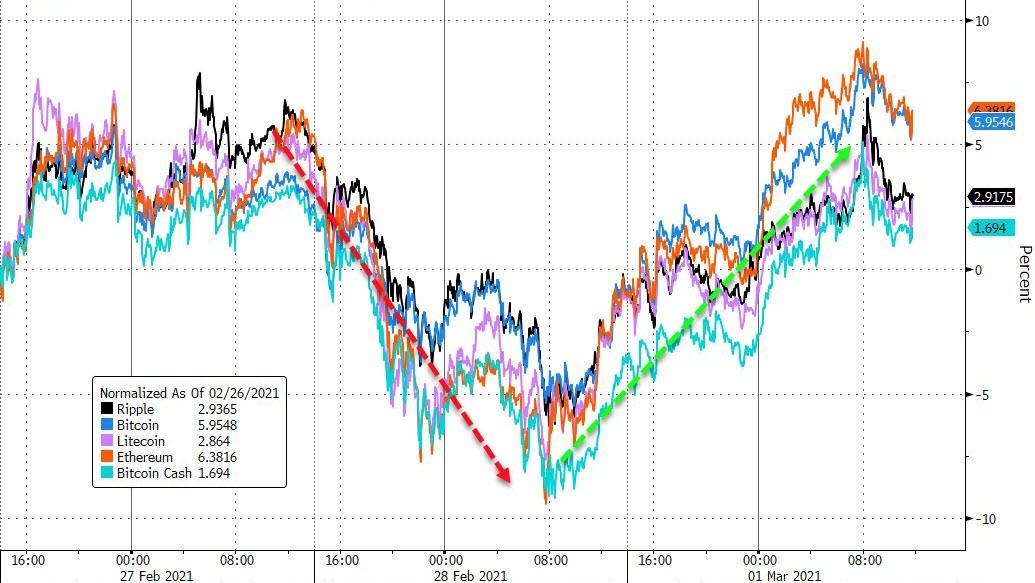
And Crypto was aggressively bid off weak weekend dip lows…

Source: Bloomberg

A positive sentiment Citi note sent Bitcoin back up near $50k…

Source: Bloomberg

And Ethereum jumped after Mark Cuban’s comments…

Source: Bloomberg


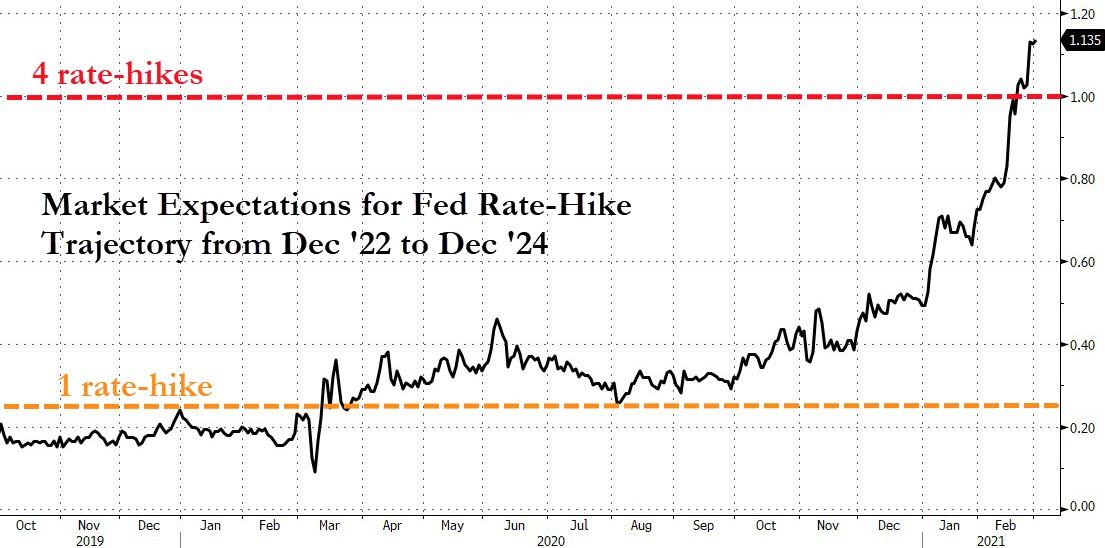
Finally, we note that the market is now pricing in some serious tightening by The Fed over the next few years…

Source: Bloomberg

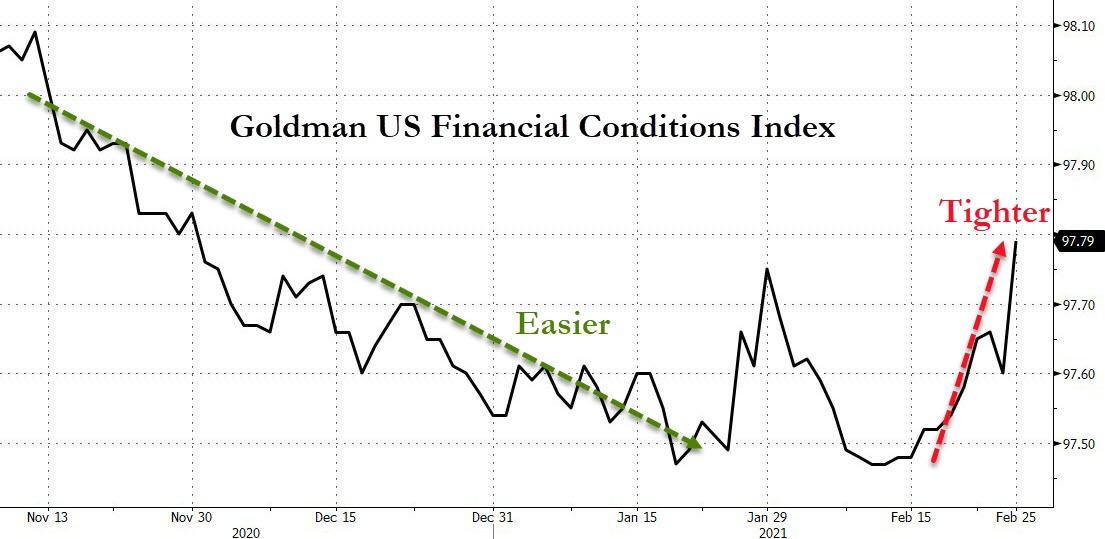
And as rates rise, financial conditions are tightening in the US (now at their tightest in 3 months)

Source: Bloomberg

Get back to work Mr.Powell!

Tyler Durden
Mon, 03/01/2021 – 16:00

via ZeroHedge News https://ift.tt/3uGtnei Tyler Durden

BofA: 1.75% Is The “Tipping Point” For Bonds

BofA: 1.75% Is The “Tipping Point” For Bonds

Almost two months ago, Nomura correctly predicted that once the 10Y breaches 1.50%, stocks would freak out and sure enough that’s precisely what happened (with Nomura’s forecast becoming self-fulfilling and sparking a stop loss cascade one the 10Y hit 1.50% last Thursday, sending the 10Y as high as 1.61% in a matter of seconds following last week’s dismal 7Y auction).

So now that 1.50% is yesterday’s news, Wall Street is scrambling to define the next critical level for 10Ys beyond which there will be blood. As a reminder, yesterday Goldman hinted that 2.10% is what traders should be looking at, but that seems a lot, especially with many far more accurate forecasters saying that the Fed will have to engage YCC around 2.0%, and for that to happen stocks would need to crash first. Therefore, the next critical level is likely one between 1.50% and 2.0%.

One such level was proposed by BofA’s chief equity strategist, Savita Subramanian who today writes that “history suggests that 1.75% on the 10-yr (the house forecast and ~25bp above current levels) is the tipping point at which asset allocators begin to shift back to bonds” and thus sell stocks in the next wave of aggressive liquidations.

Why 1.75%? Because that yield on the 10Y is decisively above the S&P’s dividend yield, and where according to BofA “there is an alternative to stocks”, or TIAA.

As Bloomberg notes, TIAA would represent a reversal to a mantra popularized in recent years as yields on Treasuries fell to historic lows and inflation stayed muted. For many, TINA – “there is no alternative” to stocks – helped rationalize a turn to riskier assets and justified S&P 500 valuations that are near their highest in two decades.

So after last week’s fireworks, will bonds continue to rise from the current level of 1.43%, and how fast until they reach the new “tipping point”? Well, after last week’s historic rout, which culminated the 2nd worst bear market for bonds in the past 40 years…

…. CTAs had been the most bearish on long-dated bonds since 2018, but as Nomura pointed out they had started to cover their shorts, usually an early indicator that yields have topped out for the time being and are set to drop, with Nomura estimating that the 10yr UST yield is currently about 30bp above the fair-value yield implied by trend-following strategies. Short-covering by CTAs and other speculators for the sake of locking in profits may serve the purpose of reeling the 10yr UST yield back in.”

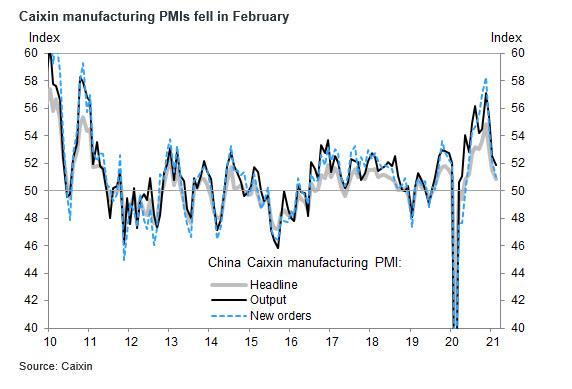
Separately, rising growth expectations have also fueled huge gains for commodities with the likes of corn and soybeans up roughly 50% in the past year. On a six-month rolling basis, both offered higher risk-adjusted returns, or Sharpe ratios, than the famously high-flying Bitcoin, according to Quantica. However, in an ominous reversal, over the weekend China reported disappointing PMI prints…

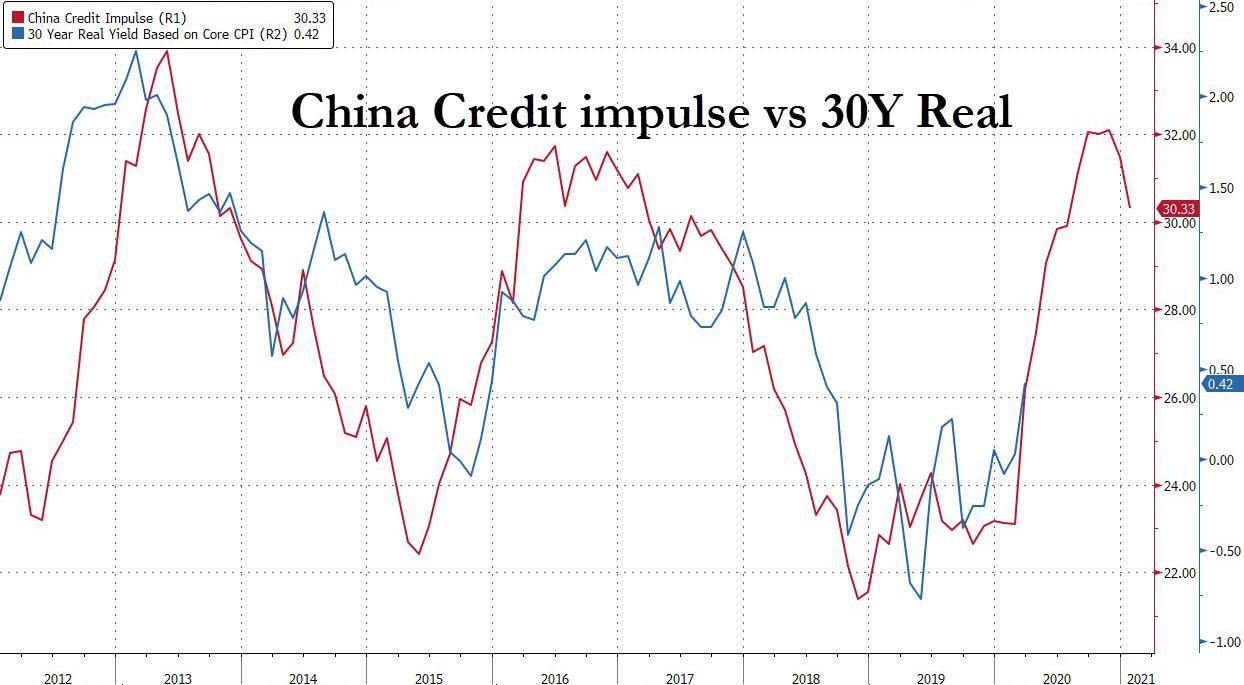
… which suggest that the global reflation trade sparked by the world’s biggest credit dynamo, Beijing, could be starting to fizzle.

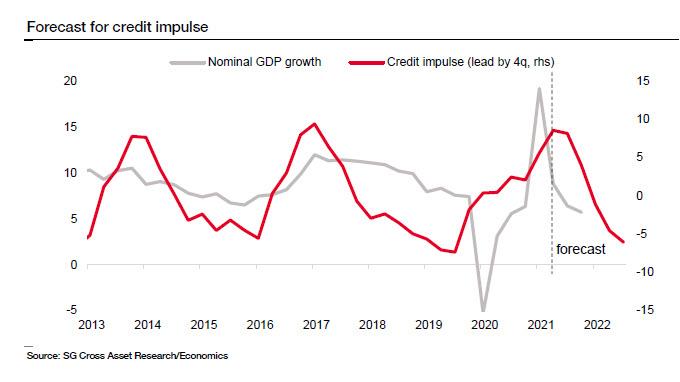
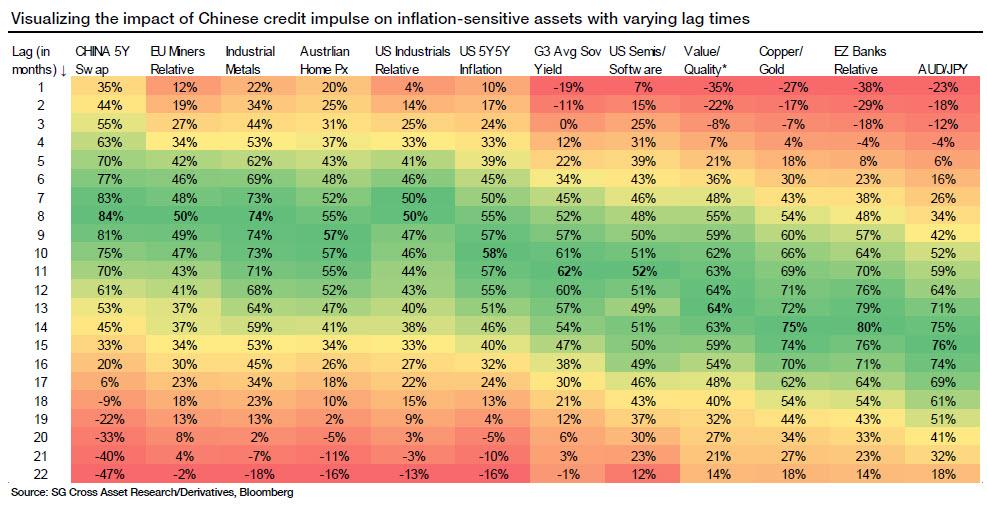
What’s worse, the propagation of the slowing Chinese credit impulse would have adverse consequences on all inflation-sensitive assets.

The only question is how long before China’s credit slowdown is manifest in real yields. And here, according to one of our favorite charts, we probably have another 6-9 months of real yield upside before yields come crashing down again.

Indeed, after last week’s freakout, some Treasury bulls have emerged, and according to Jim Paulsen, chief investment strategist at the Leuthold Group, the 1.75% level may be further away than it seems. Paulsen believes that the spike in bond yields could take a pause around 1.5% before embarking on another leg higher. Among the reasons he cites is the recent bout of colder weather, which could result in weaker economic data – including slower retail sales – in the next month. That will dampen anxieties over economic overheating, he wrote in a note.

“Yields still have further to rise this year,” said Paulsen. “But, if they do it a bit more slowly and intermittently, rather than all at once, the impact on the economy and the stock market should be far-less damaging.”

Of course, others disagree. One among them is Sonal Desai, Franklin Templeton’s fixed-income chief who is back with another big bet that rising inflation will prolong the slump in U.S. Treasuries. As Bloomberg notes, Desia says the 10-year yield could jump above 1.75% by the end of the year, compared with around 1.43% currently.

“Inflation could easily overshoot under the approving eye of the Fed,” wrote the chief executive officer of the debt division with around $155 billion in a note. She cited price pressures including accelerating growth, the vaccine rollout, massive fiscal stimulus and the historic growth in money supply.

To be sure, one could simply respond that Desai, along with her colleague Michael Hasenstab, have been broken records, predicting the end of the bond rally for years. Worse, he track record is rather dismal: her previous predictions about the Treasury market have fallen flat, amid relentless investor demand, and unexpected economic shocks including trade frictions and the pandemic itself. In October 2019 she projected that the 10-year yield would rise to 3% within 12 months. It peaked at 1.9% over that period before dropping to as low as 0.5%.

Misfiring bearish bets have hit Hasenstab’s Templeton Global Bond Fund with $15 billion in assets, which was forced last year to unwind a multi-year short position on Treasuries. The fund still maintains low duration, according to filings, though that stance still hasn’t spared it from a 1.9% loss so far this year.

That has not stopped Desai, who helps oversee everything from credit to money markets, to put her investors’ money where her mouth is, and she says she is trading her conviction on higher Treasury yields by being selective in high yield and emerging-market investments. She also favors securities in the floating-rate loan market, according to the note.

“Both the Fed and the European Central Bank have reiterated their reassurance that monetary policy will remain supportive, but markets may be challenging central bank credibility,” Desai wrote. “Given the underlying strength of the economy, I think widening spreads will offer opportunities in short duration fixed income assets in the coming weeks.”

Here’s the problem: Desai may well be right and central bank credibility could soon be completely gone. However, in that case, the first people out of a job will be asset managers such as Desai and all her peers at Franklin Templeton as the ensuing historic crash will guarantee that total losses on everything else dwarf what little profits the bond manager can make on its Treasury short.

Tyler Durden
Mon, 03/01/2021 – 15:40

via ZeroHedge News https://ift.tt/3r6GdjZ Tyler Durden

“Judgment” or “Judgement”?

In America, “judgment” remains the sharply dominant spelling, by a factor of more than 10 to 1. The divide was even greater before about 2010:

(The graph shows the ratio of uses of “judgement” divided by the uses of “judgment,” and it’s under 10%.) The divide is likewise stark in American legal sources; a quick Westlaw search over the last week reported 2800 cases mentioning “judgment” and 72 “judgement.”

Curiously, in England, “judgement” has recently become a pretty common variant, being used for a few decades at at least half the rate of “judgment” (so that, of uses of both, a third are with the extra “e”).

I suspect that makes both standard in normal British English (I can’t speak to British legalese), much as “grey” and “gray” are both standard equivalents. But that’s only in Britain; in America, “judgment,” unusually spelled as it may be, is the dominant form, and using the spelling “judgement” is particularly likely to be seen as a mistake.
from Latest – Reason.com https://ift.tt/380EEwd
via IFTTT

How Congress Could Send Bigger Stimulus Checks, Fund School Reopening, and Save $1 Trillion

rollcallpix133086

President Joe Biden’s $1.9 trillion COVID-19 relief bill took its first major step toward passage over the weekend. But political circumstances and the current state of the pandemic suggest that Congress ought to reconsider this approach.

In comments to reporters on Saturday, Biden urged the Senate to take “quick action” to pass the bill after the House of Representatives passed it in the early morning hours that same day.

“We have no time to waste,” Biden said, according to a pool report. “If we act now decisively, quickly, and boldly, we can finally get ahead of this virus. We can finally get our economy moving again. And the people of this country have suffered far too much for too long. We need to relieve that suffering.”

Biden has been pushing this message since before he was inaugurated—the basic framework of this $1.9 trillion stimulus bill was announced in early January. He and congressional Democrats have touted the package as an urgently needed response to a still-out-of-control pandemic, a necessary step to getting schools reopened, and a way to help jobless Americans make ends meet until a full recovery is achieved.

That message is at odds with much of the bill itself, which is larded up with things like an increase to the federal minimum wage, funding for a new subway in San Jose, California, and billions of dollars in supposedly urgent school funding that wouldn’t actually be used for years to come. About $312 billion of the bill’s overall spending has nothing to do with the pandemic at all, according to an analysis by the nonpartisan Committee for a Responsible Federal Budget (CRFB), including changes to tax credit programs for parents and an expansion of the Affordable Care Act’s health insurance subsidies.

The package would also spend about $500 billion bailing out state and local governments, far in excess of what would repair COVID-19 budget holes. The American Enterprise Institute, a conservative think tank, estimates that states and local governments need about $100 billion in direct aid, while the Center for Budget and Policy Priorities, a progressive think tank, has called for $225 billion in aid. Part of the discrepancy is due to the fact that the Biden plan was built around the assumption that state budgets would be facing an 8 percent decline in revenue this year. The Wall Street Journal reports that state tax revenue declined by a mere 1.6 percent instead.

Beyond all that, a clear-eyed assessment of how the federal government should respond to COVID-19 in March 2021 must also take into account the fact that the pandemic is clearly ebbing. This weekend saw new daily records for vaccinations and the approval of a third vaccine by the Food and Drug Administration, a development that promises even more vaccine supply in the weeks and months ahead. New cases, current hospitalizations, and daily deaths have fallen to levels not seen in months. It’s not over yet, of course, but the current situation seems significantly different from where things stood in early January.

Senate Democrats appear willing to make some changes to the bill before putting it up for a vote. The much-discussed minimum wage increase is likely to be removed now that Senate Parliamentarian Elizabeth MacDonough has ruled that the wage hike could not be passed with a simple majority via the reconciliation process. Meanwhile, CNBC reported on Monday that Senate Democrats are abandoning plans to include a backdoor minimum wage hike that could have been accomplished by revoking tax breaks from businesses that pay workers less than $15 per hour.

It’s good to remove a job-killing proposal that’s completely unrelated to the pandemic. Still, more could be done. Given current economic and COVID trends, Congress could revisit a smaller, bipartisan proposal that Democratic leaders rejected in early February for being insufficiently expensive. That earlier plan would have spent about $618 billion, with the funding focused on direct payments to many Americans, expanded unemployment benefits, and money aimed at reopening schools.

Now Rep. Peter Meijer (R–Mich.) is touting a revamped version of that proposal as the Direct Dollars Over Government Excess (DOGE) plan. (Yes, it’s named for that dog meme.) Meijer contrasts it with the Biden bill, which he calls a “grab bag of gifts for special interests.”

Meijer’s plan would send direct payments of up to $2,400 to individuals who earned less than $50,000 last year and households that earned less than $100,000. That’s $1,000 more per person than the Biden plan would provide, but with payments phasing out at lower levels. The DOGE plan would also extend the boosted federal unemployment payments of $200 per week (down from the current level of $300 per week and Biden’s proposal of $400 per week) through the end of July.

Meijer says his proposal would cost about $992 billion. That means removing the chaff from the House-passed relief bill could save as much as $1 trillion from being added to the national debt—and every little bit helps, considering that COVID-19 emergency spending has already added about $3.3 trillion to the deficit, according to the CRFB.

Needless to say, Senate Democrats are unlikely to seriously consider any alternative to the House-passed bill at this stage. We’re likely instead to see some much more modest tinkering, after which the Senate will send the Biden plan back to the House, which will then pass the new version and send it to the president’s desk.

And you can expect that to happen pretty quickly now. The longer Congress delays, the more apparent it will become that the need for a major bill has evaporated.

from Latest – Reason.com https://ift.tt/2PjmQG5
via IFTTT

How Congress Could Send Bigger Stimulus Checks, Fund School Reopening, and Save $1 Trillion

rollcallpix133086

President Joe Biden’s $1.9 trillion COVID-19 relief bill took its first major step toward passage over the weekend. But political circumstances and the current state of the pandemic suggest that Congress ought to reconsider this approach.

In comments to reporters on Saturday, Biden urged the Senate to take “quick action” to pass the bill after the House of Representatives passed it in the early morning hours that same day.

“We have no time to waste,” Biden said, according to a pool report. “If we act now decisively, quickly, and boldly, we can finally get ahead of this virus. We can finally get our economy moving again. And the people of this country have suffered far too much for too long. We need to relieve that suffering.”

Biden has been pushing this message since before he was inaugurated—the basic framework of this $1.9 trillion stimulus bill was announced in early January. He and congressional Democrats have touted the package as an urgently needed response to a still-out-of-control pandemic, a necessary step to getting schools reopened, and a way to help jobless Americans make ends meet until a full recovery is achieved.

That message is at odds with much of the bill itself, which is larded up with things like an increase to the federal minimum wage, funding for a new subway in San Jose, California, and billions of dollars in supposedly urgent school funding that wouldn’t actually be used for years to come. About $312 billion of the bill’s overall spending has nothing to do with the pandemic at all, according to an analysis by the nonpartisan Committee for a Responsible Federal Budget (CRFB), including changes to tax credit programs for parents and an expansion of the Affordable Care Act’s health insurance subsidies.

The package would also spend about $500 billion bailing out state and local governments, far in excess of what would repair COVID-19 budget holes. The American Enterprise Institute, a conservative think tank, estimates that states and local governments need about $100 billion in direct aid, while the Center for Budget and Policy Priorities, a progressive think tank, has called for $225 billion in aid. Part of the discrepancy is due to the fact that the Biden plan was built around the assumption that state budgets would be facing an 8 percent decline in revenue this year. The Wall Street Journal reports that state tax revenue declined by a mere 1.6 percent instead.

Beyond all that, a clear-eyed assessment of how the federal government should respond to COVID-19 in March 2021 must also take into account the fact that the pandemic is clearly ebbing. This weekend saw new daily records for vaccinations and the approval of a third vaccine by the Food and Drug Administration, a development that promises even more vaccine supply in the weeks and months ahead. New cases, current hospitalizations, and daily deaths have fallen to levels not seen in months. It’s not over yet, of course, but the current situation seems significantly different from where things stood in early January.

Senate Democrats appear willing to make some changes to the bill before putting it up for a vote. The much-discussed minimum wage increase is likely to be removed now that Senate Parliamentarian Elizabeth MacDonough has ruled that the wage hike could not be passed with a simple majority via the reconciliation process. Meanwhile, CNBC reported on Monday that Senate Democrats are abandoning plans to include a backdoor minimum wage hike that could have been accomplished by revoking tax breaks from businesses that pay workers less than $15 per hour.

It’s good to remove a job-killing proposal that’s completely unrelated to the pandemic. Still, more could be done. Given current economic and COVID trends, Congress could revisit a smaller, bipartisan proposal that Democratic leaders rejected in early February for being insufficiently expensive. That earlier plan would have spent about $618 billion, with the funding focused on direct payments to many Americans, expanded unemployment benefits, and money aimed at reopening schools.

Now Rep. Peter Meijer (R–Mich.) is touting a revamped version of that proposal as the Direct Dollars Over Government Excess (DOGE) plan. (Yes, it’s named for that dog meme.) Meijer contrasts it with the Biden bill, which he calls a “grab bag of gifts for special interests.”

Meijer’s plan would send direct payments of up to $2,400 to individuals who earned less than $50,000 last year and households that earned less than $100,000. That’s $1,000 more per person than the Biden plan would provide, but with payments phasing out at lower levels. The DOGE plan would also extend the boosted federal unemployment payments of $200 per week (down from the current level of $300 per week and Biden’s proposal of $400 per week) through the end of July.

Meijer says his proposal would cost about $992 billion. That means removing the chaff from the House-passed relief bill could save as much as $1 trillion from being added to the national debt—and every little bit helps, considering that COVID-19 emergency spending has already added about $3.3 trillion to the deficit, according to the CRFB.

Needless to say, Senate Democrats are unlikely to seriously consider any alternative to the House-passed bill at this stage. We’re likely instead to see some much more modest tinkering, after which the Senate will send the Biden plan back to the House, which will then pass the new version and send it to the president’s desk.

And you can expect that to happen pretty quickly now. The longer Congress delays, the more apparent it will become that the need for a major bill has evaporated.

from Latest – Reason.com https://ift.tt/2PjmQG5
via IFTTT

Ayanna Pressley Revives Justin Amash’s Bill To End Qualified Immunity

admphotostwo716533

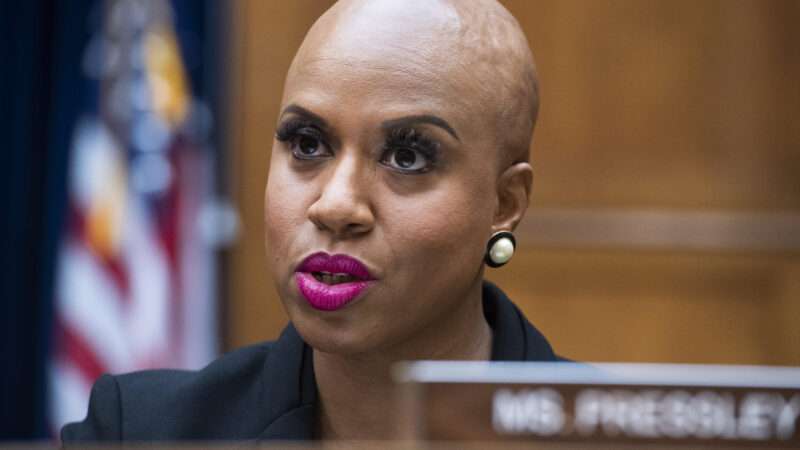
Rep. Ayanna Pressley (D–Mass.) has reintroduced a bill to end qualified immunity, a legal doctrine that makes it difficult for the public to hold government officials accountable for alleged misconduct.

Former Rep. Justin Amash (L–Mich.) originally unveiled the Ending Qualified Immunity Act in June 2020 after the police killing of George Floyd. Pressley signed on as cosponsor a few days after, though the bill died without ever receiving a vote.

The Ending Qualified Immunity Act of 2021, which Sens. Ed Markey (D–Mass.) and Elizabeth Warren (D–Mass.) are cosponsoring in the Senate, endeavors to do the exact same thing as its predecessor: abolish qualified immunity for all state actors.

The American public maintains the right to sue civil servants who violate their rights under Section 1983 of Title 42 of the U.S. Code. But the Supreme Court has radically limited that right over the years. First, there was the decision in Pierson v. Ray (1967), which held that public officials may avoid civil suits if constitutional violations were made in “good faith.” In Harlow v. Fitzgerald (1982), the high court took that a step further: Victims may not sue state actors for misbehavior unless that misbehavior was “clearly established” in previous case law.

In other words, in order to have the right to bring a case before a jury, a plaintiff must be able to point to a court precedent that explicitly describes the situation in question to a tee. Qualified immunity has protected two cops who stole $225,000 while executing a search warrant, a cop who damaged a man’s eye after allegedly kneeing him 20 to 30 times after he had been subdued, a prison guard who hid while an inmate raped a nurse, two cops who beat and arrested a man for standing outside of his house, a cop who ruined a man’s vehicle during a bogus drug search, a cop who shot a 10-year-old, and a cop who shot a 15-year-old.

In all of those cases, the victims were left with no avenue for recompense.

“It is the sense of the Congress that we must correct the erroneous interpretation” of Section 1983, the bill says, “and reiterate the standard found on the face of the statute, which does not limit liability on the basis of a defendant’s good faith beliefs or on the basis that the right was not ‘clearly established’ at the time of the violation.”

The Supreme Court has demurred at the opportunity to fundamentally reevaluate the doctrine. But it has started to send messages to the lower courts that the current application of qualified immunity no longer cuts it. In November, it overturned an appeals court decision that awarded qualified immunity to a group of correctional officers who forced a naked inmate into two deplorable cells, one teeming with sewage and the other with “massive amounts” of human feces. And just last month, it reversed another appeals court decision that gave qualified immunity to a prison guard who had pepper-sprayed an inmate without provocation.

Lawmakers are poised to vote soon on the Justice in Policing Act, a reform bill that would end qualified immunity for cops. Pressley’s bill eliminates it for all public officials—a relevant tidbit, when considering that the last two SCOTUS decisions on the issue pertained to correctional officers, not police officers. Moderate Democrats have begun backing away from that provision, however, in some cases because they face tough re-election challenges and want support from police unions.

Meanwhile, the GOP has largely resisted such reforms. Sen. Mike Braun (R–Ind.) did introduce a bill last summer that would have effectively paralyzed qualified immunity, but he abandoned it after scuffling with Fox News host Tucker Carlson. Amash’s bill only boasted one Republican cosponsor, Rep. Tom McClintock (R–Calif.).

But the American public is on board. The majority of the country supports reform, with high-profile attempts gaining steam. Citing Reason‘s reporting on the issue, players from the NFL, MLB, and NBA urged Congress to support Amash’s bill last June.

One big hurdle at the time was then-President Donald Trump, who said that qualified immunity reform would merit an automatic veto. Will President Joe Biden, who has said that he isn’t ready to end the doctrine, be any better? His national press secretary told me during the campaign that he wants to see it “severely reined in.” He did not provide details as to what that meant.

from Latest – Reason.com https://ift.tt/3b4kmE0
via IFTTT