Bill Blain: Brace, Brace, Brace

Bill Blain: Brace, Brace, Brace

Authored by Bill Blain via MorningPorridge.com,

“The supreme art of war is to subdue the enemy without fighting.”

You could not make this up; an unimaginably complex WW3 Techno-thriller unfolding as markets stumble and global supply chains hover on the edge of anarchy. On the other hand, maybe that’s just the way it was planned.

I am not one for conspiracy theories. But… this morning… If I was a writer of trashy global-techno-World War 3 pulp fiction, and proposed the following scenario where the global economy lurches into an unprecedented period of instability – nobody would believe me:

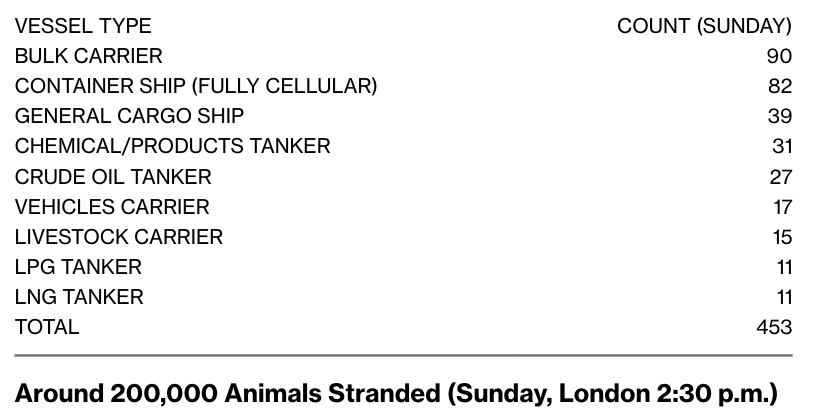
1)    Global Supply Chains, weakened and struggling after a year of global pandemic, plus a growing shortage of microchips holding back multiple industrial sectors, are plunged into new crisis by a puff of wind causing a box-ship to skite sideways and block the Suez Canal, trapping East-West Trade.

2)    Unstable and over-priced Global Markets are spooked into a frenzy late on a quiet Friday night by the largest margin calls ever ($20 bln plus) as an Asian “family office” dumps billions of dollars of stock into the market. Collateral damage spreads, as other financial firms, (inevitably including Credit Suisse (Switzerland’s very own Deutsche Bank), and Nomura), announce material losses.

3)    As global central banks struggle to restore real growth, while trying to hold interest rates low and support commerce, and acutely conscious of how a market crash could crush global confidence – things suddenly get more difficult as confidence in equity valuations takes a massive knock.

4)    Geopolitical stability wobbles after China lashes back at US criticism in Alaska, and then surprises Europe with sanctions and push back on trade deal – when many has expected China to attempt to reach out to Europe – even as it reaches out to pariah states including Iran, Myanmar and Turkey.

5)    Rumours abound of imminent China action to seize Taiwan – and the potential impotence of US fleets from the Gulf to the Pacific are targeted by long range Chinese carrier-killer missiles – further destabilising markets.

6)    Cyber-attacks across western economies, first uncovered at Solar Wind, but possibly undiscovered elsewhere, raise questions as to how much the West’s digital and financial infrastructure has been compromised.

What happens next?

On the basis I am an optimist, and things are never as bad as we fear, I think it all settles. Who knows? But I suspect one thing is going to become very apparent. China has crossed the Rubicon and will now longer be a rule taker. The rules have changed. China has demands.

What’s different in the above scenario is that it doesn’t necessarily lead to a hot-war. The Beijing leadership see benefit in trade, engagement and the global economy to deliver its pact of prosperity to the Chinese population. They may conclude China’s done enough to achieve its’ strategic economic objectives; parity with the west, and economic primacy across Asia.  Whether the mood turns hot or cold rather depends on how the West responds to the apparent nullification of the USA’s military hegemony achieved by China’s new missile technologies.

These new missiles are a known unknown. The latest versions of the D-26 Carrier-Killer are apparently based on the Tibetan Plateau and can take out US Carriers from the Gult to New Zealand – making any defence of Taiwan look an extremely risky call. Sending the UK’s carrier strike group into the region later this year looks… challenging.

And suddenly you are wide awake and wondering just how crazy this suddenly got…..

*  *  *

On Sunday I spoke with one of my old racing yacht crew who is now doing extremely well in Global Shipping. I asked if there was anything we were not being told, or what the real story of the ship blocking the Suez was. He was cagey but told me.. “If you need Garden Furniture, buy it today.”

This morning it looks like the Suez has been uncorked – the boat has been shifted – but I was asking because I reckon slowing global trade by sending it the long way round Africa isn’t just about miles and time – it’s finding the ships capable and seaworthy for the longer trip, and bunkering them accordingly. It’s not just a matter of a longer voyage. Suddenly everyone wants Air Freighters.

The key-thing is what happened on the Suez demonstrates is just how easy it would be to block the bottlenecks of global trade. Everything from consumer tat to chips would be stressed.

After Archegos Capital, the family office of tiger-cub and convicted insider Bill Hwang was forced to sell more than $20 bln of stocks in a series of block trades on Friday, this morning – its looking likely to be a risk-off day. Block equity-trades stemming from the margin-calls on Archegos will have sent the market’s spidey senses a’tingle. Who is next?

There will be flows back into the relative safety and comfort of bonds – even if they do yield nothing. In bonds there is truth, and I suspect today will confirm it’s all about fear. Over the past 10-years artificially low rates have eroded the relationship – telling investors low rates are a reason to take risk. Its low rates that have supported today’s frankly insane stock market valuations. Risk is very real again.

While Gold might be on the agenda, I’m not so sure about Bitcoin. The Chinese have made it quite clear they will digitise the Yuan.

Today’s moves will likely also reflect a Q1 rebalancing of bonds vs equities holdings– which have been distorted by the relative yields on asset classes. But I suspect it will just be the start of a trend. Just how big has unregulated leverage in the shadow banking system of investment firms become? How could it unravel impact markets? Or maybe it will be illiquidity as the next duck tumbles and no one is prepared to buy?

Today won’t be much fun for anxious central bankers.

It’s not going to be much fun for the politicians either as they look realise just how vulnerable the West is to a new economic shock, even as we’re still being floored by the self-inflicted economic harm of the Pandemic.

Western Economies are dependent on long exterior global supply chains to fuel demand for more and more consumer goods. We’ve become comfortable to click and deliver being satisfied from China. Stuck in lockdown we’ve heard disembodied voices warning of economic catastrophe, but we’ve been cocooned from the economic reality, relying on governments assurances they can prop up the Covid ravaged economy with subsidy and furloughs. Destabilise our supply lines, and the threat is a run on everything – potentially making last year’s pandemic panic look tame.

Meanwhile, dissent is all the rage across the west, whether it’s the right-wing complaining about their civil liberties, smaller nations demanding independence, or gender and race issues coming to the fore and exposing the inequality and division of society. All of these divisions are fed on a rich oxygen-mix of social media, and targeted with fake news aiming to deepen division. Everyone has a cause, and everyone believes what they want to, but nobody listens. Western society has never been this unstable, polarised and disunited.

Chalk up another win to China.

China’s leaders are satisfied. Their position is secure. China’s economy is exposed to supply chains, but is based on interior lines (and pretty much brand new infrastructure) – better able to weather and internalise a global trade-storm. Its’ society is homogenous and willing to buy the greater prosperity/state control trade off. National pride hasn’t been compromised by the pernicious effects of Wokery.

The economy of the West is bought into the promises of technological change and addressing the environment. Markets are soaring on the back of expectations of increased technological adoption, with a few successes spurring thousands of highly speculative copycats – witness the insane boom in SPACs. But the reality is economies have become increasingly bureaucratic, stultified by regulation, and held back by political gridlock and polarisation. Infrastructure is old and tired. Key skills and capacities have been lost.

Let me present a tiny example – speciality steels. Without speciality steels for the fine work of tech, the economy will ultimately wither and die. We are now entirely beholden to external steel. The UK government put plans to restore mining the key element of steel in the UK on hold. Without metallurgical coal – you can’t make steel. Fact. The UK prefers its steel to be made in China with Australian met. coal so it can say it’s tough on cutting carbon. The facts are simple – make the steel here, less carbon miles and more high quality jobs.. Or…

But, the risks are not just in terms of physical supply chains. The digital economy is even more important and potentially even less protected. We’ve largely remained unaware of just how vulnerable we are. The cyber-attacks on SolarWinds last year may reveal the Trojan Horse is already in the city.

The degree of interconnectedness in the global economy is extraordinary. All the major financial institutions used SolarWinds’ Orion platform. The hackers got into SolarWinds and were able to install malicious code into software updates, accessing thousands of clients’ confidential information. We still have no idea how deep the hack goes. Increasingly companies release its not a matter of understanding their own vulnerability, but the vulnerability of all their suppliers, and hence, the whole digital supply chain.

So… what happens next?

Do the Chinese explode a couple of massive nuclear missiles in space to take down global positioning, communications and spy satellites with an EMP pulse, alongside a simultaneous cyber-attack to crash the Western Financial System, plunging us into limbo? How would Central Banks cope with the resultant market meltdown? What would happen if even a small part of the global payments system crashed?

Sometimes it easier to not over think it.. and just hope it was just coincidence… hope is never a strategy.

Tyler Durden
Mon, 03/29/2021 – 08:17

via ZeroHedge News https://ift.tt/3dd4jnj Tyler Durden
25-Foot Rooftop Videocamera Peering Into Neighbor’s Yard Must Be Taken Down

From Jackman v. Cebrink-Swartz, decided Friday by the Florida Court of Appeal, in an opinion by Judge Robert Morris, joined by Judges Daniel Sleet and Matthew Lucas:

The Jackmans and the Swartzes own adjoining lots with the border running along the sides of their respective homes. [After some disputes,] the Swartzes installed a twenty-five-foot-high rooftop camera. The record reflects that the camera had night-vision capabilities and recorded twenty-four hours a day, seven days a week.

The camera was positioned to see over the Jackmans’ [6-foot-high] privacy fence, allowing the Swartzes to see into a portion of the Jackmans’ backyard and the edge of their lanai. Testimony reflected that the camera could also see the side door to the Jackmans’ home but could not see beyond the threshold of the door when it was open….

Mrs. Jackman testified that she could see the camera from within her lanai and that she found it highly offensive and intrusive, frustrating her use and enjoyment of the Jackmans’ property. Mrs. Jackman further testified she did not believe there was a legitimate reason for the installation of the camera since the Swartzes already had three other cameras installed on their home, two of which already faced the common border area between the homes, though they were not positioned to see over the Jackmans’ privacy fence.

Mrs. Swartz testified the twenty-five-foot-high camera was installed due to her fear of Mr. Jackman, with whom she had had several confrontations. She testified that after installation of the camera, Mr. Jackman ceased the activities that had caused her concern on prior occasions. {Mrs. Swartz alleged that Mr. Jackman had previously followed her and paced along side of her as she was working in her side yard.} The Jackmans presented testimony from two neighbors … who testified that Mrs. Swartz had never acted like she was in fear of Mr. Jackman….

The court held that the Jackmans were entitled to an injunction ordering Swartzes to take down the camera, because the camera’s operation constituted tortious intrusion upon seclusion:

The tort of invasion of privacy is comprised of several different forms. Intrusion upon seclusion is defined as where a person “intentionally intrudes, physically or otherwise, upon the solitude or seclusion of another or his private affairs or concerns … if the intrusion would be highly offensive to a reasonable person.” Restatement (Second) of Torts § 652B (Am. Law Inst. 1977). Notably, this form of invasion of privacy “does not depend on any publicity given to the person whose interest is invaded or to his affairs.” …

[T]here is a reasonable expectation of privacy within the curtilage of a residence, and we conclude that there is a material difference between occasionally viewing the activities within a neighbor’s backyard that are observable without peering over a privacy fence and erecting a camera to see over a privacy fence to thereafter surveil and record those activities on a consistent basis. See Goosen v. Walker (Fla. 4th DCA 1998) (recognizing that engaging in repeated surveillance of another person can constitute the tort of invasion of privacy—intrusion upon seclusion); Shafer v. City of Boulder (D. Nev. 2012) (citing United States v. Cuevas-Sanchez (5th Cir. 1987), for the proposition that video surveillance of someone’s backyard is different from a one-time overhead glance and that society would recognize a homeowner’s expectation to be free from such video surveillance to be reasonable); Baugh v. Fleming (Tex. App. Dec. 31, 2009) (holding that evidence was sufficient to establish intrusion upon seclusion claim where party videotaped neighbor through window by peering over six-foot-high privacy fence in their backyard).

We do not overlook the Swartzes’ argument that the Jackmans had their own camera installed on their home and that it surveilled a portion of the Swartzes’ home. However, the Swartzes have acknowledged that the Jackmans’ camera is aimed primarily at the border area between the homes—rather than into the Swartzes’ backyard—and that it is facing the street. Further it is undisputed that the door of the Swartzes’ home that is visible to the Jackmans’ camera is a side door to the house which is visible from the street. Thus the Swartzes do not have the same subjective expectation of privacy related to that area of their home as they would if it was enclosed by a privacy fence adorned with “no trespassing” signs….

Finally, we note that the trial court determined below that the position of the camera was not dispositive and that the dispositive issue was what footage the camera was capable of capturing. For the reasons we have already explained, we conclude that the position of the camera in this case—peering over a privacy fence into the curtilage of a neighbor’s backyard—was dispositive. However, we also recognize that due to the proliferation of home surveillance cameras and drones, there is some uncertainty about what surveillance activities may be maintained without resulting in an invasion of privacy of another person. Thus we certify the following question as one of great public importance:

Does the use of a camera by a private citizen to monitor and/or record activities occurring within the curtilage of a home surrounded by a privacy fence not belonging to the camera operator constitute the tort of invasion of privacy—intrusion upon seclusion?

This certification, as I understand it, would give the Florida Supreme Court discretionary jurisdiction to consider the matter, should the Swartzes decide to seek review by the Florida Supreme Court; but if the parties don’t seek such review, then the Jackmans are entitled to the injunction.

from Latest – Reason.com https://ift.tt/3wassUg
via IFTTT

The Republican Attack on Voting Rights


thumb-6

The father of the Constitution wasn’t having it.

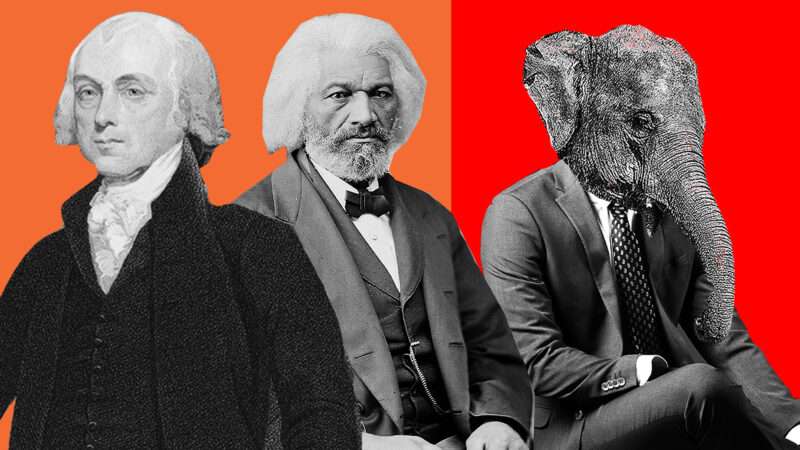
On August 7, 1787, toward the end of what would become known as the Constitutional Convention, the delegates debated what powers state legislatures and the Congress would have when it came to federal election administration. Some delegates in Philadelphia wanted state legislatures to have complete control over the time, places, and manner of federal elections. They worried about centralized power, an overzealous and suffocating federal government.

But James Madison disagreed. He worried about state and local machinations. The diminutive Virginia slave master worried aloud that it was “impossible to foresee all the abuses that might be made of the discretionary power” to control election rules. He worried about corruption. “Whenever the State Legislatures had a favorite measure to carry,” he said, “they would take care so to mould their regulations as to favor the candidates they wished to succeed.”

Madison eventually would win the argument, and Congress would get its veto power. Under the Constitution’s Elections Clause, state legislatures would be responsible for running federal elections, but “the Congress may at any time by Law make or alter such Regulations.”

Madison has proven prescient. Throughout American history, state legislatures have wielded their powers to determine which Americans were deemed worthy enough to cast a ballot and give their consent to be governed. Nowhere was this clearer than in the Jim Crow South, where legislatures, with malice and artifice, took away the voting rights that millions of black men gained after the Civil War.

But this history has not ended. In the aftermath of a divisive election marked by allegations of widespread voter fraud, which led to the storming of the Capitol to overturn a free and fair election, Republican state legislators across the country continue to prove Madison’s distrust correct.

A National Trend

As of February 19, 2021, Republican legislators in at least 43 states had introduced more than 250 bills to suppress or constrain voting, according to the Brennan Center for Justice at NYU Law School, where I work. That’s a sevenfold increase over the same time last year. The proposed changes include crippling limits on mail-in voting, restrictions on early voting, and reduced voter registration opportunities. These efforts, led almost entirely by Republicans, are a direct reaction to then-President Donald Trump’s claim that the 2020 election was “stolen from the voters in a massive fraud.”

But there was no epidemic of fraud. State and local Republican election officials confirmed the integrity of the vote. Trump’s legal team lost virtually every lawsuit it filed contesting the election results in multiple states, often in cases heard by Trump’s own judicial appointees. Their rulings were littered with phrases like “without merit,” “not credible,” and “obviously lacking.” Trump nominee Stephanos Bibas wrote a scathing opinion for a unanimous panel of the U.S. Court of Appeals for the 3rd Circuit, rejecting the Trump campaign’s challenge to Joe Biden’s victory in Pennsylvania. “Calling an election unfair does not make it so,” Bibas noted. “Charges require specific allegations and then proof. We have neither here.”

Even former Trump campaign lawyer Sidney Powell, who spent the fall and winter accusing Dominion Voting Systems of participating in a massive fraud that supposedly denied Trump his rightful victory, recently said “no reasonable person” would have thought her wild allegations “were truly statements of fact.” In response to a defamation lawsuit filed by Dominion, Powell did not even attempt to prove the truth of her claims.

None of that stopped Republican legislators from rushing to remedy the mythical problem described by Trump and his allies. “I think what we’re seeing is the most serious attempt across the country to restrict the rights of certain Americans to vote since the days of Jim Crow,” said Rep. Colin Allred (D–Texas), a member of the Congressional Black Caucus.

Ohio State University law professor Edward Foley sees the legislation as an attempt to undermine the achievements of the “Second Reconstruction,” when Congress passed the Civil Rights Acts of 1957, 1964, and 1968 as well as the Voting Rights Act of 1965. “It’s not exactly the same as the end of the first Reconstruction, and one has to hope that it won’t be,” Foley told The Washington Post. “But there are enough parallels to be nerve-racking.”

The days of barring prospective Southern black voters by requiring them to count the kernels of corn in a jar or the seeds in a watermelon are thankfully over. But the spirit of those practices lives on in the recent surge of enacted and proposed restrictions on voting. Policies such as requiring a government-issued ID to vote or cutting back on early voting are facially neutral, but they disproportionately affect voters of color—who, not incidentally, overwhelmingly favor Democratic candidates.

In the past, many of the jurisdictions that are making it harder to vote would have had to clear their changes with the Justice Department or a federal court under the Voting Rights Act of 1965. That requirement applied to jurisdictions, mostly in the South, with a history of voting discrimination. But in 2013, the Supreme Court invalidated a key provision of the law, eliminating what is known as “preclearance” and ushering in a wave of voter suppression in once-covered jurisdictions that will only get worse if states pass more restrictive measures this legislative session.

Arguments about these restrictive measures often get bogged down in the question of whether particular legislators are personally motivated by racism or are merely seeking to maximize their party’s share of the vote. These aren’t either/or propositions, and it’s hard to disentangle the two motives during these tribal times. But when legislation disproportionately erects barriers to the ballot box for certain communities—especially those that have been historically deprived of their civil rights—the lawmakers responsible for it make a mockery of the promised equality of “one person, one vote.”

In states where Democrats control the legislature, these bills likely will die in committee or be voted down on the floor. But in the 19 states where Republicans control both the legislature and the governor’s office, severe voting restrictions almost certainly will be enacted.

Republican legislators in these states claim they are concerned only with “election integrity” and restoring confidence in the electoral process. But a closer look at some of the legislation in Georgia, Texas, and Arizona exposes a disturbing bid to suppress the votes of people who vote blue more often than red, particularly blacks and Latinos.  

Georgia 

Proposed legislation in Georgia provides the most striking case study. As of February 19, according to the Brennan Center’s state voting bills tracker, the state’s Republican-controlled legislature was considering at least 22 bills that would selectively limit access to voting. A few caused a public firestorm because of their apparent racial bias. 

Two bills sought to end no-excuse mail voting, except for older voters. That policy, which allows people to vote by mail without any special justification, was established with Republican support in 2005.

S.B. 241, which passed the Georgia Senate on March 8 but died in the House, would have allowed only voters 65 or older and those with disabilities to vote by mail. S.B. 71, which also failed, would have raised the age cutoff to 75.

These bills may seem neutral until you dig a little deeper into voter behavior in the 2020 general election. The pandemic made voting by mail an extremely popular option for all racial groups, but new patterns emerged, as my Brennan Center colleague Kevin Morris has shown.

In 2016, white voters accounted for 67 percent of the vote-by-mail electorate in Georgia. In 2020, that dropped to 54 percent, perhaps partly due to Trump’s denunciations of this voting method. Black voters, meanwhile, flocked to voting by mail. They represented 31 percent of mail voters in 2020, up from 23 percent in 2016.

Last year in Georgia, about 30 percent of black voters used mail-in ballots, while only 24 percent of white voters did. White voters, however, are considerably older than black voters in Georgia. This means that, despite using mail ballots less frequently, white voters made up a clear majority of mail voters 65 years and older. By allowing elderly voters to continue to vote by mail, Republican legislators privileged their likely voters in these bills.

While allowing elderly voters to vote by mail without an excuse may look neutral at first glance, Georgia’s H.B. 531 does not. The bill, which passed the House on March 1, would have eliminated Sunday voting. During election season, black churches use the day to get their parishioners to vote, a tradition known as “Souls to the Polls.” The bill, which caused a public backlash locally and nationally, was recently revised. The modified measure gives local election officials the option of adding two Sundays to early voting but requires two Saturdays of early voting in the lead-up to Election Day.

The original intent was not subtle, especially when you consider that Georgia narrowly flipped blue in 2020, when President Biden won the state and two Senate races led to runoffs won by Democrats Raphael Warnock and Jon Ossoff. An analysis by The Washington Post‘s Philip Bump shows why that happened. During Georgia’s early voting period, black voters accounted for 26 percent of the vote. But during the four weekend days, black voters cast 32 percent to 44 percent of the ballots. “Lock out 100,000 Democratic votes,” Bump notes, “and Georgia switches from slightly blue back to slightly red.”

Georgia Lt. Gov. Geoff Duncan (R), breaking ranks with his party, said he understood why reasonable people would conclude that targeting weekend voting meant targeting black voters. “There is [sic] a lot of solutions in search of a problem,” he told Chuck Todd on Meet the Press.

Georgia also has a history of some of the longest wait times to vote in the nation, especially in black neighborhoods. During early voting in last year’s primary, voters in largely black areas waited up to seven hours to vote and drone footage showed shockingly long lines. During the general election, voters in Atlanta, which is 51 percent black, waited up to 11 hours. In response to the excruciating wait times, nonpartisan groups and good Samaritans handed out food and water to keep people in line.

This, however, is now illegal. On Friday, Republican Gov. Brian Kemp signed an omnibus voting bill that criminalized this very practice for everyone on top of other provisions that would make it harder to vote. Under previous law, the ban only applied to representatives of political organizations.  

“We’ve had some very hot days,” Savannah Mayor Van Johnson told a local news station. “So I’m supposed to watch somebody pass out and not offer them water? Or offer them food if they’re diabetic or if they have some type of health challenges? Because state law says I can’t help them?”

Texas

As of February 19, Texas Republican legislators had proposed at least 10 measures likely to restrict voting, according to the Brennan Center tracker. Gov. Greg Abbott has encouraged the legislation by making “election integrity” an emergency priority, even though he admitted there is no evidence yet that widespread fraud occurred in the state’s 2020 election. “Republicans, of course, have run Texas for almost two decades,” Christopher Hooks observed in Texas Monthly. “If there’s widespread fraud in Texas elections, one would think they’d have found it by now—and fixed it.”

Texas Republicans nevertheless want to make voting harder in a state already known for policies such as strict voter ID laws and cuts to polling places in rapidly expanding black and Latino communities. The state, even in the midst of a pandemic, refused to allow no-excuse voting by mail.

Harris County, which includes Houston, the state’s largest city, has been a special focus of this legislative ire. The diverse city has one of the country’s biggest Hispanic/Latino populations, a majority of which votes Democrat. In the run-up to the election, Harris County tried to make it easier to vote during the pandemic. Officials kept polling locations open for 24 hours to give voters more options and to limit the number of people waiting to vote. They opened drive-through voting locations, which they then almost entirely shut down on Election Day due to Republican legal challenges. And they tried to send voters mail-ballot applications but were stopped by the Texas Supreme Court.

Republicans in the statehouse want to put an end to any future experimentation with easier voting. S.B. 1115 requires all counties, regardless of size, to have the same early voting schedule. “Unless ordered by a court,” the bill says, “voting time shall be not more than 12 hours in one day”—a provision that takes direct aim at Harris County.

Another Senate bill, S.B. 7, is even more restrictive. The American Civil Liberties Union of Texas summed it up in a tweet: “SB 7 would ban 24-hour voting, eliminate drive-thru voting, reduce early voting hours, and prevent counties from using stadiums and convention centers as polling places—for no reason other than keeping Texas away from the ballot box.” And there’s more: The bill also would require people with disabilities to provide documentation of them in return for a mail-in ballot application.

All this, Abbott says, is to ensure “trust and confidence in our elections.” In December, the Houston Chronicle reported that the Texas Attorney General’s Office spent 22,000 staff hours looking for voter fraud in 2020. It found just 16 incidents in which Harris County residents provided false addresses on their voter registration forms. In all these prosecutions, no one received jail time.

Also in December, an election security task force in Harris County released its report on the integrity of the November election. “Despite claims,” it said, “our thorough investigations found no proof of any election tampering, ballot harvesting, voter suppression, intimidation or any other type of foul play that might have impacted the legitimate cast or count of a ballot.”

Hooks’ conclusion: “As with the chupacabra, voter fraud is greatly feared but rarely seen. 

Arizona

Republican-controlled Arizona, whose voters broke for Biden by just 10,000 votes in November, is now also a hotbed of restrictive election legislation, including at least 22 bills according to the Brennan Center.

S.B. 1485, which recently passed the Arizona Senate, would change the rules governing the permanent early voting list, which allows the state’s voters to sign up once and then receive a mail ballot for every election they’re eligible to vote in going forward. The bill requires that residents on the list who did not vote in the last two election cycles be sent notices asking if they would like to continue receiving mail-in ballots. Recipients who do not respond yes would be dropped from the list, meaning that they would have to vote in person, according to the bill’s sponsor.

Discussing the bill on CNN, one supporter, state Rep. John Kavanagh (R–Scottsdale), admitted that evidence of vote-by-mail fraud was “anecdotal” but argued that the legislation was necessary anyway. “Democrats value as many people as possible voting, and they’re willing to risk fraud,” Kavanagh said. “Republicans are more concerned about fraud, so we don’t mind putting security measures in that won’t let everybody vote—but everybody shouldn’t be voting.”

He didn’t stop there. “Not everybody wants to vote, and if somebody is uninterested in voting, that probably means that they’re totally uninformed on the issues,” Kavanagh added. “Quantity is important, but we have to look at the quality of votes as well.”

Kavanagh’s observation that not everyone wants to vote is correct, of course. Libertarians, for example, often sit out multiple elections in a row simply because we don’t like either major-party candidate or platform. That does not make libertarians low-quality voters. But talking about the “quality of votes” and averring that “everybody shouldn’t be voting” is so reminiscent of Jim Crow rhetoric that it’s difficult to be charitable and chalk those remarks up to ignorance. 

Once again, the official rationale for restricting voting by mail is security. But Arizona has had no-excuse mail-in voting since 1992. Today, the vast majority of Arizonans vote by mail. During an Oval Office meeting with Trump last August, Republican Gov. Doug Ducey defended the state’s vote-by-mail system. “It will be free and fair,” he told Trump. “It will be difficult, if not impossible, to cheat. And it will be easy to vote.” 

If Republican legislators get their way, Arizona’s system will be less free and less fair, and voting will be much more difficult.

What Everyone Should Want

This eruption of legislation should worry anyone who believes that the ultimate authority in this nation rests with the people and not the politicians.

Members of Congress now have a choice. They can see what Republican state legislatures are doing and consider using their power under the Elections Clause to do something about it. Republican members can put principle over party, recognizing that it may harm their electoral chances in the short term.

In a democratic nation, the vote ensures that we engage in politics, not war. It gives us a voice: one vote to cast as we please, plus the right to speak freely and convince others to also cast their ballots for particular candidates or causes. It gives us the ability to privilege the ballot box over the cartridge box when things get real. The winner today may not be the winner next election. The self-corrective process of elections allows for the peaceful transfer of power—a historical miracle that, after the Capitol riot, we might not want to take for granted.

As the internecine bloodbath of the Civil War came to a close, Frederick Douglass addressed the annual meeting of the Massachusetts Anti-Slavery Society in Boston. His speech, “What the Black Man Wants,” is a reminder of the importance of the franchise to self-government and individual freedom.

“Without this, his liberty is a mockery,” Douglass said. “Without this, you might as well almost retain the old name of slavery for his condition; for in fact, if he is not the slave of the individual master, he is the slave of society, and holds his liberty as a privilege, not as a right.” 

The same truth holds today. Discriminatory laws and practices that create long lines and make casting a vote as difficult as possible deter people from voting. By doing so, they attack Americans’ liberty and their equality before the law. A right made onerous is, in many respects, a right denied.

from Latest – Reason.com https://ift.tt/39njBF1
via IFTTT

25-Foot Rooftop Videocamera Peering Into Neighbor’s Yard Must Be Taken Down

From Jackman v. Cebrink-Swartz, decided Friday by the Florida Court of Appeal, in an opinion by Judge Robert Morris, joined by Judges Daniel Sleet and Matthew Lucas:

The Jackmans and the Swartzes own adjoining lots with the border running along the sides of their respective homes. [After some disputes,] the Swartzes installed a twenty-five-foot-high rooftop camera. The record reflects that the camera had night-vision capabilities and recorded twenty-four hours a day, seven days a week.

The camera was positioned to see over the Jackmans’ [6-foot-high] privacy fence, allowing the Swartzes to see into a portion of the Jackmans’ backyard and the edge of their lanai. Testimony reflected that the camera could also see the side door to the Jackmans’ home but could not see beyond the threshold of the door when it was open….

Mrs. Jackman testified that she could see the camera from within her lanai and that she found it highly offensive and intrusive, frustrating her use and enjoyment of the Jackmans’ property. Mrs. Jackman further testified she did not believe there was a legitimate reason for the installation of the camera since the Swartzes already had three other cameras installed on their home, two of which already faced the common border area between the homes, though they were not positioned to see over the Jackmans’ privacy fence.

Mrs. Swartz testified the twenty-five-foot-high camera was installed due to her fear of Mr. Jackman, with whom she had had several confrontations. She testified that after installation of the camera, Mr. Jackman ceased the activities that had caused her concern on prior occasions. {Mrs. Swartz alleged that Mr. Jackman had previously followed her and paced along side of her as she was working in her side yard.} The Jackmans presented testimony from two neighbors … who testified that Mrs. Swartz had never acted like she was in fear of Mr. Jackman….

The court held that the Jackmans were entitled to an injunction ordering Swartzes to take down the camera, because the camera’s operation constituted tortious intrusion upon seclusion:

The tort of invasion of privacy is comprised of several different forms. Intrusion upon seclusion is defined as where a person “intentionally intrudes, physically or otherwise, upon the solitude or seclusion of another or his private affairs or concerns … if the intrusion would be highly offensive to a reasonable person.” Restatement (Second) of Torts § 652B (Am. Law Inst. 1977). Notably, this form of invasion of privacy “does not depend on any publicity given to the person whose interest is invaded or to his affairs.” …

[T]here is a reasonable expectation of privacy within the curtilage of a residence, and we conclude that there is a material difference between occasionally viewing the activities within a neighbor’s backyard that are observable without peering over a privacy fence and erecting a camera to see over a privacy fence to thereafter surveil and record those activities on a consistent basis. See Goosen v. Walker (Fla. 4th DCA 1998) (recognizing that engaging in repeated surveillance of another person can constitute the tort of invasion of privacy—intrusion upon seclusion); Shafer v. City of Boulder (D. Nev. 2012) (citing United States v. Cuevas-Sanchez (5th Cir. 1987), for the proposition that video surveillance of someone’s backyard is different from a one-time overhead glance and that society would recognize a homeowner’s expectation to be free from such video surveillance to be reasonable); Baugh v. Fleming (Tex. App. Dec. 31, 2009) (holding that evidence was sufficient to establish intrusion upon seclusion claim where party videotaped neighbor through window by peering over six-foot-high privacy fence in their backyard).

We do not overlook the Swartzes’ argument that the Jackmans had their own camera installed on their home and that it surveilled a portion of the Swartzes’ home. However, the Swartzes have acknowledged that the Jackmans’ camera is aimed primarily at the border area between the homes—rather than into the Swartzes’ backyard—and that it is facing the street. Further it is undisputed that the door of the Swartzes’ home that is visible to the Jackmans’ camera is a side door to the house which is visible from the street. Thus the Swartzes do not have the same subjective expectation of privacy related to that area of their home as they would if it was enclosed by a privacy fence adorned with “no trespassing” signs….

Finally, we note that the trial court determined below that the position of the camera was not dispositive and that the dispositive issue was what footage the camera was capable of capturing. For the reasons we have already explained, we conclude that the position of the camera in this case—peering over a privacy fence into the curtilage of a neighbor’s backyard—was dispositive. However, we also recognize that due to the proliferation of home surveillance cameras and drones, there is some uncertainty about what surveillance activities may be maintained without resulting in an invasion of privacy of another person. Thus we certify the following question as one of great public importance:

Does the use of a camera by a private citizen to monitor and/or record activities occurring within the curtilage of a home surrounded by a privacy fence not belonging to the camera operator constitute the tort of invasion of privacy—intrusion upon seclusion?

This certification, as I understand it, would give the Florida Supreme Court discretionary jurisdiction to consider the matter, should the Swartzes decide to seek review by the Florida Supreme Court; but if the parties don’t seek such review, then the Jackmans are entitled to the injunction.

from Latest – Reason.com https://ift.tt/3wassUg
via IFTTT

The Republican Attack on Voting Rights


thumb-6

The father of the Constitution wasn’t having it.

On August 7, 1787, toward the end of what would become known as the Constitutional Convention, the delegates debated what powers state legislatures and the Congress would have when it came to federal election administration. Some delegates in Philadelphia wanted state legislatures to have complete control over the time, places, and manner of federal elections. They worried about centralized power, an overzealous and suffocating federal government.

But James Madison disagreed. He worried about state and local machinations. The diminutive Virginia slave master worried aloud that it was “impossible to foresee all the abuses that might be made of the discretionary power” to control election rules. He worried about corruption. “Whenever the State Legislatures had a favorite measure to carry,” he said, “they would take care so to mould their regulations as to favor the candidates they wished to succeed.”

Madison eventually would win the argument, and Congress would get its veto power. Under the Constitution’s Elections Clause, state legislatures would be responsible for running federal elections, but “the Congress may at any time by Law make or alter such Regulations.”

Madison has proven prescient. Throughout American history, state legislatures have wielded their powers to determine which Americans were deemed worthy enough to cast a ballot and give their consent to be governed. Nowhere was this clearer than in the Jim Crow South, where legislatures, with malice and artifice, took away the voting rights that millions of black men gained after the Civil War.

But this history has not ended. In the aftermath of a divisive election marked by allegations of widespread voter fraud, which led to the storming of the Capitol to overturn a free and fair election, Republican state legislators across the country continue to prove Madison’s distrust correct.

A National Trend

As of February 19, 2021, Republican legislators in at least 43 states had introduced more than 250 bills to suppress or constrain voting, according to the Brennan Center for Justice at NYU Law School, where I work. That’s a sevenfold increase over the same time last year. The proposed changes include crippling limits on mail-in voting, restrictions on early voting, and reduced voter registration opportunities. These efforts, led almost entirely by Republicans, are a direct reaction to then-President Donald Trump’s claim that the 2020 election was “stolen from the voters in a massive fraud.”

But there was no epidemic of fraud. State and local Republican election officials confirmed the integrity of the vote. Trump’s legal team lost virtually every lawsuit it filed contesting the election results in multiple states, often in cases heard by Trump’s own judicial appointees. Their rulings were littered with phrases like “without merit,” “not credible,” and “obviously lacking.” Trump nominee Stephanos Bibas wrote a scathing opinion for a unanimous panel of the U.S. Court of Appeals for the 3rd Circuit, rejecting the Trump campaign’s challenge to Joe Biden’s victory in Pennsylvania. “Calling an election unfair does not make it so,” Bibas noted. “Charges require specific allegations and then proof. We have neither here.”

Even former Trump campaign lawyer Sidney Powell, who spent the fall and winter accusing Dominion Voting Systems of participating in a massive fraud that supposedly denied Trump his rightful victory, recently said “no reasonable person” would have thought her wild allegations “were truly statements of fact.” In response to a defamation lawsuit filed by Dominion, Powell did not even attempt to prove the truth of her claims.

None of that stopped Republican legislators from rushing to remedy the mythical problem described by Trump and his allies. “I think what we’re seeing is the most serious attempt across the country to restrict the rights of certain Americans to vote since the days of Jim Crow,” said Rep. Colin Allred (D–Texas), a member of the Congressional Black Caucus.

Ohio State University law professor Edward Foley sees the legislation as an attempt to undermine the achievements of the “Second Reconstruction,” when Congress passed the Civil Rights Acts of 1957, 1964, and 1968 as well as the Voting Rights Act of 1965. “It’s not exactly the same as the end of the first Reconstruction, and one has to hope that it won’t be,” Foley told The Washington Post. “But there are enough parallels to be nerve-racking.”

The days of barring prospective Southern black voters by requiring them to count the kernels of corn in a jar or the seeds in a watermelon are thankfully over. But the spirit of those practices lives on in the recent surge of enacted and proposed restrictions on voting. Policies such as requiring a government-issued ID to vote or cutting back on early voting are facially neutral, but they disproportionately affect voters of color—who, not incidentally, overwhelmingly favor Democratic candidates.

In the past, many of the jurisdictions that are making it harder to vote would have had to clear their changes with the Justice Department or a federal court under the Voting Rights Act of 1965. That requirement applied to jurisdictions, mostly in the South, with a history of voting discrimination. But in 2013, the Supreme Court invalidated a key provision of the law, eliminating what is known as “preclearance” and ushering in a wave of voter suppression in once-covered jurisdictions that will only get worse if states pass more restrictive measures this legislative session.

Arguments about these restrictive measures often get bogged down in the question of whether particular legislators are personally motivated by racism or are merely seeking to maximize their party’s share of the vote. These aren’t either/or propositions, and it’s hard to disentangle the two motives during these tribal times. But when legislation disproportionately erects barriers to the ballot box for certain communities—especially those that have been historically deprived of their civil rights—the lawmakers responsible for it make a mockery of the promised equality of “one person, one vote.”

In states where Democrats control the legislature, these bills likely will die in committee or be voted down on the floor. But in the 19 states where Republicans control both the legislature and the governor’s office, severe voting restrictions almost certainly will be enacted.

Republican legislators in these states claim they are concerned only with “election integrity” and restoring confidence in the electoral process. But a closer look at some of the legislation in Georgia, Texas, and Arizona exposes a disturbing bid to suppress the votes of people who vote blue more often than red, particularly blacks and Latinos.  

Georgia 

Proposed legislation in Georgia provides the most striking case study. As of February 19, according to the Brennan Center’s state voting bills tracker, the state’s Republican-controlled legislature was considering at least 22 bills that would selectively limit access to voting. A few caused a public firestorm because of their apparent racial bias. 

Two bills sought to end no-excuse mail voting, except for older voters. That policy, which allows people to vote by mail without any special justification, was established with Republican support in 2005.

S.B. 241, which passed the Georgia Senate on March 8 but died in the House, would have allowed only voters 65 or older and those with disabilities to vote by mail. S.B. 71, which also failed, would have raised the age cutoff to 75.

These bills may seem neutral until you dig a little deeper into voter behavior in the 2020 general election. The pandemic made voting by mail an extremely popular option for all racial groups, but new patterns emerged, as my Brennan Center colleague Kevin Morris has shown.

In 2016, white voters accounted for 67 percent of the vote-by-mail electorate in Georgia. In 2020, that dropped to 54 percent, perhaps partly due to Trump’s denunciations of this voting method. Black voters, meanwhile, flocked to voting by mail. They represented 31 percent of mail voters in 2020, up from 23 percent in 2016.

Last year in Georgia, about 30 percent of black voters used mail-in ballots, while only 24 percent of white voters did. White voters, however, are considerably older than black voters in Georgia. This means that, despite using mail ballots less frequently, white voters made up a clear majority of mail voters 65 years and older. By allowing elderly voters to continue to vote by mail, Republican legislators privileged their likely voters in these bills.

While allowing elderly voters to vote by mail without an excuse may look neutral at first glance, Georgia’s H.B. 531 does not. The bill, which passed the House on March 1, would have eliminated Sunday voting. During election season, black churches use the day to get their parishioners to vote, a tradition known as “Souls to the Polls.” The bill, which caused a public backlash locally and nationally, was recently revised. The modified measure gives local election officials the option of adding two Sundays to early voting but requires two Saturdays of early voting in the lead-up to Election Day.

The original intent was not subtle, especially when you consider that Georgia narrowly flipped blue in 2020, when President Biden won the state and two Senate races led to runoffs won by Democrats Raphael Warnock and Jon Ossoff. An analysis by The Washington Post‘s Philip Bump shows why that happened. During Georgia’s early voting period, black voters accounted for 26 percent of the vote. But during the four weekend days, black voters cast 32 percent to 44 percent of the ballots. “Lock out 100,000 Democratic votes,” Bump notes, “and Georgia switches from slightly blue back to slightly red.”

Georgia Lt. Gov. Geoff Duncan (R), breaking ranks with his party, said he understood why reasonable people would conclude that targeting weekend voting meant targeting black voters. “There is [sic] a lot of solutions in search of a problem,” he told Chuck Todd on Meet the Press.

Georgia also has a history of some of the longest wait times to vote in the nation, especially in black neighborhoods. During early voting in last year’s primary, voters in largely black areas waited up to seven hours to vote and drone footage showed shockingly long lines. During the general election, voters in Atlanta, which is 51 percent black, waited up to 11 hours. In response to the excruciating wait times, nonpartisan groups and good Samaritans handed out food and water to keep people in line.

This, however, is now illegal. On Friday, Republican Gov. Brian Kemp signed an omnibus voting bill that criminalized this very practice for everyone on top of other provisions that would make it harder to vote. Under previous law, the ban only applied to representatives of political organizations.  

“We’ve had some very hot days,” Savannah Mayor Van Johnson told a local news station. “So I’m supposed to watch somebody pass out and not offer them water? Or offer them food if they’re diabetic or if they have some type of health challenges? Because state law says I can’t help them?”

Texas

As of February 19, Texas Republican legislators had proposed at least 10 measures likely to restrict voting, according to the Brennan Center tracker. Gov. Greg Abbott has encouraged the legislation by making “election integrity” an emergency priority, even though he admitted there is no evidence yet that widespread fraud occurred in the state’s 2020 election. “Republicans, of course, have run Texas for almost two decades,” Christopher Hooks observed in Texas Monthly. “If there’s widespread fraud in Texas elections, one would think they’d have found it by now—and fixed it.”

Texas Republicans nevertheless want to make voting harder in a state already known for policies such as strict voter ID laws and cuts to polling places in rapidly expanding black and Latino communities. The state, even in the midst of a pandemic, refused to allow no-excuse voting by mail.

Harris County, which includes Houston, the state’s largest city, has been a special focus of this legislative ire. The diverse city has one of the country’s biggest Hispanic/Latino populations, a majority of which votes Democrat. In the run-up to the election, Harris County tried to make it easier to vote during the pandemic. Officials kept polling locations open for 24 hours to give voters more options and to limit the number of people waiting to vote. They opened drive-through voting locations, which they then almost entirely shut down on Election Day due to Republican legal challenges. And they tried to send voters mail-ballot applications but were stopped by the Texas Supreme Court.

Republicans in the statehouse want to put an end to any future experimentation with easier voting. S.B. 1115 requires all counties, regardless of size, to have the same early voting schedule. “Unless ordered by a court,” the bill says, “voting time shall be not more than 12 hours in one day”—a provision that takes direct aim at Harris County.

Another Senate bill, S.B. 7, is even more restrictive. The American Civil Liberties Union of Texas summed it up in a tweet: “SB 7 would ban 24-hour voting, eliminate drive-thru voting, reduce early voting hours, and prevent counties from using stadiums and convention centers as polling places—for no reason other than keeping Texas away from the ballot box.” And there’s more: The bill also would require people with disabilities to provide documentation of them in return for a mail-in ballot application.

All this, Abbott says, is to ensure “trust and confidence in our elections.” In December, the Houston Chronicle reported that the Texas Attorney General’s Office spent 22,000 staff hours looking for voter fraud in 2020. It found just 16 incidents in which Harris County residents provided false addresses on their voter registration forms. In all these prosecutions, no one received jail time.

Also in December, an election security task force in Harris County released its report on the integrity of the November election. “Despite claims,” it said, “our thorough investigations found no proof of any election tampering, ballot harvesting, voter suppression, intimidation or any other type of foul play that might have impacted the legitimate cast or count of a ballot.”

Hooks’ conclusion: “As with the chupacabra, voter fraud is greatly feared but rarely seen. 

Arizona

Republican-controlled Arizona, whose voters broke for Biden by just 10,000 votes in November, is now also a hotbed of restrictive election legislation, including at least 22 bills according to the Brennan Center.

S.B. 1485, which recently passed the Arizona Senate, would change the rules governing the permanent early voting list, which allows the state’s voters to sign up once and then receive a mail ballot for every election they’re eligible to vote in going forward. The bill requires that residents on the list who did not vote in the last two election cycles be sent notices asking if they would like to continue receiving mail-in ballots. Recipients who do not respond yes would be dropped from the list, meaning that they would have to vote in person, according to the bill’s sponsor.

Discussing the bill on CNN, one supporter, state Rep. John Kavanagh (R–Scottsdale), admitted that evidence of vote-by-mail fraud was “anecdotal” but argued that the legislation was necessary anyway. “Democrats value as many people as possible voting, and they’re willing to risk fraud,” Kavanagh said. “Republicans are more concerned about fraud, so we don’t mind putting security measures in that won’t let everybody vote—but everybody shouldn’t be voting.”

He didn’t stop there. “Not everybody wants to vote, and if somebody is uninterested in voting, that probably means that they’re totally uninformed on the issues,” Kavanagh added. “Quantity is important, but we have to look at the quality of votes as well.”

Kavanagh’s observation that not everyone wants to vote is correct, of course. Libertarians, for example, often sit out multiple elections in a row simply because we don’t like either major-party candidate or platform. That does not make libertarians low-quality voters. But talking about the “quality of votes” and averring that “everybody shouldn’t be voting” is so reminiscent of Jim Crow rhetoric that it’s difficult to be charitable and chalk those remarks up to ignorance. 

Once again, the official rationale for restricting voting by mail is security. But Arizona has had no-excuse mail-in voting since 1992. Today, the vast majority of Arizonans vote by mail. During an Oval Office meeting with Trump last August, Republican Gov. Doug Ducey defended the state’s vote-by-mail system. “It will be free and fair,” he told Trump. “It will be difficult, if not impossible, to cheat. And it will be easy to vote.” 

If Republican legislators get their way, Arizona’s system will be less free and less fair, and voting will be much more difficult.

What Everyone Should Want

This eruption of legislation should worry anyone who believes that the ultimate authority in this nation rests with the people and not the politicians.

Members of Congress now have a choice. They can see what Republican state legislatures are doing and consider using their power under the Elections Clause to do something about it. Republican members can put principle over party, recognizing that it may harm their electoral chances in the short term.

In a democratic nation, the vote ensures that we engage in politics, not war. It gives us a voice: one vote to cast as we please, plus the right to speak freely and convince others to also cast their ballots for particular candidates or causes. It gives us the ability to privilege the ballot box over the cartridge box when things get real. The winner today may not be the winner next election. The self-corrective process of elections allows for the peaceful transfer of power—a historical miracle that, after the Capitol riot, we might not want to take for granted.

As the internecine bloodbath of the Civil War came to a close, Frederick Douglass addressed the annual meeting of the Massachusetts Anti-Slavery Society in Boston. His speech, “What the Black Man Wants,” is a reminder of the importance of the franchise to self-government and individual freedom.

“Without this, his liberty is a mockery,” Douglass said. “Without this, you might as well almost retain the old name of slavery for his condition; for in fact, if he is not the slave of the individual master, he is the slave of society, and holds his liberty as a privilege, not as a right.” 

The same truth holds today. Discriminatory laws and practices that create long lines and make casting a vote as difficult as possible deter people from voting. By doing so, they attack Americans’ liberty and their equality before the law. A right made onerous is, in many respects, a right denied.

from Latest – Reason.com https://ift.tt/39njBF1
via IFTTT

Futures Rebound Despite Global Margin Call Fears

Futures Rebound Despite Global Margin Call Fears

After initially dipping as much as -0.7% during the early Asian session on fears that the Archegos margin call crisis which has already cost billions in losses at Nomura and Credit Suisse’s prime brokerage units could spread, futures have stabilized and at last check the Emini was down -0.3% to 3,952 after its remarkable late Friday surge which pushed the S&P just shy of an all time high, while quarter-end is expected to be in focus this week, favoring buying of Treasuries although it is debatable how stocks will trade today.

At the same time, Nasdaq 100 futures erased losses of as much as 1.2% to trade little changed as of 7:30am in New York following revelations that Archegos Capital Management LLC – Bill Hwang’s family office – was behind a $20 billion spree of block trades on Friday, selling Chinese tech giants and U.S. media firms. And with a number of banks exposed to Archegos and losing billions, investors are on edge lookout for signs of contagion.

As noted earlier, Nomura and Credit Suisse warned of significant losses after Archegos defaulted, sending their stocks plunging by near record amounts.

Shares in Bank of America Corp, Citigroup Inc, JPMorgan Chase & Co, Goldman Sachs, Wells Fargo & Co and Morgan Stanley dropped between 0.8% and 3.3% in premarket trading.

As Bloomberg reported this morning, much of the leverage used by Hwang’s Archegos Capital Management was provided by banks including Nomura and Credit Suisse Group through swaps or so-called contracts-for-difference, according to people with direct knowledge of the deals. It means Archegos may never actually have owned most of the underlying securities – if any at all.

Many of the stocks that were hammered on Friday were volatile in early trading, they have since stabilized and ViacomCBS, Discovery and a group of Chinese ADRs were trading mostly higher premarket, reversing earlier declines for some of the names. A ViacomCBS block trade that launched on Sunday has priced at $47 per share, according to a person familiar with the matter, after shares were said to be offered at $46-$47. ViacomCBS Class B shares are up 1.5% to $48.94 premarket, while the less-heavily traded Class A shares are up 6.7%; Class B slumped 27% on Friday. Shares in Discovery Inc rose about 5% after tumbling 27% on Friday, while U.S.-listed shares of Tencent Music rose 4% after nearly halving in value last week. ViacomCBS, Baidu and VIPShop fell between 0.2% and 1.5%.

“This incident reminded markets of the dark side of leverage, likely leading some players to cut their risk exposure near record highs to avoid any serious losses if the selling snowballs,” said Marios Hadjikyriacos, investment analyst at online broker XM in Cyprus.

Wall Street’s main indexes surged over 1% in a late-session rally on Friday as investors looking to rebalance their portfolios at the end of the quarter, piled into economy-linked banks, energy, materials as well as technology names. The Dow and the S&P 500 are less than 1% from their record highs, while the tech-heavy Nasdaq is still about 7.1% from its February all-time high. Investors have been focusing on the strength of the recovery, aided by vaccines, and inflation risks.

The value-intensive Europe appears to have put the Archegos fiasco in the rearvier mirror shockwave as the Stoxx 600 rose for a second day as gains for defensive sectors including food and beverages outweighed losses for cyclical sectors such as banks and travel.

“I don’t necessarily see that we’re going to have a big correction even with these block trades going on in the market,” Carol Pepper, Pepper International chief executive officer and founder, said on Bloomberg TV. “There is not a lot of bad news lurking that’s going to truly cause a major correction at least the next two to three months, therefore your dips are going to be modest.”

Earlier in the session, Asian stocks were also in the green after a mixed day, as tech shares gained while communication services and consumer discretionary stocks declined. Japanese brokerage Nomura Holdings was among the worst performers in Asia, plunging the most on record after warning of significant potential losses from an unnamed U.S. client. The losses are related to Friday’s unwinding of trades by Bill Hwang’s Archegos Capital Management, according to people familiar with the matter. The Topix index climbed 0.5% despite the drag from Nomura. Meanwhile, China’s CSI 300 Index ended the day up 0.2% as analysts called a market bottom. The country’s tech sector saw limited losses despite the selloff on Friday in the U.S., with the Hang Seng Tech index falling 1.8%, as analysts and fund managers saw the rout as a buying opportunity. Baidu shares fell 5% in Hong Kong, while Bilibili dropped on its debut there. Meituan was another laggard on the Asian gauge as the Chinese food-delivery giant slid 7.2%, after warning that it will remain in the red for several more quarters despite record revenues. Markets in India were closed for a holiday.

In rates, Treasuries were off best levels of the day, richer by more than 3bps across long-end of the curve. Treasury 10-year yields are richer by ~2.5bp at around 1.65%, outperforming bunds and gilts by 2bp and 3bp; curve spreads are mostly flatter, 2s10s by ~2bps. No Treasury coupon supply this week, and quarter-end rebalancing is expected to buying of Treasuries

In FX, the Bloomberg Dollar Spot Index advanced as the dollar climbed against most of its Group-of-10 peers, while risk-sensitive currencies fell, led by Scandinavian currencies; the euro fell, trading near its lowest level since November against the greenback.  The pound led G-10 gains with traders focused on key levels in EUR/GBP against the backdrop of U.K.’s vaccination program far outpacing the European Union’s. Britons are being urged to follow the rules or risk a resurgence of the coronavirus as England takes a much-anticipated step toward exiting restrictions that have pummeled the economy and curtailed civil liberties. Commodity currencies were weighed down by a decline in oil prices after the giant container ship blocking the Suez Canal was partially re-floated. The yen was steady and the premium to hedge USD/JPY downside increased as spot is weighed down by deteriorating risk sentiment after Nomura Holdings warned of a “significant” potential loss arising from transactions with an unnamed U.S. client. The Chinese yuan fell to its weakest level since early December as investors sold emerging-market assets with weaker equity futures.

In commodities, West Texas Intermediate crude slid as much as 2.6% after the Ever Given was refloated in a first step to reopening the Suez Canal to traffic.

Looking at today’s calendar, we get UK February mortgage approvals, M4 money supply, consumer credit, while in the US we justhave the latest Dallas Fed manufacturing activity. Fed’s Waller speaks later. Later this week, U.S. President Joe Biden plans to unveil a further stimulus program with a tilt toward infrastructure. U.S.-China ties are also in focus, after a report that Washington isn’t ready to lift tariffs on Chinese imports in the near future, but may be open to trade talks.

Market Snapshot

  • S&P 500 futures down 0.4% to 3,949
  • STOXX Europe 600 little changed at 427.18
  • MXAP up 0.2% to 205.17
  • MXAPJ little changed at 676.86
  • Nikkei up 0.7% to 29,384.52
  • Topix up 0.5% to 1,993.34
  • Hang Seng Index little changed at 28,338.30
  • Shanghai Composite up 0.5% to 3,435.30
  • Sensex up 1.2% to 49,008.50
  • Australia S&P/ASX 200 down 0.4% to 6,799.49
  • Kospi down 0.2% to 3,036.04
  • Brent futures down 0.4% to $64.29/bbl
  • Gold spot down 0.4% to $1,725.82
  • German 10Y yield up 1 bps to 0.34%
  • Euro down 0.1% to $1.1776
  • U.S. Dollar Index little changed at 92.83

Top Overnight News from Bloomberg

  • Biden will unveil the framework for a major infrastructure-and- jobs program on Wednesday in Pittsburgh, and later in the week offer the first glimpse of his 2022 budget — which promises to redirect federal funds to areas such as climate change and health care
  • Turkish central bank Governor Sahap Kavcioglu said markets shouldn’t take for granted that he’ll cut interest rates as soon as April, when he sets monetary policy for the first time since his surprise appointment
  • Chancellor Angela Merkel threatened to assert federal authority over pandemic measures to help stem the latest surge in Europe’s biggest economy

A quick look at global markets courtesy of Newsquawk

Asia-Pac equity markets eventually traded mostly higher as the region picked up the baton from last week’s late surge on Wall St although upside was capped and sentiment was somewhat choppy with participants tentative heading into quarter-end, as well as Friday’s NFP jobs data and Easter holiday closures. ASX 200 (-0.4%) failed to hold on to opening gains with the index pressured by underperformance in tech and a subdued financial sector, while a 3-day lockdown in the Queensland state capital of Brisbane and China’s final ruling for tariffs of between 116.2%-218.4% on imported wines from Australia clouded risk sentiment. Nikkei 225 (+0.7%) initially outperformed due to the recent JPY weakness and after the upper house of parliament approved a record budget of JPY 106.6tln for fiscal 2021 but with some weak spots including Nomura Holdings after it flagged a USD 2bln charge from losses in its US operations which was said to be linked to the Archegos margin call sell down. Note, gains for the Nikkei were trimmed ahead of the European entrance. Elsewhere, Hang Seng (+0.1%) and Shanghai Comp. (+0.5%) gradually composed themselves after the early choppy price action with sentiment eventually helped by stronger earnings from China’s megabanks including ICBC, CCB and Bocom, while Sinopec is higher despite posting lower profits and reports of the Co. is to acquire stakes in five assets from its parent valued at a total of nearly CNY 7bln. In addition, there was a large surge in Industrial Profits which grew by 178.9% Y/Y for January-February, although like the recent strong trade and activity data for China, it was most likely due to distortions from base effects and there was also some IPO-related disappointment in which Bilibili shares fell as much as 6% in its Hong Kong debut. Finally, 10yr JGBs were lower with prices subdued amid the outperformance in Japanese stocks, recent softness in USTs and with the lack of BoJ purchases in the market today, while the Summary of Opinions from the March meeting didn’t provide any meaningful fresh insights regarding the BoJ’s clarification that long-term yields can move +/-25bps from the 0% target.

Top Asian News

  • Evergrande Sells Online Unit Stake for $2 Billion Before IPO
  • Bilibili Drops in Hong Kong Debut as Tech Shares Lose Shine
  • Turkey Says April Rate Cut Shouldn’t Be Taken for Granted
  • Worst Yuan Selloff in Year Drives Traders Back to Daily Fix

European equities (Eurostoxx 50 +0.4%) have seen a relatively choppy start to the week ahead of quarter-end on Wednesday. From a macro perspective, concerns continue to mount about the impact of a third COVID-19 wave in some Eurozone countries with German Chancellor Merkel not convinced that measures taken thus far will be sufficient in slowing the spread of the virus. Stateside, White House Press Secretary Psaki stated that President Biden plans to split his Build Back Better package into two separate proposals in which the first part involving infrastructure will be unveiled on Wednesday and more details for the second part will be provided later in April. Note, stimulus hopes have not been sufficient enough to provide reprieve for US equity futures with the e-mini S&P down 0.4% and the e-mini Russell 2000 lagging, lower by 0.8%. Back to Europe, sectors are mixed with Food & Beverage, Media and Personal Goods faring better than peers. To the downside, Financials are a notable laggard amid losses in Credit Suisse (-13.8%) after the Co. warned there ‘could be highly significant and material (impact) to Q1 results’ due to a significant US-based hedge fund defaulting on margin calls last week; reports suggest the losses could be in the range of USD 3-4bln. Deutsche Bank (-4.5%) have also taken a hit this morning with reports suggesting the Co. also had exposure to the troubled fund, Archegos, however, sources have noted that Deutsche’s exposure is a fraction of what others hold. Elsewhere, softness can also be seen in other cyclically-exposed names (albeit, to a lesser extent) with Travel & Leisure and Basic Resources posting losses; downside for the latter has acted as a drag on the FTSE 100 (-0.1%). Oil & Gas names sit in mildly negative territory alongside losses in the crude complex after the refloating of the stuck tanker in the Suez Canal.

Top European News

  • Merkel Warns Lenient Regions She May Take Control of Covid Fight
  • BlueBay’s Pound U-Turn Signals U.K. Post-Brexit Pain Starts Now
  • Deliveroo Shaves $1.3 Billion Off Valuation as Investors Revolt
  • Cazoo Agrees $7 Billion SPAC Deal With Dan Och in Blow to London

In FX, the Dollar remains mixed against major counterparts in contrast to gains vs most EM currencies, but gradually rising following relatively rangebound trade as the index nudges a fraction above last week’s 92.917 peak within a tight 92.919-729 band. However, residual positioning for March 31 that coincides with the end of the quarter and 2020/21 financial year could spark more price action and volatility as Monday’s session unfolds, especially in absence of any key data or events, aside from the weekly ECB QE updates and Dallas Fed manufacturing business index. Looking at portfolio rebalancing models, signals are said to be strongest and most bullish for the Buck against the Yen, but Usd/Jpy continues to encounter decent offers into 110.00 and is currently hovering above 109.60 after Japan’s upper house of parliament voted in favour of a record Jpy 106.6 tn budget for the next fiscal year and the latest BoJ Summary of Opinions effectively reiterated policy support due to the adverse impact of COVID-19.

  • CAD/NZD/AUD – Ongoing weakness in oil prices is weighing on the Loonie as Usd/Cad straddles 1.2600 awaiting minor Canadian data tomorrow before monthly GDP and ppi on Wednesday, while the Kiwi is still suffering from NZ Government measures designed to cap house prices in advance of building consents, ironically, with Nzd/Usd sub-0.7000 and Aud/Nzd nudging nearer 109.50 even though the Aussie is softer vs its US rival under 0.7750 in wake of Brisbane beginning a 3-day lockdown.
  • GBP/EUR – The Pound is outperforming as the UK starts stage 2 of PM Johnson’s exit from lockdown, but also as fears over a shortage of vaccines ease with the prospect of Moderna supplies arriving shortly. Cable is holding on to the 1.3800 handle, albeit just and with a large helping hand from the Euro via cross flows that have pushed Eur/Gbp down to a new y-t-d base around 0.8510, while Eur/Usd languishes below 1.1800 between 1.1795-63 parameters amidst downbeat remarks from ECB chief economist Lane and German Chancellor Merkel mulling the use of federal law to tighten pandemic restrictions.
  • CHF – A rise in Swiss sight deposits and domestic banks suggests a return to intervention during SNB quarterly policy review week, but the Franc is a tad firmer vs the Buck and Euro through 0.9400 and 1.1050 respectively ahead of the March KOF indicator on Tuesday.
  • EM – Contrasting performances from the Lira and Yuan, as Usd/Try pares back from 8.1730+ following comments from new CBRT Governor Kavcioglu playing down prospects of a rate reversal at the April 15 meeting or even in the coming months, while Usd/Cnh climbs to circa 6.5700 following a 6.5416 Usd/Cny midpoint fix from the PBoC and more angst between China and the US over trade tariffs and Taiwan. Elsewhere, the Rub, Mxn and Zar are all down with crude, Gold and other commodities irrespective of Russia indicating that it might use some of its wealth fund to buy bullion.

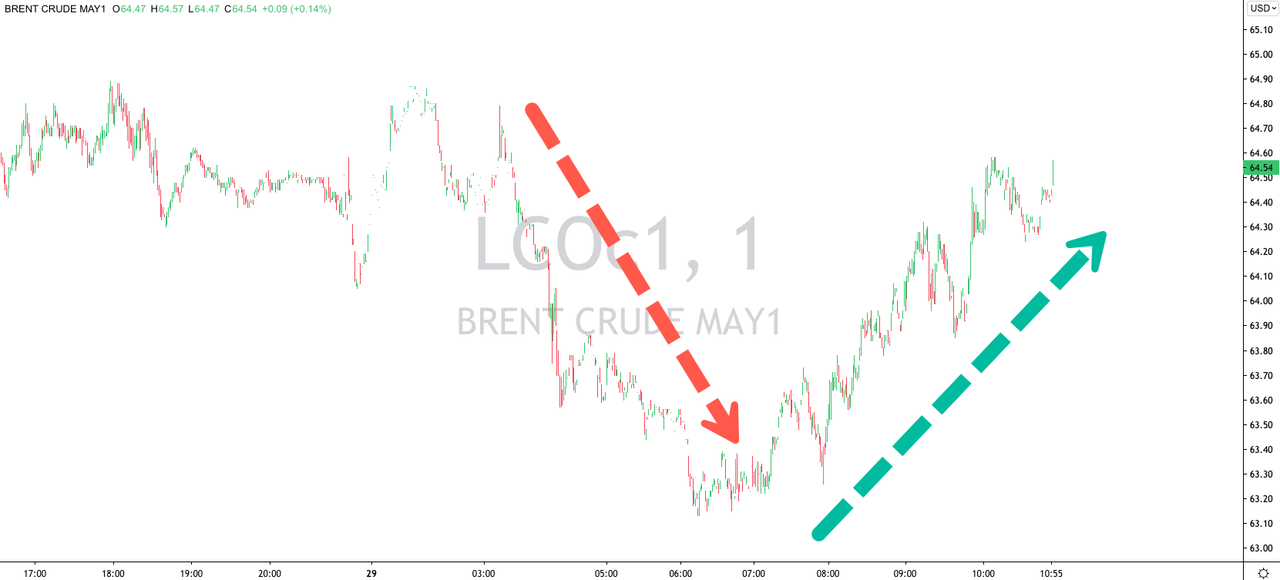
In commodities, WTI and Brent front month futures opened the first session of the week softer, which is in-fitting with Asia’s lead, but have since seen some upside from intra-day lows with Brent now trading flat on the day. Initial pressure came as a result of the Ever-Given container ship being refloated in the Suez Canal. Henceforth, many oil-laden tankers backed up will be free to move, which would see an increase of supply reaching its intended destination and stop the blockage of one of the world’s busiest waterways. Moreover, the anticipated movement of the ship saw an immediate reaction as oil prices moved sharply lower as potential supply fears were curbed. Elsewhere, fundamental drivers remain the same with focus on vaccination progress and lockdown measures. The May WTI contract trades towards the top-end of the USD 60.00/bbl handle (vs low 59.41/bbl) whilst its Brent counterpart trades low USD 64.00/bbl handle (vs low 63.13/bbl). Looking ahead, notable risk events include the JMMC & OPEC+ meetings later in the week, where expectations remain that OPEC+ will maintain lower output levels. Spot gold and silver are both in the red, with more notable losses in the latter alongside USD strength. Spot gold trades around the USD 1,725/oz mark (vs high USD 1,732/oz) and silver sub USD 25/oz (vs high USD 25.08/oz). In base metals, LME copper resides softer in early morning trade after giving back gains seen on Friday. Finally, Chinese steel futures opened the week on a firmer footing, with rebar and hot-rolled coil up more than 3% in the wake of firm domestic industrial & manufacturing activity data.

US Event Calendar

  • 10:30am: March Dallas Fed Manf. Activity, est. 14.5, prior 17.2

Central Banks

  • 11am: Fed’s Waller to Speak at Peterson Institute

DB’s Jim Reid concludes the overnight wrap

As we start the week and the final three days of Q1, investors have been bracing for potential further block trades following a wave of sales on Friday that saw a number of US media companies and Chinese technology firms lose significant ground. Multiple news outlets have cited sources saying that Archegos Capital was behind the trades, with ViacomCBS and Discovery both seeing their largest ever daily declines on Friday, as each fell by more than -27%. The big concern over the weekend was whether more are coming this morning, though overnight in Asia markets seem little impacted by the developments overall, with the Nikkei (+1.13%), Hang Seng (+0.33%), Shanghai Comp (+0.79%) and Kospi (+0.14%) all moving higher. A notable exception to this was Nomura, however, which is the worst performer out of the 225 companies in the Nikkei this morning with a -15.05% decline, after the firm flagged a possible $2 billion loss thanks to transactions with a US client, which Bloomberg reported was tied to the Archegos moves. Nevertheless, US futures are also pointing lower overnight, and those on the S&P 500 are down -0.51% this morning.

The other big developing story overnight is that the Ever Given ship blocking the Suez Canal has been successfully refloated, according to Inchcape Shipping Services, with the ship currently being secured. The news has sent oil prices lower this morning, and WTI (-1.59%) and Brent crude (-1.27%) prices have both fallen in response, even though it isn’t yet apparent how long it’ll take before the container ship can be moved out of the way and the canal cleared for others to pass through. For reference, the ship has been obstructing the route since Tuesday and it’s longer than the Eiffel Tower in length, and a number of container ships have already taken alternative routes and gone round the Cape of Good Hope, even though that adds over a week to the journey time. The big question will now be how long before the Canal is back to normal service, as 12% of global trade goes through this route, and the issue has only added to the existing supply chain disruption thanks to the pandemic.

Looking to the week ahead, the spotlight will remain on the pandemic as investors are becoming increasingly worried at the rising number of cases in multiple regions, which in turn is raising the prospect of further restrictions and limits on economic activity. Europe in particular is facing a potential 3rd wave driven by the new variants, and over the last week we saw the German lockdown extended until April 18 (albeit with a U-turn over the Easter weekend restrictions), more French regions placed under lockdown, and a number of Eastern European countries also moving to toughen up restrictions. The coming days could see further measures announced, with German Chancellor Merkel saying in an interview last night that she could use federal law to take control of the pandemic response from the states. And this isn’t just affecting Europe either, with the Australian city of Brisbane announcing a 3-day lockdown from 5pm local time today due to an outbreak of the UK strain. The newsflow from Europe lately has shown a markedly different situation to the US, which is significantly outpacing the continent in terms of the vaccine rollout, while President Biden last week announced a new goal of 200m vaccine doses in the US within his first 100 days. By the close on Friday the gap between yields on 10yr US Treasuries and German bunds stood at their widest level in more than a year, with a spread of 202bps. More broadly, Covid-19 jitters have been evident elsewhere in financial markets, with oil prices down from their peak at the start of the month in part due to fears of weakening economic demand, whilst the STOXX Travel & Leisure Index in Europe is down by more than 3% since its peak less than 2 weeks ago.

Over in the US, one of the main highlights this week will be on Wednesday, when President Biden is due to deliver a speech unveiling his new infrastructure plan, as part of his “Build Back Better” agenda. We’re obviously yet to get the full details on the exact size and composition of the plan, but multiple outlets have reported that it will be in the $3tn range, with part of the cost offset via tax increases. In terms of what measures to expect, his campaign plans included a lot of emphasis on sustainability and the transition to a greener economy, while the tax measures he outlined included raising the corporate tax rate from 21% to 28%, along with higher income taxes on those earning more than $400,000. After that, the next step will be to turn the proposals into legislation, but as our US economists wrote in the world outlook, such a plan won’t win sufficient support from Republicans, so will need to go through the reconciliation process that allows legislation to pass the Senate with just a simple majority. This is what happened with the $1.9tn American Rescue Plan that Biden signed earlier this month, and they expect it to be passed along party lines in late summer or Q4.

Staying on the US, this Friday will also see the release of the March jobs report, where our economists are expecting a +800k increase in nonfarm payrolls as many states reopen or scale back lockdown measures, and this would be the strongest monthly job growth since August. Furthermore, they’re expecting that the unemployment rate will fall to a post-pandemic low of 6.0%. This would come against the backdrop of some decent labour market data out of the US recently, with the weekly initial jobless claims for the week through March 20 falling to a post-pandemic low of 684k. Nevertheless, even if the +800k growth in nonfarm payrolls were realised, that would still leave the total number of nonfarm payrolls more than 8.6m beneath its pre-Covid-19 pandemic peak, and this shortfall is something that Fed Chair Powell has been emphasising, which just shows the distance there’s still to go before the economic damage from the pandemic is repaired.

Elsewhere, the main data highlight will likely be the release of the manufacturing PMIs from around the world on Thursday. The flash releases we’ve already seen have been incredibly strong, with the numbers for both Germany (66.6) and the Euro Area (62.4) coming in at all-time highs, while the US was also at a decent 59.0. An interesting question will be whether the strength in the price gauges we saw in the flash PMIs will be reflected in other countries too, since that would add further support to the idea that inflationary pressures are building in multiple regions. The other data release of note from Europe will be the March flash inflation prints, with the Euro Area number coming out on Wednesday. Our European economists expect headline HICP to pick up to +1.4% yoy, and core inflation to rise to +1.2%.

To recap last week now, risk assets had reached new highs by Friday as the seemingly relentless rise in global bond yields took a breather following their steep climb. The S&P 500 rose +1.57% on the week, closing at a record high following a +1.66% gain on Friday – which also marked the largest single day move for three weeks. The weekly move was driven by cyclicals as financials, industrials, and energy stocks gained while technology stocks continued to underperform. The NASDAQ fell back -0.58% on the week even with a strong Friday gain (+1.24%), while the highly concentrated megacap NYFANG index lost -4.04% over the course of the week and is now down -0.43% YTD. European stocks somewhat shrugged off worries of further shutdowns as the STOXX 600 gained +0.85% over the five days to reach a post-pandemic high, with the German DAX (+0.88%) outperforming other bourses slightly.

Over in rates, 10yr Treasury yields finished the week -4.9bps lower (+3.9bps Friday) at 1.672% – bringing an end to a run of 7 consecutive weekly moves higher. The move was driven by lower real yields (-10.1bps), which overcame increasing inflation expectations (+5.1bps), which themselves reached new heights. Indeed, 10yr breakevens closed at 2.36% on Friday, their highest level since 2013. The rally in rates was seen across the curve as 30yr yields fell -5.7bps on the week and shorter-dated 5y yields fell back -1.9bps. In Europe, there was a similar move lower over the week, with 10yr bund yields down -5.2bps last week and gilts dropping -8.1bps. The moves in European sovereign debt came as weekly data showed the ECB’s net purchases under their Pandemic Emergency Purchase Programme (PEPP) rose to €21.1bn in the week to March 19, which was the fastest pace since December.

In terms of data from last Friday, the US personal income and spending releases for February showed a pullback after the $600 stimulus check in January and ahead of the anticipated March spike from the current round of checks. Incomes were down -7.1% (-7.2% expected) in February, following a +10.1% rise in January, while spending fell -1.0% (-0.8% expected) after January’s upwardly revised +3.4% increase. The final reading of the University of Michigan’s consumer sentiment index for March rose to a one-year high of 84.9, up from the initial 83.0 reading earlier this month. Under the surface a gauge of expectations rose 9 points to 79.7 – the largest one-month advance since 2009. Meanwhile in Europe, the Ifo business expectations indicator for March from Germany rose to 100.4 (95.0 expected), the highest level in almost three years. Italian consumer confidence for March actually fell back, however, dropping to 100.9 from the prior month’s 101.4 reading. Lastly, UK retail sales excluding fuel for February rose +2.4% mom (+1.7% expected), though down -1.1% yoy.

Tyler Durden
Mon, 03/29/2021 – 07:54

via ZeroHedge News https://ift.tt/3szimdp Tyler Durden

Czech Republic’s Richest Man Dies In Alaskan Helicopter Crash

Czech Republic’s Richest Man Dies In Alaskan Helicopter Crash

Czech billionaire Petr Kellner, the tiny Central European country’s richest man, was among five people killed in a helicopter crash in Alaska’s backcountry over the weekend while he and several other guests at a local ski lodge were on a trip. 

The Airbus AS350 B3 carrying Kellner and the others crashed in unknown circumstances about 50 miles east of Anchorage at roughly 1835ET on Saturday, according to local officials quoted in the Times of London.

Kellner, 56, had a net worth of about $7.5 billion according ot the latest Forbes estimate.

The others who died were Gregory Harms, 52, of Colorado, Benjamin Larochaix, 50, of the Czech Republic, and two Alaskans, Sean McMannany, 38, and the pilot, Zachary Russel, 33, of Anchorage. Another individual who was on board was in serious but stable condition.

The passengers had been flying from the Tordrillo Mountain Lodge (about a 40 minute flight from Anchorage, a spokeswoman for the lodge said) at the time the helicopter crashed.

Kellner and the Coloradoan Larochaix were said to be “loyal and frequent” guests at the lodge, while Harms was a pioneering heli-ski guide in Alaska who had worked at the lodge for years.

The spokeswoman added: “This news is devastating to our staff, the community in which we operate and the families of the deceased.” The lodge says it is the longest operating heli-skiing lodge in Alaska. Packages start at $15,000 per person.

For those who aren’t familiar with it, heli-skiing involves off-trail, downhill skiing or snowboarding reached by helicopter, instead of a ski lift.

Kellner is the latest uber-rich person to perish in a US helicopter accident. The most high-profile figure, of course, is Kobe Bryant, who died in Southern California last January.

Tyler Durden
Mon, 03/29/2021 – 07:39

via ZeroHedge News https://ift.tt/2PHktgo Tyler Durden

Megaship Blocking Suez Canal “80% Partially Refloated” 

Megaship Blocking Suez Canal “80% Partially Refloated” 

The Ever Given container ship, stuck in the southern part of the Suez Canal, has been partially refloated, according to Egypt Today Magazine. Tugboat efforts will continue Monday around high tide to clear the blockage in one of the world’s most important shipping lanes. Ever Given has been paralyzed in the canal for nearly a week as more than 450 ships are queued up, waiting to transit the vital shipping lane while others have rerouted around the Cape of Good Hope

A statement by the Suez Canal Authority (SCA) said the container ship has “responded to the pulling and towing maneuvers.” We reported Sunday at least 14 tugboats and a dredging vessel have worked around the clock for days to move the Ever Given. SCA gave no timeline when the canal would reopen since the vessel is only partially refloated. 

Egypt Today Magazine, using VesselFinder, shows Ever Given’s positioning has changed. The vessel’s bow is positioned more into the channel than ever before. 

The local news agency tweeted a video of the salvage team blaring their foghorns in jubilation after the vessel was partially refloated. 

VesselFinder shows Ever Given’s trajectory has dramatically shifted into the channel.

SCA confirmed on Monday Ever Given changed its course and is “80% refloated after it was partially freed.” 

Egypt Today Magazine notes tugboats have led to the vessel’s partial refloating, and the stern is now 102 meters away from the bank of the canal. There will be additional maneuvers later today once high tide arrives to fully refloat the vessel and position it in the middle of the channel. 

As a result of the positive news, crude prices retreated, with Brent crude futures dipping as much as 1.5%. 

Peter Berdowski, chief executive officer of Boskalis Westminster, the salvage team’s parent company, told Bloomberg with the vessel partially refloated, the stern of the ship is “still very stuck in the mud.” 

“Putting the rear end of the ship afloat was the easy part,” Berdowski said to Dutch NPO Radio. “The challenging part will be the front of the ship. Now, we will start working at the front.”

There are still no timelines when the vessel will be fully refloated. More than 450 ships have been stuck around the canal, waiting to transit the canal. Global supply chains have already been affected as some vessels have rerouted around the Cape of Good Hope. 

Even when Ever Given is refloated – the backlog of vessels, 450 and counting, would mean that it would take at least ten days to resume normal activity in the canal, meaning the Suez crisis is not over. 

Source: Bloomberg 

“It’s one thing to refloat the ship, and it’s another thing to clear the canal of traffic completely,” Hugo De Stoop, CEO of oil-shipping firm Euronav, said to Bloomberg Television. “Whatever has been accumulated so far will take time to clear. Tentative timeline is probably two to three weeks, because the Suez canal was used probably at full capacity.”

With the vessel partially refloated, and once high tide returns, the vessel’s own propulsion system might be used in conjunction with the dozen-plus tugboats. 

The good news is that the worst-case scenario of unloading the vessel might be avoided. As JPMorgan’s Marko Kolanovic told clients last week, any reloading of the vessel risks “ship breaking.” 

Tyler Durden
Mon, 03/29/2021 – 07:11

via ZeroHedge News https://ift.tt/31vdppS Tyler Durden