Key Events This Week: Payrolls, PMIs, Pandemics And Biden’s Latest Stimulus

Key Events This Week: Payrolls, PMIs, Pandemics And Biden’s Latest Stimulus

Looking at the main events this week, the spotlight will as usual remain on the pandemic as investors are becoming increasingly worried at the rising number of cases in multiple regions, which in turn is raising the prospect of further restrictions and limits on economic activity. As DB’s Jim Reid writes, Europe in particular is facing a potential 3rd wave driven by the new variants, and over the last week we saw the German lockdown extended until April 18 (albeit with a U-turn over the Easter weekend restrictions), more French regions placed under lockdown, and a number of Eastern European countries also moving to toughen up restrictions. 

The coming days could see further measures announced, with German Chancellor Merkel saying in an interview last night that she could use federal law to take control of the pandemic response from the states. And this isn’t just affecting Europe either, with the Australian city of Brisbane announcing a 3-day lockdown from 5pm local time today due to an outbreak of the UK strain. The newsflow from Europe lately has shown a markedly different situation to the US, which is significantly outpacing the continent in terms of the vaccine rollout, while President Biden last week announced a new goal of 200m vaccine doses in the US within his first 100 days. 

By the close on Friday the gap between yields on 10yr US Treasuries and German bunds stood at their widest level in more than a year, with a spread of 202bps. More broadly, Covid-19 jitters have been evident elsewhere in financial markets, with oil prices down from their peak at the start of the month in part due to fears of weakening economic demand, whilst the STOXX Travel & Leisure Index in Europe is down by more than 3% since its peak less than 2 weeks ago.

In the US, the main highlight this week will be on Wednesday, when President Biden is due to deliver a speech unveiling his new infrastructure plan, as part of his “Build Back Better” agenda. We’re obviously yet to get the full details on the exact size and composition of the plan, but multiple outlets have reported that it will be in the $3tn range, with part of the cost offset via tax increases. In terms of what measures to expect, his campaign plans included a lot of emphasis on sustainability and the transition to a greener economy, while the tax measures he outlined included raising the corporate tax rate from 21% to 28%, along with higher income taxes on those earning more than $400,000. After that, the next step will be to turn the proposals into legislation, but as our US economists wrote in the world outlook, such a plan won’t win sufficient support from Republicans, so will need to go through the reconciliation process that allows legislation to pass the Senate with just a simple majority. This is what happened with the $1.9tn American Rescue Plan that Biden signed earlier this month, and they expect it to be passed along party lines in late summer or Q4.

Staying on the US, this Friday will also see the release of the March jobs report, where DB’s economists are expecting a blistering +800k increase in nonfarm payrolls as many states reopen or scale back lockdown measures, and this would be the strongest monthly job growth since August (whisper numbers are north of 1 million). Furthermore, the unemployment rate is expected to fall to a post-pandemic low of 6.0%. This would come against the backdrop of some decent labor market data out of the US recently, with the weekly initial jobless claims for the week through March 20 falling to a post-pandemic low of 684k. Nevertheless, even if the +800k growth in nonfarm payrolls were realized, that would still leave the total number of nonfarm payrolls more than 8.6m beneath its pre-Covid-19 pandemic peak, and this shortfall is something that Fed Chair Powell has been emphasizing, which just shows the distance there’s still to go before the economic damage from the pandemic is repaired.

Elsewhere, the main data highlight will likely be the release of the manufacturing PMIs from around the world on. Thursday. The flash releases we’ve already seen have been incredibly strong, with the numbers for both Germany (66.6) and the Euro Area (62.4) coming in at all-time highs, while the US was also at a decent 59.0. An interesting question will be whether the strength in the price gauges we saw in the flash PMIs will be reflected in other countries too, since that would add further support to the idea that inflationary pressures are building in multiple regions. The other data release of note from Europe will be the March flash inflation prints, with the Euro Area number coming out on Wednesday. Our European economists expect headline HICP to pick up to +1.4% yoy, and core inflation to rise to +1.2%.

Courtesy of Deutsche Bank, here is a day by day week ahead calendar

Monday March 29

  • Data: UK February mortgage approvals, M4 money supply, consumer credit, US March Dallas Fed manufacturing activity
  • Central Banks: Fed’s Waller speaks

Tuesday March 30

  • Data: Japan February jobless rate, retail sales, France March consumer confidence, Euro Area final March consumer confidence, Germany preliminary March CPI, US January FHFA house price index, March Conference Board consumer confidence
  • Central Banks: Fed’s Quarles and Williams speak

Wednesday March 31

  • Data: Japan preliminary February industrial production, February housing starts, China March non-manufacturing PMI, manufacturing PMI, composite PMI, UK final Q4 GDP, France and Italy preliminary March CPI, Euro Area March CPI estimate, Germany March unemployment, US March ADP employment change, MNI Chicago PMI, February pending home sales, Canada January GDP, Australia final March manufacturing PMI (23:00 UK time)
  • Central Banks: ECB’s Villeroy speaks
  • Politics: US President Biden to outline infrastructure plan

Thursday April 1

  • Data: March manufacturing PMIs from South Korea, Indonesia, Japan, China, Russia, Turkey, Italy, France, Germany, Euro Area, UK, South Africa, Brazil, Canada and US, Japan March vehicle sales, US weekly initial jobless claims, February construction spending, US March ISM manufacturing
  • Central Banks: Fed’s Harker speaks

Friday April 2

  • Data: Japan March monetary base, US March change in nonfarm payrolls, unemployment rate, average hourly earnings
  • Other: Financial markets closed in multiple countries for Good Friday


Finally, looking at just the US, Goldman writes that the key economic data releases this week are the ISM manufacturing and jobless claims reports on Thursday, and the March employment report on Friday. There are numerous speaking engagements from Fed officials this week.

Monday, March 29

  • 10:30 AM Dallas Fed manufacturing index, March (consensus 14.5, last 17.2)
  • 11:00 AM Fed Governor Waller (FOMC voter) speaks: Fed Governor Christopher Waller will take part in a virtual discussion on Fed independence hosted by the Peterson Institute for International Economics. Text and moderated Q&A are expected.

Tuesday, March 30

  • 09:00 AM FHFA house price index, January (consensus +1.2%, last +1.1%)
  • 09:00 AM S&P/Case-Shiller 20-city home price index, January (GS +1.3%, consensus +1.2%, last +1.25%): We estimate the S&P/Case-Shiller 20-city home price index rose by 1.3% in January, following a 1.25% increase in December.
  • 09:00 AM Fed Vice Chair Quarles (FOMC voter) speaks: Fed Vice Chair for Supervision Randal Quarles will take part in a virtual discussion on the Financial Stability Board hosted by the Peterson Institute for International Economics. Text and moderated Q&A are expected.
  • 10:00 AM Conference Board consumer confidence, March (GS 97.5, consensus 96.8, last 91.3): We estimate that the Conference Board consumer confidence index increased by 6.2pt to 97.5 in March. Our forecast reflects stronger signals from other consumer confidence measures.
  • 02:30 PM New York Fed President Williams (FOMC voter) speaks: New York Fed President John Williams will participate in a moderated discussion on “The Role Small Business Plays in Building Financial Resilience for the 50+.”

Wednesday, March 31

  • 08:15 AM ADP employment report, March (GS +575k, consensus +550k, last +117k):  We expect a 575k rise in March ADP payroll employment, reflecting strong underlying job growth and a boost from lower initial jobless claims. That said, we note the possibility that ADP underperforms the BLS payroll measure this month, because workers returning to their previous employers may not be fully captured by the ADP panel methodology.
  • 09:45 AM Chicago PMI, March (GS 61.0, consensus 60.0, last 59.5): We estimate that the Chicago PMI increased by 1.5pt to 61.0 in March, reflecting improvement in other manufacturing surveys and a continued boost from the supplier deliveries component.
  • 10:00 AM Pending home sales, February (GS -5.0%, consensus -2.9%, last -2.8%): We estimate that pending home sales declined by 5.0% in February.

Thursday, April 1

  • 08:30 AM Initial jobless claims, week ended March 27 (GS 690k, consensus 680k, last 684k); Continuing jobless claims, week ended March 20 (consensus 3,775k, last 3,870k): We estimate initial jobless claims increased to 690k in the week ended March 27.
  • 09:45 AM Markit manufacturing PMI, March final (consensus 59.0, last 59.0)
  • 10:00 AM Construction spending, February (GS -0.5%, consensus -1.0%, last +1.7%): We estimate a 0.5% decrease in construction spending in February following several months of solid gains, largely reflecting weakness in residential construction spending as a result of February’s winter storms.
  • 10:00 AM ISM manufacturing index, March (GS 62.0, consensus 61.4, last 60.8): We expect the ISM manufacturing index to rise by 1.2pt to 62.0 in the March report, reflecting strength in the regional manufacturing surveys and a continued boost from the supplier deliveries component. Our manufacturing survey tracker rose by 2.6pt to 61.4.
  • 01:00 PM Philadelphia Fed President Harker (FOMC non-voter) speaks: Philadelphia Fed President Patrick Harker will speak at a virtual Fintech symposium. Text and Q&A are expected.
  • 5:00 PM Wards Total Vehicle Sales, March (GS 16.5m, consensus 16.4m, last 15.67m)

Friday, April 2

  • 08:30 AM Nonfarm payroll employment, March (GS +775k, consensus +643k, last +379k); Private payroll employment, March (GS +750k, consensus +635k, last +465k); Average hourly earnings (mom), March (GS +0.1%, consensus +0.1%, last +0.2%); Average hourly earnings (yoy), March (GS +4.5%, consensus +4.5%, last +5.3%); Unemployment rate, March (GS 5.9%, consensus 6.0%, last 6.2%): We estimate nonfarm payrolls rose 775k in March. Falling infection rates and a net easing of business restrictions likely supported job growth in virus-sensitive industries—particularly leisure and hospitality—and Big Data signals generally indicate strong employment gains. A favorable swing in the weather is also likely to support payroll growth in the construction sector and other weather-sensitive industries (following weakness in February). We estimate a three-tenth decline in the unemployment rate to 5.9%, reflecting a strong expected gain in household employment. That being said, we believe a vaccine- and reopening-related rebound in labor force participation is more likely than not, and this could limit any decline in the jobless rate. We estimate a 0.1% increase in average hourly earnings (mom sa) due to negative calendar effects and negative composition effects.
  • 12:00 PM Atlanta Fed President Bostic (FOMC voter) speaks: Atlanta Fed President Raphael Bostic will take part in a NBER panel discussion on inequality and discrimination and the financial system.

Source: DB, Goldman, BofA

Tyler Durden
Mon, 03/29/2021 – 09:37

via ZeroHedge News https://ift.tt/39lbN6w Tyler Durden
Biden’s Stimulus Will Cut Poverty By 40%… For One Year

Biden’s Stimulus Will Cut Poverty By 40%… For One Year

Authored by Lance Roberts via RealInvestmentAdvice.com,

President Biden’s stimulus bill “will cut the number of children in poverty by 40%,” according to the Center on Budget and Policy Priorities.

“The current Child Tax Credit and EITC together lift more children above the poverty line, 5.5 million, than any other economic support program. This level of poverty reduction was achieved through multiple expansions of the EITC and Child Tax Credit since their respective enactments in 1975 and 1997. The House’s proposal — with one significant change to the Child Tax Credit — would lift another 4.1 million children above the poverty line, cutting the remaining number of children in poverty by more than 40 percent.” – CBPP

The NY Times also jumped on Biden’s stimulus package to tout how “transformative” Biden will be to the U.S. economy. To wit:

“The list of new policies goes on. There is money in the American Rescue Plan to expand food stamps, bolster state welfare programs, and increase federal support for child and dependent care. Put all this together and the bill is expected to reduce overall poverty by more than a third and child poverty by more than half. It is, with no exaggeration, the single most important piece of anti-poverty legislation since Lyndon B. Johnson’s Great Society, itself the signature program of a man who sought to emulate F.D.R.”

Here’s the problem. Unlike the New Deal, which benefitted the economy for decades, the American Rescue Plan will only help the poor for one year. As is always the case with such socialistic policies, they sound great in theory, but they rarely work as expected in reality.

The Poor Do Need Help

“More money in people’s pockets will lead to stronger economic growth.” – J.M. Keynes

I certainly agree with trying to help those in need. Such is why we have charitable organizations that do everything from providing housing, meals, and even job placement. These charities do formidable, challenging, and meaningful work and should have access to funding to do what they do best.

However, the Federal Government is not one of these charities, and throwing money at the problem does more harm than good in the long-term.

Let me explain.

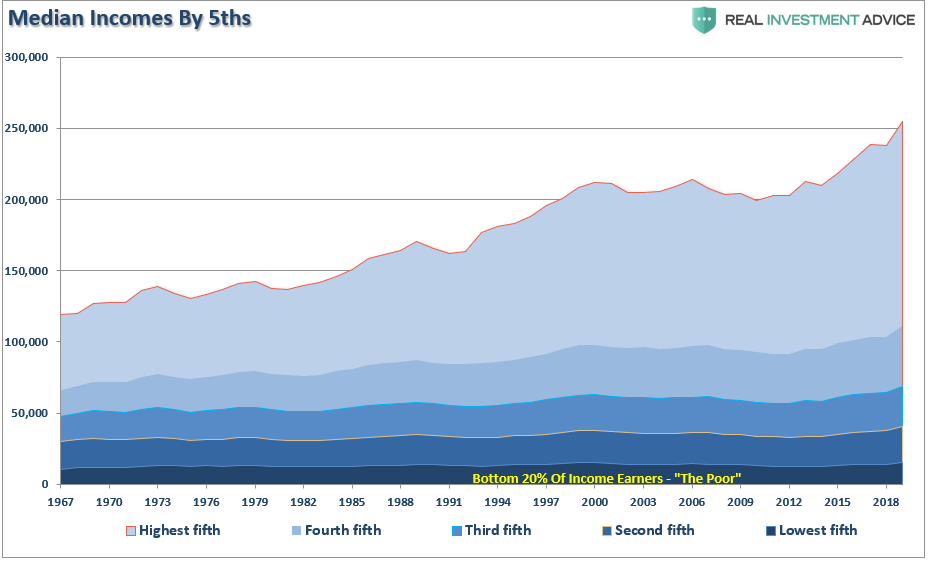
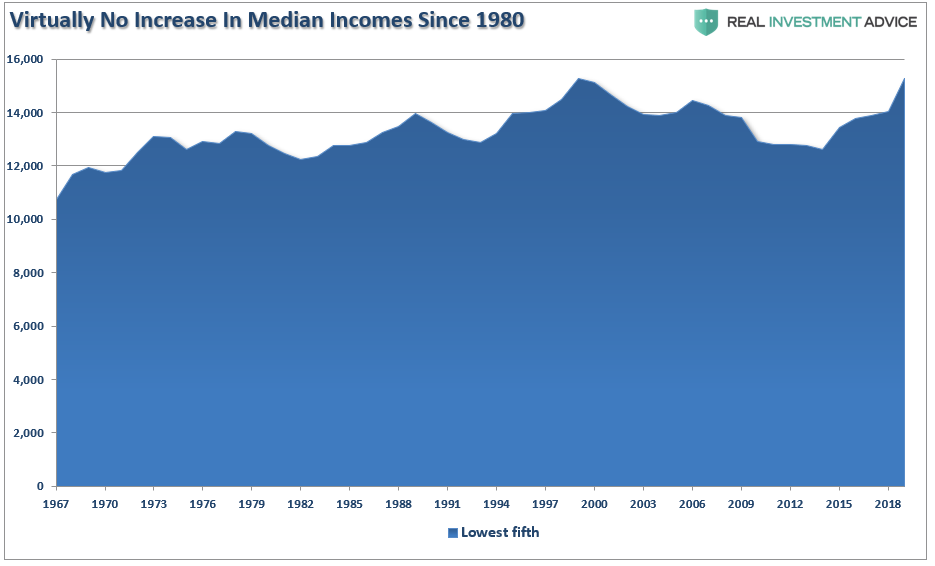
Using data from the Census Bureau, we can look at the bottom 20% of the population’s historical incomes since 1967. As shown, there has virtually been no substantive increase in median incomes for that income group since 1980.

The problem is more apparent when viewed against the other income quintiles.

The problem of “government handouts” should be readily apparent. Since the 1960’s the U.S. has expanded access to social security, welfare, food stamps, tax credits, and a litany of other programs directly targeted to help the most deficient 20% of Americans.

Nothing has changed. Even if the current one-year subsidies are made permanent, they will fail to change the economics of poverty after one-year.

A Temporary Solution

Given the massive support given to the poor over the last 60-years, it should be readily apparent that something is flawed in the thinking. To explain the issue, let’s use another “socialistic policy” being floated by more liberal thinkers – a “universal basic income” or “UBI.”

The idea is that if the Government supplies a basic “living income” to the poor, they will be better off as they won’t have to worry about meeting their “basic needs.” While noble in its intent, economically, it doesn’t change outcomes over the longer term.

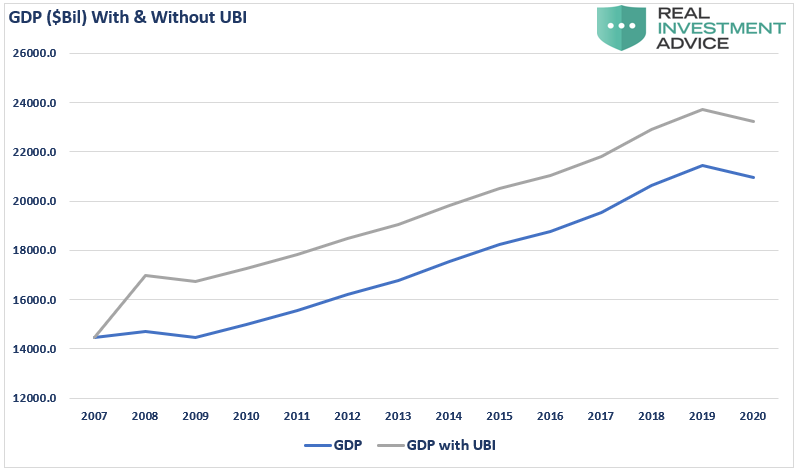
Let’s run a hypothetical example using GDP from 2007 to the present. In 2008, in response to the “Financial Crisis,” Congress passes a bill, in theory, that provides $1000/month ($12,000 annually) to 190 million families in the U.S. 

The chart below shows the economy’s annual GDP growth trend assuming the entire UBI program shows up in economic growth. For those supporting programs like UBI, it certainly appears as if GDP elevates permanently to a higher level. 

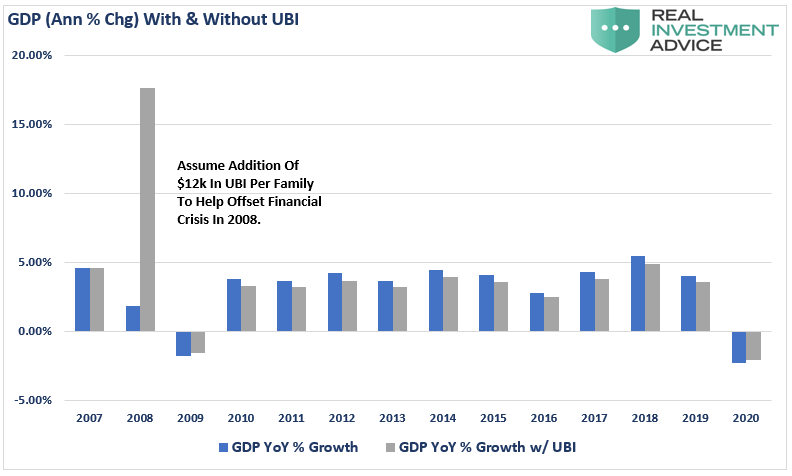
When you look at the annual rate of change in economic growth, which is how we measure GDP for economic purposes, a different picture emerges. In 2008, when the $12,000 arrives at households, GDP spikes, printing a 17% growth rate versus the actual 1.81% rate.

However, beginning in 2009, the benefit disappears. The reason is that after UBI enters the system, the economy normalizes to a “new level” after the first year. Also, notice that GDP grows at a slightly slower rate as dollar changes to GDP at higher levels print a lower growth rate.

UBI’s Dark Side

Of course, the money to provide the $12,000 UBI benefit had to come from somewhere.

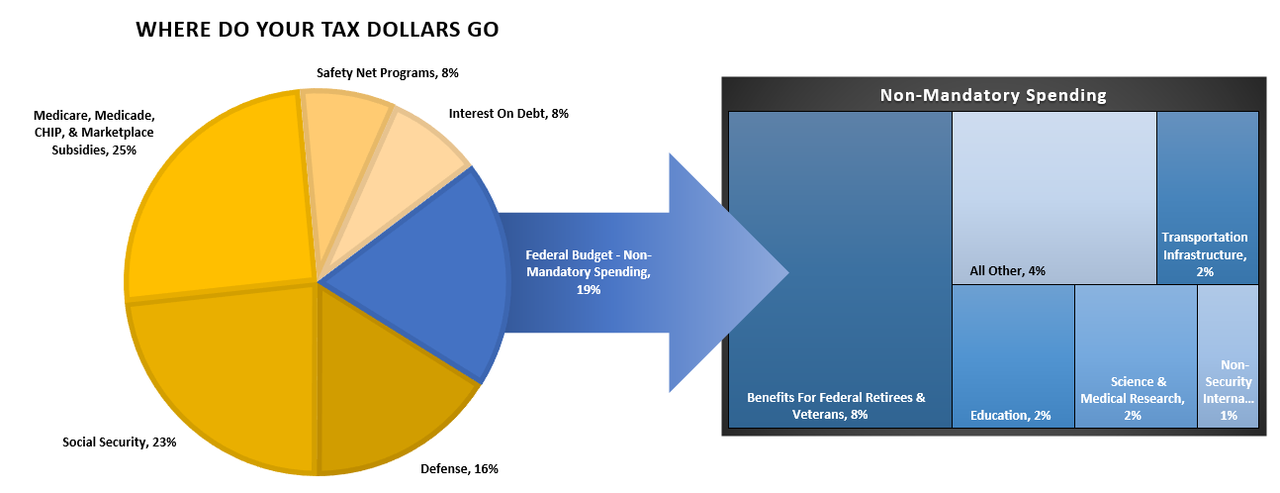
According to the Center On Budget & Policy Priorities, in 2020, roughly 75% of every tax dollar went to non-productive spending. 

“In the fiscal year 2019, the Federal Government spent $4.4 trillion, amounting to 21 percent of the nation’s gross domestic product (GDP). Of that $4.4 trillion, federal revenues financed only $3.5 trillion. The remaining $984 billion came from debt issuance. As the chart below shows, three major areas of spending make up most of the budget.”

Think about that for a minute. In 2019, 75% of all expenditures went to social welfare and interest on the debt. Those payments required $3.3 Trillion of the $3.5 Trillion (or 95%) of the total revenue collected.

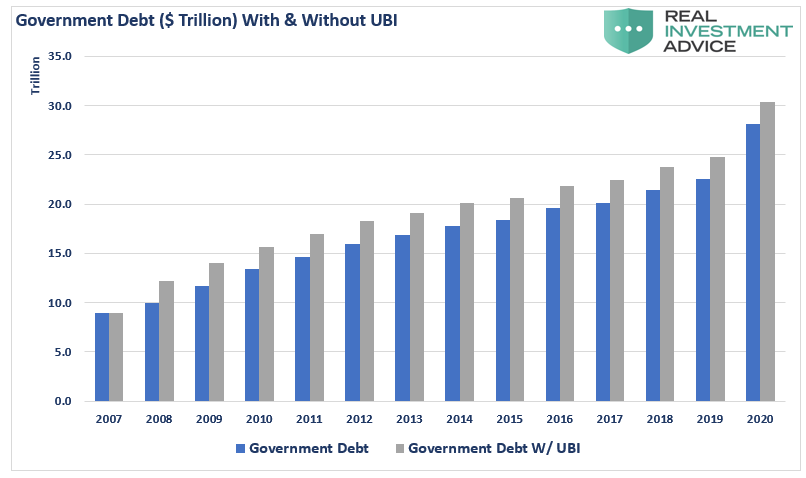
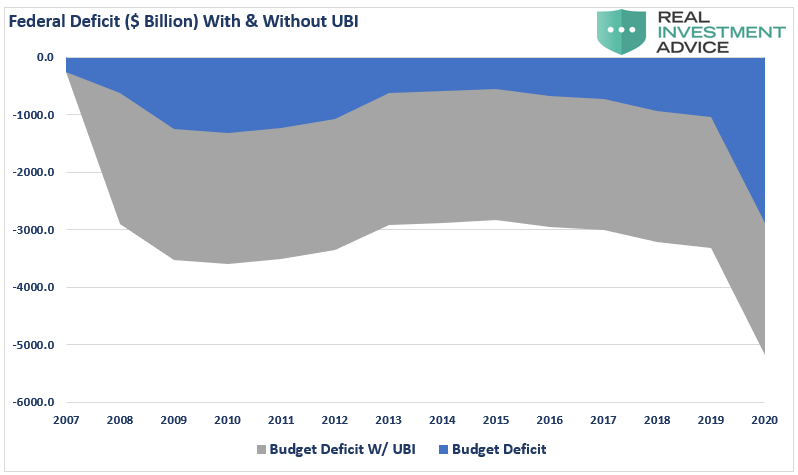
Given the decline in economic activity during 2020, those numbers become markedly worse. For the first time in U.S. history, the Federal Government will have to issue debt to cover the mandatory spending. If we add a UBI payment, the deficit spending becomes markedly worse.

The chart below shows the impact of the additional debt on the Federal deficit.

While the “theoretical models” assume that UBI will create enough economic growth and prosperity to “offset” the increase in debt, 40-years of history suggest otherwise.

The Poor Will Remain Poor

Social programs don’t increase prosperity over time. Yes, sending checks to households will increase economic prosperity and cut poverty for 12-months. However, next year, when the checks end, the poverty levels will return to normal, and worse, due to increased inflation.

In a rush to help those in need, economic basics are nearly always forgotten. If I increase incomes by $1000/month, prices of goods and services will adjust to the increased demand. As noted above, the economy will quickly absorb the increased incomes returning the poor to the previous position.

The annual increases in the cost of living impact those in the bottom 20% and those in the bottom 60% of income earners. As I discussed in “The Feedback Loop:”

“‘The ability to ‘maintain a certain standard of living’ remains problematic for many forcing them further into debt.’ – WSJ”

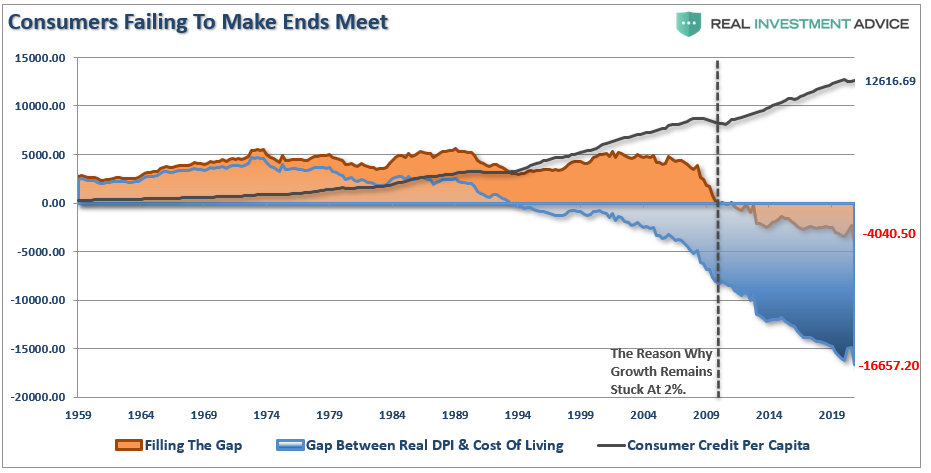
I often show the “gap” between the “standard of living” and real disposable incomes. In 1990, incomes alone were no longer able to meet the standard of living. Therefore, consumers turned to debt to fill the “gap.” 

However, following the “financial crisis,” even the combined income and debt levels no longer filled the gap. Currently, there is almost a $4050 annual deficit facing the average American.

The problem with an economy built on “debt” is exceptionally problematic for the poor as they generally can’t obtain credit. Such cuts off a much-needed source of spending power in the economy.

“‘Consumers increasingly need it [debt].Companies increasingly can’t sell their goods without it. And the economy, which counts on consumer spending for more than two-thirds of GDP, would struggle without a plentiful supply of credit.’ – WSJ”

In the end, once the stimulus fades and the economy adjusts for inflation, Biden’s small moment of reduced poverty rates will revert with a vengeance.

Not A “New New Deal”

While the media is quick to fawn on Biden’s stimulus plan, claiming it to be the 2nd coming of FDR, it isn’t.

FDR’s “New Deal” did have many “social programs” embedded in it, including the beginning of the social welfare safety net. However, FDR backed those social programs with massive works projects from the Hoover Dam’s building to the Tennesse River Valley Authority. Not only did the spending on these projects create jobs, but they were also productive investments repaying the debt used to fund them.

More importantly, the focus of many of the programs was the creation of “jobs.” From the Works Progress Administration to the National Labor Relations Act, Roosevelt believed the best solution to help those in need was to get them back to work.

Furthermore, FDR focused on cleaning up the predatory nature of the financial system on Americans. The 1933 Banking Act, which reformed the banking system by separating banking and brokerage activities. He also established regulatory oversight on the banking system with the Securities Act of 1933.

While providing short-term relief, Biden’s plan does nothing to solve the long-term problems of those living at poverty levels. They need both incentives to “go to work” and access to training and education to obtain gainful employment.

Such is what FDR understood. As with all Government programs, some programs worked while others didn’t. Today, there is still debate about whether FDR’s programs cured or exacerbated the “Great Depression.”

However, what history does define well is that debt-funded programs to provide social assistance to the poor have failed.

Next year, when the money is all spent, we will find poverty levels surged, economic growth weakened, and deficits exploded.

Such is the outcome of all socialistic programs in history.

Tyler Durden
Mon, 03/29/2021 – 09:30

via ZeroHedge News https://ift.tt/31r1hq7 Tyler Durden

DoorDash Customer Fees Go Up Thanks To Dumb Regulations


zumaamericastwentynine946555

DoorDash regulators get a crash course in economics. Across the U.S., authorities are getting a lesson in how government price controls don’t work. When city and state regulators artificially cap prices for an in-demand product or service, providers of that product or service will simply recoup costs elsewhere.

The lesson comes courtesy of DoorDash, a food delivery app that soared in popularity among restaurants and consumers during the COVID-19 pandemic.

DoorDash drivers pick up carryout orders from restaurants and take them to consumers; in addition, the DoorDash app serves as a centralized place for consumers to search for restaurants, read their menus, and order food. For this service, DoorDash and similar apps (like Uber Eats) typically charge a commission to restaurants as well as fees to those getting delivery.

Pandemic-slammed restaurants—which tended to operate on very thin margins pre-COVID—frequently complain about the commissions DoorDash and its ilk take. But DoorDash needs to make money, too. And while restaurant owners might like for DoorDash to cut into their profits less, the fact that so many continue to use the service suggests it’s still a better deal for them than hiring their own delivery drivers or not doing delivery at all.

But in many places, authorities—always keen to pick winners and losers in the business sphere—answered restaurant owner complaints by capping allowable DoorDash commissions. Since the start of the pandemic, at least 68 cities, counties, and states have enacted food delivery commission limits and other locales are considering them, NBC News found.

Authorities seem to believe that delivery services can and will simply accept making less money so that restaurants can make more. DoorDash is showing them that this isn’t the case:

To recoup what it considers lost revenue, DoorDash has tacked on another flat surcharge of $1 to $2.50, which it often calls a “Regulatory Response Fee.” The money goes straight to DoorDash. Only when customers click a tiny button does an explanation pop up saying the city has “temporarily capped the fees that we may charge local restaurants.”

NBC News found that DoorDash added supplemental local fees in 57 of the 68 locations that have fee caps.

So, the lost revenue is now being recouped from delivery food consumers—which means higher prices for those who order food. Consumers, in turn, may make up for this by ordering delivery food less often or making smaller or less pricey orders when they do.

NBC News cites restaurant complaints about the new DoorDash fees added to customer food orders and how they make ordering delivery unattractive to consumers. But what did they expect? DoorDash is a business in its own right, not a magical lifeline to help restaurants make more money. (And it’s not exactly swimming in dough either: “In the second quarter of 2020, DoorDash made its first profit ever, just $32 million,” NBC News reports, and “the company remains billions of dollars in debt,” having “lost a combined $355 million in the third and fourth quarters of 2020.”)

Lawmakers also seem somehow baffled by the fact that DoorDash won’t just altruistically go into more debt to help restaurants make more money:

The newer surcharges have befuddled the legislators who thought they had finally made progress to limit the cost of takeout food in the pandemic. Dan Kalb, the City Council member who wrote Oakland’s fee cap bill, was unaware that DoorDash had instituted a $2 “Oakland Fee” until NBC News brought it to his attention.

“I was not anticipating that there would be this extra fee. But I’m not sure that I can stop them from doing that,” said Kalb, who represents the northern part of the city. “It is concerning that the fee might be misinterpreted that the city of Oakland is charging something.”

But while it might not be a fee directly imposed by Oakland, it is the city’s fault.

If Oakland and other areas want to lower prices for delivery food consumers, maybe they could start by suspending taxes on food delivery orders. But I suspect we won’t see city, county, and state regulators rush to cut into their own revenue sources the way they do with other people’s money.


FREE MINDS

Boise mask burners won’t face charges:


FREE MARKETS

New York lawmakers have reached a deal to legalize recreational marijuana. The good news (from the Associated Press):

The legislation would allow recreational marijuana sales to adults over the age of 21, and set up a licensing process for the delivery of cannabis products to customers. Individual New Yorkers could grow up to three mature and three immature plants for personal consumption, and local governments could opt out of retail sales.

The legislation would take effect immediately if passed, though sales wouldn’t start immediately as New York sets up rules and a proposed cannabis board. Assembly Majority Leader Crystal Peoples-Stokes estimated Friday it could take 18 months to two years for sales to start.

The bad news:


QUICK HITS

• Dozens of U.S. cities could be poised for a housing crisis.

• What is Delta-8 THC and why are authorities freaking out about it?

from Latest – Reason.com https://ift.tt/3swIt4w
via IFTTT

DoorDash Customer Fees Go Up Thanks To Dumb Regulations


zumaamericastwentynine946555

DoorDash regulators get a crash course in economics. Across the U.S., authorities are getting a lesson in how government price controls don’t work. When city and state regulators artificially cap prices for an in-demand product or service, providers of that product or service will simply recoup costs elsewhere.

The lesson comes courtesy of DoorDash, a food delivery app that soared in popularity among restaurants and consumers during the COVID-19 pandemic.

DoorDash drivers pick up carryout orders from restaurants and take them to consumers; in addition, the DoorDash app serves as a centralized place for consumers to search for restaurants, read their menus, and order food. For this service, DoorDash and similar apps (like Uber Eats) typically charge a commission to restaurants as well as fees to those getting delivery.

Pandemic-slammed restaurants—which tended to operate on very thin margins pre-COVID—frequently complain about the commissions DoorDash and its ilk take. But DoorDash needs to make money, too. And while restaurant owners might like for DoorDash to cut into their profits less, the fact that so many continue to use the service suggests it’s still a better deal for them than hiring their own delivery drivers or not doing delivery at all.

But in many places, authorities—always keen to pick winners and losers in the business sphere—answered restaurant owner complaints by capping allowable DoorDash commissions. Since the start of the pandemic, at least 68 cities, counties, and states have enacted food delivery commission limits and other locales are considering them, NBC News found.

Authorities seem to believe that delivery services can and will simply accept making less money so that restaurants can make more. DoorDash is showing them that this isn’t the case:

To recoup what it considers lost revenue, DoorDash has tacked on another flat surcharge of $1 to $2.50, which it often calls a “Regulatory Response Fee.” The money goes straight to DoorDash. Only when customers click a tiny button does an explanation pop up saying the city has “temporarily capped the fees that we may charge local restaurants.”

NBC News found that DoorDash added supplemental local fees in 57 of the 68 locations that have fee caps.

So, the lost revenue is now being recouped from delivery food consumers—which means higher prices for those who order food. Consumers, in turn, may make up for this by ordering delivery food less often or making smaller or less pricey orders when they do.

NBC News cites restaurant complaints about the new DoorDash fees added to customer food orders and how they make ordering delivery unattractive to consumers. But what did they expect? DoorDash is a business in its own right, not a magical lifeline to help restaurants make more money. (And it’s not exactly swimming in dough either: “In the second quarter of 2020, DoorDash made its first profit ever, just $32 million,” NBC News reports, and “the company remains billions of dollars in debt,” having “lost a combined $355 million in the third and fourth quarters of 2020.”)

Lawmakers also seem somehow baffled by the fact that DoorDash won’t just altruistically go into more debt to help restaurants make more money:

The newer surcharges have befuddled the legislators who thought they had finally made progress to limit the cost of takeout food in the pandemic. Dan Kalb, the City Council member who wrote Oakland’s fee cap bill, was unaware that DoorDash had instituted a $2 “Oakland Fee” until NBC News brought it to his attention.

“I was not anticipating that there would be this extra fee. But I’m not sure that I can stop them from doing that,” said Kalb, who represents the northern part of the city. “It is concerning that the fee might be misinterpreted that the city of Oakland is charging something.”

But while it might not be a fee directly imposed by Oakland, it is the city’s fault.

If Oakland and other areas want to lower prices for delivery food consumers, maybe they could start by suspending taxes on food delivery orders. But I suspect we won’t see city, county, and state regulators rush to cut into their own revenue sources the way they do with other people’s money.


FREE MINDS

Boise mask burners won’t face charges:


FREE MARKETS

New York lawmakers have reached a deal to legalize recreational marijuana. The good news (from the Associated Press):

The legislation would allow recreational marijuana sales to adults over the age of 21, and set up a licensing process for the delivery of cannabis products to customers. Individual New Yorkers could grow up to three mature and three immature plants for personal consumption, and local governments could opt out of retail sales.

The legislation would take effect immediately if passed, though sales wouldn’t start immediately as New York sets up rules and a proposed cannabis board. Assembly Majority Leader Crystal Peoples-Stokes estimated Friday it could take 18 months to two years for sales to start.

The bad news:


QUICK HITS

• Dozens of U.S. cities could be poised for a housing crisis.

• What is Delta-8 THC and why are authorities freaking out about it?

from Latest – Reason.com https://ift.tt/3swIt4w
via IFTTT

Traders Are Bracing For Another Hectic Session

Traders Are Bracing For Another Hectic Session

By Michael Msika, market commentator and analyst for Bloomberg Markets

Just when Europe’s equity benchmark was about to hit a record high, clouds are forming over the stock market again, with a wave of U.S. block trades rattling investors worldwide. But at least one alluring factor remains intact: the region’s stocks are still cheap, especially in a world of rising bond yields.

Traders were bracing for a hectic morning after Credit Suisse Group AG joined Nomura in warning about potential significant losses related to an unnamed U.S. hedge fund client defaulting on margin calls. Meanwhile, Morgan Stanley was shopping a large block of ViacomCBS Inc. shares, according to people familiar with the matter, a sign that the unwinding may not be over.

Shares in Nomura tumbled 16%, most on record, while Credit Suisse shares were indicated down 7% ahead of the open. Still, Euro Stoxx 50 futures were edging higher while U.S. index futures slipped.

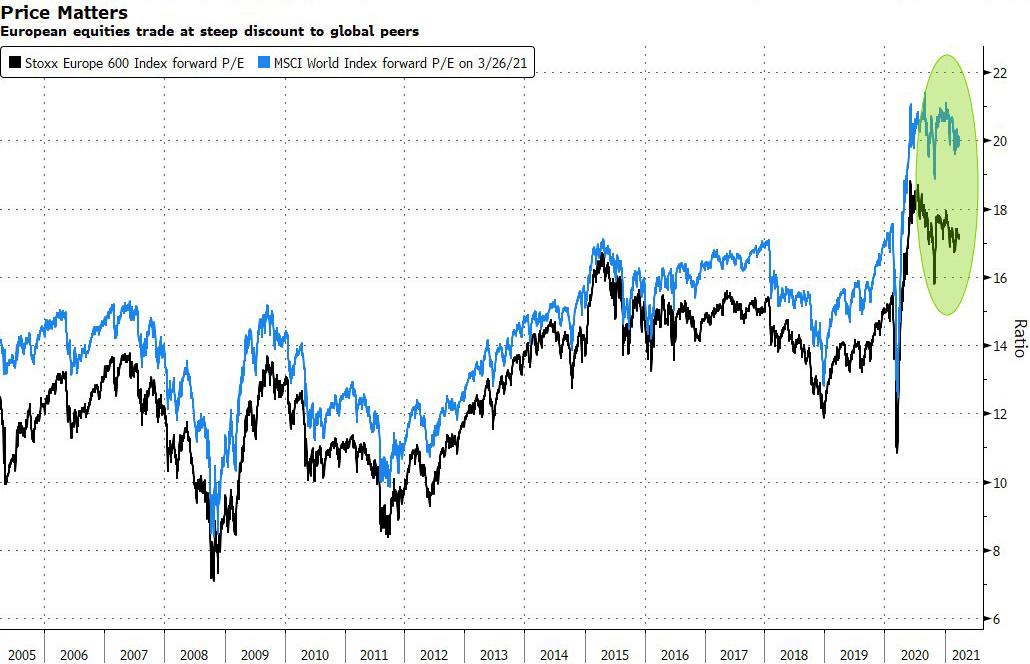
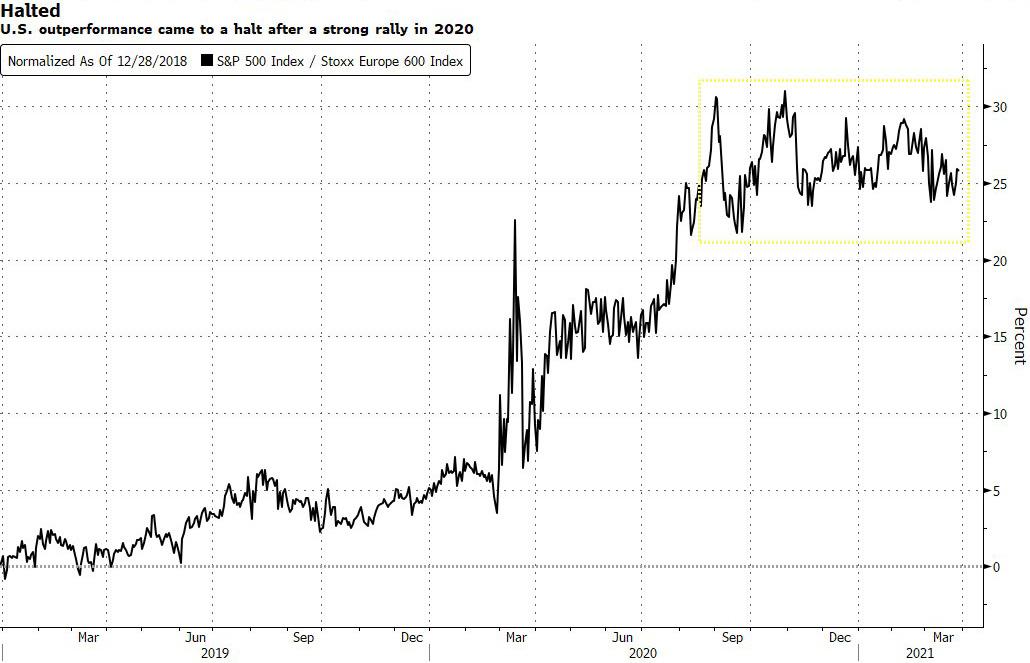
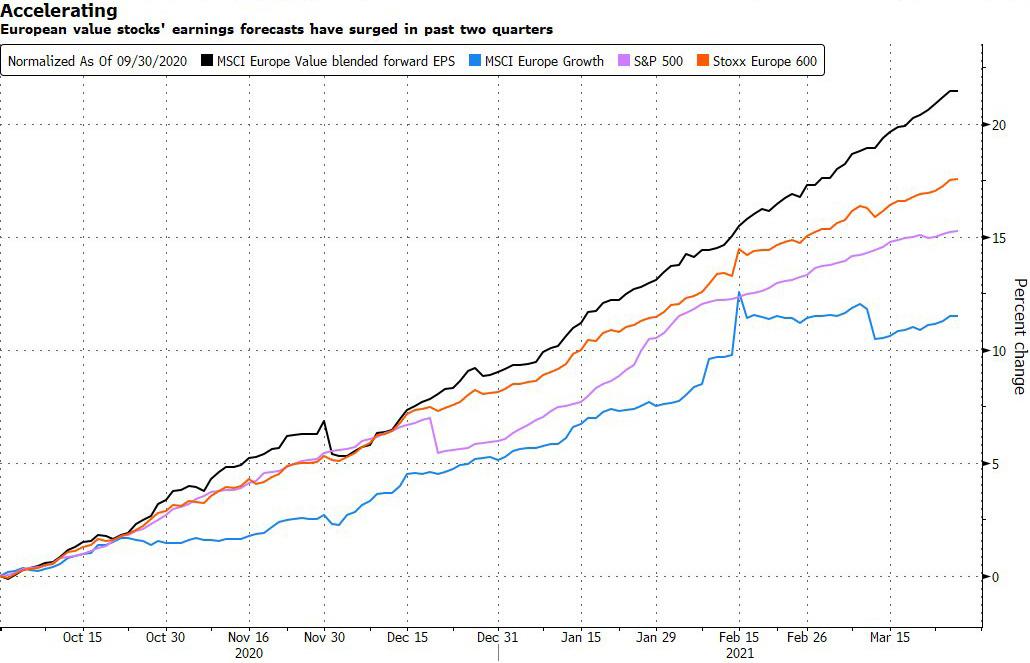
Despite the Stoxx 600’s strong outperformance since the end of October, the benchmark has been getting cheaper. The gauge’s forward P/E has dropped since a record high last June, as a surge in earnings forecasts has outpaced the stock gains. That’s kept valuations lower than global peers.

Europe’s stock rally has wobbled in recent weeks, with the Stoxx 600 struggling to recapture a record high that’s tantalizingly close as rising virus cases and vaccine hurdles cast doubts about reopenings. Still, a sharp improvement in vaccine supply in the next two quarters should be enough to inoculate the bloc’s population, which should accelerate economic momentum, according to Bank of America.

“Equity returns should slow, but Europe can outperform as relative macro data improves,” say Morgan Stanley strategists including Graham Secker, who see the continent’s relative economic momentum improving in the next three to six months. Europe is likely to be the only region with stronger GDP growth in 2022 than 2021, and should remain a relative beneficiary of higher bond yields, they say.

While the “easy money has been made” on European stocks after a 33% rally over the past year, there’s still double-digit upside left to banks, insurance, energy, Italian and U.K. equities, says Secker, part of a chorus of bullish call on value.

Such shares are not only lagging cyclicals, signaling more room for a rally, but are positively correlated to bond yields and inflation expectations. European stocks, with a heavy exposure to the cheap stocks, in fact trade at similar P/E levels to U.S. value shares.

“This alignment of positive top down macro conditions and bottom up fundamental views is a powerful narrative for value and for further upside from here, despite the already large rotation we have already seen,” says Bernstein strategist Sarah McCarthy, who is overweight on value shares. While European profit forecasts have risen faster than the U.S. in the past two quarters, McCarthy sees more upgrades in store for sectors such as banks, energy and autos.

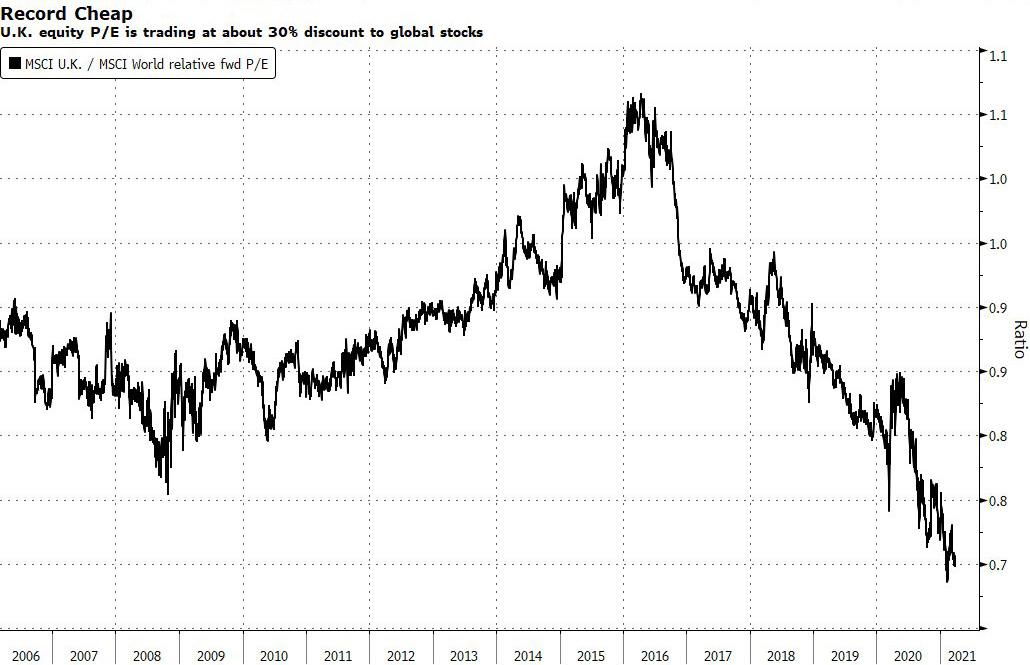
If valuation is the key attraction, U.K. equities too are due a catch up. Despite the lifting of the Brexit overhang and faster vaccine rollouts, they remain one of the cheapest developed markets. The MSCI U.K. gauge hit an all-time low against global peers last month and trades near a 30% discount, the most in at least 15 years.

Not everyone is optimistic though, and the row over vaccines and fresh virus-led restrictions this month show where things could go wrong with the long-awaited economic rebound. Looking beyond the immediate recovery, the prospect of higher taxes also dims the appeal of the value trade, according to Lewis Grant, senior global equities portfolio manager at Federated Hermes.

“The U.S. economic stimulus promised a lot for value, yet the optimism gave way to concerns about increased U.S. corporate tax rates that typically have a greater impact on value than growth stocks,” says Grant. The U.K. government was the first major country to announce a corporate tax hike from 2023, while the U.S. is also weighing higher levies.


Tyler Durden
Mon, 03/29/2021 – 09:09

via ZeroHedge News https://ift.tt/3rBxHZw Tyler Durden

Get Ready to Show Your Vaccine Passport Everywhere


Originally touted as an innovative means of reducing the reach and duration of pandemic restrictions, health passports have moved beyond speculation to reality with the recent debut of several versions of such credentials. But after a year of lockdowns, travel restrictions, and surveillance justified on public health grounds, it’s likely that, rather than live up their liberating promise, health passports will become just another bureaucratic hurdle for people trying to go about their lives. For better or worse, though, the new credentials look destined to be part of the post-COVID-19 world.

“The Biden administration and private companies are working to develop a standard way of handling credentials — often referred to as ‘vaccine passports’ — that would allow Americans to prove they have been vaccinated against the novel coronavirus as businesses try to reopen,” The Washington Post reported over the weekend.

The federal government is something of a johnny-come-lately to a phenomenon already in motion.

“IATA Travel Pass is a mobile application that helps travelers to store and manage their verified certifications for COVID-19 tests or COVID-19 vaccines,” according to the International Air Transport Association. “By the middle of March 2021, a total of 17 airlines had signed up to trial IATA Travel Pass. Singapore Airlines was the first airline to launch a full pilot on March 15 on the Singapore-London route, followed by Qatar Airways on March 18.”

IATA’s Travel Pass is a leading contender among a host of competing credentials sponsored by governments and private entities and intended to demonstrate to authorities with a renewed fear of contagion that the bearer poses minimal risk. IATA’s digital credential (with paper alternatives available) offers information on destinations’ testing and vaccine requirements, connects travelers with their test and vaccination certificates and, by verifying and storing those certificates, acts as a “digital passport” for health purposes.

IBM’s blockchain-based Digital Health Pass offers similar capabilities and is customizable for organizations that have different requirements for travel and access to facilities. “[T]he solution is designed to enable organizations to verify health credentials for employees, customers and visitors entering their site based on criteria specified by the organization,” the company says.

The European Union is developing its own Digital Green Certificate that will serve as proof that a person has been vaccinated against COVID-19, received a negative test result, or recovered from the disease and accordingly gained immunity. “The Digital Green Certificate will be accepted in all EU Member States,” the European Commission promises. “It will help to ensure that restrictions currently in place can be lifted in a coordinated manner.”

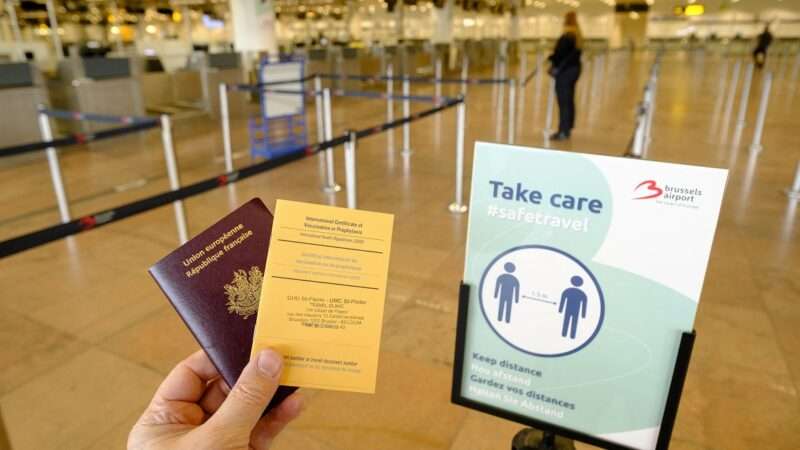
Such credentials aren’t entirely unprecedented; the World Health Organization’s International Certificate of Vaccination or Prophylaxis, or “yellow card,” serves as proof of vaccination for travelers headed for places where certain diseases are common (yellow fever, for example). But the yellow card is a low-tech paper document that doesn’t store health data or link to a network, it’s in limited use, and it applies only to travel. Pandemic-era health passports are already taking on a larger role.

“Governor Andrew M. Cuomo today announced the launch of Excelsior Pass — a free, voluntary platform developed in partnership with IBM, which utilizes proven, secure technology to confirm an individual’s recent negative PCR or antigen test result or proof of vaccination to help fast-track the reopening of businesses and event venues in accordance with New York State Department of Health guidelines,” New York State announced last week. 

An implementation of IBM’s Digital Health Pass, the Excelsior Pass is voluntary for both businesses setting policies and customers seeking entry. But it’s easy to see how people might feel pressure to adopt the standard in order to stay in the good graces of regulators and licensing authorities. Major New York venues such as Madison Square Garden and Barclays Center have already implemented the Excelsior Pass as a means of satisfying state testing and vaccination requirements for attendees, and other venues are likely to follow.

Of course, to demonstrate that you’re tested, vaccinated, or otherwise immune, these various passes need access to relevant health data. All of the systems promise tight security for users, but they still need potentially sensitive information.

“When you receive a COVID-19 vaccination or test in the State of New York, the Department of Health receives a copy of your records from your vaccine administrator, provider or lab,” New York State says. “Using the information you provide, Excelsior Pass searches the Department of Health’s records for your COVID-19 vaccination or negative COVID-19 test results and then provides you a Pass showing your name, date of birth, Pass type and Pass expiration. No other information is accessed or stored.”

IATA goes further, assuring that “Travel Pass does not store any data centrally. It simply links entities that need verification (airlines and governments) with the test or vaccination data when travelers permit.”

Still, these systems need some degree of access to sensitive health information in order to function, and that creates an unavoidable vulnerability.

“If you have your health records attached to something you have to carry that has to be verified, you have created an opening into the most private data you have,” Member of Parliament David Davis last week cautioned fellow British lawmakers considering vaccine passport requirements. “It is straight away a problem and it will grow because, inevitably, once we have the mechanism, it is common sense that people will try to use it for other uses and it will grow and grow.”

That’s the next concern. Having already expanded beyond air travel to encompass access to sports and concert arenas, it’s easy to see COVID-19 being only the first entry in credentials designed to be scalable. They can all be easily tweaked to record conformity with any imaginable public health requirement. Underground entrepreneurs certainly anticipate a large role for such documents—they’ve established a brisk business selling bogus vaccine certificates to buyers unable or unwilling to secure the real thing.

A year-plus into the COVID-19 pandemic, health passports are far too late to mitigate the damage done by lockdowns, surveillance, and travel restrictions. Even so, they’re almost guaranteed to be a part of the world to come.

from Latest – Reason.com https://ift.tt/3cwvURd
via IFTTT

CFDs – The Dirty Little Secret Behind The Collapse Of Archegos

CFDs – The Dirty Little Secret Behind The Collapse Of Archegos

Tell us if you’ve heard this one before – Wall Street prime brokers allowed hedge funds to dance while the music was playing with ever greater leverage in off-exchange and unregulated derivatives… until the first sign of trouble and the whole house of cards comes crashing down in a potentially systemic manner.

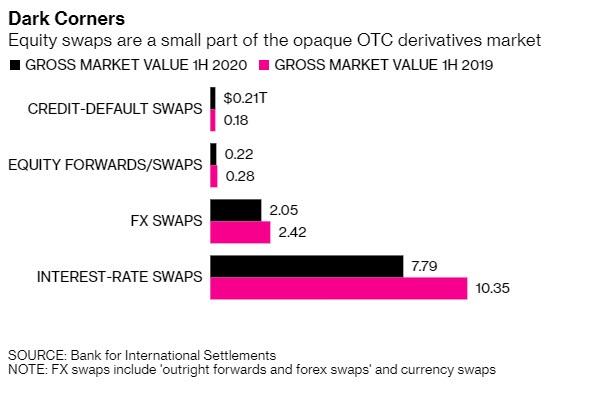
The bloodbath in various media stocks on Friday has brought light back to one of the dark corners of the equity trading business – so-called contracts-for-differences (CFDs).

As Bloomberg reports, much of the leverage used by Hwang’s Archegos Capital was provided by banks including Nomura and Credit Suisse – who have most recently admitted huge losses – as CFDs, which are made off exchanges, allow managers like Hwang to amass stakes in publicly traded companies without having to declare their holdings (far in excess of the 5% stakes that require regulatory reporting).

Crucially, as Bloomberg notes, this means Archegos may never actually have owned most of the underlying securities – if any at all – as the CFD is akin to a privately-arranged (i.e. off exchange and bespoke) futures contract where the differences in the settlement between the open and closing trade prices are cash-settled (there is no delivery of physical goods or securities with CFDs).

The leverage Hwang was given made him look like a trading genius as the various positions he took were pumped and pumped (and helped by gamma-squeezers) but now look like a reckless gambling fool as the bets collapsed.

CFDs are among bespoke derivatives that investors trade privately between themselves, or over-the-counter, instead of through public exchanges. This is exactly the kind of hidden risk that amplified the losses during the 2008 financial crisis.

As Bloomberg notes, regulators have begun clamping down on CFDs in recent years because they’re concerned the derivatives are too complex and too risky for retail investors, with the European Securities and Markets Authority in 2018 restricting the distribution to individuals and capping leverage. In the U.S., CFDs are largely banned for amateur traders… but not for hedge fund managers who are “sophisticated”?

But, banks still favor them because they can make a large profit without needing to set aside as much capital versus trading actual securities (driven to this opaque market as an unintended consequence of heavy regulation following the 2008 financial crisis).

In the case of Archegos, there is very little transparency about Hwang’s trades, but market participants suggest his assets had grown to anywhere from $5 billion to $10 billion in recent years with total exposure topping $50 billion. And bear in mind, this is not ‘leverage’ in the old-fashioned sense (i.e. banks allow you buy X-times the amount of stocks relative to your capital); this is purely synthetic – the firm has no actual underlying asset to fall back on, but is linearly exposed to losses (and gains) on a margined basis.

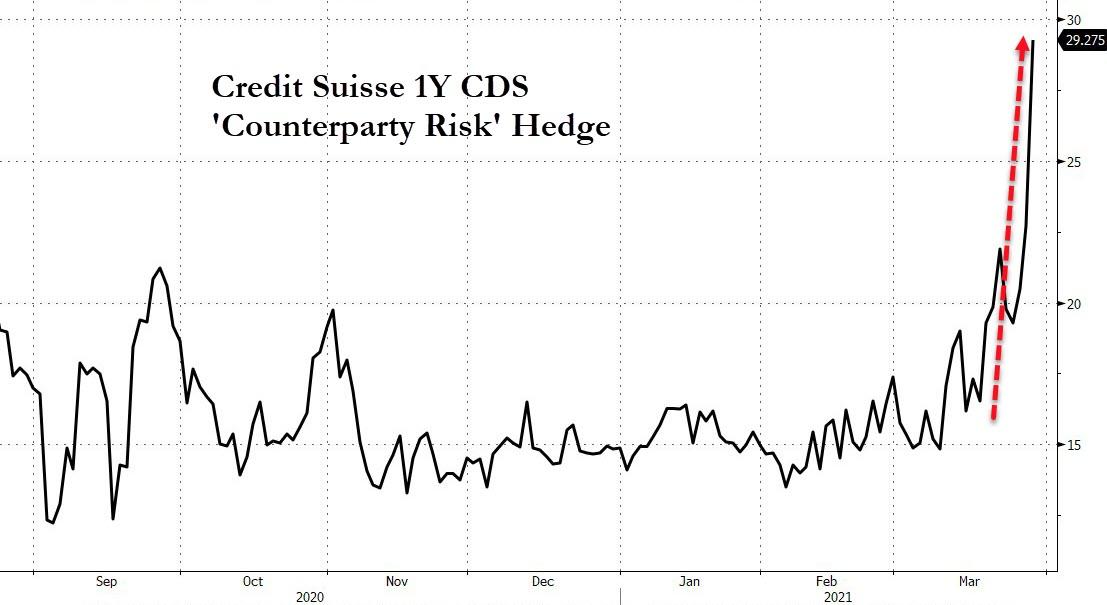
And as we noted at the beginning, this has the potential to be much more systemic as the losses created by Archegos’ margin calls trigger more margin calls and more potential losses for the prime brokers. Think we are exaggerating, then explain why the costs of counterparty risk hedging for Credit Suisse for example, has exploded in the last few days…

Source: Bloomberg

We look forward to the Congressional hearings on this.

Tyler Durden
Mon, 03/29/2021 – 08:59

via ZeroHedge News https://ift.tt/3dd9qE1 Tyler Durden

“Heavily Armed” Antifa Protestors Clash With Proud Boys At Oregon State Capitol 

“Heavily Armed” Antifa Protestors Clash With Proud Boys At Oregon State Capitol 

Oregon Public Broadcasting (OPB) reported Sunday a small group of Proud Boys and Trump supporters clashed with more than 100 anti-fascist counterprotesters at Oregon State Capitol. The far-right group organized the protest several days leading up to Sunday, saying they would be at the state capitol building to support “freedom.” 

Sunday was the first time in months that the two opposing sides have clashed in Oregon. 

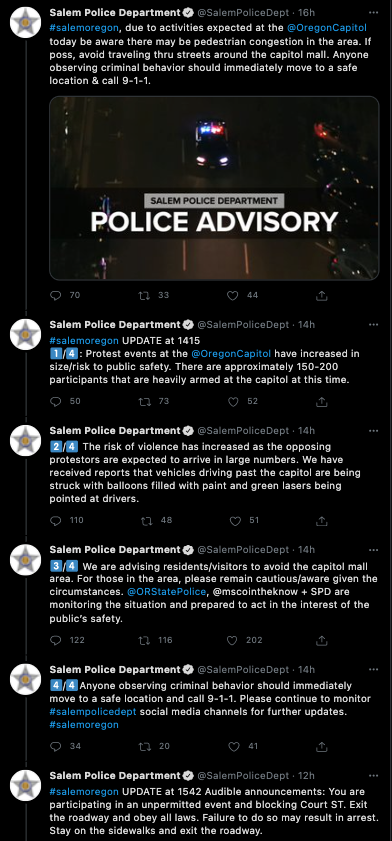
Salem Police Department posted a series of tweets warning about a “public safety” risk of “150-200” anti-fascist counterprotesters at the capitol who were “heavily armed.” The anti-fascist were considered “counterprotesters.” 

Police told anti-fascist protesters they were participating in an illegal demonstration. “Failure to do so may result in arrest,” police said over loudspeakers. 

Footage of Antifa flags was present at the rally. 

A crowd-controlling police unit was dispatched to the capitol complex to mediate anti-fascist counterprotesters. 

Things quickly got out of hand when Proud Boys and Trump supporters showed up in their trucks. Counterprotesters smashed their vehicle windows with blunt objects. 

Alleged shots of Proud Boys at the capitol building.

Counterprotesters pummeled Trump supporters’ trucks with objects. 

Antifa members destroyed another Trump supporter’s truck. 

One Trump supporter pulled a gun on Antifa following damage to his truck. 

“Antifa gathered in Salem, Ore. in a pre-planned riot. They wore ballistic vests & carried guns, bats, shields & gasmasks. They assaulted drivers on the road by throwing paint & rocks,” tweeted Andy Ngô.

Eventually, Ngô said police and troopers pushed Antifa rioters away from the streets where they were “assaulting drivers.”

OPB said several arrests were made in the anti-fascist group Sunday.

As for the “peace and unity,” which President Biden promised in January during his inauguration speech appears a distant dream at the moment. America is still traveling down a dangerous path towards continued clashes by both extreme political fringes. 

Tyler Durden
Mon, 03/29/2021 – 08:40

via ZeroHedge News https://ift.tt/3w6osE9 Tyler Durden

Get Ready to Show Your Vaccine Passport Everywhere


Originally touted as an innovative means of reducing the reach and duration of pandemic restrictions, health passports have moved beyond speculation to reality with the recent debut of several versions of such credentials. But after a year of lockdowns, travel restrictions, and surveillance justified on public health grounds, it’s likely that, rather than live up their liberating promise, health passports will become just another bureaucratic hurdle for people trying to go about their lives. For better or worse, though, the new credentials look destined to be part of the post-COVID-19 world.

“The Biden administration and private companies are working to develop a standard way of handling credentials — often referred to as ‘vaccine passports’ — that would allow Americans to prove they have been vaccinated against the novel coronavirus as businesses try to reopen,” The Washington Post reported over the weekend.

The federal government is something of a johnny-come-lately to a phenomenon already in motion.

“IATA Travel Pass is a mobile application that helps travelers to store and manage their verified certifications for COVID-19 tests or COVID-19 vaccines,” according to the International Air Transport Association. “By the middle of March 2021, a total of 17 airlines had signed up to trial IATA Travel Pass. Singapore Airlines was the first airline to launch a full pilot on March 15 on the Singapore-London route, followed by Qatar Airways on March 18.”

IATA’s Travel Pass is a leading contender among a host of competing credentials sponsored by governments and private entities and intended to demonstrate to authorities with a renewed fear of contagion that the bearer poses minimal risk. IATA’s digital credential (with paper alternatives available) offers information on destinations’ testing and vaccine requirements, connects travelers with their test and vaccination certificates and, by verifying and storing those certificates, acts as a “digital passport” for health purposes.

IBM’s blockchain-based Digital Health Pass offers similar capabilities and is customizable for organizations that have different requirements for travel and access to facilities. “[T]he solution is designed to enable organizations to verify health credentials for employees, customers and visitors entering their site based on criteria specified by the organization,” the company says.

The European Union is developing its own Digital Green Certificate that will serve as proof that a person has been vaccinated against COVID-19, received a negative test result, or recovered from the disease and accordingly gained immunity. “The Digital Green Certificate will be accepted in all EU Member States,” the European Commission promises. “It will help to ensure that restrictions currently in place can be lifted in a coordinated manner.”

Such credentials aren’t entirely unprecedented; the World Health Organization’s International Certificate of Vaccination or Prophylaxis, or “yellow card,” serves as proof of vaccination for travelers headed for places where certain diseases are common (yellow fever, for example). But the yellow card is a low-tech paper document that doesn’t store health data or link to a network, it’s in limited use, and it applies only to travel. Pandemic-era health passports are already taking on a larger role.

“Governor Andrew M. Cuomo today announced the launch of Excelsior Pass — a free, voluntary platform developed in partnership with IBM, which utilizes proven, secure technology to confirm an individual’s recent negative PCR or antigen test result or proof of vaccination to help fast-track the reopening of businesses and event venues in accordance with New York State Department of Health guidelines,” New York State announced last week. 

An implementation of IBM’s Digital Health Pass, the Excelsior Pass is voluntary for both businesses setting policies and customers seeking entry. But it’s easy to see how people might feel pressure to adopt the standard in order to stay in the good graces of regulators and licensing authorities. Major New York venues such as Madison Square Garden and Barclays Center have already implemented the Excelsior Pass as a means of satisfying state testing and vaccination requirements for attendees, and other venues are likely to follow.

Of course, to demonstrate that you’re tested, vaccinated, or otherwise immune, these various passes need access to relevant health data. All of the systems promise tight security for users, but they still need potentially sensitive information.

“When you receive a COVID-19 vaccination or test in the State of New York, the Department of Health receives a copy of your records from your vaccine administrator, provider or lab,” New York State says. “Using the information you provide, Excelsior Pass searches the Department of Health’s records for your COVID-19 vaccination or negative COVID-19 test results and then provides you a Pass showing your name, date of birth, Pass type and Pass expiration. No other information is accessed or stored.”

IATA goes further, assuring that “Travel Pass does not store any data centrally. It simply links entities that need verification (airlines and governments) with the test or vaccination data when travelers permit.”

Still, these systems need some degree of access to sensitive health information in order to function, and that creates an unavoidable vulnerability.

“If you have your health records attached to something you have to carry that has to be verified, you have created an opening into the most private data you have,” Member of Parliament David Davis last week cautioned fellow British lawmakers considering vaccine passport requirements. “It is straight away a problem and it will grow because, inevitably, once we have the mechanism, it is common sense that people will try to use it for other uses and it will grow and grow.”

That’s the next concern. Having already expanded beyond air travel to encompass access to sports and concert arenas, it’s easy to see COVID-19 being only the first entry in credentials designed to be scalable. They can all be easily tweaked to record conformity with any imaginable public health requirement. Underground entrepreneurs certainly anticipate a large role for such documents—they’ve established a brisk business selling bogus vaccine certificates to buyers unable or unwilling to secure the real thing.

A year-plus into the COVID-19 pandemic, health passports are far too late to mitigate the damage done by lockdowns, surveillance, and travel restrictions. Even so, they’re almost guaranteed to be a part of the world to come.

from Latest – Reason.com https://ift.tt/3cwvURd
via IFTTT

Archegos Margin Call Stocks Rebound As Forced Liquidations Fade

Archegos Margin Call Stocks Rebound As Forced Liquidations Fade

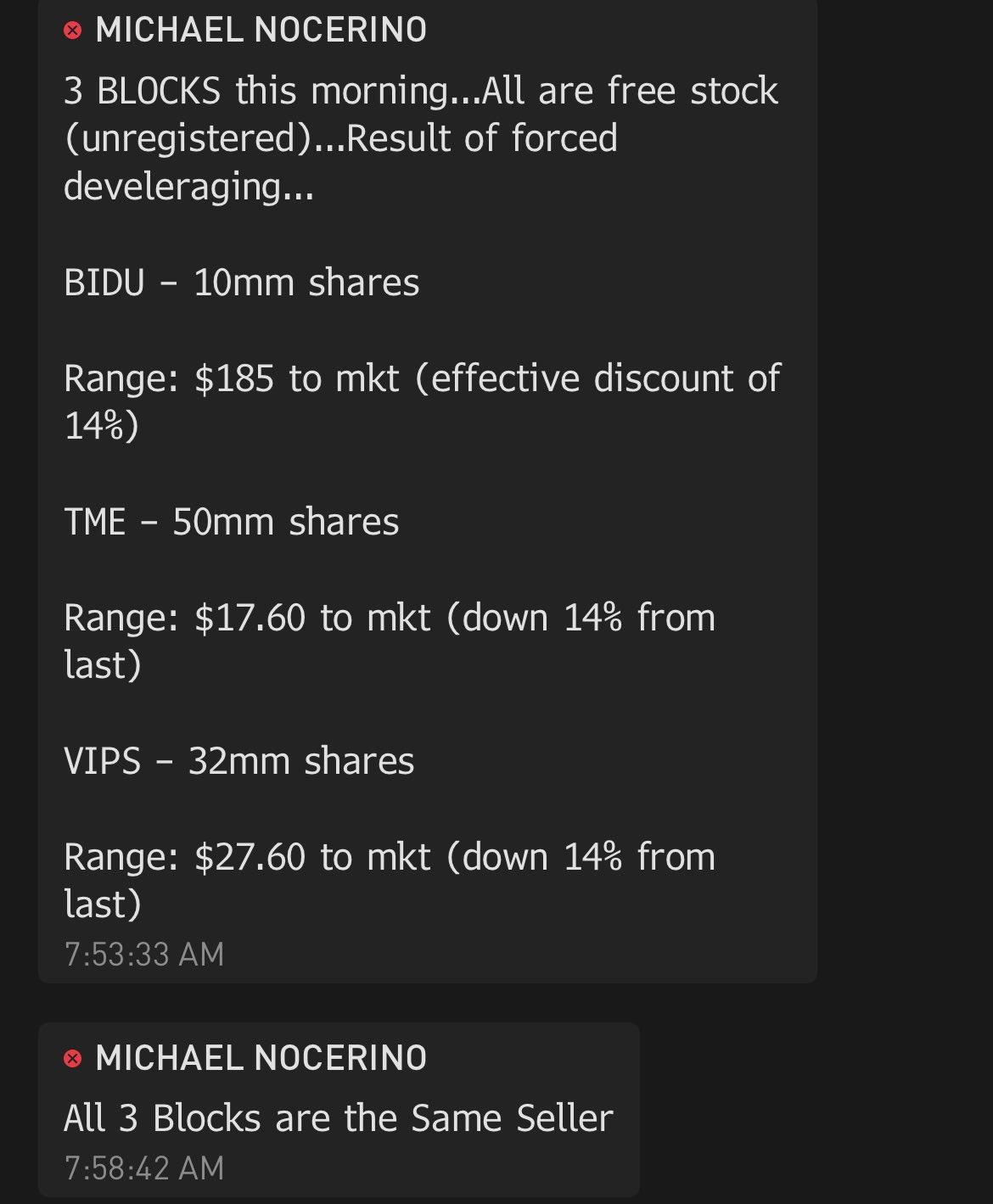
One day after a historic plunge in several media and Chinese tech stocks which was started by the following BWIC from Goldman…

… which we now know was the result of Archegos capital’s terminal margin call, which may or may not be continuing today.

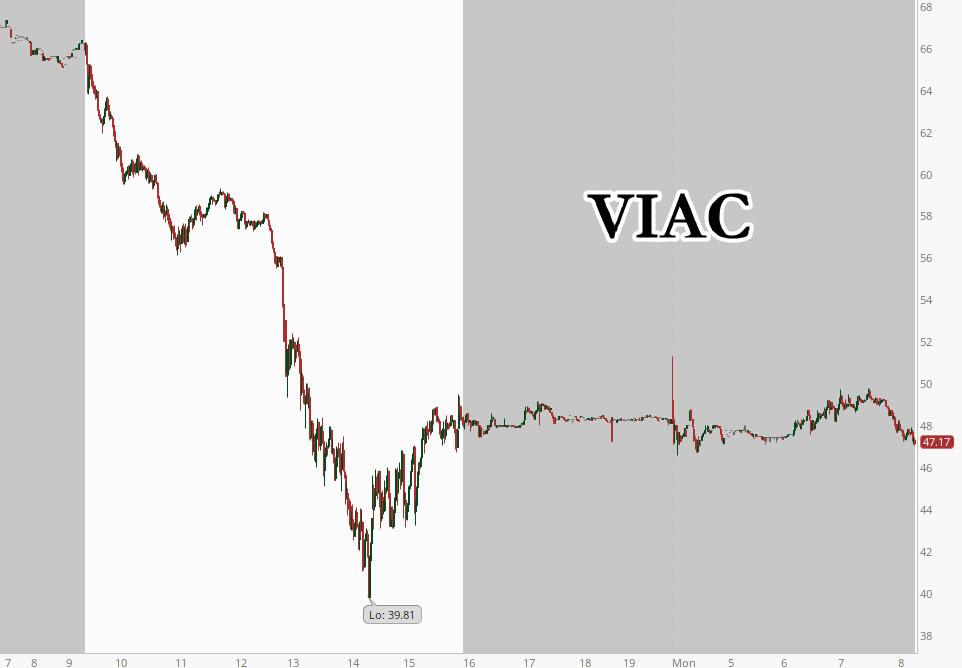
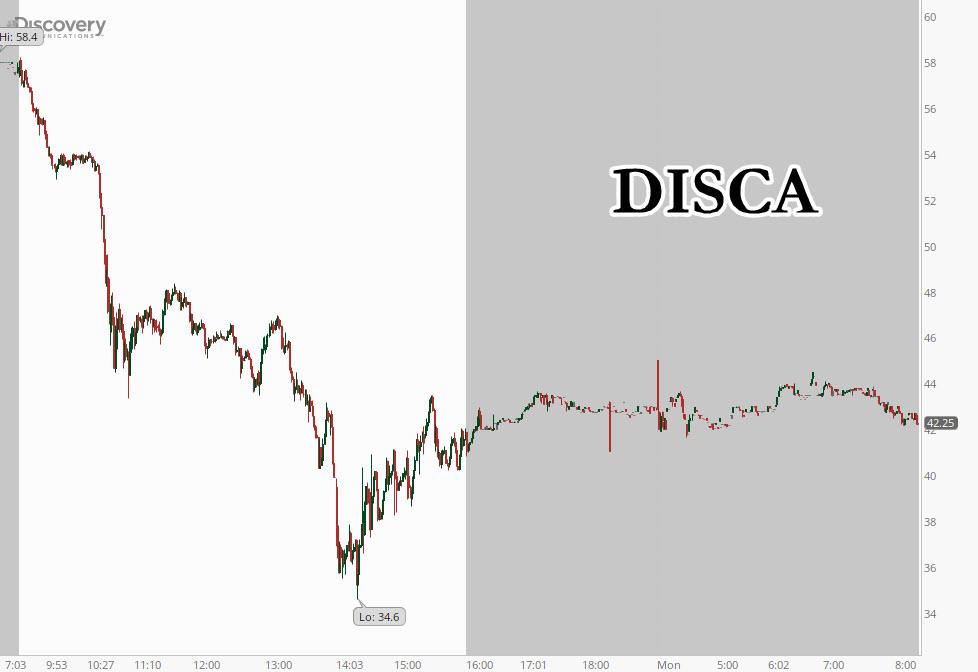
So while we wait to see if we get any new BWICs from Goldman, Morgan Stanley or other Prime Brokers hit, there has been a reversal in the impacted stocks, with ViacomCBS, Discovery and a group of Chinese ADRs now trading mostly higher premarket, reversing earlier declines.

A ViacomCBS block trade that launched on Sunday has priced at $47 per share, Bloomberg reported, after shares were said to be offered at $46-$47. As a result, ViacomCBS Class B shares were back down to $47.1, after rising up 1.5% to $48.94 premarket, They plunged 27% on Friday.

Discovery shares, which also tumbled 27% Friday, rose 4.1% premarket before fading much of the gains.

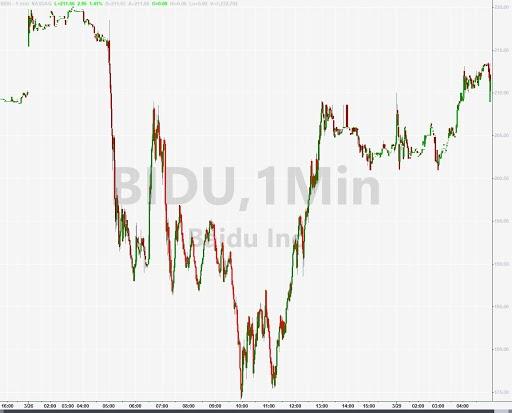
Shares in most of the other stocks involved in the block trades also rose: Tencent Music Entertainment rises 5.5%, reversing an earlier drop; Baidu rises 1.5%, also reversing an earlier drop, while Vipshop +0.1%, iQiyi +0.5%, Farfetch -1.9% and GSX Techedu -1.3%.

Tyler Durden
Mon, 03/29/2021 – 08:22

via ZeroHedge News https://ift.tt/31sNAqD Tyler Durden