ARK Funds Amend ETF Prospectus To Remove Investment Concentration Limits

ARK Funds Amend ETF Prospectus To Remove Investment Concentration Limits

We have been following the volatility with flows in and out of ARK Funds over the last few months, make note of Cathie Wood’s performance and “proprietary” investing style as the NASDAQ has whipsawed back and forth for the better part of 2021.

Now, it looks like ARK is making some changes in its disclosures commensurate with its recent “active investing style”, wherein it has been rotating out of large cap tech names and into smaller, more speculative names, especially in its ARKK flagship fund. 

ARK funds filed an amendment to its prospectuses for its ETFs on Friday, making some little recognized changes that were caught by @syouth1 on Twitter over the weekend.

As the tweet notes, the new ARK SEC filing does several things. First, on a perfunctory note, it specifies risks related to investing in SPACs, noting that they are “subject to a variety of risks beyond those associated with other equity securities”. 

Special Purpose Acquisition Companies (SPACs). The Fund may invest in stock of, warrants to purchase stock of, and other interests in SPACs or similar special purposes entities. A SPAC is a publicly traded company that raises investment capital for the purpose of acquiring or merging with an existing company. Investments in SPACs and similar entities are subject to a variety of risks beyond those associated with other equity securities. Because SPACs and similar entities do not have any operating history or ongoing business other than seeking acquisitions, the value of their securities is particularly dependent on the ability of the SPAC’s management to identify a merger target and complete an acquisition. Until an acquisition or merger is completed, a SPAC generally invests its assets, less a portion retained to cover expenses, in U.S. government securities, money market securities and cash and does not typically pay dividends in respect of its common stock. As a result, it is possible that an investment in a SPAC may lose value.

But then the filing gets very interesting – language is removed that allows ARK funds to take even larger concentrations in names – in addition to over-the-counter traded ADRs, which are notoriously riskier products than normal equity. 

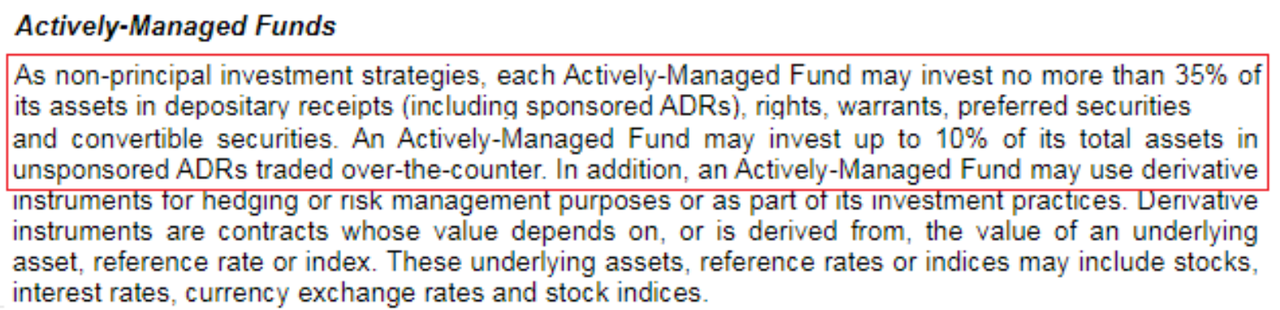
The amendment removes ARK’s limit to invest 10% of its total assets in any active fund in ADRs that are traded over-the-counter. 

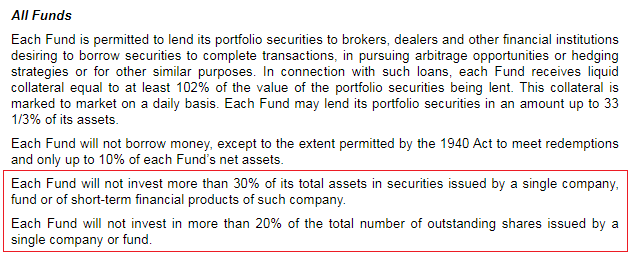
On top of that, the amended prospectus removes language that formerly limited ARK to investing no more than 30% of a fund’s total assets into securities issued by a single company. Another “rule” removed was language preventing ARK from investing in more than 20% of a company’s total outstanding shares.

The amendments portend ARK piling further into concentrated, high-risk names that dominate their respective funds. Wood’s recent rotation out of big cap names like Microsoft and into “speculative” smaller cap companies like Workhorse and Vuzix has made it clear that the firm’s appetite for risk continues to grow as NASDAQ volatility continues.

Obviously, if a pin is finally going to prick the NASDAQ gamma bubble that has blown up over the last 12 months, the higher Wood’s concentration in speculative names, the more spectacular a crash would be for ARK funds.

But for now, ARK continues to hold up – we noted it will be launching its Space ETF as soon as this week. And despite noting that the NASDAQ gamma squeeze appears to be over, Wood and her team seem hell bent on continuing to tempt fate. We’ll keep a close eye on the situation going forward. 

Tyler Durden
Mon, 03/29/2021 – 10:24

via ZeroHedge News https://ift.tt/31rX3P5 Tyler Durden

Basic Income Programs in Marin County and Oakland Exclude White People. Is That Legal?


reason-cash

Basic income pilot programs are proliferating throughout the San Francisco Bay Area. The goal is to empower poor families with unconditional cash grants. But there’s a catch: You aren’t eligible if you’re white.

Last week, Oakland Mayor Libby Schaaf announced the launch of the Oakland Resilient Families partnership, which will provide 600 families with a $500 monthly cash stipend for the 18 months.

“The poverty we all witness today is not a personal failure, it is a systems failure,” said Schaaf. “Guaranteed income is one of the most promising tools for systems change, racial equity, and economic mobility we’ve seen in decades.”

The program—modeled off of a similar pilot in Stockton, California—will be eligible to families with at least one child under 18, who are making no more than 50 percent of the area’s median income ($59,000 for a family of three), and who are black, indigenous, and/or people of color (BIPOC).

The Resilient Families partnership, while endorsed and promoted by Schaaf and the city government, is funded entirely by philanthropic donations. It will be run by a collection of community groups, including the nonprofits Family Independence Initiative, Mayors for a Guaranteed Income, and Oakland Thrives, a public-private partnership.

A recent study of Stockton’s basic income pilot program found that recipients saw their financial security and reported mental well-being rise, reports NPR.

Eligible families will apply online to participate in the program and will be chosen at random. The program is scheduled to start this spring.

It’s similar to another basic income pilot being launched in nearby Marin County. That program, reports the San Francisco Chronicle, will provide a $1,000 monthly stipend to 125 low-wage women of color with at least one child over the next two years.

The program will be administered by the Marin Community Foundation, a nonprofit, which is also contributing $3 million to the endeavor. The Marin County Board of Supervisors voted last Tuesday to spend $400,000 on the program.

Oakland’s program is probably the better-designed out of the two, says Max Ghenis, founder and president of the UBI Center, a think tank that researches basic income policies.

“Oakland set up smaller amounts and used the budget to expand the population that’s being reached, so that’s a pretty smart step,” he tells Reason, saying that research on cash transfer programs shows that smaller amounts provided to a larger number of people do a better job of alleviating poverty.

The same is true of programs that target families with children, which both Marin and Oakland counties do. “The impact [of a cash stipend] on the future well-being and development of those kids is much stronger than alleviating the poverty of adults,” Ghenis says.

Transfer programs with strict income cutoffs often discourage recipients from earning more money, as additional wages could cost them even more in benefits. These pilot programs should be able to avoid that perverse incentive, given that once participants are selected, they’ll remain eligible for the monthly cash stipend even if their income rises.

Limiting eligibility of these programs by race could well prove legally problematic, says Walter Olson, a legal expert at the Cato Institute. The U.S. and California constitutions, he notes, generally prohibit race-selective programs and public services.

This is particularly true of Marin County’s decision to award public funding to its local basic income pilot program.

“The structure of the program is racially discriminatory. It will probably not make it over the threshold for when government is allowed to discriminate,” Olson says, telling Reason that governments can generally only discriminate along racial lines when implementing programs narrowly aimed at righting past discriminatory behavior by that same government.

The legal issues around Oakland’s basic income pilot are harder to parse, he says, given that it is privately funded and administered, but also heavily promoted by city officials.

“The issue that comes out is, is there state action?” says Olson.

Much of the fleshing out what counts as state action stems from court cases in the post–Jim Crow South, where local and state governments would nominally privatize government services like schools or libraries in order to maintain racially discriminatory rules about their use.

Oakland’s basic income pilot could be found to be unconstitutional on similar grounds depending on how active of a role city officials take in administering or directing people toward the program, says Olson.

At the same time, he says, libertarians should be wary of defining state action too broadly.

“By libertarian standards, there ought to be quite a bit of leeway for local government to talk up things, endorse things,” says Olson, giving the example of a city closing off streets for a parade honoring a local same-sex college.

While the local government would be prohibited from operating a same-sex college, it shouldn’t be so constrained as to not be able to promote it. That’s separate from the political question of whether local officials should be endorsing race-selective programs the way Schaaf has.

“The legal controversy is only part of it. I think it’s appropriate to have a controversy about what our mayors are getting into when they seem to put a city’s endorsement behind these kinds of things,” says Olson.

“We’ve just gone through ten years of agitation about how you should be allowed to have medical studies” that select for race, he says. There’s no reason that social experiments should be immune from that same scrutiny.

Ghenis says that race-based eligibility requirements could also undermine public support for basic income proposals.

“I do worry that something like this could be spun as something closer to reparations than [universal basic income]. The polling is much stronger for semi-universal cash relief than it is for reparations,” he says. “I think there’s a political case and also an external validity case. If ultimately, we want to get to UBI, we need to see how more inclusive programs fare.”

from Latest – Reason.com https://ift.tt/3waQNt6
via IFTTT

Basic Income Programs in Marin County and Oakland Exclude White People. Is That Legal?


reason-cash

Basic income pilot programs are proliferating throughout the San Francisco Bay Area. The goal is to empower poor families with unconditional cash grants. But there’s a catch: You aren’t eligible if you’re white.

Last week, Oakland Mayor Libby Schaaf announced the launch of the Oakland Resilient Families partnership, which will provide 600 families with a $500 monthly cash stipend for the 18 months.

“The poverty we all witness today is not a personal failure, it is a systems failure,” said Schaaf. “Guaranteed income is one of the most promising tools for systems change, racial equity, and economic mobility we’ve seen in decades.”

The program—modeled off of a similar pilot in Stockton, California—will be eligible to families with at least one child under 18, who are making no more than 50 percent of the area’s median income ($59,000 for a family of three), and who are black, indigenous, and/or people of color (BIPOC).

The Resilient Families partnership, while endorsed and promoted by Schaaf and the city government, is funded entirely by philanthropic donations. It will be run by a collection of community groups, including the nonprofits Family Independence Initiative, Mayors for a Guaranteed Income, and Oakland Thrives, a public-private partnership.

A recent study of Stockton’s basic income pilot program found that recipients saw their financial security and reported mental well-being rise, reports NPR.

Eligible families will apply online to participate in the program and will be chosen at random. The program is scheduled to start this spring.

It’s similar to another basic income pilot being launched in nearby Marin County. That program, reports the San Francisco Chronicle, will provide a $1,000 monthly stipend to 125 low-wage women of color with at least one child over the next two years.

The program will be administered by the Marin Community Foundation, a nonprofit, which is also contributing $3 million to the endeavor. The Marin County Board of Supervisors voted last Tuesday to spend $400,000 on the program.

Oakland’s program is probably the better-designed out of the two, says Max Ghenis, founder and president of the UBI Center, a think tank that researches basic income policies.

“Oakland set up smaller amounts and used the budget to expand the population that’s being reached, so that’s a pretty smart step,” he tells Reason, saying that research on cash transfer programs shows that smaller amounts provided to a larger number of people do a better job of alleviating poverty.

The same is true of programs that target families with children, which both Marin and Oakland counties do. “The impact [of a cash stipend] on the future well-being and development of those kids is much stronger than alleviating the poverty of adults,” Ghenis says.

Transfer programs with strict income cutoffs often discourage recipients from earning more money, as additional wages could cost them even more in benefits. These pilot programs should be able to avoid that perverse incentive, given that once participants are selected, they’ll remain eligible for the monthly cash stipend even if their income rises.

Limiting eligibility of these programs by race could well prove legally problematic, says Walter Olson, a legal expert at the Cato Institute. The U.S. and California constitutions, he notes, generally prohibit race-selective programs and public services.

This is particularly true of Marin County’s decision to award public funding to its local basic income pilot program.

“The structure of the program is racially discriminatory. It will probably not make it over the threshold for when government is allowed to discriminate,” Olson says, telling Reason that governments can generally only discriminate along racial lines when implementing programs narrowly aimed at righting past discriminatory behavior by that same government.

The legal issues around Oakland’s basic income pilot are harder to parse, he says, given that it is privately funded and administered, but also heavily promoted by city officials.

“The issue that comes out is, is there state action?” says Olson.

Much of the fleshing out what counts as state action stems from court cases in the post–Jim Crow South, where local and state governments would nominally privatize government services like schools or libraries in order to maintain racially discriminatory rules about their use.

Oakland’s basic income pilot could be found to be unconstitutional on similar grounds depending on how active of a role city officials take in administering or directing people toward the program, says Olson.

At the same time, he says, libertarians should be wary of defining state action too broadly.

“By libertarian standards, there ought to be quite a bit of leeway for local government to talk up things, endorse things,” says Olson, giving the example of a city closing off streets for a parade honoring a local same-sex college.

While the local government would be prohibited from operating a same-sex college, it shouldn’t be so constrained as to not be able to promote it. That’s separate from the political question of whether local officials should be endorsing race-selective programs the way Schaaf has.

“The legal controversy is only part of it. I think it’s appropriate to have a controversy about what our mayors are getting into when they seem to put a city’s endorsement behind these kinds of things,” says Olson.

“We’ve just gone through ten years of agitation about how you should be allowed to have medical studies” that select for race, he says. There’s no reason that social experiments should be immune from that same scrutiny.

Ghenis says that race-based eligibility requirements could also undermine public support for basic income proposals.

“I do worry that something like this could be spun as something closer to reparations than [universal basic income]. The polling is much stronger for semi-universal cash relief than it is for reparations,” he says. “I think there’s a political case and also an external validity case. If ultimately, we want to get to UBI, we need to see how more inclusive programs fare.”

from Latest – Reason.com https://ift.tt/3waQNt6
via IFTTT

Conservative Economic Nationalism Is Not as Popular as People Think


trumpsupporters

This article originally appeared at Public Discourse


If there’s one thing the “post-liberal” conservatives can agree on, it’s that 2016 should have been a wake-up call for the Republican Party. According to the new conventional wisdom within the conservative movement, Donald Trump’s shocking electoral victory four years ago represented a blue-collar economic revolt against GOP elites, who had lost touch with their base. Rural and small-town Americans, disillusioned with the globally integrated modern economy, were desperate for a hand up. Trump alone noticed, and they rewarded him with their energetic support.

These basic assumptions undergird a push by many conservative commentators—and a concomitant pivot by a number of Republican officials—to reimagine the GOP as the party of workers, comfortable with much more direct government intervention into the economy than ever before. As Florida Sen. Marco Rubio put it in a 2019 speech, “Our challenge is an economic order that is bad for America.” As columnist David Brooks wrote last year, “over the long term, some version of Working-Class Republicanism will redefine the G.O.P.”

The post-liberals take great satisfaction in labeling the libertarian economic agenda of open trade, low taxes, and deregulation with sneering epithets like “zombie Reaganism” and “market fundamentalism.” They are persuaded that voters overwhelmingly share their disdain for the free market economic regime. The empirical evidence for that belief, though, has always been thinner than they appreciate. To the extent that the Trump coalition was unified and energized by anything, survey data suggest that it was cultural issues, not economic ones.

A New Nationalism Emerges

In an August 2020 essay for The New York Times, Brooks explored three possible paths forward for Republicans. Notably, he insisted that each option begins with the Trumpian presumptions that “the free market is not working well” and “economic libertarianism is not the answer.” He’s not alone. Both money and attention have been lining up behind a new conservative nationalist element in the last few years. In July 2019, a multi-day conference convened in Washington, D.C., to hash out a better conservative economic program. As I reported at the time:

Practically speaking, the nationalist agenda is largely focused on the need for a federal “industrial policy.” For Breitbart’s John Carney, that means tariffs, and lots of them. Americans need to be willing to pay higher prices to protect the jobs of their fellow citizens, according to [activist David] Brog. For American Affairs founder Julius Krein, “protectionism is not sufficient. . . . It’s not radical enough.” The Manhattan Institute’s Oren Cass laid out a plan involving research and development subsidies, infrastructure investments, preferential tax rates for favored firms, punitive taxes on companies that move jobs overseas, “trade enforcement” to make other countries play according to our rules, and more. “We should have a National Institutes of Manufacturing just as we have a National Institutes of Health,” he said.

It’s true, of course, that President Trump was a free trader’s nightmare, surrounding himself with radical protectionists and slapping import levies on goods not just from China but from many of our closest allies, often with devastating effects. He also embraced a sort of economic strongmanism in which a president may dictate business decisions to private companies and use the full arsenal of federal powers to compel their submission—you know, for the common good. All of this is pretty far from the libertarian economic ideal.

At the same time, the Trump years saw one of the largest tax cuts in American history, alongside some noteworthy efforts to roll back the federal regulatory burden—two archetypally Reaganite policy moves. More to the point, these years also saw mixed support—at best—for top-down management of the economy.

Broad Support for Free Enterprise

The new economic nationalists posit that, to remain competitive, the Republican Party must learn from 2016 and jettison its crippling commitment to economic libertarianism. Yet public polling suggests that America is still a country of people who broadly support free enterprise. In the fall of 2019, Gallup found that just 28 percent of Americans (and just 7 percent of GOPers) think there is too little government regulation of business and industry. But a desire for greater oversight of market actors—stronger fetters, if you will—is at the core of the nationalist alternative that people like Cass are articulating.

Pollsters also found support for foreign trade increasing over the course of the Trump presidency. According to Pew Research Center, the proportion of Americans who thought free trade agreements have been a good thing for the country jumped from 45 percent in 2016 to 65 percent in 2019. According to Gallup, 58 percent of Americans said in February 2016 that free trade represented an opportunity for increased economic growth, compared to 34 percent who saw it as a threat to the American economy. Three years later, 74 percent said it was an opportunity (a 16-percentage-point increase), compared to 21 percent who saw it as a threat (a 13-percentage-point decline).

These numbers all predate the COVID-19 crisis. Amid a once-in-a-century event, it should come as no surprise that support for emergency spending would be sky-high across the board—and so it is. Still, recent data reinforce the supposition that something other than broad disapproval of limited government and free market capitalism animates today’s Republican coalition. A January survey commissioned by the Ethics and Public Policy Center (EPPC) found that only 35 percent of 2020 Trump voters thought the United States should reduce trade with foreign countries. Meanwhile, 93 percent agreed that “government doesn’t create wealth; people and businesses do.” Again, these figures are among self-identifying Trump supporters. Ask yourself: Does this sound like a cohort mobilized primarily by disgust with “zombie Reaganism”?

While the evidence is mostly anecdotal at this point, it has even been posited—including in the left-wing Mother Jones—that the Democratic Party’s socialist turn explains the unexpected gains for Trump in places like South Florida last year. Where there are sizable pockets of immigrants from countries with less than rosy experiences of state-controlled economic systems, people may have shifted toward Trump out of a last-ditch desire for relatively more economic freedom.

Cultural Anxieties Are the Real Driver

There was always good reason to suspect that cultural anxieties, far more than economic anxieties, were driving support for Trump. His success was indeed evidence of a backlash. But voters, rather than retaliating against supposedly stale GOP talking points on NAFTA, likely were acting on something more primal: a strong feeling that people like them are under attack from powerful cultural institutions in America. Under such conditions, it is tempting to conclude that extreme medicine is warranted.

This sense of being besieged is epitomized by two issue categories that every journalist and congressional staffer knows garner disproportionate, and disproportionately passionate, attention from the public: the perceived dual threats of runaway political correctness and legal assaults on religious liberty.

Immediately following the 2016 election, Reason‘s Robby Soave drew attention to the former phenomenon. “Ever since Donald Trump became a serious threat to win the GOP presidential primaries,” he wrote, “I have warned that a lot of people, both on campus and off it, were furious about political-correctness-run-amok—so furious that they would give power to any man who stood in opposition to it.” Soave acknowledged the phrase is difficult to define but argued that “the segment of the electorate who flocked to Trump because he positioned himself as ‘an icon of irreverent resistance to political correctness’ think it means this: smug, entitled, elitist, privileged leftists jumping down the throats of ordinary folks who aren’t up-to-date on the latest requirements of progressive society.”

On the religious liberty front, I too speak from experience. After four years of writing about the Obama administration’s efforts to make evangelical Christian colleges pay for their employees’ birth control, state and city governments’ efforts to forbid wedding vendors from opting out of same-sex marriage celebrations, and the ACLU’s efforts to force Catholic hospitals to provide elective abortions and gender transition services, I had no trouble understanding why conservative voters might feel radicalized, even if I reacted with equal horror to the man they appointed to do something about it.

Last month’s EPPC poll bears this theory out. While a mere 2 percent of Trump voters thought the federal government was too small, 89 percent said “Christianity is under attack in America today”; 90 percent said “Americans are losing faith in the ideas that make our country great”; and 92 percent said “the mainstream media today is just a part of the Democratic Party.” Only 20 percent agreed that “white people have an advantage in today’s America because of their skin color,” while a staggering 87 percent were worried that “discrimination against whites will increase a lot in the next few years.”

Here, not on economic questions, is the overwhelming consensus. Many Republicans—and even some non-Republicans—feel that people who look like them and believe what they do have been unjustly branded as enemies by Hollywood, academia, the mainstream media, and the tech sector. More than a few of them are prepared to strike back in any way they can.

A quick aside: It’s clear that most Trump supporters are highly skeptical of immigration. The EPPC poll found, for instance, that 86 percent support building a wall on America’s southern border, 89 percent support a federal requirement that employers verify their workers are here legally, and 65 percent think the United States should reduce the number of people it allows to come here from abroad. What’s less clear is the extent to which these views are rooted in cultural concerns (e.g., a fear that white Americans are being replaced by ethnic minorities) or economic ones (e.g., a fear that an influx of workers are driving down wages). Although I suspect the latter concerns are often used as cover for the former, the data are not particularly clear on this point.

Against Grievance Politics

History books are full of reasons to be exceedingly nervous when identity-based grievance politics finds a foothold in your country. This is no less true when it happens on the right, among “regular folks,” than when it happens on the left, among “historically disadvantaged groups.” It’s also just as true when, as is virtually always the case, there’s some validity to the underlying grievance.

I think many conservative elites know that cultural resentment has the potential to take the Republican Party in an ugly direction. That’s why so many of them cling to the alternative explanation: It wasn’t racism or misogyny that was motivating Trump voters! It was righteous anger that their government hasn’t done more to protect them from the ravages of globalization!

Cass and the other new conservative nationalists are trying to offer a constructive policy agenda that reflects this alternative story. But in doing so, they’re building on a foundation of sand. The data just don’t support the idea that most Republicans reject free markets or free trade. And the further the GOP moves in a big-government, economically interventionist direction, the more it risks losing fusionists like me.

If the 2016 election was a wake-up call, it was for the left, not the right—a warning to the Democratic Party that dabblings in socialism and critical theory are suited to college dorm rooms, not the national political stage. We saw in 2016 that pushing past the electoral center of gravity will provoke a backlash you probably won’t much like.

Now that I think of it, that might be a lesson both sides need to hear.

from Latest – Reason.com https://ift.tt/3sBVpGg
via IFTTT
In Defense of CUNY Law Dean Mary Lu Bilek

In 2018, students at CUNY Law School tried to shut down my lecture on free speech. Prior to the event, Dean Mary Lu Bilek refused to cancel the event. But after my event, she said the “non-violent, limited protest was a reasonable exercise of protected free speech, and it did not violate any university policy.”

Dean Bilek never reached out to me. Indeed, not a single faculty member CUNY ever said a word to me. I briefly considered litigation, but ultimately decided against it. Based on my analysis of the events, the Dean followed controlling First Amendment caselaw, albeit grudgingly. I did submit requests under New York’s Freedom of Information Law. Nothing meaningful turned up. I know that Bilek retained a crisis management firm, but nothing of substance was discussed over email. I let the matter go.

A few months later I attended a small conference of law professors. Dean Bilek was there. I walked over to her and introduced myself. She said hello, pretended not to know me, and briskly walked away. I surmised that she was in a tough spot. I understood the type of institution she taught in. And I recognized that if she showed me even the slightest courtesy, her students would rebel. I can’t fathom what teaching at CUNY Law is like.

I gave Dean Bilek very little thought over the past few years. Fast forward to the present. By now, Dean Bilek’s self-cancellation has made national headlines. I encourage you to read the summary in the New York Times. I won’t even try to summarize the surreal circumstances. I’ll admit it. I had a brief moment of schadenfreude, but then my libertarian wheels started spinning, and I rallied to her cause.

I write in defense of Mary Lu Bilek. I truly feel bad for her. Dean Bilek spent her career promoting the cause of social justice and anti-racism. She did everything in her power to address the unique concerns of the CUNY community. But then she slipped. Once. She made a mistake. Who knows why she said what she said. Maybe she was having a bad day. Maybe she was under a lot of stress. Maybe she thought she was making a more profound point that was lost in translation. Whatever the reason, she said what she said.

That one comment ruined her career. In our current culture, there is no room for error. And, no one knows ex ante what those errors will be. We live in precarious times. There is no longer any margin of errors. Apologies are meaningless. If a dyed-in-the-wool progressive can be shunned for a single errant comment, none of us are safe. I fear the legal academy will become something of a circular firing squad. Anyone who crosses an ill-defined line will be subject to summary cancellation. And anyone who disagrees with that sentence will be charged with bystander liability. At bottom, the most aggrieved students will have the power to control any aspect of the institution. Universities will no longer be places where truth and knowledge can be pursued. Rather, Universities will first and foremost be designed to pursue social justice, as defined by the vacillating whims of societal revolution. Dissidents will be excluded.

I’m sorry we had to witness Bilek’s decanal self-immolation. But I must defend her, even if she wouldn’t defend me.

from Latest – Reason.com https://ift.tt/2O3xYa1
via IFTTT

“CCP’s Useful Idiots”: U.S. Rep Slams WHO COVID-Origin Whitewash Report

“CCP’s Useful Idiots”: U.S. Rep Slams WHO COVID-Origin Whitewash Report

Authored by Steve Watson via Summit News,

Republican Representative Lee Zeldin has blasted the World Health Organisation as China’s “useful idiots” after a draft version of its investigation into the origins of the coronavirus outbreak was revealed to have dismissed the lab leak theory as ‘extremely unlikely’.

Zeldin slammed China for “covering up to the world the pandemic’s origins” and called for a real independent investigation:

The WHO report repeats the often touted CCP explanation that the virus was likely transmitted to humans by animals, and did not come from a lab.

WHO officials have stated that the report will be officially released in the coming days:

The notion that the virus came from a ‘wet market’ in Wuhan discounts the fact that cases were reported before localised outbreaks close to the market.

Last week, Dr. Robert Redfield, the former director of the U.S. Centers for Disease Control and Prevention under President Trump declared that he believes the virus originated in a lab in Wuhan, China.

It’s a theory that is supported by top US National Security officials in the US and Britain, as well as scores of virologists and other scientists.

A prominent German scientist with the University of Hamburg released findings in February of a year long study that concludes the most likely cause of the coronavirus pandemic was a leak from the Wuhan Institute of Virology.

As we highlighted last month, after spending months trying to negotiate the visit, WHO officials largely absolved China of blame for the COVID-19 pandemic after visiting a virus lab in Wuhan for just 3 hours.

Tyler Durden
Mon, 03/29/2021 – 10:05

via ZeroHedge News https://ift.tt/3m2Ev1l Tyler Durden

Conservative Economic Nationalism Is Not as Popular as People Think


trumpsupporters

This article originally appeared at Public Discourse


If there’s one thing the “post-liberal” conservatives can agree on, it’s that 2016 should have been a wake-up call for the Republican Party. According to the new conventional wisdom within the conservative movement, Donald Trump’s shocking electoral victory four years ago represented a blue-collar economic revolt against GOP elites, who had lost touch with their base. Rural and small-town Americans, disillusioned with the globally integrated modern economy, were desperate for a hand up. Trump alone noticed, and they rewarded him with their energetic support.

These basic assumptions undergird a push by many conservative commentators—and a concomitant pivot by a number of Republican officials—to reimagine the GOP as the party of workers, comfortable with much more direct government intervention into the economy than ever before. As Florida Sen. Marco Rubio put it in a 2019 speech, “Our challenge is an economic order that is bad for America.” As columnist David Brooks wrote last year, “over the long term, some version of Working-Class Republicanism will redefine the G.O.P.”

The post-liberals take great satisfaction in labeling the libertarian economic agenda of open trade, low taxes, and deregulation with sneering epithets like “zombie Reaganism” and “market fundamentalism.” They are persuaded that voters overwhelmingly share their disdain for the free market economic regime. The empirical evidence for that belief, though, has always been thinner than they appreciate. To the extent that the Trump coalition was unified and energized by anything, survey data suggest that it was cultural issues, not economic ones.

A New Nationalism Emerges

In an August 2020 essay for The New York Times, Brooks explored three possible paths forward for Republicans. Notably, he insisted that each option begins with the Trumpian presumptions that “the free market is not working well” and “economic libertarianism is not the answer.” He’s not alone. Both money and attention have been lining up behind a new conservative nationalist element in the last few years. In July 2019, a multi-day conference convened in Washington, D.C., to hash out a better conservative economic program. As I reported at the time:

Practically speaking, the nationalist agenda is largely focused on the need for a federal “industrial policy.” For Breitbart’s John Carney, that means tariffs, and lots of them. Americans need to be willing to pay higher prices to protect the jobs of their fellow citizens, according to [activist David] Brog. For American Affairs founder Julius Krein, “protectionism is not sufficient. . . . It’s not radical enough.” The Manhattan Institute’s Oren Cass laid out a plan involving research and development subsidies, infrastructure investments, preferential tax rates for favored firms, punitive taxes on companies that move jobs overseas, “trade enforcement” to make other countries play according to our rules, and more. “We should have a National Institutes of Manufacturing just as we have a National Institutes of Health,” he said.

It’s true, of course, that President Trump was a free trader’s nightmare, surrounding himself with radical protectionists and slapping import levies on goods not just from China but from many of our closest allies, often with devastating effects. He also embraced a sort of economic strongmanism in which a president may dictate business decisions to private companies and use the full arsenal of federal powers to compel their submission—you know, for the common good. All of this is pretty far from the libertarian economic ideal.

At the same time, the Trump years saw one of the largest tax cuts in American history, alongside some noteworthy efforts to roll back the federal regulatory burden—two archetypally Reaganite policy moves. More to the point, these years also saw mixed support—at best—for top-down management of the economy.

Broad Support for Free Enterprise

The new economic nationalists posit that, to remain competitive, the Republican Party must learn from 2016 and jettison its crippling commitment to economic libertarianism. Yet public polling suggests that America is still a country of people who broadly support free enterprise. In the fall of 2019, Gallup found that just 28 percent of Americans (and just 7 percent of GOPers) think there is too little government regulation of business and industry. But a desire for greater oversight of market actors—stronger fetters, if you will—is at the core of the nationalist alternative that people like Cass are articulating.

Pollsters also found support for foreign trade increasing over the course of the Trump presidency. According to Pew Research Center, the proportion of Americans who thought free trade agreements have been a good thing for the country jumped from 45 percent in 2016 to 65 percent in 2019. According to Gallup, 58 percent of Americans said in February 2016 that free trade represented an opportunity for increased economic growth, compared to 34 percent who saw it as a threat to the American economy. Three years later, 74 percent said it was an opportunity (a 16-percentage-point increase), compared to 21 percent who saw it as a threat (a 13-percentage-point decline).

These numbers all predate the COVID-19 crisis. Amid a once-in-a-century event, it should come as no surprise that support for emergency spending would be sky-high across the board—and so it is. Still, recent data reinforce the supposition that something other than broad disapproval of limited government and free market capitalism animates today’s Republican coalition. A January survey commissioned by the Ethics and Public Policy Center (EPPC) found that only 35 percent of 2020 Trump voters thought the United States should reduce trade with foreign countries. Meanwhile, 93 percent agreed that “government doesn’t create wealth; people and businesses do.” Again, these figures are among self-identifying Trump supporters. Ask yourself: Does this sound like a cohort mobilized primarily by disgust with “zombie Reaganism”?

While the evidence is mostly anecdotal at this point, it has even been posited—including in the left-wing Mother Jones—that the Democratic Party’s socialist turn explains the unexpected gains for Trump in places like South Florida last year. Where there are sizable pockets of immigrants from countries with less than rosy experiences of state-controlled economic systems, people may have shifted toward Trump out of a last-ditch desire for relatively more economic freedom.

Cultural Anxieties Are the Real Driver

There was always good reason to suspect that cultural anxieties, far more than economic anxieties, were driving support for Trump. His success was indeed evidence of a backlash. But voters, rather than retaliating against supposedly stale GOP talking points on NAFTA, likely were acting on something more primal: a strong feeling that people like them are under attack from powerful cultural institutions in America. Under such conditions, it is tempting to conclude that extreme medicine is warranted.

This sense of being besieged is epitomized by two issue categories that every journalist and congressional staffer knows garner disproportionate, and disproportionately passionate, attention from the public: the perceived dual threats of runaway political correctness and legal assaults on religious liberty.

Immediately following the 2016 election, Reason‘s Robby Soave drew attention to the former phenomenon. “Ever since Donald Trump became a serious threat to win the GOP presidential primaries,” he wrote, “I have warned that a lot of people, both on campus and off it, were furious about political-correctness-run-amok—so furious that they would give power to any man who stood in opposition to it.” Soave acknowledged the phrase is difficult to define but argued that “the segment of the electorate who flocked to Trump because he positioned himself as ‘an icon of irreverent resistance to political correctness’ think it means this: smug, entitled, elitist, privileged leftists jumping down the throats of ordinary folks who aren’t up-to-date on the latest requirements of progressive society.”

On the religious liberty front, I too speak from experience. After four years of writing about the Obama administration’s efforts to make evangelical Christian colleges pay for their employees’ birth control, state and city governments’ efforts to forbid wedding vendors from opting out of same-sex marriage celebrations, and the ACLU’s efforts to force Catholic hospitals to provide elective abortions and gender transition services, I had no trouble understanding why conservative voters might feel radicalized, even if I reacted with equal horror to the man they appointed to do something about it.

Last month’s EPPC poll bears this theory out. While a mere 2 percent of Trump voters thought the federal government was too small, 89 percent said “Christianity is under attack in America today”; 90 percent said “Americans are losing faith in the ideas that make our country great”; and 92 percent said “the mainstream media today is just a part of the Democratic Party.” Only 20 percent agreed that “white people have an advantage in today’s America because of their skin color,” while a staggering 87 percent were worried that “discrimination against whites will increase a lot in the next few years.”

Here, not on economic questions, is the overwhelming consensus. Many Republicans—and even some non-Republicans—feel that people who look like them and believe what they do have been unjustly branded as enemies by Hollywood, academia, the mainstream media, and the tech sector. More than a few of them are prepared to strike back in any way they can.

A quick aside: It’s clear that most Trump supporters are highly skeptical of immigration. The EPPC poll found, for instance, that 86 percent support building a wall on America’s southern border, 89 percent support a federal requirement that employers verify their workers are here legally, and 65 percent think the United States should reduce the number of people it allows to come here from abroad. What’s less clear is the extent to which these views are rooted in cultural concerns (e.g., a fear that white Americans are being replaced by ethnic minorities) or economic ones (e.g., a fear that an influx of workers are driving down wages). Although I suspect the latter concerns are often used as cover for the former, the data are not particularly clear on this point.

Against Grievance Politics

History books are full of reasons to be exceedingly nervous when identity-based grievance politics finds a foothold in your country. This is no less true when it happens on the right, among “regular folks,” than when it happens on the left, among “historically disadvantaged groups.” It’s also just as true when, as is virtually always the case, there’s some validity to the underlying grievance.

I think many conservative elites know that cultural resentment has the potential to take the Republican Party in an ugly direction. That’s why so many of them cling to the alternative explanation: It wasn’t racism or misogyny that was motivating Trump voters! It was righteous anger that their government hasn’t done more to protect them from the ravages of globalization!

Cass and the other new conservative nationalists are trying to offer a constructive policy agenda that reflects this alternative story. But in doing so, they’re building on a foundation of sand. The data just don’t support the idea that most Republicans reject free markets or free trade. And the further the GOP moves in a big-government, economically interventionist direction, the more it risks losing fusionists like me.

If the 2016 election was a wake-up call, it was for the left, not the right—a warning to the Democratic Party that dabblings in socialism and critical theory are suited to college dorm rooms, not the national political stage. We saw in 2016 that pushing past the electoral center of gravity will provoke a backlash you probably won’t much like.

Now that I think of it, that might be a lesson both sides need to hear.

from Latest – Reason.com https://ift.tt/3sBVpGg
via IFTTT
In Defense of CUNY Law Dean Mary Lu Bilek

In 2018, students at CUNY Law School tried to shut down my lecture on free speech. Prior to the event, Dean Mary Lu Bilek refused to cancel the event. But after my event, she said the “non-violent, limited protest was a reasonable exercise of protected free speech, and it did not violate any university policy.”

Dean Bilek never reached out to me. Indeed, not a single faculty member CUNY ever said a word to me. I briefly considered litigation, but ultimately decided against it. Based on my analysis of the events, the Dean followed controlling First Amendment caselaw, albeit grudgingly. I did submit requests under New York’s Freedom of Information Law. Nothing meaningful turned up. I know that Bilek retained a crisis management firm, but nothing of substance was discussed over email. I let the matter go.

A few months later I attended a small conference of law professors. Dean Bilek was there. I walked over to her and introduced myself. She said hello, pretended not to know me, and briskly walked away. I surmised that she was in a tough spot. I understood the type of institution she taught in. And I recognized that if she showed me even the slightest courtesy, her students would rebel. I can’t fathom what teaching at CUNY Law is like.

I gave Dean Bilek very little thought over the past few years. Fast forward to the present. By now, Dean Bilek’s self-cancellation has made national headlines. I encourage you to read the summary in the New York Times. I won’t even try to summarize the surreal circumstances. I’ll admit it. I had a brief moment of schadenfreude, but then my libertarian wheels started spinning, and I rallied to her cause.

I write in defense of Mary Lu Bilek. I truly feel bad for her. Dean Bilek spent her career promoting the cause of social justice and anti-racism. She did everything in her power to address the unique concerns of the CUNY community. But then she slipped. Once. She made a mistake. Who knows why she said what she said. Maybe she was having a bad day. Maybe she was under a lot of stress. Maybe she thought she was making a more profound point that was lost in translation. Whatever the reason, she said what she said.

That one comment ruined her career. In our current culture, there is no room for error. And, no one knows ex ante what those errors will be. We live in precarious times. There is no longer any margin of errors. Apologies are meaningless. If a dyed-in-the-wool progressive can be shunned for a single errant comment, none of us are safe. I fear the legal academy will become something of a circular firing squad. Anyone who crosses an ill-defined line will be subject to summary cancellation. And anyone who disagrees with that sentence will be charged with bystander liability. At bottom, the most aggrieved students will have the power to control any aspect of the institution. Universities will no longer be places where truth and knowledge can be pursued. Rather, Universities will first and foremost be designed to pursue social justice, as defined by the vacillating whims of societal revolution. Dissidents will be excluded.

I’m sorry we had to witness Bilek’s decanal self-immolation. But I must defend her, even if she wouldn’t defend me.

from Latest – Reason.com https://ift.tt/2O3xYa1
via IFTTT

Liquidation – Bonds, Bullion, & Big-Tech Stocks All Being Dumped

Liquidation – Bonds, Bullion, & Big-Tech Stocks All Being Dumped

Step 1: Put on pants

Step 2: Sell everything

Step 3: Think…

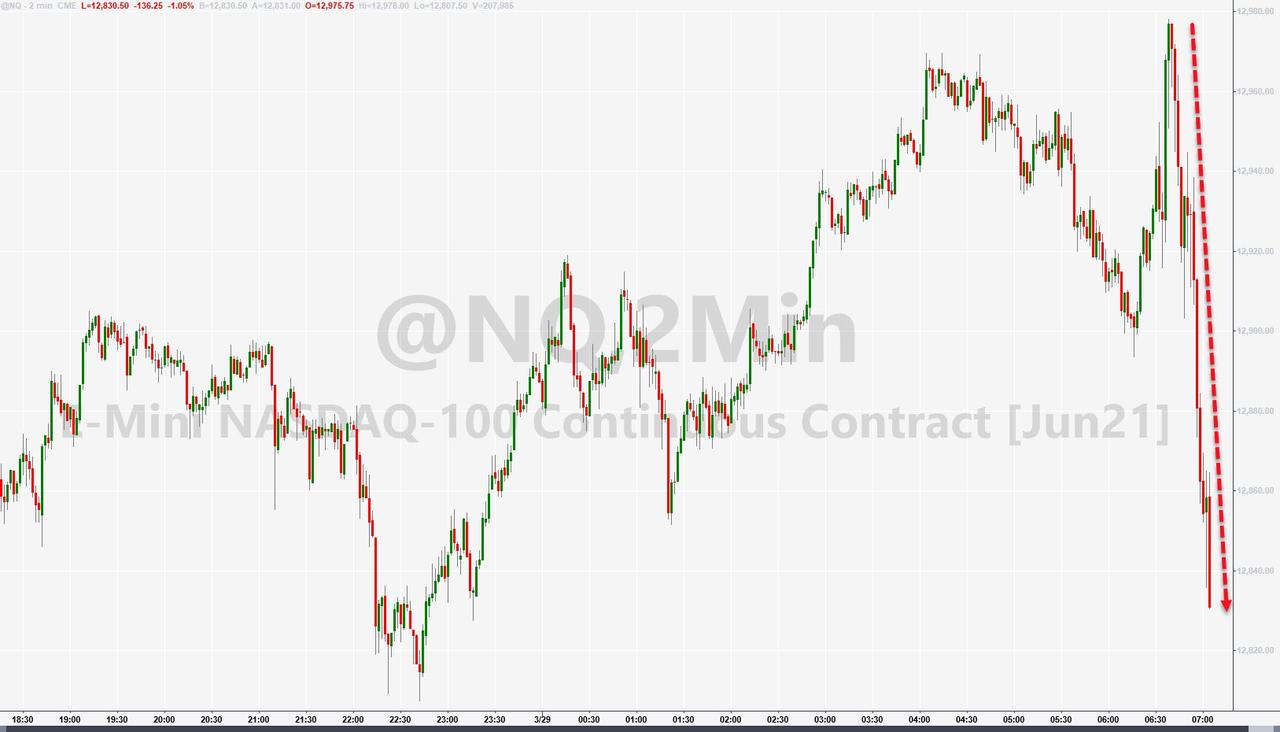
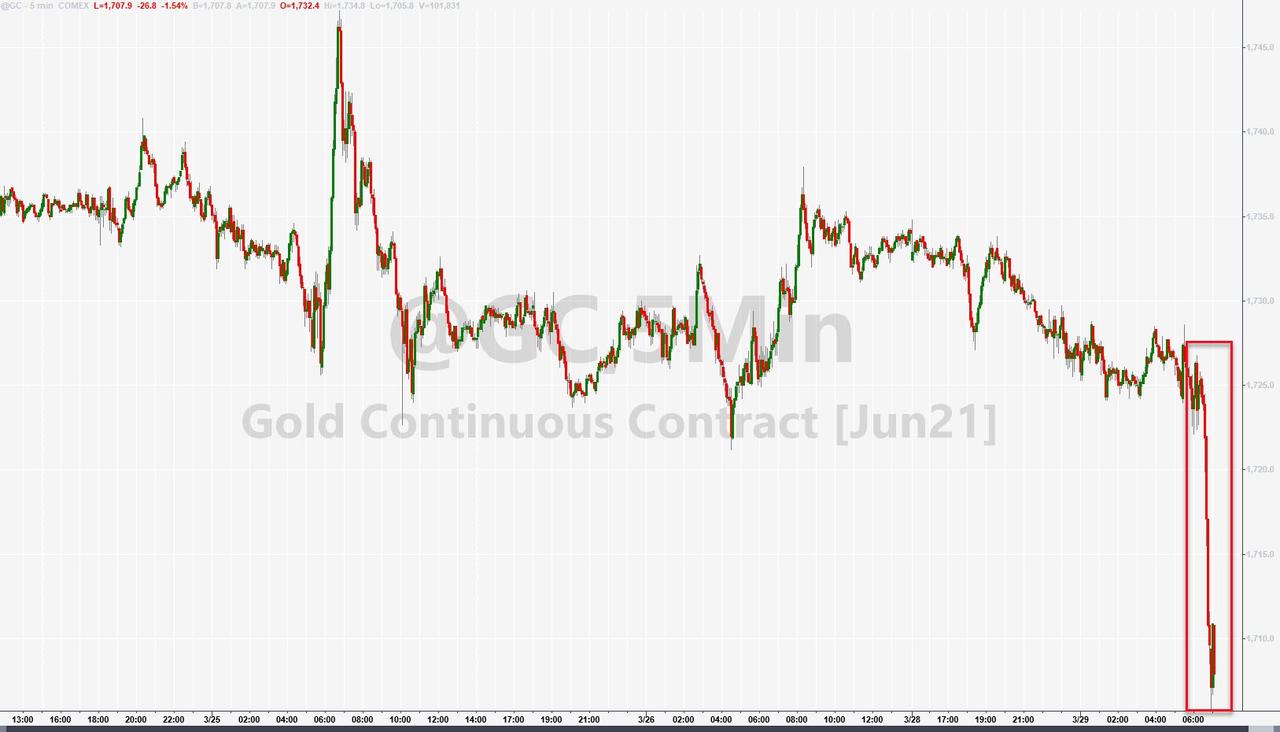
That appears to be the plan this morning as everything is being sold amid the Archegos anxiety in a reach for liquidity.

Big tech is getting hammered…

Bonds are being dumped…

And bullion is puking back near $1700…

And where it stops, nobody knows.

Tyler Durden
Mon, 03/29/2021 – 10:06

via ZeroHedge News https://ift.tt/3m2sM2B Tyler Durden

Watch Live: Derek Chauvin Murder Trial Begins In Minneapolis 

Watch Live: Derek Chauvin Murder Trial Begins In Minneapolis 

After a laborious and often fraught jury selection process (where many potential jurors were dropped for expressing concerns about being targeted by left-wing “activists” and for other complications related to pre-trial publicity, including a $27MM civil settlement between the city and the Floyd family), the trial of former Minneapolis Police Officer Derek Chauvin is set to begin Monday morning at 1000ET (or 0900CT).

The proceedings will be broadcast live on CourtTV, and interested parties can watch it live below:

Lawyer and legal analyst Jonathan Turley has argued that the stakes in the Chauvin trial are extremely high, and not only because the former officer, if convicted, could face life in prison (he’s facing charges of second-degree and third-degree murder, along with manslaughter). Turley explained that “the domino effect” of a Chauvin acquittal would likely lead to charges against three other officers accused of abetting Floyd’s murder being dropped.

The prosecutors constructed the cases against Chauvin, Alexander Kueng, Thomas Lane and Tou Thao like an upside-down pyramid resting on a conviction of Chauvin. The main charges against Kueng, Land and Thao are as aiders and abettors to Chauvin’s alleged murder or manslaughter. If Chauvin is acquitted or the jury hangs on the charges, the prosecution of the other three officers becomes extremely difficult.

Prosecutors are aware of the instability and vulnerability of that strategy. For that reason, they fought to restore a third-degree murder claim to give the jury another option for a compromise verdict between the second-degree murder claim and the second-degree manslaughter case. In a case that is best suited for a manslaughter claim, there is a risk of overcharging a case that undermines the narrative of the prosecution. The second-degree murder claim does not require intent to murder Floyd but still requires a murder committed in the course of another felony. The third-degree murder charge requires a showing that Chauvin perpetrated “an act eminently dangerous to others and evincing a depraved mind, without regard for human life.“

There are some very significant challenges for the prosecution, even with the infamous videotape of Chauvin with his knee on Floyd’s neck for more than 9 minutes. There is a palpable fear that even mentioning countervailing defense arguments will trigger claims of racism or insensitivity to police abuse. However, the jury must unanimously convict on the basis of beyond a reasonable doubt after considering a variety of such arguments, including:

  • When called to the scene due to Floyd allegedly passing counterfeit money, Floyd denied using drugs but later said he was “hooping,” or taking drugs.
  • The autopsy did not conclude that Floyd died from asphyxiation (though a family pathologist made that finding). Rather, it found “cardiopulmonary arrest while being restrained by law enforcement officer(s).” The state’s criminal complaint against Chauvin said the autopsy “revealed no physical findings that support a diagnosis of traumatic asphyxia or strangulation. Mr. Floyd had underlying health conditions including coronary artery disease and hypertensive heart disease.” He also was COVID-19 positive.
  • Andrew Baker, Hennepin County’s chief medical examiner, strongly suggestedthat the primary cause was a huge amount of fentanyl in Floyd’s system: “Fentanyl at 11 ng/ml — this is higher than (a) chronic pain patient. If he were found dead at home alone & no other apparent causes, this could be acceptable to call an OD (overdose). Deaths have been certified w/levels of 3.” Baker also told investigators that the autopsy revealed no physical evidence suggesting Floyd died of asphyxiation.
  • The toxicology report on Floyd’s blood also noted that “in fatalities from fentanyl, blood concentrations are variable and have been reported as low as 3 ng/ml.” Floyd had almost four times the level of fentanyl considered potentially lethal.
  • Floyd notably repeatedly said that he could not breathe while sitting in the police cruiser and before he was ever restrained on the ground. That is consistent with the level of fentanyl in his system that can cause “slowed or stopped breathing.”
  • Finally, the restraint using an officer’s knee on an uncooperative suspect was part of the training of officers, and jurors will watch training videotapes employing the same type of restraint as official policy.

For readers who haven’t been closely following the case, Liberty Nation News has a breakdown of the key players:

  • The prosecution is led by Keith Ellison, the Minnesota attorney general, who was chosen as a special prosecutor by the governor, Tim Walz. Both are members of the Democratic-Farmer-Labor Party. Mr. Ellison, who is not highly regarded as a homicide prosecutor, went out and hired a Minnesota dream team to make sure Chauvin gets convicted. His lead lawyer so far has been Steven Schleicher, who Ellison hired out of private practice, and he will likely make the state’s opening arguments. Ellison has been in court during jury selection but has so far kept silent.
  • Eric Nelson represents Derek Chauvin. He has experience working for police officer defendants and for the police union. Mr. Chauvin’s defense is being funded through that union, the Minnesota Police and Peace Officers Association’s legal defense fund. According to the Associated Press: “Though he was fired soon after Floyd’s death, Chauvin earned the right to representation through his years as a member of his local union, the Minneapolis Police Federation.”
  • Calling balls and strikes will be Hennepin County Judge Peter Cahill. Judge Cahill has largely shown himself to be a fair jurist in this case so far. While he denied a defense request to move or delay the trial, he has given the defense many extra juror strikes during selection. He ordered cameras be allowed to broadcast the trial over a prosecution objection. Cahill has served as a prosecutor and a defense attorney during his long career.
  • The process so far has not been light on drama. Jury selection almost went off the rails due to the announcement of a $27 million settlement paid by the city of Minneapolis to attorney Ben Crump and George Floyd’s family for his wrongful death. Jurors who were previously selected had to be re-examined after the settlement news broke, and two had to be dismissed. Numerous prospective jurors had to be eliminated from consideration due to this pretrial publicity. Judge Cahill and the trial lawyers eventually selected a panel, with 15 jurors chosen as acceptable. The trial will have 12 jurors and two alternates. The judge said he would send one approved juror home on Monday if all showed up for trial and impanel the rest. The current group of 15 breaks down as “six men and nine women; nine of the jurors are white, four are Black, and two are multiracial,” according to the court.

Finally, USAToday reports that the county government center where the courthouse is located has been surrounded by fencing and barricades to keep protesters at a distance. Numerous vigils and demonstrations are being held Monday, including one where Rev. Al Sharpton gathered supporters ahead of the trial to denounce Chauvin and call for a guilty verdict in the case, insinuating that justice would not be done otherwise.

Tyler Durden
Mon, 03/29/2021 – 09:53

via ZeroHedge News https://ift.tt/3w6uXGZ Tyler Durden