Baltimore City No Longer Prosecutes Prostitution, Drug Possessions 

Baltimore City No Longer Prosecutes Prostitution, Drug Possessions 

A little more than a year ago, right around the time the virus pandemic lockdowns began, Baltimore City State’s Attorney Marilyn Mosby halted prosecuting minor traffic violations, prostitution, drug possession, and other minor offenses, a move directed at preventing outbreaks of COVID-19 in regional jails, according to local news channel WBAL

The easing of Baltimore’s policing resulted in a miracle: crime in nearly every category decreased, confirming what Mosby and some criminal justice experts argued for years: rough policing doesn’t work to prevent more violent crimes. 

On Friday, Mosby held a press conference in her first public appearance since a lien for nonpayment of back taxes was placed on her home. She told reporters they could speak to her attorney about those issues. She went on to say putting people behind bars for petty offenses isn’t working: 

“A year ago, we underwent an experiment in Baltimore… What we learned in that year, and it’s so incredibly exciting, is there’s no public safety value in prosecuting these low-level offenses. These low-level offenses were being, and have been, discriminately enforced against Black and Brown people.

“The era of ‘tough on crime’ prosecutors is over in Baltimore. We have to rebuild the community’s trust in the criminal justice system and that’s what we will do, so we can focus on violent crime.” 

And with that success, she said, her “COVID policies will now become permanent. And America’s failed war on drugs and users across the metro area is “over.” 

This is a complete shift in how the city handles crime. In the last 12 months, violent crime is down 20%, and property crime has fallen 36%. Homicides were a tad bit lower but remained some of the highest in the country on a per capita basis. 

Mosby asked public health researchers at Johns Hopkins University to review the crime data over the last year. What they noticed was a dramatic reduction in calls to police concerning drugs and prostitution. 

“Clearly, the data suggest there is no public safety value in prosecuting low-level offenses,” Mosby said at the news conference.

Hopkins researchers also found 1,431 people who had charges or warrants were immediately dismissed at the beginning of the pandemic. Only 5 out of 1,431, or .0003%, were rearrested. 

Susan G. Sherman, a behavioral health professor at Johns Hopkins, told WaPo that data on repeat offenders with only five reentered the system is “pretty unbelievable.” 

“In a world where drug decriminalization is happening around the country, the impact on the community is important,” Sherman said, and Mosby “really values having an understanding of these impacts.”

“When it comes to violent offenses, carjackings, murders, armed robberies, attempted murders, and drug distribution, we are still prosecuting you. The police will still arrest you. But on these low-level crimes, we are no longer using our limited resources on these low-level offenses,” Mosby said.

A year ago, Baltimore underwent a grand experiment on policing, and perhaps it’s working. Here’s a former police officer’s take on all of this: 

“Crime is a symptom of the disease of our society. For years, we’ve asked the police to address this disease by locking people up. We merely addressed the symptom. Not the disease,” said retired Baltimore police major Mike Hillard, of Law Enforcement Action Partnership.

Mosby’s pandemic social experiment has so far resulted in possibly a new direction for the city. But whether the experiment in Baltimore can be replicated elsewhere remains to be seen. Other liberal cities have tried this and miserably failed, resulting in soaring crime all around.

San Fransico is one of those liberal cities that has defunded police and eased rules on petty crimes but has seen an explosion of all sorts of violent and non-violent crimes. Murders are up, people are quickly exiting the metro area, and as we come to find out more recently, businesses are leaving too. 

Due to rampant shoplifting, nearly a dozen Bay Area Walgreens have closed up shop. The crime is so bad in the metro area that even TV reporters are being robbed

As for Baltimore, it remains to be seen if crime in general will stay low given Mosby’s actions as pandemic restrictions are being lifted, warmer weather is ahead, and the opioid crisis in the city continues to rage on. 

Tyler Durden
Sun, 03/28/2021 – 23:25

via ZeroHedge News https://ift.tt/3lXRcKL Tyler Durden
Pennsylvania Voters Can Approve Constitutional Amendment To Limit Governor’s Emergency Powers

Earlier this month, I blogged about legislation in New York that would limit the Governor’s emergency powers. In May, the voters of Pennsylvania will have an opportunity to claw back the executive’s authority. Jennifer Stefano summarizes the measures in the Wall Street Journal:

During the initial 90 days [starting in March 2020], the Legislature sent Mr. Wolf seven bills tailored to reopen certain businesses safely and establish consistent Covid-19 mitigation standards. He vetoed them all. Last summer, the Pennsylvania Supreme Court, which is dominated 5-2 by Democrats, sided with the governor and allowed him to veto the Legislature’s attempt to rescind his special powers and claw back control over emergency disaster declarations. Mr. Wolf has renewed his initial emergency declaration four times, most recently on Feb. 19.

Now the General Assembly is asking voters to approve two ballot measures that would return control over emergency declarations to the people’s representatives in the legislature. The first would limit the length of an emergency disaster to 21 days, down from 90. After that, only a joint resolution by the legislature could extend the proclamation. The second measure would amend the Pennsylvania Constitution to allow the General Assembly to pass a resolution, which the governor cannot veto, by a simple majority to extend or terminate the governor’s emergency declaration.” Should these ballot measures succeed, Pennsylvanians will have completed a rare reversal of ever-expanding executive power.

As with most absolute grants of power, Governor Wolf exercised this power arbitrarily. In September 2020, the U.S. District Court for the Western District of Pennsylvania found the Governor’s determination of what was, and was not “life-sustaining” to be irrational:

The record shows that the Governor’s advisory team, which designated the Business Plaintiffs and countless other businesses throughout the Commonwealth as “non-life-sustaining” and, thereby, closing them, did so with no set policy as to the designation and, indeed, without ever formulating a set definition for “life-sustaining” and, conversely “non-life-sustaining.” The terms “life-sustaining” and “non-life-sustaining” relative to businesses are not defined in any Pennsylvania statute or regulation. . . . The record demonstrates that the policy team’s unilateral determination as to which classes of businesses would be classified as “life-sustaining” was never formalized and the team never settled on a specific definition of “life-sustaining.” COUNTY OF BUTLER, et al, Plaintiffs, v. THOMAS W. WOLF, et al, Defendants., No. 2:20-CV-677, 2020 WL 5510690 (W.D. Pa. Sept. 14, 2020).

The Secretary of State has posted the text of the measures here:

Shall the Pennsylvania Constitution be amended to change existing law and increase the power of the General Assembly to unilaterally terminate or extend a disaster emergency declaration—and the powers of Commonwealth agencies to address the disaster regardless of its severity pursuant to that declaration—through passing a concurrent resolution by simple majority, thereby removing the existing check and balance of presenting a resolution to the Governor for approval or disapproval?

Shall the Pennsylvania Constitution be amended to change existing law so that: a disaster emergency declaration will expire automatically after 21 days, regardless of the severity of the emergency, unless the General Assembly takes action to extend the disaster emergency; the Governor may not declare a new disaster emergency to respond to the dangers facing the Commonwealth unless the General Assembly passes a concurrent resolution; the General Assembly enacts new laws for disaster management?

Ballotpedia offers a summary of these measures.

from Latest – Reason.com https://ift.tt/31sZXD6
via IFTTT

Congress, In Five-Hour Hearing, Demands Tech CEOs Censor The Internet Even More Aggressively: Greenwald

Congress, In Five-Hour Hearing, Demands Tech CEOs Censor The Internet Even More Aggressively: Greenwald

Authored by Glenn Greenwald via greenwald.substack.com,

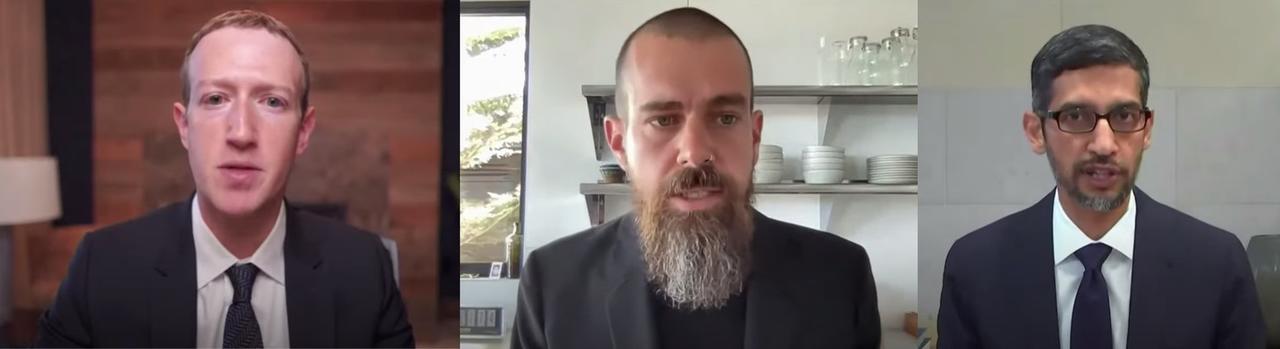
Over the course of five-plus hours on Thursday, a House Committee along with two subcommittees badgered three tech CEOs, repeatedly demanding that they censor more political content from their platforms and vowing legislative retaliation if they fail to comply. The hearing — convened by the House Energy and Commerce Committee’s Chair Rep. Frank Pallone, Jr. (D-NJ), and the two Chairs of its Subcommittees, Mike Doyle (D-PA) and Jan Schakowsky (D-IL) — was one of the most stunning displays of the growing authoritarian effort in Congress to commandeer the control which these companies wield over political discourse for their own political interests and purposes.

Facebook CEO Mark Zuckerberg, Twitter CEO Jack Dorsey, and Google/Alphabet CEO Sundar Pichai testify before the House Energy and Commerce Committee, Mar. 25, 2021

As I noted when I reported last month on the scheduling of this hearing, this was “the third time in less than five months that the U.S. Congress has summoned the CEOs of social media companies to appear before them with the explicit intent to pressure and coerce them to censor more content from their platforms.” The bulk of Thursday’s lengthy hearing consisted of one Democratic member after the next complaining that Facebook CEO Mark Zuckerberg, Google/Alphabet CEO Sundar Pichai and Twitter CEO Jack Dorsey have failed in their duties to censor political voices and ideological content that these elected officials regard as adversarial or harmful, accompanied by threats that legislative punishment (including possible revocation of Section 230 immunity) is imminent in order to force compliance (Section 230 is the provision of the 1996 Communications Decency Act that shields internet companies from liability for content posted by their users).

Republican members largely confined their grievances to the opposite concern: that these social media giants were excessively silencing conservative voices in order to promote a liberal political agenda (that complaint is only partially true: a good amount of online censorship, like growing law enforcement domestic monitoring generally, focuses on all anti-establishment ideologies, not just the right-wing variant). This editorial censoring, many Republicans insisted, rendered the tech companies’ Section 230 immunity obsolete, since they are now acting as publishers rather than mere neutral transmitters of information. Some Republicans did join with Democrats in demanding greater censorship, though typically in the name of protecting children from mental health disorders and predators rather than ideological conformity.

As they have done in prior hearings, both Zuckerberg and Pichai spoke like the super-scripted, programmed automatons that they are, eager to please their Congressional overseers (though they did periodically issue what should have been unnecessary warnings that excessive “content moderation” can cripple free political discourse). Dorsey, by contrast, seemed at the end of his line of patience and tolerance for vapid, moronic censorship demands, and — sitting in a kitchen in front of a pile of plates and glasses — he, refreshingly, barely bothered to hide that indifference. At one point, he flatly stated in response to demands that Twitter do more to remove “disinformation”: “I don’t think we should be the arbiters of truth and I don’t think the government should be either.”

Zuckerberg in particular has minimal capacity to communicate the way human beings naturally do. The Facebook CEO was obviously instructed by a team of public speaking consultants that it is customary to address members of the Committee as “Congressman” or “Congresswoman.” He thus began literally every answer he gave — even in rapid back and forth questions — with that word. He just refused to move his mouth without doing that — for five hours (though, in fairness, the questioning of Zuckerberg was often absurd and unreasonable). His brain permits no discretion to deviate from his script no matter how appropriate. For every question directed to him, he paused for several seconds, had his internal algorithms search for the relevant place in the metaphorical cassette inserted in a hidden box in his back, uttered the word “Congressman” or “Congresswoman,” stopped for several more seconds to search for the next applicable spot in the spine-cassette, and then proceeded unblinkingly to recite the words slowly transmitted into his neurons. One could practically see the gears in his head painfully churning as the cassette rewound or fast-forwarded. This tortuous ritual likely consumed roughly thirty percent of the hearing time. I’ve never seen members of Congress from across the ideological spectrum so united as they were by visceral contempt for Zuckerberg’s non-human comportment:

But it is vital not to lose sight of how truly despotic hearings like this are. It is easy to overlook because we have become so accustomed to political leaders successfully demanding that social media companies censor the internet in accordance with their whims. Recall that Parler, at the time it was the most-downloaded app in the country, was removed in January from the Apple and Google Play Stores and then denied internet service by Amazon, only after two very prominent Democratic House members publicly demanded this. At the last pro-censorship hearing convened by Congress, Sen. Ed Markey (D-MA) explicitly declared that the Democrats’ grievance is not that these companies are censoring too much but rather not enough. One Democrat after the next at Thursday’s hearing described all the content on the internet they want gone: or else. Many of them said this explicitly.

At one point toward the end of the hearing, Rep. Lizzie Fletcher (D-TX), in the context of the January 6 riot, actually suggested that the government should create a list of groups they unilaterally deem to be “domestic terror organizations” and then provide it to tech companies as guidance for what discussions they should “track and remove”: in other words, treat these groups the same was as ISIS and Al Qaeda.

Words cannot convey how chilling and authoritarian this all is: watching government officials, hour after hour, demand censorship of political speech and threaten punishment for failures to obey. As I detailed last month, the U.S. Supreme Court has repeatedly ruled that the state violates the First Amendment’s free speech guarantee when they coerce private actors to censor for them — exactly the tyrannical goal to which these hearings are singularly devoted.

There are genuine problems posed by Silicon Valley monopoly power. Monopolies are a threat to both political freedom and competition, which is why economists of most ideological persuasions have long urged the need to prevent them. There is some encouraging legislation pending in Congress with bipartisan support (including in the House Antitrust Subcommittee before which I testified several weeks ago) that would make meaningful and productive strides toward diluting the unaccountable and undemocratic power these monopolies wield over our political and cultural lives. If these hearings were about substantively considering those antitrust measures, they would be meritorious.

But that is hard and difficult work and that is not what these hearings are about. They want the worst of all worlds: to maintain Silicon Valley monopoly power but transfer the immense, menacing power to police our discourse from those companies into the hands of the Democratic-controlled Congress and Executive Branch.

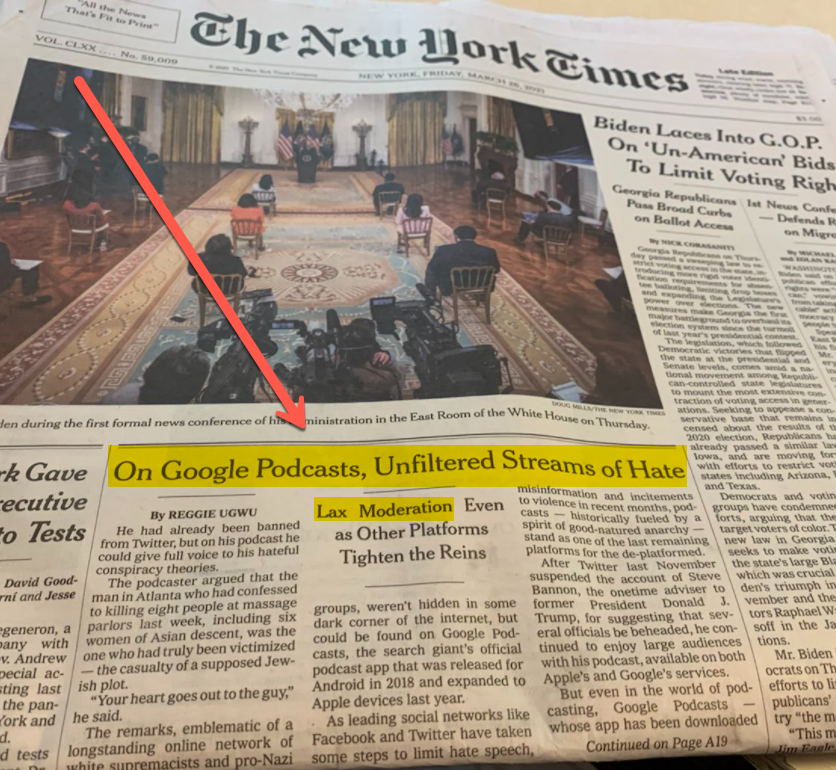
And as I have repeatedly documented, it is not just Democratic politicians agitating for greater political censorship but also their liberal journalistic allies, who cannot tolerate that there may be any places on the internet that they cannot control. That is the petty wannabe-despot mentality that has driven them to police the “unfettered” discussions on the relatively new conversation app Clubhouse, and escalate their attempts to have writers they dislike removed from Substack. Just today, The New York Times warns, on its front page, that there are “unfiltered” discussions taking place on Google-enabled podcasts:

New York Times front page, Mar. 26, 2021

We are taught from childhood that a defining hallmark of repressive regimes is that political officials wield power to silence ideas and people they dislike, and that, conversely, what makes the U.S. a “free” society is the guarantee that American leaders are barred from doing so. It is impossible to reconcile that claim with what happened in that House hearing room over the course of five hours on Thursday.

Tyler Durden
Sun, 03/28/2021 – 23:00

via ZeroHedge News https://ift.tt/3ddo4el Tyler Durden

Pennsylvania Voters Can Approve Constitutional Amendment To Limit Governor’s Emergency Powers

Earlier this month, I blogged about legislation in New York that would limit the Governor’s emergency powers. In May, the voters of Pennsylvania will have an opportunity to claw back the executive’s authority. Jennifer Stefano summarizes the measures in the Wall Street Journal:

During the initial 90 days [starting in March 2020], the Legislature sent Mr. Wolf seven bills tailored to reopen certain businesses safely and establish consistent Covid-19 mitigation standards. He vetoed them all. Last summer, the Pennsylvania Supreme Court, which is dominated 5-2 by Democrats, sided with the governor and allowed him to veto the Legislature’s attempt to rescind his special powers and claw back control over emergency disaster declarations. Mr. Wolf has renewed his initial emergency declaration four times, most recently on Feb. 19.

Now the General Assembly is asking voters to approve two ballot measures that would return control over emergency declarations to the people’s representatives in the legislature. The first would limit the length of an emergency disaster to 21 days, down from 90. After that, only a joint resolution by the legislature could extend the proclamation. The second measure would amend the Pennsylvania Constitution to allow the General Assembly to pass a resolution, which the governor cannot veto, by a simple majority to extend or terminate the governor’s emergency declaration.” Should these ballot measures succeed, Pennsylvanians will have completed a rare reversal of ever-expanding executive power.

As with most absolute grants of power, Governor Wolf exercised this power arbitrarily. In September 2020, the U.S. District Court for the Western District of Pennsylvania found the Governor’s determination of what was, and was not “life-sustaining” to be irrational:

The record shows that the Governor’s advisory team, which designated the Business Plaintiffs and countless other businesses throughout the Commonwealth as “non-life-sustaining” and, thereby, closing them, did so with no set policy as to the designation and, indeed, without ever formulating a set definition for “life-sustaining” and, conversely “non-life-sustaining.” The terms “life-sustaining” and “non-life-sustaining” relative to businesses are not defined in any Pennsylvania statute or regulation. . . . The record demonstrates that the policy team’s unilateral determination as to which classes of businesses would be classified as “life-sustaining” was never formalized and the team never settled on a specific definition of “life-sustaining.” COUNTY OF BUTLER, et al, Plaintiffs, v. THOMAS W. WOLF, et al, Defendants., No. 2:20-CV-677, 2020 WL 5510690 (W.D. Pa. Sept. 14, 2020).

The Secretary of State has posted the text of the measures here:

Shall the Pennsylvania Constitution be amended to change existing law and increase the power of the General Assembly to unilaterally terminate or extend a disaster emergency declaration—and the powers of Commonwealth agencies to address the disaster regardless of its severity pursuant to that declaration—through passing a concurrent resolution by simple majority, thereby removing the existing check and balance of presenting a resolution to the Governor for approval or disapproval?

Shall the Pennsylvania Constitution be amended to change existing law so that: a disaster emergency declaration will expire automatically after 21 days, regardless of the severity of the emergency, unless the General Assembly takes action to extend the disaster emergency; the Governor may not declare a new disaster emergency to respond to the dangers facing the Commonwealth unless the General Assembly passes a concurrent resolution; the General Assembly enacts new laws for disaster management?

Ballotpedia offers a summary of these measures.

from Latest – Reason.com https://ift.tt/31sZXD6
via IFTTT

Hackers Simultaneously Attack Australian Parliament, TV Network

Hackers Simultaneously Attack Australian Parliament, TV Network

Hackers were able to disrupt live broadcasts from an Australian news channel at the same time Parliament’s House email system was taken offline for a concurrent breach, according to Sky News.

As a result of the attack, Channel Nine’s Sunday morning news program – “Weekend Today” – did not air, along with the station’s 5pm news show. Future programming is expected to progress on schedule. Channel Nine is investigating whether the hack was a matter of “criminal sabotage or the work of a foreign nation,” according to the report.

Meanwhile, the Australian government was forced to cut access to IT and emails at Parliament House via an external provider was compromised.

Andrew Hastie in Canberra. Picture: Gary RamageSource:News Corp Australia

The issue relates to an external provider, and once the issue was detected the connection to government systems was cut immediately as a precaution,” said Andrew Hastie, assistant minister of defense, in a statement to News.com.au. “Cyber security is a team effort and a shared responsibility. It is vital that Australian businesses and organisations are alert to this threat and take the necessary steps to ensure our digital sovereignty.”

Nine Entertainment, the broadcaster’s parent company, which also owns the Sydney Morning Herald and The Age newspapers, confirmed that it had been targeted by an attack, but it is unclear whether the incidents are linked.

In its statement Channel Nine said: “A cyber attack on our systems has disrupted live broadcasts today however, we have put processes in place to ensure we’re able to resume our normal broadcast schedule.” –Sky News

Meanwhile all parliamentary staff received a Sunday night email warning over a potential messaging scam which hit senior ministers – including Finance Minister Simon Birmingham. According to News.com.au, it is unknown if the parliamentary issue and the messaging scam are related.

The AFP is aware of a messaging scam currently targeting Commonwealth Parliamentarians and Australian High Office Holders, which presents as a request from a trusted colleague,” reads the email.

“The scam originates over WhatsApp and asks recipients to download the Telegram application for the purposes of further communication. The message also asks for the recipient to forward the Two Factor Authentication (2FA) codes to the sender. Doing this will allow the sender to ‘take over’ the Telegram account. The request is not genuine and may be used as an attempt to obtain information from you or your phone.”

“If you receive a message claiming to be from an associate which asks you to download a new messaging platform – for example – the Telegram application – do not download it.”

Tyler Durden
Sun, 03/28/2021 – 22:35

via ZeroHedge News https://ift.tt/3rqvOyM Tyler Durden

US Military Launches Task Force To Fight ‘Information War’ Against China

US Military Launches Task Force To Fight ‘Information War’ Against China

Authored by Dave DeCamp via AntiWar.com,

The head of US Special Operations Command (SOCOM) told the Senate Armed Services Committee on Thursday that the command launched a new task force to focus on information operations to counter China in the Pacific.

According to a report from C4ISRNET, the task force, known as the Joint Task Force Indo-Pacific team, will  focus “on information and influence operations in the Pacific theater.” Gen. Richard D. Clarke, the commander of SOCOM, said the task force will work with “like-minded partners” in the region.

Image source: US Navy/Flickr

“We actually are able to tamp down some of the disinformation that they [China] continuously sow,” Clarke said. It’s not clear exactly what this new task force will be doing, but the C4ISRNET report suggested that offensive cyber operations could be part of the influence campaign.

Gen. Paul Nakasone, the head of US Cyber Command, also spoke with senators on Thursday and pointed to offensive cyber operations the command took prior to the 2020 election that he claims thwarted election interference.

“The idea of operating outside of the United States, being able to both enable our partners with information and act when authorized. This is an active approach to our adversaries,” Nakasone said. “It’s been most effective as we’ve seen with the 2018 and 2020 elections with adversaries attempting to influence us, attempting to interfere but not being able to do that.”

Gen. Clarke also spoke of information operations conducted under SOCOM’s Special Operations Forces, specifically a group known as Military Information Support Operations professionals that are deployed at embassies around the world.

“By working closely with those partners to ensure that our adversaries, our competitors are not getting that free pass and to recognize what is truth from fiction and continue to highlight that to using our intel communities is critical,” he said.

The Biden administration has made it clear that countering Beijing is its top foreign policy priority. The task force shows that Washington’s campaign against Chinese influence will be played out in many theaters.

Tyler Durden
Sun, 03/28/2021 – 22:10

via ZeroHedge News https://ift.tt/3dgnQDb Tyler Durden

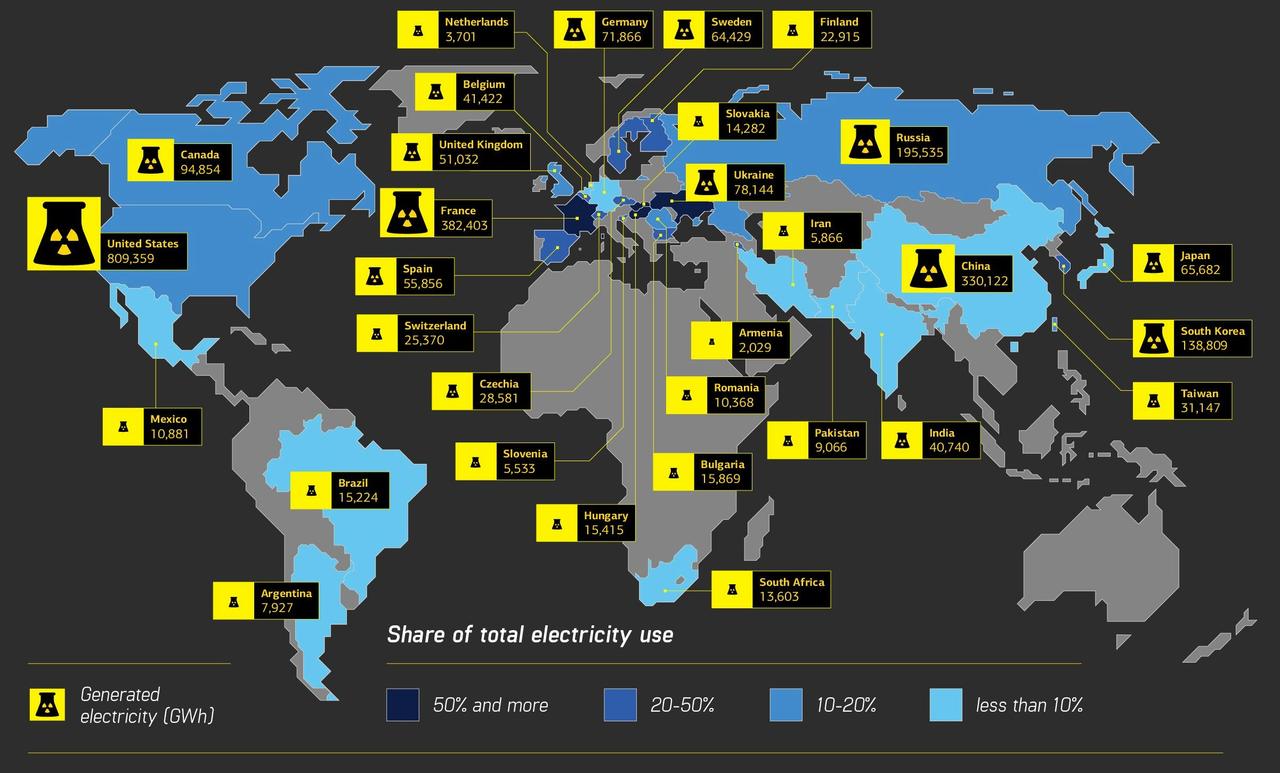
Nuclear Energy In The World 10 Years After Fukushima

Nuclear Energy In The World 10 Years After Fukushima

The March 2011 Fukushima disaster was the most severe nuclear accident since Chernobyl.

Its terrifying consequences led some countries to reconsider their attitude to nuclear energy with states like Germany deciding to phase out the technology.

However, elsewhere, nuclear power continues to be a major source of electricity supply.

Source

The United States, with 96 commercial reactors, remains the world’s largest producer of commercial nuclear power.

As Bisconti Research national poll, held in June 20202, revealed that 60% of respondents favored the use of nuclear energy, with only 25% opposing it.

Tyler Durden
Sun, 03/28/2021 – 21:45

via ZeroHedge News https://ift.tt/3sydgOz Tyler Durden

Hedge Fund CIO: “Sinners Have Become The System And Will Be Eternally Supported By Policy”

Hedge Fund CIO: “Sinners Have Become The System And Will Be Eternally Supported By Policy”

By Eric Peters, CIO of One River Asset Management

Sinners

“At some point on the current path, policy makers will attempt to normalize,” said the CIO. We were discussing sequencing, recognizing its centrality to macro trading, investing. “They will start by attempting to taper Fed purchases,” he said, the US central bank currently creating $120bln per month and using it to purchase debt. “Perhaps they signal that they intend to lower the deficit.” But of course, that would only be after they first lift the deficit to fund America’s coming $3trln Recovery Plan. “And at that point, the clock starts ticking,” he said.

“Even if one thinks the current policy path inevitably leads to a substantial inflation, there are enough orthodox policy makers that we can be confident they’ll try to avert that outcome,” continued the same CIO. “So what we need to figure out is how far they’ll let stocks and inflation run before they’re compelled to taper,” he said. “And then we’ll need to judge how long it will take for the economy and/or market to take a deep dive.” Not long. “When they then quickly pivot and aggressively ease, their predicament will be clear for all to see.”

“Given the size of the stimulus and deficits at this stage, if policy makers are seen to be unable to normalize in any material way, that will be the stage in the sequencing when the great reset begins,” explained the same CIO. “Markets at that point will move very fast.” Maintaining calm given current policy settings requires inflation expectations to remain anchored and investors to believe policy can be normalized. “I am often a bit early on the very big trades, but this whole sequence appears sure to play out over the coming three years.”
 
“The biggest macro change in the past 50yrs was the taming of inflation,” said Marco Polo, my favorite macro modeler. “Paul Volcker was a byproduct of the political choice to anchor inflation in a post-gold-standard world. It required great resolve, and management of a domestic financial crisis induced by the high interest rates needed to get the job done. Don Kohn observed that the Volcker master lesson ‘was to protect the system but not the sinner – and that required facts, analysis, and flexibility.’ Volcker was the first Fed Chair who required a personal bodyguard. The Hunt brothers (silver), Penn Square and Continental Illinois (oil) and the entire Farm Credit System were all strained by his decisions and Volcker was the first Fed Chair who required a personal bodyguard. The resolve to tackling inflation cannot be overstated.”

“The virtuous cycle of declining government bond yields in the past three decades that followed Volcker’s attack on inflation has been an overwhelmingly positive impulse to financial portfolios,” explained Marco Polo. “Government bonds played a large role, directly or indirectly through other assets that benefited from lower bond yields. To illustrate the point, I built a simple dynamic portfolio of stocks, bonds, the US dollar, and commodities. Allocations to those asset classes are selected depending on the state of the macro economy.”

“When things are good and getting better, asset allocation is split between stocks and commodities; bonds are the asset allocation when things are good but weakening; long US dollar exposure is deployed in downturns; stocks and foreign currency allocations are the benchmark in early upturns,” continued Marco. “The states of the macro economy are probability weighted and rebalanced over time to arrive at a balanced portfolio. The annualized monthly return of such an approach since Sep 1981 is +7.5% with volatility of less than 6%. Not bad for a passive, blunt approach.”
 
“Let’s include a long-bond overlay to the asset allocation in all macro states so that the average gross portfolio exposure is 2x,” said Marco. “Think of this leverage as a move out the risk spectrum. The historical performance jumps to +11.5% and the Sharpe rises to more than 1.5x. Of course, asset managers did not initially have the foresight to implement such a portfolio nor did financial intermediaries have the risk appetite to provide short-term funding. But with time and reinforcement from policy actions that tell us sinners have now become the system and will thus be eternally supported by policy, portfolios have pushed far out the risk spectrum taking long duration exposure directly or indirectly. It is all the same trade.”

“Recent correlations reinforce the point. The US TIPs and Tesla daily correlation is nearly 30% this year. TIPs act like a low-beta play on highly valued growth companies. Both are bets on duration. The difference today from the past is today’s low starting point of bond yields. At steeply negative real yields and very low nominals, the role of bonds in a portfolio becomes heavily challenged. German bund performance in the Mar 2020 period is also a good reminder. Bund prices rose sharply over 7wks during the pandemic and reversed that move in 10-days.”

“Bunds provided no protection to slower-moving asset allocators. Ten-year German real yields now trade -1.75%. They have no value as an investment, nor as a risk-mitigator,” said Marco. “Asset managers have no choice but to explore alternatives to bonds and find risk mitigators to long duration exposure. And official institutions have little choice but to lean against any undesired rise in ‘risk free’ yields. Everyone is a sinner now, the system is held hostage. After all, 44% of outstanding Treasury securities are held between the Fed and foreign official institutions. And at any wobble they buy more.”

Tyler Durden
Sun, 03/28/2021 – 21:20

via ZeroHedge News https://ift.tt/3rrC0Xb Tyler Durden

Archegos Fallout Begins: Nomura Crashes 15% After Reporting Record $2BN Loss From “Transactions With US Client”

Archegos Fallout Begins: Nomura Crashes 15% After Reporting Record $2BN Loss From “Transactions With US Client”

Back in May 2016, Japanese mega-bank Nomura, announced that it had suffered its biggest-ever loss in history (of a rather tame by Western standards $40 million) from a single client, and which it then quickly blamed on an “incompetent” bond trader.  Fast forward to today, when Nomura just suffered a far, far greater loss from a single client, this one is anything but boring.

Early on Monday local time, Nomura Holdings said it may have incurred a “significant loss” arising from transactions with a U.S. client.
The estimated amount of the claim against the client is about $2 billion based on market prices as of March 26, the Japanese brokerage said in a statement. The estimate is “subject to change depending on unwinding of the transactions and fluctuations in market prices.”

Nomura is currently evaluating the extent of the possible loss and the impact it could have on its consolidated financial results.
The Japanese brokerage also canceled plans to sell dollar-denominated bonds.

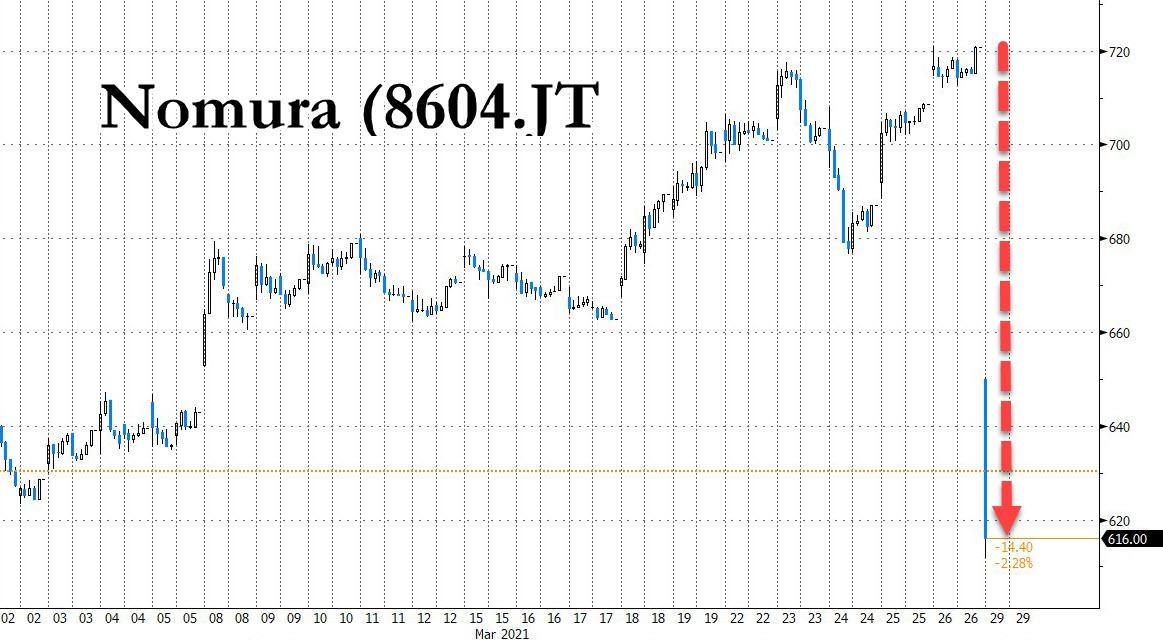
The news, incomplete as it may be, was enough to send Nomura stock crashing 15%, wiping out all March gains, and the biggest one day drop in a decade.

While it wasn’t immediately clear if Nomura’s loss is linked to the spectacular margin call at Tiger Cub Bill Hwang’s Archegos Capital which we noted earlier (accurately noting that the unwind is probably not yet done), the two are almost certainly linked especially as some have noted that in the case of Nomura, the bank owned some $10MM shares in Chinese tech firm GSX which imploded, via leveraged swaps to clients. Since GSX was one of the firms aggressively dumped by Hwang, one can see how the house of cards, having crippled Prime Brokers, may be spreading down the investment bank foodchain next.

Meanwhile, as we asked earlier, the real question is whether the liquidation of the handful of highly concentrated stocks is over, or whether the selling cascade is only just starting.

One thing we do know: as of Sunday night, the seller was not done yet, as this Bloomberg headline confirms:

  • *VIACOMCBS HOLDER SAID TO OFFER 45M SHR BLOCK VIA MORGAN STANLEY

Some more details:

Morgan Stanley was shopping a large block of ViacomCBS Inc. shares on Sunday, according to a person familiar with the matter, the latest in a flurry of block trades that began before the weekend.

About 45 million shares were offered Sunday on behalf of an undisclosed holder, the person said. The media giant was also the subject of at least one large block trade on Friday through Goldman Sachs, a person familiar with the matter told Bloomberg at the time.

Which means there are now two big questions: i) is Archegos still dumping, or is this now a fellow Hedge funders who was also margined out on a similar portfolio, and ii) just how bad is the pain – as more prime brokers issue urgent margin calls – and how widespread will the liquidation chain stretch…

Tyler Durden
Sun, 03/28/2021 – 20:53

via ZeroHedge News https://ift.tt/3lZ5Jpr Tyler Durden

Biden Staffer Blocks Ted Cruz From Taking Video At Border Facility

Biden Staffer Blocks Ted Cruz From Taking Video At Border Facility

Authored by Jack Phillips via The Epoch Times (emphasis ours),

Sen. Ted Cruz (R-Texas) said he was told by a Biden administration staffer that he could not record a video at a Border Patrol facility along the U.S.-Mexico border.

Please give dignity to the people. Please give dignity to the people. … Please respect the people, the rules,” the so-called staffer told Cruz while blocking the camera with her face, according to a video he showed Fox News.

So you work for the commissioner, you’re a senior adviser, you were hired two weeks ago and you’re instructed to ask us to not have any pictures taken here because the political leadership at DHS does not want the American people to know it,” Cruz said in response to the official.

Sens. Ted Cruz (R-Texas), Thom Tillis (R-N.C.), and Susan Collins (R-Maine) are seen at an unspecified location near the Rio Grande River in Texas, on March 26, 2021. (Courtesy of Sen. Ted Cruz)

She did not disclose her identity, and The Epoch Times has contacted the Department of Homeland Security (DHS) for comment.

The staffer then told him:

“Please don’t treat the people as such,” to which Cruz responded that “your policies are unfortunately trying to hide them.”

“I understand that you were instructed,” Cruz said.

“I respect them, and I want to fix this situation, and the administration that you work for is responsible for these conditions.”

Cruz and more than a dozen Republican senators went to the border last week, with many describing overcrowded and severe conditions in facilities used to hold unaccompanied minors—children who unlawfully enter the country without an adult.

In recent weeks, Republicans have blamed President Joe Biden’s administration for the surge in illegal immigration, although Biden in a press conference said such surges are routine and blamed the previous administration for the humanitarian conditions on the border.

The senator also posted photos that the “Biden administration doesn’t want the American people to see,” according to a tweet that included images of a crowded illegal immigrant facility in Donna, Texas—near the border.

This is why they won’t allow the press. This is the CBP facility in Donna, Texas. This is a humanitarian and a public health crisis,” Cruz tweeted.

Journalists will be eventually allowed to go to the border to film Border Patrol facilities after they have been largely denied access, according to White House press secretary Jen Psaki in a Sunday interview.

Some Democrats whose districts lie on the border have said Biden needs to take action immediately to deal with the situation.

Rep. Henry Cuellar (D-Texas) told CBS News on Sunday that numerous family units who crossed the border illegally have been released into the United States without a notice to appear in court.

“They’re supposed to appear, show up, maybe in 60 days, report to an ICE office,” he said. “This is unprecedented.”

Tyler Durden
Sun, 03/28/2021 – 20:30

via ZeroHedge News https://ift.tt/3dgQ6Ww Tyler Durden