The Precarious State of the Georgetown University Law Center

The Georgetown University Law Center is one of the top-ranked law schools in the country. And throughout my career, I have been fortunate to have many interactions with GULC. I presented there a dozen times, have published in three of their journals, and am a non-resident scholar at the Georgetown Center for the Constitution. But if GULC continues on its current trajectory, I may no longer be able to speak, publish, or affiliate with the university. To be sure, Georgetown is not the only law school in such a precarious state. Rather, Georgetown is a canary in the coal mine. Recent events have revealed dangerous trends in legal academia.

Let’s start with the incident involving Professors Sandra Sellers and David Batson. GULC students shared a 40-second clip of the pair talking. 

I’ve since learned some more context about the recording. At this point in the semester, the class had already drawn to a close. Sellers and Batson were in the process of grading the final assignments. And, like most people today, they were using Zoom to discuss their work. The professors were having what they thought was a confidential discussion about grades. Sellers said:

“You know what? I hate to say this. I end up having this angst every semester that a lot of my lower ones are Blacks — happens almost every semester. And it’s like, ‘Oh, come on.’ You know? You get some really good ones. But there are also usually some that are just plain at the bottom. It drives me crazy.”

However, Sellers and (the aptly named) Batson didn’t realize that their discussion would be saved on the Georgetown streaming server. The 40-second clip came around the 1:13:00 mark of a lengthy meeting. (You can see the timestamps on the left side of the screen.) Apparently, the video was on the server for about two weeks, and no one noticed. Then, at some point, one student found it, and shared the clip with others. And the recording snowballed from there.

I think the most important word in Sellers’s brief remarks is “angst.” Why does Sellers have angst? She does not say, but we can speculate about several possibilities. Perhaps she was concerned about performance by black students and would like them to do better, but didn’t know how to help. Or she may be doubting herself about why Black students are not performing better

There is another possibility. I think all professors–especially those in small classes without blind grading–are tuned into the campus culture concerning race. A professor who gives lower grades to Black students may be seen as giving lower grades because the students are Black. Under anti-racism teaching, unequal results are prima facie evidence of systemic racism. Sellers may have angst because she is worried that her grading will be viewed as racist. These fears may be what “drives [her] crazy.” Sellers may have been articulating a worry that all academics face: how would you handle allegations of racism, and minority students underperforming? If Sellers had this fear, her concerns were well-founded. The mere discussion of racial disparities in grading resulted in her immediate termination. This decision poses a dilemma. If it is impossible to discuss race-based disparities in grading, how can those disparities be addressed? The answer, of course, is that those issues can be discussed–but only by those with the proper motivations.

Consider the Georgetown Law Journal. (I published in GULC’s flagship journal in 2019). There are three ways to join the journal. First, 50% of members “will be selected solely on the basis of their Write On packet scores.” The policy states that “[t]he Write On packet score will weight students’ case comment score 60% and their Bluebook test 40%.” For this first category, grades play no part in the process. Second, 20% of members “will be selected on the basis of a formula that weighs Write On scores and grades equally.” And third, 30% of members “will be selected solely on the basis of a Personal Diversity Statement, provided that they have reached a certain threshold score on their Write On submission.” For this category, grades play no role in admission. And, presumably, the “threshold” for the Write On score in the third category is lower than the threshold in the first category. The Journal explains that “[t]he exact threshold score will vary from year to year, dependent on both the number of candidates who participate in the Write On Competition and the number of candidates who opt-in to apply to GLJ.” In short, nearly a third of the members will be admitted entirely on the basis of a diversity statement, without regard to grades, and who are likely subject to a lower Write On packet threshold. 

This policy did not emerge out of thin air. Rather, I suspect the editors crafted these three specific paths after much deliberation. And part of those deliberations likely reflected a conversation on how to admit a more diverse class of members. Imagine for a moment, if you will, a potential conversation between three editors.

Editor A: We need to increase the number of minority members on the journal.

Editor B: I agree. But our current policy is not yielding the critical mass we need.

Editor C: You’re right. There are not enough minority applicants who can “grade on” to the journal. 

Editor A: I know. It gives me angst when I review a minority student’s application and see a low class rank. It drives me crazy!

Editor B: I have an idea. What if we admit a third of the members without regard to grades, based solely on the diversity statement. That process will let us admit more qualified minority members. 

Editor C: But what about the write-on? Shouldn’t we ensure that members have some minimal qualifications to write a case note and to bluebook?

Editor A: Well, we can consider the diversity statement alongside the Write On score. And we can adopt the same threshold that we use for traditional write-on students.

Editor B: I am not so sure. I fear that threshold may be too restrictive, and reduce the number of minority members.

Editor C: We can adopt a lower threshold for the diversity statement applicants.

Editor A: Hold on. We can’t put that in our policy. What if we say something like, “[t]he exact threshold score will vary from year to year, dependent on both the number of candidates who participate in the Write On Competition and the number of candidates who opt-in to apply to GLJ.” That language gives us some wiggle room, and will allow our successors flexibility to vary the level from year to year.

Editor B: Agreed. 

Editor A: This solution will address my angst.

Here, the imagined editors discussed the racial disparities in grading. And, I suspect, this conversation would be completely acceptable because they had the correct motivations. Admissions officers at schools nationwide no doubt have these sorts of conversations on a daily basis, with respect to undergraduate GPA and LSAT scores of minority students. Again, these discussions are permissible when used to promote certain goals. 

Now, I don’t think Professor Sellers was talking about race in the same context as our three imagined editors. Her off-the-cuff, out-of-context remarks failed to register the right anti-racist tones. But, at bottom, she expressed concern of what would happen if Black students performed at the bottom of her class.

Dean Treanor said he fired Professor Sellers for “engag[ing] in a conversation that included reprehensible statements concerning the evaluation of Black students.” As best as I can tell, the investigation was limited to watching the video, and asking Sellers to explain her statement. The Dean did not conduct any investigation to determine what grades Sellers gave to Black students. Nor was there an investigation into whether Sellers graded Black students unfairly. The termination was based entirely on Sellers’s private conversation that was inadvertently recorded. I agree with Eugene that this termination is inconsistent with the University’s policies on free speech.

Shortly after Dean Treanor terminated Professor Sellers, he sent an email to the Georgetown community. A current student forwarded it to me. Treanor proposed several “items that will be implemented in the next few months.”

First, the Dean is considering whether he should make “non-discrimination training . . . programs mandatory for all faculty.” At present, “non-discrimination and anti-harassment training is required for new full-time hires.” At most universities, all employees are required to take many types of training. For example, I have to take an annual Title IX course. The instruction is fairly routine. I read some slides, answer some questions, and move on. I suspect Georgetown employees are already required to complete such mundane training. 

Dean Treanor, however, may have other types of classes in mind. Anti-racist training, which is gaining in currency, takes on a very different form. Here, employees are required to have that difficult “conversation” about race. In general, conversations are two-way exchanges. But these exercises are often one-way monologues. There is a dogma, and the failure to accept that dogma is prima facie evidence of racism. I imagine that many tenured faculty members will chafe at having to attend these sorts of indoctrination sessions. But the old guard may not be able to resist the sweeping currents.

Second, the administration “will be re-examining the past teaching evaluations of all faculty currently teaching, starting with the past three years.” Presumably, the re-examination can go beyond three years. Dean Treanor explains that “[t]his second look will allow us to ensure that we have responded appropriately to any reports of discrimination or harassment.”

I always read my teaching evaluations very carefully. Over the past decade years, I have read north of 1,000 evaluations. And I am one of the few professors who shares his evaluations. Still, these submissions are of very, very limited utility. These comments are anonymous, and are usually completed towards the end of the semester when students are stressed and unhappy. In my experience, the students who leave the most detailed comments are those who are most aggrieved. Now, all of my classes are on YouTube. It is very simple for an aggrieved student to provide a time-stamp when they complain about something specific. But they never do. Rather, the anonymous comments invariably refer to some nebulous conduct at some indeterminate time that bothered them. I struggle, mightily, to determine what exactly the student is referring to. Sometimes I figure it out. Other times I have no clue.

Now, consider the GULC policy. An administrator will review 3-year old anonymous evaluations to find any allegations of “discrimination or harassment.” Imagine another conversation.

Associate Dean X: Professor Y, in 2018, a student wrote you made an “inappropriate comment” about race when you were teaching affirmative action cases. 

Professor Y: That class was three years ago. I have no clue what the student was referring to.

Associate Dean X: Well, we still need to address the comment, whatever it is. We’d like you to attend an anti-racism counseling session.

Professor Y: How is that fair?

Associate Dean X: Perception is sometimes more important than reality. You need to address how students perceive you, regardless of how you actually behaved.

Going forward, students will now be able to weaponize teaching evaluations. They get a free shot to make anonymous, unsubstantiated attacks on professors. Tenured professors in the past have been able to safely ignore teaching evaluations. No longer. An untenured professors will dread receiving a scarlet R in their evaluations. Fortunately, the current semester is on Zoom. In theory at least, Deans can ferret out false reports by going through recordings. But that process is too labor-intensive. And punishment may be doled out based on the flimsiest of evidence. This second policy is either a complete farce, or absolutely chilling. I am leaning towards virtue signaling, but time will tell.

Third, the Dean will “provid[e] grants for faculty members who wish to work over the summer to develop curricular materials addressing racial justice, racial inequities, and the experiences and agency of traditionally marginalized groups.” The Dean explains that he is “especially interested in developing new materials that can be incorporated into the courses they and others already teach.” Translation: a required course on critical racial studies. The Dean writes:

For example, the SBA, BLSA, and our other affinity groups have recommended that the Law Center mandate a critical race theory unit in all first-year criminal justice courses, and consider establishing a two-credit racial justice requirement for all students. At the start of the academic year [that is, before the Sellers incident], I charged the Academic Standards Committee with considering this proposal; they hope to make a recommendation to the faculty by the end of this academic year. 

A handful of other other schools have adopted this mandatory class. Georgetown is likely next. Again, these classes are not about having a conversation. Students will understand that there is a right answer and a wrong answer to contested issues of social policy. And if you hold the wrong views, you are a racist. Imagine a student who champions Justice Thomas’s views of affirmative action. Instead of receiving an F, perhaps shunned students will have to wear a Scarlet R.

The Dean alludes to a fourth change that is “not a matter of decanal authority and will take time.” Treanor writes, “Other student requests include making faculty attention to diversity, equity, and inclusion an explicit part of our tenure standards, hiring practices, and salary reviews.” Treanor said he was “beginning conversations about those requests with the relevant faculty committees as part of the Law Center’s faculty governance processes.” 

Generally, tenure standards are premised on three factors: scholarship, teaching, and service (such as serving on committees, etc.). These categories are broad, but they allow faculty members to gain tenure by pursuing a wide range of intellectual pursuits. Professors can write about what they want, teach how they want, and perform service according to their judgment about what is in the best interest of the school. But at all junctures, professors can choose their own adventure. The tenure process is stressful, but liberating. 

Treanor’s change would radically alter this three legged stool. When a Dean says “diversity, equity, and inclusion,” he is referring to very specific ideological commitments. “Diversity” does not mean diversity of thought. This fourth leg would mandate conformity of thought at every stage of the tenure process. Professors will no longer have the autonomy to challenge dogmas and pursue truth and knowledge as they see it. There will be lines that cannot be crossed. “Equity” does not refer to equality in the sense that people ought to be treated equally. Rather, anti-racism requires unequal treatment to address inequality. Professors who disagree with that dogma, and view anti-racism as racist, will be excoriated. And “inclusion” requires the exclusion of ideas inconsistent with diversity and equity. This proposal would allow the University to deny tenure to a professor because of insufficient commitment to anti-racist ideals. Indeed, a tenured professor could be disciplined for committing some sort of ill-defined microaggression. And potential hires would be required to adopt a very specific understanding of social issues, or be immediately disqualified. And do not think these forms of retribution are limited to conservative faculty members. Recently, the CUNY Law Dean–the wokest of wokes–cancelled herself for a single comment. (I will discuss that incident in due course).

Thankfully, Dean Treanor lacks the unilateral authority to make these changes. But how can the professors on the relevant committees say no? The Dean already signaled that he wants to move in this direction. And students will pressure the relevant professors to rubber stamp the changes. After all, what professor would want to be seen as part of systemic racism. Generally, matters of faculty governance are not disclosed to students until the internal processes are complete. But the Dean jumped the gun. By announcing the policy, Treanor settled the matter.

The Georgetown University Law Center is in a precarious state. Junior faculty members will be required to conform to standards inconsistent with free thought and exchange. Senior faculty members who resist will be forced out, quietly or overtly. And the most outraged students now have absolute control over the law school. Any demand they make, no matter how unreasonable, must be accommodated. Again, GULC is the canary in the coal mine. These changes will soon trickle down throughout the rankings–unless an administration is willing to say no to groups. I doubt many deans have that intestinal fortitude to say a student’s offense is unreasonable. Indeed, their own jobs may be on the line. I fear for the state of the legal academy.

from Latest – Reason.com https://ift.tt/31pxzSn
via IFTTT

The Precarious State of the Georgetown University Law Center

The Georgetown University Law Center is one of the top-ranked law schools in the country. And throughout my career, I have been fortunate to have many interactions with GULC. I presented there a dozen times, have published in three of their journals, and am a non-resident scholar at the Georgetown Center for the Constitution. But if GULC continues on its current trajectory, I may no longer be able to speak, publish, or affiliate with the university. To be sure, Georgetown is not the only law school in such a precarious state. Rather, Georgetown is a canary in the coal mine. Recent events have revealed dangerous trends in legal academia.

Let’s start with the incident involving Professors Sandra Sellers and David Batson. GULC students shared a 40-second clip of the pair talking. 

I’ve since learned some more context about the recording. At this point in the semester, the class had already drawn to a close. Sellers and Batson were in the process of grading the final assignments. And, like most people today, they were using Zoom to discuss their work. The professors were having what they thought was a confidential discussion about grades. Sellers said:

“You know what? I hate to say this. I end up having this angst every semester that a lot of my lower ones are Blacks — happens almost every semester. And it’s like, ‘Oh, come on.’ You know? You get some really good ones. But there are also usually some that are just plain at the bottom. It drives me crazy.”

However, Sellers and (the aptly named) Batson didn’t realize that their discussion would be saved on the Georgetown streaming server. The 40-second clip came around the 1:13:00 mark of a lengthy meeting. (You can see the timestamps on the left side of the screen.) Apparently, the video was on the server for about two weeks, and no one noticed. Then, at some point, one student found it, and shared the clip with others. And the recording snowballed from there.

I think the most important word in Sellers’s brief remarks is “angst.” Why does Sellers have angst? She does not say, but we can speculate about several possibilities. Perhaps she was concerned about performance by black students and would like them to do better, but didn’t know how to help. Or she may be doubting herself about why Black students are not performing better

There is another possibility. I think all professors–especially those in small classes without blind grading–are tuned into the campus culture concerning race. A professor who gives lower grades to Black students may be seen as giving lower grades because the students are Black. Under anti-racism teaching, unequal results are prima facie evidence of systemic racism. Sellers may have angst because she is worried that her grading will be viewed as racist. These fears may be what “drives [her] crazy.” Sellers may have been articulating a worry that all academics face: how would you handle allegations of racism, and minority students underperforming? If Sellers had this fear, her concerns were well-founded. The mere discussion of racial disparities in grading resulted in her immediate termination. This decision poses a dilemma. If it is impossible to discuss race-based disparities in grading, how can those disparities be addressed? The answer, of course, is that those issues can be discussed–but only by those with the proper motivations.

Consider the Georgetown Law Journal. (I published in GULC’s flagship journal in 2019). There are three ways to join the journal. First, 50% of members “will be selected solely on the basis of their Write On packet scores.” The policy states that “[t]he Write On packet score will weight students’ case comment score 60% and their Bluebook test 40%.” For this first category, grades play no part in the process. Second, 20% of members “will be selected on the basis of a formula that weighs Write On scores and grades equally.” And third, 30% of members “will be selected solely on the basis of a Personal Diversity Statement, provided that they have reached a certain threshold score on their Write On submission.” For this category, grades play no role in admission. And, presumably, the “threshold” for the Write On score in the third category is lower than the threshold in the first category. The Journal explains that “[t]he exact threshold score will vary from year to year, dependent on both the number of candidates who participate in the Write On Competition and the number of candidates who opt-in to apply to GLJ.” In short, nearly a third of the members will be admitted entirely on the basis of a diversity statement, without regard to grades, and who are likely subject to a lower Write On packet threshold. 

This policy did not emerge out of thin air. Rather, I suspect the editors crafted these three specific paths after much deliberation. And part of those deliberations likely reflected a conversation on how to admit a more diverse class of members. Imagine for a moment, if you will, a potential conversation between three editors.

Editor A: We need to increase the number of minority members on the journal.

Editor B: I agree. But our current policy is not yielding the critical mass we need.

Editor C: You’re right. There are not enough minority applicants who can “grade on” to the journal. 

Editor A: I know. It gives me angst when I review a minority student’s application and see a low class rank. It drives me crazy!

Editor B: I have an idea. What if we admit a third of the members without regard to grades, based solely on the diversity statement. That process will let us admit more qualified minority members. 

Editor C: But what about the write-on? Shouldn’t we ensure that members have some minimal qualifications to write a case note and to bluebook?

Editor A: Well, we can consider the diversity statement alongside the Write On score. And we can adopt the same threshold that we use for traditional write-on students.

Editor B: I am not so sure. I fear that threshold may be too restrictive, and reduce the number of minority members.

Editor C: We can adopt a lower threshold for the diversity statement applicants.

Editor A: Hold on. We can’t put that in our policy. What if we say something like, “[t]he exact threshold score will vary from year to year, dependent on both the number of candidates who participate in the Write On Competition and the number of candidates who opt-in to apply to GLJ.” That language gives us some wiggle room, and will allow our successors flexibility to vary the level from year to year.

Editor B: Agreed. 

Editor A: This solution will address my angst.

Here, the imagined editors discussed the racial disparities in grading. And, I suspect, this conversation would be completely acceptable because they had the correct motivations. Admissions officers at schools nationwide no doubt have these sorts of conversations on a daily basis, with respect to undergraduate GPA and LSAT scores of minority students. Again, these discussions are permissible when used to promote certain goals. 

Now, I don’t think Professor Sellers was talking about race in the same context as our three imagined editors. Her off-the-cuff, out-of-context remarks failed to register the right anti-racist tones. But, at bottom, she expressed concern of what would happen if Black students performed at the bottom of her class.

Dean Treanor said he fired Professor Sellers for “engag[ing] in a conversation that included reprehensible statements concerning the evaluation of Black students.” As best as I can tell, the investigation was limited to watching the video, and asking Sellers to explain her statement. The Dean did not conduct any investigation to determine what grades Sellers gave to Black students. Nor was there an investigation into whether Sellers graded Black students unfairly. The termination was based entirely on Sellers’s private conversation that was inadvertently recorded. I agree with Eugene that this termination is inconsistent with the University’s policies on free speech.

Shortly after Dean Treanor terminated Professor Sellers, he sent an email to the Georgetown community. A current student forwarded it to me. Treanor proposed several “items that will be implemented in the next few months.”

First, the Dean is considering whether he should make “non-discrimination training . . . programs mandatory for all faculty.” At present, “non-discrimination and anti-harassment training is required for new full-time hires.” At most universities, all employees are required to take many types of training. For example, I have to take an annual Title IX course. The instruction is fairly routine. I read some slides, answer some questions, and move on. I suspect Georgetown employees are already required to complete such mundane training. 

Dean Treanor, however, may have other types of classes in mind. Anti-racist training, which is gaining in currency, takes on a very different form. Here, employees are required to have that difficult “conversation” about race. In general, conversations are two-way exchanges. But these exercises are often one-way monologues. There is a dogma, and the failure to accept that dogma is prima facie evidence of racism. I imagine that many tenured faculty members will chafe at having to attend these sorts of indoctrination sessions. But the old guard may not be able to resist the sweeping currents.

Second, the administration “will be re-examining the past teaching evaluations of all faculty currently teaching, starting with the past three years.” Presumably, the re-examination can go beyond three years. Dean Treanor explains that “[t]his second look will allow us to ensure that we have responded appropriately to any reports of discrimination or harassment.”

I always read my teaching evaluations very carefully. Over the past decade years, I have read north of 1,000 evaluations. And I am one of the few professors who shares his evaluations. Still, these submissions are of very, very limited utility. These comments are anonymous, and are usually completed towards the end of the semester when students are stressed and unhappy. In my experience, the students who leave the most detailed comments are those who are most aggrieved. Now, all of my classes are on YouTube. It is very simple for an aggrieved student to provide a time-stamp when they complain about something specific. But they never do. Rather, the anonymous comments invariably refer to some nebulous conduct at some indeterminate time that bothered them. I struggle, mightily, to determine what exactly the student is referring to. Sometimes I figure it out. Other times I have no clue.

Now, consider the GULC policy. An administrator will review 3-year old anonymous evaluations to find any allegations of “discrimination or harassment.” Imagine another conversation.

Associate Dean X: Professor Y, in 2018, a student wrote you made an “inappropriate comment” about race when you were teaching affirmative action cases. 

Professor Y: That class was three years ago. I have no clue what the student was referring to.

Associate Dean X: Well, we still need to address the comment, whatever it is. We’d like you to attend an anti-racism counseling session.

Professor Y: How is that fair?

Associate Dean X: Perception is sometimes more important than reality. You need to address how students perceive you, regardless of how you actually behaved.

Going forward, students will now be able to weaponize teaching evaluations. They get a free shot to make anonymous, unsubstantiated attacks on professors. Tenured professors in the past have been able to safely ignore teaching evaluations. No longer. An untenured professors will dread receiving a scarlet R in their evaluations. Fortunately, the current semester is on Zoom. In theory at least, Deans can ferret out false reports by going through recordings. But that process is too labor-intensive. And punishment may be doled out based on the flimsiest of evidence. This second policy is either a complete farce, or absolutely chilling. I am leaning towards virtue signaling, but time will tell.

Third, the Dean will “provid[e] grants for faculty members who wish to work over the summer to develop curricular materials addressing racial justice, racial inequities, and the experiences and agency of traditionally marginalized groups.” The Dean explains that he is “especially interested in developing new materials that can be incorporated into the courses they and others already teach.” Translation: a required course on critical racial studies. The Dean writes:

For example, the SBA, BLSA, and our other affinity groups have recommended that the Law Center mandate a critical race theory unit in all first-year criminal justice courses, and consider establishing a two-credit racial justice requirement for all students. At the start of the academic year [that is, before the Sellers incident], I charged the Academic Standards Committee with considering this proposal; they hope to make a recommendation to the faculty by the end of this academic year. 

A handful of other other schools have adopted this mandatory class. Georgetown is likely next. Again, these classes are not about having a conversation. Students will understand that there is a right answer and a wrong answer to contested issues of social policy. And if you hold the wrong views, you are a racist. Imagine a student who champions Justice Thomas’s views of affirmative action. Instead of receiving an F, perhaps shunned students will have to wear a Scarlet R.

The Dean alludes to a fourth change that is “not a matter of decanal authority and will take time.” Treanor writes, “Other student requests include making faculty attention to diversity, equity, and inclusion an explicit part of our tenure standards, hiring practices, and salary reviews.” Treanor said he was “beginning conversations about those requests with the relevant faculty committees as part of the Law Center’s faculty governance processes.” 

Generally, tenure standards are premised on three factors: scholarship, teaching, and service (such as serving on committees, etc.). These categories are broad, but they allow faculty members to gain tenure by pursuing a wide range of intellectual pursuits. Professors can write about what they want, teach how they want, and perform service according to their judgment about what is in the best interest of the school. But at all junctures, professors can choose their own adventure. The tenure process is stressful, but liberating. 

Treanor’s change would radically alter this three legged stool. When a Dean says “diversity, equity, and inclusion,” he is referring to very specific ideological commitments. “Diversity” does not mean diversity of thought. This fourth leg would mandate conformity of thought at every stage of the tenure process. Professors will no longer have the autonomy to challenge dogmas and pursue truth and knowledge as they see it. There will be lines that cannot be crossed. “Equity” does not refer to equality in the sense that people ought to be treated equally. Rather, anti-racism requires unequal treatment to address inequality. Professors who disagree with that dogma, and view anti-racism as racist, will be excoriated. And “inclusion” requires the exclusion of ideas inconsistent with diversity and equity. This proposal would allow the University to deny tenure to a professor because of insufficient commitment to anti-racist ideals. Indeed, a tenured professor could be disciplined for committing some sort of ill-defined microaggression. And potential hires would be required to adopt a very specific understanding of social issues, or be immediately disqualified. And do not think these forms of retribution are limited to conservative faculty members. Recently, the CUNY Law Dean–the wokest of wokes–cancelled herself for a single comment. (I will discuss that incident in due course).

Thankfully, Dean Treanor lacks the unilateral authority to make these changes. But how can the professors on the relevant committees say no? The Dean already signaled that he wants to move in this direction. And students will pressure the relevant professors to rubber stamp the changes. After all, what professor would want to be seen as part of systemic racism. Generally, matters of faculty governance are not disclosed to students until the internal processes are complete. But the Dean jumped the gun. By announcing the policy, Treanor settled the matter.

The Georgetown University Law Center is in a precarious state. Junior faculty members will be required to conform to standards inconsistent with free thought and exchange. Senior faculty members who resist will be forced out, quietly or overtly. And the most outraged students now have absolute control over the law school. Any demand they make, no matter how unreasonable, must be accommodated. Again, GULC is the canary in the coal mine. These changes will soon trickle down throughout the rankings–unless an administration is willing to say no to groups. I doubt many deans have that intestinal fortitude to say a student’s offense is unreasonable. Indeed, their own jobs may be on the line. I fear for the state of the legal academy.

from Latest – Reason.com https://ift.tt/31pxzSn
via IFTTT

10 Reasons Why Freedom Is Dangerous

10 Reasons Why Freedom Is Dangerous

The number one thing that terrorizes us in this world and gets in the way of you having a better life… freedom!

Here is JP Sears’ top ten “science-based” reasons why freedom is bad:

1. Freedom requires you to think for yourself (…think the thoughts they hand you… so turn on your TV. It’s like psychological breadline where you can get your very nourishing thought handouts from… and that should be the only place you get them from).

2. Freedom will make you uncomfortable at times.

3. With freedom, no one’s controlling you…

4. Freedom requires self-responsibility.

5. Freedom comes with free speech (99.98% of all speech is hate speech… and hate speech is objectively defined as speech that you subjectively hate which is all speech that represents thoughts that don’t come from the one true source that you get your thoughts from)

6. With freedom you constantly learn and grow.

7. With freedom you can’t just print money when want more of it.

8. With freedom you can protest, but you can’t peacefully protest.

9. With freedom you’re allowed to not trust those who try to control you.

10. Freedom gives you equal opportunity, not equality of outcome (leaving people’s outcomes to what they earn  through work and effort levels promotes hate and incentivizes prosperity).

So with all that said, what should we do?

“Communism needs your vote…freedom destroys lives, robs people of their dignity and takes away their birthright of being controlled.”

Enjoy:

Tyler Durden
Sun, 03/28/2021 – 20:00

via ZeroHedge News https://ift.tt/39nyw21 Tyler Durden

Re-Fund The Police? LA County Increases Funding by $36 Million Months After Budget Cuts

Re-Fund The Police? LA County Increases Funding by $36 Million Months After Budget Cuts

Authored by Zachary Steiber via The Epoch Times,

Officials in Los Angeles County on Thursday voted to increase funding to local law enforcement by $36 million, months after the Los Angeles Police Department’s budget was cut by $150 million.

The Los Angeles County Metropolitan Transportation Authority’s board unanimously agreed to increase funding to its five-year contract with the LAPD, the Long Beach Police Department, and the Los Angeles Sheriff’s Department.

The board includes Los Angeles Mayor Eric Garcetti, a Democrat.

The authority’s CEO, Phillip Washington, said before the vote that he wanted to find a balance between people complaining about law enforcement and those who wanted increased funding.

“Our hope is that of the public and the board understands that we’re trying as a staff to get to a good balance, to get to a good balance here in terms of policing on our system, trying to get to a happy medium here understanding both perspectives,” he said.

And I do understand both perspectives from a lived experience. And as an African American male, I understand completely what we are saying about policing. But also, as someone who reviews every incident report on the system, I do believe we need some level of security on the system.”

Several members of the public disagreed.

“I don’t think that safety is something that should be balanced. I think when the board votes, they should vote for what they think is the safest thing, whether that’s all ambassadors or all police. We don’t want to look for a balance. I don’t think the public is necessarily the best skill to weigh in on that,” one told board members.

“And I did want to mention, I don’t know if it was mentioned, but the LAPD, I ride the bus and the train and I see them on the bus in the train, and they represent Los Angeles, they look like Los Angeles, they look like me. They look as much like Los Angeles as this board, if not more.”

The decision on the funding increase was originally planned for last month, but the board decided to postpone it. The increase was originally proposed as $111 million. The original contract, approved in early 2017, was $645.7 million. It represented a new approach, bringing on the LAPD and Long Beach police after Metro previously only contracted with the county’s sheriff.

In addition to approving a lower amount than requested, Garcetti and several members amended the motion to direct Metro’s CEO to use at least $40 million in the next budget to invest in transit ambassadors and other alternatives to using law enforcement to police public transportation.

The increase in funding was requested “to cover significant costs incurred … to:

(1) augment outreach services to the unhoused population, address crime trends, sexual harassment; and

(2) enhanced deployments to cover special events, employee, and customer complaints, or other unforeseen circumstances,” according to a board report.

The Los Angeles City Council in July 2020 slashed $150 million in funding from the LAPD, cutting the number of officers by 231. Los Angeles, like most major cities, saw an increase in murders last year.

Tyler Durden
Sun, 03/28/2021 – 19:30

via ZeroHedge News https://ift.tt/3u37HYA Tyler Durden

Gun Group At Iowa State University Faces Backlash Over Event About 3D-Printed Weapons 

Gun Group At Iowa State University Faces Backlash Over Event About 3D-Printed Weapons 

Some Iowa State University students are upset at members of a student organization for promoting an event about 3D-printed guns in the wake of two mass shootings, one in Boulder, Colorado, and the other in Atlanta, according to Ames Tribune.

A schoolwide email sent Tuesday by “Students for 2A” invited students to learn about 3D-printed firearms. The email titled “Do you want to learn about 3D-printed firearms? read:

“Are you curious about 3D-printed firearms? Are you curious about home gunsmithing at all? Are you looking for a new hobby? Join Students for 2A on Monday, the 29th at 7 PM in Carver Hall room 305! We will be presenting on the recent history and legality of homemade firearms, talking about some 3D-printed projects we completed, talking about how you can get started, and, most importantly, answering the questions you have! This presentation has been a year in the making, and if you are interested in firearms, it is not one you want to miss!” 

Some students are upset with the pro-Second Amendment rights group, whose email announcement of the event was poorly timed. 

An open letter to administrators criticized the email’s timing and had more than 100 signatures, the Iowa State Daily reported. 

The letter said members of Students for 2A “did not understand the emotional intensity the events of the past week have taken on students.” 

“The University should release a statement condemning the timeliness, insensitivity, and potentially harmful and triggering nature of the email,” the letter said. “The student organization, Students for 2A, should also release a statement acknowledging the harm caused.”

Iowa State spokesperson Angie Hunt said members of Students for 2A followed university protocol in planning the event, adding that the presentation is “not a demonstration of 3D printing or weapons.”

“While not everyone may support the topic, all students have the right to gather and discuss issues that others may feel are controversial or do not align with their values,” Hunt said in a statement. “We understand our students’ concerns, and as a campus community, we mourn with those who have lost loved ones in the recent violent mass shooting tragedies in Boulder and Atlanta.”

According to the Students for 2A’s Iowa State website, the group has 45 members and is affiliated with the National Rifle Association. Under “useful links,” the group links to a website called CTRL+Pew, which appears to be a database of 3D-printed weapons. Digging further into CTRL+Pew, there is an entire library of weapons that anyone can easily download and print. 

The timing of the email by members of Students for 2A may have been a little insensitive, considering most colleges are super liberal and don’t tolerate guns. What’s more interesting is that younger generations are intrigued by 3D printers and their ability to print weapons. 

We noted last month that anyone can 3D print this weapon at home for under $350

Tyler Durden
Sun, 03/28/2021 – 19:00

via ZeroHedge News https://ift.tt/3lZCNxu Tyler Durden

Morgan Stanley Asks: Will The Market Move Towards The Fed, Or Will The Fed Shift Its Reaction Function Towards The Market

Morgan Stanley Asks: Will The Market Move Towards The Fed, Or Will The Fed Shift Its Reaction Function Towards The Market

By Vishwanath Tirupattur, head of Credit Securitized Products Research and Strategy at Morgan Stanley.

A year ago this week, global equities bottomed as jobless claims spiked to all-time highs with the shutdown of the global economy as a result of the pandemic, and gloom started to set in. It was also around this time that massive monetary and fiscal policy intervention began, matching the enormity of the catastrophe. Today, hope is growing for light at the end of the tunnel, and the return of March Madness is a sign that we are on the path back towards normalcy.

Vis-à-vis our 2021 Outlook published in November 2020, the US economy is aligning with our economists’ bull case, to which we assigned a likelihood of 20%. The bull case envisioned stronger growth than their above-consensus base case, with multiple COVID-19 vaccines increasing the speed and size of the roll-out, along with a more proactive US fiscal response than in their base case. This is exactly what we are seeing. The US$1.9 trillion American Rescue Plan was more than double our base-case expectation of 2021 fiscal stimulus, and another US$2+ trillion infrastructure package is in the works. The vaccine roll-out in the US has gathered pace, and the timeline for vaccinations has been brought forward, with 87.3 million people in the US receiving at least one dose of a COVID-19 vaccine and 47.4 million fully vaccinated as of last Thursday, according to the Centers for Disease Control and Prevention. Clearly, progress on the vaccination front has not been uniform globally, as parts of Europe and many emerging market economies lag the US. Still, growth is tracking the bull case narrative in our 2021 Outlook.

In the last six to eight weeks, risk assets have seemed listless. Since early February, the S&P 500 index is more or less unchanged and US investment grade credit spreads have stayed within a narrow range around mid-90bp. On the other hand, interest rates have risen steadily. Benchmark US 10-year Treasury yields have climbed about 60bp over the same period. Here is where fiscal and monetary policy meet face to face, and we need think about monetary policy in relation to fiscal policy. Let us dig into the underlying tensions in this policy confluence.

The conventional response to stronger-than-expected growth coupled with steep declines in headline unemployment would have steered monetary policy towards tightening in anticipation of higher inflation. In fact, the bond market is pricing in a 25bp rate hike at the start of 2023 and two more hikes of that size by the end of 2023. The thesis is that trillions of dollars in stimulus and an accelerating vaccination campaign mean front-end rates cannot stay this low without inflation spiraling out of control.

However, the FOMC’s ‘dot plot,’ Chair Powell’s comments during the post-FOMC meeting press conference last week and subsequent pronouncements by Fed officials have been stridently dovish and notably at odds with the bond market As Ellen Zentner, Matthew Hornbach and colleagues note, “Policy makers did not just ‘double down’ on dovish guidance, they ‘tripled down‘.” They highlight that even though the median FOMC participant now believes core inflation will remain at or above 2% through 2023, that alone is not grounds for thinking about rate hikes because strong labor market conditions consistent with maximum employment take primacy in the Fed’s reaction function. The Fed has not just raised the bar on the timing of future rate hikes. The Chair sounded equally dovish on tapering asset purchases when he stated, “We have said that we would continue asset purchases at this pace until we see substantial further progress, and that’s actual progress, not forecast progress. That’s a difference from our past approach.”

The conventional policy response reflected in the bond market stands in stark contrast to the Fed’s unequivocal message. Will the market move towards the Fed, or will the Fed shift its reaction function towards the market’s conventional thinking? Our global macro strategists Matthew Hornbach and Guneet Dhingra believe in the former, suggesting investors treat the recent technical-driven price action as noise and focus on the Fed’s signal. They recommend an overweight in the belly of the Treasury yield curve via 5s30s curve steepeners. Our economists continue to expect that conditions will be in place for the Fed to raise rates in 3Q23, with balance sheet tapering to start in January 2022.

Clearly, we are in uncharted waters in terms of policy. As my colleagues Andrew Pauker, Michael Wilson and team caution, this policy response may mean that the current economic cycle could run hotter but shorter than the prior three. They posit that risk-asset leadership is already shifting from ‘early-cycle’ to ‘mid-cycle,’ and that investors should position accordingly.

Tyler Durden
Sun, 03/28/2021 – 18:30

via ZeroHedge News https://ift.tt/3u7kcCF Tyler Durden

US Believes China “Flirting” With Taiwan Takeover: It’s “Closer Than Most Think”

US Believes China “Flirting” With Taiwan Takeover: It’s “Closer Than Most Think”

A weekend report in Financial Times suggests the world is closer than ever to witnessing a major conflict flare up over Taiwan. Multiple alarming quotes from top American defense officials included in the report reveal that Washington fears China is now in the process of planning a takeover of the US-backed democratic island.

Ironically the report was published shortly on the heels of the Chinese Air Force’s largest ever incursion into Taiwan’s air space Friday, which saw a whopping 20 aircraft, including four long-range bombers, breach the country’s southwest defense zone. FT concludes based on the US officials interviewed for the report that the Biden administration now sees Beijing as actively “flirting with the idea of seizing control of Taiwan as President Xi Jinping becomes more willing to take risks to boost his legacy.”

Getty Images
 

Such a scenario would force Washington’s hand — it would have to decide to either go to war on behalf of its tiny ally halfway across the world against the massive and formidable People’s Liberation Army (PLA) — or sit back and watch from the sidelines somewhat helplessly.

“China appears to be moving from a period of being content with the status quo over Taiwan to a period in which they are more impatient and more prepared to test the limits and flirt with the idea of unification,” one senior US official was cited in the report as saying.

The pessimistic assessment was reportedly based on the Biden admin monitoring Chinese military movements and behavior over the prior two months.

The official stated that Xi sees this as a crucial part of his legacy moving forward. The Chinese president “sees capstone progress on Taiwan as important to his legitimacy and legacy,” the official was quoted further as saying. “It seems that he is prepared to take more risks,” the official said.

This appears to also be the assessment of Admiral John Aquilino, who’s been tapped to head US forces in the Pacific. He testified before the Senate Armed Services Committee this past week week that the threat to Taiwan “is much closer to us than most think,” according to CNN

He told the briefing of Beijing’s hostile intentions for asserting control over Taiwan that it’s now “their No. 1 priority.”

Interestingly, Aquilino actually suggested that the recent prediction of a “within 6 years” takeover timeframe earlier this month stated by outgoing Indo-Pacom commander Adm Philip Davidson was too conservative. “My opinion is that this problem is much closer to us than most think and we have to take this on,” Aquilino said.

And then there’s the assessment of top White House Asia official Kurt Campbell, who concludes, “…nowhere have we seen more persistent and determined activities than the military, diplomatic and other activities directed at Taiwan.” However, it should be noted that FT emphasized that Taiwan’s government and military leadership itself doesn’t share this assessment of any ‘imminent’ invasion threat in the works — or if so they’re at least not willing to state it openly.

Tyler Durden
Sun, 03/28/2021 – 18:00

via ZeroHedge News https://ift.tt/3w6iPpn Tyler Durden

Alternatives To Censorship: Interview With Matt Stoller By Matt Taibbi

Alternatives To Censorship: Interview With Matt Stoller By Matt Taibbi

Authored by Matt Taibbi via TK News,

Led by Chairman Frank Pallone, the House Energy and Commerce Committee Thursday held a five-hour interrogation of Silicon Valley CEOs entitled, “Disinformation Nation: Social Media’s Role in Promoting Extremism and Misinformation.”

As Glenn Greenwald wrote yesterday, the hearing was at once agonizingly boring and frightening to speech advocates, filled with scenes of members of Congress demanding that monopolist companies engage in draconian crackdowns.

Again, as Greenwald pointed out, one of the craziest exchanges involved Texas Democrat Lizzie Fletcher:

Fletcher brought up the State Department’s maintenance of a list of Foreign Terrorist Organizations. She praised the CEOs of Twitter, Facebook, and Google, saying that “by all accounts, your platforms do a better job with terrorist organizations, where that post is automatically removed with keywords or phrases and those are designated by the state department.”

Then she went further, chiding the firms for not doing the same domestically. asking, “Would a federal standard for defining a domestic terror organization similar to [Foreign Terrorist Organizations] help your platforms better track and remove harmful content?”

At another point, Fletcher noted that material from the January 6th protests had been taken down (for TK interviews of several of the videographers affected, click here) and said, “I think we can all understand some of the reasons for this.” Then she complained about a lack of transparency, asking the members, “Will you commit to sharing the removed content with Congress?” so that they can continue their “investigation” of the incident.

Questions like Fletcher’s suggest Congress wants to create a multi-tiered informational system, one in which “data transparency” means sharing content with Congress but not the public.

Worse, they’re seeking systems of “responsible” curation that might mean private companies like Google enforcing government-created lists of bannable domestic organizations, which is pretty much the opposite of what the First Amendment intended.

Under the system favored by Fletcher and others, these monopolistic firms would target speakers as well as speech, a major departure from our current legal framework, which focuses on speech connected to provable harm.

As detailed in an earlier article about NEC appointee Timothy Wu, these solutions presuppose that the media landscape will remain highly concentrated, the power of these firms just deployed in a direction more to the liking of House members like Fletcher, Pallone, Minnesota’s Angie Craig, and New York’s Alexandria Ocasio-Cortez, as well as Senators like Ed Markey of Massachusetts. Remember this quote from Markey: “The issue isn’t that the companies before us today are taking too many posts down. The issue is that they’re leaving too many dangerous posts up.”

These ideas are infected by the same fundamental reasoning error that drove the Hill’s previous drive for tech censorship in the Russian misinformation panic. Do countries like Russia (and Saudi Arabia, Israel, the United Arab Emirates, China, Venezuela, and others) promote division, misinformation, and the dreaded “societal discord” in the United State? Sure. Of course.

But the sum total of the divisive efforts of those other countries makes up at most a tiny fraction of the divisive content we ourselves produce in the United States, as an intentional component of our commercial media system, which uses advanced analytics and engagement strategies to get us upset with each other.

As Matt Stoller, Director of Research at the American Economic Liberties Project puts it, describing how companies like Facebook make money:

It’s like if you were in a bar and there was a guy in the corner that was constantly egging people onto getting into fights, and he got paid whenever somebody got into a fight? That’s the business model here.

As Stoller points out in a recent interview with Useful Idiots, the calls for Silicon Valley to crack down on “misinformation” and “extremism” is rooted in a basic misunderstanding of how these firms make money. Even as a cynical or draconian method for clamping down on speech, getting Facebook or Google to eliminate lists of taboo speakers wouldn’t work, because it wouldn’t change the core function of these companies: selling ads through surveillance-based herding of users into silos of sensational content.

These utility-like firms take in data from everything you do on the Web, whether you’re on their sites or not, and use that information to create a methodology that allows a vendor to buy the most effective possible ad, in the cheapest possible location. If Joe Schmo Motors wants to sell you a car, it can either pay premium prices to advertise in a place like Car and Driver, or it can go to Facebook and Google, who will match that car dealership to a list of men aged 55 and up who looked at an ad for a car in the last week, and target them at some other, cheaper site.

In this system, bogus news “content” has the same role as porn or cat videos — it’s a cheap method of sucking in a predictable group of users and keeping them engaged long enough to see an ad. The salient issue with conspiracy theories or content that inspires “societal discord” isn’t that they achieve a political end, it’s that they’re effective as attention-grabbing devices.

The companies’ use of these ad methods undermines factuality and journalism in multiple ways. One, as Stoller points out, is that the firms are literally “stealing” from legitimate news organizations. “What Google and Facebook are doing is they’re getting the proprietary subscriber and reader information from the New York Times and Wall Street Journal, and then they’re advertising to them on other properties.”

As he points out, if a company did this through physical means — breaking into offices, taking subscriber lists, and targeting the names for ads — “We would all be like, ‘Wow! That’s outrageous. That’s crazy. That’s stealing.’” But it’s what they do.

Secondly, the companies’ model depends upon keeping attention siloed. If users are regularly exposed to different points of view, if they develop healthy habits for weighing fact versus fiction, they will be tougher targets for engagement.

So the system of push notifications and surveillance-inspired news feeds stresses feeding users content that’s in the middle of the middle of their historical areas of interest: the more efficient the firms are in delivering content that aligns with your opinions, the better their chance at keeping you engaged.

Rope people in, show them ads in spaces that in a vacuum are cheap but which Facebook or Google can sell at a premium because of the intel they have, and you can turn anything from QAnon to Pizzagate into cash machines.

After the January 6th riots, Stoller’s organization wrote a piece called, “How To Prevent the Next Social Media-Driven Attack On Democracy—and Avoid a Big Tech Censorship Regime” that said:

While the world is a better place without Donald Trump’s Twitter feed or Facebook page inciting his followers to violently overturn an election, keeping him or other arbitrarily chosen malignant actors off these platforms doesn’t change the incentive for Facebook or other social networks to continue pumping misinformation into users’ feeds to continue profiting off of ads.

In other words, until you deal with the underlying profit model, no amount of censoring will change a thing. Pallone hinted that he understood this a little on Thursday, when he asked Zuckerberg if it were true, as the Wall Street Journal reported last year, that in an analysis done in Germany, researchers found that “Facebook’s own engagement tools were tied to a significant rise in membership in extremist organizations.” But most of the questions went in the other direction.

“The question isn’t whether Alex Jones should have a platform,” Stoller explains. “The question is, should YouTube have recommended Alex Jones 15 billion times through its algorithms so that YouTube could make money selling ads?”

Below is an excerpted transcript from the Stoller interview at Useful Idiots, part of which is already up here. When the full video is released, I’ll update and include it.

Stoller is one of the leading experts on tech monopolies. He wrote the Simon and Schuster book, Goliath: The Hundred Year War Between Monopoly Power and Democracy, and is a former policy advisor to the Senate Budget Committee. His writing has appeared in the Washington Post, the New York Times, Fast Company, Foreign Policy, the Guardian, Vice, The American Conservative, and the Baffler, among others. Excerpts from his responses to questions from myself and Katie Halper are below, edited for clarity:

Matt Taibbi: There’s a debate going on within the Democratic Party-aligned activist world about approaches to dealing with problems in the speech world. Could you summarize?

Matt Stoller: There are two sides. One bunch of people has been saying, “Hey, these firms are really powerful…” This is the anti-monopoly wing. Google and Facebook, let’s break them up, regulate them. They’re really powerful and big, and that’s scary. So, without getting in too deep, there’s the Antitrust subcommittee, that’s been saying, “Hey, these firms are really powerful, and they’re picking and choosing winners.” Usually, they talk about small businesses, but the issue with speech is the same thing.

Then there’s another side, which is, I think, noisier and has more of the MSNBC/CNN vibe. This is the disinformation/misinformation world. This is the Russiagate people, the “We don’t like that Trump can speak” type of people. What their argument is, effectively, is that firms haven’t sufficiently curated their platforms to present what they think is a legitimate form of public debate. They’re thinking, “Well, we need to figure out how to get them to filter differently, and organize discourse differently.”

Ideologically, they just accept the dominance of these firms, and they’re just saying, “What’s the best way for these firms to organize discourse?”

Taibbi: By conceding the inevitability of these firms, they’re making that concession, but saying they want to direct that power in a direction that they’d like better.

Stoller: That’s right. I mean, there’s a lot of different reasons for that. Some of them are neoliberal. A lot of the law professors are like, “Oh, this is just the way of technology, and this is more efficient.” Therefore, the question is, “How do you manage these large platforms?” They’re just inevitable.

Then there are people who are actually socialists who think, “Well, the internet killed newspapers. The internet does all of these things. Also, there’s a bunch of them that never liked commercial press in the first place. A lot of well-meaning people were like, “We never liked advertising models to begin with. We think everything should be like the BBC.”

So, those are the two groups that accept the inevitability thesis. It’s really deep-rooted in political philosophy. It’s not just a simple disagreement. Then there are people like us who are like, “No, no. Actually, technology is deployed according to law and regulation, and this specific regulatory model that we have, the business structures of these firms, the way they make money from advertising, those are specific policy choices, and we can make different ones if we want.”

Katie Halper: When you say socialist, some may identify as socialists, but that there’s a general group of people who just believe, “We oppose hate speech and White supremacy,” and so we have to make these companies that are evil, and give them moral authority and a content moderation authority, which is an inherent contradiction/wishful thinking/inconsistent paradox.

In other words, you’re saying leftists, right? Leftist, not liberals, not neo-liberals, not even liberals, but people who are really would identify as left.

Stoller: Yes. There’s a part of the socialist world that’s like, “What we really want is egalitarianism in the form of a giant HR compliance department that tells everyone to be tolerant.” Right? Then there are most people who are like, “No. I just don’t like wall street and I want people to be equal and everyone should have a little bit over something,” and they both call themselves socialists.

Taibbi: You and the American Economic Liberties Project have said, there’s a reason why taking Trump off Twitter isn’t going to fix the problem, because you’re not fixing those incentives. Can you talk about what those incentives are, and why they cause the problems?

Stoller: Google and Facebook, they sell ads, right? They collect lots of information on you and they sell ads and ads are valuable for two reasons. One, you’re looking at them. Two, if they know who you are and they know information about you, then they can make the ad more valuable. A random ad space isn’t worth very much, if you’re showing it to some undefined person. An ad space you’re showing to a 55-year-old man who’s thinking of buying a luxury car, somebody will pay a lot for that ad space, if you know who that person is and you know that that person has actually been browsing luxury car websites and reading the Wall Street Journal about how best to liquidate their portfolio or something to buy a luxury item.

Google and Facebook want to sell that advertising particularly on their properties, where they get to keep 100% of the profits. If Google sells an ad on YouTube, they get to keep the money. Facebook sells an ad on Instagram or Facebook, they get to keep the money. So, their goal is to keep you using their sites and to collect information on you.

Taibbi: What methods do they use to keep you on the sites?

Stoller: They have all sorts of psychological tricks. Engagement is the way that they talk about it, but it’s like if you go and you look for something on YouTube, they’re going to send you something that’s a little bit more extreme. It’s not necessarily just political. It’s like if you’re a vegetarian, they’ll say, or if you look at stuff that’s like, “Here’s how to become a vegetarian,” they’ll say, “Well, about becoming a vegan?” If you look at stuff that suggests you’re a little bit scared of whether this vaccine will work, if you search for, “I would want to find safety data on this vaccine,” eventually, they’ll move you to like serious anti-vax world.

So, the question that we have to ask is whether you should block crazy people from saying things, or do something else… Like Alex Jones, for example, is crazy person or an entertainer, he says things that I don’t particularly like or agree with. The question, though, isn’t whether Alex Jones should have a platform. We’ve always allowed people to go to the corner of the street and say whatever they want or to write pamphlets or whatever.

The question is, should YouTube have recommended Alex Jones 15 billion times through its algorithms so that YouTube could make money selling ads? That’s a different question than censorship.

Taibbi: Conversely they’re not recommending other material that might discourage you from believing Alex Jones.

Stoller: Right. The other thing is, it’s not just that they want to create more inventory so they can sell ads. It’s also the kinds of ads that they’re selling. So, you can sell an ad based on trust. The New York Times or the Wall Street Journal — I hate using them as examples — they have an audience and people. They built that audience by investing in content, and then they sell ads to that audience, and the advertiser knows where that advertising is going and it’s based on trust.

The alternative model which we have now is simply based on clickbait. It’s just, “Generate as many impressions as possible, and then sell those impressions wherever the person is on the web.” That creates a kind of journalism, which is designed to get clicks or not even journalism. It’s just you’re creating content just to get engagement and not actually to build trust.

So, what this business model does, we call it surveillance advertising, but it’s an infrastructure player, a communications player manipulating you so that they could put content, engage content in front of you. What that does is it incentivizes a low trust form of content production. It both kills trusted content producers, a.k.a. local newspapers, because you no longer need to be able to put advertising in the Pittsburgh Post-Gazette, or whatever. You can just geotarget those people through Google and Facebook. You can get some Eastern European to falsify stories and people will click on that.

So, it kills legitimate newspapers and it creates an incentive for low trust content, fraudulent content, defamatory content, whatever it is that will keep people engaged and is often fraudulent. It hits really local newspapers and niche newspapers the most, so Black-owned newspapers and also newspapers having to do with hobbies. The actual issue is more about niche audiences themselves, and the kind of low-trust content that we’re encouraging with our policy framework, versus what we used to do, which we would encourage higher trust forms of content.

Taibbi: How would you fix this problem, from a regulatory perspective?

Stoller: The House Antitrust Subcommittee had a report where they recommended what we call regulated competition. That would say, “Okay. You break up these platforms in ways that wouldn’t interfere with the efficiency of that particular network system.” So, Google and YouTube don’t need to be in the same company, you could separate them out.

There are ways that you’d have to handle the search engine. You couldn’t split Facebook into five Facebooks, because then you wouldn’t necessarily be able to talk to your friends and family, but you could separate Instagram and Facebook easily. You could force interoperability and then split up Facebook if you want to do that. So, you could separate those things out and then ban surveillance advertising for a starter.

Taibbi: What would that do to content if you ban surveillance advertising? ANd how would that work?

Stoller: It would force advertisers to go back to advertising to audiences. So, they would no longer be able to track you as an individual and say, “We know this is what you’re interested in.” They would go to what’s called contextual advertising, and they would say, “Okay. If you’re on a site that has to do with tennis, then we’ll advertise tennis rackets on that site because we assume that that people are interested in tennis rackets.”

That’s called contextual advertising, versus the current system: you read an article about tennis in a tennis magazine and the platforms say, “Oh, that’s expensive to buy an ad there, so we’ll track you around the web and when you’re on Candy Crush, we’ll show you a tennis racket ad.” That’s the surveillance advertising model we have. That pulls all the power to Google and Facebook who are doing all the tracking, versus the contextual ad where the power is actually with the tennis racket site that has the relationship with the people interested in tennis.

Taibbi: So, the idea would be you would create a sort of a firewall between the utilitarian functions of a site like Facebook or Google, that provide a service where either you’re searching for something or you’re communicating with somebody, and they wouldn’t be allowed to take that data from that utility-like function to sell you an ad?

Stoller: That’s right. Germany is hearing a court case saying that you can’t combine advertising from Facebook, Instagram, and WhatsApp, and then third parties to create a super profile of someone and show them ads. They were saying that’s an antitrust violation. There’s a court hearing on that, but, more broadly, that’s what you have to do.

Ultimately, what we would want is we would want to have subscription-based communication networks paying for services. This is something that’s worked for thousands of years. I give you something in value, you give me money. It’s an honest way of doing business. If I don’t value it enough to give you money, then I won’t get it.

If people are like, “Oh, I don’t want to pay for Facebook, or I don’t want to pay for YouTube,” or whatever it is, that makes no sense. You’re already paying. You’re either paying with a Friday night you spend surfing YouTube, where they sell a bunch of ads and you give up your Friday night — or you pay with money, and it’s an honest transaction, and it’s in the long run, a lot cheaper and more honest method of payment.

For more of this interview, check out UsefulIdiots.Substack.Com in the next days. For Stoller’s writings on the subject, see here.

Tyler Durden
Sun, 03/28/2021 – 17:30

via ZeroHedge News https://ift.tt/31tZUqt Tyler Durden

Traders Brace For More Turmoil After Archegos Forced Liquidations

Traders Brace For More Turmoil After Archegos Forced Liquidations

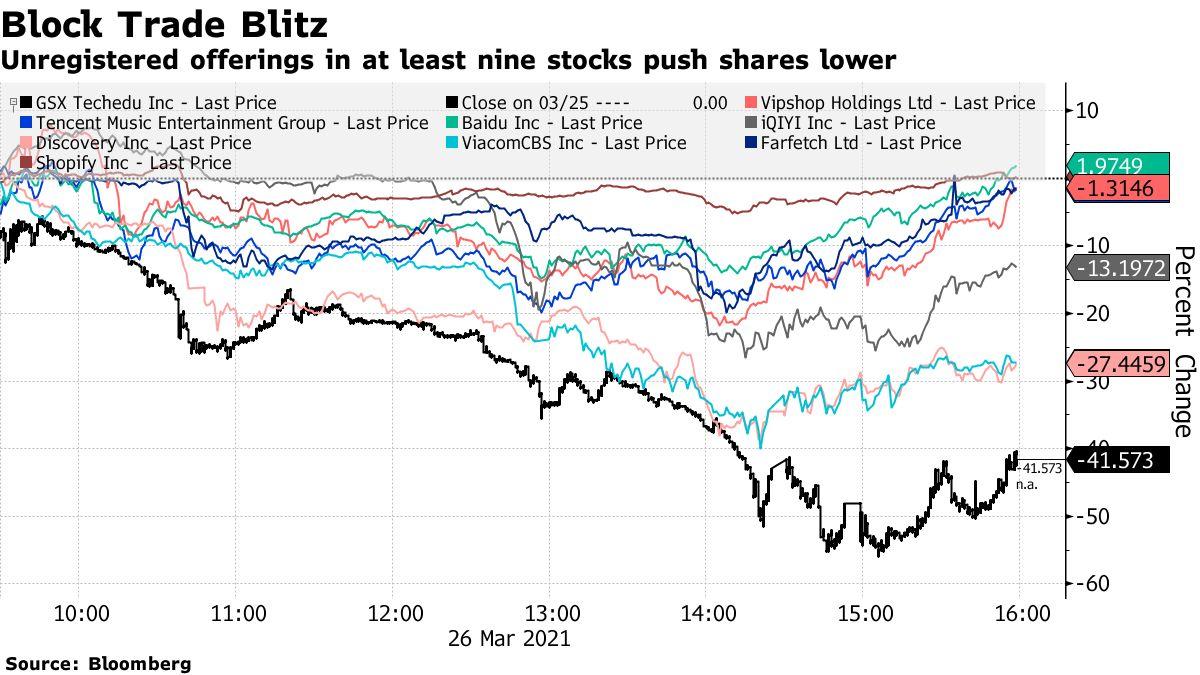
Yesterday, in the aftermath of Friday’s bizarre, furious liquidation which saw a dramatic plunge in the price of various Chinese tech stocks…

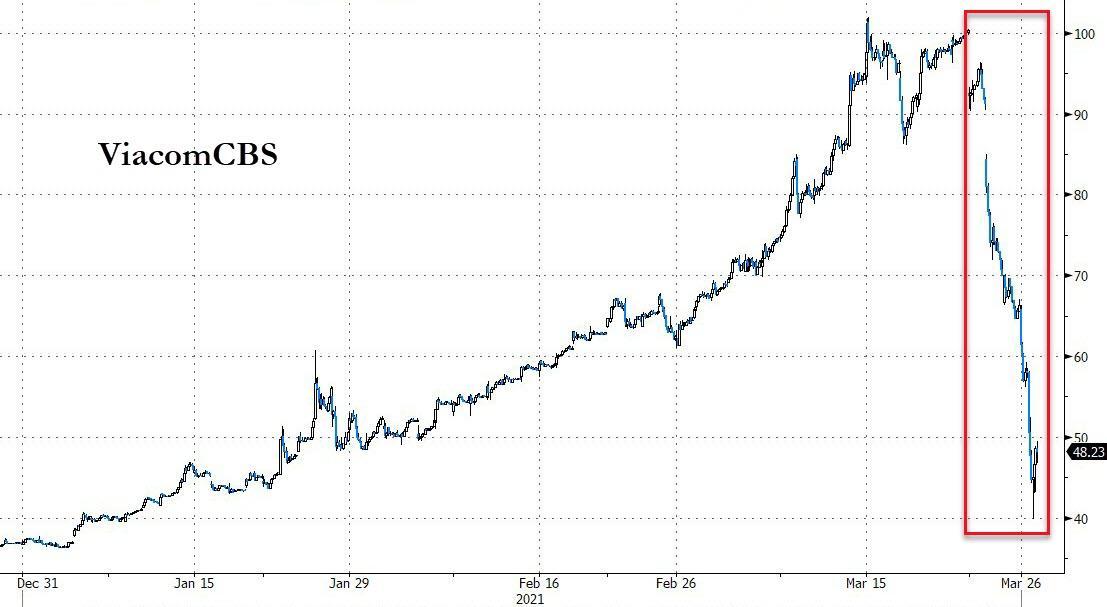
… as well as a collapse in the price of media giants such as ViacomCBS and Discovery…

… which wiped out $33BN of value off all the companies involved as Goldman Sachs and Morgan Stanley sold blocks of shares worth $20BN at discount prices throughout the day, we pointed to Tiger Cub Bill Hwang’s Archegos Capital Management family office and asked ifThis Was The Fund That Sparked The Massive Media Stock Liquidations.”

Today, both the FT and Bloomberg confirm that it was indeed Hwang responsible for the forced unwinds that shook the market on Friday.

Archegos Capital, a private investment firm, was behind billions of dollars worth of share sales that captivated Wall Street on Friday — a fire sale that has left traders scrambling to calculate how much more it has to offload, according to people with knowledge of the matter. The fund, which had large exposures to ViacomCBS and several Chinese technology stocks, was hit hard after shares of the US media group began to tumble on Tuesday and Wednesday.

As we speculated, the initial plunge in media names prompted a margin call from one of Archegos’ prime brokers, which in turn then prompted a cascade of similar cash calls from other Prime Brokers said FT sources. According to Bloomberg, Morgan Stanley traded about $13 billion, including Farfetch, Discovery, Baidu and GSX Techedu, while Goldman Sachs sold $6.6 billion worth of shares of Baidu, Tencent Music Entertainment Group and Vipshop Holdings. That sale was followed by the sale of $3.9 billion of shares including ViacomCBS Inc. and iQiyi, a Goldman email to clients said.

At the same time, traders buying the large blocks of stock – which were being intermediated by such firms as Goldman Sachs – were told the share sales had been prompted by a “forced deleveraging” by a fund.

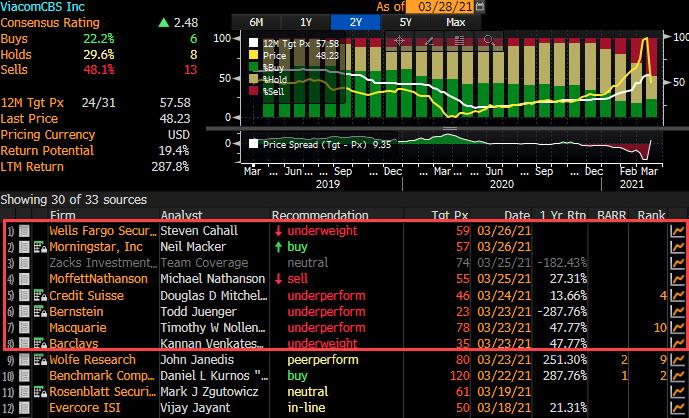
Meanwhile, adding insult to injury, a handful of completely clueless sellside “analysts” who had no idea a fund was forced to dump its positions and were scrambling to explain the price action, rushed to downgrade companies such as ViacomCBS – because on Wall Street, price dictates fundamentals apparently – and only added to the liquidation frenzy even though their arguments were completely false (just as they had been on the upside when these same clueless penguins rushed to upgrade the companies).

In any case, Archegos is now finished: as the FT reports, “the firm’s website is no longer available and the company did not return multiple requests for comment. The fund’s head trader in New York hung up the phone when contacted by the Financial Times.”

Not surprisingly, this is not the Hwang’s first forced unwind: the New York-based asset manager previously ran the Tiger Asia hedge fund but he returned cash to investors in 2012 when he admitted wire fraud relating to Chinese bank stocks. Hwang paid $44MM in fines to settle illegal trading charges with the SEC in 2012, and in 2014 he was banned from trading in Hong Kong.

While the forced liquidations at Archegos – which describes itself as a “purposeful community of investment industry professionals” whose core values are “Excellence, Integrity, Learning/Doing/Teaching, Caring/Sharing” and others according to an archived version of its now deleted website – only hit its own P&L as it does not manage outside money, there is plenty of “outside money” invested in the names that got hit on Friday as countless shareholders were crushed.

For those other investors, the question – as we asked earlier – is whether the fire sales are over. Some traders say the pattern of recent selling, which ran for several days but reached a peak on Friday, suggests the bulk has been completed. Others think the scale of leverage that Archegos appears to have used means billions of dollars’ worth of positions could still remain to be sold.

According to the FT, Archegos’ name is a biblical Greek word meaning chief, leader, or prince, used in relation to Jesus. In a 2018 YouTube video, Hwang said his investments were “not all about money”, adding that “God certainly has a long-term view”.

“We love seeing in our little eyes what God is doing through investing and capitalism and how . . . it can be done better.”

But while Hwang may believe he is God, or at least Jesus (and certainly would love to have his money) others don’t have that kind of patience, and asBloomberg writes this morning, global traders are bracing for what’s shaping up to be “one of the most anticipated opens for U.S. equities in months” following an extraordinary $20 billion wave of block trades Friday that rattled investors worldwide.

Sharif Farha, a Dubai-based portfolio manager at Safehouse Global Consumer Fund, said ViacomCBS and Discovery may actually recover on Monday and noted that the market’s fundamentals remain intact.
“The correction was not structural,” he said, and he is right: anyone who bought at Friday’s lows on the forced selling is likely set to make a killing in the coming days.

While Farha expects benign price action to start the day, but anticipation for Monday’s open remains high: “Traders everywhere know the story and will be glued to their screens,” he said.

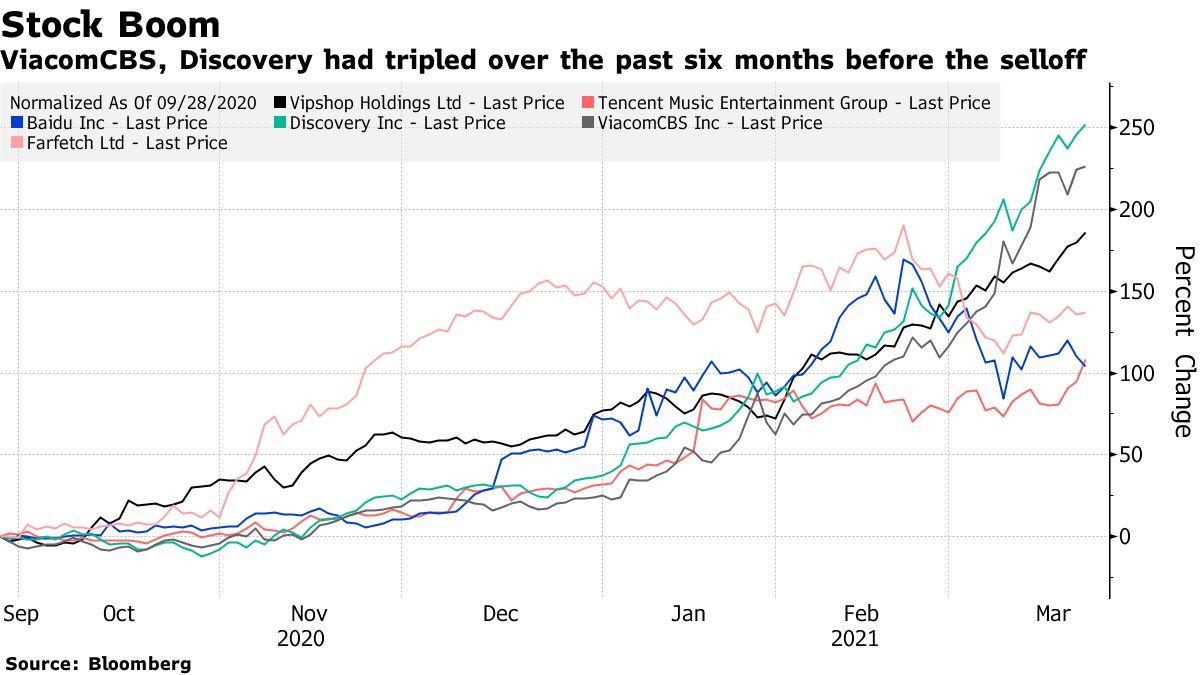
To be sure, the possibility of additional block trades – either at Hwang or other funds that have similar exposure – looms over the market, while the traditional end-of-quarter volatility which we discussed last week may contribute to sharper swings on high-flying stocks. ViacomCBS and Discovery have rallied this year.

Then again, what has soared higher may just come down and stay down: “What most people appear to have missed is that both of these companies have seen their share prices almost quadruple since October last year,” CMC Markets analyst Michael Hewson said in a note on Sunday, referring to ViacomCBS and Discovery.

It didn’t help that last Monday ViacomCBS reported an offering of $2 billion in shares after closing at a record high. The stock fell 9.1% the following day. On Friday, a downgrade by Wells Fargo and the large block trades compounded the selling pressure. it has since wiped out more than half its value in just the past 5 days!

Meanwhile, as Bloomberg notes Viacom and Discovery shares are also echoing volatility in a host of companies that soared on lockdown trades, including Zillow Group and Peloton and to some degree the entire blank-check SPAC space. Earlier this month, data compiled by Susquehanna showed that volatility futures expiring three months from now were hovering 20% above the average level or prior instances when the VIX traded at 20.

“We have seen an increase in volatility in equities capital markets, tech, working-from-home names with retail stepping back and more rotation to value in the last few weeks,” said Barclays strategist Emmanuel Cau. “It may have hurt a number of funds that were overly exposed to these trades.”

“The markets could start trading in a friendly manner at the beginning of the week,” said Andreas Lipkow, Comdirect Bank strategist, echoing what we said in “Brace For A Frenzy Of Stock Buying On March 29.” He added that “although there is currently some major profit-taking and unusual block trade activities, these market asymmetries can currently still be processed well.”

But perhaps just as remarkable as the Archegos liquidation, was the elephant in the room, namely the action in the last minutes of trading on Friday. U.S. equities notched their biggest gain in three weeks on Friday which saw the S&P 500 explode 1.7% higher after trading in the red for much of the day, as the bull market celebrated its first anniversary since hitting pandemic-era lows.

We hope that this is not what the Fed has in mind when it talks about “price stability.”

Tyler Durden
Sun, 03/28/2021 – 17:00

via ZeroHedge News https://ift.tt/31p8WoV Tyler Durden

Apparent Unconstitutional Race Discrimination in School Reopening Plan

From the Memorandum of Understanding, which I’m told was just approved Friday:

Our tenets for spring reopening are grounded in strong pedagogy aligned with the Multi Tiers of Student Supports (MTSS) model: …

2. Targeted, high needs students first. Wholesale return to in person instruction for the full day for all students is not possible within the county public health mandates at this time and the social distancing constraints ….

6. Identified High Needs Students are the first focus

a. Definitions
i. For the purposes of identification for this program, “high need students” are defined by the district, based upon the roster of students on March 15th, 2021 as Preschool through 12th grade students who fall into one or more of the following categories:
1. Homeless
2. Foster Youth
3. English language learners
4. African American students
5. Students unable to access online learning due to a lack of internet or connected device
6. Pupils with disabilities, including Transition-aged youth
a. Students with IEPs in Self Contained Classes (ESN and MMSN) or Full Inclusion
b. Students needing in-person evaluation for special education
c. Students with Section 504 Plans
7. Students who chronically absent/disengaged
8. Students at risk for abuse, neglect, or exploitation
9. Students identified as having severe social emotional needs, as determined by CARE / COST / SST / IEP, history of Risk Assessment and/or hospitalizations …

8. Additional support for non-high need students
a. In the event that there are additional cohort spaces above and beyond what is needed to support district-identified high need students, school sites shall assess the remaining available space and staffing capacity and invite students in PS-12 to participate in the additional support program

Black students are thus expressly preferred, even entirely apart from any other factor (such as homelessness, foster youth status, poverty, or anything else). A black student with none of the other factors is eligible for the early reopening; a white, Hispanic, or Asian student with none of the other factors is not.

This is likely unconstitutional under the Equal Protection Clause, I think, as well as illegal under Title VI of the Civil Rights Act of 1964. Though the Court has allowed certain kinds of race classifications under these provisions if they are “narrowly tailored” to a “compelling government interest,” I doubt that this sort of system—under which one’s race, by itself, creates eligibility for a benefit—would pass that quite demanding standard. (Several parents had pointed this out, but the school district was unmoved.)

And it’s clearly unconstitutional under the California Constitution, which categorically provides,

The State shall not discriminate against, or grant preferential treatment to, any individual or group on the basis of race, sex, color, ethnicity, or national origin in the operation of public employment, public education, or public contracting.

The California Legislature had asked California voters to vote on repealing this provision last November, but the voters preserved it, by a 56-44% margin.

from Latest – Reason.com https://ift.tt/3u0F6Dl
via IFTTT