How the NFL and the Players Union Screw Draft Picks Out of Millions


csmphototwo730104

When the National Football League drafts its next crop of players this weekend, those draftees will have to be careful about what’s showing on their in-home camera. Don’t drink anything but Pepsi products, don’t snack on anything but Frito-Lay brands, and don’t do any video interviews using Apple AirPods. And definitely don’t try to make a few bucks by hawking a motor oil other than Castrol or a mattress company other than Sleep Number. The league has threatened to keep any player off-camera if an NFL sponsor’s competitor would otherwise be onscreen.

It’s just one of the ways NFL rules keep young players from realizing their true market value, thanks to the league’s take-it-or-leave-it system.

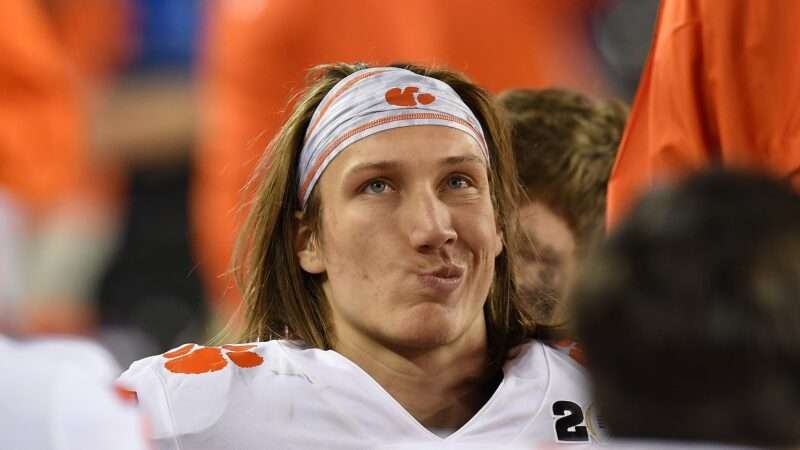
Consider the path of Trevor Lawrence, the Clemson quarterback who’s likely to be the first overall draft pick. In his freshman year, Lawrence led Clemson to an undefeated championship season. If he wasn’t good enough then to enter the NFL draft, he certainly was after his second season, where his team suffered only one loss and Lawrence came seventh in the Heisman Trophy vote.

But Lawrence couldn’t enter the draft until after his third collegiate season, because the NFL won’t allow players to enter the draft until three years after they’ve left high school. Lawrence probably wouldn’t have been the number one pick if he’d entered the draft sooner, but he still would have been earning millions of dollars in the NFL instead of playing for virtually nothing at Clemson, where NCAA rules barred him even from signing endorsement deals. The rule doesn’t just hurt stars like Lawrence: Even an unknown player who just wanted to provide for his family couldn’t try to get a low-salary job playing in the NFL.

In most other sports, players have alternatives to the NCAA, with developmental leagues in the U.S. and the option to play abroad. The NBA, for example, has the G League. Football players could try to make some money in the Canadian Football League before getting signed by an NFL team, but crossover between the sports is rare and CFL salaries are a fraction of the NFL’s. Realistically, NFL draftees are limited to sticking it out for three years in college, a situation the NCAA surely isn’t complaining about.

Even if he was drafted in an earlier year, Lawrence couldn’t have negotiated for a higher salary salary—since 2011, under the collective bargaining agreement between the NFL and the National Football League Players Association, each draft pick has a set salary and a length of four years. (Teams have an option to extend the contracts for first-round picks to five years.) In 2009 and 2010, the first overall draft picks were able to negotiate deals worth more than $70 million over six years. The new structure limited 2011’s number one pick, Cam Newton, to just $22 million over four years.

Barring injury, Lawrence will probably play in the NFL for a long time. But most NFL players aren’t Tom Bradys playing well into their 40s. Their average age of retirement (from football, at least) is 27.6, and 78 percent of players go broke within three years of retirement. The average player’s career lasts just 2.5 years—though for better players who make the opening-day roster in their rookie season, the NFL says their careers average six years.

So under the salary strictures organized by the union and the NFL, a player who doesn’t last more than four years will never have the chance to negotiate for a better salary. What’s more, the contracts are not guaranteed for their whole length, so if a player is cut from the roster after two seasons, he doesn’t get paid the full value of the deal. Running backs have some of the shortest careers in the NFL. Even though they have one of the most important positions, they spend most of their prime years getting paid nothing in college or an amount dictated by the draft pick salary structure.

Draft picks do have some room to negotiate for signing bonuses or performance incentives, but each team has a limit on how much they can spend on rookie contracts. Unlike other players, draft picks don’t have the leverage of a holdout. The salary structure gives them nothing to hold out for, and rules prevent them from renegotiating their contracts if they do hold out.

Of course, the players are doing what they love for a living and making a ton of money while they do it. (The league’s minimum salary is $660,000.) They know the physical risks of getting tackled or tackling others for a living. And the NFL is a private employer that can set its own compensation rules.

But it says a lot about the players union that it organized a deal that can’t keep its former members from going broke after retirement. Players on the union’s Board of Player Representatives are generally not in the early stages of their four-year deal, so there’s little incentive for them to get rid of the salary rules. The older players with most of the union power are making sure they get a bigger piece of the NFL salary pie, the size of which is limited by the league’s salary cap. While the 2020 collective bargaining agreement did adopt some minor changes to this system, the worst parts are set to remain through 2030: the minimum age requirement that keeps able-bodied players from getting paid in the league, the preset salary structure for draftees, and the minimum length of those contracts.

Meanwhile, don’t drink or eat anything other than Pepsi and Frito-Lay products during the draft.

from Latest – Reason.com https://ift.tt/331aciM
via IFTTT
How the NFL and the Players Union Screw Draft Picks Out of Millions


csmphototwo730104

When the National Football League drafts its next crop of players this weekend, those draftees will have to be careful about what’s showing on their in-home camera. Don’t drink anything but Pepsi products, don’t snack on anything but Frito-Lay brands, and don’t do any video interviews using Apple AirPods. And definitely don’t try to make a few bucks by hawking a motor oil other than Castrol or a mattress company other than Sleep Number. The league has threatened to keep any player off-camera if an NFL sponsor’s competitor would otherwise be onscreen.

It’s just one of the ways NFL rules keep young players from realizing their true market value, thanks to the league’s take-it-or-leave-it system.

Consider the path of Trevor Lawrence, the Clemson quarterback who’s likely to be the first overall draft pick. In his freshman year, Lawrence led Clemson to an undefeated championship season. If he wasn’t good enough then to enter the NFL draft, he certainly was after his second season, where his team suffered only one loss and Lawrence came seventh in the Heisman Trophy vote.

But Lawrence couldn’t enter the draft until after his third collegiate season, because the NFL won’t allow players to enter the draft until three years after they’ve left high school. Lawrence probably wouldn’t have been the number one pick if he’d entered the draft sooner, but he still would have been earning millions of dollars in the NFL instead of playing for virtually nothing at Clemson, where NCAA rules barred him even from signing endorsement deals. The rule doesn’t just hurt stars like Lawrence: Even an unknown player who just wanted to provide for his family couldn’t try to get a low-salary job playing in the NFL.

In most other sports, players have alternatives to the NCAA, with developmental leagues in the U.S. and the option to play abroad. The NBA, for example, has the G League. Football players could try to make some money in the Canadian Football League before getting signed by an NFL team, but crossover between the sports is rare and CFL salaries are a fraction of the NFL’s. Realistically, NFL draftees are limited to sticking it out for three years in college, a situation the NCAA surely isn’t complaining about.

Even if he was drafted in an earlier year, Lawrence couldn’t have negotiated for a higher salary salary—since 2011, under the collective bargaining agreement between the NFL and the National Football League Players Association, each draft pick has a set salary and a length of four years. (Teams have an option to extend the contracts for first-round picks to five years.) In 2009 and 2010, the first overall draft picks were able to negotiate deals worth more than $70 million over six years. The new structure limited 2011’s number one pick, Cam Newton, to just $22 million over four years.

Barring injury, Lawrence will probably play in the NFL for a long time. But most NFL players aren’t Tom Bradys playing well into their 40s. Their average age of retirement (from football, at least) is 27.6, and 78 percent of players go broke within three years of retirement. The average player’s career lasts just 2.5 years—though for better players who make the opening-day roster in their rookie season, the NFL says their careers average six years.

So under the salary strictures organized by the union and the NFL, a player who doesn’t last more than four years will never have the chance to negotiate for a better salary. What’s more, the contracts are not guaranteed for their whole length, so if a player is cut from the roster after two seasons, he doesn’t get paid the full value of the deal. Running backs have some of the shortest careers in the NFL. Even though they have one of the most important positions, they spend most of their prime years getting paid nothing in college or an amount dictated by the draft pick salary structure.

Draft picks do have some room to negotiate for signing bonuses or performance incentives, but each team has a limit on how much they can spend on rookie contracts. Unlike other players, draft picks don’t have the leverage of a holdout. The salary structure gives them nothing to hold out for, and rules prevent them from renegotiating their contracts if they do hold out.

Of course, the players are doing what they love for a living and making a ton of money while they do it. (The league’s minimum salary is $660,000.) They know the physical risks of getting tackled or tackling others for a living. And the NFL is a private employer that can set its own compensation rules.

But it says a lot about the players union that it organized a deal that can’t keep its former members from going broke after retirement. Players on the union’s Board of Player Representatives are generally not in the early stages of their four-year deal, so there’s little incentive for them to get rid of the salary rules. The older players with most of the union power are making sure they get a bigger piece of the NFL salary pie, the size of which is limited by the league’s salary cap. While the 2020 collective bargaining agreement did adopt some minor changes to this system, the worst parts are set to remain through 2030: the minimum age requirement that keeps able-bodied players from getting paid in the league, the preset salary structure for draftees, and the minimum length of those contracts.

Meanwhile, don’t drink or eat anything other than Pepsi and Frito-Lay products during the draft.

from Latest – Reason.com https://ift.tt/331aciM
via IFTTT
America Is Exceptionally… Kleptocratic

America Is Exceptionally… Kleptocratic

Authored by Charles Hugh Smith via OfTwoMinds blog,

The sheer weight of this outlandish asymmetry of wealth and power is pulling the nation into disorder.

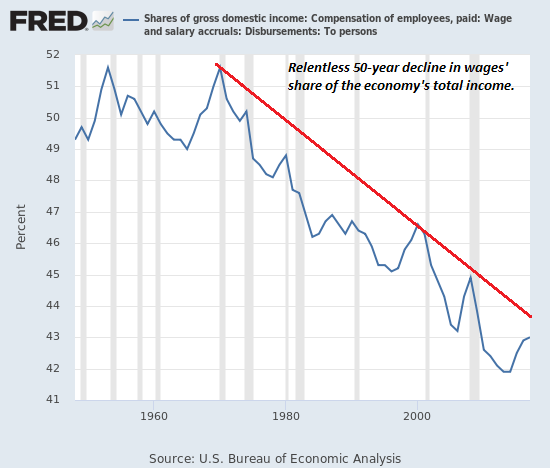
The U.S. Constitution doesn’t address a small elite owning most of the nation’s private wealth and using a sliver of that wealth to influence the federal government so their wealth and political power increase in a self-reinforcing feedback: as a result of their campaign contributions and lobbying, the elites’ wealth continues expanding, enhancing their political power to further expand their wealth, and so on.

This financial and political dominance is thus perfectly legal. As Bastiat’s famous quote puts it: 

“When plunder becomes a way of life for a group of men in a society, over the course of time they create for themselves a legal system that authorizes it and a moral code that glorifies it.”

This legalized looting has now reached such absurd extremes that kleptocracy no longer does justice as a descriptor of the U.S. Consider this excerpt from Monopoly Versus Democracy (Foreign Affairs):

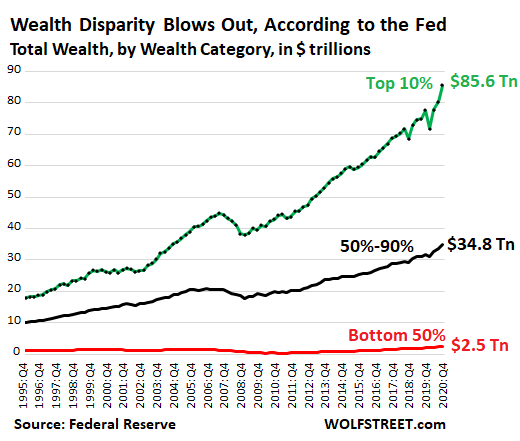
Like their forebears in the early twentieth century, today’s Americans have experienced decades of growing inequality and increasing concentrations of wealth and power. The last decade alone witnessed nearly 500,000 corporate mergers worldwide. Ten percent of Americans now control 97 percent of all capital income in the country. Nearly half of the new income generated since the global financial crisis of 2008 has gone to the wealthiest one percent of U.S. citizens. The richest three Americans collectively have more wealth than the poorest 160 million Americans. (emphasis added.)

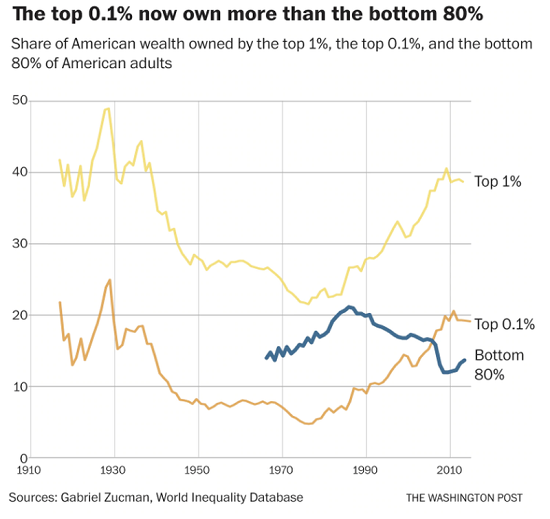
If you read that three kleptocrats held more wealth than half the residents of Lower Slobovia, that the top 0.1% own more wealth than the bottom 80% and that a near-zero 3% of all income flowing from capital trickled down to the bottom 90%, what would you think about wealth/power asymmetry in Lower Slobovia?

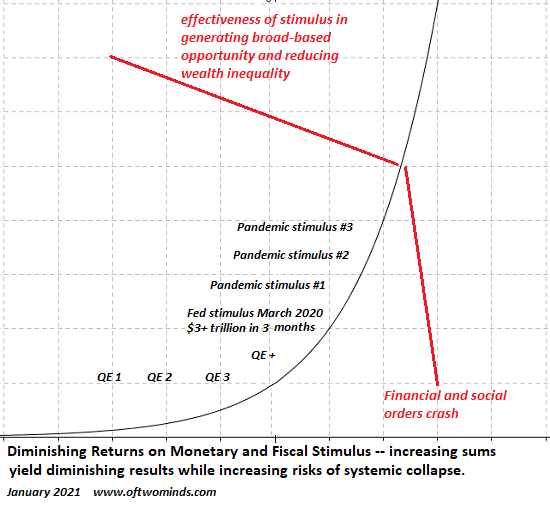
We now know what American Exceptionalism really means: exceptionally kleptocratic. Even as private wealth soared to unprecedented heights in the past decade of Federal Reserve largesse (endless trillions for financiers and too-big-to-jail speculators), the percentage of stocks owned by the fortunate class of the 90% to 99% fell from 39% to 35% and the percentage owned by the bottom 50% slipped to 0.6%. (Data from the Federal Reserve’s FRED database)

Now there are rumblings in Washington D.C. about closing tax loopholes for corporations, which scoop 15% of the nation’s GDP as profits. This is certainly very pretty political theater, but please let me know when you and I can rent a post office box in Ireland and pay no federal income taxes, while corporations are paying the total federal tax rates we pay (40+%) with 15.3% self-employment tax, 3.9% supplemental Medicare tax, etc.

The sheer weight of this outlandish asymmetry of wealth and power is pulling the nation into disorder. There are no legal or political limits on private wealth and political power, and the politicians that depend on the wealthy to fund their re-election campaigns have demonstrably little interest in harming the geese that lay their golden eggs.

The super-wealthy and Corporate America reckon that they can suppress any resistance to their dominance with virtue-signaling and political suppression, but they must have flunked history: when the bottom 90% own effectively zero income-producing capital and no political voice, and even the top 9.9% don’t really have any real political power, then disorder of the uncontrollable variety arises to rebalance the extreme asymmetry.

*  *  *

If you found value in this content, please join me in seeking solutions by becoming a $1/month patron of my work via patreon.com.

*  *  *

My recent books:

A Hacker’s Teleology: Sharing the Wealth of Our Shrinking Planet (Kindle $8.95, print $20, audiobook $17.46) Read the first section for free (PDF).

Will You Be Richer or Poorer?: Profit, Power, and AI in a Traumatized World (Kindle $5, print $10, audiobook) Read the first section for free (PDF).

Pathfinding our Destiny: Preventing the Final Fall of Our Democratic Republic ($5 (Kindle), $10 (print), ( audiobook): Read the first section for free (PDF).

The Adventures of the Consulting Philosopher: The Disappearance of Drake $1.29 (Kindle), $8.95 (print); read the first chapters for free (PDF)

Money and Work Unchained $6.95 (Kindle), $15 (print) Read the first section for free (PDF).

Tyler Durden
Thu, 04/29/2021 – 16:31

via ZeroHedge News https://ift.tt/334hEcI Tyler Durden

TWTR Tumbles On Weak User Growth, Lowered Outlook

TWTR Tumbles On Weak User Growth, Lowered Outlook

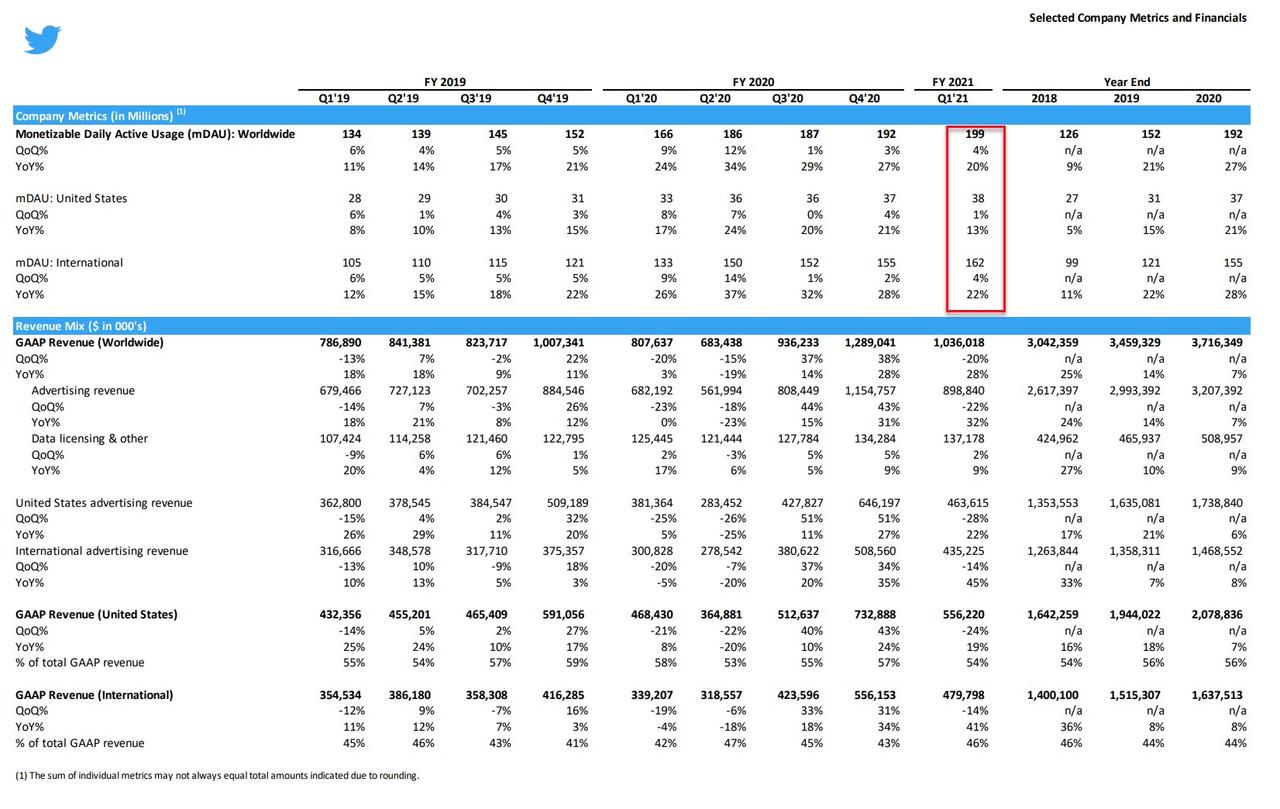
At first glance, Twitter looked solid – beating top- and bottom-line (albeit modestly)…

  • 1Q Rev. $1.04B, Est. $1.03B

  • 1Q Adj EPS 16c, Est. 14c

However, two things stand out and have sparked concern for investors:

First, Twitter added 7 million news users, and now has 199 million total daily users. That’s 20% growth, which was only marginally in line with expectations, but notably slowdowns in that growth…

And the outlook for that user growth was not great…

“Looking ahead, the significant pandemic-related surge we saw last year creates challenging comps, and may lead to mDAU growth rates in the low double digits on a year-over-year basis in Q2, Q3, and Q4, with the low point in terms of growth likely in Q2.”

Second, and considerably more important, Twitter appeared to lower its Q2 revenue outlook.

The company says revenue should come in between $980 million and $1.08 billion for the quarter.

Current estimates are on the high end of that range at $1.05 billion.

The result is an 8% drop in TWTR after hours…

After Facebook and Google’s breathtaking results, this is a big notice that TWTR just doesn’t have the kind of direct-response advertising products its competitors have.

Tyler Durden
Thu, 04/29/2021 – 16:17

via ZeroHedge News https://ift.tt/3ezOrM8 Tyler Durden

Amazon Hits Record High On Blowout Earnings And Guidance

Amazon Hits Record High On Blowout Earnings And Guidance

With the bulk of the FAAM(N)G stocks reporting somewhat mixed earnings so far, with NFLX and MSFT disappointing offset by solid results from Google and Apple (although one wouldn’t know it looking at today’s stock price), investors were keenly looking for a tiebreaker from today’s Amazon earnings, where according to Bloomberg, the biggest question for Amazon is how sustainable are the growth trends that boosted its performance during the pandemic. The Internet giant was one of the biggest beneficiaries of shifts in consumer and business behavior last year.

Many consumers flocked to buy things online as they wanted to avoid infection at physical stores. Further, Amazon Web Services revenue soared on back of rising usage from Internet digital services – including remote-working software, videostreaming and gaming. But with the wider available of vaccines and as employees start to return to physical offices, the risk is some of these trends may start to reverse. Bloomberg also notes that investors will be also looking for any commentary on the future prospects for regulation and antitrust legislation.

Questions aside, Amazon shares rallied in recent weeks, gaining about 18% off a year-to-date low in March. The stock has been approaching an intraday record of $3,552.25 that was set in early September. Shares rose about 0.3% Thursday ahead of results.

* * *

So with that in mind, how did Amazon do? Well, in the first quarter since Jeff Bezos announced his departure, we just had another blockbuster quarter for the online retailer which blew away consensus estimates and also guided solidly higher than expected, potentially tipping the scales bullishly for the megatechs. Here is a summary for Q1:

  • Net Sales $108.5B, beating estimates of $104.56B
  • EPS $15.79, beating estimates of $9.690
  • Operating Income $8.9B, beating est. $6.11B
  • AWS net sales $13.50 billion, beating estimate $13.09 billion
  • Amazon Web Services net sales +32%, estimate +22.5%
  • Q1 Online Stores Net Sales $52.90B, beating est. $50.63B
  • Q1 Free cash flow increased to $16.8 billion for the trailing twelve months, compared with $11.7 billion for the trailing twelve months ended March 31, 2020.

Looking ahead, the company’s guidance was once again stellar:

  • Q2 Net Sales $110.0B to $116.0B, smashing Wall Street est. $108.35B
  • Q2 Operating income between $4.5 billion and $8.0 billion, compared with $5.8 billion in second quarter 2020.

Bottom line: the first post-Bezos quarter was nothing short of a “grand slam” with revenue and earnings smashing expectations, as did cloud computing sales and income. Looking ahead, the outlook for the current quarter also beat expectations, easing concerns about a post-pandemic let up in sales.

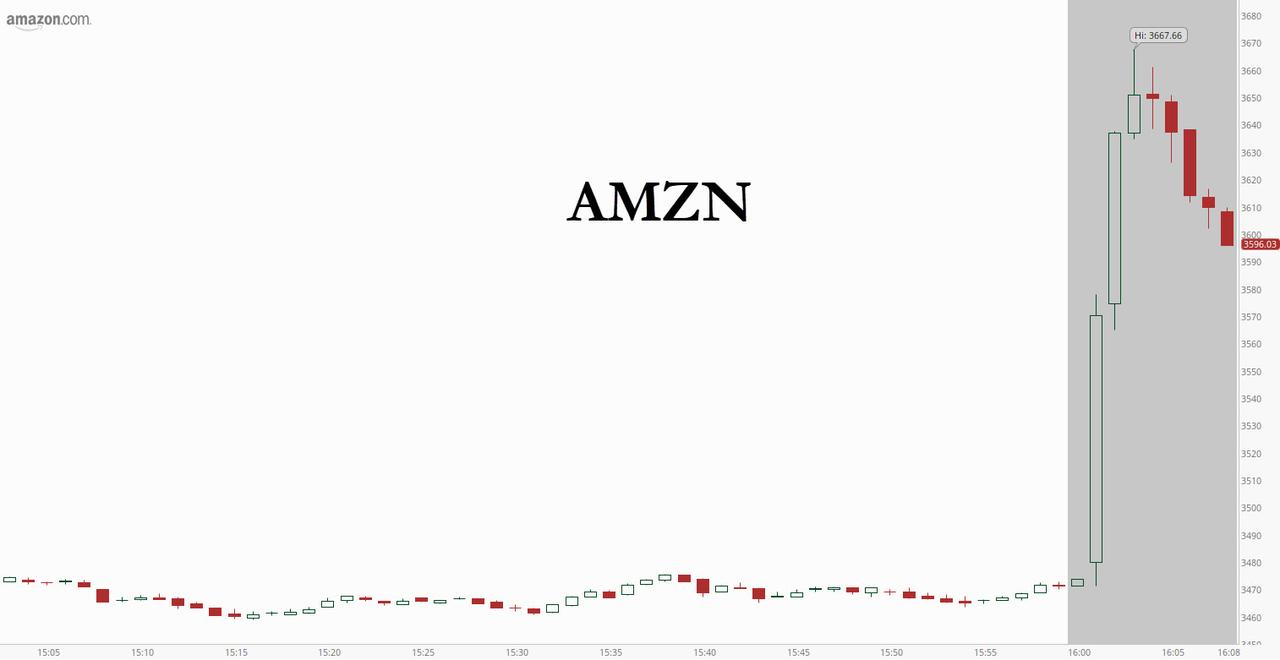
The stock predictably has surged after hours, hitting a new all time high of $3,667.66 before retracing some of the gains.

Developing


Tyler Durden
Thu, 04/29/2021 – 16:10

via ZeroHedge News https://ift.tt/3xAA4zZ Tyler Durden

Stocks Panic-Bid Off EU Close After Biden-Induced Breakdown

Stocks Panic-Bid Off EU Close After Biden-Induced Breakdown

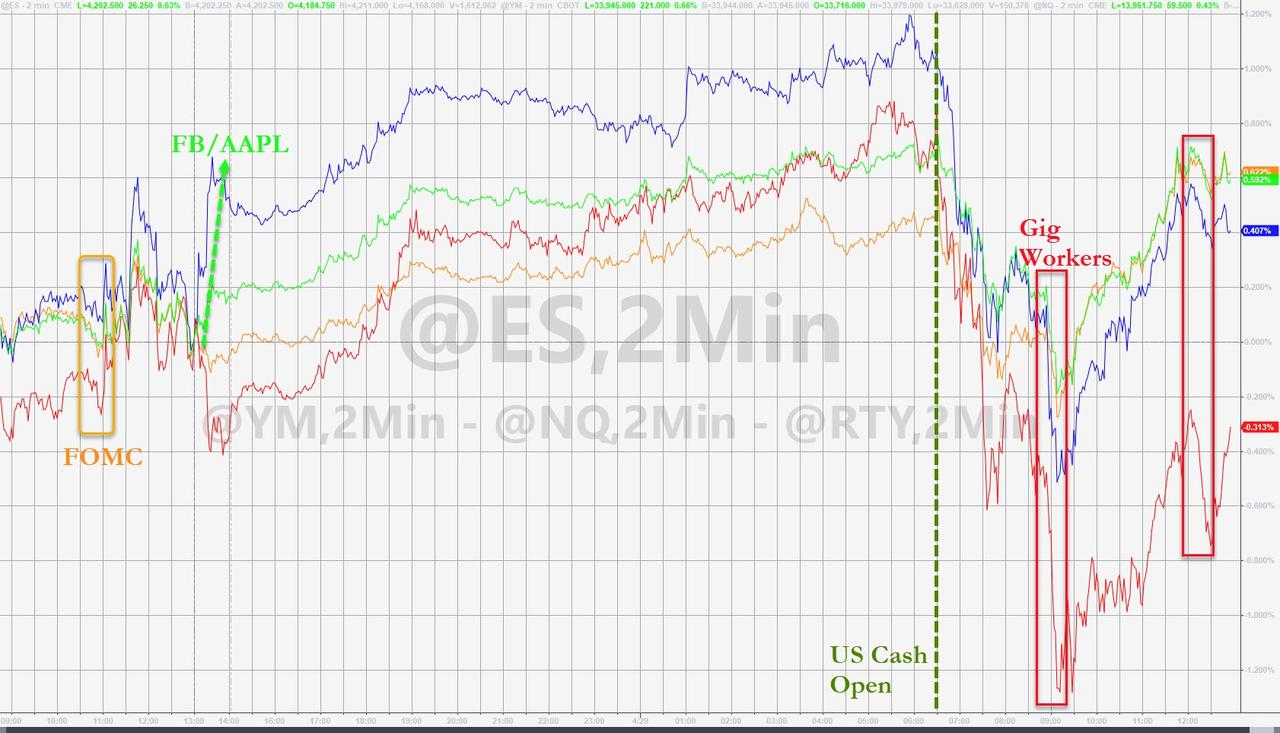
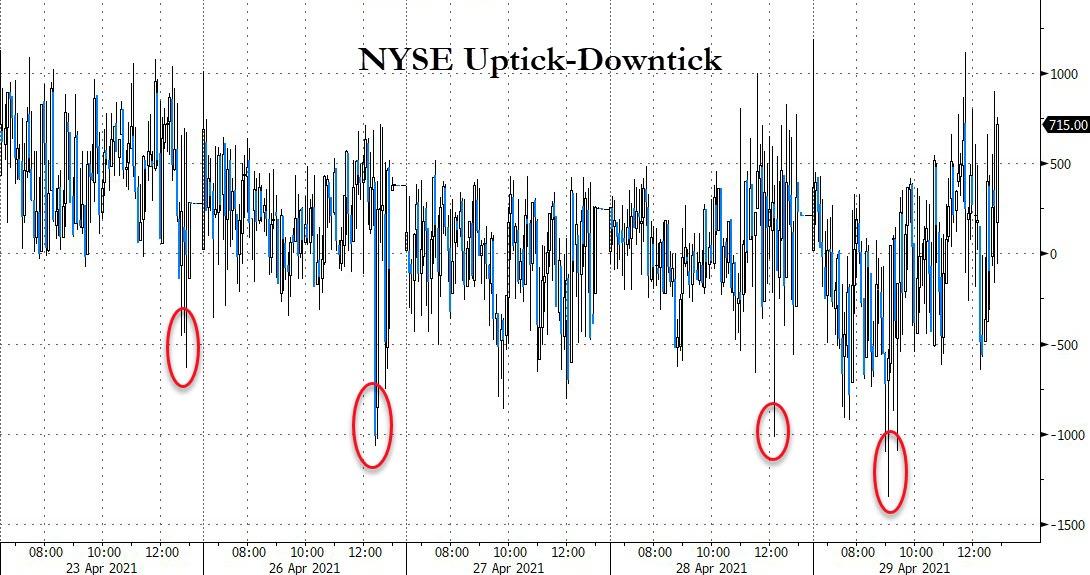
After solid gains overnight building on the FB and AAPL earnings beats (understatement) but a disappointing miss on GDP (bear in mind that jobless were basically flat and pending home sales also disappointed), everything went to shit as US cash markets opened and stocks puked below pre-FOMC lows. Then that selling was exaggerated when the Biden admin said they would like all gig workers to be employees (whether they like it or not), which sparked another big puke. The European close appeared to stall the selling and dip-buyers rushed in to lift everything back into the green in one-trade. And then, around 1500ET, it all started to slide again, but that didn’t last…

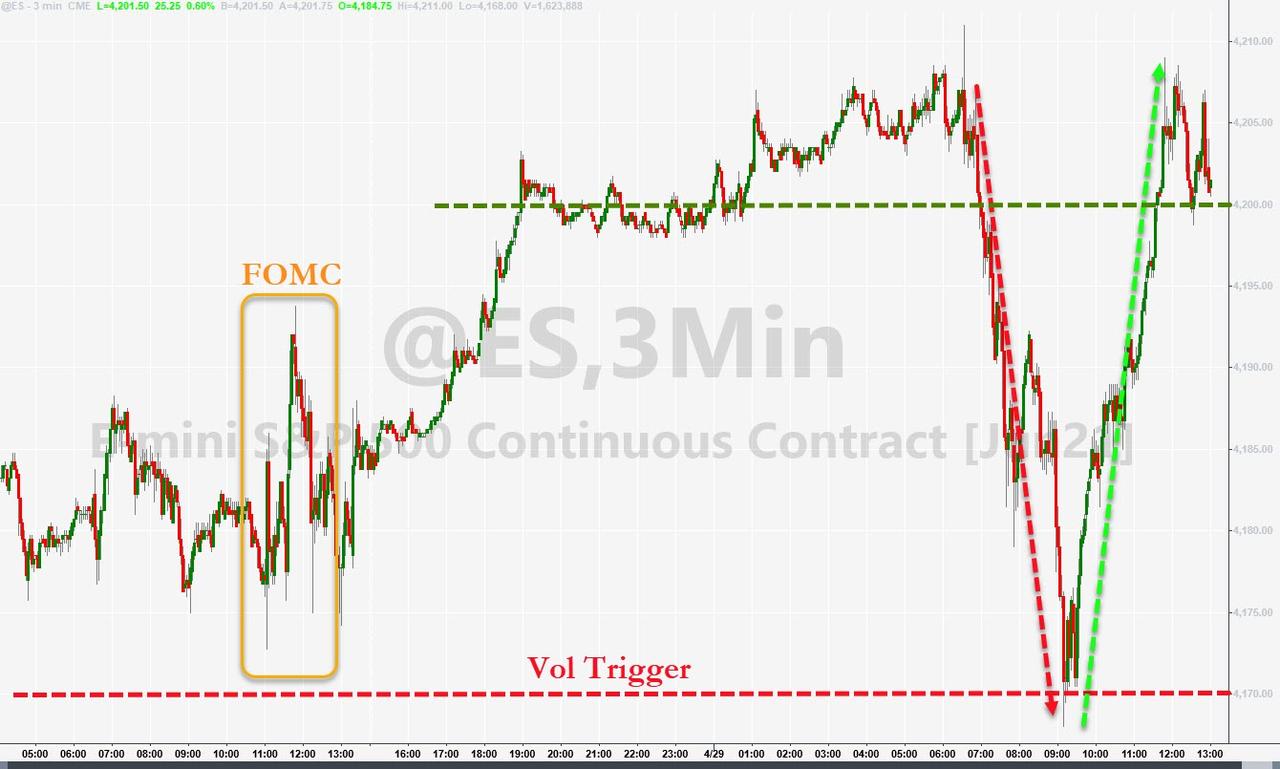
The S&P 500 broke above the psychologically important 4200 level, then plunged to a crucial support level 4170 (vol trigger) and ripped back before fading in the end to close above 4200 at a new record high…

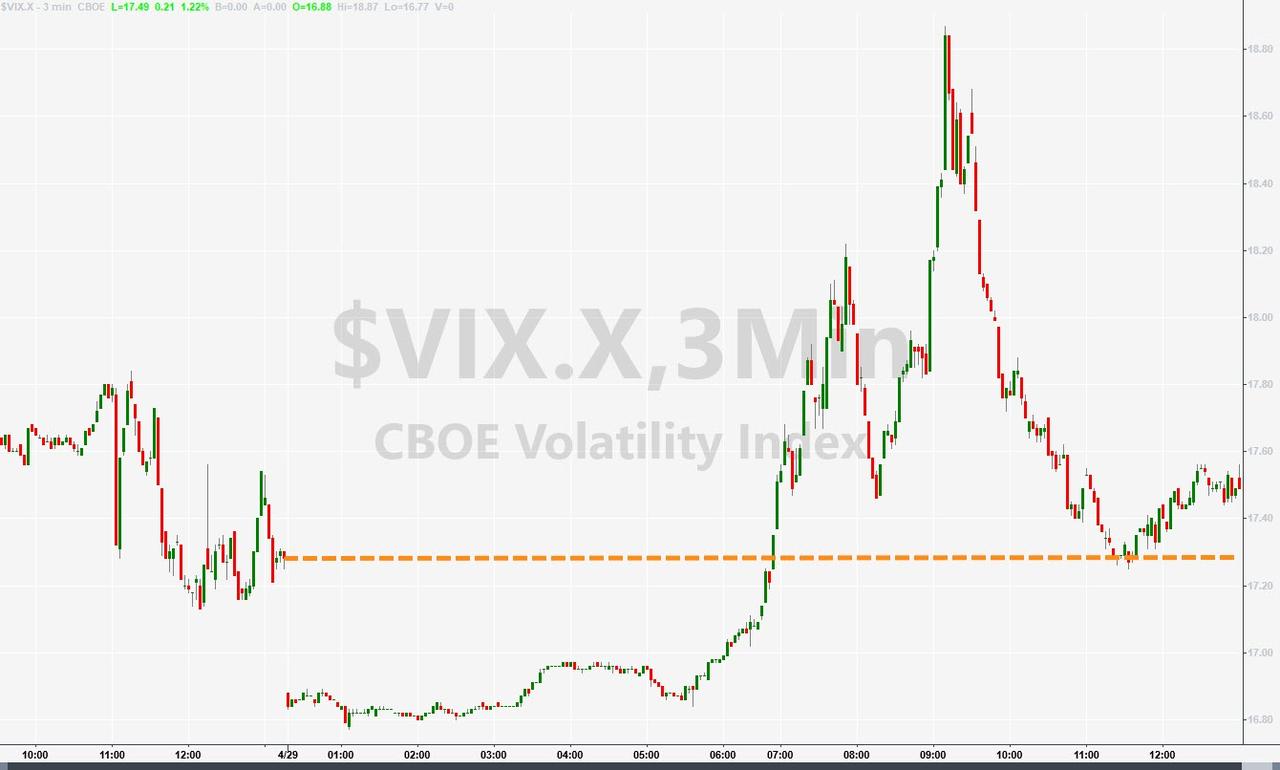
VIX was wild too…

The early puke saw the most widespread sell program in over a month…

Source: Bloomberg

AAPL shocked many with blowout earnings last night, but lost its gains during the day session…

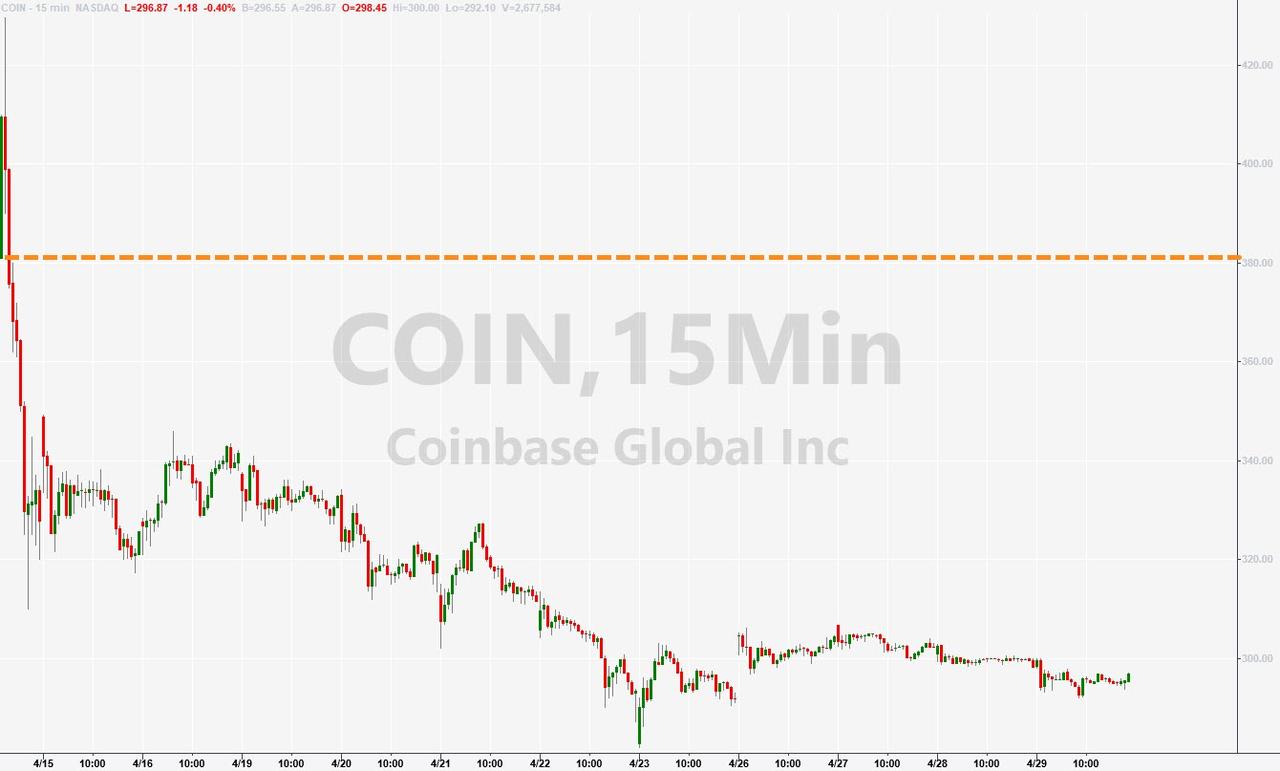
COIN is down 9 out of 11 days since going public…

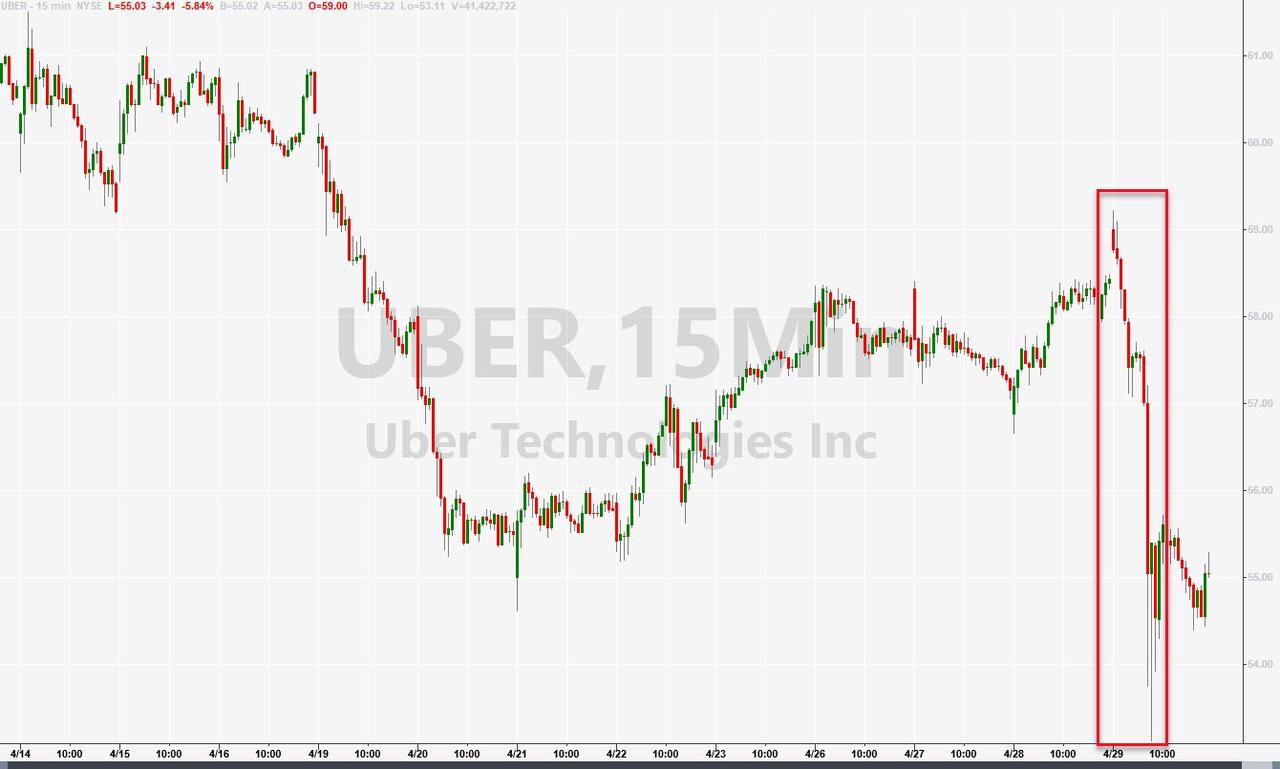
UBER and LYFT were both battered by Biden’s plan for gig-workers…

Bonds whipsawed just like stocks today (but not as you’d expect) – Treasuries were dumped along with stocks and bid-back along with stocks…

Source: Bloomberg

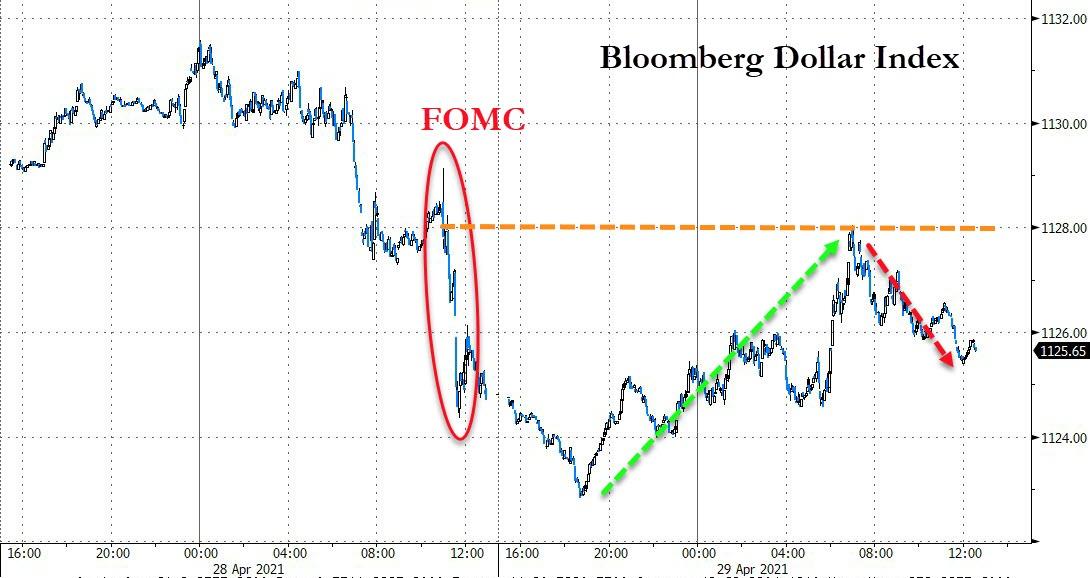
The dollar managed gains on the day, ramping back to erase post-Fed losses, only to fade once those stops were run…

Source: Bloomberg

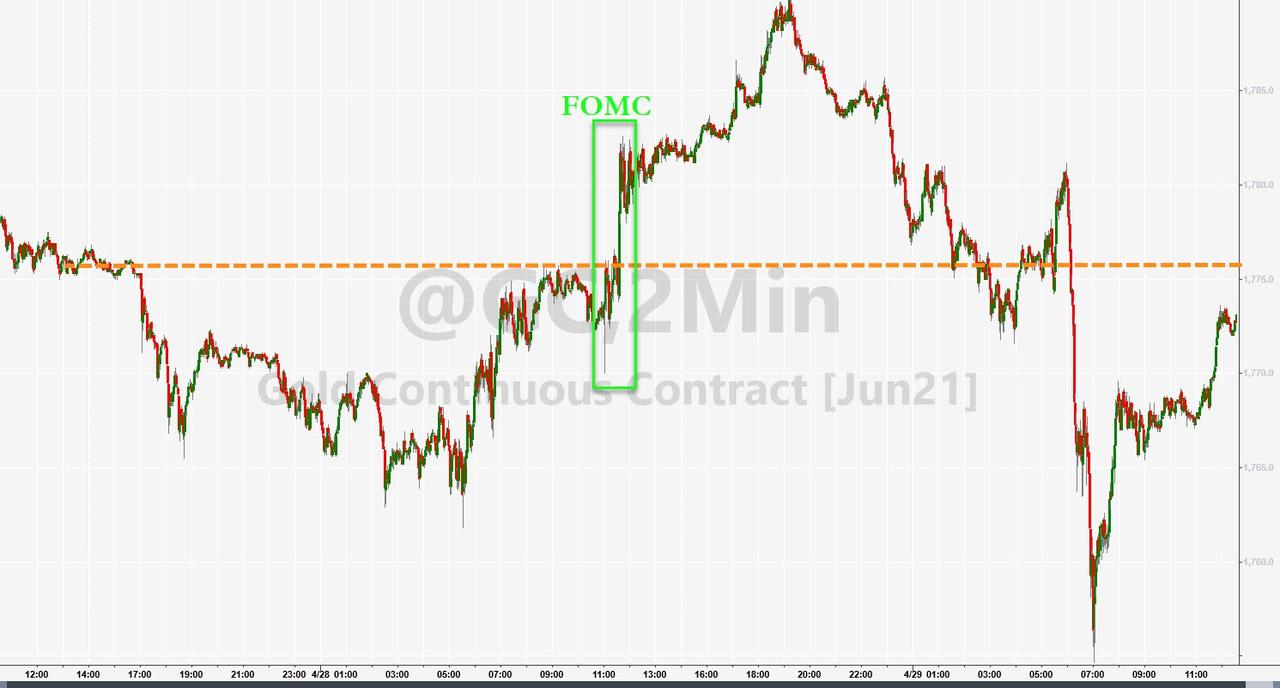
Gold ended the day flat amid some more whipsaw action…

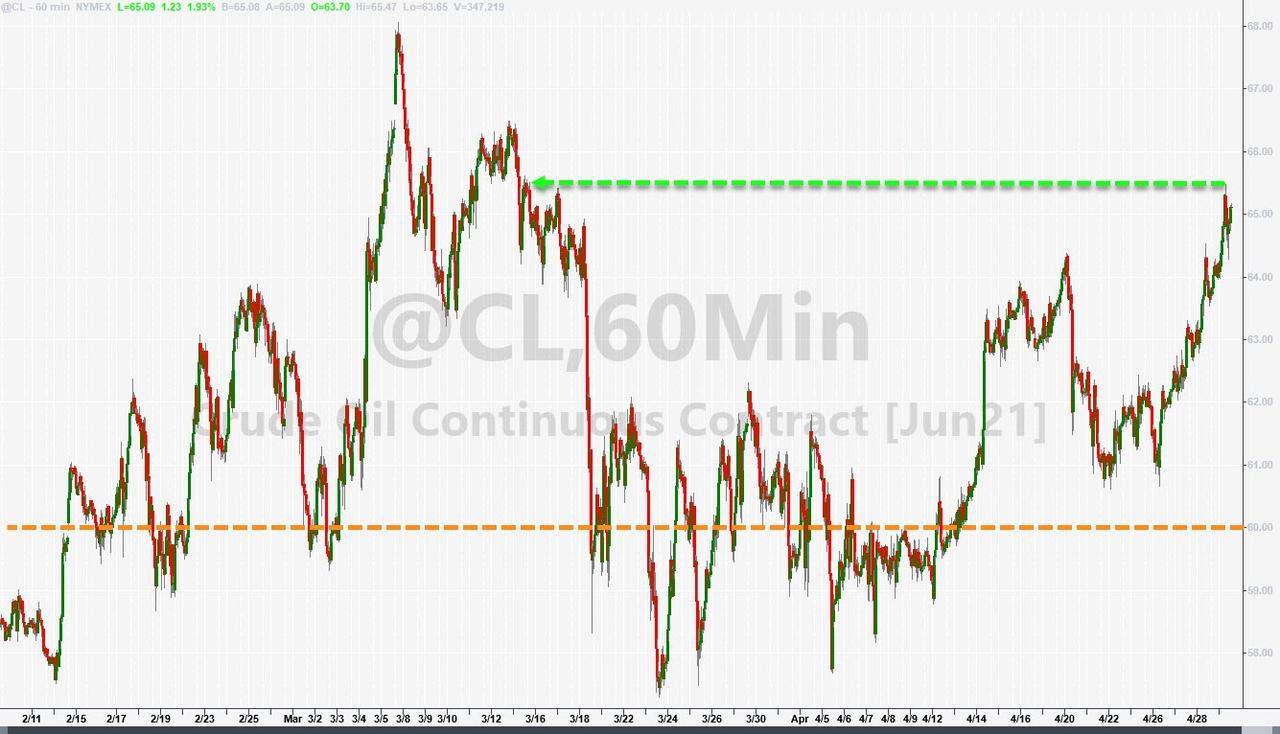
WTI surged back above $65 for the first time since mid-March…

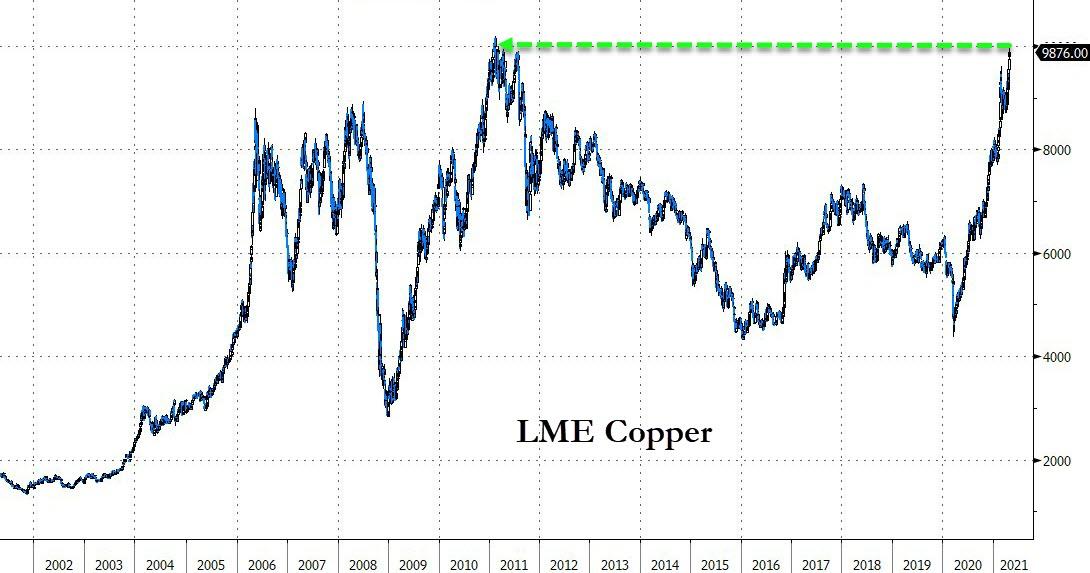
And Copper pushed up near $10,000 record highs…

Source: Bloomberg

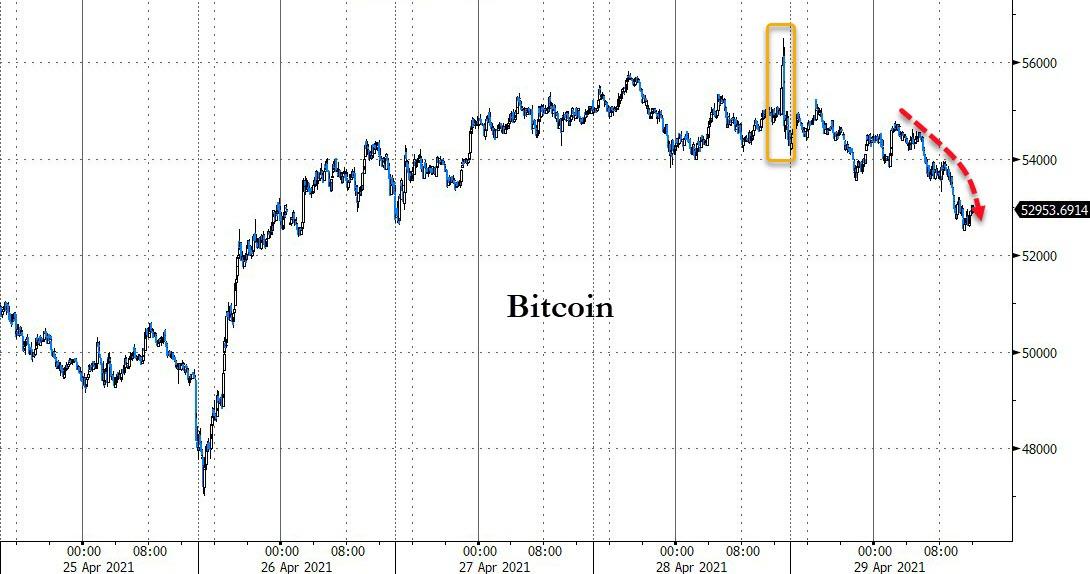
Bitcoin rolled over ahead of a major opex tomorrow…

Source: Bloomberg

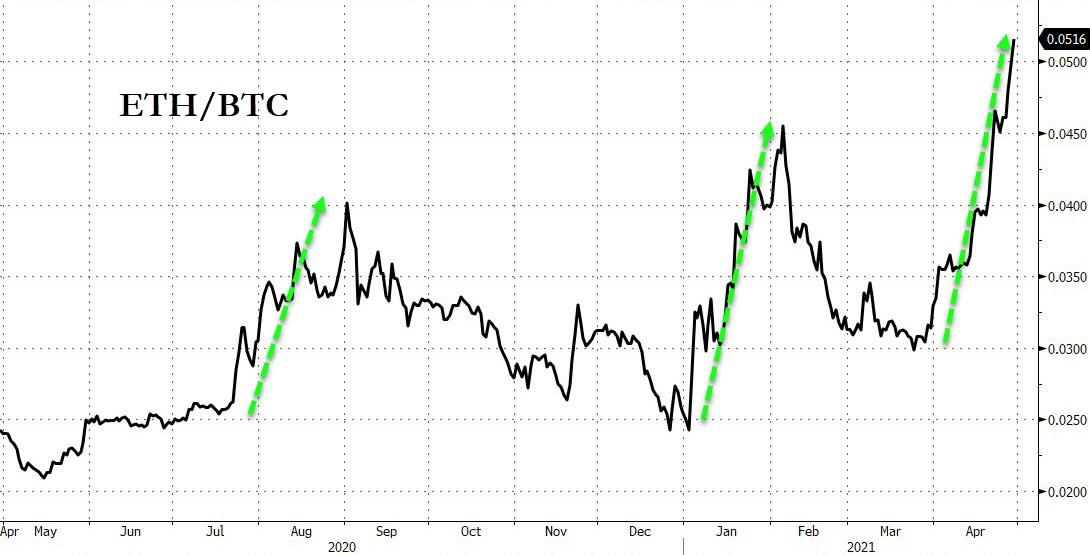
And while Ethereum gave some early gains back, it outperformed, hitting $2800 (record highs) intraday…

Source: Bloomberg

Pushing the ETH/BTC back above 0.05x for the first time since Aug 2018…

Source: Bloomberg

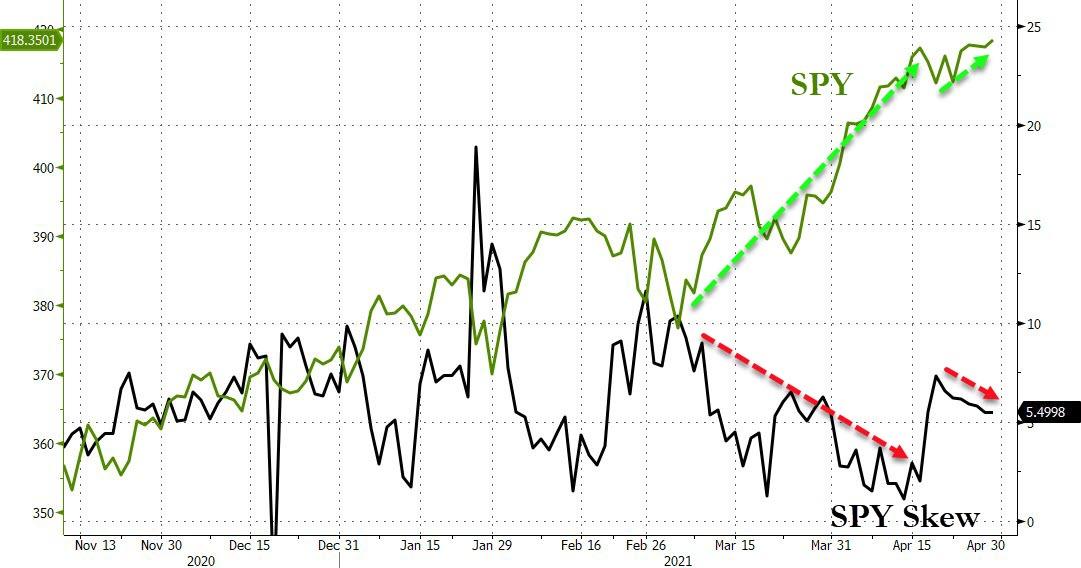
Finally, we note that as stocks have pushed to new highs over the last month (and most notably the last week), demand for downside protection has accelerated (SPY Skew below)…

Source: Bloomberg

Tyler Durden
Thu, 04/29/2021 – 16:00

via ZeroHedge News https://ift.tt/3e4JUmc Tyler Durden

Stocks Panic-Bid Off EU Close After Biden-Induced Breakdown

Stocks Panic-Bid Off EU Close After Biden-Induced Breakdown

After solid gains overnight building on the FB and AAPL earnings beats (understatement) but a disappointing miss on GDP (bear in mind that jobless were basically flat and pending home sales also disappointed), everything went to shit as US cash markets opened and stocks puked below pre-FOMC lows. Then that selling was exaggerated when the Biden admin said they would like all gig workers to be employees (whether they like it or not), which sparked another big puke. The European close appeared to stall the selling and dip-buyers rushed in to lift everything back into the green in one-trade. And then, around 1500ET, it all started to slide again, but that didn’t last…

The S&P 500 broke above the psychologically important 4200 level, then plunged to a crucial support level 4170 (vol trigger) and ripped back before fading in the end to close above 4200 at a new record high…

VIX was wild too…

The early puke saw the most widespread sell program in over a month…

Source: Bloomberg

AAPL shocked many with blowout earnings last night, but lost its gains during the day session…

COIN is down 9 out of 11 days since going public…

UBER and LYFT were both battered by Biden’s plan for gig-workers…

Bonds whipsawed just like stocks today (but not as you’d expect) – Treasuries were dumped along with stocks and bid-back along with stocks…

Source: Bloomberg

The dollar managed gains on the day, ramping back to erase post-Fed losses, only to fade once those stops were run…

Source: Bloomberg

Gold ended the day flat amid some more whipsaw action…

WTI surged back above $65 for the first time since mid-March…

And Copper pushed up near $10,000 record highs…

Source: Bloomberg

Bitcoin rolled over ahead of a major opex tomorrow…

Source: Bloomberg

And while Ethereum gave some early gains back, it outperformed, hitting $2800 (record highs) intraday…

Source: Bloomberg

Pushing the ETH/BTC back above 0.05x for the first time since Aug 2018…

Source: Bloomberg

Finally, we note that as stocks have pushed to new highs over the last month (and most notably the last week), demand for downside protection has accelerated (SPY Skew below)…

Source: Bloomberg

Tyler Durden
Thu, 04/29/2021 – 16:00

via ZeroHedge News https://ift.tt/3e4JUmc Tyler Durden

A Simple Question Going Unanswered About COVID Vaccines

A Simple Question Going Unanswered About COVID Vaccines

Authored by Mark Glennon via Wirepoints.org,

“The emerging data confirms what many of us thought would be the case—that not only do the vaccines stop symptomatic COVID, but they also make it highly unlikely that someone can even be infected at all. I think the preponderance of the evidence supports the fact that vaccinated individuals are not able to spread the virus.

– Amesh Adalja, MD, is a senior scholar at the Center for Health Security

Think about that quote above. It’s posted on the Johns Hopkins School of Public Health website. Yet extensive limitations or recommended restrictions remain for vaccinated people, from the Center for Disease Control and many state or local health authorities.

Why? Why are there any remaining restrictions on vaccinated people if they can’t get infected or spread the virus?

Search for an answer and about all you will find are health authorities saying is that vaccinated people still might become infected and thereby put themselves and others at risk. The CDC elaborates a bit, saying they don’t know for how long vaccination immunity lasts or how well vaccines work against new variants of the virus.

Fair enough, except we also know this from the CDC about those “breakthrough cases” – when a vaccinated person gets infected: Out of 84 million fully vaccinated Americans just 6,000 nevertheless later got infected of which 74 died.

That means the chances of getting infected once vaccinated have been about seven one-thousandths of one percent and the chances of dying are one ten-millionth of one percent.

In other word’s the risk is so incomprehensibly small you’d need an electron microscope to see it.

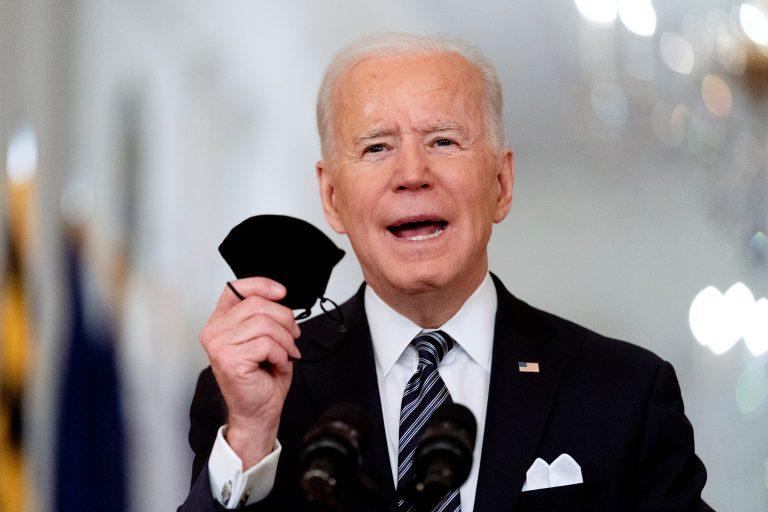
The biggest obstacle now to loosening restrictions, as health authorities see things, is “vaccine hesitancy” — getting the unwilling vaccinated. Yet politicians from President Biden on down go out of their way to wear masks and maintain distancing measures even though they they are vaccinated. Biden delivered his address to a half-empty Congress last night like it was of group of suspected lepers — they were all masked and distanced. That’s senseless given their own claims and data about the vaccine.

It’s as if they are trying to confuse the daylights out of America. It’s no wonder much of the country thinks its leadership has some ulterior motive for prolonging the restrictions. It’s no wonder that a large part of America now so distrusts the medical establishment that they’d prefer to rely on their own immune systems over the vaccine.

Here in Illinois, Gov. JB Pritzker announced this week a $60 million spend to combat vaccine hesitancy by educating the public about it.

It will take more than that unless the supposed experts and politicians get their story and conduct straight. They need to stop treating inconsequential risks as material risks. They must state whatever basis they have for the policies they impose coherently, consistently and realistically.

Tyler Durden
Thu, 04/29/2021 – 15:50

via ZeroHedge News https://ift.tt/3xCTQuD Tyler Durden

NYC Lost $1.2 Billion In Tax Revenue As Tourism Plunged 73% During Pandemic

NYC Lost $1.2 Billion In Tax Revenue As Tourism Plunged 73% During Pandemic

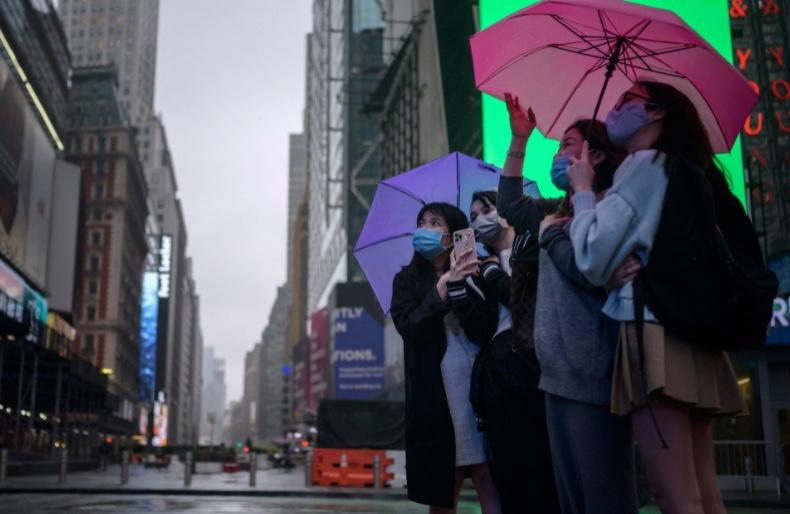
As Europe rolls out a vaccine passport to try and support its tourism industry by any means necessary, New York City’s tourism industry is just showing its first signs of revival.

And with those who choose not to get vaccinated restricted from traveling abroad for the foreseeable future, domestic destinations like the Big Apple are excited by the prospect of a bigger-than-expected rebound. On that note, Bloomberg reports that the city’s tourism industry is just showing its first signs of revival, according to a report from the state Comptroller’s Office.

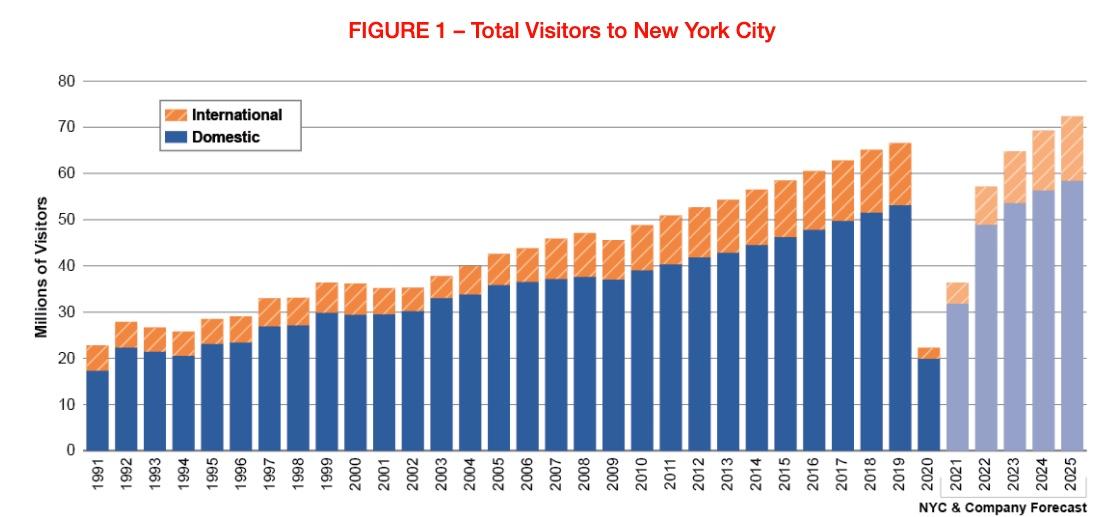
Spending by visitors to New York City dropped by 73% in 2020 from the year before, costing the city $1.2 billion in lost tax revenue, as 43.7MM fewer visitors arrived in the city in 2020. This accounted for 59% of the $2 billion in lost revenue the city believes was lost due to the pandemic. What’s more, the industry’s overall economic impact fell to $20.2 billion in 2020 from $80.3 billion in 2019.

Prior to the pandemic (September 2019), hotel occupancy in the City was 89.6 percent, the highest in the nation, and was a key factor attracting hotel builders and operators. By September 2020, occupancy had dropped to 38.9 percent, pressuring daily room rates.

While the first green shoots are starting to show, New York Comptroller Thomas DiNapoli said it will take years for the industry to fully recover.

“The pandemic’s damage to this industry has been staggering and it may take years before tourism returns to pre-pandemic levels,” Comptroller Thomas DiNapoli said in a statement on Wednesday. “Visitors and their spending are essential factors in measuring the health of the economy.”

Over the past few decades, NYC’s services-based economy has become increasingly dependent on tourism, as any panhandler in Times Square would likely attest.

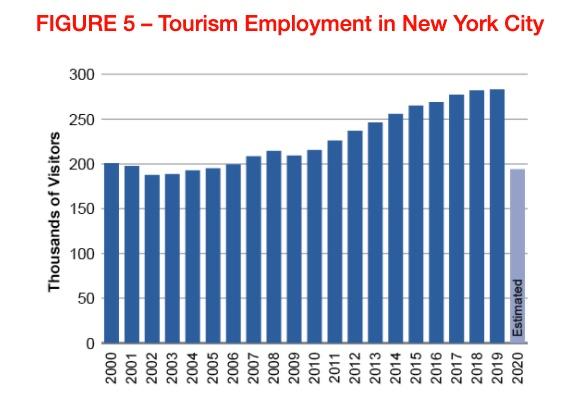
Tourism jobs declined by more than 30% last year, from 283K to 194K, a loss of 89K jobs, numbers that – according to the latest nonfarm payrolls data, are finally creeping higher.

Since 1991, the number of visitors to the City has nearly tripled, with almost half the growth occurring in the last 10 years (between 2009 and 2019). Much of this has been driven by international tourism, although with the US’s lingering travel restrictions, international travelers have seen by far the biggest drop. Though, to be sure, the majority of visitors to the city are still domestic travelers. But generally speaking, the city makes more money off of international tourists, with one international tourist typically spending 4x what a domestic tourist spends. Unsurprisingly, the majority of these jobs are located in Manhattan, though Brooklyn and Queens have seen rapid tourism job creation over the last 10 years.

Tourism industry employees, like hospitality workers, tend to live in the city. According to the report, 83% of the nearly 200K workers live in the city. A higher share are also self-employed. There are 60,800 firms in New York City that provide at least some of their services in support of tourism. Of these, 39.5 percent are located in Manhattan, while Brooklyn and Queens also account for large portions (25.3 percent and 22.5 percent, respectively).

Of course, even as international travelers start to trickle back once COVID-19 case numbers have returned to zero, it’s looking increasingly possible that a new scourge might take its place: violent crime, which is exploding in the city in the wake of the pandemic.

Tyler Durden
Thu, 04/29/2021 – 15:35

via ZeroHedge News https://ift.tt/3u6anVY Tyler Durden

University of Toledo Backtracks on “Inclusive Excellence Award” to Conservative Professor Lee Strang

As at most law schools, the faculty at University of Toledo leans strongly to the left. Nevertheless, in an admirable display of ideological ecumenicism, the law school faculty overwhelmingly nominated their conservative colleague, Lee Strang for the university’s second annual Inclusive Excellence Award, and the university announced that he would receive the award this year. According to the university’s chief diversity officer:

The individuals who nominated Strang for the award recognized his conservative point of view as a minority in academia and a benefit to legal debate.

One nomination read: “Professor Strang always welcomes students to present and defend their perspectives while respectfully challenging them to consider points of view contrary to their starting point. I believe the academy at its best is a place where truth claims and viewpoints can contend with one another based on their own merits and scholars from all life experiences have the opportunity to wrestle with the arguments of others as well as their own assumptions.”

Another wrote, “As much as any demographic measure of diversity, the diversity of thought and perspective is at the very heart of our identity as an academic institution.”

It is for these reasons Strang was recognized with the 2021 award.

Unfortunately, you can guess what happened next. Giving the award to Strang created an uproar among students, who started an online petition to revoke the award. In the course of doing so, students dug up an article from 2003 in which Strang argued in favor of discouraging homosexuality. Strang, for his part, noted that he no longer would make the same argument today, and that he had indeed long since successfully asked the publisher to pull the article from its website.

What Strang wrote in 2003 should be neither here nor there. He was being awarded for his commitment to “inclusive excellence” while working at Toledo, and no one has suggested that he said or did anything to make anyone feel unwelcome during his tenure at the law school.

One suspects that most of the objecting students and others were crying foul because the university actually lived up to its commitment to “inclusive excellence” by giving an award to a white man with conservative views, a professor whom his liberal colleagues found expertly facilitated classroom dialogue between people of opposing political point of views. Surely that comes within a literal definition of “inclusive excellence.”

But in fact, the common understanding of “inclusive excellence” in the university context is that concern for inclusivity is limited to designated minority groups, with the goal of making them feel comfortable; a white male Christian professor who devotes classroom times to making sure viewpoints on all sides are represented and debated not only doesn’t fit that ideal, to a significant extent he contradicts it. This is especially true if one believes, as many do, that disagree with woke orthodoxy makes people feel “unsafe” and may even constitute “violence.” And “excellence” in the common understanding, when prefaced by inclusive, does not mean a commitment to academic excellence, it means “we are excellent in our inclusivity.” This in turn precludes conservative voices who dissent from the progressive version of inclusivity described above.

So the university was faced with a choice: (1) live up to the literal, plain meaning of inclusive excellence, and defend the award to Strang because diversity of opinion is crucial to the academic enterprise, and a professor who is able to facilitate difficult, ideologically laden discussions is a boon to the university; or (2) backtrack, and suggest the award was a mistake.

Again, you can guess the rest. The university’s diversity officer in essence promised reforms to ensure that such a mistake won’t recur:

We have learned that more work is needed on our part to inform our campus community and our alumni of this recognition opportunity and to seek their nominations. Our UToledo alumni is an audience we had not actively engaged for nominations and will do so in the years ahead. In addition, we will broaden the review committee beyond the Office of Diversity and Inclusion to be sure we have diverse perspectives during the selection process for this honor.

In these first two years of the awards in 2019 and 2021, the recipients have been selected based exclusively on the nominations submitted. We are working to revise the nomination and review process to be sure we take a comprehensive approach in selecting the recipients to ensure their bodies of work represent our diversity and inclusion values.

As an institution we are committed to promoting a campus environment where every member of the UToledo community feels included and respected. I will continue to do my best to acknowledge and facilitate respectful discussions that enable us all to grow and do better.

That said, at least University of Toledo has not completely embarrassed itself. Near as I can tell, it has not announced a decision to revoke the award.

from Latest – Reason.com https://ift.tt/3e23tex
via IFTTT