Court Notes Possible Lack of Diversity of Citizenship in Marc Rotenberg v. Politico LLC

I blogged a few weeks ago about a COVID-related libel lawsuit by former Electronic Privacy Information Center head Marc Rotenberg against Politico, LLC, and in particular noted the possible jurisdictional problem:

As I’ve suggested in my earlier posts (on the disclosure of private facts claim and the libel and false light claims), the lawsuit by Marc Rotenberg—former head of the Electronic Privacy Information Center—against Politico and Protocol is likely to be an uphill battle. This of course raises the question: Will Politico and Protocol be able to take advantage of D.C.’s anti-SLAPP statute? That statute, like others in various states,

  • allows early dismissal of lawsuits based on speech “in connection with an issue of public interest,” if the court concludes that plaintiff’s claim is legally unfounded;
  • generally suspends discovery until the motion is resolved;
  • requires expedited hearings and rulings in such cases;
  • provides for immediate appellate review; and
  • presumptively requires a losing plaintiff to pay the prevailing defendant’s attorney fees.

Anti-SLAPP statutes are bad news for plaintiffs with iffy legal claims.

But wait: Though many federal courts have held that state anti-SLAPP statutes apply in federal lawsuits based on state tort claims, others have disagreed. And the D.C. Circuit, in an opinion by then-Judge Kavanaugh, held that the D.C. anti-SLAPP statute is a procedural rule that doesn’t apply in D.C. federal district court. Rotenberg sued in that federal court, so he needn’t fear the anti-SLAPP statute, right?

Not so fast! The lawsuit is in federal court on a “diversity of citizenship” theory—the claim is that plaintiff Rotenberg is domiciled in D.C. and defendants Politico LLC and Protocol Media, LLC are headquartered and “incorporated” in Virginia. But there are also two other defendants, Robert L. Allbritton and Tim Grieve, who run Politico and Protocol. And while their addresses are listed on the Complaint as being the same as the Virginia address of Politico and Protocol Media, my quick research suggests that they might be domiciled in D.C.

And if at least one of the defendants is a D.C. domiciliary, that means that there isn’t complete diversity of citizenship between plaintiff and defendants, and thus no federal jurisdiction. The federal court would have to dismiss the case, and while Rotenberg could refile in D.C. Superior Court, the anti-SLAPP statute would apply there.

Nor can Rotenberg avoid this by refiling the lawsuit in federal court without the two individual defendants (who aren’t really necessary defendants in any event). “For diversity jurisdiction to exist, no plaintiff may share state citizenship with any defendant,” and “Unincorporated associations, including LLCs, have the citizenship of each of their members.”

Contrary to what the Complaint says, Politico LLC and Protocol Media, LLC appear not to have been “incorporated,” but to instead be, true to their names, LLCs; I checked on the Virginia State Corporation Commission’s site, which showed each as a “Limited Liability Company.” So if Allbritton, Grieve, or both are members of the LLCs, and if the member or members are D.C. residents, then the case would still be kicked out of federal court, and would have to be refiled in D.C. Superior Court.

I expect that, if my tentative research about Allbritton’s and Grieve’s D.C. residence is correct, the defendants will promptly move to dismiss on this jurisdictional ground; we should learn within a few weeks whether that indeed happens.

But it looks like Judge Tanya S. Chutkan beat the defendants to it:

Plaintiff brings this diversity action against two corporate entities and two individuals. However, the venue, jurisdiction and parties sections of the Complaint do not set forth the facts necessary to establish that this court has jurisdiction pursuant to 29 U.S.C. Section 1332. Plaintiff has not alleged the states where the individual defendants are citizens. Additionally, Defendant has not alleged where Politico LLC has its principal places of business, nor where Protocol Media, LLC is incorporated or has its principal place of business. Accordingly, by May 5, 2021 Plaintiff shall file an Amended Complaint that contains the facts necessary for this court to establish jurisdiction.

(Federal judges indeed often inquire into their possible lack of jurisdiction, even before the parties raise it.) I’ll report on what plaintiff files.

from Latest – Reason.com https://ift.tt/3t3le1q
via IFTTT
Biden’s ‘American Families Plan’ Sends the IRS To Snoop on Bank Transactions, Venmo Accounts


covphotos128456

To pay for a glut of new federal spending, President Joe Biden on Wednesday announced plans to hike taxes on businesses and wealthy Americans—and to sic the federal tax cops on everyone.

Biden’s American Families Plan calls for spending $80 billion on the Internal Revenue Service (IRS) to increase tax compliance in the hopes of generating $700 billion over the next 10 years to partially offset the plan’s $1.8 trillion price tag. The $700 billion that will supposedly come from stepped-up tax enforcement will be the largest single funding source for the American Families Plan—the revenue from tax enforcement is six times larger than what will be produced by raising the top income tax rate back to 39.6 percent.

The additional funding for the IRS will allow the agency to hire 15 percent more enforcement staff. The White House’s fact sheet on the American Families Plan says the additional resources will be aimed primarily at high-earners and corporations. “The IRS will crack down on millionaires and billionaires who cheat on their taxes,” Biden said during his address to a joint session of Congress on Wednesday, adding that he was “not out to punish anyone.”

Everyone should pay the taxes they owe, of course, but it is virtually certain that a beefed-up IRS will create new headaches for banks, financial institutions, and anyone who uses them. Biden says he’s targeting only the wealthiest Americans, but his own Treasury Department is already signaling that increased tax enforcement will require hoovering up more data from bank accounts and third-party payment providers like PayPal and Venmo.

Among other things, that means banks and third-party apps will be required to give the IRS data about account holders’ “aggregate account outflows and inflows,” the Treasury Department said in a statement on Wednesday.

“This reform aims to provide the IRS information on account flows so that it has a lens into investment and business activity,” according to the Treasury’s statement. “Providing the IRS this information will help improve audit selection so it can better target its enforcement activity.”

Keeping an eye on the inflow and outflow of bank accounts won’t automatically tell the IRS that someone is hiding unreported, taxable income, The Wall Street Journal notes. But it would be a “first step” in determining how much additional scrutiny might be necessary.

Think of it as giving another opportunity for the federal tax cops to establish probable cause for a financial stop and frisk. And that comes after Biden has already ordered the IRS to give greater scrutiny to transactions in the so-called sharing economy.

The entire IRS budget for the current fiscal year is about $12 billion, with $5.2 billion earmarked for enforcement activities. That means Biden’s $80 billion funding increase, spread out over 10 years, amounts to a 150 percent increase in spending on tax audits and investigations.

But Biden is throwing so much new funding at the IRS that it isn’t clear whether the agency will be capable of using it all. “I’m not sure you’d be able to efficiently use that much money,” John Koskinen, who ran the IRS for part of the Obama presidency, tells The New York Times. “That’s a lot of money.”

It sure is. And it won’t just be the rich paying the costs.

from Latest – Reason.com https://ift.tt/2Re6CyX
via IFTTT

Pitch For “Trump Media Group” Values President’s Brand At $15 Billion

Pitch For “Trump Media Group” Values President’s Brand At $15 Billion

Axios, that purveyor of lightly reported political gossip, has published the latest “scoop” about the machinations inside President Trump’s inner circle as the president considers launching his own media venture, something he has been pondering for years, since even before his stunning upset of Hillary Clinton back in 2016.

According to the report, Trump was pitched last month about launching a multi-billion-dollar media and technology company built around his personal brand. The pitch even involved going public immediately via SPAC (and perhaps taking advantage of a sudden drought in deal flow).

The 24-page presentation made its way to Trump’s desk at Mar-a-Lago, although it doesn’t seem to have gained traction with the former president.

The proposal is still just that – a proposal, with no word yet on whether Trump plans to move forward. Word on the street for months is that Trump is contemplating something between a Parlar-like social media network, or a TV station and digital offering more akin to Fox News and Fox Nation.

At one point in the slide deck (which Axios neglected to release), the dealmakers referred to “Trump Media Group” – with Trump as its CEO and Chairman – as “a conservative media powerhouse that will rival the liberal media and fight back against ‘Big Tech’ companies of Silicon Valley.” The company was comprised of three divisions (social media, streaming, and technology) and was estimated at a valuation of $15 billion.

It was to be comprised of three divisions: Trump+ (a subscription-based content business that gets compared to Netflix and Disney+), Trump Social Media (which would take a stake in existing companies or build its own), and Trump Technologies (which would provide alternatives to internet services like AWS and Stripe, and promise not to censor customers).

It forecast a base case valuation of $15 billion, with Trump+ alone at $9.2 billion.

It also suggested that TMG would go public, and presumably raise capital, via a SPAC. No mention of other funding sources, including if Trump would be asked to invest.

Axios signs off with the following comment: “While this particular proposal seems dead in the water, it offers a glimpse into the sorts of business endeavors being presented to Trump”.

But what Axios didn’t say is that this proposal was likely leaked for a reason, and is only one in a series of recent reports about Trump’s media ambitions. The other day, we reported that Trump plans to restart his MAGA rallies as soon as next month, as he appears to be taking a 2024 run very seriously.

Tyler Durden
Thu, 04/29/2021 – 13:20

via ZeroHedge News https://ift.tt/2QyFWcB Tyler Durden

Biden’s ‘American Families Plan’ Sends the IRS To Snoop on Bank Transactions, Venmo Accounts


covphotos128456

To pay for a glut of new federal spending, President Joe Biden on Wednesday announced plans to hike taxes on businesses and wealthy Americans—and to sic the federal tax cops on everyone.

Biden’s American Families Plan calls for spending $80 billion on the Internal Revenue Service (IRS) to increase tax compliance in the hopes of generating $700 billion over the next 10 years to partially offset the plan’s $1.8 trillion price tag. The $700 billion that will supposedly come from stepped-up tax enforcement will be the largest single funding source for the American Families Plan—the revenue from tax enforcement is six times larger than what will be produced by raising the top income tax rate back to 39.6 percent.

The additional funding for the IRS will allow the agency to hire 15 percent more enforcement staff. The White House’s fact sheet on the American Families Plan says the additional resources will be aimed primarily at high-earners and corporations. “The IRS will crack down on millionaires and billionaires who cheat on their taxes,” Biden said during his address to a joint session of Congress on Wednesday, adding that he was “not out to punish anyone.”

Everyone should pay the taxes they owe, of course, but it is virtually certain that a beefed-up IRS will create new headaches for banks, financial institutions, and anyone who uses them. Biden says he’s targeting only the wealthiest Americans, but his own Treasury Department is already signaling that increased tax enforcement will require hoovering up more data from bank accounts and third-party payment providers like PayPal and Venmo.

Among other things, that means banks and third-party apps will be required to give the IRS data about account holders’ “aggregate account outflows and inflows,” the Treasury Department said in a statement on Wednesday.

“This reform aims to provide the IRS information on account flows so that it has a lens into investment and business activity,” according to the Treasury’s statement. “Providing the IRS this information will help improve audit selection so it can better target its enforcement activity.”

Keeping an eye on the inflow and outflow of bank accounts won’t automatically tell the IRS that someone is hiding unreported, taxable income, The Wall Street Journal notes. But it would be a “first step” in determining how much additional scrutiny might be necessary.

Think of it as giving another opportunity for the federal tax cops to establish probable cause for a financial stop and frisk. And that comes after Biden has already ordered the IRS to give greater scrutiny to transactions in the so-called sharing economy.

The entire IRS budget for the current fiscal year is about $12 billion, with $5.2 billion earmarked for enforcement activities. That means Biden’s $80 billion funding increase, spread out over 10 years, amounts to a 150 percent increase in spending on tax audits and investigations.

But Biden is throwing so much new funding at the IRS that it isn’t clear whether the agency will be capable of using it all. “I’m not sure you’d be able to efficiently use that much money,” John Koskinen, who ran the IRS for part of the Obama presidency, tells The New York Times. “That’s a lot of money.”

It sure is. And it won’t just be the rich paying the costs.

from Latest – Reason.com https://ift.tt/2Re6CyX
via IFTTT

Bitcoin, Ethereum Face Huge $4.5BN In Friday Option Expiration: What To Expect

Bitcoin, Ethereum Face Huge $4.5BN In Friday Option Expiration: What To Expect

Authored by @bit_hedge

With Ether knocking at $3,000 (+280% ytd) and Bitcoin consolidating at the $1T market cap level after record 1-day BTC options volume last week on Deribit Exchange, the two cryptocurrencies face a combined $4.5BN in contract expirations this Friday.

Bitcoin in particular has been showing a particularly strong and positive ‘un-stick’ effect post expiration for the past few months, presumably as dealers unwind their hedges and remove liquidity in the days following.

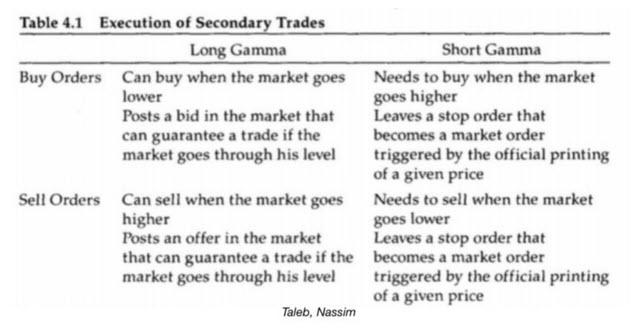
But with 18 hours remaining, as gamma ticks up at an accelerating rate into expiry options-driven flows could begin moving spot significantly right now – as market makers have to trade increasingly large clips to stay directionally neutral. The desks handling most options volume are there to collect at the spread… if they’re short calls and spot picks up, they’ll market buy into the rally to stay hedged.

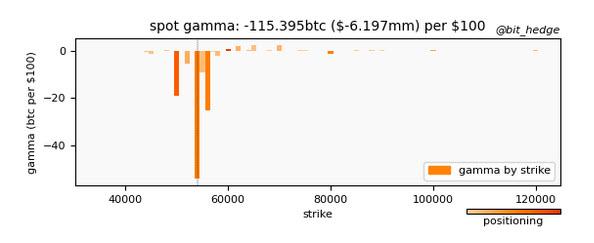
This can be a significant chunk of order-flow: right now our models have it estimated at $6.2mm to buy/sell for every $100 increase/decrease in spot.

And for the smaller-market ETH, $2.4mm to buy/sell for every $100 increase/decrease in spot.

These large gamma strikes don’t necessarily have to be the areas of highest open interest (although they often are). What matters is if dealer inventory is skewed to long or short gamma – whether they have to chase price or suppress price. In this case both cryptocurrencies look to have the volatility amplifier that is short gamma (chase).

In fact, this is such a long-call and long-put heavy expiration, that there seems to be almost no positive gamma at all! Exception: 60k strike on BTC. However, spot would have to move significantly closer to that level for it to come ‘into play’. 

Given ETH’s current position we’d expect increasing volatility into expiration with the potential for negative gamma at the 2560 and 3200 strikes to lead into a reflexive melt-down or melt-up should we push closer to either of those areas. Currently a cluster of long puts at 2720 is exhibiting the biggest ‘pull’ on spot.

For BTC, serious negative gamma to the downside at the 50k strike presents a possible target should things head south: although a v-shape recovery back as dealers re-buy into strength would be just as likely. Should we miraculously tap 60k before expiry, long-gamma ‘insulative’ flows there could lead to a ‘pinning’ as dealers pad the book. As spot currently stands, whip-lashing around the two large strikes at 54k and 56k looks likely to us.

We expect the continuing evolution of the crypto and crypto options markets to come with the ‘tail wags the dog’ options-driven phenomenon that has gripped the equity complex and look forward to watching it unfold.

Tyler Durden
Thu, 04/29/2021 – 13:04

via ZeroHedge News https://ift.tt/3gTpRbZ Tyler Durden

The FDA Wants To Lower Nicotine in All Cigarettes, Which Will Make Smokers Smoke More


neonbrand-I8LO9eXxjg8-unsplash

If it doesn’t look like avocado toast, you can’t have it. That’s the message I get loud and clear from Uncle Sam when I read story after story about the Food and Drug Administration’s latest foray into stopping ordinary Americans from doing what ordinary Americans like to do.

Take the latest news that the FDA is thinking about requiring tobacco companies to lower the nicotine in all cigarettes sold in the United States. Its goal is to fight nicotine addiction. The paternalists at the FDA are also considering whether this proposal should be paired with a ban on menthol products.

This comes from the agency that has badly botched the COVID-19 response by delaying test and vaccine authorizations that could have saved countless lives. Now it has the nerve to tell Americans, most of whom are stressed out of their minds after a year of the pandemic and lockdowns, what they can or can’t inhale.

While it may sound old-fashioned, I don’t believe that it’s the role of the government to tell fully consenting adults what they can and cannot do with their own bodies, even if their choice is something that most people disapprove of. And if you tell me that socialized medicine should give Uncle Sam the right to boss us around, I’ll tell you that two wrongs don’t make a right.

Besides, these measures are nonsensical. According to The Wall Street Journal, the idea behind the nicotine reduction measure is that it “would lower the chemical in cigarettes to nonaddictive or minimally addictive levels, aiming to push millions of smokers to either quit or switch to less harmful alternatives such as nicotine gums, lozenges, or e-cigarettes.” Note that this same FDA has waged a war on these same e-cigarettes by banning the most popular flavors to ensure that these new and less harmful products were as unappealing as a plate of raw broccoli for breakfast.

Ask yourself this question: Do the geniuses at the FDA not realize that many people will simply smoke a greater number of cigarettes per day in order to get their nicotine fix?

Why would the FDA expect smokers to respond in a radically different way than all the people the government has tried to nudge with failed nanny state interventions to get to stop smoking or drinking sugary drinks in the past? I understand the superficial belief that raising the price of an item with taxes or other means as this proposal effectively suggests could discourage its consumption. But studies show that this isn’t what happens in practice.

In fact, consumers have a knack for finding ways to consume the same amount of stuff that the government is trying to diminish the consumption of, especially when it comes to drugs, alcohol, or sugar. Sometimes they switch to substitutes that are even more dangerous.

For instance, studies find that smokers in high-tax states tend to consume cigarettes that are longer and higher in tar and nicotine than the ones consumed by smokers in low-tax states. This effect is especially pronounced among 18- to 24-year-olds because they have less money and insist on getting more bang for their buck. The same is true of harder drug prohibition. As the Cato Institute’s Trevor Burrus tells me, “Prohibition makes drugs stronger for the same reason people smuggle flasks and not 12 packs at sporting events.”

The same will happen with this latest nanny state gambit by the FDA. At the margin, a few, mostly light, smokers will give up the habit, but longtime and heavy smokers will likely start smoking more cigarettes to get their desired amount of nicotine. As with drugs and other prohibitions, this move is not neutral health-wise because, while nicotine doesn’t lead to cancer or real harm, according to the FDA, the tar in each cigarette does. According to Cato Institute Senior Fellow Jeff Singer, who is also a fellow of the American College of Surgeons, “While nicotine is addictive, the tars in tobacco smoke are what do all of the damage to health. Reducing nicotine content might paradoxically make smoking more dangerous.”

So, there you go: With its latest headline-grabbing proposal, the FDA would make smokers poorer and less healthy. We should also expect the black market to expand and offer smokers the stuff they’ve been wanting all along, including menthol cigarettes.

Why not, in this self-proclaimed land of the free, simply let adults choose as they wish.

COPYRIGHT 2021 CREATORS.COM

from Latest – Reason.com https://ift.tt/3aP4pRG
via IFTTT

The FDA Wants To Lower Nicotine in All Cigarettes, Which Will Make Smokers Smoke More


neonbrand-I8LO9eXxjg8-unsplash

If it doesn’t look like avocado toast, you can’t have it. That’s the message I get loud and clear from Uncle Sam when I read story after story about the Food and Drug Administration’s latest foray into stopping ordinary Americans from doing what ordinary Americans like to do.

Take the latest news that the FDA is thinking about requiring tobacco companies to lower the nicotine in all cigarettes sold in the United States. Its goal is to fight nicotine addiction. The paternalists at the FDA are also considering whether this proposal should be paired with a ban on menthol products.

This comes from the agency that has badly botched the COVID-19 response by delaying test and vaccine authorizations that could have saved countless lives. Now it has the nerve to tell Americans, most of whom are stressed out of their minds after a year of the pandemic and lockdowns, what they can or can’t inhale.

While it may sound old-fashioned, I don’t believe that it’s the role of the government to tell fully consenting adults what they can and cannot do with their own bodies, even if their choice is something that most people disapprove of. And if you tell me that socialized medicine should give Uncle Sam the right to boss us around, I’ll tell you that two wrongs don’t make a right.

Besides, these measures are nonsensical. According to The Wall Street Journal, the idea behind the nicotine reduction measure is that it “would lower the chemical in cigarettes to nonaddictive or minimally addictive levels, aiming to push millions of smokers to either quit or switch to less harmful alternatives such as nicotine gums, lozenges, or e-cigarettes.” Note that this same FDA has waged a war on these same e-cigarettes by banning the most popular flavors to ensure that these new and less harmful products were as unappealing as a plate of raw broccoli for breakfast.

Ask yourself this question: Do the geniuses at the FDA not realize that many people will simply smoke a greater number of cigarettes per day in order to get their nicotine fix?

Why would the FDA expect smokers to respond in a radically different way than all the people the government has tried to nudge with failed nanny state interventions to get to stop smoking or drinking sugary drinks in the past? I understand the superficial belief that raising the price of an item with taxes or other means as this proposal effectively suggests could discourage its consumption. But studies show that this isn’t what happens in practice.

In fact, consumers have a knack for finding ways to consume the same amount of stuff that the government is trying to diminish the consumption of, especially when it comes to drugs, alcohol, or sugar. Sometimes they switch to substitutes that are even more dangerous.

For instance, studies find that smokers in high-tax states tend to consume cigarettes that are longer and higher in tar and nicotine than the ones consumed by smokers in low-tax states. This effect is especially pronounced among 18- to 24-year-olds because they have less money and insist on getting more bang for their buck. The same is true of harder drug prohibition. As the Cato Institute’s Trevor Burrus tells me, “Prohibition makes drugs stronger for the same reason people smuggle flasks and not 12 packs at sporting events.”

The same will happen with this latest nanny state gambit by the FDA. At the margin, a few, mostly light, smokers will give up the habit, but longtime and heavy smokers will likely start smoking more cigarettes to get their desired amount of nicotine. As with drugs and other prohibitions, this move is not neutral health-wise because, while nicotine doesn’t lead to cancer or real harm, according to the FDA, the tar in each cigarette does. According to Cato Institute Senior Fellow Jeff Singer, who is also a fellow of the American College of Surgeons, “While nicotine is addictive, the tars in tobacco smoke are what do all of the damage to health. Reducing nicotine content might paradoxically make smoking more dangerous.”

So, there you go: With its latest headline-grabbing proposal, the FDA would make smokers poorer and less healthy. We should also expect the black market to expand and offer smokers the stuff they’ve been wanting all along, including menthol cigarettes.

Why not, in this self-proclaimed land of the free, simply let adults choose as they wish.

COPYRIGHT 2021 CREATORS.COM

from Latest – Reason.com https://ift.tt/3aP4pRG
via IFTTT

US Sells Treasury Bills At 0% For The First Time Since The Covid Crash

US Sells Treasury Bills At 0% For The First Time Since The Covid Crash

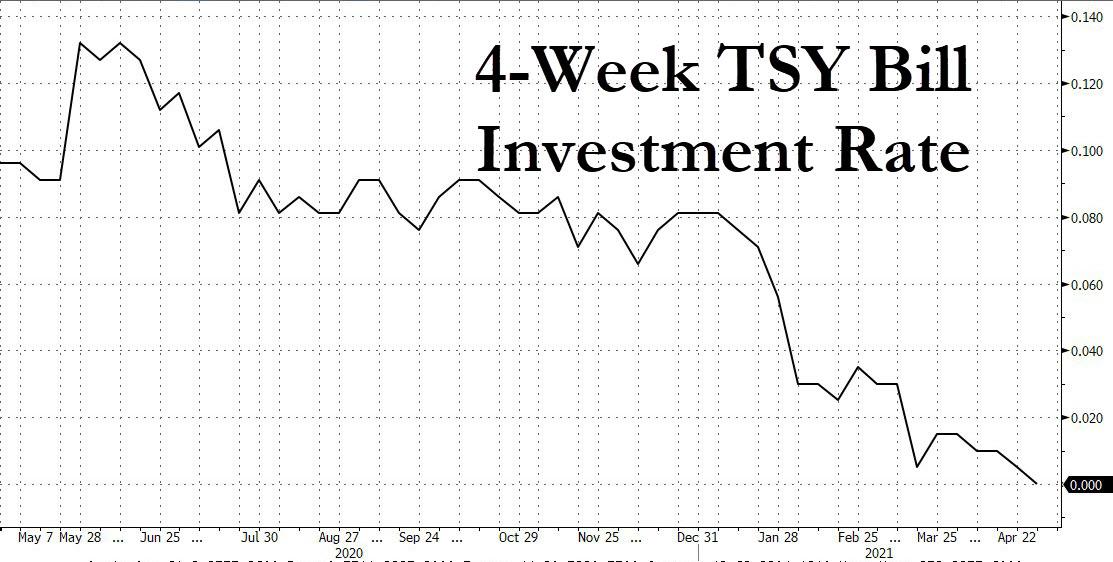
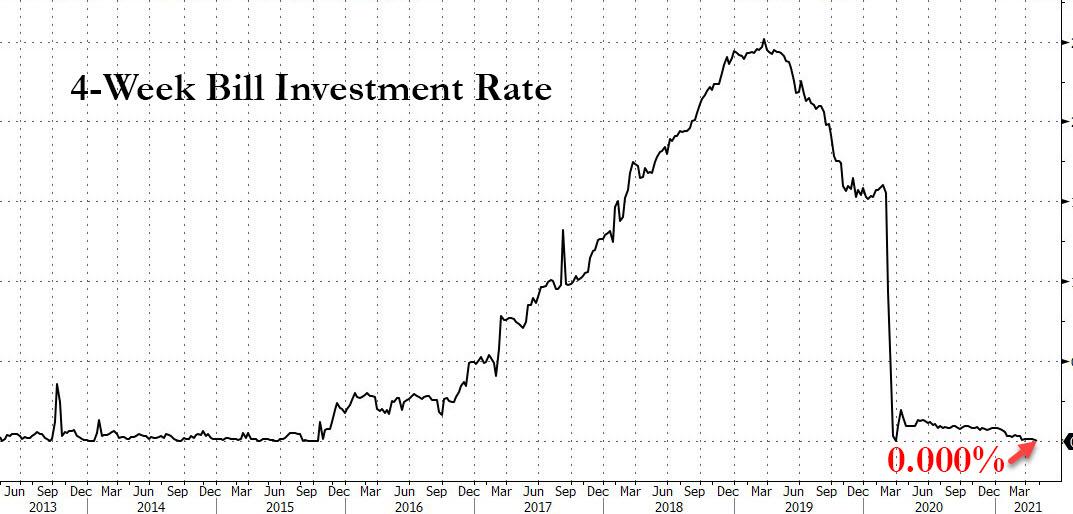
While 4-week Treasury Bill rates had dipped negative on occasion over the past several months, the last time the 4-Week Bill priced at a 0.000% investment rate was during the post-covid crash scramble, when the 4-Week printed at 0.000% on the March 26 auction.

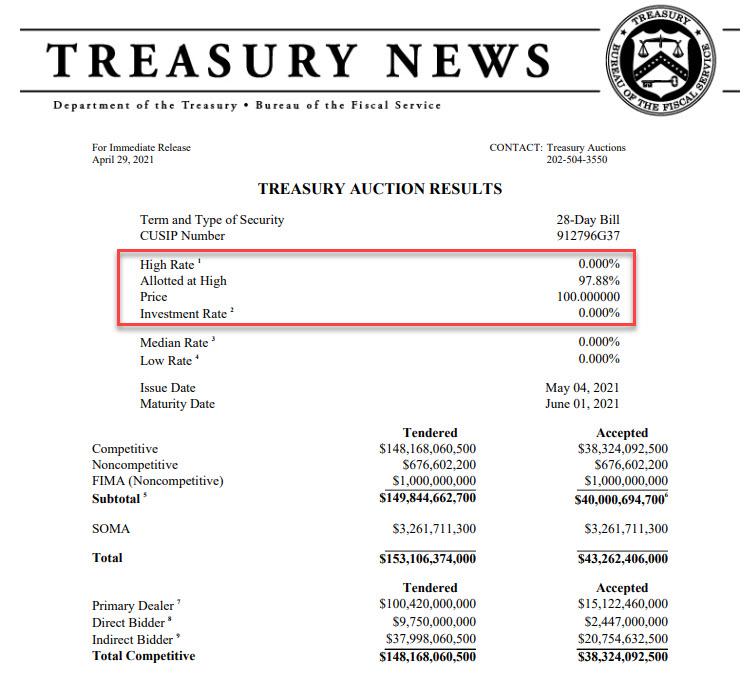
Until today that is, because moments ago, the Treasury sold $40BN in 4-week bills at a price of 100.000% representing a rate of 0.00%.

To be sure, Bills had printed at 0.000% at auction previously, but that was largely during the reserve glut days of 2015.

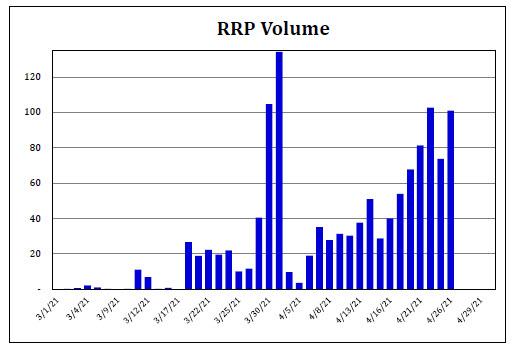
So why now? The same reason usage of the Fed’s Reverse Repo facility has soared in recent weeks for nothing to over $100 billion…

…as investors choose to directly transact with the Fed – where only positive rates are allowed – rather than the open market where collateral rates have frequently been negative in recent weeks, as Curvature’s Scott Skyrm explains in this note from April 26:

Overnight rates are low. Too low by all normal standards. The fed funds rate is well below the mid-point of the fed funds target range and the Repo GC rate is at zero; often trading negative. Zero percent interest rates are forcing billions of dollars of cash into the Fed’s RRP facility; a total of $100.9 billion went there today.

While this This is a delightful case of deja vu irony – the Fed is taking Treasurys out of the market through QE purchases and putting them right back in via the RRP – it is also distorting the Repo market, and although the Fed can fix this aberration by hiking the IOER or RRP rates, it has so far refused to do so. 

If the Fed wants to push Repo rates higher, an IOER hike would help. Raising the IOER will move fed funds, which, in turn, will put upward pressure on Repo rates. As an alternative, the Fed could increase the RRP rate – currently at zero. This is most favored by economists. However, increasing the RRP will mean cash investors sending more cash to the Fed each day.

This is also having a knock-on effect on Treasury bills, which have been under pressure as the government is reducing its issuance of short-term securities in order to draw down its mammoth cash balance so it can comply with a possible debt-ceiling reinstatement and to cover expenses.

As Bloomberg writes, in its survey of dealers ahead of the next refunding announcement, the Treasury Department has asked about “the impacts that reinstatement of the debt limit could have on the Treasury market as well as on broader financial markets.” Related to that, it has also asked about for expectations for bill supply over the next three months and adjustments in issuance.

The good news is that negative bill rates at auction are not possible (yet). The bad news is that as the Treasury continues to draw down on its cash, the rate on 4-week (and soon 8-week and so on) auctions will be 0.000% while secondary market yields will dip negative again, encouraging the return the infamous ZIRP/NIRP auction arbitrage trade which we observed a year ago.

Tyler Durden
Thu, 04/29/2021 – 12:48

via ZeroHedge News https://ift.tt/2PxirzQ Tyler Durden

NASA’s Mars Helicopter To Push Limits On Fourth Flight 

NASA’s Mars Helicopter To Push Limits On Fourth Flight 

NASA’s Mars helicopter Ingenuity is ready for the boldest flight yet in the skies of Mars, according to NASA’s Jet Propulsion Laboratory in Pasadena, California. 

The 4-pound helicopter will attempt its fourth flight today on the Red Planet. The flight will begin at 1012 ET, and streaming data won’t be received by NASA’s JPL until 1321 ET. We would assume shortly after, Twitter handle NASA JPL will release images and or videos of the flight. 

According to the fourth flight plan, Ingenuity is expected to autonomously fly south for 276 feet at an altitude of 16 feet and pass over rocks, impact craters, and sand ripples. “As it flies, the rotorcraft will use its downward-looking navigation camera to collect images of the surface every 4 feet (1.2 meters) from that point until it travels a total of 436 feet (133 meters) downrange. Then, Ingenuity will go into a hover and take images with its color camera before heading back to Wright Brothers Field,” NASA’s JPL said. 

“To achieve the distance necessary for this scouting flight, we’re going to break our own Mars records set during flight three,” said Mars Helicopter backup pilot Johnny Lam. “We’re upping the time airborne from 80 seconds to 117, increasing our max airspeed from 2 meters per second to 3.5 (4.5 mph to 8), and more than doubling our total range.”

The Perseverance rover also capture images and video of Ingenuity’s flight.

It’s no surprise that Ingenuity has garnered so much attention because it’s the first aircraft to operate on a different planet. 

Tyler Durden
Thu, 04/29/2021 – 12:40

via ZeroHedge News https://ift.tt/3u8gtVU Tyler Durden

Biden Is Using the Pandemic as an Excuse for Permanent Expansions of Government Power


biden-notSOTU-2021-xnaphotostwo364185

President Joe Biden isn’t letting a crisis go to waste. 

His administration is using the pandemic as an excuse to push a list of preexisting Democratic policy priorities, few of which have much to do with COVID-19, and some of which were initially pitched as temporary measures. 

But in last night’s address to a joint Congress, Biden made clear that he wants to extend some these policies, turning COVID-era emergency measures into permanent expansions of federal power, using the virus as an excuse. For Biden, the pandemic has become a catchall justification for a wide array of big-government programs that he and the Democratic Party already wanted to pursue. 

Take, for example, Biden’s push to expand subsidies for health insurance purchased via the Affordable Care Act, the health law commonly known as Obamacare. 

Biden’s American Rescue Plan—the $1.9 trillion aid bill passed in March—included $34 billion to temporarily boost subsidies for health coverage purchased through Obamacare’s marketplaces. The subsidy boost was set to last for two years. 

One could perhaps argue that a pandemic that left millions out of work would justify a temporary program to make health insurance premiums less directly costly for struggling low-income individuals. 

But Biden’s subsidy expansion was structured in a way that would expand subsidy availability to families with quite high incomes. The expanded subsidy is tied to local premiums, and so it varies geographically. In some parts of the country, however, it could make tens of thousands of dollars in annual subsidies available to households earning $350,000 a year

In a pandemic-induced recession whose negative economic effects have been concentrated almost entirely at the bottom of the income ladder, there’s no non-ridiculous way to justify that sort of handout to the well-off as pandemic relief. It’s just a straightforward bid to make an existing big-government program even bigger. 

And what was initially touted as a temporary subsidy expansion is now being upsold as a permanent upgrade. Last night, Biden announced that he wants to extend the subsidy boost indefinitely, which would cost an estimated $200 billion over the next decade. He then went on to praise Obamacare as a “lifeline for millions of Americans” and insist that “the pandemic has demonstrated how badly it is needed.” 

The pandemic, in other words, was a convenient excuse—first for a temporary expansion of an already large federal program, then for an even more expensive permanent expansion of that same program. Big government for now swiftly becomes bigger government forever. 

Biden is using this playbook to extend and expand other programs as well. His $1.9 trillion American Rescue Plan also included a one-year expansion of the child tax credit. Much of it is refundable, and the plan allows for it to be paid monthly, meaning that it is essentially a regular check cut to parents by the government. As a New York Times report put it recently: “Though framed in technocratic terms as an expansion of an existing tax credit, it is essentially a guaranteed income for families with children.” 

The one-year cost of expanding the child tax credit was about $100 billion. In last night’s speech, Biden pushed Congress to extend the boost to 2025, likely costing hundreds of billions more. And while some of the benefits would go to low-income households, this plan, too, is structured in a way that delivers benefits to families with six-figure earnings; the White House fact sheet offers an example of a family of four making $100,000 a year that would see thousands of dollars in benefits from this plan. 

If Biden’s cash for kids program is extended through 2025, it would be unlikely to end there. It might be reauthorized and extended on a rolling basis, but it would effectively become an ongoing program, another untouchable entitlement in America’s already sizable federal policy firmament. Indeed, some Democrats have already publicly pushed the president to simply make the program permanent. And from there, it’s easy to imagine that the next push would be to make the benefit even larger. Big government has already become bigger government, and under Biden, it is on track to grow larger and larger still. 

And somehow it’s all justified by the pandemic. His speech last night started with the words, “Tonight, I come to talk about crisis.” As he took office in January, he said, he had “inherited a nation in crisis.” The speech, and its laundry list of pricey new programs and policies, was thus framed as an extended response to that crisis. 

It’s not. In part that’s because so many of his proposals are either poorly targeted (large checks for households with stable six-figure incomes) or totally irrelevant to any actual problems stemming from the pandemic (bailouts for union pension funds). 

And in part because the crisis itself is fading from the scene, or at least becoming less severe. Thanks to vaccines, COVID-19 cases and deaths are falling rapidly. And thanks to the improving picture around coronavirus health and safety, the economy is rebounding too. The crisis is, if not entirely gone, much less of one than it was a few months ago, and thus much less of a plausible justification for extreme measures in response. Yet even as COVID fades away, Biden is pursuing massive expansions of federal power premised on crisis response. 

That’s because despite the speech’s framing, crisis response isn’t really the goal—or, at the very least, it’s only part of it. Biden is pursuing a historically unprecedented expansion of government spending and power for its own sake. And no one is really trying to hide it either. The post-speech headline at the top of The New York Times main page this morning read, “Biden Makes Case to Vastly Expand Government’s Role.” It described his speech as an “ambitious agenda to rewrite the American social compact.”  

Biden’s presidency is barely three months old, but it’s already fallen into a predictable pattern: Point to the pandemic. Declare that it’s an emergency, and that something must be done. Then insist on an expensive, expansive policy overhaul that Democrats have pushed for years—first, in some cases, as a temporary measure, and then, inevitably, for much longer. It’s deceptive and dangerous. And if he keeps this up, he may leave a new crisis in his wake.

from Latest – Reason.com https://ift.tt/330RQOM
via IFTTT