Stocks Spooked As Treasury Yields Surge

Stocks Spooked As Treasury Yields Surge

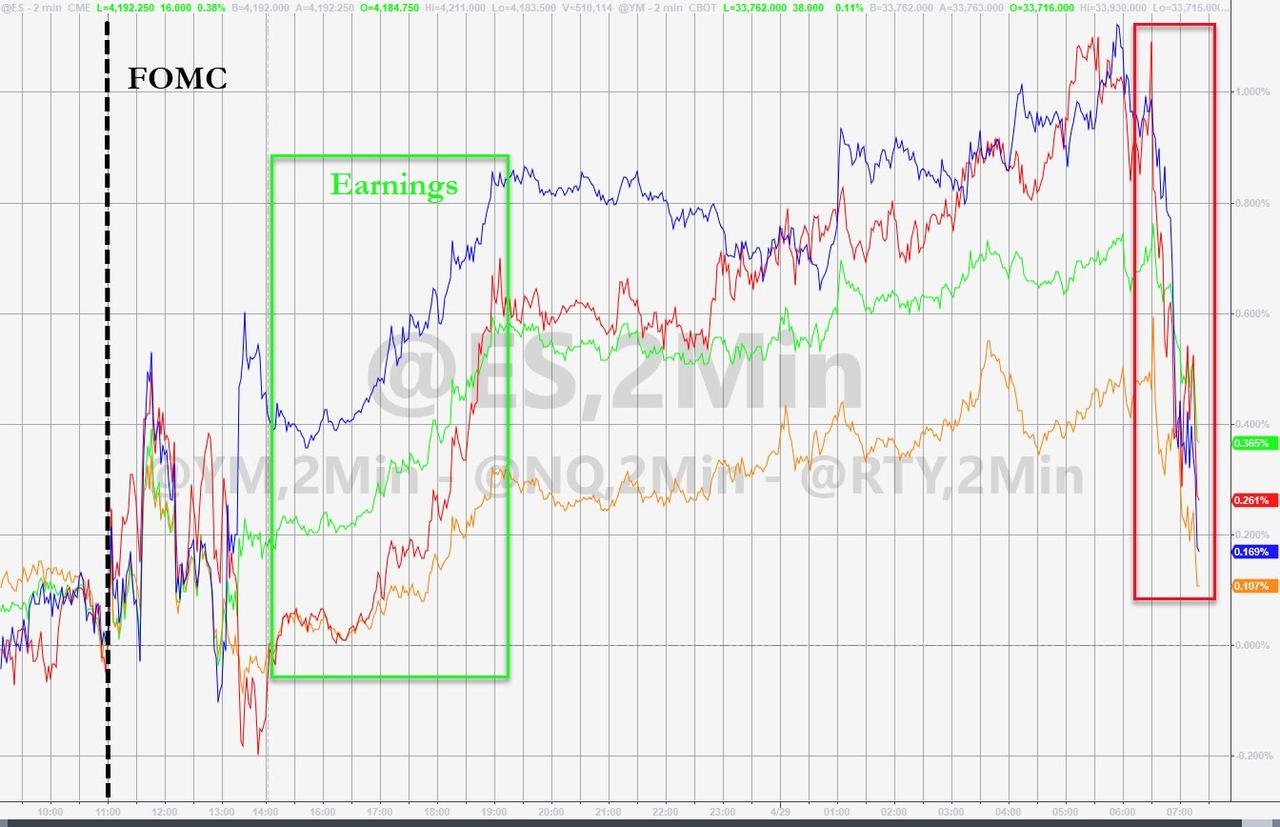
Despite explosive earnings overnight, US equity markets are tanking this morning as the surge in Treasury yields spooks investors…

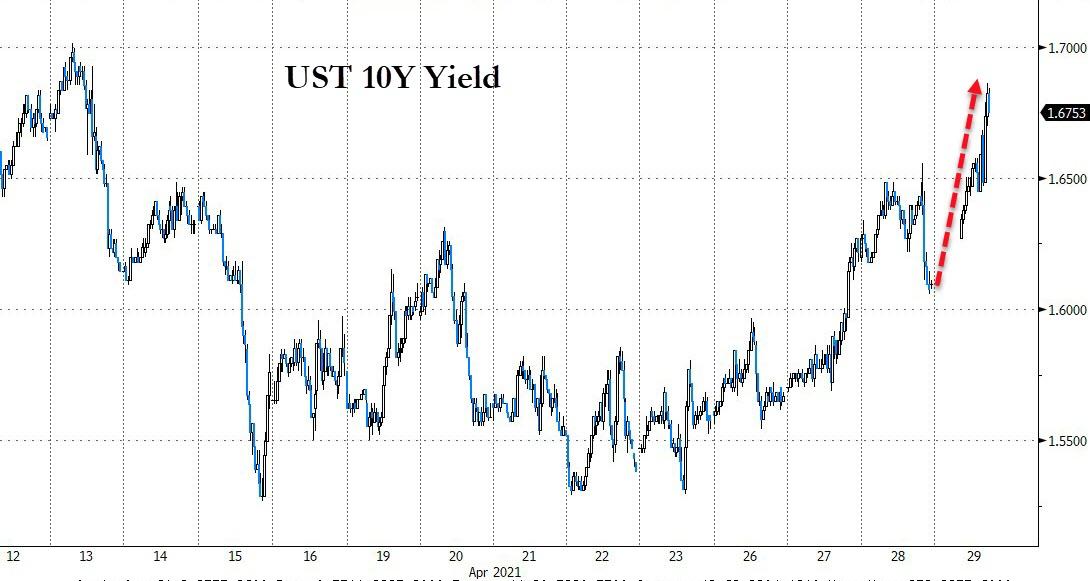
10Y yields have reversed the post-Fed gains and then some, pushing back up, rapidly, to two-week highs…

Will Powell and his lackeys start jawboning again?

Remember, DoubleLine’s Jeff Gundlach warned “The Fed will allow the market forces to take yields to higher levels [10Y 2.25%] before stepping in,” adding that the US stock market is very overvalued by virtually every important metric.

Tyler Durden
Thu, 04/29/2021 – 10:24

via ZeroHedge News https://ift.tt/2PyY7OB Tyler Durden

Biden’s Lofty Economic Plan Will Be Dead On Arrival In The Senate

Biden’s Lofty Economic Plan Will Be Dead On Arrival In The Senate

Authored by Mike Shedlock via MishTalk.com,

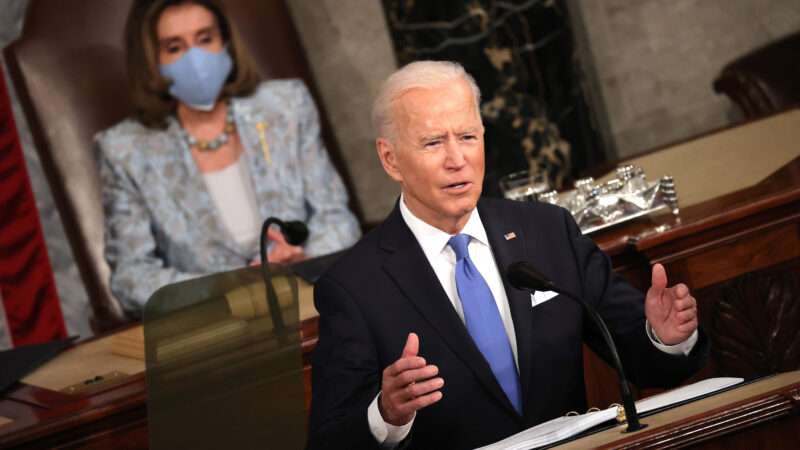
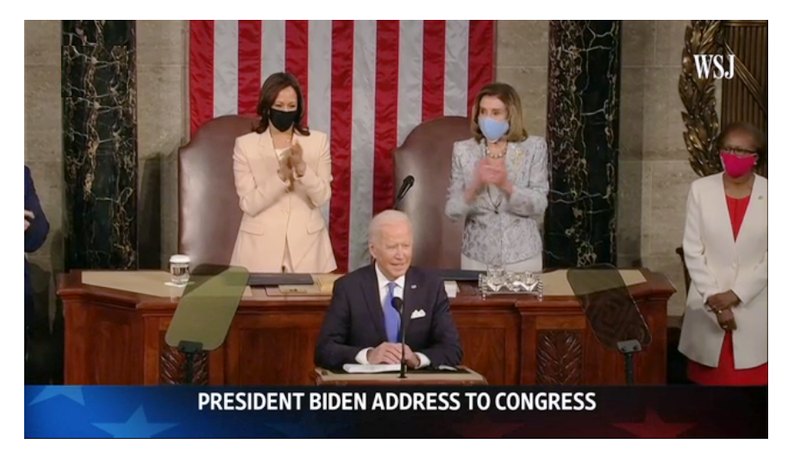
Wednesday Evening Biden proved he is beholden to the Progressive wing of the party. His speech was a cornucopia of dead on arrival ideas…

Massive Overreach

President Biden wants people to believe he is a moderate. The plan he presented to Congress and the nation Wednesday evening was more like a Progressive wish list.

In case you missed it, here is the Transcript of Biden’s Speech.

I discussed pre-disclosed details yesterday in Biden to Propose a $1.8 Trillion “Family Plan” in a Prime Time Address

Wednesday evening Biden added climate change, a $15 minimum wage, right to organize, gun control, paycheck fairness, defense spending, charging stations, even a goal to cure cancer.

He kicked things off with a catchy phrase “My fellow Americans, trickle-down economics has never worked. It’s time to grow the economy from the bottom and middle-out.

The Big Lie

Biden jumped from that catch phrase immediately to a big lie: “A broad consensus of economists – left, right, center – agree that what I’m proposing will help create millions of jobs and generate historic economic growth.”

There is no “broad consensus”.

His plan cannot possibly pass the Senate as is, and I rather doubt it can even make its way unscathed through the House. 

Dead on Arrival

Biden cannot afford to lose a single Democrat Senator but many have already expressed Reservations Over Tax Hikes.

  • Sen. Joe Manchin (D., W.Va.), a pivotal centrist lawmaker, said Congress should focus on raising revenue by enhancing enforcement for existing tax levels. “It intrigues me to understand that we have 400 billion to a trillion dollars that people have stated that we haven’t collected; don’t you think we ought to look at that first?” he said. “I’ve been very clear on 25% corporate, but I want to see basically where our loopholes are and why we’re not collecting and why the IRS has been eviscerated.”

  • Sen. Bob Menendez (D., N.J.): “For me, it is what you’re doing, the totality of the package, and how does it affect the ability of growth to continue to take place. That’s how I’m judging it. Right now it seems like a rather high rate to me,” said Sen. Menendez, a member of the Senate Finance Committee, of the proposed capital-gains rate. New Jersey has one of the highest median household incomes in the U.S.

  • Sen. Ron Wyden (D., Ore.) chairman of the Senate Finance Committee, has put forward an alternative to the president’s proposal for the capital-gains tax. Under his approach, unrealized gains for wealthy people would be taxed annually, which would limit the tax benefits for people waiting to realize their gains even more than the president’s plan would.

  • Sen. Angus King (I., Maine), who caucuses with Democrats. “I want to understand what it would raise in the way of revenues. I want to have some research on what, if any, impact it would have on stock ownership. But fundamentally I’ve always had a hard time explaining to somebody who pays straight taxes when they work 40 hours a week, why they pay twice as much as somebody who gets a check in the mail.”

  • Sen. Jon Tester (D., Mont.) said that he didn’t want the spending to contribute to deficits, which have piled up during the pandemic. “My answer to that would be hell, I don’t want to raise any taxes, but I don’t want to put stuff on the debt, either,” he said. “But if we’re going to build infrastructure we have to pay for it somehow. I’m open to all ideas.”

Consensus? 

Biden cannot even corral the Democrats. The above quotes are from the WSJ.

Two Keys

At a minimum there are at least two keys to the lock. In addition to Manchin (as usual) we can now safely add Menendez. 

Wyden’s idea to tax gains annually is the worst of the lot. About all that will do is sow confusion because it’s going nowhere.

The non-budget items will not stand up to a filibuster. But the whole plan is so overreaching that it’s possible nothing passes.

Call For Unity

Biden finished with a plea to be united. But kowtowing to the Progressives is a sure way to go it alone.

Ultimately, I expect Biden to rally the troops and settle for whatever Manchin, Menendez, and Senator Krysten Sinema (D, AZ) will go along with, but it will be a huge struggle.

Tyler Durden
Thu, 04/29/2021 – 10:15

via ZeroHedge News https://ift.tt/3nvxNBw Tyler Durden

Joe Biden Wants To Close the ‘Boyfriend Loophole.’ Here’s What That Means.


spnphotosten226259

During last night’s national address, President Joe Biden spoke of his desire to end the “boyfriend loophole.” What does this mean?

At its core, it involves one of Biden’s long-running specialties: pushing tough-on-crime policies—ones that ramp up federal law enforcement involvement in people’s lives and threaten a host of negative and disproportionate consequences for the same groups that always get shafted by them—in the name of being a feminist ally.

Closing the Biden “boyfriend loophole” would involve expanding the Violence Against Women Act (VAWA), which was written by then-Sen. Biden and passed as part of the now-disgraced 1994 Crime Bill.

Every several years, the VAWA gets expanded. Democrats call this “reauthorization,” even though the main provisions of VAWA never expire and each new version has done much more than simply add more money for VAWA grant programs. (Biden admitted this in 2019, tweeting that “VAWA’s power is that it gets stronger with each reauthorization.”) Republicans have recently been voting against these expansions, which Democrats have been having a public relations field day with.

This is how so much bad legislation gets passed—slapping a noble-sounding name on something with questionable results and then demonizing anyone who dares question it. (Hello, Fight Online Sex Trafficking Act, aka FOSTA). It’s been very effective for the VAWA—as Democrats say, who could be against stopping violence against women?

All of these tricks were on display during Biden’s address last night. “Let’s reauthorize the Violence Against Women Act, which has been law in this country for 27 years since I first wrote it,” Biden said. “It will close the so-called ‘boyfriend’ loophole to keep guns out of the hands of abusers.…Pass it and save lives.”

VAWA History

Some evidence suggests that VAWA provisions actually increased violence against women, all while steering domestic violence resources away from peer-to-peer networks, local women’s shelters, and other forms of material assistance for victims of abuse and toward police, prosecutors, and courts.

“Anti-violence feminists from the left, especially women of color, were adamantly opposed to outsourcing vengeance to the state,” note Judith Levine and Erica R. Meiners in The Feminist and the Sex Offender: Confronting Sexual Harm, Ending State Violence. These groups “learned from experience that prisons do not end violence, but instead perpetrate and perpetuate it, while destroying individual lives, families, and communities.”

But Biden and a bipartisan gaggle of Tough on Crime politicians—backed by radical feminist lawyers and politically connected groups like the National Organization for Women—dismissed their concerns in favor of creating new federal crimes and centering solutions on courts and police.

The VAWA was part of a carceral feminist agenda that said “that battered women had a right to state action. But it was one kind of state action—arrest,” as Aya Gruber writes in The Feminist War on Crime. “Within short order, this right became compulsory, and a battered woman could not waive the ‘right’ to her husband’s arrest.”

Some VAWA grants were conditioned on recipients encouraging an arrest during all domestic violence calls—no matter what the alleged victim’s wishes are—and helped spur dual arrest of both partners if the abused party fights back.

A major part of the VAWA (involving civil lawsuits) was declared unconstitutional. But Biden promised on his campaign website to bring it back anyway, declaring that “the Supreme Court got it wrong.”

The New VAWA

The latest VAWA “reauthorization” —which passed the House in March—is full of new expansions, including what Democrats keep referring to as “closing the boyfriend loophole.”

Under current federal law, it’s illegal to possess a gun if you’ve been subject to a restraining order against an intimate partner or have been convicted of a misdemeanor crime of domestic violence.

A misdemeanor crime of domestic violence includes threats, force, or attempted force, under which force doesn’t necessarily mean violence and can include “offensive touching.” Domestic violence “is not merely a type of ‘violence’; it is a term of art encompassing acts that one might not characterize as ‘violent’ in a nondomestic context,” wrote Justice Sonia Sotomayor in the Court’s 2014 opinion on the matter.

As it stands, the domestic violence/intimate partner provisions only apply to acts involving spouses, domestic partners, and people who have a child together. Democrats want to expand them to cover people in all sorts of sexual or romantic relationships.

The new bill would expand the term intimate partner to cover “a dating partner or former dating partner.” It defines dating partner as “a person who is or has been in a social relationship of a romantic or intimate nature with the person.”

This would massively expand the reach of the law, and the federal government’s prerogative to get involved. It would allow the feds to punish girlfriends and boyfriends convicted of everything from serious violence to mere “offensive touching.” And it doesn’t just stop there, as Reason‘s Jacob Sullum explained back in 2019 (when similar provisions were up for consideration):

Under current law, people subject to [protective] orders may not possess guns, but only when they have had an opportunity to contest claims that they pose a threat.

The House bill would expand the disqualification to ex parte orders, which are issued without a hearing, can last a few weeks, and may be renewable after that. That change should trouble anyone who cares about due process, since it takes away people’s constitutional rights based on allegations they have had no chance to rebut.

Another provision of the House bill is even more far-reaching. It would permanently deprive someone of his Second Amendment rights if he has been convicted of misdemeanor stalking, a crime that need not involve violence, threats, or even a victim the offender knows.

Protecting Women?

Proponents of these new rules say they’re about protecting women. But will men who aim to commit violence against women really stop just because they can’t legally purchase a new firearm? There are other ways to commit violence—and other ways to get guns. People intent on murder aren’t generally put off by having to illegally obtain the murder weapon.

Even some proponents of the law when it comes to domestic partners don’t seem so sure about its expansion. “Everyone agrees that a firearm in a household with domestic violence poses a clear increased danger to the abused partner,” University of Wyoming law professor George Mocsary told PolitiFact. But no reliable evidence shows “that there is a similar increased danger” in non-cohabitation scenarios.

Meanwhile, there is some evidence that provisions of VAWA and other tough-on-domestic-violence policies—like mandatory arrest and/or prosecution in domestic violence cases—have led to a spike in girls and women being arrested and prosecuted. Some of this may be warranted, but some of it is targeted at women merely trying to protect themselves; it’s not uncommon for abusers to accuse their victims of abusing them for fighting back or for reacting in minor physical ways to intimidation and similar non-physical slights. And in a world where “offensive touching” qualifies as domestic violence, they may technically be right.

Which means a lot of women and abuse victims would have their right to own a firearm for protection taken away. And unlike people intent on threats and violence, they’re probably a lot less likely to go through illegal channels to get one—which means laws like these could make it more difficult for women to protect themselves.

These laws would also give law enforcement another reason to harass and discriminate against people of color, people in poor communities, and others who tend to wind up disproportionately targeted by the police. Not only are already marginalized groups liable to bear the brunt of enforcement for “dating violence,” and to thus be unevenly excluded from legally owning a gun, they’ll also have new opportunities to be guilty of a federal firearms offense (and the feds will have a new excuse to monitor these people and communities).

This isn’t the only new gun prohibition Biden wants—he’s also proposing a ban on “ghost guns.” And there’s another new prohibition in the works; allegedly, the administration is considering a crackdown on menthol cigarettes.

The Biden administration sometimes talks a good game about criminal justice reform. But at the same time, the administration just keeps pushing the same old triggers for mass incarceration and police abuse, disguised in different packages. It suggests neither Biden nor Vice President Kamala Harris has actually learned anything since their ardent crime warrior days except which messages it’s most popular to pay lip service to these days.


FREE MINDS 

Criminalizing prostitution harms sex workers, their children, and public health. Check out the Cato Institute’s new brief on the unintended consequences of criminalizing sex work. Researchers Lisa Cameron, Jennifer Seager, and Manisha Shah find that “criminalizing sex work increases STI rates among sex workers (measured using biological test results) by 27.3 percentage points, or 58 percent, from baseline,” that “the health consequences of criminalization are not restricted to sex workers,” and that “children of women from criminalized work sites are adversely affected.”


FREE MARKETS

California already tried Biden’s ghost gun ban and it didn’t work, as Reason‘s Brian Doherty points out:

California is ahead of Biden’s game in banning ghost guns, having since 2018, as the Center for American Progress summed up, “require[d] all self-assembled firearms to contain a unique serial number from the California Department of Justice. Furthermore, owners of newly serialized firearms must provide identification information to the California Department of Justice. Under California law, self-assembled firearms cannot be sold or transferred.”

At the same time, California has remained a place media calls on to scare you about the still growing threat of ghost guns, such as the claim made to ABC News last year by Carlos A. Canino, the special agent in charge of the A.T.F. Los Angeles field division, that “Forty-one percent, so almost half our cases we’re coming across, are these ‘ghost guns.” Last year was two years after California banned them in just the way Biden plans to. Not a promising sign for the efficacy of his bold initiative.

More here.


QUICK HITS

• The FBI searched Rudy Giuliani’s home and office and seized his electronics yesterday.

• Biden said his new spending plans will be paid for in part by targeting corporate tax scofflaws—firms that paid $0 in corporate taxes. But “tax experts are not sure whether Biden’s plan would in fact substantially reduce the number of large corporations paying zero dollars in federal income taxes,” says The Washington Post.

• “As part of a $2.3 trillion infrastructure proposal, President Joe Biden is pushing Congress to spend $100 billion fixing a problem that mostly doesn’t exist: widespread lack of access to broadband internet,” writes Reason‘s Eric Boehm.

• Are politicians finally starting to come around about civil asset forfeiture? In Arizona, at least, the answer appears to be yes:

• A new law in Colorado called the Ranch to Plate Act “deregulates meat sales that are made directly to consumers,” explains Food Safety News.

from Latest – Reason.com https://ift.tt/3xCkEvk
via IFTTT
Pending Home Sales Disappoint In March, Realtors Blame “Low Inventory” Again

Pending Home Sales Disappoint In March, Realtors Blame “Low Inventory” Again

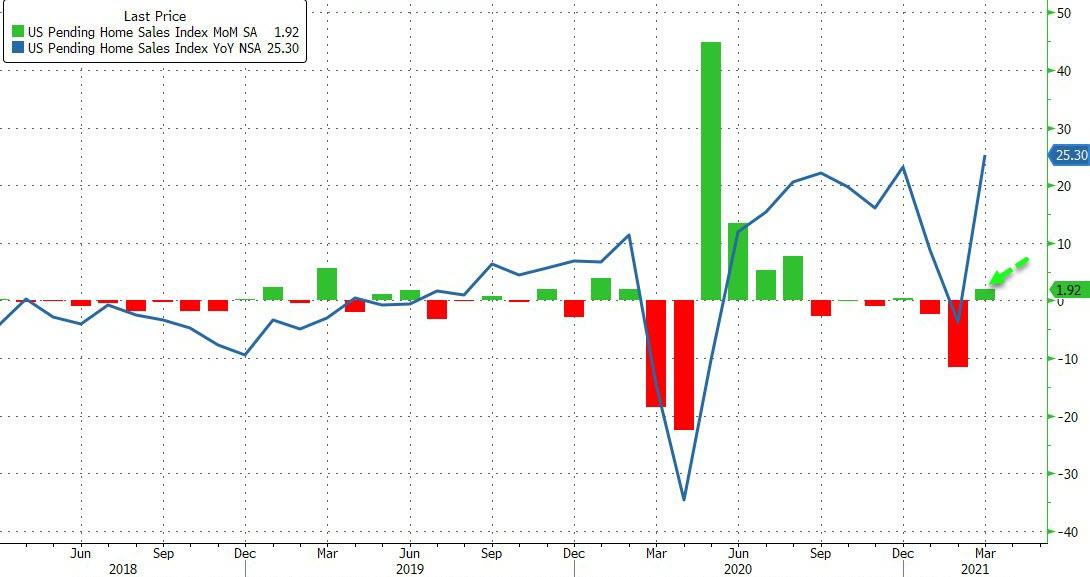
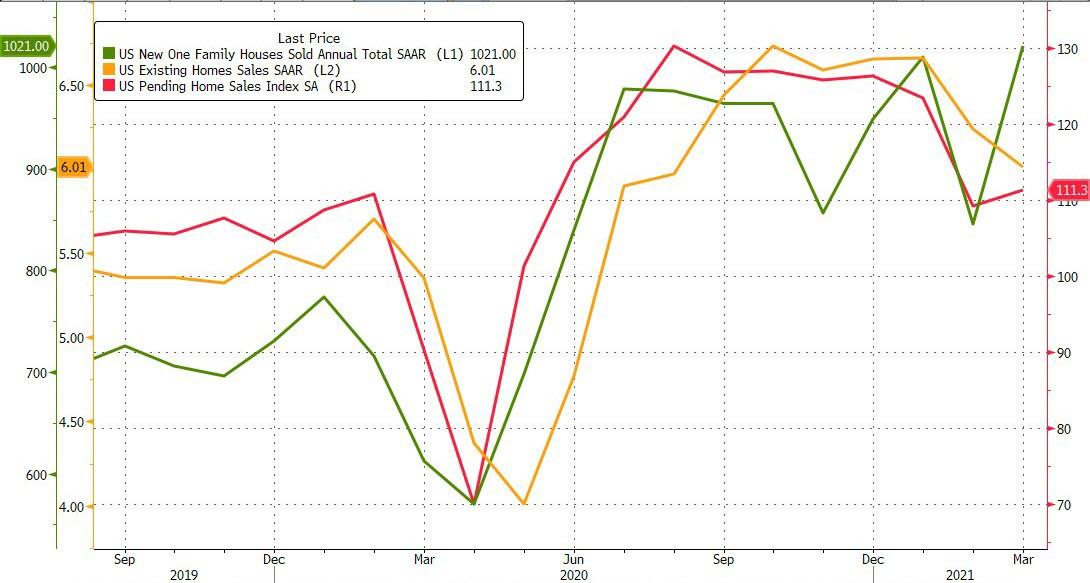
After a surge in new home sales and tumble in existing home sales, today’s pending home sales print is the tie-breaker for whether the housing bubble has peaked on the back of un-affordability and rising mortgage rates. After a 10.6% plunged in February (weather-related), analysts expected pending home sales to rebound 4.4% MoM in March, but were disappointed by a mere 1.9% rebound (and a downward revision to -11.5% MoM in February)…

Source: Bloomberg

Of course, thanks to the comps from last March’s collapse, the year-over-year surge of 25.3% is a little misleading (biggest YoY since March 2010).

So the new home sales surge looks like a big outlier for now…

Source: Bloomberg

It is likely that the severe winter weather that limited housing activity in February impacted March’s pending sales data and rising borrowing costs and skyrocketing property values have been pricing some buyers out of the market.

“Low inventory has been a consistent problem,” Lawrence Yun, chief economist at the NAR, said in a statement.

“With mortgage rates still very close to record lows and a solid job recovery underway, demand will likely remain high.”

All regions except the Midwest saw gains, with sales rising the most in the Northeast.

Tyler Durden
Thu, 04/29/2021 – 10:05

via ZeroHedge News https://ift.tt/3eHL2Lo Tyler Durden

Joe Biden Wants To Close the ‘Boyfriend Loophole.’ Here’s What That Means.


spnphotosten226259

During last night’s national address, President Joe Biden spoke of his desire to end the “boyfriend loophole.” What does this mean?

At its core, it involves one of Biden’s long-running specialties: pushing tough-on-crime policies—ones that ramp up federal law enforcement involvement in people’s lives and threaten a host of negative and disproportionate consequences for the same groups that always get shafted by them—in the name of being a feminist ally.

Closing the Biden “boyfriend loophole” would involve expanding the Violence Against Women Act (VAWA), which was written by then-Sen. Biden and passed as part of the now-disgraced 1994 Crime Bill.

Every several years, the VAWA gets expanded. Democrats call this “reauthorization,” even though the main provisions of VAWA never expire and each new version has done much more than simply add more money for VAWA grant programs. (Biden admitted this in 2019, tweeting that “VAWA’s power is that it gets stronger with each reauthorization.”) Republicans have recently been voting against these expansions, which Democrats have been having a public relations field day with.

This is how so much bad legislation gets passed—slapping a noble-sounding name on something with questionable results and then demonizing anyone who dares question it. (Hello, Fight Online Sex Trafficking Act, aka FOSTA). It’s been very effective for the VAWA—as Democrats say, who could be against stopping violence against women?

All of these tricks were on display during Biden’s address last night. “Let’s reauthorize the Violence Against Women Act, which has been law in this country for 27 years since I first wrote it,” Biden said. “It will close the so-called ‘boyfriend’ loophole to keep guns out of the hands of abusers.…Pass it and save lives.”

VAWA History

Some evidence suggests that VAWA provisions actually increased violence against women, all while steering domestic violence resources away from peer-to-peer networks, local women’s shelters, and other forms of material assistance for victims of abuse and toward police, prosecutors, and courts.

“Anti-violence feminists from the left, especially women of color, were adamantly opposed to outsourcing vengeance to the state,” note Judith Levine and Erica R. Meiners in The Feminist and the Sex Offender: Confronting Sexual Harm, Ending State Violence. These groups “learned from experience that prisons do not end violence, but instead perpetrate and perpetuate it, while destroying individual lives, families, and communities.”

But Biden and a bipartisan gaggle of Tough on Crime politicians—backed by radical feminist lawyers and politically connected groups like the National Organization for Women—dismissed their concerns in favor of creating new federal crimes and centering solutions on courts and police.

The VAWA was part of a carceral feminist agenda that said “that battered women had a right to state action. But it was one kind of state action—arrest,” as Aya Gruber writes in The Feminist War on Crime. “Within short order, this right became compulsory, and a battered woman could not waive the ‘right’ to her husband’s arrest.”

Some VAWA grants were conditioned on recipients encouraging an arrest during all domestic violence calls—no matter what the alleged victim’s wishes are—and helped spur dual arrest of both partners if the abused party fights back.

A major part of the VAWA (involving civil lawsuits) was declared unconstitutional. But Biden promised on his campaign website to bring it back anyway, declaring that “the Supreme Court got it wrong.”

The New VAWA

The latest VAWA “reauthorization” —which passed the House in March—is full of new expansions, including what Democrats keep referring to as “closing the boyfriend loophole.”

Under current federal law, it’s illegal to possess a gun if you’ve been subject to a restraining order against an intimate partner or have been convicted of a misdemeanor crime of domestic violence.

A misdemeanor crime of domestic violence includes threats, force, or attempted force, under which force doesn’t necessarily mean violence and can include “offensive touching.” Domestic violence “is not merely a type of ‘violence’; it is a term of art encompassing acts that one might not characterize as ‘violent’ in a nondomestic context,” wrote Justice Sonia Sotomayor in the Court’s 2014 opinion on the matter.

As it stands, the domestic violence/intimate partner provisions only apply to acts involving spouses, domestic partners, and people who have a child together. Democrats want to expand them to cover people in all sorts of sexual or romantic relationships.

The new bill would expand the term intimate partner to cover “a dating partner or former dating partner.” It defines dating partner as “a person who is or has been in a social relationship of a romantic or intimate nature with the person.”

This would massively expand the reach of the law, and the federal government’s prerogative to get involved. It would allow the feds to punish girlfriends and boyfriends convicted of everything from serious violence to mere “offensive touching.” And it doesn’t just stop there, as Reason‘s Jacob Sullum explained back in 2019 (when similar provisions were up for consideration):

Under current law, people subject to [protective] orders may not possess guns, but only when they have had an opportunity to contest claims that they pose a threat.

The House bill would expand the disqualification to ex parte orders, which are issued without a hearing, can last a few weeks, and may be renewable after that. That change should trouble anyone who cares about due process, since it takes away people’s constitutional rights based on allegations they have had no chance to rebut.

Another provision of the House bill is even more far-reaching. It would permanently deprive someone of his Second Amendment rights if he has been convicted of misdemeanor stalking, a crime that need not involve violence, threats, or even a victim the offender knows.

Protecting Women?

Proponents of these new rules say they’re about protecting women. But will men who aim to commit violence against women really stop just because they can’t legally purchase a new firearm? There are other ways to commit violence—and other ways to get guns. People intent on murder aren’t generally put off by having to illegally obtain the murder weapon.

Even some proponents of the law when it comes to domestic partners don’t seem so sure about its expansion. “Everyone agrees that a firearm in a household with domestic violence poses a clear increased danger to the abused partner,” University of Wyoming law professor George Mocsary told PolitiFact. But no reliable evidence shows “that there is a similar increased danger” in non-cohabitation scenarios.

Meanwhile, there is some evidence that provisions of VAWA and other tough-on-domestic-violence policies—like mandatory arrest and/or prosecution in domestic violence cases—have led to a spike in girls and women being arrested and prosecuted. Some of this may be warranted, but some of it is targeted at women merely trying to protect themselves; it’s not uncommon for abusers to accuse their victims of abusing them for fighting back or for reacting in minor physical ways to intimidation and similar non-physical slights. And in a world where “offensive touching” qualifies as domestic violence, they may technically be right.

Which means a lot of women and abuse victims would have their right to own a firearm for protection taken away. And unlike people intent on threats and violence, they’re probably a lot less likely to go through illegal channels to get one—which means laws like these could make it more difficult for women to protect themselves.

These laws would also give law enforcement another reason to harass and discriminate against people of color, people in poor communities, and others who tend to wind up disproportionately targeted by the police. Not only are already marginalized groups liable to bear the brunt of enforcement for “dating violence,” and to thus be unevenly excluded from legally owning a gun, they’ll also have new opportunities to be guilty of a federal firearms offense (and the feds will have a new excuse to monitor these people and communities).

This isn’t the only new gun prohibition Biden wants—he’s also proposing a ban on “ghost guns.” And there’s another new prohibition in the works; allegedly, the administration is considering a crackdown on menthol cigarettes.

The Biden administration sometimes talks a good game about criminal justice reform. But at the same time, the administration just keeps pushing the same old triggers for mass incarceration and police abuse, disguised in different packages. It suggests neither Biden nor Vice President Kamala Harris has actually learned anything since their ardent crime warrior days except which messages it’s most popular to pay lip service to these days.


FREE MINDS 

Criminalizing prostitution harms sex workers, their children, and public health. Check out the Cato Institute’s new brief on the unintended consequences of criminalizing sex work. Researchers Lisa Cameron, Jennifer Seager, and Manisha Shah find that “criminalizing sex work increases STI rates among sex workers (measured using biological test results) by 27.3 percentage points, or 58 percent, from baseline,” that “the health consequences of criminalization are not restricted to sex workers,” and that “children of women from criminalized work sites are adversely affected.”


FREE MARKETS

California already tried Biden’s ghost gun ban and it didn’t work, as Reason‘s Brian Doherty points out:

California is ahead of Biden’s game in banning ghost guns, having since 2018, as the Center for American Progress summed up, “require[d] all self-assembled firearms to contain a unique serial number from the California Department of Justice. Furthermore, owners of newly serialized firearms must provide identification information to the California Department of Justice. Under California law, self-assembled firearms cannot be sold or transferred.”

At the same time, California has remained a place media calls on to scare you about the still growing threat of ghost guns, such as the claim made to ABC News last year by Carlos A. Canino, the special agent in charge of the A.T.F. Los Angeles field division, that “Forty-one percent, so almost half our cases we’re coming across, are these ‘ghost guns.” Last year was two years after California banned them in just the way Biden plans to. Not a promising sign for the efficacy of his bold initiative.

More here.


QUICK HITS

• The FBI searched Rudy Giuliani’s home and office and seized his electronics yesterday.

• Biden said his new spending plans will be paid for in part by targeting corporate tax scofflaws—firms that paid $0 in corporate taxes. But “tax experts are not sure whether Biden’s plan would in fact substantially reduce the number of large corporations paying zero dollars in federal income taxes,” says The Washington Post.

• “As part of a $2.3 trillion infrastructure proposal, President Joe Biden is pushing Congress to spend $100 billion fixing a problem that mostly doesn’t exist: widespread lack of access to broadband internet,” writes Reason‘s Eric Boehm.

• Are politicians finally starting to come around about civil asset forfeiture? In Arizona, at least, the answer appears to be yes:

• A new law in Colorado called the Ranch to Plate Act “deregulates meat sales that are made directly to consumers,” explains Food Safety News.

from Latest – Reason.com https://ift.tt/3xCkEvk
via IFTTT
Russian FM Lavrov: US Relations Now Worse Than Cold War

Russian FM Lavrov: US Relations Now Worse Than Cold War

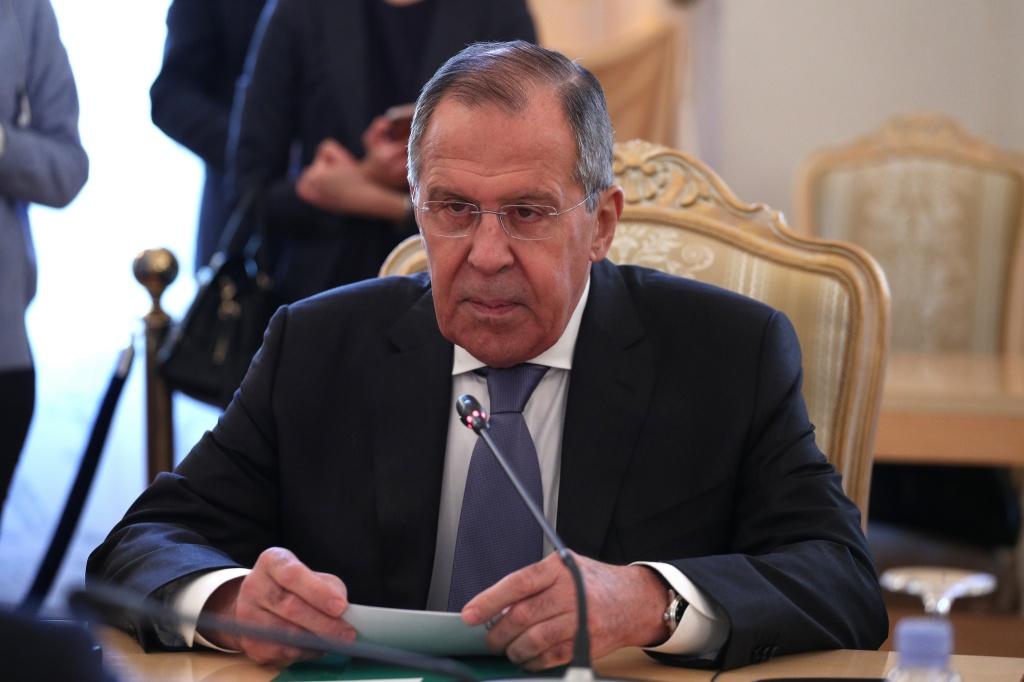
Russian Foreign Minister Sergei Lavrov warned that the state of US-Russia relations is now even worse than during the Cold War. His Wednesday comments during a televised interview might be easily dismissed as hyperbole, given there’s not something that’s quite equivalent to the Cuban missile crisis happening right now, but it does accurately convey things in terms of lack of simple communications at a diplomatic level. He said it was the “lack of respect” in the current climate that makes things worse.

Lavrov explained Moscow has a desire to normalize ties with Washington but that should the Biden administration refuse respectful dialogue, “we would live in conditions of a ‘Cold War’ or worse.”

“During the Cold War, the tensions were flying high and risky crisis situations often emerged, but there was also a mutual respect,” he said as cited in The Associated Press. “It seems to me there is a deficit of it now.”

Whether or not this dangerous trajectory in lack of “respect” and communications will continue is likely to be determined on whether the proposed Biden-Putin summit actually takes place this summer. In the past days there’s been multiple reports from both sides signaling the meeting is in preparation for a European country for mid-June. 

The latest on Russia’s view on summit progress comes via the AP as follows:

Speaking in an interview with Russian state television, Lavrov noted that Moscow has had a “positive” attitude to U.S. President Joe Biden’s proposal to hold a summit with Russian President Vladimir Putin, but added that Russia still needs to analyze all aspects of the initiative.

Indeed US-Russia relations have reached a low point arguably even when compared to the height of the Ukraine and Crimea crisis of 2014 and 2015…

Amid a flurry of claims that Russia was building up troops in preparation for some kind of Ukraine action or offensive last month into this month (claims that Kiev officials have been pushing hard), the White House slapped sanctions on Moscow for the SolarWinds hack and ‘interference’-related charges, while also expelling ten Russian diplomats. 

The Kremlin responded in kind with the expelling of American officials, including a blacklist of top government and intelligence officials who are banned from travel to Russia.

Tyler Durden
Thu, 04/29/2021 – 09:50

via ZeroHedge News https://ift.tt/3nxQDId Tyler Durden

Cheerleader Temper Tantrum Sparks SCOTUS Free Speech Debate

Cheerleader Temper Tantrum Sparks SCOTUS Free Speech Debate

Authored by Leesa K. Donner via Liberty Nation News (emphasis ours),

When 14-year-old Brandi Levy had a temper tantrum on Snapchat four years ago, little did she know she would pay for her outburst and become the poster child for off-campus free speech rights. The former high school cheerleader was punished for her online conniption by Pennsylvania’s Mahanoy Area High School, and whether school authorities had the right to discipline her has been argued on up the legal food chain to the U.S. Supreme Court. In what many are saying will likely prove to be a “momentous decision,” Levy has landed at the center of the free speech maelstrom.

Brandi Levy

On its face, the off-campus speech rights of public school students appears to be an open-and-shut case for lovers of liberty; however, Levy’s legal battle is filled with nuance and carries with it many complex contours. It all began when the cheerleader had a meltdown and threw out the F-bomb on the social media platform Snapchat. The fact that everything on Snapchat is erased within 24 hours mattered not because her outburst was noticed by school officials who used it as the reason to suspend her from the cheerleading squad.

[As Bloomberg notes:  In the spring of 2017, Levy, then 14, tried out for the varsity cheer squad at Mahanoy Area High School, but only managed to make the JV team. She expressed her reaction on Snapchat in a post that read “Fuck school fuck softball fuck cheer fuck everything. The post went up on a Saturday, reached some 250 of her friends and, like all other posts to the social media platform, disappeared after 24 hours. Nevertheless, a classmate showed a screenshot to her mother, who happened to be one of the cheer coaches.]

What resulted was four years of legal battles before numerous courts. Even the Biden administration has weighed in on this one. Still, this case has an uncommon mix of political alliances. Imagine the Pennsylvania American Civil Liberties Union and the Alliance Defending Freedom and the Christian Legal Society on the same side? David Cole, the attorney set to argue the case in front of the Supreme Court this week, was quoted in a prominent Washington newspaper as saying, “You won’t find another case in the past decade with such a diverse range of groups on the same side.” Strange political bedfellows, indeed.

* * *

In Wednesday oral arguments, justices were faced with whether to grant school officials the authority to regulate students’ speech when they aren’t in the classroom or participating in school-related activities such as sports. According to Just the News, “Justices expressed skepticism about each side’s proposed legal test, especially how schools would determine that off-campus speech is “directed” at them and can thus be regulated. Some justices seemed receptive to a halfway measure, though: limiting off-campus jurisdiction to extracurricular activities like team sports, at least in some situations.”

Attorney Lisa Blatt, representing Mahanoy Area Schools, emphasized that schools only want the power to stop students from “terrorizing” each other or teachers, regardless of where it happens.

She said “madness, confusion and chaos” would result from the argument made by ACLU lawyer David Cole, who is representing cheerleader Brandi Levy. Blatt derided his “Twilight Zone” portrayal of schools as “the gulag,” ordering students what to think and banning dissent.

Cole retorted that Blatt’s argument would create a “24-7 rule” where students “carry the schoolhouse on their backs” everywhere they go. Justice Neil Gorsuch echoed the lawyer’s argument that parental rights were endangered as schools expand their jurisdiction.

Justice Kavanaugh, who has coached his daughter’s basketball team, agreed with Cole that students need space for “venting frustration,” as Levy did when she failed to make the varsity squad.

She “blew off steam like millions of other kids” when they get cut from teams, Kavanaugh said, citing basketball great Michael Jordan. With Levy’s yearlong suspension from the team, it “didn’t seem like the punishment was tailored to the offense.” 

Justice Amy Coney Barrett said her colleagues didn’t see a “material and substantial disruption” — the only exception to student rights under Tinker — stemming from the Snapchat rant. “Schools abuse this authority” by inventing disruptions, she told Blatt, when they could constitutionally issue “soft punishment” such as warnings for gray-area violations. –Just the News

During questioning, Justice Clarence Thomas asked Blatt about the difference between off-campus speech about Antifa and Black Lives Matter, and classroom discussions which can be “just as disruptive” – to which the attorney rejected the suggestion that students can get in trouble for simply sharing unpopular views, arguing that wearing a Confederate flag symbol “alone” is protected, but not when it’s used to “terrorize” a black student. (For the rest of the blow-by-blow from Wednesday’s hearing, click here)

* * *

Central to determining an outcome is the query: Where does the schoolyard end? Not only was Levy’s rant posted only on a social media platform rather than uttered on the school grounds – but also was done on the weekend and not connected to a school event per se. So, what could be the problem here?

If you tease out a student’s right to free speech, many legitimate areas of concern go from harmless to life-threatening. What if a smart-aleck decides to post the answers to an exam online, another student chooses to put up pictures of a schoolmate engaged in sexual activity, or – worse – another repeatedly encourages a youngster to commit suicide?

On the other hand, one could reasonably argue that schools have no right to police what students say 24/7. The ACLU’s Witold “Vic” Walczak made the case to PennLive.com that giving schools this type of power over a student is likely to create a monster. “And that is super dangerous. Not only would students like Brandi not be able to express non-threatening, non-harassing bursts of frustration, but it would give schools the possibility of regulating important political and religious speech,” Walczak said.

The Freedom Forum Institute posits:

“Though public-school students do possess First Amendment freedoms, the courts allow school officials to regulate certain types of student expression. For example, school officials may prohibit speech that substantially disrupts the school environment or that invades the rights of others. Many courts have held that school officials can restrict student speech that is lewd.”

That may sound black and white, but in reality it has turned out to be many shades of gray.

Vietnam Flashbacks

Justice Clarence Thomas

The last time the U.S. Supreme Court decided a student speech rights case of this magnitude was back in the days of anti-Vietnam war protests. In Tinker v. Des Moines Independent Community School District, the High Court found 7-2 in favor of Mary Beth Tinker. It ruled Tinker was not being “disruptive” when she wore a black armband to school to protest the Vietnam war.

Since then, several current Supreme Court associate justices have weighed in on Tinker and similar cases in the lower courts.

Justice Clarence Thomas wrote that the U.S. Constitution “does not protect student speech in public schools” (Morse v. Frederick). Justice Sonia Sotomayor sided with a school district in yet another case when she was on the U.S. Court of Appeals for the 2nd Circuit.

Here lies a case where political, ideological, and philosophical differences do not appear to matter, and justices may have to play Solomon and split the baby in two to render a decision that a majority can support.

Who knows where the wind will blow on this one?

Tyler Durden
Thu, 04/29/2021 – 09:35

via ZeroHedge News https://ift.tt/3aRAyIa Tyler Durden

SEC Enforcement Director Resigns Less Than Two Weeks After Being Appointed

SEC Enforcement Director Resigns Less Than Two Weeks After Being Appointed

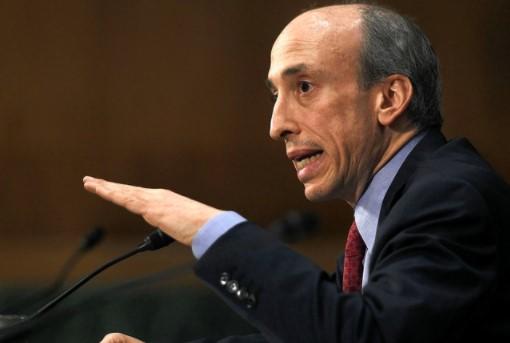
So far, new SEC Chair Gary Gensler’s tenure isn’t starting exactly as planned.

Gensler’s appointee for Enforcement Director, Alex Oh, who was announced in the role less than two weeks ago, has already resigned.

The stunning turnaround came “after a federal judge reprimanded her and others defending oil giant ExxonMobil in a class action lawsuit brought by Indonesian villagers,” according to Politico

Oh wrote in her resignation letter: “In light of the time and attention it will take from me, I have reached the conclusion that I cannot address this development without it becoming an unwelcome distraction to the important work of the division.”

Gensler, meanwhile, had already been under fire from progressives for hiring a “long-time corporate lawyer for one of the government’s most powerful posts for overseeing the finance industry”. Oh had previously worked at Paul, Weiss, Rifkind, Wharton & Garrison, representing Fortune 100 companies who were facing government investigations. She helped defend ExxonMobil “in a lawsuit seeking to hold the company liable for murder and torture by the Indonesian military during civil unrest between 1999 and 2001.”

U.S. District Judge Royce Lamberth on Monday admonished Oh for defending Exxon. 

Demand Progress, the Progressive Change Campaign Committee and the Revolving Door Project had called Oh’s morals into question on Tuesday of this week, asking if she would “change her entire legal philosophy toward fully enforcing the very laws and regulations whose enforcement she has built a career of defending against.”

They wrote: “We therefore ask you to immediately reconsider your decision to name Alex Oh for this position, and instead to select an attorney with a proven track record of public-oriented service, of which there is no shortage.”

Jeff Hauser, executive director of the Revolving Door Project, said: “Gary Gensler and the SEC dodged a bullet in avoiding having a seemingly overzealous defender of ExxonMobil’s interests over Indonesian villagers entrusted with the powerful SEC Enforcement Division.”

The friendly fire stood at odds with the praise Gensler received after being appointed. Gensler announced that SEC lawyer Melissa Hodgman would resume the role of acting director of enforcement in the meantime. 

In early March, we highlighted how Gensler would focus on ridding trading apps and the crypto market of fraud and manipulation. 

Gensler is reported to be worth up to $119 million, as we noted in February 2021. He was previously the chairman of the CFTC and a partner at Goldman Sachs. He disclosed his net worth as part of disclosures he had to file with the Office of Government Ethics earlier this year. A majority of his money was made at Goldman, where he joined in the late 1970’s after graduating from the University of Pennsylvania. He became one of the youngest partners in Goldman Sachs history. 

Recall, we also wrote about Gensler’s nomination at the beginning of the year. His arrival is slated to be a stark difference from the last 4 years of Jay Clayton, as Gensler’s resume includes going to war with major financial titans when he was head of the Commodity Futures Trading Commission – and winning. Financial lobbyists sometimes simply called him “the enemy” during the 2010 Dodd-Frank Act battle. 

Justin Slaughter, a consultant at Mercury Strategies, said at the beginning of this year: “The sheriff is coming to the preeminent financial regulator in the world. It means regulation and enforcement are about to get much tougher.”

Tyler Durden
Thu, 04/29/2021 – 09:19

via ZeroHedge News https://ift.tt/3aNTebX Tyler Durden

Leaving the COVID Bubble and Re-Entering Civil Society

For some people, 2020 were not much different than 2019. They traveled wherever they wanted. They shopped in any store. They ate in any restaurant. And so on. Indeed, some jurisdictions never enforced mask mandates. I was not one of those people. Last March, my world ground to a halt. Over the past 13 months, I haven’t left Houston. I have not travelled more than 60 miles from my house. (The prior year I flew about 100,000 miles on United.) I stopped going to any stores. (Door Dash and other apps made visits to grocery stores obsolete). I haven’t eaten at a restaurant, indoor our outdoors. I have relied entirely on delivery and curbside pickup. I haven’t had a meal in anyone else’s home either. With the exception of doctor and dentist appointments, I haven’t spent any considerable times indoors. I’ve done some outdoor activities, like going to the Zoo. But even then, I was masked and avoided crowded spots. And so on. I’ve been as careful as possible to protect myself and those in my household.

But soon enough, I will be fully vaccinated. On May 1, I will be two weeks removed from my second Pfizer shot. And all of the other adults in my house will also be fully vaccinated. With the new CDC guidance, a brave new world awaits me. At that point, I will face a choice that I am still grappling with: how to re-enter civil society.

I worry about walking into a restaurant, taking my mask off, and eating. It was something I have done thousands of times before, and seemed so natural. Now, I simply don’t see the need to eat out. Why risk it, I think? I dread the prospect of getting on a plane, only to have the person in the middle seat wear his mask falling below his nose for three hours. And I still have that dread even though the circulation of air on airplanes is better than any place on terra firma. And what about hopping in an uber or a taxi? Do I keep the window open while driving on the highway? I worry about speaking in a classroom, where students may not be properly masked. Can I get a meal with students, like I would any other semester? And so on.

I have lots of these worries. And I am not sure the best way to address them. Do I go cold turkey, and jump back into society? I do need to book a mileage run to Singapore to maintain my airline status. Or do I take baby steps? I’ve considered ordering an Uber ride around the block as a trial run. (Yes, I have). I’ve also considered buying a points ticket, going through security at the airport, then cancelling the ticket, and going home. (That option would only cost a few dollars to cancel). I’m sure there are other people reading this that have had similar thoughts. Or, perhaps, all Volokh readers are heartier than me, and are ready to roll with their jabs.

By the fall, I plan to be back to some semblance of normalcy. I may even get a haircut. I don’t quite know how I’ll get there. But I’ll make it work.

from Latest – Reason.com https://ift.tt/3aNQfjL
via IFTTT

Leaving the COVID Bubble and Re-Entering Civil Society

For some people, 2020 were not much different than 2019. They traveled wherever they wanted. They shopped in any store. They ate in any restaurant. And so on. Indeed, some jurisdictions never enforced mask mandates. I was not one of those people. Last March, my world ground to a halt. Over the past 13 months, I haven’t left Houston. I have not travelled more than 60 miles from my house. (The prior year I flew about 100,000 miles on United.) I stopped going to any stores. (Door Dash and other apps made visits to grocery stores obsolete). I haven’t eaten at a restaurant, indoor our outdoors. I have relied entirely on delivery and curbside pickup. I haven’t had a meal in anyone else’s home either. With the exception of doctor and dentist appointments, I haven’t spent any considerable times indoors. I’ve done some outdoor activities, like going to the Zoo. But even then, I was masked and avoided crowded spots. And so on. I’ve been as careful as possible to protect myself and those in my household.

But soon enough, I will be fully vaccinated. On May 1, I will be two weeks removed from my second Pfizer shot. And all of the other adults in my house will also be fully vaccinated. With the new CDC guidance, a brave new world awaits me. At that point, I will face a choice that I am still grappling with: how to re-enter civil society.

I worry about walking into a restaurant, taking my mask off, and eating. It was something I have done thousands of times before, and seemed so natural. Now, I simply don’t see the need to eat out. Why risk it, I think? I dread the prospect of getting on a plane, only to have the person in the middle seat wear his mask falling below his nose for three hours. And I still have that dread even though the circulation of air on airplanes is better than any place on terra firma. And what about hopping in an uber or a taxi? Do I keep the window open while driving on the highway? I worry about speaking in a classroom, where students may not be properly masked. Can I get a meal with students, like I would any other semester? And so on.

I have lots of these worries. And I am not sure the best way to address them. Do I go cold turkey, and jump back into society? I do need to book a mileage run to Singapore to maintain my airline status. Or do I take baby steps? I’ve considered ordering an Uber ride around the block as a trial run. (Yes, I have). I’ve also considered buying a points ticket, going through security at the airport, then cancelling the ticket, and going home. (That option would only cost a few dollars to cancel). I’m sure there are other people reading this that have had similar thoughts. Or, perhaps, all Volokh readers are heartier than me, and are ready to roll with their jabs.

By the fall, I plan to be back to some semblance of normalcy. I may even get a haircut. I don’t quite know how I’ll get there. But I’ll make it work.

from Latest – Reason.com https://ift.tt/3aNQfjL
via IFTTT