“We’re On An Economic Cliff!”

“We’re On An Economic Cliff!”

Via SchiffGold.com,

By and large, the mainstream is bullish on the economy. According to conventional wisdom, we are in the midst of a robust recovery. In fact, many people out there believe the Fed is going to have to tighten monetary policy sooner rather than later. But there are a few people in the mainstream who seem to have caught a glimpse behind the veil. Former JP Morgan managing director Jon Deane told Kitco News that we’re sitting on an economic cliff. And because of that, Deane is extremely bullish on gold and silver.

Gold has struggled in recent months due to inflation expectations. Many in the mainstream think the Fed will reverse monetary policy sooner than expected to deal with inflation. In an interview with Kitco News, Deane said inflation is already here.

If you look around the world, you see real estate prices, building supplies, and services skyrocket.”

Historically, the Fed has dealt with inflation by tightening monetary policy and raising interest rates. But how does the central bank do this in an economy built on debt? Peter Schiff has been saying the Fed won’t fight inflation because it can’t. Deane echoed that sentiment.

What we created since the early 1990s is an entire financial infrastructure that is relying on debt, and we have accelerated that dramatically in our response to managing the COVID-19 crisis. In that regard, we will continue to increase the money supply globally, and we will continue to have a quite aggressive fiscal policy. We are sitting on an economic cliff.”

Deane says that the monetary policy system is broken. The entire global economy is built on debt. There was a massive debt problem even before the pandemic. Monetary policy is incentivizing even more borrowing. You can’t raise rates to fight inflation without popping the debt bubble.

If you are now at 50 basis points and you raise rates by 25 basis points. That is a 50% increase in your borrowing costs at a time when the world has the greatest amount of debt we ever had. It would be a huge economic shock to put it through the system.

Meanwhile, all of this stimulus is doing the exact opposite of stimulating. It’s actually blowing up a giant economic bubble.

Monetary policy is broken because of the debt situation everyone is in and it is impossible to get rates back up to a meaningful level without some form of significantly higher inflation. Money printing creates stimulus in the economy. You are pushing those dollars out the door. And people are building houses, renovating their properties, starting new businesses, spending cash. That naturally creates inflation.”

Peter has been saying that once the Fed figures out inflation is a problem, it will be too late. Deane echoes this sentiment, saying that once inflation starts running hot, it’s very difficult to control.

We don’t want inflation to run too hot. And this is the risk of Fed’s approach to inflation right now. People are losing confidence in economic management. People are less likely to hold US dollars. The return on them is zero.”

As a result, Deane expects to see a big move in gold, with the yellow metal trading above $2,000 in 2021.

We’ll see a real big move in gold. We’ve taken a lot of the length out. We are in a real position to move higher. We’ll go well north of $2,000 this year. Realistically, $2,200 is probable. It may have some headwinds as we go through $2,000 again. Gold is in a much better position than where it was a few months ago.”

He’s also bullish on silver, saying we could see the price upward of $40 by Q1 2022.

Tyler Durden
Thu, 04/29/2021 – 08:58

via ZeroHedge News https://ift.tt/3e7fQq5 Tyler Durden

Q1 GDP Unexpectedly Misses Despite Stimmy-Funded Spending Surge

Q1 GDP Unexpectedly Misses Despite Stimmy-Funded Spending Surge

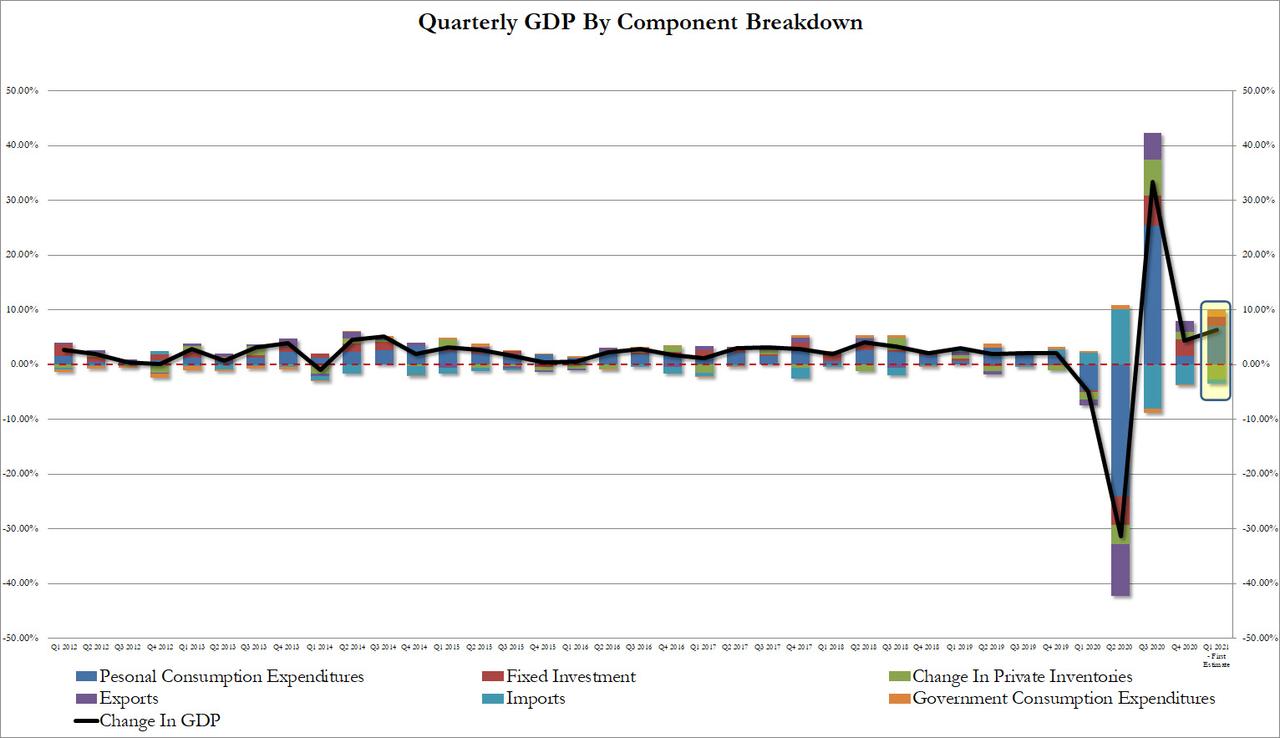
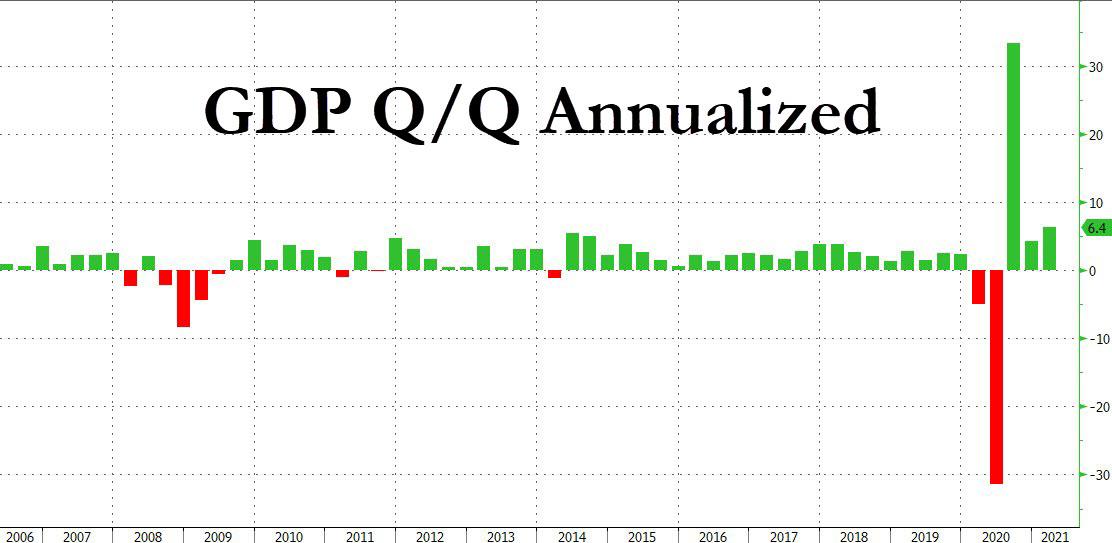
With the US economy overheating in virtually every aspect, with inflation scorching hot and with retail spending at record highs, all funded of course by trillions in fiscal stimulus, it was actually a surprise to see that annualized Q1 GDP was reported at “only” 6.4%, which while an improvement to the 4.3% in Q4 missed consensus expectations of 6.6%, and certainly missed the whisper numbers some of which were even in the double digit range. Is this all the growth that $2 trillion in stimulus can buy?

The highlight of the report is surely that personal consumption soared 10.7% in 1Q after rising 2.3% prior quarter, and contributed more than 100% of the final GDP print. This was the 2nd biggest jump in consumption since the 1950s with just the stimulus-frenzy fueled Q3 2020 coming in higher.

Final sales to private domestic purchasers q/q rose 10.6% in 1Q after rising 5.5% prior quarter, while nonresidential fixed investment, or spending on equipment, structures and intellectual property rose 9.9% in 1Q after rising 13.1% prior quarter.

According to the BEA, the jump in Q1 growth reflected the “continued economic recovery, reopening of establishments, and continued government response related to the COVID-19 pandemic. In the first quarter, government assistance payments, such as direct economic impact payments, expanded unemployment benefits, and Paycheck Protection Program loans, were distributed to households and businesses through the Coronavirus Response and Relief Supplemental Appropriations Act and the American Rescue Plan Act. In the  fourth quarter of 2020, real GDP increased 4.3 percent.”

Here are the highlights from the report:

  • The increase in consumer spending reflected increases in goods (led by motor vehicles and parts) and services (led by food services and accommodations).
  • The increase in business investment reflected increases in equipment (led by information processing equipment) and intellectual property products (led by software).
  • The increase in government spending primarily reflected an increase in federal spending related to payments made to banks for processing and administering the Paycheck Protection Program loan applications as well as purchases of COVID-19 vaccines for distribution to the public.
  • The decrease in inventory investment primarily reflected a decrease in retail trade inventories.

Looking at the breakdown of components we find the following:

  • Personal Consumption contributed more than 100% of the bottom line 6.4% GDP number at 7.02%, up from 1.58% in Q4. All of this was thanks to stimmy checks.
  • Fixed Investment dipped from 3.04% in Q4 to 1.77% of the final GDP print
  • The change in private Inventories saw a big drop, sliding from +1.37% to subtracting 2.64% from the GDP print
  • Net exports also subtracted from the GDP print, reducing it by 0.87%, an improvement from the -1.53% detraction in Q4
  • Government added 1.12% to the GDP print, up solidly from the -0.14% in Q4.

The BEA also noted that real disposable personal income (DPI)—personal income adjusted for taxes and inflation—increased 61.3% in the first quarter after decreasing 10.1% in the fourth quarter of 2020. The increase in current-dollar DPI primarily reflected an increase in government social benefits related to pandemic relief programs, notably direct economic impact payments to households established by the Coronavirus Response and Relief Supplemental Appropriations Act and the American Rescue Plan Act. Personal saving as a percent of DPI was 21.0 percent in the first quarter, compared with 13.0 percent in the fourth quarter of 2020.

Finally for those keeping tabs on PCE, the GDP price index rose 4.1% in 1Q after rising 2.0% prior quarter while core PCE q/q rose 2.3% in 1Q after rising 1.3% in the prior quarter.

Prices of goods and services purchased by U.S. residents increased 3.8% in the first quarter of 2021 after increasing 1.7% in the
fourth quarter of 2020. Energy prices increased 46.7% in the first quarter while food prices decreased 0.1% (check back on that in a few weeks). Excluding food and energy, prices increased 3.1 percent in the first quarter after increasing 1.6 percent in the fourth quarter of 2020.

Tyler Durden
Thu, 04/29/2021 – 08:48

via ZeroHedge News https://ift.tt/3nvhtke Tyler Durden

There Are Still Over 16 Million Americans On Some Form Of Government Jobless Benefits

There Are Still Over 16 Million Americans On Some Form Of Government Jobless Benefits

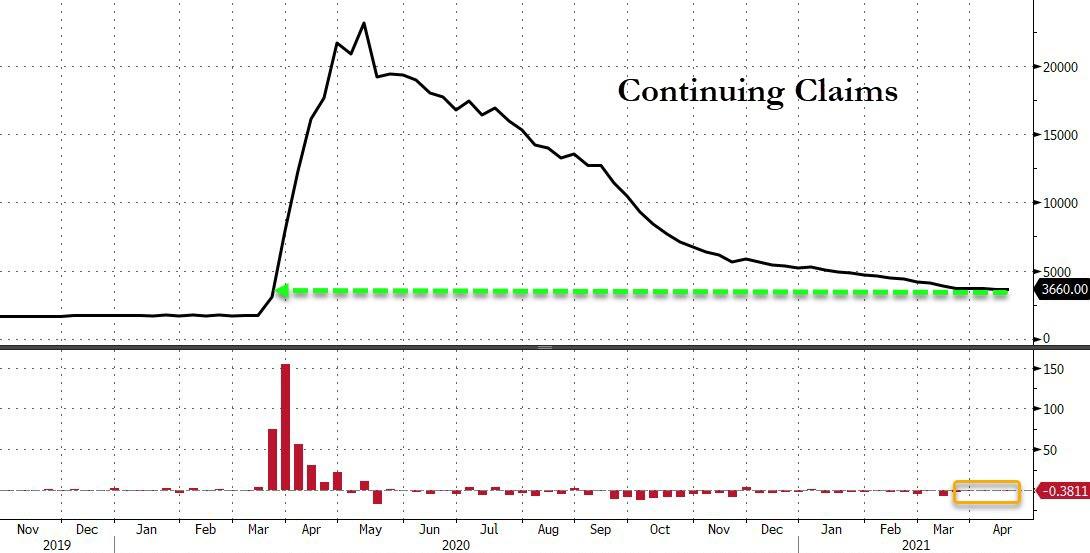
The prior week’s pandemic cycle low print for initial claims was revised higher, only to see this week’s claims drop to a new post-pandemic-spike low at 553k…

Source: Bloomberg

Continuing Claims followed a similar path with a historical upward revision and a new cycle low for the latest print, but we note that the pace of improvement has dramatically slowed…

Source: Bloomberg

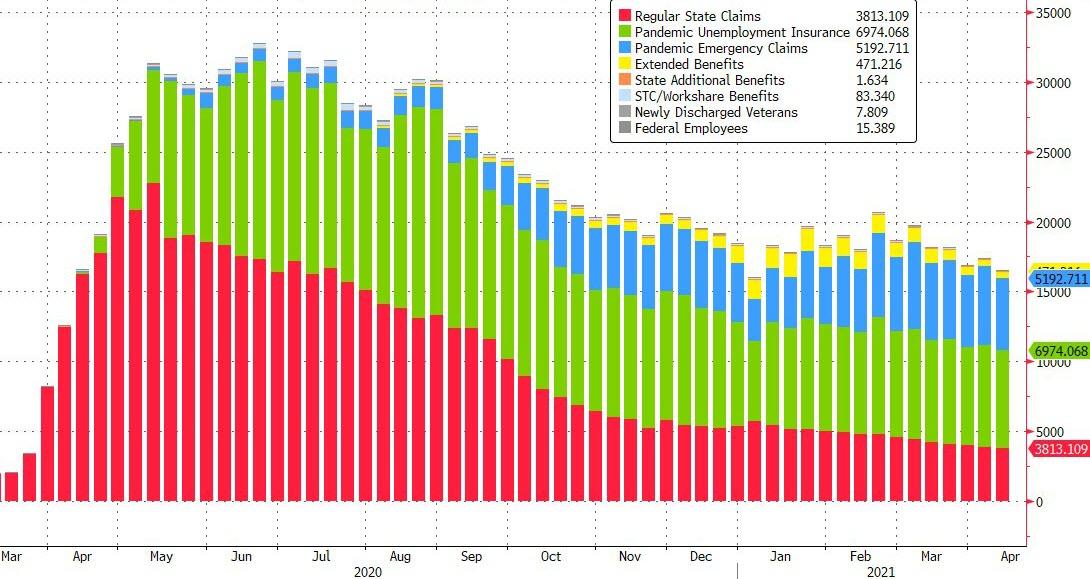
However, the total number of Americans still on some form of government jobless benefit remains above 16.5 million…

Source: Bloomberg

Maybe it’s time to stop the handouts and get Americans off the couch and back to work… the job openings are out there!

Tyler Durden
Thu, 04/29/2021 – 08:37

via ZeroHedge News https://ift.tt/32Xk9NY Tyler Durden

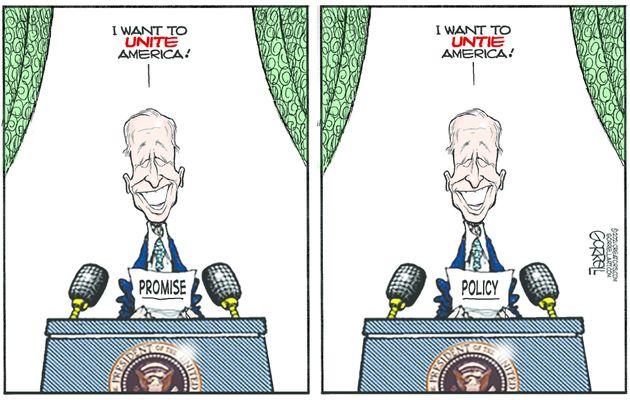
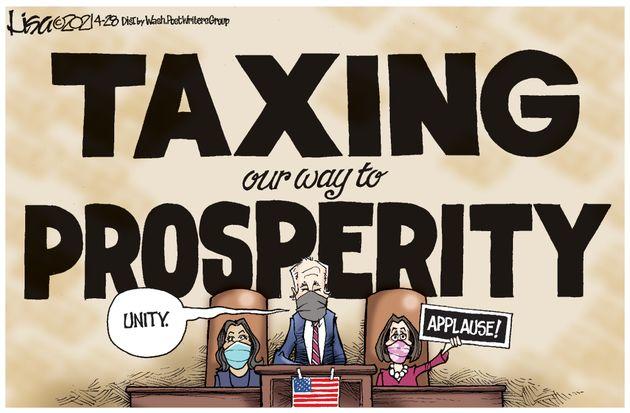
Joe Biden’s Speech Was A Declaration Of War On America

Joe Biden’s Speech Was A Declaration Of War On America

Authored by Conrad Black via The National Interest,

The best aspect of President Biden’s speech to the nation from the House of Representatives was his competent and persuasive delivery. He once again beat back the claims that he is a senescent, robotic dummy of severely diminished cognitive abilities. It was just reading a Teleprompter, but everyone remembers what an almost insurmountable challenge even that was at times in his candidacy, while the national political media conducted his campaign for him.

He spoke to a sparse, well-distanced corporal’s guard of well-masked and double-vaccinated legislators-signaling their doubts about vaccines and determination to continue lock-downs-Covid got Biden to the White House but they all seemed absurd.


He did not mention his predecessor and his entire address of over an hour was based on the only argument the Democrats have put forward on their own behalf in the last five years: Trump hate. He assumed the headship of ”a nation in crisis,” in which our “house was on fire,” and “We stared into the abyss of insurrection and autocracy,” a pitiful and almost subliminal appeal to the Trump Monster.

The country had “done nothing about immigration in 30 years,” (most of them under Clinton and Obama), except that under Trump illegal immigration was reduced by 90 percent, and the principal problem was effectively solved until Biden stopped construction of the southern border wall and reopened the borders. He said it was time to do something about the ”dreamers” but that was not the policy of his party when Trump attempted to help them. Biden called for resources to deal with the “root cause of why people are fleeing” Central America as if it were the business of the United States to raise the welfare of those poor countries, and feed more graft into them, rather than to monitor its own border and apply a sane system of an admission of immigrants.

He revived the old Obama nonsense about combating employment with unionized green jobs, and leaped into the time warp of bygone days with the bunk that “the middle class built the country and the unions built the middle class, and we must promote the right to unionize.” Unions today are an almost wholly retrograde force redundant to market pressures for higher wages and better working conditions and largely confined to the stagnant backwater the public sector.

The former administration created huge numbers of “millionaires and billionaires who cheat on their taxes…adding $2 trillion of debt and extending the pay disparity between the chief executive and the lowest wage earner to 320 to 1.” Naturally ignored were the facts that under his predecessor the income taxes of 83 percent of taxpayers were reduced, the number of positions to be filled exceeded the number of unemployed by over 750,000 and the lowest 20 percent of income-earners was in percentage terms gaining income more swiftly than the top ten percent.

He taxed the former administration with  “trickle-down” economics, though that charge was leveled at President Reagan’s massively popular and successful economic policies. Most outrageously, Biden took all credit for 220 million vaccinations with no hint that if it had not been for Trump’s direct intervention to accelerate the development of vaccines, none of it would have happened.

Almost as disingenuous was the claim that House of Representatives Bill Number 1, which would effectively eliminate any serious method of verifying the validity of individual votes, is really an attack on the Republican effort to attack “the sacred right to vote.“ That bill is almost certainly unconstitutional, would institutionalize and protect mass ballot harvesting, and it ignores the fact that 77 percent of Americans support photo-identification for voters.

The climate was again bandied as an “existential crisis” even though Biden acknowledged that the U.S. only provides 15 percent of the world’s carbon emissions. He also omitted to mention its splendid record in reducing those omissions even though there remains no convincing argument that they are relevant to the alleged crisis. Foreign affairs was an unrecognizable dreamworld: ”while leading with our allies” and  “working closely“ with them to deal with Iran and North Korea, (principally by recommitting the West to acquiescing in Iranian nuclear militarization), he will ”stand up to (Chinese leader) Xi” whom he realizes is ”in deadly earnest” in his determination to supplant the United States as the world’s most important country.    

After the usual reassertion that everyone is created equal, Biden slipped in the need to ”root out systemic racism that plagues America… White supremacy is terrorism” and has “surpassed Jihadism” as a menace. He gave no hint of what he thinks of organizations that are constantly threatening to burn America down if they’re not successful in extracting a full-body immersion in self-humiliation from the majority of Americans who despise all racism. Rarely in his rabidly bowdlerized summary of the nation’s affairs does the president allow the truth to intrude. This made the opposition response by Sen. Tim Scott of South Carolina particularly effective.

In sum, Biden’s address was cringe-worthy, fatuous, and deeply distressing. The State of the Union is almost at suicide watch.

Tyler Durden
Thu, 04/29/2021 – 08:25

via ZeroHedge News https://ift.tt/3vvXODM Tyler Durden

NYC Will “Fully Reopen” On July 1 With All Businesses At 100% Capacity, De Blasio Says

NYC Will “Fully Reopen” On July 1 With All Businesses At 100% Capacity, De Blasio Says

New York City restaurants are already starting to reopen as Gov Andrew Cuomo has raised indoor dining capacity while rising temperatures have enabled restaurants to seat more people outdoors. But New Yorkers eager to get back to “normal” will need to wait a few more months, as Mayor Bill de Blasio just confirmed during an interview on MSNBC’s “Morning Joe” that the city will “fully reopen” on July 1.

That’s the date when New Yorkers can expect all businesses to reopen at 100% capacity, the mayor said. The city’s schools, which reopen part-time for in-person learning last month, will be back at “full strength” come the fall, de Blasio added. “We’re ready to take the pathway to a full reopening”.

De Blasio credited the city’s rapid vaccination push for opening the door to re-opening.

“Our plan is to fully reopen New York City on July 1. We are ready for stores to reopen, for businesses to reopen, offices, businesses, theaters – full strength. People have gotten vaccinated in extraordinary numbers – 6.3 million vaccinations in New York City to date – we’re doing a lot to reach people at the grass roots.”

While cautioning people to be “smart” about their health, de Blasio said that that “we now have the confidence that we can pull all of these pieces together and get life back, really, in many ways, to where it was.”

De Blasio added that the Museum of Natural History has joined the vaccination effort and is currently giving jabs “under the blue whale” while offering free admission as an incentive.

“This is going to be the summer of New York City,” de Blasio added. “You’re going to see amazing activities, cultural activities coming back. I think people are going to flock to New York City, because they want to live again.”

Asked about potential pushback from Gov. Cuomo, de Blasio said “state government and federal government always have a say”…”but as mayor of New York City, we’re ready to come back and come back strong.”

For many, this statement will likely elicit images of packed rooftop bars and crowded downtown streets packed with revelers looking to enjoy the start of another “Roaring 20s”. It’s also has major implications for the US reopening effort more broadly, seeing as NYC is the most populous city in the country, and was also the first major COVID-19 “hot spot”. Fortunately, it looks like this summer will be better than last summer, which was mostly characterized by city residents fleeing to stay with relatives in the suburbs as the city filled with the sound of ambulances ferrying the dead and dying to overcrowded hospitals staffed by nurses wearing garbage-bag gowns instead of proper PPE.

Tyler Durden
Thu, 04/29/2021 – 08:10

via ZeroHedge News https://ift.tt/3aPbbqC Tyler Durden

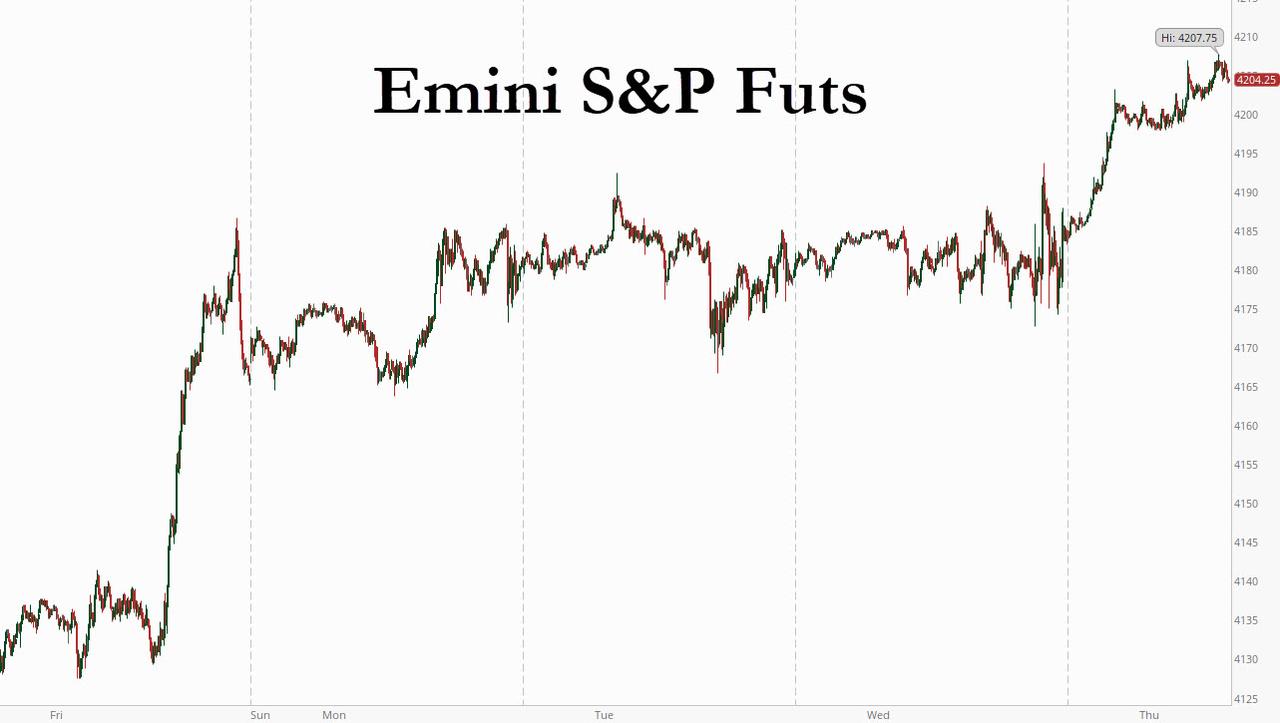
Futures Jump To Record Above 4,200 On Blockbuster Earning, Bubble-Blowing Fed

Futures Jump To Record Above 4,200 On Blockbuster Earning, Bubble-Blowing Fed

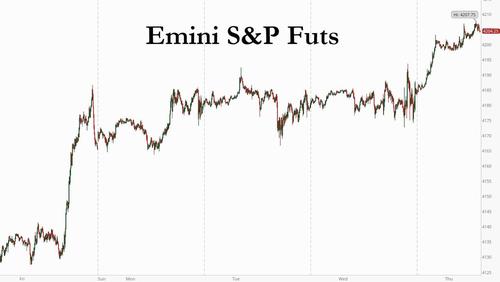
S&P Futures roared to new record highs above 4,200 and Nasdaq futures jumped 1% on Thursday as Powell’s dovish assurances and blow-out earnings from Apple and Facebook powered a rally in tech stocks and cemented conviction the world’s largest economy is resurgent ahead of GDP numbers and jobless claims data which are expected to show further improvements.  At 7:30 a.m. ET, Dow e-minis were up 130 points, or 0.38%, S&P 500 e-minis were up 28.00 points, or 0.67%, and Nasdaq 100 e-minis were up 144  points, or 1.03%.
Some notable premarket movers:

  • Apple gained 2.7% in premarket trading after posting sales and profits ahead of Wall Street estimates, led by much stronger-than-expected iPhone and Mac sales.
  • Facebook jumped 7.3% on beating analysts’ expectations for both quarterly revenue and profit, helped by a surge in digital ad spending during the pandemic, along with higher ad prices coupled with a 10% growth in active users.
  • Other megacap companies, including Microsoft Corp, Alphabet Inc and Netflix Inc, rose between 0.2% and 1.1%.
  • EV companies, including Tesla and Nikola rose 1.1% and 2.6%, respectively, as sales picked up speed in the first quarter, according to the International Energy Agency.
  • Caterpillar rose 2.8% after the heavy equipment maker reported a rise in adjusted first-quarter profit.
  • Merck slid 3.2% on posting a 1.2% fall in quarterly profit.

With almost half of the S&P 500 companies having reported results so far, about 88% have either met or beaten expectations.

Global shares extended gains after the Federal Reserve said it was too early to consider rolling back emergency support for the economy, and U.S. President Joe Biden proposed a $1.8 trillion stimulus package. On Wednesday, Powell acknowledged the economy’s growth but dismissed worries about price surges or anecdotes of labor shortage, implying the central bank is prepared to run the economy hot for a while; he said there was not yet enough evidence of “substantial further progress” – whatever that means – toward recovery to warrant a change in policy. He also glossed over soaring prices as “transitory.”

“Equities should continue to power higher but there will be bouts of volatility along the way,” Mehvish Ayub, State Street Global Advisors senior investment manager, said on Bloomberg TV. “Yields should continue to trend higher, and this is very much a reflection of better economic prospects so it’s not really a negative for equity markets.”

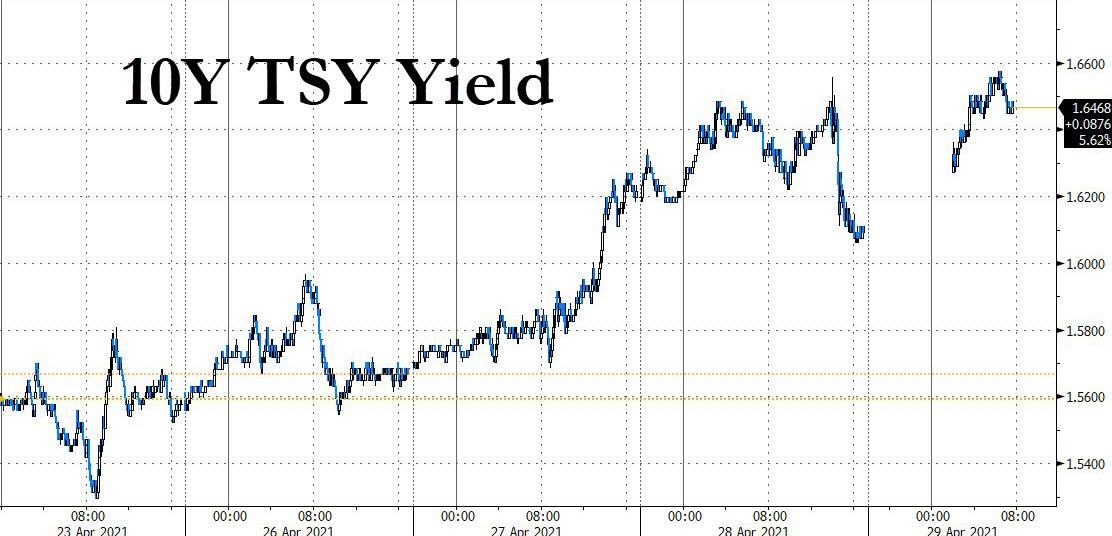
But while Powell may not be concerned about inflation, the bond market is and the 10-Year TSY yield headed for the biggest weekly increase since March 19, and a key gauge of commodities was on course for the longest daily rally in more than three years.
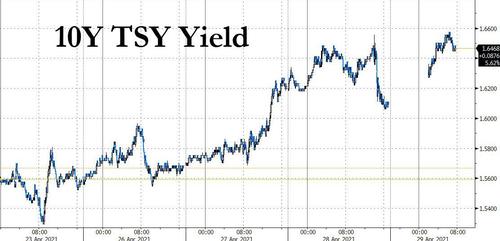
Reflation trades got a boost after Joe Biden unveiled a $1.8 trillion spending plan targeted at American families, adding to the economic optimism.

Europe’s benchmark Stoxx 600 index rose 0.4%, moving closer to a record reached earlier in April. Personal-care shares climbed after Unilever delivered a sales beat and announced a share buyback. Oil giants Total SE and Royal Dutch Shell Plc boosted their sector after reporting better-than-forecast profits. Here are some of the biggest European movers today:

  • Unilever shares jump as much as 4%, most since Nov. 25, after the consumer-goods company reported 1Q sales that beat market expectations and announced plans for a share buyback that impressed most analysts.
  • Nokia’s shares surged as much as 15% to their best day since getting caught up in a Reddit trader frenzy in January, after results surpassed analyst expectations. Analysts were particularly positive on Nokia’s adjusted gross margin, and were also reassured by the telecom equipment maker maintaining its guidance for 2021 and management pointing toward the higher end of the range.
  • Straumann shares jump as much as 10.3% to a record high after the Swiss dental-implant maker reported 1Q sales that Mirabaud says were “super strong,” especially in APAC.
  • Airbus shares gain as much as 3.5% in Paris trading and is the day’s best performer on the CAC 40; Bernstein says the company had a strong start to the year, with 1Q results better than expected on all key metrics.
  • WH Smith shares fall as much as 5.8% after the U.K. retailer issued convertible bonds. Separately, its 1H results are better than expected, driven by a good performance in its high street business, RBC (outperform) writes in a note.

Earlier in the session, Asian stocks rose and were set for a second day of gains, with the MSCI Asia Pacific Index rising 0.3% led by material and energy shares, as investors cheered Joe Biden’s ambitious spending plans and buoyant earnings from U.S. tech giants like Apple. China stocks rose for a third session in their longest streak of gains this month, on the back of solid first-quarter earnings growth by financial and consumer staples companies. The CSI 300 Index gained 0.9%, while Hong Kong’s Hang Seng rose 0.8%. India’s S&P BSE Sensex Index pared an advance of as much as 1.3% and traded little changed as the South Asian country continued to report record daily coronavirus cases. The nation’s biggest conglomerates and global giants such as Amazon.com Inc. stepped in to help ease the country’s pandemic-induced crisis. Overall, the MSCI Asia Pacific Index rose 0.3% led by material and energy shares, getting a boost from Biden’s promise of tax increases on the wealthy to pay for plans to spend trillions of dollars on infrastructure, education and other Democratic priorities. Biden’s address to a joint session of Congress on Wednesday came after the Fed upgraded its assessment of the U.S. economy but said it was not ready to consider scaling back pandemic support. “I didn’t expect the degree to which Biden will embark on this incredible spending program,” Mark Mobius, co-founder of Mobius Capital Partners told Bloomberg Television. The spending plan will benefit global markets, he added, because it means the U.S. will be importing more and there are “opportunities for more exports” from China and India. Asian markets got a lift earlier this morning on a slew of tech earnings. Apple Inc. crushed revenue estimates and Facebook Inc. reported increases in sales and users. However, shares of Samsung Electronics and its suppliers fell even though South Korea’s largest company reported a better-than-forecast first quarter profit. Markets in Japan and Malaysia were closed on account of local holidays

In rates, Treasury futures traded near lows of the day heading into early U.S. session as post-FOMC gains are unwound. Yields were higher by nearly 4bps across intermediates, steepening 2s10s by 3.5bp, 2s5s by 2.5bp; 10-year around 1.65% underperforms bunds by ~2bp, gilts by ~1bp. Most of the move occurred when cash trading — closed in Asia as Japan’s Golden Week holiday begins — resumed in London. Volume light in both futures and cash. S&P 500 futures’ advance to record above 4200 and USD/JPY strength also weigh on Treasuries. Treasuries bull steepened on Wednesday, with markets showing a modest dovish repricing after Fed Chair Powell reiterated the central bank’s commitment to asset purchases while the economy is recovering.

In FX, the Bloomberg Dollar Spot Index edged up and the greenback advanced versus most of its Group-of-10 peers; the euro retreated after rising to a fresh one-month high of $1.2150. The pound advanced to the highest in over a week before paring gains; sterling was still among the top G-10 performers. Sweden’s krona largely ignored better-than-forecast economic tendency survey and GDP data out of the Nordic nation while Norway’s krone fell for the first day in five; the Scandinavian currencies are still set to be the best G-10 performers this month. The Australian dollar swung to a loss after rising as much as 0.4% earlier as U.S. President Joe Biden’s speech disappointed some traders betting on an additional stimulus announcement; bonds firmed into the central bank’s purchases in the 7-10 year sector.

In commodities, crude oil extended gains on a confident outlook on demand from OPEC and its allies, despite the threat from India’s Covid-19 crisis. The Bloomberg Commodity Index increased for a ninth day, nearing a three-year high on a closing basis.

Looking at today’s calendar, we’ll get a fresh round of earnings releases with the highlights including Amazon, Mastercard, Comcast, Merck, Thermo Fisher Scientific, McDonald’s, Bristol Myers Squibb, Caterpillar, American Tower and Twitter. On the data front, we’ll get the advance estimate of Q1 GDP in the US, as well as the weekly initial jobless claims and March’s pending home sales. In Europe, we’ll get the change in German unemployment for April and the country’s preliminary CPI reading for that month, on top of the final Euro Area consumer confidence reading for April. Central bank speakers include Fed Vice Chair Quarles, ECB Vice President de Guindos, and the ECB’s Elderson and Holzmann.

Market Snapshot

  • S&P 500 futures up 0.6% to 4,202.00
  • STOXX Europe 600 rose 0.3% to 441.25
  • MXAP up 0.3% to 209.16
  • MXAPJ up 0.4% to 706.99
  • Nikkei up 0.2% to 29,053.97
  • Topix up 0.3% to 1,909.06
  • Hang Seng Index up 0.8% to 29,303.26
  • Shanghai Composite up 0.5% to 3,474.90
  • Sensex little changed at 49,765.82
  • Australia S&P/ASX 200 up 0.2% to 7,082.28
  • Kospi down 0.2% to 3,174.07
  • Brent Futures up 0.89% to $67.87/bbl
  • Gold spot down 0.25% to $1,777.20
  • U.S. Dollar Index up 0.06% to 90.663
  • German 10Y yield rose 1.2 bps to -0.219%
  • Euro down 0.03% to $1.2122

Top Overnight News from Bloomberg

  • Forty years ago, President Ronald Reagan and Federal Reserve Chairman Paul Volcker oversaw a root-and-branch restructuring of the U.S. economy. Today, Joe Biden and Jerome Powell are trying to do the same thing — only in reverse. In the Reagan-Volcker regime change, power in the economy shifted from the government to the market and from labor to the owners of capital. The emphasis was on efficiency, not equality, and on promoting supply, not demand
  • China said its population increased in 2020, countering concerns that its upcoming census will show a possible decline as the nation ages rapidly
  • German unemployment unexpectedly rose in April, signaling that the labor market is experiencing strains from lockdown restrictions that have been tightened
  • The retreat in Treasury yields this month has revived demand for emerging-market carry trades with China and South Korea bonds looking among the most attractive targets in Asia

Quick look at global markets courtesy of Newsquawk

Asian equity markets traded positively in reaction to the continued dovish tone from the FOMC and beat on earnings amongst the tech giants including Apple, Facebook and Qualcomm. In addition, focus was also on President Biden’s first address to a joint session of Congress where he stated America is on the move again and that the American Jobs Plan is a blue-collar blueprint to build America, while he called on Congress to pass the USD 15/hour minimum wage and extend child tax credit through at least end-2025, as well as outlined the American Families Plan. This facilitated a continued upside in US equity futures to push the Emini S&P to a record high and briefly above the 4,200 level although gains for Asia bourses were tempered amid a heavy slate of earnings and with Japanese participants absent due to a holiday closure. ASX 200 (+0.3%) was positive with outperformance in gold miners amid a rebound in the precious metal in the aftermath of the dovish FOMC, but with gains in the index capped by losses in consumer stocks after weaker quarterly sales from Woolworths and with Treasury Wine Estates dampened by a 4% decline of Australian wine exports in the year to end-March. KOSPI (-0.2%) benefitted initially as its top constituent Samsung Electronics remained afloat following its final Q1 earnings results which topped forecasts for net profit and posted a slight increase in revenue from the preliminary. Hang Seng (+0.8%) and Shanghai Comp. (+0.5%) also gained with sentiment encouraged by earnings releases including China’s largest oil company Sinopec and big 4 bank China Construction Bank.

Top Asian News

  • China Says Population Grew in 2020, Rebutting Report of Drop
  • Singapore Finds 16 New Coronavirus Cases in Wider Community
  • China Huarong Leaves Rating Firms Guessing on State Support (1)
  • India’s RBI May be Augmenting its T-Bill Holdings, Traders Say

Major bourses in Europe, for the most part, see gains (Euro Stoxx 50 +0.3%) although to varying degrees as earnings take the driving seat with the FOMC meeting and Biden’s speech are out of the way and heading into month-end. US equity futures meanwhile remain elevated with the NQ (+1.0%) leading the gains whilst its peers see broad-based upside. Heading into month-end, JPM forecasts balanced mutual funds to sell some USD 30bln of equity, although, by historical portfolio rebalancing standards, this is quite modest. Back in Europe, the AEX (+0.9%) narrowly outperforms among the majors as the index is propped up by heavyweights Unilever (+3.0%) and Shell (+2.0%) post-earnings, with the latter beating on the top and bottom lines whilst increasing its dividend. Conversely, the DAX (-0.1%) underperforms as losses in German autos keep gains capped, whilst post-earnings BASF (-1.6%) provides further pressure. Sectors are mostly higher but again it is hard to discern a particular risk tone or theme as idiosyncratic factors are at play. Autos sit at the bottom of the pile amid the ongoing chip shortage coupled with Ford (-2.7% pre-mkt) earnings that were not well received. Telecoms outperform as Nokia (+14%) and Swisscom (+5%) were bolstered following their metrics, whilst further tailwinds are felt from BT (+2.1%) amid reports the Co. is in talks with Amazon, Disney, and others regarding a potential sale of its sports arm. Oil & Gas also see a firm performance amid the numbers from Shell, Total (+1.4%), and Equinor (+3.3%), and against the backdrop of firmer oil prices. Individual movers are largely earning-oriented and include the likes of Lufthansa (-2.5%), Airbus (+2.2%), Standard Chartered (+5.7%), Natwest (-3%), Logitech (+1.3%) and Clariant (-3%).

Top European News

  • NatWest Starts to Reverse Covid Provisions as Earnings Beat
  • Cboe Opens Derivatives Venue in Amsterdam in Latest Brexit Shift
  • Bankinter Bolsters Spanish Insurers With Spinoff
  • Total Profit Surges to Pre-Pandemic Levels on Oil Recovery

In FX, the Dollar remains in a clear bear trend following another dovish message from the Fed and Chair Powell in the post-meeting press conference/Q&A, but perhaps there was enough in the latest official statement and assessment to indicate more confidence or less caution about the economic outlook. Indeed, the FOMC no longer deems downside risks to be considerable, upgraded activity levels to strengthening from turning up and acknowledged rising inflation, albeit still mainly due to transitory factors. Meanwhile, US President Biden’s first address to a joint Congress was largely as expected in terms of content and details of the America Families Plan, so no real surprises or reason for the Greenback and markets in general to dwell for too long. Hence, Treasuries have reverted to bear-steepening mode and are providing the Buck with some impetus to pare deeper losses after the DXY slipped to fresh April and cycle lows under 90.500 at 90.422 in the run up to a raft of data before Fed’s Williams appears at the NY Economic Club. The index is currently hovering just shy of a 90.721 recovery high amidst with the Dollar firmer vs most components and major counterparts.

  • JPY – Holiday-thinned volumes may well be compounding price action, but the Yen is bearing the brunt of the aforementioned Greenback rebound and yield/curve retracement, as Usd/Jpy retests the 109.00 level vs sub-108.50. However, while Japan observes Showa Day, decent option expiries could keep the headline pair contained before Tokyo CPI, jobs and ip tomorrow given 1.9 bn and 1.3 bn rolling off at 108.50 and 109.00 respectively.
  • AUD/NZD/CHF/EUR – Also handing back gains vs their US rival, with the Aussie back under 0.7800 irrespective of an acceleration in Q1 export prices and perhaps more conscious of comments by Treasurer Frydenberg putting a 4% handle on the jobless rate to generate stronger wages and inflation, while predicting that it will take 2 years before returning to full employment. Similarly, no sustained impetus for the Kiwi to reach 0.7300 via improvements in NBNZ business sentiment or the activity outlook after trade data showing an almost flat balance, as Nzd/Usd hovers below 0.7250. Elsewhere, the Franc is now straddling 0.9100 and the Euro has breached key chart resistance in the form of a descending trendline, but hit another obstacle at 1.2150 before waning amidst a barrage of mostly firmer than expected Eurozone data/surveys that should keep Eur/Usd afloat along with 1.1 bn option expiry interest either side of 1.2100 (1.2095-1.2105 specifically).
  • GBP/CAD – Relative G10 outperformers, as the Pound rebounds firmly from midweek session lows to straddle 1.3950 vs the Buck and probe 0.8675 against the Euro, though again on little fundamental bar firmer oil prices that are boosting the Loonie around 1.2300 and even loftier multi-year peaks circa 1.2287.

WTI and Brent front month futures continue edging higher in conjunction with the broader sentiment across markets following Powell and Biden’s appearances since the European close yesterday. The upside could also be supported by the overall bullish inventory data seen during the week, whilst eyes remain on India’s situations amid its rampant “double variant”, although the nation is receiving international support. On this note, analysts at ING suggest that Indian refiners are erring towards increased refined product exports in a bid to tackle a domestic glut. “Increased export flows from India are a risk to regional product cracks, with additional supply potentially weighing on them. This is particularly the case, given that refiners in the country so far appear to have made only marginal cuts to run rates.”, the Dutch bank states. WTI resides just around USD 64.75/bbl (vs low USD 63.35/bbl) and Brent hovers sub-USD 67.75/bbl (vs low USD 66.64/bbl). Elsewhere, spot gold and silver are mixed but price action during European trade has been pegged to the Buck, with the former still around the USD 1,775/oz and spot silver just north of USD 26/oz. Turning to base metals, LME copper remains firm after testing but failing to breach USD 10,000/t to the upside, with overnight prices again experiencing upside as Chinese players entered the market. LME nickel meanwhile topped the USD 17,000/t mark yesterday with some citing restocking ahead of the Chinese labour day holiday between May 1st and 5th.

US Event Calendar

  • 8:30am: 1Q GDP Annualized QoQ, est. 6.6%, prior 4.3%;
    • Personal Consumption, est. 10.5%, prior 2.3%
    • PCE Core QoQ, est. 2.4%, prior 1.3%
  • 8:30am: April Initial Jobless Claims, est. 540,000, prior 547,000; Continuing Claims, est. 3.59m, prior 3.67m
  • 9:45am: April Langer Consumer Comfort, prior 54.2
  • 10am: March Pending Home Sales YoY, est. 27.5%, prior -2.7%; Pending Home Sales (MoM), est. 4.4%, prior -10.6%

DB’s Jim Reid concludes the overnight wrap

The main event yesterday was the Federal Reserve meeting in the US, where expectations were low for there being much new information. The FOMC did announce upgraded forecasts for the US economy though, and Chair Powell noted in the ensuing press conference that “amid progress on vaccinations and strong policy support, indicators of economic activity and employment have strengthened.” However the FOMC kept both the pace of asset purchases and its key interest rate unchanged, with no change to the forward guidance. Powell softened some language and acknowledged that the recovery has been faster than previously expected but that “it remains uneven and far from complete” and that he viewed the economy as “a long way from our goals.” He once again noted that inflation metrics would be higher in coming months but that it remains a “largely” a transitory phenomenon. For more see our US economists report here.

The market was very steady going into the Fed announcement. The S&P was trading within a 13.3pt (0.3%) range before finishing slightly lower on the day (-0.08%) after gaining as much as +0.35% at the intraday highs which were reached at the beginning of the Powell presser. That marginal loss left the S&P just off its record levels, though cyclicals such as energy (+3.35%), retailing (+0.56%) and banks (+0.47%) continued to lead the index. Yields on US treasuries retreated to the lows of the day after being as much as +2.9bps higher just prior to the FOMC release. Afterward the FOMC announcement, they rallied through the rest of the US afternoon with 10yr yields finishing the day down -1.2bps at 1.609%. The fall in yields was driven by real yields (-2.9bps) falling back, even as inflation expectations rose even further (+1.6bps) with 10yr breakevens at fresh 8 year highs. The dollar index ending the day down -0.33%. Commodities were largely higher with copper (+0.22%), gold (+0.29%), and WTI (+1.46%) all gaining.

Tech shares largely traded lower yesterday with the NASDAQ down -0.28%, but this reversed after the US close, when we saw earnings from Apple and Facebook. Facebook was up +6.2% in after-market trading on a large revenue beat, with reported sales up 47% at $26.17bn (est 23.7bn). Investors seemed to respond well to a strong Q2 guidance and steady user growth. Apple rose +2.3% after the largest public company in the US announced strong revenues, up +54% to $89.6bn (est. $77.3bn). Sales were strong across their suite of products with the company reporting “revenue records in each of our geographic segments and strong double-digit growth in each of our product categories,” in the earning release. Nasdaq futures are now up +0.93%.

Biden delivered his first speech to a joint session of Congress yesterday outlining his plans on infrastructure, education and other party priorities. We actually got the contents of the American Families Plan from the White House ahead of the speech, which is a $1.8tn package that has $1tn in spending and $800bn in tax cuts. Among the measures are free universal pre-school for 3 and 4-year olds, two years of free community college, measures on paid leave and affordable childcare, and an extension of various tax credits. In terms of how they propose to pay for this, it would see the top tax rate go back up to 39.6%, and households earning over $1m would also face the same 39.6% rate on capital gains tax. The president tried to keep much of the focus on the job-making possibilities, especially for those without college degrees. “Nearly 90% of the infrastructure jobs created in the American Jobs Plan don’t require a college degree… and 75% percent do not require an associate’s degree.” President Biden also struck a more hawkish tone against Russia and China, particularly where he sees American interests being at risk – such as election tampering and the South China Sea. S&P futures rose around +0.6% after the start of the speech having already rallied slightly on the stronger tech earnings after the close.

Asian markets are also trading up this morning on the prospect of more stimulus from the US with the Hang Seng (+0.62%), Shanghai Comp (+0.17%), Kospi (+0.16%) and India’s Nifty (+1.04%) all up. Japan’s markets are closed for a holiday. European futures are also pointing to a positive open. Elsewhere, Reuters has reported that China is preparing to fine Tencent as part of its antitrust crackdown on the country’s internet giants. The report added that the fine could be as much as CNY 10bn.

In other news, the global chip shortage is worsening with Honda and BMW joining the growing list of automakers (including Jaguar Land Rover, Volvo and Mistubishi Motors) temporarily pausing production for a few days next month to deal with the crisis. Meanwhile, Ford has gone a step further and reduced its full year earnings guidance due to the shortage and has said that it now sees the shortage extending into next year. Elsewhere, tech giants like Apple and Samsung have also flagged production cuts and lost revenue as a result of the shortage in their earnings releases overnight. Apple’s CFO Maestri warned that supply constraints are crimping sales of iPads and Macs, two products that performed especially well during lockdowns. Maestri added that this will knock $3 bn to $4 bn off revenue during the fiscal third quarter.

Risk assets had performed well in Europe ahead of the Fed, with the DAX (+0.28%), the CAC 40 (+0.53%) and the FTSE 100 (+0.27%) all posting solid gains. The STOXX 600 (+0.02%) lagged behind somewhat thanks to an underperformance in Swedish equities, but still managed to close just shy of its all-time high. Separately, sovereign bond yields outside of the US climbed to their highest level in months, with yields on 10yr bunds up +1.8bps to -0.23%, their highest closing level in over a year, as those on 10yr OATs (+2.0bps) and BTPs (+5.1bps) similarly moved higher.

There wasn’t a great deal of news on the pandemic yesterday, though in New York, Governor Cuomo said that the 12am outdoor dining area curfew for bars and restaurants would be lifted from May 17, and that the 12am indoor curfew would go on May 31. Poland announced an easing of restrictions as well, with shopping malls partially open from May 4 and outdoor dining to recommence on May 15. Meanwhile on the Tokyo Olympics, it was announced that athletes will now be tested on a daily basis, though a decision on whether to have domestic spectators won’t be made until June. Sticking with Japan, the Nikkei has reported overnight that the country is considering making vaccines and medical treatments that have yet to be domestically approved available for emergency use in order to reduce regulatory delays to vaccination as cases are continuing to rise. Elsewhere, the US has issued a level 4 travel advisory for India overnight and have told its citizens to leave India as soon as possible and not to travel there because of the escalating coronavirus crisis. India reported 379k cases and 3645 fatalities over the past 24 hours, marking new record highs.

Here in the UK, yesterday saw the ONS published their latest antibody survey, which found that in England 68% of the adult population had tested positive for antibodies in the week ending April 11, the highest since they began running this survey late last year. The effects of the vaccination drive could be seen through the age breakdowns, as all the groups covering the over-50s had an antibody rate of higher than 80%. See the graph below for the breakdown. There was also late news in the UK that the government had secured a deal with Pfizer and BioNtech for an additional 60 million doses of its vaccine as part of a booster program to protect the most vulnerable ahead of the winter.

To the day ahead now, and we’ll get a fresh round of earnings releases with the highlights including Amazon, Mastercard, Comcast, Merck, Thermo Fisher Scientific, McDonald’s, Bristol Myers Squibb, Caterpillar, American Tower and Twitter. On the data front, we’ll get the advance estimate of Q1 GDP in the US, as well as the weekly initial jobless claims and March’s pending home sales. In Europe, we’ll get the change in German unemployment for April and the country’s preliminary CPI reading for that month, on top of the final Euro Area consumer confidence reading for April. Central bank speakers include Fed Vice Chair Quarles, ECB Vice President de Guindos, and the ECB’s Elderson and Holzmann.

Tyler Durden
Thu, 04/29/2021 – 07:58

via ZeroHedge News https://ift.tt/3e29cBd Tyler Durden

The Legal Profession and the Efficacy of Microeconomic Policy

Trouble at the Bar points out that the legal profession has more influence on public policy than any other profession. It also suggests that its influence on microeconomic policy may be harmful based on circumstantial evidence in my 2021 Brookings book, Gaining Ground: Markets Helping Government, and Yale Law Professor Peter Schuck’s 2014 book, Why Government Fails So Often and How It Can Do Better, which documents that pervasive microeconomic policy failures have generated huge costs to American society. Before indicting the legal profession, it is important to consider how government policy failures could be linked to the profession’s influence, and, if so, what could be done to make its influence more constructive.

Law and lawyers are essential for formulating and applying public policy, but both have features that sow the seeds of government policy inefficiencies. The strength of law is that it establishes boundaries—that is, identifies illegal behavior—and governs interactions among and between people and firms. Its weakness is that proposed laws that offer constructive change can be vetoed. For example, the Senate and the House of Representatives are veto players because, without their consent, no bill can become a law. The more veto players in a political system—and the United States has an exceptionally high number of them—the more difficult it is to avoid status quo bias and to adopt socially beneficial policy reforms.

Lawyers understand and respect the policymaking process and account for a large share of policymakers, especially in Congress, where 42 per­cent of the seats in the House and 59 percent of the seats in the Senate in the 113th Congress were held by lawyers. However, lawyers, like economists, can be slaves to their training and professional culture. This adversely affects policy. For example, lawyers in government emphasize procedure and advocacy and the prosecutorial style of congressional hearings instead of a systematic, collaborative search for truth.

Lawyers also have a predilection for writing laws and regulations and producing huge volumes that run in the thousands of pages yet nonetheless result in ambiguities and a constant stream of legal challenges, instead of initiating clear and effective policies that help to resolve social problems. Administrative lawyers are especially comfortable with, and, indeed, may welcome, highly detailed regulations and statutes. For example, the Federal Register exceeds 70,000 pages; the Dodd-Frank Act spawned an additional 14,000 pages on top of its initial 2,300 pages; and the Affordable Care Act amounted to 2,700 pages and 1,327 waivers. Some lawyers can be so preoccupied with administering regulations that they neglect to consider whether the regulations are enhanc­ing or harming social welfare.

Phillip Howard’s critique of the legal profession argues that law­yers share a philosophy of the correctness of the law, such as compliance with a rule, regardless of the law’s actual economic and social effects. For more than three years, the Veterans Benefits Administration intentionally stopped redacting names, Social Security numbers, and other personally identifiable information on third-party individuals in claims records provided to veter­ans. Although people could face substantial harm if their information were misused, the Veterans Affairs’ General Counsel’s Office said there was legal support for not redacting the data.

Trouble at the Bar argues that the pervasive role of lawyers in all levels of government has had an adverse effect on the efficacy of public policies in general because lawyers’ training, career development, and policy perspectives have oc­curred in an inefficient environment shaped by regulations that reduce competition and innovation. In addition, legal training and practice does not encourage policymakers to acknowledge and correct policy inefficiencies by subjecting previous decisions to rigorous retrospective cost-benefit analyses and by subjecting new decisions to rigorous prospective cost-benefit analyses. Precedent is, well, precedent. Period.

To be sure, economists have a comparative advantage in performing quantitative studies, but an economic analysis must usually go through lawyers if it is to have any influence on policy. Often such work is simply ignored or dismissed as “gobbledygook” unless the lawyers participating in the policy process believe its message supports their strongly held views.

For example, the available scholarly empirical evidence does not indicate that antitrust policy and enforcement has benefited consumers by promoting competition and by preventing firms from engaging in anticompetitive behavior. Nonetheless, such evidence is not acknowledged by lawyers Tim Wu and Lina Khan who advocate breaking up Big Tech and abandoning the consumer welfare standard in favor of “leveling the playing field” for any and all competitors. This is troubling because Wu and Khan are likely to have considerable influence on the future direction of antitrust enforcement given that President Biden is supporting their appointments to the National Economic Council and the Federal Trade Commission, respectively. One might hope that leveling the playing field promotes consumer welfare, but that is certainly not a given.

Trouble at the Bar also presents evidence suggesting that policy may be compromised because the government does not attract the most able lawyers graduating from the nation’s leading law schools, and when it recruits top lawyers from the private sector for a few years, the effectiveness of those lawyers may be limited by the government’s resource constraints. Although access to justice is a problem of most ordinary Americans, those individuals and firms with the resources to have access are likely to have an advantage in the quality of their legal representation when they oppose the government in a policy dispute.

The shortcomings of the legal profession in government policymaking that I have summarized contribute to status quo bias, which is the strongest explanation for government policy failure. Status quo bias inhibits learning and vision about the long-run effects of a policy, enables significant inefficiencies in part of the economy to persist and interact with inefficiencies in other parts of the economy, and makes it extremely difficult for the government to reform inefficient policies by implementing efficient ones.

Importantly, reforms that do occur may make things worse instead of better because of a lack of learning and vision. Society, of course, has other goals besides economic efficiency, but persistent inefficiencies make it much more difficult for society to accomplish those goals.

The deregulatory reforms of the legal profession that I recommended previously to increase access to justice also could help the legal profession’s influence in policymaking to be more constructive. First, deregulation that generates more competition and reduces the government earnings penalty should help the government to attract more able lawyers. Second, greater competition among legal service providers that improves the culture of law firms to make them more efficient, innovative, and congenial toward all employees could help government performance if lawyers from those firms impart those values when they take leave from the private sector to work in government.

Finally, the development of new specialized legal education programs, which result from eliminating the ABA’s monopoly control over legal education, could greatly im­prove the training of lawyers who pursue specific career paths that lead to long or short-term positions in government. For example, law schools in combination with other university departments could develop programs that blend:

  • Law, economics, political science, and policy analysis for lawyers who want to work in government to help formulate and implement social science-based policies. Such a program would enable lawyers to develop skills to assess and possibly initiate empirical policy analyses that are relevant to their area of responsibility.
  • Law, policy analysis, and STEM disciplines for lawyers who want to advise government officials and judges on policies based on science and engineering.
  • Law and medicine for lawyers who want to work in government on health-related policy issues.

Other programs that could better prepare lawyers who work in government to contribute more effectively to public policy also are likely to be developed.

Lawyers who obtain a broad analytical, multidisciplinary education are likely to be more effective at helping public officials appreciate rigorous policy-based arguments and they may be more likely to advance those arguments when they are able to do so. Lawyers with such an education also are likely to take a less ideological approach to resolving cases; thus, if they become a judge on a lower court or a justice on the Supreme Court, they could help to reduce ideologically based decisions by their own (less ideological) perspective.

Lawyers who oppose deregulating the legal profession reflect status quo bias that benefits a special interest at the expense of society. Those same lawyers, when they occupy influential positions in government, are also likely to enable government policy inefficiencies to persist. If lawyers change their mindset of how they self-regulate the legal profession, they could contribute more effectively to policy reforms that greatly benefit society when they serve in government.

from Latest – Reason.com https://ift.tt/3e1LYeB
via IFTTT

The Legal Profession and the Efficacy of Microeconomic Policy

Trouble at the Bar points out that the legal profession has more influence on public policy than any other profession. It also suggests that its influence on microeconomic policy may be harmful based on circumstantial evidence in my 2021 Brookings book, Gaining Ground: Markets Helping Government, and Yale Law Professor Peter Schuck’s 2014 book, Why Government Fails So Often and How It Can Do Better, which documents that pervasive microeconomic policy failures have generated huge costs to American society. Before indicting the legal profession, it is important to consider how government policy failures could be linked to the profession’s influence, and, if so, what could be done to make its influence more constructive.

Law and lawyers are essential for formulating and applying public policy, but both have features that sow the seeds of government policy inefficiencies. The strength of law is that it establishes boundaries—that is, identifies illegal behavior—and governs interactions among and between people and firms. Its weakness is that proposed laws that offer constructive change can be vetoed. For example, the Senate and the House of Representatives are veto players because, without their consent, no bill can become a law. The more veto players in a political system—and the United States has an exceptionally high number of them—the more difficult it is to avoid status quo bias and to adopt socially beneficial policy reforms.

Lawyers understand and respect the policymaking process and account for a large share of policymakers, especially in Congress, where 42 per­cent of the seats in the House and 59 percent of the seats in the Senate in the 113th Congress were held by lawyers. However, lawyers, like economists, can be slaves to their training and professional culture. This adversely affects policy. For example, lawyers in government emphasize procedure and advocacy and the prosecutorial style of congressional hearings instead of a systematic, collaborative search for truth.

Lawyers also have a predilection for writing laws and regulations and producing huge volumes that run in the thousands of pages yet nonetheless result in ambiguities and a constant stream of legal challenges, instead of initiating clear and effective policies that help to resolve social problems. Administrative lawyers are especially comfortable with, and, indeed, may welcome, highly detailed regulations and statutes. For example, the Federal Register exceeds 70,000 pages; the Dodd-Frank Act spawned an additional 14,000 pages on top of its initial 2,300 pages; and the Affordable Care Act amounted to 2,700 pages and 1,327 waivers. Some lawyers can be so preoccupied with administering regulations that they neglect to consider whether the regulations are enhanc­ing or harming social welfare.

Phillip Howard’s critique of the legal profession argues that law­yers share a philosophy of the correctness of the law, such as compliance with a rule, regardless of the law’s actual economic and social effects. For more than three years, the Veterans Benefits Administration intentionally stopped redacting names, Social Security numbers, and other personally identifiable information on third-party individuals in claims records provided to veter­ans. Although people could face substantial harm if their information were misused, the Veterans Affairs’ General Counsel’s Office said there was legal support for not redacting the data.

Trouble at the Bar argues that the pervasive role of lawyers in all levels of government has had an adverse effect on the efficacy of public policies in general because lawyers’ training, career development, and policy perspectives have oc­curred in an inefficient environment shaped by regulations that reduce competition and innovation. In addition, legal training and practice does not encourage policymakers to acknowledge and correct policy inefficiencies by subjecting previous decisions to rigorous retrospective cost-benefit analyses and by subjecting new decisions to rigorous prospective cost-benefit analyses. Precedent is, well, precedent. Period.

To be sure, economists have a comparative advantage in performing quantitative studies, but an economic analysis must usually go through lawyers if it is to have any influence on policy. Often such work is simply ignored or dismissed as “gobbledygook” unless the lawyers participating in the policy process believe its message supports their strongly held views.

For example, the available scholarly empirical evidence does not indicate that antitrust policy and enforcement has benefited consumers by promoting competition and by preventing firms from engaging in anticompetitive behavior. Nonetheless, such evidence is not acknowledged by lawyers Tim Wu and Lina Khan who advocate breaking up Big Tech and abandoning the consumer welfare standard in favor of “leveling the playing field” for any and all competitors. This is troubling because Wu and Khan are likely to have considerable influence on the future direction of antitrust enforcement given that President Biden is supporting their appointments to the National Economic Council and the Federal Trade Commission, respectively. One might hope that leveling the playing field promotes consumer welfare, but that is certainly not a given.

Trouble at the Bar also presents evidence suggesting that policy may be compromised because the government does not attract the most able lawyers graduating from the nation’s leading law schools, and when it recruits top lawyers from the private sector for a few years, the effectiveness of those lawyers may be limited by the government’s resource constraints. Although access to justice is a problem of most ordinary Americans, those individuals and firms with the resources to have access are likely to have an advantage in the quality of their legal representation when they oppose the government in a policy dispute.

The shortcomings of the legal profession in government policymaking that I have summarized contribute to status quo bias, which is the strongest explanation for government policy failure. Status quo bias inhibits learning and vision about the long-run effects of a policy, enables significant inefficiencies in part of the economy to persist and interact with inefficiencies in other parts of the economy, and makes it extremely difficult for the government to reform inefficient policies by implementing efficient ones.

Importantly, reforms that do occur may make things worse instead of better because of a lack of learning and vision. Society, of course, has other goals besides economic efficiency, but persistent inefficiencies make it much more difficult for society to accomplish those goals.

The deregulatory reforms of the legal profession that I recommended previously to increase access to justice also could help the legal profession’s influence in policymaking to be more constructive. First, deregulation that generates more competition and reduces the government earnings penalty should help the government to attract more able lawyers. Second, greater competition among legal service providers that improves the culture of law firms to make them more efficient, innovative, and congenial toward all employees could help government performance if lawyers from those firms impart those values when they take leave from the private sector to work in government.

Finally, the development of new specialized legal education programs, which result from eliminating the ABA’s monopoly control over legal education, could greatly im­prove the training of lawyers who pursue specific career paths that lead to long or short-term positions in government. For example, law schools in combination with other university departments could develop programs that blend:

  • Law, economics, political science, and policy analysis for lawyers who want to work in government to help formulate and implement social science-based policies. Such a program would enable lawyers to develop skills to assess and possibly initiate empirical policy analyses that are relevant to their area of responsibility.
  • Law, policy analysis, and STEM disciplines for lawyers who want to advise government officials and judges on policies based on science and engineering.
  • Law and medicine for lawyers who want to work in government on health-related policy issues.

Other programs that could better prepare lawyers who work in government to contribute more effectively to public policy also are likely to be developed.

Lawyers who obtain a broad analytical, multidisciplinary education are likely to be more effective at helping public officials appreciate rigorous policy-based arguments and they may be more likely to advance those arguments when they are able to do so. Lawyers with such an education also are likely to take a less ideological approach to resolving cases; thus, if they become a judge on a lower court or a justice on the Supreme Court, they could help to reduce ideologically based decisions by their own (less ideological) perspective.

Lawyers who oppose deregulating the legal profession reflect status quo bias that benefits a special interest at the expense of society. Those same lawyers, when they occupy influential positions in government, are also likely to enable government policy inefficiencies to persist. If lawyers change their mindset of how they self-regulate the legal profession, they could contribute more effectively to policy reforms that greatly benefit society when they serve in government.

from Latest – Reason.com https://ift.tt/3e1LYeB
via IFTTT