If Biden Is Serious About Criminal Justice Reform, He Needs To Get Serious About Qualified Immunity


polspphotos788173

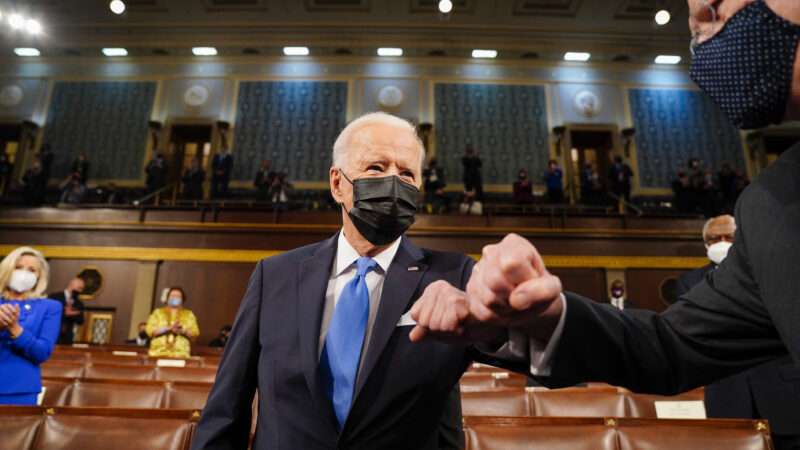
“We have all seen the knee of justice on the neck of black Americans. Now is the opportunity to make real progress,” said President Joe Biden on Wednesday, addressing the nation after his first 100 days in the Oval Office. “My fellow Americans, we have to come together to rebuild trust between law enforcement and the people they serve.”

That debate returned to the forefront following the guilty verdict of Derek Chauvin, the former Minneapolis police officer now convicted of murdering George Floyd. In that vein, the federal government has arguably never been this close to passing major police reform that would unravel some of the tough-on-crime policies popular a mere two decades ago, and long championed by Biden.

“We need to work together to find a consensus but let us get it done next month by the first anniversary of George Floyd’s death,” said Biden, in a speech heavy on platitudes and light on policy specifics. And there is a particular policy debate that could throw a wrench in his timeline: qualified immunity, the legal doctrine that makes it unreasonably difficult to file a lawsuit against a state actor accused of misconduct.

Conjured out of thin air by the high court, it requires that any misconduct alleged against a government official be “clearly established” in a pre-existing court precedent in order for a victim to secure permission to simply make their case before a jury. Qualified immunity has protected two cops who allegedly stole $225,000 during a search warrant, a cop who shot a teenage boy on his way to school, two cops who arrested and assaulted a man for standing outside of his own house, a cop who decimated a man’s car during a bogus drug search, and a college administrator who flouted a student’s free speech rights, among others.

Unfortunately, qualified immunity became the flashpoint in the debate over criminal justice reform last summer. Republicans were unwilling to pass any reform that scaled back qualified immunity, and Democrats wouldn’t vote for a bill unless it did.

As the Senate reconsiders the George Floyd Justice in Policing Act, which Biden would likely sign, that GOP reluctance appears to be softening. Tim Scott (R–S.C.) offered a compromise this month that would curtail qualified immunity for law enforcement officers if the departments themselves, rather than the offending officers, are held liable.

It’s unclear if the reform will pass, as Democrats will need to overcome the filibuster and court support from at least 10 Republicans. They will also need to address skepticism from those in their coalition on this issue, some of whom say the compromise isn’t really a compromise at all.

“Republicans pride themselves as the party of individual responsibility and personal accountability,” says Clark Neily, senior vice president for criminal justice at the Cato Institute. “A policy that would prevent police officers from being held liable for their own misconduct—and leave taxpayers to pick up the tab—is the very antithesis of those values. Everyone should be responsible for the harms they inflict on others, whether or not they wear a badge.”

Biden talked a big game Wednesday evening, rebuking what he cast as white supremacist terrorism. On the campaign trail, however, he was measured on this topic, expressing in meetings that he wasn’t yet ready to end qualified immunity outright. But to get serious on criminal justice reform will require him to get serious on qualified immunity.

from Latest – Reason.com https://ift.tt/3nA3v0r
via IFTTT

California Already Tried Biden’s Ghost Gun Ban. It Didn’t Work.


Screen Shot 2021-04-28 at 8.09.05 PM

In President Joe Biden’s address to Congress tonight, he repeated his intention to, in a manner still unspecified, ban so-called “ghost guns” made from kits that have no serial numbers and which you can buy without the background checks required in buying assembled guns from licensed dealers.

In a recent Reason TV video, Cody Wilson, a major entrepreneur in this currently legal space with Defense Distributed, guesses that the method Biden will go for is requiring serialization and background check for buying more of the component parts that go into making these finished homemade weapons.

This would mean that people dedicated to anonymously making homemade guns would have a harder time acquiring materials, yet the proliferation of home milling tools and software to guide them means that while Biden might be able to make home fabricating harder and more expensive (depending on the price of aluminum blocks), he cannot eliminate it. At a certain point, the feds could complicate the homemade scene such that people go back to just buying on the black market, which is stocked with non-homemade weapons.

California is ahead of Biden’s game in banning ghost guns, having since 2018, as the Center for American Progress summed up, “require[d] all self-assembled firearms to contain a unique serial number from the California Department of Justice. Furthermore, owners of newly serialized firearms must provide identification information to the California Department of Justice. Under California law, self-assembled firearms cannot be sold or transferred.”

At the same time, California has remained a place media calls on to scare you about the still growing threat of ghost guns, such as the claim made to ABC News last year by Carlos A. Canino, the special agent in charge of the A.T.F. Los Angeles field division, that “Forty-one percent, so almost half our cases we’re coming across, are these ‘ghost guns.” Last year was two years after California banned them in just the way Biden plans to. Not a promising sign for the efficacy of his bold initiative.

Various cities have reported scary-sounding percentage increases in captured ghost guns in the past few years as the hobby has spread, though, again, one could eliminate every homemade gun and still have plenty of traditional firearms to go around for both crooks and peaceful citizens. As J.D. Tuccille and Jacob Sullum have argued at Reason, Biden’s effort might make life harder on hobbyists and conceivably make punishing someone for a crime already committed easier in some marginal cases, but it can’t possibly be expected to make a serious dent in overall gun violence. Likely it’s the only real goal is to satisfy some of Biden’s political constituents.

from Latest – Reason.com https://ift.tt/3t1iT7a
via IFTTT

Nondelegation Doctrine Lessons from State Experience

Several justices on the Supreme Court are interested in reviving the nondelegation doctrine. Three justices joined Justice Gorsuch’s Gundy dissent calling for a nondelegation revival, and two other justices have expressed at least some support for the endeavor.

Precisely how to revive the nondelegation doctrine is an interesting question. There is an active academic debate on what lessons can or should be drawn from the founding era, and serious efforts to develop judicially manageable standards for implementing a limit on legislative delegation.

Two recent papers on SSRN suggest there are some lessons to be learned from the states. Given the interest in the nondelegation doctrine among VC readers, I thought I would flag these two papers.

Nondelegation in the States by Benjamin Silver.

American public law is on the precipice of a nondelegation revival. Yet scholars have largely ignored the greatest wellspring of American nondelegation law: that of the states. As a result, the nondelegation literature is badly in need of a broad and deep examination of state nondelegation. This article takes up that task by describing the kaleidoscope of contexts in which states apply the nondelegation doctrine. Significantly, state nondelegation reaches deep into public law and covers far more than the legislature-to-agency delegations that preoccupy the discussion at the federal level. This article analyzes this mess of state nondelegation jurisprudence, arguing that it can be explained coherently by two theories underlying nondelegation: the separation of powers and sovereignty. While these theories overlap to an extent, each supplies a distinct logic to nondelegation, thus motivating the doctrine’s disparate and varied applications.

Finally, the article argues affirmatively that the Supreme Court ought to consult state nondelegation jurisprudence when it revives the federal nondelegation doctrine. The states’ experience counsels important lessons for the federal doctrine. For nondelegation supporters, state nondelegation indicates that a strong doctrine may require revising vast expanses of public law, especially the separation of powers. As a result, a revived doctrine may prove difficult to administer, though in a way few have recognized. Fortunately, where the nondelegation doctrine might overreach into other areas of public law, relatively straightforward doctrinal guardrails can be established so that a strong doctrine doesn’t prove to be an obstacle to effective governance.

Decoding Nondelegation After Gundy: What the Experience in State Courts Tells Us About What to Expect When We’re Expecting by Daniel Walters (forthcoming in the Emory Law Journal).

The nondelegation doctrine theoretically limits Congress’s ability to delegate legislative powers to the executive agencies that make up the modern administrative state. Yet, in practice, the Supreme Court has, since the New Deal, shied away from enforcing any limits on congressional delegation. That may all change in the near future. In Gundy v. United States, the Court narrowly upheld a delegation, and a dissent signaled deep doubts about the Court’s longstanding “intelligible principle” standard and offered a new framework to replace it. Subsequent events strongly suggest that the Court is poised to move in the direction contemplated by the dissent in Gundy, drawing a line between policy discretion, which cannot be delegated, and authority to fill in details or find facts triggering policies, which can. Whether observers’ view of the prospect of Court-imposed limits on delegation is apocalyptic or euphoric, virtually everyone expects it to be highly consequential.

While these opinions about the nondelegation doctrine are understandable, they are ultimately speculative. This article offers a more data-driven evaluation of what implementation of the Gundy dissent’s line drawing would portend for administrative law. Using the underexamined laboratory of the nondelegation doctrine in the states, where the doctrine has always had more life than at the federal level, I show that states that adhere closely to the lines drawn by the Gundy dissent are no more or less likely to invalidate statutes passed by state legislatures than are states that adhere to the intelligible principle formulation. The lack of a relationship between doctrinal formulation and outcomes suggests we will only know whether a revolution is afoot based on what the Court actually does over a series of cases, not in what it says it is going to do. Moreover, it suggests significant limitations in the ability of the Gundy dissent’s approach to provide any ex ante guidance to Congress, the lower courts, or even future Supreme Courts about what the nondelegation doctrine prohibits—an observation that suggests significant logistical and institutional problems inherent in the entire project of resuscitating the doctrine.

from Latest – Reason.com https://ift.tt/3ufcjv6
via IFTTT

If Biden Is Serious About Criminal Justice Reform, He Needs To Get Serious About Qualified Immunity


polspphotos788173

“We have all seen the knee of justice on the neck of black Americans. Now is the opportunity to make real progress,” said President Joe Biden on Wednesday, addressing the nation after his first 100 days in the Oval Office. “My fellow Americans, we have to come together to rebuild trust between law enforcement and the people they serve.”

That debate returned to the forefront following the guilty verdict of Derek Chauvin, the former Minneapolis police officer now convicted of murdering George Floyd. In that vein, the federal government has arguably never been this close to passing major police reform that would unravel some of the tough-on-crime policies popular a mere two decades ago, and long championed by Biden.

“We need to work together to find a consensus but let us get it done next month by the first anniversary of George Floyd’s death,” said Biden, in a speech heavy on platitudes and light on policy specifics. And there is a particular policy debate that could throw a wrench in his timeline: qualified immunity, the legal doctrine that makes it unreasonably difficult to file a lawsuit against a state actor accused of misconduct.

Conjured out of thin air by the high court, it requires that any misconduct alleged against a government official be “clearly established” in a pre-existing court precedent in order for a victim to secure permission to simply make their case before a jury. Qualified immunity has protected two cops who allegedly stole $225,000 during a search warrant, a cop who shot a teenage boy on his way to school, two cops who arrested and assaulted a man for standing outside of his own house, a cop who decimated a man’s car during a bogus drug search, and a college administrator who flouted a student’s free speech rights, among others.

Unfortunately, qualified immunity became the flashpoint in the debate over criminal justice reform last summer. Republicans were unwilling to pass any reform that scaled back qualified immunity, and Democrats wouldn’t vote for a bill unless it did.

As the Senate reconsiders the George Floyd Justice in Policing Act, which Biden would likely sign, that GOP reluctance appears to be softening. Tim Scott (R–S.C.) offered a compromise this month that would curtail qualified immunity for law enforcement officers if the departments themselves, rather than the offending officers, are held liable.

It’s unclear if the reform will pass, as Democrats will need to overcome the filibuster and court support from at least 10 Republicans. They will also need to address skepticism from those in their coalition on this issue, some of whom say the compromise isn’t really a compromise at all.

“Republicans pride themselves as the party of individual responsibility and personal accountability,” says Clark Neily, senior vice president for criminal justice at the Cato Institute. “A policy that would prevent police officers from being held liable for their own misconduct—and leave taxpayers to pick up the tab—is the very antithesis of those values. Everyone should be responsible for the harms they inflict on others, whether or not they wear a badge.”

Biden talked a big game Wednesday evening, rebuking what he cast as white supremacist terrorism. On the campaign trail, however, he was measured on this topic, expressing in meetings that he wasn’t yet ready to end qualified immunity outright. But to get serious on criminal justice reform will require him to get serious on qualified immunity.

from Latest – Reason.com https://ift.tt/3nA3v0r
via IFTTT

A Cross-Ideological Case for Ending Exclusionary Zoning


Zoning

The Century Fund recently published “Tearing Down the Walls: How the Biden Administration and Congress Can Reduce Exclusionary Zoning.”  In it, Century Fund Senior Fellow Richard Kahlenberg summarizes the harm caused by exclusionary zoning, and summarizes several proposed ways the federal government can help reduce it. The report represents Kahlenberg’s views. But  it is based in part on a conference on zoning held by the Century Fund in December, which included a wide range of academics and policymakers, including myself.

I don’t agree with Kahlenberg on every point. But he’s absolutely right about the great extent of the problem, and the ways in which it cuts across ideological lines:

While democratic egalitarianism and the liberty to be free from government interference are values that are typically in tension with one another, in the case of exclusionary zoning, they point in the same direction. Perhaps because curtailing exclusionary zoning honors both egalitarian (anti-discriminatory) and libertarian (small government) streams in the American belief system, surveys suggest it is popular. In a 2019 Data for Progress poll, for example, voters were asked, “Would you support or oppose a policy to ensure smaller, lower-cost homes like duplexes, townhouses, and garden apartments can be built in middle- and upper-class neighborhoods?” Supporters outnumbered opponents by two to one.

Kahlenberg expands on this theme in a recent New York Times op ed:

Blue cities and states — most notably Minneapolis and Oregon — have recently led the way on eliminating single-family exclusive zoning, as a matter of racial justice, housing affordability and environmental protection. But conservatives often support this type of reform as well, because they don’t want government micromanaging what people can do on their own land. At the national level, some conservatives have joined liberals in championing reforms like the Yes in My Backyard Act, which seeks to discourage exclusionary zoning.

As Kahlenberg points out in both articles, cutting back on zoning would serve progressive values by expanding housing and job opportunities for the poor, and by eliminating restrictions that, in many cases, were originally established for the purpose of keeping out African-Americans and other racial minorities. In recent years, some liberal jurisdictions have undertaken important reforms in this field, most notably Minneapolis and Oregon (as Kahlenberg notes). But there is still a tension between the growing recognition that zoning is inimical to liberal values, and the high degree of NIMBY sentiment in many liberal areas:

If race were only the driving factor behind exclusionary zoning, one would expect to see such policies most extensively promoted in communities where racial intolerance is highest, but in fact the most restrictive zoning is found in politically liberal cities, where racial views are more progressive.186 Indeed, some liberals even take special pride in the fact that particular neighbors of theirs are members of racial or ethnic minority groups….

[S]ome upper-middle-class liberals will strenuously argue that people should never be denied an opportunity to live in a neighborhood because of race or ethnic origin, but have no problem with government policies that effectively exclude those who are less educationally and financially successful. As Princeton political scientist Omar Wasow acerbically noted: “There are people in the town of Princeton who will have a Black Lives Matter sign on their front lawn and a sign saying ‘We love our Muslim neighbors,’ but oppose changing zoning policies that say you have to have an acre and a half per house.” He continues: “That means, ‘We love our Muslim neighbors, as long as they’re millionaires.'”

There are similar tensions on the right between free market economists and property law experts who recognize that zoning reform can eliminate severe restrictions on property rights and  vastly expand economic growth, and those who sympathize with Donald Trump’s claims during the last election, that exclusionary zoning is needed to protect white middle-class neighborhoods against an influx of the poor and minorities.

In both of his articles, Kahlenberg correctly argues that reducing exclusionary zoning will help alleviate both racial injustice and economic inequality. As I have previously pointed out, this is an issue on which the largely Republican white working class and mostly Democratic African-American and Hispanic workers have an important common interest.

It is worth emphasizing, moreover, that the racial angle here is not simply about alleviating “structural racism” in some very broad sense of the word that might understandably raise conservative and libertarian hackles. Rather, many of today’s exclusionary zoning policies were original enacted for the specific purpose of keeping out blacks (and sometimes other minorities, as well). That’s racial discrimination even under the narrowest plausible definition thereof. Anyone who advocates color-blind government policy (as many on the right—for good reason—do), cannot overlook this history.

I wish, however, that Kahlenberg had also emphasized the ways in which zoning reform not only benefits the poor and minorities, but also can greatly increase economic growth, thereby ensuring gains for society as a whole. As Matt Yglesias points out in a thoughtful analysis of Kahlenberg’s articles, survey data suggests that the economic growth aspect of the issue actually has broader appeal than the racial justice frame. The latter has value in appealing to committed progressives—an important constituency in many of the liberal areas that have some of the most egregious zoning restrictions. But the former is crucial to building a cross-ideological coalition.

Recent evidence suggests that the zoning stifles growth to an even greater extent than previously recognized. Reform advocates should do all they can to make that fact more widely known.

I will not, in this post, offer a detailed assessment of the specific policy proposals outlined in the Kahlenberg/Century Fund report. My general view is that there is some real merit in proposals to condition various federal grants to states and localities on zoning reform. I am more wary of more comprehensive federal efforts to override local land-use policy. However, for reasons I laid out in a 2011 article on this topic, there may be good reasons for such overriding in cases where it expands protection for property rights, and thus gives individual property owners the ultimate say in deciding how to use their land, as opposed to imposing some kind of centralized federal land-use plan. Curbing state and local restrictions on property rights can actually increase decentralization, overall. The most localist land-use policy and the one that takes greatest account of diversity and local knowledge is one under which property owners have broad autonomy in deciding how to use their land.

While the federal reforms Kahlenberg describes deserve consideration, I believe the greatest potential for reform may lie at the state level, building on recent successes in Oregon and elsewhere. If state Rep. Scott Wiener is able to push through his proposed reforms in California, it could be a game-changer for the entire nation.

Reformers should also make greater use of referendum initiatives to promote zoning reforms. I outlined some of the reasons why here. In addition, they should systematically look for ways to challenge exclusionary zoning under various property rights provisions of both state and federal constitutions—a subject I plan to write about more in the future.

There aren’t many policy changes that can simultaneously strengthen protection for property rights, increase opportunity for the poor, alleviate grave historic racial injustices, and greatly expand economic growth. Abolishing exclusionary zoning can do it all! Whether you’re a libertarian, a conservative property rights advocate, a racial justice crusader, a progressive concerned about economic inequality, or just someone who wants to lower housing prices because “the rent is too damn high,” this is a cause you have good reason to support.


from Latest – Reason.com https://ift.tt/3nxOFry
via IFTTT
California Officials, Biden-Linked Firm Coordinated With Big Tech To Censor Election Posts: Judicial Watch

California Officials, Biden-Linked Firm Coordinated With Big Tech To Censor Election Posts: Judicial Watch

Authored by Isabel Van Burgen via The Epoch Times (emphasis ours),

California officials colluded with Big Tech to censor social media posts in the United States during the 2020 presidential election, government watchdog group Judicial Watch announced Tuesday.

A thumbprint is displayed on a mobile phone as the logo for the Twitter social media network is projected onto a screen in London, England on Aug. 9, 2017. (Leon Neal/Getty Images)

The findings come after Judicial Watch received 540 pages and a further four pages of documents from the office of the Secretary of State of California in response to an open records request, the group said.

It had filed the request after a December 2020 report surfaced revealing that California’s Office of Election Cybersecurity had surveilled and asked the social media giants to remove or flag as “misleading” at least two dozen messages.

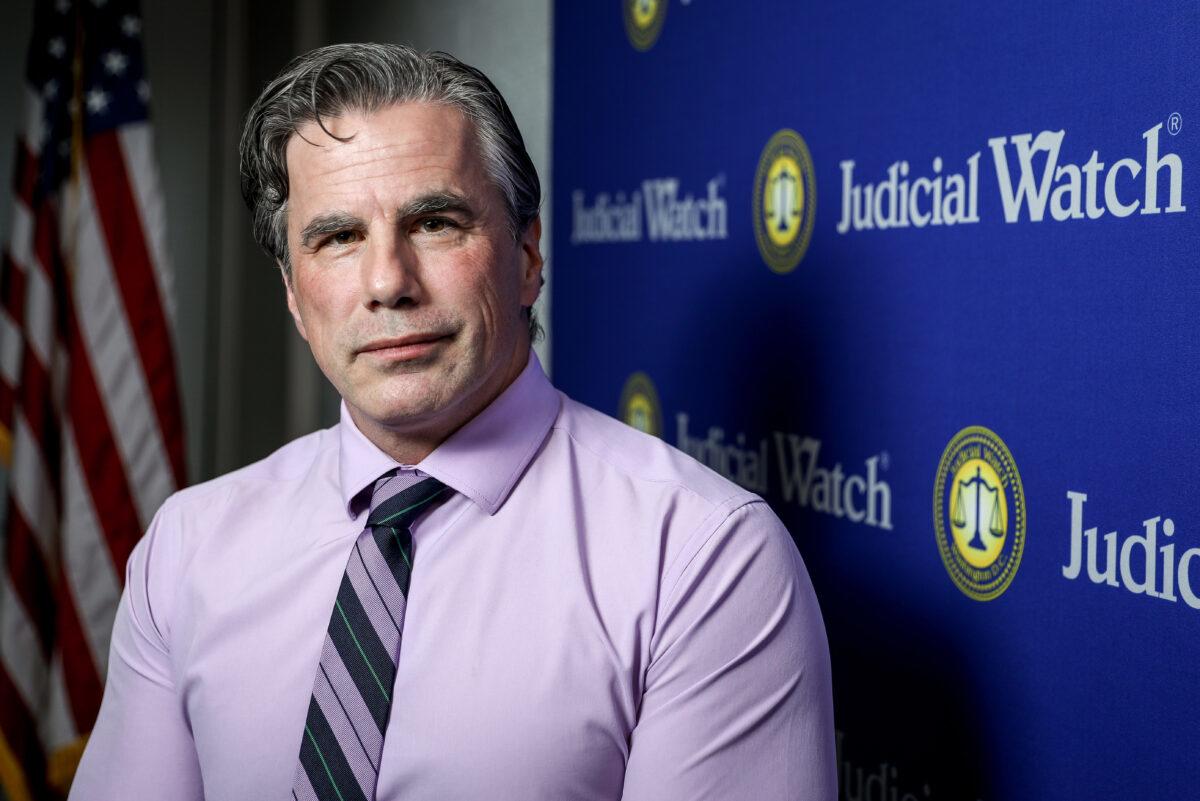
Judicial Watch President Tom Fitton said that SKDKnickerbocker, a communications company linked to President Joe Biden’s election campaign, was involved in the censoring of speech during last year’s election period.

The company did this by sharing its “Misinformation Daily Briefings” with California officials, who then passed them on to social media giants Facebook, Twitter, and Google for dissemination, according to Judicial Watch.

These new documents suggest a conspiracy against the First Amendment rights of Americans by the California Secretary of State, the Biden campaign operation, and Big Tech,” Fitton said.

Tom Fitton, president of Judicial Watch, in Washington on Nov. 1, 2019. (Samira Bouaou/The Epoch Times)

He added, “These documents blow up the big lie that Big Tech censorship is ‘private’—as the documents show collusion between a whole group of government officials in multiple states to suppress speech about election controversies.

Jenna Dresner, senior public information officer for the Office of Election Cybersecurity, responded to the December report at the time saying that “we don’t take down posts, that is not our role to play.”

“We alert potential sources of misinformation to the social media companies and we let them make that call based on community standards they created,” Dresner said.

According to Judicial Watch, the documents it obtained show how officials pushed big tech companies to censor social media posts.

The Google and YouTube logos are seen at the entrance to the Google offices in Los Angeles, Calif., on Nov. 21, 2019. (Robyn Beck/AFP via Getty Images)

Google’s YouTube was contacted directly by a state official to remove a Judicial Watch video on the platform on Sept. 24, last year, according to the group.

YouTube seemed to respond by deleting the video on September 27, 2020,” Judicial Watch said.

In another instance, a Facebook user who implied having voted twice with multiple ballots had their post removed on Oct. 31, 2020. Other posts removed by social media giants included claims of voter fraud, receiving multiple ballots in the mail, and finding thousands of alleged unopened ballots in a dumpster.

Meanwhile, a Twitter post from Fitton that said “Mailing 51 million ballots to those who haven’t asked for increases risk of voter fraud of voter intimidation,” was flagged by SKDKnickerBocker as part of its “Misinformation Tracker.”

Washington-based SKDKnickerBocker said in a statement last November that it developed the Biden campaign’s vote-by-mail program in Pennsylvania, Michigan, Wisconsin, and Arizona.

The communications firm and California’s Office of Election Cybersecurity didn’t immediately respond to requests for comment by The Epoch Times.

Big Tech companies have drawn intense scrutiny for perceived political bias and alleged unbalanced moderation of users’ content. Critics say much of the companies’ moderation in the past year has unfairly targeted conservative speech and speech from individuals deemed to be supporters of former President Donald Trump.

Meanwhile, groups on the other side of the aisle have been taking issue with how social media companies are operating, claiming that the Silicon Valley companies have failed to adequately address misinformation that is being proliferated online.

Janita Kan contributed to this report.

Tyler Durden
Wed, 04/28/2021 – 23:20

via ZeroHedge News https://ift.tt/3xwi9dK Tyler Durden

A Cross-Ideological Case for Ending Exclusionary Zoning


Zoning

The Century Fund recently published “Tearing Down the Walls: How the Biden Administration and Congress Can Reduce Exclusionary Zoning.”  In it, Century Fund Senior Fellow Richard Kahlenberg summarizes the harm caused by exclusionary zoning, and summarizes several proposed ways the federal government can help reduce it. The report represents Kahlenberg’s views. But  it is based in part on a conference on zoning held by the Century Fund in December, which included a wide range of academics and policymakers, including myself.

I don’t agree with Kahlenberg on every point. But he’s absolutely right about the great extent of the problem, and the ways in which it cuts across ideological lines:

While democratic egalitarianism and the liberty to be free from government interference are values that are typically in tension with one another, in the case of exclusionary zoning, they point in the same direction. Perhaps because curtailing exclusionary zoning honors both egalitarian (anti-discriminatory) and libertarian (small government) streams in the American belief system, surveys suggest it is popular. In a 2019 Data for Progress poll, for example, voters were asked, “Would you support or oppose a policy to ensure smaller, lower-cost homes like duplexes, townhouses, and garden apartments can be built in middle- and upper-class neighborhoods?” Supporters outnumbered opponents by two to one.

Kahlenberg expands on this theme in a recent New York Times op ed:

Blue cities and states — most notably Minneapolis and Oregon — have recently led the way on eliminating single-family exclusive zoning, as a matter of racial justice, housing affordability and environmental protection. But conservatives often support this type of reform as well, because they don’t want government micromanaging what people can do on their own land. At the national level, some conservatives have joined liberals in championing reforms like the Yes in My Backyard Act, which seeks to discourage exclusionary zoning.

As Kahlenberg points out in both articles, cutting back on zoning would serve progressive values by expanding housing and job opportunities for the poor, and by eliminating restrictions that, in many cases, were originally established for the purpose of keeping out African-Americans and other racial minorities. In recent years, some liberal jurisdictions have undertaken important reforms in this field, most notably Minneapolis and Oregon (as Kahlenberg notes). But there is still a tension between the growing recognition that zoning is inimical to liberal values, and the high degree of NIMBY sentiment in many liberal areas:

If race were only the driving factor behind exclusionary zoning, one would expect to see such policies most extensively promoted in communities where racial intolerance is highest, but in fact the most restrictive zoning is found in politically liberal cities, where racial views are more progressive.186 Indeed, some liberals even take special pride in the fact that particular neighbors of theirs are members of racial or ethnic minority groups….

[S]ome upper-middle-class liberals will strenuously argue that people should never be denied an opportunity to live in a neighborhood because of race or ethnic origin, but have no problem with government policies that effectively exclude those who are less educationally and financially successful. As Princeton political scientist Omar Wasow acerbically noted: “There are people in the town of Princeton who will have a Black Lives Matter sign on their front lawn and a sign saying ‘We love our Muslim neighbors,’ but oppose changing zoning policies that say you have to have an acre and a half per house.” He continues: “That means, ‘We love our Muslim neighbors, as long as they’re millionaires.'”

There are similar tensions on the right between free market economists and property law experts who recognize that zoning reform can eliminate severe restrictions on property rights and  vastly expand economic growth, and those who sympathize with Donald Trump’s claims during the last election, that exclusionary zoning is needed to protect white middle-class neighborhoods against an influx of the poor and minorities.

In both of his articles, Kahlenberg correctly argues that reducing exclusionary zoning will help alleviate both racial injustice and economic inequality. As I have previously pointed out, this is an issue on which the largely Republican white working class and mostly Democratic African-American and Hispanic workers have an important common interest.

It is worth emphasizing, moreover, that the racial angle here is not simply about alleviating “structural racism” in some very broad sense of the word that might understandably raise conservative and libertarian hackles. Rather, many of today’s exclusionary zoning policies were original enacted for the specific purpose of keeping out blacks (and sometimes other minorities, as well). That’s racial discrimination even under the narrowest plausible definition thereof. Anyone who advocates color-blind government policy (as many on the right—for good reason—do), cannot overlook this history.

I wish, however, that Kahlenberg had also emphasized the ways in which zoning reform not only benefits the poor and minorities, but also can greatly increase economic growth, thereby ensuring gains for society as a whole. As Matt Yglesias points out in a thoughtful analysis of Kahlenberg’s articles, survey data suggests that the economic growth aspect of the issue actually has broader appeal than the racial justice frame. The latter has value in appealing to committed progressives—an important constituency in many of the liberal areas that have some of the most egregious zoning restrictions. But the former is crucial to building a cross-ideological coalition.

Recent evidence suggests that the zoning stifles growth to an even greater extent than previously recognized. Reform advocates should do all they can to make that fact more widely known.

I will not, in this post, offer a detailed assessment of the specific policy proposals outlined in the Kahlenberg/Century Fund report. My general view is that there is some real merit in proposals to condition various federal grants to states and localities on zoning reform. I am more wary of more comprehensive federal efforts to override local land-use policy. However, for reasons I laid out in a 2011 article on this topic, there may be good reasons for such overriding in cases where it expands protection for property rights, and thus gives individual property owners the ultimate say in deciding how to use their land, as opposed to imposing some kind of centralized federal land-use plan. Curbing state and local restrictions on property rights can actually increase decentralization, overall. The most localist land-use policy and the one that takes greatest account of diversity and local knowledge is one under which property owners have broad autonomy in deciding how to use their land.

While the federal reforms Kahlenberg describes deserve consideration, I believe the greatest potential for reform may lie at the state level, building on recent successes in Oregon and elsewhere. If state Rep. Scott Wiener is able to push through his proposed reforms in California, it could be a game-changer for the entire nation.

Reformers should also make greater use of referendum initiatives to promote zoning reforms. I outlined some of the reasons why here. In addition, they should systematically look for ways to challenge exclusionary zoning under various property rights provisions of both state and federal constitutions—a subject I plan to write about more in the future.

There aren’t many policy changes that can simultaneously strengthen protection for property rights, increase opportunity for the poor, alleviate grave historic racial injustices, and greatly expand economic growth. Abolishing exclusionary zoning can do it all! Whether you’re a libertarian, a conservative property rights advocate, a racial justice crusader, a progressive concerned about economic inequality, or just someone who wants to lower housing prices because “the rent is too damn high,” this is a cause you have good reason to support.


from Latest – Reason.com https://ift.tt/3nxOFry
via IFTTT

Extent Of Toxic DDT Dumping Off Los Angeles Coast Is ‘Staggering’

Extent Of Toxic DDT Dumping Off Los Angeles Coast Is ‘Staggering’

A new report from the Scripps Institution of Oceanography in California found a massive graveyard at the bottom of the seafloor between Santa Catalina Island and Los Angeles of a toxic chemical known as dichlorodiphenyltrichloroethane (DDT).

Scientists used underwater drones with sonar technology to map out 36,000 acres of the seafloor between Santa Catalina Island and Los Angeles, where they found at least 27,000 barrels of DDT and an excess of 100,000 total debris objects. 

This area has previously been known as a dumpsite for the industrial complex in Southern California, but the scientist uncovered the true extent of the massive underwater toxic waste zone dating back to World War II in March. 

Images like this one show barrel-like objects containing the dangerous insecticide reside just 3,000 feet below the water’s surface.

The survey provides “a wide-area map” of where the barrels are resting.

For our millennial readers who weren’t around during the days of DDT over half a century ago, the ‘miracle’ pesticide was used against malaria and banned in 1972 after it was linked to cancer and severely damaged ecosystems. 

Research from Scripps found traces of DDT after decades of barrels sitting at the bottom of the sea. 

“Unfortunately, the basin offshore Los Angeles had been a dumping ground for industrial waste for several decades, beginning in the 1930s. We found an extensive debris field in the wide-area survey,” said Eric Terrill, chief scientist of the expedition and director of the Marine Physical Laboratory at Scripps Institution of Oceanography. “Now that we’ve mapped this area at very high resolution, we are hopeful the data will inform the development of strategies to address potential impacts from the dumping.”

UC Santa Barbara professor David Valentin first discovered the concentrated accumulations of DDT in the area about a decade ago. He visually confirmed 60 barrels on the seafloor. Over the years, scientists have found high DDT levels in marine mammals, including dolphins and sea lions. Such exposure has been linked to the development of cancer in marine life. 

Decades ago, the Southern California industry got away with dumping whatever they wanted offshore. The question now is who will pay for the cleanup? 

Tyler Durden
Wed, 04/28/2021 – 23:00

via ZeroHedge News https://ift.tt/3xsRmiF Tyler Durden

Japan Restarts Older Nuclear Reactors For First Time Since Fukushima

Japan Restarts Older Nuclear Reactors For First Time Since Fukushima

Since achieving the ambitious emissions-reduction targets laid out in the Paris Accords will require developed nations to revive their nuclear plans (something that climate activists have increasingly supported despite the continuing fallout from the disaster at Fukushima) Japan on Wednesday decided to revive three long-idled reactors, marking the first time that Japan has restarted a reactor that’s more than 40 years old.

After Prime Minister Yoshihide Suga last week announced a new goal of cutting the country’s greenhouse gas emissions 46% by fiscal 2030 (an announcement that coincided with President Biden’s virtual climate summit) Nikkei reports that Gov. Tatsuji Sugimoto of Fukui Prefecture (located about 300 km, about 186 miles, west of Tokyo) gave the green light on Wednesday to restart the Kansai Electric Power reactor units 1 and 2 at the Takahama nuclear power plant, and unit 3 at the utility’s Mihama plant. Japan’s plans for building new reactors have been frozen for years, leaving its aging nuclear infrastructure largely intact.

Achieving the emissions goals laid out by Suga last week will require generating 20% of Japan’s power via nuclear energy in the coming decades, experts said.

Currently, Japanese regulations imposed after the 2011 Fukushima meltdown set the operating life of Japanese reactors at 40 years, while leaving open the possibility of extending that to 60 years. No reactors older than 40 years are currently operating in Japan – but that’s about to change.

Industry Minister Hiroshi Kajiyama on Tuesday told Sugimoto that Japan “will use nuclear power sustainably into the future” and promised up to 2.5 billion yen ($23.1 million) in federal grants to help restart older reactors. Sugimoto told reporters that Kajiyama’s remarks were “something we hadn’t heard before.”

Japan had about 50 nuclear reactors when Tokyo Electric Power’s Fukushima Daiichi plant was struck by a tsunami in 2011 that knocked out its emergency power, leading to a historic meltdown. 

Since then, more than 20 reactors in Japan have been marked for decommissioning. By 2030, nearly half of the country’s remaining reactors will be over 40 years old.

Still, as Fukushima fades into history, support for nuclear power is growing within Japan’s ruling Liberal Democratic Party. To open the door to reviving more reactors, more lawmakers favor a different rubric for counting a reactor’s operating age that will subtract the years they spent idled.

Unfortunately for the nuclear industry in Japan, other obstacles remain aside from environmental concerns. For example, the outlook for restarting Tokyo Electric’s workhorse Kashiwazaki-Kariwa plant has been dimmed by a report that finds insufficient safeguards against terrorist attacks. In the US, nuclear has remained out of favor ever since that incident at the Three Mile Island plant in Pennsylvania.

As we pointed out on Earth Day, proponents of lower emissions are starting to accept that nuclear is the only practical strategy that wouldn’t involve massive reductions in energy use, while still maintaining robust systems that won’t seize up when wind turbines freeze.

Tyler Durden
Wed, 04/28/2021 – 22:40

via ZeroHedge News https://ift.tt/3sWc8Uc Tyler Durden

Democrats Learn to Love the Congressional Review Act

Earlier today the Senate voted 52-42 to repeal a Trump Administration regulation governing methane emissions under the Congressional Review Act. The House is expected to follow suit next week, sending the CRA resolution to President Biden’s desk for his signature. Once signed, the resolution will repeal the Trump rule and, as a consequence, restore the Obama Administration rule the Trump regulation replaced.

Today’s almost-party-line vote marked the first time a Democratic-majority Senate has invoked the CRA to override a regulation adopted by a Republican Administration. As I noted previously, the Trump Administration adopted many last-minute regulatory measures that would be vulnerable to quick repeal through the CRA. Yet Democrats were slow to embrace the CRA. Many Democrats and progressive interest groups viewed the CRA as an inherently anti-regulatory measure, and some were concerned that passage of a CRA resolution might obstruct efforts to adopt more stringent regulations.

The regulation at issue was the Environmental Protection Agency’s rule setting emission standards for new, reconstructed and modified sources of methane emissions in the oil and gas industry. This rule, adopted last fall, loosened the restrictions the Obama Administration had imposed on methane emissions from oil and gas development. Because methane is a particularly potent greenhouse gas, the Biden Administration made undoing the Trump rule and restoring the Obama Administration restrictions a high priority.

The CRA represents a useful tool for an administration that wants to quickly undo late-adopted measures of its predecessors. The CRA provides for an expedited process in the Senate and is both a more rapid and a more resilient way to change regulatory policy than waiting for a regulatory agency to navigate the regulatory process. Now that Democrats have been willing to use the CRA once, we’ll see whether they are willing to use it for this purpose again.

from Latest – Reason.com https://ift.tt/3xrnV0l
via IFTTT