The Libel Portion of the Rotenberg v. Politico Lawsuit

Yesterday, I blogged about the lawsuit by Marc Rotenberg, former head of the Electronic Privacy Information Center, against Politico and Protocol, over a story that discussed Rotenberg’s positive COVID test result, and Rotenberg’s not immediately informing his staff about the test. In that post, I focused on Rotenberg’s disclosure of private facts claim, which raises an interesting and important legal issue: when is disclosure of a person’s medical  potentially tortious (and in particular when can defendants avoid liability on the grounds that the disclosure was newsworthy)?

Here, I’d like to focus on Rotenberg’s libel claim. My sense is that it raises fewer novel legal issues, but is still an interesting illustration of recurring controversies in libel litigation.

The Complaint is quite long, and much of it isn’t about Politico’s and Protocol’s statements at all. Instead, much discusses the alleged failings of Politico, Protocol, and their managers more generally (e.g., firings of staffers by Protocol, on the theory that “To further distract attention from the meltdown underway at The Protocol, Defendants manufactured even more egregious statements about the Plaintiff”). Much of the rest discusses EPIC’s successes under Rotenberg’s leadership.

But here is my sense of the key alleged defamation. The numbered paragraphs are quotes from the Complaint (which you can refer to for more details, such as illustrations and footnotes); the bolded headings are my summary of the allegedly libelous statement; and in each section I offer my opinion on the tentative legal analysis:

“Accusing a former staff member of leaking the story”

[91.] The Protocol article is replete with false, misleading, and defamatory statements.

[92.] When Issie Lapowsky contacted Marc Rotenberg prior to publication of the article with a detailed list of bullet points, Marc knew immediately the source of the allegations.

[93.] Marc, who knew Issie from prior unrelated reporting on privacy issues, responded by email “Hi, Issie, Is this really what Mary wants to do? Regards, Marc.” When Issie pressed further for a response, Marc replied “Hi, Issie, I think I said what needed to be said. Regards, Marc.”

[94.] Lapowsky falsely reported in the April 16 article, “Asked to comment, Rotenberg responded by accusing a former staff member of leaking the story to Protocol.”

[95.] That sentence, like virtually every other sentence in the article, was not true.

My tentative reaction: the “accusing a former staff member of leaking the story” strikes me as an accurate characterization of the “Is this really what Mary wants to do?” quote. (“Mary” refers to former staff member Mary Stone Ross.) It thus, in my view, isn’t libelous

Staff resignations

[96.] The Protocol article contained more than a dozen statements that were untrue, false, misleading, malicious, and defamatory or contorted true facts so that a negative inference could be drawn (the “false light” tort.)

[97.] The Protocol article falsely stated, for example, that Ross had “resigned.” Ross had been fired.

[98.] The Protocol article also falsely stated that “several employees resign[ed].”

[99.]  Apart from Ross’s termination, there was only one other person who left EPIC during this time, and it was long planned, and with Marc’s full support as both were unable to resolve an issue with another staff member at EPIC.

[100.] Nobody at EPIC resigned because of Marc’s conduct during this period, contrary to the article’s implication to the contrary.

The claims of staff resignations are factual allegations. But even so I’m skeptical that—even if they are false—they are defamatory, in the sense of tending to expose Rotenberg to contempt, derision, or ridicule. Under D.C. law, as under American libel law generally, “an allegedly defamatory remark must be more than unpleasant or offensive; the language must make the plaintiff appear ‘odious, infamous, or ridiculous.'” I doubt that even false claims of multiple resignations by staffers would qualify, but I’m not positive about this.

What Rotenberg’s memo to staff said

[101.] The Protocol article falsely stated that Marc “acknowledged in a memo to his staff and his board that he should have quarantined and alerted his staff that he was taking a coronavirus test on March 9 …”

[102.] That statement is also not true. Marc’s memo to staff, which expresses concern for possible lack of empathy in the early days of the pandemic, (1) does not say Marc should have quarantined or that he violated any medical or public health direction to quarantine; or (2) that Marc should have alerted staff that he was taking a test for coronavirus.

[103.] Both statements are fabrications and contrary to fact, medical advice, and the content of the memo then in the physical possession of both the reporter Issie Lapowsky and the Executive Editor Tim Grieve. They are beyond malicious and defamatory.

This too may involve a factual falsehood (if the memo, which I haven’t seen, was mischaracterized); as with the staff-firings claim, I’m not sure that this claim of Rotenberg’s acknowledgment of error tends to make Rotenberg “appear ‘odious, infamous, or ridiculous,'” but again it’s possible.

“Worked alongside them for two days” after the test (though before the result)

[104.] The Protocol also stated that Marc “worked alongside them for two days.” Almost every word in that sentence is false—and in this context—malicious. Marc had no physical contact with any staff members. EPIC is located in a five-story townhouse; every staff member, including Marc, has their own office. The use of “alongside” maliciously conveyed the image that Marc worked in close physical proximity to other members of the EPIC staff.

This strikes me as a matter of characterization and opinion, and thus not actionable. “Worked alongside them” doesn’t, I think, mean constant close physical proximity (especially when you’re talking about an organization’s president, who most people would assume has his own office). Rather, the claim seems to me that he was in the same building and thus likely to be passing closely by employees on various occasions (coming to and from work or to and from lunch, meeting with people, and so on). Whether this was dangerous or improper is a separate matter, and one of opinion.

“Put their safety at risk, but also undermined the organization’s resistance to … surveillance”

[105.] The Protocol further “reported” that some EPIC employees say that Marc “put their safety at risk, but also undermined their organization’s resistance to invasive coronavirus surveillance.”

[106.]  As to Marc putting others at risk, that statement is twice false. First, as EPIC Chair Anita Allen would later state, at all times Marc followed the medical advice he received. Second, as the leader of a privacy organization, he had a professional obligation to uphold privacy practices for contract tracing. It is absurd—and in this context malicious—to suggest that a privacy organization undermines its mission when it attempts to comply with well-established practices for the protection of sensitive medical information.

[107.] The statement also falsely and maliciously suggested that, as a manager, Marc acted irresponsibility and without regard to the interests of EPIC.

[108.] In fact, Marc was in the office to ensure bills were paid (including staff salaries) and key management materials for the organization were updated.

[109.] The Protocol article maliciously attacked Marc for doing his job as Executive Director of EPIC, then one of the nation’s leading privacy organizations.

This strikes me as even more clearly a matter of opinion (even accepting that The Protocol could be liable for reprinting the EPIC employees’ allegations). “Put their safety at risk” clearly means “undue risk,” and that is a question on which different people would naturally have different views (regardless of whether he was “follow[ing] the medical advice he received”). As to what would or wouldn’t undermine a privacy organization’s resistance to invasive coronavirus surveillance, that is a classic question of opinion.

“Out there saying privacy trumps surveillance”

[110.] On information and belief, Ross is anonymously quoted in the article: “‘He’s out there saying privacy trumps surveillance,’ said one former employee [Ross] who worked there at the time. ‘Every time he opens his mouth, what runs through my head is: We need more surveillance.'”

[111.] Again, one sentence contains two false, defamatory and malicious statements. First, Marc never said “privacy trumps surveillance.” Marc’s entire life work—reflected in testimony for the US Congress, amicus briefs for federal courts, academic articles, and public speeches—has focused on non-zero-sum outcomes for privacy.

[112.]  Marc had also served as an expert for several panels of the National Academies of  Sciences with the explicit goal of developing privacy-protecting measures for the federal government….

[113.] Simply stated, Marc would always look for approaches to achieve the stated goal and protect privacy.

[114.] And that is also almost precisely the view expressed about the pandemic and privacy by now President Joe Biden in April 2020, the week before The Protocol article appeared. As then-candidate Biden wrote, “there needs to be widespread, easily available and prompt testing—and a contact tracing strategy that protects privacy.”

[115.] Marc Rotenberg, on behalf of EPIC, literally cited the President’s comment above in a detailed statement to the House Committee on Energy and Commerce on April 15, 2020  regarding the protection of medical privacy amidst efforts to combat the spread of the novel coronavirus.

[116.] Marc wrote, “Former vice president Joe Biden has correctly said ‘there needs to be widespread, easily available and prompt testing—and a contact tracing strategy that protects privacy.'”

[117.] Marc also cited the remarks of Dr. Michael Ryan of the World Health Organization, a leading spokesperson for the organization battling the pandemic, who repeatedly emphasized the need to protect privacy.

[118.] Marc wrote: “It is essential that government agencies and private companies implement standards that safeguard privacy. As Dr. Michael Ryan of the World Health Organization has stated, there is a “tremendous amount” of innovation and enthusiasm for new products. But he also cautioned that “when collecting information on citizens or tracking their movements there are always serious data protection and human rights principles involved.” Dr. Ryan said, “we want to ensure that all products are done in the most sensitive way possible and that we never step beyond the principles of individual freedoms and rights.”

[119.] In the statement for Congress, also signed also by EPIC Policy Counsel Caitriona Fitzgerald and EPIC Senior Counsel Alan Butler, Marc wrote, “This moment provides a unique opportunity to show that privacy and public health are complimentary goals and to establish that Privacy Enhancing Techniques can be deployed to serve the public interest and protect individuals.”

[120.]  This is precisely the point that The Protocol maliciously sought to obscure: the fact that public safety and privacy protection are complimentary goals, a view expressed by leading medical organizations, including the CDC and the WHO, and the current President of the United States.

[121.] The Protocol statement above also wrongly suggests that Marc could fulfill his responsibility as director of one of the nation’s leading privacy organizations by simply supporting unchecked surveillance. That is also an absurd—and this context malicious— statement.

Again, a three-word summary of a privacy advocate’s statements as “privacy trumps surveillance” is clearly an opinion, as is any suggestion about how Rotenberg could best “fulfill his responsibility as director of one of the nation’s leading privacy organizations.”

“Did not mention that his COVID-19 test had come back positive”

[122.] The Protocol further “reported” that in an email to staff Marc, “did not mention that his COVID-19 test had come back positive that very morning.”

[123.] That statement presumes an action—namely, revealing the identity of individuals who had tested positive for coronavirus—that is directly contrary to widely established practices for public safety.

[124.] For The Protocol to publish this statement, Grieve would have had to recklessly ignore all of the relevant scientific and medical information concerning the disclosure of the identity of a patient’s medical diagnosis.

[125.] This scientific and medical information was, and is, readily available on the Internet.

The Complaint seems to acknowledge here that The Protocol’s statement is true, not to assert that it’s false.

“At that time, [99.5 F] was still below what the [CDC] considered to be a symptom”

[126.] The Protocol’s flair for defamation posing as objective reporting is almost unparalleled in modern journalism. Lapowsky writes, “Marc told them he’d returned from Milan on Feb. 22, and registered a temperature of 99.5 on March 1. At the time, that was still below what the Centers for Disease Control considered to be a symptom,” as if to suggest that there was  a subsequent determination by the CDC that a temperature of 99.5 was later considered to be a symptom.

[127.] But the CDC standard remains at 38 degrees centigrade today (100.4 Fahrenheit) as it was in March 2020.

[128.] So widely established is this medical fact that the DC government currently displays placards with the number 100.4 to help people readily identify the actual symptoms of COVID.

[129.] Marc followed all medical advice he received. DC health authorities told him to gather telephone numbers for contact tracing purposes, which he promptly did.

[130.] He was not told by DC health authorities to contact staff members directly.

[131.]  As the CDC emphasizes “Contact tracing is a key strategy to prevent the further spread of COVID-19.”

[132.] And the CDC emphasizes the need to protect the infected patient’s identity.

[133.] EPIC Board Chair Anita Allen also stated that Marc complied with all medical instructions he received.

[134.] The Protocol report that Marc had a temperature of 99.5 also presents a true fact in a false light (implying that this temperature imposed on Marc requirements that he breached), is injurious to Marc, tortious, and actionable as an invasion of privacy.

[135.]  The Protocol’s purposeful contortion of that number to generate a “scoop” also undermined public health efforts, pursued by the CDC, DC Health, and other agencies.

“Was still below” could indeed be reasonably interpreted, I think, as saying that now 99.5 is above what the CDC considered to be a symptom. (See Memphis Pub. Co. v. Nichols (Tenn. 1978) for a colorful example of such implications.) But even if that’s false, I don’t think it’s defamatory of Rotenberg. The article isn’t accusing Rotenberg of improperly failing to get a test on Mar. 1 when his temperature was 99.5; indeed, it’s expressly acknowledging that 99.5 wasn’t seen as a symptom by the CDC when all this was happening, so there was nothing unreasonable in Rotenberg’s not getting tested then. And indeed the article says Rotenberg did get a test on Mar. 5. Whatever Rotenberg is alleged to have done wrong, it wasn’t in failing to get a test until Mar. 5.

“Falsely and maliciously suggests that Marc acted contrary to medical advice”

[136.] The Protocol article further stated he “later told the staff he was already on a plane about to depart for Miami for the weekend. So he scheduled a test for when he returned to D.C. on Monday, March 9.”

[137.] The article falsely and maliciously suggests that Marc acted contrary to medical advice. Marc took the test on Monday, following the advice of his doctor, who stated that there was no urgency. On March 6, he was already at the end of the period that created any risk of exposure, following his return from work travel to Northern Italy on February 22.

I just don’t see how the statement about the Miami trip—the literal accuracy of which the Complaint doesn’t deny—would imply to a reasonable reader that he was acting contrary to medical advice. There is an implication that he was acting less carefully than the author or others think he might have, but that is a question of opinion.

“I exposed my team to a pandemic, and you might not have a job”

[138.] The Protocol also “reported” that Marc said “I exposed my team to a pandemic, and you might not have a job” in the same meeting.

[139.] Again, with an economy of words, The Protocol manages to stuff three false and defamatory statements into one sentence. First, Marc in no way uttered the quote that was attributed to him by The Protocol in the preceding paragraph. Second, Marc did not expose his team to the pandemic. And third, Marc’s discussion of EPIC’s finances was (1) intended to keep the staff in the loop about the state of the organization, which is a good management practice, and (2) assure staff that there was funding for at least six months, even though there had been a significant downturn in the market and that the annual fundraising dinner would likely be cancelled.

[140.] The Protocol falsely reported the opposite point that Marc had made with an unambiguously malicious intent.

The article, though, stated:

“It was, ‘I exposed my team to a pandemic, and you might not have a job’ in the same meeting,” the former employee said. “Pretty rough.”

In context, it seems to me, (1) a reasonable reader would likely not view this as a claim that Rotenberg said those words; rather, it comes across as the former employee’s characterization of the gist of what Rotenberg had said. (2) Whether Rotenberg exposed his team to the pandemic is a question of opinion. And (3) whatever the intentions of Rotenberg’s financial explanation, it does sound to me, from the Complaint, like there was indeed some risk to people’s jobs.

“That rationale [anonymity] is pretty strained when it’s the executive director”

[141.]  The Protocol also falsely and maliciously reported that “The idea [of anonymity] is for workplace retaliation. I think that rationale is pretty strained when it’s the executive director,” said one of the former employees.

[142.] Again, on information and belief, Ross, the fired employee, made the foregoing statement to Lapowsky.

[143.] It is precisely the obligation of the head of a privacy organization to uphold well- established privacy practices, such as contact-tracing with privacy. To write otherwise is absurd—and in this context—malicious.

Assuming the former employee’s statement is accurately reported (and the Complaint doesn’t seem to deny that), it’s a clear statement of opinion.

“When he’s violating the guidelines”

[144.] The Protocol, again following Ross’s (on information and belief, the “former employee” being quoted) instructions, falsely reports, “It rubs us all the wrong way when we see him quoted in the press talking about contact-tracing privacy issues when he’s violating the guidelines.”

[145.] There is no indication that Marc violated any guidelines at any time. The statement is clearly false and defamatory, and in this context—from a fired employee, seeking revenge, “vindictive” as described at the time—is prima facie evidence of malicious intent.

This might be libelous, on the theory that The Protocol is liable for repeating the former employee’s statements, if it’s false and if The Protocol’s reporter knew or was reckless about its falsity (if Rotenberg is viewed as a public figure) or was negligent about its falsity (if Rotenberg is viewed as a private figure).

“Went to work … after his doctor told him to take a COVID-19 test”

[192.] Tim Grieve, the Executive Editor of The Protocol, did not simply approve publication of the defamatory, false, and malicious article about Marc Rotenberg. On April 16, 2020, the same day that he approved publication of the article, he also personally tweeted from his Twitter account (@timgrieve) the story, the image, and the link.

[193.] Grieve added the defamatory, false and malicious statement, “A chief critic of tech’s coronavirus tracking went to work and held meetings with employees after his doctor told him to take a COVID-19 test. It came back positive.”

[194.] On April 21, 2020, the very same day that Executive Editor Tim Grieve was firing nearly half of his reporters, including many of his senior staff, he caused to be published another series of false and defamatory statements about Marc Rotenberg.

[195.] The Protocol falsely and maliciously stated that “Marc Rotenberg came to work and held meetings after his doctor directed him to take a test that later came back positive,” falsely and maliciously implying that he acted contrary to medical advice.

The statement that he went to work after he took the test appears to be true (or at least the Complaint doesn’t deny its truth). And I don’t see how the statement can be read as implying that “he acted contrary to medical advice.” “In entertaining claims of defamation by implication, courts must be vigilant not to allow an implied defamatory meaning to be manufactured from words not reasonably capable of sustaining such meaning.”

“Outspoken critic of invasive surveillance efforts”

[196.] The Protocol also falsely and maliciously stated that Rotenberg has recently been an “outspoken critic of invasive surveillance efforts to address the spread of COVID-19,” falsely and maliciously implying that he was opposed to effective means of tracking COVID.

[197.] In fact, in the article cited by The Protocol, Marc made clear the need ensure effective testing.

[198.]  The Protocol also falsely and maliciously stated that he did not notify employees of the test results, falsely and maliciously implying that health protocols required this or that Marc was directed to do so by doctors or public health authorities.

Pretty clearly a matter of opinion.

“A consequence of his actions during the week of March 12”

[199.] The Protocol maliciously and falsely implied that Marc’s departure from EPIC was a consequence of his actions during the week of March 12, 2020.

[200.] In fact, the proximate cause of Marc’s departure was the publication by Tim Grieve of the Protocol article on April 16, 2020.

I’m not sure how the implication is alleged to be false—indeed, Rotenberg’s departure from EPIC, according to the Complaint itself, was a consequence of Rotenberg’s actions the week of March 12, even if ultimately Protocol’s publicizing those actions precipitated the departure.

Summary

[290.] “In a defamation by implication case under D.C. law, ‘the courts are charged with the responsibility of determining whether a challenged statement is capable of conveying a defamatory meaning.'”

[291.]  As the D.C. Circuit has recently explained, “A plaintiff must show first that the ‘communication, viewed in its entire context, … conveys materially true facts from which a defamatory inference can reasonably be drawn,'” and second, that “‘the communication, by the particular manner or language in which the true facts are conveyed, supplies additional, affirmative evidence suggesting that the defendant intends or endorses the defamatory inference.'”

[297.] The Protocol articles falsely and maliciously stated that Marc “acknowledged in a memo to his staff and his board that he should have quarantined and alerted his staff that he was taking a coronavirus test.”

[298.] The Protocol articles falsely and maliciously suggested that Marc’s action “undermined their organization’s resistance to invasive coronavirus surveillance.”

[299.]  The Protocol articles falsely and maliciously suggested that Marc ignored medical advice.

[300.] The Protocol articles falsely and maliciously suggested that it is contrary to the purpose of a privacy organization to safeguard privacy.

[301.] The Protocol articles falsely and maliciously suggested that multiple employees had resigned relating to the events falsely described in the article when, in fact, the single employee who resigned during the relevant timeframe did so for unrelated reasons.

[313.] The April 21, 2020 POLITICO article falsely and maliciously stated that Marc “later acknowledged to staff in a memo that he should have notified them of the test instead of continuing to work, according to the report.”

[314.] The republication of a defamatory statement is itself defamatory…..

[315.] The POLITICO article also made the false, defamatory and malicious statement that “Marc Rotenberg has been a leading critic of Silicon Valley’s efforts to track the spread of Covid-19.”

So my tentative thinking: The libel claims strike me as mostly pretty weak. Many are about statements of opinion; others are based on theoretical implications that the court is unlikely to find. Some are indeed based on factual statements, and might be enough to let the case go forward (assuming there is evidence the statements were false and made with the relevant mental state), though even some of those are likely not to be seen as sufficiently tending to damage Rotenberg’s reputation.

There is also a false light claim; the false light tort allows for liability for false statements that aren’t damaging to reputation but are nonetheless highly offensive. (A classic example, from an illustration to the Restatement of Torts, would be knowingly mischaracterizing a person’s political party affiliation.)

But I doubt that the statements that I discussed as factual and possibly false but nondefamatory would mean the threshold of “the false light in which the other was placed would be highly offensive to a reasonable person.” Perhaps some might be; for instance, perhaps saying that Rotenberg “acknowledged in a memo to his staff and his board that he should have quarantined and alerted his staff that he was taking a coronavirus test on March 9,” if that characterization is false, might be seen as highly offensive much as mislabeling a person’s political party affiliation might be. But even that, I think, would be an uphill battle.

In any event, though, that’s just my tentative opinion; I’d love to hear what you folks think.

from Latest – Reason.com https://ift.tt/3ulDjc5
via IFTTT

The Libel Portion of the Rotenberg v. Politico Lawsuit

Yesterday, I blogged about the lawsuit by Marc Rotenberg, former head of the Electronic Privacy Information Center, against Politico and Protocol, over a story that discussed Rotenberg’s positive COVID test result, and Rotenberg’s not immediately informing his staff about the test. In that post, I focused on Rotenberg’s disclosure of private facts claim, which raises an interesting and important legal issue: when is disclosure of a person’s medical  potentially tortious (and in particular when can defendants avoid liability on the grounds that the disclosure was newsworthy)?

Here, I’d like to focus on Rotenberg’s libel claim. My sense is that it raises fewer novel legal issues, but is still an interesting illustration of recurring controversies in libel litigation.

The Complaint is quite long, and much of it isn’t about Politico’s and Protocol’s statements at all. Instead, much discusses the alleged failings of Politico, Protocol, and their managers more generally (e.g., firings of staffers by Protocol, on the theory that “To further distract attention from the meltdown underway at The Protocol, Defendants manufactured even more egregious statements about the Plaintiff”). Much of the rest discusses EPIC’s successes under Rotenberg’s leadership.

But here is my sense of the key alleged defamation. The numbered paragraphs are quotes from the Complaint (which you can refer to for more details, such as illustrations and footnotes); the bolded headings are my summary of the allegedly libelous statement; and in each section I offer my opinion on the tentative legal analysis:

“Accusing a former staff member of leaking the story”

[91.] The Protocol article is replete with false, misleading, and defamatory statements.

[92.] When Issie Lapowsky contacted Marc Rotenberg prior to publication of the article with a detailed list of bullet points, Marc knew immediately the source of the allegations.

[93.] Marc, who knew Issie from prior unrelated reporting on privacy issues, responded by email “Hi, Issie, Is this really what Mary wants to do? Regards, Marc.” When Issie pressed further for a response, Marc replied “Hi, Issie, I think I said what needed to be said. Regards, Marc.”

[94.] Lapowsky falsely reported in the April 16 article, “Asked to comment, Rotenberg responded by accusing a former staff member of leaking the story to Protocol.”

[95.] That sentence, like virtually every other sentence in the article, was not true.

My tentative reaction: the “accusing a former staff member of leaking the story” strikes me as an accurate characterization of the “Is this really what Mary wants to do?” quote. (“Mary” refers to former staff member Mary Stone Ross.) It thus, in my view, isn’t libelous

Staff resignations

[96.] The Protocol article contained more than a dozen statements that were untrue, false, misleading, malicious, and defamatory or contorted true facts so that a negative inference could be drawn (the “false light” tort.)

[97.] The Protocol article falsely stated, for example, that Ross had “resigned.” Ross had been fired.

[98.] The Protocol article also falsely stated that “several employees resign[ed].”

[99.]  Apart from Ross’s termination, there was only one other person who left EPIC during this time, and it was long planned, and with Marc’s full support as both were unable to resolve an issue with another staff member at EPIC.

[100.] Nobody at EPIC resigned because of Marc’s conduct during this period, contrary to the article’s implication to the contrary.

The claims of staff resignations are factual allegations. But even so I’m skeptical that—even if they are false—they are defamatory, in the sense of tending to expose Rotenberg to contempt, derision, or ridicule. Under D.C. law, as under American libel law generally, “an allegedly defamatory remark must be more than unpleasant or offensive; the language must make the plaintiff appear ‘odious, infamous, or ridiculous.'” I doubt that even false claims of multiple resignations by staffers would qualify, but I’m not positive about this.

What Rotenberg’s memo to staff said

[101.] The Protocol article falsely stated that Marc “acknowledged in a memo to his staff and his board that he should have quarantined and alerted his staff that he was taking a coronavirus test on March 9 …”

[102.] That statement is also not true. Marc’s memo to staff, which expresses concern for possible lack of empathy in the early days of the pandemic, (1) does not say Marc should have quarantined or that he violated any medical or public health direction to quarantine; or (2) that Marc should have alerted staff that he was taking a test for coronavirus.

[103.] Both statements are fabrications and contrary to fact, medical advice, and the content of the memo then in the physical possession of both the reporter Issie Lapowsky and the Executive Editor Tim Grieve. They are beyond malicious and defamatory.

This too may involve a factual falsehood (if the memo, which I haven’t seen, was mischaracterized); as with the staff-firings claim, I’m not sure that this claim of Rotenberg’s acknowledgment of error tends to make Rotenberg “appear ‘odious, infamous, or ridiculous,'” but again it’s possible.

“Worked alongside them for two days” after the test (though before the result)

[104.] The Protocol also stated that Marc “worked alongside them for two days.” Almost every word in that sentence is false—and in this context—malicious. Marc had no physical contact with any staff members. EPIC is located in a five-story townhouse; every staff member, including Marc, has their own office. The use of “alongside” maliciously conveyed the image that Marc worked in close physical proximity to other members of the EPIC staff.

This strikes me as a matter of characterization and opinion, and thus not actionable. “Worked alongside them” doesn’t, I think, mean constant close physical proximity (especially when you’re talking about an organization’s president, who most people would assume has his own office). Rather, the claim seems to me that he was in the same building and thus likely to be passing closely by employees on various occasions (coming to and from work or to and from lunch, meeting with people, and so on). Whether this was dangerous or improper is a separate matter, and one of opinion.

“Put their safety at risk, but also undermined the organization’s resistance to … surveillance”

[105.] The Protocol further “reported” that some EPIC employees say that Marc “put their safety at risk, but also undermined their organization’s resistance to invasive coronavirus surveillance.”

[106.]  As to Marc putting others at risk, that statement is twice false. First, as EPIC Chair Anita Allen would later state, at all times Marc followed the medical advice he received. Second, as the leader of a privacy organization, he had a professional obligation to uphold privacy practices for contract tracing. It is absurd—and in this context malicious—to suggest that a privacy organization undermines its mission when it attempts to comply with well-established practices for the protection of sensitive medical information.

[107.] The statement also falsely and maliciously suggested that, as a manager, Marc acted irresponsibility and without regard to the interests of EPIC.

[108.] In fact, Marc was in the office to ensure bills were paid (including staff salaries) and key management materials for the organization were updated.

[109.] The Protocol article maliciously attacked Marc for doing his job as Executive Director of EPIC, then one of the nation’s leading privacy organizations.

This strikes me as even more clearly a matter of opinion (even accepting that The Protocol could be liable for reprinting the EPIC employees’ allegations). “Put their safety at risk” clearly means “undue risk,” and that is a question on which different people would naturally have different views (regardless of whether he was “follow[ing] the medical advice he received”). As to what would or wouldn’t undermine a privacy organization’s resistance to invasive coronavirus surveillance, that is a classic question of opinion.

“Out there saying privacy trumps surveillance”

[110.] On information and belief, Ross is anonymously quoted in the article: “‘He’s out there saying privacy trumps surveillance,’ said one former employee [Ross] who worked there at the time. ‘Every time he opens his mouth, what runs through my head is: We need more surveillance.'”

[111.] Again, one sentence contains two false, defamatory and malicious statements. First, Marc never said “privacy trumps surveillance.” Marc’s entire life work—reflected in testimony for the US Congress, amicus briefs for federal courts, academic articles, and public speeches—has focused on non-zero-sum outcomes for privacy.

[112.]  Marc had also served as an expert for several panels of the National Academies of  Sciences with the explicit goal of developing privacy-protecting measures for the federal government….

[113.] Simply stated, Marc would always look for approaches to achieve the stated goal and protect privacy.

[114.] And that is also almost precisely the view expressed about the pandemic and privacy by now President Joe Biden in April 2020, the week before The Protocol article appeared. As then-candidate Biden wrote, “there needs to be widespread, easily available and prompt testing—and a contact tracing strategy that protects privacy.”

[115.] Marc Rotenberg, on behalf of EPIC, literally cited the President’s comment above in a detailed statement to the House Committee on Energy and Commerce on April 15, 2020  regarding the protection of medical privacy amidst efforts to combat the spread of the novel coronavirus.

[116.] Marc wrote, “Former vice president Joe Biden has correctly said ‘there needs to be widespread, easily available and prompt testing—and a contact tracing strategy that protects privacy.'”

[117.] Marc also cited the remarks of Dr. Michael Ryan of the World Health Organization, a leading spokesperson for the organization battling the pandemic, who repeatedly emphasized the need to protect privacy.

[118.] Marc wrote: “It is essential that government agencies and private companies implement standards that safeguard privacy. As Dr. Michael Ryan of the World Health Organization has stated, there is a “tremendous amount” of innovation and enthusiasm for new products. But he also cautioned that “when collecting information on citizens or tracking their movements there are always serious data protection and human rights principles involved.” Dr. Ryan said, “we want to ensure that all products are done in the most sensitive way possible and that we never step beyond the principles of individual freedoms and rights.”

[119.] In the statement for Congress, also signed also by EPIC Policy Counsel Caitriona Fitzgerald and EPIC Senior Counsel Alan Butler, Marc wrote, “This moment provides a unique opportunity to show that privacy and public health are complimentary goals and to establish that Privacy Enhancing Techniques can be deployed to serve the public interest and protect individuals.”

[120.]  This is precisely the point that The Protocol maliciously sought to obscure: the fact that public safety and privacy protection are complimentary goals, a view expressed by leading medical organizations, including the CDC and the WHO, and the current President of the United States.

[121.] The Protocol statement above also wrongly suggests that Marc could fulfill his responsibility as director of one of the nation’s leading privacy organizations by simply supporting unchecked surveillance. That is also an absurd—and this context malicious— statement.

Again, a three-word summary of a privacy advocate’s statements as “privacy trumps surveillance” is clearly an opinion, as is any suggestion about how Rotenberg could best “fulfill his responsibility as director of one of the nation’s leading privacy organizations.”

“Did not mention that his COVID-19 test had come back positive”

[122.] The Protocol further “reported” that in an email to staff Marc, “did not mention that his COVID-19 test had come back positive that very morning.”

[123.] That statement presumes an action—namely, revealing the identity of individuals who had tested positive for coronavirus—that is directly contrary to widely established practices for public safety.

[124.] For The Protocol to publish this statement, Grieve would have had to recklessly ignore all of the relevant scientific and medical information concerning the disclosure of the identity of a patient’s medical diagnosis.

[125.] This scientific and medical information was, and is, readily available on the Internet.

The Complaint seems to acknowledge here that The Protocol’s statement is true, not to assert that it’s false.

“At that time, [99.5 F] was still below what the [CDC] considered to be a symptom”

[126.] The Protocol’s flair for defamation posing as objective reporting is almost unparalleled in modern journalism. Lapowsky writes, “Marc told them he’d returned from Milan on Feb. 22, and registered a temperature of 99.5 on March 1. At the time, that was still below what the Centers for Disease Control considered to be a symptom,” as if to suggest that there was  a subsequent determination by the CDC that a temperature of 99.5 was later considered to be a symptom.

[127.] But the CDC standard remains at 38 degrees centigrade today (100.4 Fahrenheit) as it was in March 2020.

[128.] So widely established is this medical fact that the DC government currently displays placards with the number 100.4 to help people readily identify the actual symptoms of COVID.

[129.] Marc followed all medical advice he received. DC health authorities told him to gather telephone numbers for contact tracing purposes, which he promptly did.

[130.] He was not told by DC health authorities to contact staff members directly.

[131.]  As the CDC emphasizes “Contact tracing is a key strategy to prevent the further spread of COVID-19.”

[132.] And the CDC emphasizes the need to protect the infected patient’s identity.

[133.] EPIC Board Chair Anita Allen also stated that Marc complied with all medical instructions he received.

[134.] The Protocol report that Marc had a temperature of 99.5 also presents a true fact in a false light (implying that this temperature imposed on Marc requirements that he breached), is injurious to Marc, tortious, and actionable as an invasion of privacy.

[135.]  The Protocol’s purposeful contortion of that number to generate a “scoop” also undermined public health efforts, pursued by the CDC, DC Health, and other agencies.

“Was still below” could indeed be reasonably interpreted, I think, as saying that now 99.5 is above what the CDC considered to be a symptom. (See Memphis Pub. Co. v. Nichols (Tenn. 1978) for a colorful example of such implications.) But even if that’s false, I don’t think it’s defamatory of Rotenberg. The article isn’t accusing Rotenberg of improperly failing to get a test on Mar. 1 when his temperature was 99.5; indeed, it’s expressly acknowledging that 99.5 wasn’t seen as a symptom by the CDC when all this was happening, so there was nothing unreasonable in Rotenberg’s not getting tested then. And indeed the article says Rotenberg did get a test on Mar. 5. Whatever Rotenberg is alleged to have done wrong, it wasn’t in failing to get a test until Mar. 5.

“Falsely and maliciously suggests that Marc acted contrary to medical advice”

[136.] The Protocol article further stated he “later told the staff he was already on a plane about to depart for Miami for the weekend. So he scheduled a test for when he returned to D.C. on Monday, March 9.”

[137.] The article falsely and maliciously suggests that Marc acted contrary to medical advice. Marc took the test on Monday, following the advice of his doctor, who stated that there was no urgency. On March 6, he was already at the end of the period that created any risk of exposure, following his return from work travel to Northern Italy on February 22.

I just don’t see how the statement about the Miami trip—the literal accuracy of which the Complaint doesn’t deny—would imply to a reasonable reader that he was acting contrary to medical advice. There is an implication that he was acting less carefully than the author or others think he might have, but that is a question of opinion.

“I exposed my team to a pandemic, and you might not have a job”

[138.] The Protocol also “reported” that Marc said “I exposed my team to a pandemic, and you might not have a job” in the same meeting.

[139.] Again, with an economy of words, The Protocol manages to stuff three false and defamatory statements into one sentence. First, Marc in no way uttered the quote that was attributed to him by The Protocol in the preceding paragraph. Second, Marc did not expose his team to the pandemic. And third, Marc’s discussion of EPIC’s finances was (1) intended to keep the staff in the loop about the state of the organization, which is a good management practice, and (2) assure staff that there was funding for at least six months, even though there had been a significant downturn in the market and that the annual fundraising dinner would likely be cancelled.

[140.] The Protocol falsely reported the opposite point that Marc had made with an unambiguously malicious intent.

The article, though, stated:

“It was, ‘I exposed my team to a pandemic, and you might not have a job’ in the same meeting,” the former employee said. “Pretty rough.”

In context, it seems to me, (1) a reasonable reader would likely not view this as a claim that Rotenberg said those words; rather, it comes across as the former employee’s characterization of the gist of what Rotenberg had said. (2) Whether Rotenberg exposed his team to the pandemic is a question of opinion. And (3) whatever the intentions of Rotenberg’s financial explanation, it does sound to me, from the Complaint, like there was indeed some risk to people’s jobs.

“That rationale [anonymity] is pretty strained when it’s the executive director”

[141.]  The Protocol also falsely and maliciously reported that “The idea [of anonymity] is for workplace retaliation. I think that rationale is pretty strained when it’s the executive director,” said one of the former employees.

[142.] Again, on information and belief, Ross, the fired employee, made the foregoing statement to Lapowsky.

[143.] It is precisely the obligation of the head of a privacy organization to uphold well- established privacy practices, such as contact-tracing with privacy. To write otherwise is absurd—and in this context—malicious.

Assuming the former employee’s statement is accurately reported (and the Complaint doesn’t seem to deny that), it’s a clear statement of opinion.

“When he’s violating the guidelines”

[144.] The Protocol, again following Ross’s (on information and belief, the “former employee” being quoted) instructions, falsely reports, “It rubs us all the wrong way when we see him quoted in the press talking about contact-tracing privacy issues when he’s violating the guidelines.”

[145.] There is no indication that Marc violated any guidelines at any time. The statement is clearly false and defamatory, and in this context—from a fired employee, seeking revenge, “vindictive” as described at the time—is prima facie evidence of malicious intent.

This might be libelous, on the theory that The Protocol is liable for repeating the former employee’s statements, if it’s false and if The Protocol’s reporter knew or was reckless about its falsity (if Rotenberg is viewed as a public figure) or was negligent about its falsity (if Rotenberg is viewed as a private figure).

“Went to work … after his doctor told him to take a COVID-19 test”

[192.] Tim Grieve, the Executive Editor of The Protocol, did not simply approve publication of the defamatory, false, and malicious article about Marc Rotenberg. On April 16, 2020, the same day that he approved publication of the article, he also personally tweeted from his Twitter account (@timgrieve) the story, the image, and the link.

[193.] Grieve added the defamatory, false and malicious statement, “A chief critic of tech’s coronavirus tracking went to work and held meetings with employees after his doctor told him to take a COVID-19 test. It came back positive.”

[194.] On April 21, 2020, the very same day that Executive Editor Tim Grieve was firing nearly half of his reporters, including many of his senior staff, he caused to be published another series of false and defamatory statements about Marc Rotenberg.

[195.] The Protocol falsely and maliciously stated that “Marc Rotenberg came to work and held meetings after his doctor directed him to take a test that later came back positive,” falsely and maliciously implying that he acted contrary to medical advice.

The statement that he went to work after he took the test appears to be true (or at least the Complaint doesn’t deny its truth). And I don’t see how the statement can be read as implying that “he acted contrary to medical advice.” “In entertaining claims of defamation by implication, courts must be vigilant not to allow an implied defamatory meaning to be manufactured from words not reasonably capable of sustaining such meaning.”

“Outspoken critic of invasive surveillance efforts”

[196.] The Protocol also falsely and maliciously stated that Rotenberg has recently been an “outspoken critic of invasive surveillance efforts to address the spread of COVID-19,” falsely and maliciously implying that he was opposed to effective means of tracking COVID.

[197.] In fact, in the article cited by The Protocol, Marc made clear the need ensure effective testing.

[198.]  The Protocol also falsely and maliciously stated that he did not notify employees of the test results, falsely and maliciously implying that health protocols required this or that Marc was directed to do so by doctors or public health authorities.

Pretty clearly a matter of opinion.

“A consequence of his actions during the week of March 12”

[199.] The Protocol maliciously and falsely implied that Marc’s departure from EPIC was a consequence of his actions during the week of March 12, 2020.

[200.] In fact, the proximate cause of Marc’s departure was the publication by Tim Grieve of the Protocol article on April 16, 2020.

I’m not sure how the implication is alleged to be false—indeed, Rotenberg’s departure from EPIC, according to the Complaint itself, was a consequence of Rotenberg’s actions the week of March 12, even if ultimately Protocol’s publicizing those actions precipitated the departure.

Summary

[290.] “In a defamation by implication case under D.C. law, ‘the courts are charged with the responsibility of determining whether a challenged statement is capable of conveying a defamatory meaning.'”

[291.]  As the D.C. Circuit has recently explained, “A plaintiff must show first that the ‘communication, viewed in its entire context, … conveys materially true facts from which a defamatory inference can reasonably be drawn,'” and second, that “‘the communication, by the particular manner or language in which the true facts are conveyed, supplies additional, affirmative evidence suggesting that the defendant intends or endorses the defamatory inference.'”

[297.] The Protocol articles falsely and maliciously stated that Marc “acknowledged in a memo to his staff and his board that he should have quarantined and alerted his staff that he was taking a coronavirus test.”

[298.] The Protocol articles falsely and maliciously suggested that Marc’s action “undermined their organization’s resistance to invasive coronavirus surveillance.”

[299.]  The Protocol articles falsely and maliciously suggested that Marc ignored medical advice.

[300.] The Protocol articles falsely and maliciously suggested that it is contrary to the purpose of a privacy organization to safeguard privacy.

[301.] The Protocol articles falsely and maliciously suggested that multiple employees had resigned relating to the events falsely described in the article when, in fact, the single employee who resigned during the relevant timeframe did so for unrelated reasons.

[313.] The April 21, 2020 POLITICO article falsely and maliciously stated that Marc “later acknowledged to staff in a memo that he should have notified them of the test instead of continuing to work, according to the report.”

[314.] The republication of a defamatory statement is itself defamatory…..

[315.] The POLITICO article also made the false, defamatory and malicious statement that “Marc Rotenberg has been a leading critic of Silicon Valley’s efforts to track the spread of Covid-19.”

So my tentative thinking: The libel claims strike me as mostly pretty weak. Many are about statements of opinion; others are based on theoretical implications that the court is unlikely to find. Some are indeed based on factual statements, and might be enough to let the case go forward (assuming there is evidence the statements were false and made with the relevant mental state), though even some of those are likely not to be seen as sufficiently tending to damage Rotenberg’s reputation.

There is also a false light claim; the false light tort allows for liability for false statements that aren’t damaging to reputation but are nonetheless highly offensive. (A classic example, from an illustration to the Restatement of Torts, would be knowingly mischaracterizing a person’s political party affiliation.)

But I doubt that the statements that I discussed as factual and possibly false but nondefamatory would mean the threshold of “the false light in which the other was placed would be highly offensive to a reasonable person.” Perhaps some might be; for instance, perhaps saying that Rotenberg “acknowledged in a memo to his staff and his board that he should have quarantined and alerted his staff that he was taking a coronavirus test on March 9,” if that characterization is false, might be seen as highly offensive much as mislabeling a person’s political party affiliation might be. But even that, I think, would be an uphill battle.

In any event, though, that’s just my tentative opinion; I’d love to hear what you folks think.

from Latest – Reason.com https://ift.tt/3ulDjc5
via IFTTT
Uranium Prices Poised To Rally

Uranium Prices Poised To Rally

Via Mining.com,

The uranium market is emerging from years in the doldrums as the overhang from the nuclear disaster in Japan is cleared and global demand picks up steam. 

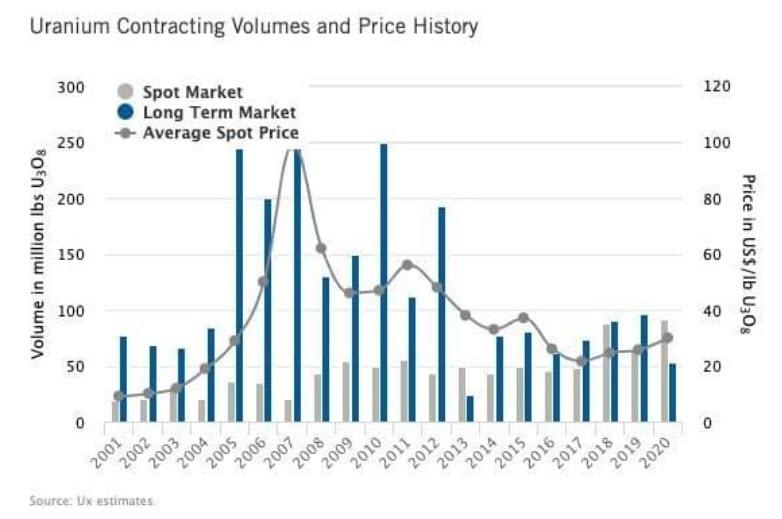
The spot price for U3O8 moved above $30 per pound for the first time this year as uranium producers and mine developers hoover up above-ground inventories and reactor construction continues apace.

Two new research notes from BMO Capital Markets and Morgan Stanley say today’s price marks a floor and predict a rally in prices over the next few years to the ~$50 level by 2024.

The stars seem to be aligning for a new phase of nuclear energy investment with the US, China and Europe bolstering the bull case for the fuel this month. 

Although nuclear energy was not mentioned explicitly in the $2 trillion Biden infrastructure proposal released today, its federally mandated “energy efficiency and clean electricity standard” is hardly achievable without it.  

Source: Cameco

Over the weekend leaked documents showed a panel of experts advising the EU is set to designate nuclear as a sustainable source of electricity which opens the door for new investment under the continent’s ambitious green energy program.

China’s 14th five-year plan released a fortnight ago also buoyed the uranium market with Beijing planning to up the country’s nuclear energy capacity by 46% – from 48GW in 2020 to 70GW by 2025.

There are several factors working in uranium’s favour, not least the fact that annual uranium demand is now above the level that existed before the 2011 Fukushima disaster when Japan shut off all its reactors:

  1. Uranium miners, developers and investment funds like Yellow Cake (13m lbs inventory build up so far) are buying material on the spot market bringing to more normal levels government and utility inventories built up over the last decade

  2. Major mines are idled including Cameco’s Cigar Lake (due to covid-19) which accounts for 18m lbs or 13% of annual mine supply.  The world’s largest uranium operation McArthur River was suspended in July 2018 taking 25m lbs off the market

  3. Permanent closures so far this year include Rio Tinto’s Ranger operation in Australia (3m lbs) and Niger’s Cominak mine (2.6m lbs) which had been in operation since 1978. Rio is exiting the market entirely following the sale of Rössing Uranium in Namibia

  4. Like Cameco, top producer Kazatomprom, which mined 15% less material last year due to covid restrictions has committed to below capacity production (–20% for the state-owned Kazakh miner) for the foreseeable future

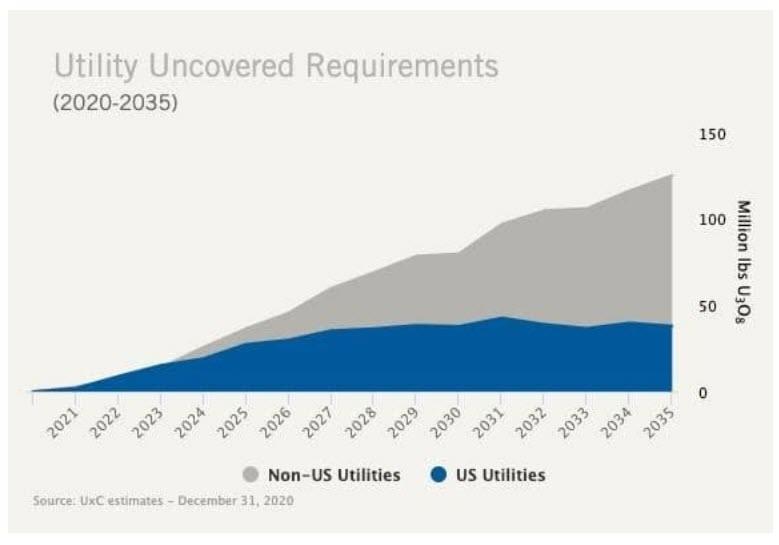
  5. Price reporting agency and research company UxC estimates that utilities’ uncovered requirements would balloon to some 500m lbs by 2026 and 1.4 billion lbs by 2035  

  6. Roughly 390m lbs are already locked up in the long term market while 815m lbs have been consumed in reactors over the last five years, according to UxC

  7. There are 444 nuclear reactors in operation worldwide and another 50 under construction – 2 new connections to the grid and one construction start so far in  2021

  8. Much cheaper and safer, small modular nuclear power reactors which can readily slot into brownfield sites like decommissioned coal-fired plants (or even underground or underwater) are expected to become a significant source of additional demand.

There are caveats to this rosy scenario, however. 

Morgan Stanley warns that “the opacity of the inventory situation remains a key uncertainty to price – see for example palladium, which needed almost 7 years of deficit before the price really took off.”

Source: Cameco

BMO says given the still high levels of inventories “acute shortages and price squeezes are extremely unlikely, both for this year and the foreseeable future,” adding that “there is no obvious need for new mine supply in the near future.”

Tyler Durden
Sun, 04/04/2021 – 13:40

via ZeroHedge News https://ift.tt/3ulukrA Tyler Durden

Hedge Fund CIO: “At Some Point, Through Inflation, War Or Confiscation, The System Will Restart”

Hedge Fund CIO: “At Some Point, Through Inflation, War Or Confiscation, The System Will Restart”

By Eric Peters, CIO of One River Asset Management

Dusted off an anecdote from 2016 that explores the meaning of money. It is worth considering after a quarter in which the US dollar declined by more than 50% versus the dominant digital assets and the S&P 500 closed at an all-time high.

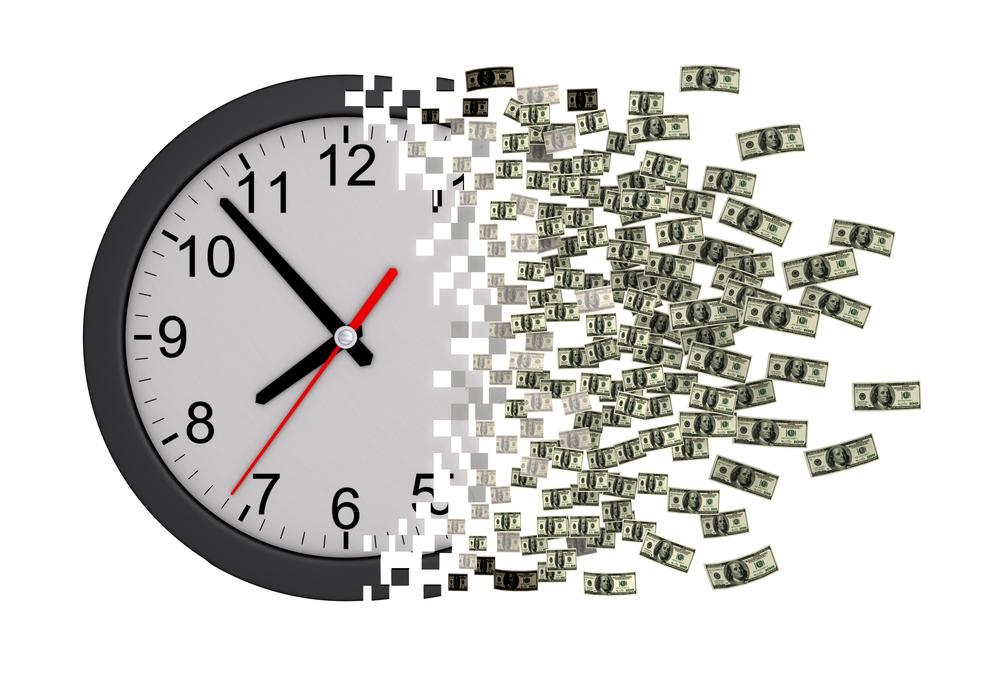
“People work in order to convert their time into a unit of account,” he said.

“We call that money, and it’s an invention that allows us to store time.”

Most people have stored little or none. So when they receive money, they quickly purchase necessities; food, shelter, health care.

“People who are able to save money inevitably purchase real estate, stocks, bonds – all of which are alternative vehicles for storing time.”

One share of Google stores 70 hours of work for the average American, or 2 hours of copying-and-pasting formation documents for the average hedge fund attorney.

“Bill Gates has stored enough time to fund a 1bln person army for 20 years.”

As the gulf between people’s income has grown, the amount of stored time has accumulated in fewer hands.

“Wealthy people convert their hours into financial assets so that they can accumulate excess hours relative to their fellow man. But the average worker is simply thinking how to exchange hours for dollars and then exchange those for food.”

Central banks face a different problem altogether.

They need to get people who’ve saved time to exchange it for something other than clever inventions that store it.

They’ve largely failed.

So now, everything that stores time is extremely expensive and offers little or negative return, while the pace of economic activity slows.

“The problem that we face now is that there is simply too much time that’s been saved. Another way of saying it is that there’s too much capital in the world, in too few hands.”

To restart the system, capital needs to change hands or be destroyed, spurring people to rebuild their store of time, rather than just save it.

“It is an elemental truth that at some point, through inflation, war, or confiscation and redistribution, this imbalance will correct, and the system will then restart.”

Tyler Durden
Sun, 04/04/2021 – 12:51

via ZeroHedge News https://ift.tt/2QWWiLE Tyler Durden

“We’re So Stupid Following Our Politicians” – Charles Barkley Unleashes One Minute Of Truth On America

“We’re So Stupid Following Our Politicians” – Charles Barkley Unleashes One Minute Of Truth On America

Forget Orwell’s “Two Minutes Hate.”

NBA legend Charles Barkley unleashed ‘One Minute Truth’ on NCAA-Final-Four-watchers last night, telling viewers that:

“I truly believe in my heart most white people and black people are awesome people, but we’re so stupid following our politicians, whether they’re Republicans or Democrats.”

Barkley was responding to a feature that detailed how on April 4, 1968, Robert F. Kennedy broke the news about the assassination of Martin Luther King Jr. to a crowd in Indianapolis, urging people to seek compassion and justice rather than anger and revenge, saying the vast majority of Americans, both black and white, want to live in peace with each other.

As a reminder, Robert F. Kennedy was assassinated two months later.

This was the same message Barkley offered, as he warned:

“I think our system is set up where our politicians, whether they’re Republicans or Democrats, are designed to make us not like each other so they can keep their grasp of money and power.”

Furthermore, he described what he believes to be the thinking behind the divide-and-conquer strategy:

 “Hey, let’s make these people not like each other. We don’t live in their neighborhoods, we all got money, let’s make the whites and blacks not like each other, let’s make rich people and poor people not like each other, let’s scramble the middle class.”

Watch the full clip here:

This is not the first time Barkley has unleashed uncomfortable truths. In September of last year he dared to speak common sense against the left’s calls to defund the police, arguing that poor black communities would be hit hardest by a spike in crime if there is less policing. “Who are black people supposed to call, Ghostbusters, when we have crime in our neighborhood?”

How long will it be before the outrage mob comes for Barkley for taking such a “bothist” common-sense and honest view and refusing to be drawn, like weak CEOs or pandering politicians to one side or the other in our ever more divisive society?

It’s already begun…

…sigh

Tyler Durden
Sun, 04/04/2021 – 12:25

via ZeroHedge News https://ift.tt/31YP78h Tyler Durden

Liberal Lawyer Lambasted For Suggesting Georgia Voters Unable To Correctly Identify Their Driver’s License Number

Liberal Lawyer Lambasted For Suggesting Georgia Voters Unable To Correctly Identify Their Driver’s License Number

Authored by Jonathan Turley,

We have previously discussed the controversial history of Marc Elias, including allegations that he lied about the funding of Steele Dossier by the Clinton campaign. Elias has also been criticized for challenging elections when he and other Democratic lawyers denounced Republican challenges as a threat to democracy. Now, Elias (who is heading a new group called “Democracy Docket”) is again under intense criticism after a tweet that some have called inherently racist.

Democrats have used the recent Georgia election law as a rallying cry for federalizing elections by labelling the law, as described by President Biden, “Jim Crow on steroids.” Biden has been repeatedly called out for demonstrably false statements about the law.  Elias has been arguing that the law is a barrier for black and minority voters. He is being denounced for a tweet where he suggested that Georgia voters could not be expected to be able to read their driver’s licenses correctly — a statement that seemed to refer to minority voters who would be disproportionately impacted by such a requirement.

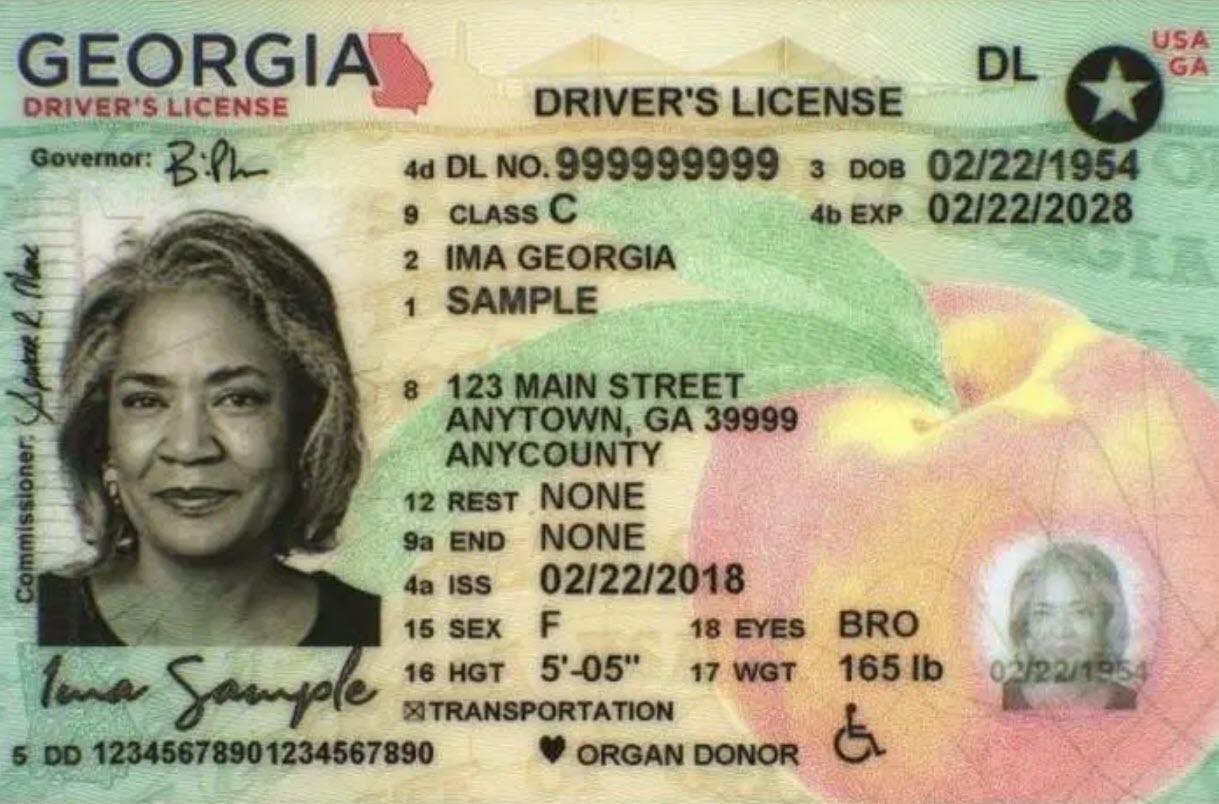
Elias tries to explain by the new law is such a barrier to voting by noting that “The new Georgia law will require voters to submit ID to vote by mail. If they use their driver’s license, they need to provide the #. One of the two numbers below is correct. If they put the other, it will be rejected.”

He then includes an image of a Georgia driver’s license with two separate numbers highlights and asks “Are you sure you would pick the right one?”

Elias is suggesting that the numbers will be hopelessly confusing and thus effectively bar black voters from participating in elections.

Polls show that 72 percent of American adults approve of requiring photo identification to vote, but they have not faced with the daunting challenge of finding the driver’s license number.

If voters cannot deduce that the “DL” number refers to “Driver’s License” number, the form itself would make this obvious by only have boxes for nine numbers as well as instructions on where to find the number. There should be a concern for how errors are addressed in such systems, including the use of provisional votes or other means to address errors in writing down such numbers. Mistakes can occur that the system should allow for notice and corrections to be made.

Previously, the main argument against verified voting rules was that many minority voters do not have identification cards.  This argument suggests that many who do have such cards will have difficulty figuring out their DL number.

Whatever the arguments against verified voting, insulting the intelligence of minority voters is not likely the best option.

As Curt Schilling tweeted: “Once again the left exposes its bigotry of minorities with their “too stupid to know better” set of low expectations. There is NO OTHER lengthy number and what on earth does the DL# stand for other than Drivers License #? Stop thinking anyone not white is dumber than you are.”

Blasting Elias for his clearly racist and bigoted comments…

Tyler Durden
Sun, 04/04/2021 – 12:00

via ZeroHedge News https://ift.tt/39JkQOZ Tyler Durden

Goldman Asks “Is There A More Interesting Chart On Planet Earth Right Now”

Goldman Asks “Is There A More Interesting Chart On Planet Earth Right Now”

In his exhaustive yet Q1 lookback and post-mortem, Goldman’s Tony Pasquariello  (global head of Hedge Fund Sales, which these days we assume excludes family offices for obvious reasons) whose work we have profiled extensively in the past, discussed how much has changed in the past quarter, in which while stocks continued to ramp and closed 6.2% higher there was unprecedented turbulence below the surface, and is why he writes that “certain impulses changed as the quarter wore on, which presents a different setup for Q2.”

In any case, while we will look at a detailed analysis of all that happened in one of the most unforgettable quarters in history (and they said 2021 would be much quieter than 2020), here are the seven most important market charts to follow according to one of the people who is most critical in setting the narrative at Goldman.

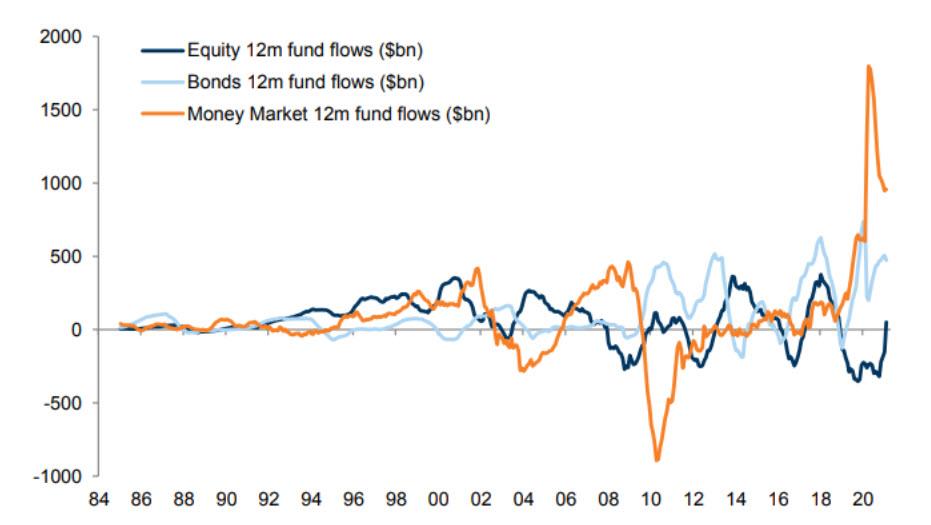
1. Pasquariello starts with the latest fund flows, where he notes that on one hand the market has seen record inflows to equity funds to start the year yet at the same time that really only marks a reversal of outflows in the prior few years (and also takes place during a burst in market volatility as discussed in “Another Market Paradox: Wall Street Struggles To Explain Record Equity Inflows Amid Stock Turmoil“). According to the GS trader, while retail demand is apt to slow from a white hot pace, it should on net remain positive “as equity funds take from both bond funds and the money markets”:

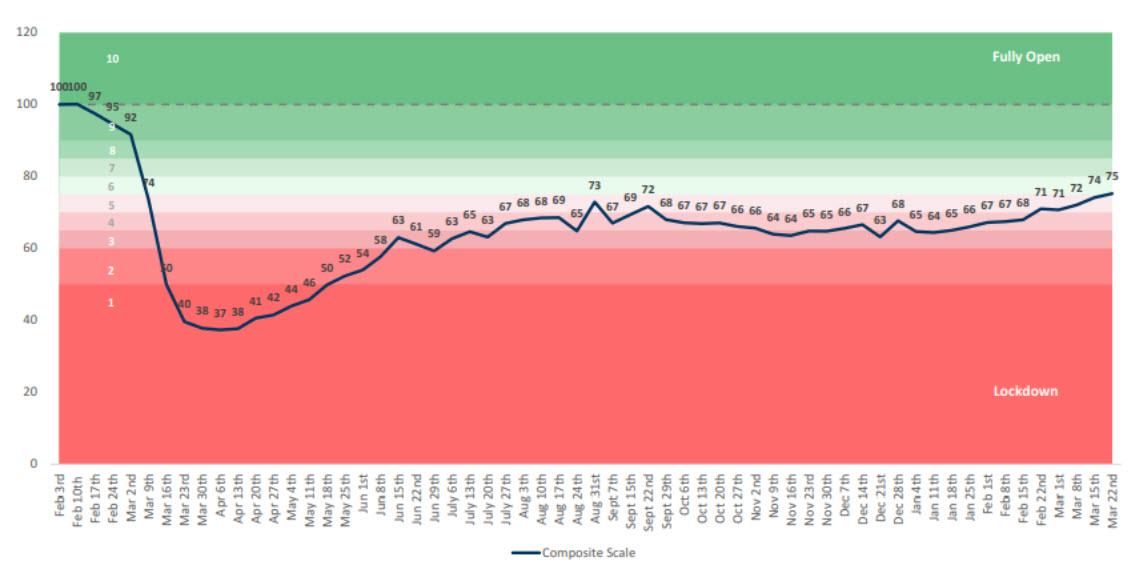
2. Looking ahead, Pasquariello says that Goldman’s composite score for the bank’s proprietary US reopening scale will be critical to watch in the coming months, as the US gets closer to normalcy with every passing day.

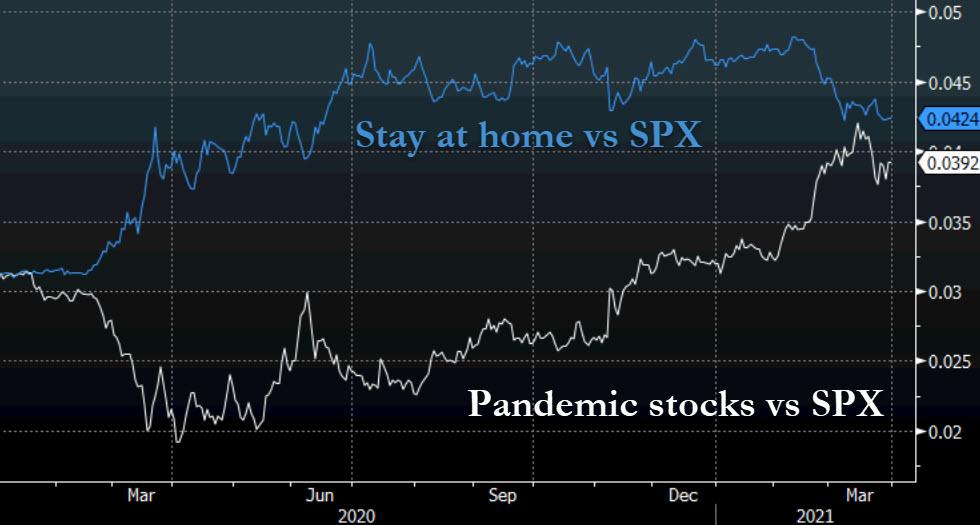
3. In turn, the Goldman trader thinks “this is a very interesting chart”: the blue line is a custom basket of stocks levered to the stay-at-home theme (GSXUSTAY), expressed as a ratio vs S&P; the white line is a custom basket of stocks most exposed to the pandemic (GSXUPAND), also vs the S&P. “As you can see, these trades did exactly what you’d expect them to do for a while. What I
find interesting, however, is how much these spreads have narrowed in recent months:”

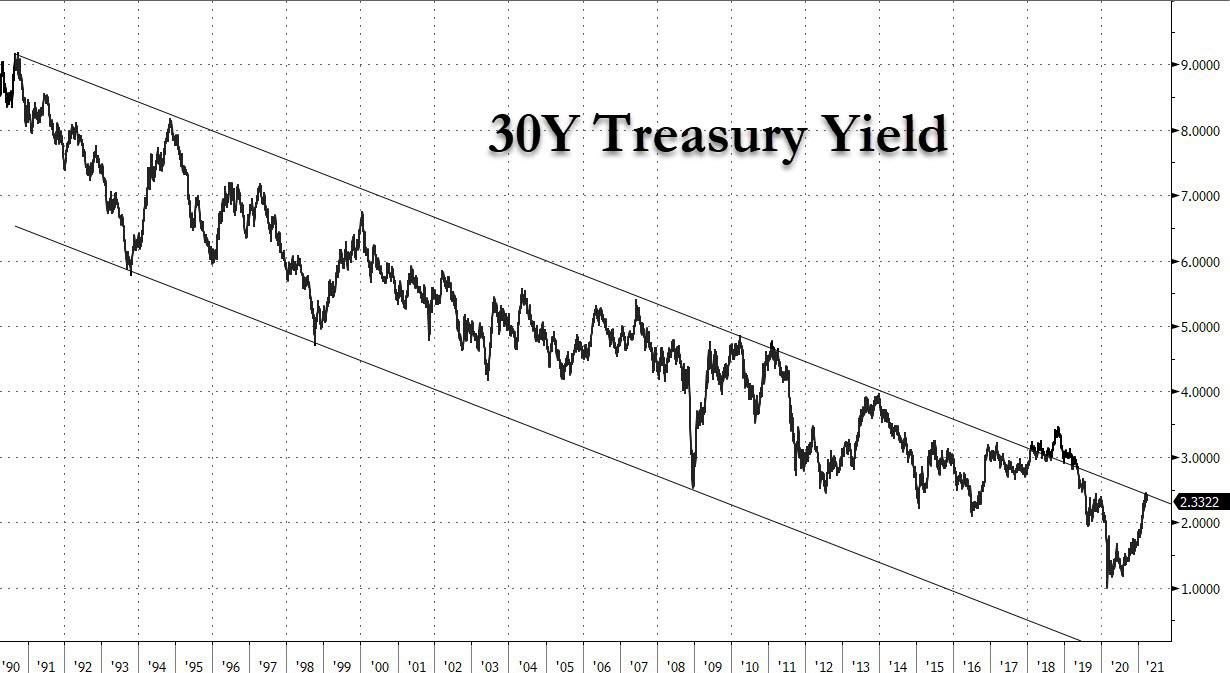
4. This brings us to the punchline: a very long-term chart of the long bond. According to Goldman, with the 30Y now at the long-term resistance line and potentially set to break a 31-year-channel, what happens next is critical, and is why Goldman asks “is there a more interest chart on planet earth right now.”

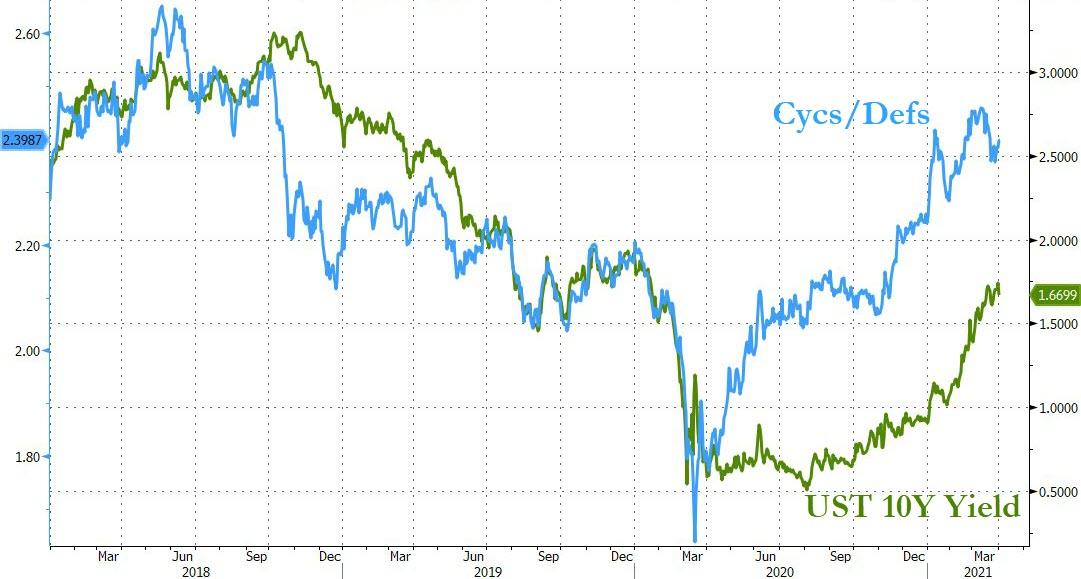
5. And speaking of the bond market, Pasquariello notes that for all the uniqueness of this cycle, the relationship between bond yields (green line) and cyclicals vs defensives (white line) is right in line. In fact as the Goldman trader notes, “look at the tell equities gave in advance of the bond move last year.”

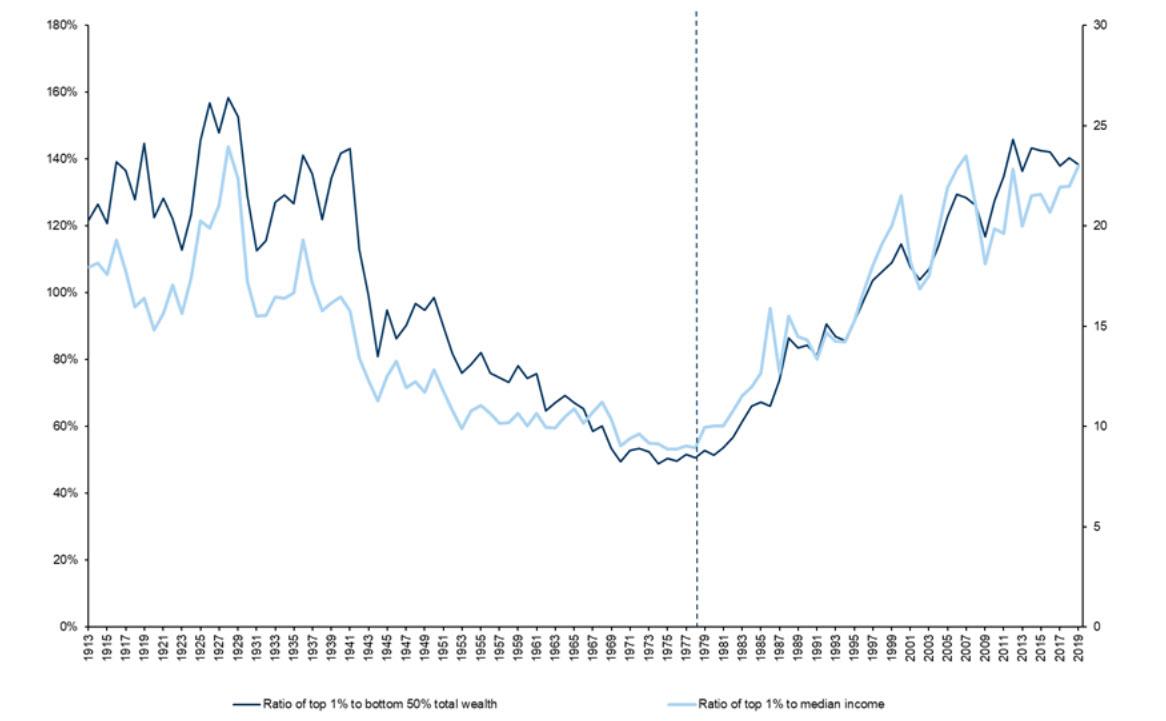
6. One of the prevalent themes on Wall Street in Q1 has been the resurgence of faith in commodity names, and here is another reason why. The next chart from Pasquariello shows a measure of US wealth inequality. Why is this notable? Because as he writes, “the best era of US equality was coincident with exceptionally strong commodity prices. given the focus of global policy makers on the inequality issue right now, one can understand how this underscores a bullish medium-term call on commodities.”

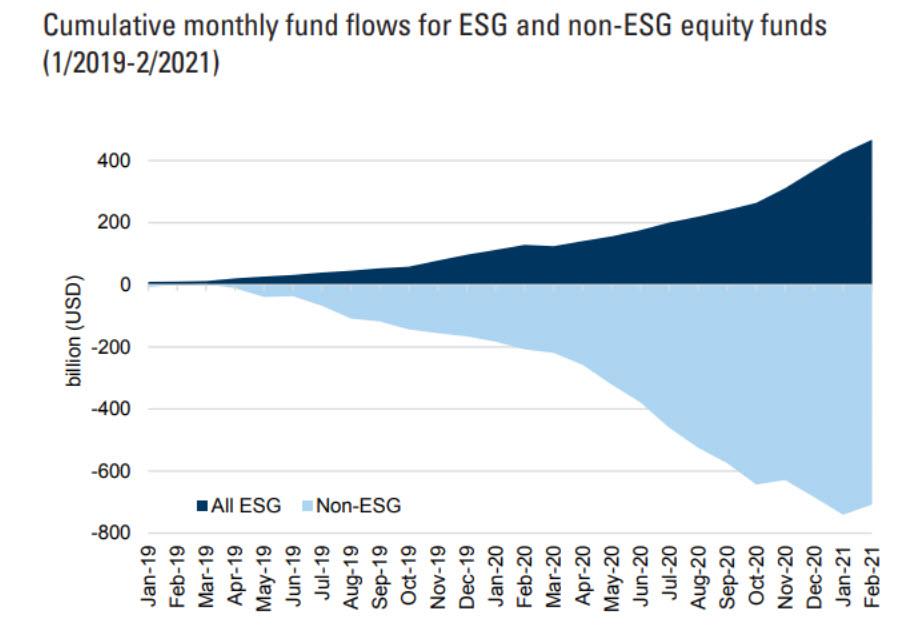
7. Finally, what chart recap is possible without mentioning the virtue signaling craze du jour: As Pasquariello concludes, “the more things change, the more they stay the same, and while outflows from equity funds have thankfully inflected (light blue) , investor demand for ESG product (dark blue) remains firmly in place” and os one of the biggest drivers of inflows into global stocks.

Tyler Durden
Sun, 04/04/2021 – 11:35

via ZeroHedge News https://ift.tt/3t2kM4c Tyler Durden

Russia’s Lavrov Warns Of Surging Anti-White Racism In US

Russia’s Lavrov Warns Of Surging Anti-White Racism In US

Authored by Paul Joseph Watson via Summit News,

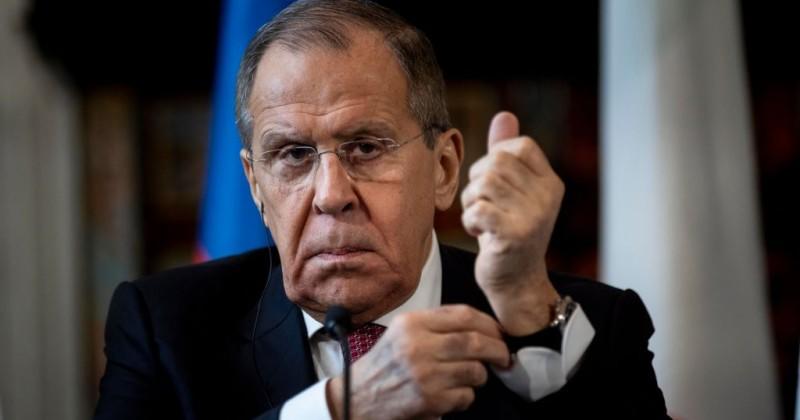
Russian Foreign Minister Sergei Lavrov says there is surging “aggression against white people” in the United States and that it is harming efforts to fight racism.

Lavrov made the comments during an interview with political scientists that was broadcast on national television.

“We were pioneers of the movement promoting equal rights of people of any skin color,” said Lavrov, adding that “everyone wants to get rid of racism.”

However, he emphasized how it was important “not to switch to the other extreme which we saw during the ‘BLM’ (Black Lives Matter) events and the aggression against white people, white U.S. citizens.”

Lavrov also insisted that forces within the U.S. were trying to spread a “cultural revolution” around the world by forcing “diversity” down everyone’s throats.

“Hollywood is now also changing its rules so that everything reflects the diversity of modern society,” he said, labeling it “a form of censorship.”

“I’ve seen Black people play in Shakespeare’s comedies. Only I don’t know when there will be a white Othello,” Lavrov said.

“You see this is absurd. Political correctness taken to the point of absurdity will not end well,” he concluded.

As we previously highlighted, after every mass shooting, journalists and leftists rush to blame white people even before the perpetrator has been identified.

In the case of the Boulder supermarket shooting, this backfired massively after it was revealed that the gunman was an Islamist immigrant from the Middle East.

After the Atlanta shooting attack which targeted massage parlors, the media once again whipped up hysteria over “white supremacy,” despite the fact that authorities found absolutely zero evidence the assault was motivated by race.

This led New York Times contributor Damon Young to assert that “whiteness is a pandemic” and “the only way to stop it is to locate it, isolate it, extract it, and kill it.”

“He was not fired from his job at The Root and the New York Times refused to condemn him — such proclamations are what they pay him for!” writes Chris Menahan.

This narrative, in addition to Critical Race Theory, which teaches that all the United States’ problems are the fault of white people, has clearly created an atmosphere where race hate directed towards white people is not only tolerated, it is openly encouraged.

*  *  *

Brand new merch now available! Get it at https://www.pjwshop.com/

*  *  *

In the age of mass Silicon Valley censorship It is crucial that we stay in touch. I need you to sign up for my free newsletter here. Support my sponsor – Turbo Force – a supercharged boost of clean energy without the comedown. Also, I urgently need your financial support here.

Tyler Durden
Sun, 04/04/2021 – 11:12

via ZeroHedge News https://ift.tt/3dx0g5n Tyler Durden

Nearly 20 Arrested In Coup Attempt Against Jordan’s King Abdullah

Nearly 20 Arrested In Coup Attempt Against Jordan’s King Abdullah

A spate of high level Jordanian officials were arrested Saturday after what’s being widely reported as a significant failed coup attempt – though government signals out of Amman are somewhat contradictory as of Sunday. The Washington Post is reporting that nearly 20 Jordanian officials have been detained.

A powerful royal family member, the popular half-brother of ruling King Abdulla II, former Crown Prince Hamzah bin Al Hussein, is reportedly under house arrest (something authorities are denying), and several former top officials have also been arrested, including at least two senior officials working in the palace. 

Jordan’s King Abdullah II and then Crown Prince Hussein in a 2019 ceremony, AFP via Getty Images

The military described of the rare series of events within the close US allied country that’s typically prided itself on its “stability” – which also hosts American and Western intelligence and army bases – that authorities had to make “moves against a threat to national security,” as The Hill described. 

The events were apparently a severe enough threat to King Abdulla’s rule that an urgent message was sent to Israel later in the day saying “the situation is under control”

Details remain murky, but here’s what’s known according to The Associated Press:

The half-brother of Jordan’s King Abdullah II said Saturday he has been placed under house arrest and accused the country’s “ruling system” of incompetence and corruption, exposing a rare rift within the ruling monarchy of a close Western ally.

Prince Hamzah’s videotaped statement came after the country’s official news agency reported that two former senior officials and other suspects had been arrested for “security reasons,” even as authorities denied that Hamzah had been detained or placed under house arrest.

In a video leaked to the British Broadcasting Corp., Hamzah — a former crown prince stripped of his title in 2004 — said he was visited early Saturday by the country’s military chief and told he was not allowed to go out, communicate with people or meet with them.

Jordan’s top general, Yousef Huneiti, told Petra news agency than an investigation is ongoing, saying “No one is above the law and Jordan’s security and stability are above all,” and vowed to soon make the findings public.

Interestingly Hamzah’s leaked video statement had indeed pointed to broader stirrings of rebellion against the monarchy: “I’m not part of any conspiracy or nefarious organization or foreign-backed group, as is always the claim here for anyone who speaks out,” he said before adding:  

There are members of this family who still love this country, who care for (its people) and will put them above all else.”

“Apparently, that is a crime worthy of isolation, threats and now being cut off.”

As of Sunday there’s been accusations out of Amman that foreign powers may have been in league with the crown prince

King Abdulla’s rule goes all the way back to 1999, with essentially no internal challenges of note in over two decades, following the rule of his father King Hussein over the prior half-century. Israel sees the stability of its eastern neighbor as paramount to its own security, also given the massive Palestinian refugee population there.

Meanwhile the US has said it’s “closely following” the situation. “We are closely following the reports and in touch with Jordanian officials,” State Department spokesman Ned Price announced in a statement. “King Abdullah is a key partner of the United States, and he has our full support.”

Tyler Durden
Sun, 04/04/2021 – 10:46

via ZeroHedge News https://ift.tt/3dwUrFd Tyler Durden

Bullish, But ‘There Be Dragons’

Bullish, But ‘There Be Dragons’

Authored by Lance Roberts via RealInvestmentAdvice.com,

Over the last several weeks, we have discussed how the “negative money flow” environment was keeping a lid on prices short-term. To wit:

“As discussed last week, the ‘sell signal’ triggering on a short-term basis coincides with our concerns of quarter-end rebalancing for pension funds. I suspect we may have some additional quarter-end rebalancing risk early next week. However, buying on Thursday next week, as second-quarter positioning gets underway, would not be surprising.

As such, hold positions early next week and look for weaknesses to add to exposures as needed.

Such turned out to be the case as the markets slopped around early in the week. However, that changed as markets exploded to new highs on Wednesday and Thursday as portfolio managers charged back into the stocks sold off during the Archegos debacle.

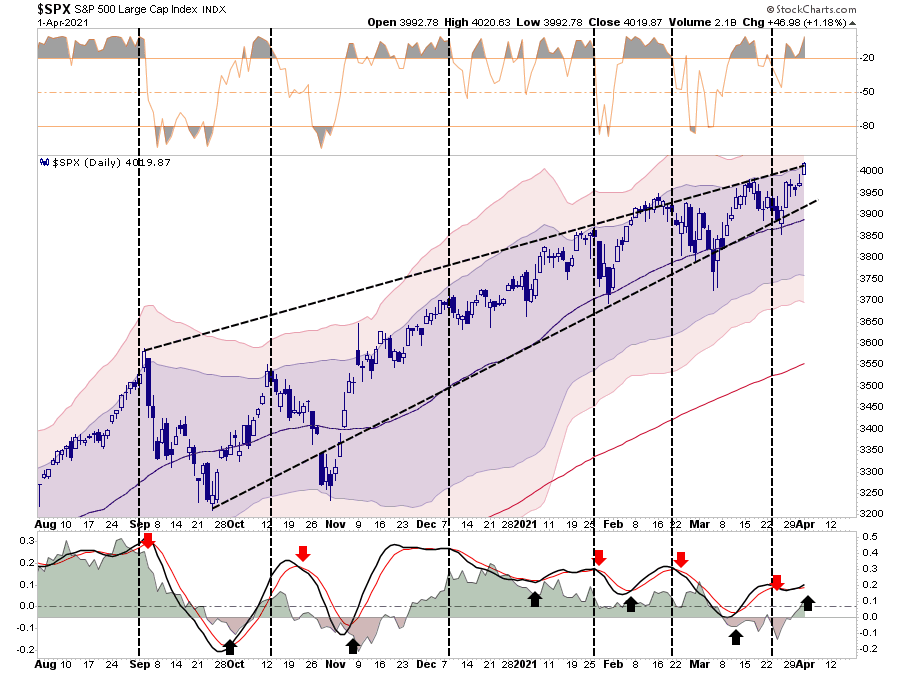
As shown, the break out to new highs for the S&P 500 confirmed the positive turn in “money flows.” Notably, the breakout got further confirmation from combined “money flow” and “MACD” buy signals.

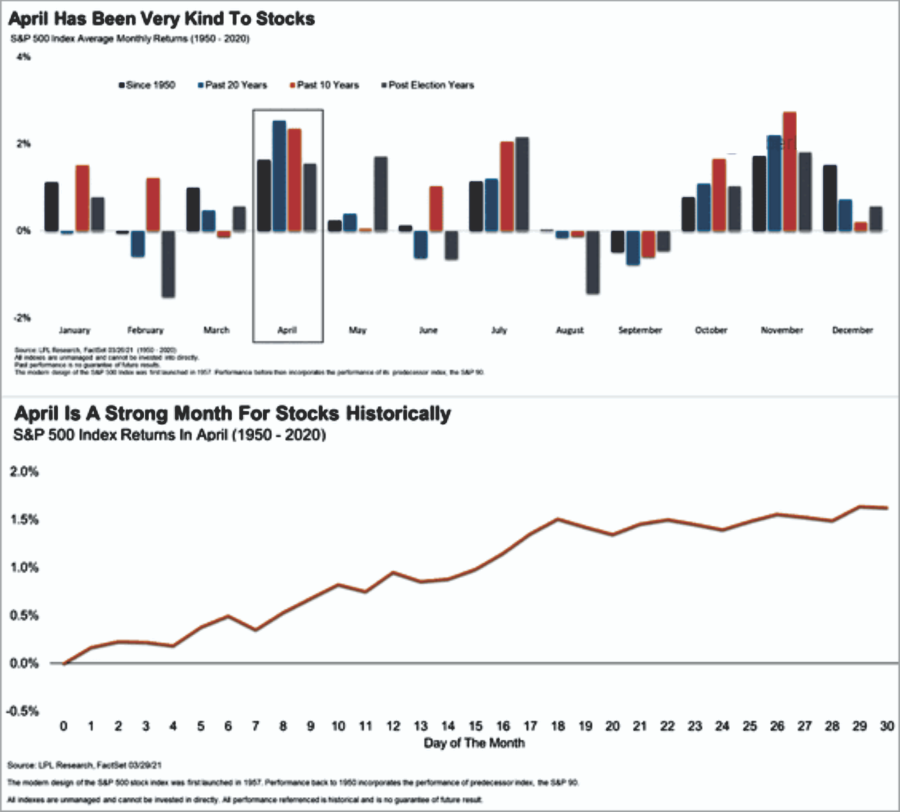
Yesterday’s “3-minutes” video goes into more detail about the turn of the “money flow” indicators as we enter one of the stronger months of the year.

There Be Dragons

Given the confluence of those “buy signals” and “seasonality,” we did increase exposure to portfolios over the last two weeks.

However, as we will discuss more in a moment, that increase in exposure does not come without risks.

As discussed last week, the dollar continued to gain strength and broke above the 200-day moving average. As shown below, sharp increases in the dollar tend to weigh on equity markets.

“The recent rotation to value has been primarily a function of a ‘weaker dollar,’ which boosts commodities. As noted, if economic growth does strengthen, leading to higher rates will attract foreign inflows into the dollar for a higher yield.Such also undermines corporate profitability, given that roughly 40% of corporate profits are from abroad.”

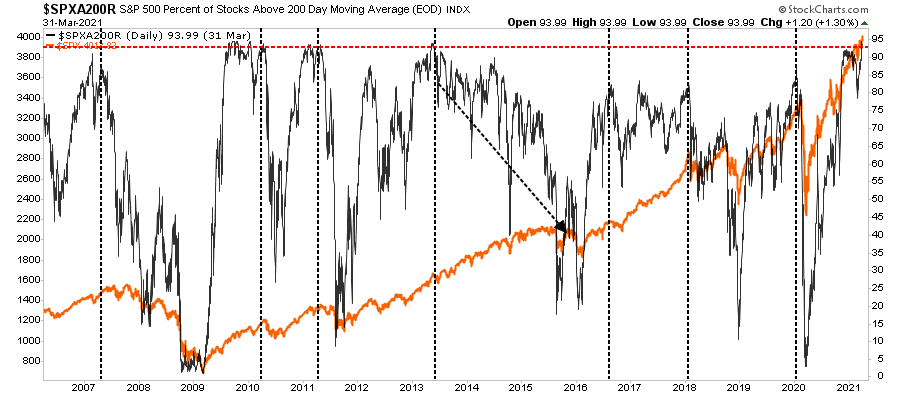
Secondly, the number of stocks trading above their 200-dma is at extremes. Historically, when the “rising tide lifts EVERY boat,” such has usually been near markets’ peaks.

Lastly, interest rates remain a key to much of the ongoing advance. Sharply rising interest rates have always, without exception, led to a market decoupling. It isn’t a question of “if” it will happen. It’s only an issue of “what rate” pops the speculation.

I know. It isn’t apparent.

“If you think there are risks, why increase exposure?”

Great question.

Cognitive Dissonance

As a portfolio manager for other people’s money, I get tasked with two primary jobs.

  1. Generate returns per financial planning goals and objectives; and,
  2. Don’t lose money.

Therefore, I have to take measured “portfolio risk” to create returns but remain aware of the “risks” which could lead to a loss of capital.

On Thursday, I tweeted, as noted above, that we increased equity exposure due to the confluence of buy signals and the seasonally strong month of April. A response to that tweet provides the basis for discussing “portfolio management in a high-risk environment.” To wit:

I certainly understand his dismay. With valuations at some of the most extreme levels seen only outside of the “dot.com” bubble, why would you invest capital now?

To clarify, we have to distinguish between time frames, risk, and expected outcomes.

What Is Risk?

What is the definition of “risk?” 

The chance that an investment will lose value

Increasing risk does not suggest a positive outcome? We can use a mathematical example of “Russian Roulette” to prove the point.

The number of bullets, the prize for “surviving,” and the odds of “survival” are shown:

The point is simply while “more risk” equates to more reward, the consequences of a negative result increase markedly.

Blaise Pascal, a brilliant 17th-century mathematician, famously argued that:

“If God exists, belief would lead to infinite joy in heaven, while disbelief would lead to infinite damnation in hell. But, if God doesn’t exist, belief would have a finite cost, and disbelief would only have at best a finite benefit.”

Pascal concluded, given that we can never prove God’s existence, it’s probably wiser to assume he exists because infinite damnation is much worse than a finite cost.

Risk does not equal reward. “Risk” is a function of how much money you will lose when things don’t go as planned. The problem with being wrong, and facing the wrath of risk, is the loss of capital creates a negative effect to compounding that you can never recover.

There is an essential aspect to the “power of compounding” the media never discusses. It ONLY WORKS when you do not lose money. As shown, after three straight years of 10% returns, a drawdown of just 10% cuts the average annual compound growth rate by 50%. Furthermore, it then requires a 30% return to regain the average rate of return required. In reality, chasing returns is much less critical to your long-term investment success than is commonly believed. 

Even in healthy markets with fair valuations, risks exist. But in markets with high valuations, the risk of a reversion increase as time marches on.

Valuations Dictate Returns Long-Term

Understanding what “risk” takes us to this vital point made by Michael Lebowitz in “Zen And The Art Of Risk Management.”

“In the short-term, price changes of stocks are based solely on liquidity, or the balance of buyers and sellers. Over long periods, price changes are dependent on valuations. The following scatter plots compare CAPE valuations to subsequent 10-year and 3-month returns to highlight this fact.”

“The correlation of ten-year forward returns and CAPE is statistically significant with an R-squared of .4803. In other words, valuation matters in the long run. Conversely, there is no correlation between quarterly returns and CAPE.”

Such is an important point relative to our reader’s comment.

In the short-term, worrying about high multiplies isn’t conducive to creating portfolio returns from one month to the next. As such, it isn’t “cognitive dissonance” that we are increasing exposure in a month that has a very high statistical probability of positive returns over the next 30-days.

Fully Invested Bears

The problem in discussing “investment risk” is that such commentary is summarily dismissed as being “bearish,” By extension, such means we must be either sitting in cash or short the market. In either event, I have “missed out” on the last advance. 

Such reminds me of something famed Morgan Stanley strategist Gerard Minack said once:

The funny thing is there is a disconnect between what investors are saying and what they are doing. No one thinks all the problems the global financial crisis revealed have been healed. But, when you have an equity rally as you’ve seen for the past four or five years, everybody has had to participate.

What you’ve had are fully invested bears.”

While the mainstream media continues to skew individual’s expectations by chastising them for “not beating the market,” which is impossible to doour job is to participate in the markets with a bias toward capital preservation. As noted, the destruction of capital during market declines has the most significant impact on long-term portfolio performance.

From that view, as a portfolio manager, the idea of “fully invested bears” defines the reality of the markets we live with today. Despite the understanding that the markets are overly bullish, extended, and valued, we must stay invested or suffer potential “career risk” for underperformance. 

Such is the consequence of the Federal Reserve’s ongoing interventions. Portfolio managers must chase performance despite concerns of potential capital loss. In other words, we are all “fully invested bears.” We are all quite aware this will eventually end badly. However, in the short-term, no one is willing to take the risk of being grossly underexposed to Central Bank interventions.


Portfolio Update

With this understanding, you can appreciate why we increased our equity exposure last week. Currently, we are at full equity allocations, with a slight increase in the duration of bonds. Such leaves our portfolios at model weights in cash with bond durations shorter than our benchmark.

Furthermore, we added an “index trading position.” Having a single index position in the portfolio allows us to increase exposure to markets as needed quickly and promptly reduce exposure if required.

Lastly, we continue to carry a “barbell approach” in our portfolios. Such splits holdings between “reflation” trades such as Energy, Financials, and Materials and “growth” focused on Technology.

Therefore, with the breakout to new highs, the markets will likely stretch towards our year-end target of 4100.

After this discussion, it seems apropos to remind you of Bob Farrell’s “10-Investment Rules:”

  • Markets tend to return to the mean over time.
  • Excesses in one direction will lead to an opposite excess in the other direction.
  • There are no new eras — excesses are never permanent
  • Exponential rapidly rising or falling markets usually go further than you think, but they do not correct by going sideways
  • The public buys the most at the top and the least at the bottom
  • Fear and greed are stronger than long-term resolve
  • Markets are strongest when they are broad and weakest when they narrow to a handful of blue-chip names
  • Bear markets have three stages — sharp down, reflexive rebound, and a drawn-out fundamental downtrend
  • When all the experts and forecasts agree — something else is going to happen
  • Bull markets are more fun than bear markets

There is only one fact to remember:

“All bull markets last until they are over.” – Jim Dines

Just remember, “risk” is always “risk.”

Tyler Durden
Sun, 04/04/2021 – 10:20

via ZeroHedge News https://ift.tt/3uhR2kj Tyler Durden