50 Million People In Pathway Of Severe Storms From Texas To New York

50 Million People In Pathway Of Severe Storms From Texas To New York

A multi-day heavy rainfall and powerful storm threat will affect upwards of 50 million people across Southern Plains Wednesday and into the interior Northeast Thursday, according to CNN

“Even though today may not look like a classic set up for a severe weather outbreak, there will be severe storms that break out from Texas all the way up to the Northeast,” said CNN meteorologist Chad Myers. “We often talk about the ingredients for big storms and today’s recipe includes an overabundance of warm air and humidity.”

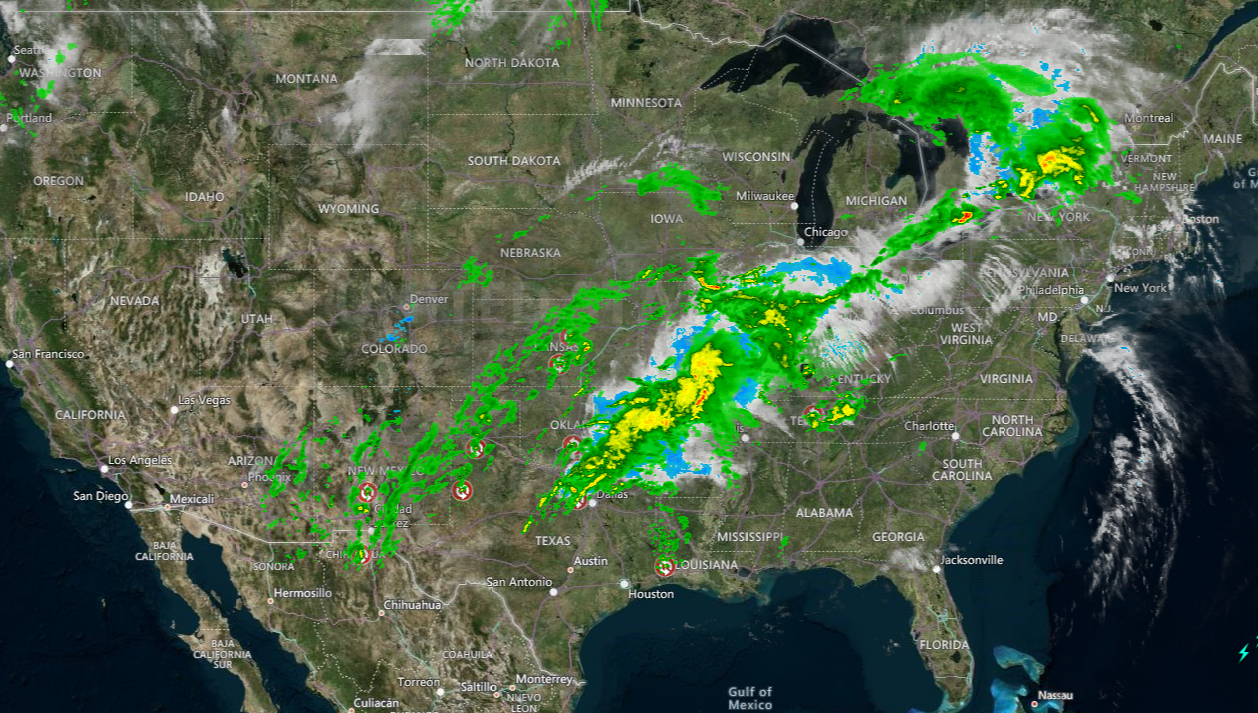
Current Radar (as of 1300 ET)

Storm Prediction Center (SPC) warned hailstones up to 4 inches in diameter for some areas in the Plains. Texas, Oklahoma, Arkansas, and Missouri will see severe weather on Wednesday. 

“The stronger thunderstorms may produce large hail and wind damage. A tornado threat may also develop in the Southern Plains,” warned SPC.

The Southern Plains through the lower Midwest will experience torrential rains this afternoon and into tonight. 

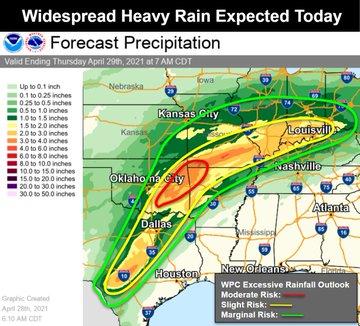
Forecast Precipitation 

“Locally heavy rainfall will be a bigger concern in our area by later today and tonight, with both flash flooding and main-steam river flooding possible depending on just where the heavier rain swathes set up,” said the National Weather Service office in Tulsa, Oklahoma.

There will be an elevated risk for severe storms in parts of the interior Northeast by Thursday, especially the eastern Great Lakes region.

Ohio, Pennsylvania, and New York, including Cleveland and Pittsburgh, could experience storms during the mid-to-late-afternoon hours, increasing into the evening. 

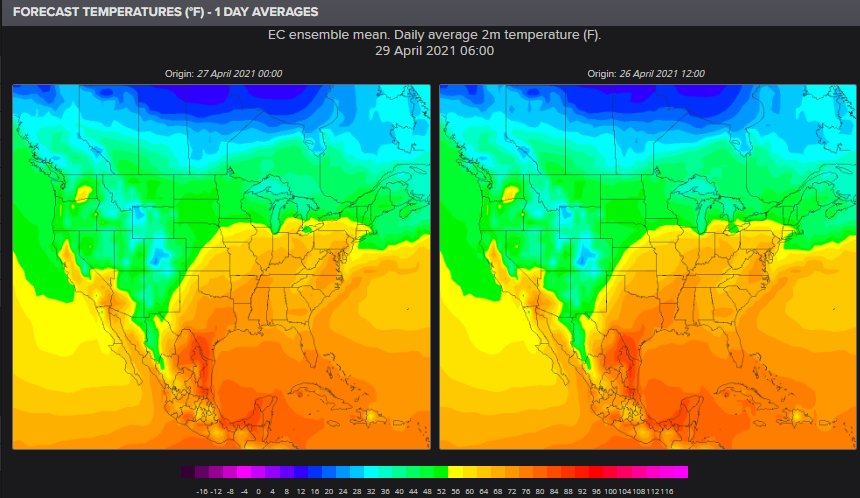
Over 200 million people in the US are forecasted to have high temperatures of at least 80 degrees on Wednesday. All that warm and moist air have been fueling severe storms. 

Thursday’s Forecast High Temps 

So far, we don’t see any price anomalies in Texas power prices nor any others across the South. 

… and of course, climate change warriors will point to the temperature spike and severe weather as proof global warming exists. 

Tyler Durden
Wed, 04/28/2021 – 20:00

via ZeroHedge News https://ift.tt/3sYymox Tyler Durden

50 Million People In Pathway Of Severe Storms From Texas To New York

50 Million People In Pathway Of Severe Storms From Texas To New York

A multi-day heavy rainfall and powerful storm threat will affect upwards of 50 million people across Southern Plains Wednesday and into the interior Northeast Thursday, according to CNN

“Even though today may not look like a classic set up for a severe weather outbreak, there will be severe storms that break out from Texas all the way up to the Northeast,” said CNN meteorologist Chad Myers. “We often talk about the ingredients for big storms and today’s recipe includes an overabundance of warm air and humidity.”

Current Radar (as of 1300 ET)

Storm Prediction Center (SPC) warned hailstones up to 4 inches in diameter for some areas in the Plains. Texas, Oklahoma, Arkansas, and Missouri will see severe weather on Wednesday. 

“The stronger thunderstorms may produce large hail and wind damage. A tornado threat may also develop in the Southern Plains,” warned SPC.

The Southern Plains through the lower Midwest will experience torrential rains this afternoon and into tonight. 

Forecast Precipitation 

“Locally heavy rainfall will be a bigger concern in our area by later today and tonight, with both flash flooding and main-steam river flooding possible depending on just where the heavier rain swathes set up,” said the National Weather Service office in Tulsa, Oklahoma.

There will be an elevated risk for severe storms in parts of the interior Northeast by Thursday, especially the eastern Great Lakes region.

Ohio, Pennsylvania, and New York, including Cleveland and Pittsburgh, could experience storms during the mid-to-late-afternoon hours, increasing into the evening. 

Over 200 million people in the US are forecasted to have high temperatures of at least 80 degrees on Wednesday. All that warm and moist air have been fueling severe storms. 

Thursday’s Forecast High Temps 

So far, we don’t see any price anomalies in Texas power prices nor any others across the South. 

… and of course, climate change warriors will point to the temperature spike and severe weather as proof global warming exists. 

Tyler Durden
Wed, 04/28/2021 – 20:00

via ZeroHedge News https://ift.tt/3sYymox Tyler Durden

Why Did Congress “Bailout” Utah For $1.5 Billion? (When Utah Has A $1.5 Billion Budget Surplus)

Why Did Congress “Bailout” Utah For $1.5 Billion? (When Utah Has A $1.5 Billion Budget Surplus)

Authored by Adam Andrzejewski, CEO/Founder of OpenTheBooks.com, via Forbes.com,

Recently, Congress passed the $1.9 trillion American Rescue Act along party lines – no Republicans voted for the legislation. Within the bill, there was $350 billion allocated to states, tribes, territories, and 30,000 localities.

House Speaker Nancy Pelosi forecast that “republicans would vote no and take the dough.” So far, she’s right, as no republican governor has returned the funding.

A case in point is Utah Gov. Spencer Cox (R). Utah state government received $1.5 billion from the Rescue Act. However, the state has an estimated $1.5 billion budget surplus for 2021.

Gov. Cox forecast a $427 million surplus for 2021 and already expected to have a $1.1 billion one-time surplus. The total extra funds in the state budget amounted to $1.5 billion.

So, what’s the compelling public purpose for Congress to send Utah $1.5 billion in coronavirus aid? Considering the strength of their state economy, what’s the governor’s argument to keep the money?

We reached out to Gov. Cox for comment on these important issues, however, we didn’t receive a response. Although U.S. Senator Mitt Romney (R-UT) voted against the bill, he hasn’t weighed in on the Utah “bailouts.”

Our auditors at OpenTheBooks.com mapped every government receiving the congressional bailout. Look up your hometown by clicking one of the 50 pins (state capitol) and then scroll down to the chart beneath the map to see the local areas that received Rescue Act aid.

Beyond the $1.5 billion in aid to Utah state government, a lot of taxpayer money also flowed to Utah’s counties and cities.

Here’s a high-level breakdown of congressional bailout flowing into communities across Utah.

Salt Lake County – $225 million

Salt Lake County is the most populous in the state with an $1.1 million residents. The county is home to the state capital and its largest city, Salt Lake City. Roughly 1 in every 3 Utahns lives in this county. With $225 million in aid, the county collected the equivalent of about $225 for every resident.

The county is home to the Church of Jesus Christ of Latter-Day Saints (LDS) in Salt Lake City.

Utah County – $123 million

Utah County is the second most populous county in the state with 636,000 residents. That means the county collected about $193 per person.

Brigham Young University located in the city of Provo ($31.6 million in aid). Brigham Young was the founder of Salt Lake City, the first governor of the Utah Territory and second president of the LDS faith.

Salt Lake City – $87.5 million

Salt Lake City is the state capitol and is known for its ski resorts. In 2002, the city hosted the Winter Olympics.

It’s also home to the Salt Lake City Temple. The 174-year-old Mormon Tabernacle Choir performs in the Salt Lake Tabernacle. With an estimated population of 197,756, the equivalent aid for every resident amounted to $442.

Davis County – $69 million

With some ski resorts of its own, Davis County is considered a “bedroom community.” With a population of 355,000, the county collected $194 in stimulus funds for each resident.

Weber County – $50.5 million

The county is home to Weber State University, also founded by The Church of Jesus Christ of Latter-day Saints. With 260,213 people, the stimulus works out to be about $194 per resident, the same rate of funding as Utah County and Davis County.

Washington County – $34.4 million

The county is home to Zion National Park and Snow Canyon State Park, and has 177,556 residents — an average $194 per person in aid — the same rate as Utah, Davis and Weber counties.

West Valley City – $28.3 million

The second largest city in the state, West Valley has 136,009 people — an average of $208 per person in aid. A suburb of Salt Lake City, West Valley is relatively new, only incorporating in 1980. The city is home to The Maverik Center which houses the professional hockey team, the Utah Grizzlies.

Review the rest of Utah’s localities receiving congressional aid here.

The Utah state economy remained strong as they successfully navigated the pandemic and the state government has a $1.5 billion surplus. Therefore, it’s mind-boggling that the state collected an additional $1.5 billion from the $1.9 trillion stimulus package.

Critics say that Congress needs to do a better job of letting states manage their own affairs and stop the taxpayer-funded bailouts of states and localities.

However, Speaker Pelosi was right: republican members of Congress voted no, but their governors took the dough.

A request for comment to the governor’s office wasn’t returned by our deadline

Tyler Durden
Wed, 04/28/2021 – 19:40

via ZeroHedge News https://ift.tt/2Px9sPb Tyler Durden

White House Insiders Oppose Biden Plan To “Share” Vaccines With India, Others

White House Insiders Oppose Biden Plan To “Share” Vaccines With India, Others

Even as unused COVID-19 vaccines pile up and a growing number of US states are scaling back orders of new vaccines, some top West Wing staffers are quietly pushing back against President Biden’s decision to “share” unwanted AstraZeneca jabs with India and other countries badly in need of more jabs.

According to three senior officials with knowledge of the situation, senior officials in the West Wing, and National Security Council have repeatedly rebuffed requests from leaders of health agencies to send more American vaccines abroad. While President Biden has promised to give jabs to Mexico and other nations, so far, this has mostly been talk. Those backing exports cited internal projections showing the US will soon have tens of millions of vaccines to spare. But those arguing against sharing were unmoved.

Politico pointed out that the resistance to exporting more vaccines raises troubling questions about the administration’s confidence in the domestic vaccine pipeline, which is largely reliant on just two companies – Moderna and Pfizer – as J&J and AstraZeneca struggle with reports of rare but deadly blood clots in a tiny number of patients with low blood platelet counts.

It also raises questions about the west’s decision to prioritize protection of IP rights for vaccinemakers over creating an “open vaccine” that could be manufactured by any nation around the world. Bill Gates, the biggest advocate for IP protections, has insisted that developing nations would be better off waiting to buy supplies of jabs from developed nations who own the IP. The Biden Administration is considering whether to back a proposal at the WTO to waive IP protections for vaccine technology, which could save hundreds of thousands of lives at the expense of big pharma’s profits.

After a mix-up at a factory in Baltimore ruined some 15MM doses of J&J’s jab, observers can’t help but wonder if there’s another shoe about to drop.

“The question is, what if there is a manufacturing problem or a contamination or a barrier, and then all of a sudden we don’t have enough vaccines,” said one senior administration official. “There’s people … pushing to do it and do it now. Then there are people who are saying … we’ll deal with it, but not right now, let’s just wait a little bit.”

Some inside the administration, meanwhile, are struggling to gauge whether there’s enough support for shipping vaccines abroad before the end of the year.

A White House spokesperson responded to a series of questions on the matter by pointing to coronavirus response coordinator Jeff Zients’ statement Tuesday that the U.S.’ “strong portfolio” of existing vaccines made it possible for the administration to share AstraZeneca doses with other countries.

The Biden administration is getting sizable, regular shipments of vaccine from Moderna and Pfizer, which between them have agreed to supply enough shots for 300 million people. The third authorized U.S. vaccine maker, Johnson & Johnson, had initially promised to make 100 million doses by June, reinforcing the U.S. supply with a one-shot option that is relatively easy to store and could be deployed to hard-to-reach groups.

As US demand slows while India’s pandemic reaches unprecedented levels of mortality, some are arguing that continuing to hoard jabs is simply immoral on Washington’s part.

“There’s no reason for the U.S. to sit on doses and have hundreds of millions of doses on the shelf over the summer,” said Krishna Udayakumar, director of Duke’s Global Health Innovation Center. “If and when more doses are needed in the fall and into the winter, the manufacturing capacity is going to ramp up pretty significantly.”

Others argued that Washington must either back a waiver on vaccine IP at the WTO, or hand over more of its vaccines. Refusing to do either would be cruel.

“This is no longer a conversation about protecting American lives versus protecting Indian lives, like America has plenty of vaccines,” said Ashish Jha, dean of Brown University’s School of Public Health. “Americans will have plenty of vaccines for a long time. The absolute minimum we should be doing is helping places like this institute make a lot more.”

The US is currently entertaining bids from multiple countries for Covid-19 assistance and have received specific requests for doses, according to a senior official with direct knowledge of and another individual familiar with the situation. A team led by Gayle Smith, the State Department’s global Covid-19 coordinator, is still debating how to identify which countries are most in need of vaccines.

Tyler Durden
Wed, 04/28/2021 – 19:20

via ZeroHedge News https://ift.tt/2R8OJ4A Tyler Durden

JPMorgan After Powell: “Buy Every Dip”

JPMorgan After Powell: “Buy Every Dip”

One week ago JPMorgan’s chief equity strategist, Dubravko Lakos-Bujas, joined the bearish sellside bandwagon aka the “Doom Chorus” we profiled previously and which included such bank as Morgan Stanley, Goldman and Deutsche Bank, when writing that after “aggressively pushing the upside case for equities” for the last 12 months, and arguing for a continued melt-up  with S&P 500 reaching 4,000 in 1Q and the majority of the upside to our year-end PT of 4,400 being realized during 1H”, he warned that “easy equity gains for the broad market are likely behind us” and as a result JPMorgan’s “bullish conviction is now lower.”

Remarkably, Lakos-Bujas’ bearish reversal followed just hours after his fellow JPM Croat and permabull, Marko Kolanovic, appeared on CNBC and said that “It’s time to buy the dip” (it wasn’t clear just what dip he was referring to).

So fast forward to today when after this afternoon’s extremely dovish FOMC statement in which there were no changes to policy, and Powell presser in which the Fed Chair pushed back on questions about rampant reflation (stagflation) as purely “transitory” despite casually mentioning that capital markets seem “frothy”…

… when JPMorgan flip-flopped again, and in the afternoon market intelligence note by JPM’s Andrew Tyler, the strategist not only streamrolled over Lakos-Bujas’ words of caution, but reverted JPM right back to its rightful place as Wall Street’s most bullish bank, telling clients to “buy every dip”:

Beginning with Powell, there was chatter that we may hear language that the Fed was beginning to think about tapering. That did not come to fruition and bonds caught a big on the back of that. Equities subsequently sold off. The lack of action and the lack of a statement should have been consensus as we look towards June to hear language on tapering. That said, Powell remains adamant that nothing will change until there is substantial improvement in labor markets and the broader economy. With the US still in an 8mm+ job deficit, how does he/Fed define “substantial improvement”? Is that recovering 50% of those jobs? 75% 90? This is really the question and given his lack of traditional economic training, past models may give investors little comfort.

My take is that the Fed’s announcement today is market-positive. We will still receive $120bn/month in QE with historically low rates. US earnings continue to improve and we are still several weeks away from a full reopening.

Buy every dip.

Which reminds us of what we said just last Friday when we reported that JPM had turned bearish:

Which probably means no more bullish hits for Kolanovic on CNBC for at least a few weeks, when the S&P will either break out above 4,400 forcing JPM to once again turn ravingly bullish, or stocks indeed fall. Which, however, we find unlikely for one simple reason: as we said first thing this morning when we read JPM’s report, “JPM has joined the bearish bandwagon, there is no big bank that is bullish on stocks in the mid-term.” The implication is simple: stocks will go up…

It wasn’t “a few weeks” – instead it was just a few days, but sure enough stocks did touch a fresh record high… and as expected JPM is balls to the wall bullish once again.

Tyler Durden
Wed, 04/28/2021 – 19:00

via ZeroHedge News https://ift.tt/3aNaPkp Tyler Durden

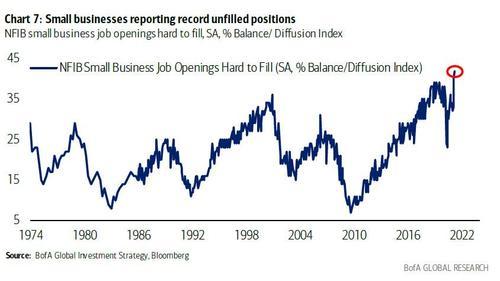
Royal Farms Offers $500 Signing Bonus As Labor Shortage Intensifies 

Royal Farms Offers $500 Signing Bonus As Labor Shortage Intensifies 

Baltimore-based Royal Farms, a privately owned chain of more than 200 convenience stores throughout Maryland, Delaware, Pennsylvania, New Jersey, and Virginia, is ramping up part-time and full-time employment by offering signing bonuses to new employees. 

“A $500 sign-on bonus at select locations is being offered to new employees. A $300 referral bonus for any active employee is also being offered internally. If an employee is fully vaccinated, they will also receive a $50 COVID-19 Wellness bonus,” a recent Royal Farms press release read. 

The purpose of signing a bonus appears to entice low-level applicants to work for the convenience store. Think of it as an extra incentive for the prospect to accept the job. 

On the surface, the press release describes the signing bonus as a way to attract new employees at a time of “growing store count and warmer months approaching.” But as we’ve explained before, people are once again getting paid more money to sit on their couch via Biden stimulus checks than work, thus creating a labor shortage that destroys labor market recovery. 

A similar scheme was seen at a McDonald’s in Tampa, Florida, that offered $50 for people to show up for a job interview. 

The latest comments from the Federal Reserve Bank of Kansas City provide a chilling insight this month into the labor shortage developing:

“Stimulus and increased unemployment money are wrecking the labor pool. Lower-level employees are quitting to make just as much not working.”

So, lower-level employees are making more money collecting stimulus checks and other handouts under the Biden administration. This was very similar when former President Trump dished out helicopter money during the early days of the pandemic. 

Even JPMorgan is worried about massive labor shortages in a new report to clients.  

In a letter sent to the White House last week, WSJ explains Democrats on Capitol Hill are pushing for the Biden administration to make the jobless benefits permanent, the onset to universal basic income. 

… and if employers want to hire low-skilled workers who get paid more by the government to sit on the couch to play Xbox, trade crypto, or try to flip penny stocks, they better sweeten the pot for these workers, which is becoming the case in the form of signing bonuses. 

Tyler Durden
Wed, 04/28/2021 – 18:40

via ZeroHedge News https://ift.tt/3sYYG20 Tyler Durden

Beijing Slams Biden For Embracing Trump’s “Wrong Path” During First 100 Days

Beijing Slams Biden For Embracing Trump’s “Wrong Path” During First 100 Days

Hu Xijin, the editor in chief of China’s English-language Global Times, has developed a curious reputation in the West as one of the most visible mouthpieces for the CCP. Now, with President Biden on the cusp of crossing the 100-day mark on Friday, the Global Times has published an evaluation of Biden’s first three months in office and determined that Biden has “adopted much of the Trump Administration’s wrong path” when it comes to the bilateral relationship between the world’s two largest economies.

In some ways, Biden has been even more aggressive than his predecessor. One notable difference is Biden’s ability to organize American allies from around the world to “impede China and to strangle China’s technology development” – an oblique reference to Biden’s work with “the Quad” (Japan, India, Australia and the US) to contain Beijing’s military ambitions in the Pacific.

Furthermore, when it comes to economic cooperation and trade, the Biden Administration has not shown any willingness to restore normal business and trade ties with China. On the contrary, it tends to further push the decoupling agenda.

GT also noted how, in a recent interview, US Trade Representative Katherine Tai indicated that the US doesn’t have plans to remove Trump’s tariffs on many Chinese products in the near future.

Meanwhile, trade data from Chinese customs authorities showed that China’s trade with the US rose 61.3% to reach 1.08 trillion yuan ($165 billion) during Q1, continuing a trend of China-US trade rebounding from an ebb last year triggered by Trump’s trade war and exacerbated by the COVID19 outbreak.

Hu also blasted Washington for adding to its relentless sanctions on Chinese technology companies, adding seven Chinese supercomputing firms to the sanctions list for conducting alleged activities that are contrary to the US national security.

Among a series of recent action plans, the US Senate Commerce Committee has reportedly hold a hearing on a bipartisan bill, titled the Endless Frontier Act, which is aimed at bolstering US technological research and development and to thwart China’s development.

To be sure, there are still many opportunities for Beijing and Washington to foster cooperation, but for this to happen Biden must “correct the wrong course of its China policy. If the Biden administration stubbornly continues its wrong path and keeps confronting China, while it will cause difficulty for China, the US will inevitably fall.”

Tyler Durden
Wed, 04/28/2021 – 18:20

via ZeroHedge News https://ift.tt/2S720Lv Tyler Durden

Dr. Gottlieb Slams “Byzantine” CDC Reopening Guidelines, Says “More Flexibility” Needed

Dr. Gottlieb Slams “Byzantine” CDC Reopening Guidelines, Says “More Flexibility” Needed

For more than a year now, former FDA head Dr. Scott Gottlieb has provided analysis and (occasionally) criticism of the federal government’s response to the COVID-19 pandemic. But in recent weeks, Dr. Gottlieb, who led the FDA during the first two years of the Trump Administration, has sounded increasingly critical of the Biden Administration. First, he pushed for the CDC to end its requirements on outdoor masks, arguing that the agency had waited too long already. No sooner did an editorial penned by Dr. Gottlieb appear in WSJ than President Biden scheduled a press conference to announce the change.

The good doctor has also warned that President Biden’s projections to have the vast majority of American adults fully vaccinated by the end of the summer was far too rosy, and failed to account for the large number of young people refusing to take the vaccine altogether.

But during one of his regular appearances on CNBC’s “Squawk Box”, Dr. Gottlieb warned Thursday that the CDC and FDA need to further relax certain aspects of their COVID-19 restrictions, or risk sacrificing their credibility in the eyes of the public

The challenge is if we don’t lift restrictions with the same speed as we imposed them we lose credibility…because the public will be wondering if this is a one-way street. We have to be willing to lift the mask ordinances completely and I think the risk to the CDC as an institution is that they lose relevancy and that people stop listening to them,” Dr. Gottlieb said.

The doctor also warned American businesses not to wait for the CDC to tell them that it’s safe to stop wearing masks in the office and other behavioral guidelines during the period between when most American workers are already back in the office (at least part time) but new cases continue to be reported.

“If businesses are waiting for prescriptive guidance from the CDC…I think they ought to think twice and maybe try to develop guidelines on their own or it will look like the guidelines the CDC gave to summer camps which are byzantine and hard to follow,” Dr. Gottlieb warned.

“I think there’s going to be pockets of vulnerability, there are pockets in the country where vaccination rates are lower…there’s going to continue to be these hot spots across the country it’s a big diverse nation…” Gottlieb added.

“Guidance for the nation as a whole should be to give more flexibility to individuals to go out without some of these restrictions that we had in place during the peak of the epidemic.”

Watch a clip from the interview below:

Tyler Durden
Wed, 04/28/2021 – 18:00

via ZeroHedge News https://ift.tt/3vp7LCI Tyler Durden

Daily Briefing: The Widening Chasm Between the Fed and Reality

Daily Briefing: The Widening Chasm Between the Fed and Reality

Real Vision managing editor Ed Harrison welcomes back Peter Boockvar, CIO of Bleakley Advisory Group and editor of The Boock Report, to discuss his takeaways from today’s FOMC meeting. He expresses his concerns about Powell’s assessment of intensifying inflationary pressures as being only transitory and anticipates the bond market continuing to tighten over the next few months. Harrison and Boockvar then analyze the possibility of a fiscal cliff to come in the next year and the potential impact of tax increases on the economy as well as Boockvar’s perspective on the global economic recovery, the dollar, and how he’s positioning his trades.

Tyler Durden
Wed, 04/28/2021 – 16:00

via ZeroHedge News https://ift.tt/3nyCxXg Tyler Durden

Tinker, Mahanoy, Students, Hecklers, and Lawyers

[1.] Alice is burning an American flag in a public place. Some people threaten to attack her if she doesn’t stop. A police officer therefore orders her to stop: “It’s my job to preserve the peace, and prevent fights and other disruptions. Your symbolic expression is causing such disruption, so it’s no longer protected by the First Amendment.”

Unconstitutional, the Court would say (at least unless her speech consists of personally insulting and individually targeted “fighting words,” or is intended to and likely to produce imminent violence): That would be an impermissible “heckler’s veto.” In the words of the Court in Forsyth County v. Nationalist Movement (1992),

Speech cannot be financially burdened, … punished[,] or banned[] simply because it might offend a hostile mob.

Nor does it matter that the police officer (unlike the hostile mob) may be sincerely concerned about the harmful consequences of the speech, rather than motivated by ideological opposition to the speech. The government must bear the cost—which may be a substantial cost—of allowing the speech, protecting the speaker, and (if necessary) prosecuting anyone who attacks or threatens to attack the speaker.

[2.] But what if Bob is corresponding cryptographically with Alice is wearing (not burning) an American flag T-shirt in a public school, and some people threaten to attack him if he doesn’t stop (because he’s wearing the flag on Cinco de Mayo, and some Mexican-American students view such display of the American flag to be racist and insulting)? Under Tinker v. Des Moines Indep. School. Dist. (1969), the Court’s leading K-12 student speech case,

[C]onduct by the student, in class or out of it, which for any reason—whether it stems from time, place, or type of behavior—materially disrupts classwork or involves substantial disorder or invasion of the rights of others is, of course, not immunized by the constitutional guarantee of freedom of speech.

And in Dariano v. Morgan Hill Unified School Dist. (9th Cir. 2014), the Ninth Circuit cited this sentence to conclude that Bob’s speech can be stopped (emphasis added):

We recognize that, in certain contexts, limiting speech because of reactions to the speech may give rise to concerns about a “heckler’s veto.” But the language of Tinker and the school setting guides us here.

Where speech “for any reason … materially disrupts classwork or involves substantial disorder or invasion of the rights of others,” school officials may limit the speech. To require school officials to precisely identify the source of a violent threat before taking readily-available steps to quell the threat would burden officials’ ability to protect the students in their charge—a particularly salient concern in an era of rampant school violence, much of it involving guns, other weapons, or threats on the internet—and run counter to the longstanding directive that there is a distinction between “threats or acts of violence on school premises” and speech that engenders no “substantial disruption of or material interference with school activities.”

In the school context, the crucial distinction is the nature of the speech, not the source of it. The cases do not distinguish between “substantial disruption” caused by the speaker and “substantial disruption” caused by the reactions of onlookers or a combination of circumstances. See, e.g., Taylor v. Roswell Indep. Sch. Dist. (10th Cir. 2013) (observing that “Plaintiffs note that most disruptions occurred only because of wrongful behavior of third parties and that no Plaintiffs participated in these activities…. This argument might be effective outside the school context, but it ignores the `special characteristics of the school environment,'” and that the court “ha[d] not found[] case law holding that school officials’ ability to limit disruptive expression depends on the blameworthiness of the speaker. To the contrary, the Tinker rule is guided by a school’s need to protect its learning environment and its students, and courts generally inquire only whether the potential for substantial disruption is genuine.”); Zamecnik v. Indian Prairie School Dist. No. 204 (7th Cir. 2011) (looking to the reactions of onlookers to determine whether the speech could be regulated); Holloman ex rel. Holloman v. Harland (11th Cir. 2004) (looking to the reactions of onlookers to determine whether a student’s expression “cause[d] (or [was] likely to cause) a material and substantial disruption”); [citing also various Confederate flag display cases].

[3.] Now let’s move to Mahanoy Area School Dist. v. B.L., which was just argued today before the Supreme Court. The facts of the case (a disgruntled cheerleader suspended for a year from the team because she Snapchatted a photo of herself showing the middle finger, with the caption “Fuck school fuck softball fuck cheer fuck everything”) are far removed from flags or big-picture political advocacy. But the question presented before the Court is much broader than just those facts:

Whether Tinker, which holds that public school officials may regulate speech that would materially and substantially disrupt the work and discipline of the school, applies to student speech that occurs off campus.

You see now why the heckler’s veto question is so important: If the answer to this question is “yes”—if a school can say, “we’re punishing your off-campus speech because it causes on-campus disruption” and if that disruption can flow from students being offended enough by the speech—then Bob/Dariano could be punished for wearing an American flag T-shirt on Cinco de Mayo anywhere in town, or in an Internet post. All it would take is for some people to say that they’re super-offended and will punch Bob on May 6, when he comes back to school (or that they will otherwise disrupt school), and the school could then tell Bob and his buddies that they had best comply with the heckler’s demands as to all their speech, 24/7.

And the list could go on: A student could be punished for displaying a Confederate flag anywhere at any time (assuming this speech could be seen at school, which is very likely for any online speech or offline speech that could be recorded by someone). A student could be punished for a speech at a rally or at a church that sufficiently offends classmates on any basis (and especially race, sexual orientation, religion, etc.). A student could be punished for an op-ed in the local newspaper that expresses controversial political views, since of course that op-ed could be read at school and cause disruption at school.

The outcome in Dariano, I think, is very bad (though consistent with the reasoning of many lower court cases interpreting Tinker). But that result, coupled with a rule holding Tinker applicable to off-campus speech, would be utterly intolerable.

[4.] And perhaps because of this, in today’s oral argument, Lisa Blatt—the ace Supreme Court litigator who is representing the school—argued (a) for the Tinker disruption test applying outside school (as her client’s position required), but (b) for Tinker to be read, in school and out, in a speech-protective way that largely rejects the heckler’s veto:

[S]chools cannot target political and religious speech…. [T]his Court can clarify Tinker’s reach both on and off campus. It is irrelevant that critical or unpopular speech is the but-for cause of substantial disruption. The speech itself must be culpable. It must inherently compromise school functions, like organizing lockouts. Or the speech must objectively interfere with the rights of others, like severe bullying.

But, if listeners riot because they find speech offensive, schools should punish the rioters, not the speaker. In other words, the hecklers don’t get the veto. Schools’ special needs are limited to teaching kids how to think, not what to think….

JUSTICE ALITO: … [L]et me give you an example …. [S]ince Tinker occurred back during the Vietnam War, it … will relate to that. So, during the war, a student says, war is immoral, American soldiers are baby killers, I hope there are a lot of casualties so that people will rise up. Even if that would cause a disruption in the school, I understand you to say the school couldn’t do anything about it. Is that right?

MS. BLATT: That’s correct, that would be a heckler’s veto, no can do.

[Later, responding to Justice Kagan.]

MS. BLATT: … [T]he leading case on this is K.D. versus Fillmore. It is … a brilliant case where the T-shirt was “Abortion is homicide” T-shirt. Kids having abortions were upset. They said it was false because abortion is actually legal. And the school said: Get over it…. [H]e is passively wearing the shirt. He’s not terrorizing kids with it. He’s going about his day. Leave him alone.

And that case is cited as the gospel case for heckler’s veto….

Malcolm Stewart, arguing for the federal government as amicus in support of the school as to the result, seemed to largely agree:

[E]ven in cases where we are applying Tinker, you should not just look to … the likelihood that disruption will result…. [Y]ou should employ concepts like proximate cause to determine if a disruption does result, can that properly be attributed to the speaker or is it the fault … of the listener?

The proximate cause approach is a bit slippery, because, when Bob’s actions foreseeably lead Charlie to commit a tort or crime against Donna, Bob’s actions are often treated as the “proximate cause” of the harm, despite Charlie’s misconduct. The reactions of a heckler often will be foreseeable to the speaker (even if the speaker doesn’t actually want those reactions to happen).

But in context, it appears that the government, like the school district, is trying to urge a narrow reading of Tinker (speech can’t be punished because of heckler’s potential misconduct) in order to encourage the Court to adopt a broader zone of applicability for Tinker (speech can be punished under Tinker even if it’s off-campus).

Conversely, Georgetown law professor David Cole (national legal director of the ACLU), arguing for the student, and for the argument that Tinker doesn’t apply off-campus, is stressing that courts have read Tinker as allowing a broad range of speech restrictions:

Within the context of school supervision, whether it’s an after-school program, whether it’s a class trip, whether it’s in the classroom, Tinker applies, and Tinker does mean that the school can shut down a speaker if that speaker[‘s]  … words are going to lead to disruption, period. Whether it’s political, whether it’s religious, … that’s the state of the law … in the cases below. I don’t know where the other side gets this exception for political or religious speech. It just doesn’t exist based on the case law….

In school, you can apply Tinker. [But o]ut of school, you can’t. What does that mean? It means you can’t punish out-of-school speech because listeners in school might be disrupted by the message.

Lisa Blatt picked up on that, unsurprisingly, in the rebuttal:

There’s some sort of twilight zone going on when the head of the ACLU says that schools allow hecklers’ veto, punishment for whistleblowing, any kind of reporting, any kind of criticism, all that matters is someone is offended. And you have the Biden administration and the school districts saying that’s not true. That’s not what Tinker allows…. [T]he Saxe opinion [a Third Circuit opinion by then-Judge Alito], the Morse concurrence [by Justice Alito], … have left … clear lines for schools and that hecklers’ vetoes are not allowed.

And your choice is this: If … you could choose to either tighten Tinker or you can say, well, we’re going to assume Tinker is out of control on campus, but we will leave open season on schools and complete chaos as to what their test allows.

Now these are all lawyers at the top of their games, rightly making the arguments aimed at winning this particular case on behalf of their clients. And all of their positions are quite plausible. There is indeed ample Supreme Court authority condemning heckler’s vetoes that the Court could impose on Tinker and K-12 school cases. There is also indeed ample lower court authority accepting heckler’s vetoes, which David Cole of the ACLU correctly noted.

But the arguments highlight, I think, just how central the heckler’s veto question—can student speech be punished as disruptive because some people find its viewpoint offensive and threaten to attack the speakers or disrupt classes?—is to the off-campus/on-campus question (does the Tinker lower level of protection for speech apply to school outside school and outside school-operated activities?). And I hope that when the case is handed down (which ought to be by late June) the Court will tell us something about the heckler’s veto question.

Disclosure: My colleague Stuart Banner and I filed an amicus brief in the case, signed by Prof. Jane Bambauer, Prof. Ashutosh Bhagwat, and me. Our argument was similar to the ACLU’s, which is that Tinker has been read as allowing a good deal of speech suppression at school, and thus shouldn’t be extended outside school—but, again, much of that argument turns on lower courts’ broadly speech-restrictive (and pro-heckler’s-veto) view of the Tinker test, which the Court could overrule if it so chooses.

from Latest – Reason.com https://ift.tt/32V3Kdd
via IFTTT