Gunmaking CAD Files Free To Spread Around the Internet, 9th Circuit Rules


131

In a case that was already moot in the colloquial sense of the term if not the legal one, the 9th Circuit Court of Appeals decided yesterday that an attempt by various states to stop the federal government from not restricting certain computer files can go no further. So for now, CAD files that can help instruct certain devices to make weapons at home can be legally spread into the public domain.

The history of the issues behind the case, State of Washington et al. v. State Department, is long and convoluted and embedded in arcane arguments about proper administrative procedure. What triggered the states to want to interfere in federal decisions was the result of a resolution in 2018 of a lawsuit from Defense Distributed, a company dedicated to the spread of gun-making software, founded by 3D weapon entrepreneur and provocateur Cody Wilson. In settling a case challenging their restrictions on such files, the government agreed to remove them from the control of International Traffic in Arms Regulations (ITAR).

The states pretended they were fighting for public safety against the threat of computer-assisted homemade gun making. But their efforts were, at their core, an attempt to make the government continue constitutionally questionable policies restricting the free spread of information in the form of certain computer files, even though that information is obviously free to be spread through other means. For example, gun-making instructions in a book would obviously be legally protected expression.

But a district court had earlier issued an “order granting the motion of 22 states and the District of Columbia to enjoin [the State Department’s] final rule removing 3D-printed guns and their associated files from the U.S. Munitions List.”

As yesterday’s decision explained, “The government used that broad discretion back in 2018 to shift control of the computer files in question from ITAR to CCL [Commerce Control List] under Commerce authority, and final rules regarding them were promulgated in January 2020.”

The 9th Circuit panel decision this week, written by Judge Ryan D. Nelson, is not based on any of the important First Amendment questions implicated in earlier cases about the same overall issue—government power to prevent the spread of information under the guise of munitions control—but on the simple legal fact that the laws regarding these particular munition controls just don’t allow for judicial rethinking of the agencies’ decisions.

As the 9th Circuit wrote, “Congress precluded judicial review of both the designation and undesignation of items as defense articles…..The texts of both the Control Act and Reform Act demonstrate Congress’s intent to preclude judicial review of both the DOS and Commerce Final Rules.” Thus, “because both the DOS and Commerce Final Rules were unreviewable, the plaintiffs had not demonstrated the requisite likelihood of success on the merits, and therefore, a preliminary injunction was not merited. The panel remanded with instructions to dismiss.”

The states were trying to argue that only adding items to the prohibited list is judicially unreviewable, while taking items off it, at issue here, should be reviewable. The 9th Circuit panel disagreed. In other words, the lower court erred in allowing the states to successfully challenge the new rules that allow, rightly, for the free spread of these files. It’s worth remembering it was never about U.S. citizens having access to them, but the alleged threat of exporting the files to overseas persons, as that was, by prior ITAR theory, the equivalent of overseas arms proliferation. But the use of the Internet for such file spread makes restricting them to U.S. citizens more complicated.

This being the internet, attempts to suppress the spread of the files is impossible and trying to do so can only mean giving the government the power to harass specific parties from doing something everyone else can do and has been doing. While the company was not a party in this specific case, the legal history of attempts to punish people for spreading these files has been focused on one party, Defense Distributed.

Defense Distributed announced on their DEFCAD site that in light of this decision, U.S. law must be interpreted to “permit the limited and unlimited publication of our growing library of CAD, CAM, and other files. All CAD files are currently free to download. CAM data remains unconstitutionally controlled by the EAR [Commerce’s Export Administration Regulations], and is restricted to US persons with DEFCAD accounts.”

There is no way to actually stop the spread of such files, though that is not an argument the Court was relying on here. Such restrictions being on the books does give the government an extra tool with which to bash those it disapproves of.

The power to classify items as regulatable munitions is at “President’s discretion,” so the Biden administration could try to put certain computer files back on the list that puts them under ITAR authority or the Department of Commerce equivalent, but one wrinkle is that information or items already clearly in the public domain are supposed to be immune from that. Wilson at Defense Distributed is excited that with this week’s decision, a space is created to get more and more such files out that barn door while it’s open, which should limit the Biden administration’s powers to cram them back in later should it want to try.

As DEFCAD’s statement hinted, even under Commerce’s new rule, it’s not a complete free-for-all for gun-making files. Commerce still insists it can restrict software that “is ready for insertion into a computer numerically controlled machine tool, additive manufacturing equipment, or any other equipment that makes use of the ‘software’ or ‘technology’ to produce the firearm frame or receiver or complete firearm.”

But Defense Distributed believes simple CAD files, not to mention such things as blueprints or instructional videos which were arguably restrictable under the old ITAR rules, are now officially liberated thanks to the 9th Circuit’s decision yesterday.

from Latest – Reason.com https://ift.tt/2R8FAt3
via IFTTT

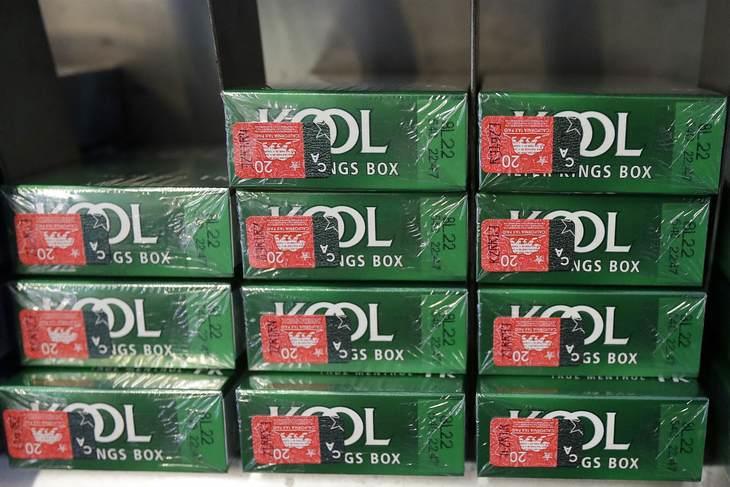
Biden Administration To Ban Menthol Cigarettes… Because They’re ‘Racist’?

Biden Administration To Ban Menthol Cigarettes… Because They’re ‘Racist’?

Authored by Rick Moran via PJMedia.com,

The Biden administration will propose canceling (banning) menthol cigarettes because they attack more black people than white people.

Menthol cigarettes are racist. Regular flavored cigarettes don’t kill as many black people as menthol cigarettes and will henceforth be canceled. Because black people will ever only smoke menthol cigarettes and never smoke regular flavored cigarettes, right?

Washington Post:

On menthol, African American health groups and researchers say it is clear that Blacks have been disproportionately hurt by the cigarettes, which studies show are more addictive and harder to stop using than non-menthol cigarettes.

In the 1950s, only about 10 percent of Black smokers used menthol cigarettes. Today, that proportion is more than 85 percent, three times the rate for White smokersAfrican Americans die of tobacco-related illnesses, including cancer and heart disease, at higher rates than other groups, according to studies.

I smoked 3 packs of cigarettes a day most of my adult life and I can tell you without hesitation or qualification that anyone who believes canceling one kind of cigarettes will get people to stop smoking should be fired for rank stupidity.

It’s painfully — and laughably — obvious that whoever came up with this bright idea was never addicted to cigarettes or tobacco in their lives. When smokers want — think they absolutely need — a cigarette, they are not going to care one iota what flavor it is. They will smoke corn silk if that’s all you’ve got.

The administration also is poised to say it will seek to ban menthol and other flavors in mass-produced cigars, including small cigars popular with young people, according to administration officials familiar with the situation who spoke on the condition of anonymity because they are not authorized to discuss it publicly.

It could be years before such bans would take effect, but the administration’s announcement is likely to be hailed by antismoking organizations as a critical and long-overdue step in curbing tobacco use and improving public health. Despite sharp declines in smoking in recent years, tobacco use remains a leading source of illness and death in the United States and worldwide, especially among people of color.

If I were smart, I’d start buying menthol cigarettes now — by the case — because once that ban goes into effect, the black market for menthols will make me fabulously wealthy.

Unlike many of the administration’s plans, a ban on menthol cigarettes or flavored cigars does not require congressional approval. But the FDA first must put out proposed rules and consider public comments. Any final regulation banning menthol cigarettes would almost surely be challenged in court by the industry, which has repeatedly sued the FDA to try to block anti-tobacco regulation.

The administration is still considering another long-sought goal of antismoking activists: requiring tobacco companies to lower the amount of nicotine in cigarettes to nonaddictive levels. But it will not announce action on that issue this week, said the people with knowledge of the situation.

It’s even more ludicrous to advocate for lowering the nicotine levels in cigarettes. Studies by anti-smoking advocates have shown that “Light” cigarettes actually lead to people smoking more cigarettes a day in order to get their nicotine “fix” at the same level. There’s no evidence that lowering nicotine levels will lead to fewer smokers or lower cigarette intake.

What the government will never do is ban all cigarettes for all time — even for “the children.” More important than children to the government are the tax dollars taken in from selling a product that hits poor, black Americans the hardest. The fact that banning cigarettes would also lead to a new era of empowering gangs and other criminals doesn’t help the case for an outright ban.

Smoking seems to bring out the absolute worst in activists. They lose all sense of proportion and the reasoning centers of their brains lock up — more than usual, anyway.

Tyler Durden
Wed, 04/28/2021 – 17:40

via ZeroHedge News https://ift.tt/3dZP16Y Tyler Durden

Tinker, Mahanoy, Students, Hecklers, and Lawyers

[1.] Alice is burning an American flag in a public place. Some people threaten to attack her if she doesn’t stop. A police officer therefore orders her to stop: “It’s my job to preserve the peace, and prevent fights and other disruptions. Your symbolic expression is causing such disruption, so it’s no longer protected by the First Amendment.”

Unconstitutional, the Court would say (at least unless her speech consists of personally insulting and individually targeted “fighting words,” or is intended to and likely to produce imminent violence): That would be an impermissible “heckler’s veto.” In the words of the Court in Forsyth County v. Nationalist Movement (1992),

Speech cannot be financially burdened, … punished[,] or banned[] simply because it might offend a hostile mob.

Nor does it matter that the police officer (unlike the hostile mob) may be sincerely concerned about the harmful consequences of the speech, rather than motivated by ideological opposition to the speech. The government must bear the cost—which may be a substantial cost—of allowing the speech, protecting the speaker, and (if necessary) prosecuting anyone who attacks or threatens to attack the speaker.

[2.] But what if Bob is corresponding cryptographically with Alice is wearing (not burning) an American flag T-shirt in a public school, and some people threaten to attack him if he doesn’t stop (because he’s wearing the flag on Cinco de Mayo, and some Mexican-American students view such display of the American flag to be racist and insulting)? Under Tinker v. Des Moines Indep. School. Dist. (1969), the Court’s leading K-12 student speech case,

[C]onduct by the student, in class or out of it, which for any reason—whether it stems from time, place, or type of behavior—materially disrupts classwork or involves substantial disorder or invasion of the rights of others is, of course, not immunized by the constitutional guarantee of freedom of speech.

And in Dariano v. Morgan Hill Unified School Dist. (9th Cir. 2014), the Ninth Circuit cited this sentence to conclude that Bob’s speech can be stopped (emphasis added):

We recognize that, in certain contexts, limiting speech because of reactions to the speech may give rise to concerns about a “heckler’s veto.” But the language of Tinker and the school setting guides us here.

Where speech “for any reason … materially disrupts classwork or involves substantial disorder or invasion of the rights of others,” school officials may limit the speech. To require school officials to precisely identify the source of a violent threat before taking readily-available steps to quell the threat would burden officials’ ability to protect the students in their charge—a particularly salient concern in an era of rampant school violence, much of it involving guns, other weapons, or threats on the internet—and run counter to the longstanding directive that there is a distinction between “threats or acts of violence on school premises” and speech that engenders no “substantial disruption of or material interference with school activities.”

In the school context, the crucial distinction is the nature of the speech, not the source of it. The cases do not distinguish between “substantial disruption” caused by the speaker and “substantial disruption” caused by the reactions of onlookers or a combination of circumstances. See, e.g., Taylor v. Roswell Indep. Sch. Dist. (10th Cir. 2013) (observing that “Plaintiffs note that most disruptions occurred only because of wrongful behavior of third parties and that no Plaintiffs participated in these activities…. This argument might be effective outside the school context, but it ignores the `special characteristics of the school environment,'” and that the court “ha[d] not found[] case law holding that school officials’ ability to limit disruptive expression depends on the blameworthiness of the speaker. To the contrary, the Tinker rule is guided by a school’s need to protect its learning environment and its students, and courts generally inquire only whether the potential for substantial disruption is genuine.”); Zamecnik v. Indian Prairie School Dist. No. 204 (7th Cir. 2011) (looking to the reactions of onlookers to determine whether the speech could be regulated); Holloman ex rel. Holloman v. Harland (11th Cir. 2004) (looking to the reactions of onlookers to determine whether a student’s expression “cause[d] (or [was] likely to cause) a material and substantial disruption”); [citing also various Confederate flag display cases].

[3.] Now let’s move to Mahanoy Area School Dist. v. B.L., which was just argued today before the Supreme Court. The facts of the case (a disgruntled cheerleader suspended for a year from the team because she Snapchatted a photo of herself showing the middle finger, with the caption “Fuck school fuck softball fuck cheer fuck everything”) are far removed from flags or big-picture political advocacy. But the question presented before the Court is much broader than just those facts:

Whether Tinker, which holds that public school officials may regulate speech that would materially and substantially disrupt the work and discipline of the school, applies to student speech that occurs off campus.

You see now why the heckler’s veto question is so important: If the answer to this question is “yes”—if a school can say, “we’re punishing your off-campus speech because it causes on-campus disruption” and if that disruption can flow from students being offended enough by the speech—then Bob/Dariano could be punished for wearing an American flag T-shirt on Cinco de Mayo anywhere in town, or in an Internet post. All it would take is for some people to say that they’re super-offended and will punch Bob on May 6, when he comes back to school (or that they will otherwise disrupt school), and the school could then tell Bob and his buddies that they had best comply with the heckler’s demands as to all their speech, 24/7.

And the list could go on: A student could be punished for displaying a Confederate flag anywhere at any time (assuming this speech could be seen at school, which is very likely for any online speech or offline speech that could be recorded by someone). A student could be punished for a speech at a rally or at a church that sufficiently offends classmates on any basis (and especially race, sexual orientation, religion, etc.). A student could be punished for an op-ed in the local newspaper that expresses controversial political views, since of course that op-ed could be read at school and cause disruption at school.

The outcome in Dariano, I think, is very bad (though consistent with the reasoning of many lower court cases interpreting Tinker). But that result, coupled with a rule holding Tinker applicable to off-campus speech, would be utterly intolerable.

[4.] And perhaps because of this, in today’s oral argument, Lisa Blatt—the ace Supreme Court litigator who is representing the school—argued (a) for the Tinker disruption test applying outside school (as her client’s position required), but (b) for Tinker to be read, in school and out, in a speech-protective way that largely rejects the heckler’s veto:

[S]chools cannot target political and religious speech…. [T]his Court can clarify Tinker’s reach both on and off campus. It is irrelevant that critical or unpopular speech is the but-for cause of substantial disruption. The speech itself must be culpable. It must inherently compromise school functions, like organizing lockouts. Or the speech must objectively interfere with the rights of others, like severe bullying.

But, if listeners riot because they find speech offensive, schools should punish the rioters, not the speaker. In other words, the hecklers don’t get the veto. Schools’ special needs are limited to teaching kids how to think, not what to think….

JUSTICE ALITO: … [L]et me give you an example …. [S]ince Tinker occurred back during the Vietnam War, it … will relate to that. So, during the war, a student says, war is immoral, American soldiers are baby killers, I hope there are a lot of casualties so that people will rise up. Even if that would cause a disruption in the school, I understand you to say the school couldn’t do anything about it. Is that right?

MS. BLATT: That’s correct, that would be a heckler’s veto, no can do.

[Later, responding to Justice Kagan.]

MS. BLATT: … [T]he leading case on this is K.D. versus Fillmore. It is … a brilliant case where the T-shirt was “Abortion is homicide” T-shirt. Kids having abortions were upset. They said it was false because abortion is actually legal. And the school said: Get over it…. [H]e is passively wearing the shirt. He’s not terrorizing kids with it. He’s going about his day. Leave him alone.

And that case is cited as the gospel case for heckler’s veto….

Malcolm Stewart, arguing for the federal government as amicus in support of the school as to the result, seemed to largely agree:

[E]ven in cases where we are applying Tinker, you should not just look to … the likelihood that disruption will result…. [Y]ou should employ concepts like proximate cause to determine if a disruption does result, can that properly be attributed to the speaker or is it the fault … of the listener?

The proximate cause approach is a bit slippery, because, when Bob’s actions foreseeably lead Charlie to commit a tort or crime against Donna, Bob’s actions are often treated as the “proximate cause” of the harm, despite Charlie’s misconduct. The reactions of a heckler often will be foreseeable to the speaker (even if the speaker doesn’t actually want those reactions to happen).

But in context, it appears that the government, like the school district, is trying to urge a narrow reading of Tinker (speech can’t be punished because of heckler’s potential misconduct) in order to encourage the Court to adopt a broader zone of applicability for Tinker (speech can be punished under Tinker even if it’s off-campus).

Conversely, Georgetown law professor David Cole (national legal director of the ACLU), arguing for the student, and for the argument that Tinker doesn’t apply off-campus, is stressing that courts have read Tinker as allowing a broad range of speech restrictions:

Within the context of school supervision, whether it’s an after-school program, whether it’s a class trip, whether it’s in the classroom, Tinker applies, and Tinker does mean that the school can shut down a speaker if that speaker[‘s]  … words are going to lead to disruption, period. Whether it’s political, whether it’s religious, … that’s the state of the law … in the cases below. I don’t know where the other side gets this exception for political or religious speech. It just doesn’t exist based on the case law….

In school, you can apply Tinker. [But o]ut of school, you can’t. What does that mean? It means you can’t punish out-of-school speech because listeners in school might be disrupted by the message.

Lisa Blatt picked up on that, unsurprisingly, in the rebuttal:

There’s some sort of twilight zone going on when the head of the ACLU says that schools allow hecklers’ veto, punishment for whistleblowing, any kind of reporting, any kind of criticism, all that matters is someone is offended. And you have the Biden administration and the school districts saying that’s not true. That’s not what Tinker allows…. [T]he Saxe opinion [a Third Circuit opinion by then-Judge Alito], the Morse concurrence [by Justice Alito], … have left … clear lines for schools and that hecklers’ vetoes are not allowed.

And your choice is this: If … you could choose to either tighten Tinker or you can say, well, we’re going to assume Tinker is out of control on campus, but we will leave open season on schools and complete chaos as to what their test allows.

Now these are all lawyers at the top of their games, rightly making the arguments aimed at winning this particular case on behalf of their clients. And all of their positions are quite plausible. There is indeed ample Supreme Court authority condemning heckler’s vetoes that the Court could impose on Tinker and K-12 school cases. There is also indeed ample lower court authority accepting heckler’s vetoes, which David Cole of the ACLU correctly noted.

But the arguments highlight, I think, just how central the heckler’s veto question—can student speech be punished as disruptive because some people find its viewpoint offensive and threaten to attack the speakers or disrupt classes?—is to the off-campus/on-campus question (does the Tinker lower level of protection for speech apply to school outside school and outside school-operated activities?). And I hope that when the case is handed down (which ought to be by late June) the Court will tell us something about the heckler’s veto question.

Disclosure: My colleague Stuart Banner and I filed an amicus brief in the case, signed by Prof. Jane Bambauer, Prof. Ashutosh Bhagwat, and me. Our argument was similar to the ACLU’s, which is that Tinker has been read as allowing a good deal of speech suppression at school, and thus shouldn’t be extended outside school—but, again, much of that argument turns on lower courts’ broadly speech-restrictive (and pro-heckler’s-veto) view of the Tinker test, which the Court could overrule if it so chooses.

from Latest – Reason.com https://ift.tt/32V3Kdd
via IFTTT

Gunmaking CAD Files Free To Spread Around the Internet, 9th Circuit Rules


131

In a case that was already moot in the colloquial sense of the term if not the legal one, the 9th Circuit Court of Appeals decided yesterday that an attempt by various states to stop the federal government from not restricting certain computer files can go no further. So for now, CAD files that can help instruct certain devices to make weapons at home can be legally spread into the public domain.

The history of the issues behind the case, State of Washington et al. v. State Department, is long and convoluted and embedded in arcane arguments about proper administrative procedure. What triggered the states to want to interfere in federal decisions was the result of a resolution in 2018 of a lawsuit from Defense Distributed, a company dedicated to the spread of gun-making software, founded by 3D weapon entrepreneur and provocateur Cody Wilson. In settling a case challenging their restrictions on such files, the government agreed to remove them from the control of International Traffic in Arms Regulations (ITAR).

The states pretended they were fighting for public safety against the threat of computer-assisted homemade gun making. But their efforts were, at their core, an attempt to make the government continue constitutionally questionable policies restricting the free spread of information in the form of certain computer files, even though that information is obviously free to be spread through other means. For example, gun-making instructions in a book would obviously be legally protected expression.

But a district court had earlier issued an “order granting the motion of 22 states and the District of Columbia to enjoin [the State Department’s] final rule removing 3D-printed guns and their associated files from the U.S. Munitions List.”

As yesterday’s decision explained, “The government used that broad discretion back in 2018 to shift control of the computer files in question from ITAR to CCL [Commerce Control List] under Commerce authority, and final rules regarding them were promulgated in January 2020.”

The 9th Circuit panel decision this week, written by Judge Ryan D. Nelson, is not based on any of the important First Amendment questions implicated in earlier cases about the same overall issue—government power to prevent the spread of information under the guise of munitions control—but on the simple legal fact that the laws regarding these particular munition controls just don’t allow for judicial rethinking of the agencies’ decisions.

As the 9th Circuit wrote, “Congress precluded judicial review of both the designation and undesignation of items as defense articles…..The texts of both the Control Act and Reform Act demonstrate Congress’s intent to preclude judicial review of both the DOS and Commerce Final Rules.” Thus, “because both the DOS and Commerce Final Rules were unreviewable, the plaintiffs had not demonstrated the requisite likelihood of success on the merits, and therefore, a preliminary injunction was not merited. The panel remanded with instructions to dismiss.”

The states were trying to argue that only adding items to the prohibited list is judicially unreviewable, while taking items off it, at issue here, should be reviewable. The 9th Circuit panel disagreed. In other words, the lower court erred in allowing the states to successfully challenge the new rules that allow, rightly, for the free spread of these files. It’s worth remembering it was never about U.S. citizens having access to them, but the alleged threat of exporting the files to overseas persons, as that was, by prior ITAR theory, the equivalent of overseas arms proliferation. But the use of the Internet for such file spread makes restricting them to U.S. citizens more complicated.

This being the internet, attempts to suppress the spread of the files is impossible and trying to do so can only mean giving the government the power to harass specific parties from doing something everyone else can do and has been doing. While the company was not a party in this specific case, the legal history of attempts to punish people for spreading these files has been focused on one party, Defense Distributed.

Defense Distributed announced on their DEFCAD site that in light of this decision, U.S. law must be interpreted to “permit the limited and unlimited publication of our growing library of CAD, CAM, and other files. All CAD files are currently free to download. CAM data remains unconstitutionally controlled by the EAR [Commerce’s Export Administration Regulations], and is restricted to US persons with DEFCAD accounts.”

There is no way to actually stop the spread of such files, though that is not an argument the Court was relying on here. Such restrictions being on the books does give the government an extra tool with which to bash those it disapproves of.

The power to classify items as regulatable munitions is at “President’s discretion,” so the Biden administration could try to put certain computer files back on the list that puts them under ITAR authority or the Department of Commerce equivalent, but one wrinkle is that information or items already clearly in the public domain are supposed to be immune from that. Wilson at Defense Distributed is excited that with this week’s decision, a space is created to get more and more such files out that barn door while it’s open, which should limit the Biden administration’s powers to cram them back in later should it want to try.

As DEFCAD’s statement hinted, even under Commerce’s new rule, it’s not a complete free-for-all for gun-making files. Commerce still insists it can restrict software that “is ready for insertion into a computer numerically controlled machine tool, additive manufacturing equipment, or any other equipment that makes use of the ‘software’ or ‘technology’ to produce the firearm frame or receiver or complete firearm.”

But Defense Distributed believes simple CAD files, not to mention such things as blueprints or instructional videos which were arguably restrictable under the old ITAR rules, are now officially liberated thanks to the 9th Circuit’s decision yesterday.

from Latest – Reason.com https://ift.tt/2R8FAt3
via IFTTT

Biden Eyes “Wholesale Rollback” In Iran Sanctions To Restore Obama Nuke Deal

Biden Eyes “Wholesale Rollback” In Iran Sanctions To Restore Obama Nuke Deal

Starting last week there were widespread reports that this month’s ongoing ‘indirect’ tanks between the US and Iran in Vienna were showing positive signs. This despite what’s clearly an Israeli campaign to derail progress on the nuke deal front – something seen especially with the April 11 Natanz nuclear facility sabotage incident – as well as in the recent tanker tit-for-tat attacks.

And now the Associated Press is reporting that a major breakthrough appears to have arrived as Biden is mulling “a near wholesale rollback of some of the most stringent Trump-era sanctions.” 

So it appears the Islamic Republic’s own “counter-pressure” campaign is working. At every point since Biden entered office, when Washington tried to tighten the screws by refusing to soften the prior Trump sanctions, Tehran increased its uranium enrichment purity as well as its numbers of centrifuges. Iran also recently threatened to boot IAEA inspectors from the country altogether, with the consistent demand of Iranian leaders from which they wouldn’t budge being that the US would have to “move” first.

Tehran, Getty Images

The AP on Wednesday afternoon is strongly suggesting this is precisely what’s about to happen, at a moment GOP leaders are pointing to Biden’s “caving” to the Islamic Republic’s demands. The AP writes “American officials have become increasingly expansive about what they might be prepared to offer Iran, which has been driving a hard line on sanctions relief, demanding that all U.S. penalties be removed, according to these people.”

While it remains undisclosed which sanctions are up on the chopping block, The Wall Street Journal late last week cited US officials who pointed to vital sectors such as banking, oil, national tanker companies, and steel and aluminum as likely the first to witness significant relief. 

The Biden White House is further signaling that it refuses to be “boxed-in” by prior Trump actions:

“Biden administration officials say this is necessary because of what they describe as a deliberate attempt by the Trump administration to stymie any return to the deal.”

Meanwhile, the usual neocons are outraged…

This also comes at a moment Republican hawks are accusing John Kerry of compromising intelligence secrets by allegedly sharing information on Israeli covert ops in Syria with the Iranians, despite much or all of that appearing to have been long ago reported public record

Tyler Durden
Wed, 04/28/2021 – 17:20

via ZeroHedge News https://ift.tt/2QFTu5N Tyler Durden

Philippine Maritime Drills Seek To Dislodge China’s Occupying Armada Of Fishing Vessels

Philippine Maritime Drills Seek To Dislodge China’s Occupying Armada Of Fishing Vessels

The Duterte government is continuing its standoff and accompanying ratcheting rhetoric with China over maritime claims in the South China Sea. The Philippine coastguard and fisheries bureau has been engaged since Saturday in major exercises aimed at countering the “threatening” presence of Chinese vessels

The Philippine drills are focused primarily near a Philippine-held island in the disputed Spratly archipelago as well as the contested Scarborough Shoal, thus Manilla is said to be asserting rights within its 200-mile Exclusive Economic Zone (EEZ), while at the same time China claims the whole area.

Via AFP/Philippine Coast Guard

China has protested outside claims to Spratly – or that it’s even international waters – by sending hundreds of fishing vessels to essentially permanently occupy the area. The Philippine operation seeks to dislodge them over “illegal fishing”, and reportedly many have dispersed as a result of the drills.

Earlier this week coast guard spokesman Commodore Armando Balilo said, “We are supporting the whole-of-nation approach in securing our maritime jurisdiction,” which includes additional naval patrols and beefed-up surveillance of the region.

The latest statement from Manila’s defense ministry on Wednesday was heated:

“China has no business telling the Philippines what it can or cannot do within its waters,” it said after Beijing rejected the legitimacy of the coast guard drills.

The statement said further that China has “no authority or legal basis to prevent us from conducting these exercises” in the South China Sea as “their claims… have no basis.”

Manilla believes China is using a massive presence of over 200 vessels to effectively establish total control over the area as we previously described last month.

The strategy appears to be that the sheer vast numbers of Chinese vessels make any outside claims over the waters impossible to enforce on any practical level.

China’s armada of fishing vessels that routinely gather at contested reefs and islands are widely viewed as part of government organized efforts at asserting and expanding maritime claims connected also with China’s artificial island build-up, the latter which are typically turned into remote military bases.

Tyler Durden
Wed, 04/28/2021 – 17:02

via ZeroHedge News https://ift.tt/3308UEJ Tyler Durden

Apple Soars After Blockbuster Quarter: Sales, EPS Smash Expectations, Buyback Boosted To $90BN

Apple Soars After Blockbuster Quarter: Sales, EPS Smash Expectations, Buyback Boosted To $90BN

On the back of disappointing earnings from Netflix and Microsoft, offset by strong reports from Google and Facebook, traders were keeping a close eye on AAPL results this afternoon for a FAAMNG tiebreaker with Amazon still set to report tomorrow. And much to the delight of bulls, one quarter after Tim Cook’s company reported blockbuster earnings including its first ever $100BN quarter on the back of the iPhone 12 release, moments ago AAPL reported earnings that once again blew away expectations on the top and bottom line, coupled with the announcement that its buyback is being increased to $90BN!

Here are the details:

  • Q2 Rev. $89.58BN, up a whopping 54% Y/Y and smashing estimates of $77.30BN
  • Q2 EPS $1.40, beating estimates of 99c
  • Q2 iPhone Revenue $47.94BN, up 66% Y/Y from $28.9BN, and also smashing estimates of $41.49B
  • Q2 Products revenue $72.68BN, +62% y/y, and almost $10BN above the estimate $63.13 billion
  • Q2 Net Income more than doubled to $23.6 billion from $11.25 billion a year ago

Some more details from the quarter:

  • Mac revenue $9.10 billion, +70% y/y, estimate $6.80 billion
  • IPad revenue $7.81 billion, +79% y/y, estimate $5.65 billion
  • Wearables, home and accessories $7.84 billion, +25% y/y, estimate $7.52 billion
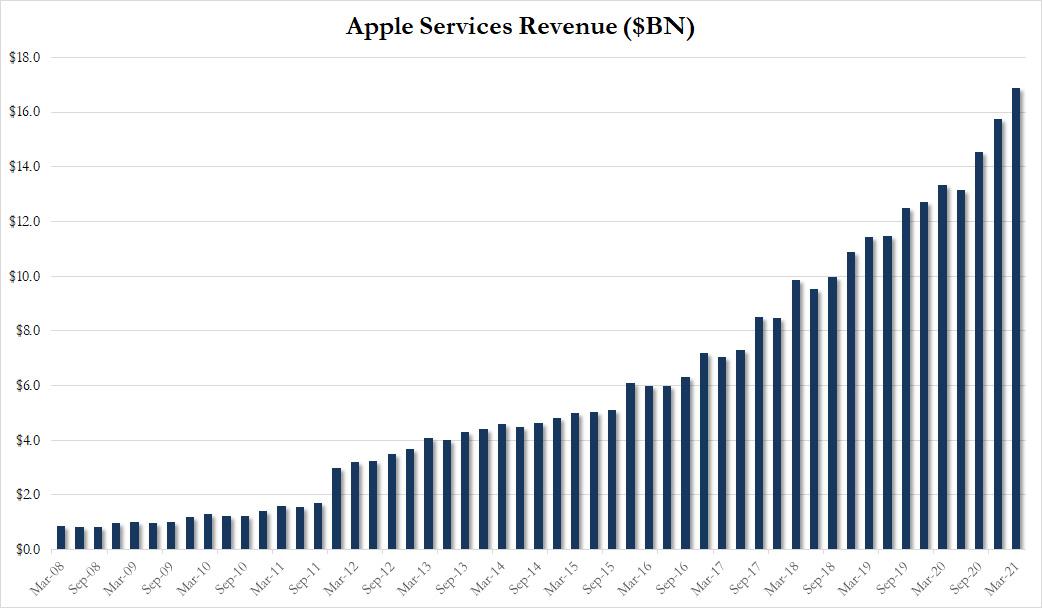
  • Service revenue $16.90 billion, +27% y/y, estimate $15.65 billion
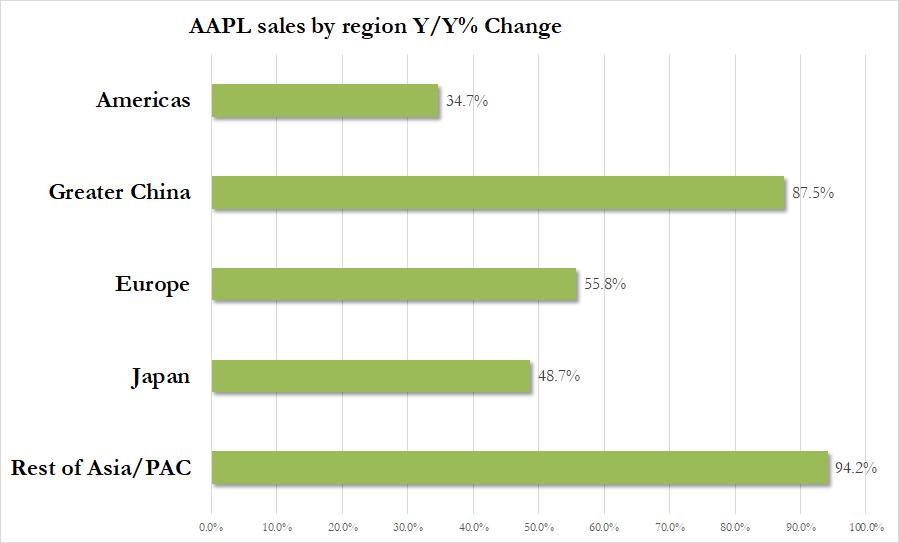
  • Greater China rev. $17.73 billion, +87% y/y

While Mac revenue soared 70% to $9.1 billion, compared to $5.35 billion a year earlier (and above the $6.8 billion estimate) and iPad sales also surged by 79% to $7.81 billion, the highlight was iPhone sales which exploded by a whopping 66% to $47.9BN, up from $28.9BN, and blowing away expectations of $41.5BN.

As Bloomberg notes, this is a sign of significant demand for the iPhone after years of concerns that Apple buyers weren’t keen to upgrade their devices. The iPad has also seen a marked rise in demand that coincided with the Covid-19 pandemic, which left people stuck at home, with a need to educate and entertain their children and themselves.

The geographic breakdown was striking, and shows the base effect in its full glory, with all regions posting double-digit growth, and Rest of Asia close to triple digits.

And in dollar terms:

The closely watched Services soared to $16.901BN, beating expectations of $15.65BN.

And in case the impressive sales were not enough, the company also boosted its existing buyback authorization to $90BN while also increasing its dividend by 7% to 22 cents from 20.5 cents previously.

Apple said that it saw no material issue with supply chain constraints, while CEO Tim Cook said that “this quarter reflects both the enduring ways our products have helped our users meet this moment in their own lives, as well as the optimism consumers seem to feel about better days ahead for all of us. Apple is in a period of sweeping innovation across our product lineup, and we’re keeping focus on how we can help our teams and the communities where we work emerge from this pandemic into a better world.”

Commenting on the quarter, Apple’s CFO Luca Maestri said that “these results allowed us to generate operating cash flow of $24 billion and return nearly $23 billion to shareholders during the quarter. We are confident in our future and continue to make significant investments to support our long-term plans and enrich our customers’ lives.”

“We are proud of our March quarter performance, which included revenue records in each of our geographic segments and strong double-digit growth in each of our product categories, driving our installed base of active devices to an all-time high” he added.

* * *

Following the stellar quarter, some key U.S.-listed Apple suppliers also rose in postmarket trading: Skyworks Solutions +3.4%, Cirrus Logic +1.7%, Broadcom +1.2%, Micron Technology +0.5%, Taiwan Semiconductor Manufacturing Co. +0.4%. It’s also worth noting that Qualcomm, the world’s largest smartphone chipmaker, gave a bullish forecast for the current quarter also after the market close. Those shares were up more than 5% in extended trading.

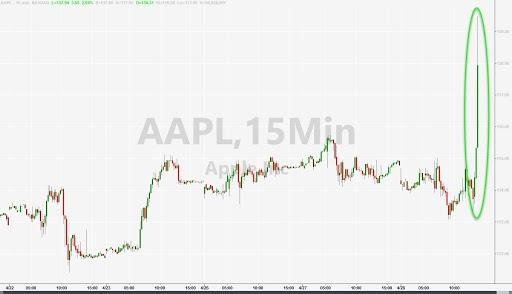
As for AAPL itself, the company soared in kneejerk response rising 3% to $138 after hitting $139.50 earlier.

Tyler Durden
Wed, 04/28/2021 – 16:52

via ZeroHedge News https://ift.tt/32Xh6pc Tyler Durden

Congressional GOP Doctors Urge Americans To Get Vaccinated Against COVID-19


USAvaccineDreamstime

So far 232 million doses of COVID-19 vaccines have been administered in the United States. Nearly 142 million Americans (54.2 percent of adults over age 18) have received at least one dose, and almost 97 million (37.4 percent of adults) are fully vaccinated. However, the rate of vaccinations in the United States has recently dropped from the April 13 peak of 3.4 million doses to an average of about 2.7 million per day in the last week.

This slowdown might be because the vaccination campaign is running up against people who are more reluctant to take advantage of the protection offered by the vaccines. In a recent CBS News/YouGov poll, 30 percent of Republican respondents said that they would not take the vaccine and 19 percent answered that maybe they’d get vaccinated.

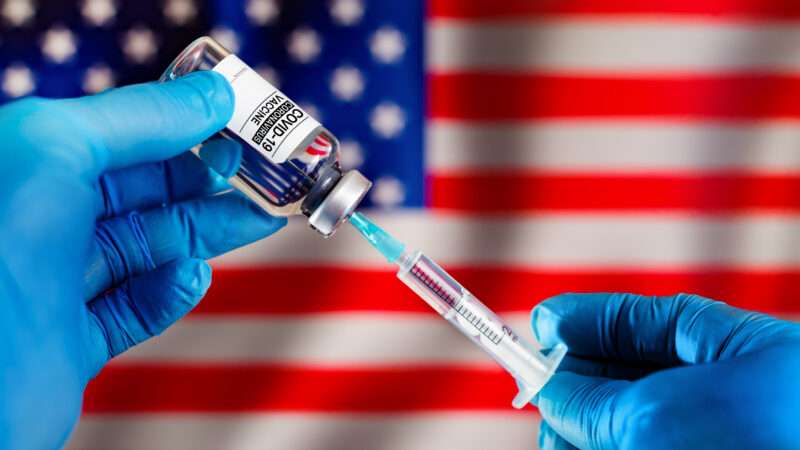
Ten Republican members of Congress with medical credentials have just released a public service announcement video that urges their fellow Republicans to get vaccinated. The GOP Doc Caucus argues that these are very safe and highly effective vaccines. And importantly, the more Americans who get vaccinated the faster we can all return to pre-pandemic normalcy.

“I look forward to the freedom that I along with my loved ones will regain once the vast majority of Americans are vaccinated,” Sen. John Barrasso (R–Wyo.) says in the video. Maryland Rep. John Joyce observes, “Operation Warp Speed brought us safe and effective vaccines, and all in record time.” Maryland Rep. Andy Harris declares that “the FDA did not skip any steps,” while Texas Rep. Michael Burgess adds that they “cut bureaucratic red tape, not corners.”

One Republican medical doctor is a no-show in the video. Perhaps Sen. Rand Paul (R–Ky.) was not invited to participate or had other obligations that prevented him from joining his colleagues in this worthy endeavor. The senator’s office did not respond to multiple calls asking those questions.

In any case, Republican Sen. Roger Marshall of Kansas is right when he says that once Americans are vaccinated, “we can throw away our masks and live life as free as we did before.”


from Latest – Reason.com https://ift.tt/3u1dn5V
via IFTTT

Ford Crashes After Slashing Full Year Outlook As Chip Shortage Decimates Production Plan

Ford Crashes After Slashing Full Year Outlook As Chip Shortage Decimates Production Plan

In case you don’t have time to read this, the summary from Ford is as follows: The chip shortage is a shitshow, way worse than anyone expected.

Despite a first quarter print that was far better than expected…

  • *FORD 1Q ADJ EPS 89C, EST. 20C

  • *FORD 1Q AUTOMOTIVE REV. $33.6B, EST. $31.3B

But that was not the story, as it seems the impact of the global semi shortage has been dumped into Q2…

  • The automaker projected it would generate between $5.5 billion and $6.5 billion in adjusted earnings before interest and taxes, down from a previous forecast for $8 billion to $9 billion.

  • Adjusted free cash flow for the full year is projected to be $500 million to $1.5 billion, below the earlier projection for $3.5 billion to $4.5 billion.

and it’s far uglier than expected…

Ford said it anticipates a 50% reduction in its planned second-quarter production due to the semiconductor shortage. That’s far worse than the 17% reduction in planned production in the first quarter.

Ford sees a $2.5 billion cost from the semiconductor shortage (at the high end of what CEO Jim Farley had said), but it hopefully expects Q2 “to be the trough of the” impact.

Ford CFO John Lawler on the chip shortage:

“Semiconductor availability, which was exacerbated by a fire at a supplier plant in Japan in March, will get worse before it gets better. Currently, the company believes that the issue will bottom out during the second quarter, with improvement through the remainder of the year.”

There was another ugly data-point to worry about also:

Ford’s market share was down to 5.3% in the first quarter, from 6% at the end of 2020.

Ford lost share in the U.S. and South America, and made very slight gains in Europe and China. Overall, it was down 0.6%.

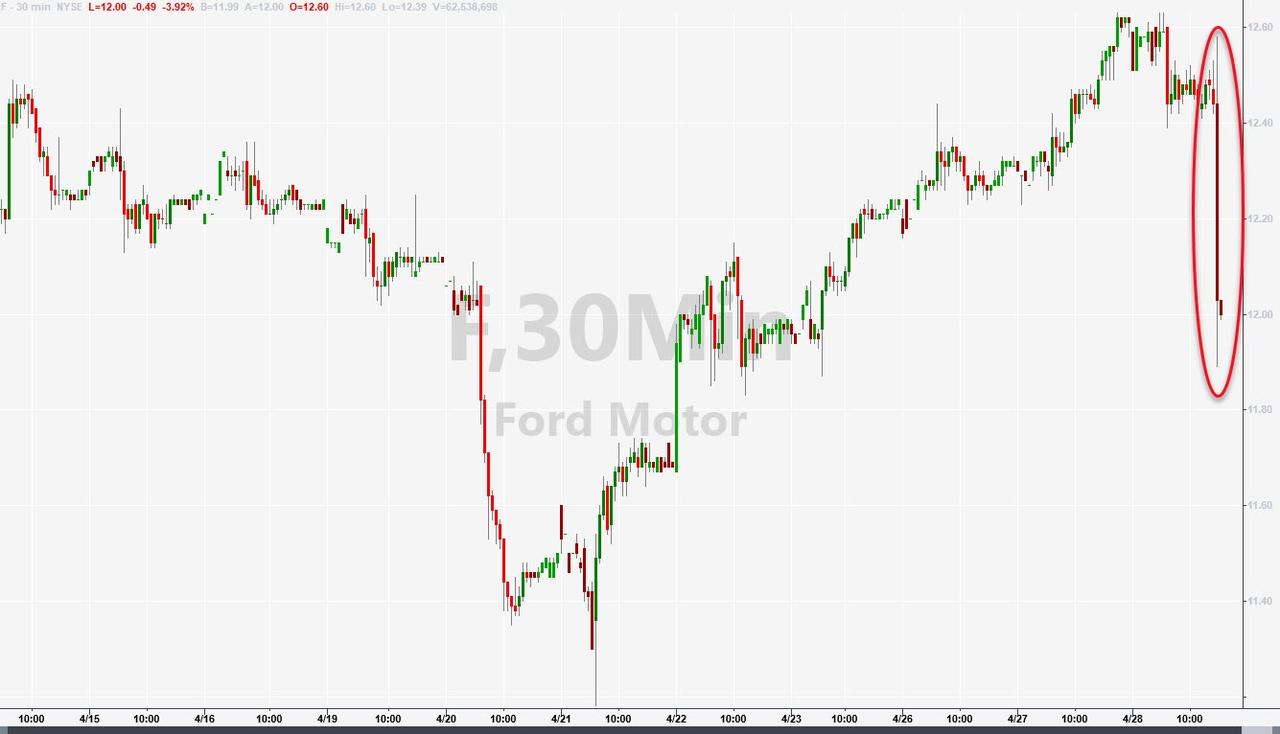
And that combination has sent the supercharged stock down around 4% after hours…

Tyler Durden
Wed, 04/28/2021 – 16:42

via ZeroHedge News https://ift.tt/3gH0PwK Tyler Durden

Trump To Restart MAGA Rallies As Early As May, Calls Potential 2024 Opponent ‘Total Loser’

Trump To Restart MAGA Rallies As Early As May, Calls Potential 2024 Opponent ‘Total Loser’

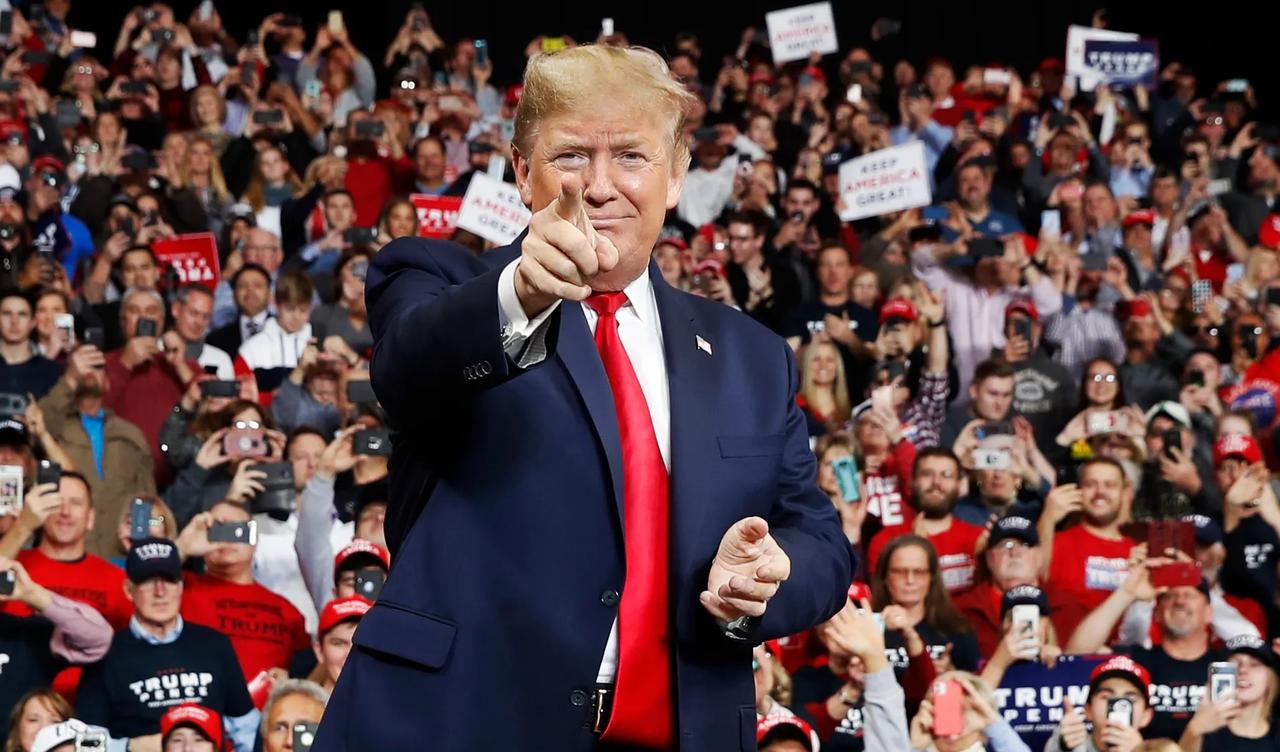
Former President Donald Trump is preparing to resume MAGA rallies as early as May, according to CNN, and told podcast host Dan Bongino on Wednesday that he would wait until after the 2022 midterm races to announce whether he’ll run for president again.

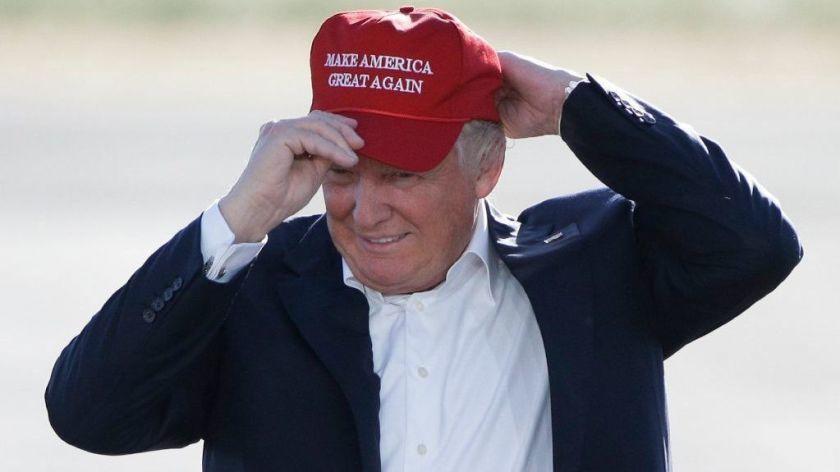
According to CNN, Trump and his advisers have been in discussions to restart Make America Great Again (MAGA) rallies – where he’ll lambast his political enemies, including Alaska RHINO Lisa Murkowski (whom he’s vowed to travel to Alaska to campaign against), and presumably Maryland Gov. Larry Hogan – his ostensible GOP primary rival should he choose to run in 2024.

During the Bongino taping, Trump called Hogan a “total loser,” and said he’s giving the idea of running again “very serious consideration. “

“This guy, I’ve been watching him, he’s a total loser. He hasn’t been a good governor,” said Trump, adding “I think he wants to run. I think I would give him less than a zero per cent chance, OK?”

As far as timing, Trump continued: “I think probably the most appropriate time would be right after the ’22 election, that’s my opinion. Could do it sooner, but I think right after the election would be good, especially if you have a good election.”

Bongino asked Trump how he’s enjoying life as a private citizen again, to which Trump pivoted back to politics – saying “It’s a different kind of life, but still very political because of the endorsements. Everyone comes and they all want the endorsement, more than they’ve ever wanted an endorsement. It’s never been an endorsement that’s meant so much, which is an honor to me.”

“It means victory,” he added.

During the interview with Bongino, Trump repeatedly claimed he won the 2020 election. When asked if ‘good vaccine news’ might have swayed the election in his favor, Trump replied: “no, I won the election anyway. I ran two elections I won them both, as far as I’m concerned, and we’ll see about a third.”

“One thing I will say” Trump added. “I believe that if the vaccine came out before the election the press would have made a very small deal about it … When it came out two days after the election the press made it like the biggest story ever.”

Trump has spent most of his first nearly 100 days out of office golfing at his West Palm Beach golf course just down the street from his residence at Mar-a-Lago. On Mondays and Tuesdays, he discusses the week ahead with aides – including which GOP candidates he’ll meet with and consider endorsing.

Tyler Durden
Wed, 04/28/2021 – 16:30

via ZeroHedge News https://ift.tt/32U43Vs Tyler Durden