Visualizing The Richest Families In America

Visualizing The Richest Families In America

When we think about the richest people in America, individual names often come to mind like Elon Musk, Jeff Bezos, and Bill Gates. But often, as Visual Capitalist’s Avery Koop details below, it’s the the richest families in America that hold a deeper legacy, and sometimes, even deeper pockets.

The country’s 50 richest families hold a collective wealth of $1.2 trillion. This ranking goes beyond nuclear family units and self-made fortunes, and it instead measures the wealth of multi-generational or extended families.

Our visualization, which leverages the latest data from Forbes, reveals the wealthiest families in America and the enterprises that helped them earn their billions.

Editor’s note on methodology: in this ranking, Forbes leaves out self-made entrepreneurs that appear with their nuclear families on the billionaires list. For example, Jeff Bezos founded Amazon and Rupert Murdoch founded News Corp, but these successes did not come from family wealth that was passed down to them.

Family Matters

Say the name Rockefeller or Vanderbilt, and everyone knows who you’re talking about—but how do these household names hold up in the modern rankings?

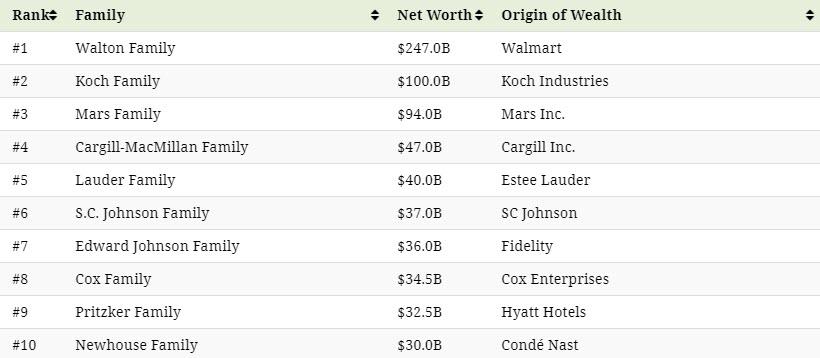
Below are the 10 richest families in America, based on net worth:

The richest family in the U.S. is the Waltons, founders of Walmart. Their net worth adds to an approximate $247 billion, making them also the richest family in the world. Over the last year, they’ve grown their family fortune by $25 billion, equal to nearly $3 million per hour.

Interestingly, the Vanderbilts—the railroad tycoons that were once the richest family in the country in the late 19th century—have been ousted from the rankings entirely. Other notable American families, like Ford and Astor, have lost their place on the list as well.

On the other hand, the Rockefellers still hold their status today, ranked at number 43 with a net worth of $8.4 billion. John D. Rockefeller became America’s first billionaire back in 1916, despite the breaking up of Standard Oil for antitrust reasons.

Building Wealth

Over the last five years, nearly every family on this list has seen wealth increase. Many of the behemoth companies on which these families built their fortunes are staples in America, like Campbell’s Soup, Cargill, Dixie Cups, Estee Lauder, and M&Ms and Snickers.

For example, the South’s beloved fast food chain, Chick-fil-A, was founded by the Cathy family and generated $12.67 billion in sales as of the latest annual data, making it the third most popular chain restaurant in the country.

Some of the newer families to make the list also owe it to the success of their enterprises:

  • The Kohler family: Kohler Co. (manufacturers of kitchenware, plumbing products, furniture, etc.)

  • The Taylor family: Enterprise Rent-A-Car (car rental services)

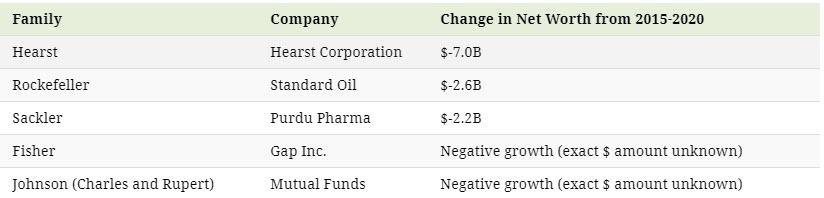
However, a few families have experienced significant losses since the last Forbes ranking. Here’s a look at some notable net worth decreases:

Purdue Pharma recently filed for bankruptcy. The Sackler family’s plan is to reformulate the company into a new venture whose profits would go towards the opioid crisis, for which they are largely blamed. It would also cost the family around $4.3 billion directly.

Keeping it in the Family

While some families may have experienced decreases in their wealth, for many this is just a small bump in the road.

Overall, the richest families in America are the keepers of immense wealth that has accumulated over generations. For some, their names are now cultural landmarks across the U.S. and their brands have become synonymous with life in America.

Tyler Durden
Fri, 04/02/2021 – 23:00

via ZeroHedge News https://ift.tt/3rMEz6n Tyler Durden

US Army Seeks Long-Range Missiles In Pacific To Face China

US Army Seeks Long-Range Missiles In Pacific To Face China

Authored by Dave DeCamp via AntiWar.com,

As part of its modernization efforts, the US Army is developing medium and long-range missiles, which the service sees as a vital weapon in a potential conflict with China in the Pacific.

While the Army is traditionally a land-based service, it is developing fast-moving island-hopping forces that can sink ships in the western Pacific, similar to what the Marine Corps has traditionally done.

Image: US Air Force

On Tuesday, US Army leaders discussed the service’s future in the Indo-Pacific and said the Army is not trying to compete for funding with the Marine Corps or other branches as military leaders fear resources will be limited.

“The systems we’re developing are more along the lines of a campaign rather than quickly expeditionary-type systems. And so I don’t see us in competition with the Marine Corps.” Chief of Staff of the Army Gen. James McConville told the Center for Strategic and International Studies.

Gen. Paul LaCamera, the head of US Army Pacific, said the Army could complement the Marines in the region. “So, I think whether they [the Marines] are there first [and] we come in behind them, that allows them to continue to move on,” he said.

The US Marines are also in the process of revamping their forces to prepare for a future conflict in the Pacific. US-Indo Pacific Command has its hand out to Congress for an additional $27 billion in funding.

Part of the command’s wishlist includes a network of long-range missiles near China’s coast, although it’s not clear what countries would be willing to host the missiles.

The Army officers were asked on Tuesday how the US could get allies in the region to host such missiles. “That’s a political decision,” McConville said. “The [Biden] administration will, I believe, lead with a policy, and that will be shaped by diplomacy between our countries.”

Tyler Durden
Fri, 04/02/2021 – 22:30

via ZeroHedge News https://ift.tt/3cQmctj Tyler Durden

“Find Of The Century” –  Rare 1955 Porsche 550 Spyder Found In Shipping Container 

“Find Of The Century” –  Rare 1955 Porsche 550 Spyder Found In Shipping Container 

Bobby Green of Old Crow Speed Shop uncovered a rare 1955 Porsche 550 Spyder in an old shipping container in a remote area of Orange County, California. The Old Crow Speed Shop owner describes the rare Porsche as the “find of the century.” 

On Mar. 26, Old Crow Speed Shop’s Facebook page posted a picture of a weathered green shipping container. The post read: 

“You won’t believe what @large_hands_grant and I found in this shipping container! Stay tuned, I will reveal it later today. Anyone care to take a guess? 

About two hours later, on that Friday, Old Crow Speed Shop revealed they found what appears to be a pristine 1955 Porsche 550 Spyder. Baby boomers may remember the sportscar is the same one that American actor James Dean died in. Only 90 of the 1200-pound aluminum-bodied cars were ever built, making it an extremely rare car. About three years ago, only of these cars sold for $4.5 million at Pebble Beach. 

In what usually turns out to be a barn find, Old Crow Speed Shop posted a lengthy Facebook post on uncovering the rare Porsche from a shipping container: 

The find of the century!…. At least for me anyway. And to think it all started by chasing old motorcycles.

A fellow named Les Gunnerson passed away and left a large British motorcycle collection at the top of a remote hill in Orange California which @large_hands_grant and @mikedavis70 got wind of and thankfully called me to come take a look. As it turns out, Les was big into Porsche’s back in the 60’s/70’s and acquired a 550 Spyder in ’63 from Loretta Turnbull who raced it in Hawaii for a mere 2k. Les restored the 550 in the early 80’s but soon got into motorcycles and just put the Porsche in a shipping container where it’s lived for 35 years. …….Until now.

To say the 550’s are rare and valuable is an understatement, and to find one that’s been lost to time in a container, … Well, that’s like finding a unicorn with bigfoot riding it… it just doesn’t happen! Or does it?

It’s been a surreal experience indeed! I’m not only honored to say I was part of the discovery, but equally so that I could help find a new home for such a priceless vehicle. I immediately called my friend and filmmaker Blue Nelson because I knew he grew up with these cars in the family and knew the top Porsche collectors in the world. Porsche 550 Spyder serial #0069 with its original 4 cam motor #0075 is off to a very good home where it will be preserved and enjoyed by many.

Here are pictures of the iconic car:

Car enthusiasts on Facebook responded to the find by saying, “Keeping Automotive History Alive!.” 

Another person said, “So nuts! Awesome awesome awesome. I’m pretty sure This just landed you a visit from Jerry Seinfeld, the Porsche nut.” 

Old Crow Speed Shop also posted a video on the find. Watch here:

Tyler Durden
Fri, 04/02/2021 – 22:00

via ZeroHedge News https://ift.tt/3cJWNBe Tyler Durden

The Pending Collapse Of The “Rules-Based International Order” Is An Existential Threat To The US

The Pending Collapse Of The “Rules-Based International Order” Is An Existential Threat To The US

Authored by Scott Ritter via GlobalResearch.ca,

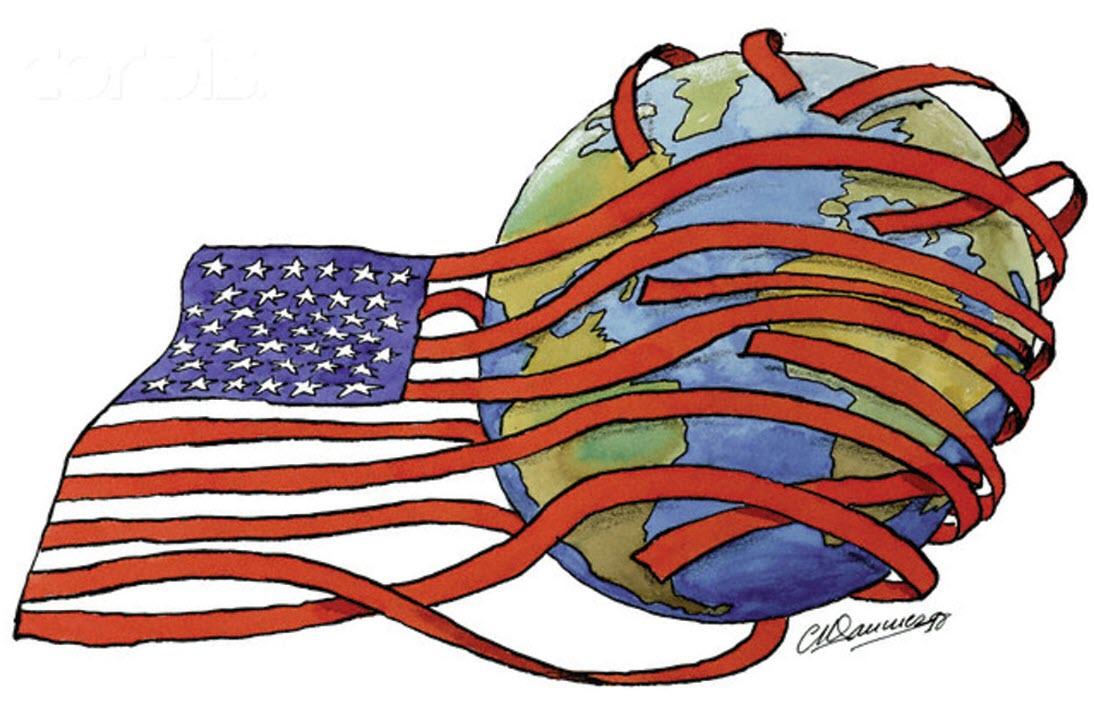
For decades, America styled itself the ‘indispensable nation’ that led the world & it’s now seeking to sustain that role by emphasizing a new Cold War-style battle against ‘authoritarianism’. But it’s a dangerous fantasy.
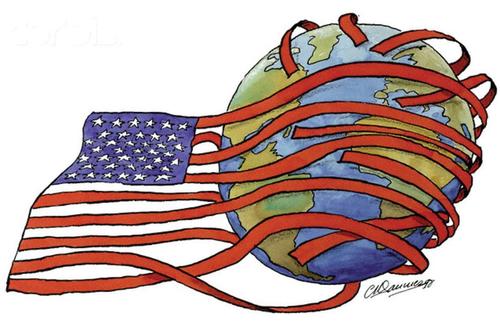
It seems a week cannot go by without US Secretary of State Antony Blinken bringing up the specter of the ‘rules-based international order’ as an excuse for meddling in the affairs of another state or region.

The most recent crisis revolves around allegations that China has dispatched a fleet of more than 200 ships, part of a so-called ‘maritime militia’, into waters of the South China Sea claimed by the Philippines. China says that these vessels are simply fishing boats seeking shelter from a storm. The Philippines has responded by dispatching military ships and aircraft to investigate. Enter Antony Blinken, stage right:

“The United States stands with our ally, the Philippines, in the face of the PRC’s maritime militia amassing at Whitsun Reef,” Blinken tweeted“We will always stand by our allies and stand up for the rules-based international order.”

Blinken’s message came a mere 18 hours after he tweeted about his meeting in Brussels with NATO.

“Our alliances were created to defend shared values,” he wrote“Renewing our commitment requires reaffirming those values and the foundation of international relations we vow to protect: a free and open rules-based order.”

Our rules, our order

What this actually means, of course, is that the order is rules-based so long as it is the nation called America that sets these rules and is accepted as the world’s undisputed leader.

Blinken’s fervent embrace of the ‘rules-based international order’ puts action behind the words set forth in the recently published ‘Interim National Security Strategy Guidance’, a White House document which outlines President Joe Biden’s vision “for how America will engage with the world.” 

While the specific term ‘rules-based international order’ does not appear in the body of the document, the precepts it represents are spelled out in considerable detail, and conform with the five pillars of the “liberal international order” as set forth by the noted international relations scholars, Daniel Duedney and G. John Ikenberry, in their ground-breaking essay, ‘The nature and sources of liberal international order’, published by the Review of International Studies in 1999.

The origins of this “liberal international order” can be traced back to the end of the Second World War and the onset of a Cold War between Western liberal democracies, helmed by the United States, and the communist bloc nations, led by the Soviet Union and the People’s Republic of China. The purpose of this order was simple – to maintain a balance of power between the US-led liberal democracies and their communist adversaries, and to maintain and sustain US hegemony over its liberal democratic allies.  This was accomplished through five basic policy ‘pillars’: Security co-binding; the embrace of US hegemony; self-limitation on the part of US allies; the politicization of global economic institutions for the gain of liberal democracies; and Western “civil identity.”

All five are emphasized in Biden’s interim guidance, in which the president openly advocates for “a stable and open international system.” It notes that “the alliances, institutions, agreements, and norms underwriting the international order the United States helped to establish are being tested.” 

The faltering empire’s flaws and inequities

Biden also observed that the restoration of this international order “rests on a core strategic proposition: The United States must renew its enduring advantages so that we can meet today’s challenges from a position of strength. We will build back better our economic foundations; reclaim our place in international institutions; lift up our values at home and speak out to defend them around the world; modernize our military capabilities, while leading first with diplomacy; and revitalize America’s unmatched network of alliances and partnerships.”

All five of Duedney’s and Ikenberry’s policy ‘pillars’ can be found embedded in these – and other – statements contained in the guidance.

There is a defensive tone to Biden’s guidance, which notes that “rapid change and mounting crisis” have exposed “flaws and inequities” in the US-dominated international system which “have caused many around the world – including many Americans – to question its continued relevance.” 

Here Biden runs into the fundamental problem of trying to justify and sustain a model of economic-based global hegemony which was founded at a time when the existence of a Western liberal democratic “order” could be justified as a counter to the Soviet-led communist bloc. The Cold War ended in 1990. The ‘international rules-based order’ that was created at the behest of the US to prevail in this conflict continued, however. It seems that the US wasn’t simply satisfied with preventing the spread of communism; its raison d’être instead transitioned from being the leader of an alliance of liberal democracies, to being the global hegemon, using the very system devised to confront communism to instead install and sustain the US as the undisputed dominant power in the world.

This trend began in the immediate aftermath of the end of the Cold War, where the US had the opportunity to pass the baton of global leadership to the United Nations, an act that would have given legitimacy to the notion of an ‘international order’.

This, however, proved a bridge too far for the neo-liberal tendencies of the administration of President Bill Clinton, who continued the Cold War-era practice of using the UN as a vehicle to promote US policy prerogatives at the expense of the international ‘order’. Clinton’s Secretary of State Madeleine Albright helped coin the term “indispensable nation” when defining America’s post-Cold War role in the world (it is notable that Blinken recently praised Albright in a tweet, noting that “her tenacity & effectiveness left the US stronger & more respected globally,” and adding “she’s a role model for me & so many of our diplomats.”)

The arrogance and hubris contained in any notion of a single nation being “indispensable” to the global order is mind-boggling and is reflective of a disconnect with both reality and history on the part of those embracing it.

The myth of indispensability

The unsustainability of the premise of American ‘indispensability’ was demonstrated by both the events of September 11, 2001, and the inability of the US to deal with its aftermath. Had the US embraced and acted on President George H. W. Bush’s notion of a “new world order” in the aftermath of the Cold War, it would have found itself as a vital world leader working in concert with a global community of nations to confront the scourge of Islamic fundamentalist-based terrorism. But this was not to be.

Instead, the ‘indispensable nation’ was exposed as a fraud, with many in the world recognizing the US not as a power worthy of emulation, but rather as the source of global angst. This rejection of America’s self-anointed role as global savior extended to many Americans too, who were tired of the costs associated with serving as the world’s police force.

Indeed, this exhaustion with global intervention, and the costs accrued, helped create the foundation of electoral support for Donald Trump’s rejection of the “rules-based international order” in favor of a more distinct “America first” approach to global governance. What gave Trump’s policy so much “punch” was the fact that not only did many American citizens reject the “rules-based international order,” but so did much of the rest of the world.

Repairing the damage done by four years of Trump has become the number one priority of the Biden administration. To do this, both Biden and Blinken recognize that they simply cannot return to the policy formulations that existed before Trump took office; that ship has sailed, and trying to sell the American people and the rest of the world on what many viewed as a failed policy construct (i.e., unilateral, uncontested American hegemony) was seen as an impossible task.

Instead, the Biden administration is seeking to reinvent the original premise of the ‘rules-based international order’ by substituting Russian and Chinese ‘authoritarianism’ in place of Soviet-led communism as a threat which liberal democracies around the world willingly and enthusiastically rally around the US to confront.

“Authoritarianism is on the global march,” Biden’s guidance observed, “and we must join with like minded allies and partners to revitalize democracy the world over. We will work alongside fellow democracies across the globe to deter and defend against aggression from hostile adversaries. We will stand with our allies and partners to combat new threats aimed at our democracies” and which “undermine the rules and values at the heart of an open and stable international system.”

Biden concluded his essay in dramatic fashion. “This moment is an inflection point,” he noted. “We are in the midst of a fundamental debate about the future direction of our world. No nation is better positioned to navigate this future than America. Doing so requires us to embrace and reclaim our enduring advantages, and to approach the world from a position of confidence and strength. If we do this, working with our democratic partners, we will meet every challenge and outpace every challenger. Together, we can and will build back better.”

No longer the world’s undisputed No.1

While postulated as a statement of American strength, Biden’s concluding remarks actually project not only the inherent insecurity of the US today, but also its root causes. The fact that the US needs to “reclaim our enduring advantages”implies that we lost them, and illustrates that these so-called advantages are not nearly as enduring as Biden would like to think. “Building back better” is an admission of weakness, a recognition that the notion of an ‘indispensable nation’ is an artificial construct; most nations no longer accept America as the world leader.

The reality is that the US is one of the most powerful nations in the world. That position, however, is no longer uncontested; China has emerged as the equal of the US in many metrics used to measure global power and influence, and superior in some. Moreover, China operates effectively in a multi-polar global reality, recognizing that the era of the American singularity is over. Russia, India, Brazil, and the European collective all represent polar realities whose existence and influence exists independent of the US.

The US, however, cannot function in such a world. While there is a growing recognition among American politicians that the post-Cold War notion of the US being the sole-remaining superpower has run its course, the only alternative these politicians can offer is the attempt to return to a bi-polar world which has the US at the head of its liberal democratic ‘partners’, facing off against the forces of ‘authoritarianism’. This vision, however, is unrealistic, if for no other reason that the world no longer views Western liberal democracy as ‘good’, and authoritarianism as ‘evil’.

This reality is evident to much of the rest of the world. Why, then, would US policy makers embrace a formulation doomed to fail? The answer is simple – the US, as it exists today, needs the ‘rules-based international order’ to remain relevant. Relevant, as used here, means globally dominant.

US politicians who operate on the national level cannot get elected on platforms that reject the ‘indispensable’ role of the country, even if many Americans and most of the world have. US economic dominance is in large part sustained by the very systems that underpin the ‘rules-based international order’ – the World Trade Organization and the World Bank. US geopolitical relevance is sustained by Cold War-era military alliances.

An unviable, unsustainable future

An American retreat from being the ‘indispensable’ power, and a corresponding embrace of a leadership role based upon a more collegial notion of shared authorities, would not mean the physical demise of the US – the nation would continue to exist as a sovereign entity. But it would mean an end to the psychological reality of America as we know it today – a quasi-imperial power whose relevance is founded on compelled global hegemony. This model is no longer viable. The fact that the Biden administration has chosen to define its administration through an ardent embrace of this failed system is proof positive that the survival of post-Cold War American is existentially connected to its ability to function as the world’s ‘indispensable nation’.

American exceptionalism is a narcotic that fuels the country’s domestic politics more than global geo-political reality. The ‘rules-based international order’ that underpins this fantasy is unsustainable in the modern era and makes the collapse of the “exceptional” United States inevitable.

Watching the Biden administration throw its weight behind a US-dominated ‘rules-based international order’ is like watching the Titanic set sail; it is big, bold, and beautiful, and its fate pre-ordained.

Tyler Durden
Fri, 04/02/2021 – 21:30

via ZeroHedge News https://ift.tt/3rQ69Qe Tyler Durden

Viagra May Also Lengthen A Man’s Lifespan, Swedish Study Finds

Viagra May Also Lengthen A Man’s Lifespan, Swedish Study Finds

Popping a Viagra pill isn’t just for the tens of millions of baby boomer men trying to maintain a healthy sex life – it may be connected to extending their lifespan. 

Researchers at the Karolinska Institutet in Sweden published a new report that finds the erectile dysfunction pill can help cardiovascular disease patients.

The study, titled “Association of Phosphodiesterase-5 Inhibitors Versus Alprostadil With Survival in Men With Coronary Artery Disease,” was recently published in the American College journal Cardiology. The results show men with coronary artery disease who have been prescribed Viagra due to impotence seem to have a healthier life and lower risk of experiencing a heart attack. 

When men enter their golden years, at least 70% of them experience impotence: blood flow problems affect the legs, high blood pressure, and high cholesterol. The disorder is treated with alprostadil, which dilates the blood vessels and helps stimulate the penis, or with PDE5 inhibitors such as Viagra. The pills are taken before sex to increase blood flow before the mood is right. 

“Potency problems are common in older men, and now our study also shows that PDE5 inhibitors may protect against heart attack and prolong life,” stated lead author Martin Holzmann of the Karolinska Institute. “The protection was dose-dependent, so that the more frequent the dose of PDE5 inhibitor, the lower the risk.”

Holzmann and his research team suggest men who have already sustained a heart attack and take Viagra or Cialis in tablet form showed signs of prolonged life expectancy and a decrease against new infarctions and heart failure.

The study included 16,548 Swedish men who had both erectile dysfunction and heart disease. About 2,000 of the test subjects received alprostadil and the remaining Viagra.

Holzmann said, “PDE5 inhibitor may protect against heart attack and prolong life.” 

So erectile dysfunction could be an early sign of cardiovascular disease, and the possible treatment to promote longer lifespans in older men could be with Viagra or Cialis. Who would have ever thought?

Tyler Durden
Fri, 04/02/2021 – 21:00

via ZeroHedge News https://ift.tt/3rSlWhG Tyler Durden

FBI Gun Background Checks Soar To Record High In March Amid Gun Control Push

FBI Gun Background Checks Soar To Record High In March Amid Gun Control Push

Authored by Zachary Stieber via The Epoch Times (emphasis ours),

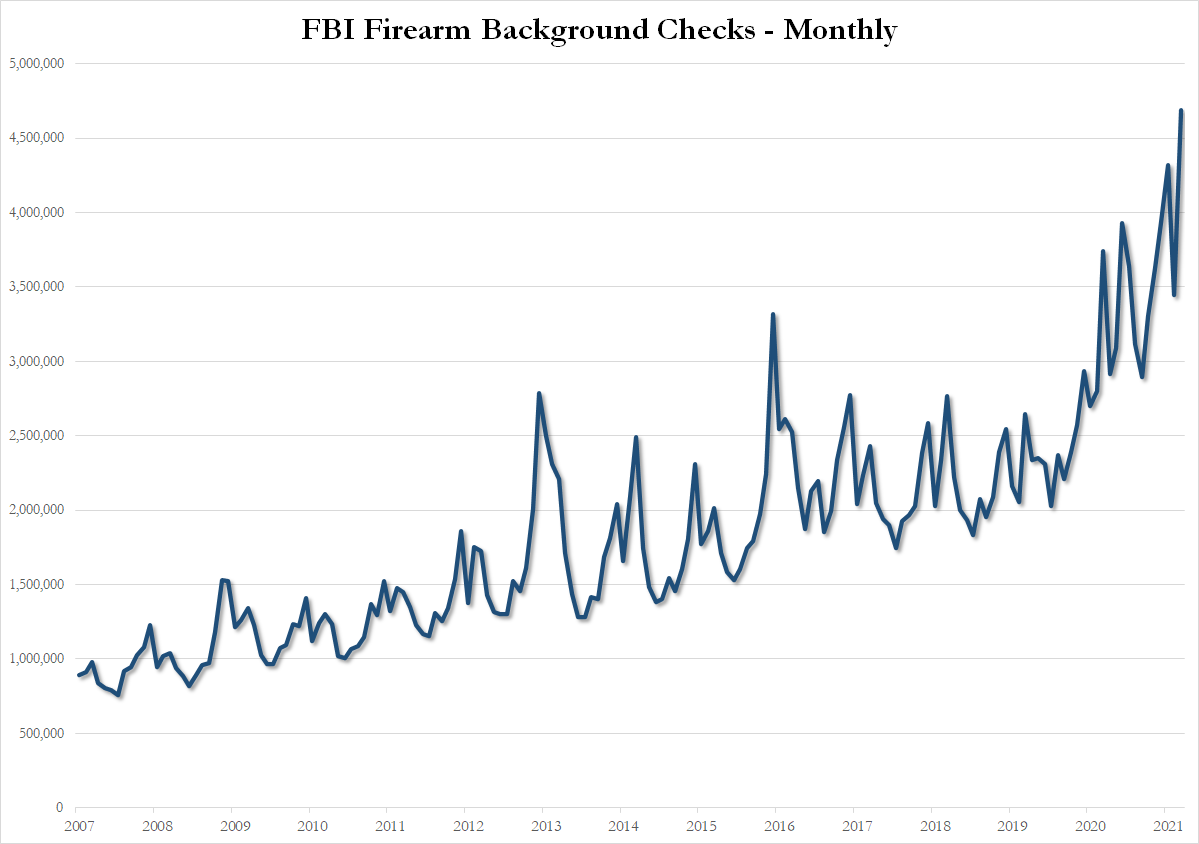
Background checks for firearms conducted by the FBI reached a new record high in March.

Firearms are seen at a gun shop in Richmond, Va., on Jan. 13, 2020. (Samira Bouaou/The Epoch Times)

Nearly 4.7 million checks were done across the month, smashing the previous record of 4.3 million set in January.

Chart: ZeroHedge

The FBI numbers include background checks for firearms, permits, and other purposes related to guns.

Adjusted numbers from the National Shooting Sports Foundation provided to The Epoch Times shows the gun checks alone in March were 2 million. That is the second highest number on record, after the 2.3 million checks completed in March 2020.

The COVID-19 pandemic conditions and the push for gun ownership restrictions are propelling Americans to buy more guns, Mark Olivia with the foundation told The Epoch Times.

“I think as long as you continue to see these misguided calls for gun control to chip away the rights of law abiding citizens and not look at legislation that’s going to keep firearms out of the hands of criminals, firearms on the hands of those who are adjudicated mentally defective, you’re going to continue to see Americans go out and exercise their right before that right is seized from them by their government,” Olivia said.

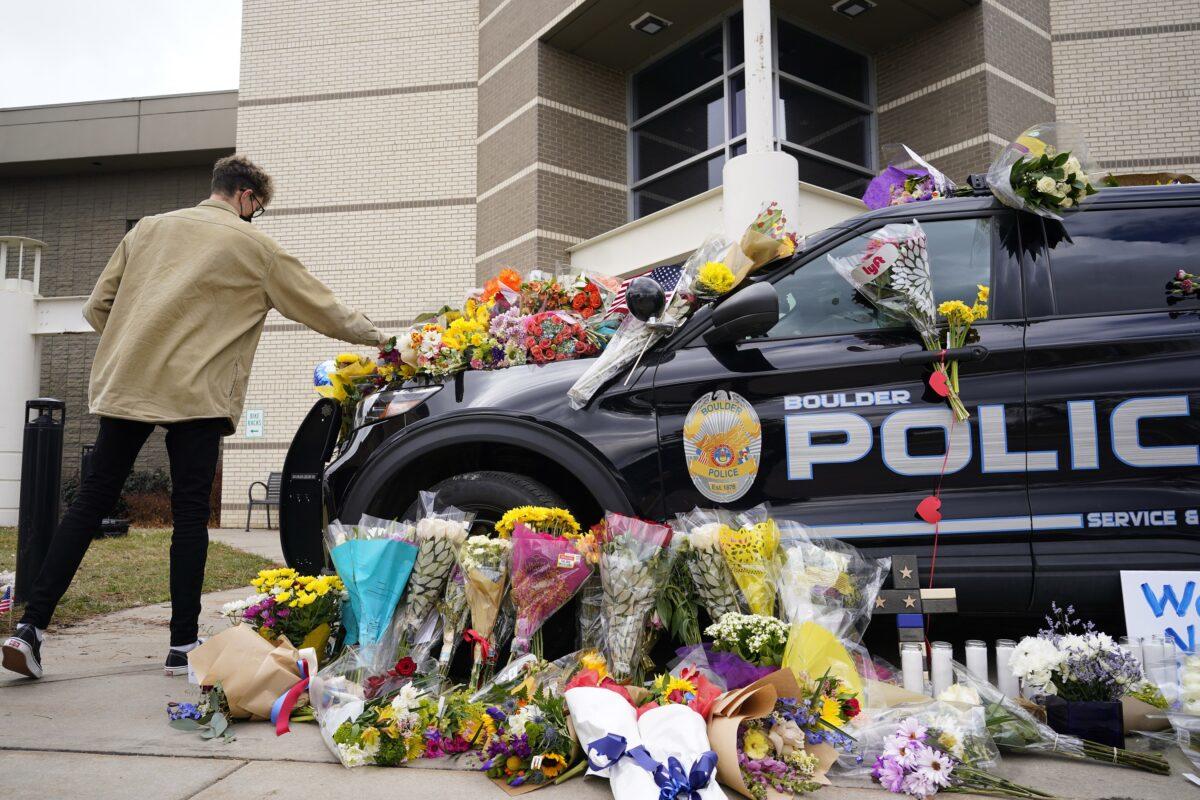
A man leaves a bouquet on a police cruiser parked outside the Boulder Police Department after an officer was one of the victims of a mass shooting at a King Soopers grocery store, in Boulder, Colo., on March 23, 2021. (David Zalubowski/AP Photo)

The Brady Campaign to Prevent Gun Violence promoted a different view.

“The latest data released by the FBI shows that Americans continue to react to uncertainty by seeking self protection with a firearm. This reaction follows decades of public posturing by the gun industry and the NRA, who have fueled a year of panic purchasing by promulgating fear and paranoia,” Kris Brown, president of the group, said in a statement. NRA stands for the National Rifle Association.

“These new statistics similarly do not reflect the many firearms that are sold without a background check in private transfers, potentially dangerous sales that are currently legal. Those sales are not regulated and therefore not accounted for in NICS data. We need comprehensive gun safety laws, such as universal background checks, to ensure that firearm sales are conducted safely and that individuals prohibited from buying a firearm do not obtain one,” Brown added.

Along with surging gun sales, NRA memberships have jumped in recent months.

President Joe Biden and congressional Democrats, in the wake of mass shootings last month in Georgia and Colorado, are pushing for both new gun control laws and executive action that would curtail gun ownership.

Few mass shootings took place in 2020 as many Americans spent most of their time at home after governors imposed harsh restrictions amid the pandemic.

But crime rose in a number of cities, with a sharp increase in murders. That, combined with the movement to cut police funding, compelled Americans to buy guns in record numbers.

People purchasing guns are “buying guns for defense,” Jerry Koch, owner of Guntraders in Redmond, Oregon, told The Epoch Times in February.

“They’re doing it because they’re afraid,” he added.

Follow Zachary on Twitter: @zackstieber
Follow Zachary on Parler: @zackstieber

Tyler Durden
Fri, 04/02/2021 – 20:30

via ZeroHedge News https://ift.tt/2R6fdnD Tyler Durden

Americans’ Vaccination Cards May Be Only Record Of COVID Immunity – So Keep Them Safe

Americans’ Vaccination Cards May Be Only Record Of COVID Immunity – So Keep Them Safe

If you have a tendency to misplace your smartphone or wallet, beware: losing your COVID vaccine card could create serious headaches for people, since the physical cards are in many case the only record that an individual was vaccinated – meaning it might soon double as a de facto passport for anybody who wants to leave their home.

As Forbes pointed out in a piece published over the weekend, some destinations, cruise lines and major sports venues are already requiring travelers to provide proof that they have been fully vaccinated against the virus. And if you’re among the ~48MM Americans who have been “fully vaccinated” (ie received either two doses of the Pfizer or Moderna jabs, or 1 dose of the JNJ jab, with at least two weeks passing since the final dose).

Anybody who loses their card is asked to return to the site where they were vaccinated, and ask for another one.

“If you do not receive a Covid-19 vaccination card at your appointment, contact the vaccination provider site where you got vaccinated or your state health department to find out how you can get a card,” according to the CDC website.

Of course, that’s easy enough if you were vaccinated at a pharmacy chain but more difficult if you had to travel cross-state or inter-state to be vaccinated at a drive-through or pop-up event.

All Covid-19 vaccination providers are required to report data within 72 hours in their state’s immunization system, so there should be a back-up record of your vaccination status there. The CDC has a list of the Immunization Information System (IIS) in each state, which is where to start if you need a replacement card and either can’t remember where you were vaccinated or have difficulty contacting the facility.

While digital vaccine passports may become a reality in the future (they’re certainly closer to reality in Europe than in the US, despite the fact that the US is further ahead in its vaccination campaign). That’s because EU members like Greece and Spain badly need to salvage this year’s tourism season, or risk serious economic blowback as the critical tourism season remains shuttered for a second year.

But for now, at least, the only record for Americans is their paper card. Here are a few recommendations for keeping it safe (text courtesy of Forbes):

Make a photocopy of your vaccination card.

First and foremost, make a duplicate of your card. Keep a hard copy on file in a safe place.

Get your CDC vaccination record card laminated

Laminating your vaccination card will make it more durable and protect it from wear and tear. Do this after you are fully vaccinated, so you can carry your card in your wallet or purse without damaging it.

You can laminate your card yourself with self-adhesive laminating sheets available at most office supply stores.

But an even easier, cheaper option is to have a professional laminate your vaccination card for you. Staples is providing free lamination of vaccination cards to customers who use the coupon code 81450. The promotion currently has no end date. Office Depot, which also owns Office Max, will laminate vaccination cards for free for all fully-vaccinated people through July 25.

Take a photo of your CDC vaccination record card

“Keep your vaccination card in case you need it for future use,” says the CDC website. “Consider taking a picture of your vaccination card as a backup copy.”

You should store an image of your Covid-19 vaccination record card in your photo library or a digital wallet on your smartphone, where it can be easily retrieved.

In addition, email yourself a copy of the image and download it to your computer or laptop. That way, you’ll have one copy on your phone and another on a second device. This will come in handy if you plan to book travel or other activities that require attaching documents that prove you have been vaccinated.

Ask for a digital backup of your vaccination card

Many digital-identification apps allow you to store digital versions of health records, including a vaccination record card, on your phone, but choosing one with tight privacy controls is paramount. One reputable option is Airside’s Digital Identity & Health Passport App, which stores data only on the user’s encrypted device and allows users to control not only with whom they want to share their information but for how long.

To be sure, it looks like at least one US state is pushing back against the vaccine passport trend, with Florida Gov. Ron DeSantis promising that there won’t be strict requirements asking people to prove their vaccination status in the Sunshine State, unlike in New York, where Gov. Andrew Cuomo is relying on vaccine passports to help accelerate the state’s reopening.

Tyler Durden
Fri, 04/02/2021 – 20:00

via ZeroHedge News https://ift.tt/3fCUIck Tyler Durden

Biden Infrastructure Bill Includes $20 Billion To Destroy Highways For Being Racist

Biden Infrastructure Bill Includes $20 Billion To Destroy Highways For Being Racist

Authored by Steve Watson via Summit News,

Joe Biden’s $2.5 trillion infrastructure spending spree will include $20 billion earmarked for actually destroying highways because they have been deemed to be racist.

The administration pointed to the Claiborne Expressway in New Orleans and Interstate 81 in Syracuse, New York as two examples of “long-standing and persistent racial injustice,” in infrastructure.

The plan set forth by Biden would see billions spent on an effort to “reconnect neighborhoods” by destroying current highways and making sure that new projects “advance racial equity and environmental justice.”

A whopping $621 billion has been touted for ‘transportation infrastructure and resilience,’ with the administration promising it will address “historic inequities.”

“Structural racism and persistent economic inequities have undermined opportunity for millions of workers,” the administration has also claimed.

Last year, Biden’s Transportation Secretary Pete Buttigieg proclaimed that “Black and brown neighborhoods have been disproportionately divided by highway projects or left isolated by the lack of adequate transit and transportation resources.”

During a Senate confirmation hearing in January, Buttigeg declared “At their worst, misguided policies and missed opportunities in transportation can reinforce racial and economic inequality by dividing or isolating neighborhoods and undermining government’s basic role of empowering Americans to thrive.”

The Infrastructure plan has been widely criticised for including non-infrastructure related components:

Tucker Carlson warned Thursday that the Biden Administration is “looting America” and that the infrastructure outline is as much about tearing down highways than it is building them.

“Expect a lot more highways to meet this fate. People who believe highways are racist will get tens of billions of dollars as part of this plan, as long as they’re in what the Biden administration calls ‘underserved communities,’” Carlson noted.

“Is this really about infrastructure? Bridges? Roads? Airports? Things we could actually use? Or is it yet another weird climate scheme/power grab/race-based redistribution plan?” the host asked, going on to cite multiple examples of non-infrastructure wokeness in the bill.

Despite the vast investment plan, the woke ‘Green Deal’ crowd is all not happy with it, saying it isn’t enough.

*  *  *

Brand new merch now available! Get it at https://www.pjwshop.com/

*  *  *

In the age of mass Silicon Valley censorship It is crucial that we stay in touch. We need you to sign up for our free newsletter here. Support our sponsor – Turbo Force – a supercharged boost of clean energy without the comedown.  Also, we urgently need your financial support here.

Tyler Durden
Fri, 04/02/2021 – 19:30

via ZeroHedge News https://ift.tt/3mepfyc Tyler Durden

California Bible Worship Group Seeks Emergency Application from SCOTUS

Yesterday, I blogged about the 9th Circuit’s decision in Tandon v. Newsom. This decision upheld California’s complete prohibition of bible worship in private homes. I’ll admit, the panel’s decision irked me. Now, I often read a judicial decision that I disagree with, but that does not make me angry. This decision made me angry. Why? Because it will waste everyone’s time. This decision would require the worshipers’ counsel to scramble an emergency application to the Supreme Court. And the California Attorney General will have to reply. The Justices will have to struggle over yet another COVID case. And one month later, at least five Justices will enjoin the policy. Or California will withdraw it at the last moment, in a game of whac-a-mole. By now, the process is old habit.

Since Justice Barrett’s confirmation, four emergency application has gone against the government. At this point, the 9th Circuit should be able to discern the Court’s approach. Instead, the Ninth Circuit acted as if the Chief’s South Bay I decision was still the controlling precedent, and used the incorrect comparator. For these reasons, I did not find it a good use of my time to even describe the decision.

Now, the Plaintiffs have filed an emergency application with the Supreme Court. And we can play the game all over again. Here is an excerpt from the brief:

This Court has issued four orders in just the past five months unequivocally holding that governments may not restrict the free exercise of religion—even in the name of fighting a pandemic—if comparable nonreligious activities are not subject to the same restrictions. Yet California—assisted by the Ninth Circuit, which has “disregard[ed] the lessons from [this] Court” and “turned a blind eye to discrimination against religious practice”—continues its rearguard action against the free (and safe) practice of religious faith. App. 32 (Bumatay, J., dissenting). Because of the State’s recalcitrance and the Ninth Circuit’s refusal to follow this Court’s “clear and, by now, redundant” precedents, this Court’s intervention is, unfortunately, once again necessary. App. 36 (Bumatay, J. dissenting). . . .

Under these rules, Pastor Wong and Karen Busch can sit for a haircut with 10 other people in a barbershop, eat in a half-full restaurant (with members of 20 different families), or ride with 15 other people on a city bus, but they cannot host three people from different households for a Bible study indoors or in their backyards. The State thus treats religious exercise far more harshly than secular activities. Notwithstanding the State’s clear discrimination against religious exercise, the Ninth Circuit applied rational basis to the Gatherings Guidance and denied Applicants’ request for an injunction pending appeal. App. 27. The Court reached that head-scratching result based on its conclusion that “in-home secular and religious gatherings are treated the same.” App. 27. But the State’s decision also to disfavor some nonreligious activity—such as in-home birthday parties or Super Bowl gatherings—does not save the State’s Gatherings Guidance from strict scrutiny, as this Court has explained, repeatedly, in Diocese of Brooklyn, South Bay II, Harvest Rock, and Gateway City Church. Instead, “regulations must place religious activities on par with the most favored class of comparable secular activities, or face strict scrutiny” App. 36 (Bumatay, J., dissenting) (citing Diocese of Brooklyn, 141 S. Ct. at 66–67). And none of those precedents suggests that the Free Exercise Clause applies only to formally established “houses of worship,” or that businesses and government services are not proper comparators to private homes with respect to the risk of infection, as the panel majority concluded. On the contrary, this “Court’s prior decisions ‘clearly dictated’ enjoining the restrictions,” but the Ninth Circuit “again fail[ed] to apply [those] precedents”—”[a]t this point, a tale as old as time.” App. 36 (Bumatay, J., dissenting).

In Gateway City Church v. Newsom, the Court said the outcome was “clearly dictated” by South Bay II. I expect a similar reversal.

Still, I think this case is both easy and hard. If people from different households are allowed to assemble to watch a movie in a theater, they should be allowed to pray together in a single house. This policy reflects the state’s utter unconcern for the Free Exercise of religion. No single faith is targeted. Rather, the state ranks religion at the bottom of its priority list, along with other insignificant commercial enterprises. Movies are important. Bible worship is not. The tougher part is singing. In South Bay II, Justice Barrett drew along Justice Kavanaugh to place the burden on the challengers to demonstrate that the government was acting unreasonably. I much preferred Justice Alito’s framework, which put the burden on the state to support their policy. Generally, with the violation of an enumerated right, the government bears the burden, and not the challenger. I’m still flummoxed that ACB made this opinion her first writing as a Supreme Court justice. Perhaps now we will have more clarity on the singing issue.

I am finalizing my article on the Free Exercise Clause and the pandemic. It should be published in the Harvard Journal of Law & Public Policy in the next two months or so. I don’t know if I will have the time to incorporate yet another COVID case.

from Latest – Reason.com https://ift.tt/2QT6PaG
via IFTTT

Manhattan Office Supply Skyrockets To Three Decade High 

Manhattan Office Supply Skyrockets To Three Decade High 

Whether “working from home” is a temporary fad or a permanent “new normal” remains to be seen; what becomes more evident is the mounting supply glut of corporate space in Manhattan, according to Bloomberg, citing a new report from real estate firm Savills.

Savills said the amount of office space available in Manhattan is at a three-decade high. The report, released on Thursday, said the availability rate soared to 17.2% in the first quarter. The rise in the rate was primarily due to a massive surge in sublease space, which now stands at 22 million square feet, or 62% higher than 2019 levels. 

“Abundant short- and long-term options are driving price reductions,” Savills noted. “Many owners are proposing historically aggressive rates, concessions, and flexibility to secure tenants amid so much competition.”

Savills said rents fell for the fifth consecutive quarter to around $76.27 a square foot, down 9% from a year earlier. These cheaper rents are creating a massive opportunity for companies who want to enter the city. 

Desperate landlords were offering generous concessions for long-term leases at newly constructed buildings: “Average tenant improvement allowances jumped 16% and free rent surged 17% to an average of 13.5 months. The tenant-friendly market is expected to last for at least the next 12 to 18 months,” Savills said.

The Manhattan office market continues to struggle more than one year after the pandemic hit, which has emptied Manhattan’s skyscrapers. And since most employees are still working from home, just around 24.21% of workers in the New York metropolitan area were back at their desks as of this week. 

Even with the vaccine rollout now reaching 100 million Americans, companies are still opting for “hybrid” work as remote working dominates

In a past report, Jim Wenk, a vice chairman at Savills North America, said commercial real estate in the borough will have a “very choppy period for the foreseeable future.”

recent survey from the Partnership for New York City found 66% of Manhattan’s most prominent employers would allow employees to work under hybrid work arrangements, meaning they would Manhattan’s most prominent employers. 

As more proof the work environment is rapidly changing, major magazine publisher Conde Nast (who owns brands such as ARS Technica, GQ, Teen Vogue, The New Yorker, Vanity Fair, Vogue, Wired, among other popular magazines) is a major anchor tenant in the new World Trade Center, recently skipped out on rent as it asked for rent discounts and a reduction in square footage.

Last month, JP Morgan was reportedly looking to sublet hundreds of thousands of square feet at 4 New York Plaza in the financial district and 5 Manhattan West in the Hudson Yards area. 

To make matters worse, Hudson Yards, a massive complex on Manhattan’s Far West Side with condos, office space, and retailers built over an enormous railroad yard had investors panic because the company refused to open its books. The combination of work-at-home and folks moving to suburbs has left Hudson Yards and other places across the borough a ‘ghost town.’ 

This all suggests that the virus pandemic has brought years of technological change to the work model that has possibly made companies more productive and cut costs as employees work from home or adopt a hybrid work model. Without office workers returning to the borough, there can’t be a robust recovery in the near term. 

Tyler Durden
Fri, 04/02/2021 – 19:00

via ZeroHedge News https://ift.tt/3sOgBZM Tyler Durden